Begin
14 pages · ~28 min
Generative AI Roadmap: Priorities & Communication
This roadmap training helps teams and technical leaders prioritize generative AI milestones and communicate progress effectively.
A digital instructor presents all 14 pages. Hold “Ask” at any point and ask out loud — the answer comes from this course. No sign-up needed.
What you’ll learn
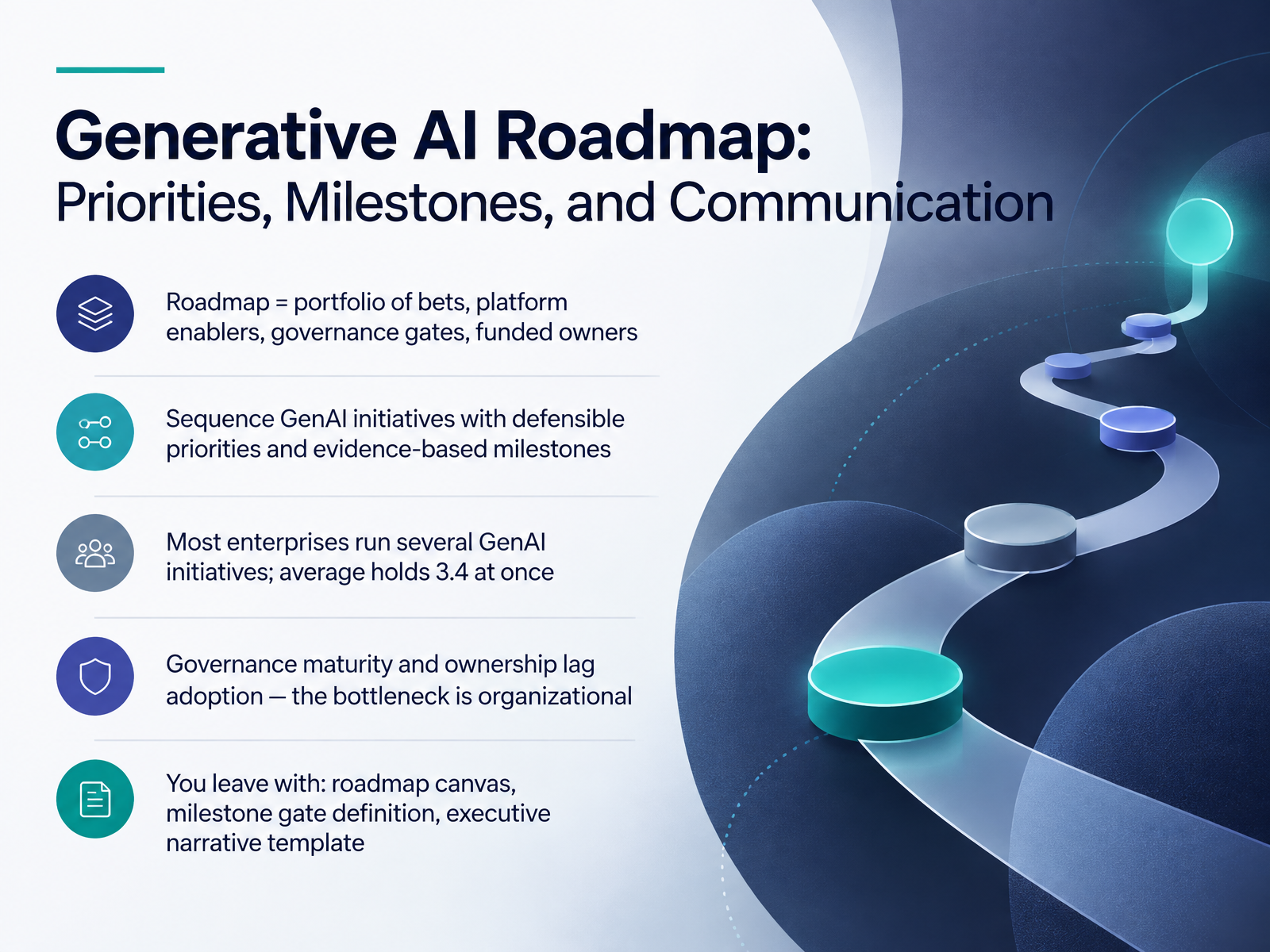
- 01Generative AI Roadmap: Priorities, Milestones, and CommunicationWelcome. Over the next fourteen slides, we will build one thing together: a generative AI roadmap you can defend in front of an executive committee. Not a list of interesting use cases. A portfolio of funded bets, platform enablers, and governance gates, each with a named owner. That distinction matters, because it is where most programmes stall.
Our agenda is sequencing and communication. We will set defensible priorities, define evidence-based milestones, and shape a narrative your board will actually accept. The urgency is real. The average enterprise now runs three point four generative AI initiatives at once. Adoption is not the constraint. Governance maturity and clear ownership lag behind it, and that gap is organisational, not technical.
So here is the decision at stake today: sequence deliberately, or let scattered pilots set your agenda for you.
You leave with three working artifacts: a roadmap canvas, a milestone gate definition, and an executive narrative template. Before we go further, let us examine why generative AI roadmaps break traditional planning assumptions.deloitte.comkearney.cominfo.flexera.com+22 min
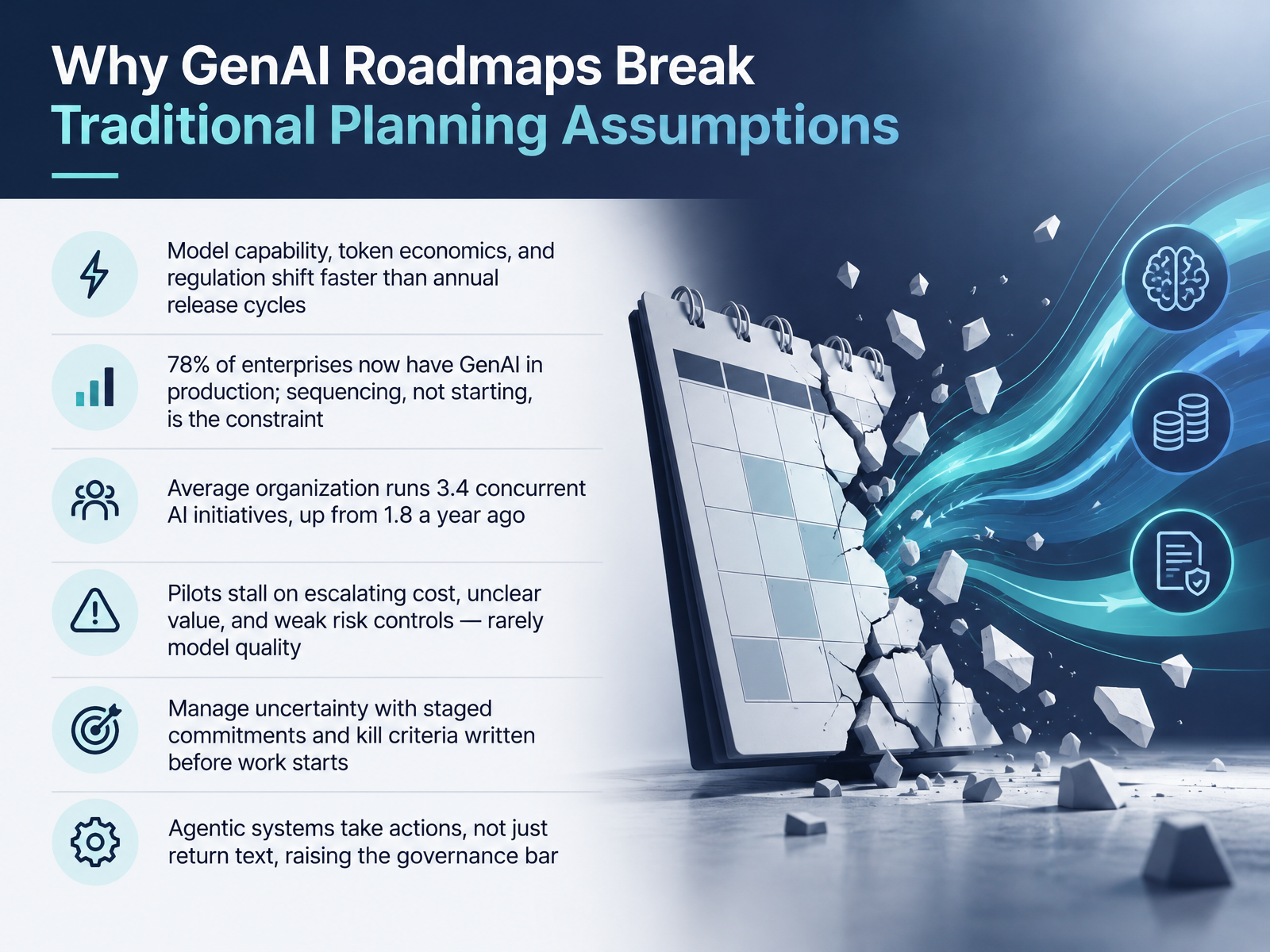
- 02Why GenAI Roadmaps Break Traditional Planning AssumptionsLet's talk about why generative AI roadmaps break our traditional planning assumptions. Model capability, token economics, and regulation now move faster than annual release cycles. Most enterprises already have GenAI in production. Seventy-eight percent report at least one live application. So the constraint is no longer starting. It's sequencing. The average organization now runs three point four concurrent AI initiatives, up from one point eight a year ago. And pilots rarely stall on model quality. They stall on escalating cost, unclear value, and weak risk controls. So we manage uncertainty with staged commitments and kill criteria written before work begins. And agentic systems raise the governance bar, because they take actions, not just return text. The takeaway is this: plan in stages, fund the operating work, and decide in advance what stops. That discipline is what separates a portfolio from a pile of pilots. Next, we look at the use-case portfolio itself: quick wins, strategic bets, platform enablers, and experiments.
 deloitte.comkearney.cominfo.flexera.com+22 min
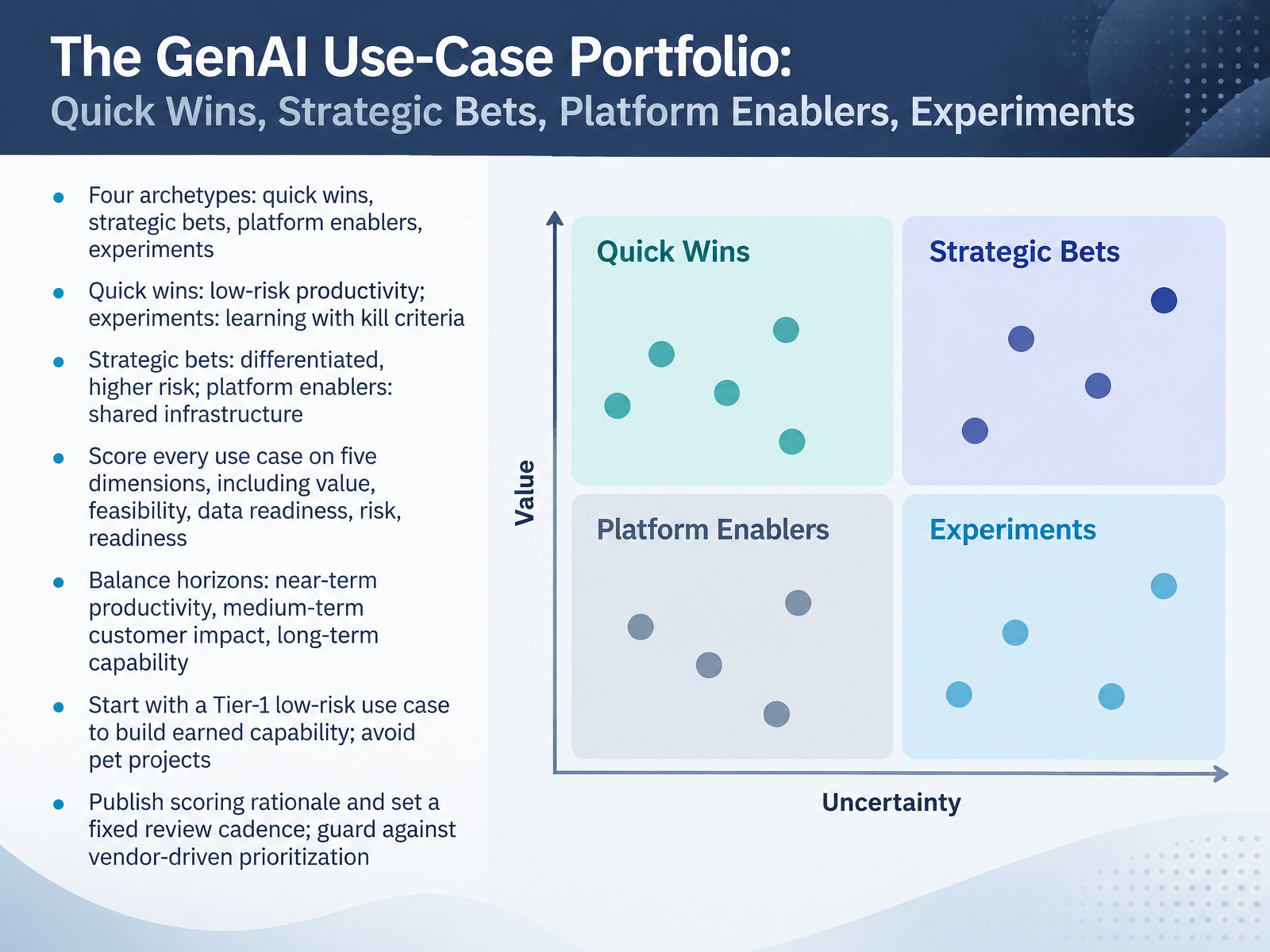
- 03The GenAI Use-Case Portfolio: Quick Wins, Strategic Bets, Platform Enablers, ExperimentsLet us talk about how we structure the portfolio itself. We group every use case into four archetypes. Quick wins deliver low-risk productivity gains and build momentum. Experiments buy learning, and they need kill criteria agreed up front. Strategic bets create differentiation, and they carry higher risk. Platform enablers are shared infrastructure that make the other three cheaper to deliver.
Score every candidate on five dimensions: value, feasibility, data readiness, risk, and readiness. Then balance your horizons across near-term productivity, medium-term customer impact, and long-term capability. Start with a Tier-1 low-risk use case to build earned capability, and steer clear of pet projects. Publish the scoring rationale so the logic is visible, and hold a fixed review cadence. That cadence is your guard against vendor-driven prioritization.
Next, we treat risk tiering as a prioritization input.
 dataiku.comgenaimaturity.netenterpriseailabs.io+21 min
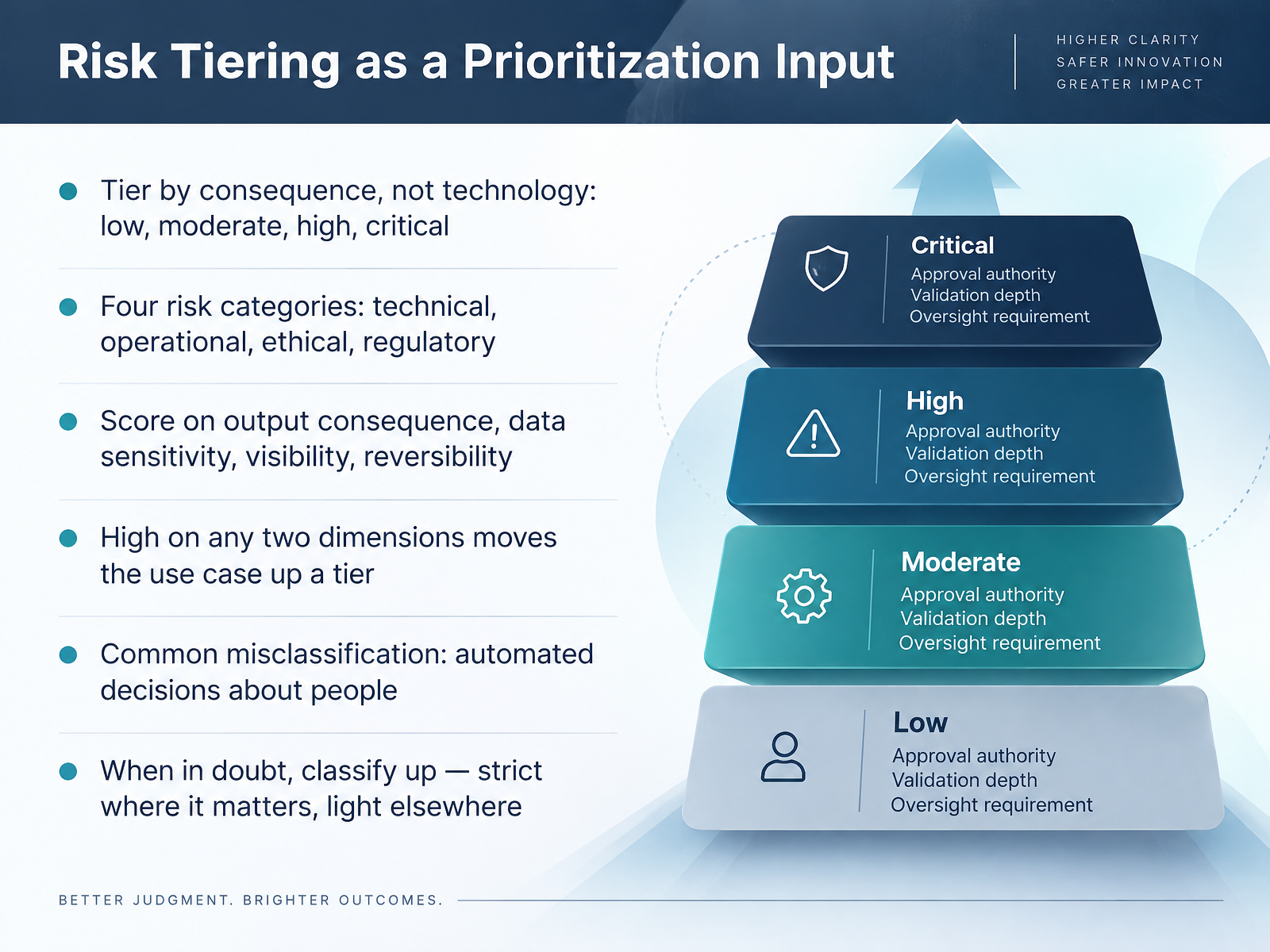
- 04Risk Tiering as a Prioritization InputLet's talk about how we tier risk as a prioritization input. The core decision here is simple. We tier by consequence, not by technology. A meeting summarizer and a hiring tool can run on the same model, and they still belong in different tiers because the consequences differ. We use four tiers: low, moderate, high, and critical. And we score every use case across four risk categories: technical, operational, ethical, and regulatory. Then we score four dimensions: output consequence, data sensitivity, visibility, and reversibility. A high score on any two dimensions moves that use case up a tier. Pause there and map your current pipeline against those dimensions. Now, the most common misclassification is automated decisions about people. Loan pre-qualification, resume filtering, benefits eligibility. Those are almost always high risk, even when the output looks low consequence. So when in doubt, classify up. That lets you be strict where it matters and light everywhere else. Next, we look at the milestones that move us from proof of value to scaled adoption.
 dataiku.comgenaimaturity.netenterpriseailabs.io+21 min
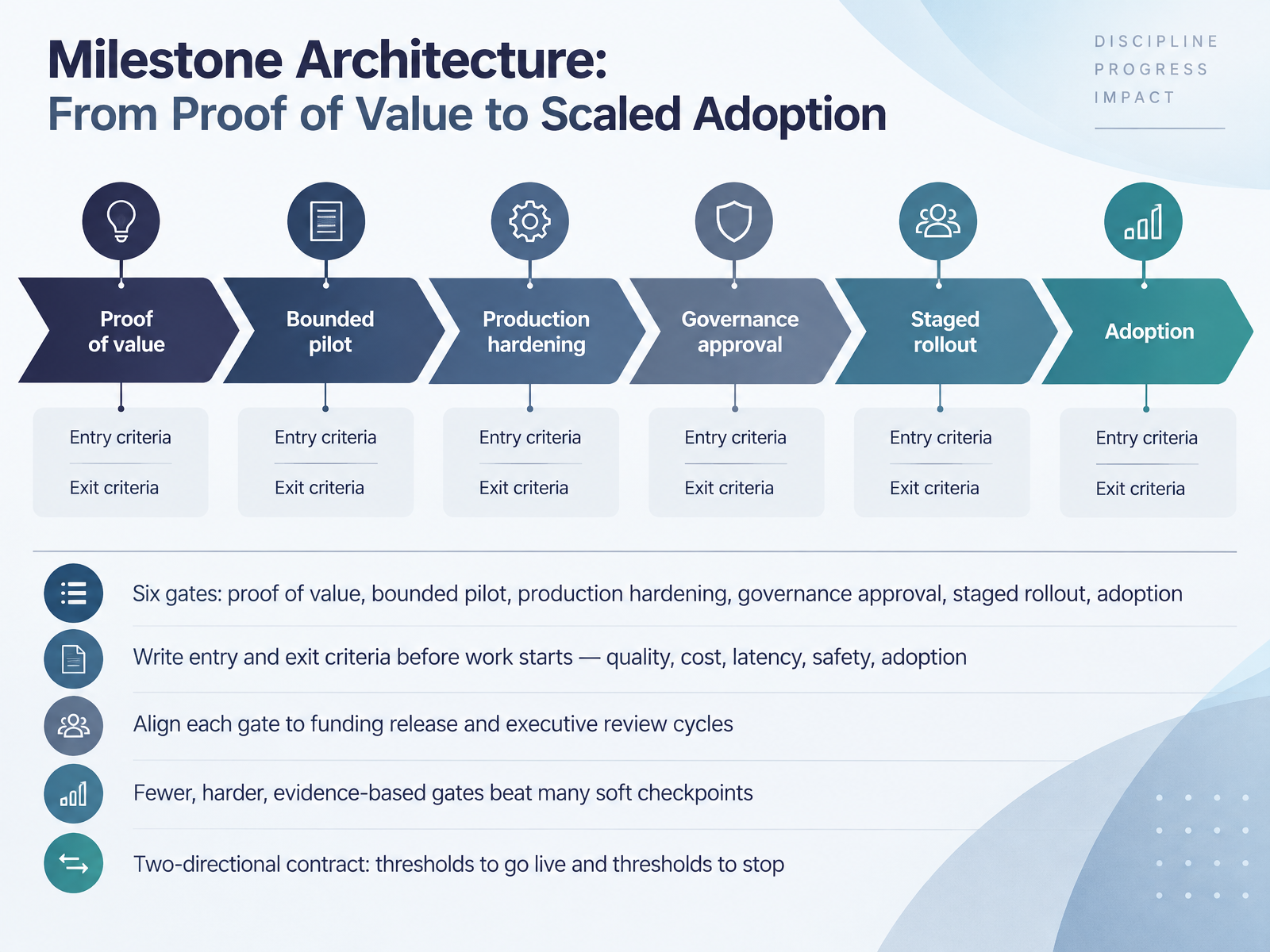
- 05Milestone Architecture: From Proof of Value to Scaled AdoptionLet us talk about milestone architecture. The decision at stake is this: which gates does a generative AI initiative have to clear before it earns the right to scale? We recommend six. Proof of value, bounded pilot, production hardening, governance approval, staged rollout, and adoption. Write the entry and exit criteria before any work starts. Quality, cost, latency, safety, adoption. Align each gate to a funding release and an executive review cycle, so the money and the decision move together. Fewer, harder, evidence-based gates beat many soft checkpoints. And treat it as a two-directional contract: thresholds to go live, and thresholds to stop. That is the structure. Next, we look at the five gates before scaling.
 shiftquality.combrightlume.aichokmah.in+21 min
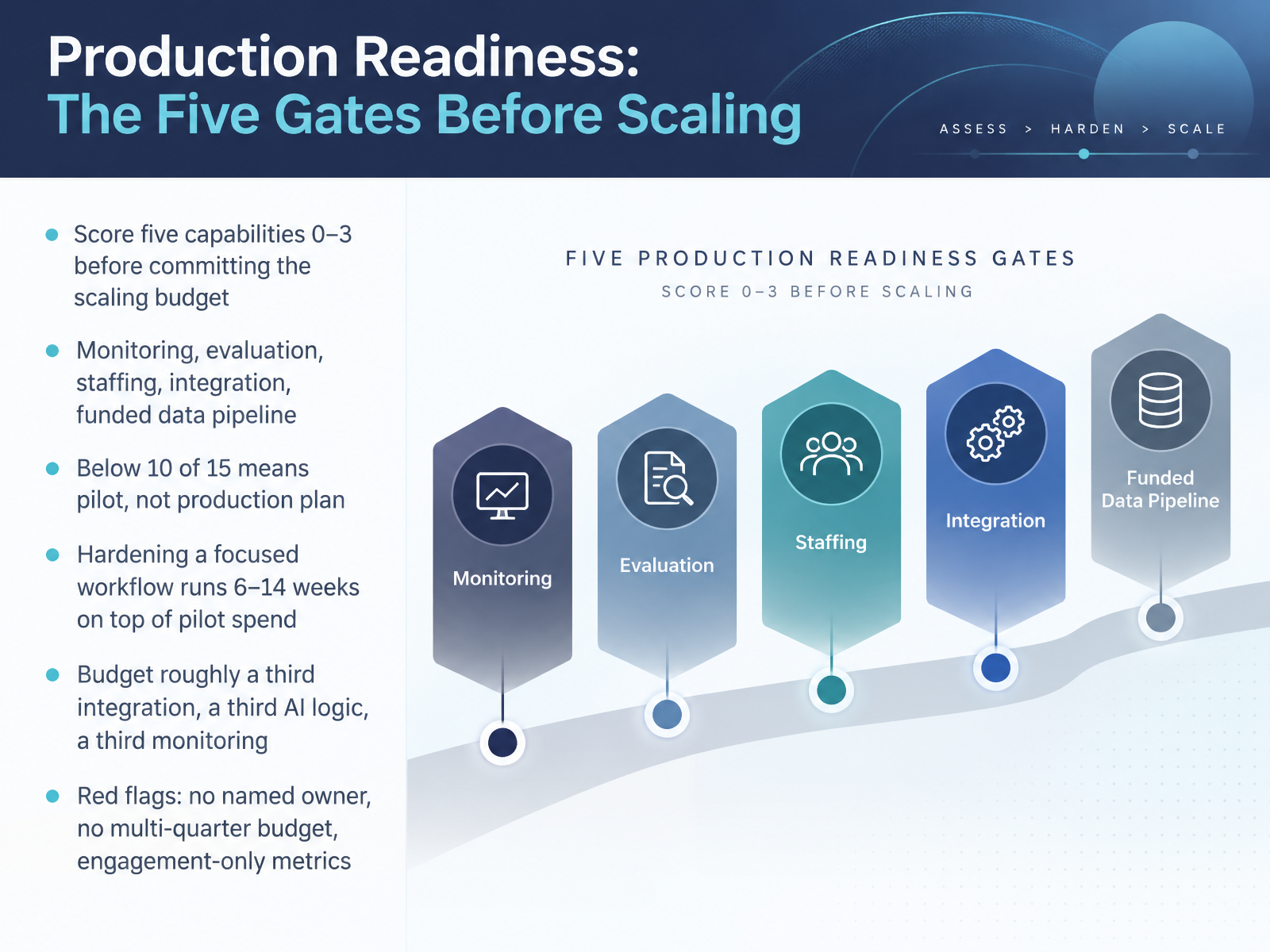
- 06Production Readiness: The Five Gates Before ScalingBefore you commit the scaling budget, score five capabilities from zero to three. Monitoring, evaluation, staffing, integration, and a funded data pipeline. Score what exists today, not what you plan to build.
Below ten of fifteen, you have a pilot, not a production plan. That is a deliberate trigger, not a judgment on the team.
Now plan the hardening work honestly. A focused workflow takes six to fourteen weeks beyond pilot spend. Split the budget roughly three ways. A third for integration, a third for the AI logic, and a third for monitoring, evaluation, and rollback. When almost all the money sits on the model, you are funding a demo.
Three red flags should stop you. No named owner. No multi-quarter budget. And engagement-only metrics like queries or users.
So the next action is concrete. Run a sixty-minute scoring session with the business owner and engineering lead. Agree the score, and agree what below ten commits you to: more piloting, not scaling.
That sets up the next question. Sequencing dependencies and platform enablers.
 shiftquality.combrightlume.aichokmah.in+22 min
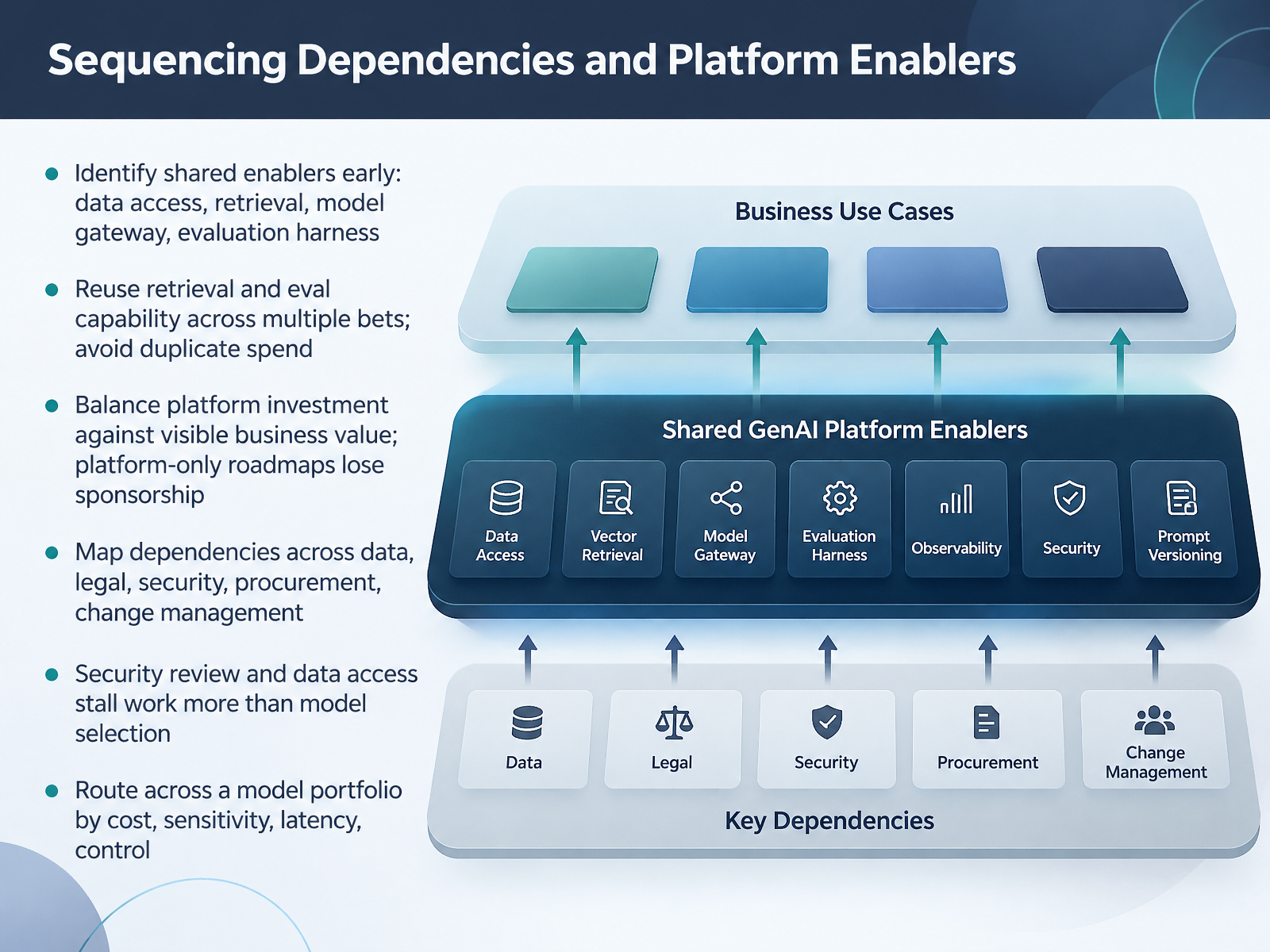
- 07Sequencing Dependencies and Platform EnablersNow, sequencing dependencies and platform enablers. The decision here is what to build once, so every bet does not pay for it twice. Identify shared enablers early: data access, retrieval, a model gateway, an evaluation harness. Reuse retrieval and evaluation across multiple bets, and you avoid duplicate spend. But balance platform investment against visible business value. A platform-only roadmap loses sponsorship, every time. Then map dependencies across data, legal, security, procurement, and change management. In practice, security review and data access stall work more than model selection does. So staff those paths first. Finally, route across a model portfolio by cost, sensitivity, latency, and control. No single model wins every task. The next step is yours: name your shared enablers, and assign an owner and a date to each. That moves us to operating model, ownership, and decision rights.
 deloitte.comkearney.cominfo.flexera.com+21 min
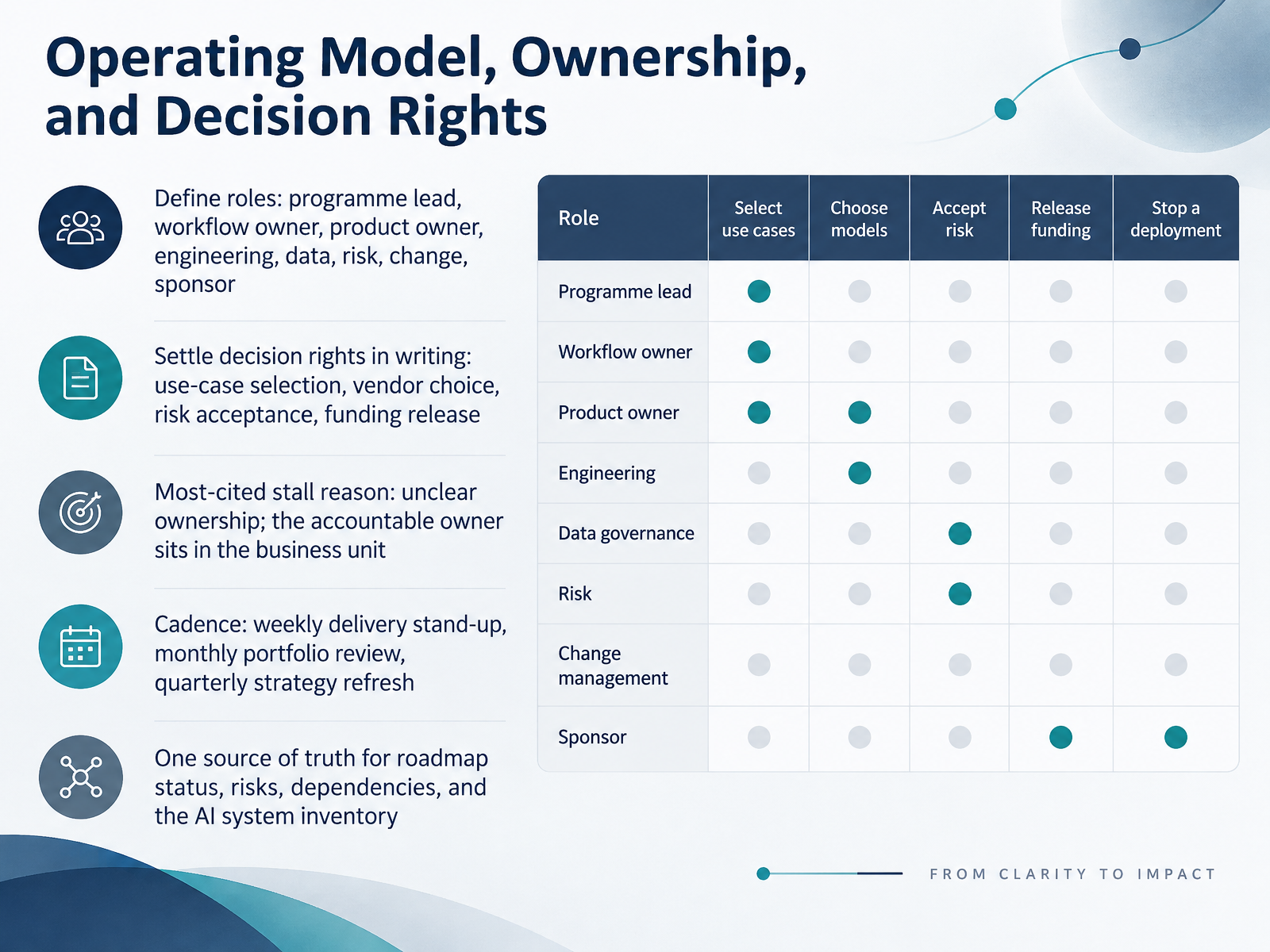
- 08Operating Model, Ownership, and Decision RightsLet's talk about the operating model that keeps a generative AI roadmap moving. This is where most programmes stall, so treat it as a decision, not a document. First, define the roles. Name a programme lead, a workflow owner, a product owner, plus engineering, data, risk, change, and an executive sponsor. Second, settle decision rights in writing. Who selects use cases, who chooses vendors, who accepts risk, and who releases funding. Write it down, so escalation has a path. Here is the pattern we see most often. The top cited stall reason is unclear ownership. The accountable owner usually sits in the business unit, not in a central team, so accountability stays close to the work. Then set the cadence: a weekly delivery stand-up, a monthly portfolio review, and a quarterly strategy refresh. Finally, run one source of truth for roadmap status, risks, dependencies, and the AI system inventory. So the action is this. Before your next portfolio review, confirm each role, publish the decision rights, and stand up that single source of truth. That is what turns intent into delivery. Next, we look at governance and responsible AI as roadmap enablers.
 dataiku.comgenaimaturity.netenterpriseailabs.io+22 min
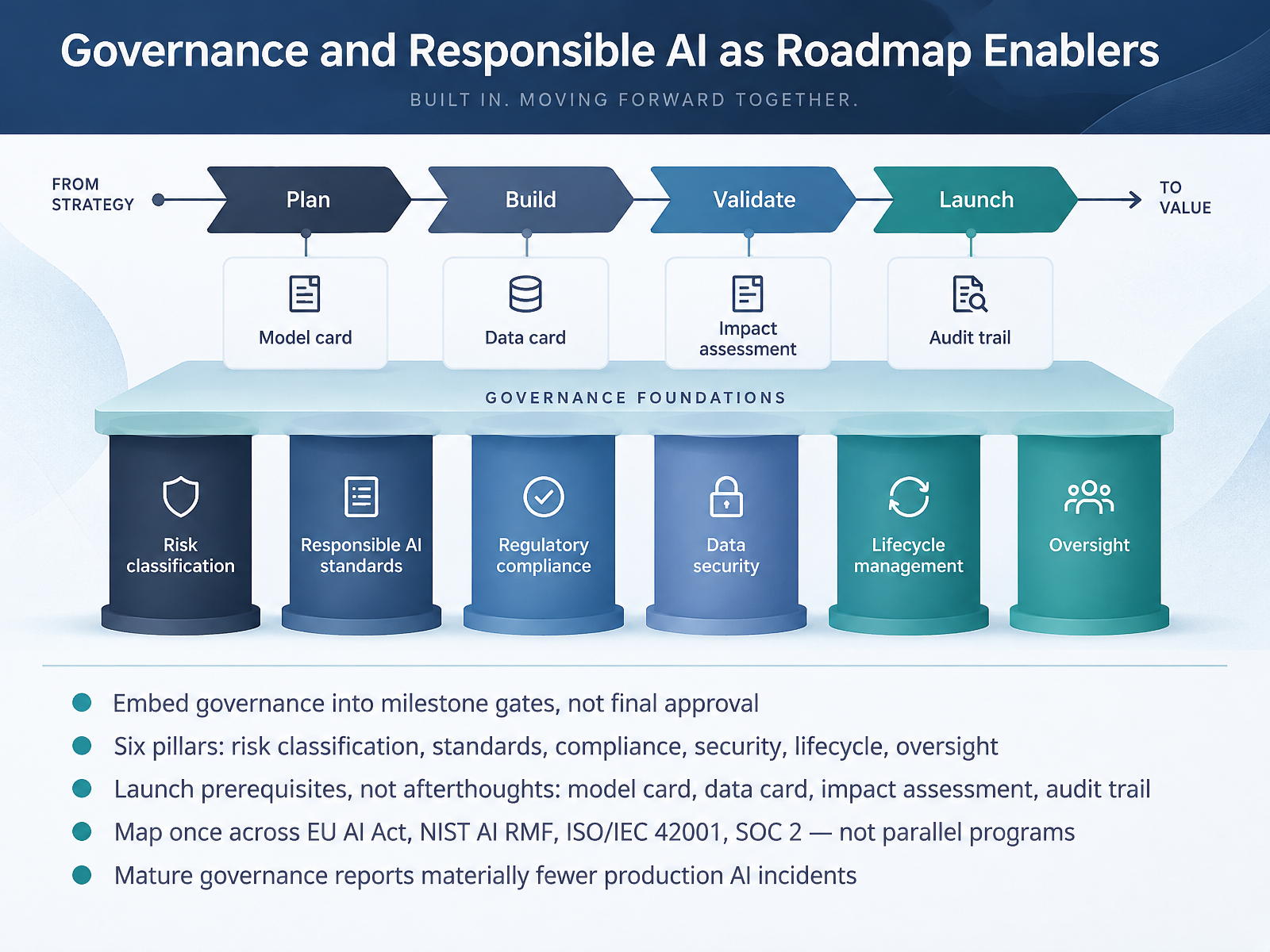
- 09Governance and Responsible AI as Roadmap EnablersNow let's talk about governance, because it is an enabler, not a brake. The decision at stake is simple. Do we treat governance as a final approval step, or do we embed it into every milestone gate? We embed it. Six pillars carry the load: risk classification, standards, compliance, security, lifecycle, and oversight. They work as one system, not six workstreams. Then four launch prerequisites. A model card, a data card, an impact assessment, and an audit trail. If the card cannot be produced, the system does not ship. One more thing. Map once across the EU AI Act, NIST, ISO 42001, and SOC 2. Four parallel programs waste effort and still leave gaps. Here is the payoff. Enterprises with mature governance report roughly two point four times fewer production AI incidents. So make governance a gate owner this quarter. Next, we look at metrics and evidence that survive executive review.
 dataiku.comgenaimaturity.netenterpriseailabs.io+22 min
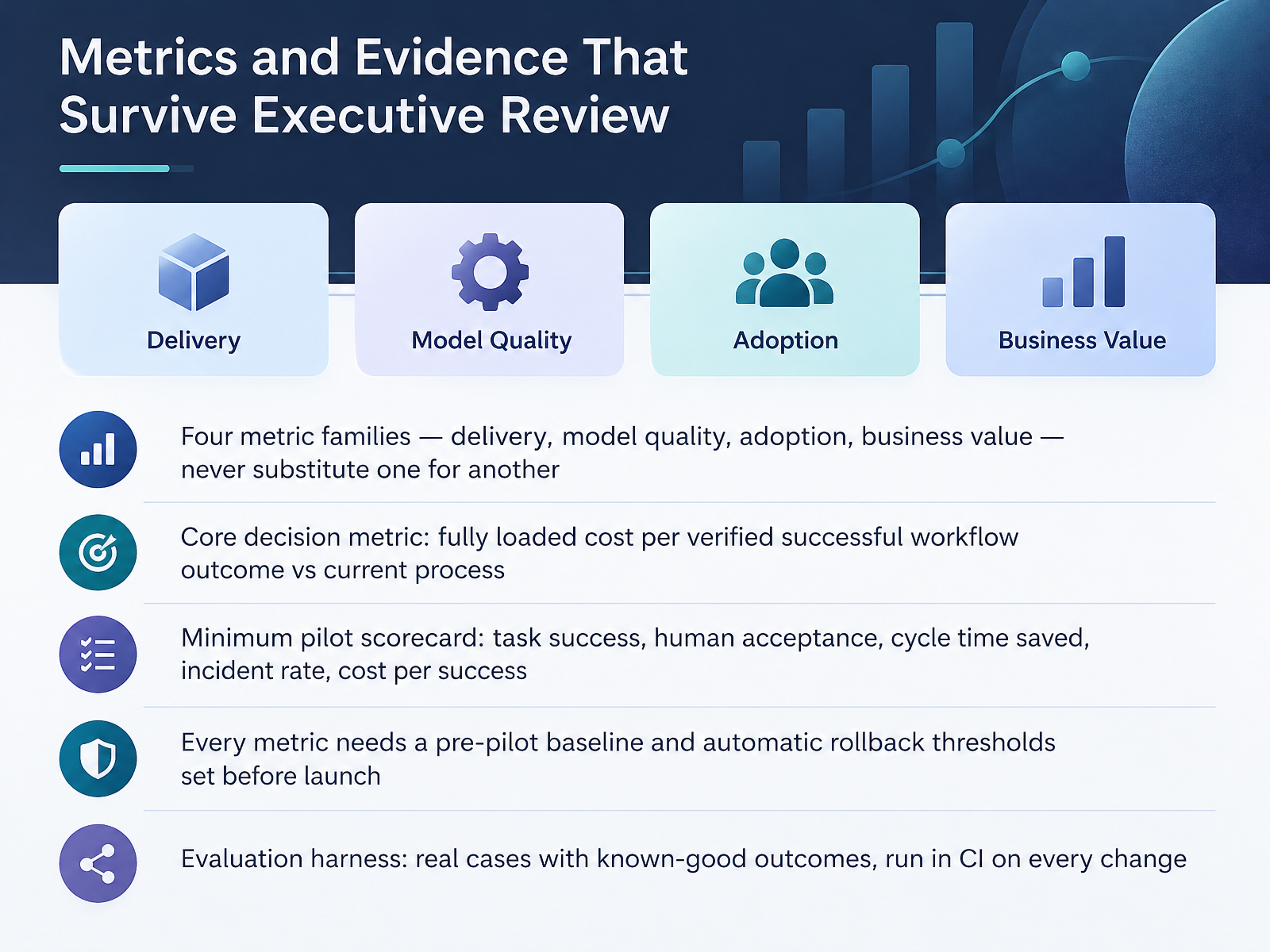
- 10Metrics and Evidence That Survive Executive ReviewNow, the metrics that survive executive review. The rule is simple. We track four metric families: delivery, model quality, adoption, and business value. Never let one substitute for another. The core decision metric is fully loaded cost per verified successful workflow outcome, compared against your current process. Your minimum pilot scorecard has five lines: task success, human acceptance, cycle time saved, incident rate, and cost per success. Every metric needs a pre-pilot baseline and automatic rollback thresholds, both set before launch. And build the evaluation harness from real cases with known-good outcomes, run in continuous integration on every change, so a regression is caught before it reaches users. Here is the ask. Before your next steering review, write down the baseline and the rollback threshold for each metric. That is what makes the numbers defensible. Next, we turn to communication strategy: audiences, narrative, and evidence.
 shiftquality.combrightlume.aichokmah.in+22 min
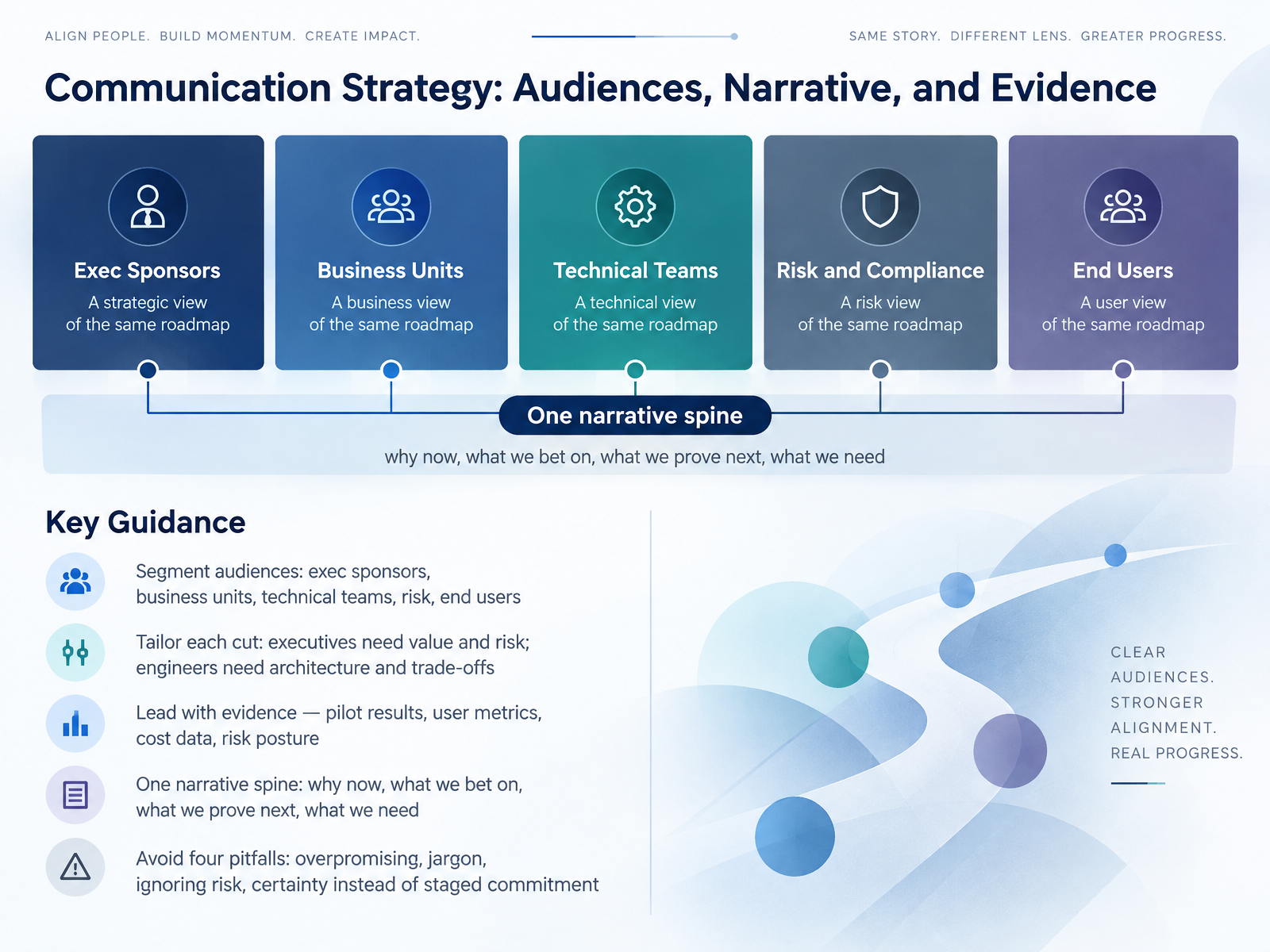
- 11Communication Strategy: Audiences, Narrative, and EvidenceNow let's talk about communication, because the best roadmap fails if the narrative does not land. Segment your audiences first. Executive sponsors, business units, technical teams, risk, and end users each need a different cut. Executives want value and risk. Engineers want architecture and trade-offs. Lead with evidence: pilot results, user metrics, cost data, and risk posture. Then hold one narrative spine across every conversation. Why now. What we bet on. What we prove next. What we need. And avoid four pitfalls. Overpromising, jargon, ignoring risk, and claiming certainty instead of staged commitment. Pick one audience this week and rebuild your update around evidence, not enthusiasm. Next, Stakeholder Scenarios: Funding, Kill Decisions, and Bad News.
 dataiku.comgenaimaturity.netenterpriseailabs.io+21 min
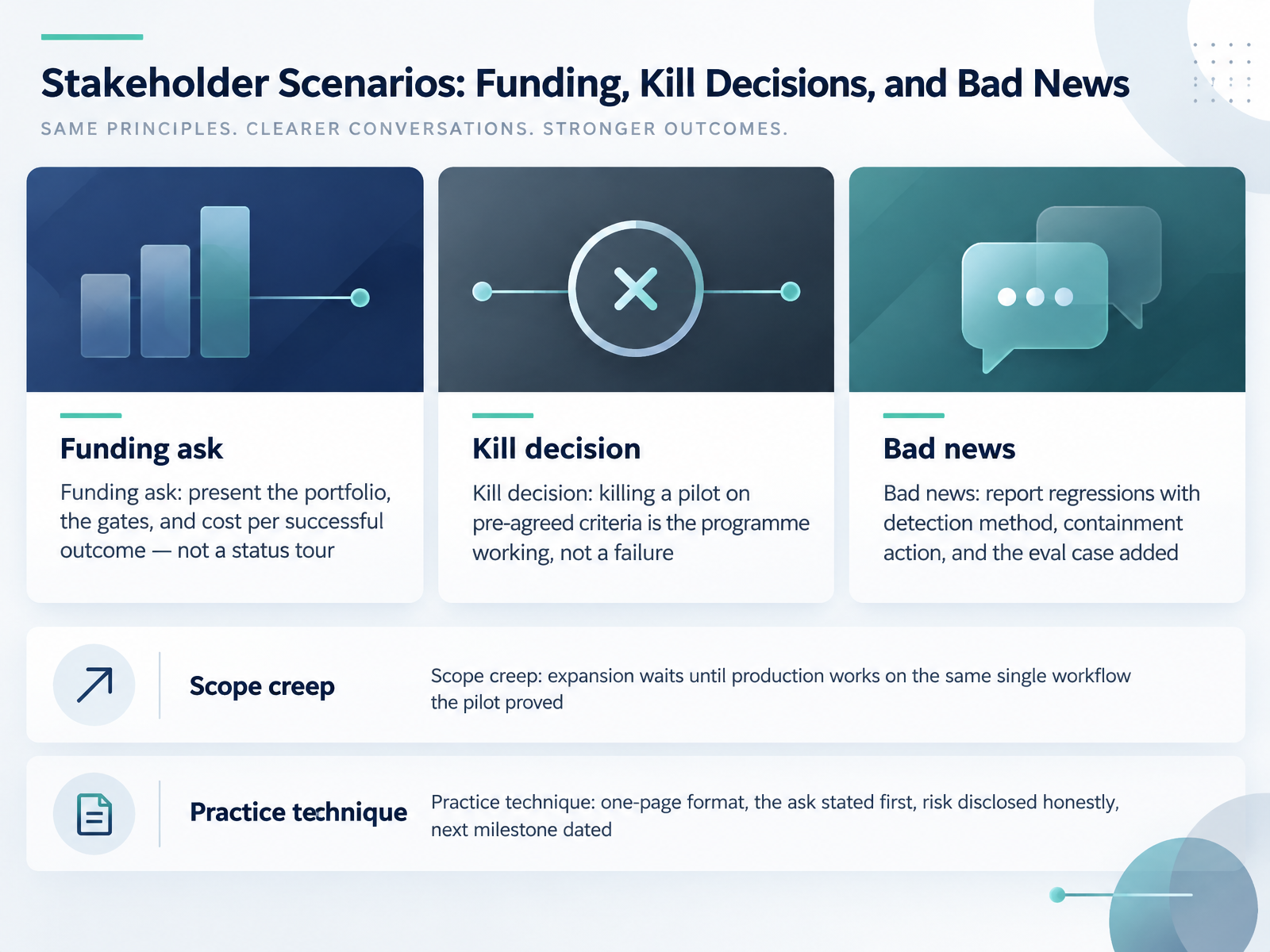
- 12Stakeholder Scenarios: Funding, Kill Decisions, and Bad NewsNow let's talk about the conversations you will actually have: funding, kill decisions, and bad news.
When you ask for funding, present the portfolio, the gates, and cost per successful outcome. Do not walk leadership through a status tour. The ask comes first, the evidence second.
When a pilot crosses the stop criteria we agreed at the start, kill it. That is the programme working, not failing. A practice that cannot kill a pilot will run it forever.
When you report bad news, bring three things: how you detected it, what you contained, and the new evaluation case you added. That turns a regression into a control.
On scope creep, hold the line. Expansion waits until production works on the same single workflow the pilot proved.
Use one page: the ask stated first, the risk disclosed honestly, the next milestone dated.
Next, we build and stress-test your own sequence in the roadmap workshop.
 shiftquality.combrightlume.aichokmah.in+22 min
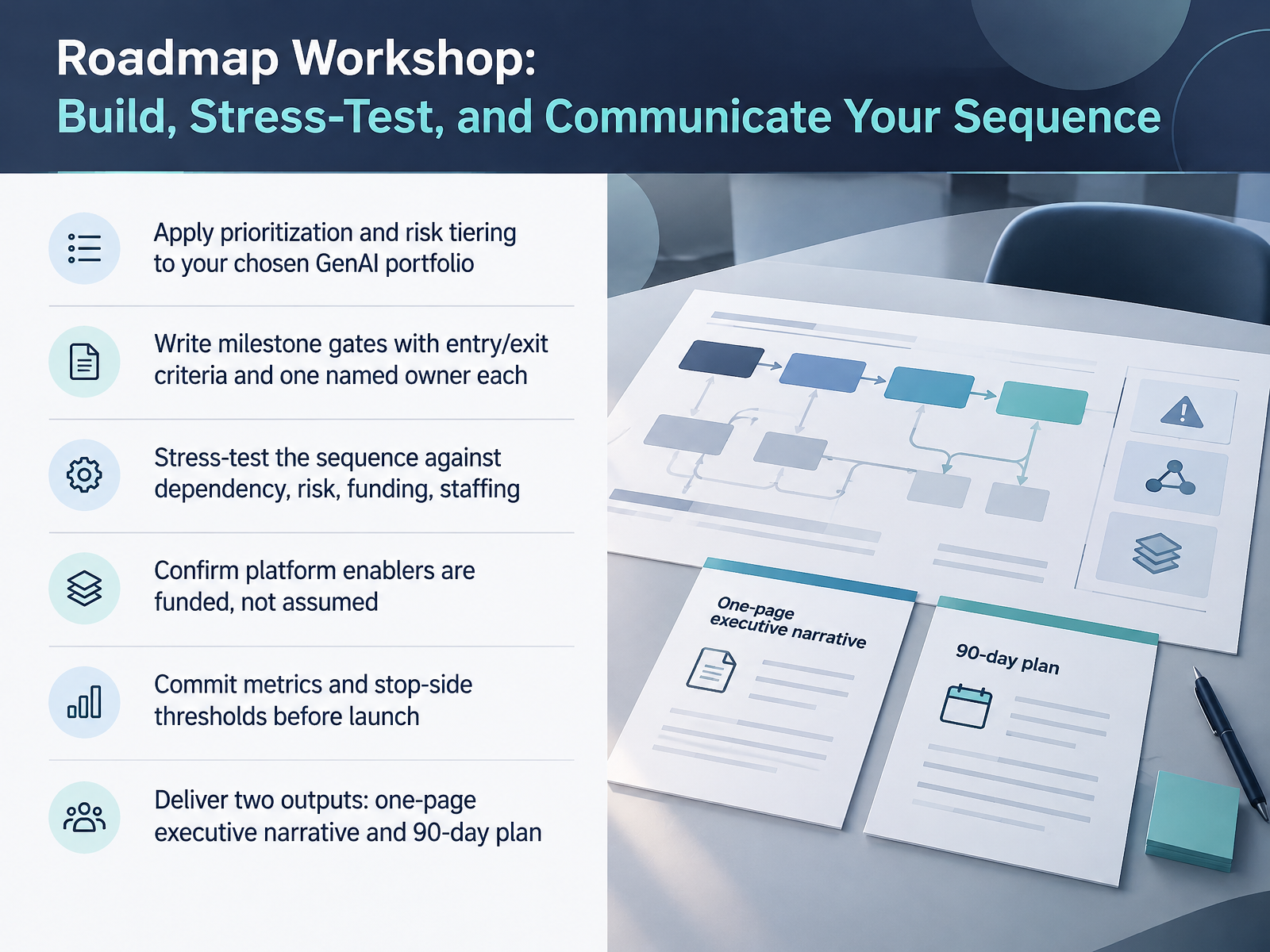
- 13Roadmap Workshop: Build, Stress-Test, and Communicate Your SequenceNow let us put the roadmap to work. This is a working session, not a review. First, apply prioritization and risk tiering to your chosen GenAI portfolio. Score each use case on consequence of a wrong output, data sensitivity, and reversibility. Tier by consequence, not by technology. Next, write milestone gates with clear entry and exit criteria, and one named owner each. An owner without authority over scope, prompts, and rollout is a placeholder. Then stress-test the sequence against four shared realities: dependency, risk, funding, and staffing. Ask what breaks first if integration slips a quarter. Confirm platform enablers are funded, not assumed. Data pipelines, evaluation harnesses, and observability are line items, not good intentions. Commit metrics and stop-side thresholds before launch. Outcome, quality, reliability, cost, and user experience, each with a written target. And set your automatic rollback thresholds now, while the decision is still yours. Deliver two outputs: a one-page executive narrative, and a ninety-day plan. That gives you a sequence you can defend. Next, we will look at the 90-Day Action Plan, Common Pitfalls, and Next Steps.
 shiftquality.combrightlume.aichokmah.in+22 min
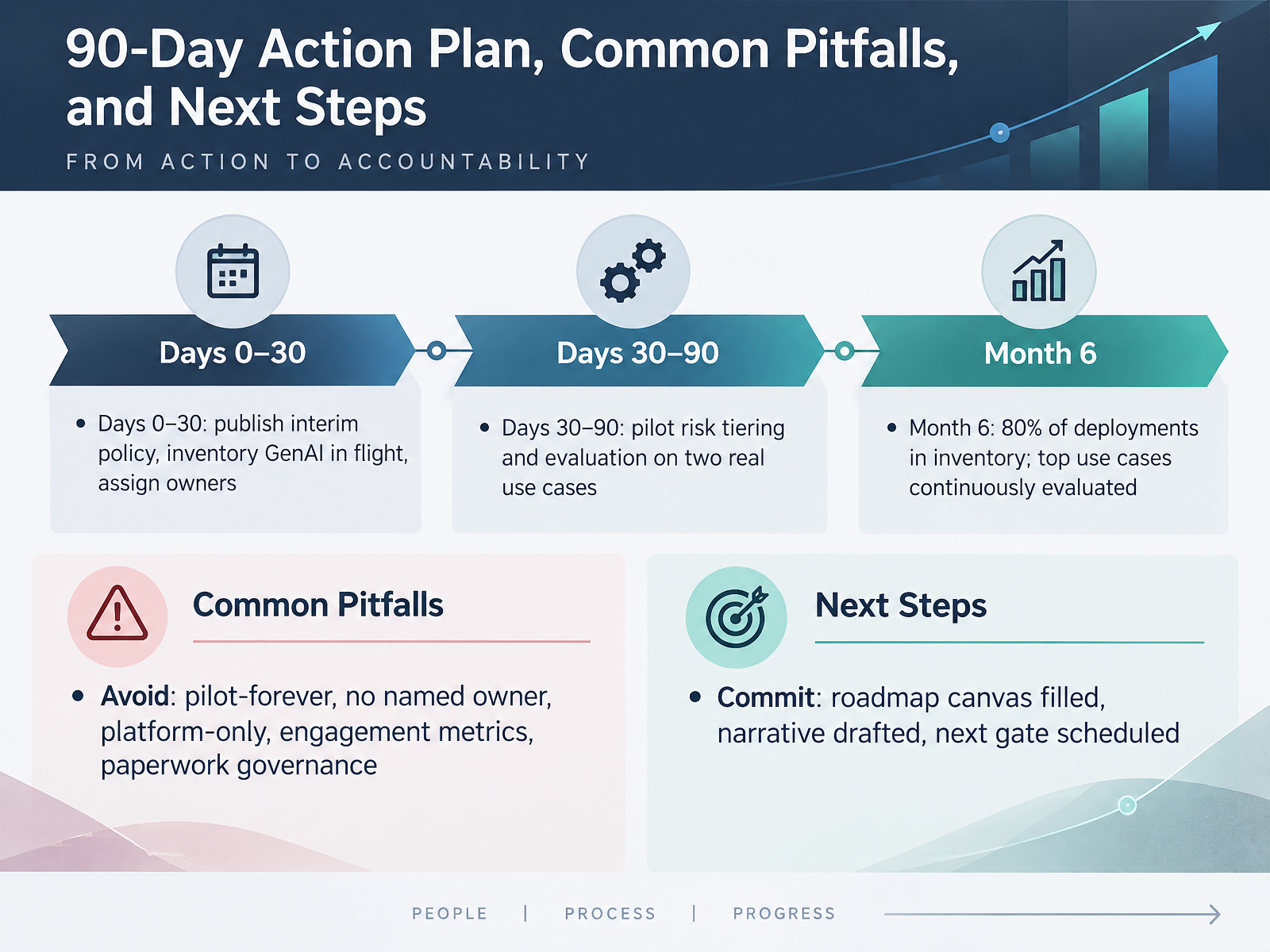
- 1490-Day Action Plan, Common Pitfalls, and Next StepsLet's close with the plan itself. First thirty days: publish your interim policy, inventory every generative AI use case already in flight, and assign a named owner to each one. Between day thirty and day ninety, pilot your risk tiering and your evaluation harness on two real use cases, one lower risk, one higher.
By month six, target eighty percent of deployments registered in the inventory, with your top use cases under continuous evaluation. Treat those dates as planning aids, not benchmarks.
Now the pitfalls. Pilot-forever, where nothing ever earns a production decision. No named owner. Platform-only thinking, where you buy tooling and skip the operating model. Engagement metrics, which measure activity, not outcomes. And paperwork governance, where the framework lives in a document instead of in the workflow.
So commit to three things. Fill in your roadmap canvas. Draft the narrative your executive sponsor will tell. And schedule the next decision gate, with entry and exit criteria written down.
You now have the priorities, the milestones, and the language to communicate them. Thank you for working through this with me. Start with the inventory and the owners. You are ready.
 dataiku.comgenaimaturity.netenterpriseailabs.io+22 min
Take the deck with you
Download this course as a file — free, no sign-up needed.
- PDF handoutEvery slide page, ready to print or share.15 pages · 3.3 MBDownload
- Narrated PowerPointThe deck that presents itself — every slide carries the digital human's narration video.15 pages · 13.4 MBDownload
- PowerPoint slidesThe full deck as a .pptx — open it in PowerPoint, Keynote, or Google Slides.15 pages · 3.3 MBDownload
Free to use in your own training — please keep the PersonWise credit page at the end.
Have your own deck? Turn it into a course
Sources consulted
Web sources consulted while building this course.
- The State of AI in the Enterprise - 2026 AI report | Deloitte US — deloitte.com
- Kearney AI Trends Report 2026 — kearney.com
- Flexera 2026 AI Pulse Report: Adoption, spend and risk — info.flexera.com
- Global Corporate Survey 2026: AI Budgets, Priorities And Tech Preferences — verdantix.com
- Gartner Top 10 Strategic Technology Trends for 2026 — gartner.com
- Generative AI governance framework: building responsible AI systems — dataiku.com
- GenAI Governance Playbook — v1.0 | Generative AI Maturity Framework — genaimaturity.net
- What Does a Working Enterprise Generative AI Governance Framework Look Like in 2026? | enterpriseailabs.io — enterpriseailabs.io
- AI Governance Framework 2026: 4 Risk Tiers + Template — iternal.ai
- Enterprise AI Governance Framework | Helixar — helixar.ai
- Pilot-to-Production Readiness Checklist for AI Features — shiftquality.com
- Pilot-to-Production KPIs: The 12 Metrics That Actually Predict Scaling Success | Brightlume AI Blog | Brightlume AI — brightlume.ai
- The pilot-to-production checklist for enterprise AI · Chokmah — chokmah.in
- Scale an AI Pilot to Production: 2026 Playbook | Game Changer Labs — gamechangerlabs.io
- What Are the Best GenAI Pilot Metrics for Enterprise ROI in 2026? | enterpriseailabs.io — enterpriseailabs.io