Begin
14 pages · ~28 min
Origins of Writing in Ancient Mesopotamia
Discover how writing began in ancient Mesopotamia, exploring the origins of cuneiform and its role in early civilization. Ideal for history and archaeology learners.
A digital instructor presents all 14 pages. Hold “Ask” at any point and ask out loud — the answer comes from this course. No sign-up needed.
What you’ll learn
- 01How Writing Began in Ancient MesopotamiaWelcome. I am glad you are here, because we are about to explore one of humanity's greatest inventions. Writing. Not the writing you do on a phone or a sticky note, but the very first writing ever created. It emerged in ancient Mesopotamia, the land between the Tigris and Euphrates rivers, in what is now southern Iraq, around thirty-two hundred to thirty-three fifty B C E. Picture this. You run a temple storeroom in the city of Uruk. Barley comes in. Fish come in. Workers need rations. How do you keep track? That is exactly the problem writing first solved. Over the next fourteen slides, we will travel from pre-literate accounting to cuneiform, the wedge-shaped script pressed into clay. We will ask two central questions. What problems did writing solve? And who actually used it? Our evidence comes from clay tablets, archaeology, modern decipherment, and museum collections around the world. And our story spans three millennia, from the first cities of Uruk to the fall of Babylon. So let's begin. Setting the Stage: Geography, Chronology, and Key Terms.getty.edupeabody.yale.edumuseums.wayne.edu+22 min
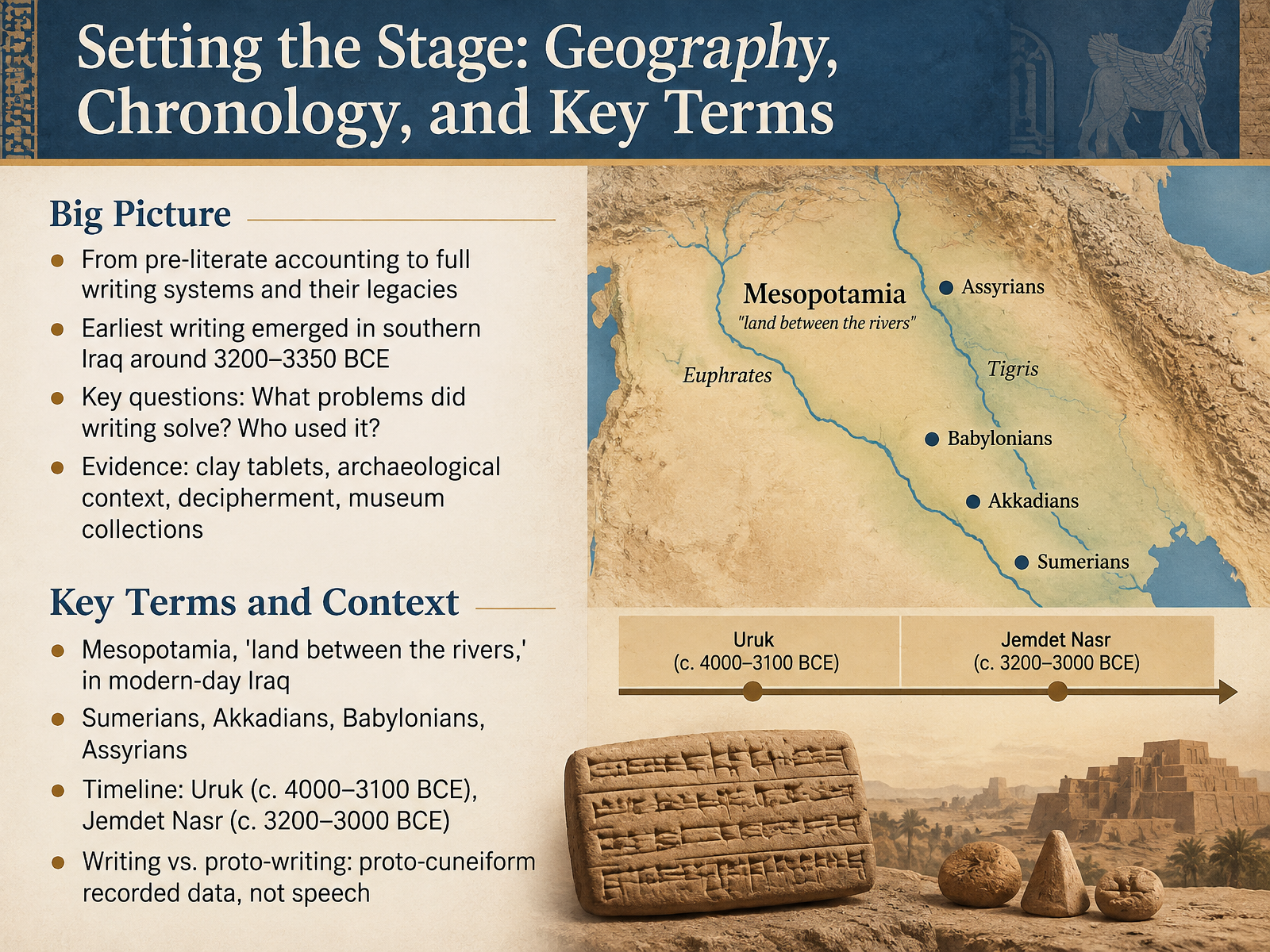
- 02Setting the Stage: Geography, Chronology, and Key TermsLet's set the stage. First, the place. Mesopotamia means the land between the rivers, and it sits in modern day Iraq. This is where the Sumerians, Akkadians, Babylonians, and Assyrians built their world. Now, the timeline. The city of Uruk flourished around four thousand to thirty one hundred B C E. And keep in mind, the very earliest writing emerged in southern Iraq around thirty two hundred to thirty three hundred fifty B C E. So what were the key questions? What problems did writing solve, and who actually used it? You might think of writing as something poetic. But at first, it was practical. It helped track goods, record receipts, and manage a growing city. We also need one important distinction. Writing versus proto writing. Proto cuneiform recorded data, not speech. Think of it like a spreadsheet, not a sentence. To understand all this, we rely on evidence. Clay tablets, archaeological context, decipherment, and museum collections. These humble objects are our time machine. And they raise a big question. How did counting turn into writing?
 getty.edupeabody.yale.edumuseums.wayne.edu+22 min
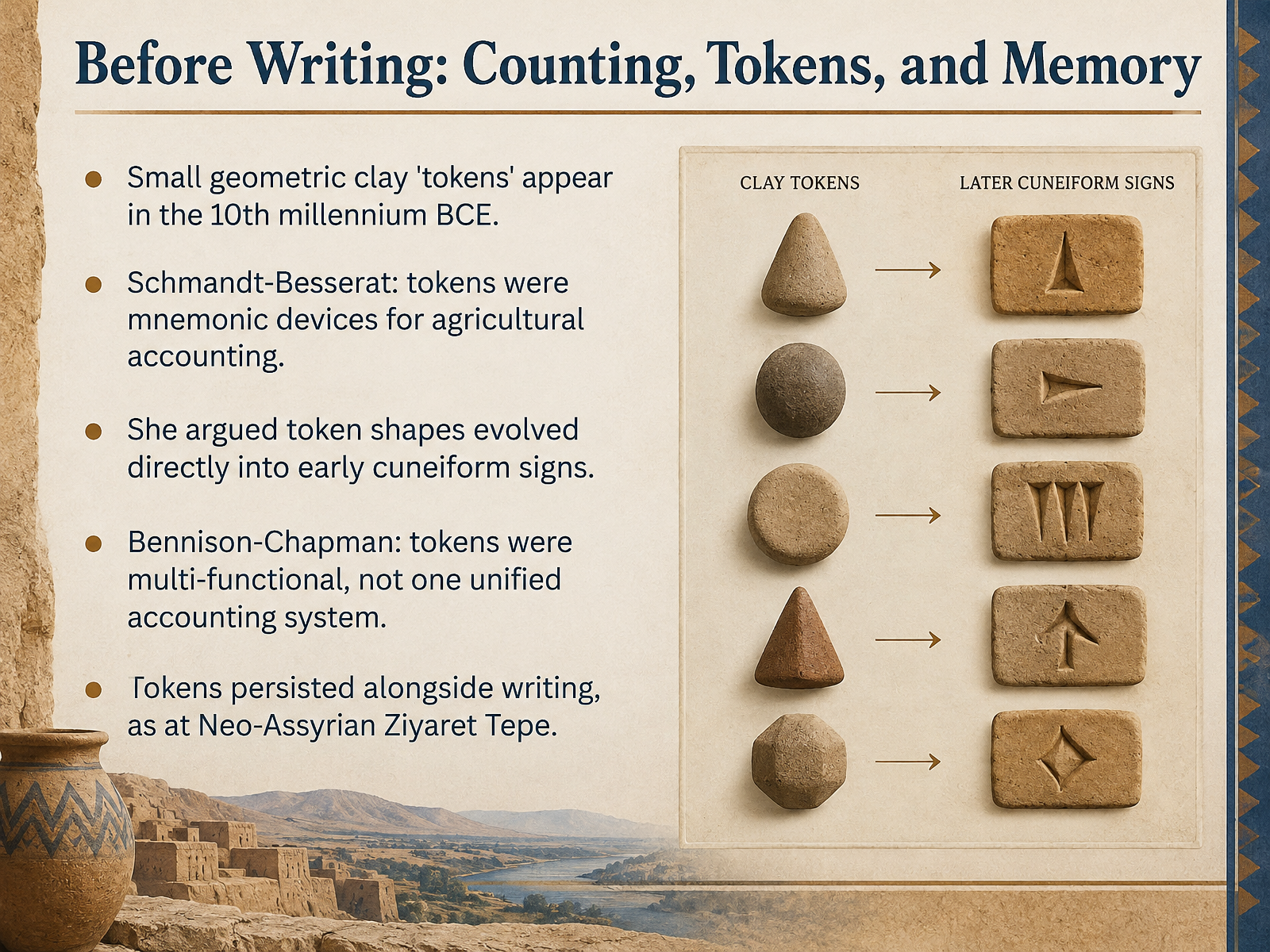
- 03Before Writing: Counting, Tokens, and MemorySo before there was writing, how did people keep track of things? They counted. And they used small clay objects called tokens. These little geometric shapes begin appearing in the tenth millennium B.C.E., at the very start of the Neolithic in West Asia. Picture a handful of tiny clay cones, spheres, and disks, each one made quickly by hand. Now, the scholar Denise Schmandt-Besserat studied thousands of these objects. She argued they were mnemonic devices, memory aids used for agricultural accounting. A token could stand for a measure of grain, or a number of animals. Think of it as ancient bookkeeping, a farmer's way of remembering a debt or a delivery. She went further, proposing that the shapes of these tokens evolved directly into early cuneiform signs. That made tokens the direct ancestors of writing. But here is where the story gets interesting. More recent research by Lucy Bennison-Chapman challenges that tidy picture. She examined nearly three thousand Neolithic clay objects and found no single unified system. Instead, tokens were multi-functional. They might have been counting aids, but also gaming pieces, ritual objects, or simple playthings for children. At one site, they could serve several roles at once. And crucially, tokens did not simply disappear once writing arrived. At Ziyaret Tepe, a Neo-Assyrian provincial capital in southeastern Turkey, excavators found tokens used alongside tablets, sealings, and weights. So even in a literate imperial administration, these humble clay pieces still had value. The takeaway here is important. Early record keeping was not a single clean line from token to script. It was messy, varied, and deeply human. Now, how did those tokens get transformed into recognizable signs? Let's look at that next, in From Envelopes to Impressed Signs: The Mechanics of Early Recording.
 cambridge.orgdegruyterbrill.comjournals.uchicago.edu+22 min
- 04From Envelopes to Impressed Signs: The Mechanics of Early RecordingNow let's look at the mechanics. How did everyday record keeping actually work? Imagine you run a busy warehouse or a granary. You need to track sacks of grain, jars of oil, and bolts of cloth. That is the everyday problem that ancient Mesopotamian accountants faced thousands of years ago.
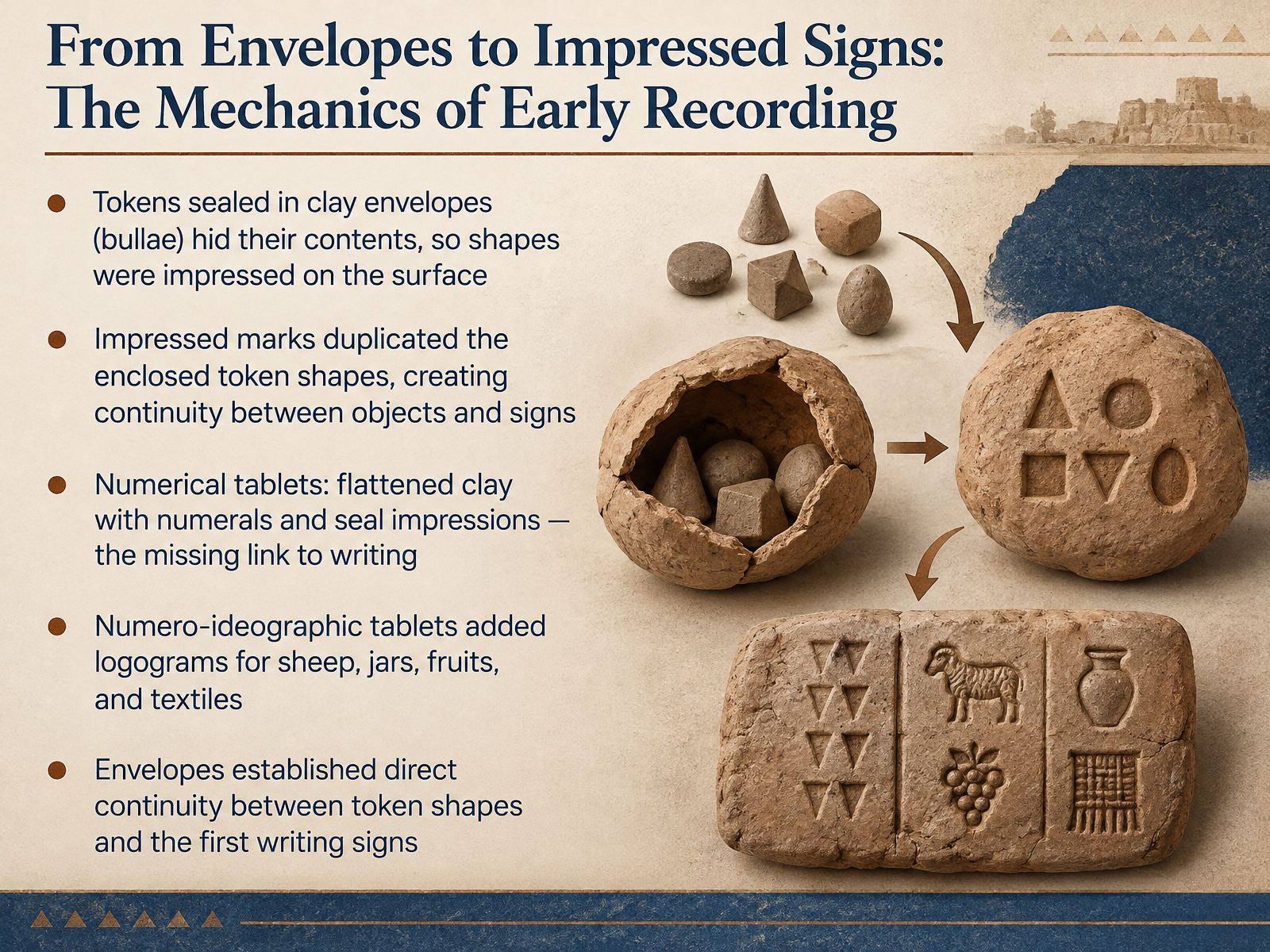
Here is the simple problem they hit. From around 3400 to 3200 BC, people began sealing their clay tokens inside hollow clay balls called envelopes, or bullae. But once a token was sealed inside, you could no longer see what was there. So they pressed the token shapes into the wet clay surface before closing the envelope. Now the outside matched the inside. The mark on the surface duplicated the shape of the token enclosed. Think of it like writing the contents on the outside of a sealed box. The receipt and the goods became one object.
Next came the numerical tablets. Flattened pieces of clay marked with numerals and seal impressions. Many scholars see these as the missing link to writing. Then numero-ideographic tablets added picture signs, or logograms, for specific goods. Sheep. Jars. Fruits. Textiles.
So what is the key takeaway? The envelopes created direct continuity between the shape of a token and the first signs of writing. And that small habit of labeling the outside of a container is, in a real sense, where writing began.
But who needed to write all of this down? That is what we turn to next, with the Uruk phenomenon and the first tablets.
 cambridge.orgdegruyterbrill.comjournals.uchicago.edu+22 min
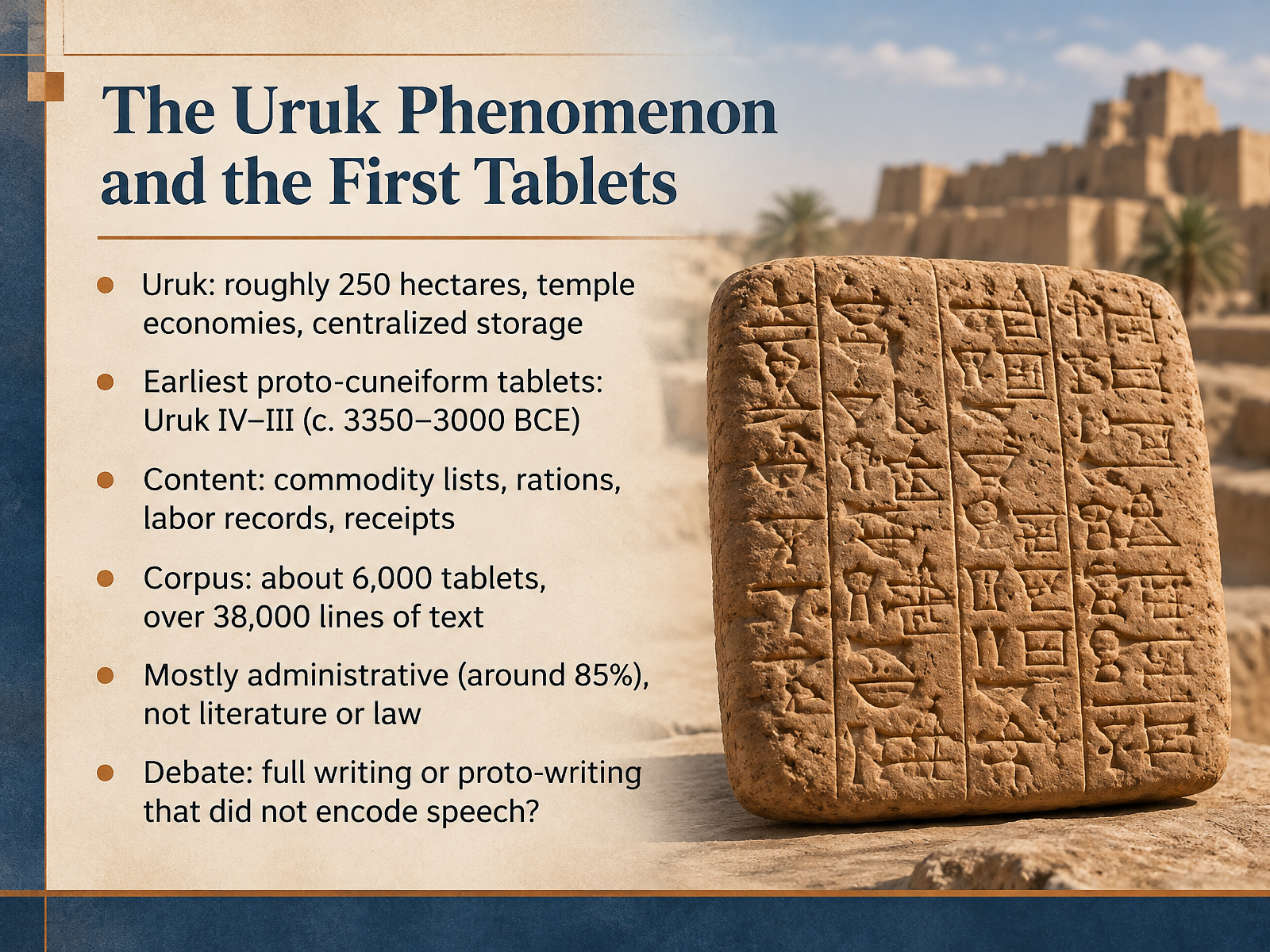
- 05The Uruk Phenomenon and the First TabletsNow let's zoom in on the city where it all began. Uruk was enormous for its time, roughly two hundred fifty hectares, and it ran on temple economies with centralized storage. Think of it as a giant warehouse system, and you need records to track what comes in and what goes out. That is exactly what we find. The earliest proto-cuneiform tablets come from Uruk four and three, around three thousand three hundred fifty to three thousand B C E. What do they record? Commodity lists, rations, labor records, receipts. Sound familiar? It is essentially the ancient version of a delivery slip or a payroll sheet. The known corpus is about six thousand tablets with more than thirty-eight thousand lines of text. And here's the twist. Roughly eighty-five percent is administrative, not literature, not law. Just accounts. So was this full writing, or proto-writing that did not yet encode speech? Scholars still debate that today. Once we have these signs, where did their shapes come from? That is our next question. Visual Precursors: Seals, Motifs, and the Making of Signs.
 cambridge.orgcdli.earthscienceline.org+22 min
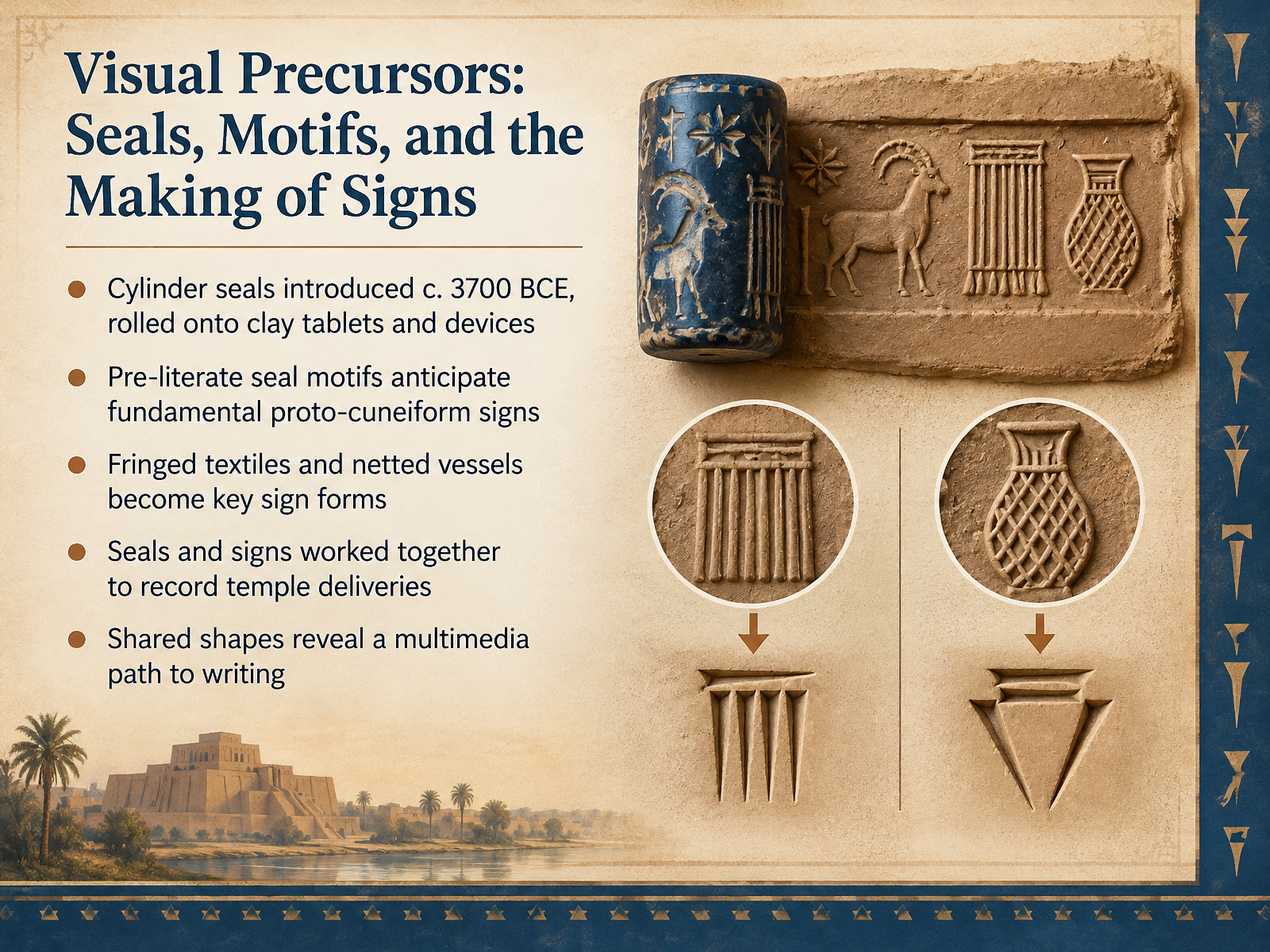
- 06Visual Precursors: Seals, Motifs, and the Making of SignsNow let's talk about the visual precursors to writing. Before signs, there were seals. Around thirty-seven hundred B C E, people began using cylinder seals. These were small carved stones, rolled across wet clay to leave a picture. Think of it like a stamp or a wax seal on an envelope. But here is the fascinating part. The motifs on those seals often match signs that later appear in proto-cuneiform. Fringed textiles. Netted vessels. These images were not decoration alone. They helped record real deliveries to temples. So seals and early signs worked side by side, sharing shapes and meaning. Writing did not spring from nothing. It grew from a rich visual world already in use. Next, we will see how those pictures became signs.
 cambridge.orgcdli.earthscienceline.org+21 min
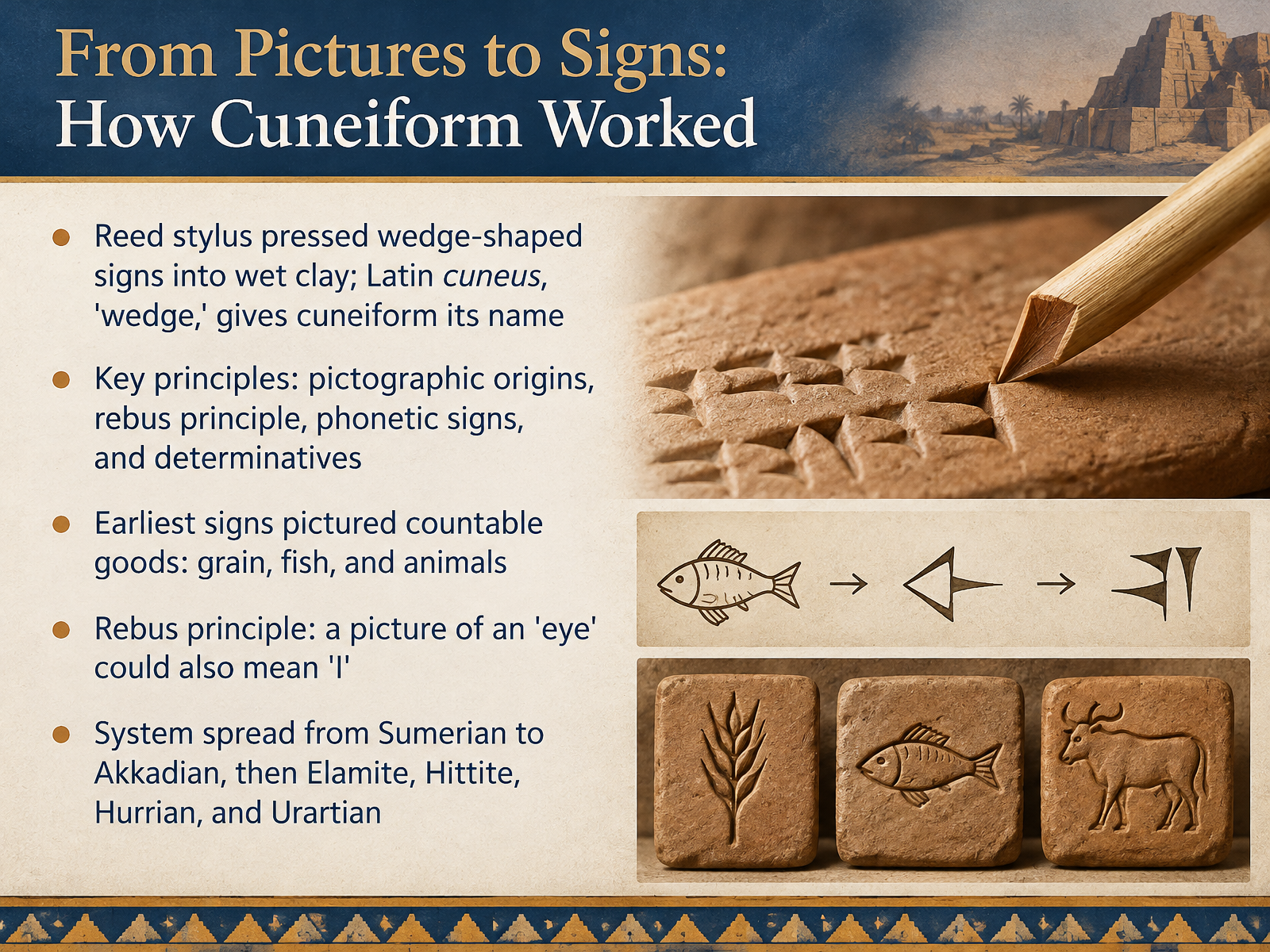
- 07From Pictures to Signs: How Cuneiform WorkedNow, how did pictures become a true writing system? Imagine pressing a sharpened reed into soft clay. Each stroke leaves a small wedge. That is where the Latin word cuneus, meaning wedge, gives us cuneiform. The earliest signs pictured countable goods: grain, fish, animals. Simple enough to count. But here is the clever leap. The rebus principle let a picture of an eye also mean the pronoun I. A sign could stand for a sound, not just a thing. Add phonetic signs and determinatives, silent markers that told you what category a word belonged to, and you had a flexible system. It spread from Sumerian to Akkadian, then to Elamite, Hittite, Hurrian, and Urartian. So cuneiform grew from counting receipts into a tool for poetry and law. Next, who actually wrote all this down, and why? Who Wrote and Why: Scribes, Temples, and Palaces.
 getty.edupeabody.yale.edumuseums.wayne.edu+22 min
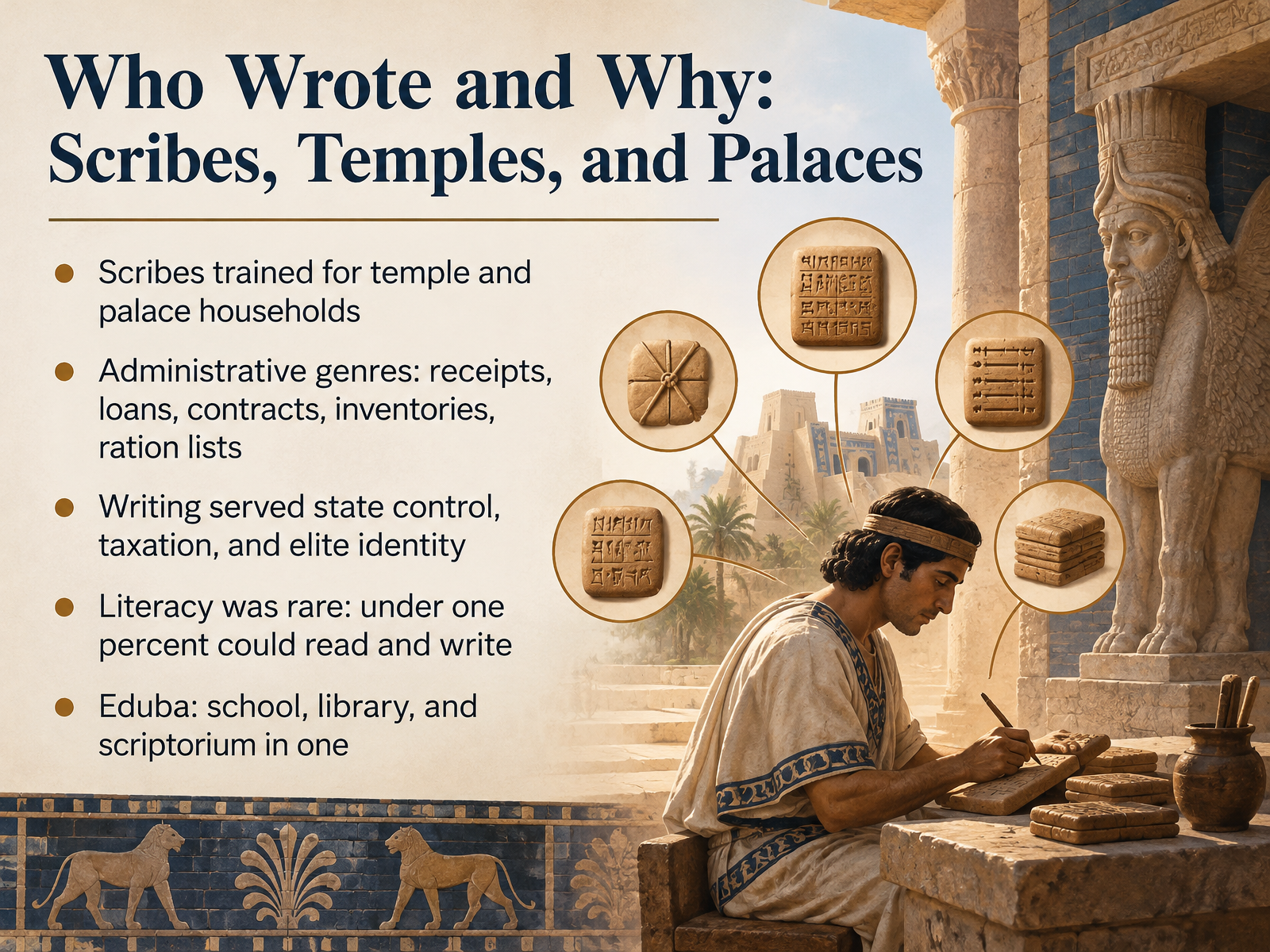
- 08Who Wrote and Why: Scribes, Temples, and PalacesSo who actually did the writing? Picture a young scribe in training, attached to a temple or palace household. His job was not poetry, at least not at first. It was receipts, loans, contracts, inventories, and ration lists. Writing grew up serving the state: tracking taxes, goods, and labor. And it marked status. Literacy was rare. Fewer than one percent of people could read and write. Think about that. Almost everyone around you could not read a single line. The school itself, the eduba, was school, library, and scriptorium in one. One house of tablets, training each new generation. So when you sign a receipt or check a list today, you are echoing a very old habit. Next, let us step inside that school and see the curriculum and daily life.
 knowledgebasedsociety.comknowledgebasedsociety.comcambridge.org+21 min
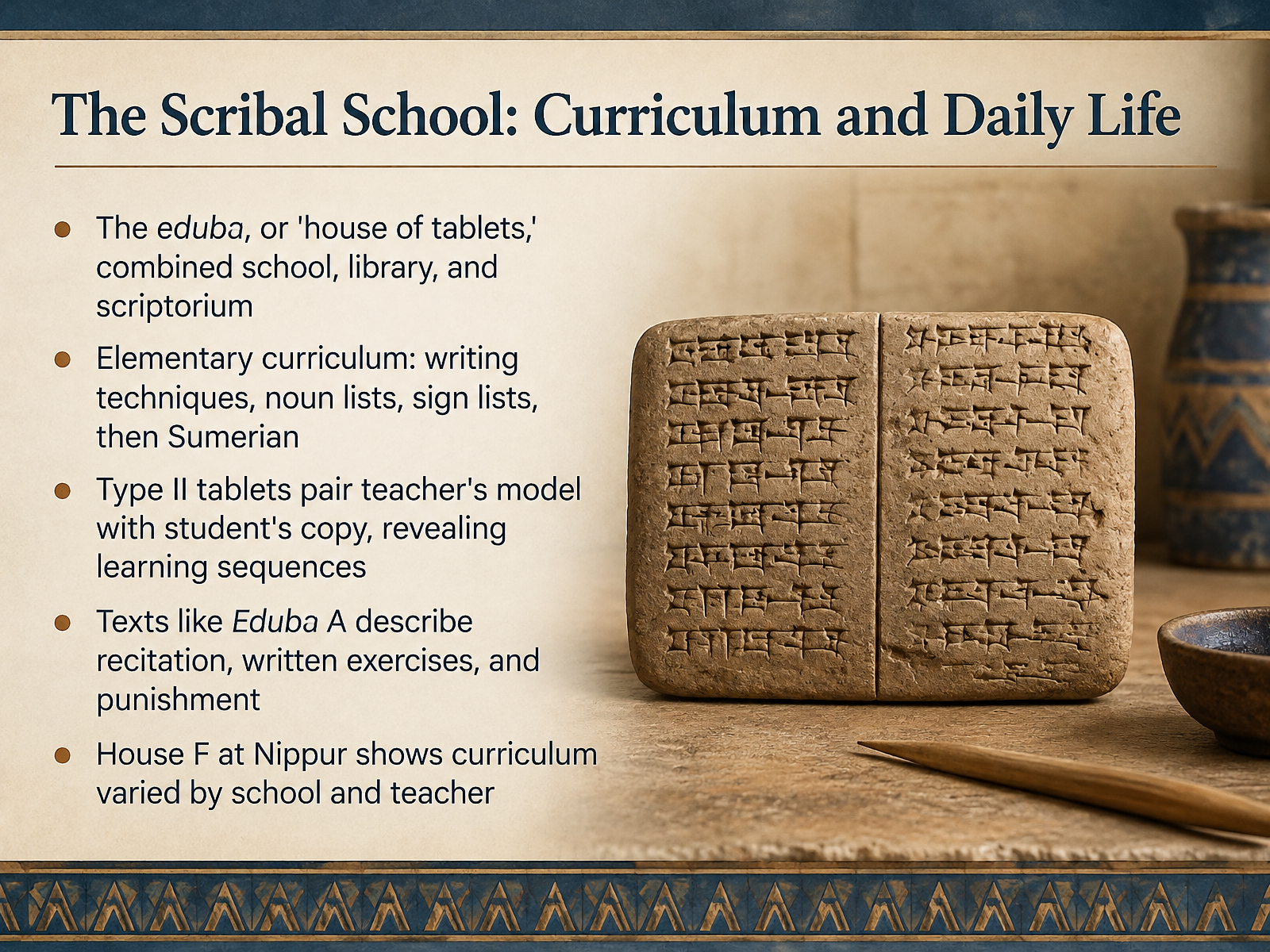
- 09The Scribal School: Curriculum and Daily LifeNow, where did this training actually happen? In a place the Sumerians called the eduba, the house of tablets. Think of it as a school, a library, and a writing workshop all in one. Students began with the basics. They practiced pressing wedge shapes into clay. Then came long lists of nouns and signs. Only after that did they tackle Sumerian, a language that was already ancient to them. How do we know the order? From Type Two tablets. On one side, the teacher wrote a model. On the other, the student copied it. By comparing the two sides, scholars can trace exactly what was learned, and when. Texts like Eduba A describe the daily grind: recitation, written exercises, even punishment for misbehavior. And at House F in Nippur, we see that no two schools were identical. Curricula varied by teacher and by city, even while the core subjects stayed remarkably similar. So the eduba was strict, structured, and surprisingly flexible. And that kind of training did not just produce accountants. It gave Mesopotamia the tools to write down something far bigger. Beyond Accounts: Literature, Law, and Science.
 knowledgebasedsociety.comknowledgebasedsociety.comcambridge.org+22 min
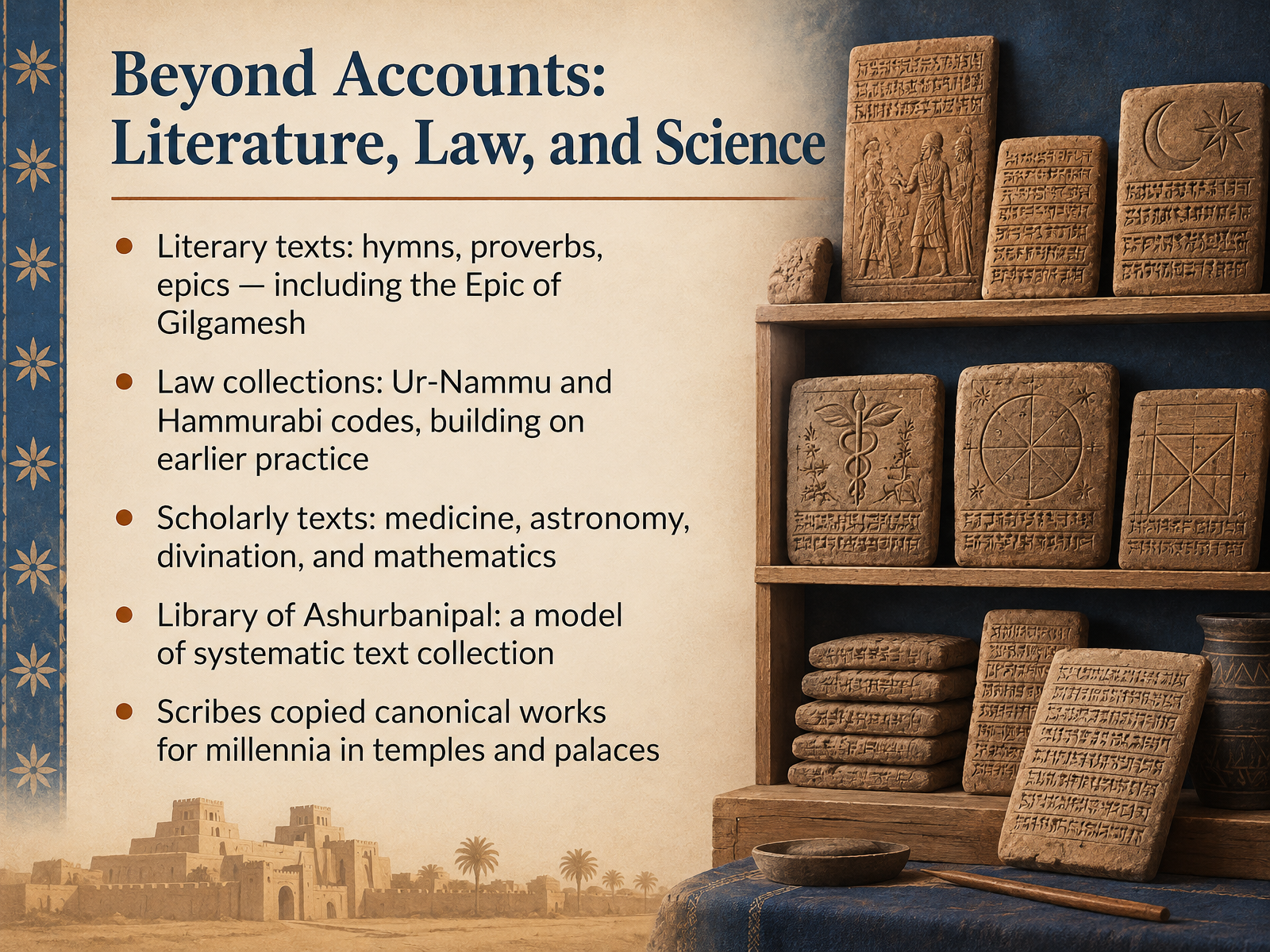
- 10Beyond Accounts: Literature, Law, and ScienceBut writing did not stay a tool of accountants for long. Once you can record a receipt, you can also record a poem. Think about your own life. You use the same alphabet for a grocery list and for a love letter. Mesopotamia did exactly that, on a much grander scale. Scribes wrote hymns, proverbs, and epics, including the Epic of Gilgamesh. They wrote law collections, such as the codes of Ur-Nammu and Hammurabi, building on earlier practice. They wrote about medicine, astronomy, divination, and mathematics. And they gathered all of it into libraries. The Library of Ashurbanipal at Nineveh is a striking early model of systematic text collection. For millennia, scribes in temples and palaces copied and recopied these canonical works, preserving them across generations. So here is the takeaway. Writing began as accounting, but it became memory. It became law, literature, and science. And that survival was no accident. It was the quiet, patient work of scribes. Next, we follow one of those texts, the Epic of Gilgamesh, and ask how scholars are reconstructing a lost masterpiece from broken clay tablets.
 getty.edupeabody.yale.edumuseums.wayne.edu+22 min
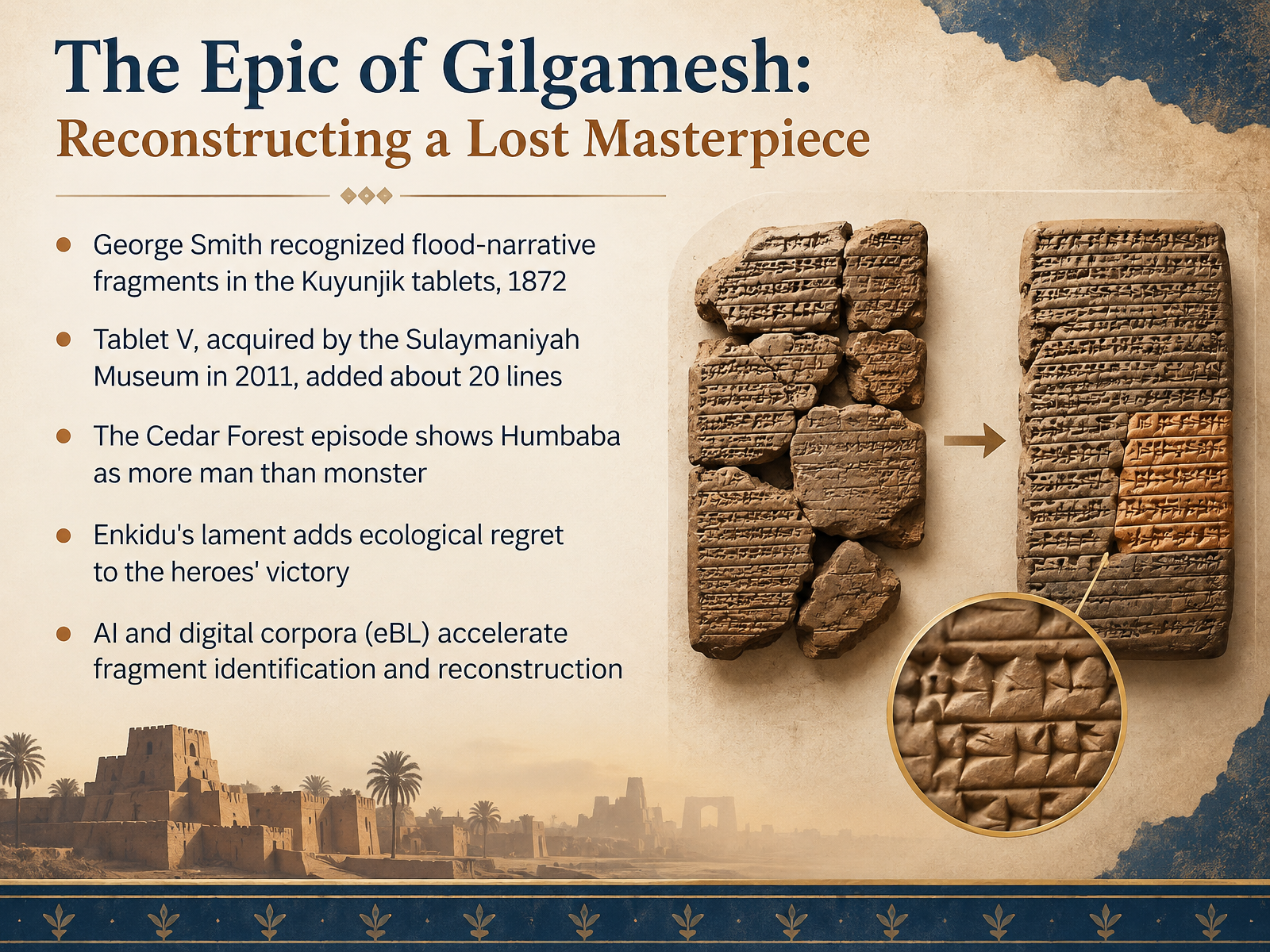
- 11The Epic of Gilgamesh: Reconstructing a Lost MasterpieceNow here is a story that feels almost like detective work. In eighteen seventy two, a self taught scholar named George Smith sat in the British Museum reading a damaged clay tablet. Suddenly, he recognized a flood story, a stranded ship, and a bird sent to search for land. Can you imagine that moment? He realized this was part of the Epic of Gilgamesh. Since then, the epic has been rebuilt piece by piece. In twenty eleven, the Sulaymaniyah Museum acquired Tablet Five, which added about twenty new lines. Those lines make Humbaba, the Cedar Forest's guardian, feel more man than monster. They also give Enkidu a lament, a kind of ecological regret over the forest the heroes destroyed. Today, artificial intelligence and digital corpora like the electronic Babylonian Library help scholars identify and reconnect fragments faster than ever. Bit by bit, this lost masterpiece is coming back to us. That patient work of reconstruction leads into our next topic, Decipherment and Discovery, Reading the Past.
 2 min
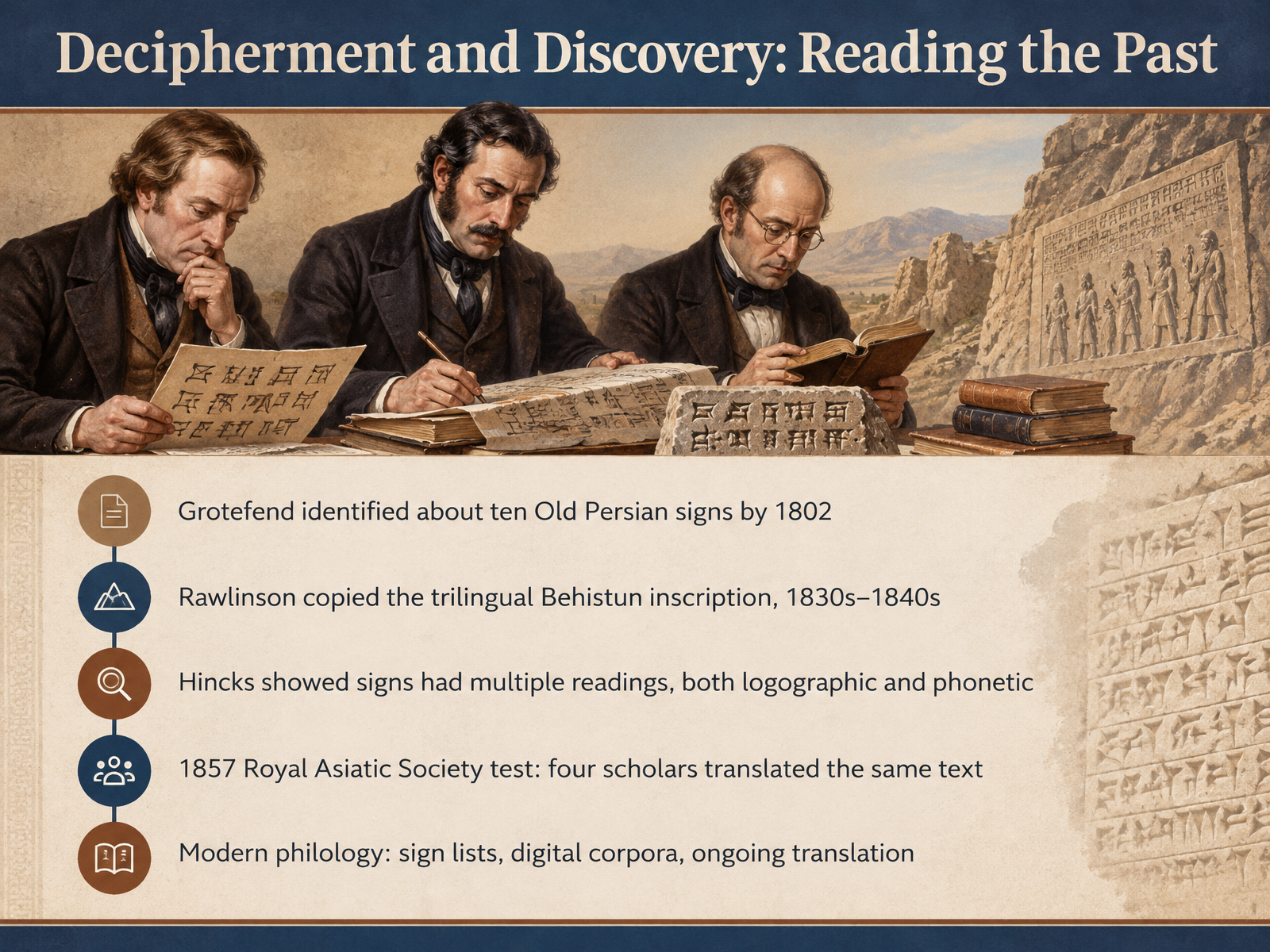
- 12Decipherment and Discovery: Reading the PastSo how did scholars actually learn to read this forgotten script? It began with a lucky guess. In eighteen oh two, a German schoolteacher named Georg Grotefend figured out about ten signs of Old Persian. He noticed that royal inscriptions repeat phrases like king of kings, and he matched those patterns to the names of Persian rulers. Clever, right? But it was only a start. Then in the eighteen thirties and forties, a British officer named Henry Rawlinson climbed the cliff at Behistun in Iran. Think of the danger. He copied a huge trilingual inscription, carved high on the rock. That monument became the Rosetta Stone of cuneiform. Meanwhile, Edward Hincks made a crucial discovery. Signs could work two ways. Some stood for whole words, called logograms, and others for sounds, either syllables or single letters. So one sign might have several possible readings. Can you imagine reading a sentence like that? To prove the decipherment was real, the Royal Asiatic Society held a famous test in eighteen fifty-seven. Four scholars translated the same text independently. Their versions matched closely, and the skeptics were convinced. Today, philologists keep building sign lists and digital corpora. Thousands of tablets still await translation. So the next time you jot a receipt or send a quick message, remember: you are taking part in a tradition that began with clay and wedge shaped marks. Next, we will explore how researchers work hands on with evidence, in tablets, museums, and digital resources.
 2 min
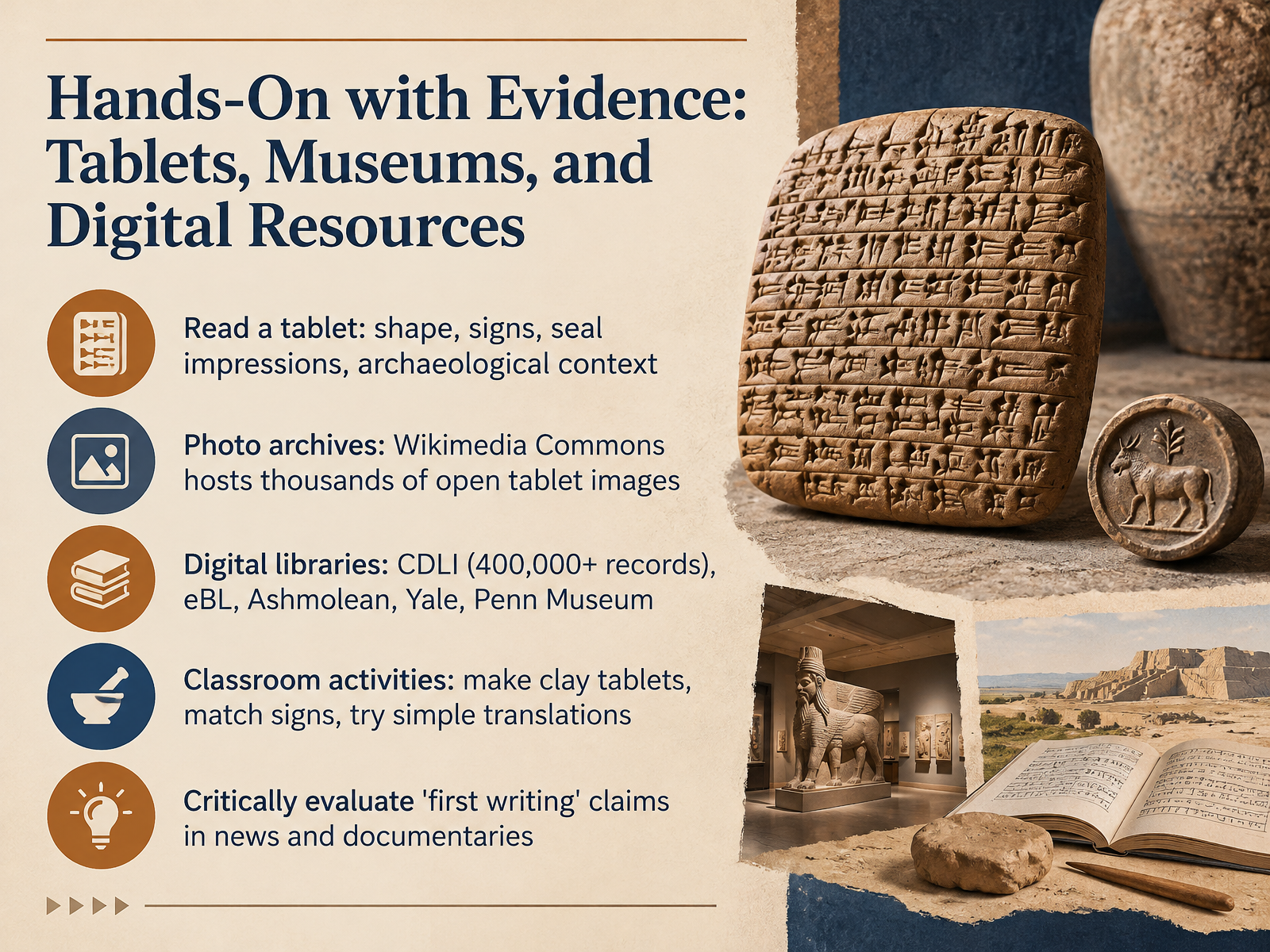
- 13Hands-On with Evidence: Tablets, Museums, and Digital ResourcesNow let's get hands on with the evidence. When you look at a tablet, what should you notice? Start with its shape and signs, then any seal impressions, and finally its archaeological context. Context matters, because it tells you where and why the tablet was made. You don't need a museum visit to explore this. Photo archives like Wikimedia Commons host thousands of open tablet images. And digital libraries such as CDLI, with more than four hundred thousand records, along with the electronic Babylonian Library, the Ashmolean, Yale, and Penn Museum, put real tablets at your fingertips. In the classroom, try making clay tablets, matching signs, or simple translations. Most importantly, evaluate claims about the first writing in news and documentaries. Ask who found the tablet, where, and how it was dated. So keep this takeaway: good evidence, carefully checked, is your best guide. Next, let's bring it together with Review and Assessment: Key Takeaways.
 getty.edulouvre.fr2 min
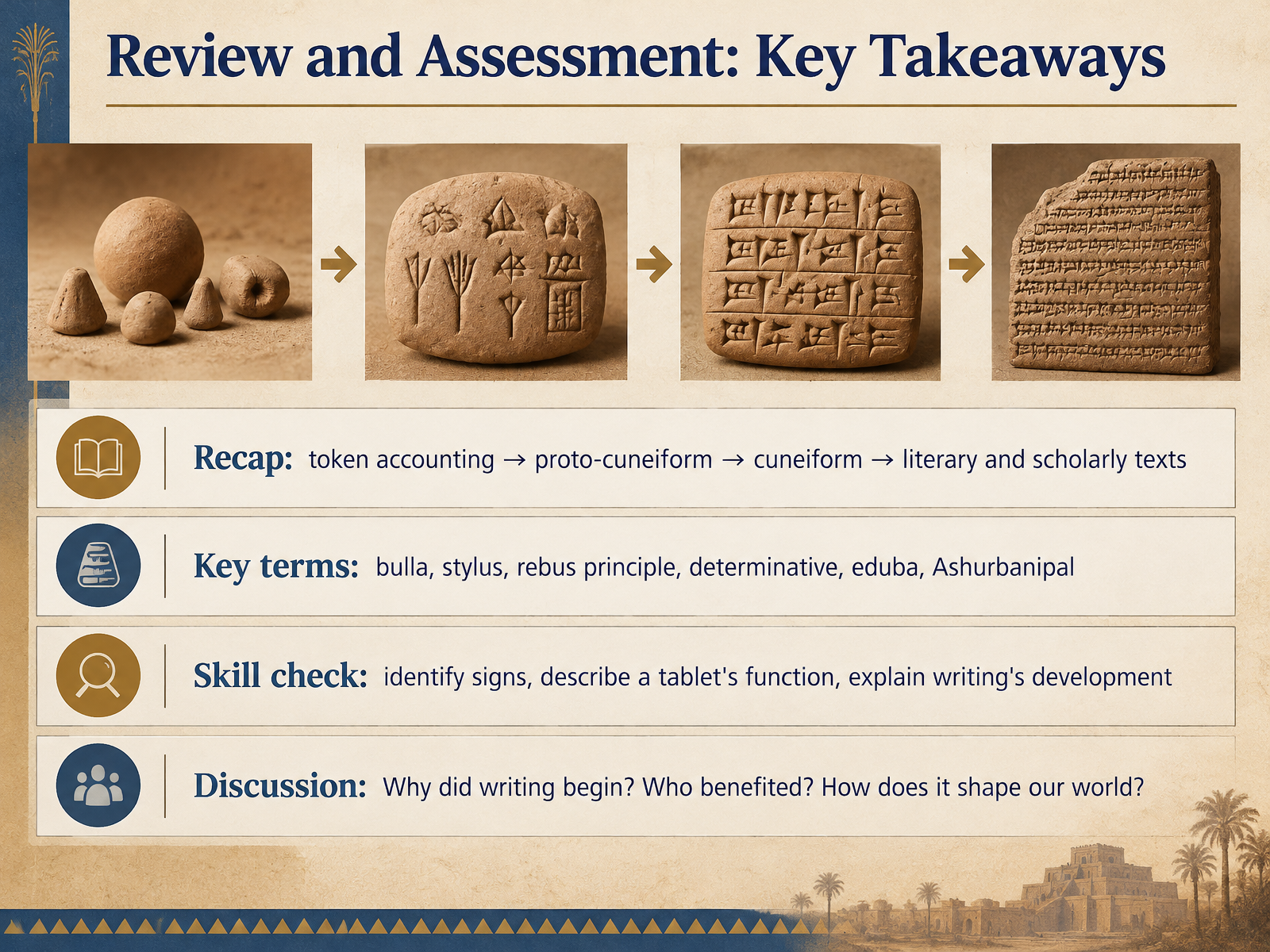
- 14Review and Assessment: Key TakeawaysLet's bring it all together. Remember the arc we've traced? Token accounting, then proto-cuneiform, then full cuneiform, and finally literary and scholarly texts like the Epic of Gilgamesh. Six terms to carry with you: bulla, stylus, rebus principle, determinative, eduba, and Ashurbanipal. For your skill check, you'll identify signs, describe what a tablet was used for, and explain how writing developed. Here's the big discussion question. Why did writing begin? Was it purely practical, or was something more at work? Who benefited most? Temple administrators, scribes, kings? And how does it still shape our world today? Every receipt you save, every message you send, every list you keep echoes those first clay tokens. Writing began as accounting, and it became memory, law, poetry, and history. Thank you for joining me on this journey. You've done wonderful work, and I hope you carry these ancient voices with you. Keep asking questions, and I'll see you next time.
 getty.edupeabody.yale.edumuseums.wayne.edu+22 min
Take the deck with you
Download this course as a file — free, no sign-up needed.
- PDF handoutEvery slide page, ready to print or share.15 pages · 6.3 MBDownload
- Narrated PowerPointThe deck that presents itself — every slide carries the digital human's narration video.15 pages · 17.4 MBDownload
- PowerPoint slidesThe full deck as a .pptx — open it in PowerPoint, Keynote, or Google Slides.15 pages · 6.3 MBDownload
Free to use in your own training — please keep the PersonWise credit page at the end.
Have your own deck? Turn it into a course
Sources consulted
Web sources consulted while building this course.
- Mesopotamia: Civilization Begins — getty.edu
- New exhibition explores origins of writing | Yale Peabody Museum — peabody.yale.edu
- "Shape of Language" exhibit brings cuneiform-inspired art to Grosscup Museum — museums.wayne.edu
- Primeval Waters - Lessons from Mesopotamia — louvre.fr
- She Who Wrote: Enheduanna and Women of Mesopotamia, ca. 3400–2000 B.C. | The Morgan Library & Museum — themorgan.org
- Reconsidering ‘Tokens’: The Neolithic Origins of Accounting or Multifunctional, Utilitarian Tools? — cambridge.org
- CHAPTER EIGHT Conclusions: Tokens, Their Role in Prehist... — degruyterbrill.com
- https://www.journals.uchicago.edu/doi/full/10.1086/727776 — journals.uchicago.edu
- Artefacts of Cognition: the Use of Clay Tokens in a Neo-Assyrian Provincial Administration — cambridge.org
- https://livrepository.liverpool.ac.uk/2008477/1/Bennison-Chapman_Luc_Jul_2014_2008477.pdf — livrepository.liverpool.ac.uk
- Seals and signs: tracing the origins of writing in ancient South-west Asia | Antiquity | Cambridge Core — cambridge.org
- The earliest Mesopotamian writing — cdli.earth
- Tracing cognition from clay stamps to cuneiform and beyond - Scienceline — scienceline.org
- The Colophons of the Archaic Lists and their Social Setting — exa.ai
- Assignment of account type to proto-cuneiform economic texts with Multi-Class Support Vector Machines — exa.ai
- THE TABLET HOUSE: A SCRIBAL SCHOOL IN OLD BABYLONIAN NIPPUR — knowledgebasedsociety.com
- American Oriental Society is collaborating with JSTOR to digitize, preserve and extend access to Journal of the American Oriental Society — knowledgebasedsociety.com
- On the curricular setting of Sumerian Literature | IRAQ | Cambridge Core — cambridge.org
- More than Metrology: Mathematics Education in an Old Babylonian Scribal School — uruk-warka.dk
- Elementary education at Nippur. The lists of trees and wooden objects Veldhuis, Nicolaas Christiaan — pure.rug.nl