Begin
14 pages · ~28 min
ESG Data in Brand Storytelling Workflow
This training teaches brand and marketing professionals a practical workflow for using ESG data in brand storytelling, from sourcing data to crafting credible narratives.
A digital instructor presents all 14 pages. Hold “Ask” at any point and ask out loud — the answer comes from this course. No sign-up needed.
What you’ll learn
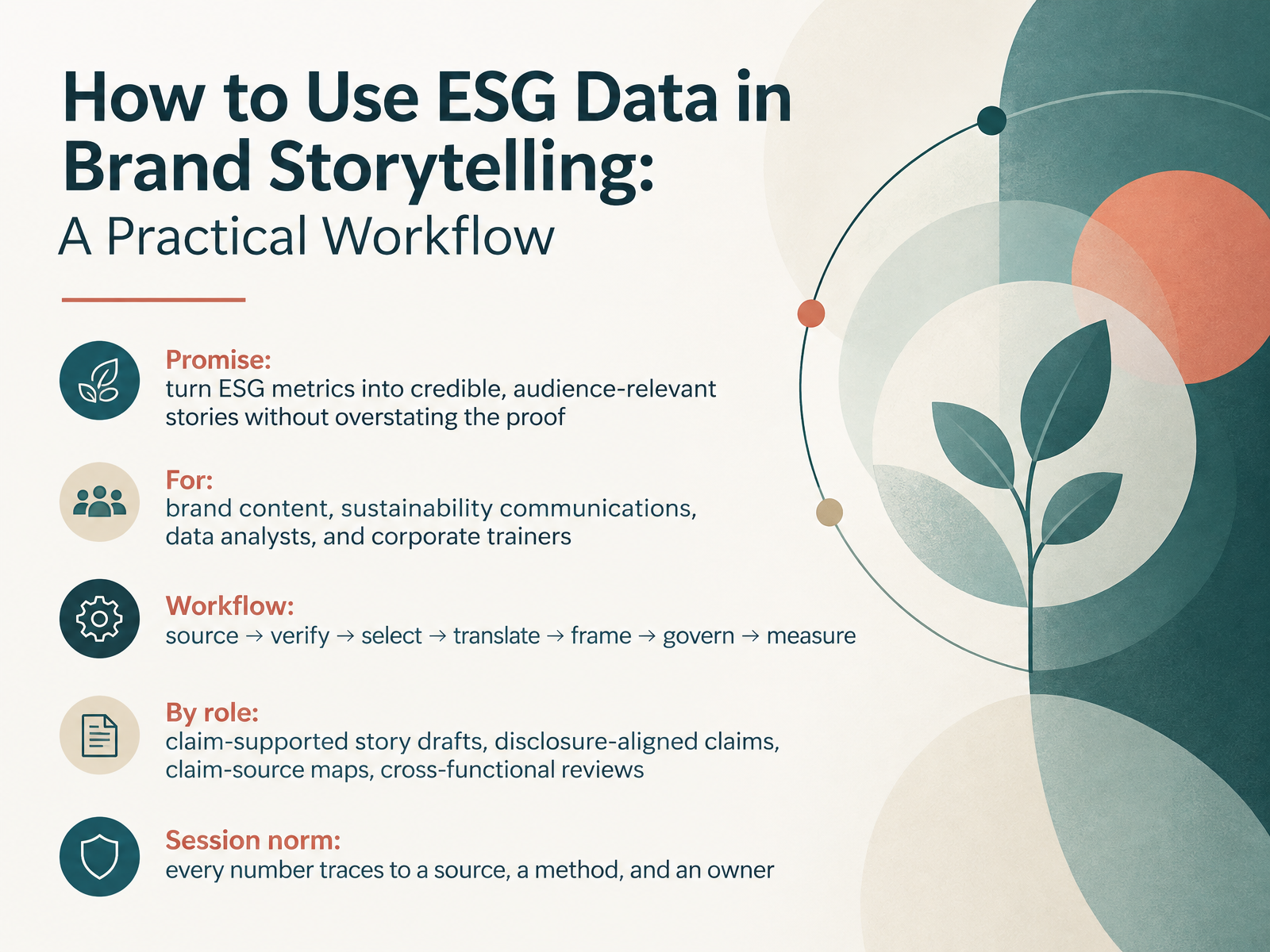
- 01How to Use ESG Data in Brand Storytelling: A Practical WorkflowWelcome. This session is about turning ESG metrics into credible stories without overstating the proof. ESG means environmental, social, and governance data, and most teams have plenty of it. The hard part is the handoff from data to narrative. So here is the goal. By the end, you will have a practical workflow you can run with colleagues. It moves through seven steps: source, verify, select, translate, frame, govern, and measure. Brand content people, sustainability communicators, data analysts, and trainers each leave with something usable, like claim-supported story drafts, disclosure-aligned claims, and a map tying every claim to its source. Our session norm is simple. Every number traces to a source, a method, and an owner. One honest takeaway before we start: data that cannot be traced is not evidence, it is decoration. Next, we look at why this matters now, and the regulatory and audience context behind it.politico.eueuroparl.europa.euenvironment.ec.europa.eu+21 min
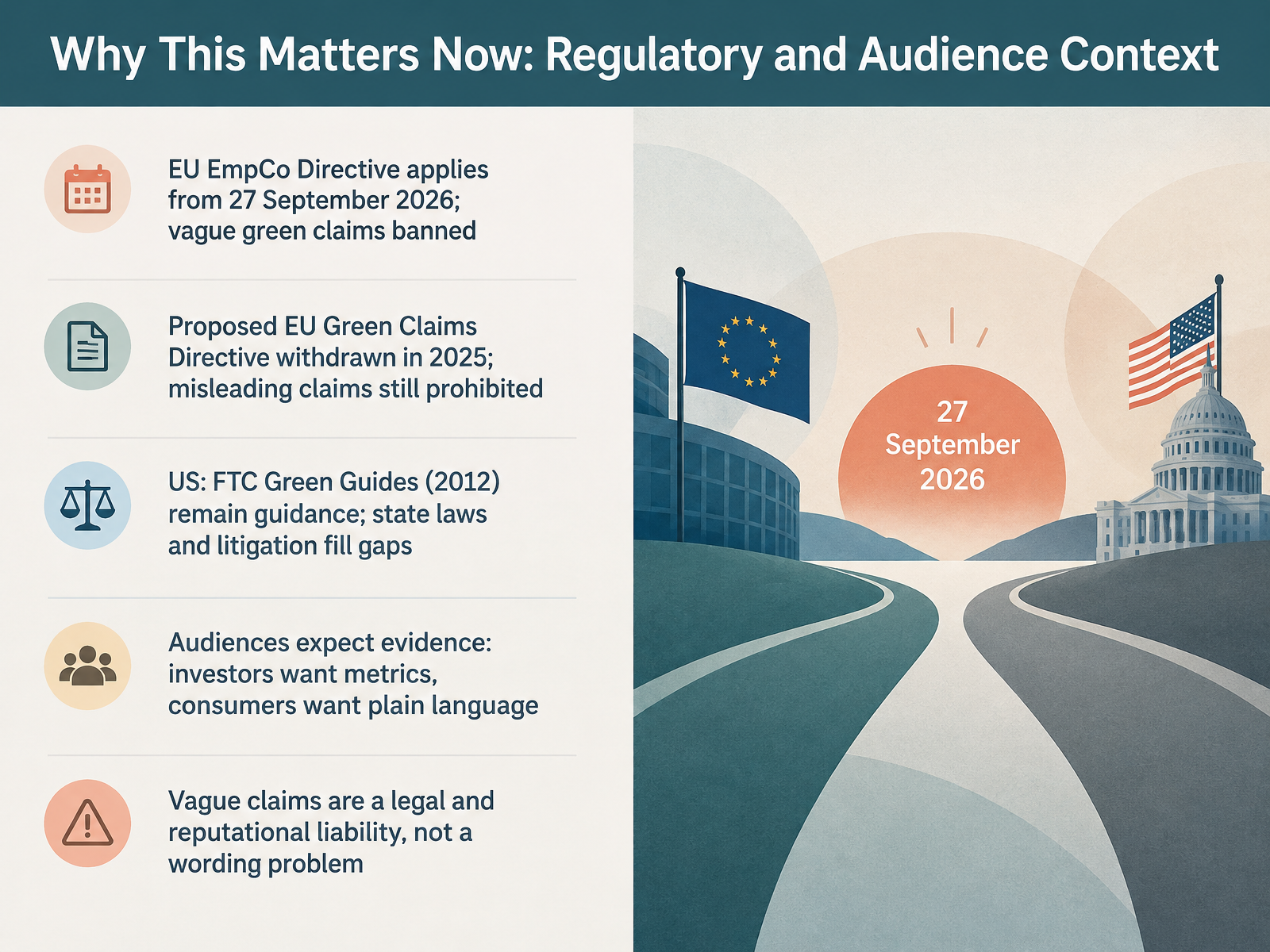
- 02Why This Matters Now: Regulatory and Audience ContextSo why does this matter right now? Two clocks are running at once: a legal one and an audience one. In the EU, the Empowering Consumers Directive applies from the twenty-seventh of September, twenty twenty-six. It bans vague green claims, meaning a term like eco-friendly with no clear, prominent specification. The proposed Green Claims Directive was withdrawn in twenty twenty-five, but misleading claims remain prohibited under existing consumer law. In the US, the FTC Green Guides from twenty twelve are still guidance, and state laws and private litigation fill the gaps. Meanwhile, your audiences split by need: investors want metrics, consumers want plain language. So treat a vague claim as a legal and reputational liability, not a wording problem. And note the trap: a claim can be accurate and still fail if the baseline or scope is off. One takeaway to repeat: claims are evidence with a deadline. Next, what counts as an environmental claim.
 politico.eueuroparl.europa.euenvironment.ec.europa.eu+22 min
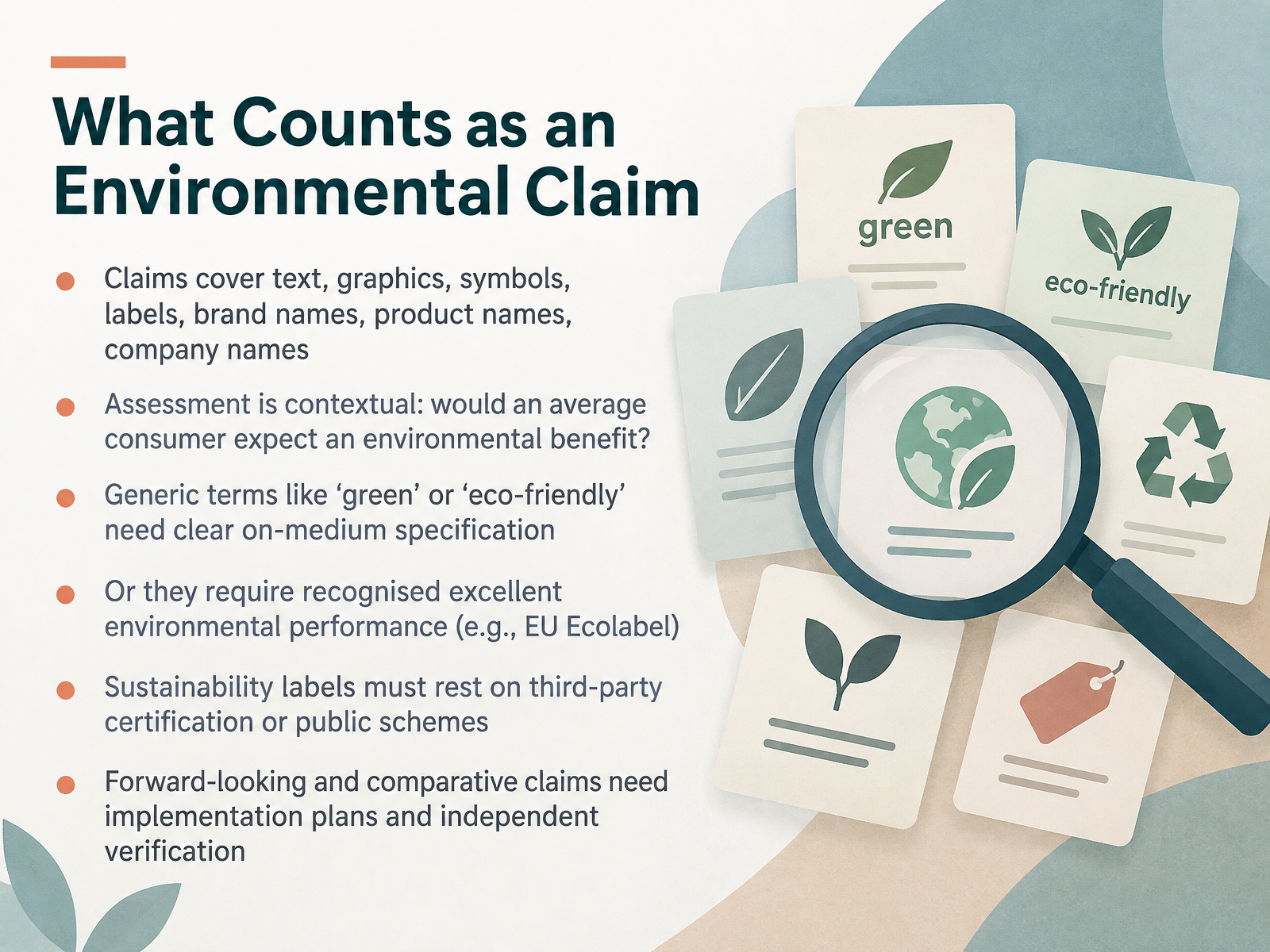
- 03What Counts as an Environmental ClaimNow let's get precise about what actually counts as an environmental claim. The definition is deliberately broad. It covers text, graphics, symbols, labels, and even brand names, product names, and company names. So a product called EcoFresh is making a claim whether you meant it or not. Second, the test is contextual. Regulators ask whether an average consumer would expect an environmental benefit in that specific setting, not in theory. Third, generic terms like green or eco-friendly are banned unless you specify the benefit clearly on the same medium, for example packaging made from eighty percent recycled content. Alternatively, you need recognised excellent performance, such as the EU Ecolabel. Sustainability labels must rest on third-party certification or a public scheme, so retire any self-declared badges. And forward-looking or comparative claims need a real implementation plan plus independent verification. Under the EU rules applying from September twenty twenty-six, this is enforceable. Side note for US teams: the FTC Green Guides still date from twenty twelve, but state laws and lawsuits fill the gap. One takeaway: if a claim appears in a name or symbol, it still needs evidence. Next, we move from claims to story, in Core Concepts: From ESG Metrics to Narrative Building Blocks.
 politico.eueuroparl.europa.euenvironment.ec.europa.eu+22 min
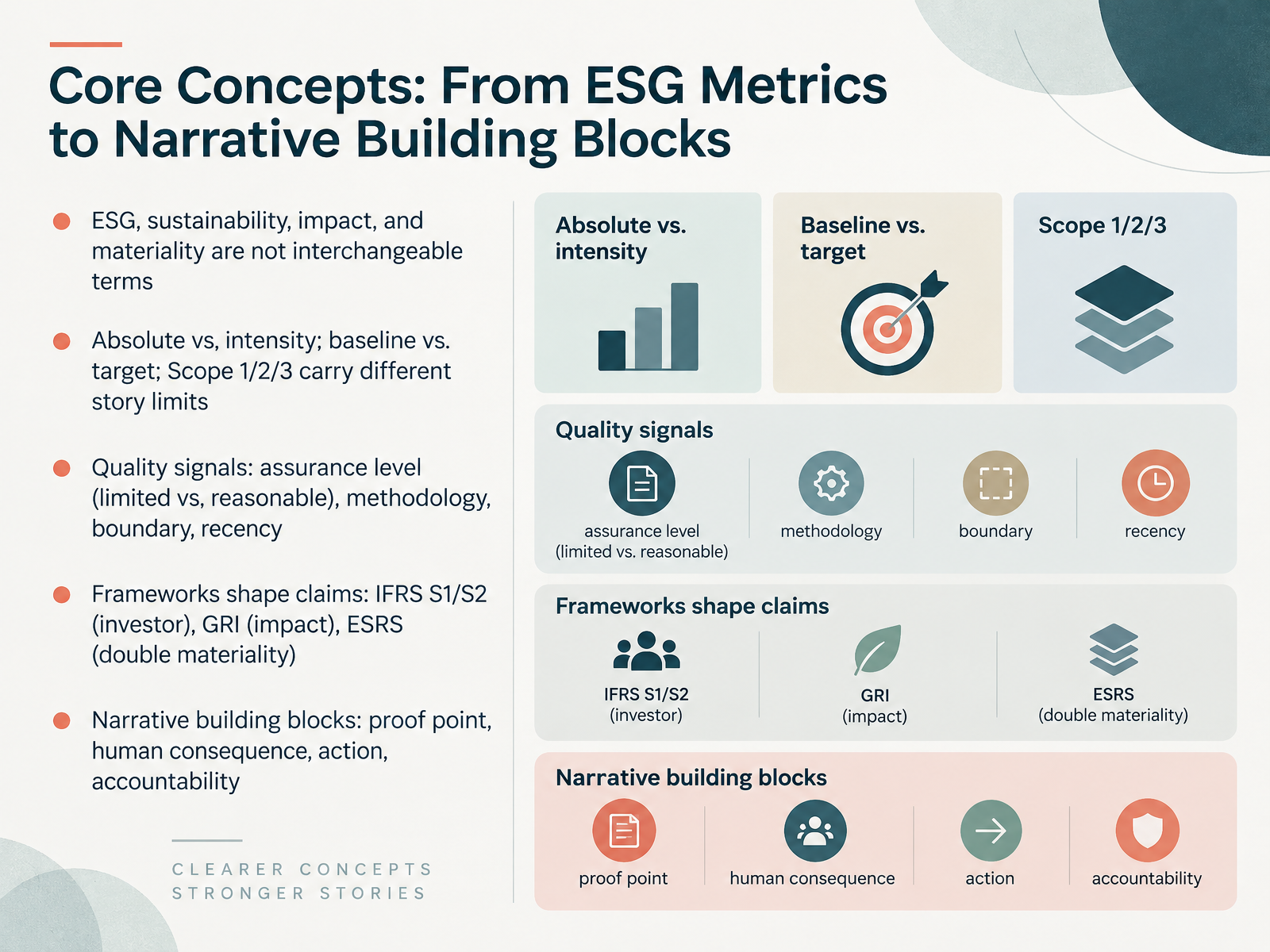
- 04Core Concepts: From ESG Metrics to Narrative Building BlocksNow let us look at the building blocks. First, ESG, sustainability, impact, and materiality are not interchangeable, so define each one before you use it. Then read your numbers carefully. Absolute and intensity tell different stories, and a target only makes sense against a stated baseline. Scope one, two, and three emissions, meaning direct, energy, and value-chain emissions, carry different story limits, because Scope three is mostly estimated. Check quality signals too: assurance level, either limited or reasonable, plus methodology, boundary, and recency. Frameworks shape your claims. The IFRS S one and S two standards serve investors, G R I covers impact, and E S R S uses double materiality, weighing impact on the company and on the world. Finally, build every claim from four blocks: a proof point, the human consequence, the action taken, and who is accountable. One takeaway to repeat: match the metric to the claim before you tell the story. Next, we move to Workflow Step 1: Source and Verify the Data.
 ifrs.orgifrs.orgspglobal.com+22 min
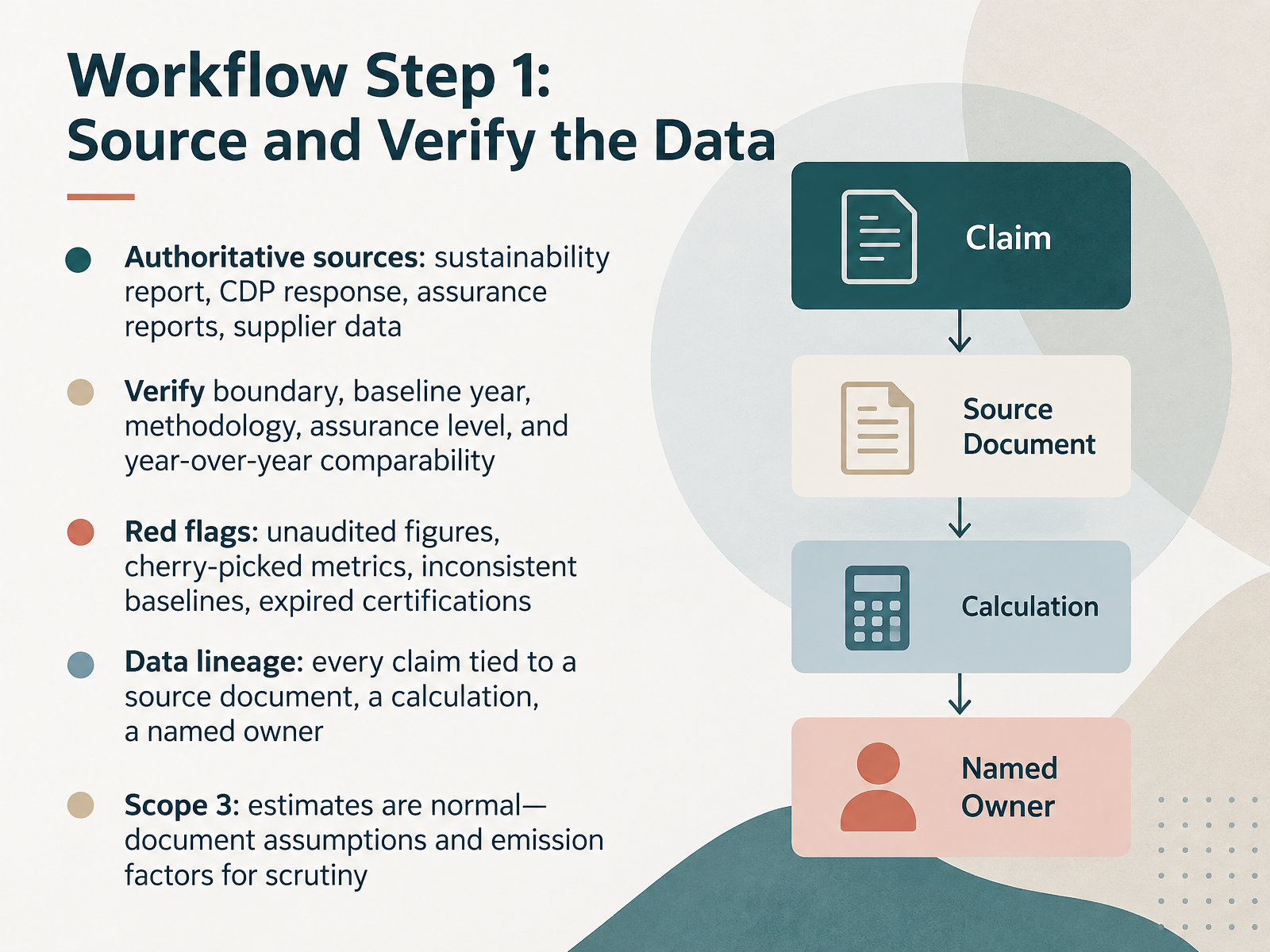
- 05Workflow Step 1: Source and Verify the DataLet's start with step one: sourcing and verifying the data. Pull from authoritative sources first. That means your sustainability report, your CDP response, assurance reports, and supplier data. Then verify five things: the boundary, the baseline year, the methodology, the assurance level, and year-over-year comparability. Assurance level matters here. Limited assurance means fewer procedures and heavier reliance on management's assertions, while reasonable assurance tests controls and traces figures to source. Watch for red flags: unaudited figures, cherry-picked metrics, shifting baselines, expired certifications. Build data lineage so every claim ties to a source document, a calculation, and a named owner. And on Scope 3, estimates are normal. Document your assumptions and emission factors so reviewers can follow your logic. Takeaway to repeat: if you can't trace it, don't say it. Next, we'll look at Workflow Step 2: Select Metrics That Can Carry a Story.
 publications.aaahq.orgscsglobalservices.comdeloitte.com+22 min
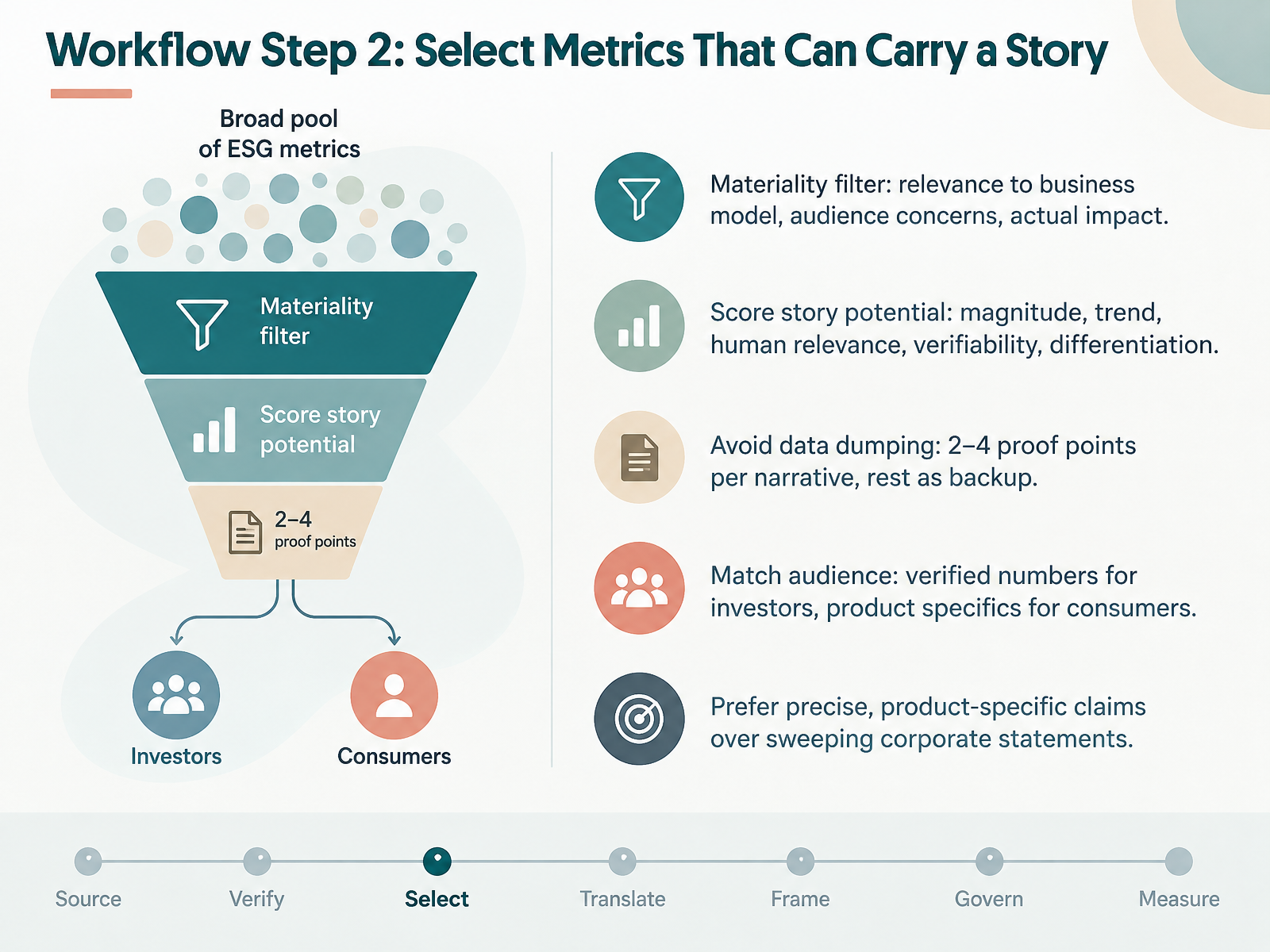
- 06Workflow Step 2: Select Metrics That Can Carry a StoryNow let's choose the metrics. Start with a materiality filter, meaning relevance to three things: your business model, your audience's concerns, and your actual impact. A logistics firm should lead with emissions and labor rights, not water scarcity. Next, score each metric on story potential: magnitude, trend, human relevance, verifiability, and differentiation. Then resist data dumping. Keep two to four proof points per narrative, and hold the rest as backup. Match the audience: investors need verified numbers with clear baselines, while consumers want product specifics. Here's the discipline shift: prefer precise, product-level claims over sweeping corporate statements. If a claim needs a footnote to survive scrutiny, it probably isn't ready to carry your story. One takeaway to repeat to a colleague: fewer claims, better evidenced. That is trust you can defend. Let's take that selected metric and turn it into words a real person understands, in Workflow Step 3: Translate Data into Plain-Language Narrative.
 koganpage.comantigreenwashcharter.orgedie.net+22 min
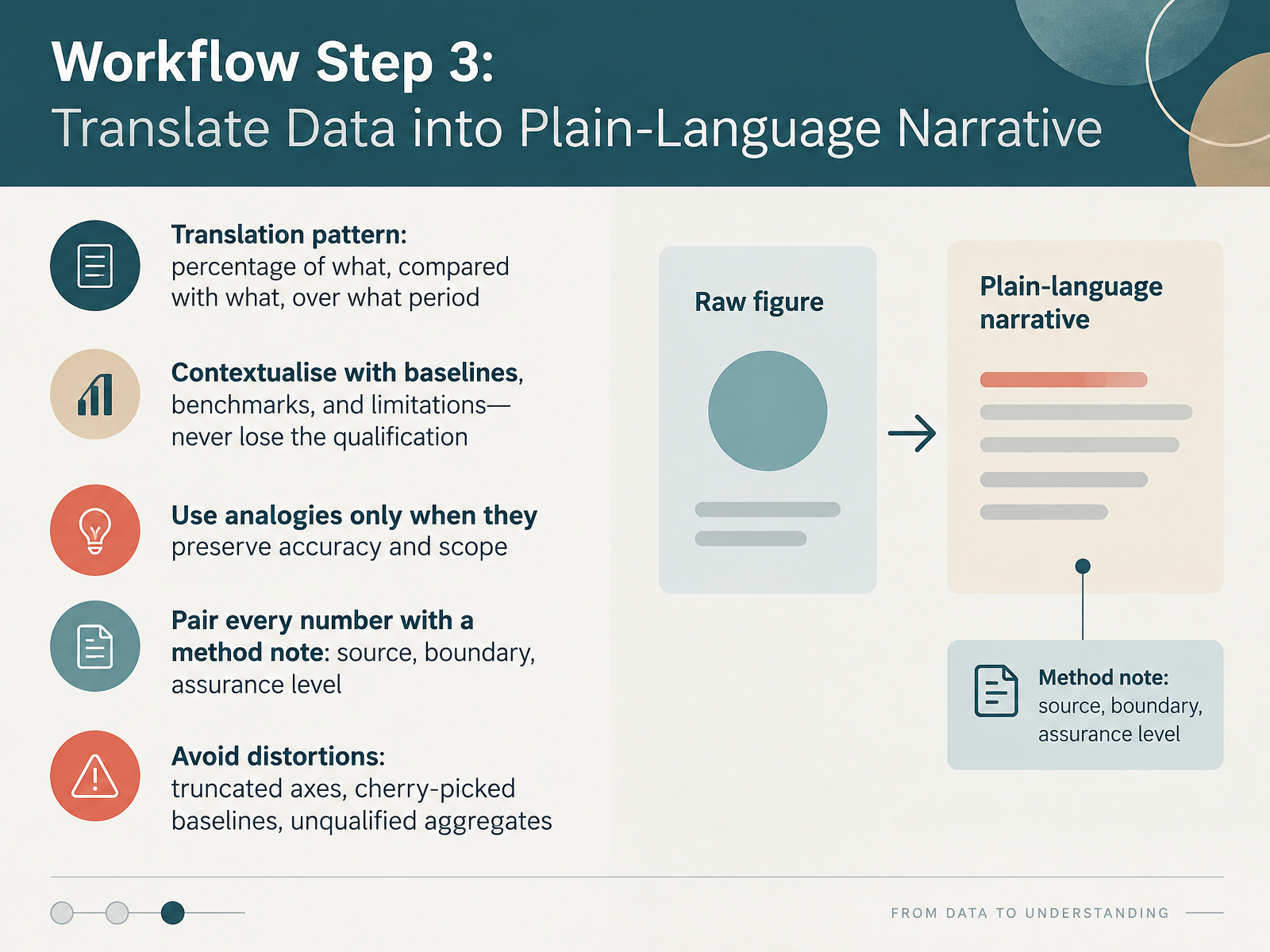
- 07Workflow Step 3: Translate Data into Plain-Language NarrativeNow let's move to step three: translating data into plain-language narrative. Here's the pattern I use. Say the percentage of what, compared with what, over what period. For example, one hundred percent of the energy used to produce this packaging comes from renewable sources. That's specific and defensible, so it survives scrutiny. Keep your baselines, benchmarks, and limitations intact. Never drop the qualification to make a line shorter. Use analogies only when they preserve accuracy and scope. And pair every number with a method note: source, boundary, assurance level. Watch for distortions like truncated axes, cherry-picked baselines, and unqualified aggregates. The takeaway to repeat to a colleague: every number carries its context, or it doesn't ship. Next, we look at the internal handoff, where good data gets lost.
 koganpage.comantigreenwashcharter.orgedie.net+21 min
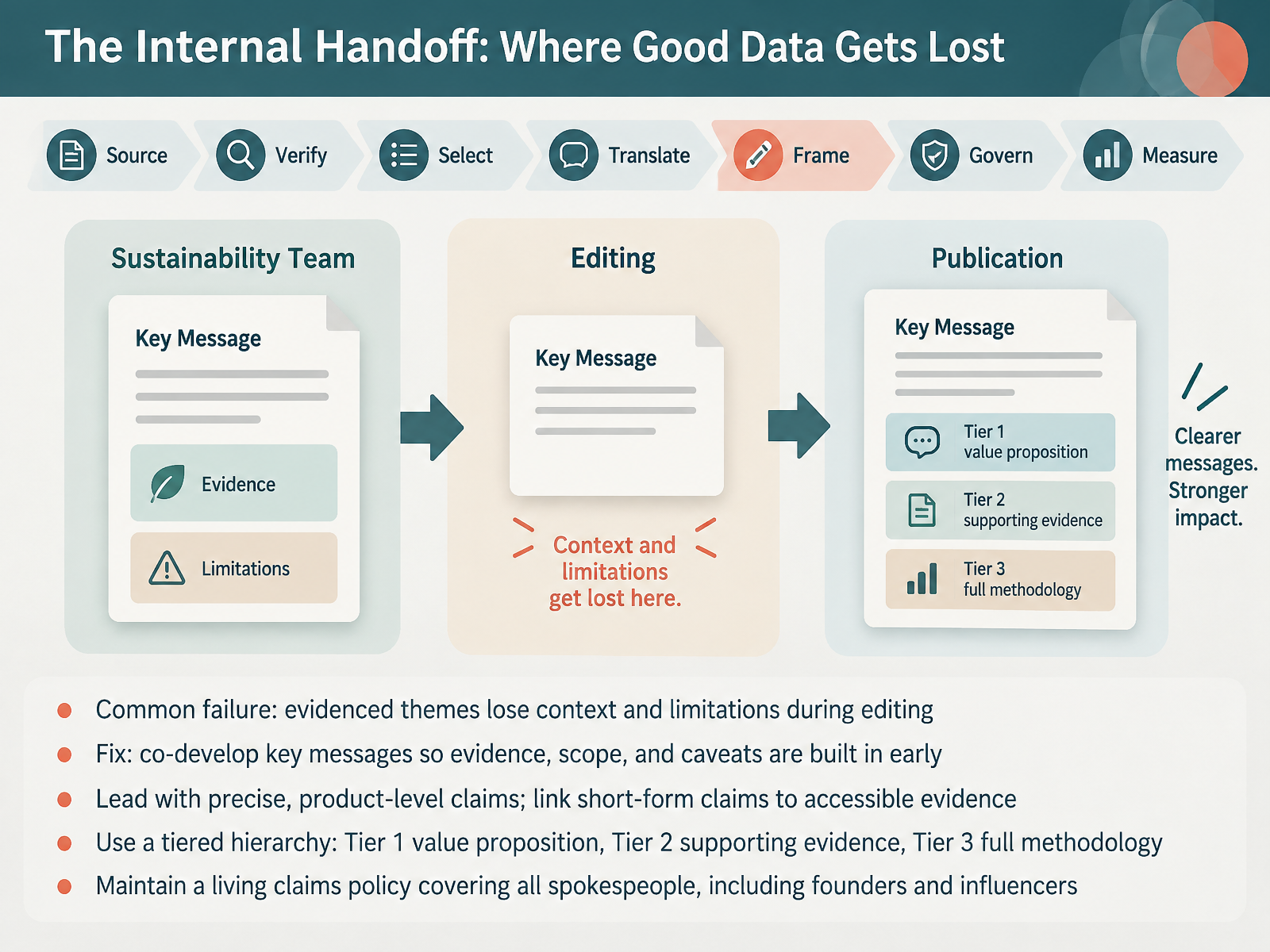
- 08The Internal Handoff: Where Good Data Gets LostNow let's talk about the internal handoff, where good data often gets lost. Here's the common failure. Sustainability specialists propose evidenced themes, then context and limitations get edited away as the material is shortened for marketing. The fix is to co-develop key messages from the start, so evidence, scope, and caveats are built in before anyone edits for length. Lead with precise, product-level claims that you can fully substantiate. Then link every short-form claim to evidence people can actually find. Use a tiered hierarchy. Tier one is the value proposition, the simple point that travels everywhere. Tier two is supporting evidence, like infographics or short films. Tier three is the full methodology for anyone who checks. And maintain a living claims policy, a single source of approved claims, covering every spokesperson, including founders and influencers. Takeaway to repeat: build the evidence in early, and link every short claim to its proof. Next, we move into Workflow Step 4: Frame the Story for Credibility and Audience Fit.
 koganpage.comantigreenwashcharter.orgedie.net+22 min
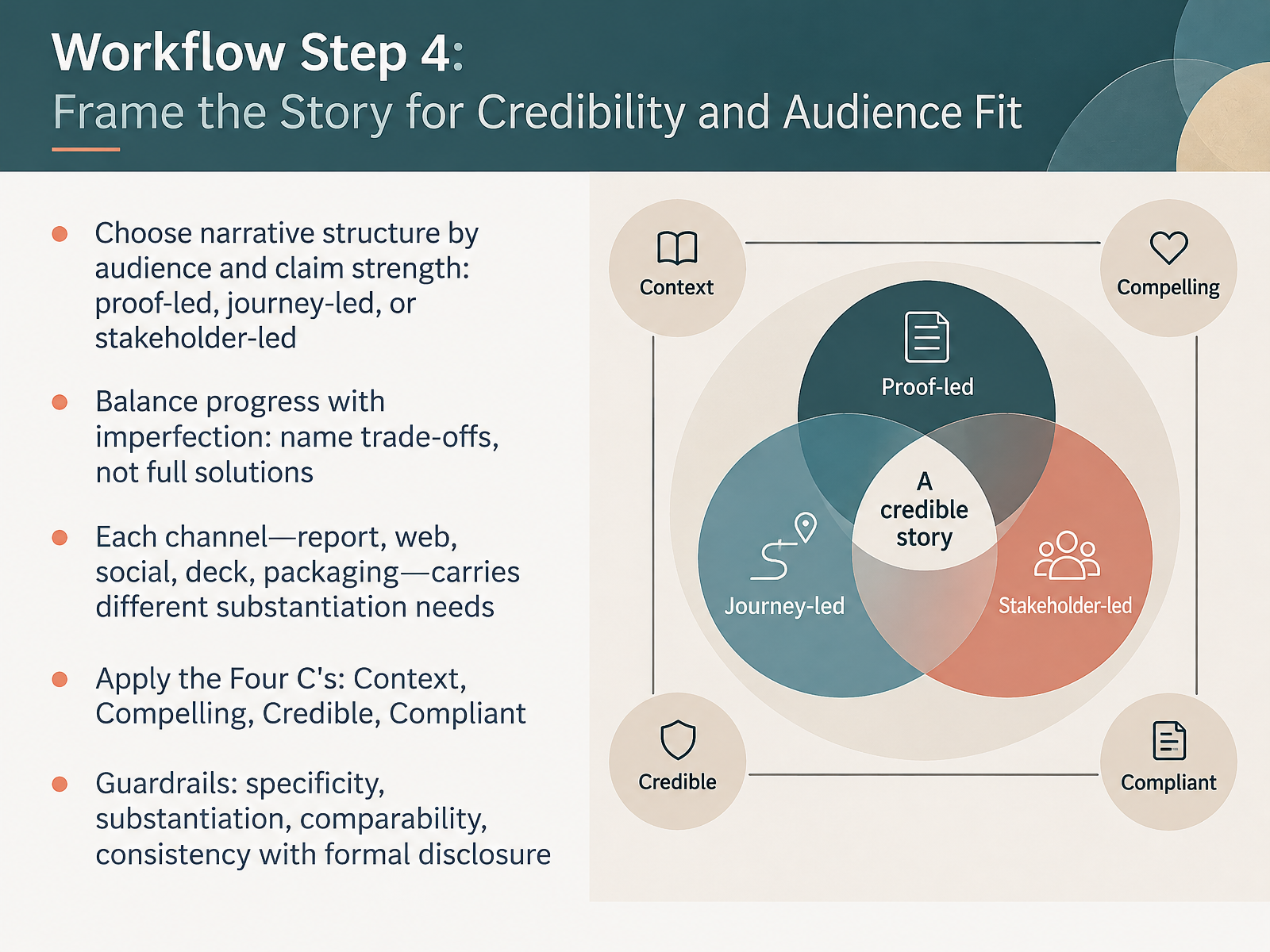
- 09Workflow Step 4: Frame the Story for Credibility and Audience FitNow let's frame the story so it holds up. Choose your structure by audience and claim strength: proof-led when your data is solid, journey-led when progress is real but uneven, stakeholder-led when the value lands with customers or communities. Balance progress with imperfection. Name the trade-off instead of implying a full solution. Each channel carries different substantiation needs. A report can hold scope and caveats. A pack or a social post cannot, so lead with a precise, product-level claim and link to the evidence. Apply the Four Cs: Context, Compelling, Credible, Compliant. Compelling without credible is greenwashing waiting for scrutiny. The guardrails are specificity, substantiation, comparability, and consistency with formal disclosure. One plain takeaway: say less, prove more, and keep every channel speaking from the same evidence base. Next, Workflow Step 5: Govern, Review, and Approve Claims.
 koganpage.comantigreenwashcharter.orgedie.net+22 min
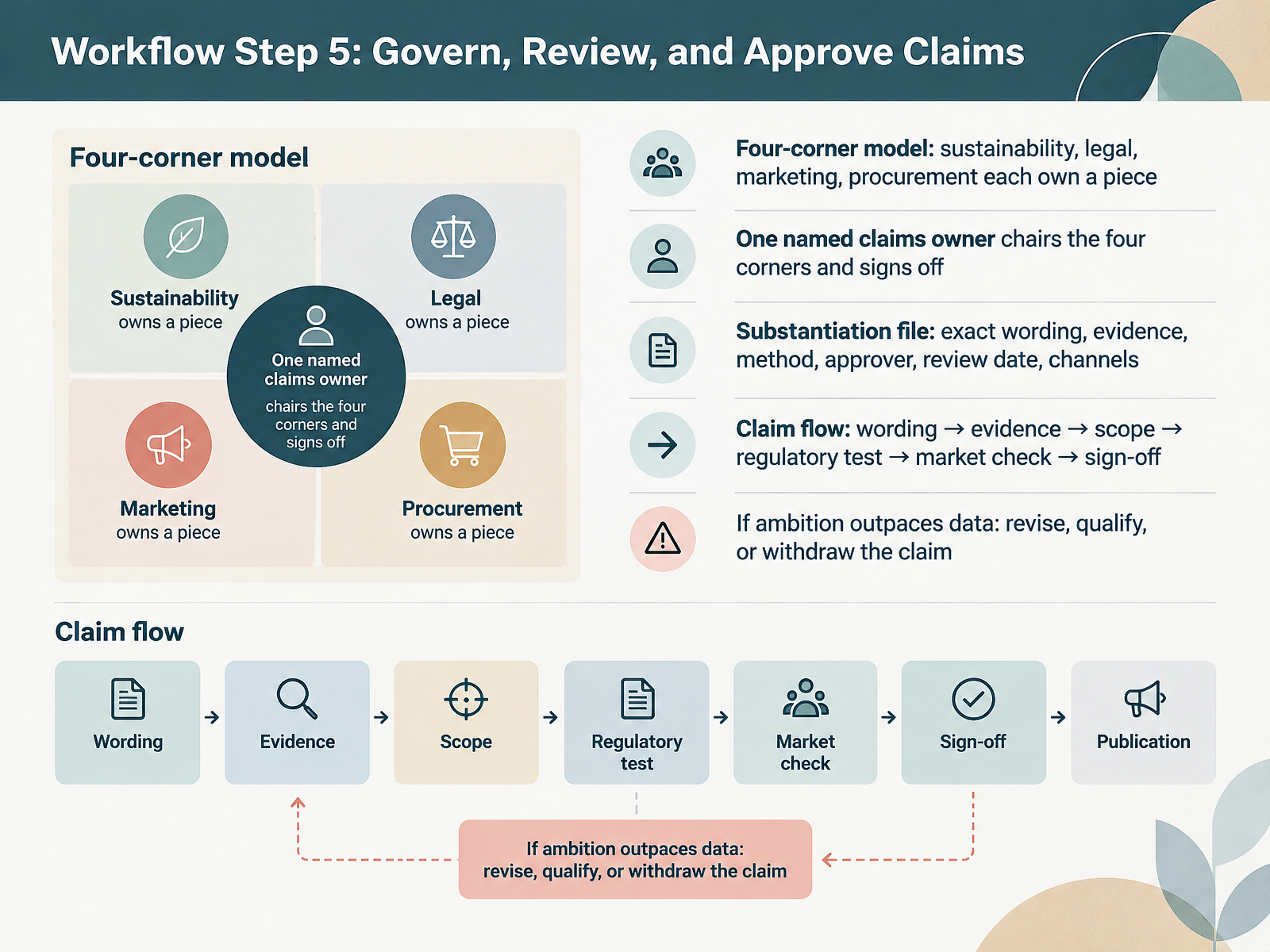
- 10Workflow Step 5: Govern, Review, and Approve ClaimsNow let's talk about governance, because a good claim with a weak approval process still becomes a risk. Start with the four-corner model. Sustainability owns the evidence. Legal owns the interpretation. Marketing owns the wording and channel. Procurement owns supplier evidence. One named claims owner chairs those four corners and signs off before anything publishes. This matters because the most common structural defect is six functions each owning a piece and nobody owning consistency.
Every approved claim gets a substantiation file. It records the exact wording, the evidence, the method, the approver, the review date, and every channel where the claim appears. Exact wording matters, because small edits can shift the compliance position.
The flow runs in one direction. Wording, then evidence, then scope check, then regulatory test, then market check, then sign-off. Here's the honest part. If your ambition outpaces your data, you have three options. Revise the claim, qualify it, or withdraw it. Choose one. Don't publish and hope.
Takeaway: one named owner, one evidence file, one sign-off before publication.
Next, Workflow Step 6: Measure Narrative Impact and Iterate.
 politico.eueuroparl.europa.euenvironment.ec.europa.eu+22 min
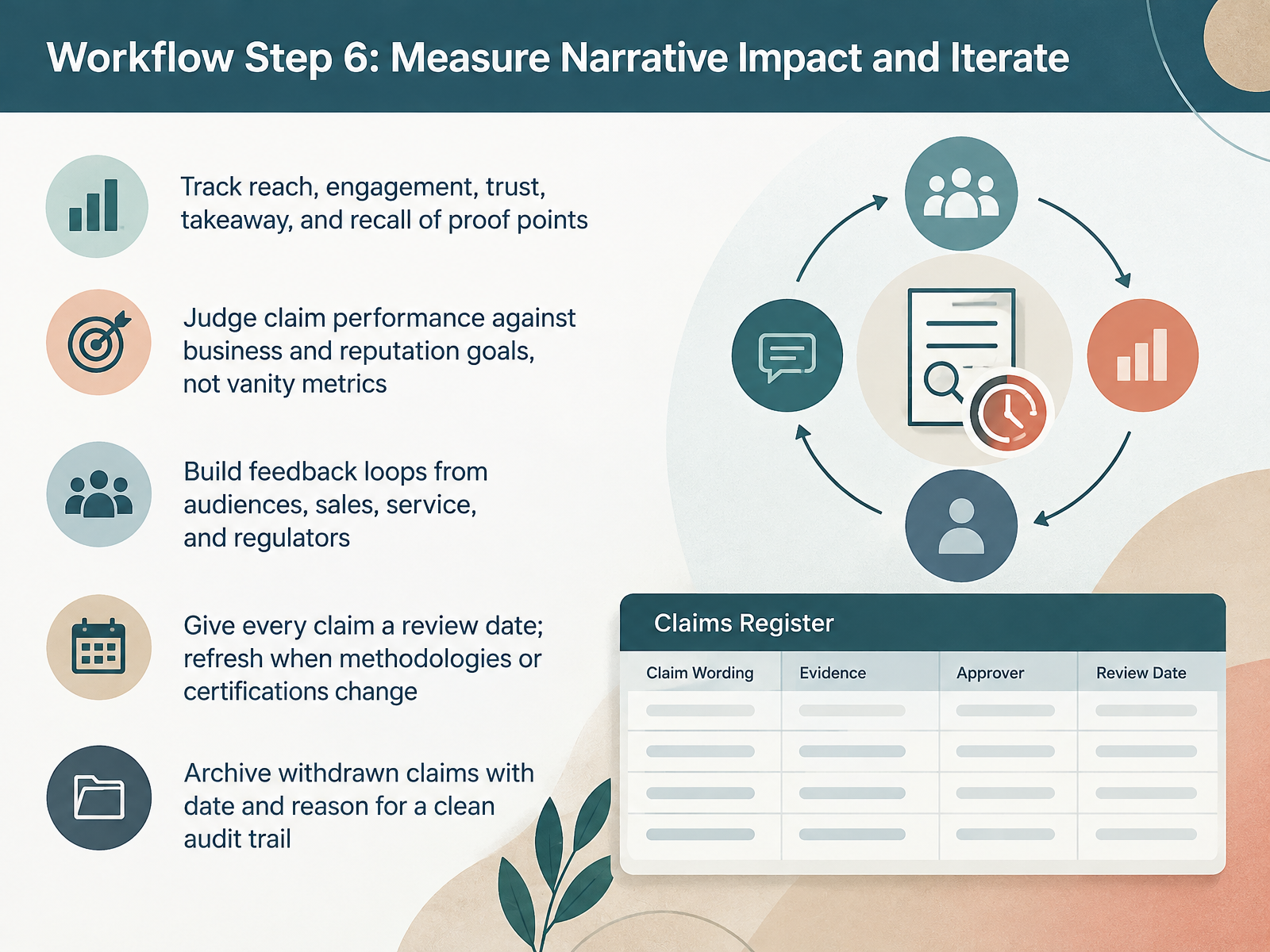
- 11Workflow Step 6: Measure Narrative Impact and IterateNow let's close the loop. Step six is measurement, and the trap here is vanity metrics. Reach and engagement are inputs, not outcomes. Track five things: reach, engagement, trust, takeaway, and recall of your proof points. Trust and recall are what tell you whether the claim actually landed.
Judge claim performance against your business and reputation goals, not likes. Then build feedback loops from audiences, sales, service, and regulators. Your service team hears the objections first, so treat them as free research.
Give every claim a review date. Certifications expire and methodologies update, so a claim that was true last year may not be defensible now. And when you withdraw a claim, archive it with the date and the reason. That gives you a clean audit trail when someone asks why you stopped saying it.
One takeaway to repeat to a colleague: a claim without a review date is a claim waiting to expire.
Next, let's put this into practice in the hands-on lab, where you'll build a claim-supported story from a dataset.
 koganpage.comantigreenwashcharter.orgedie.net+22 min
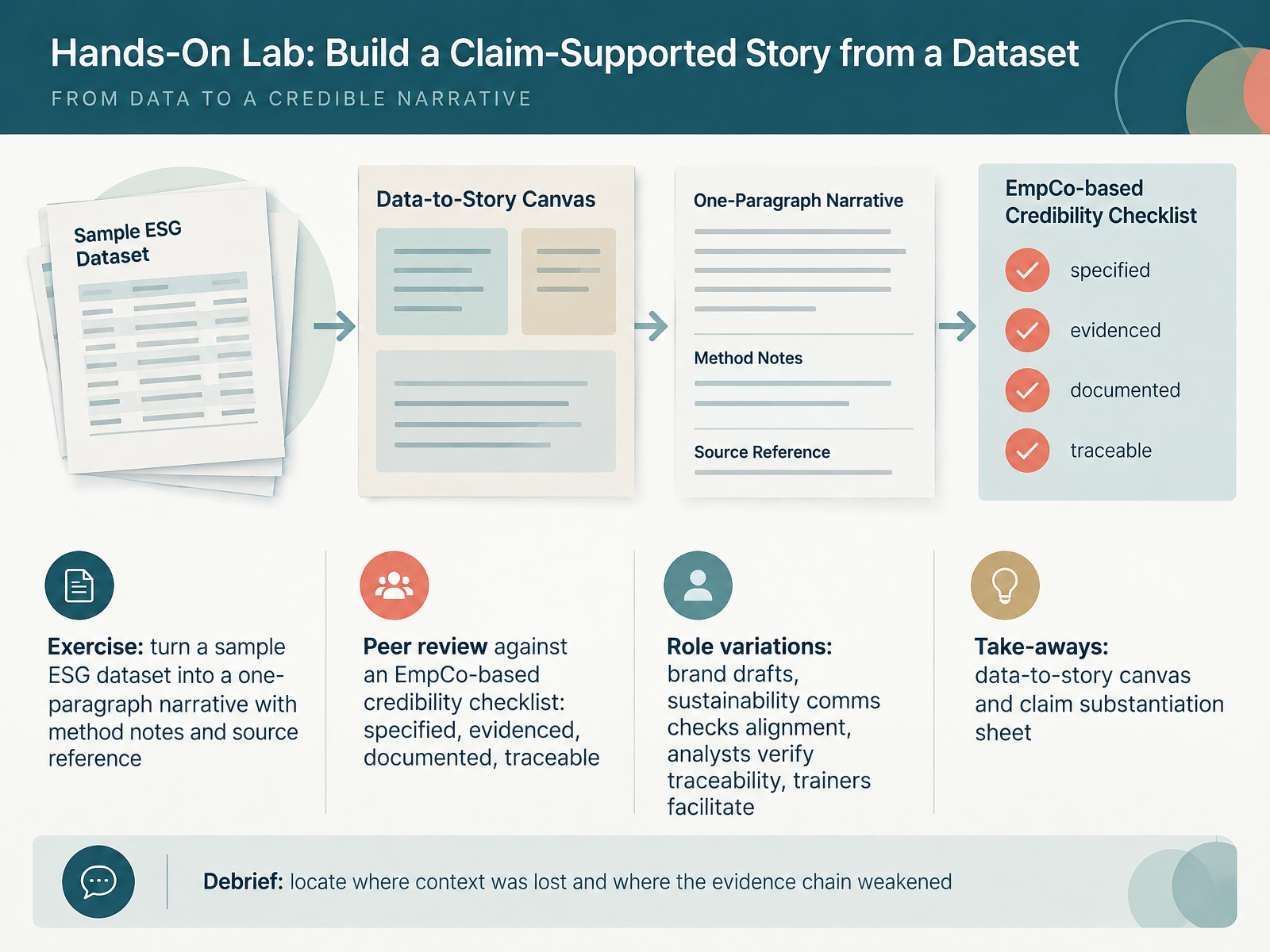
- 12Hands-On Lab: Build a Claim-Supported Story from a DatasetNow let's put that into practice with a hands-on lab. Take the sample ESG dataset and write a one-paragraph narrative that includes method notes and a source reference. Then swap drafts and peer review against the EmpCo-based credibility checklist: specified, evidenced, documented, and traceable. Specified means the claim names its scope, so a recycled-content figure states the product and the percentage, not simply greener packaging. Evidenced means the supporting data can actually carry the wording. Documented means the method, assumptions, and factor source are written down. Traceable means a reviewer can follow the figure back to its origin. Split the roles: brand people draft, sustainability communications checks alignment, analysts verify traceability, and trainers facilitate. Debrief by locating exactly where context got lost and where the evidence chain weakened. Your take-aways are the data-to-story canvas and the claim substantiation sheet. Next, we'll cover role action plans and common pitfalls to avoid.
 publications.aaahq.orgscsglobalservices.comdeloitte.com+22 min
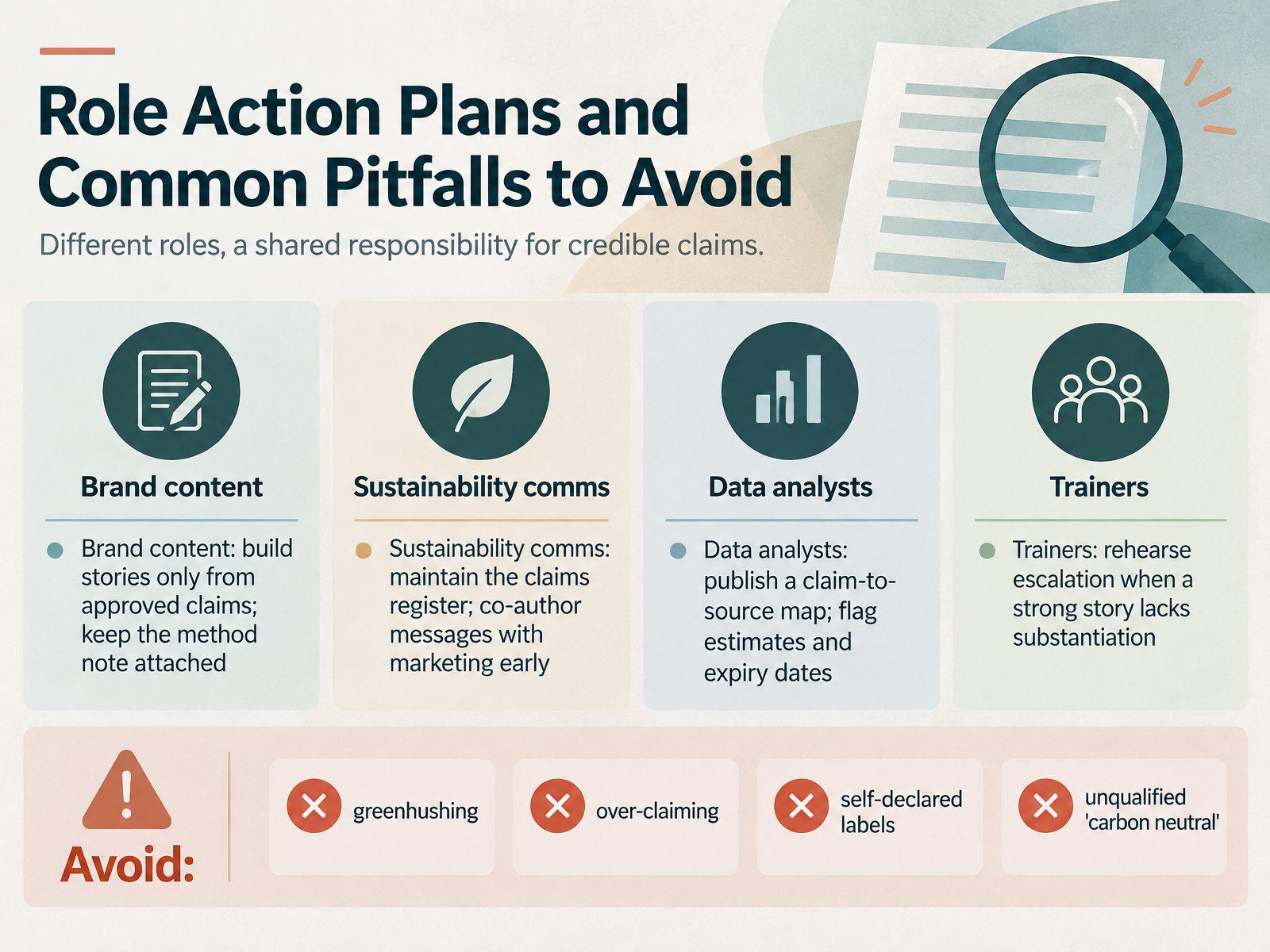
- 13Role Action Plans and Common Pitfalls to AvoidNow let's turn roles into action plans, and name the pitfalls. Brand content: build stories only from approved claims, and keep the method note attached. If you shorten a claim, never strip the qualification, because that is where greenwashing risk sneaks in. Sustainability comms: keep the claims register current, meaning the list of every active claim with its exact wording and evidence reference, and co-author messages with marketing early, not at review time. Data analysts: publish a claim-to-source map, and flag every estimate and expiry date honestly. Trainers: rehearse escalation for the moment a strong story has no substantiation behind it. Four things to avoid: greenhushing, which is staying silent out of fear; over-claiming; self-declared labels without external validation; and an unqualified carbon neutral. That means stating it without explaining how offsets or methodology support it. The takeaway to repeat: if we can't trace it, we don't say it. Next, we move into the checklist, templates, and next steps.
 koganpage.comantigreenwashcharter.orgedie.net+21 min
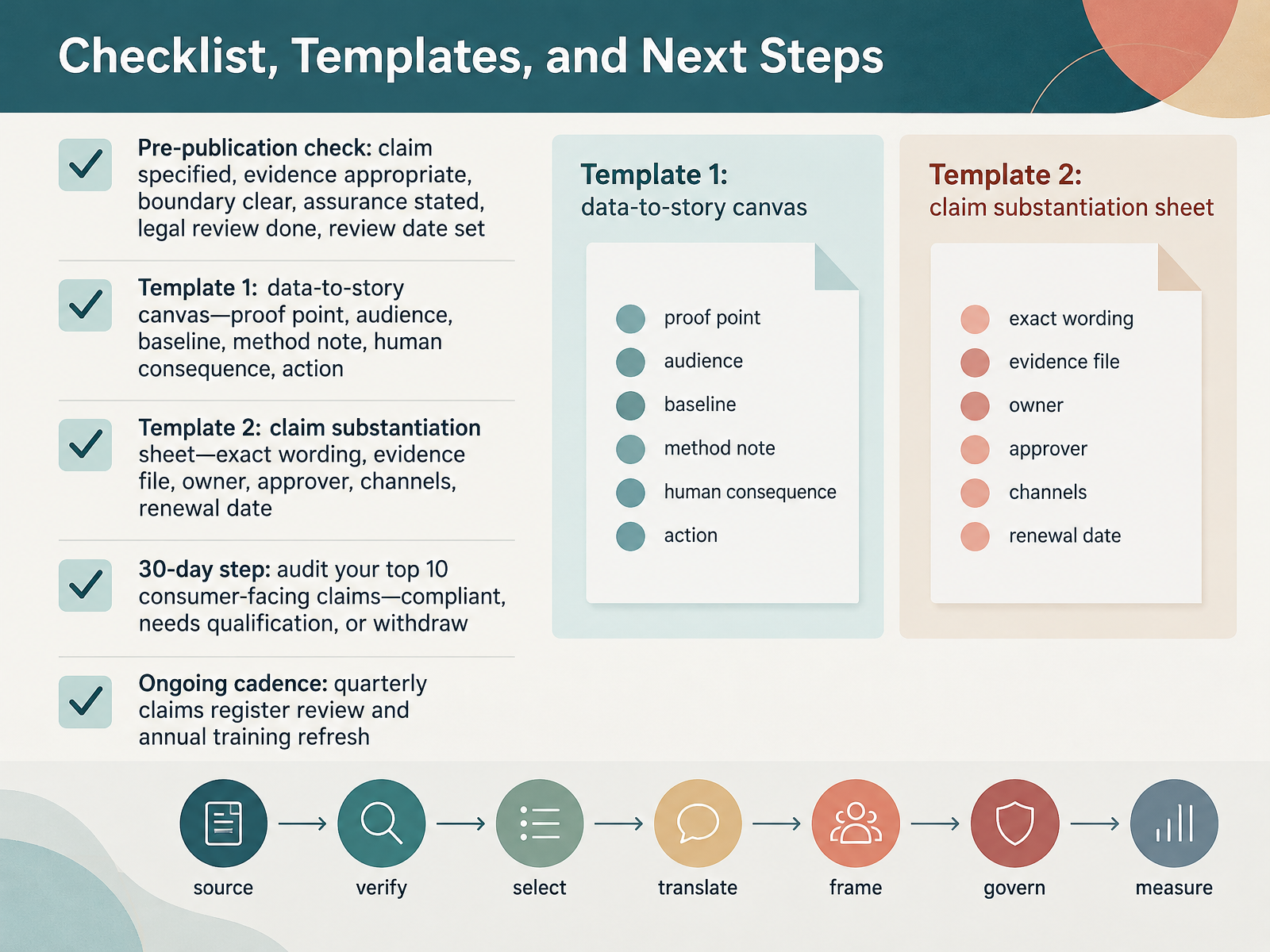
- 14Checklist, Templates, and Next StepsLet's close with the tools you'll actually use. Before anything publishes, run six checks: the claim is specified, the evidence fits the wording, the boundary is clear, any assurance is stated, legal review is done, and a review date is set. If any box is empty, it doesn't ship.
Template one is a data-to-story canvas. Six fields: proof point, audience, baseline, method note, human consequence, and the action you want. Template two is a claim substantiation sheet. Record the exact wording, the evidence file, the owner, the approver, the channels where it runs, and the renewal date. One named claims owner signs off on every new claim.
Your thirty-day step: audit your top ten consumer-facing claims. Sort each one as compliant, needs qualification, or withdraw. Then keep a quarterly claims register review and an annual training refresh.
So, the takeaway to repeat to a colleague: every claim needs a file, an owner, and a date. Thank you for working through this with me. You now have a workflow you can defend. Start with those ten claims this week, and keep the standard honest and simple.
 politico.eueuroparl.europa.euenvironment.ec.europa.eu+22 min
Take the deck with you
Download this course as a file — free, no sign-up needed.
- PDF handoutEvery slide page, ready to print or share.15 pages · 3.5 MBDownload
- Narrated PowerPointThe deck that presents itself — every slide carries the digital human's narration video.15 pages · 26.4 MBDownload
- PowerPoint slidesThe full deck as a .pptx — open it in PowerPoint, Keynote, or Google Slides.15 pages · 3.5 MBDownload
Free to use in your own training — please keep the PersonWise credit page at the end.
Have your own deck? Turn it into a course
Sources consulted
Web sources consulted while building this course.
- Brussels has a one-legged plan to fight greenwashing – POLITICO — politico.eu
- Carriages preview | Legislative Train Schedule — europarl.europa.eu
- Green claims - Environment - European Commission — environment.ec.europa.eu
- EU consumer rules on environmental claims and how to use C2C Certified® — cms.dataverse.c2ccertified.org
- EU Directive on Empowering Consumers for the Green Transition: Commission updates its FAQs, Alexia Kaztaridou — sustainablefutures.linklaters.com
- IFRS - Introduction to the ISSB and IFRS Sustainability Disclosure Standards — ifrs.org
- IFRS - Use of IFRS Sustainability Disclosure Standards by jurisdiction — ifrs.org
- Where does the world stand on ISSB adoption? | S&P Global — spglobal.com
- Application of IFRS S1 and IFRS S2 — ifrs.org
- IFRS Sustainability Reference Group — ifrs.org
- Current Developments in Sustainability Assurance: Impact of Emerging Regulations | Current Issues in Auditing | American Accounting Association — publications.aaahq.org
- Preparing for CSRD Assurance: An Auditor's Perspective on Double Materiality, Scope 3, and ESRS Readiness — scsglobalservices.com
- How independent assurance can support reliance on your third-party sustainability data | Deloitte UK — deloitte.com
- Full article: Assuring sustainability information: lessons to be learned from financial statement audit engagements — tandfonline.com
- Scope 3 Reporting Is Turning Disclosure Into Evidence | E+E Leader — environmentenergyleader.com
- The Four C's of Effective Sustainability Storytelling | Kogan Page — koganpage.com
- Trusted Communications for Purpose-Led Brands — antigreenwashcharter.org
- The reporting-to-marketing handoff: What does successful sustainability communications look like? - edie — edie.net
- ESG Storytelling: Aligning Corporate Action With Narrative | Hubbard School of Journalism and Mass Communication — hubbardschool.umn.edu
- ESG Communications: How to Build a Defensible Sustainability Narrative | EcoVadis — ecovadis.com