Brand Strategy Fundamentals
Begin
14 pages · ~28 min
Brand Strategy Fundamentals
A foundational course on brand strategy, teaching learners why it matters and how to apply strategic thinking to build a compelling brand.
What you’ll learn
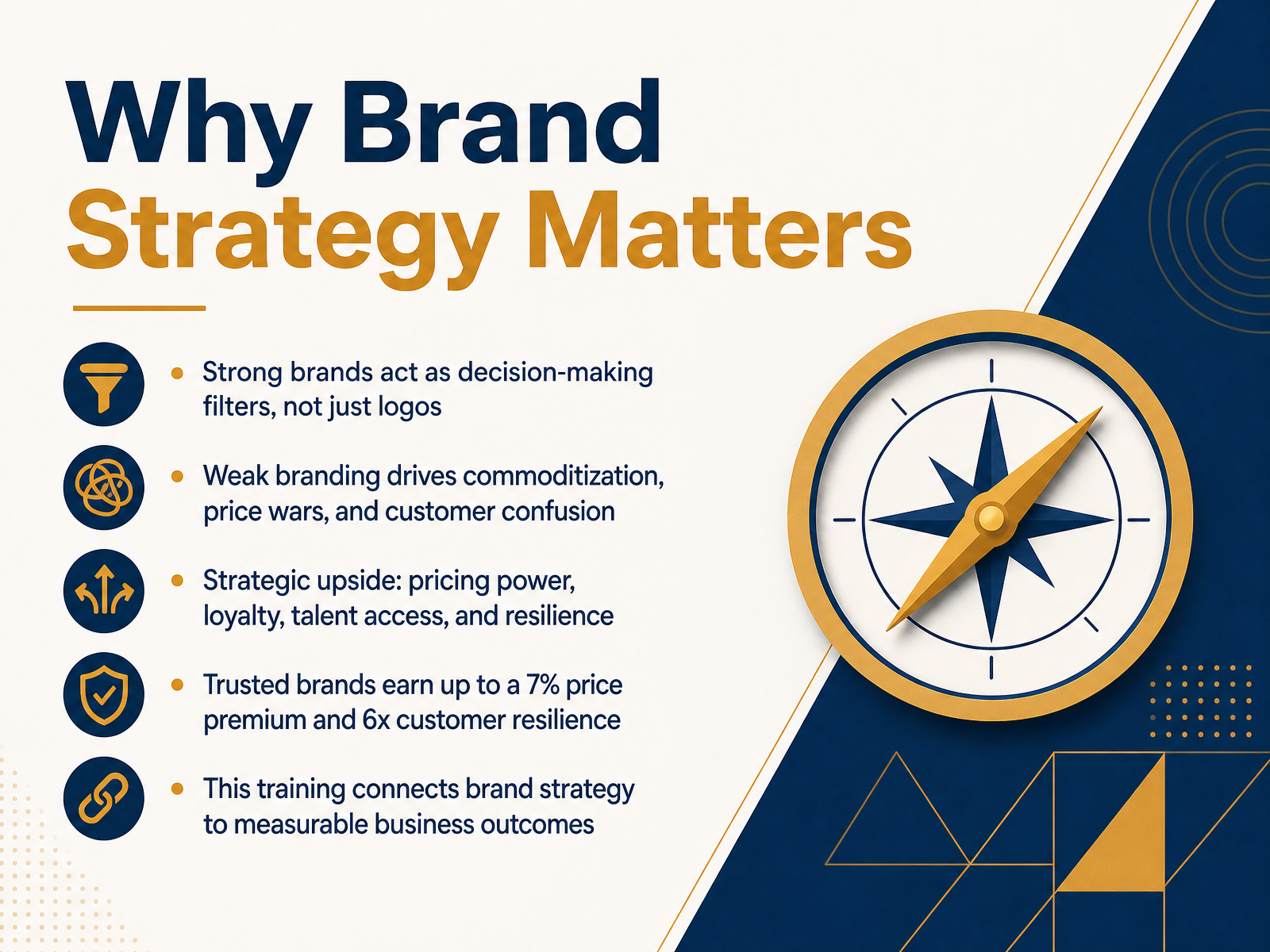
- 01Why Brand Strategy MattersWelcome. If you're leading a business, a product, or a marketing team, you've probably felt the pressure to prove that every dollar works. Today we're going to tackle one of the most misunderstood assets in your company: brand strategy. Let's start with a hard truth. A strong brand is not a logo or a tagline. It's a decision-making filter. It helps customers choose you faster, and it helps your own team decide what to build and what to say. Now, what happens with weak branding? Commoditization. Price wars. Customer confusion. You end up competing on price because there's nothing else to compete on. The upside is real though. Strong brands earn pricing power, deeper loyalty, access to better talent, and resilience when markets get tough. The data backs this up. Trusted brands can command up to a seven percent price premium, and customers are six times more likely to stick with them. Over the next few minutes, we'll connect brand strategy directly to measurable business outcomes, not just warm feelings. Let's get into what this training covers.bcg.comfospha.commarketingweek.com+22 min
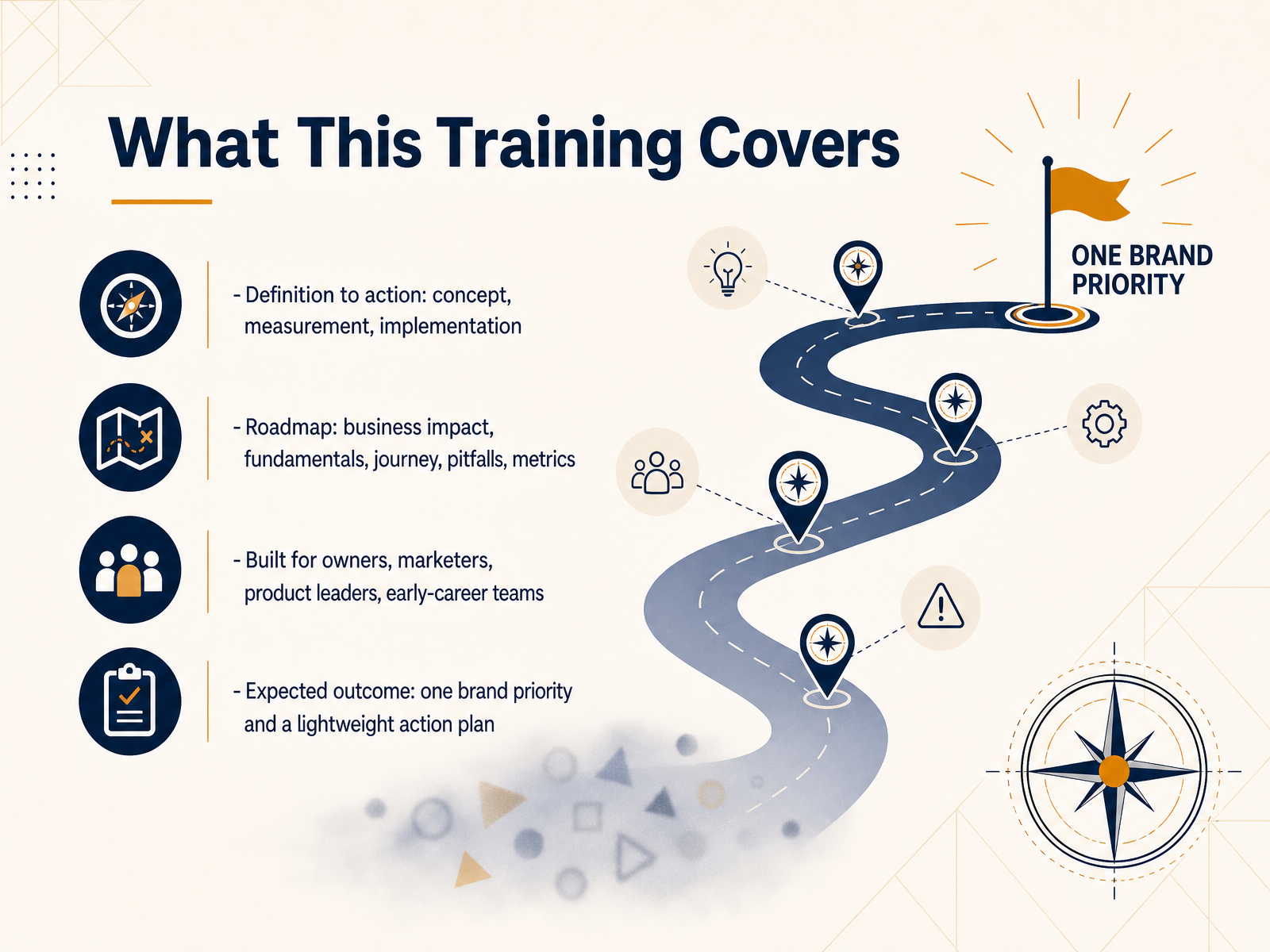
- 02What This Training CoversHere's what we're going to cover and, more importantly, what you'll leave with. We're not stopping at theory. We'll move from definition to action, covering the concept, how to measure it, and how to implement it. The roadmap takes you through business impact, the core fundamentals, the customer journey, common pitfalls, and the metrics that matter. This is built specifically for owners, marketers, product leaders, and early-career teams. No jargon, just practical tools. And here's the key outcome. By the end, you'll have one clear brand priority and a lightweight action plan you can start using immediately. Up next, we'll clarify the foundation by breaking down the difference between brand, branding, and brand strategy.
 monday.commarketingmo.comblog.momoadvisors.com+21 min
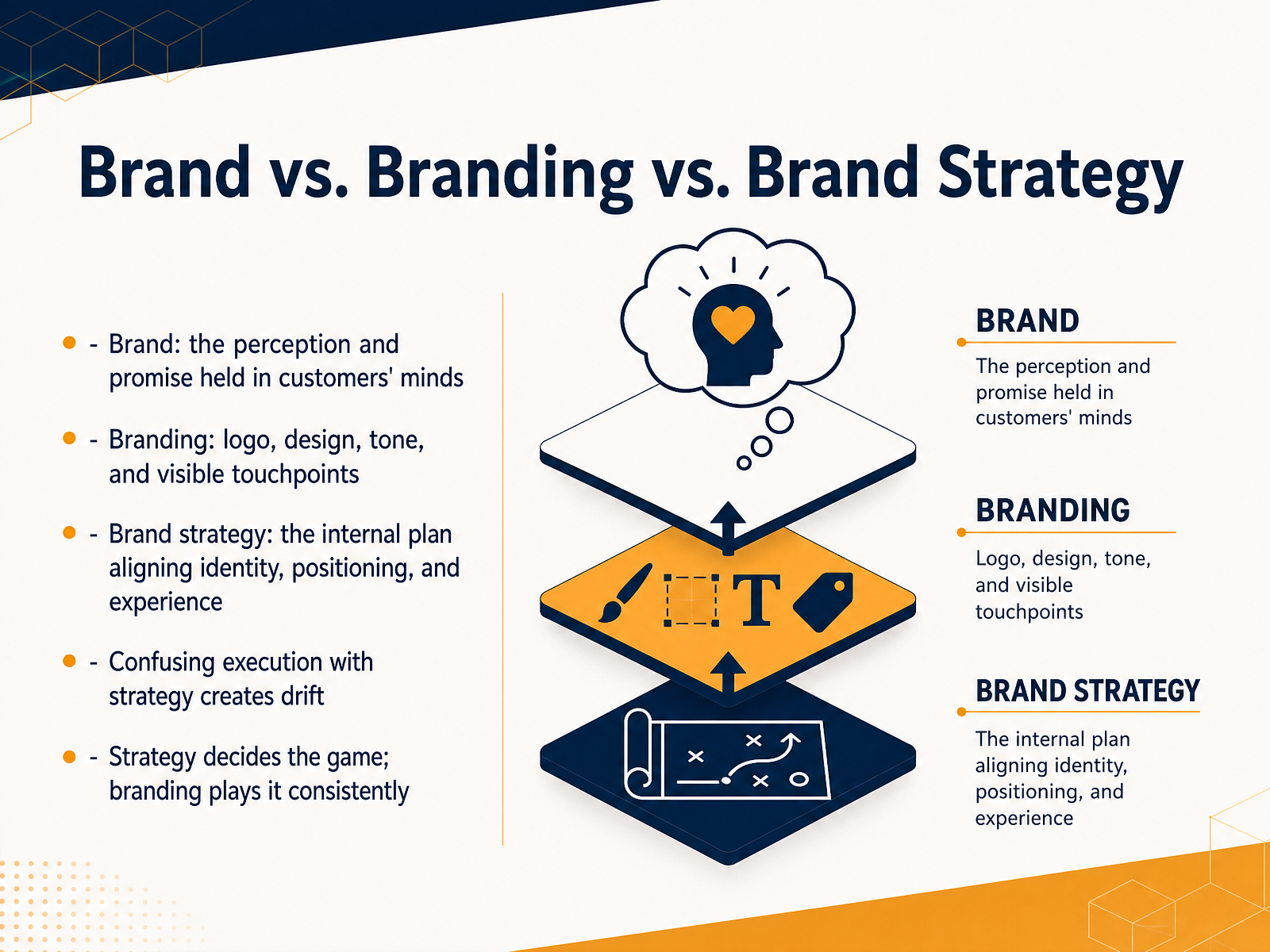
 - 03Brand vs. Branding vs. Brand StrategyLet's clear up a common source of confusion, because these three terms get used interchangeably all the time. Brand is the perception in your customer's mind. It's the promise they believe you'll keep. Branding, on the other hand, is the visible stuff. It's your logo, your colors, your tone of voice, the design of your website. Those are touchpoints. Brand strategy is the internal plan that sits underneath both. It aligns your identity, your market position, and the experience you deliver. Here's where teams get into trouble. They confuse execution with strategy. They think updating a logo is a strategy. It's not. That's just the paint job. Without a strategy, those visual updates and messaging changes create drift. Every campaign looks different, every team sounds different, and customers get confused about who you actually are. Think of it this way. Strategy decides which game you're playing and how you win. Branding plays that game consistently across every channel. Get the strategy right, and the execution has purpose. Skip it, and you're just making noise. Now, let's look at the business case for brand strategy.
 monday.commarketingmo.comblog.momoadvisors.com+22 min
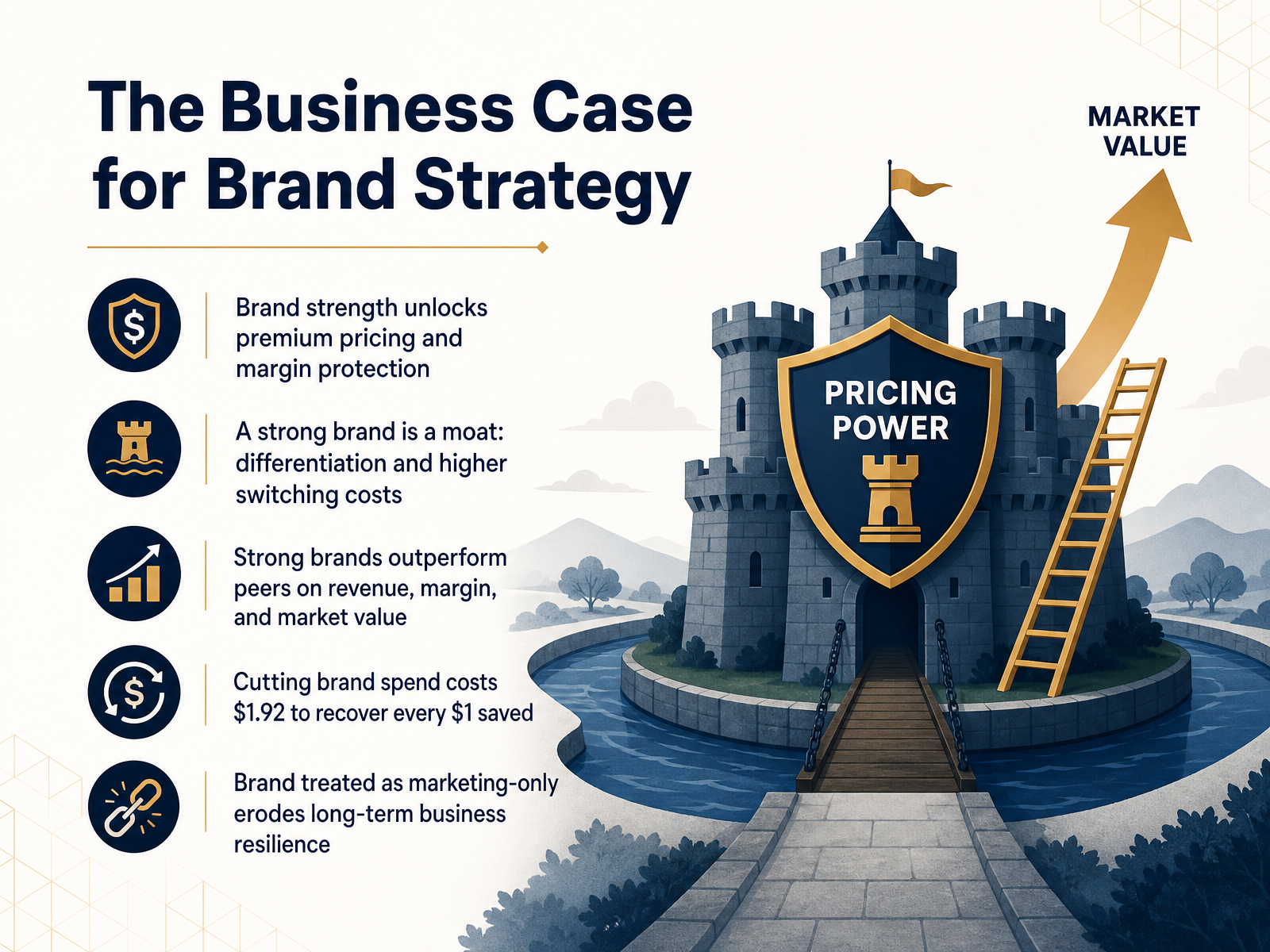
 - 04The Business Case for Brand StrategyLet's talk about the hard numbers behind brand strategy. This is where brand stops being a philosophy and starts being a financial asset. First, brand strength unlocks premium pricing and protects your margins. When customers trust you, they don't just buy from you, they pay more for the privilege. Second, a strong brand is a moat. It differentiates you from competitors and creates higher switching costs for your customers. They stick around because leaving feels like a real downgrade. The data backs this up. Strong brands consistently outperform their peers on revenue, margin, and market value. And here's a number that should stop you cold. Cutting brand spend costs one dollar and ninety-two cents to recover every single dollar saved. That is not a discount. That is a penalty. When brand is treated as marketing-only, it slowly erodes your long-term business resilience. So the takeaway is simple: brand is a compounding investment, not a cost center. That's the business case. Next, let's look at how brand strategy becomes a compass for your decisions.
 bcg.comfospha.commarketingweek.com+21 min
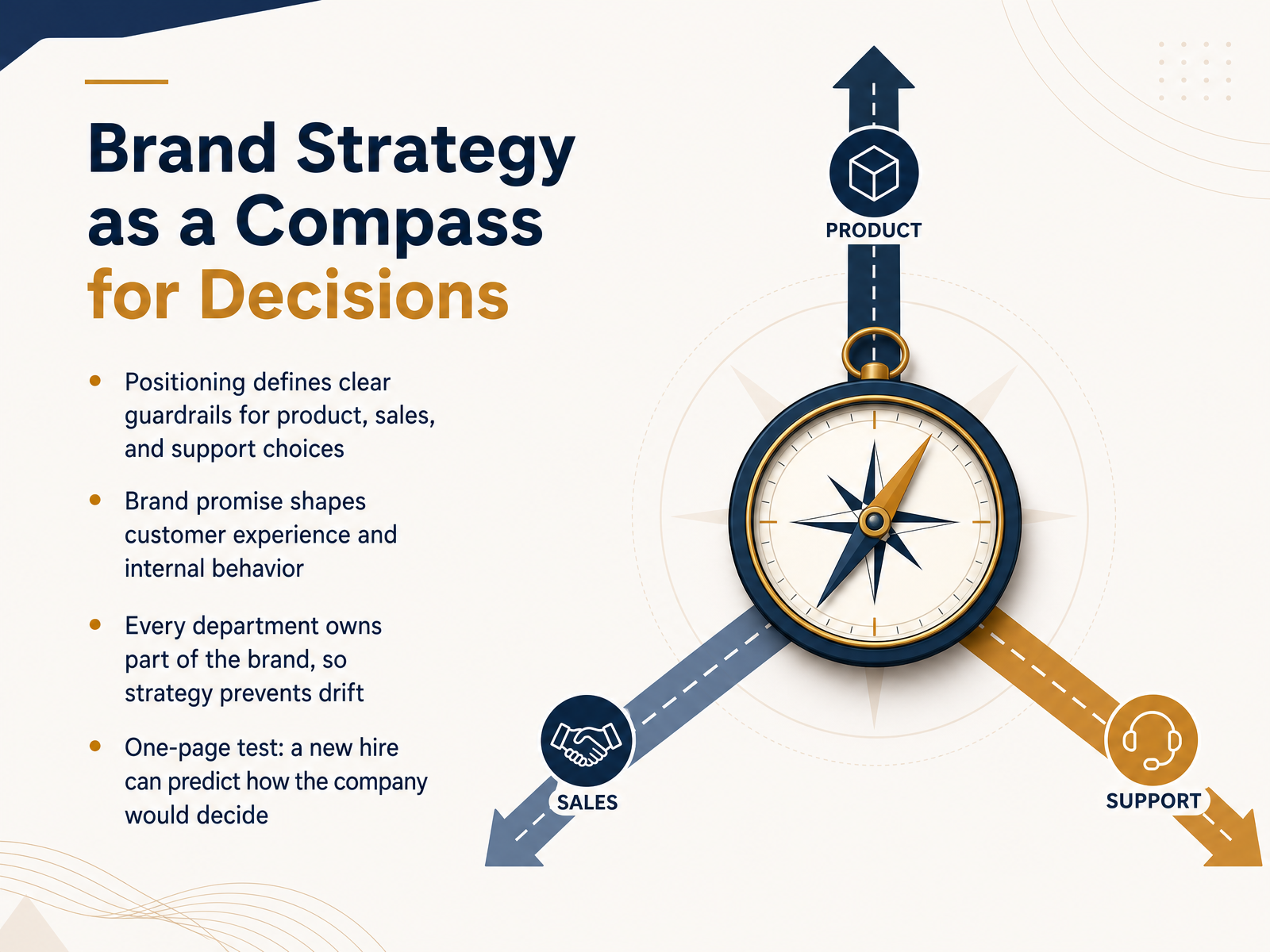
 - 05Brand Strategy as a Compass for DecisionsNow let's talk about how brand strategy serves as a compass for decisions. When your positioning is clear, every team gets guardrails. Product knows what to build. Sales knows what to promise. Support knows how to solve problems. The brand promise shapes the customer experience and it also shapes how your team behaves internally. Here's why that matters. Every department owns a piece of the brand. Product ships features. Sales sets expectations. Support follows through. Without a shared strategy, each team drifts in its own direction and the customer feels that inconsistency. So here's a simple test. Hand a new hire one page with your brand strategy on it. If they can read it and predict how your company would decide on a new feature, a partnership, or a customer complaint, your strategy is working. If they're guessing, it's just decoration. That one-page test is the fastest way to know if your brand is actually guiding decisions, or just sitting in a deck. Next, we'll look at where brand strategy shows up along the customer journey.
 monday.commarketingmo.comblog.momoadvisors.com+22 min
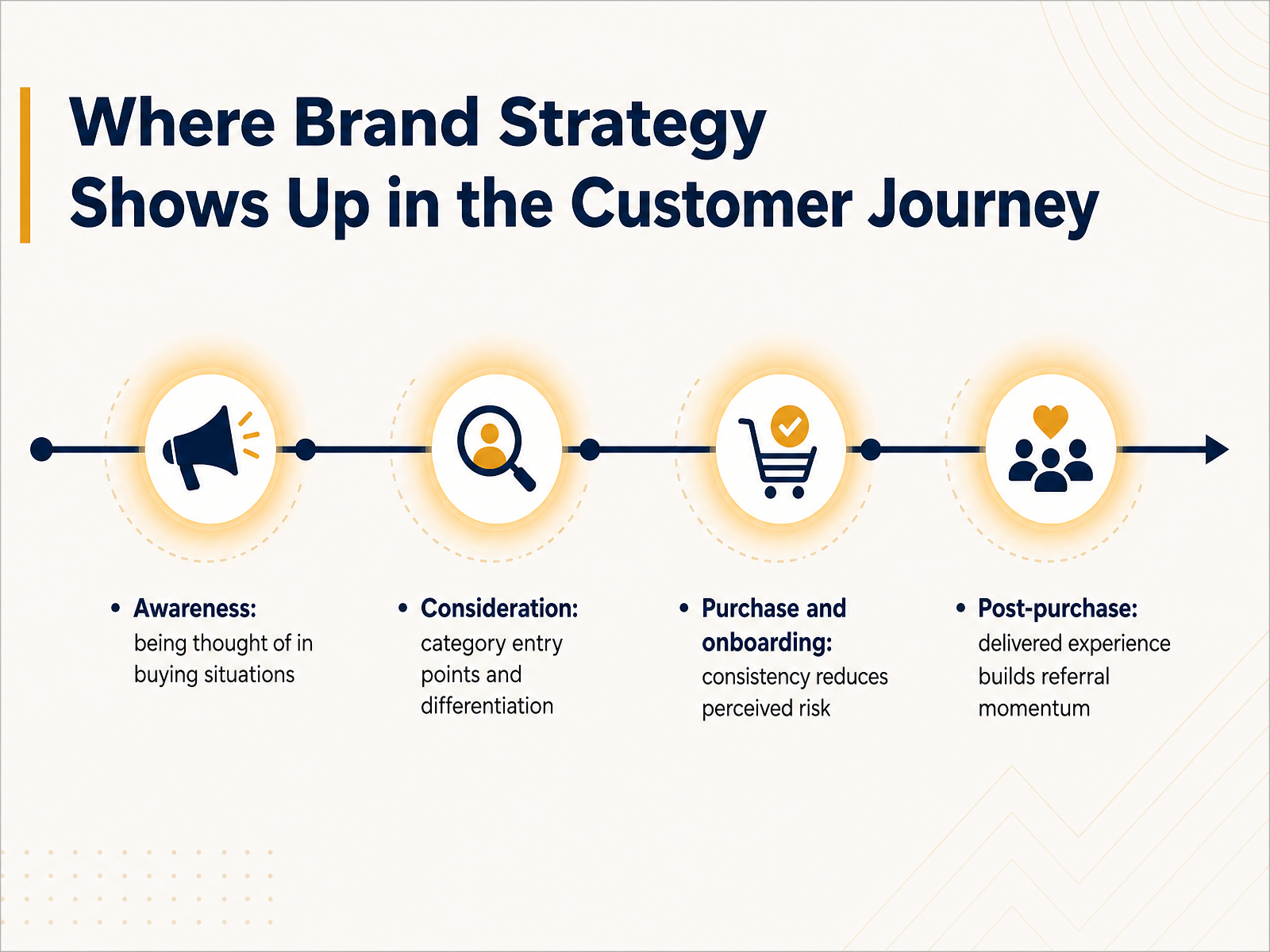
 - 06Where Brand Strategy Shows Up in the Customer JourneyNow let's see where brand strategy actually shows up in the customer journey. It shows up everywhere. In the awareness stage, the goal is to be the first brand that comes to mind in a buying situation. Not just recognized, but thought of. When someone says, I need a quick dinner, which restaurant pops into their head? That's brand strategy at work. During consideration, those mental links get specific. You're building category entry points and showing why you're the right fit. It is not about being loud. It is about being relevant. At purchase and onboarding, consistency lowers the customer's perceived risk. When what they saw matches what they get, trust starts to build. Small details matter. The tone of the confirmation email. The clarity of the setup guide. Then comes post-purchase. The delivered experience can either create a silent churn risk or build referral momentum. A customer who feels taken care of is far more likely to tell someone else. That is how this becomes a growth loop. So brand strategy is not a one-time campaign. It is a system that needs to work at every stage. But to make it work, you first need to understand the core mechanism behind it. Next, we're moving into mental availability, the engine of brand recall.
 sage.cnpereading.comjournals.sagepub.comideas.repec.org+22 min
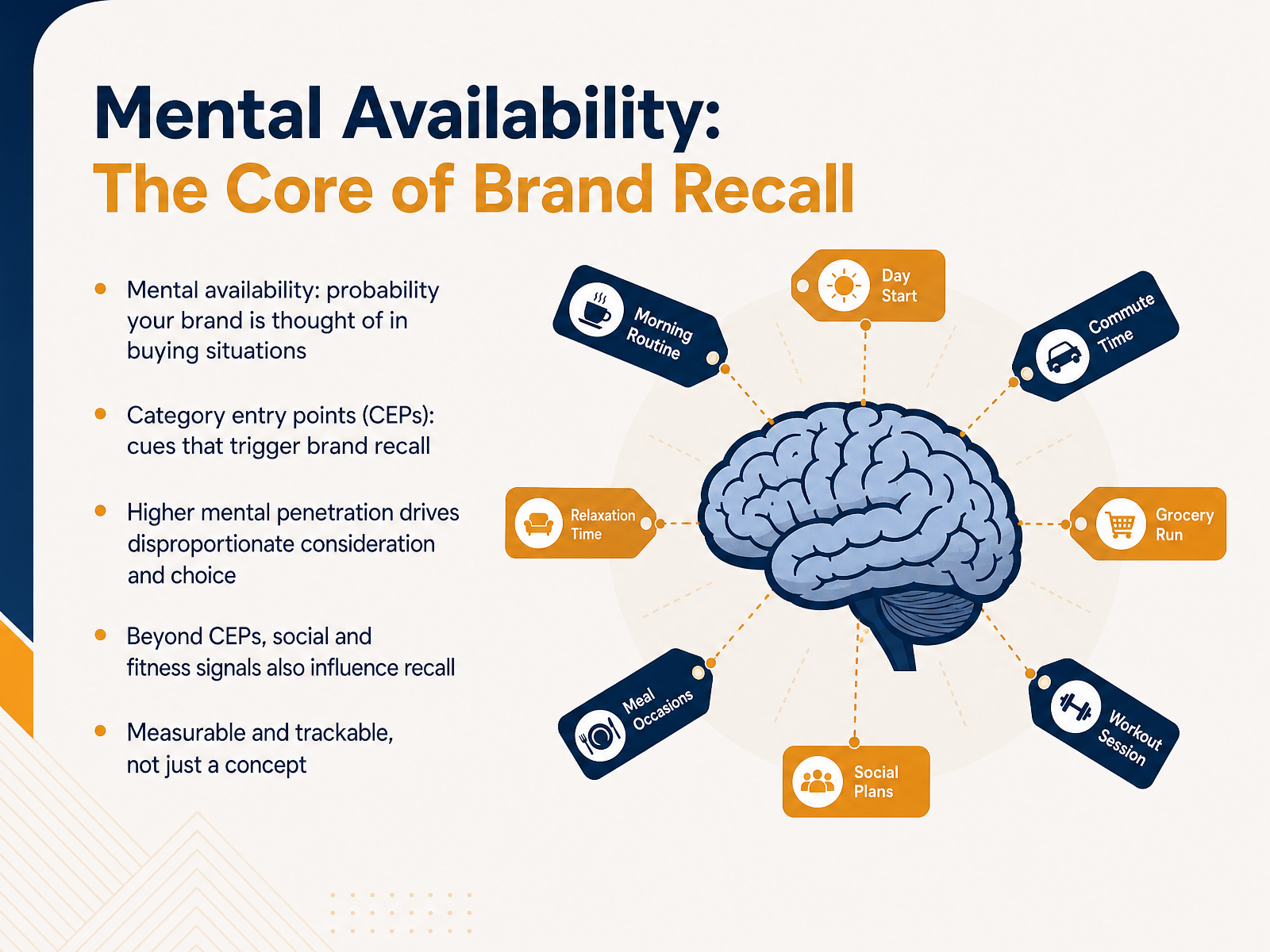
 - 07Mental Availability: The Core of Brand RecallLet's get specific about how brands actually get chosen. The core of this is what we call mental availability. Think of it as the probability that your brand comes to mind in a buying situation. Now, the triggers for that recall are called category entry points. These are the cues that make someone think of your brand. Getting this right matters because higher mental penetration leads to far more consideration and choice. In fact, people who can link a brand to at least one cue are about five times more likely to buy it. While these entry points are the backbone, recent evidence shows social and fitness signals also influence recall. But the key takeaway is this: mental availability is not just a theory. It is measurable and it is trackable. Up next, let's look at the common strategy pitfalls that undermine these efforts.
 sage.cnpereading.comjournals.sagepub.comideas.repec.org+21 min
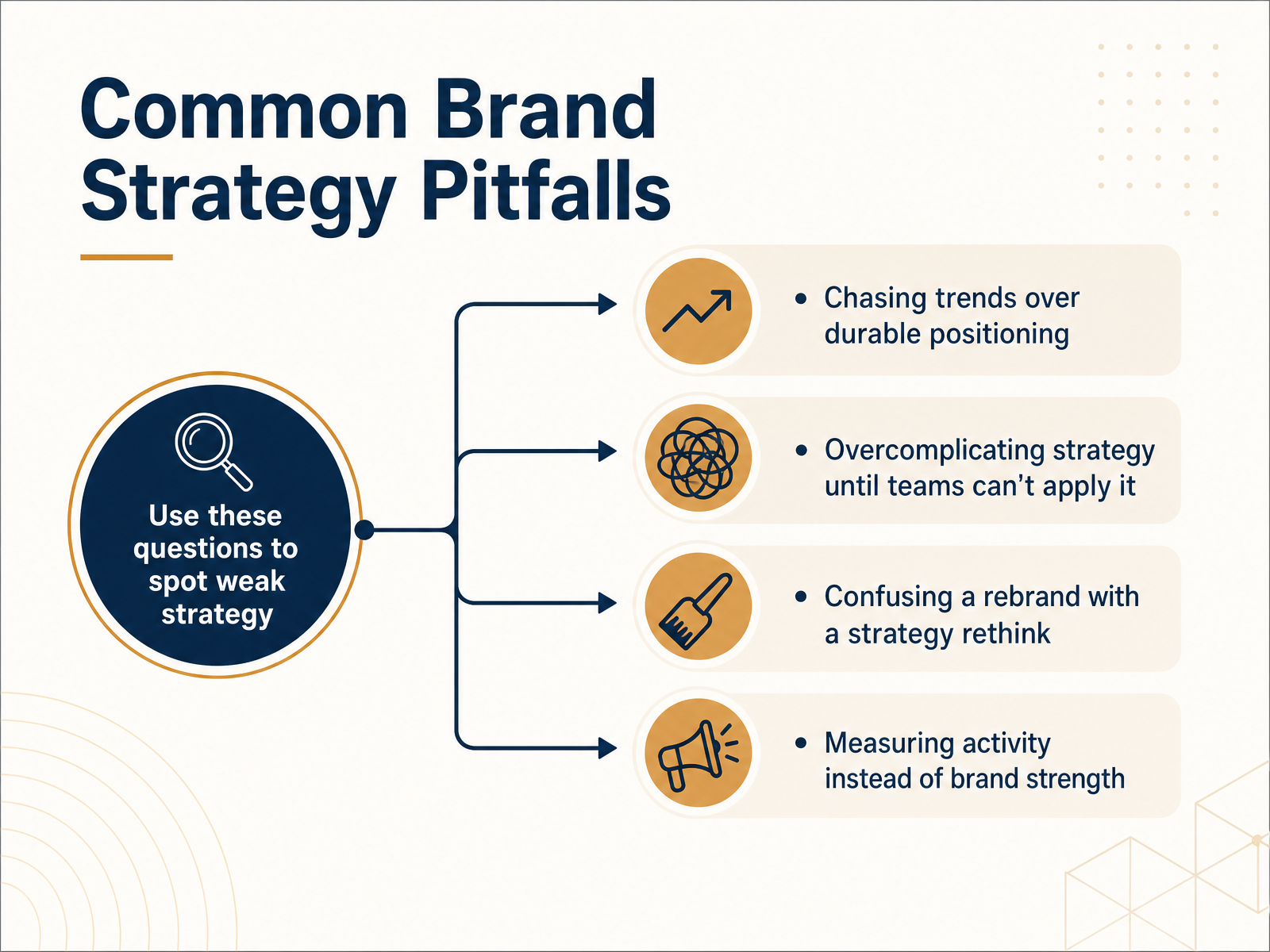
 - 08Common Brand Strategy PitfallsNow, let's talk about where brand strategy goes wrong. Because seeing the pitfalls is how you avoid them. First, there's the trend trap. Chasing what's hot right now, instead of building a position that lasts. A trendy look might get attention, but it won't build durable trust or recognition. Second is overcomplication. If your strategy is a sixty-slide deck that nobody reads, it's not a strategy. It's decoration. If your team can't apply it in their daily work, it's not doing its job. Third, a rebrand is not a strategy rethink. Changing the logo and colors might make things feel fresh, but if the underlying positioning hasn't changed, you've just repainted the same problem. And fourth, measuring activity instead of brand strength. Posting more, attending more events, launching more campaigns. That's motion. But it might not be progress. You need to know if awareness, consideration, and preference are actually moving. If any of this sounds familiar, ask your team: Can we state our position in one plain sentence? Can a new hire use our strategy to make a good decision? Those questions reveal the truth fast. Next, let's move from diagnosing problems to building momentum, from strategy to action.
 monday.commarketingmo.comblog.momoadvisors.com+22 min
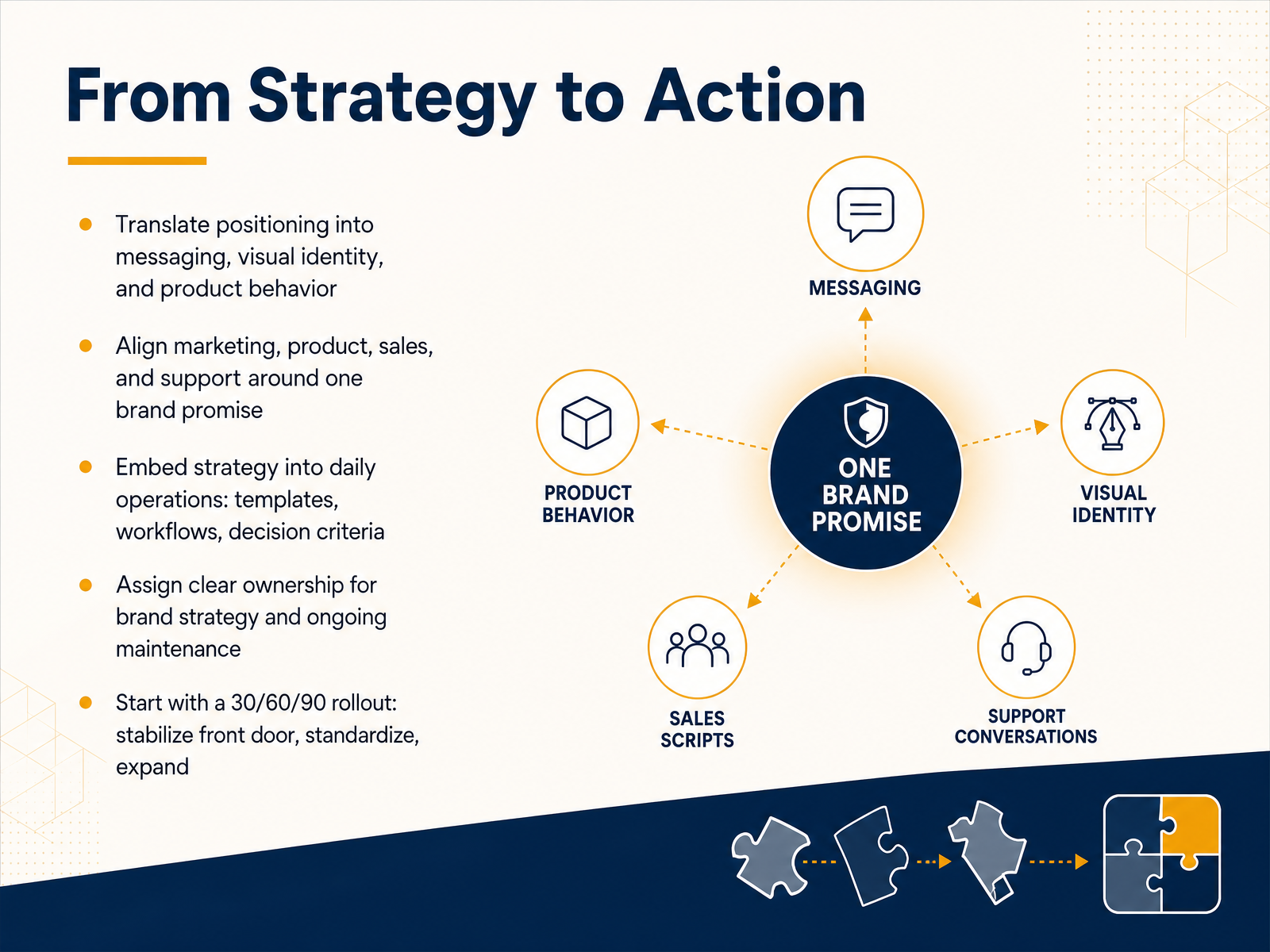
 - 09From Strategy to ActionThis is where brand strategy stops being a document and starts driving decisions. The first step is translation. Your positioning has to become messaging, visual identity, and product behavior. If a paragraph in your strategy deck doesn't change what a customer sees or experiences, it's decoration. Next, align every team around one brand promise. Marketing, sales, product, support. Same story, same standards. Then embed the strategy into daily operations. Build templates, workflows, and clear decision criteria. People follow systems more reliably than they follow slide decks. And assign ownership. One person accountable for the brand, plus clear roles for ongoing maintenance. Without an owner, consistency drifts. Finally, don't try to fix everything at once. Use a simple rollout. The first thirty days, stabilize your front door. Website, social profiles, core templates. The next thirty days, standardize guidelines and approvals. And the final thirty days, expand to secondary pages, campaigns, and a monthly quality check. That's how strategy becomes action. Let's look at a practical implementation framework you can adapt to your own team.
 monday.commarketingmo.comblog.momoadvisors.com+22 min
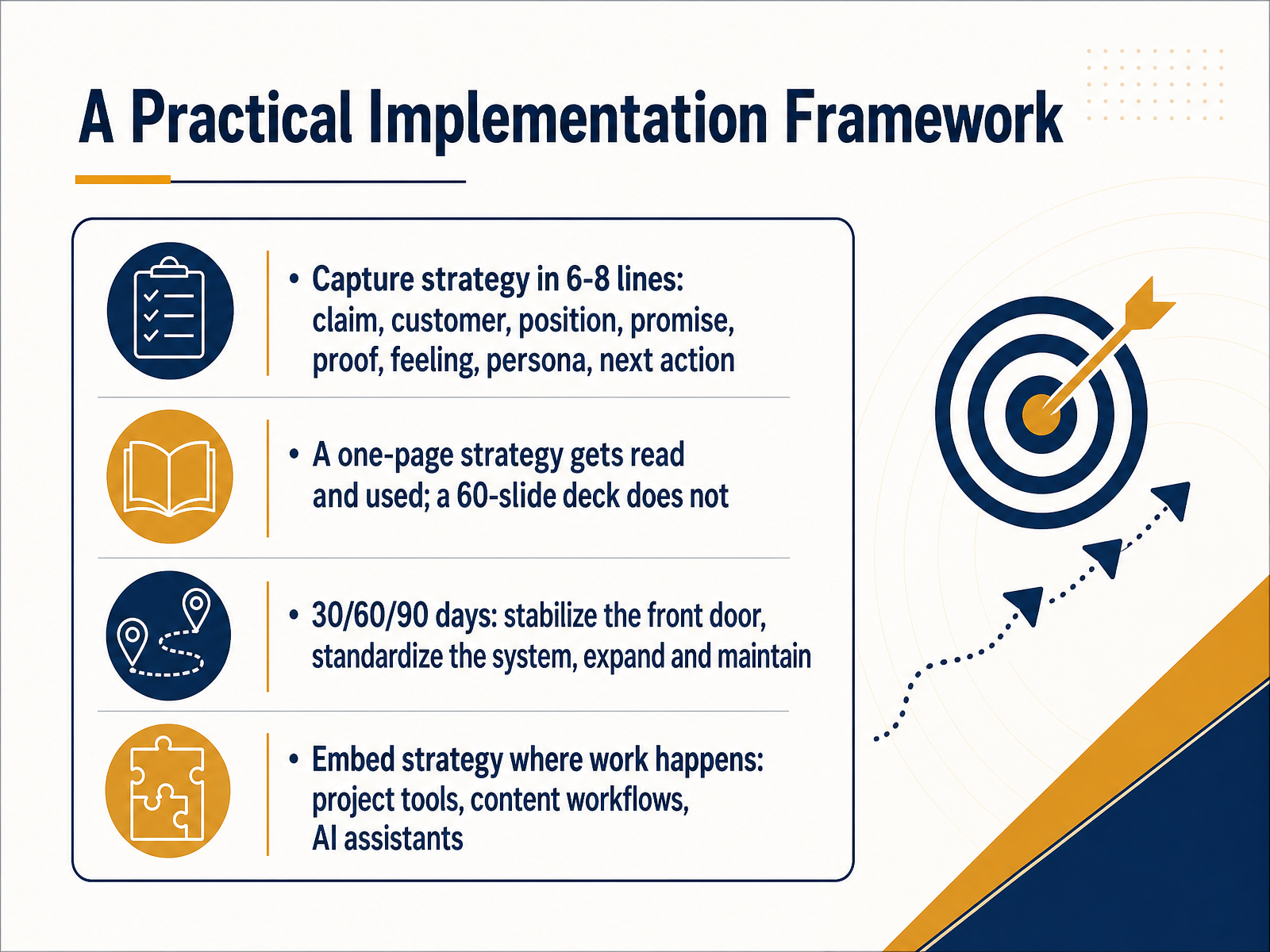
 - 10A Practical Implementation FrameworkSo what does implementation actually look like? Let us get practical. First, capture your strategy in just six to eight lines. Claim, customer, position, promise, proof, feeling, persona, and next action. If you cannot fit it on one page, you have not decided enough yet. A one-page strategy gets read and used. A sixty-slide deck gets filed and forgotten. Then, give yourself a timeline. In the first thirty days, stabilize the front door. Make your website, social profiles, and core templates feel consistent. In the next thirty days, standardize the system. Document guidelines, build templates, clarify who approves what. By day ninety, expand and maintain. Apply the brand deeper and set up a simple monthly check so you do not drift. And most importantly, embed your strategy where work actually happens. Put it in your project tools, your content workflows, and your AI assistants. If your team has to go looking for the strategy, it is not part of how you work. Make it so easy to use that consistency becomes the default. Next, let us talk about measuring what matters.
 monday.commarketingmo.comblog.momoadvisors.com+22 min
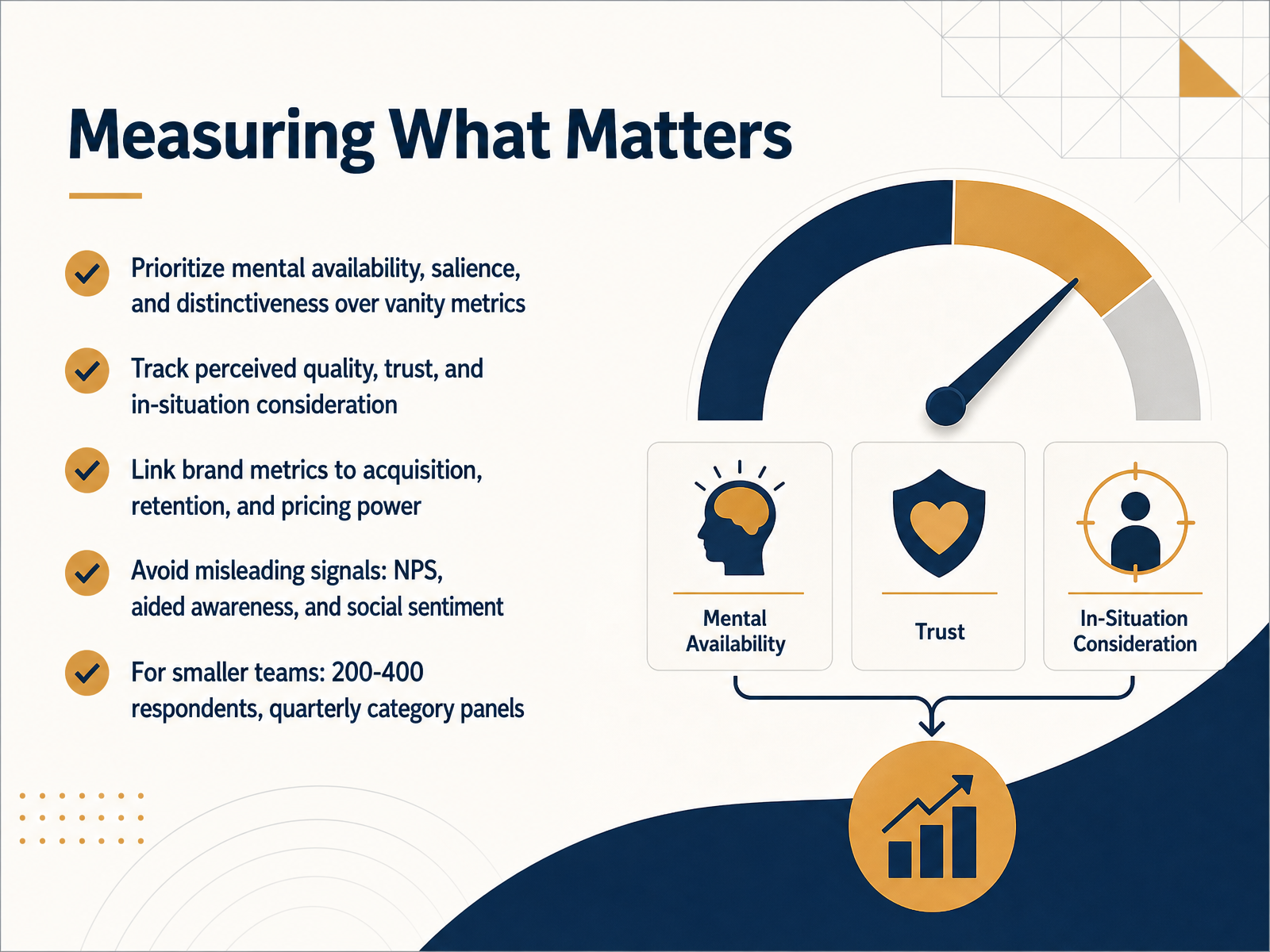
 - 11Measuring What MattersNow let's talk about the numbers that actually tell you if your brand is working. We have to measure what matters. That means prioritizing mental availability, salience, and distinctiveness over vanity metrics. In plain terms, how easily does your brand come to mind in a buying situation, and do people recognize your unique assets? We also need to track perceived quality, trust, and in-situation consideration. Not just whether people know you, but whether they would actually choose you. And here's the critical part. Link those brand metrics to real business outcomes. Acquisition, retention, and your ability to command a better price. On the other hand, be careful of misleading signals. Things like NPS, aided awareness, and social sentiment can give you false confidence. They often look good on a dashboard but don't predict growth reliably. And for smaller teams, you don't need a massive budget. Two to four hundred respondents in a quarterly category panel is enough to spot real trends. That gives you a clear signal without boiling the ocean. Next, we'll look at how to design a starter brand dashboard.
 go.bera.ainielseniq.comsloanreview.mit.edu+22 min
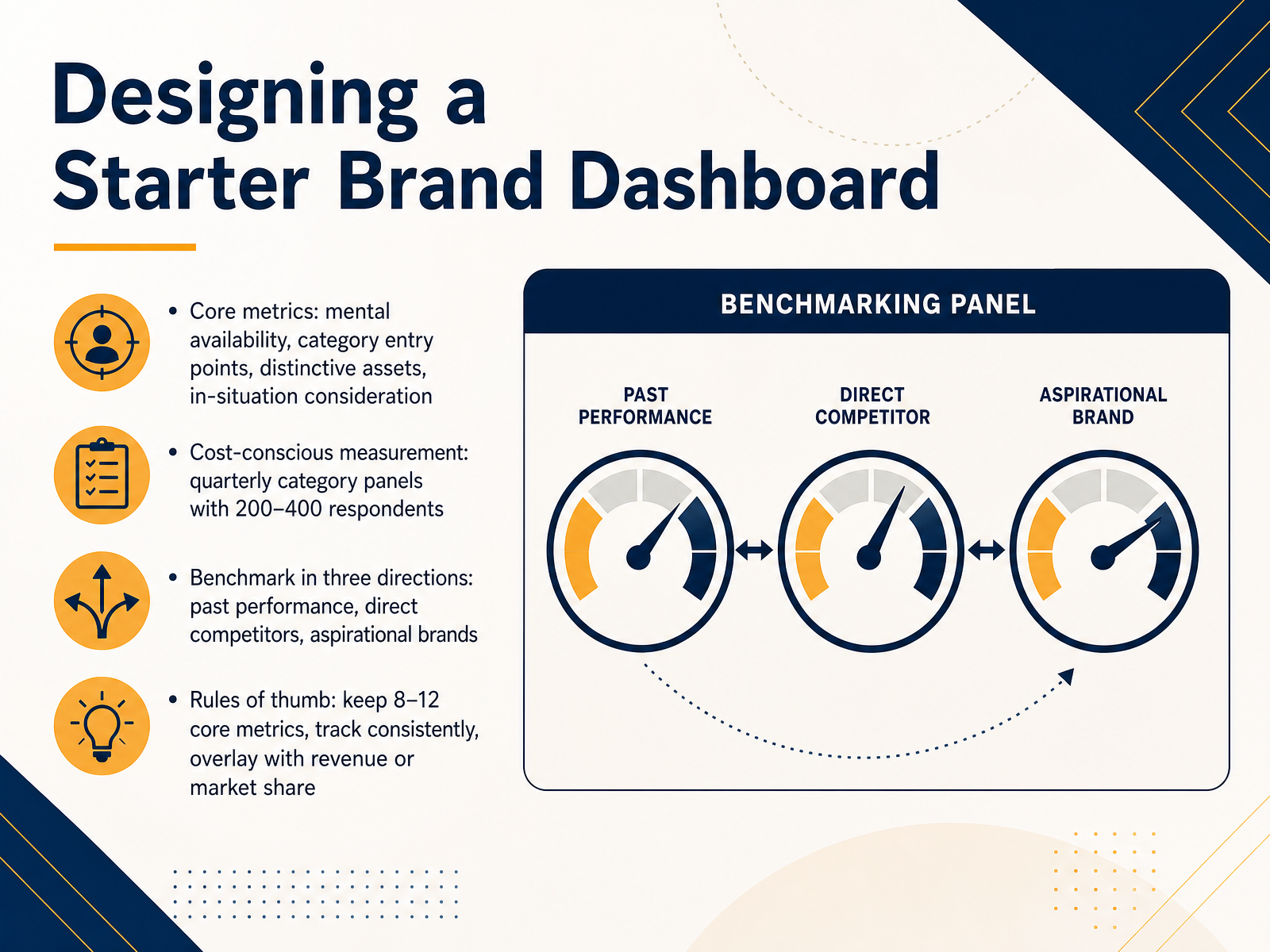
 - 12Designing a Starter Brand DashboardNow let's make this practical. You don't need a massive research budget to build a starter brand dashboard. Start with four core metrics. Mental availability, meaning how easily you come to mind. Category entry points, or the situations when buyers think of you. Distinctive assets, like your logo or colors. And in-situation consideration, whether people actually choose you when it counts. You can measure these with a lean quarterly panel. Two hundred to four hundred category buyers is usually enough. Next, benchmark in three directions. Look at your own past performance, your direct competitors, and one or two aspirational brands you admire. That third view shows you what world-class looks like. And keep it disciplined. Aim for eight to twelve core metrics. Track them consistently over time, and overlay them with revenue or market share so you can see what actually predicts growth. This keeps your dashboard focused on decisions, not just data. Up next, we'll bring all of this together and talk about applying brand strategy to your organization.
 go.bera.ainielseniq.comsloanreview.mit.edu+22 min
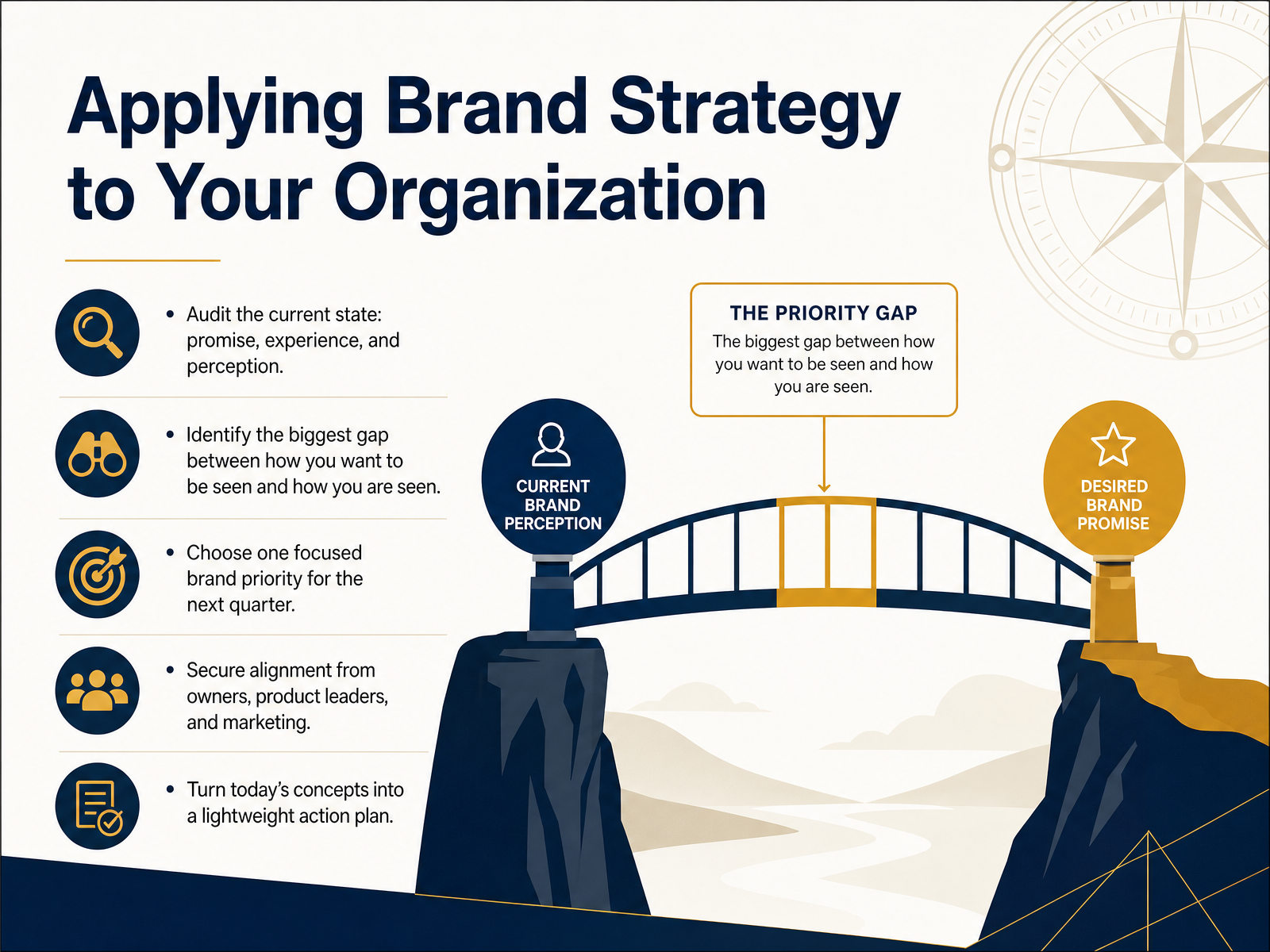
 - 13Applying Brand Strategy to Your OrganizationSo how do you actually put this to work in your organization? Start by auditing the current state. Look honestly at the promise you make, the experience you deliver, and how customers actually perceive you. Then identify the biggest gap between how you want to be seen and how you are seen. Do not try to fix everything at once. Choose one focused brand priority for the next quarter. That single choice creates real momentum. Next, secure alignment from owners, product leaders, and marketing. Brand work fails when teams move in different directions. Make the commitment shared and explicit. Finally, turn today's concepts into a lightweight action plan. A few clear actions with owners and dates beat a thick document nobody reads. That discipline turns strategy from a deck into daily decisions. In our final slide, we will bring it together with key takeaways and next steps.
 monday.commarketingmo.comblog.momoadvisors.com+22 min
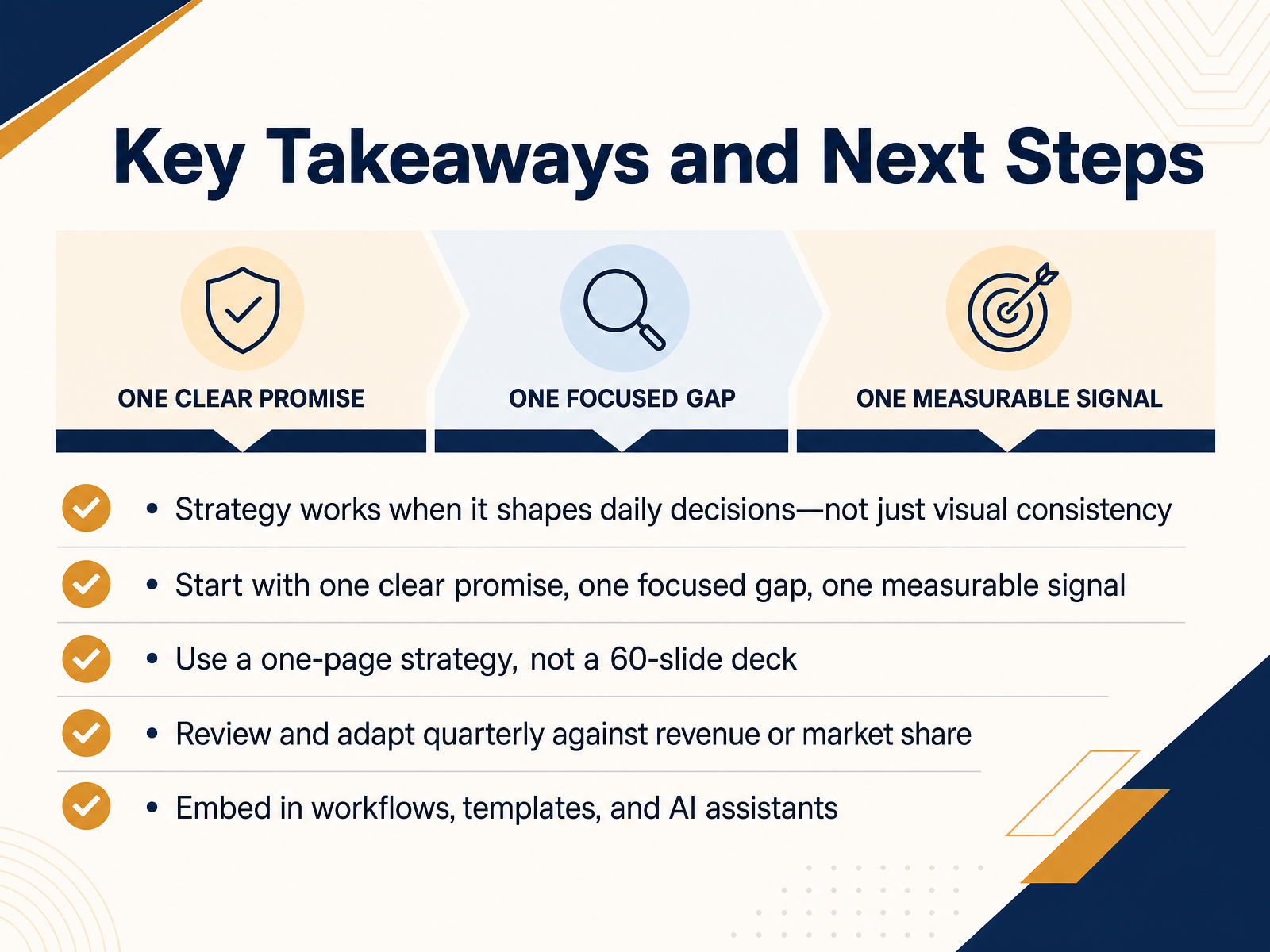
 - 14Key Takeaways and Next StepsSo, where do we go from here? Let's ground everything in a few key takeaways. First, a strategy only works when it shapes daily decisions. It's not about visual consistency; it's about business consistency. Next, start small. Choose one clear promise, one focused market gap, and one measurable signal of success. You do not need a sixty slide deck. A one page strategy is a decision making tool. A deck is a shelf ornament. Review that page every quarter. Tie it to real outcomes like revenue growth or changes in market share, not just feelings. Finally, make it live. Embed the strategy into your workflows, your templates, and yes, your AI assistants. Let the strategy brief every piece of work your team produces. That is how brand stops being a cost center and becomes a growth engine. Thank you for joining me. Now, go make those choices concrete.
 bcg.comfospha.commarketingweek.com+21 min
Take the deck with you
Download this course as a file — free, no sign-up needed.
- PDF handoutEvery slide page, ready to print or share.15 pages · 3.3 MBDownload
- Narrated PowerPointThe deck that presents itself — every slide carries the digital human's narration video.15 pages · 14.4 MBDownload
- PowerPoint slidesThe full deck as a .pptx — open it in PowerPoint, Keynote, or Google Slides.15 pages · 3.2 MBDownload
Free to use in your own training — please keep the PersonWise credit page at the end.
Have your own deck? Turn it into a course
Sources consulted
Web sources consulted while building this course.
- Building Lasting Brand Equity in the Age of AI | BCG — bcg.com
- Glow: Proving the Business Impact of Brand | Fospha — fospha.com
- Only tenth of marketers ‘very successful’ at demonstrating brand impact — marketingweek.com
- Brand Strategy Survey 2025 Overall Evaluation Ranking | Nikkei Research — en.service.nikkei-r.co.jp
- B2B marketers on the ‘multiplier’ effect of brand — marketingweek.com
- Branding Strategy: Build A Plan That Aligns Teams And Grows Trust — monday.com
- Brand Strategy Implementation - Marketing MO — marketingmo.com
- How to Implement Brand Strategy Effectively - Business Genes — blog.momoadvisors.com
- Brand Rollout Plan (30/60/90) (2026) | Magnt — magnt.com
- Brand Strategy on One Page: The Template That Works | Barakah | Barakah Agency — barakah.agency
- Measuring advertising’s effect on mental availability — sage.cnpereading.com
- The Natural Monopoly Effect in Brand Image Associations — journals.sagepub.com
- The effect of mental availability on snack food choices — ideas.repec.org
- Does your brand measure up when it comes to mental availability? — marketingweek.com
- Reality Check: There’s more to mental availability than category entry points — marketingweek.com
- The complete guide to brand measurement — go.bera.ai
- Rethinking Brand Health - NIQ — nielseniq.com
- Measuring Brand Health to Improve Top-Line Growth — sloanreview.mit.edu
- The use of Net Promoter Score (NPS) to predict sales growth: insights from an empirical investigation — link.springer.com
- The Guide to Brand-Driven Growth | Hanover Research — hanoverresearch.com