Begin
14 pages · ~28 min
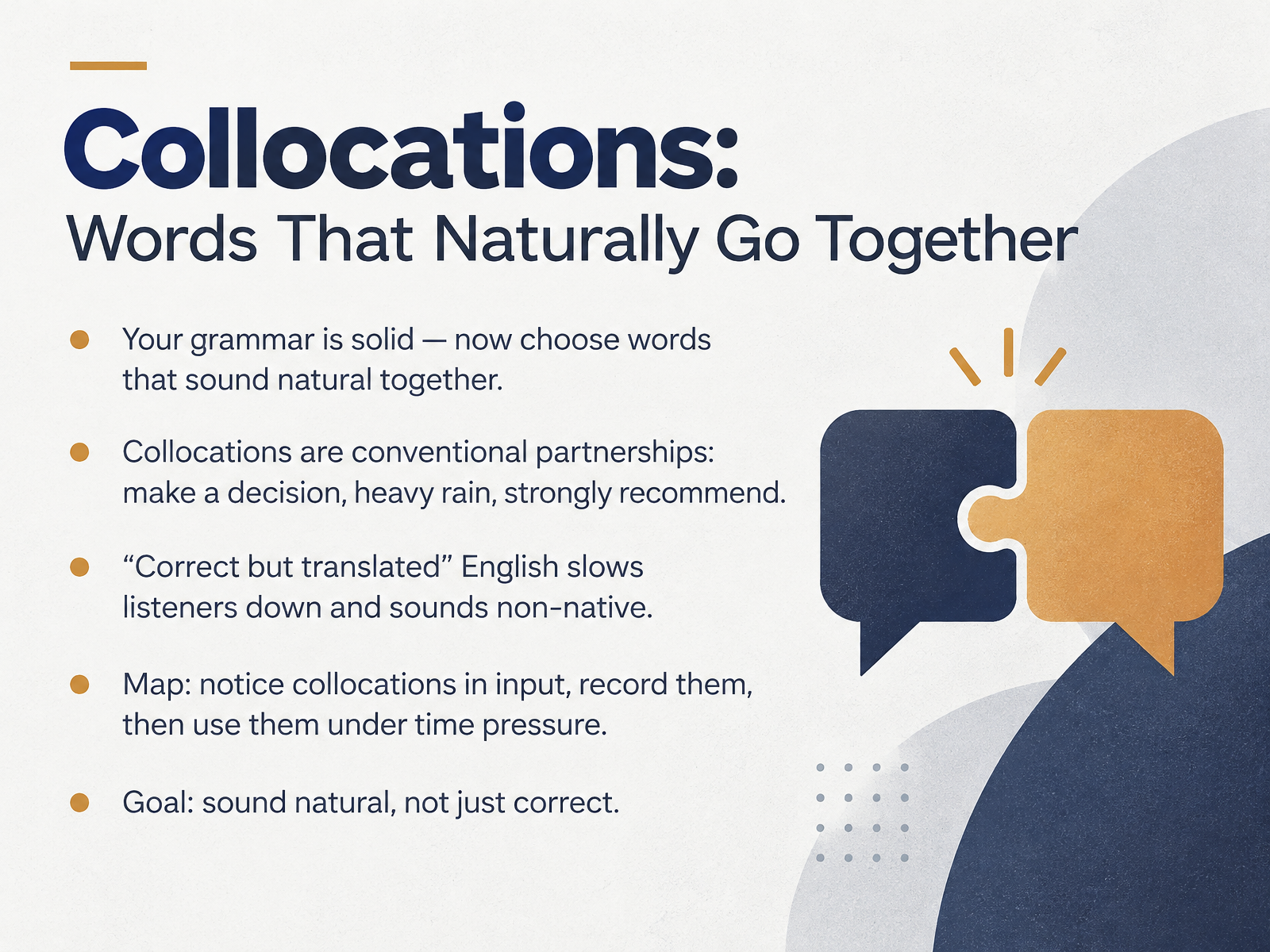
Collocations: Words That Naturally Go Together
This training helps English learners recognize and use natural word combinations, improving fluency and accuracy in everyday communication.
A digital instructor presents all 14 pages. Hold “Ask” at any point and ask out loud — the answer comes from this course. No sign-up needed.
What you’ll learn
- 01Collocations: Words That Naturally Go TogetherWelcome. I'm glad you're here. Today we're talking about collocations, the words that naturally go together. Here's the good news. Your grammar is solid. Now you just need to choose words that sound natural together. So what is a collocation? It's a conventional partnership, two words that habitually appear as a pair. For example, we say make a decision. We say heavy rain, not strong rain. And we say strongly recommend. Notice how those just sound right? Here's why this matters. English that is correct but translated sounds slow to listeners. It signals non-native, even when every rule is perfect. So how do you build this? Treat it like a map. First, notice collocations in what you read and hear. Second, record them as whole chunks, not single words. Third, use them under time pressure, in real conversation. Our goal here is simple. Sound natural, not just correct. Coming up next, we'll look closer at why correct English can still sound wrong, in The Naturalness Gap.oxfordlearnersdictionaries.comcambridge.orgassets.cambridge.org+22 min
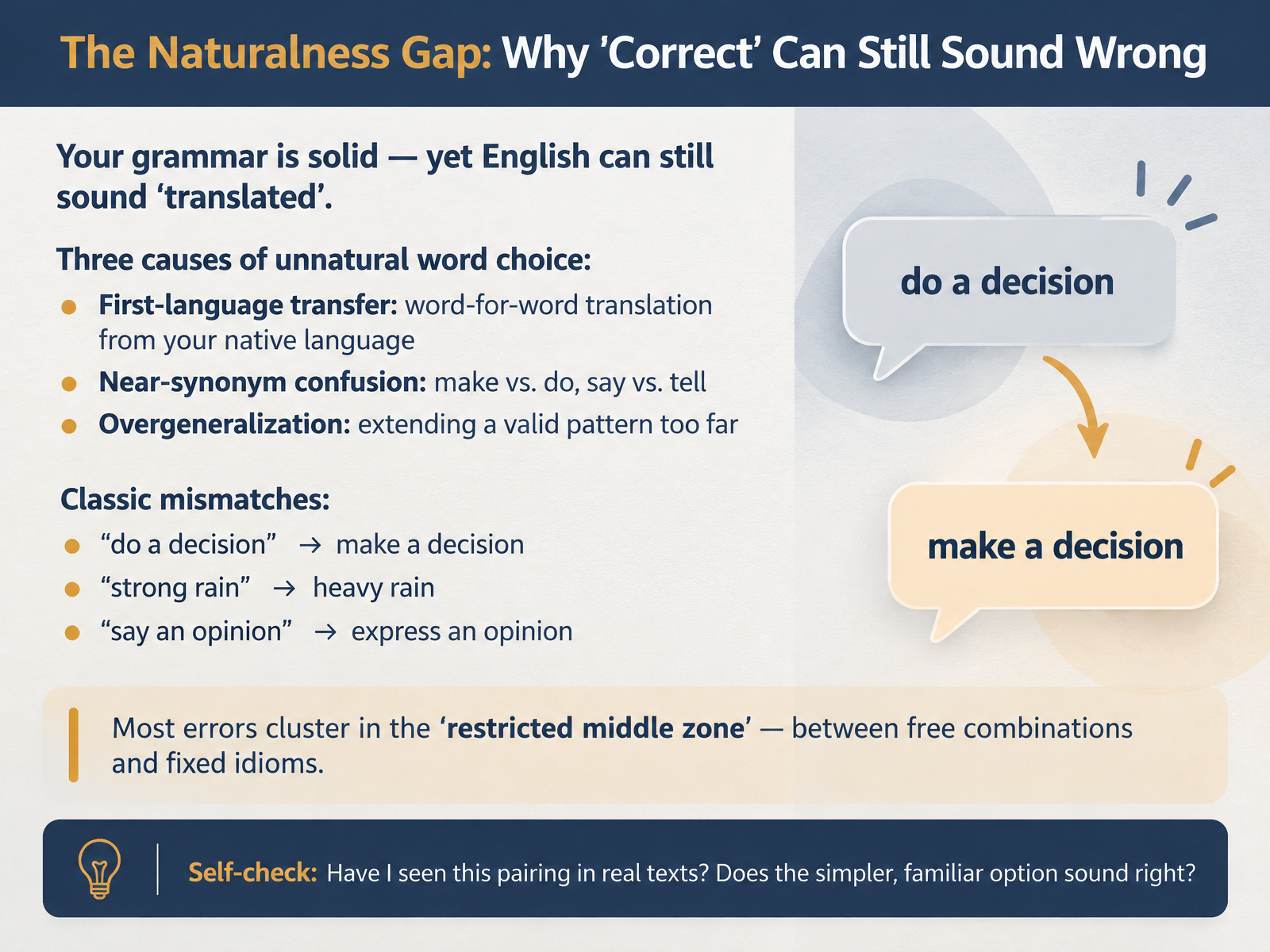
- 02The Naturalness Gap: Why 'Correct' Can Still Sound WrongSo let's look at something that surprises a lot of learners. Your grammar can be solid, and your English can still sound translated. Here's why. There are three main causes of unnatural word choice. First, first-language transfer. That's translating word for word from your native language. Second, near-synonym confusion. Think make versus do, or say versus tell. And third, overgeneralization. That's taking a valid pattern and stretching it too far. Now, listen to these classic mismatches. Do a decision becomes make a decision. Strong rain becomes heavy rain. Say an opinion becomes express an opinion. Notice something? The grammar is fine. The pairing is not. Most of these errors cluster in what researchers call the restricted middle zone. That's the space between free combinations and fixed idioms. So here's your self-check. Have I actually seen this pairing in real texts? And does the simpler, familiar option sound right? Keep those two questions in mind. Let's move on to what counts as a collocation, looking at patterns and types.
 tandfonline.comvarsitytutors.comcollocations.org+21 min
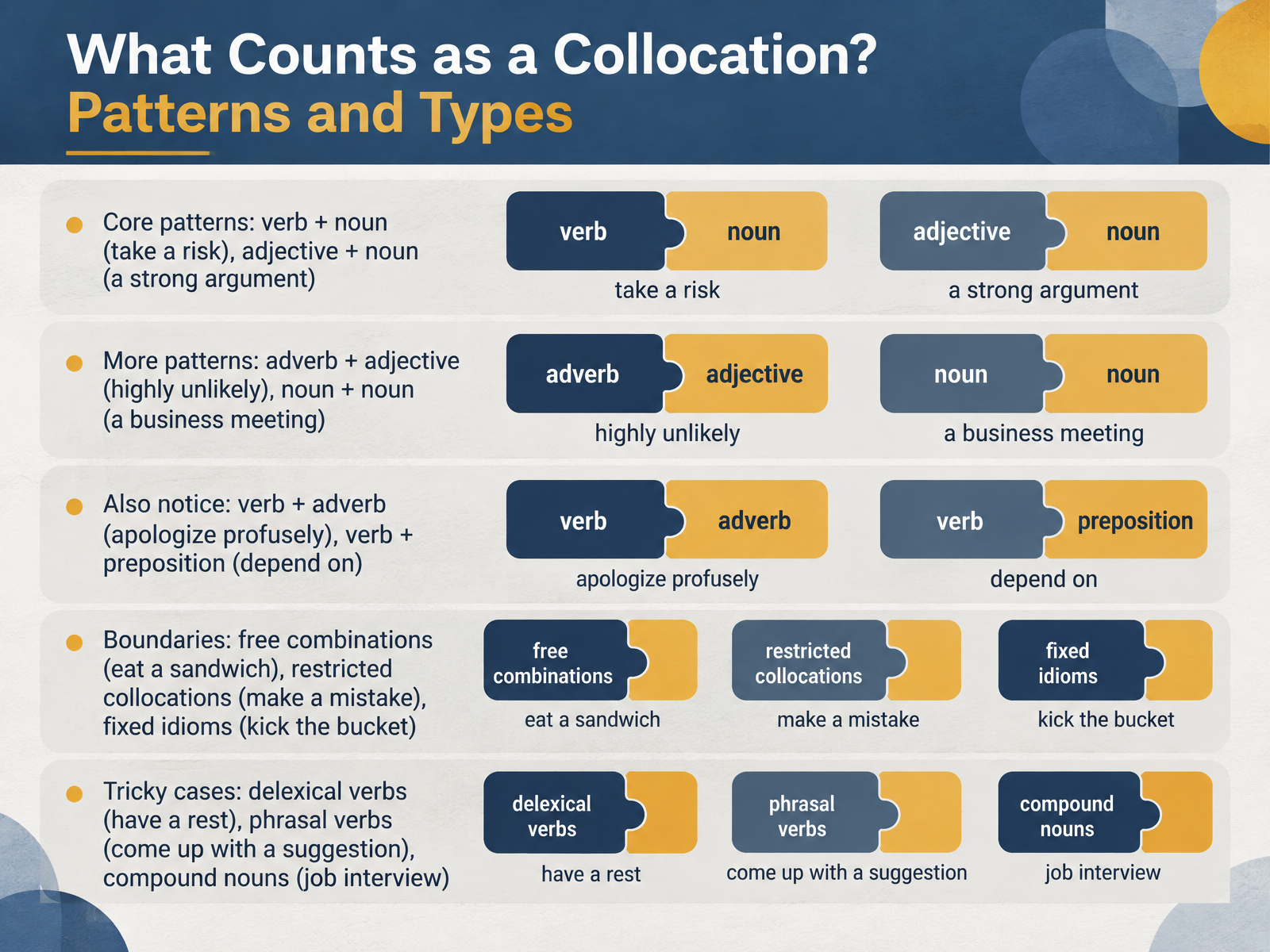
- 03What Counts as a Collocation? Patterns and TypesLet's look at the patterns behind these partnerships. The core ones are verb plus noun, like take a risk, and adjective plus noun, like a strong argument. You will also see adverb plus adjective, like highly unlikely, and noun plus noun, like a business meeting. A few more worth noticing: verb plus adverb, like apologize profusely, and verb plus preposition, like depend on. Now, not every pairing is equally tight. Eat a sandwich is a free combination, so you have plenty of choice. Make a mistake is more restricted. And kick the bucket is a fixed idiom. Then there are the tricky cases: delexical verbs like have a rest, phrasal verbs like come up with a suggestion, and compound nouns like job interview. So the key takeaway is simple. Collocations come in patterns, and the tighter the pattern, the less room you have to swap words. Strong, Weak, and Fixed: How Tight Is the Partnership?
 dictionary.cambridge.orgstorylearning.comenglishexplorations.check.uni-hamburg.de+22 min
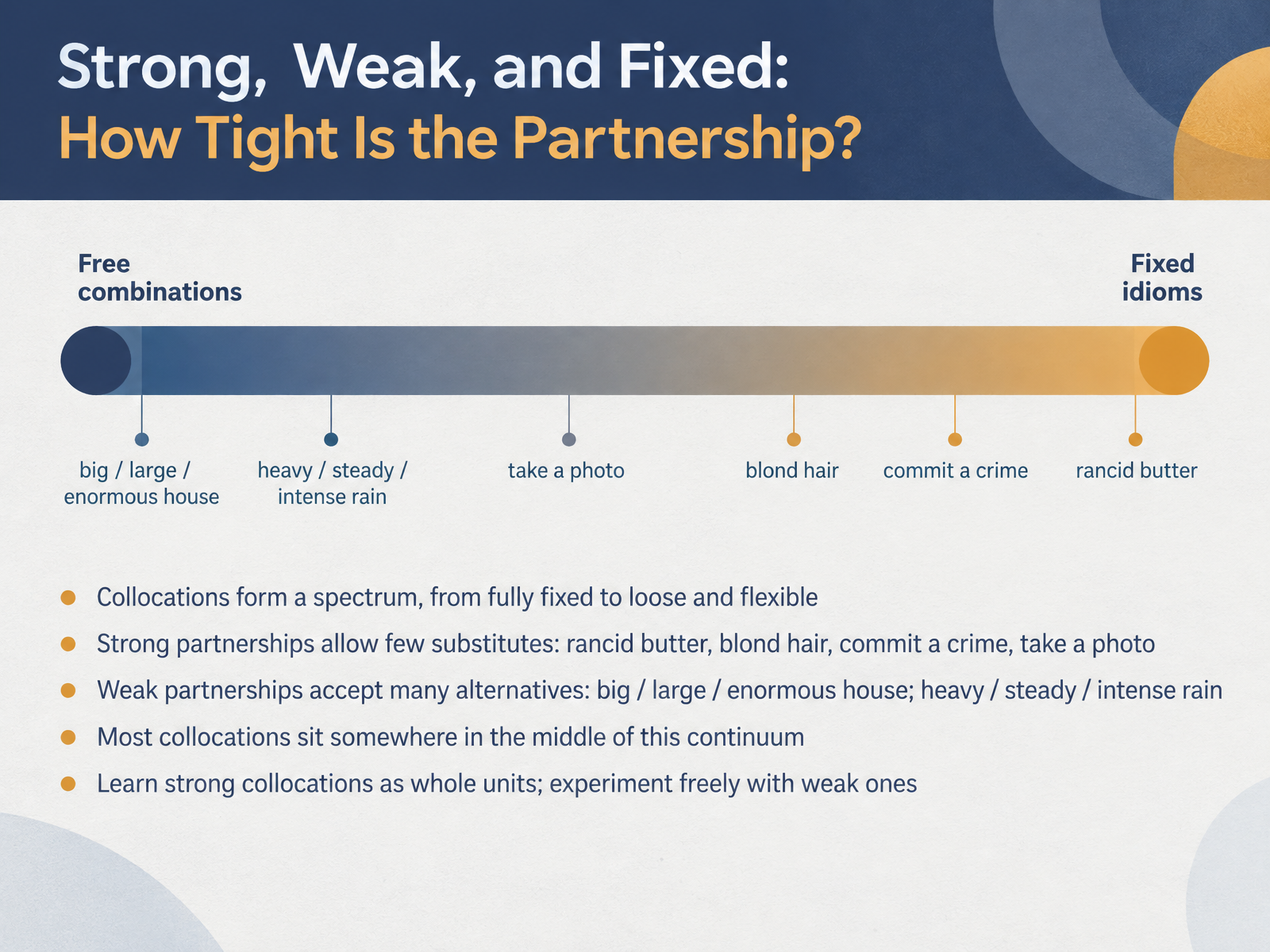
- 04Strong, Weak, and Fixed: How Tight Is the Partnership?Let's talk about how tight the partnership really is. Collocations sit on a spectrum, from fully fixed to loose and flexible. Strong partnerships allow very few substitutes. So we say rancid butter, not rotten butter. Blond hair, not yellow hair. Commit a crime, not do a crime. Take a photo, not make a photo. Hear how tightly those words hold together? At the other end, weak partnerships accept many alternatives. A big house, a large house, an enormous house. Heavy rain, steady rain, intense rain. All sound fine. Most collocations sit somewhere in the middle of this continuum. So here's the practical part. Learn strong collocations as whole units, exactly as you hear them. With weak ones, experiment freely. Swap words in and out and see what sounds natural. That flexibility is where your confidence grows. Next, let's look at noticing collocations in real input.
 dictionary.cambridge.orgstorylearning.comenglishexplorations.check.uni-hamburg.de+22 min
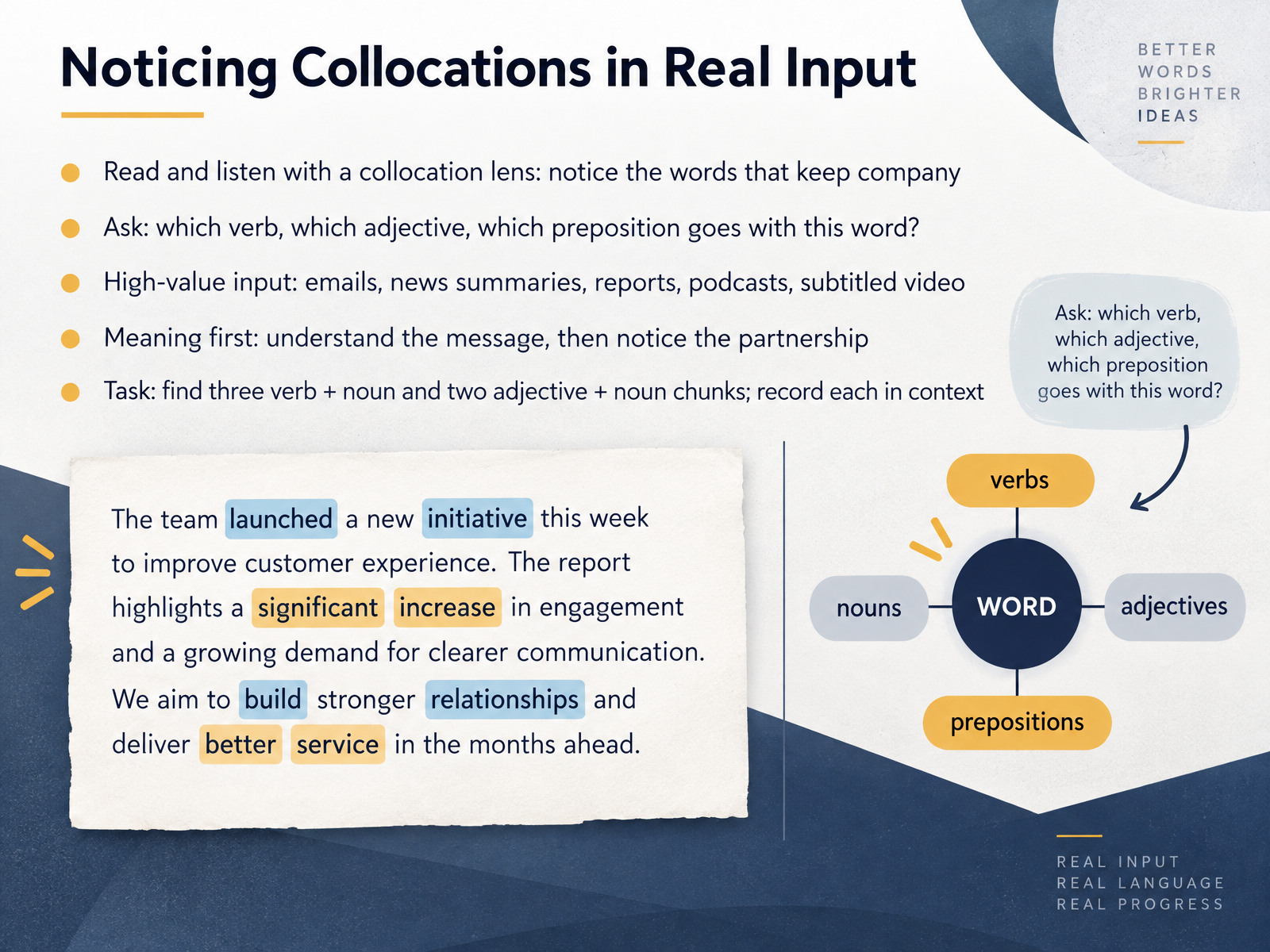
- 05Noticing Collocations in Real InputLet's talk about noticing collocations in real input. This is where the habit really builds. Read and listen with a collocation lens. Instead of only asking what does this word mean, ask which verb goes with it, which adjective, which preposition. Take the word decision. We make a decision, or we reach a decision, or we face a difficult decision.
Good input is everywhere. Emails, news summaries, reports, podcasts, subtitled video. Meaning comes first. Understand the message, then go back and notice the partnership. So the same sentence gives you comprehension and collocation practice.
Here's your task. Find three verb plus noun chunks, things like make progress or raise a concern. Then find two adjective plus noun chunks, like heavy traffic or a key factor. Record each one in context, in the whole phrase, not as a single word.
Next, let's look at recording collocations so they stick.
 alulaenglish.comojs.cuni.czeflcafe.net+21 min
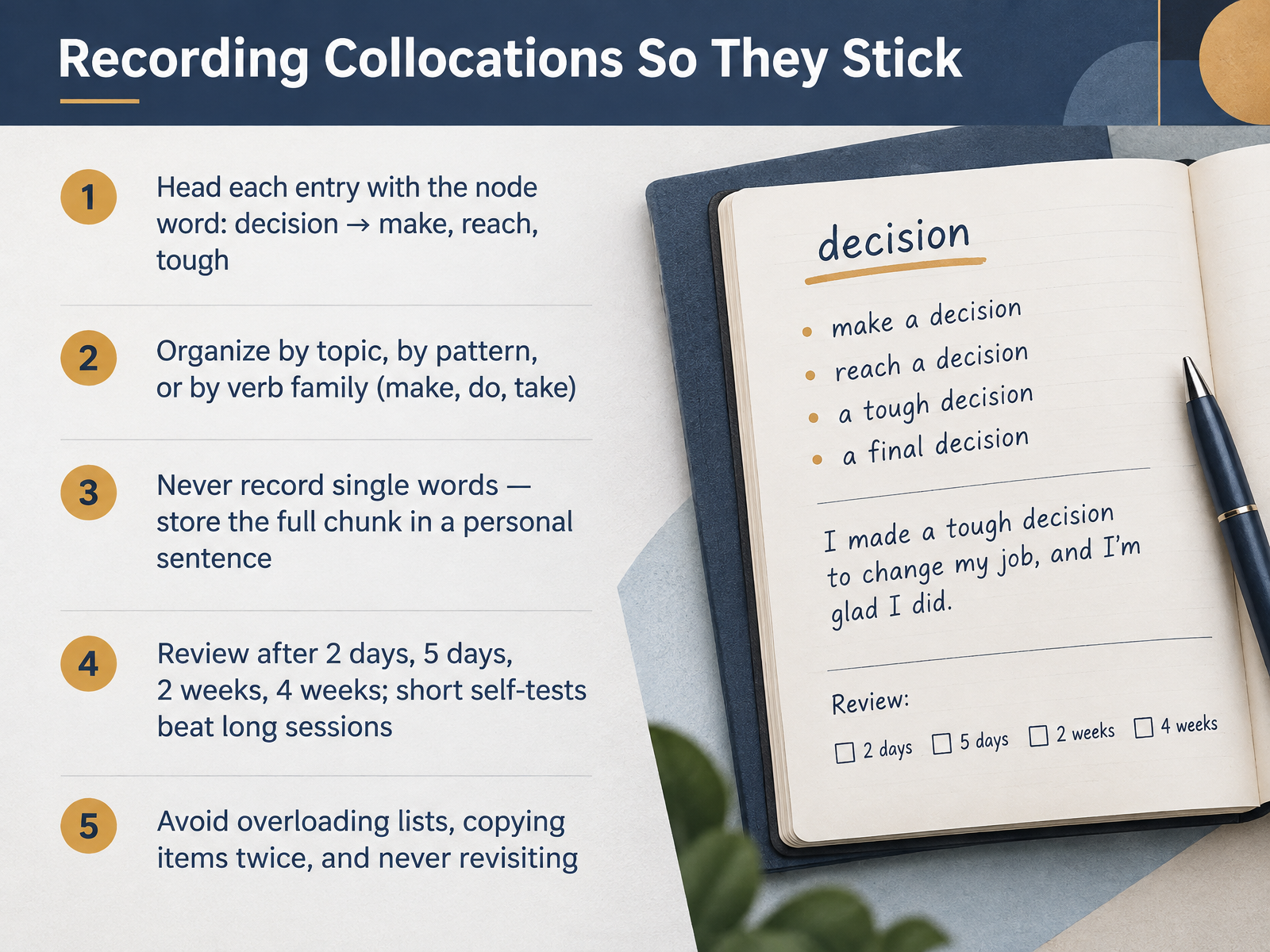
- 06Recording Collocations So They StickSo how do you record collocations so they actually stick? Start each entry with the node word. So for decision, you don't just write the word. You write make a decision. You write reach a decision. And you write a tough decision. Then organize the way that suits you. By topic, by pattern, or by verb family, like make, do, and take. Never record single words on their own. Store the full chunk inside a personal sentence, something you'd really say. For example, I made a tough decision about my job. That's one entry, not three. Now, reviewing matters. Go back after two days, then five days, then two weeks, then four weeks. Short self-tests beat long study sessions every time. And watch the traps. Don't overload your lists, don't copy the same item twice, and never leave an entry sitting there untouched. Quick check on schedule, that's the routine. Now, let's see how these patterns show up across everyday, workplace, and academic collocations.
 cdn-cms.f-static.nettandfonline.comvarsitytutors.com+21 min
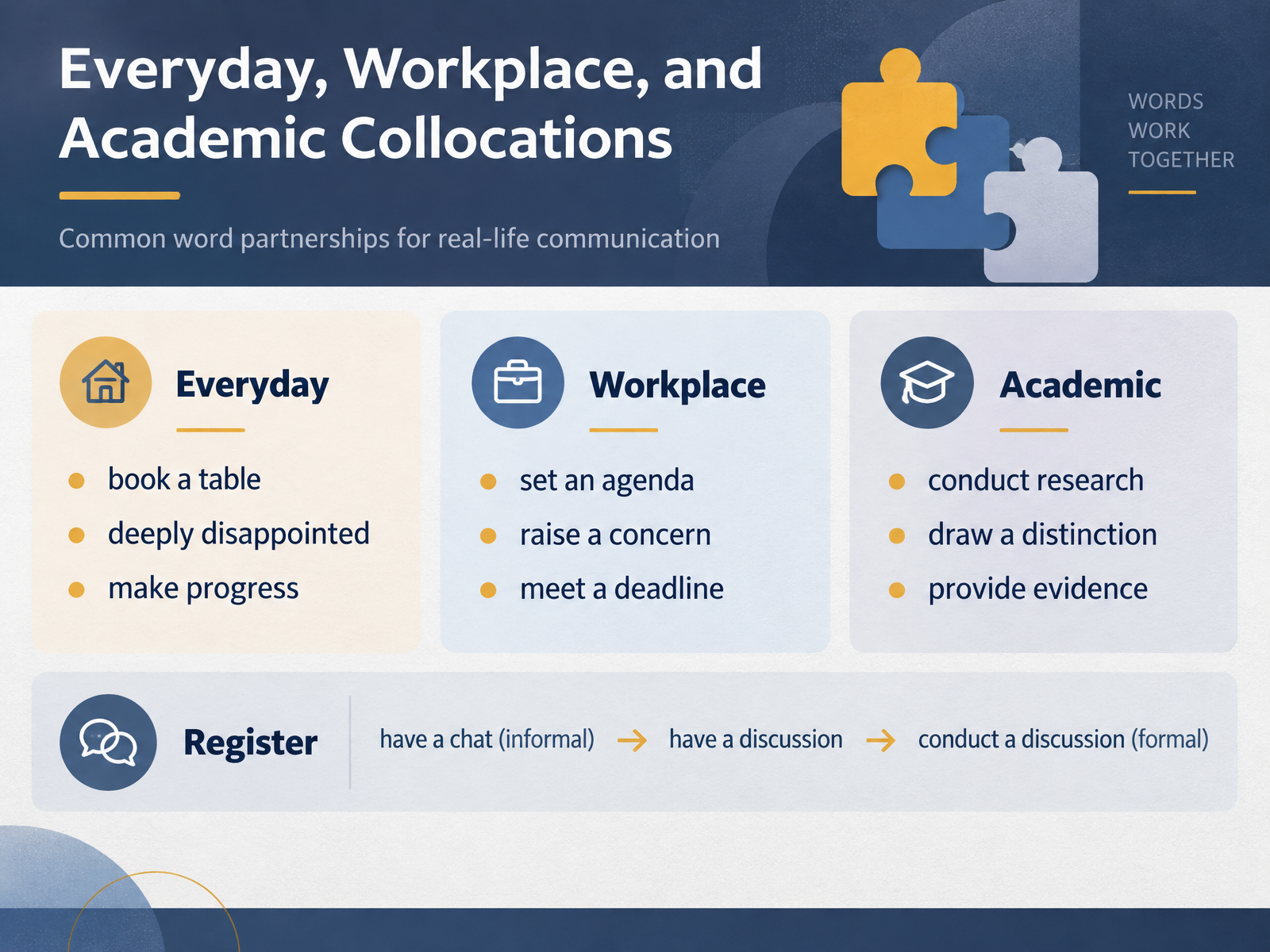
- 07Everyday, Workplace, and Academic CollocationsNow let's move across the three main registers you actually use: everyday, workplace, and academic collocations. In everyday English, you book a table, you feel deeply disappointed, and you make progress on a project. Listen to the verb partners. Book a table. Deeply disappointed. Make progress. In the workplace, you set an agenda before a meeting, you raise a concern when something worries you, and you meet a deadline. Set an agenda. Raise a concern. Meet a deadline. In presentations and emails, you draw a conclusion, and you attach a document. Draw a conclusion. Attach a document. In academic English, the same precision applies. You conduct research, you draw a distinction between two ideas, and you provide evidence. Conduct research. Draw a distinction. Provide evidence. Notice the register shift here. With a colleague, you have a chat. In a meeting, you have a discussion. In formal writing, you conduct a discussion. All three are correct, but only one fits each situation. Register is not about being polite or rude. It is about choosing the collocation your audience expects. Next, we'll look at common trouble spots and fixes.
 oxfordlearnersdictionaries.comcambridge.orgassets.cambridge.org+22 min
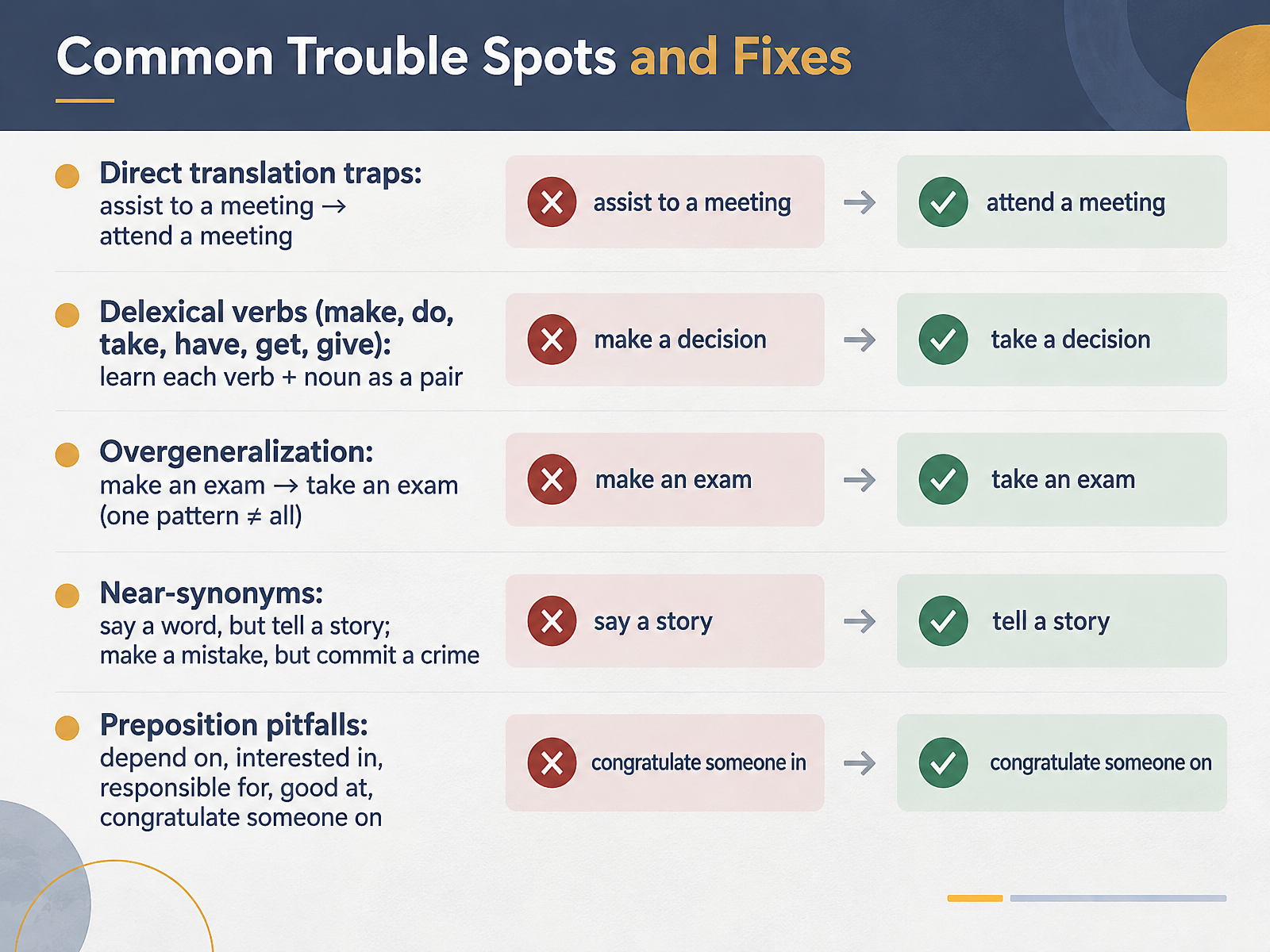
- 08Common Trouble Spots and FixesNow let's look at the trouble spots that come up again and again, and how to fix them.
First, direct translation traps. If you translate word for word from your own language, you get phrases like "assist to a meeting." In English, we attend a meeting. So attend a meeting.
Next, watch the small verbs. Make, do, take, have, get, give. They carry almost no meaning on their own. So learn each one as a pair with its noun. Make a decision. Take a risk. Do business. Have an argument.
Then there's overgeneralization. You learn make a plan, so you try make an exam. No. You take an exam. One pattern is not all patterns.
Near synonyms trip you up too. You say a word, but you tell a story. You make a mistake, but you commit a crime.
And prepositions. These are memory, not logic. Depend on. Interested in. Responsible for. Good at. Congratulate someone on.
So here's your takeaway. When you meet a new word, don't just learn the word. Learn its partners. That's what makes your English sound natural.
Let's see how this holds up when you're using collocations under pressure.
 tandfonline.comvarsitytutors.comcollocations.org+22 min
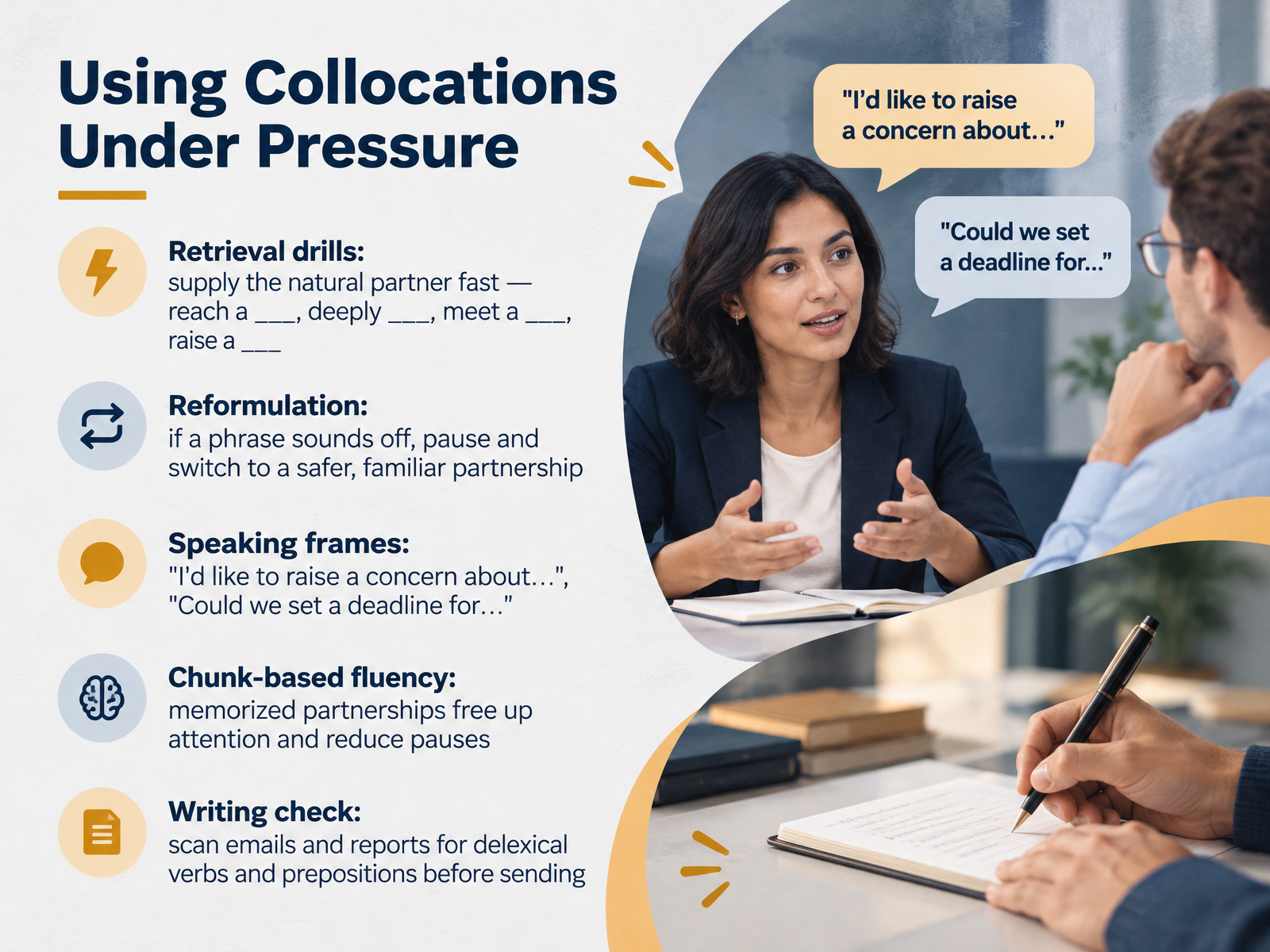
- 09Using Collocations Under PressureNow let's talk about using collocations under pressure, when you're speaking fast and can't stop to think. First, retrieval drills. Train yourself to supply the natural partner quickly. Reach a conclusion. Deeply concerned. Meet a deadline. Raise a concern. Say each one out loud and feel the pair. Next, reformulation. If a phrase sounds off, pause and switch to a safer, familiar partnership. Then speaking frames. Simple openers help you start smoothly. I'd like to raise a concern about the schedule. Could we set a deadline for Friday? Chunk-based fluency means memorized partnerships free up your attention and reduce pauses. Finally, a writing check. Before you send an email or report, scan it for delexical verbs like make, do, and take, and for prepositions. Small swaps make a big difference. Next, checking collocations with dictionaries and corpora.
 alulaenglish.comoxfordlearnersdictionaries.comcambridge.org+21 min
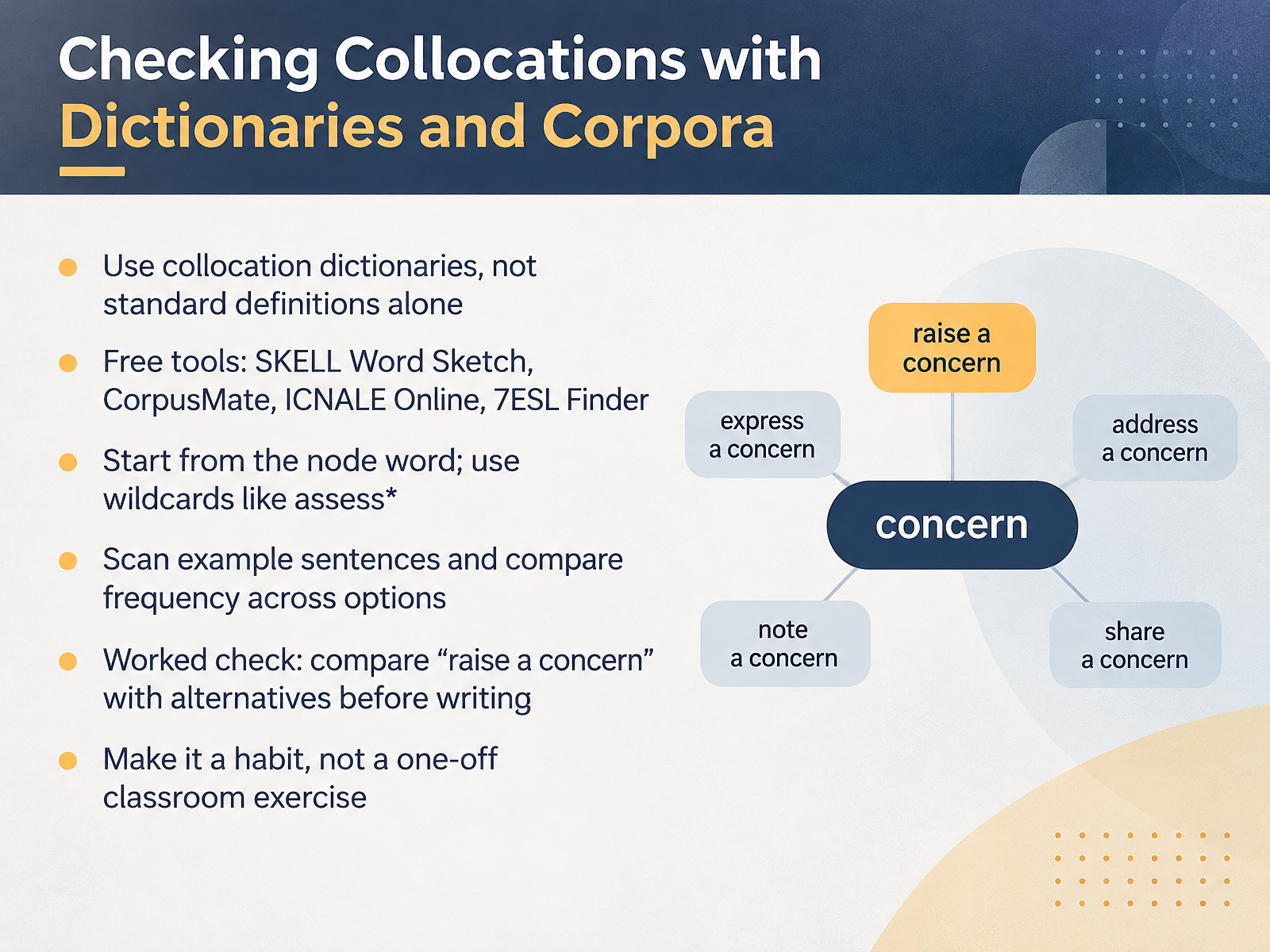
- 10Checking Collocations with Dictionaries and CorporaSo, how do you actually check a collocation? First, use a collocation dictionary, not just a standard definition. A normal dictionary tells you what a word means. A collocation dictionary shows you which words it sits with. There are free tools too. SKELL Word Sketch, CorpusMate, ICNALE Online, and the 7ESL Finder. Start from your node word, the main word you are checking. Use a wildcard, like assess with a star, to catch assessed, assessing, assessment. Then scan the example sentences and compare how often each option appears. Here is a worked check. Before you write, compare raise a concern with other choices, like make a concern or do a concern. Real examples show raise a concern is the natural one. Make this a habit, not a one-off classroom exercise. Every time you are unsure, check it, and store the phrase. Next, we look at practical strategies for independent learning.
 oxfordlearnersdictionaries.comcambridge.orgassets.cambridge.org+22 min
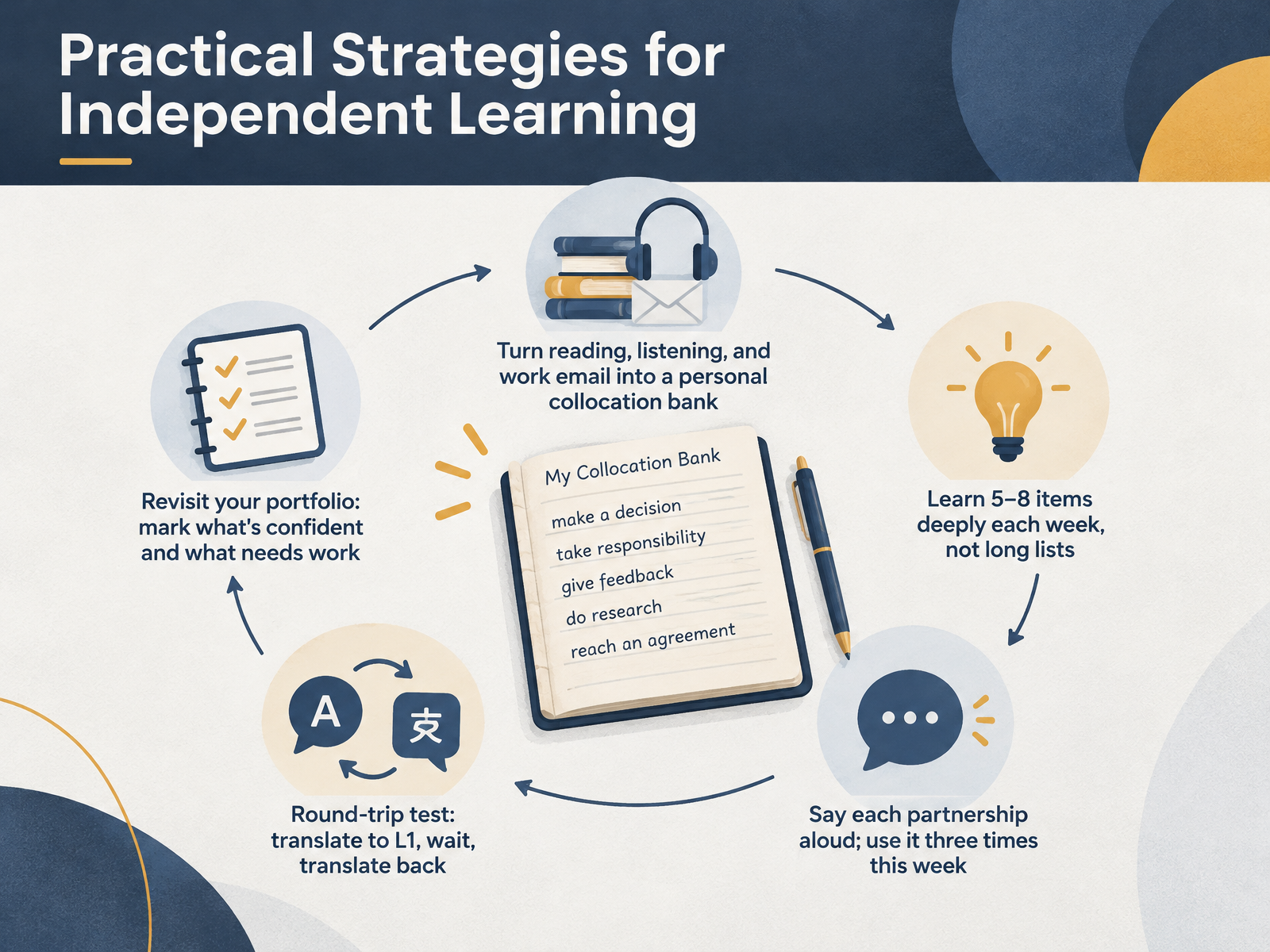
- 11Practical Strategies for Independent LearningSo let's make this practical. You can turn your reading, your listening, and even your work email into a personal collocation bank. Every time you meet a phrase like make a decision or heavy rain, that's a deposit. But here's the key. Learn five to eight items deeply each week. Not long lists. Deep, not wide. Say each partnership aloud, and use it three times this week. Once in speech, once in writing, once in your own head in a new situation. Then try the round-trip test. Translate a phrase into your first language, wait a day, then translate it back. If it comes back naturally, it's yours. Finally, revisit your portfolio. Mark what feels confident and what still needs work. That honest review is what keeps your collocations sharp. Next, we'll pull everything together with a rapid review.
 oxfordlearnersdictionaries.comalulaenglish.comojs.cuni.cz+21 min
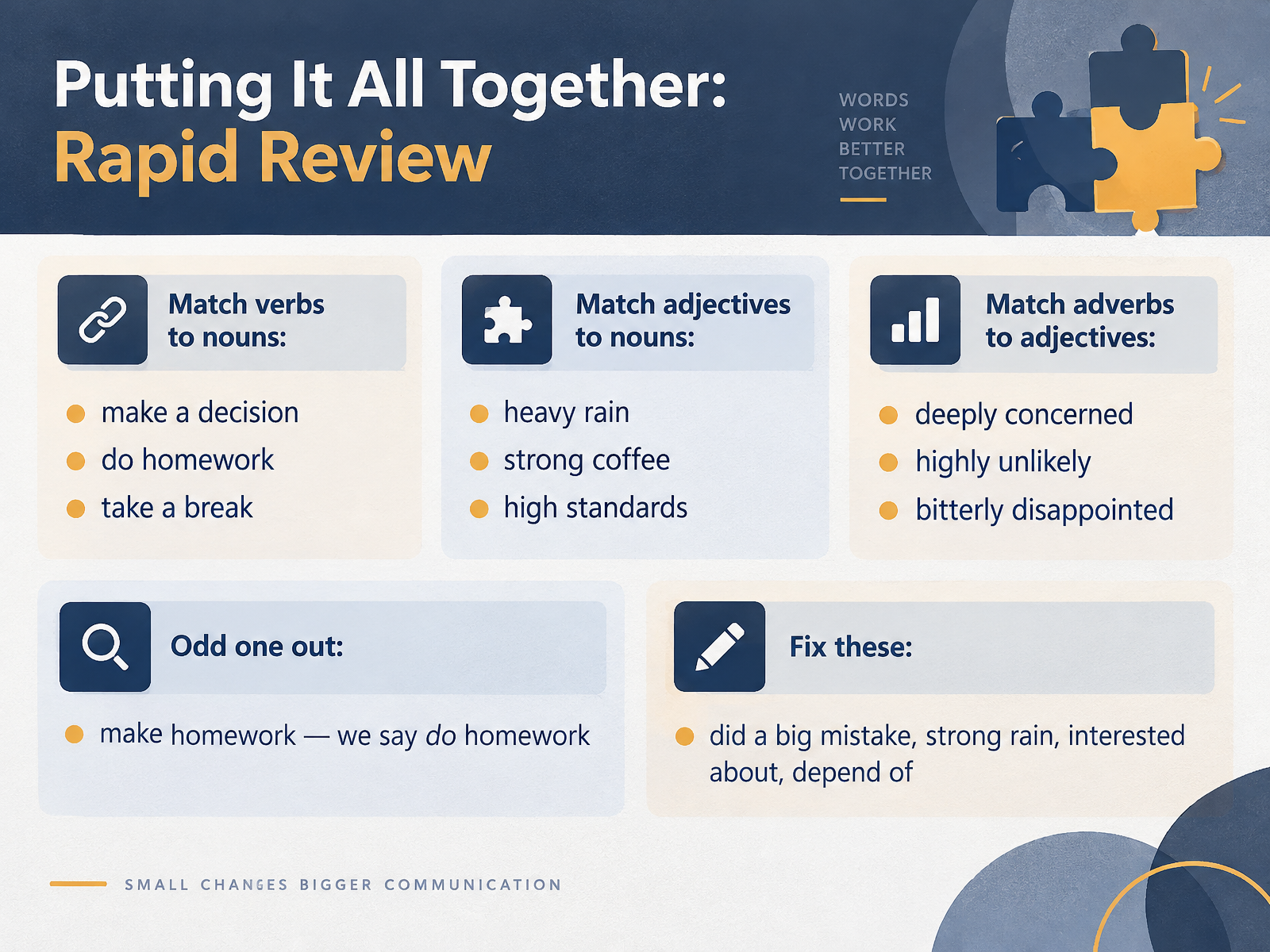
- 12Putting It All Together: Rapid ReviewLet's pull this together with a rapid review. Verbs and nouns first: make a decision, do homework, take a break. Adjectives and nouns: heavy rain, strong coffee, high standards. Adverbs and adjectives: deeply concerned, highly unlikely, bitterly disappointed. Now the odd one out. We never say make homework. We say do homework. Quick fixes. Did a big mistake becomes made a big mistake. Strong rain becomes heavy rain. Interested about becomes interested in. And depend of becomes depend on. So remember, grammar gets you understood. Collocations get you sounding natural. Next, let's build your one-week collocation action plan.
 cdn-cms.f-static.nettandfonline.comvarsitytutors.com+21 min
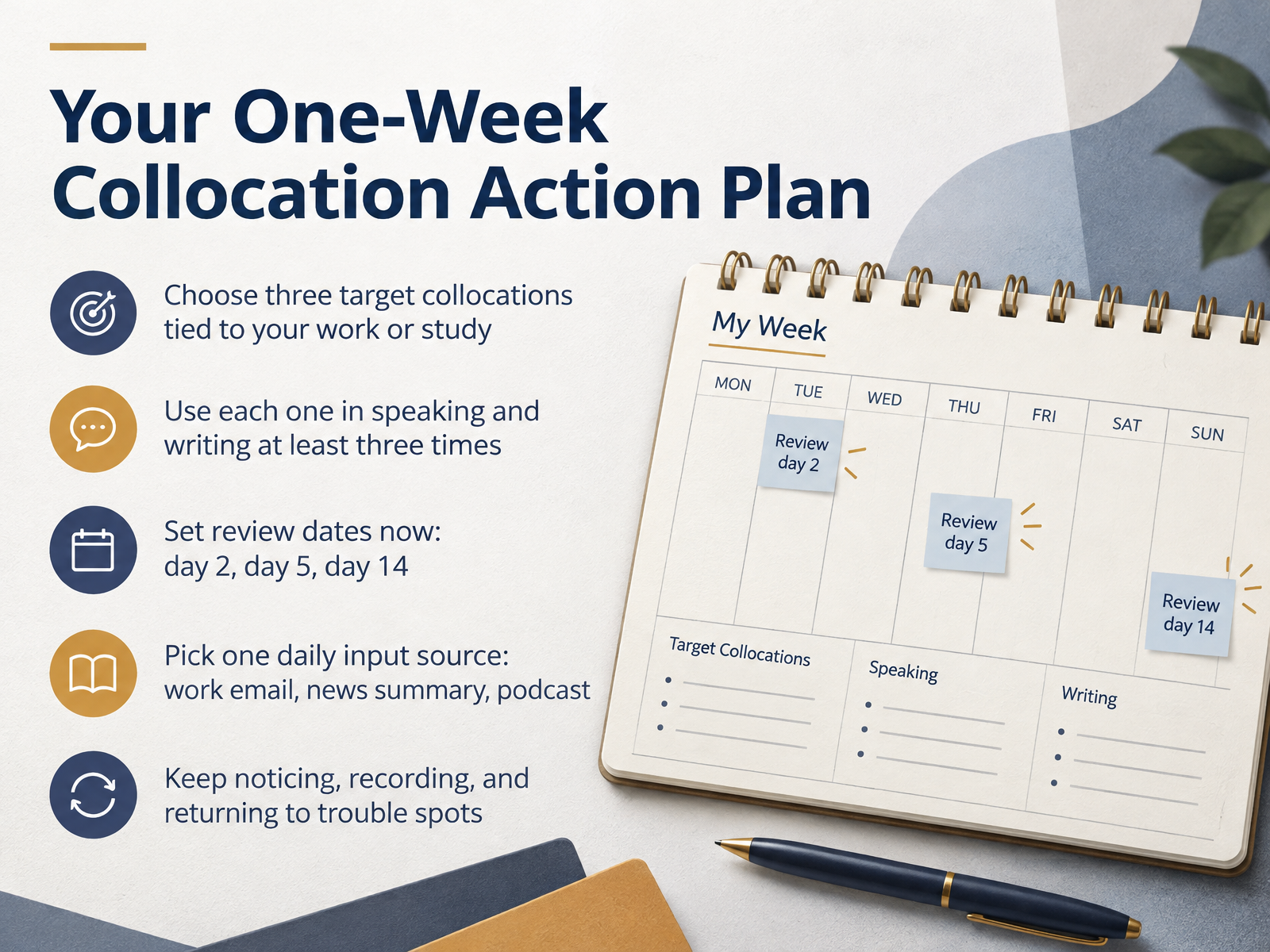
- 13Your One-Week Collocation Action PlanLet's turn all of this into something you can actually do, starting this week. Pick just three collocations tied to your work or study. Only three. For example, meet a deadline, conduct research, or heavy workload. Next, use each one at least three times, in speaking and in writing. Your brain keeps what it uses. Then set your review dates right now, today. Day two, day five, and day fourteen. Spacing works. One quick recall session beats an hour of rereading. Also, choose one daily input source: a work email, a news summary, or a podcast. Just one, so it stays manageable. Finally, keep noticing, keep recording, and go back to your trouble spots. Those stubborn ones are where the real progress hides. Three collocations, real use, spaced review. That's your week. Now let's bring everything together in our final section, Wrap-Up, Self-Assessment, and Next Steps.
 alulaenglish.comoxfordlearnersdictionaries.comcambridge.org+22 min
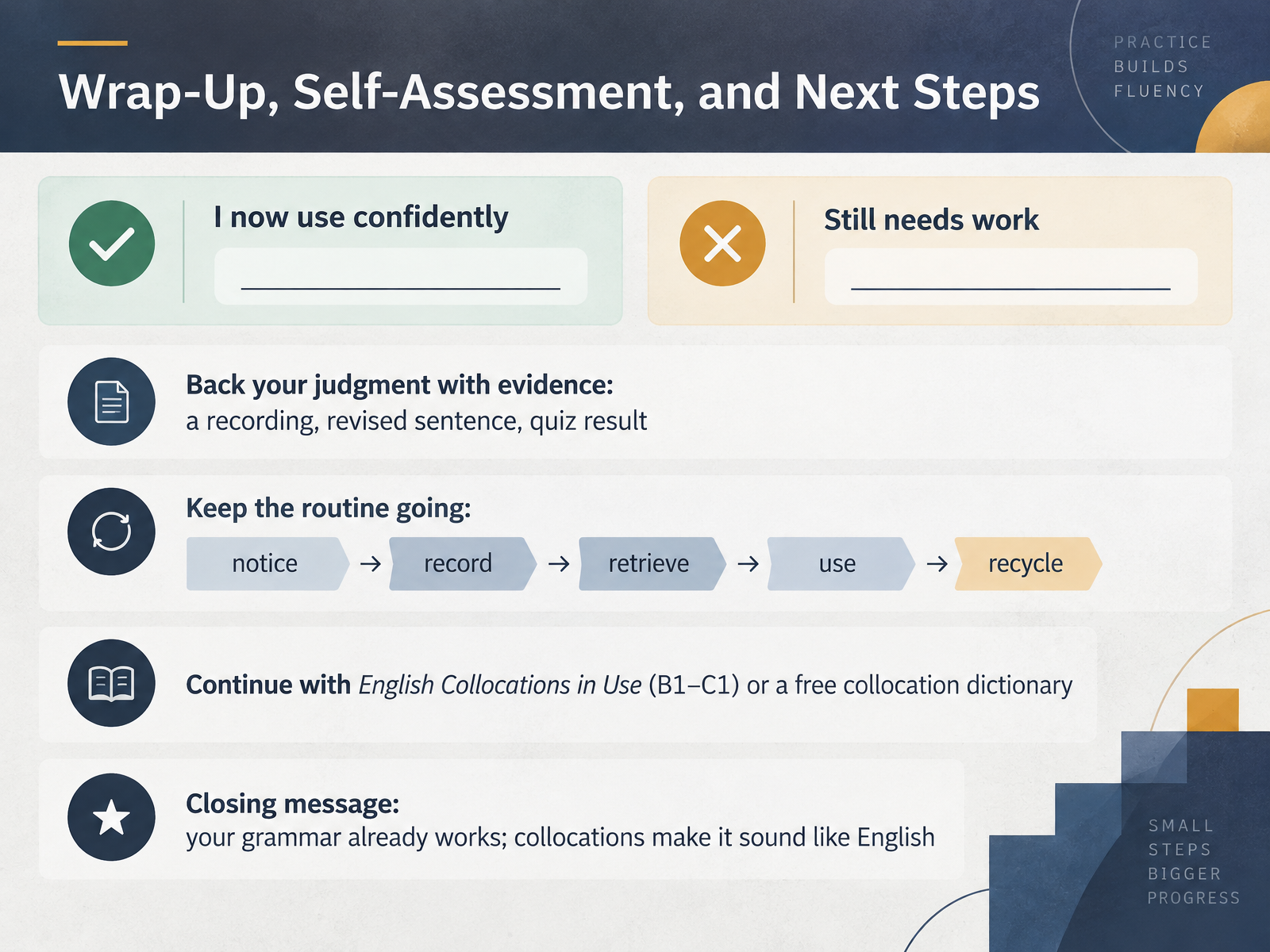
- 14Wrap-Up, Self-Assessment, and Next StepsLet's bring this together with a quick self check. Name one collocation you already use confidently. Then name one that still needs work. For example, you might say "make a decision" easily, but still hesitate with "bitterly disappointed." Back up your judgment with evidence. Save a short recording of yourself speaking. Revise one old sentence. Or keep a quiz result. Evidence tells you if you've really improved. Now keep the routine going. Notice, record, retrieve, use, and recycle. That's the loop. Notice a partnership when you read or listen. Record it in a phrase, not a single word. Retrieve it from memory the next day. Use it in a real sentence. Then recycle it again a week later. For support, continue with English Collocations in Use at B1 to C1 level, or use a free online collocation dictionary. Here's the closing message. Your grammar already works. Collocations are what make it sound like English. You've done the hard part. Keep noticing, keep collecting, and trust the process. Thank you for learning with me, and good luck.
 oxfordlearnersdictionaries.comcambridge.orgassets.cambridge.org+22 min
Take the deck with you
Download this course as a file — free, no sign-up needed.
- PDF handoutEvery slide page, ready to print or share.15 pages · 3.9 MBDownload
- Narrated PowerPointThe deck that presents itself — every slide carries the digital human's narration video.15 pages · 24.3 MBDownload
- PowerPoint slidesThe full deck as a .pptx — open it in PowerPoint, Keynote, or Google Slides.15 pages · 3.9 MBDownload
Free to use in your own training — please keep the PersonWise credit page at the end.
Have your own deck? Turn it into a course
Sources consulted
Web sources consulted while building this course.
- Oxford Collocations Dictionary at Oxford Learner's Dictionaries — oxfordlearnersdictionaries.com
- Understanding collocations: why they're important — cambridge.org
- What is a collocation? — assets.cambridge.org
- English Collocations in Use Intermediate Book with Answers How Words Work Together for Fluent and Natural English 2nd Edition — ieltspop.com
- English Collocations in Use — Free PDF | OEG — oxfordenglishglobal.com
- Using collocation clusters to detect and correct English L2 learners’ collocation errors: Computer Assisted Language Learning: Vol 34, No 3 — tandfonline.com
- Correcting Collocations & Word Choice — I can recognize and... — varsitytutors.com
- Common collocation mistakes and how to fix them | English collocations dictionary | collocations.org — collocations.org
- Collocation Errors in the Written Essays of — noyam.org
- Study on the Causes and Countermeasures of the Lexical Collocation Mistakes in College English | Yan | English Language Teaching | CCSE — ccsenet.org
- Collocation - Grammar - Cambridge Dictionary — dictionary.cambridge.org
- 80+ English Collocations To Boost Your Vocab – StoryLearning — storylearning.com
- Collocations - Explorations in English Language Learning — englishexplorations.check.uni-hamburg.de
- Collocation — Definition, Types & Examples | LexFizz Grammar Glossary — lexfizz.com
- What are Collocations in English? Types and Examples — grammarinsights.com
- Discover and Master English Collocations — alulaenglish.com
- https://ojs.cuni.cz/pedagogika/article/view/2918/2419 — ojs.cuni.cz
- Teaching English Collocations: Effective Classroom Methods — eflcafe.net
- ArticleInternational Journal of TESOL Studies (2021)Vol. 3 (4) 144-165 https://doi.org/10.46451/ijts.2021.12.10 — tesolunion.org
- Collocations exercises b2 pdf — cdn-cms.f-static.net