Begin
14 pages · ~28 min
Astronomy Concepts and Vocabulary
Introduction to astronomy concepts and essential vocabulary, covering celestial objects, phenomena, and foundational terminology for beginners.
A digital instructor presents all 14 pages. Hold “Ask” at any point and ask out loud — the answer comes from this course. No sign-up needed.
What you’ll learn
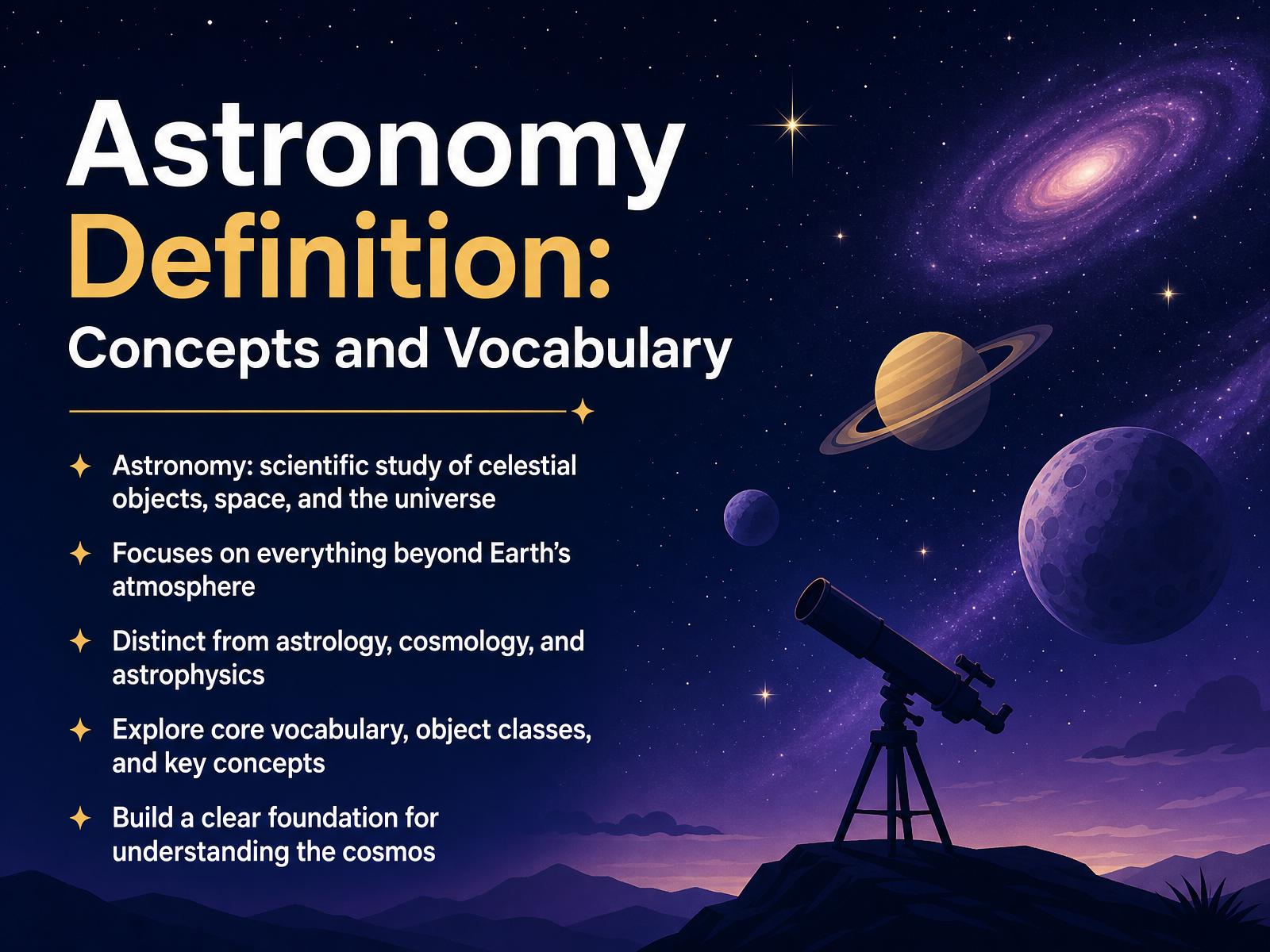
- 01Astronomy Definition: Concepts and VocabularyWelcome! I am so glad you are here as we begin our journey into astronomy. In this course, we will build a clear foundation for understanding the cosmos. Let us start with a simple question: what exactly is astronomy? At its heart, it is the scientific study of celestial objects, space, and the universe as a whole. Think of it as a way of looking up and asking how everything out there actually works. This means astronomy focuses on everything beyond Earth’s atmosphere, from the Moon and the planets to distant galaxies and even the mysterious dark matter we cannot see. Now, we should clear up one common mix-up. Astronomy is not astrology, which is a belief system about how stars influence our lives. We also distinguish it from cosmology, the study of the universe as a whole, and astrophysics, which uses physics to explain how these objects behave. Throughout this course, we will explore core vocabulary, the different classes of objects like stars and planets, and the key concepts that tie it all together. By the end, you will have a solid framework to keep exploring the night sky. Next, let us look closer at what astronomy is, and what it is not.csun.edunsta.orgastronomy.org+21 min
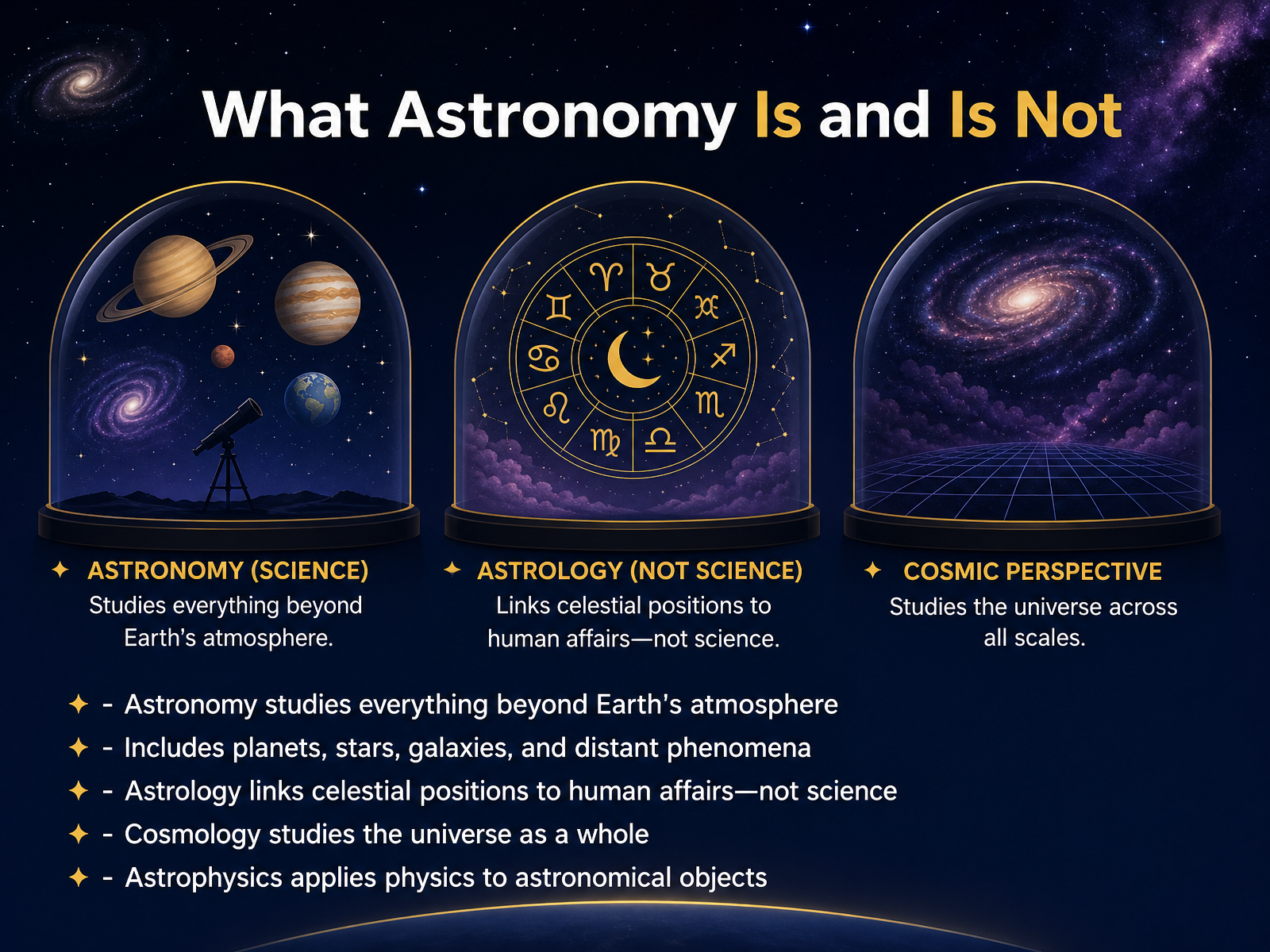
- 02What Astronomy Is and Is NotLet's start by drawing a clear line around what astronomy is. At its heart, astronomy is the study of everything beyond Earth's atmosphere. Think of it as looking up at the night sky and asking, what is all that out there? The answer includes planets and moons, stars, galaxies, and even strange phenomena like black holes and distant bursts of energy. Now, a common point of confusion is the difference between astronomy and astrology. Astrology links the positions of stars and planets to human events and personalities. It might be fun to think about, but it is not science. Astronomy uses observation, experiments, and testable ideas to understand the universe. We can also zoom in on two specific branches. Cosmology is the study of the universe as a whole, like looking at the entire cosmic forest, including how it began and how it is evolving. Astrophysics zooms in on the individual trees, using the laws of physics to explain how stars shine and how planets move. In modern use, astronomy and astrophysics often mean almost the same thing. So, keeping these ideas separate helps us avoid common misconceptions right away. Next, let's explore the main objects astronomers actually study.
 britannica.comopenstax.orgamnh.org+22 min
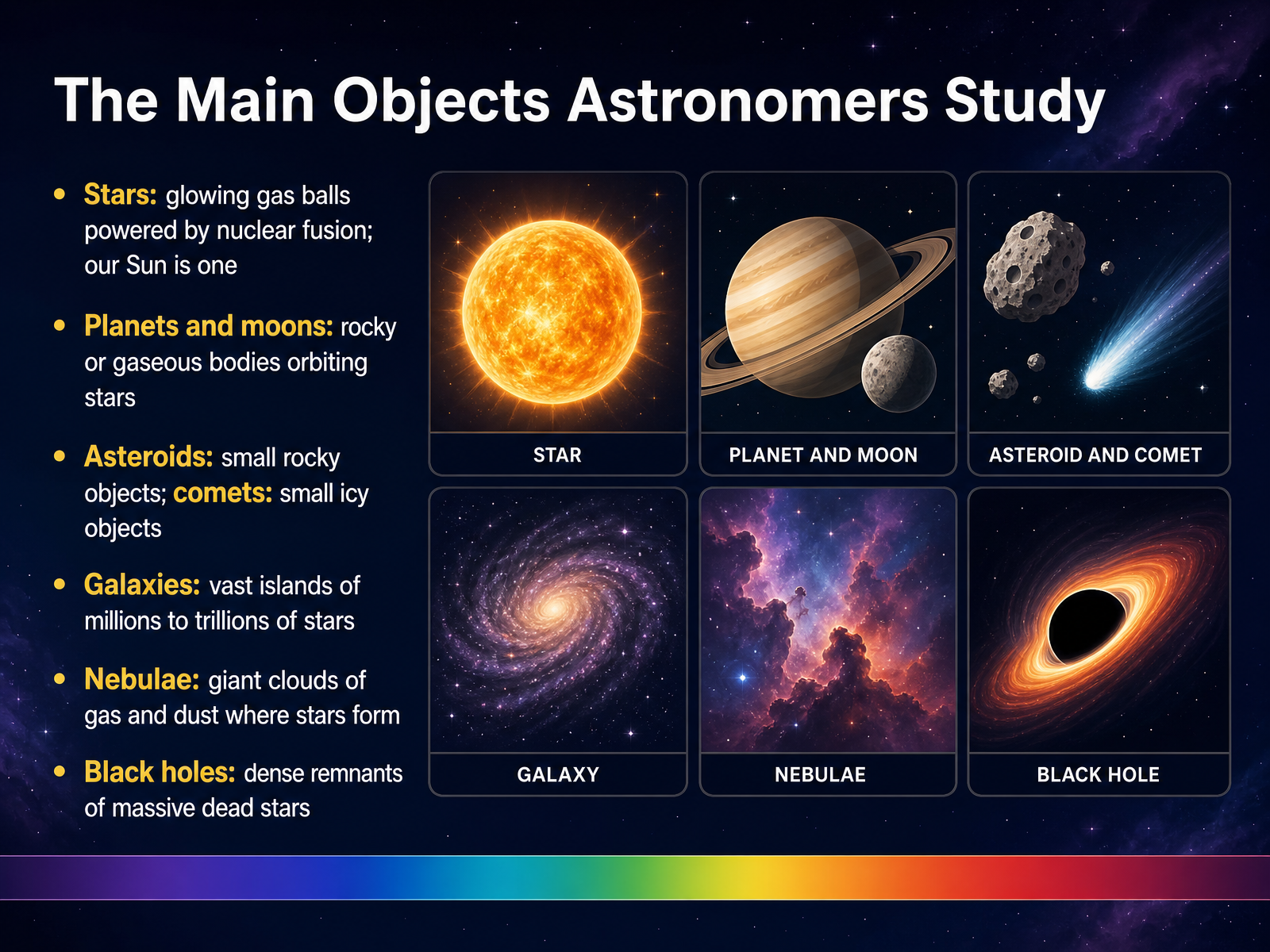
 - 03The Main Objects Astronomers StudyNow, let’s meet the main cast of characters in our cosmic story. First, there are the stars. These are glowing spheres of gas, powered deep inside by nuclear fusion. Our own Sun is a star, just like the twinkling lights we see at night. Next, we have planets and moons. Planets are large, rocky or gaseous bodies that orbit stars. Moons are smaller companions that orbit planets. Then there are the smaller wanderers. Asteroids are rocky chunks, while comets are icy bodies that grow glowing tails as they approach the Sun. When we zoom out, we find galaxies. These are vast islands of stars, containing anywhere from millions to over a trillion suns. Our Milky Way is just one of these. Inside galaxies, we find nebulae, which are enormous clouds of gas and dust. These are stellar nurseries, the places where new stars are born. Finally, there are black holes. These are extremely dense remnants left behind after very massive stars die, with gravity so strong that not even light can escape. Up next, we’ll break down the core vocabulary for these objects and the structures they form.
 phys.libretexts.orgbritannica.comphys.libretexts.org+21 min
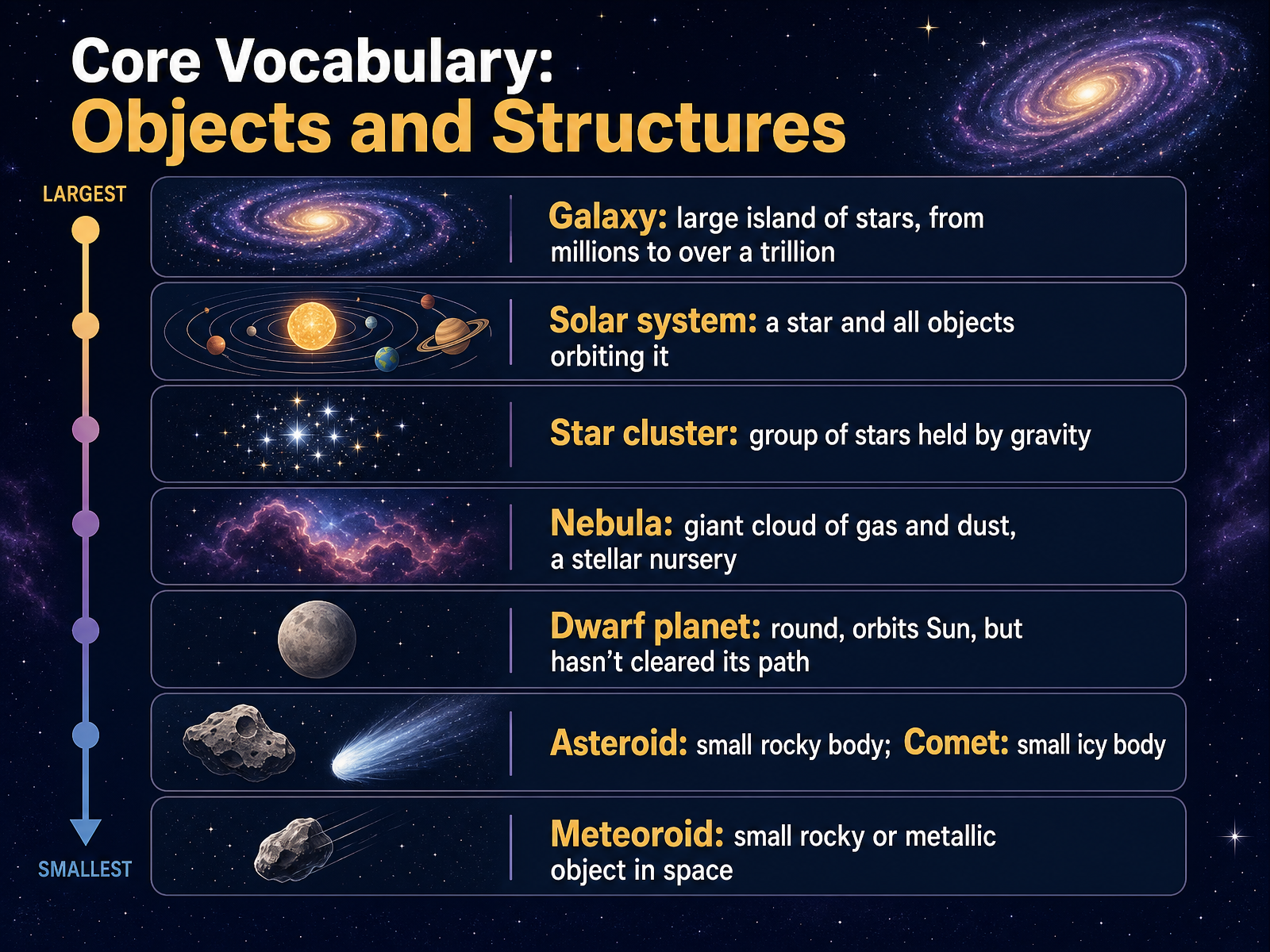
 - 04Core Vocabulary: Objects and StructuresNow let's build our cosmic vocabulary by exploring the main objects and structures you'll encounter. Think of a galaxy as a vast island of stars, containing anywhere from millions to over a trillion suns. Our own Milky Way is one such island. Zoom in, and you find a solar system: a single star and everything that orbits it, like our Sun with its planets. Sometimes stars gather in smaller groups called star clusters, held together by their mutual gravity. We also have nebulae, which are giant clouds of gas and dust. These aren't just pretty; they are stellar nurseries where new stars are born. Closer to home, we find smaller objects. A dwarf planet is round and orbits the Sun, but it hasn't cleared its orbital path of other debris. Asteroids are small rocky bodies, while comets are small icy ones. And a meteoroid is simply a small rocky or metallic object moving through space. These are the building blocks of the cosmos. Next, we'll learn the vocabulary for how these objects move and how we observe them.
 phys.libretexts.orgbritannica.comphys.libretexts.org+22 min
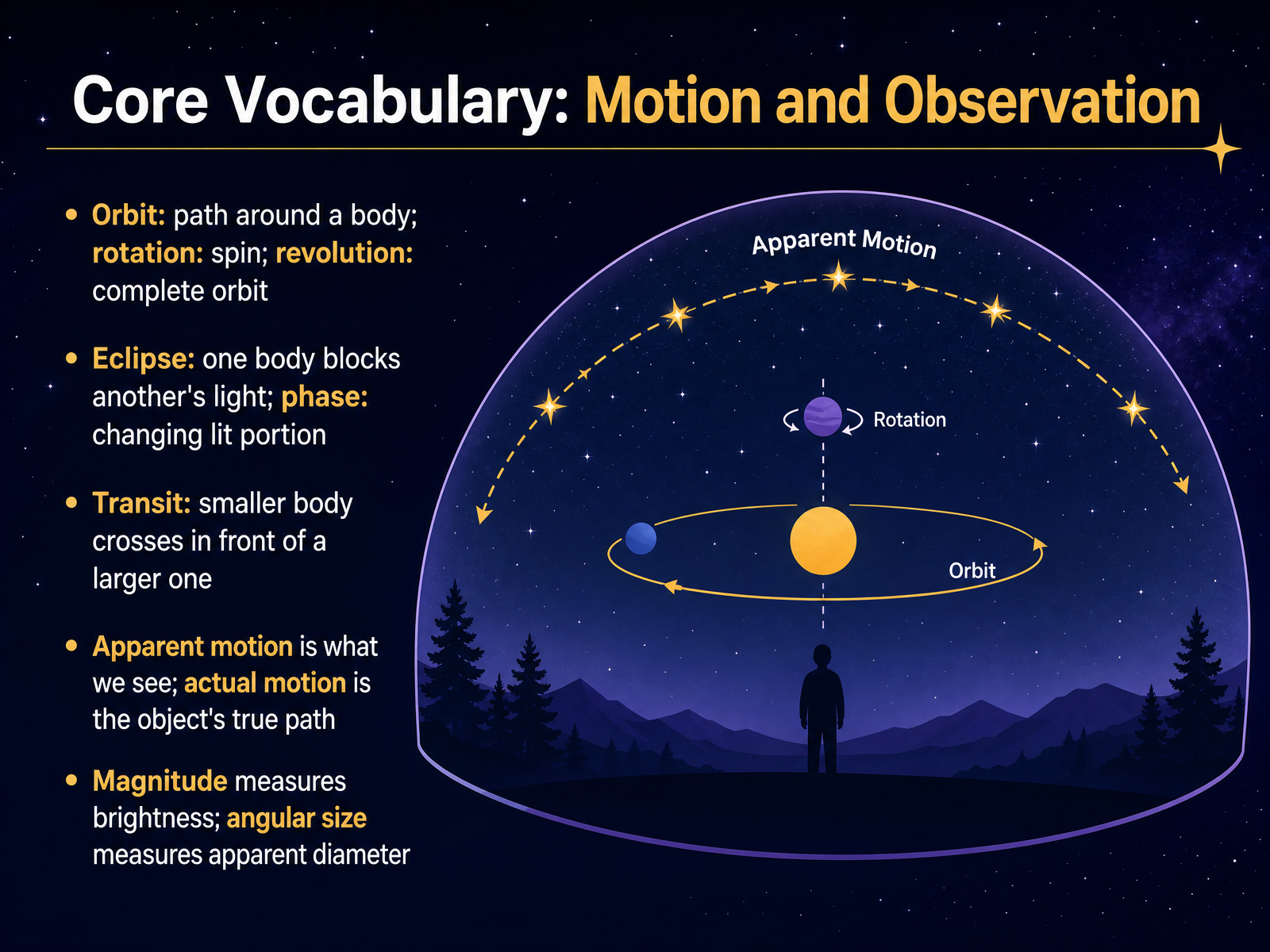
 - 05Core Vocabulary: Motion and ObservationNow, let's build our vocabulary for describing how things move and how we see them from Earth. First, think about the difference between rotation and revolution. Rotation is when a body spins on its own axis, like a basketball spinning on a finger. Revolution is a complete trip around another body, like a runner finishing a lap around a track, and the path of that lap is its orbit. An eclipse happens when one body blocks the light of another, while a phase describes the changing illuminated portion we see, like the moon's familiar cycle. A transit occurs when a smaller body crosses in front of a larger one. It is also important to distinguish between apparent motion, which is simply what we observe from our moving platform, and actual motion, which is an object's true path through space. Finally, two terms describe what we measure. Magnitude tells us how bright an object seems, and angular size describes how large it appears in our sky. Next, let's talk about the units of distance in astronomy.
 csun.edunsta.orgastronomy.org+21 min
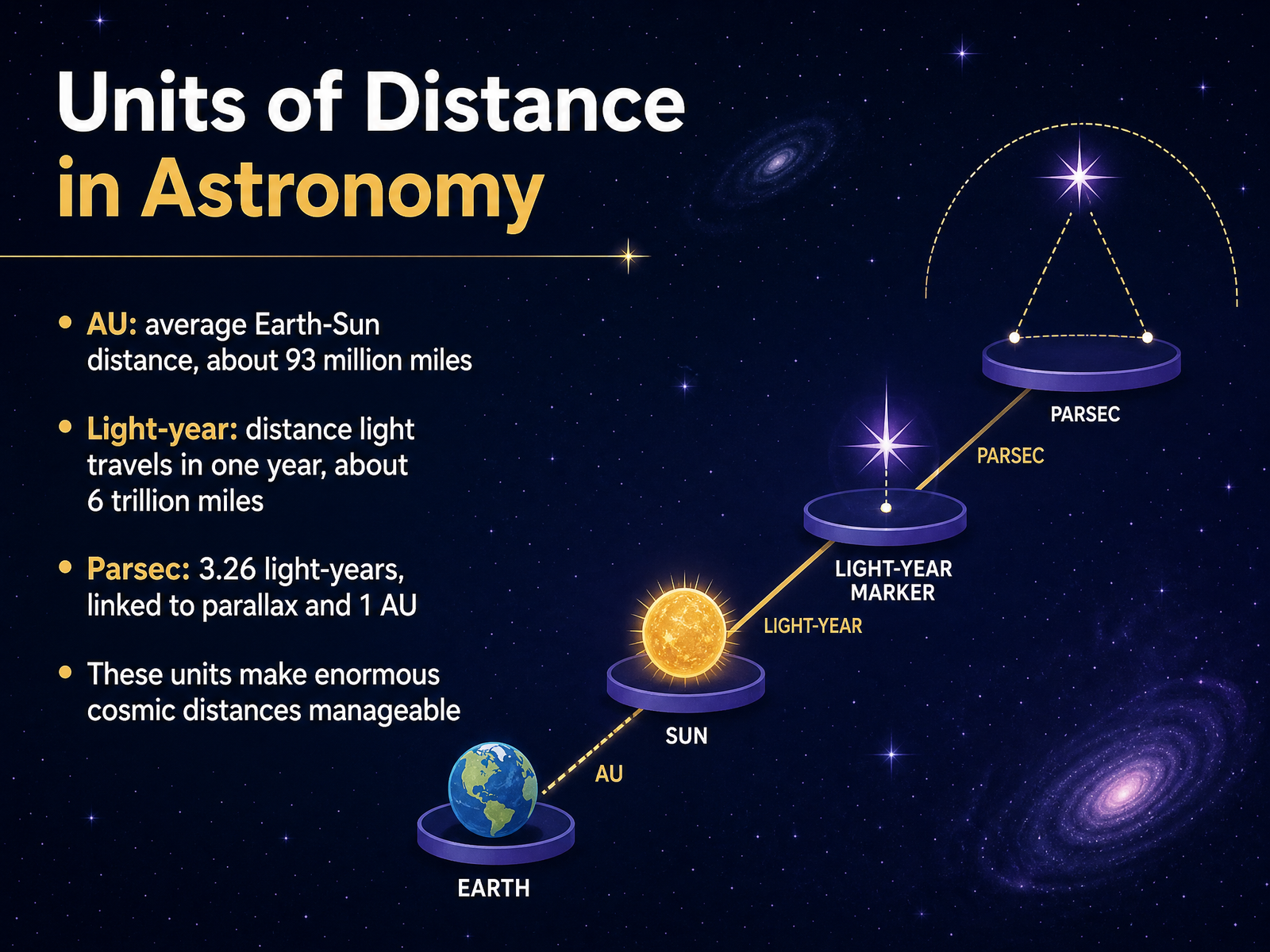
 - 06Units of Distance in AstronomyNow that we have a feel for astronomy's big ideas, let's give them room to breathe by looking at how we measure space itself. When we describe distances inside our solar system, miles get awkward fast. So astronomers use the astronomical unit, or AU. One AU is the average distance from Earth to the Sun, about ninety three million miles. That gives us a handy yardstick for planets and nearby orbits. But once we step out toward the stars, even AU values become huge. So we switch to the light-year, which sounds like time but is actually the distance light travels in one year, close to six trillion miles. Think of it as a cosmic road trip measured by the fastest traveler we know. For professional work with immense stellar distances, astronomers often prefer the parsec, which is about three point two six light-years and is tied to the tiny shift in a star's apparent position as Earth moves around the Sun. Each unit is simply a tool for keeping enormous numbers meaningful and relatable. Up next, we will focus on units of time and brightness to see how astronomers track events and compare how much energy objects really give off.
 science.nasa.govastronomy.comlco.global+22 min
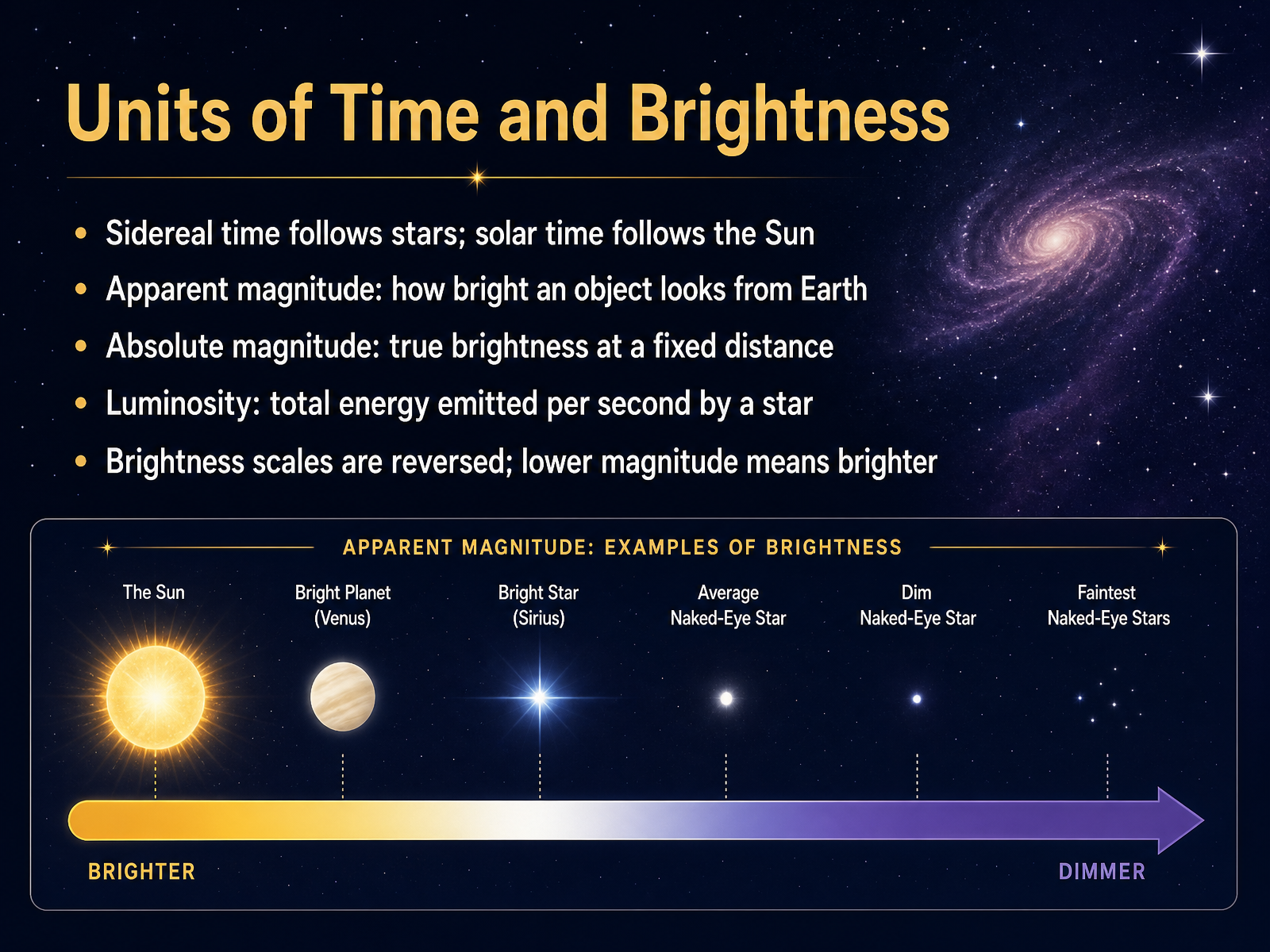
 - 07Units of Time and BrightnessNow let's talk about how we measure time and brightness in astronomy. When we tracked time by the stars, that's sidereal time, a little shorter than our solar day that tracks the Sun. For brightness, we use a few different scales. Apparent magnitude is how bright something looks from Earth. Absolute magnitude is the true brightness we would see if we placed every object at the same distance from us. And luminosity is the total energy a star actually gives off every second. Here's a quirky thing to remember about magnitude. The scale runs backwards. A lower number means a brighter object. So a star with magnitude one shines brighter than a star with magnitude three. These distinctions help us sort out what is truly bright from what is simply close to us. Next, we will explore the celestial sphere and how the sky appears to move above us.
 science.nasa.govastronomy.comlco.global+22 min
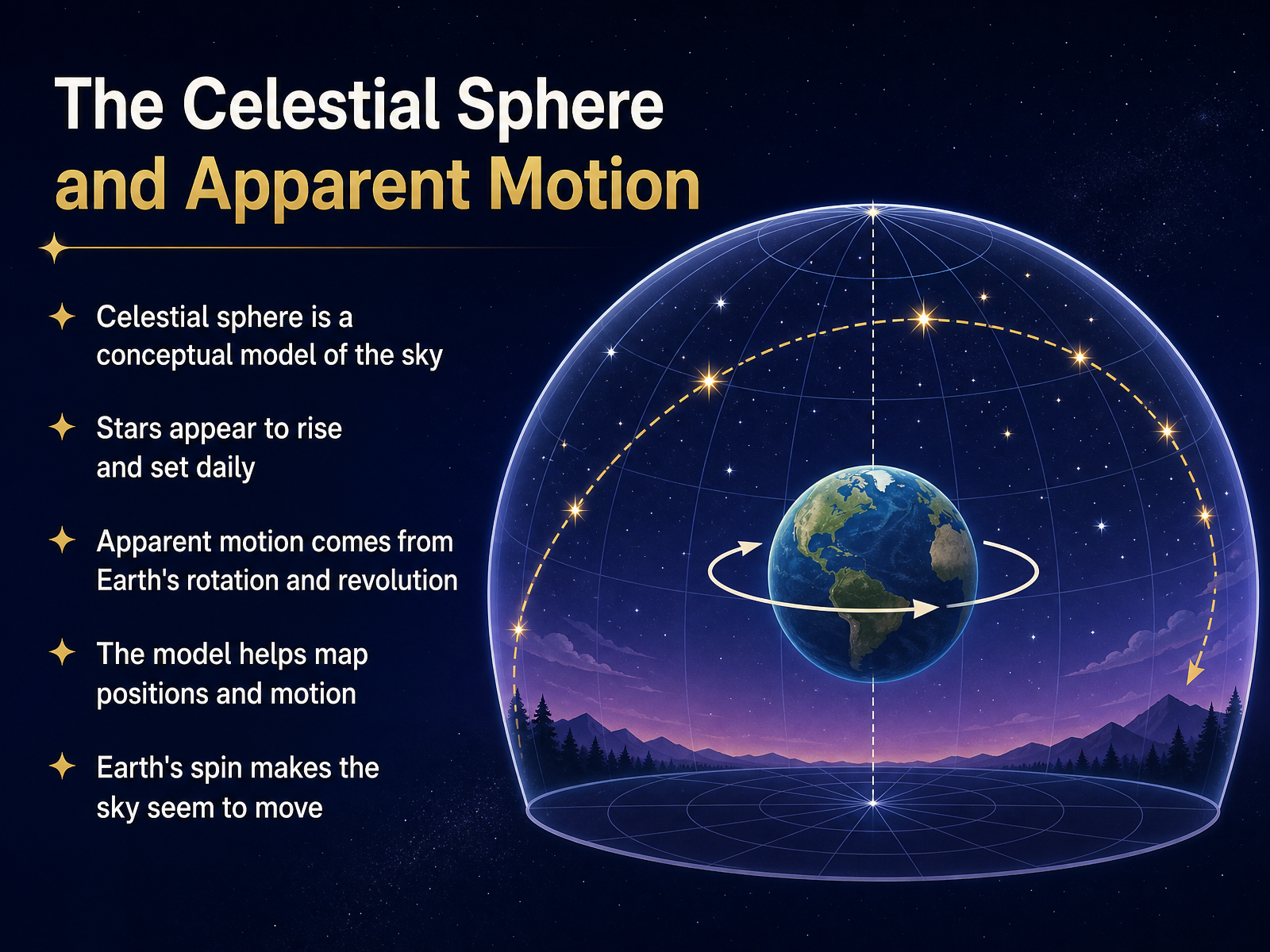
 - 08The Celestial Sphere and Apparent MotionNow let's imagine the sky as a giant, hollow ball surrounding Earth. We call this model the celestial sphere. It's not a real structure, but a helpful map for tracking stars in our minds. The stars seem to rise in the east and set in the west every night. This daily march is what we call apparent motion. It looks like the universe is spinning around us, but it's actually Earth's rotation that creates this illusion. Earth also revolves around the Sun, which shifts the constellations we see through the seasons. Using this imaginary dome helps astronomers chart positions and predict movements with precision. So remember, the sky's motion is a beautiful trick of our own planet's movement. Next, we'll explore how we study this motion with the scientific method in astronomy.
 phys.libretexts.orgbritannica.comphys.libretexts.org+21 min
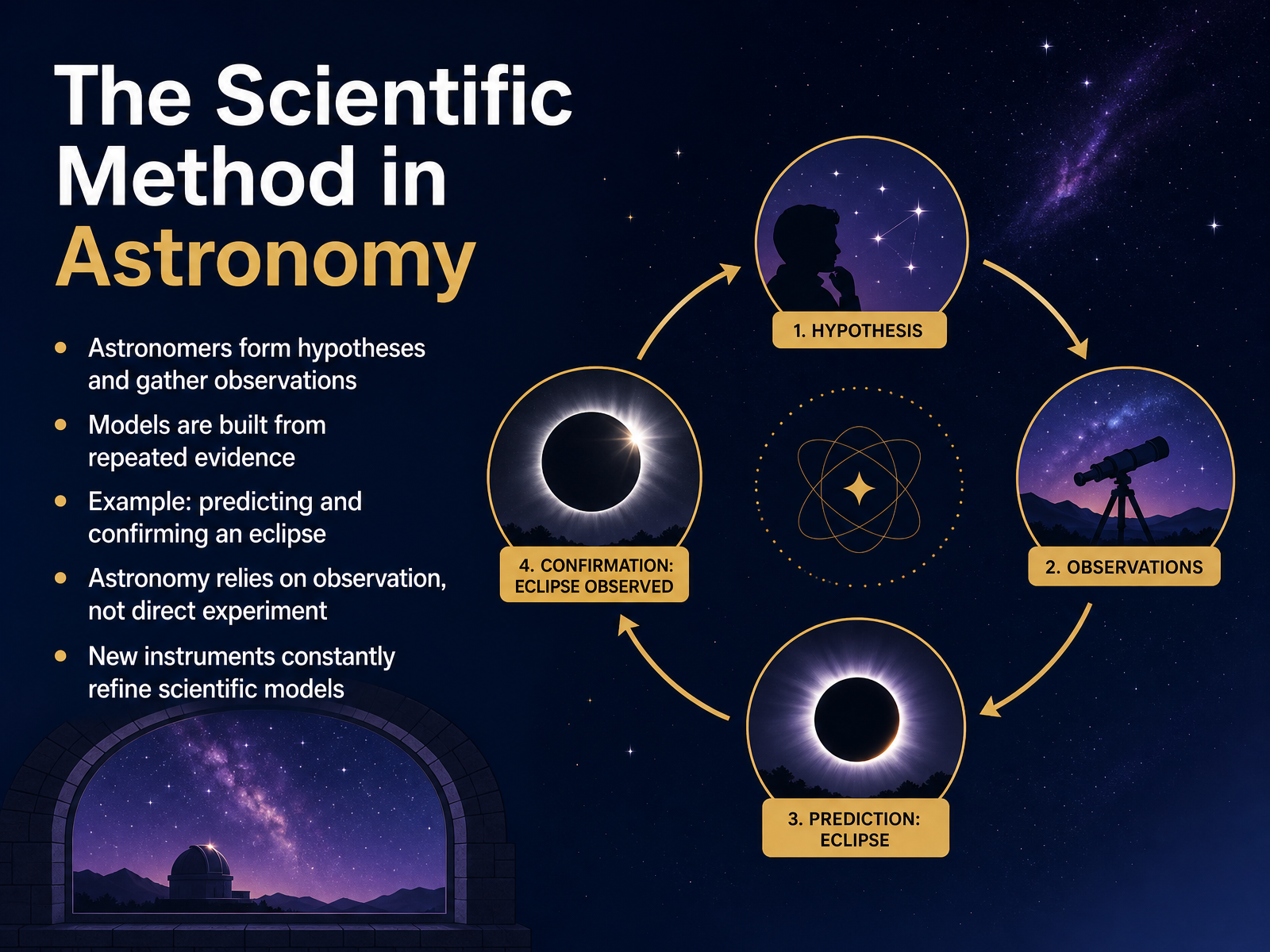
 - 09The Scientific Method in AstronomyNow let's think about how astronomers actually figure all of this out. In astronomy, the scientific method often means building a model. An astronomer might develop a hypothesis, a well-informed guess, based on what they see, then gather more observations to test it. If the evidence keeps supporting the idea, it grows into a scientific model. Take a solar eclipse. We can predict exactly when it will happen because the model of the Earth, Moon, and Sun moving in space is so reliable. Repeated evidence has confirmed it. Unlike a chemist who can mix liquids in a beaker, an astronomer usually can't run a direct experiment on a star or a galaxy. We can't change the conditions and see what happens. Instead, astronomy relies heavily on observation, carefully watching the sky over time. And as our instruments improve, from better telescopes to sensitive detectors, our models become sharper and more accurate. Science is truly a progress report, constantly being refined. Speaking of how ideas change, let's clear up some things on the next slide: Common Misconceptions About Astronomy.
 britannica.comopenstax.orgamnh.org+22 min
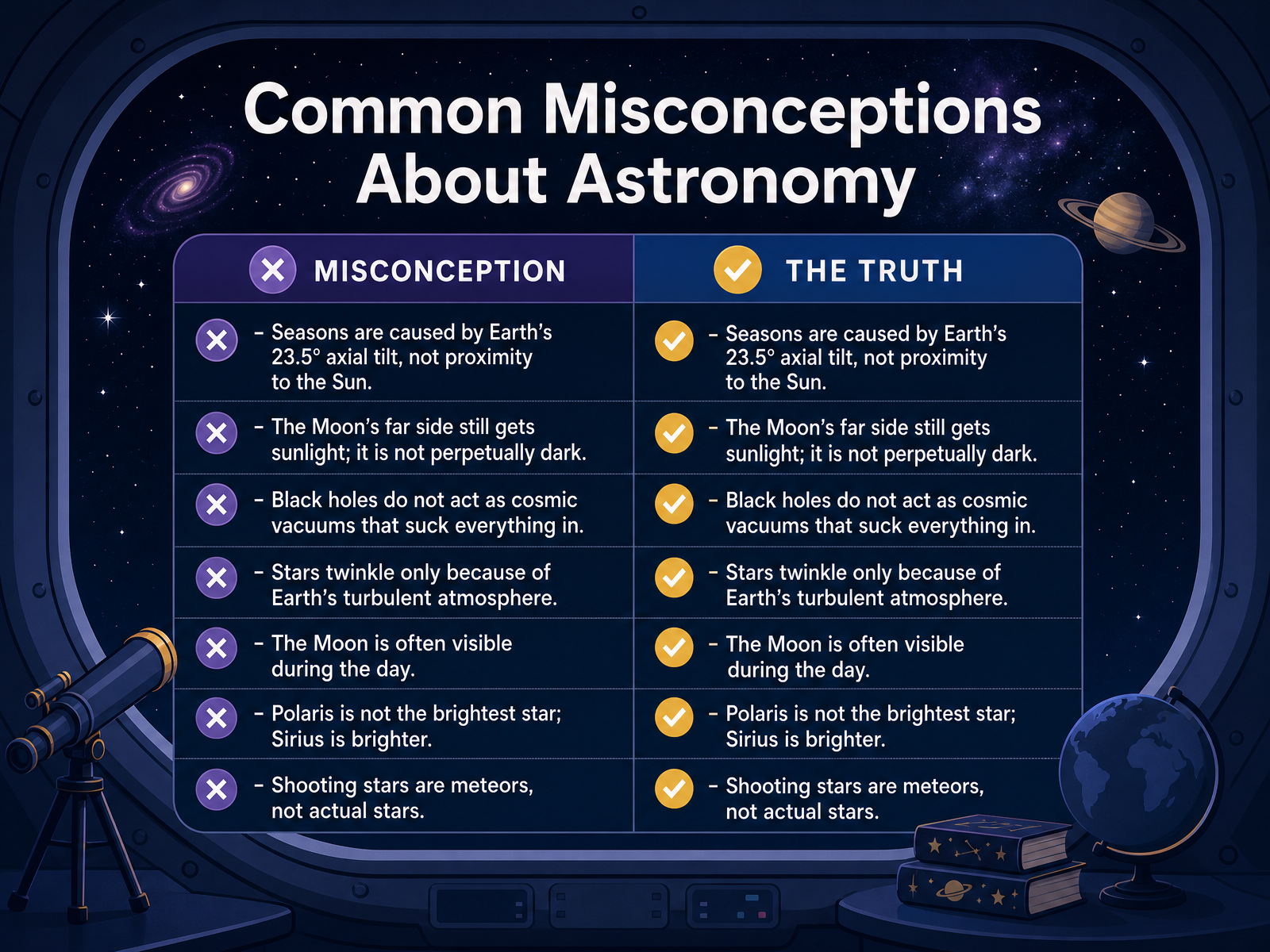
 - 10Common Misconceptions About AstronomyNow let's clear up a few ideas that often trip people up. First, our seasons. They are not caused by our distance from the sun. In fact, Earth is actually closest to the sun in January. Seasons happen because Earth is tilted on its axis by about twenty-three and a half degrees. This tilt changes how directly sunlight hits each hemisphere throughout the year. Next, we often hear about the dark side of the moon. But there is no permanently dark side. The far side, the side we cannot see from Earth, still gets plenty of sunlight. It is only dark when it is facing away from the sun. Another one is black holes. They are not cosmic vacuum cleaners. If our sun were replaced by a black hole of the same mass, Earth would not get sucked in. It would simply orbit in the cold and dark. We also see stars twinkle, but that shimmer comes from our own turbulent atmosphere, not from the stars themselves. From space, stars shine steadily. And shooting stars are not stars at all. They are tiny bits of space dust, called meteors, burning up in our atmosphere. Up next, we will sort out some frequently confused terms.
 csun.edunsta.orgastronomy.org+22 min
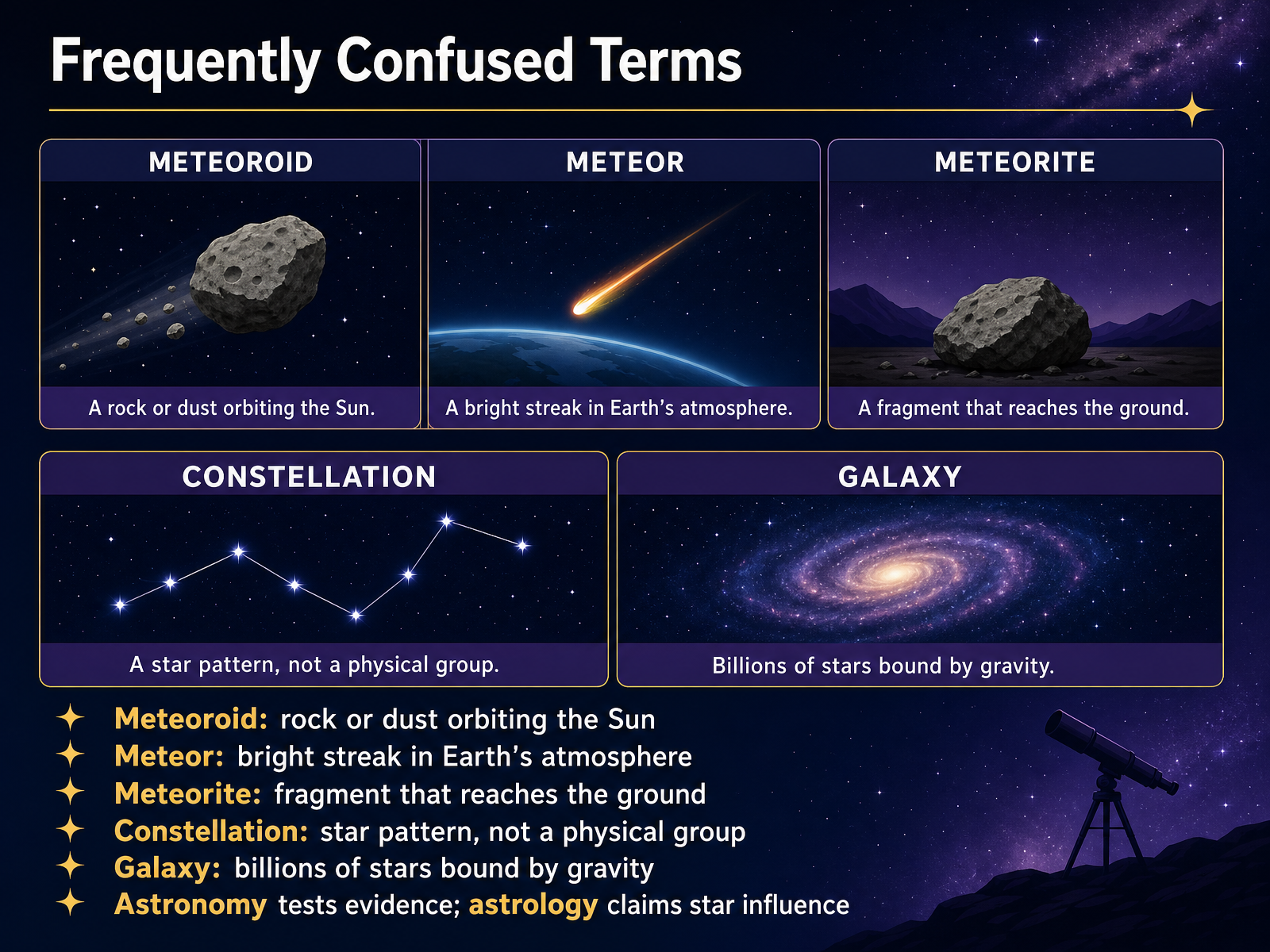
 - 11Frequently Confused TermsNow let's untangle a few terms that often get mixed up. Picture a small rock drifting through space, orbiting the Sun. That is a meteoroid. When that rock dives into Earth's atmosphere and creates a bright streak of light, that streak is a meteor, often called a shooting star. And if a piece survives the fiery fall and lands on the ground, we call it a meteorite. Think of it as a single object having three names, depending on where it is and what it's doing. Next, a constellation is just a pattern of stars we see from Earth, like connecting dots in the sky. The stars in a constellation are usually not physically close to each other. A galaxy, however, is real. It is a massive system of billions of stars, gas, and dust, all bound together by gravity. Finally, remember that astronomy is the science of observing and testing the universe, while astrology is a belief system. And that is an important difference. Now let's put this vocabulary to work as we explore how to apply astronomy terms in context.
 csun.edunsta.orgastronomy.org+21 min
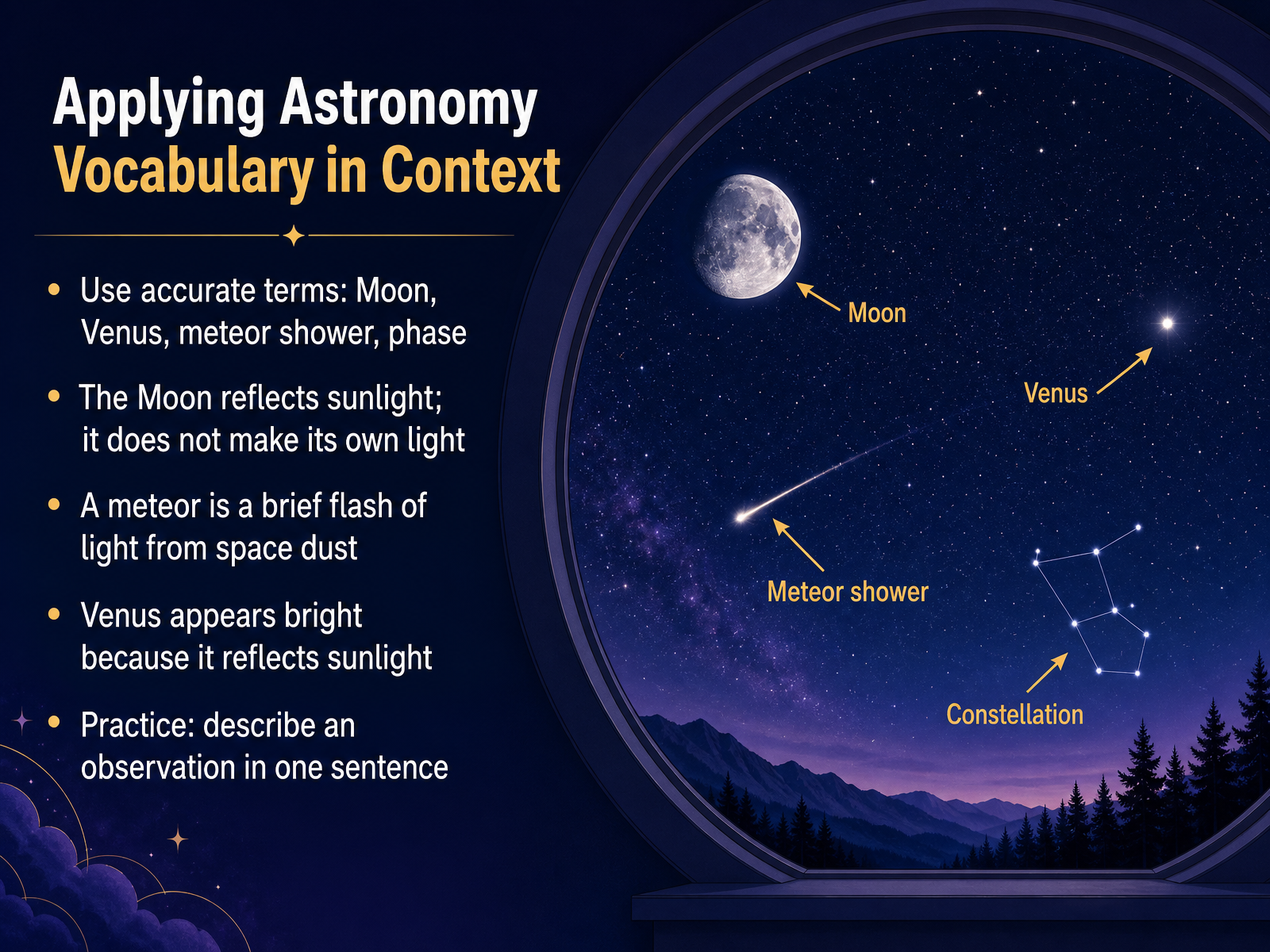
 - 12Applying Astronomy Vocabulary in ContextNow let's put those vocabulary words to work in real observations. First, the Moon. A common misunderstanding is that the Moon makes its own light. In truth, the Moon only reflects sunlight, much like a mirror bouncing light back toward us. Venus works the same way. It looks so dazzling not because it burns like a star, but because its thick clouds reflect a great deal of sunlight. Its changing appearance is called a phase, just like the Moon's changing shape in our sky. And during a meteor shower, we see brief flashes of light. These flashes happen when tiny bits of space dust slam into our atmosphere and burn up. Here is a quick practice: describe one evening observation in a single sentence, using accurate words like Moon, Venus, phase, or meteor. For example, tonight a bright Venus gleamed near the full Moon, and I saw one brief meteor streak through the sky. Using the right terms helps you turn a simple glance upward into a clear picture of what is really happening. Up next, we will move from these individual words to the bigger view in Putting It Together: From Vocabulary to Big Picture.
 csun.edunsta.orgastronomy.org+22 min
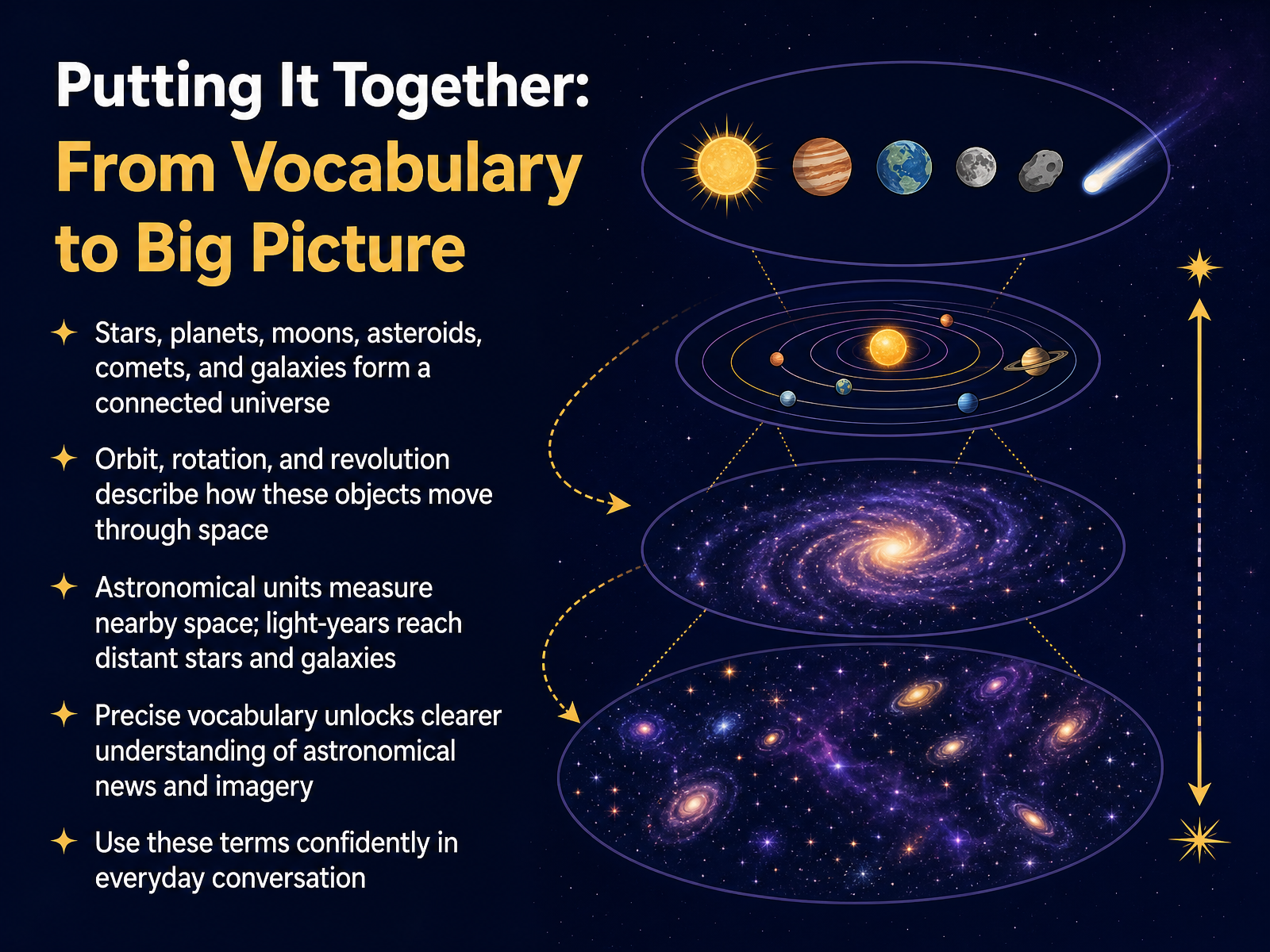
 - 13Putting It Together: From Vocabulary to Big PictureNow let us take a step back and see how all these pieces fit together. Stars, planets, moons, asteroids, comets, and galaxies are not just separate vocabulary words. They form one connected universe, all bound by gravity and motion. When we talk about orbit, rotation, and revolution, we are describing how these objects move through space and relate to each other. Think of a planet as a dancer spinning on its axis while also circling a bright star. To understand those movements, we need the right measuring tools. Astronomical units help us talk about nearby space, like the distance from Earth to the Sun. Light years reach across the impossible distances to distant stars and galaxies. This precise vocabulary is what turns a beautiful but blurry image from a telescope into a clear story we can understand. When you read astronomy news or look at a new photo from a space telescope, these terms let you join the conversation with confidence. Next, we will bring everything together with a summary and learning checks.
 phys.libretexts.orgbritannica.comphys.libretexts.org+21 min
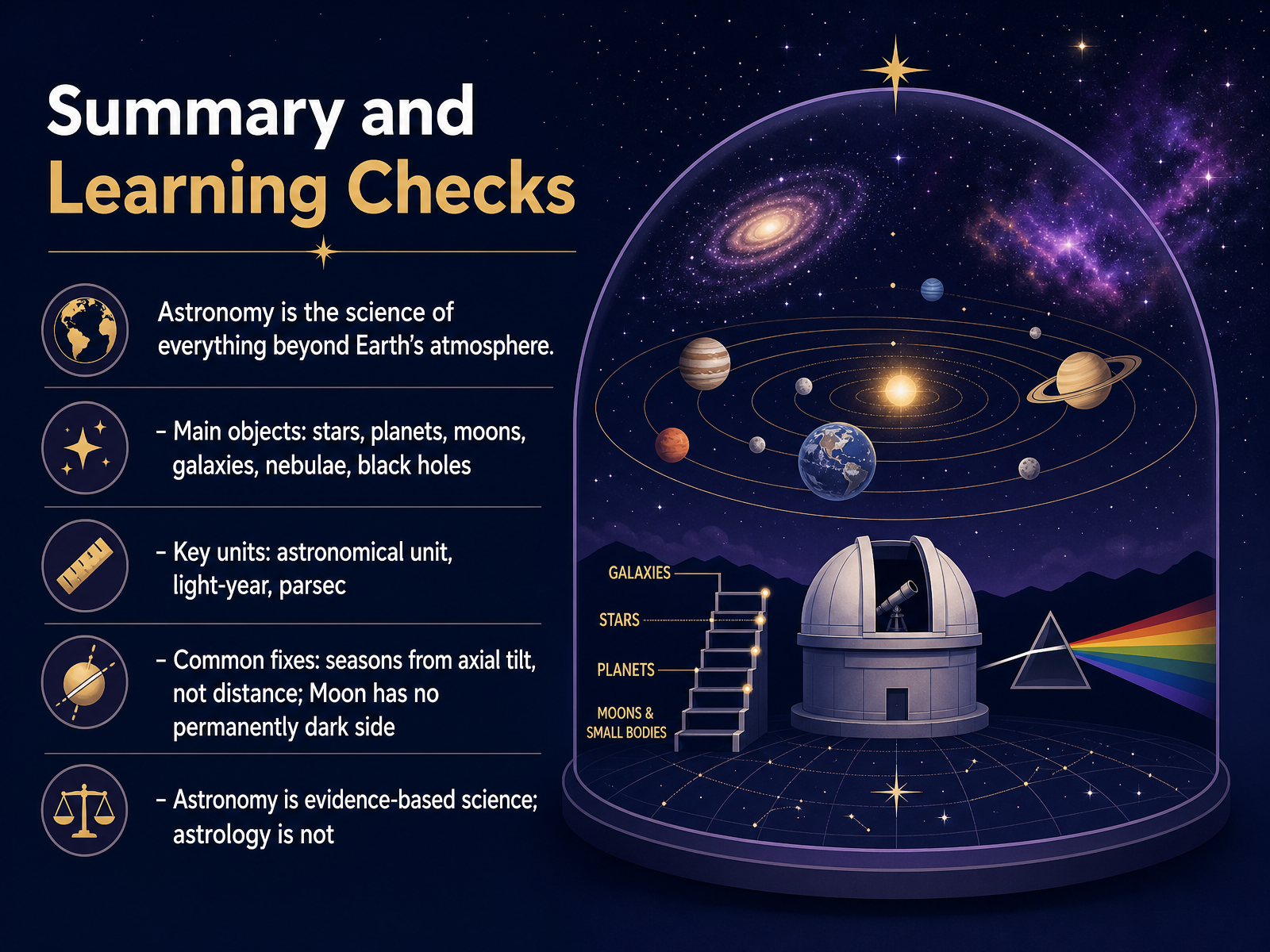
 - 14Summary and Learning ChecksLet's bring everything together with a quick recap. Astronomy is the science of everything beyond Earth's atmosphere. It is the study of stars, planets, moons, galaxies, nebulae, and even black holes. To measure this vast universe, we use units like the astronomical unit, the light-year, and the parsec. Remember that seasons come from Earth's axial tilt, not our distance from the Sun. And the Moon has no permanently dark side, only a far side. Above all, astronomy is evidence-based science, while astrology is not. Thank you for joining me on this journey through the cosmos. Keep looking up, and never stop asking questions.
 csun.edunsta.orgastronomy.org+21 min
Take the deck with you
Download this course as a file — free, no sign-up needed.
- PDF handoutEvery slide page, ready to print or share.15 pages · 4.1 MBDownload
- Narrated PowerPointThe deck that presents itself — every slide carries the digital human's narration video.15 pages · 16.4 MBDownload
- PowerPoint slidesThe full deck as a .pptx — open it in PowerPoint, Keynote, or Google Slides.15 pages · 4.1 MBDownload
Free to use in your own training — please keep the PersonWise credit page at the end.
Have your own deck? Turn it into a course
Sources consulted
Web sources consulted while building this course.
- Common Misconceptions in Astronom — csun.edu
- Science 101: What are some common misconceptions to be aware of when teaching about astronomy? | NSTA — nsta.org
- Popular Misconceptions: — astronomy.org
- Most Popular Skywatching Misconceptions Explained | Scientific American — scientificamerican.com
- Misconceptions in Astronomy — merlot.org
- Astronomy | Definition, History, Discoveries, & Facts | Britannica — britannica.com
- 1.1 The Nature of Astronomy - Astronomy 2e | OpenStax — openstax.org
- What is Astronomy? — amnh.org
- 1: Introduction to Astronomy - Physics LibreTexts — phys.libretexts.org
- The basics of astronomy | Canadian Space Agency — asc-csa.gc.ca
- 1.2: Basic Objects in the Universe - Physics LibreTexts — phys.libretexts.org
- Introduction to Astronomy — fscj.pressbooks.pub
- Cosmic Distances - NASA Science — science.nasa.gov
- Astronomy 101: Astronomical distances | Astronomy.com — astronomy.com
- Units for Distance and Size in the Universe - Las Cumbres Observatory — lco.global
- Explainer: light-years and units for the stars — theconversation.com
- Astronomical Unit, Light Year and Parsec | Secondaire - Alloprof — alloprof.qc.ca