Begin
14 pages · ~28 min
UNESCO AI Literacy Framework: Components and Application
This training explains the components of the UNESCO AI Literacy Framework and how to apply them in practice, equipping educators and trainers to build AI literacy.
A digital instructor presents all 14 pages. Hold “Ask” at any point and ask out loud — the answer comes from this course. No sign-up needed.
What you’ll learn
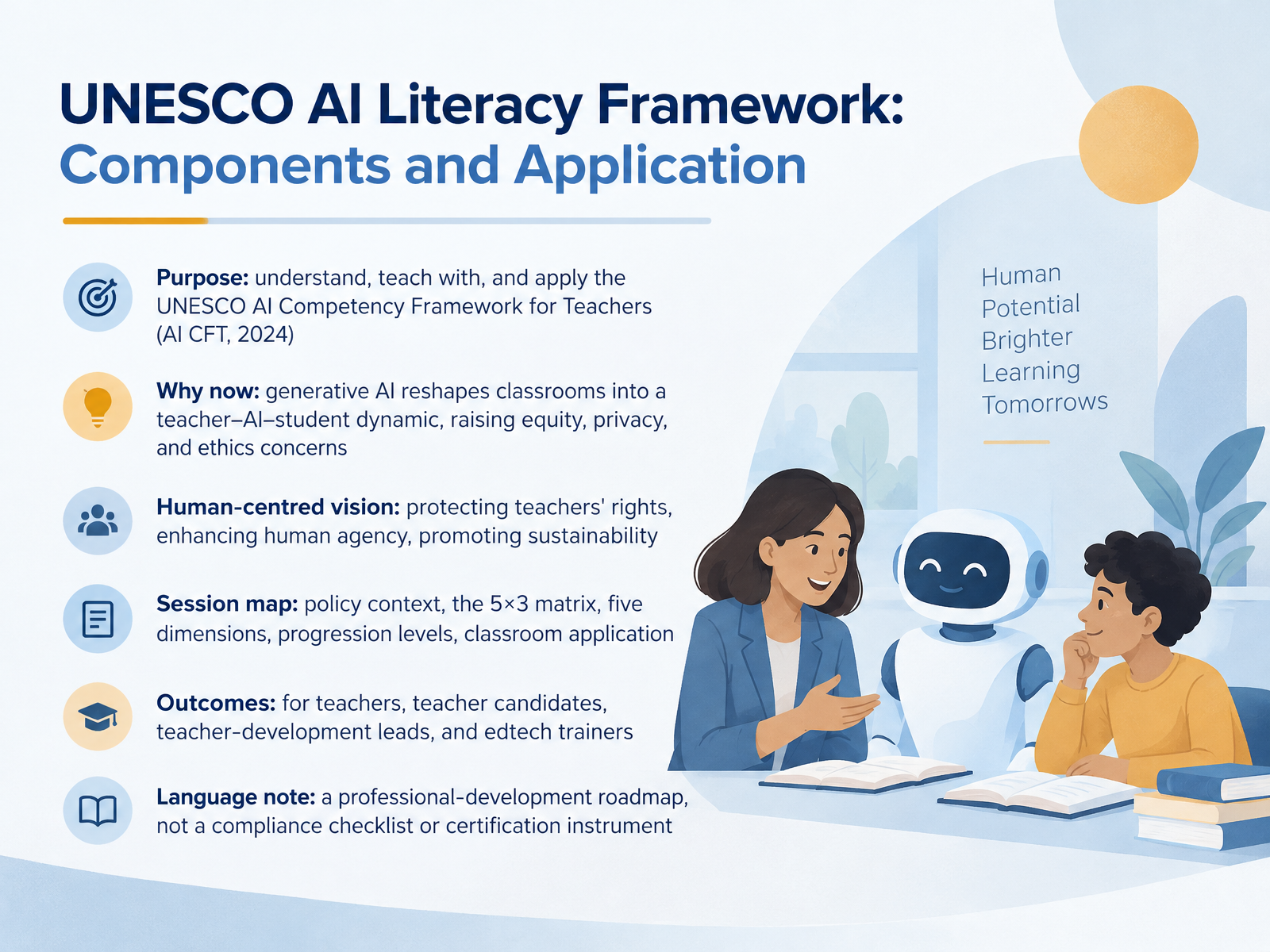
- 01UNESCO AI Literacy Framework: Components and ApplicationWelcome. In the next few minutes, we will unpack the UNESCO AI Competency Framework for Teachers. UNESCO published it in twenty twenty-four, and we will call it the AI CFT for short. Our goal is simple. You should leave able to understand the framework, teach with it, and apply it in your own setting. So why does this matter now? Generative AI has changed the classroom from a teacher and student relationship into a teacher, AI, and student dynamic. That raises real questions about equity, privacy, and ethics. The framework answers with a human-centred vision. It protects teachers' rights, strengthens human agency, and promotes sustainability. Here is our session map. We start with policy context. Then we look at the five by three matrix, the five dimensions, the three progression levels, and classroom application. The outcomes are practical for teachers, teacher candidates, teacher-development leads, and edtech trainers. One language note before we begin. Treat this framework as a professional-development roadmap, not a compliance checklist or a certification instrument. Here is your first action. When a new AI tool appears at your school, pause and ask one question: does it protect human judgement and student privacy? Please write your answer down. That question will anchor everything that follows. Let us turn now to the next slide: Why a Teacher AI Competency Framework, and Why Now.unesco.orgcedefop.europa.euunesdoc.unesco.org+22 min
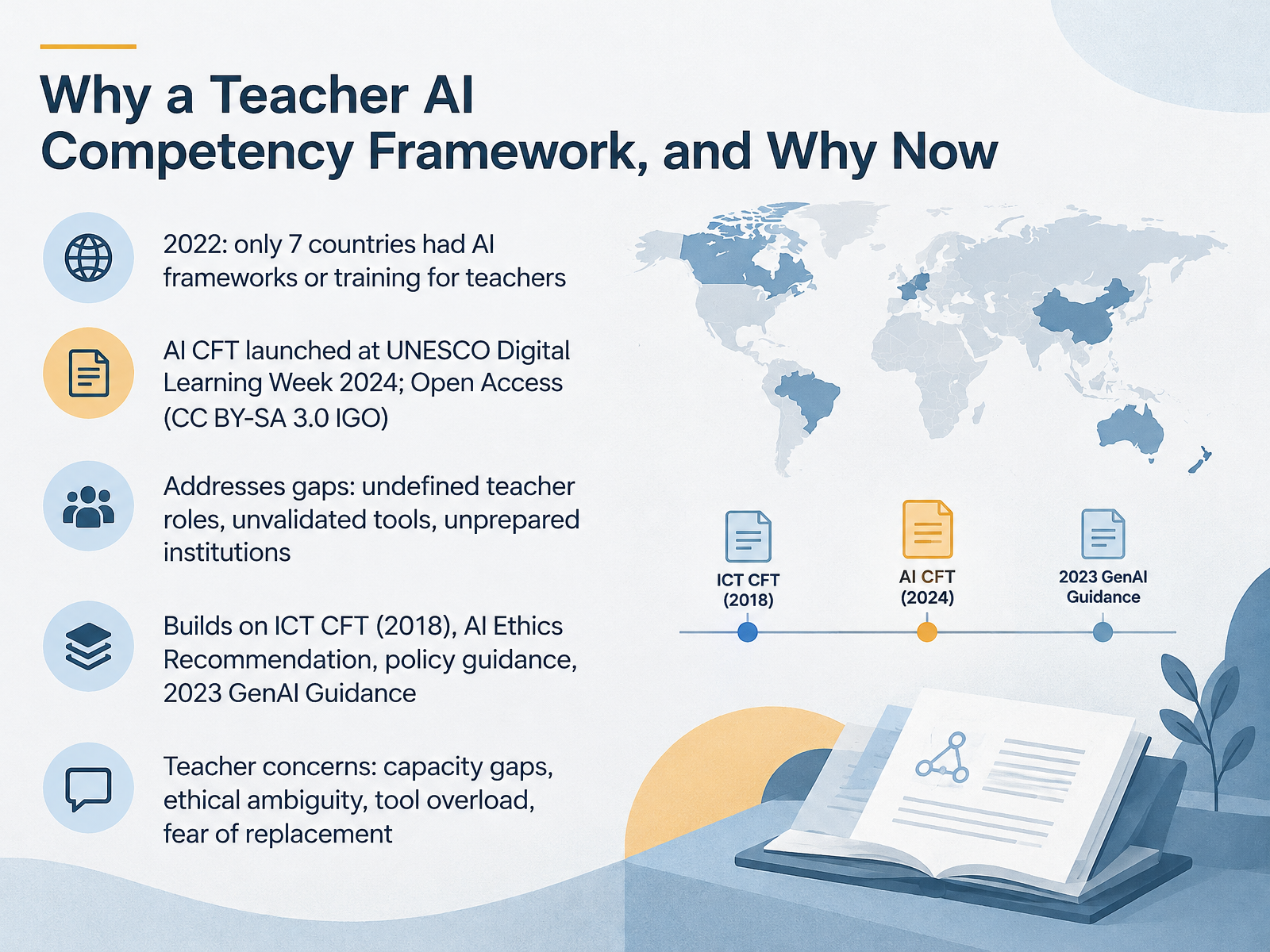
- 02Why a Teacher AI Competency Framework, and Why NowLet's look at why we need a teacher AI competency framework, and why now. In 2022, only seven countries had any framework or training programme on AI for teachers. Most educators were left to figure out AI on their own. UNESCO launched the AI Competency Framework for Teachers, the AI C F T, at Digital Learning Week in 2024. It is open access under a Creative Commons licence, so you can use and adapt it freely. The framework responds to real gaps: teacher roles were undefined, many AI tools were unvalidated, and schools were unprepared. It builds on earlier UNESCO work, including the ICT Competency Framework for Teachers from 2018, the AI Ethics Recommendation, policy guidance, and the 2023 Guidance for Generative AI. And it speaks to what teachers tell us: capacity gaps, ethical ambiguity, tool overload, and fear of replacement. Here is one action. In your next team meeting, ask colleagues which of these concerns they feel most, and write it down. A clear problem is the first step to a workable plan. Next, we will trace the global policy context, from generative AI guidance to teacher competencies.
 unesco.orgcedefop.europa.euunesdoc.unesco.org+22 min
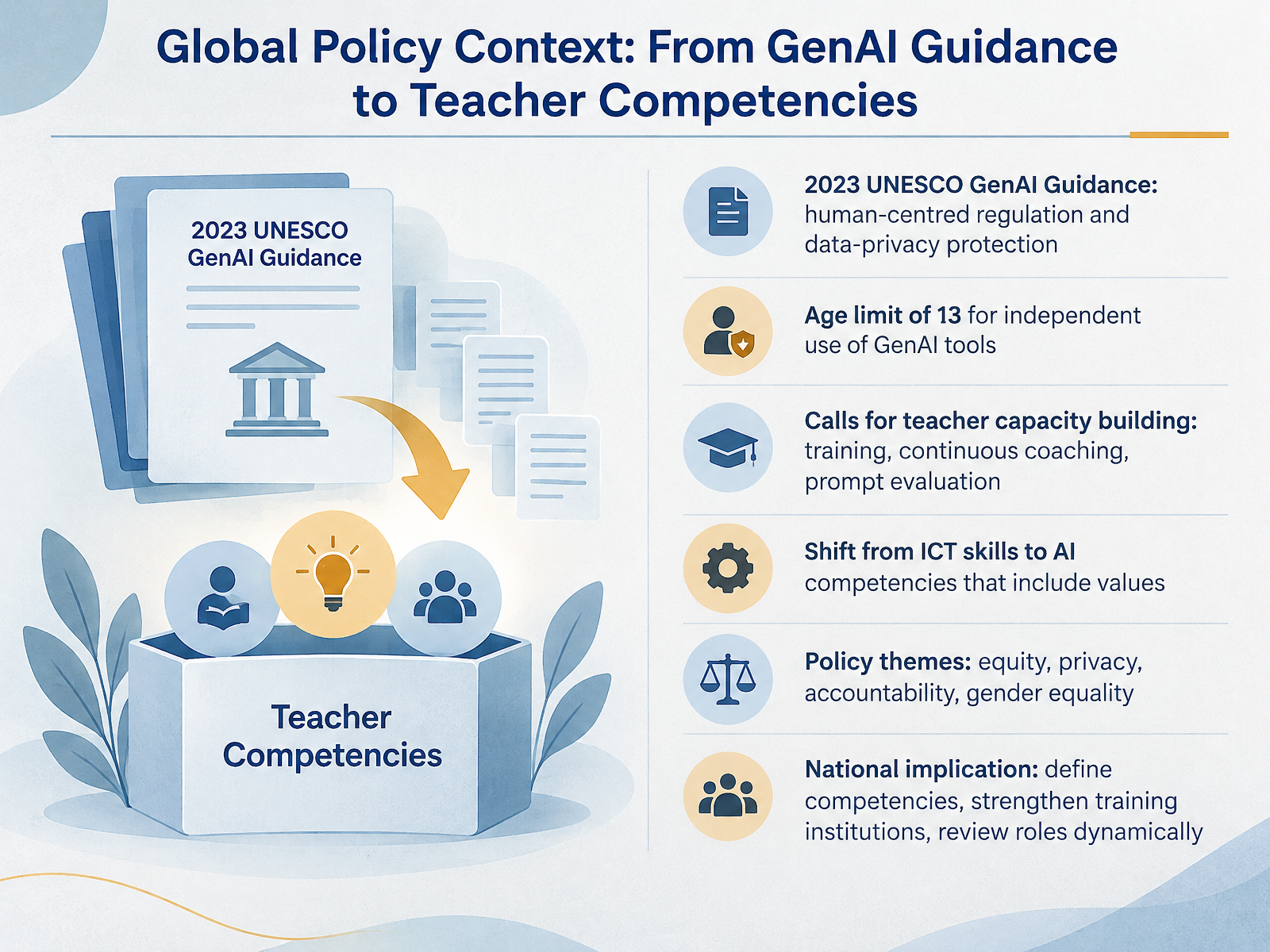
- 03Global Policy Context: From GenAI Guidance to Teacher CompetenciesLet's step back and look at the global policy context shaping your work. In 2023, UNESCO released its Guidance for Generative AI in Education and Research. It calls for human-centred regulation and protection of data privacy. It also sets an age limit of thirteen for independent use of GenAI tools, so younger students need adult mediation and school safeguards. The guidance asks for teacher capacity building: training, continuous coaching, and the ability to critically evaluate prompts. This marks a shift from basic ICT skills to AI competencies that include values. Key policy themes are equity, privacy, accountability, and gender equality. In practice, that means your institution should define competencies, strengthen training institutions, and review teacher roles dynamically. One action you can take now is to check whether your school or programme has a written policy on age, privacy, and teacher support, and flag the gaps to your training lead. Next, we look at the Framework at a Glance: Five Dimensions, Three Levels, Fifteen Competencies.
 unesco.orgteachertaskforce.orgunesco.org+22 min
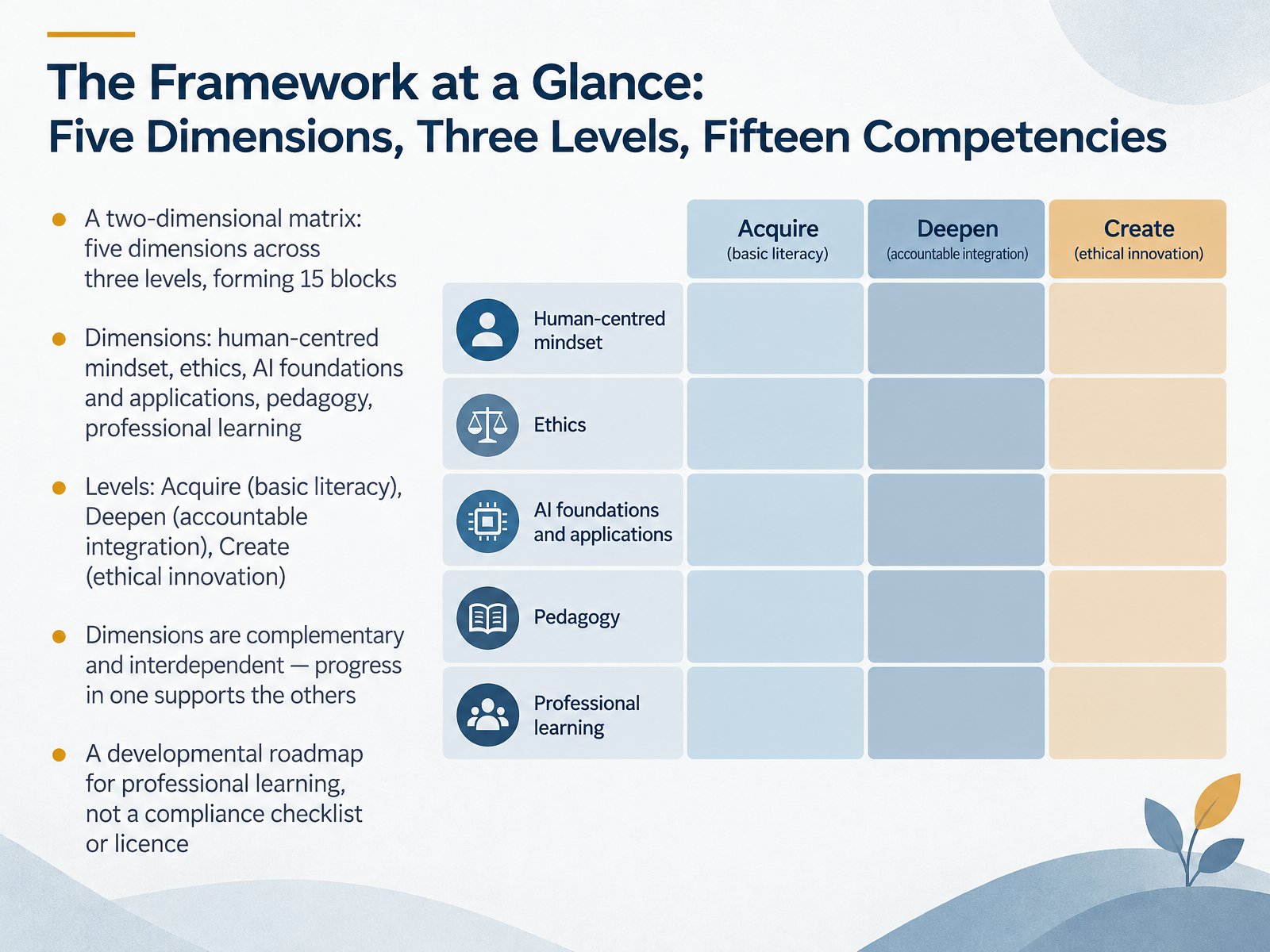
- 04The Framework at a Glance: Five Dimensions, Three Levels, Fifteen CompetenciesNow let's look at how the framework fits together. It is a two-dimensional matrix. Five dimensions run across three levels, and that creates fifteen blocks, one competency in each. The five dimensions are: a human-centred mindset, ethics of AI, AI foundations and applications, AI pedagogy, and AI for professional learning. The three levels show progression. Acquire means basic literacy. Deepen means accountable integration into your practice. Create means ethical innovation. Here is the part people often miss. The dimensions are complementary and interdependent. Progress in one supports the others. For example, a stronger grasp of AI foundations can sharpen your ethical judgement in a real lesson decision. So treat this as a developmental roadmap for professional learning, not a compliance checklist or a licence. In practice, pick one dimension and one level that match your current work, and use it to plan your next term of learning. In the next section, we begin with the first dimension: human-centred mindset, covering human agency, accountability, and social responsibility.
 unesco.orgcedefop.europa.euunesdoc.unesco.org+22 min
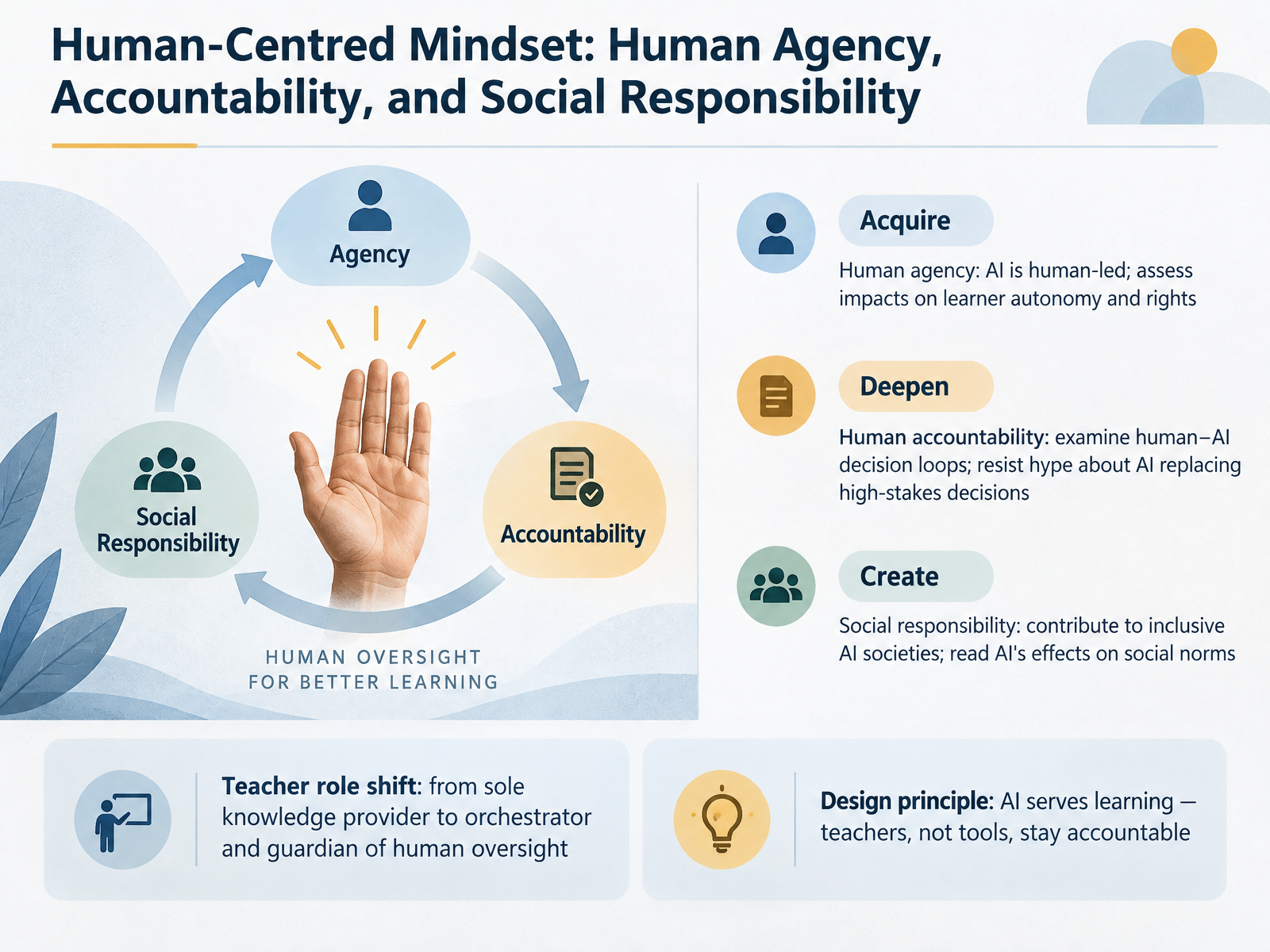
- 05Human-Centred Mindset: Human Agency, Accountability, and Social ResponsibilityNext, we look at the first competency area in the framework: a human-centred mindset. It has three levels. At the Acquire level, the focus is human agency. That means you keep AI human-led and ask how a tool affects learner autonomy and rights. For example, before adopting an AI writing assistant, check whether students still make their own choices. At the Deepen level, the focus is human accountability. Examine the decision loops between people and AI, and resist hype about AI replacing high-stakes decisions such as grading or placement. In practice, keep a named person responsible for every consequential decision. At the Create level, the focus is social responsibility. Contribute to inclusive AI societies and read how AI shapes social norms, including whose voices it amplifies or silences. This changes your role: from sole knowledge provider to orchestrator and guardian of human oversight. The design principle is simple. AI serves learning, and teachers, not tools, stay accountable. One action you can take: write a short human oversight checklist for one AI tool you use. That principle leads directly into the next area, Ethics of AI: Principles, Safe Use, and Co-Creating Rules.
 unesco.orgcedefop.europa.euunesdoc.unesco.org+22 min
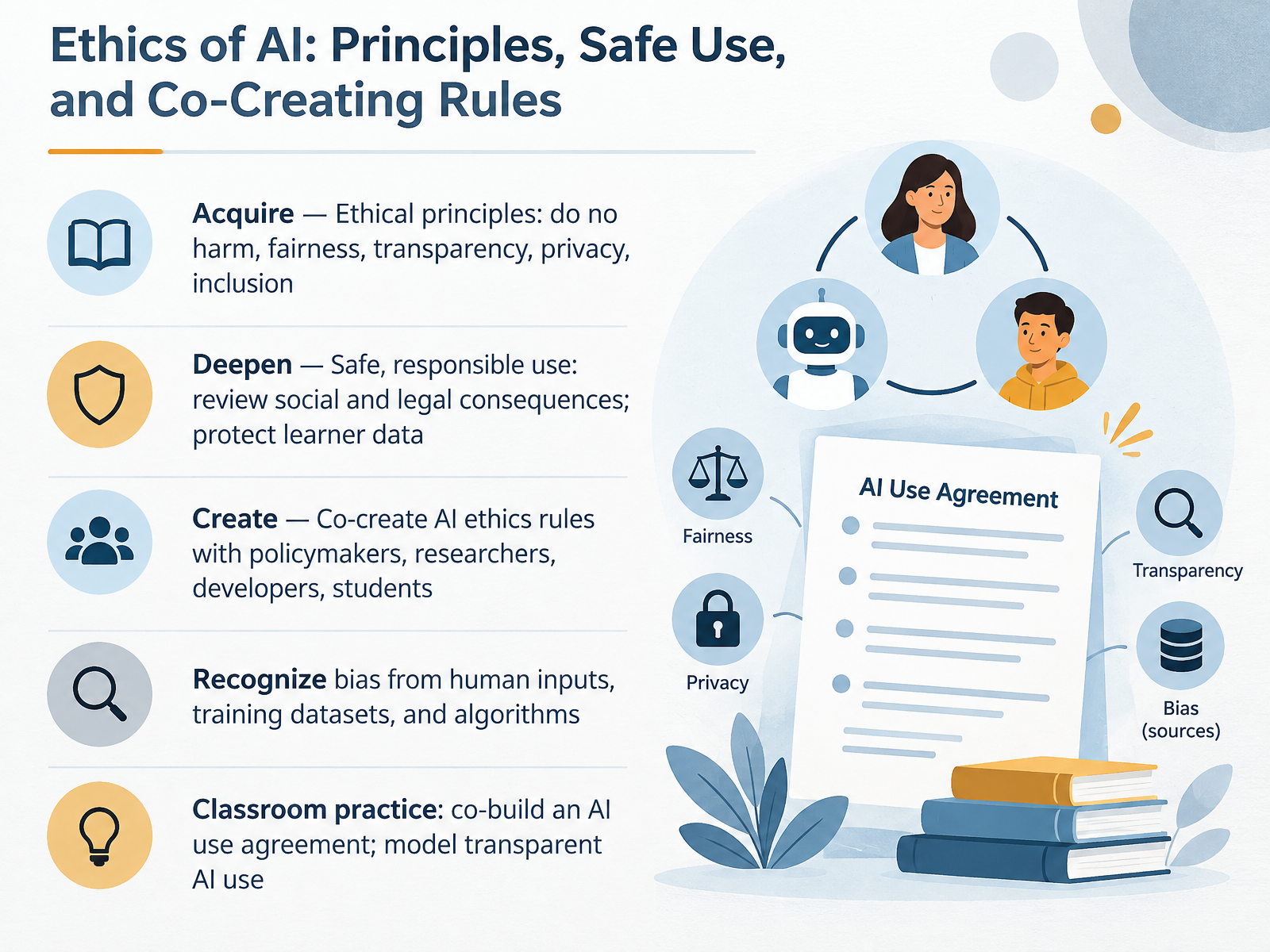
- 06Ethics of AI: Principles, Safe Use, and Co-Creating RulesLet's turn to the ethics of AI. In UNESCO's framework, this dimension has three levels. At the Acquire level, you hold core ethical principles: do no harm, fairness, transparency, privacy, and inclusion. In practice, ask one simple question before using any tool. Would I be comfortable if a student or parent saw exactly what I entered? At the Deepen level, you review the social and legal consequences of careless use and protect learner data. That means no names, no grades, no identifiable records pasted into public tools. The next component is Create. Here, you co-create AI ethics rules with policymakers, researchers, developers, and students. You also learn to recognize bias from human inputs, training datasets, and algorithms. One classroom routine makes this concrete. Co-build an AI use agreement with your students, and model transparent AI use yourself. Show them when and why you used a tool, and what you checked afterward. Pick one lesson this week and draft that agreement together. That work prepares you for a look at AI foundations and applications: just-enough technical knowledge.
 ciet.ncert.gov.inunesco.orgunesco.org+22 min
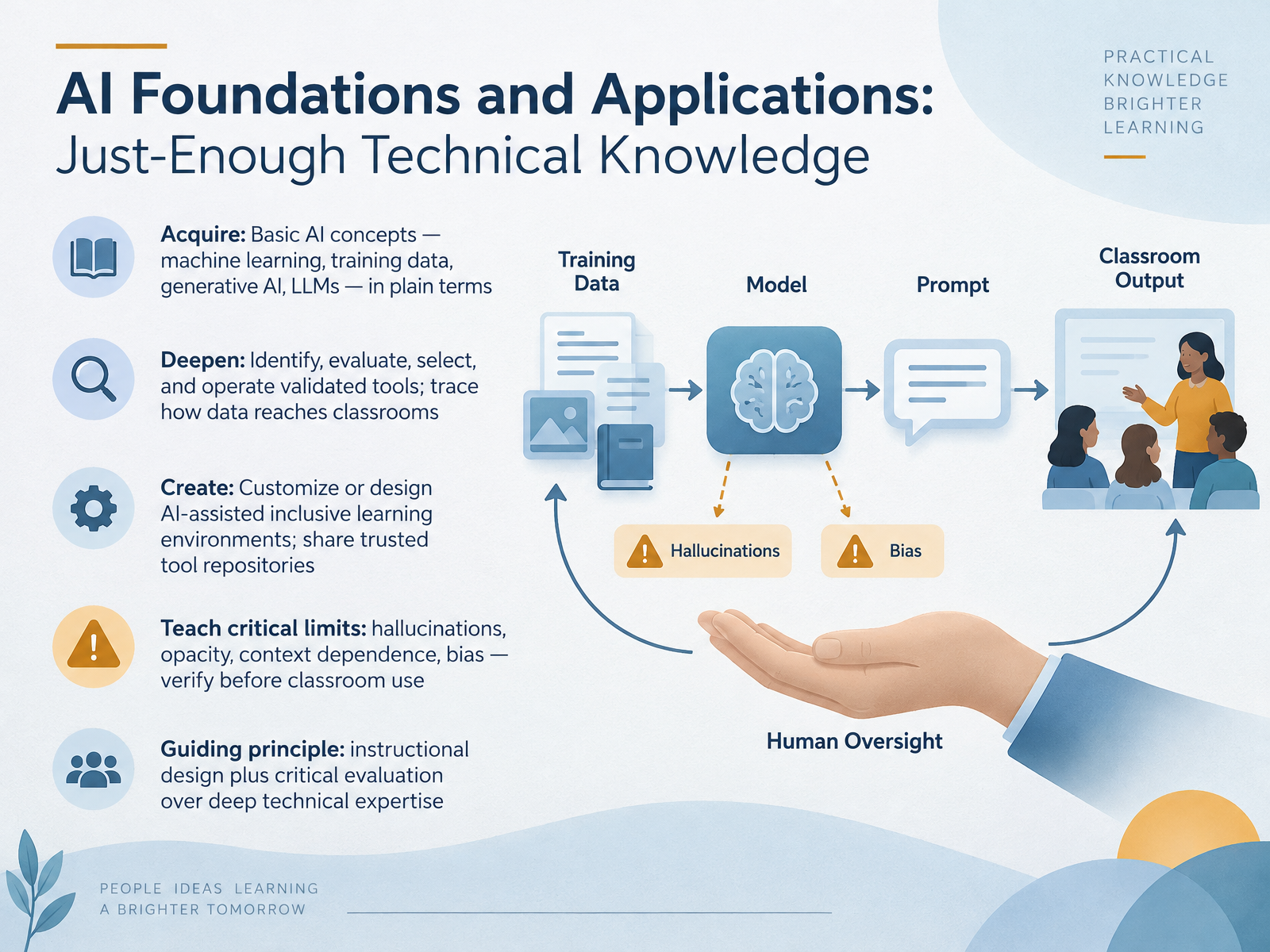
- 07AI Foundations and Applications: Just-Enough Technical KnowledgeNext, we look at the AI foundations and applications competency, and what counts as just-enough technical knowledge. You do not need to become an engineer. You need enough understanding to make sound classroom decisions. At the acquire level, you learn basic concepts in plain terms: machine learning, training data, generative AI, and large language models. Pause there. If you can explain those four terms to a colleague, you have the foundation. The next level is deepen. Here you identify, evaluate, select, and operate validated tools. You also trace how data reaches your classroom, so you can ask where student information goes. At the create level, you customize or design AI-assisted inclusive learning environments and share trusted tool repositories with colleagues. Throughout, teach the limits. AI can hallucinate, and its reasoning is often opaque. Its answers depend on context, and bias can enter through training data. So verify before classroom use. The guiding principle is simple: instructional design and critical evaluation matter more than deep technical expertise. In practice, pick one tool you already use, run its output past a second source, and log what you find. That habit builds the competency faster than any course. This foundation sets up the next competency, which is AI Pedagogy: From Assisted Teaching to Pedagogical Transformation.
 unesco.orgunesco.orgneqmap.bangkok.unesco.org+22 min
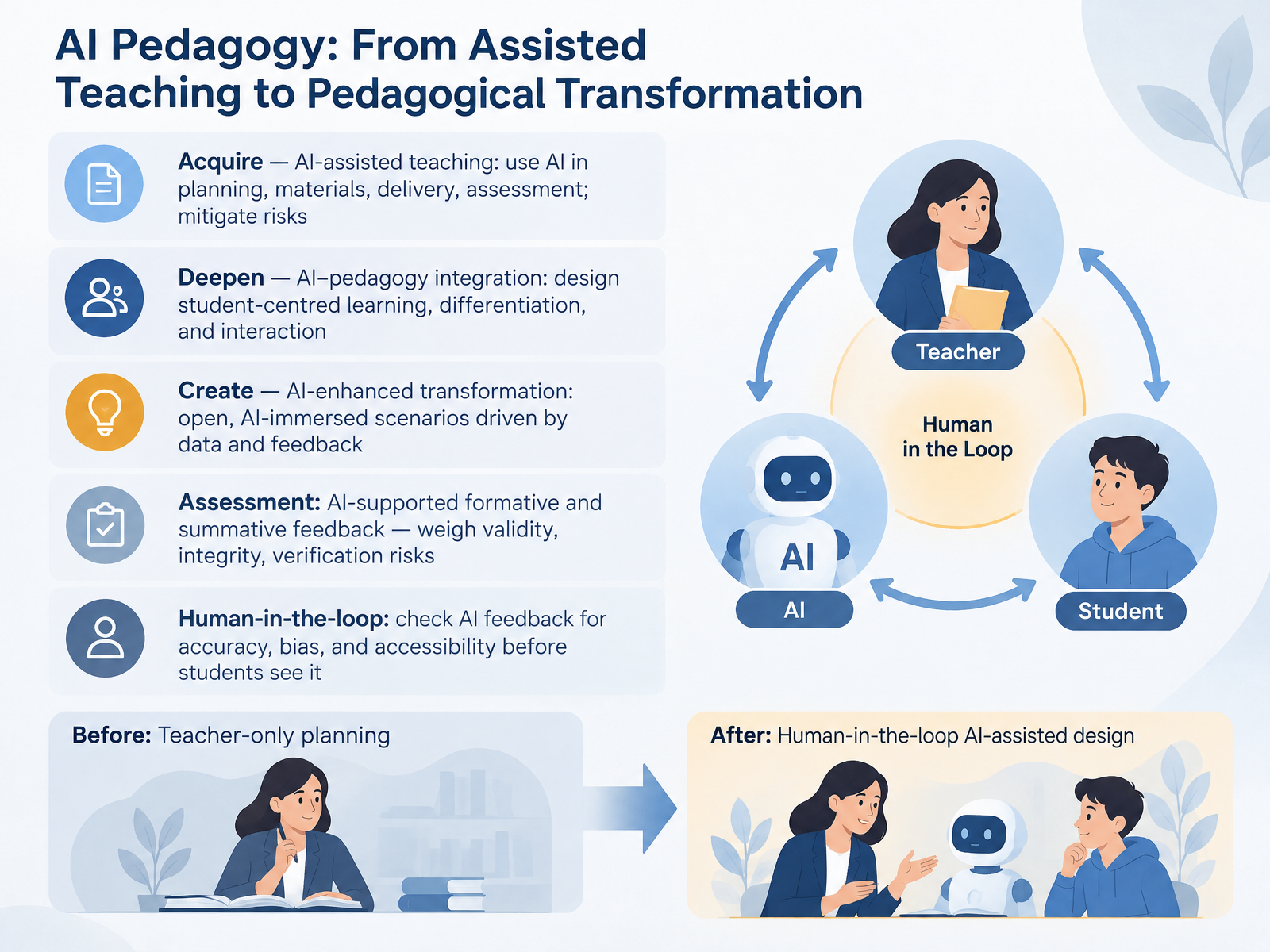
- 08AI Pedagogy: From Assisted Teaching to Pedagogical TransformationNow we turn to AI pedagogy, and the good news is that it grows in three levels. At the Acquire level, you use AI to assist your teaching, in planning, materials, delivery, and assessment, while you actively reduce the risks. At the Deepen level, you integrate AI into the design of student-centred learning, differentiation, and interaction. At the Create level, you design open, AI-immersed scenarios shaped by data and feedback, and you ask what this changes about how students learn. Assessment runs through all three levels. AI can support formative and summative feedback, but you must weigh validity, integrity, and verification risks. So keep a human in the loop. Check any AI feedback for accuracy, bias, and accessibility before students see it. In practice, pick one AI-generated draft this week and review it against those three checks. Next, we look at AI for Professional Learning: Individual, Organizational, Transformative.
 unesco.orglearn.aiforglobaleducation.orgiite.unesco.org+22 min
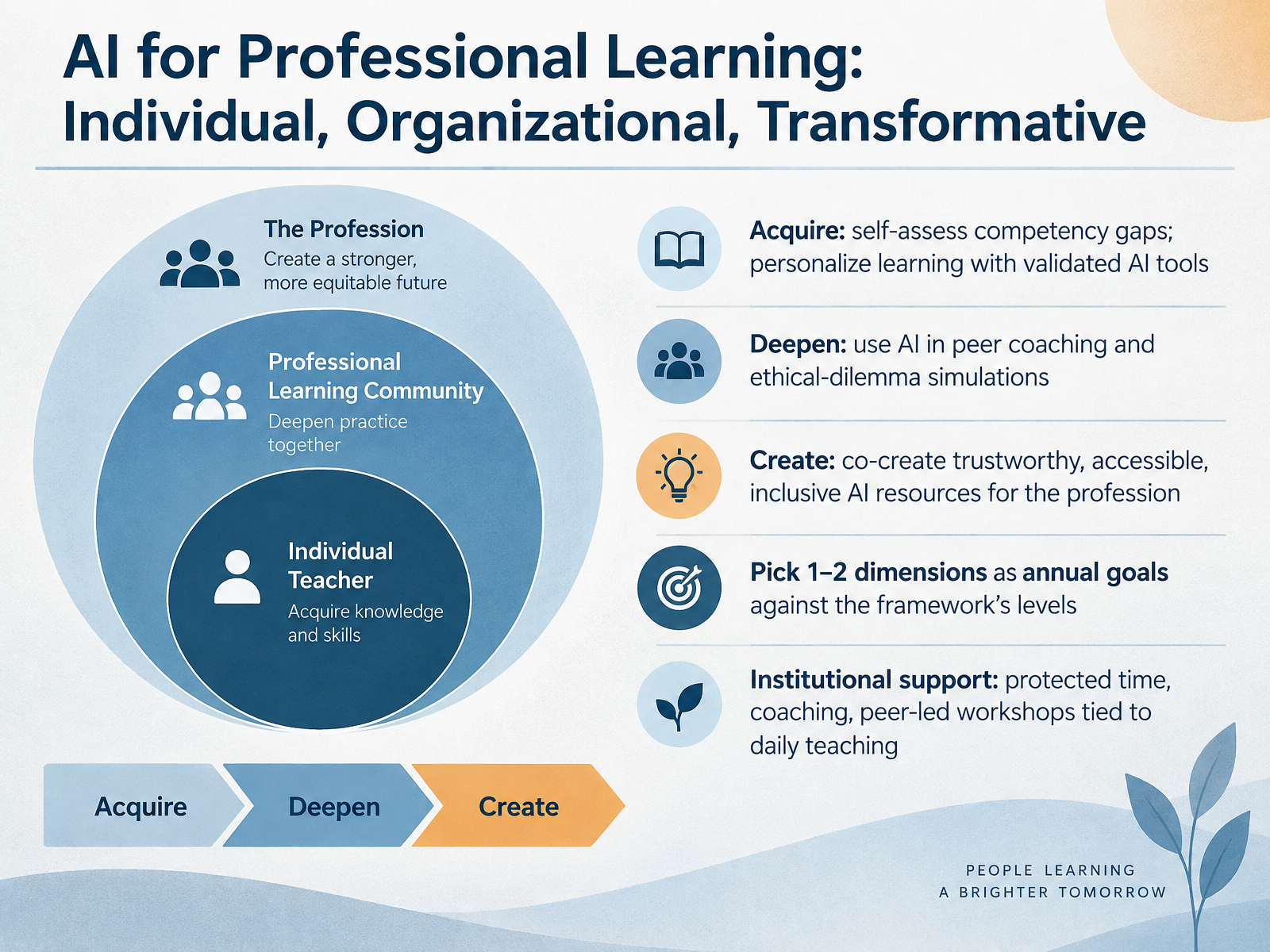
- 09AI for Professional Learning: Individual, Organizational, TransformativeLet's turn to the fifth dimension, AI for professional learning. It has three levels, and they build on each other. At Acquire, you self-assess your competency gaps and use validated AI tools to personalize your own learning. At Deepen, you use AI in peer coaching, and in ethical-dilemma simulations, where an AI coach plays a parent or a student and you practice your response. At Create, you co-create trustworthy, accessible, and inclusive AI resources for the profession, and share them. In practice, pick one or two dimensions as annual goals, and set them against the framework's levels. Then ask your institution for what makes that possible: protected time, coaching, and peer-led workshops tied to daily teaching, not one-off events. So here is your action. Choose one dimension this term, name the level you want to reach, and write one concrete step. Next, we move from framework to practice, with models, case studies, and design choices.
 tefltoday.orgunesco.orglearn.aiforglobaleducation.org+22 min
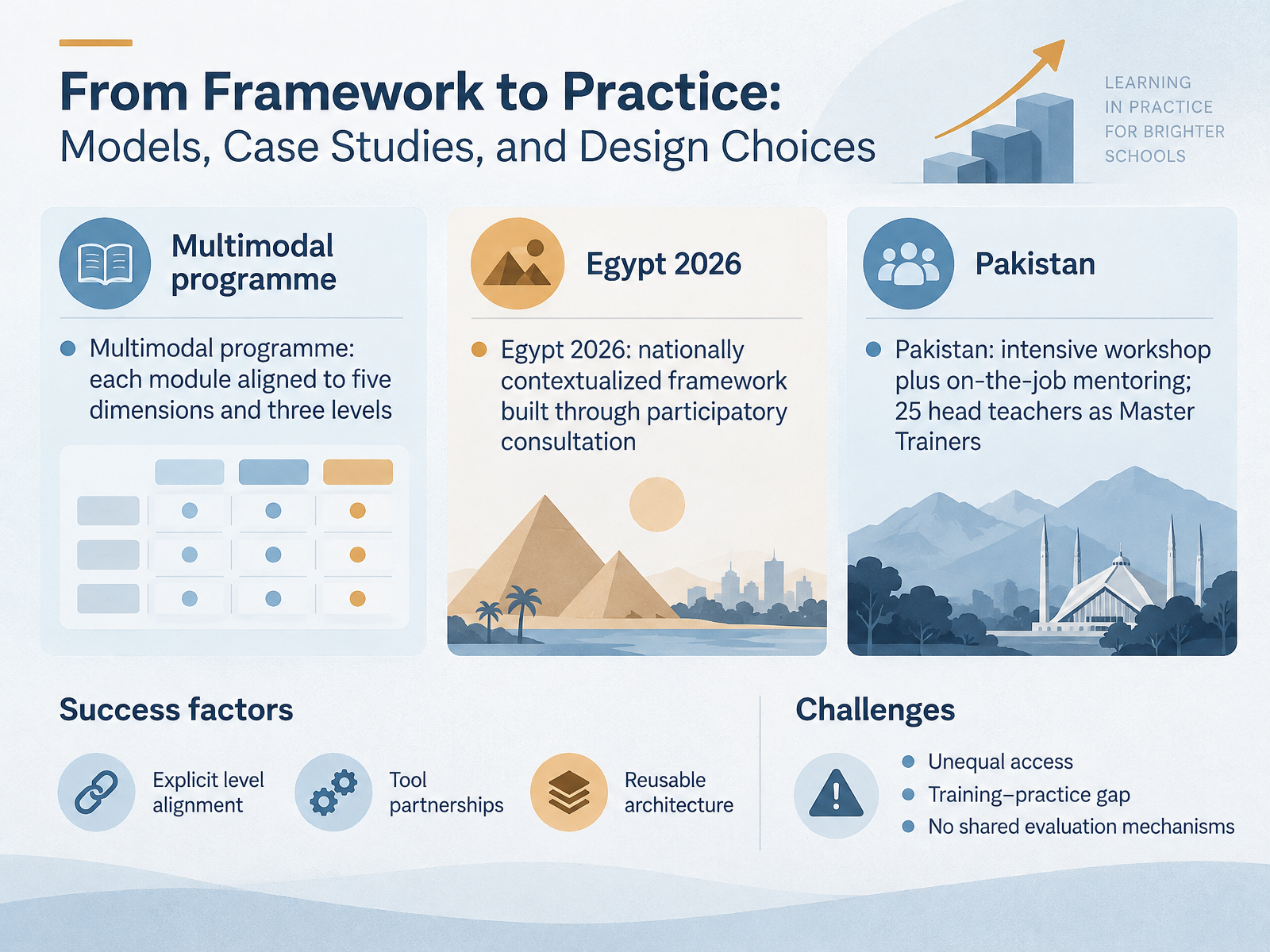
- 10From Framework to Practice: Models, Case Studies, and Design ChoicesSo what does implementation actually look like? Here are real examples. One multimodal programme aligned every module with all five dimensions and all three levels, so each activity had an explicit level. In Egypt, the national framework launched in twenty twenty-six was built through participatory consultation, with more than one hundred twenty stakeholders adapting the global framework to local priorities. Pakistan paired a three-day intensive workshop with on-the-job mentoring. Twenty five head teachers became Master Trainers, creating peer-led support that outlasts the programme. Three success factors stand out: explicit level alignment, tool partnerships that give teachers practical access, and a reusable architecture. The challenges are just as clear: unequal access, a gap between training and daily practice, and no shared evaluation mechanisms. In practice, pick one design choice to copy and name one challenge to plan for. Next, we move to designing your own training, using backward design and school pilots.
 iite.unesco.orgunesco.orgunesco.org+22 min
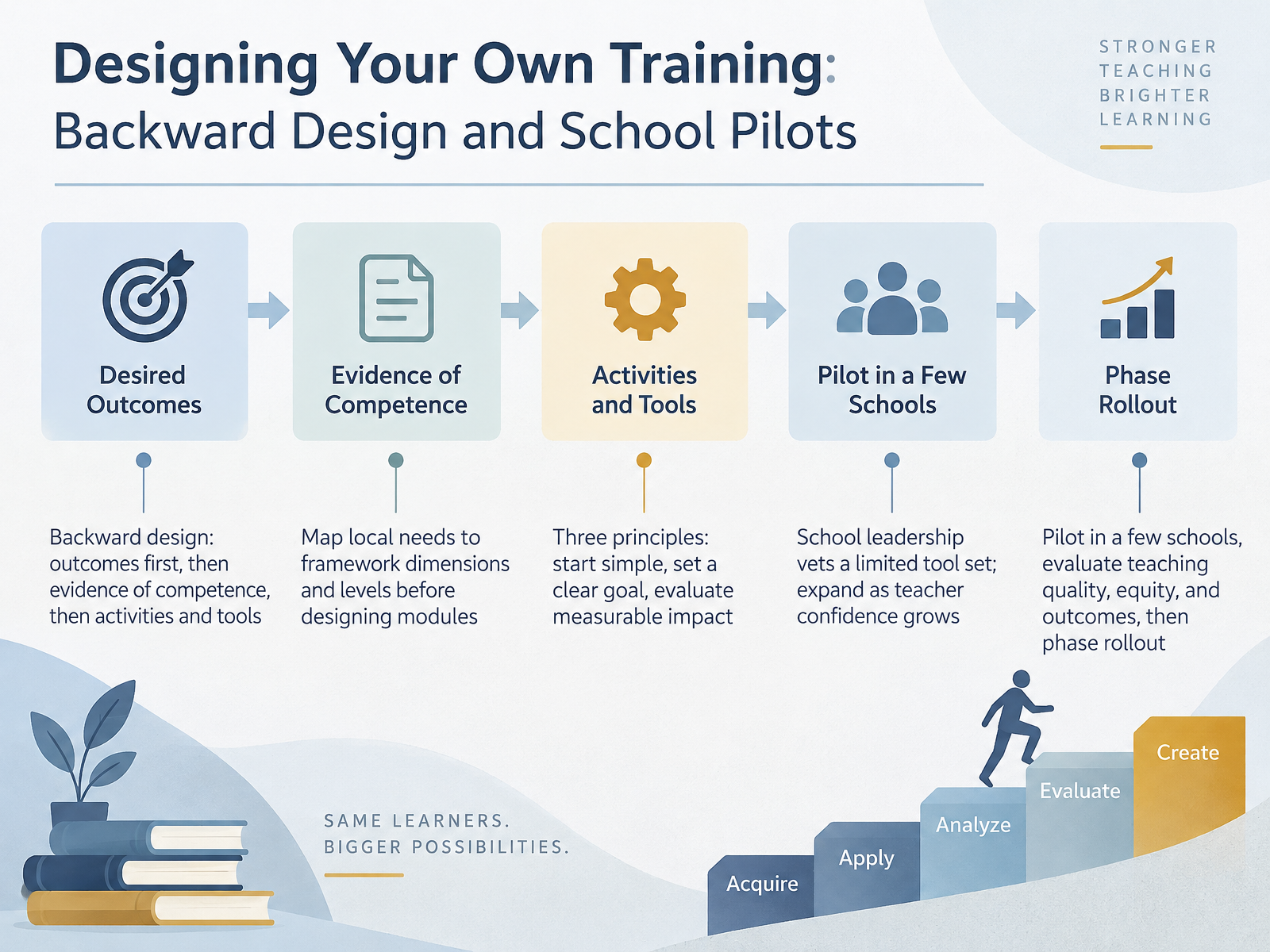
- 11Designing Your Own Training: Backward Design and School PilotsNow let's turn to designing your own training. Start with backward design. Name the outcomes first. Then decide what evidence shows a teacher has the competence. Only then choose the activities and tools. Before you write modules, map local needs to the framework's five dimensions and three levels. This tells you where your teachers actually are. Three principles keep the work grounded. Start simple. Set one clear goal. Evaluate measurable impact. In practice, school leadership vets a limited set of tools, then expands as teacher confidence grows. Pilot in a few schools. Evaluate teaching quality, equity, and outcomes. Then phase the rollout. Your action: draft one outcome and its evidence before picking any tool. Next, we look at classroom activities and formative checks for each dimension.
 unesco.orgunesco.orgneqmap.bangkok.unesco.org+22 min
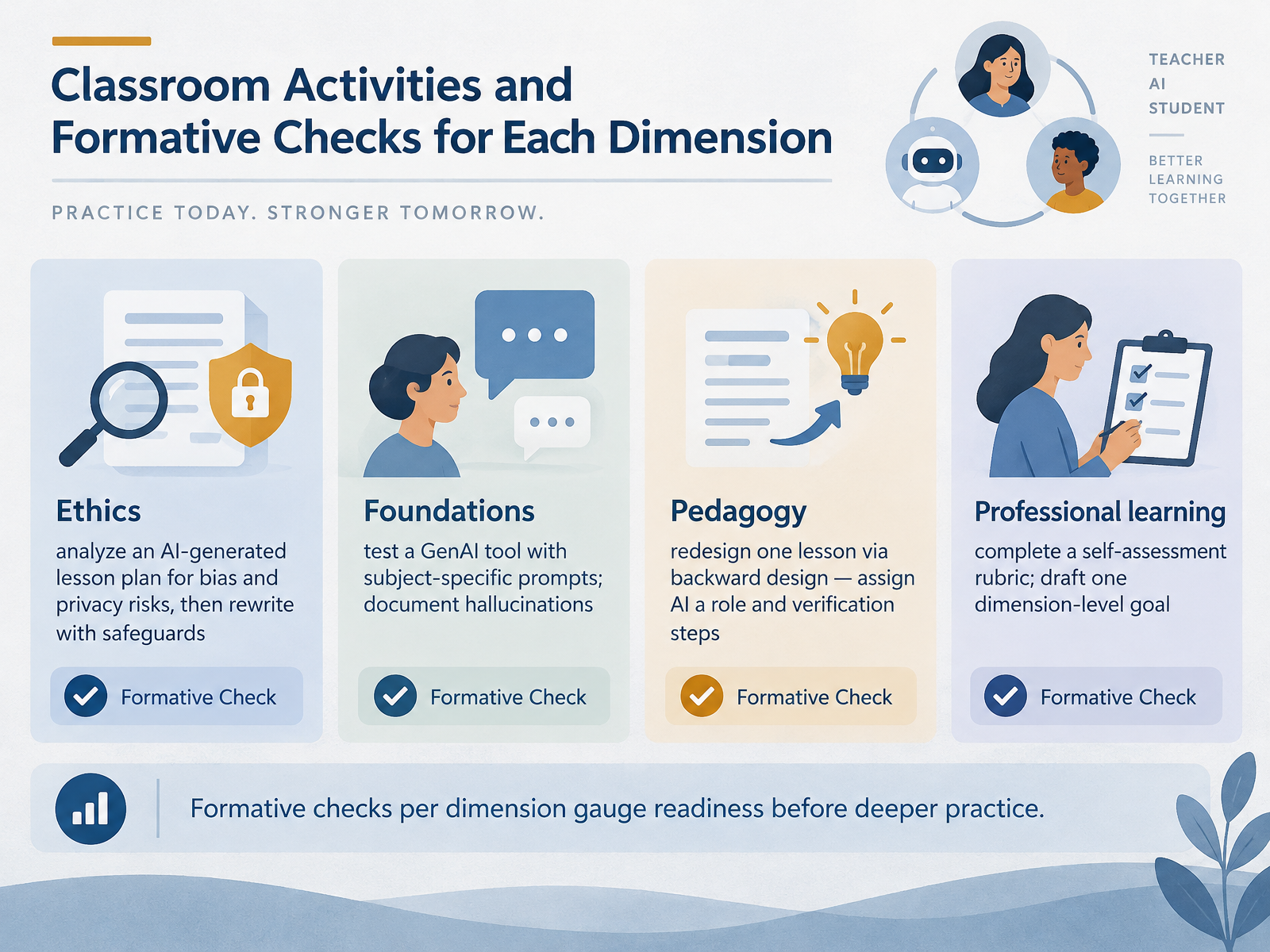
- 12Classroom Activities and Formative Checks for Each DimensionNow let's look at one classroom activity for each dimension, plus a quick check you can run before going deeper. For ethics, ask teachers to analyze an AI-generated lesson plan for bias and privacy risks, then rewrite it with safeguards. For foundations, they test a GenAI tool with subject-specific prompts and document every hallucination they find. The next component is pedagogy. Have teachers redesign one lesson through backward design, assigning AI a specific role and naming the verification steps students must take. For professional learning, they complete a self-assessment rubric and draft one goal at the dimension level, such as moving from Acquire to Deepen in ethics, following the framework's three progression levels. In practice, these formative checks per dimension gauge readiness before deeper practice. So pick one dimension this week and run its activity with your team. Next, we turn to assessing AI literacy development through rubrics, evidence, and evaluation.
 tefltoday.orgunesco.orgciet.ncert.gov.in+21 min
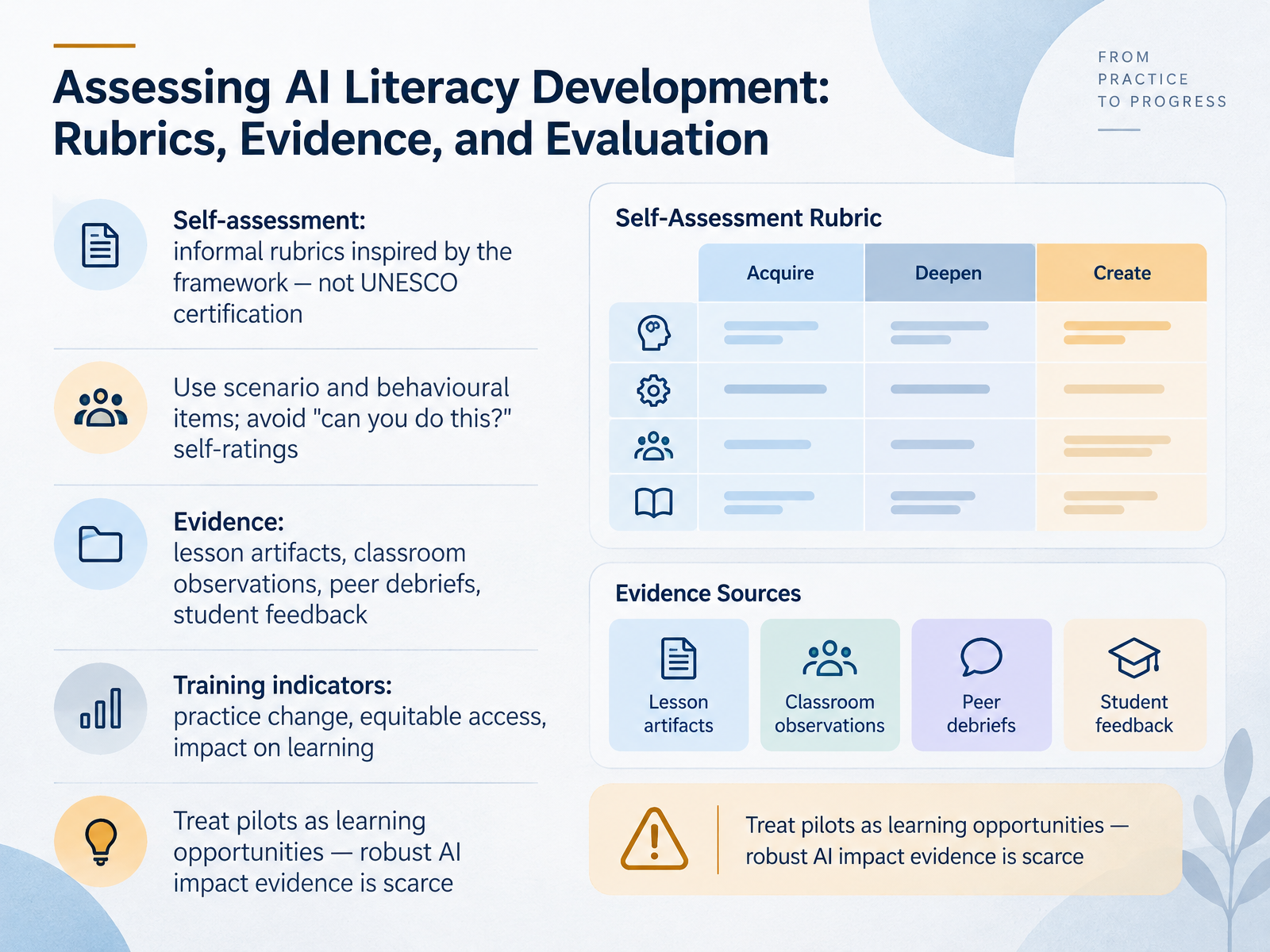
- 13Assessing AI Literacy Development: Rubrics, Evidence, and EvaluationNow let's look at how you assess AI literacy development. First, self-assessment. You can build an informal rubric from the framework's five dimensions and three levels, Acquire, Deepen, and Create. Be clear with teachers that this is a self-check, not UNESCO certification. Second, write items carefully. Use scenarios and behavioural questions, such as what a teacher actually did in a recent lesson. Avoid asking people to rate whether they can do something, because everyone over-rates themselves. Third, gather evidence. Look at lesson artifacts, classroom observations, peer debriefs, and student feedback. For your training, track three indicators: change in practice, equitable access, and impact on learning. And treat pilots as learning opportunities, since robust evidence of AI's impact is still scarce. One action to take: draft a short scenario-based self-assessment and pair it with one classroom observation this term. Next, we move to reflection, action planning, and next steps.
 tefltoday.orgunesco.orgunesco.org+22 min
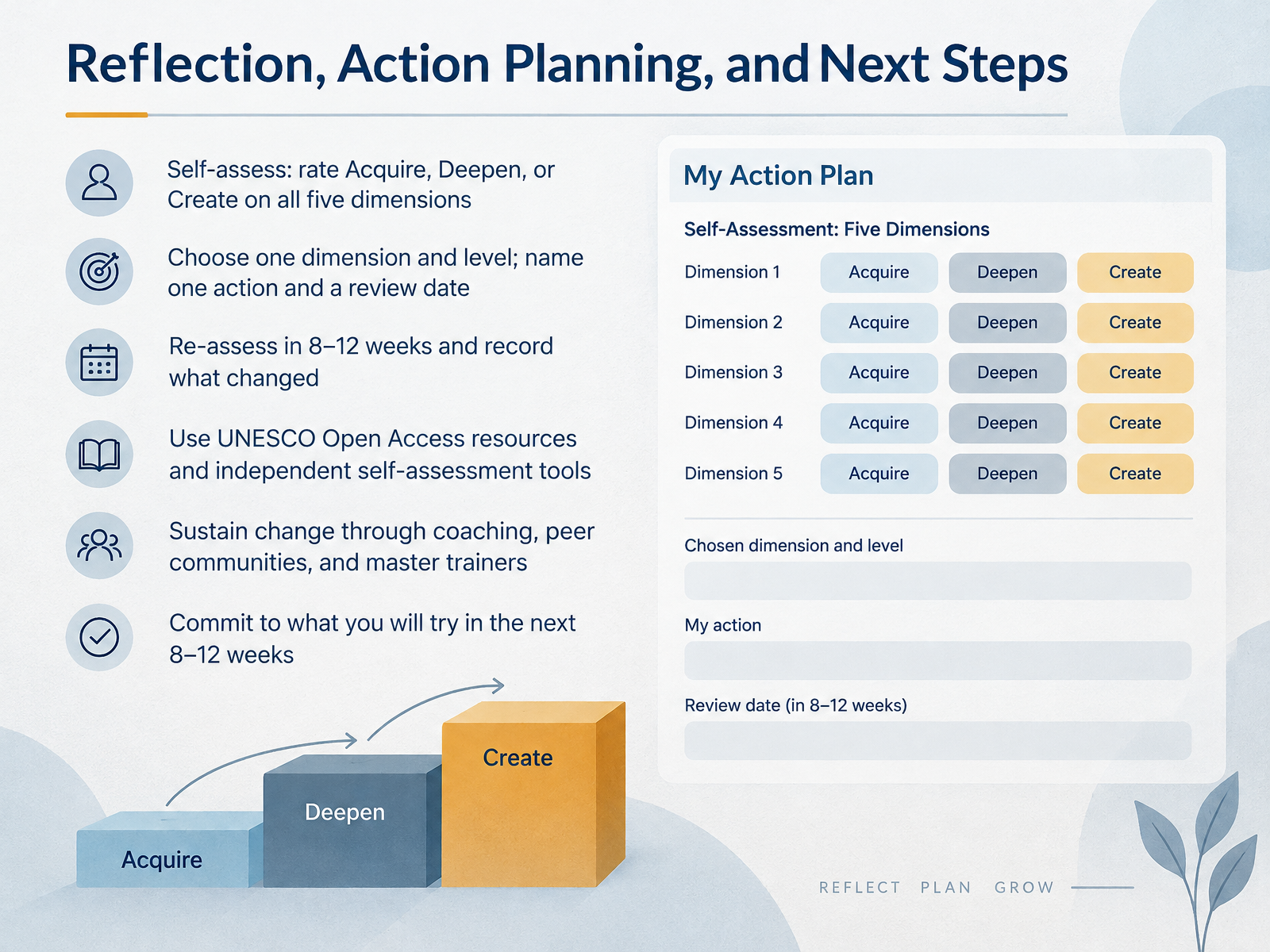
- 14Reflection, Action Planning, and Next StepsNow let's turn the framework into a plan you can actually follow. Start with an honest self-assessment. Rate yourself at Acquire, Deepen, or Create on all five dimensions. Then pick one dimension and one level to move up. Name one concrete action, such as a lesson to redesign or a tool to try, and set a review date. Re-assess in eight to twelve weeks and record what changed. You can use UNESCO's Open Access framework, plus independent self-assessment tools built on its structure, though those tools are not official UNESCO instruments. In practice, change lasts when you add support. Coaching, peer communities, and master trainers keep the work going after the workshop ends. So before you leave, commit to one thing you will try in the next eight to twelve weeks. Write it down, share it with a colleague, and put the review date in your calendar. That is how a framework becomes real practice. Thank you for your work across these fourteen slides. You now have a map, a level, and a next step. Go and take it.
 tefltoday.orgunesco.orgiite.unesco.org+22 min
Take the deck with you
Download this course as a file — free, no sign-up needed.
- PDF handoutEvery slide page, ready to print or share.15 pages · 3.9 MBDownload
- Narrated PowerPointThe deck that presents itself — every slide carries the digital human's narration video.15 pages · 15.3 MBDownload
- PowerPoint slidesThe full deck as a .pptx — open it in PowerPoint, Keynote, or Google Slides.15 pages · 3.9 MBDownload
Free to use in your own training — please keep the PersonWise credit page at the end.
Have your own deck? Turn it into a course
Sources consulted
Web sources consulted while building this course.
- AI competency framework for teachers — unesco.org
- \[PDF\] UNESCO AI competency framework for teachers - Cedefop — cedefop.europa.eu
- AI competency framework for teachers — unesdoc.unesco.org
- The AI competency framework for ... — unesdoc.unesco.org
- AI competency framework for teachers — discovery.ucl.ac.uk
- Guidance for generative AI in education and research | UNESCO — unesco.org
- Guidance for generative AI in education and research | Teacher Task Force — teachertaskforce.org
- UNESCO: Governments must quickly regulate Generative AI in schools — unesco.org
- Guidance for generative AI in education and research — discovery.ucl.ac.uk
- AI for Teachers: From the UNESCO global framework to enhancing student engagement — ciet.ncert.gov.in
- What you need to know about UNESCO's new AI competency frameworks for — unesco.org
- What skills and knowledge should teacher training focus on to support teachers to make effective and responsible use of AI? — eun.org
- UNESCO AI Competency Framework for Teachers: 5 Dimensions & 3 Levels — tefltoday.org
- Draft AI competency frameworks for teachers and for school students — unesco.org
- UNESCO Guidance for generative AI in education and research and AI Competency Frameworks — neqmap.bangkok.unesco.org
- UNESCO AI competency… | New Zealand National Commission of UNESCO | Unesco New Zealand National Commission — unesco.org.nz
- Overview and summary of AI competency framework for teachers — doi.org
- UNESCO AI Competency Framework for Teachers, AIFGE Learn — learn.aiforglobaleducation.org
- TEACHER AI COMPETENCY FRAMEWORKS. Analytical report — iite.unesco.org
- UNESCO AI competency framework for teachers | CEDEFOP — cedefop.europa.eu