Begin
14 pages · ~28 min
The Printing Press and the Spread of Ideas
This training explores how the printing press transformed the spread of ideas, helping learners understand its historical impact on communication and society.
A digital instructor presents all 14 pages. Hold “Ask” at any point and ask out loud — the answer comes from this course. No sign-up needed.
What you’ll learn
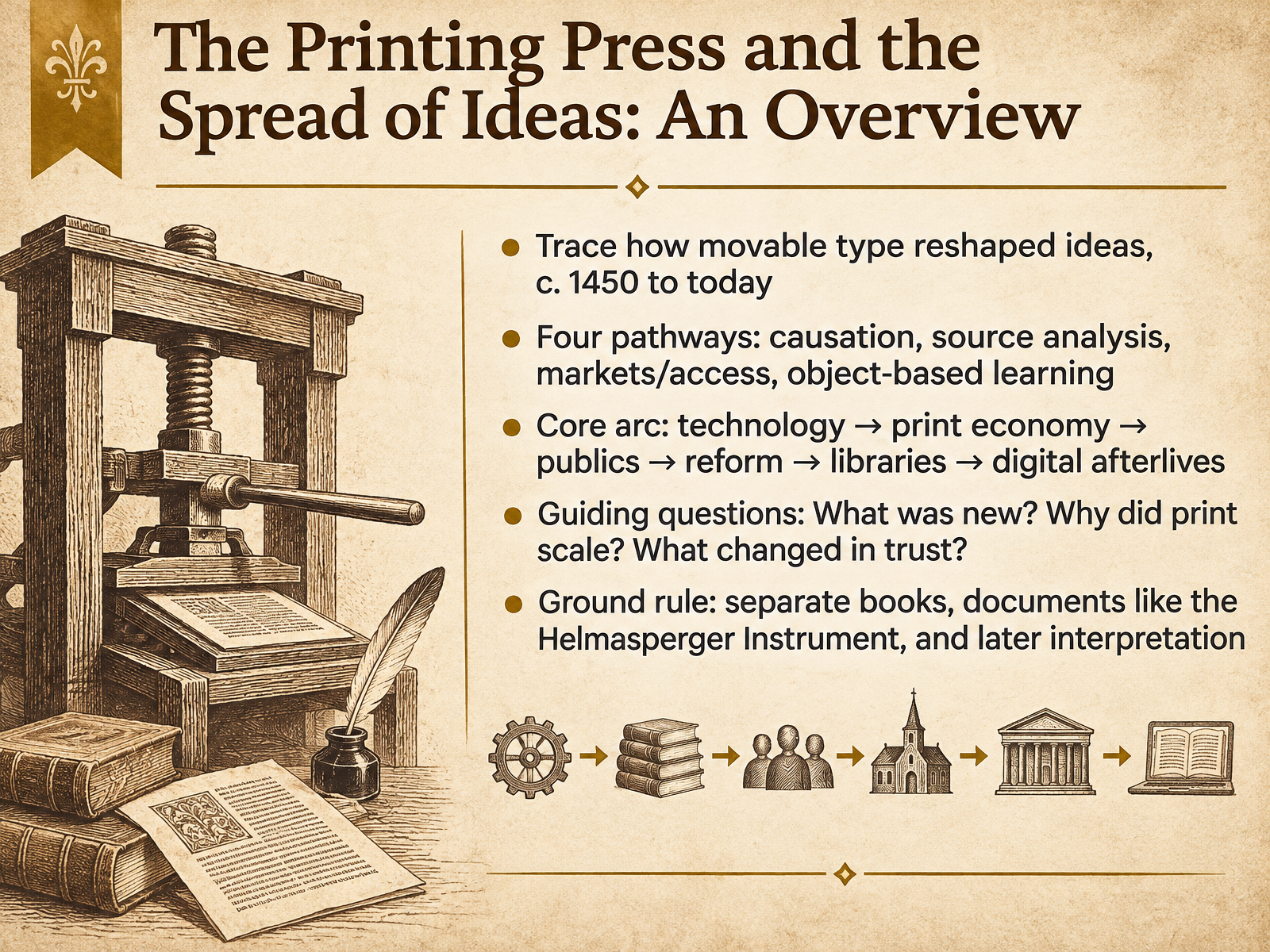
- 01The Printing Press and the Spread of Ideas: An OverviewWelcome. I'm glad you're joining me for this course on the printing press and the spread of ideas. Our goal is simple. We'll trace how movable type reshaped the way ideas traveled, from around fourteen fifty to today. We'll follow four pathways: causation, source analysis, markets and access, and object-based learning. The core arc runs from technology, to the print economy, to new reading publics, to reform, to libraries, and finally to digital afterlives. Three guiding questions will stay with us. What was actually new? Why did print scale so quickly? And what changed in the way people trusted what they read? One ground rule. Let's keep the books themselves separate from documents like the Helmasperger Instrument, Gutenberg's notarial record of fifteen fifty-five, and separate from later interpretation. That distinction keeps our sources honest. Before print, there were manuscript workshops and woodblock production. Let's start there.gutenberg-mainz.deaepm.eugutenberg-stiftung.de+22 min
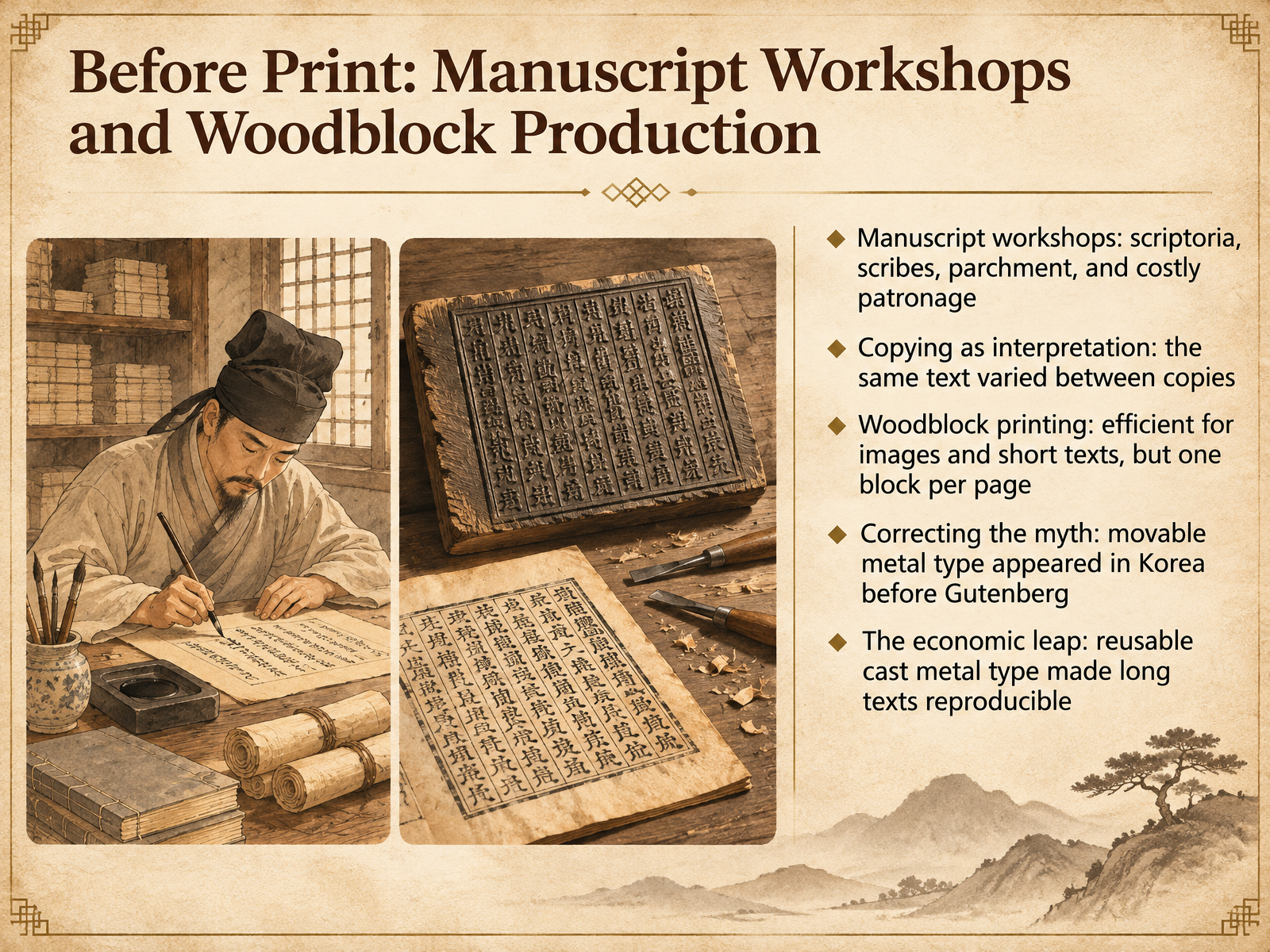
- 02Before Print: Manuscript Workshops and Woodblock ProductionBefore we get to Gutenberg, let's look at how ideas were copied before print. In manuscript workshops called scriptoria, scribes wrote by hand on parchment, and wealthy patrons paid for the work. Because copying was also interpretation, the same text varied between copies. Woodblock printing helped with images and short texts, but it needed one block per page. And one correction to a common myth: movable metal type appeared in Korea before Gutenberg. The real economic leap came from reusable cast metal type, which made long texts reproducible. Next, we'll see how Gutenberg turned this into a manufacturing process, not a gadget.
 1 min
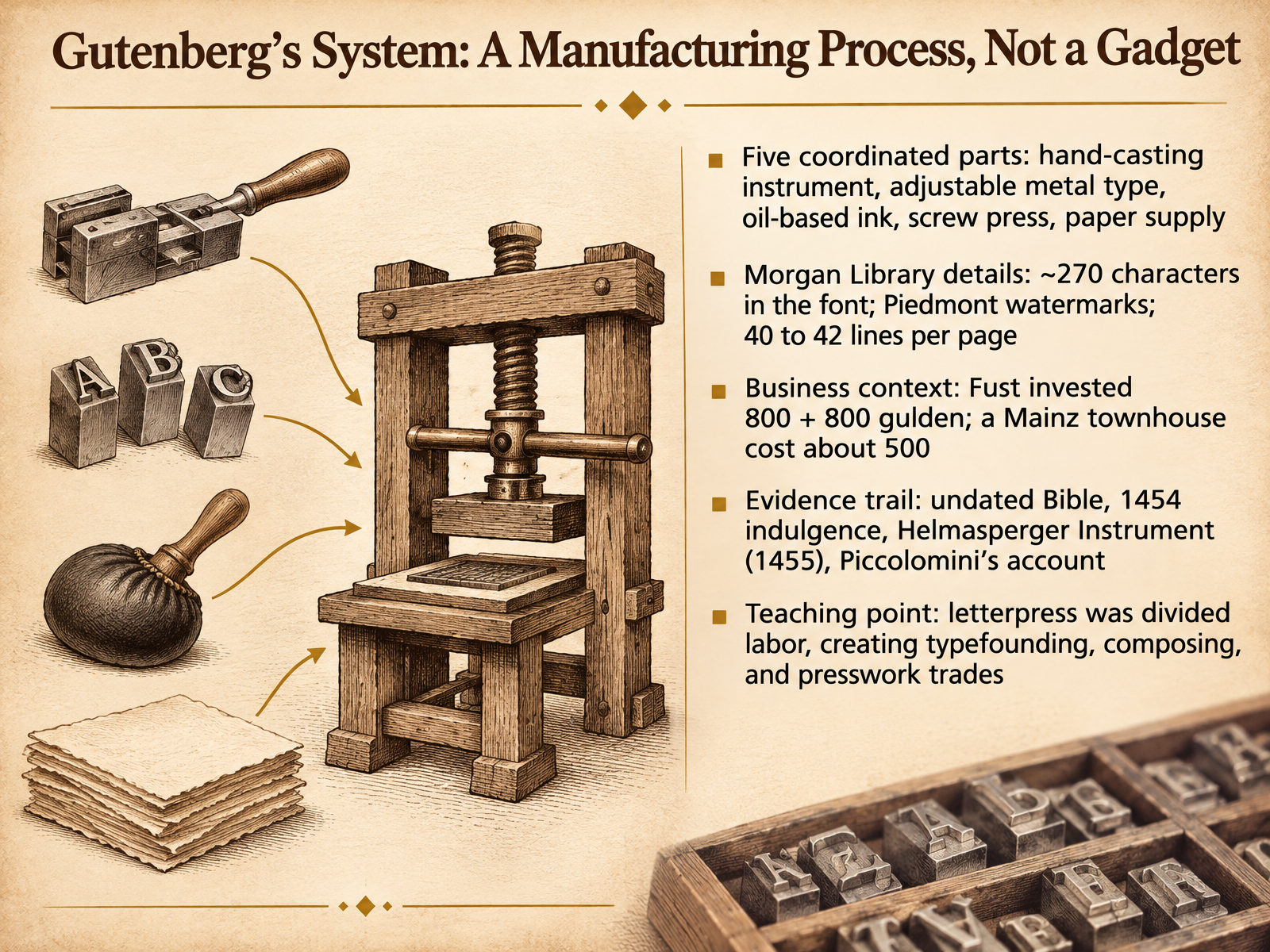
- 03Gutenberg's System: A Manufacturing Process, Not a GadgetLet's look at what Gutenberg actually built. The key idea is this. The printing press was not one clever gadget. It was a manufacturing system, with five parts working together. A hand-casting instrument for making type. Adjustable metal type. An oil-based ink that stuck to metal. A screw press, adapted from wine making. And a steady paper supply.
Details from the Morgan Library copies help here. About two hundred seventy characters in the font. Paper carrying Piedmont watermarks. And forty to forty-two lines on each page.
The money tells a story too. Johann Fust invested eight hundred gulden, then another eight hundred. A Mainz townhouse cost about five hundred, so this was serious capital.
And the evidence trail is careful. An undated Bible. A printed indulgence from fourteen fifty-four. The Helmasperger Instrument of fourteen fifty-five. And Piccolomini's account.
One teaching point. Letterpress divided labor. That created new trades, typefounding, composing, and presswork.
The 42-Line Bible: What Survives and What It Proves.
 2 min
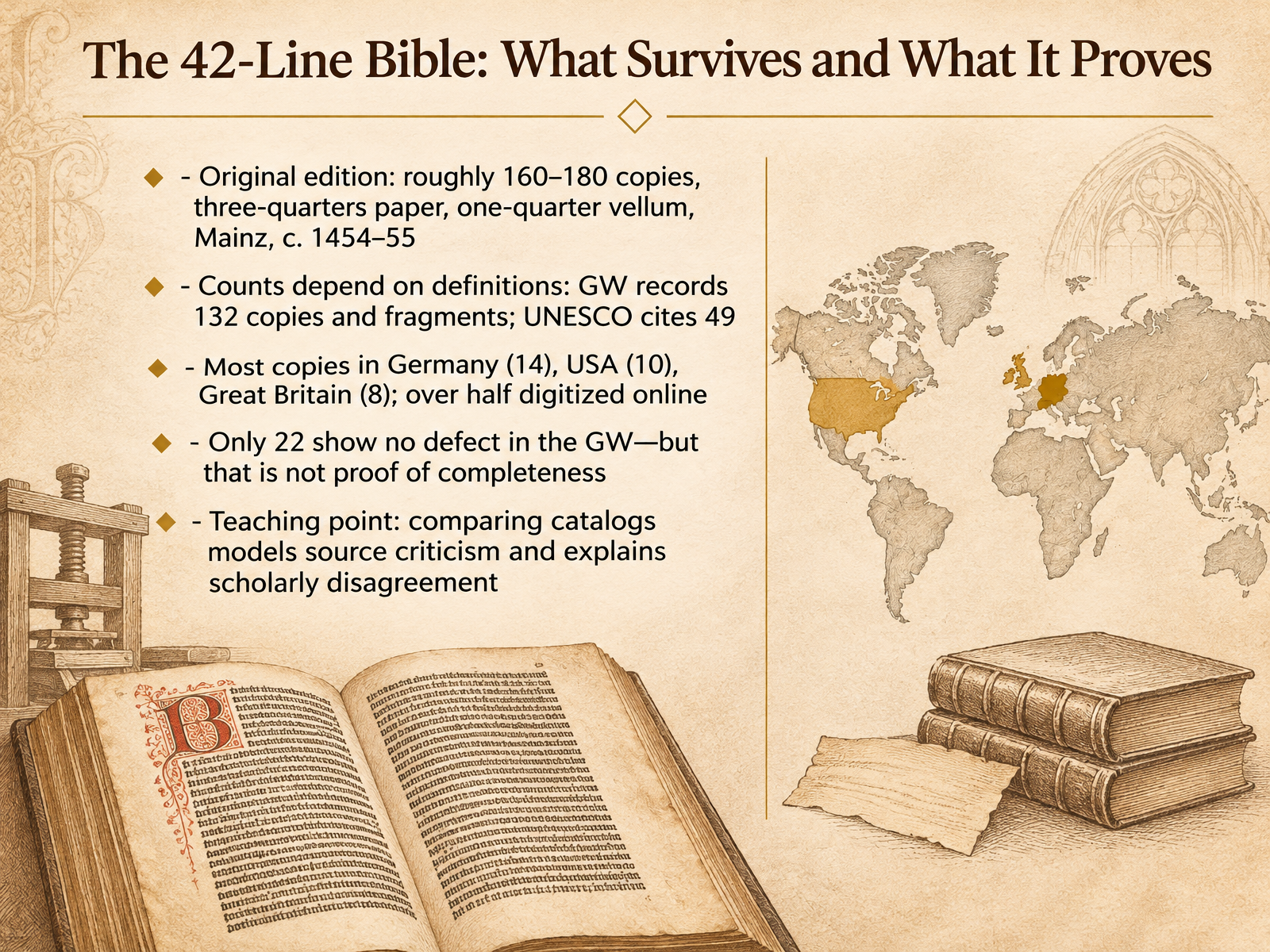
- 04The 42-Line Bible: What Survives and What It ProvesLet's take a closer look at the 42-Line Bible, and at what its surviving copies can actually tell us. The original edition was probably about one hundred sixty to one hundred eighty copies, printed in Mainz around fourteen fifty-four to fourteen fifty-five. Three quarters were on paper, and one quarter on vellum, a fine animal skin. But the counts you see depend on definitions. The Gesamtkatalog der Wiegendrucke records one hundred thirty-two copies and fragments, while UNESCO cites forty-nine. Most surviving copies are in Germany, with fourteen, then the United States, with ten, and Great Britain, with eight. More than half are now digitized online. And here is the teaching point. Only twenty-two copies show no defect in that catalog, but that is not proof of completeness. Comparing catalogs, like detectives comparing notes, models source criticism and helps explain why scholars disagree. Next, we turn to how this workshop became a market, in From Workshop to Market, the Early Print Economy.
 2 min
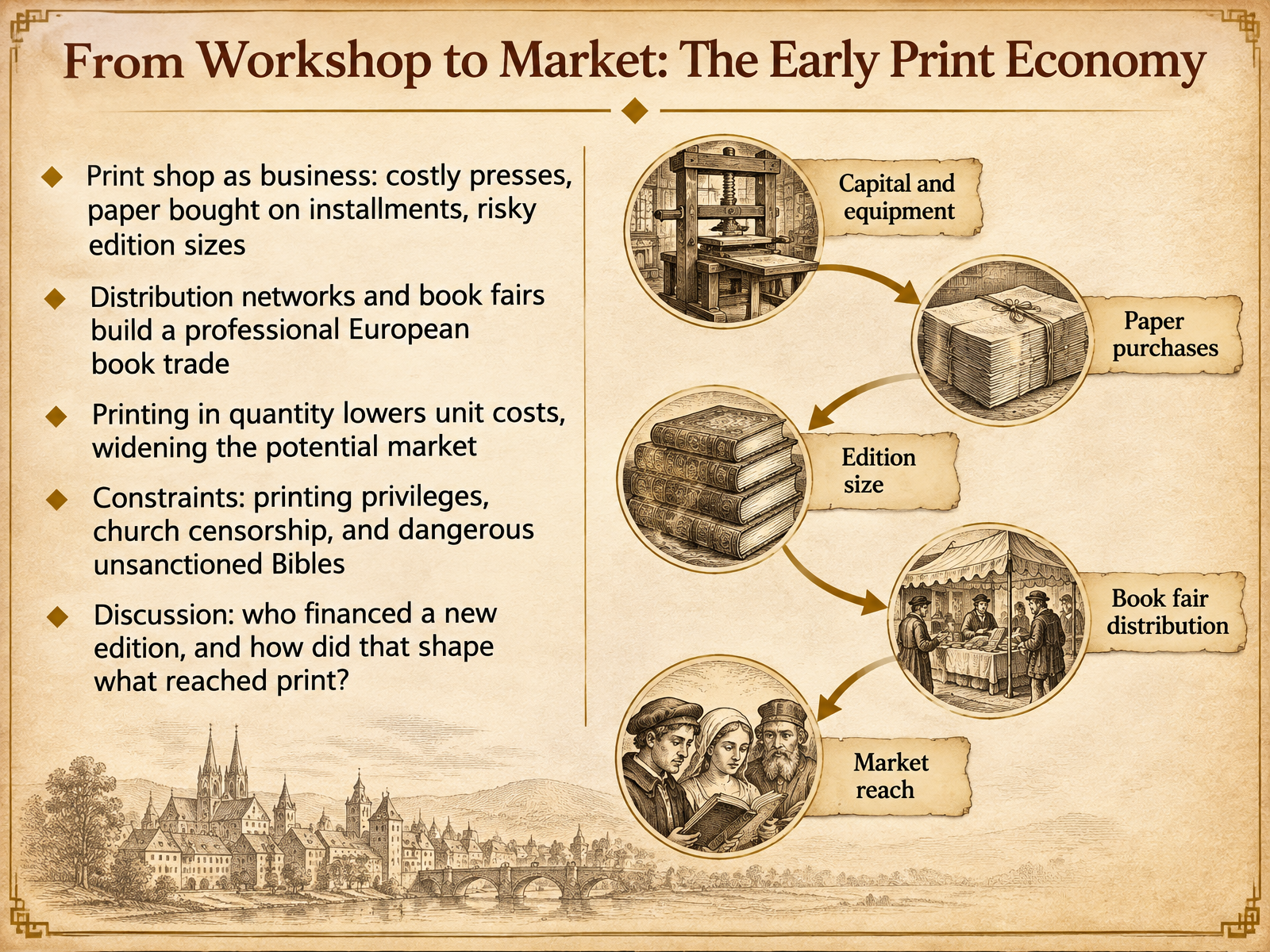
- 05From Workshop to Market: The Early Print EconomyLet's turn now from the workshop to the market. A print shop was a business, and an expensive one. Presses cost a great deal, paper was often bought on installments, and every edition carried risk. Print too few copies and you lost money. Print too many and unsold books sat in the storeroom. Distribution networks and book fairs gradually built a professional European book trade. Printing in quantity lowered the cost of each copy, which widened the potential market. But there were constraints. Printing privileges gave one printer the exclusive right to a text. Church censorship could stop a book entirely. And unauthorized Bibles were especially dangerous to print and to own. So here is a question for discussion. Who financed a new edition, and how did that shape what reached print? Keep that question in mind, because it leads us to new readers and new publics.
 1 min
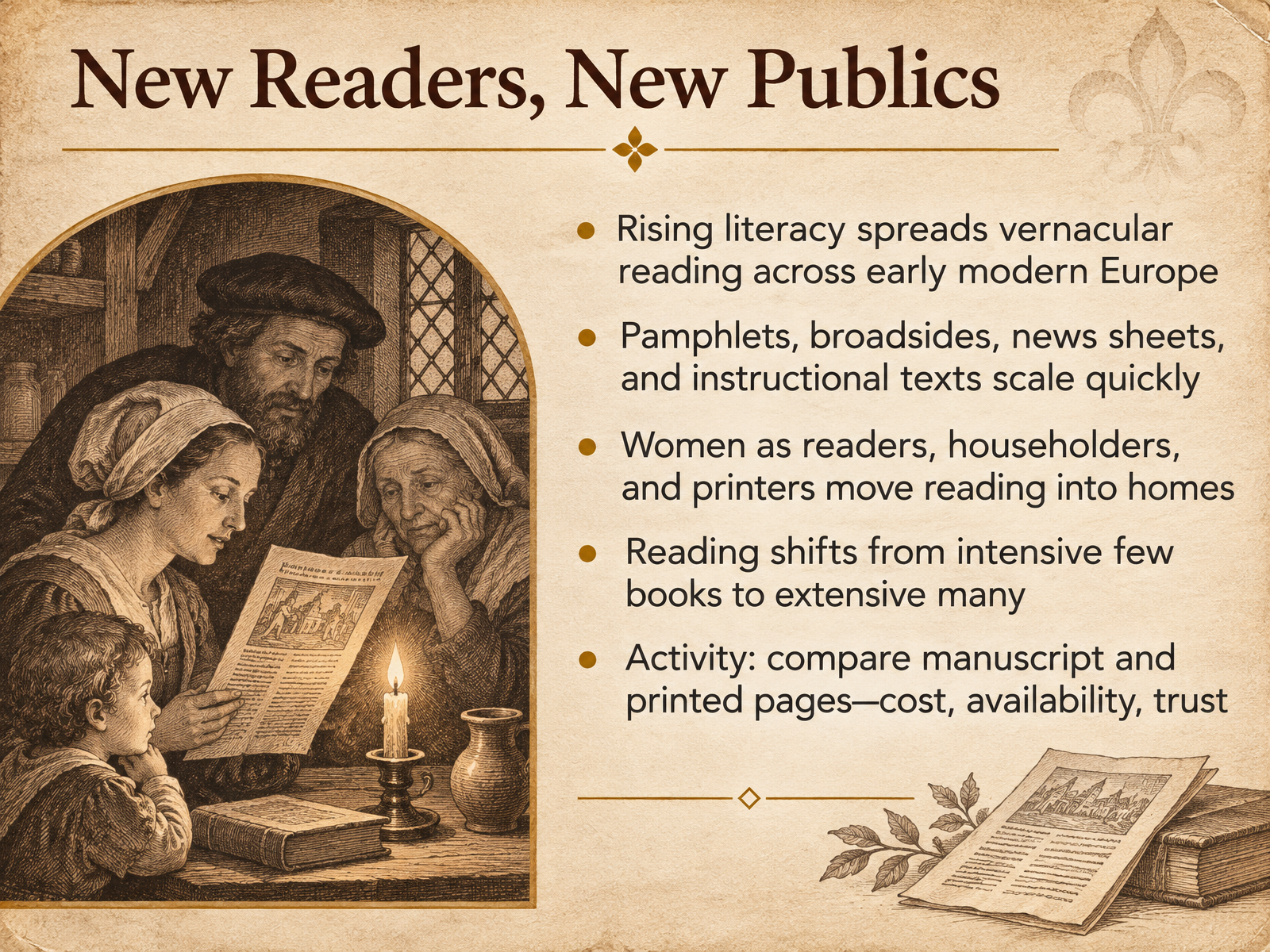
- 06New Readers, New PublicsLet's turn now to new readers and new publics. As literacy rose across early modern Europe, more people read in their everyday spoken languages, not only in Latin. Cheap print scaled quickly: pamphlets, broadsides, news sheets, and instructional texts reached far beyond a single town. Women read, managed households, and worked as printers, so reading moved into homes. And reading itself shifted, from intensive reading of a few books to extensive reading of many. Here's a simple activity. Compare a manuscript page with a printed page. Ask about cost, availability, and trust. That comparison shows how ideas traveled faster, to more people, and why that mattered. Next, we look at Reformation, Science, and Political Pamphletry.
 1 min
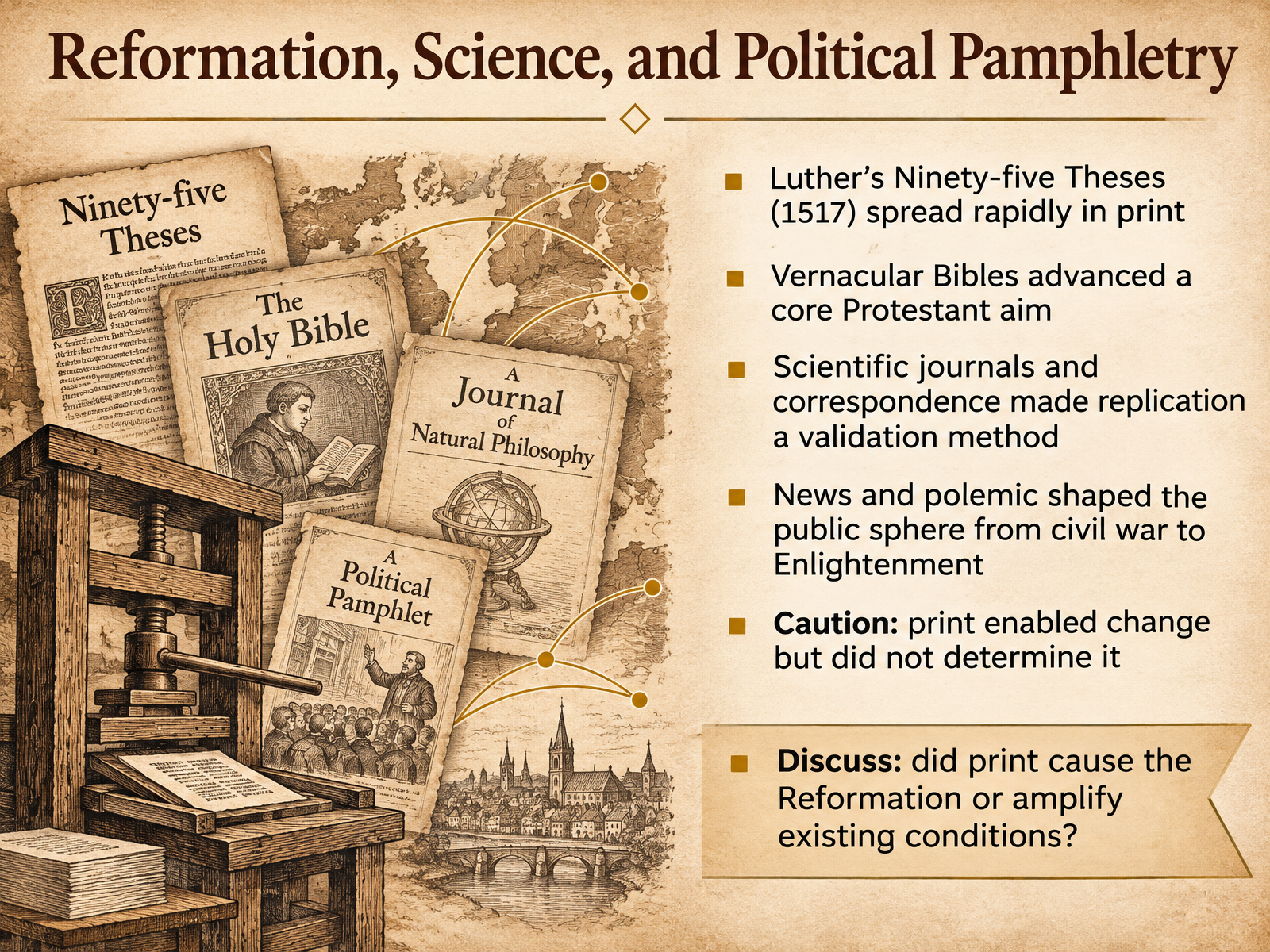
- 07Reformation, Science, and Political PamphletryLet's turn now to the Reformation, science, and political pamphletry. In fifteen seventeen, Luther's Ninety-five Theses spread rapidly in print. Printers copied and circulated them within weeks. Vernacular Bibles, translated into everyday languages, advanced a core Protestant aim. People could read scripture for themselves. Scientific journals and correspondence made replication a validation method. If others could repeat an experiment, the result gained trust. News and polemic shaped the public sphere from civil war to the Enlightenment. Pamphlets and news sheets gave more people a voice. But a caution here. Print enabled change but did not determine it. So let's discuss. Did print cause the Reformation, or amplify existing conditions? Keep that question in mind. Next, we look at collections, libraries, and the organization of knowledge.
 2 min
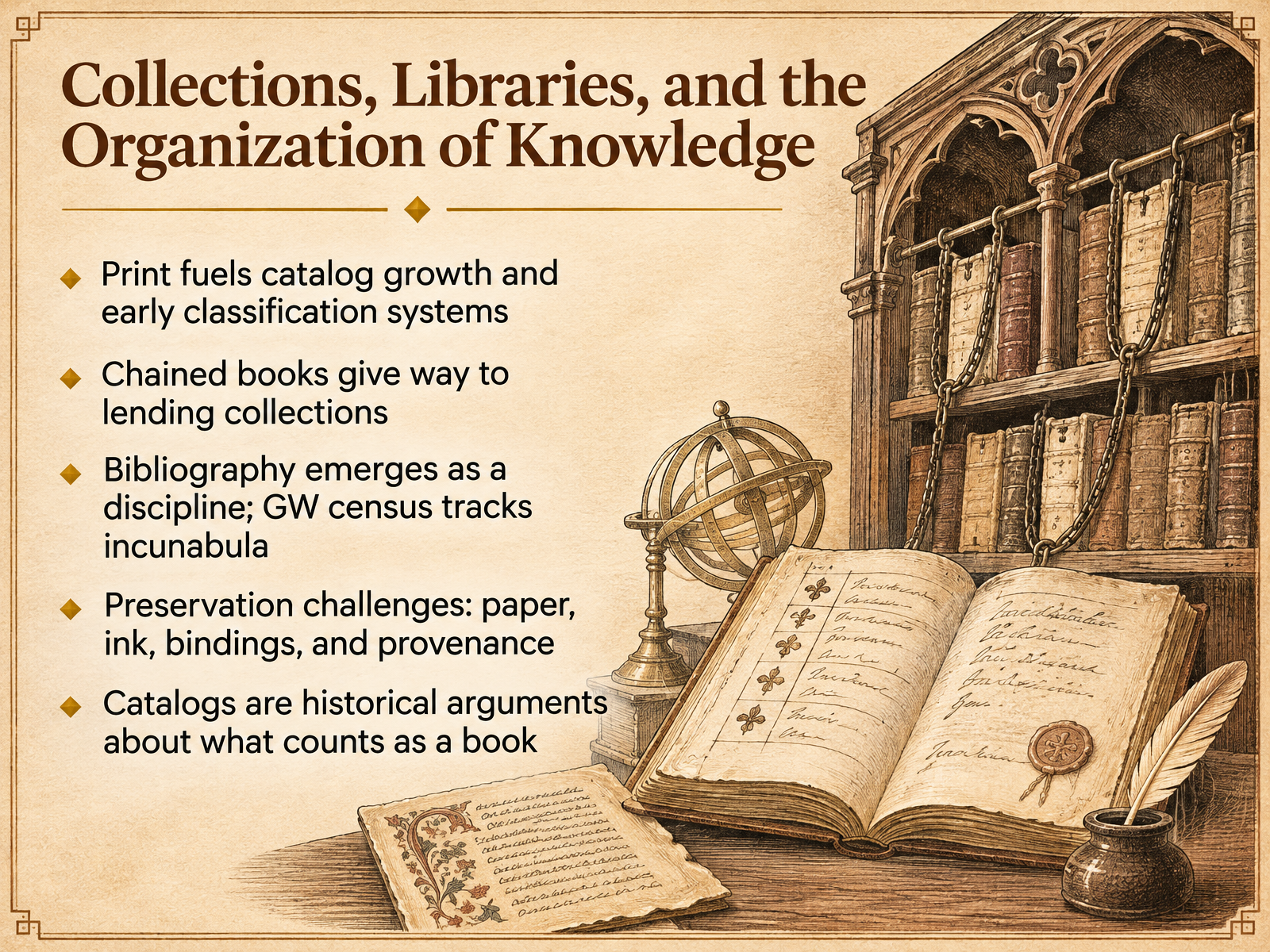
- 08Collections, Libraries, and the Organization of KnowledgeNext, let's look at how print reshaped collections and the organization of knowledge. As more books were printed, catalogs grew quickly, and early classification systems emerged to help readers find them. In many libraries, chained books, fixed to desks for security, gradually gave way to lending collections that could travel home with readers. Bibliography also became a discipline of its own. The Gesamtkatalog der Wiegendrucke, a union catalog of incunabula, tracks books printed before fifteen oh one. Preservation brings real challenges too: paper, ink, bindings, and provenance all affect whether a book survives and how we interpret it. And remember, every catalog is a historical argument about what counts as a book. That matters because catalogs decide which ideas get found. Let's turn now to Preservation and Digitization: Standards for Rare Books.
 1 min
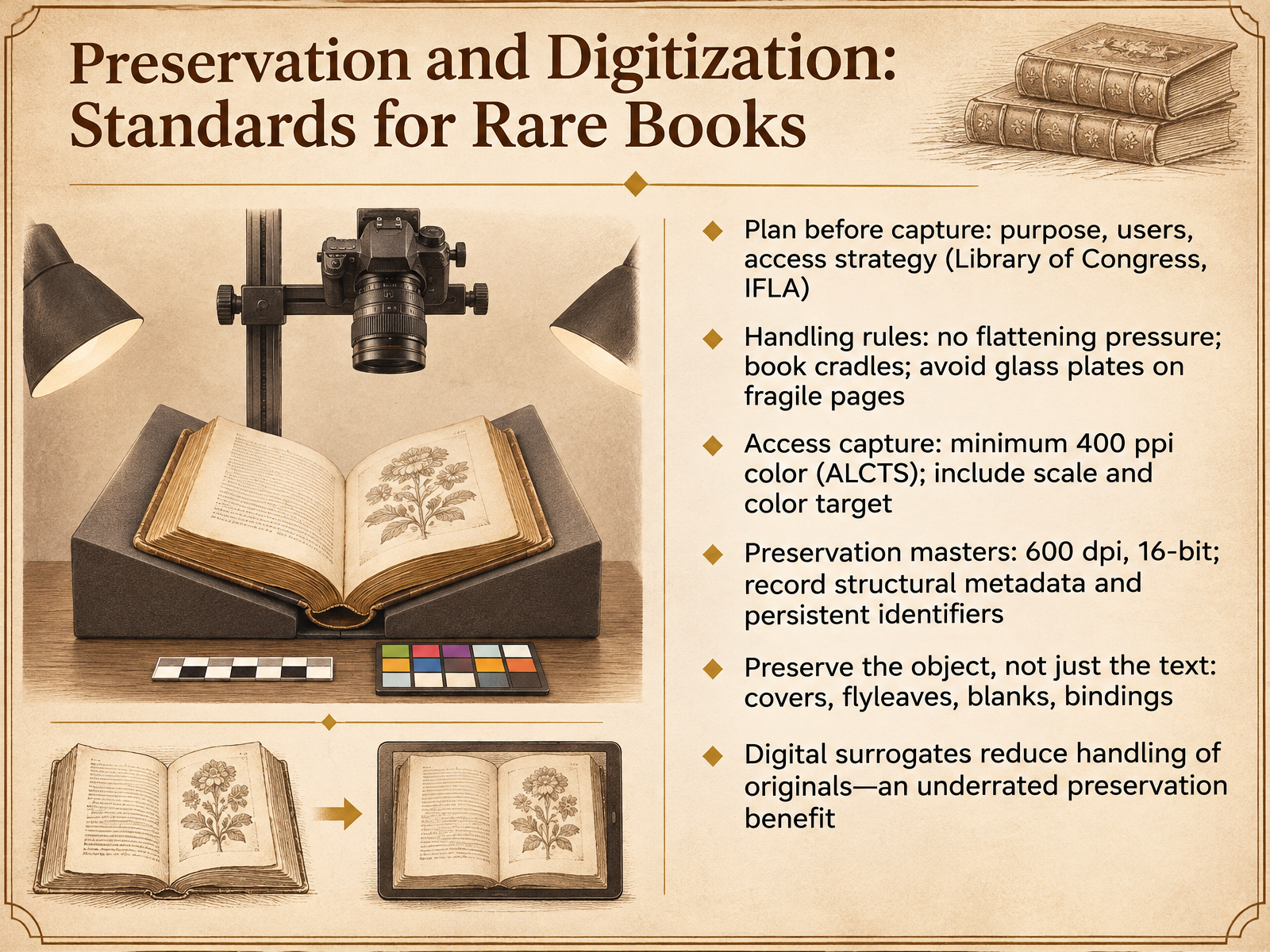
- 09Preservation and Digitization: Standards for Rare BooksLet's turn to preserving rare books in the digital age. Start with a plan before any camera clicks. Ask why you are digitizing, who will use the files, and how access will work. Groups like the Library of Congress and the International Federation of Library Associations offer useful guidance. Next, handling rules. Never press a fragile book flat. Use a book cradle and avoid glass plates on weak pages. For access images, aim for at least four hundred pixels per inch in color, following ALCTS guidance, and include a scale and color target. Keep preservation masters at six hundred dots per inch, sixteen bit, with structural metadata and persistent identifiers. And preserve the object, not just the text. Capture covers, flyleaves, blank pages, and bindings. Digitization also cuts handling of originals, an underrated preservation benefit. Next, we look at museum interpretation and object-based learning.
 1 min
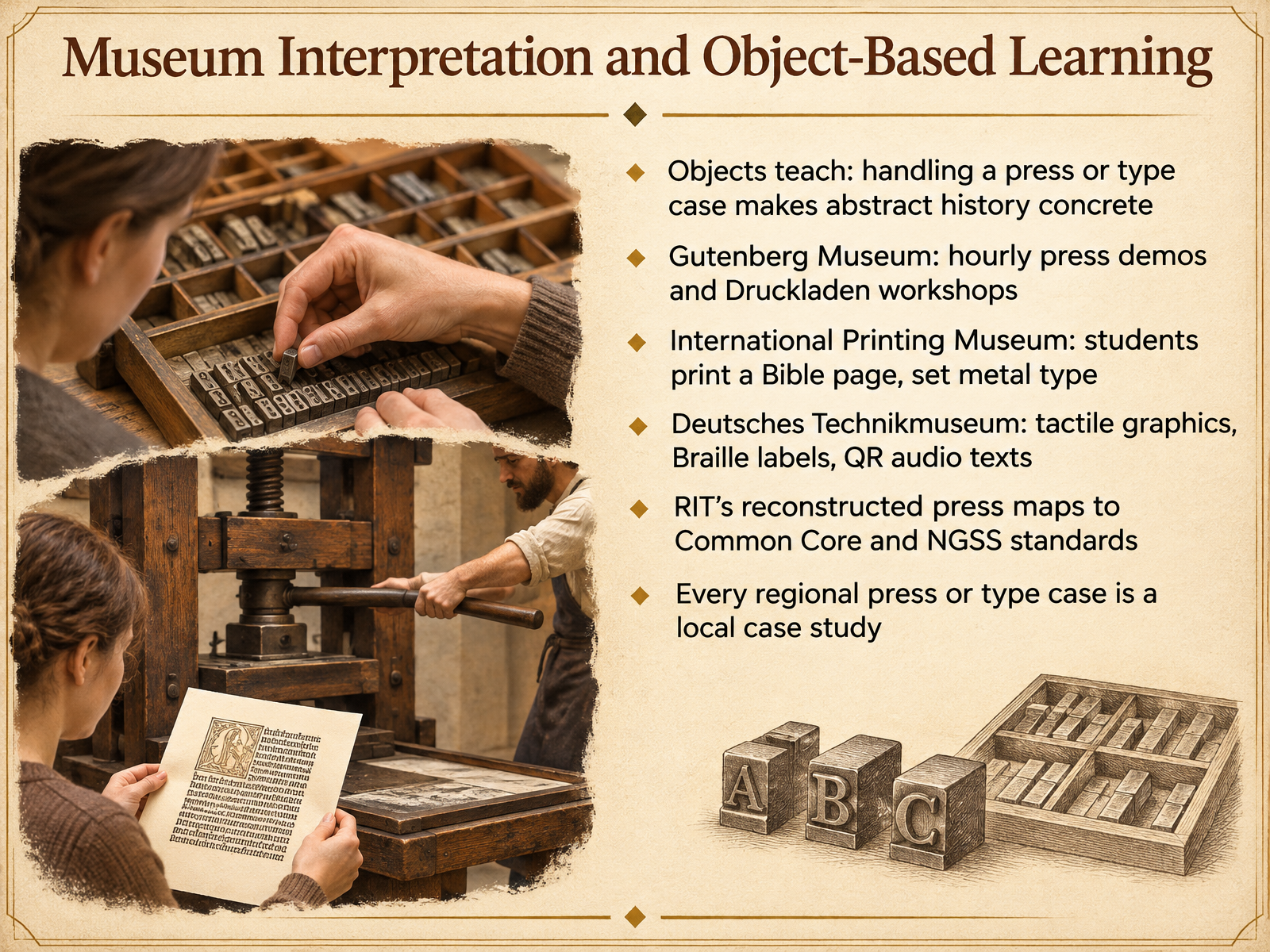
- 10Museum Interpretation and Object-Based LearningNow let's look at how museums make this history tangible. Objects teach. Handling a real press or a type case turns an abstract story into something concrete you can feel. At the Gutenberg Museum, you can watch hourly press demonstrations and join workshops in the Druckladen, its printing workshop. At the International Printing Museum, students print a Bible page and set metal type by hand. The Deutsches Technikmuseum offers tactile graphics, Braille labels, and QR audio texts, so blind and low-vision visitors can engage too. R I T's reconstructed press maps to Common Core and N G S S standards, which helps teachers connect a visit to classroom goals. And every regional press or type case is a local case study. So ask what your own collection or community can reveal about how ideas spread. Next, we turn to digitization and A I, searching the printed past.
 2 min
- 11Digitization and AI: Searching the Printed PastLet's turn now to how digitization and artificial intelligence are changing the way we search the printed past.
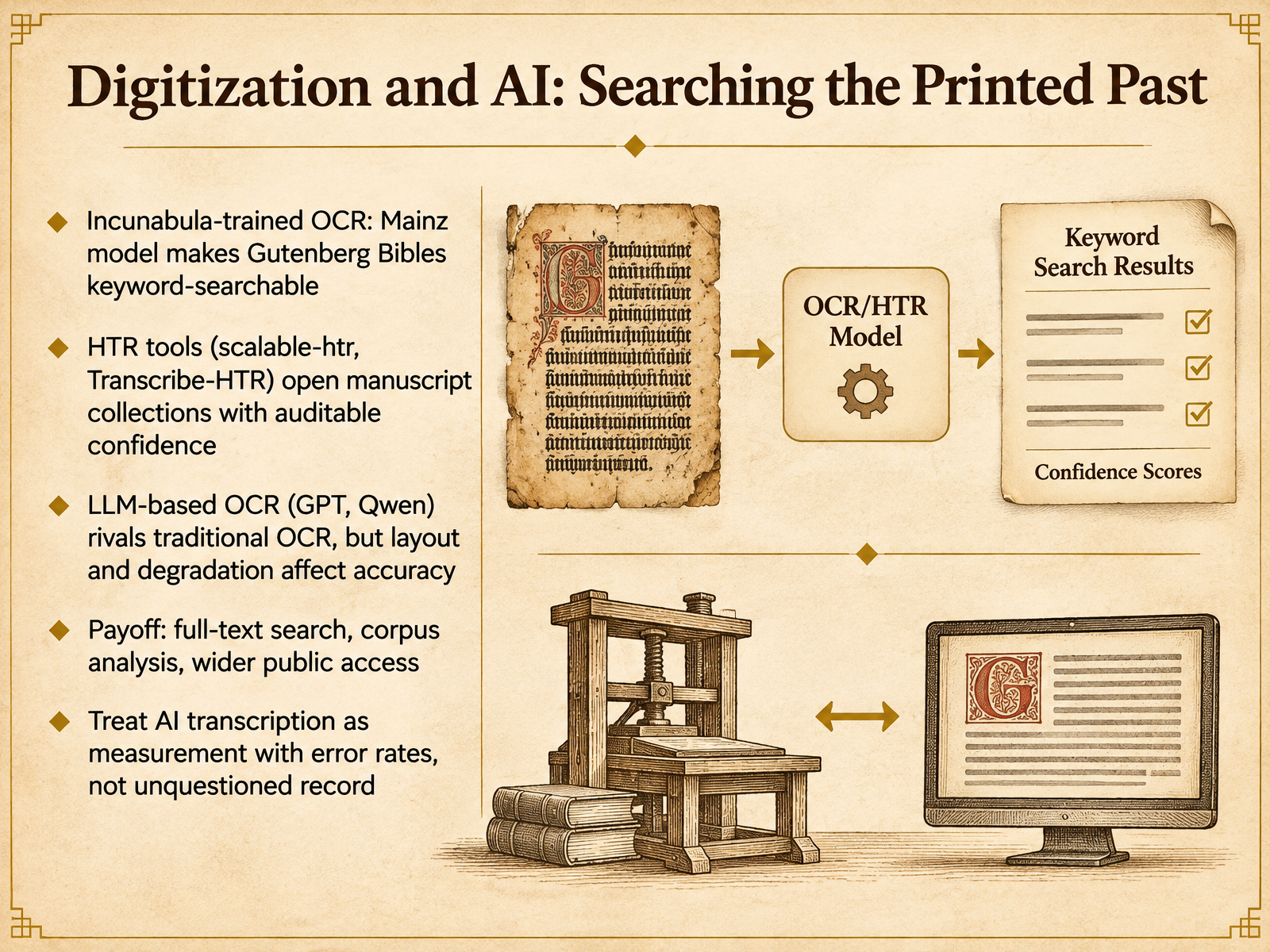
Start with incunabula. These are books printed in Europe before fifteen hundred and one. A Mainz-trained OCR model can now make Gutenberg Bibles keyword-searchable. OCR means optical character recognition, software that turns pictures of text into editable text.
Handwritten text recognition tools, like scalable HTR and Transcribe HTR, open manuscript collections and give each line an auditable confidence score. That score is a checkable measure of how sure the software is.
Large language model OCR, such as GPT and Qwen, now rivals traditional OCR. But page layout and physical degradation still affect accuracy.
The payoff is real. Full-text search, corpus analysis, and wider public access.
Just treat AI transcription as measurement, with error rates you can review, not an unquestioned record.
Next, we look at print, platforms, and the authority of ideas.
 1 min
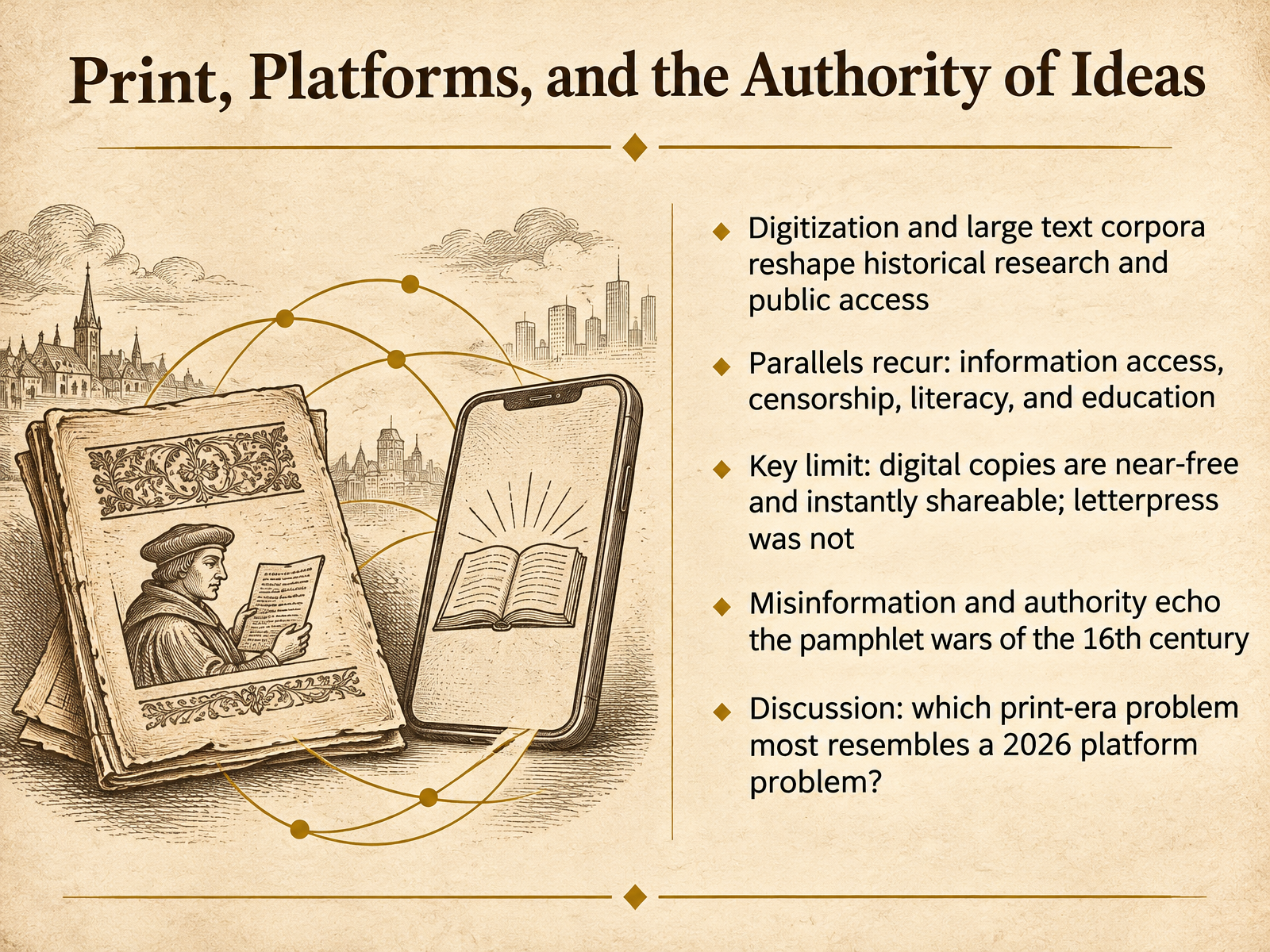
- 12Print, Platforms, and the Authority of IdeasLet's turn to print, platforms, and the authority of ideas. Today, digitization and large text corpora are reshaping historical research and public access. Think of searching thousands of early modern books in seconds. And some parallels keep returning. Who gets access to information, what gets censored, who can read, and how people learn. But one limit matters. Digital copies are nearly free and instantly shareable. A letterpress was not. Every page cost paper, ink, and labor. Misinformation and authority also echo the pamphlet wars of the sixteenth century. Cheap pamphlets spread fast, and readers argued over who to trust. So here is a question for discussion. Which print-era problem most resembles a platform problem in twenty twenty-six? Take a moment and think about access, censorship, or trust. Next, we look at digital afterlives, and what they mean for access, research, and public reach.
 2 min
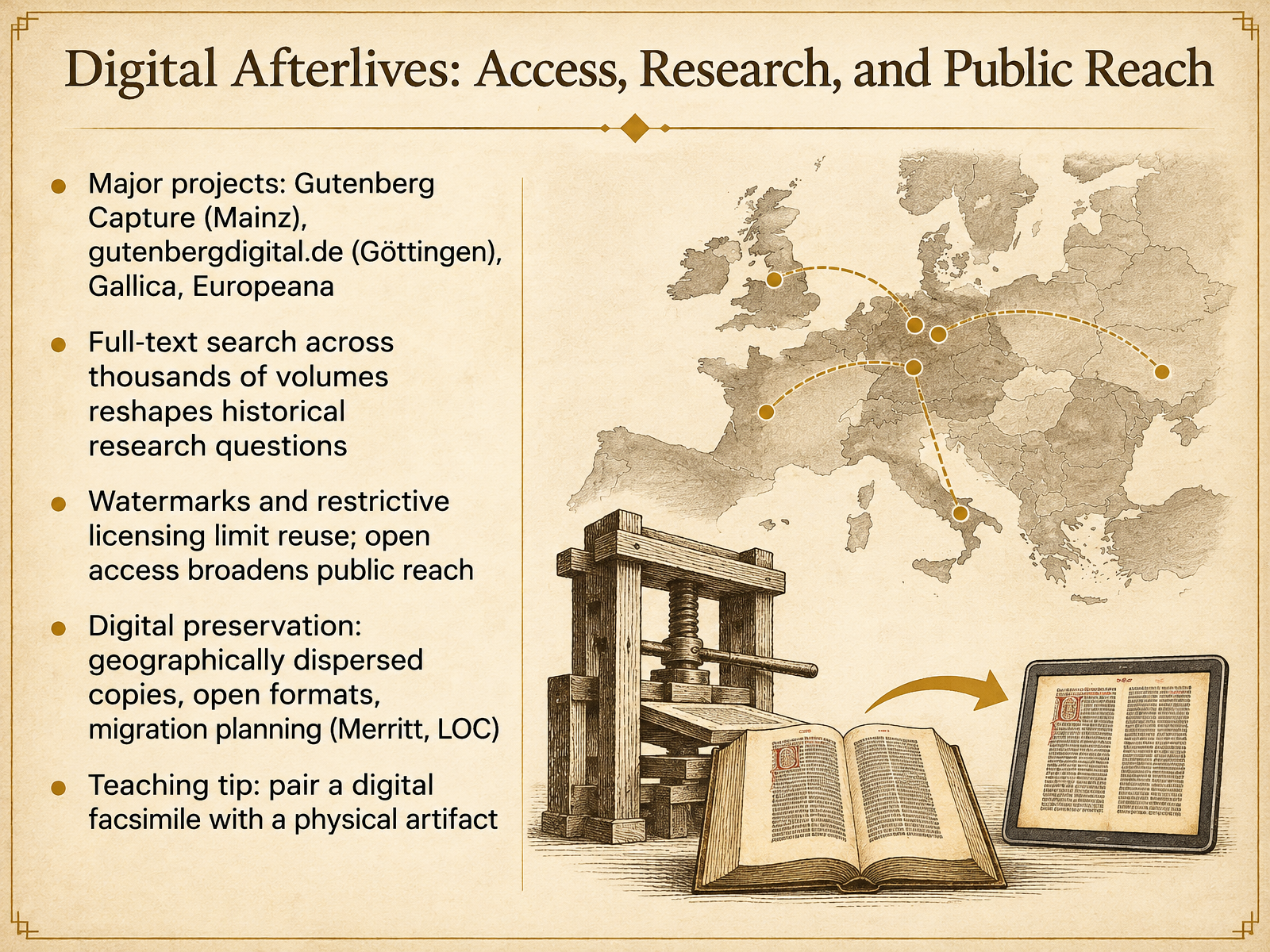
- 13Digital Afterlives: Access, Research, and Public ReachNow, let's look at how early printed books live on in digital form, and why access matters. Several major projects make these collections searchable. Gutenberg Capture in Mainz focuses on early printing. Gutenberg Digital in Göttingen offers another key collection. Gallica, from the National Library of France, and Europeana, a European union-wide platform, broaden the view across borders. Full-text search across thousands of volumes reshapes historical research questions. Instead of reading one book closely, you can trace a phrase across hundreds of editions. But reuse is often limited. Watermarks and restrictive licensing can block copying. Open access broadens public reach. Digital preservation also needs planning. Geographically dispersed copies, open formats, and migration plans, like those used by Merritt or the Library of Congress, help keep files readable over time. Here is a teaching tip. Pair a digital facsimile with a physical artifact, so learners compare screen and page. Next, we will move to synthesis, using the evidence in your own context.
 2 min
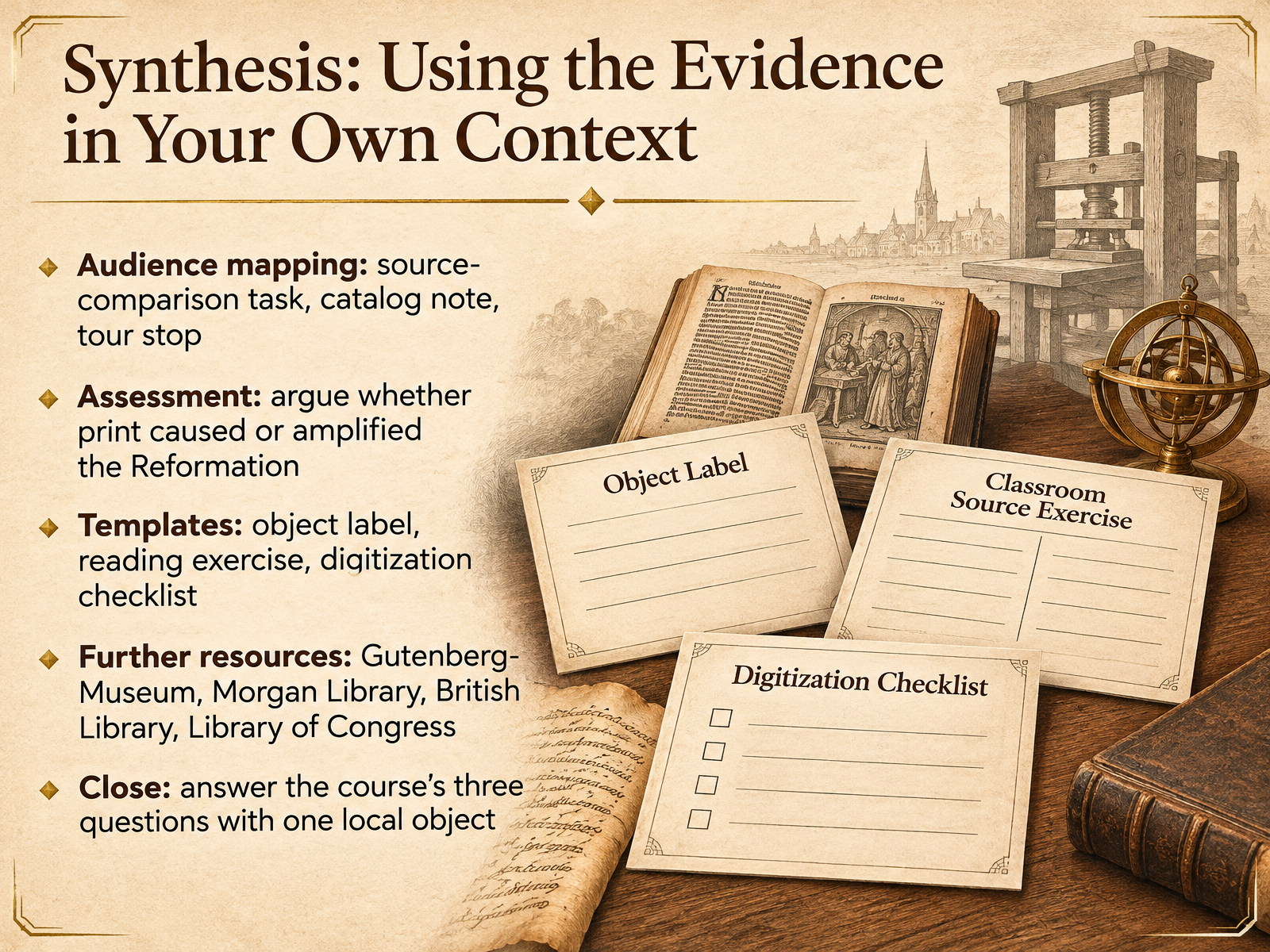
- 14Synthesis: Using the Evidence in Your Own ContextLet's bring it all together. You can use this evidence in your own setting. Start by mapping your audience. A teacher might design a source-comparison task. A librarian could write a short catalog note. A museum educator might add one tour stop. Next, assessment. Ask learners to argue whether print caused the Reformation or amplified it. That debate teaches them to weigh evidence. We have templates you can adapt: an object label, a reading exercise, and a digitization checklist. For further study, look to the Gutenberg Museum, the Morgan Library, the British Library, and the Library of Congress. As a close, choose one local object. Answer our three course questions about it. What changed, who benefited, and how did ideas travel? Well done. Use these tools, keep asking questions, and you will do excellent work.
 2 min
Take the deck with you
Download this course as a file — free, no sign-up needed.
- PDF handoutEvery slide page, ready to print or share.15 pages · 7.2 MBDownload
- Narrated PowerPointThe deck that presents itself — every slide carries the digital human's narration video.15 pages · 18.2 MBDownload
- PowerPoint slidesThe full deck as a .pptx — open it in PowerPoint, Keynote, or Google Slides.15 pages · 7.2 MBDownload
Free to use in your own training — please keep the PersonWise credit page at the end.
Have your own deck? Turn it into a course
Sources consulted
Web sources consulted while building this course.
- Where are the Gutenberg Bibles today? All locations | gutenberg-mainz.de — gutenberg-mainz.de
- Association of European Printing Museums ~ The Gutenberg Museum’s Bibles online — aepm.eu
- Online blättern in der Gutenberg-Bibel — gutenberg-stiftung.de
- The Gutenberg Bible | Harvard Library — library.harvard.edu
- The Morgan Gutenberg Bible Online | | The Morgan Library & Museum — themorgan.org