Estimating Work Effort
Begin
16 pages · ~32 min
Estimating Work Effort
A training focused on accurately estimating project effort and managing uncertainty to improve project planning and execution.
What you’ll learn
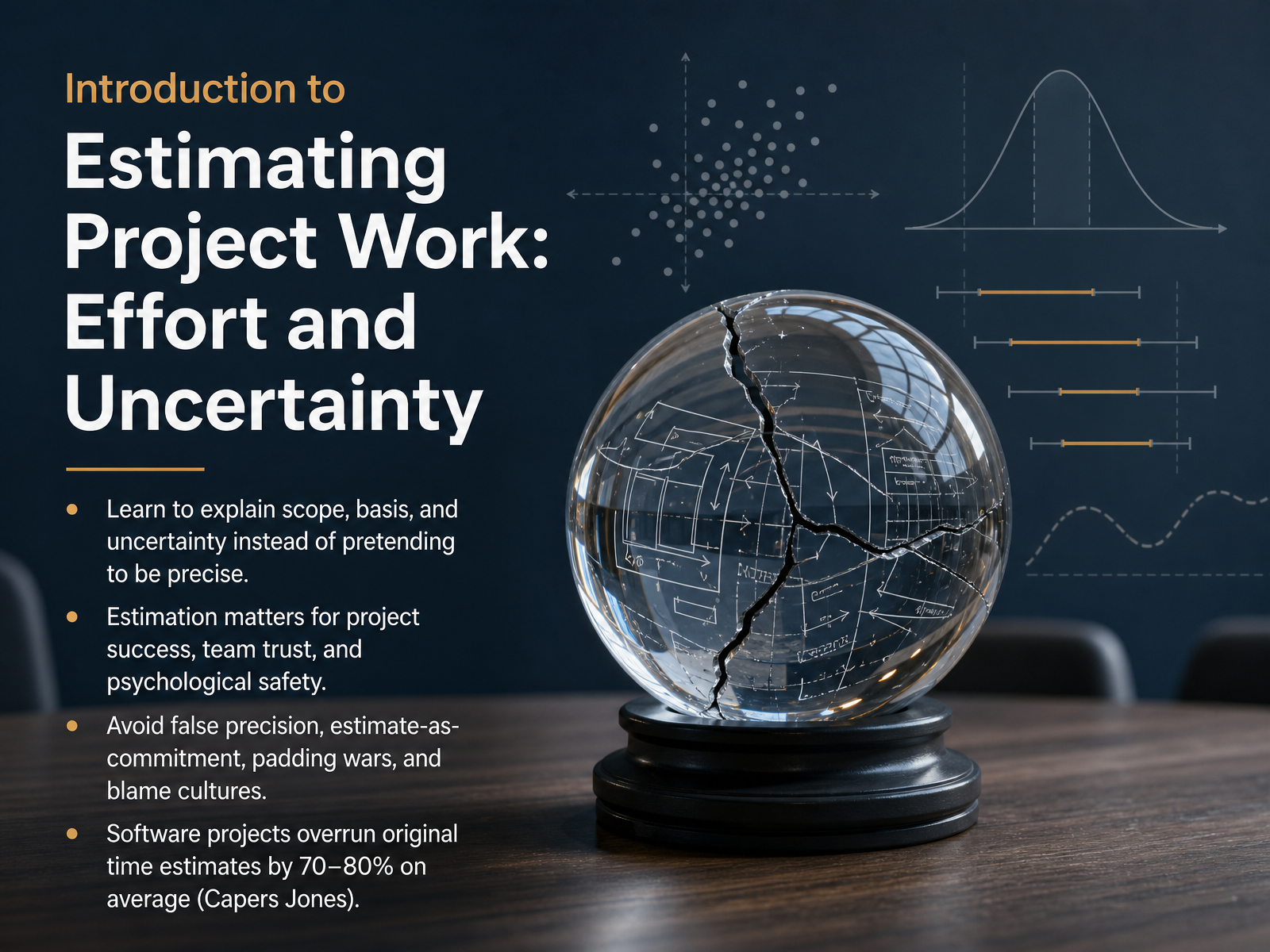
- 01Introduction to Estimating Project Work: Effort and UncertaintyWelcome. In this course we'll focus on a skill that sits at the heart of every project: estimating effort. The goal isn't to produce reassuringly precise numbers that later fall apart. Instead, you'll learn to explain three things clearly—the scope of the work, the evidence your estimate is based on, and the uncertainty that always surrounds it. That shift matters. Research on thousands of software projects shows that original time estimates tend to overrun by seventy to eighty percent on average. A lot of that pain comes from treating guesses as promises, then punishing people when reality turns out differently. When we replace false precision with honest reasoning, we protect team trust and build real psychological safety. So throughout this session, we'll go beyond the pressure to give a single number, and build estimates you can actually defend. Let's begin.medium.comamericanimpactreview.coma4al6a.substack.com+22 min
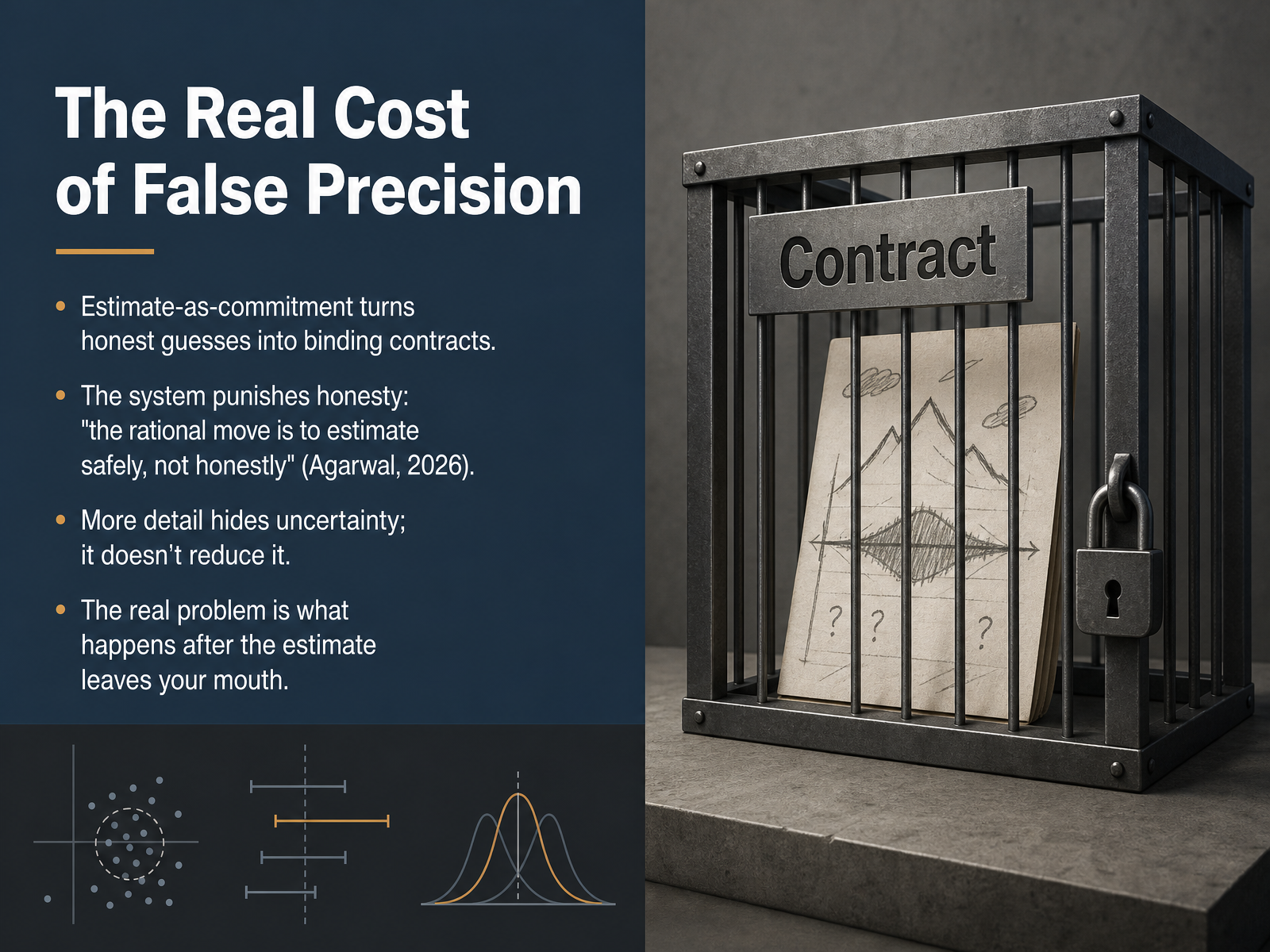
- 02The Real Cost of False PrecisionMoving on to a core problem we face in project work: the real cost of false precision. You’ve probably seen this happen. An estimate gets spoken aloud, and suddenly it’s no longer a rough guess. It becomes a promise. Honest uncertainty gets converted into a rigid deadline. The system often punishes honesty here. The researcher Agarwal points out that when estimates are treated as commitments, the rational move is not to be accurate, but to estimate safely. You add padding to protect yourself, rather than giving your true assessment. There is also a dangerous illusion that adding more detail, like a very granular task breakdown, somehow reduces the underlying uncertainty of the work. It doesn’t. It just hides the unknowns inside a prettier package. The real problem isn't even the estimate itself. It is what happens after the estimate leaves your mouth, when it starts living in someone else’s spreadsheet as a fixed truth. Let’s look deeper into why this happens by exploring the planning fallacy and the hidden work we often miss.
 discovery.ucl.ac.ukdiscovery.ucl.ac.ukdl.acm.org+22 min
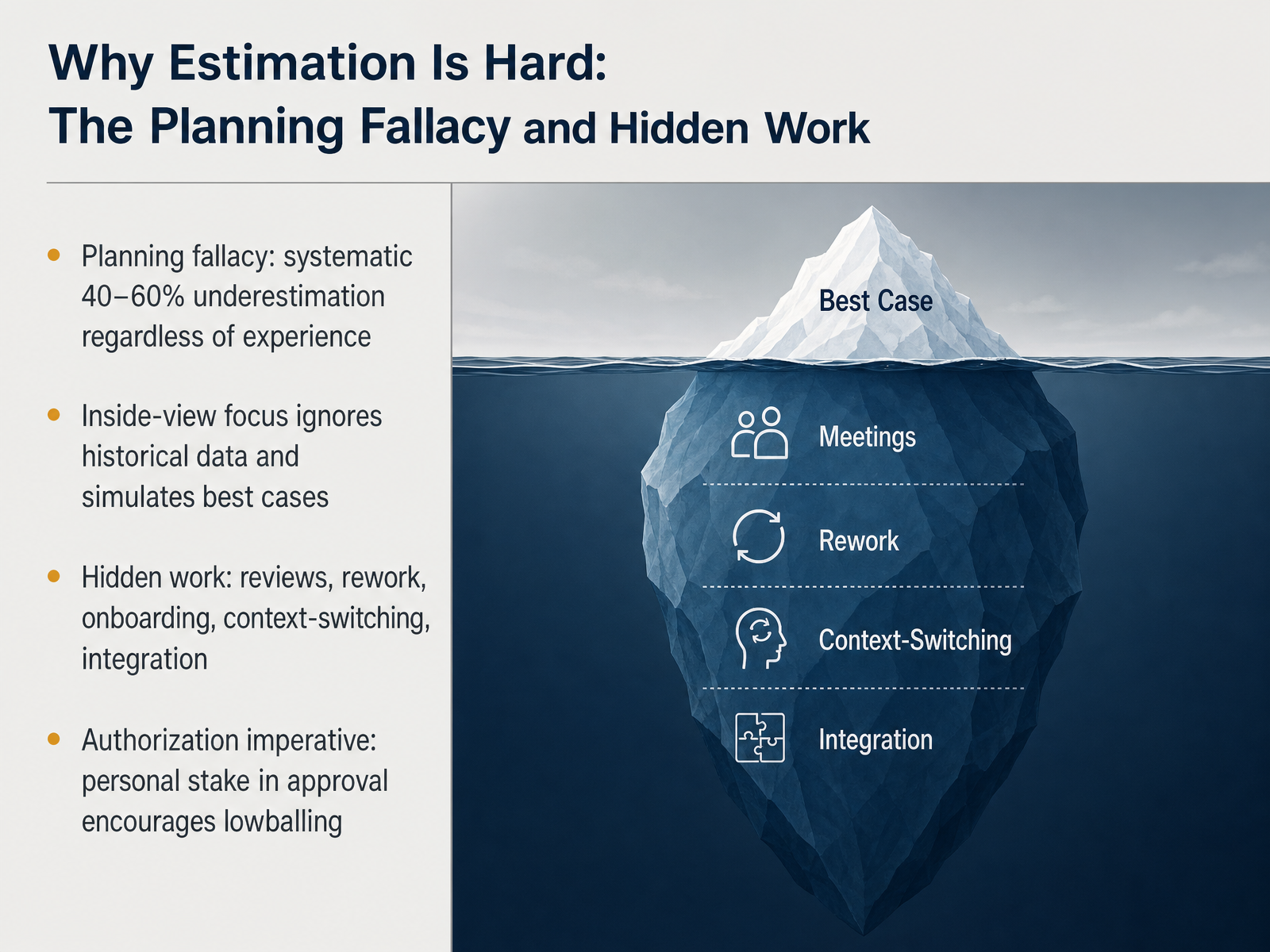
 - 03Why Estimation Is Hard: The Planning Fallacy and Hidden WorkSo, why is estimation so difficult, even for experienced teams? A big reason is something called the planning fallacy. Research shows that people systematically underestimate effort by forty to sixty percent, and this happens regardless of how many similar projects they have done before. It is not a lack of skill; it is a thinking trap. We tend to focus on the inside view, imagining every step going smoothly and ignoring the historical data that tells a different story. Then, there is the hidden work. We often forget to account for code reviews, unexpected rework, onboarding new members, constant context-switching, and the messy reality of system integration. On top of all this, there is often pressure to get a project approved. When we have a personal stake in authorization, the incentive to present a low, optimistic number can be very strong. All of these forces combine to make precise estimates far less reliable than they first appear. Next, let's look at how this uncertainty changes throughout a project by exploring the Cone of Uncertainty.
 2 min
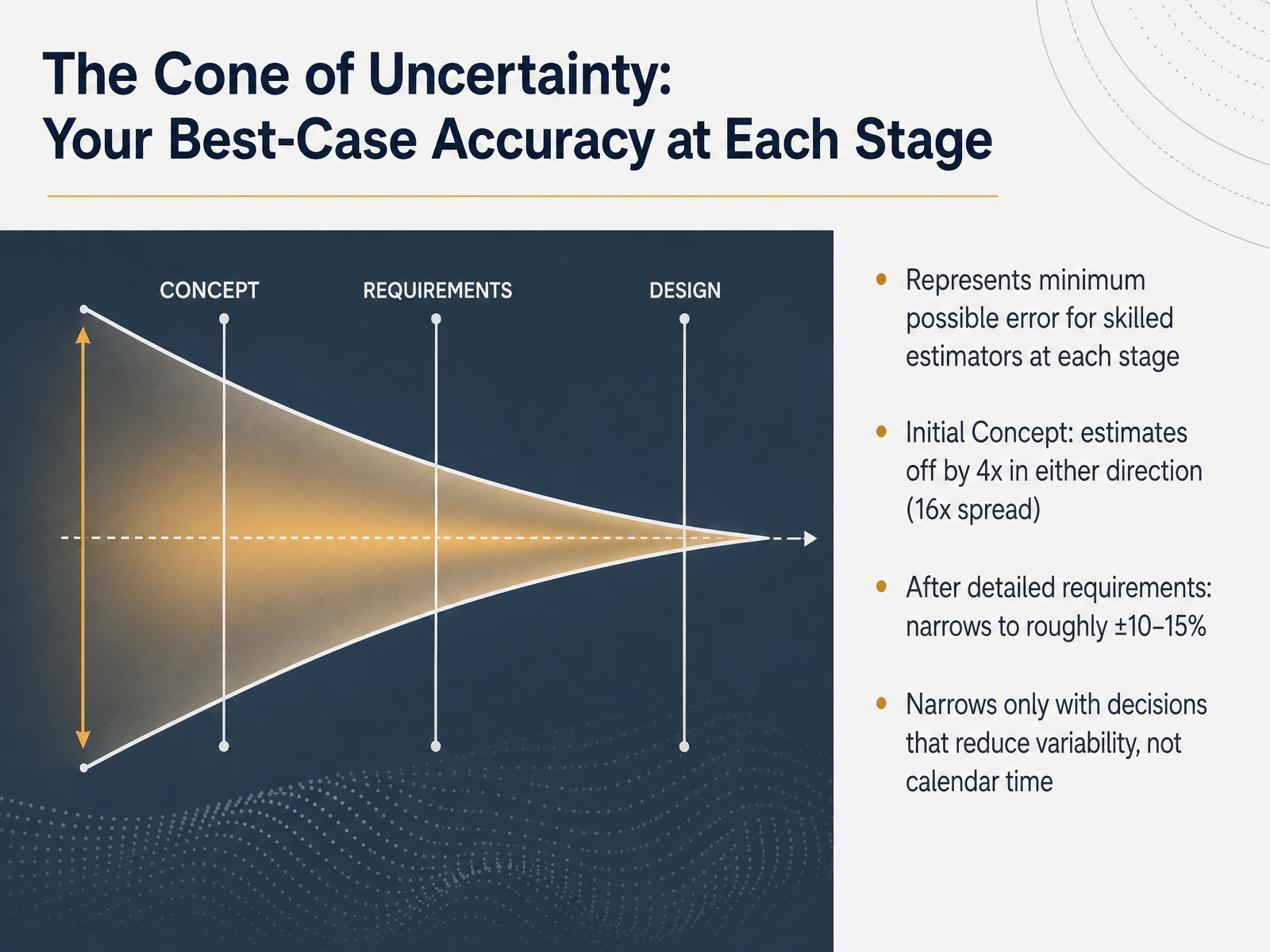
2 min - 04The Cone of Uncertainty: Your Best-Case Accuracy at Each StageNow let's look at a concept that helps us set honest expectations from the very start, the Cone of Uncertainty. This represents the best-case accuracy a skilled estimator can achieve at each stage of a project, not a worst case, but the floor of what's possible. At the initial concept stage, estimates can be off by a factor of four in either direction. That is a sixteen-times spread from best to worst case. That sounds extreme, but it accurately reflects how little we know at the beginning. As we define detailed requirements, the cone narrows. The minimum error typically shrinks to about plus or minus ten to fifteen percent. Here is the critical insight. The cone narrows only through decisions that reduce variability, not simply through the passage of calendar time. Waiting does not improve accuracy. Analysis and scope resolution do. This means we should link our estimate precision directly to the decisions we have made, not to the phase we are in on a schedule. Next, we will build on this by separating effort from duration and single points from ranges.
 2 min
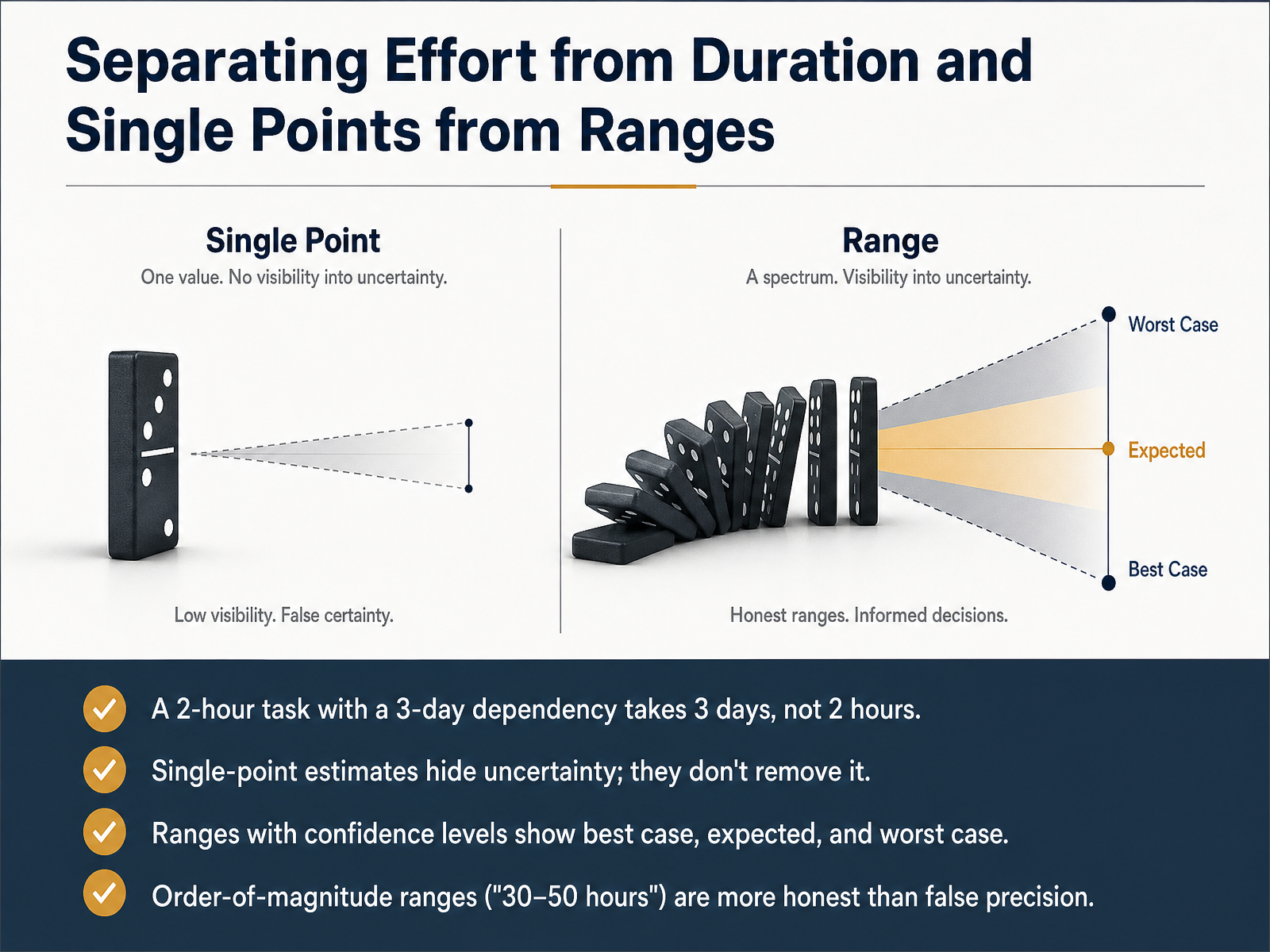
2 min - 05Separating Effort from Duration and Single Points from RangesLet's clarify three ideas that often get tangled up: effort versus duration, single points versus ranges, and the role of honest uncertainty. First, effort and duration are not the same thing. A task might take two hours of focused work, but if it depends on a sign-off that takes three days, the duration is three days, not two hours. Confusing them leads to schedules that look tight on paper but break immediately in reality. Second, be careful with single-point estimates. Saying a task is seventeen hours sounds precise, but it hides all the unknowns. It does not remove uncertainty; it just buries it. A range with a confidence level is much more useful. For example, you might say: best case ten hours, expected thirty, worst case fifty. That range sets expectations honestly. Finally, when you are very early, even a wide range like thirty to fifty hours is far more credible than a false single number like forty-three point two. It tells your stakeholders you have a sense of scale without pretending you know exactly how long things will take. Now, once you have a range, the next step is to make the reasoning behind it visible. We will look at how to expose your assumptions explicitly in the basis of estimate.
 2 min
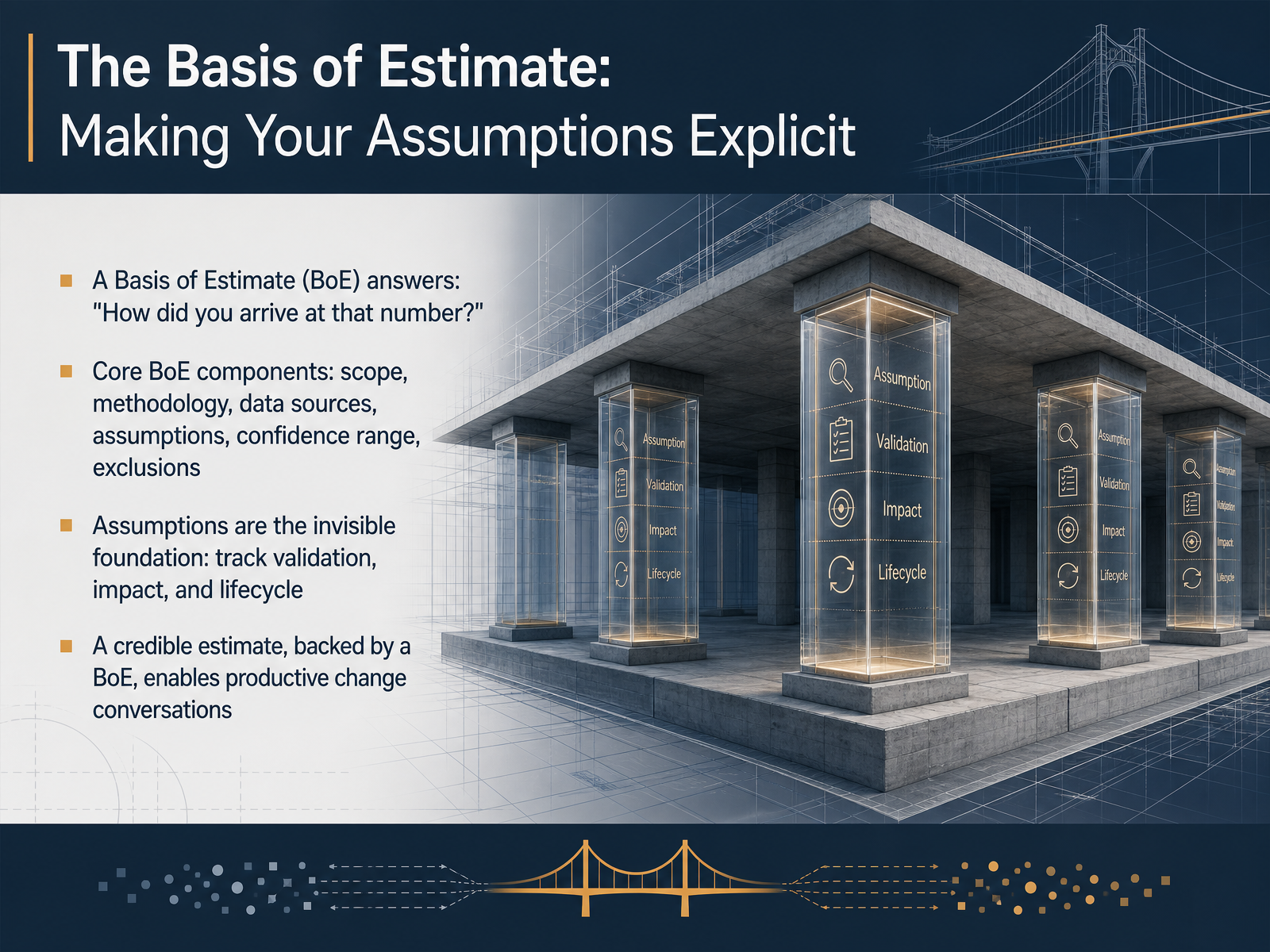
2 min - 06The Basis of Estimate: Making Your Assumptions ExplicitNow let's talk about the basis of estimate, or BoE. Think of it as showing your work. It answers the question: how did you arrive at that number? A solid BoE includes a few core components. First, scope, defining what's in and what's out. Then your methodology, the approach you used. It lists the data sources you relied on, and explicitly states your assumptions. It also includes a confidence range, not a single point, and clearly marks exclusions. Assumptions are the invisible foundation here. You need to track each one for validation, understand its impact if it's wrong, and manage it throughout the project lifecycle. A credible estimate backed by a BoE does something very practical. It turns a debate about a number into a productive conversation about what might change. Let's dig deeper into that conversation by breaking down uncertainty, moving from what we know to what we don't know.
 2 min
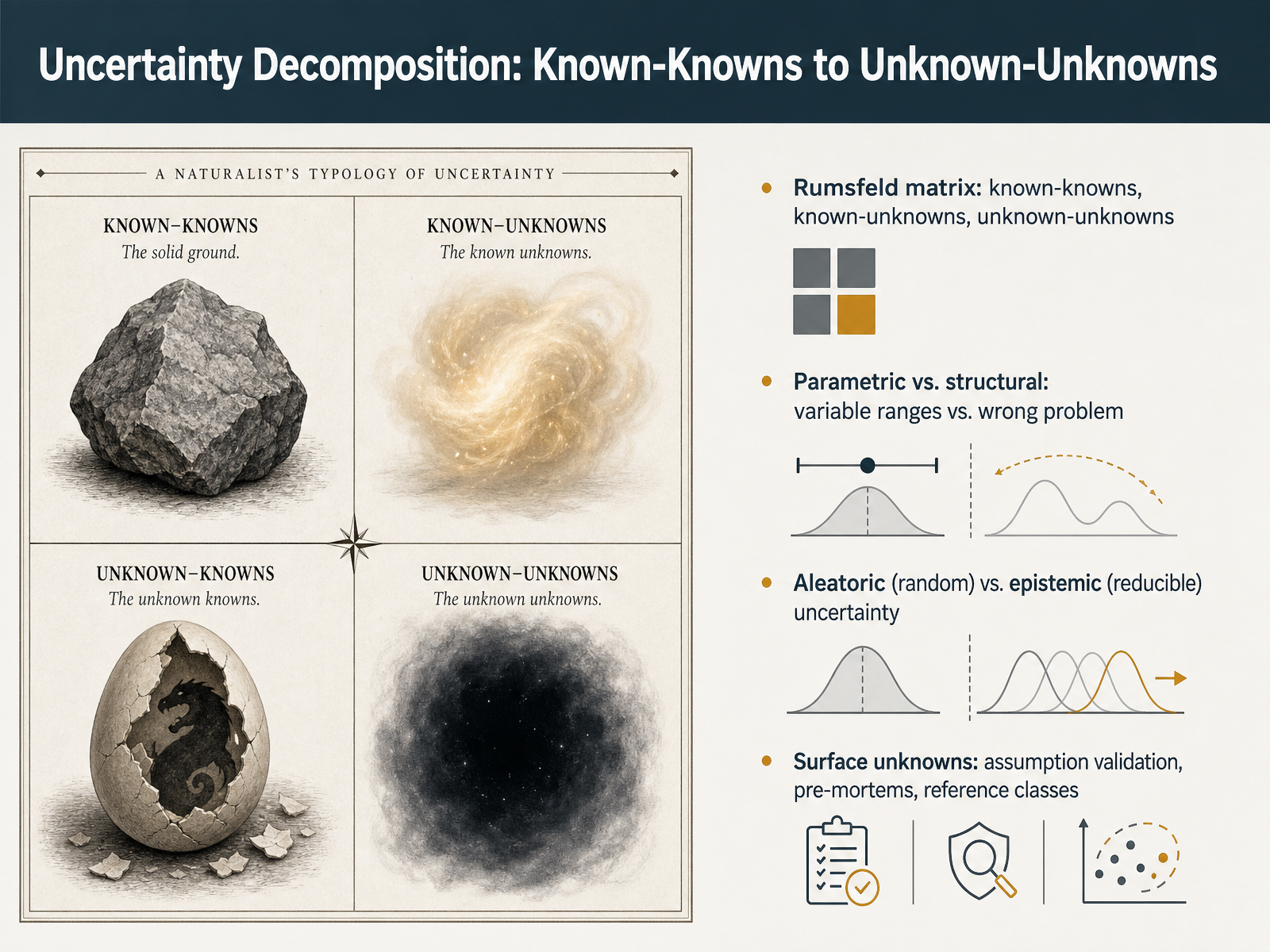
2 min - 07Uncertainty Decomposition: Known-Knowns to Unknown-UnknownsWe've talked about scope, evidence, and uncertainty. Now let's break uncertainty down, because not all uncertainty is the same. Think of the Rumsfeld matrix: there are known-knowns, things we're sure about. There are known-unknowns, things we know we don't know, like the range of a parameter. And then there are unknown-unknowns, the things we don't even know we don't know. These are structural surprises, where we might be solving the wrong problem entirely. This distinction matters. Parametric uncertainty means we have the right structure but variable inputs. Structural uncertainty means the model itself is flawed. We can also split uncertainty into aleatoric, which is random and irreducible, and epistemic, which comes from a lack of knowledge and can be reduced with research. To start surfacing hidden unknowns, we use assumption validation, pre-mortems, and reference classes. These aren't perfect shields, but they change the conversation from guessing to intentional inquiry. Next, let's focus on one of the most powerful tools for this: the pre-mortem, surfacing risks by imagining failure.
 2 min
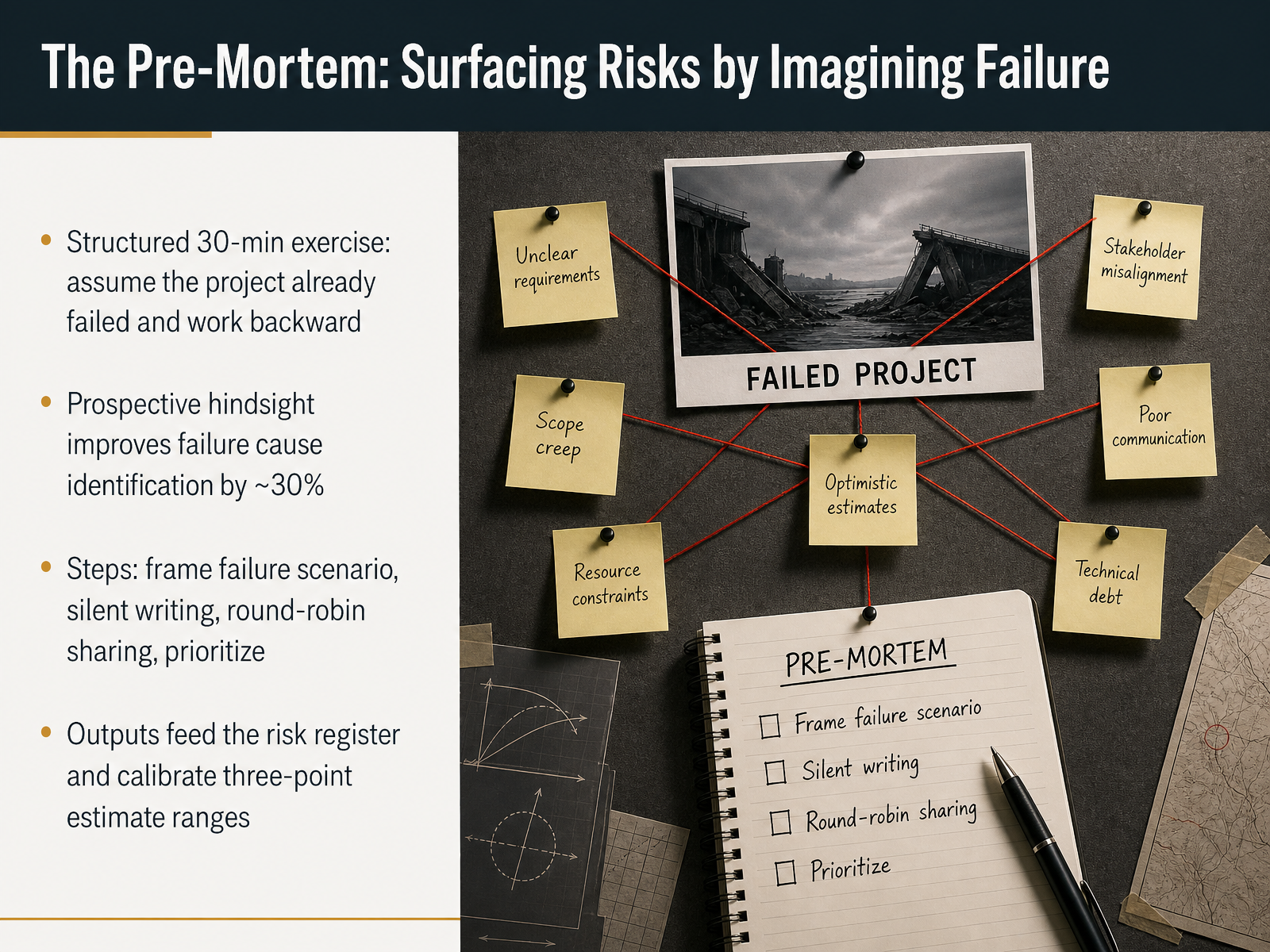
2 min - 08The Pre-Mortem: Surfacing Risks by Imagining FailureBefore we commit to a range, let's look at a technique that helps us find the risks hiding in plain sight. It's called a pre-mortem. Instead of asking what might go wrong, we start by assuming the project has already failed in spectacular fashion. Then we work backward. This is a structured thirty-minute exercise that uses prospective hindsight to improve our ability to identify failure causes by around thirty percent. Here's how it works. First, you frame the failure scenario. For example, you might say, 'It is six months after launch, and the project missed its core deadline by eight weeks.' Then, everyone silently writes down the reasons why this specific failure happened. Next, we go around the room and share one reason at a time, with no debate, just collecting them. Finally, the group votes to prioritize the most critical risks. The real value is what you do with this list. The outputs feed directly into your risk register and help you calibrate your three-point estimate. A risk that everyone identified becomes a strong justification for widening your pessimistic case. Next, we will look at the mechanics of three-point estimating, turning those ranges into numbers you can actually plan with.
 2 min
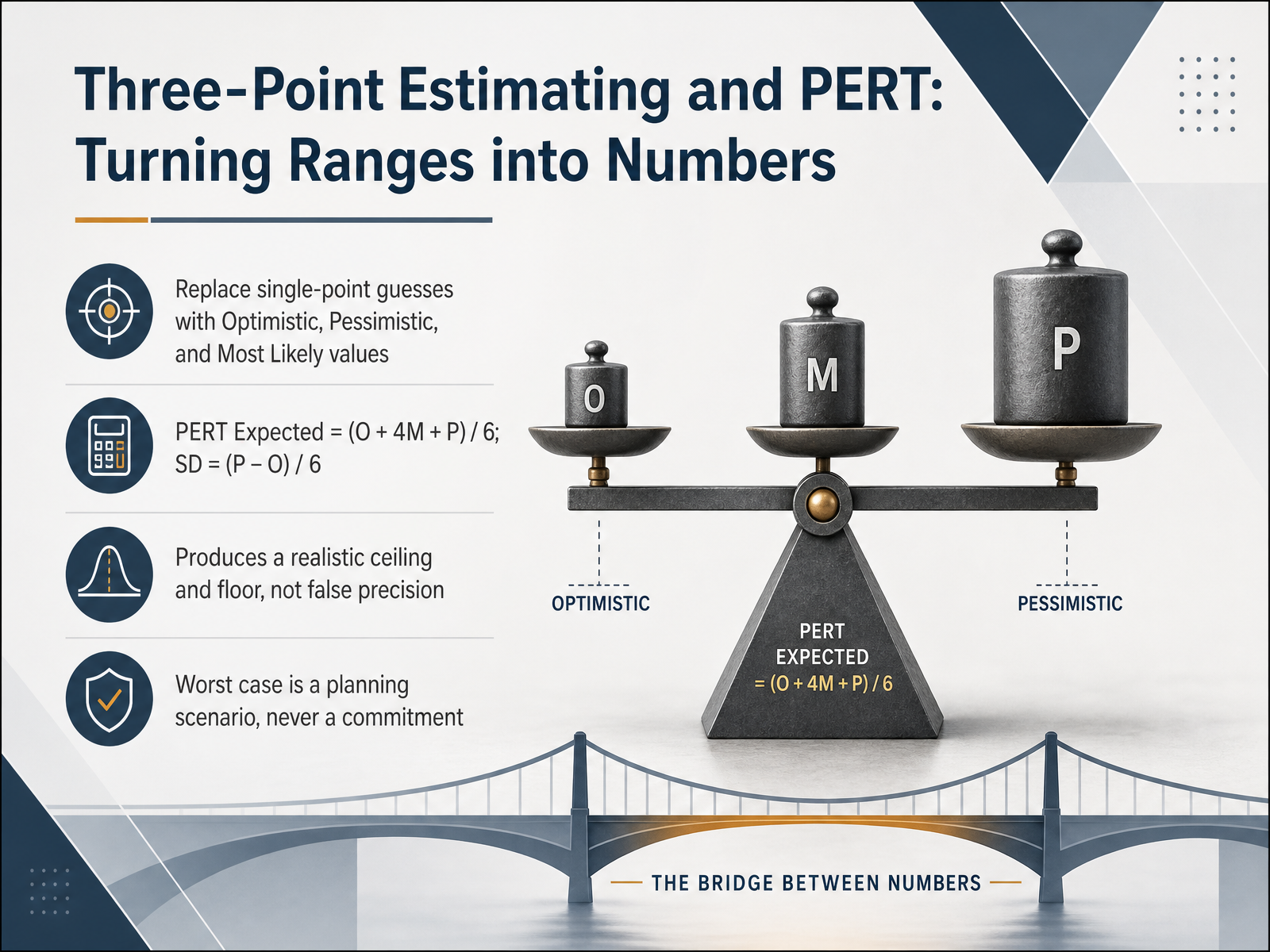
2 min - 09Three-Point Estimating and PERT: Turning Ranges into NumbersLet's move from single-number promises to a more honest technique called three-point estimating. Instead of one misleadingly precise figure, we capture the optimistic, the pessimistic, and the most likely value for a task. This range immediately makes our uncertainty visible. The PERT formula then helps us turn that range into a weighted average: Expected Effort equals the optimistic, plus four times the most likely, plus the pessimistic, all divided by six. This gives a realistic expected value, not a guarantee. We can also calculate the Standard Deviation, which is simply the pessimistic minus the optimistic, divided by six. This standard deviation tells us how wide our uncertainty is. More importantly, using three points produces a realistic ceiling and floor. The worst case becomes a planning scenario — something we prepare a buffer for — never a commitment we promise to hit. It keeps the conversation focused on probable outcomes, not absolute precision.
 2 min
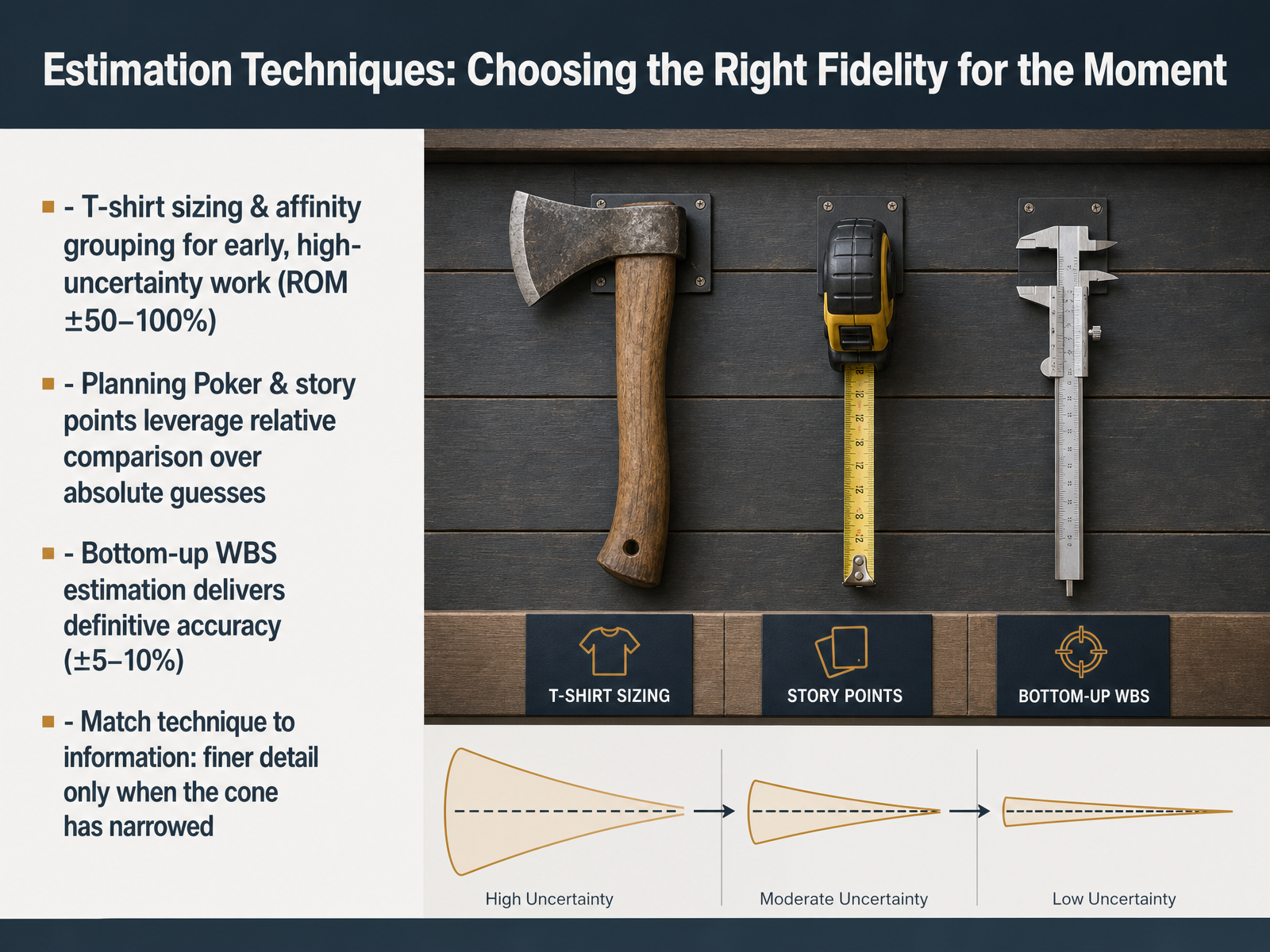
2 min - 10Estimation Techniques: Choosing the Right Fidelity for the MomentSo how do we choose a technique that fits the moment? It depends on where we are in the project and how much we really know. When uncertainty is high and we're just shaping ideas, techniques like T-shirt sizing and affinity grouping are a good match. We group work into small, medium, or large buckets. The range here is wide, roughly minus fifty to plus one hundred percent, which honestly reflects how little we know. As we learn more, we can move to relative methods. Planning Poker and story points use comparison instead of absolute guesses. The team asks, is this item twice as big as that one? We're still rough, but we're narrowing. Finally, when requirements are solid and the cone of uncertainty has narrowed, we can justify a definitive technique. A bottom-up work breakdown structure lets us estimate each component and sum them up. Accuracy can reach plus or minus five to ten percent. The key principle is to match the fidelity of your technique to the information you have. Invest in detail only when uncertainty has been reduced enough to make that investment worthwhile. Next, we'll look at how historical data can improve our starting point, with reference classes and calibration.
 2 min
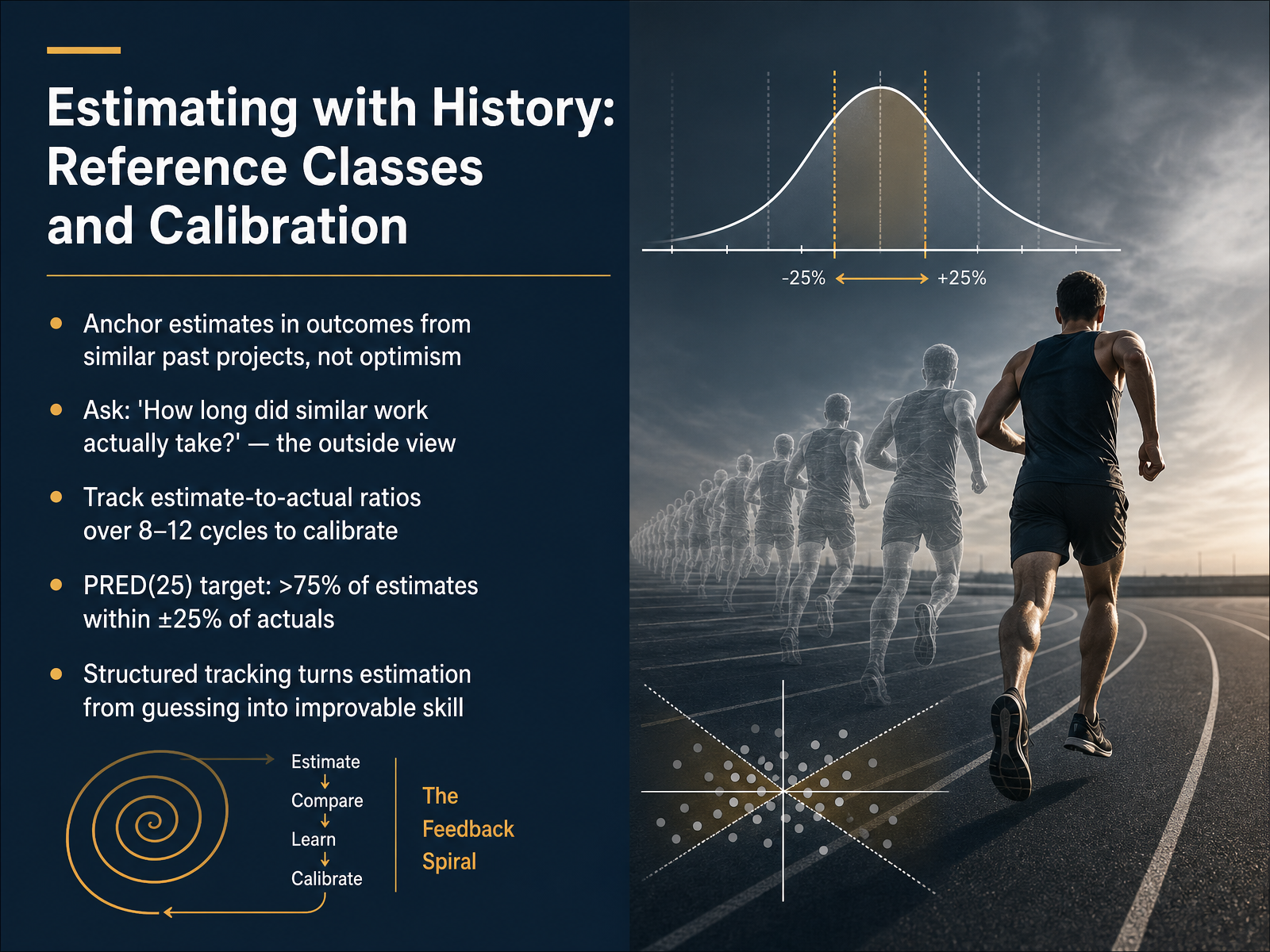
2 min - 11Estimating with History: Reference Classes and CalibrationLet's move from how we think to how we can learn from actual history. This slide is about reference classes and calibration. The core idea is to anchor estimates in outcomes from similar past projects, not in optimism or the perfect-world scenario. Ask yourself the outside view question: 'How long did similar work actually take in the past?' Not how long you hope it takes this time. To make this a repeatable skill, start tracking your estimate-to-actual ratios. After about eight to twelve cycles, you can calibrate your judgment. A practical target is the PRED twenty-five goal, meaning more than seventy-five percent of your estimates should fall within plus or minus twenty-five percent of the actual outcome. This structured tracking is what turns estimation from a guessing game into an improvable, professional skill. Next, we'll address how to communicate these estimates to stakeholders without sounding evasive.
 1 min
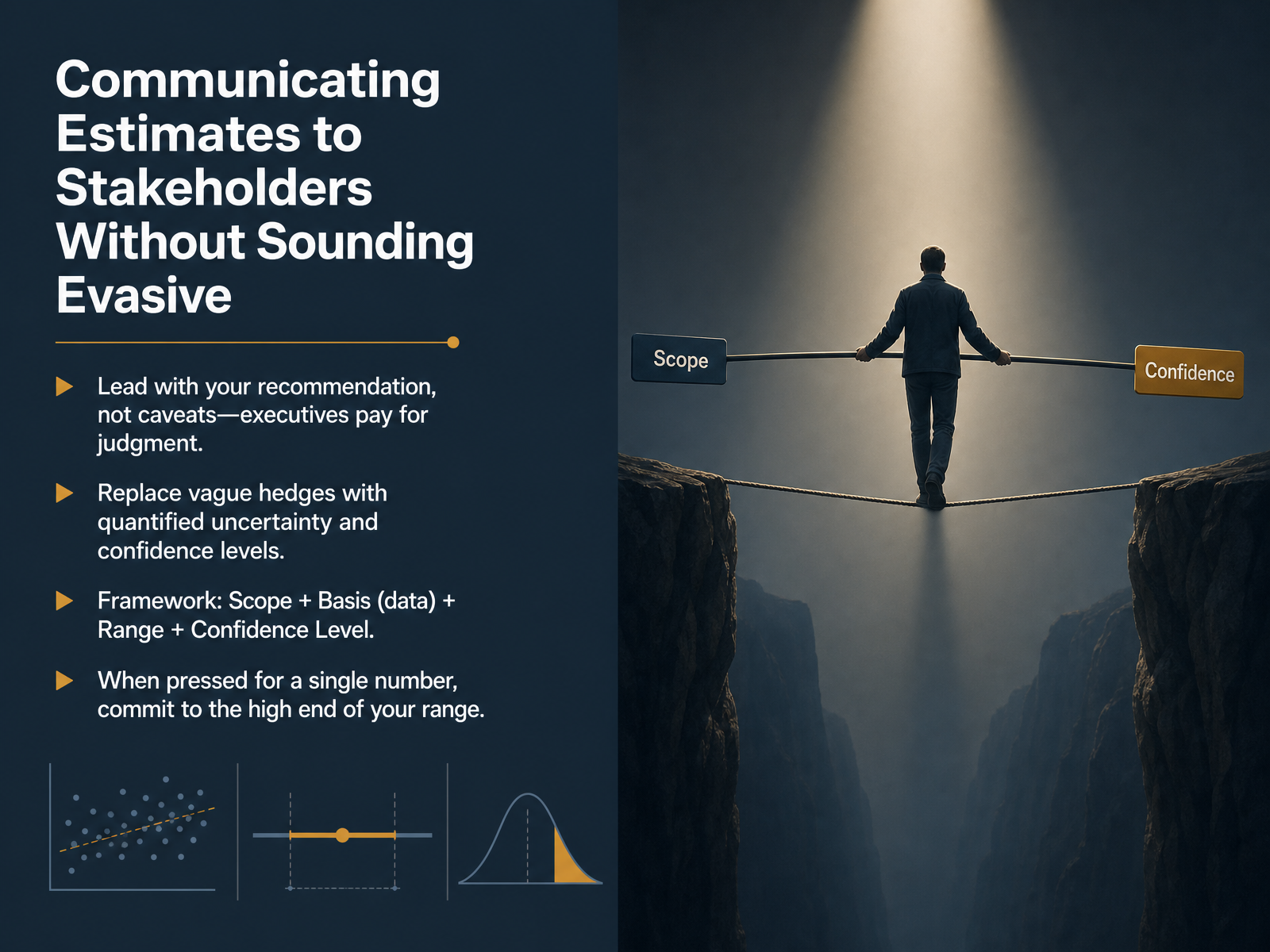
1 min - 12Communicating Estimates to Stakeholders Without Sounding EvasiveLet’s talk about how you present estimates without sounding like you’re dodging the question. The most important shift is to lead with your recommendation, not your caveats. Stakeholders pay for your professional judgment, so state your number first, then explain your reasoning.
 1 min
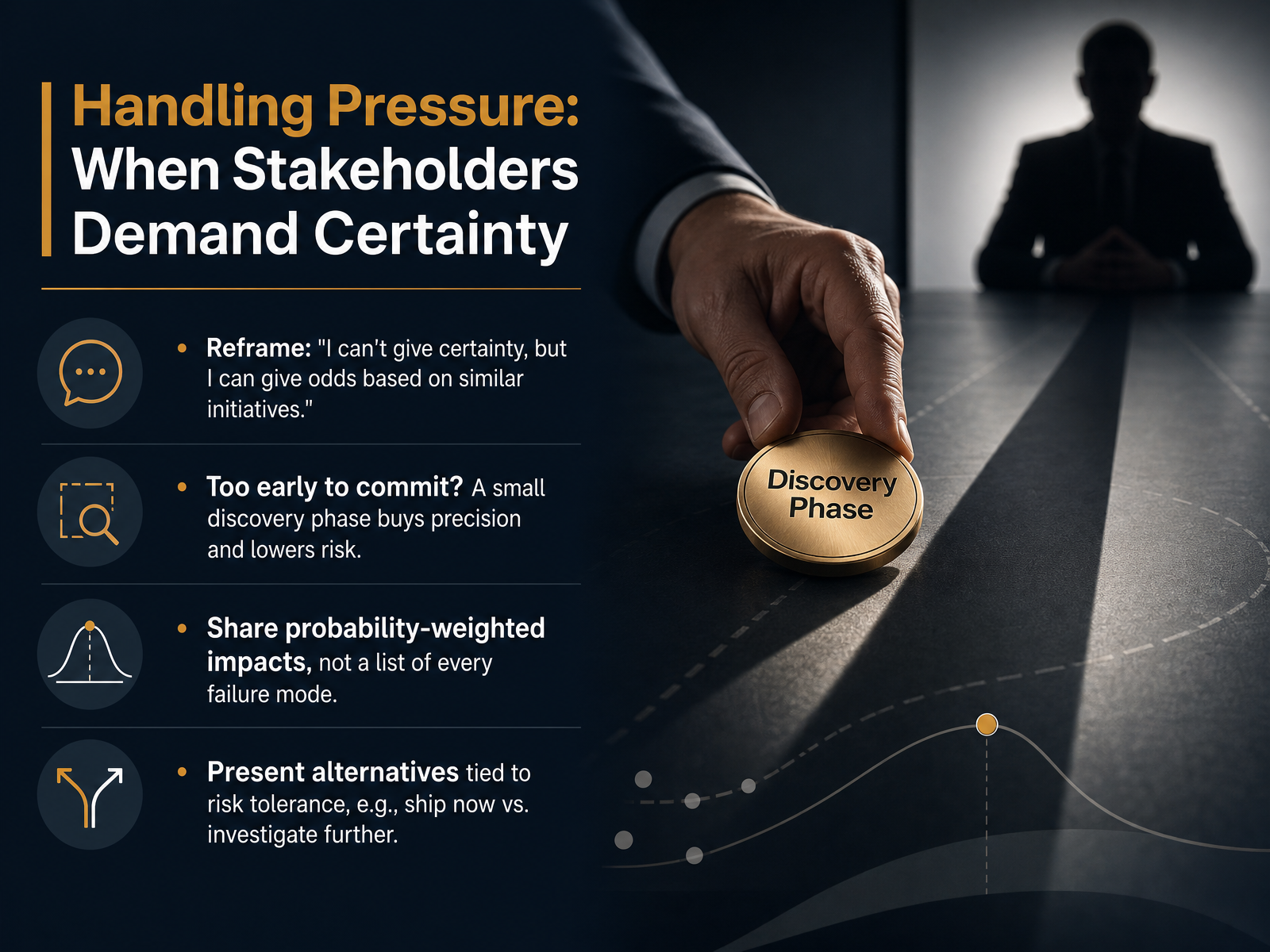
1 min - 13Handling Pressure: When Stakeholders Demand CertaintyNow, what happens when a stakeholder looks at your range and says, 'Just give me the number you're most confident in'? That pressure is real. Instead of surrendering to false certainty, reframe the conversation. Say, 'I can't give you certainty, but I can give you odds based on similar initiatives.' It shifts the demand from a crystal ball to a track record. If you're too early to commit, don't guess. Propose a small discovery phase. Two weeks of prototyping buys you real precision and lowers the risk far more than a rushed promise. When you present risks, don't drown them in a list of every possible failure mode. Share probability-weighted impacts. Show the one or two scenarios that matter most to the business case. Finally, always present alternatives tied to risk tolerance. Frame it as a clear choice: 'We can ship now and accept a lower confidence level, or we can investigate further and increase our odds.' This keeps you credible and puts the decision where it belongs. Let's look next at how to turn this into a continuous feedback loop in refining estimates over time.
 2 min
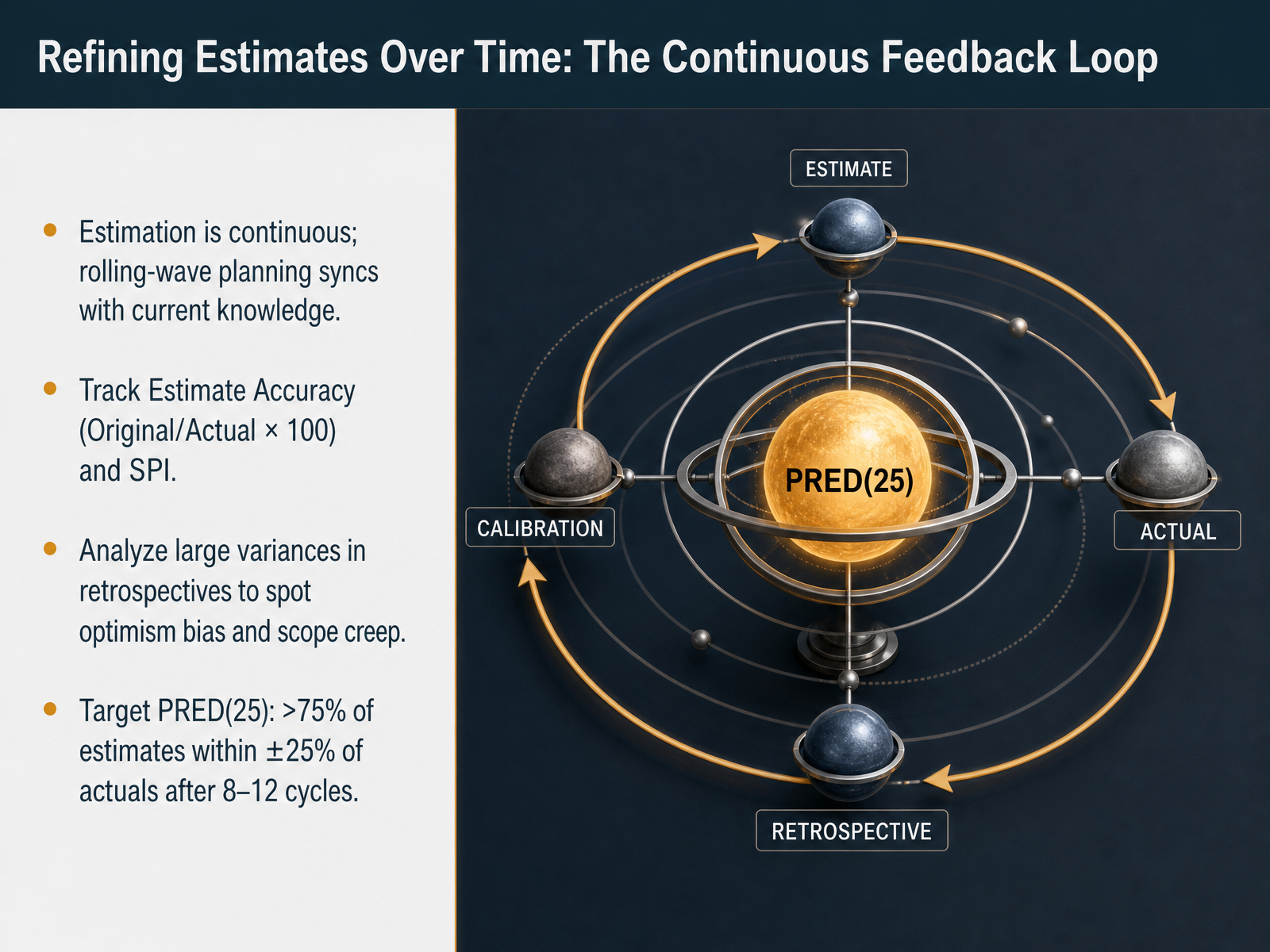
2 min - 14Refining Estimates Over Time: The Continuous Feedback LoopLet's look at how we can refine estimates as we learn more. Estimation should never be a one-time event. As the project unfolds, your knowledge grows, and your numbers need to reflect that. We practice what's called rolling-wave planning, meaning we plan in detail for the near term and keep high-level estimates for the future, continuously syncing our numbers with current reality. To get better at this, you need to track your accuracy. A simple ratio is your original estimate divided by actual effort, multiplied by one hundred. Also watch the Schedule Performance Index, or S P I, at the iteration level. Then, during retrospectives, dig into large variances. Look for patterns like optimism bias or subtle scope creep. A healthy benchmark to aim for is called Predict twenty-five. This means that after eight to twelve cycles, you want more than seventy-five percent of your estimates within plus or minus twenty-five percent of actuals. That's a realistic and mature goal. Next, we'll put all of this together in a hands-on scenario.
 1 min
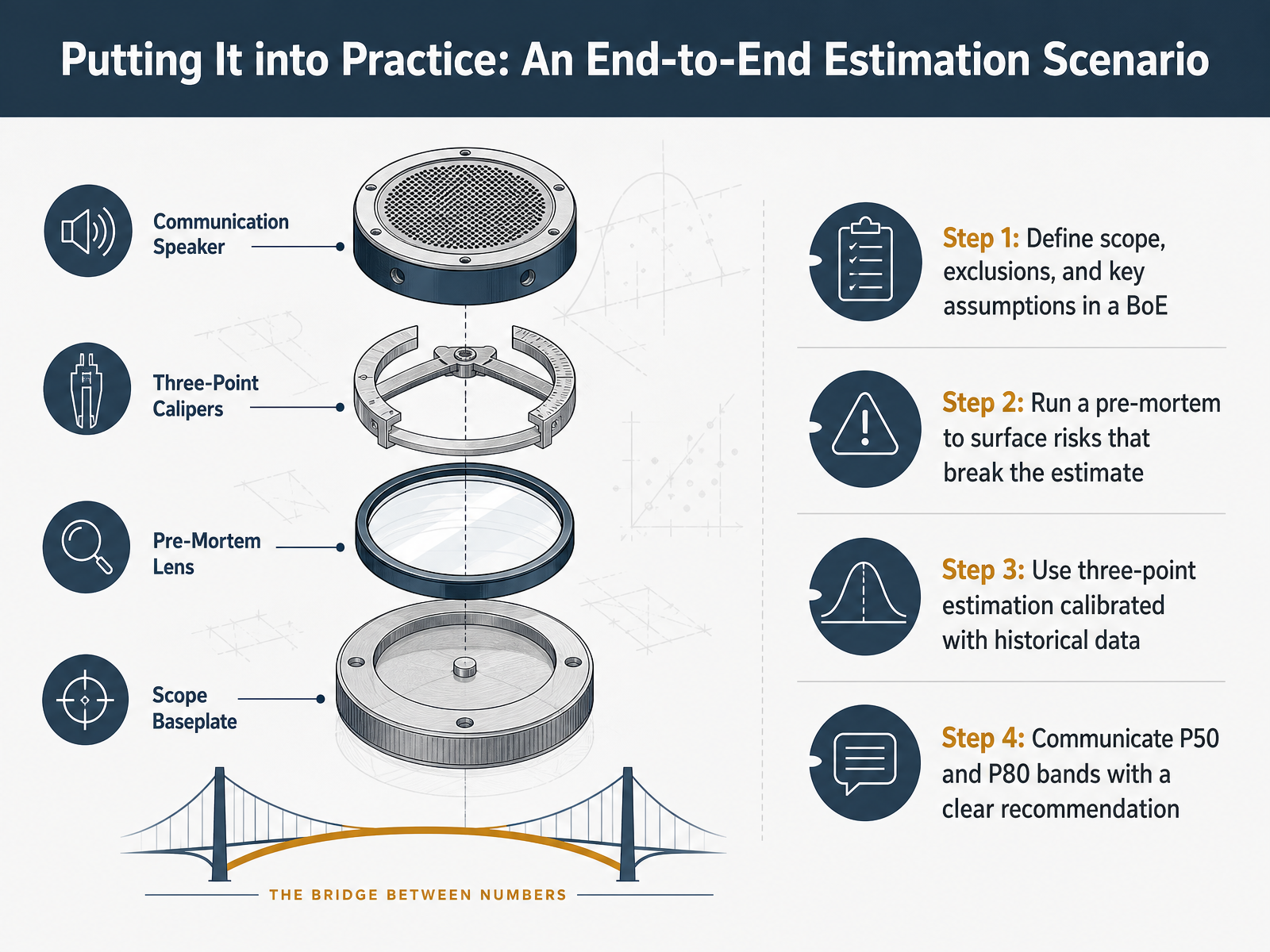
1 min - 15Putting It into Practice: An End-to-End Estimation ScenarioLet's walk through a realistic end-to-end scenario, so you can see how the pieces fit together. Step one: define your scope, exclusions, and key assumptions in a Basis of Estimate. This is your anchor, what's in, what's out, and what you believe to be true. Step two: run a pre-mortem. Ask the team, 'Imagine we missed this estimate badly. What broke it?' Surface those risks early, before they surprise you. Step three: build a three-point estimate, low, likely, and high, ideally calibrated against historical data from your own projects, not industry averages. Step four is about communication. Present the range, specifically the P50 and P80 confidence bands, and pair it with a clear, honest recommendation for the decision-maker. Now that we've walked through a full scenario, let's turn to a practical checklist you can use on your very next estimate.
 2 min
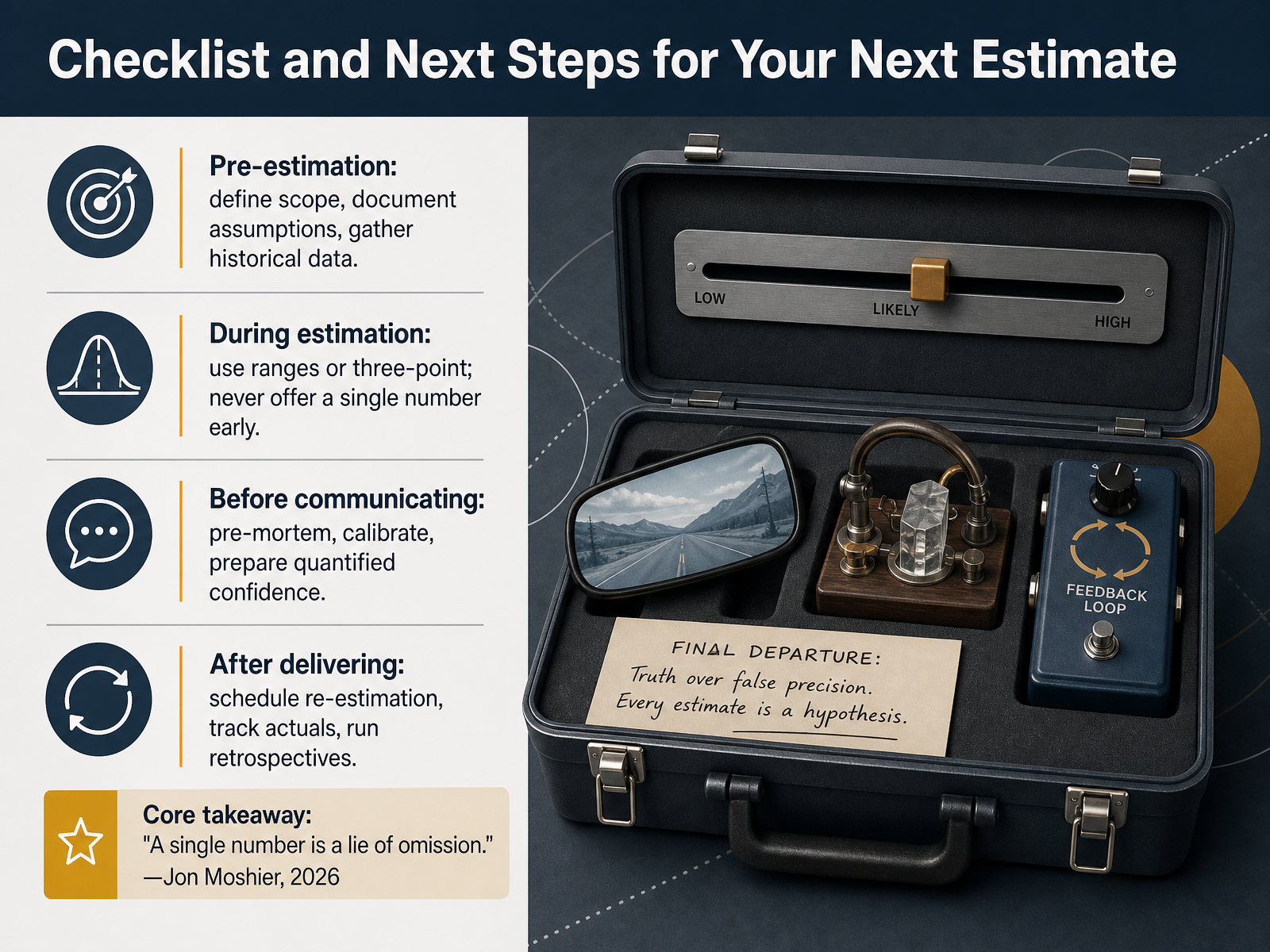
2 min - 16Checklist and Next Steps for Your Next EstimateBefore we close, let's walk through a practical checklist you can use on your very next estimate. Think of this as the narrative arc of a healthy estimation process. Before you start, define scope with your team, document your assumptions, and pull any relevant historical data you can get your hands on. During the estimation itself, use ranges or a three-point method. A key rule: never offer a single number when someone first asks. Before you communicate the estimate, run a quick pre-mortem, calibrate against those past projects, and prepare a quantified confidence statement, like 'we're about eighty percent confident in this range.' After you deliver, schedule a formal re-estimation checkpoint, track actual effort as the work unfolds, and run a retrospective when it's done. This brings us to the core takeaway from Jon Moshier, who said it perfectly: 'A single number is a lie of omission.' When you give a single number without context, you are hiding the uncertainty that is a fundamental part of our work. Carry this checklist with you, practice it, and watch the quality of your planning conversations change. Thank you for your time, and I wish you clarity in your next estimate.
 2 min
2 min
Take the deck with you
Download this course as a file — free, no sign-up needed.
- PDF handoutEvery slide page, ready to print or share.17 pages · 4.4 MBDownload
- Narrated PowerPointThe deck that presents itself — every slide carries the digital human's narration video.17 pages · 15.3 MBDownload
- PowerPoint slidesThe full deck as a .pptx — open it in PowerPoint, Keynote, or Google Slides.17 pages · 4.3 MBDownload
Free to use in your own training — please keep the PersonWise credit page at the end.
Have your own deck? Turn it into a course
Sources consulted
Web sources consulted while building this course.
- Estimating in Hours Turns Smart People into Liars. Because the Number Will Be Treated as a Promise. | by Manav Agarwal | May, 2026 | Medium — medium.com
- Estimation as Laundering: How Machine Learning Converts Software Commitments into Apparent Predictions, and What an Estimation Hygiene Framework Can Recover — americanimpactreview.com
- The Story Point Illusion - by Andrea Laforgia — a4al6a.substack.com
- Sprint Estimation Reality 2026 · Stride Research — stride.page
- The Project Time Mirage: Why Pt Time To Est Time Is Killing Your Deadlines - Accel — artisan.accel.com
- Debiasing Optimistic Planning in Knowledge Work: AHuman-Centered Approach — discovery.ucl.ac.uk
- "I Work Much Better by Doing Less": How Task Duration Feedback Affects Optimistic Planning Bias in Academic Work — discovery.ucl.ac.uk
- A Study on the Integration of Planning Fallacy Mitigation Strategies — dl.acm.org
- Bridging the Gap Between Time Management Research and Task Management App Design: A Study on the Integration of Planning Fallacy Mitigation Strategies — doi.org
- Planning fallacy — en.wikipedia.org