Begin
14 pages · ~28 min
UX Research Career Entry Workflow
This training introduces aspiring and early-career researchers to a practical UX research workflow, covering the key steps and skills needed to plan and conduct user research.
A digital instructor presents all 14 pages. Hold “Ask” at any point and ask out loud — the answer comes from this course. No sign-up needed.
What you’ll learn
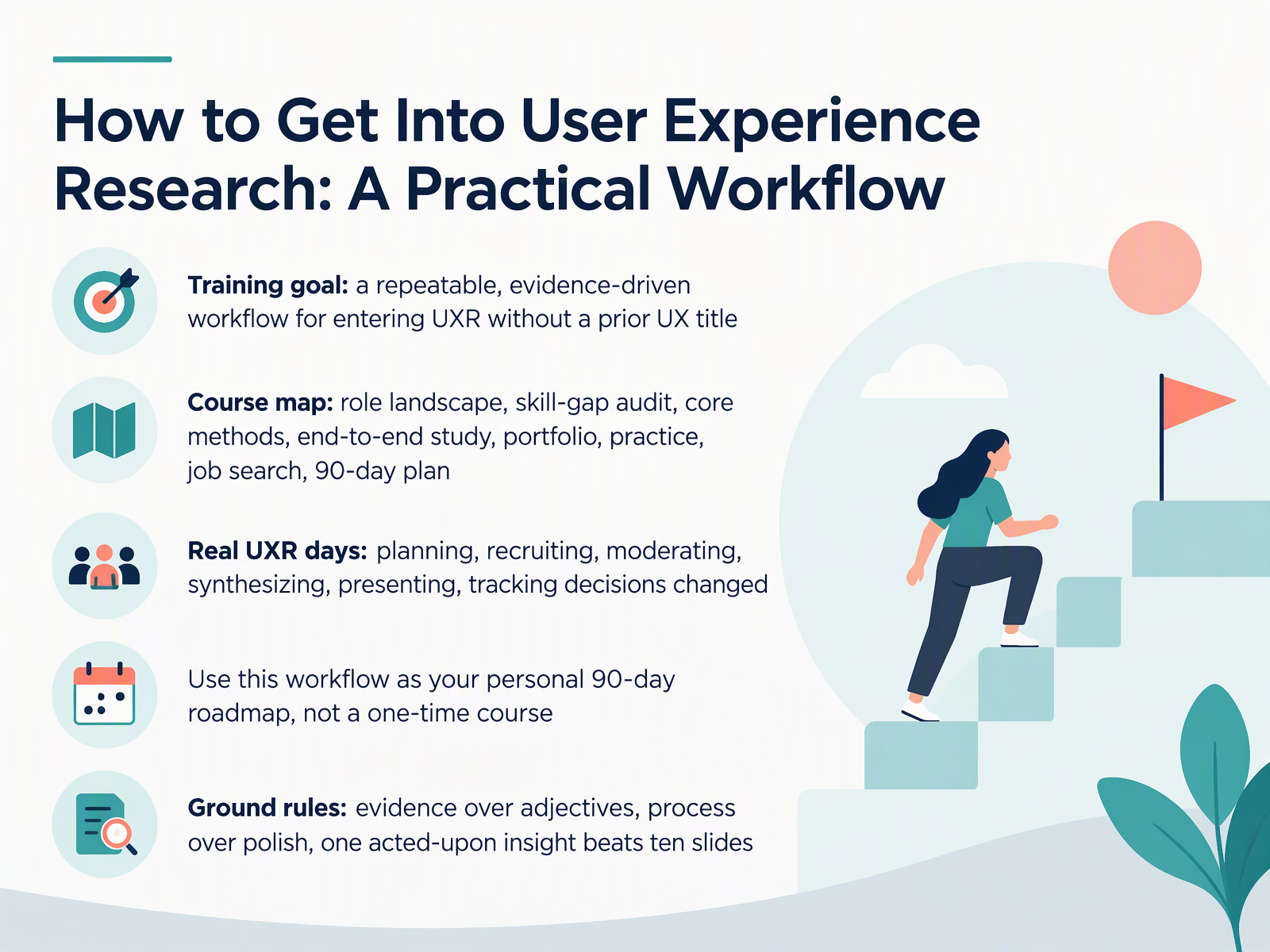
- 01How to Get Into User Experience Research: A Practical WorkflowWelcome. If you're moving into user experience research, or you're an early-career designer who wants to add research to your toolkit, this course is for you. Our goal is simple: a repeatable, evidence-driven workflow for entering UXR, meaning user experience research, even without a prior UX title. Here's the course map. We'll cover the role landscape, a skill-gap audit, core methods, one end-to-end study, your portfolio, hands-on practice, the job search, and a ninety-day plan. Picture a real UXR day: planning a study, recruiting participants, moderating sessions, synthesizing findings, presenting them, then tracking which decisions actually changed. Treat this as your personal ninety-day roadmap, not a one-time course. Three ground rules. Evidence over adjectives. Process over polish. And one acted-upon insight beats ten slides. If you're worried about lacking a research degree, no problem. Start by auditing the studies you've already run, and document one honestly. Next, we look at the 2026 reality check: market signals and hiring expectations.snapp.recruitee.com4cornerresources.comjunbrain.com+22 min
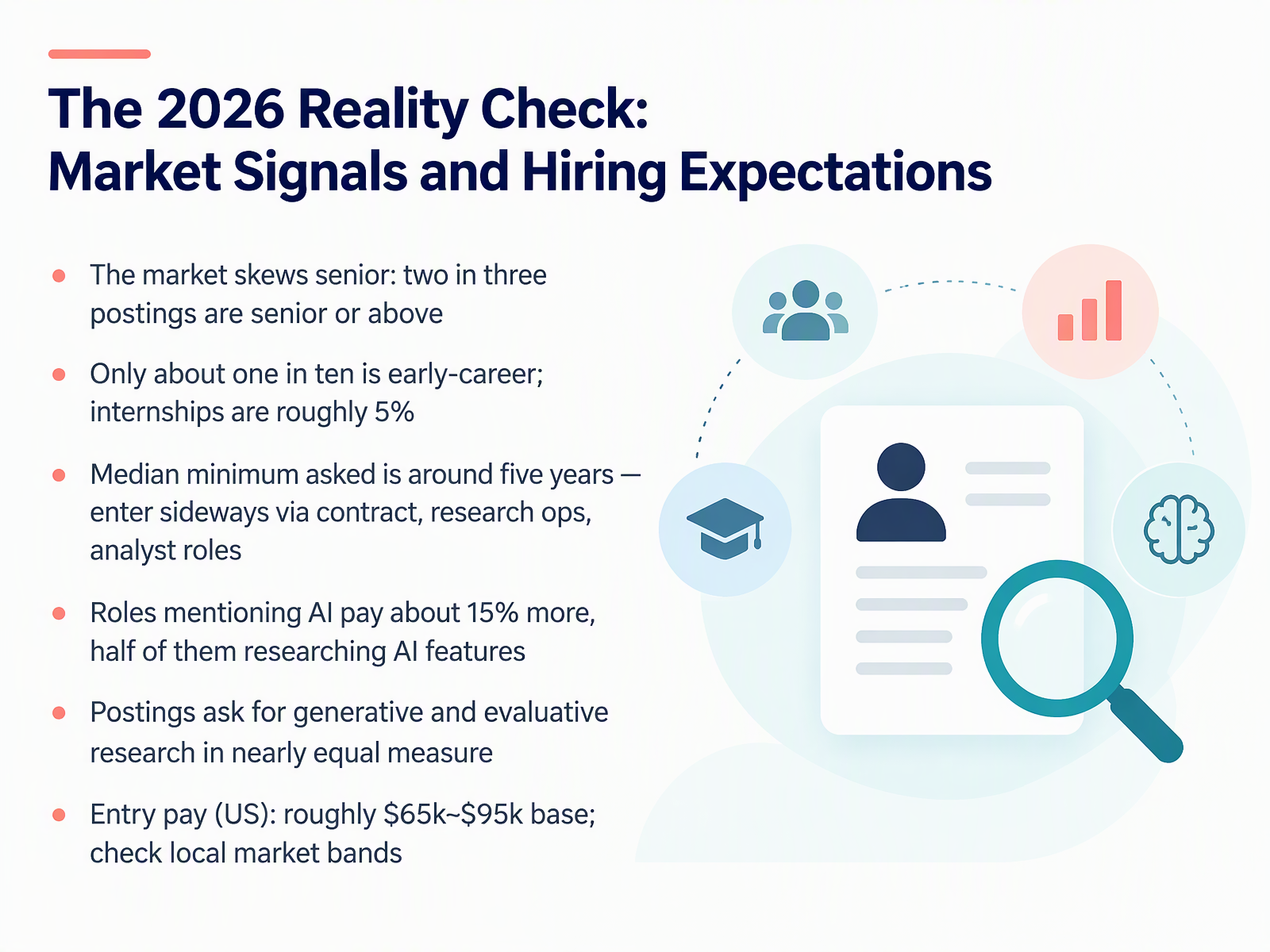
- 02The 2026 Reality Check: Market Signals and Hiring ExpectationsNow let us look honestly at the market you are stepping into. The numbers skew senior: about two in three postings are senior level or above. Only around one in ten is early career, and internships are roughly five percent. The median minimum experience asked for is about five years. So rather than forcing your way through the front door, enter sideways through contract work, research operations, or analyst roles. Here is another signal worth knowing. Roles that mention AI pay about fifteen percent more, and half of those are researching AI features. Postings also ask for generative and evaluative research in nearly equal measure, so show both on your resume. If you are worried about not having a research degree, note that a bachelor's clears the bar for most roles. For pay, entry level in the United States runs about sixty five thousand to ninety five thousand dollars in base salary, so check your local market bands. Next, we will walk through the role landscape and realistic entry points.
 pivothop.comuxr-job-market-jul-2026.netlify.appscoutify.com+22 min
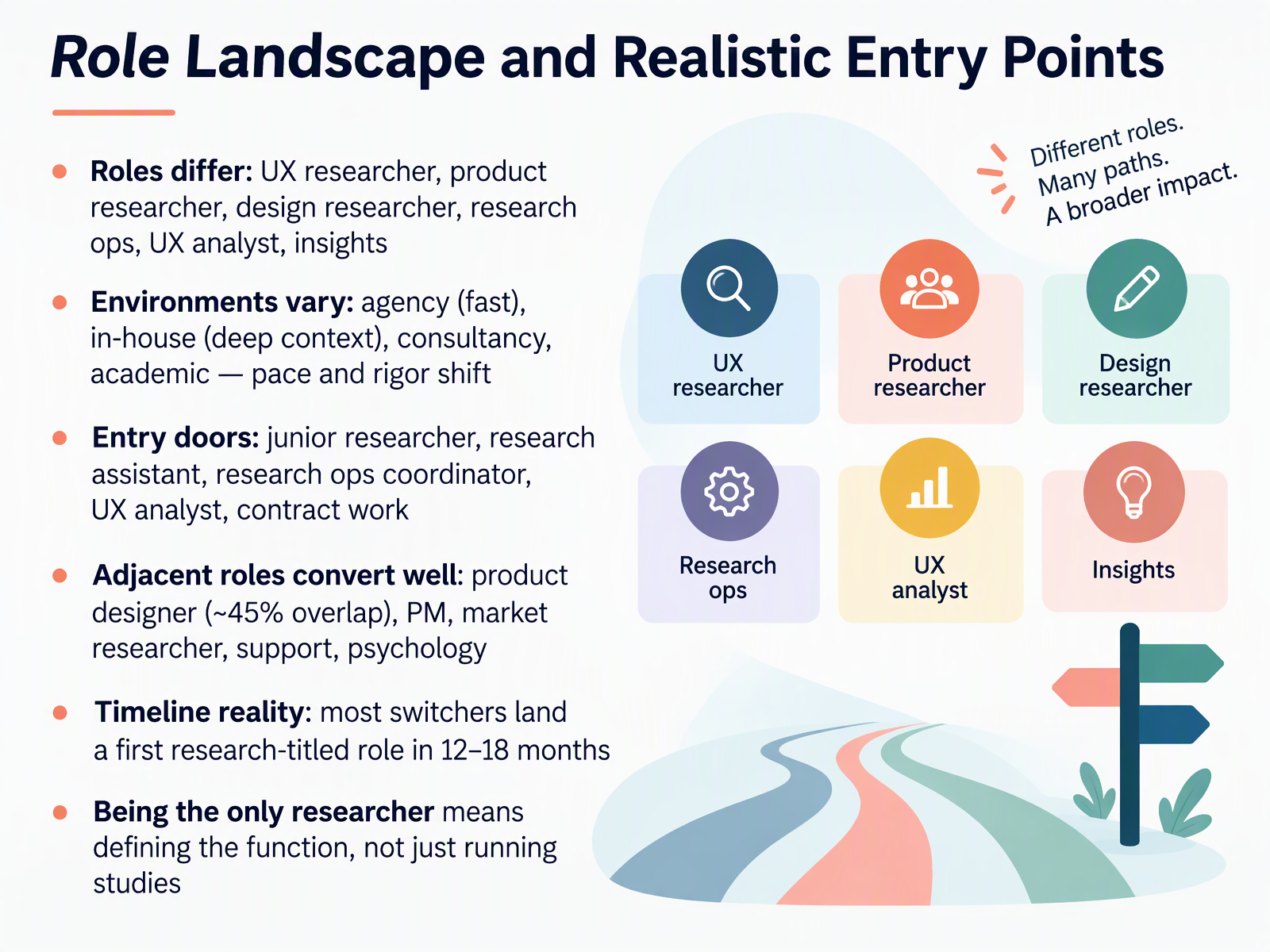
- 03Role Landscape and Realistic Entry PointsLet's look at the role landscape and where you can realistically enter. The titles vary: UX researcher, product researcher, design researcher, research operations, UX analyst, and insights. The work environment changes the pace, too. Agencies move fast, in-house teams build deep context, consultancies and academic settings add their own rhythm. The realistic doors in are junior researcher, research assistant, research operations coordinator, UX analyst, and contract work. Adjacent roles convert well: product designers cover about forty-five percent of the skill set, and product managers, market researchers, support staff, and psychology backgrounds bring strong transferable skills. On timeline, most switchers land a first research-titled role in twelve to eighteen months. If you lack a research degree, build two or three documented case studies instead, and name the decision each study changed. And know that being the only researcher means defining the function, not just running studies. Next, we will move into Transferable Skills and a Personal Skill-Gap Audit.
 uxinsight.orgwhatfix.comdscout.com+22 min
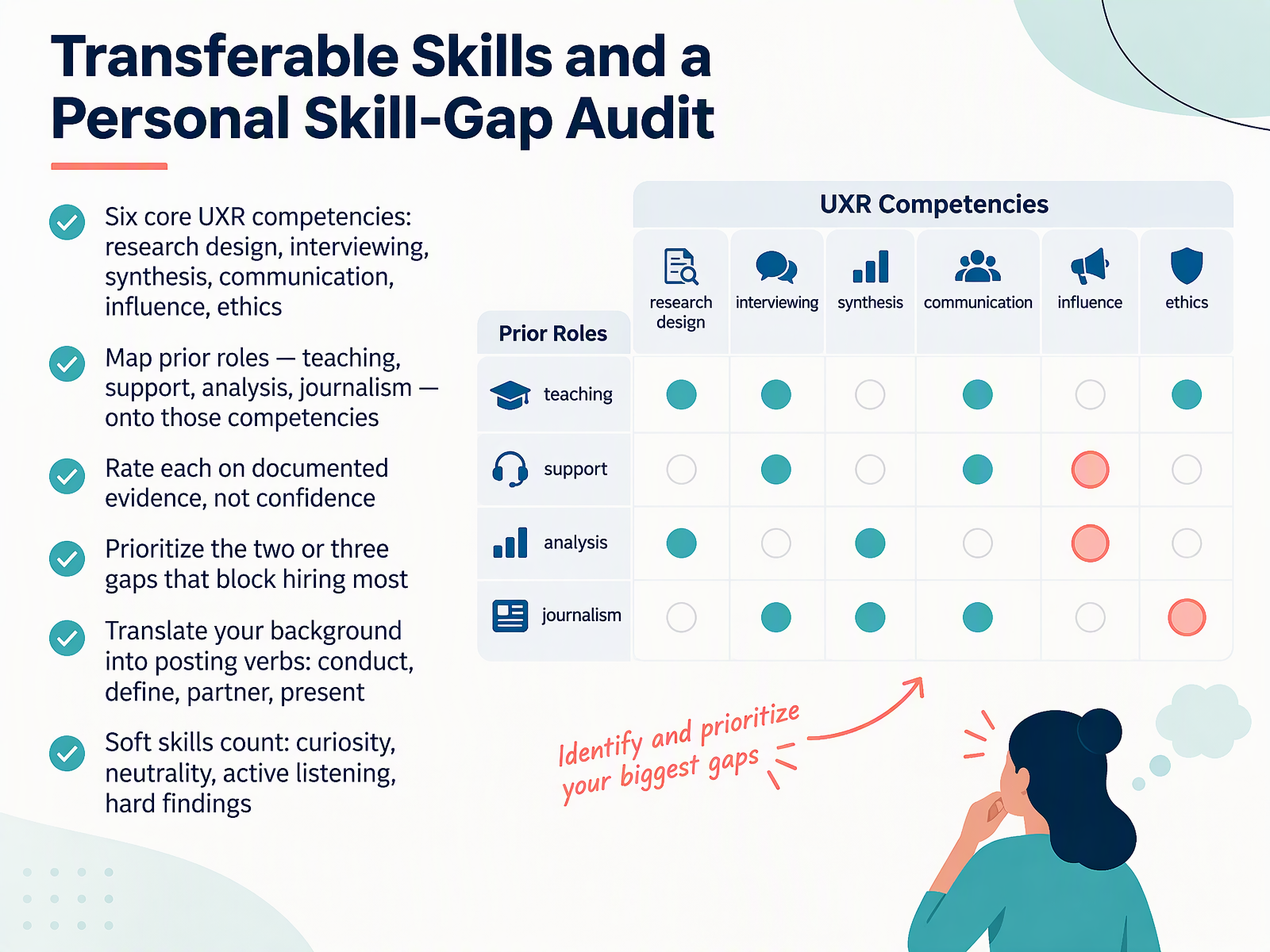
- 04Transferable Skills and a Personal Skill-Gap AuditNow let's map your background onto the skills employers actually screen for. There are six core competencies in user experience research: research design, interviewing, synthesis, which means turning raw notes into patterns, communication, influence, and ethics. Take a sheet of paper and list each one. Then look at your prior roles, like teaching, customer support, analysis, or journalism, and write down where you already practiced each competency. Here is the key rule: rate yourself on documented evidence, not confidence. If you can point to a project, a report, or a session you ran, it counts. If you cannot, it is a gap. Prioritize the two or three gaps that block hiring most, usually research design and synthesis. Then translate your background into the verbs postings use: conduct, define, partner, present. And do not overlook soft skills. Curiosity, neutrality, active listening, and the willingness to deliver hard findings are real hiring criteria. Pause here and finish your audit before moving on. Next, we cover Core Research Methods You Must Be Able to Explain.
 uxinsight.orgwhatfix.comdscout.com+22 min
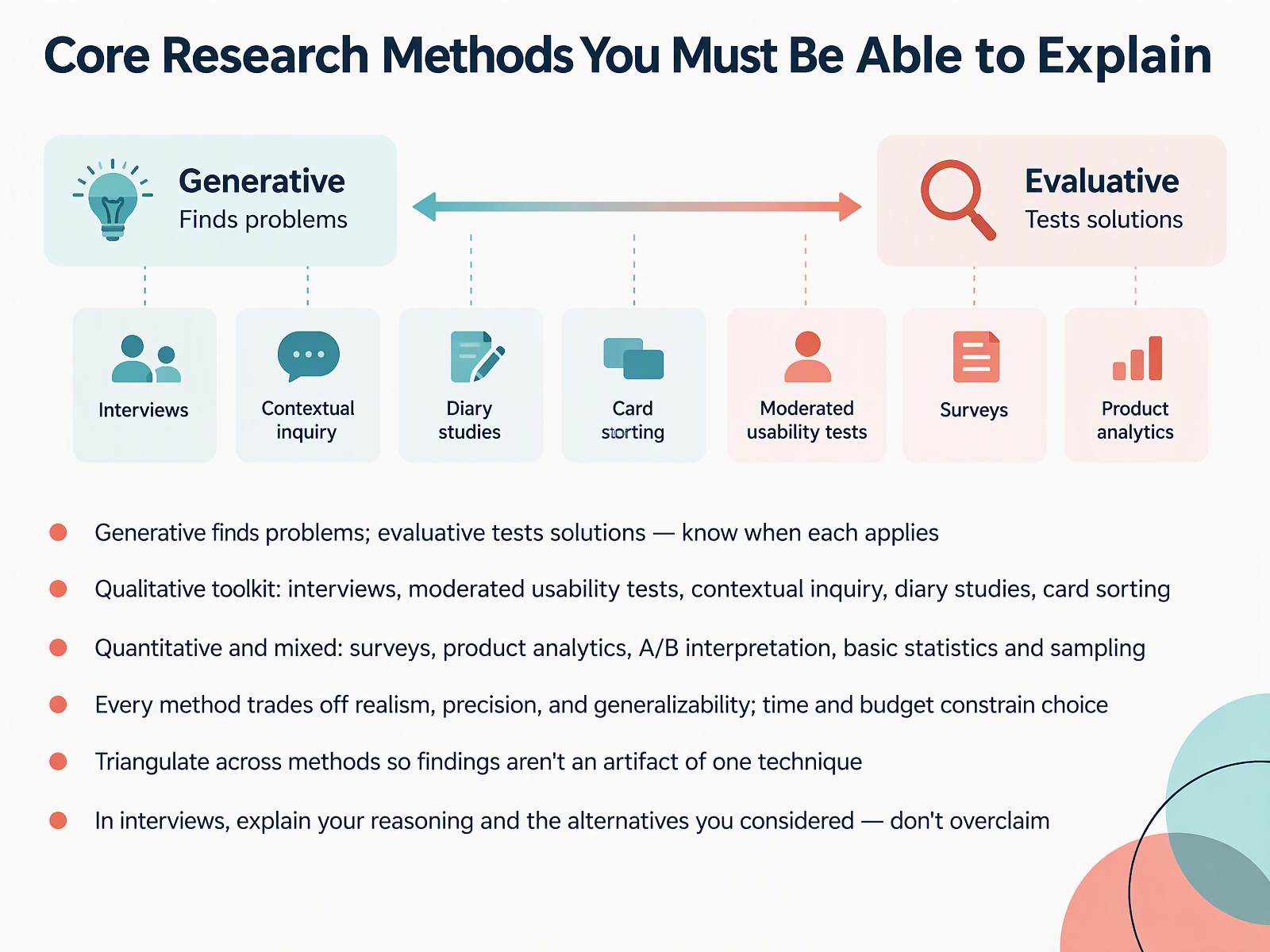
- 05Core Research Methods You Must Be Able to ExplainNext, let's cover the core research methods you must be able to explain. Start with the two modes. Generative research finds problems, and evaluative research tests solutions. Know which one your question calls for. In the qualitative toolkit, you have interviews, moderated usability tests, contextual inquiry, which means observing people in their own workspace, diary studies, and card sorting. On the quantitative and mixed side, you have surveys, product analytics, interpreting A B tests, and basic statistics and sampling. Here's the tradeoff to memorize: every method trades off realism, precision, and generalizability, and your time and budget constrain the choice. So triangulate. Combine methods so your findings aren't an artifact of one technique. And in interviews, explain your reasoning and the alternatives you considered. Don't overclaim. Let's move into Phase 1 of the Workflow: Intake and Research Planning.
 academic.oup.comcoursera.orguxrinstitute.com+22 min
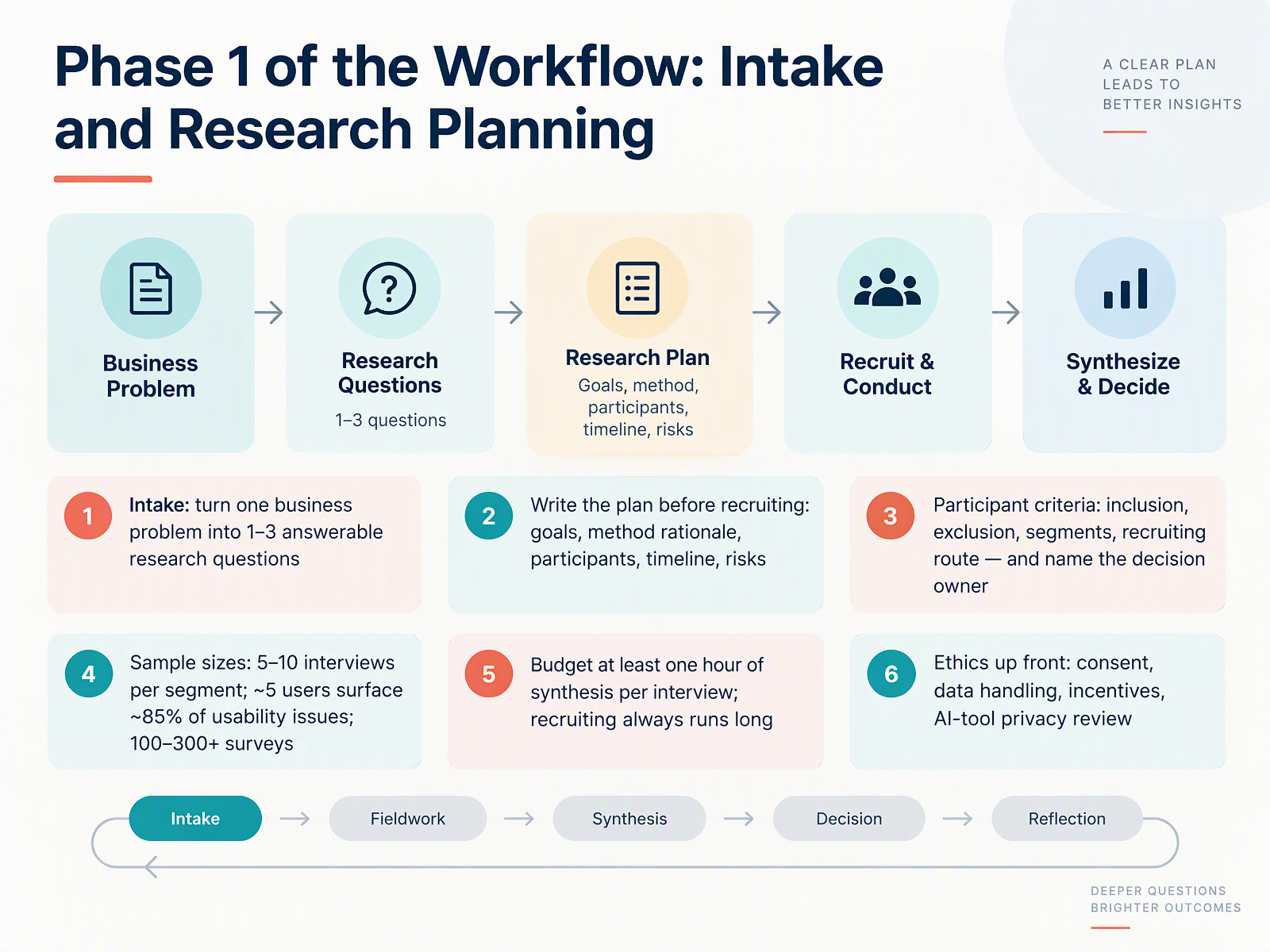
- 06Phase 1 of the Workflow: Intake and Research PlanningLet's move into the first phase of the workflow: intake and research planning. Intake means turning one business problem into one to three answerable research questions. For example, a vague ask like users are dropping off becomes a question you can actually study. Write the plan before you recruit anyone. Include goals, why you chose the method, participant criteria, timeline, and risks. Participant criteria cover inclusion, exclusion, segments, and the recruiting route, and you should name the decision owner. On sample size, plan for five to ten interviews per segment. Roughly five users surface about eighty-five percent of usability issues, and surveys often need one hundred to three hundred or more responses. Budget at least one hour of synthesis per interview, because recruiting always runs long. And handle ethics up front: consent, data handling, incentives, and a privacy review for any AI tool you use. Next, we move into phase two of the workflow: fieldwork, synthesis, and communicating impact.
 snapp.recruitee.com4cornerresources.comjunbrain.com+22 min
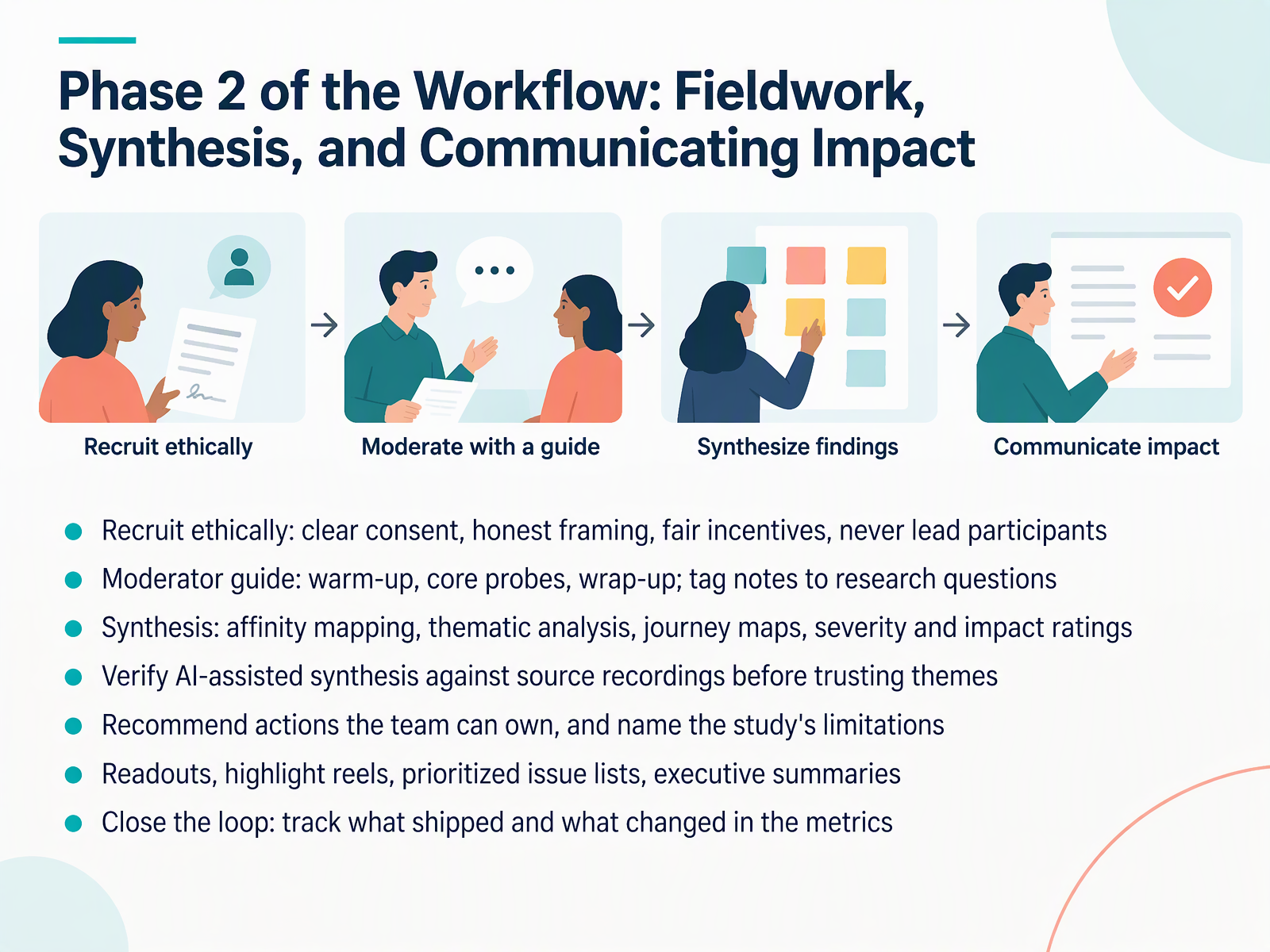
- 07Phase 2 of the Workflow: Fieldwork, Synthesis, and Communicating ImpactNow let's walk through phase two: fieldwork, synthesis, and communicating impact. Start with ethical recruiting. Get clear consent, frame the study honestly, pay fair incentives, and never lead participants toward the answer your team wants. Your moderator guide follows a simple arc: warm up, core probes, then wrap up, and tag notes to the research questions as you go. Then synthesize. Use affinity mapping to group observations, thematic analysis to name patterns, journey maps to show flow, and severity and impact ratings to prioritize. If you use AI-assisted synthesis, verify every theme against the source recordings before you trust it. When you recommend actions, name what the team can own and state the study's limitations. Share findings as readouts, highlight reels, prioritized issue lists, or an executive summary. Finally, close the loop. Track what shipped and what changed in the metrics. Next, we'll look at how to build a portfolio without a UXR job title.
 snapp.recruitee.com4cornerresources.comjunbrain.com+22 min
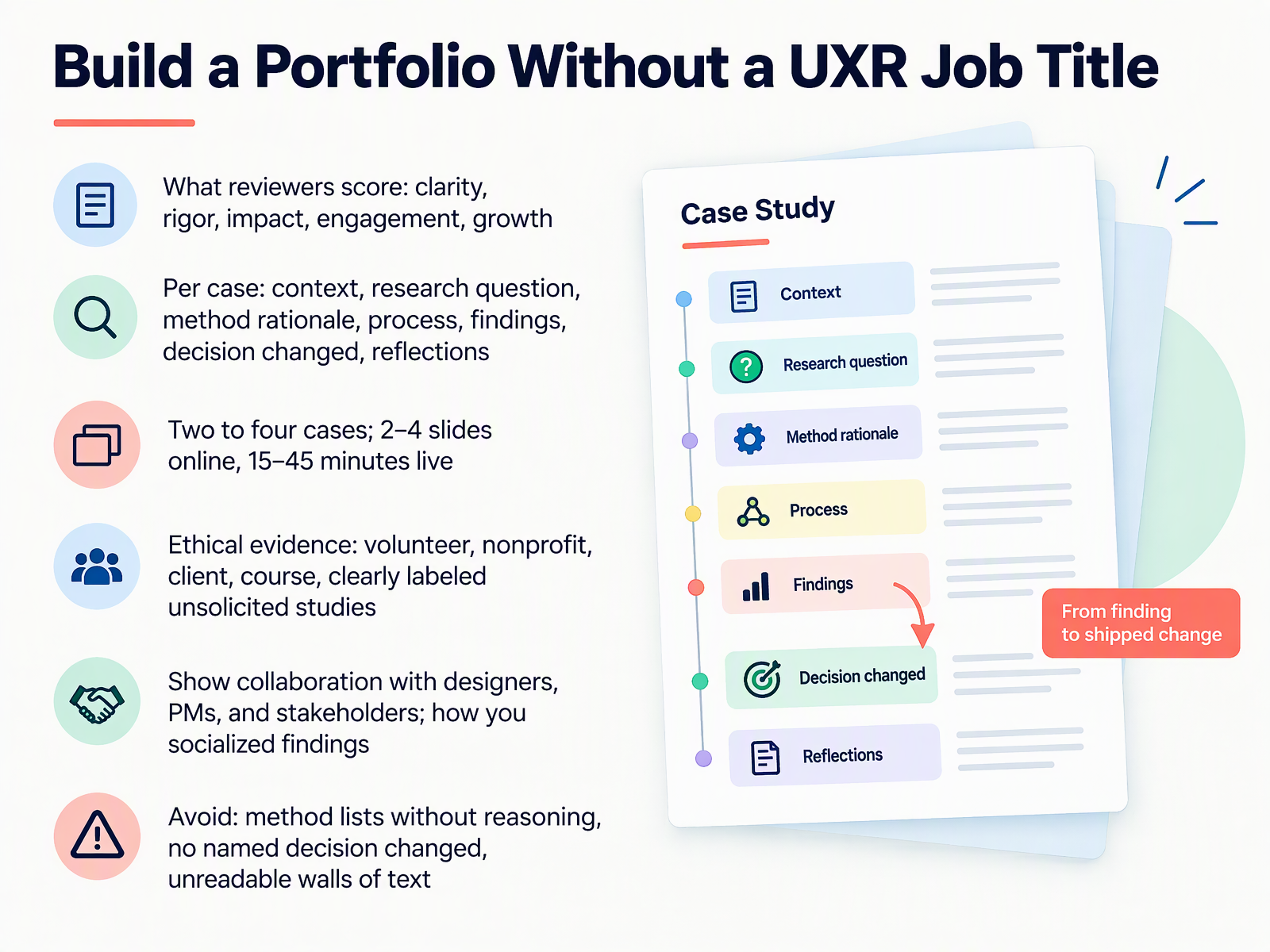
- 08Build a Portfolio Without a UXR Job TitleNext, let's talk about building a portfolio without a user experience research job title. If you don't have the title yet, you're not stuck. You build evidence from work you can actually do. Reviewers typically score five things: clarity, rigor, impact, engagement, and growth. Rigor means showing your reasoning, not just naming methods. For each case, cover the context, your research question, why you chose that method, your process, your findings, the decision it changed, and what you'd do differently. Aim for two to four cases. Online, keep each case to two to four slides. In a live review, plan fifteen to forty-five minutes per case. Your evidence can be volunteer work, nonprofit projects, client work, coursework, or unsolicited studies, as long as you clearly label them as unsolicited. Show how you worked with designers, product managers, and stakeholders, and how you shared findings. Avoid method lists with no reasoning, cases with no named decision changed, and walls of unreadable text. Get real practice, with projects that produce credible evidence.
 2 min
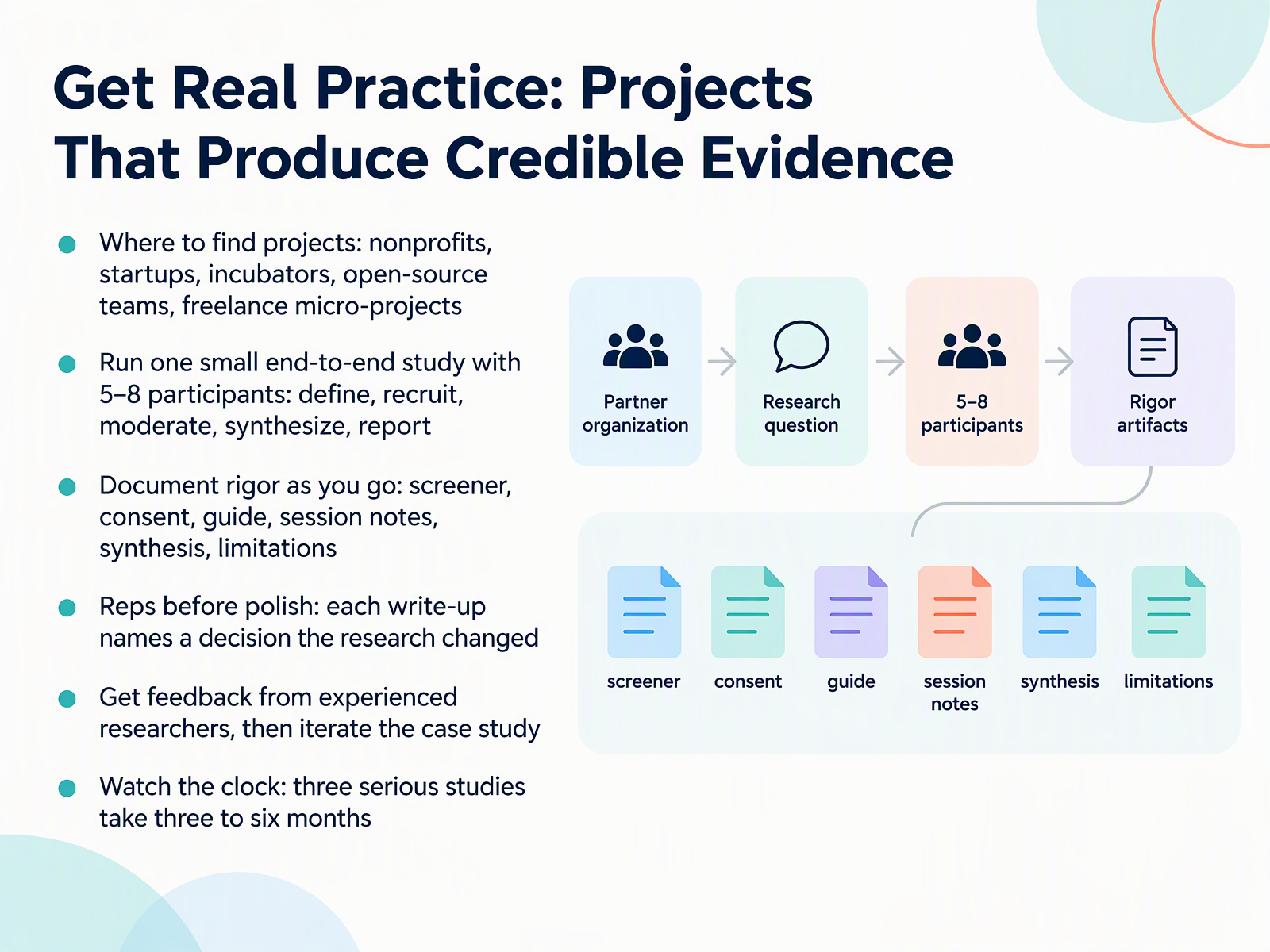
- 09Get Real Practice: Projects That Produce Credible EvidenceNow let's turn to practice that actually produces credible evidence. You don't need a research degree to start, and you don't need a paid client either. Look for small projects with nonprofits, startups, incubators, open-source teams, or freelance micro-projects. Then run one small study end to end with five to eight participants. That means defining the question, recruiting, moderating, synthesizing, and reporting. Five to eight is enough to surface patterns without overwhelming you. Document rigor as you go: your screener, consent, discussion guide, session notes, synthesis, and limitations. Those artifacts prove your process. Aim for reps before polish. In each write-up, name one decision the research changed. Then get feedback from an experienced researcher, and iterate the case study. Watch the clock: three serious studies usually take three to six months, so schedule them realistically. Next, we look at job search strategy, targeting roles, and positioning your background.
 2 min
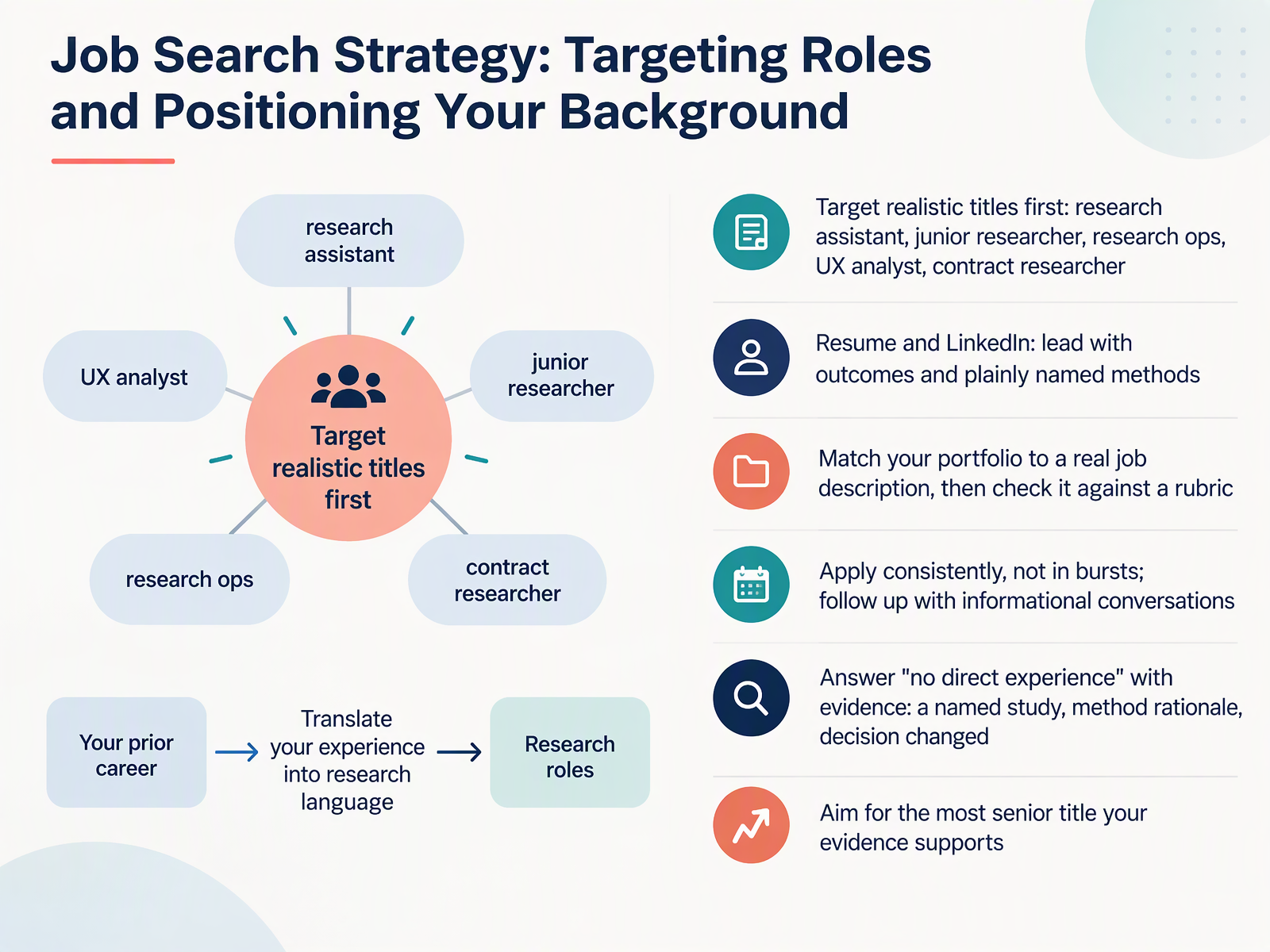
- 10Job Search Strategy: Targeting Roles and Positioning Your BackgroundNow let's turn to the job search itself. Start with realistic titles: research assistant, junior researcher, research ops, UX analyst, or contract researcher. Two in three postings are senior, so entry doors are narrow, and contract work is a normal way in. On your resume and LinkedIn, lead with outcomes and name your methods plainly, so usability testing, interviews, and surveys are easy to find. Then take a real job description, match your portfolio to it, and check your work against a rubric. Apply consistently rather than in bursts, and follow up with informational conversations. When someone says you have no direct experience, answer with evidence: a named study, why you chose the method, and the decision it changed. Finally, aim for the most senior title your evidence supports. Next, we'll look at interview formats and how to prepare for each.
 pivothop.comuxr-job-market-jul-2026.netlify.appscoutify.com+21 min
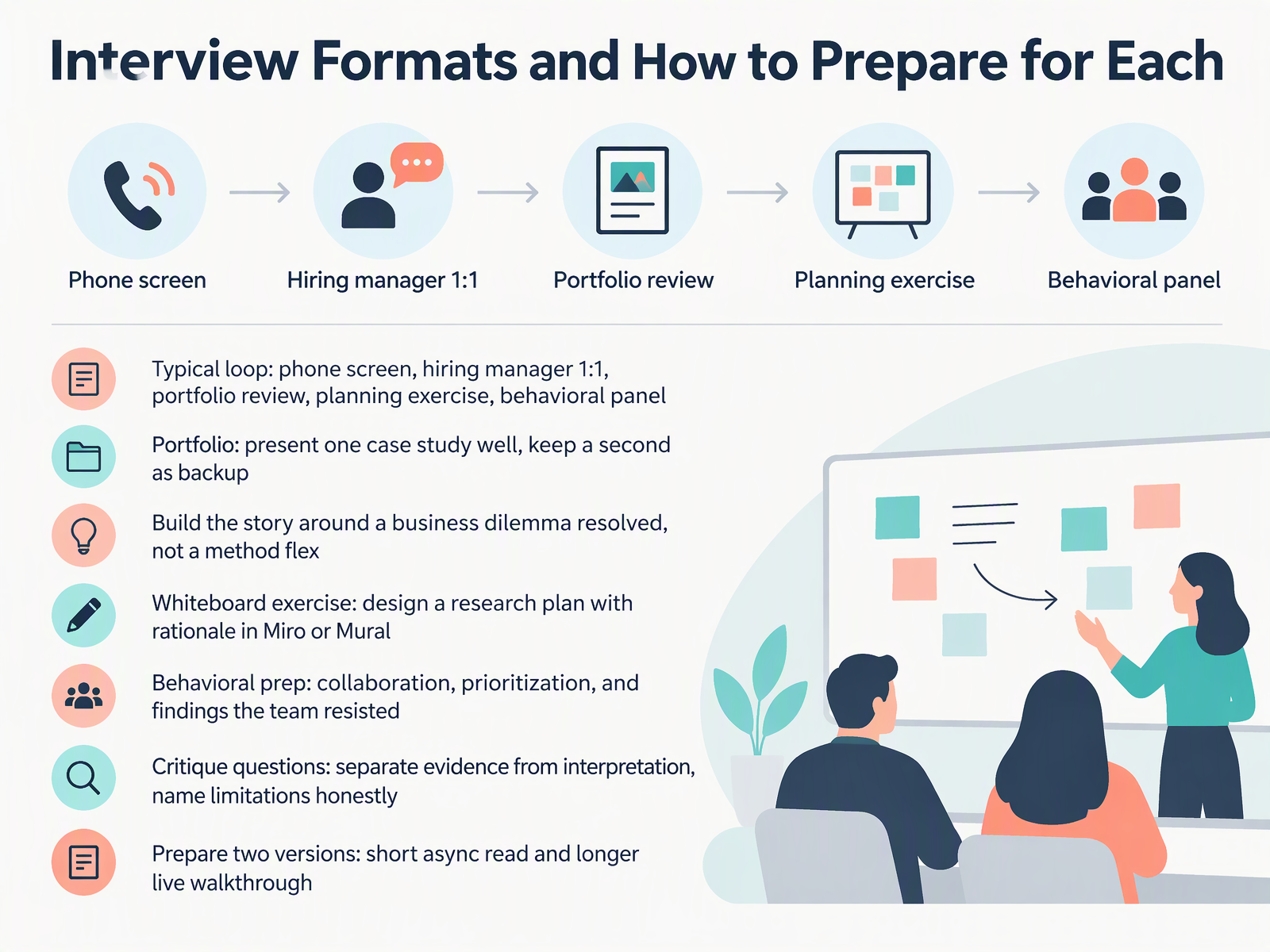
- 11Interview Formats and How to Prepare for EachNext, let's talk about the interview formats and how to prepare for each one. Most loops follow a pattern: a phone screen, a one-to-one with the hiring manager, a portfolio review, a planning exercise, and a behavioral panel. For the portfolio, present one case study well and keep a second as backup. Build the story around a business dilemma that got resolved, not a method flex. For the whiteboard exercise, you'll design a research plan with your rationale in Miro or Mural, so practice narrating your decisions out loud. For behavioral prep, have stories ready about collaboration, prioritization, and findings your team resisted. When you get critique questions, separate evidence from interpretation and name limitations honestly. Finally, prepare two versions of your presentation: a short async read and a longer live walkthrough. Coming up next is Your 90-Day Action Plan.
 snapp.recruitee.com4cornerresources.comjunbrain.com+22 min
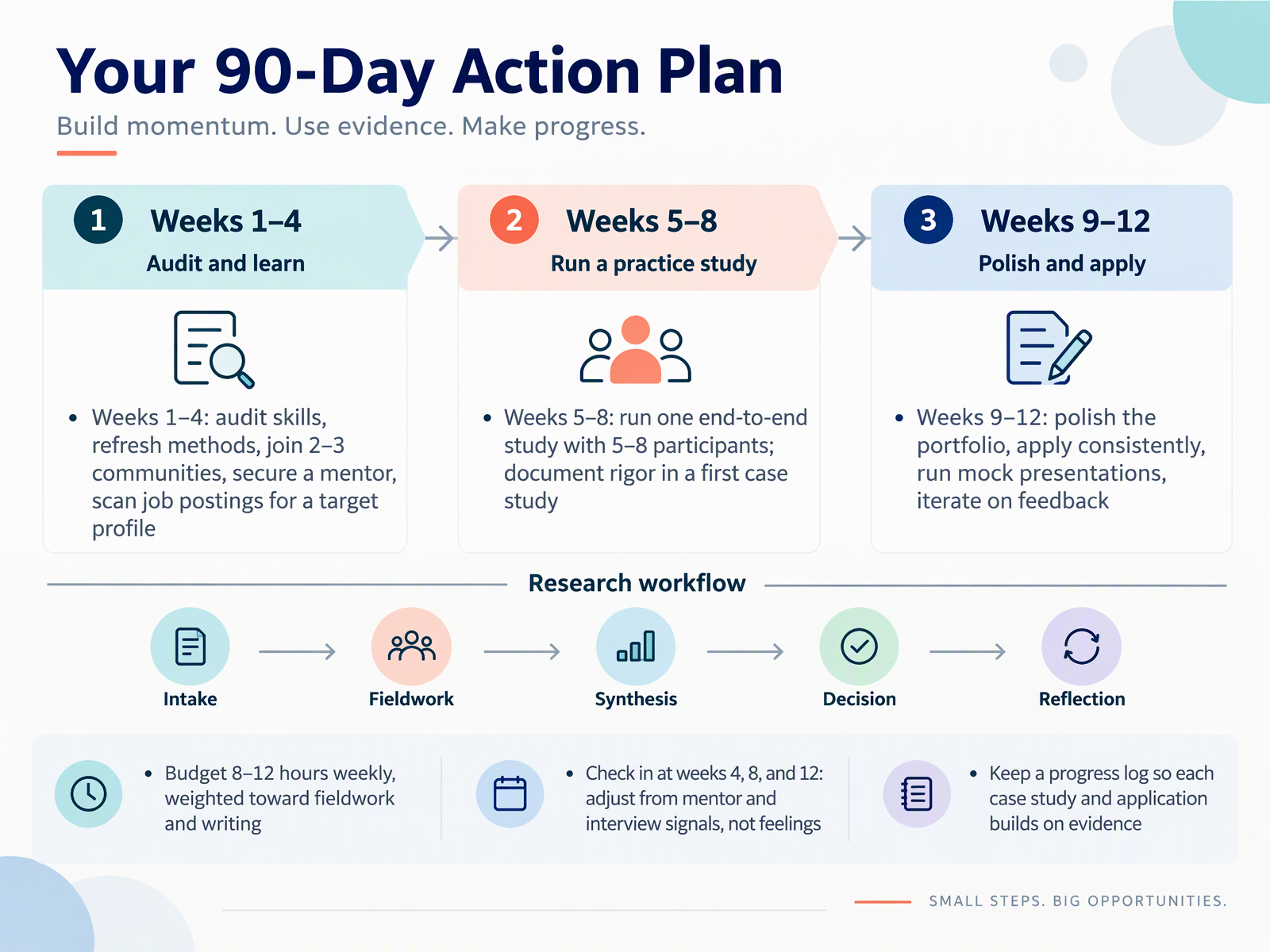
- 12Your 90-Day Action PlanLet's turn this into a concrete plan you can actually run. In weeks one through four, audit your transferable skills, refresh core methods, join two or three research communities, and secure a mentor. Then scan job postings to define a target profile. In weeks five through eight, run one end-to-end study with five to eight participants, and document your rigor in a first case study. In weeks nine through twelve, polish the portfolio, apply consistently, run mock presentations, and iterate on feedback. Budget eight to twelve hours a week, weighted toward fieldwork and writing. Check in at weeks four, eight, and twelve, and let mentor and interview signals drive adjustments, not feelings. Keep a progress log so each case study and application builds on evidence. Next, we look at landing well in your first ninety days in the role and continuing to grow.
 2 min
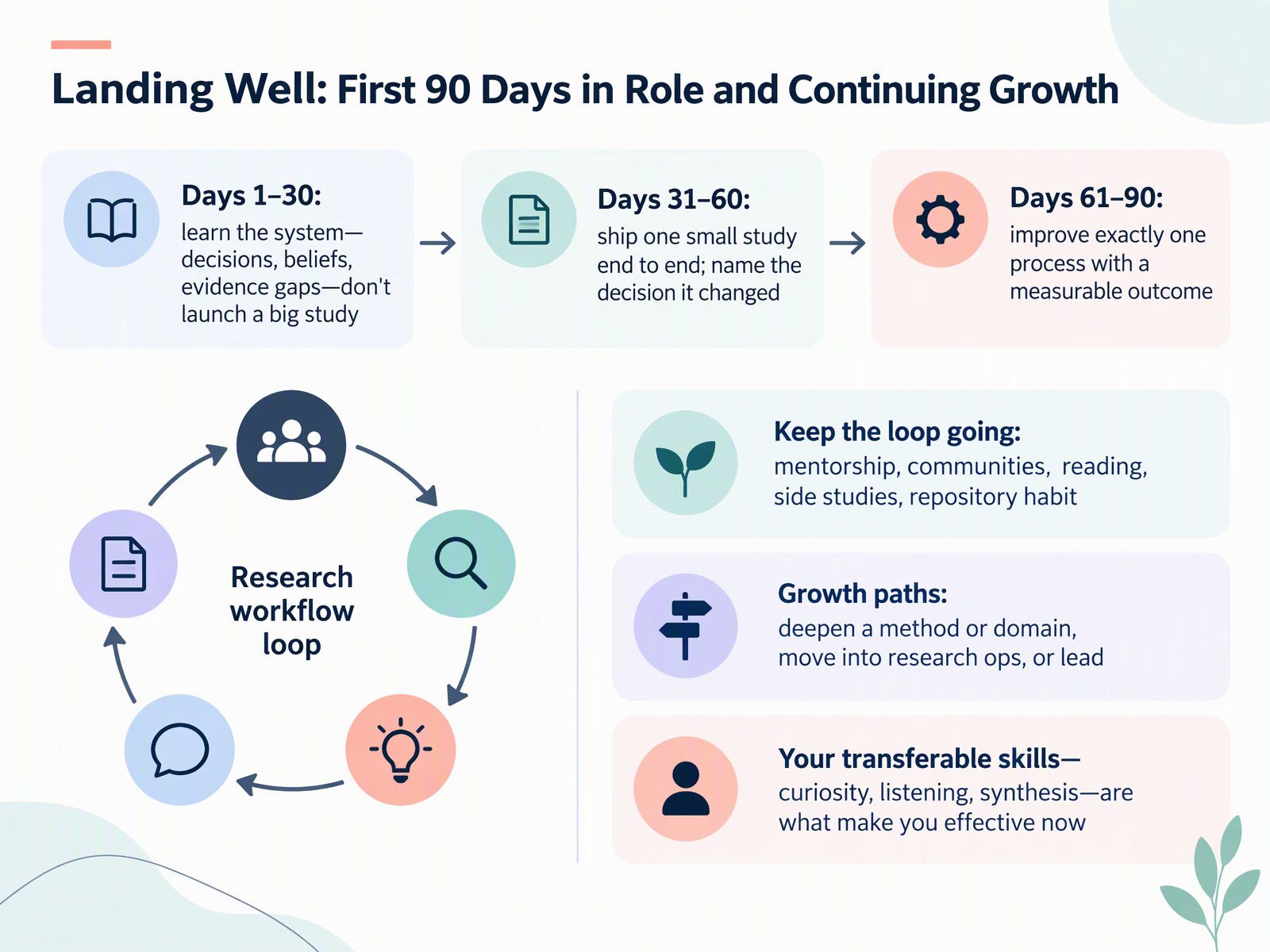
- 13Landing Well: First 90 Days in Role and Continuing GrowthLet's talk about landing well, your first ninety days and how to keep growing after that. In days one to thirty, learn the system. Map who decides what, what the team believes about users, and where the evidence gaps are. Don't launch a big study yet. From day thirty one to sixty, ship one small study end to end, and be able to name the decision it changed. That last part is what counts. Between day sixty one and ninety, improve exactly one process, with a measurable outcome. For example, if you couldn't find past findings, build a repository, and measure success as someone finding a study without asking you. Keep the loop going through mentorship, communities, reading, side studies, and a repository habit. Over time, you can deepen a method or domain, move into research operations, or lead. And remember, your transferable skills, curiosity, listening, and synthesis, are what make you effective now. Next, we'll cover common pitfalls, misconceptions, and the workflow as a personal roadmap.
 uxinsight.orgwhatfix.comdscout.com+22 min
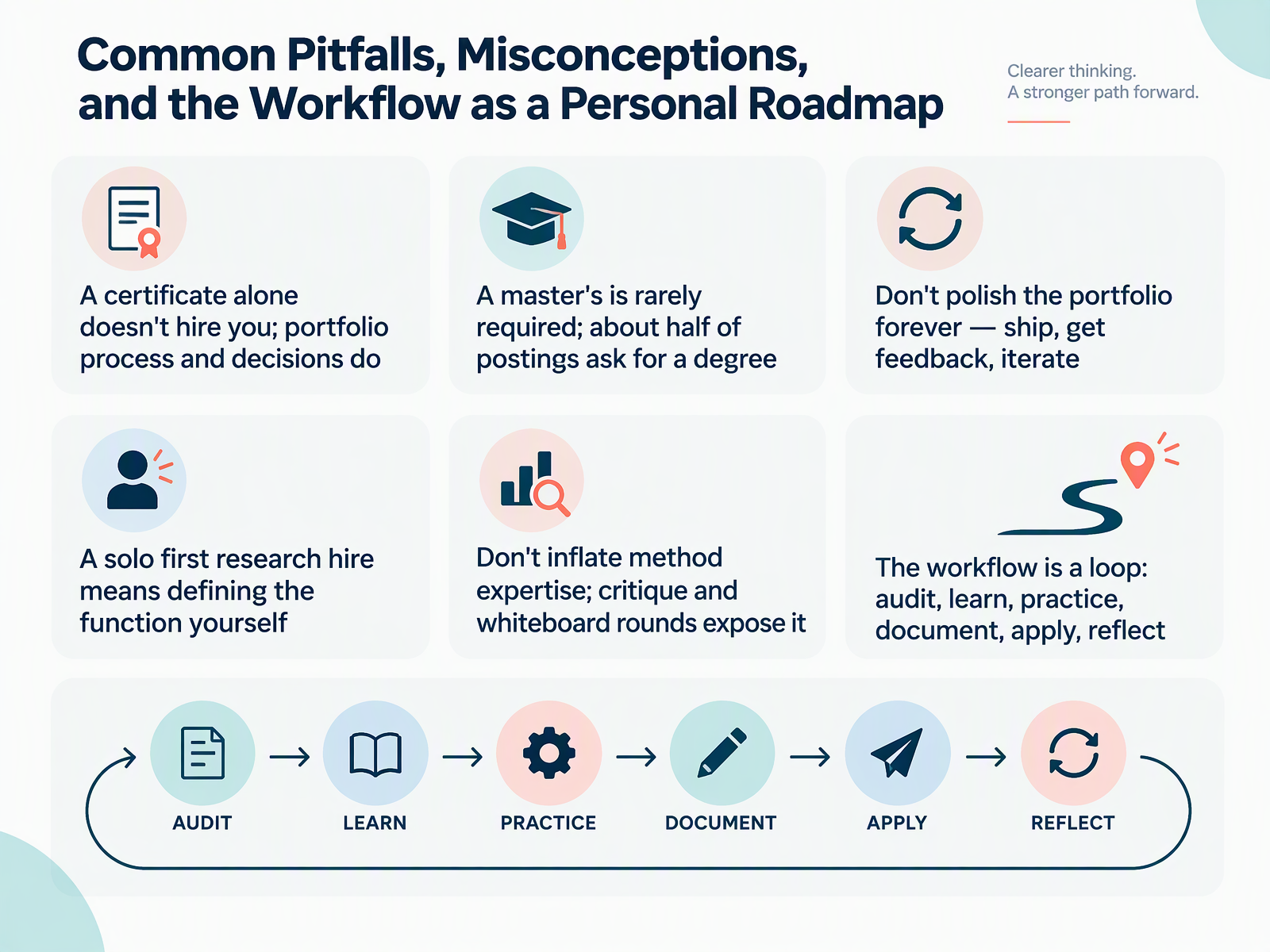
- 14Common Pitfalls, Misconceptions, and the Workflow as a Personal RoadmapBefore you go, let's clear up the pitfalls that trip people up. A certificate alone won't hire you. Hiring teams read your portfolio to see your process and your decisions. A master's degree is rarely required. About half of postings ask for a degree, and a bachelor's usually clears that bar. So don't polish your portfolio forever. Ship it, ask a mentor for feedback, and iterate. If you're the first research hire, expect to define the function yourself. And don't inflate your method expertise. Critique and whiteboard rounds will expose it, so practice explaining your reasoning out loud. Finally, treat this workflow as a loop: audit your skills, learn, practice, document, apply, and reflect. Then run it again. You have a practical path, so take the next step, and thank you for learning with me. You're ready to start.
 uxinsight.orgwhatfix.comdscout.com+22 min
Take the deck with you
Download this course as a file — free, no sign-up needed.
- PDF handoutEvery slide page, ready to print or share.15 pages · 3.1 MBDownload
- Narrated PowerPointThe deck that presents itself — every slide carries the digital human's narration video.15 pages · 12.8 MBDownload
- PowerPoint slidesThe full deck as a .pptx — open it in PowerPoint, Keynote, or Google Slides.15 pages · 3.1 MBDownload
Free to use in your own training — please keep the PersonWise credit page at the end.
Have your own deck? Turn it into a course
Sources consulted
Web sources consulted while building this course.
- UX Researcher at Snapp — snapp.recruitee.com
- UX Researcher Job Description and Salary [2026] — 4cornerresources.com
- Now Hiring Remotely Junior UX Researcher October 2026 | junbrain.com — junbrain.com
- Junior Researcher (UX) at The Inside Job — designproject.io
- Praktikant User Experience (m/w/d) UX Research at SKOPOS GROUP — designproject.io
- How to become a ux researcher: salary, skills and steps — pivothop.com
- UX Research Job Market 2026 — Infographics — uxr-job-market-jul-2026.netlify.app
- Entry-Level UX Researcher Jobs 2026: $59K-$85K, New Grad & 0-2 Years | Scoutify — scoutify.com
- How to Become a UX Researcher in 2026 (Step-by-Step Guide) | Uxcel — uxcel.com
- UX Researcher Salary in 2026 | PayScale — payscale.com
- Download the UX Research Career Guide - UXinsight — uxinsight.org
- UX Research Team - Career & Competency Frameworks - Feb 2024 — whatfix.com
- Shape Your Path with a UXR Career Framework — dscout.com
- A UX Career Framework: Driving Conversations Between Managers and Employees Um framework para a carreira de UX: conversas entre gerentes e funcionários Un estrategia para las carreras en UX: alentar las conversaciones entre gerentes y empleados - User Experience — uxpamagazine.org
- The Practical, No Nonsense Guide to Starting a Career in User Research - Dscout — dscout.com
- Introduction to user research | Introduction to Human-Computer Interaction | Oxford Academic — academic.oup.com
- User Experience Research: Methods, Best Practices, and Career Potential | Coursera — coursera.org
- UX Research: A Practitioner's Guide to Methods, Process, and Impact — uxrinstitute.com
- The Complete Guide to User Research for Product Teams — ideaplan.io
- Types of User Research Methods | UX Research Field Guide — userinterviews.com