Customer Service Maturity Models
Begin
14 pages · ~28 min
Customer Service Maturity Models
Learn how to assess and advance your organization's customer service capabilities using proven maturity models to drive continuous improvement. Ideal for service leaders and operations managers.
What you’ll learn
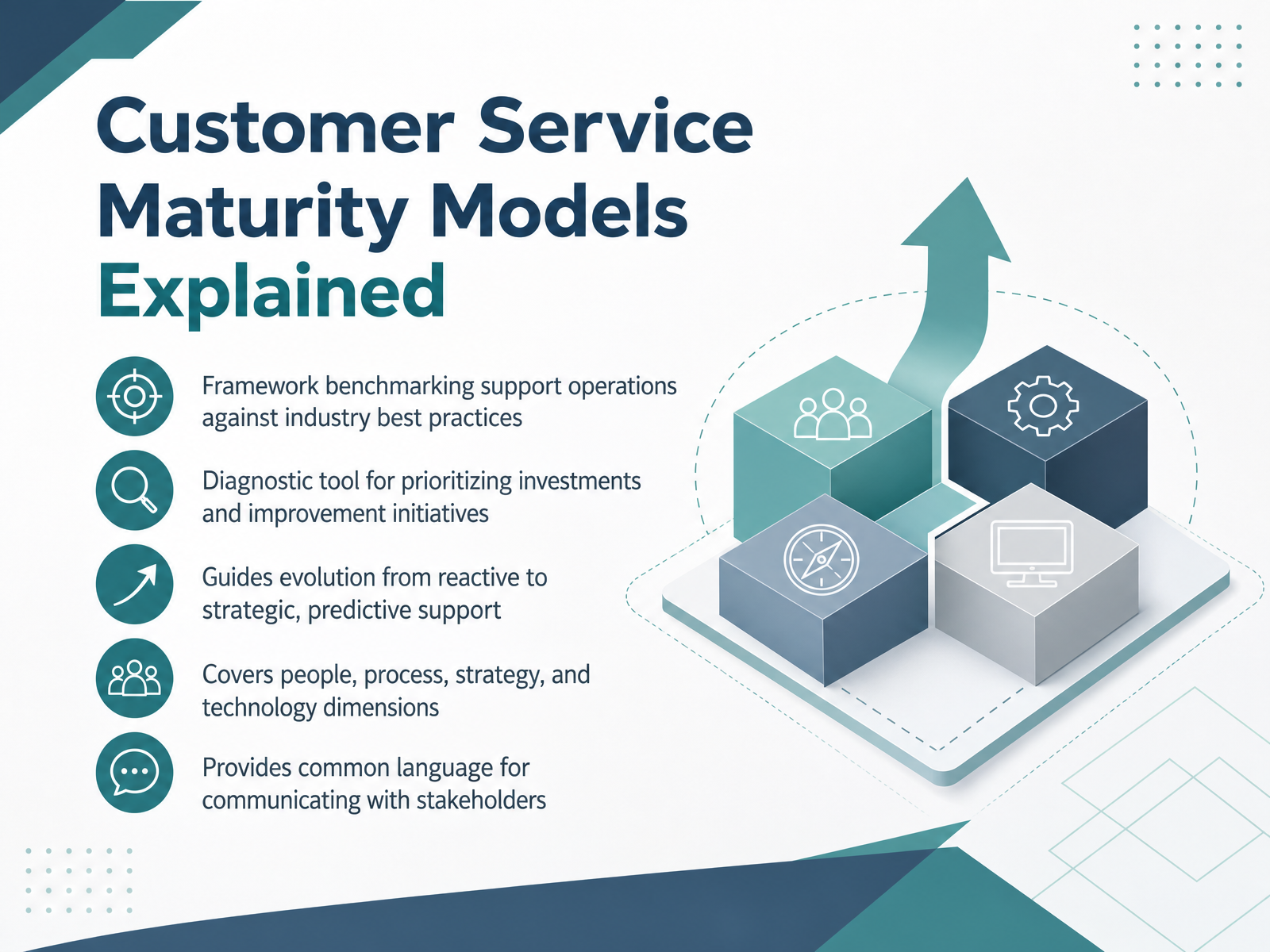
- 01Customer Service Maturity Models ExplainedWelcome. If you lead a support operation, you already know the pressure of balancing daily firefighting with long-term strategy. That is exactly why we are starting here. A customer service maturity model is not just a theoretical framework. It is a practical benchmarking tool that shows how your support operation stacks up against industry best practices. Think of it as a diagnostic lens for prioritizing where to invest next, whether that is in people, process, strategy, or technology. Most teams begin in a reactive mode, and the model gives you a structured path to evolve toward strategic and predictive support. It also gives you a common language to speak with executives and stakeholders, so you can justify investments in terms they understand. Throughout this session, we will walk through the stages and how to apply them to your daily realities. Let us get into why support teams get stuck and how this model helps you move forward.supportlogic.comsupportlogic.comleafworks.de+22 min
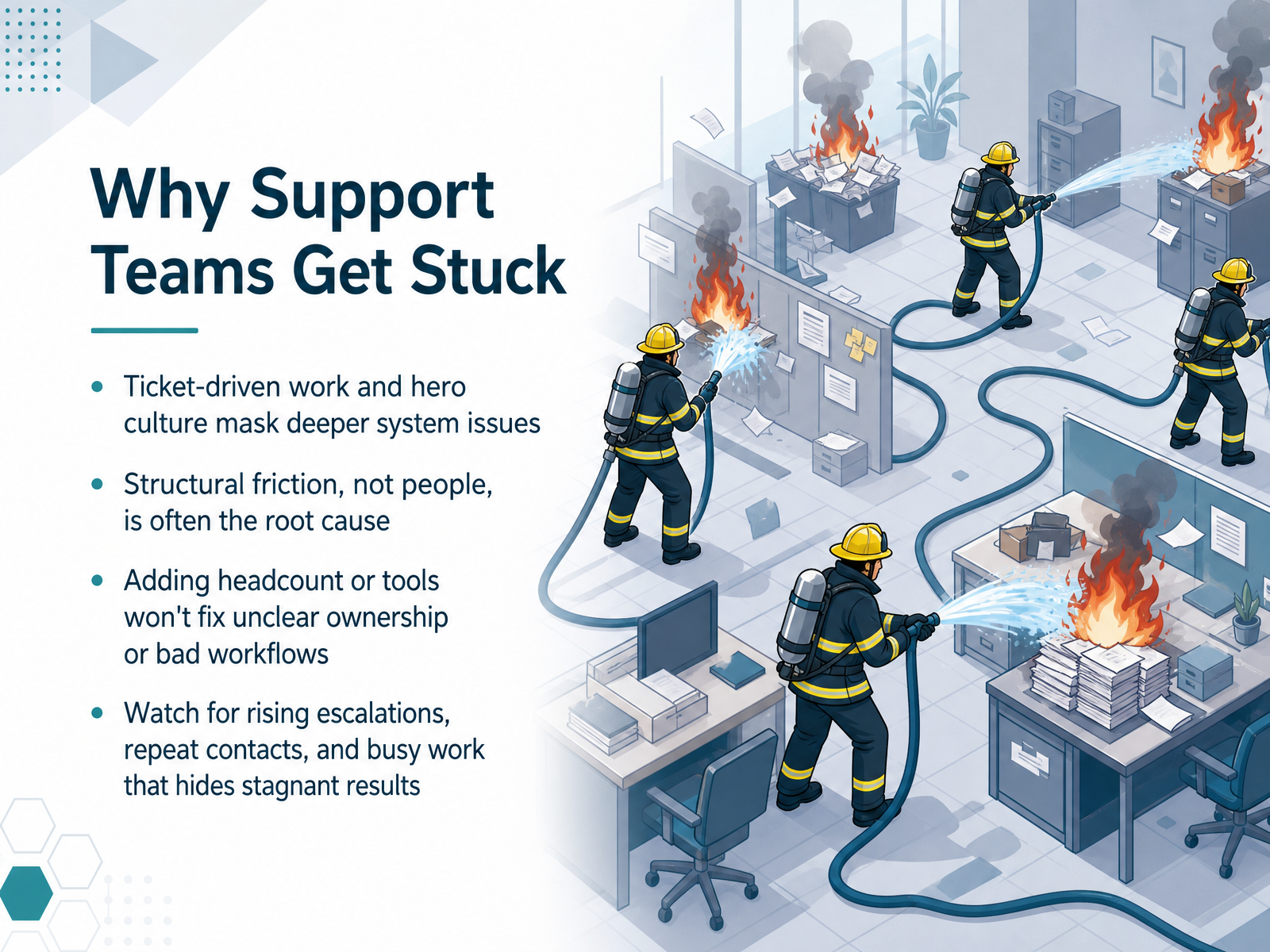
- 02Why Support Teams Get StuckSo why do so many support teams hit a plateau, no matter how hard they push? Often, it’s not the people. It’s the system they’re stuck in. Ticket-driven work and a hero culture—where a few star players constantly save the day—tend to mask deeper structural issues. Adding headcount or new tools rarely fixes the real problem: unclear ownership, fragmented workflows, and friction that forces agents to switch between multiple systems just to resolve a single case. Watch for the warning signs: rising escalations, repeat contacts, and plenty of busy work that hides stagnant results. When the same issues resurface across hires and new tools, that’s a signal the environment is the bottleneck. The fix starts with diagnosing the work mix, tooling, and decision rules. That’s exactly where maturity models come in—they give you a roadmap to move from reactive firefighting to a system designed for sustained performance. Let’s look at what service maturity really means.
 cbtw.techaventus.comfixate.nu+21 min
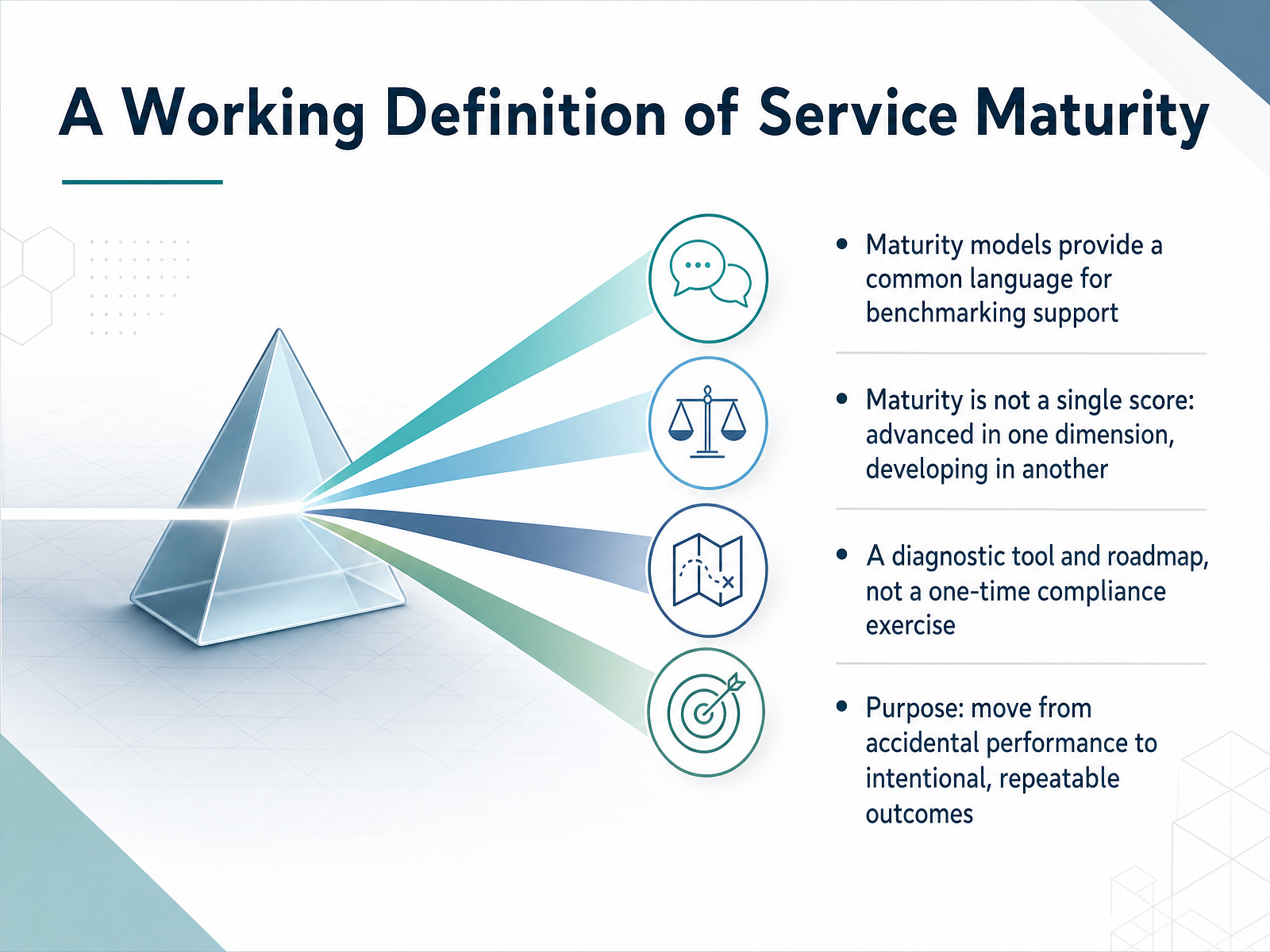
 - 03A Working Definition of Service MaturityLet’s pin down what service maturity actually means, because it’s easy to treat it as a single score. It’s not. Maturity models first give us a common language to benchmark support — so leaders, agents, and executives are all talking about the same thing. But here’s the nuance: you can be highly advanced in one dimension, like process design, while still developing in another, like proactive engagement. That’s normal. It means the model works better as a diagnostic tool and roadmap than as a one-time compliance exercise. Its real purpose is to move you from accidental performance — where good outcomes happen by luck or heroics — to intentional, repeatable results your teams can sustain under pressure. Think of it as shifting from relying on your best agents to building a support system that consistently delivers. We’ll use that lens in a moment when we break down the four dimensions that matter most for your operations.
 supportlogic.comsupportlogic.comleafworks.de+21 min
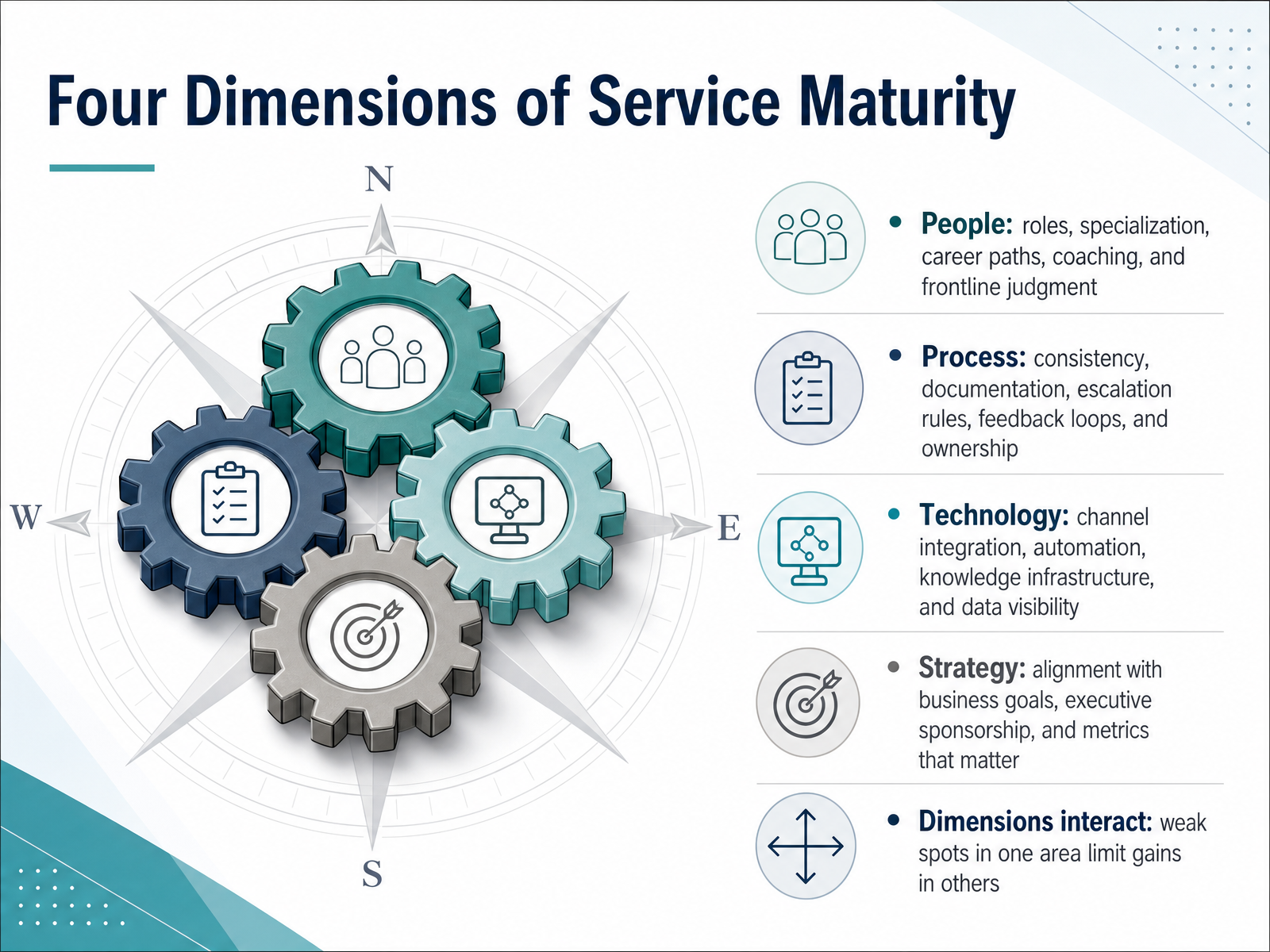
 - 04Four Dimensions of Service MaturityLet's shift from the level descriptions and look at what actually drives progress. Maturity isn't a single score; it's the combined strength of four dimensions. First, people. This covers roles, specialization, career paths, coaching, and whether your frontline has the judgment to handle the curveballs. Second, process. This is about consistency across documentation, escalation rules, feedback loops, and clear ownership of outcomes. Third, technology. Consider channel integration, automation, and whether your knowledge infrastructure gives agents one view of the customer. And fourth, strategy. This is the alignment of service goals with business objectives, the executive sponsorship that removes barriers, and tracking the metrics that actually matter. Here's the key insight: these dimensions interact. A weak spot in one area will cap the gains you can make in the others. You can have great technology, but if your people lack the authority or training to use it well, you've wasted the investment. So as you assess your own operation, don't just look at each pillar in isolation. Look at how they reinforce each other. Next, we'll walk through how strengths across these four dimensions map to a practical five-stage progression."
 crmxchange.comtmforum.orgleafworks.de+21 min
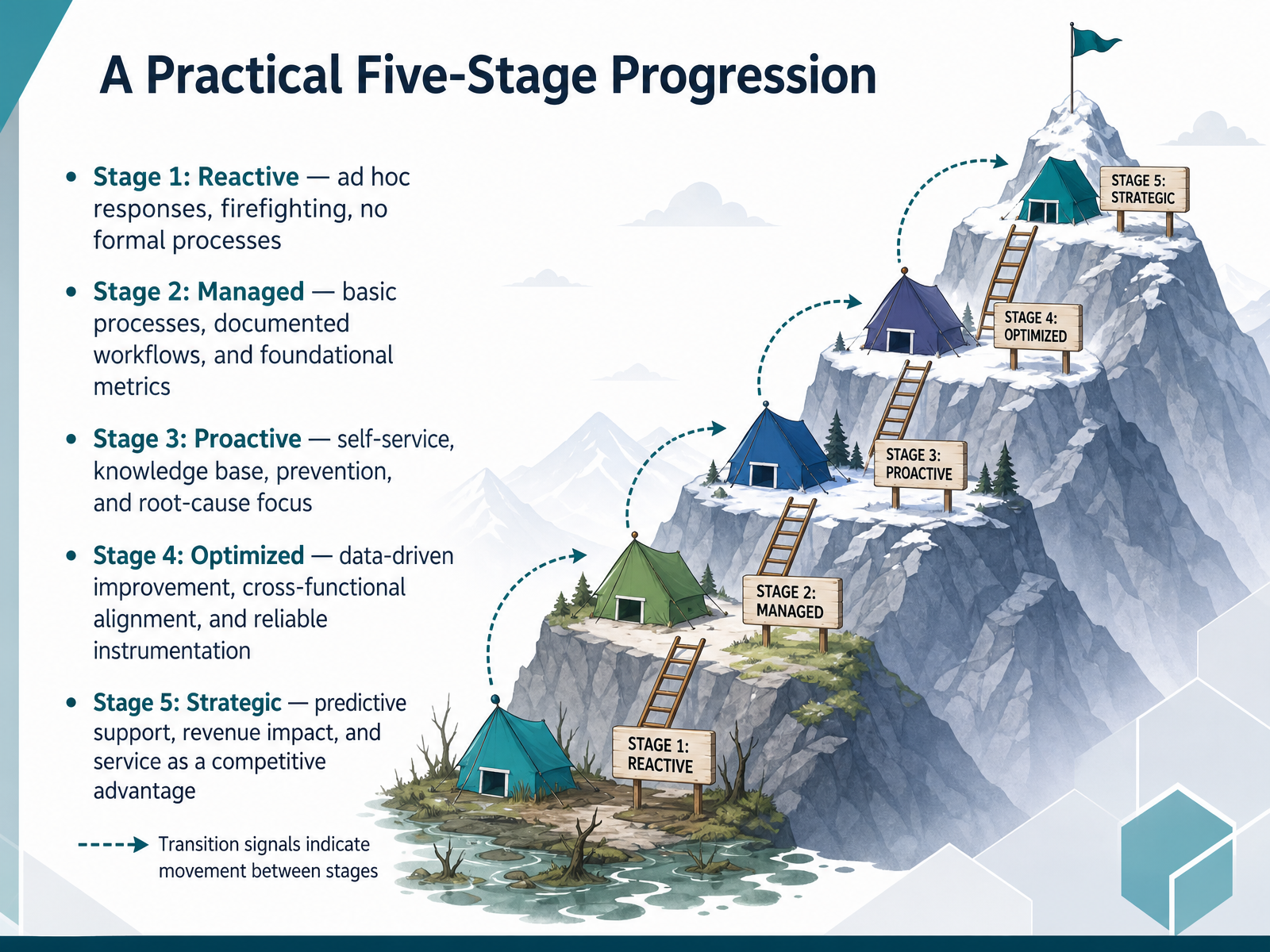
 - 05A Practical Five-Stage ProgressionLet’s walk through the five-stage progression we’ll be referencing throughout this session. Stage one is Reactive. This is the classic firefighting mode, where every issue is handled ad hoc with no formal processes in place. You’re essentially just trying to keep up. Stage two, Managed, is where you introduce documented workflows, basic processes, and foundational metrics that give you some consistency. Stage three, Proactive, marks a shift. Here you’re building self-service options, a robust knowledge base, and focusing on root-cause analysis to prevent issues rather than just fixing them. Moving into Stage four, Optimized, everything becomes data-driven. You have cross-functional alignment and reliable instrumentation guiding your decisions. This is where improvements are systematic, not incidental. Finally, Stage five is Strategic. At this level, support becomes a genuine competitive advantage. You’re acting predictively, and your team’s work directly ties to revenue impact. Because you’re leaders and operators, you know progress isn’t always linear. So watch for those transition signals that indicate movement between stages—like a drop in repeat contacts, or an increase in first-contact resolution. Those signals tell you a stage shift is real. Next, let’s look at how to assess your current state.
 supportlogic.comsupportlogic.comleafworks.de+22 min
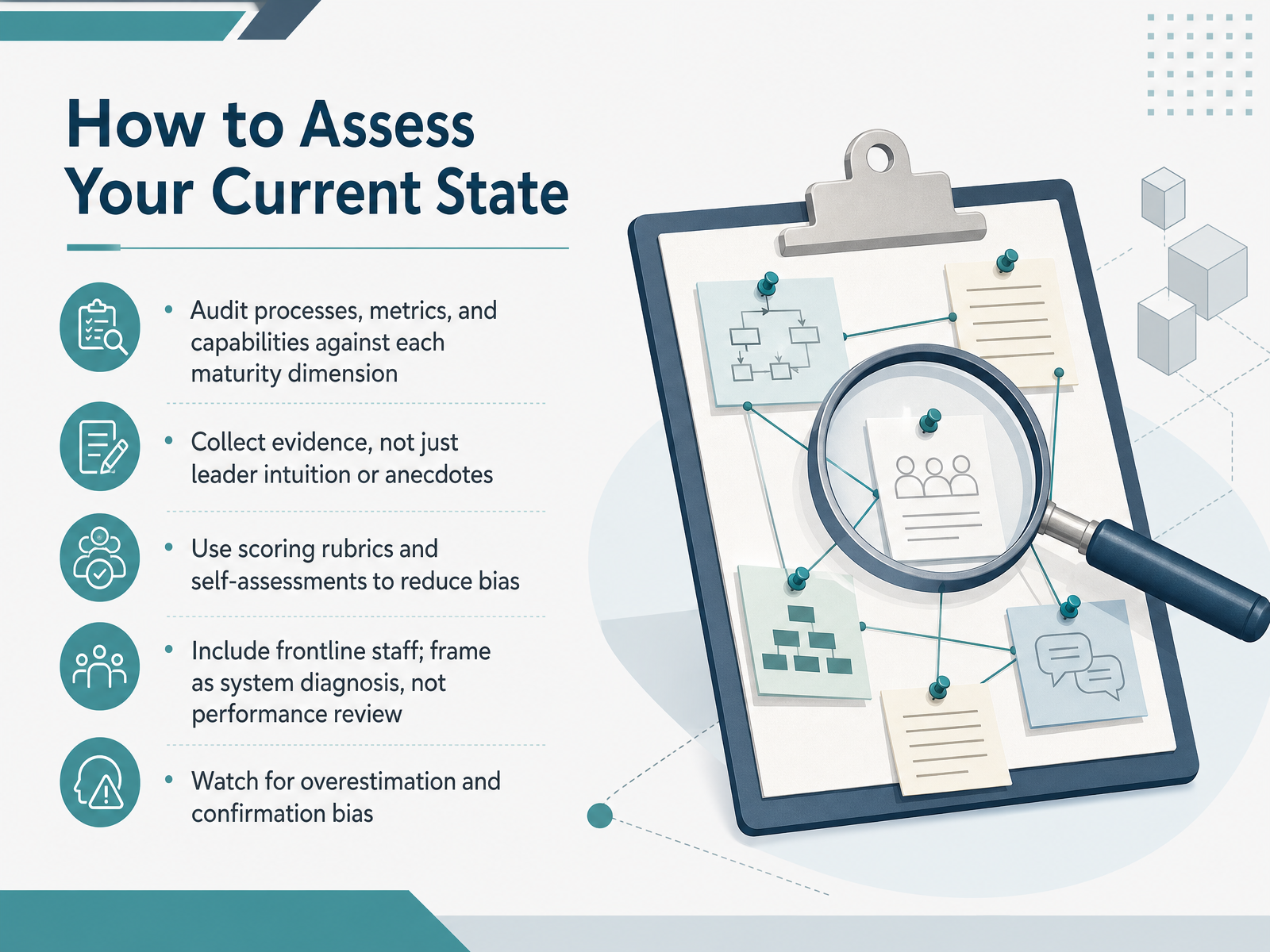
 - 06How to Assess Your Current StateSo, how do you know where you actually stand today? Start by auditing your processes, metrics, and capabilities against the maturity dimensions we’ve covered. And crucially, collect evidence. Don’t rely on leader intuition or a few memorable anecdotes. You need observable data points to back up every claim. Use scoring rubrics and structured self-assessments; these tools are designed to reduce bias and give you a consistent yardstick across teams. And this is important—bring your frontline staff into the process. Frame it clearly as a system diagnosis, not a performance review. You want their honest operational view, not defensive responses. Finally, watch for overestimation. Confirmation bias is real, and it’s most dangerous when you’re feeling good about your progress. A disciplined assessment gives you the truthful baseline you need. With that baseline in hand, we’re ready to look at designing a realistic roadmap.
 qualtrics.comencompass-cx.comfranckardourel.com+21 min
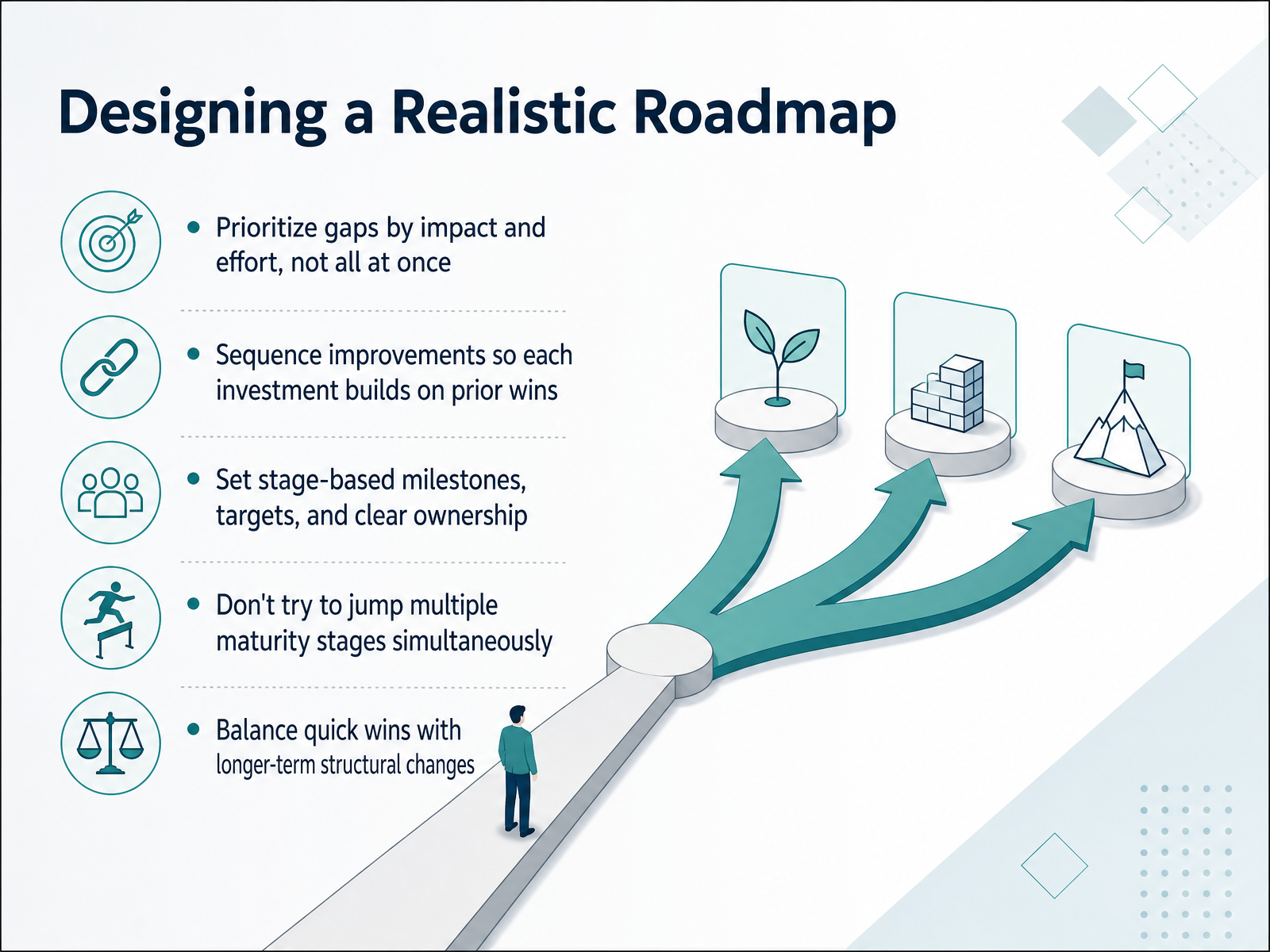
 - 07Designing a Realistic RoadmapSo once you've assessed your current state, the real work begins: designing a roadmap that's realistic, not aspirational. Start by prioritizing gaps based on their impact and the effort required — resist the urge to fix everything at once. Sequence your improvements so each investment builds on the last, creating momentum rather than isolated wins. Set clear milestones for each maturity stage, define the targets that signal success, and assign ownership for each initiative. And please, don't try to jump multiple stages simultaneously — that's a recipe for churn and frustration. Instead, look for quick wins that generate visible results early, then pair them with the longer-term structural changes that will sustain progress. This staged approach is what turns a maturity model from theory into practice. Now let's talk about how you'll measure success — the metrics that actually match your stage. This is where many teams go off track, so let's explore that next.
 supportlogic.comgetperspective.aisupportbench.com+21 min
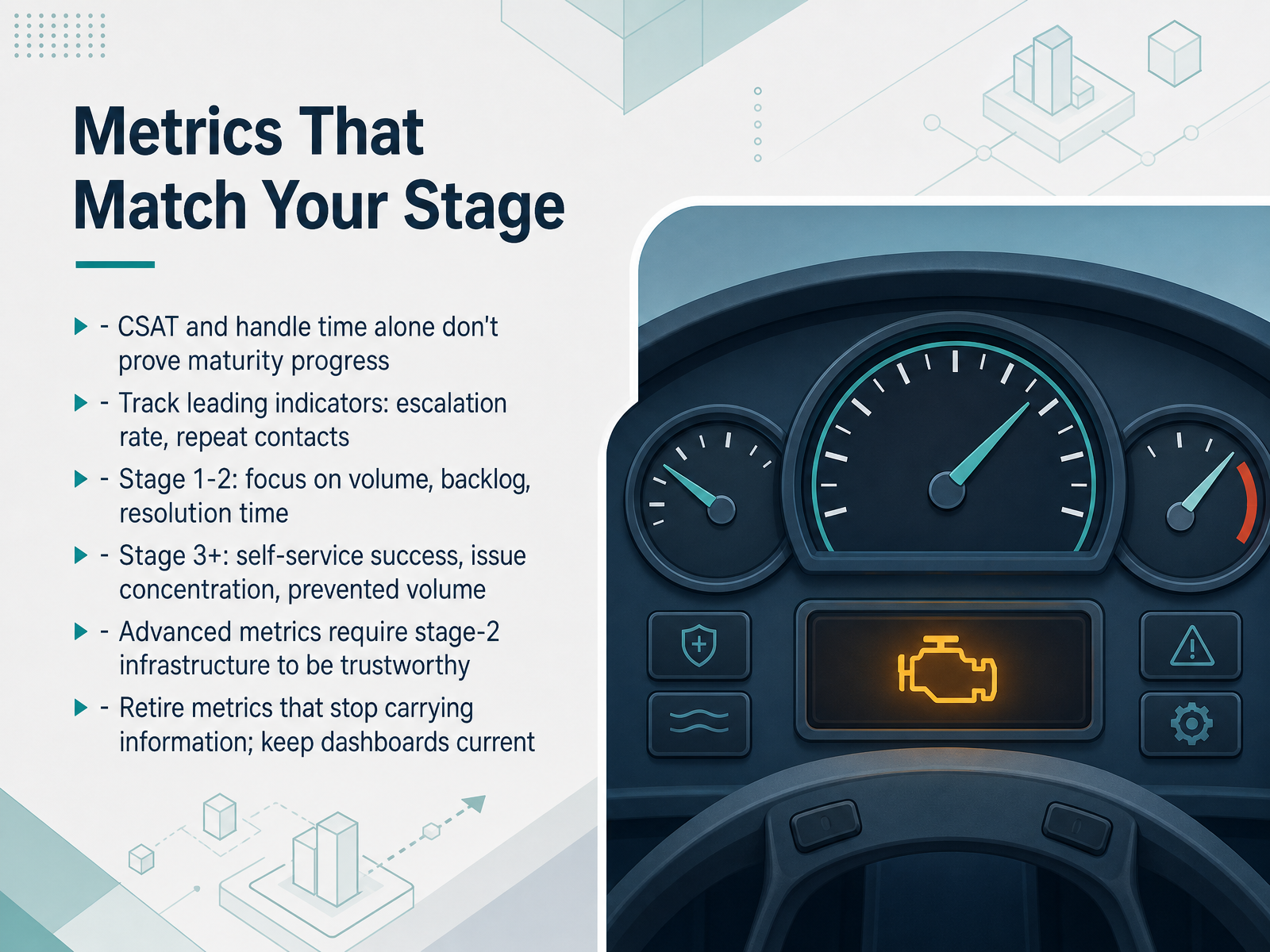
 - 08Metrics That Match Your StageNow let's talk about the metrics that actually matter at each maturity stage. If your dashboard still leads with CSAT and handle time, you are not measuring maturity progress. Those are lagging indicators, and they move too slowly to tell you whether you are improving. Instead, track leading indicators like escalation rate and repeat contacts. They move first. Here is the practical breakdown. In the reactive and managed stages, your focus is volume, backlog age, and resolution time. You cannot answer quality questions until the basics are stable. Once you move into the proactive stage, the metrics shift. Now you are tracking self-service success, issue concentration, and prevented volume. But here is the catch. Those advanced metrics silently require stage two infrastructure. If your tagging is unreliable, your issue concentration numbers mean nothing. And remember to audit your dashboard. Retire metrics that have stopped carrying information. If you are still reporting first response time as a headline once you have automation, you are measuring your bot, not your service. Keep the dashboard current. A metric is only useful when your team can both measure it reliably and act on it. Up next, we will look at common pitfalls that keep teams stuck in their maturity journey.
 getperspective.ai2 min
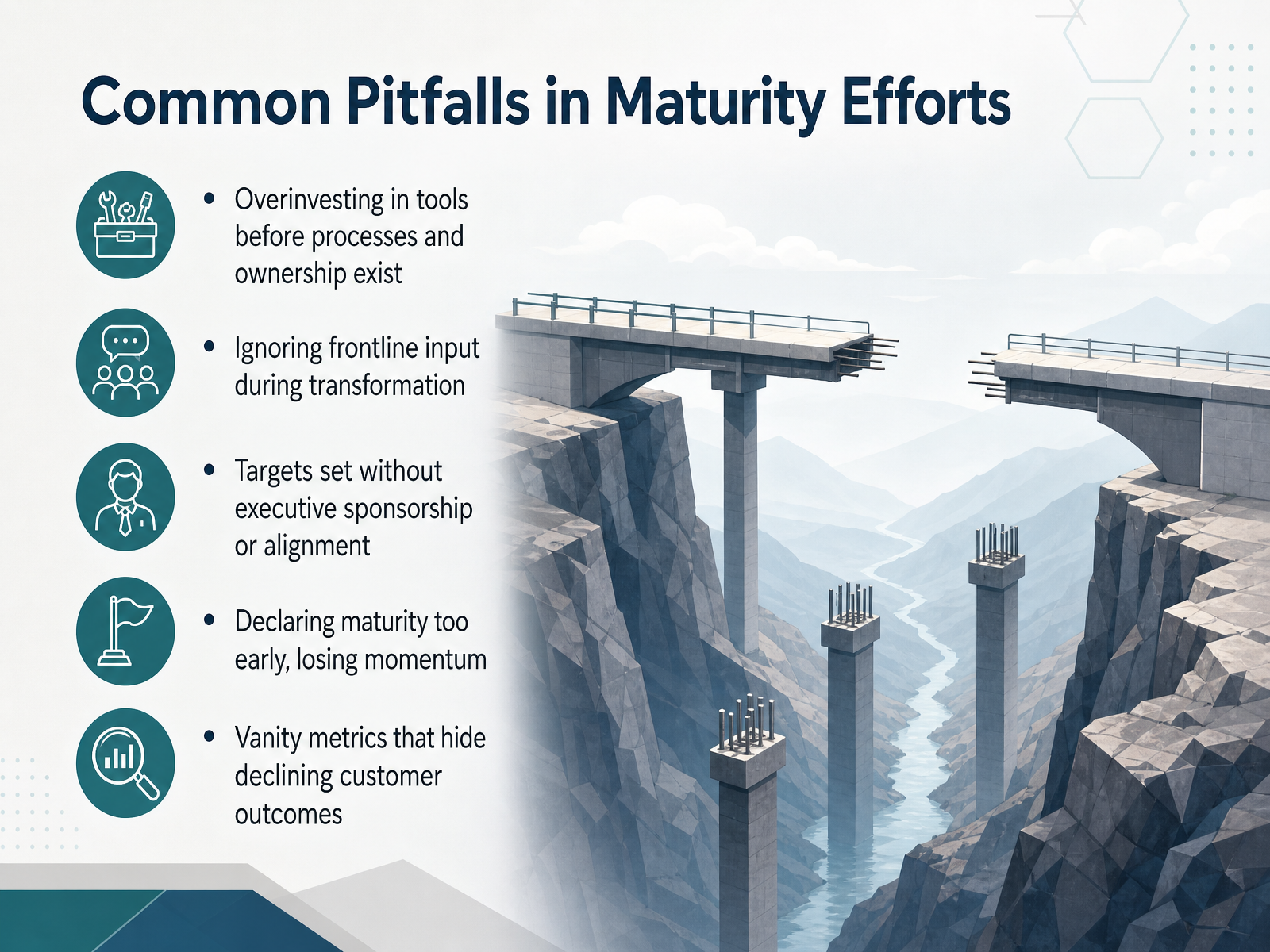
 - 09Common Pitfalls in Maturity EffortsNow let's talk about where maturity efforts typically go off the rails. One of the most common pitfalls is investing in tools before you've sorted out your processes and ownership. You end up with a powerful platform running on broken workflows, and that doesn't move your maturity score. Another big one is ignoring frontline input. Your agents know where the real friction lives, and if they're not part of the redesign, adoption dies on the vine. Next, setting targets without executive sponsorship is setting yourself up to stall the moment you need cross-functional cooperation. And be careful about declaring victory too early. If you say you're mature while the underlying behaviors haven't shifted, you'll lose the momentum to keep going. Finally, watch out for vanity metrics. A great CSAT score can hide declining resolution rates or rising repeat contacts. Maturity is about operational truth, not dashboard optics. Keep the focus on capability, not appearances. And that honest lens is exactly what we'll need as we look at measuring self-service without fooling yourself.
 2 min
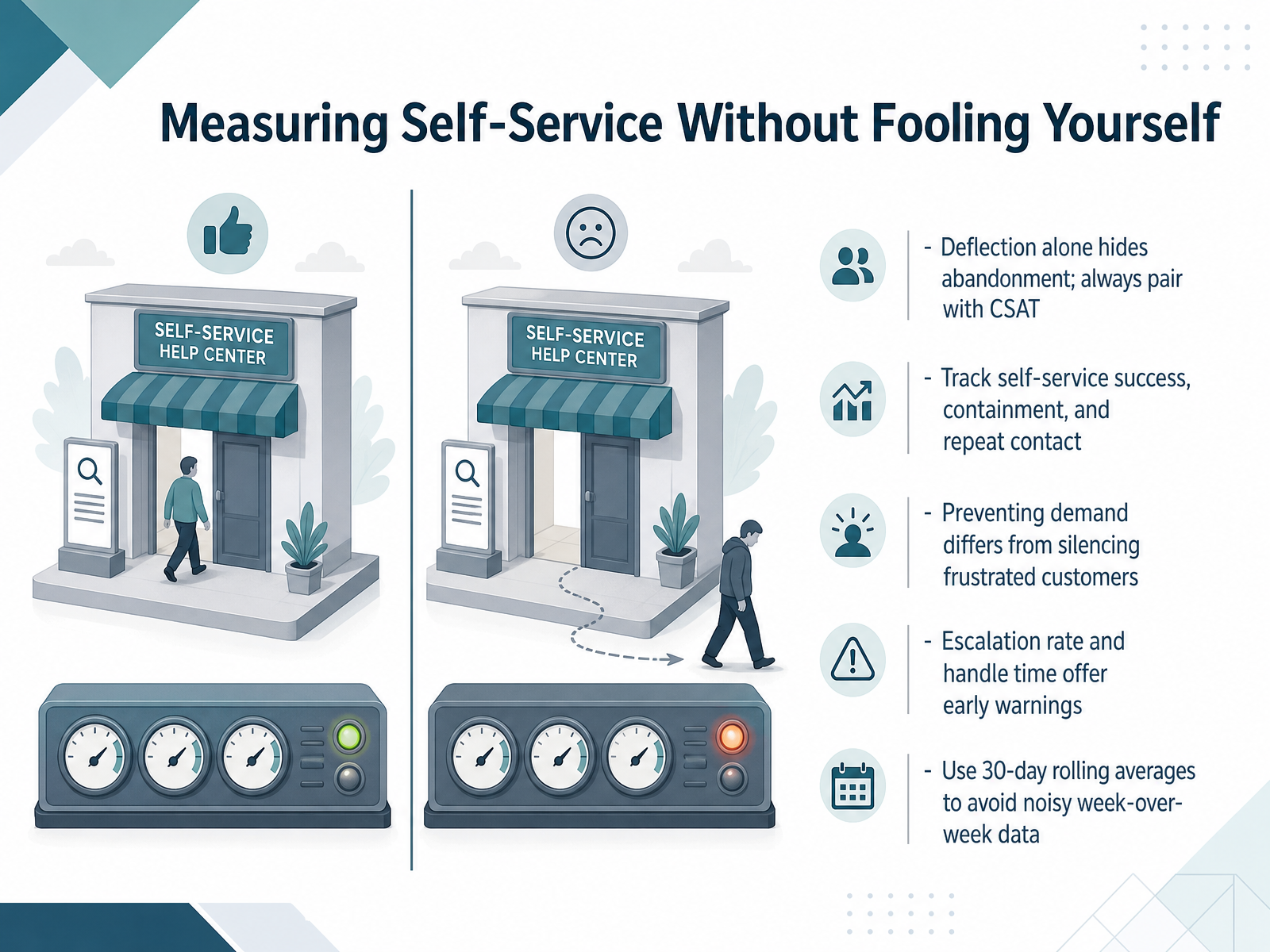
2 min - 10Measuring Self-Service Without Fooling YourselfLet's talk about measuring self-service without fooling yourself. The classic trap is celebrating deflection rate in isolation. But deflection alone can hide abandonment. A customer who clicks away in frustration and a customer who genuinely resolved their issue can look identical in the data. Always pair deflection with CSAT to reveal the difference. Next, focus on true self-service success, containment, and repeat contact. Containment tells you the conversation ended in the automated channel, not that the problem was solved. And repeat contact within a week is a strong signal the resolution didn't hold. A critical distinction: preventing demand is not the same as silencing frustrated customers. If contact volume drops because people gave up, that's not success — that's risk. Watch escalation rate and handle time as early warnings. If escalated tickets start taking longer, context may be lost at handoff. And use thirty-day rolling averages, not week-over-week numbers, which are noisy and can mislead. Smooth the data to see the real trend. Now, let's look at real-world patterns across the five stages.
 getperspective.ai1 min
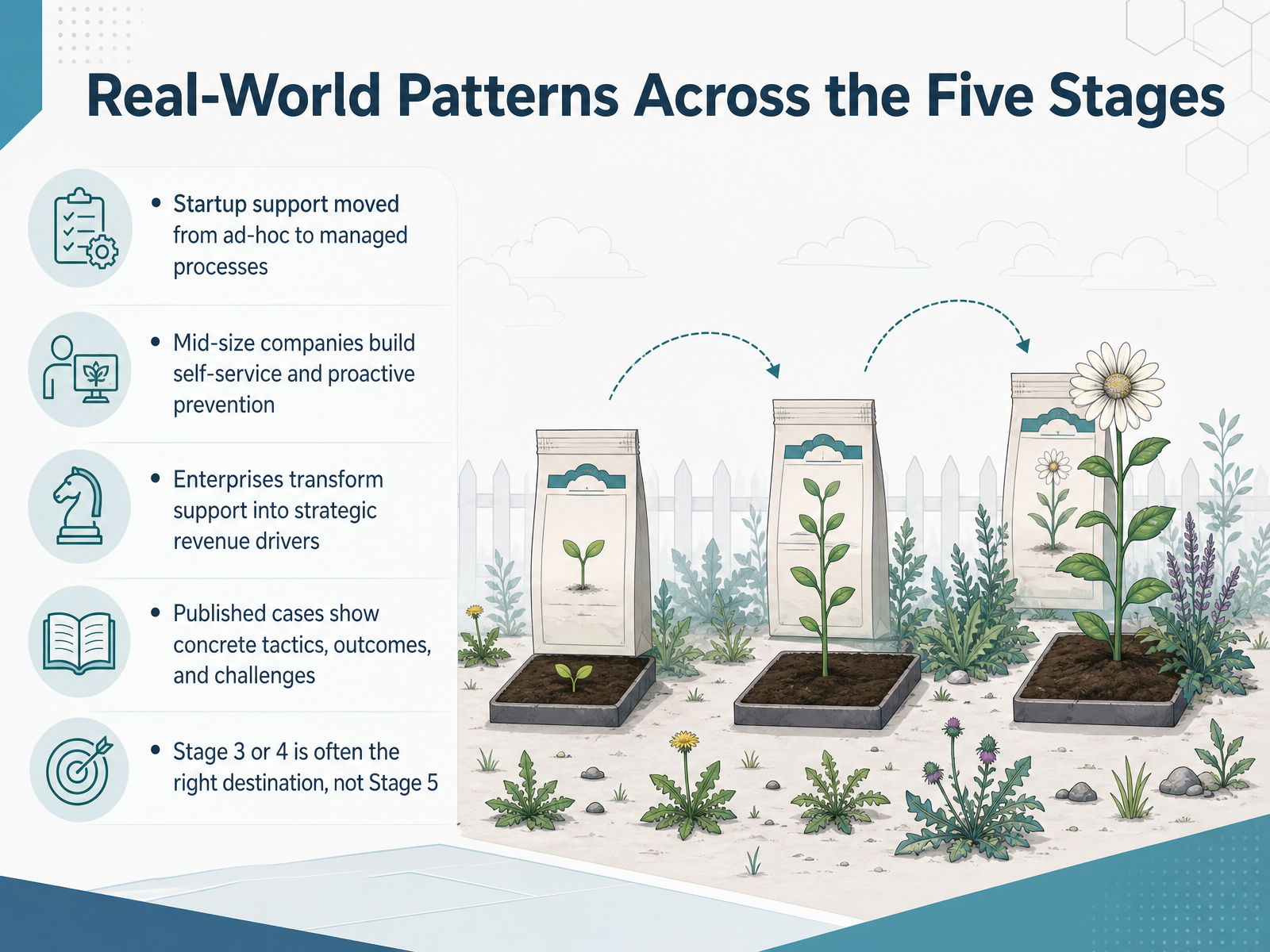
 - 11Real-World Patterns Across the Five StagesThese maturity models aren't theoretical. Real companies follow clear patterns as they progress. A startup usually moves from chaotic, reactive support into stage two, where processes get documented and some order emerges. The bigger leap happens when mid-size companies invest in their own knowledge base and build out self-service. They shift focus from fixing issues after the fact to preventing them through proactive content and deflection. For enterprises at scale, the game changes entirely. Support stops being purely a cost center and becomes a strategic revenue driver. We see this in published case studies from companies like ServiceNow and ADP where senior leaders invest in maturity to unlock tangible business outcomes. In fact, ADP decoupled revenue growth from support cost growth, expanding margins without cutting staff. That's a powerful result for a board-level conversation. Here is the key takeaway for you. Stage five or six, the fully predictive model, isn't the right goal for everyone. It demands significant investment in data science and emerging tech. For most organizations, landing solidly in stage three or four, managed or strategic, delivers the best return on effort. It's about reaching a structured, efficient, and proactive level that fits your scale and your customer needs. Now, let's talk about translating this maturity into a business case your CFO will approve.
 supportlogic.com2 min
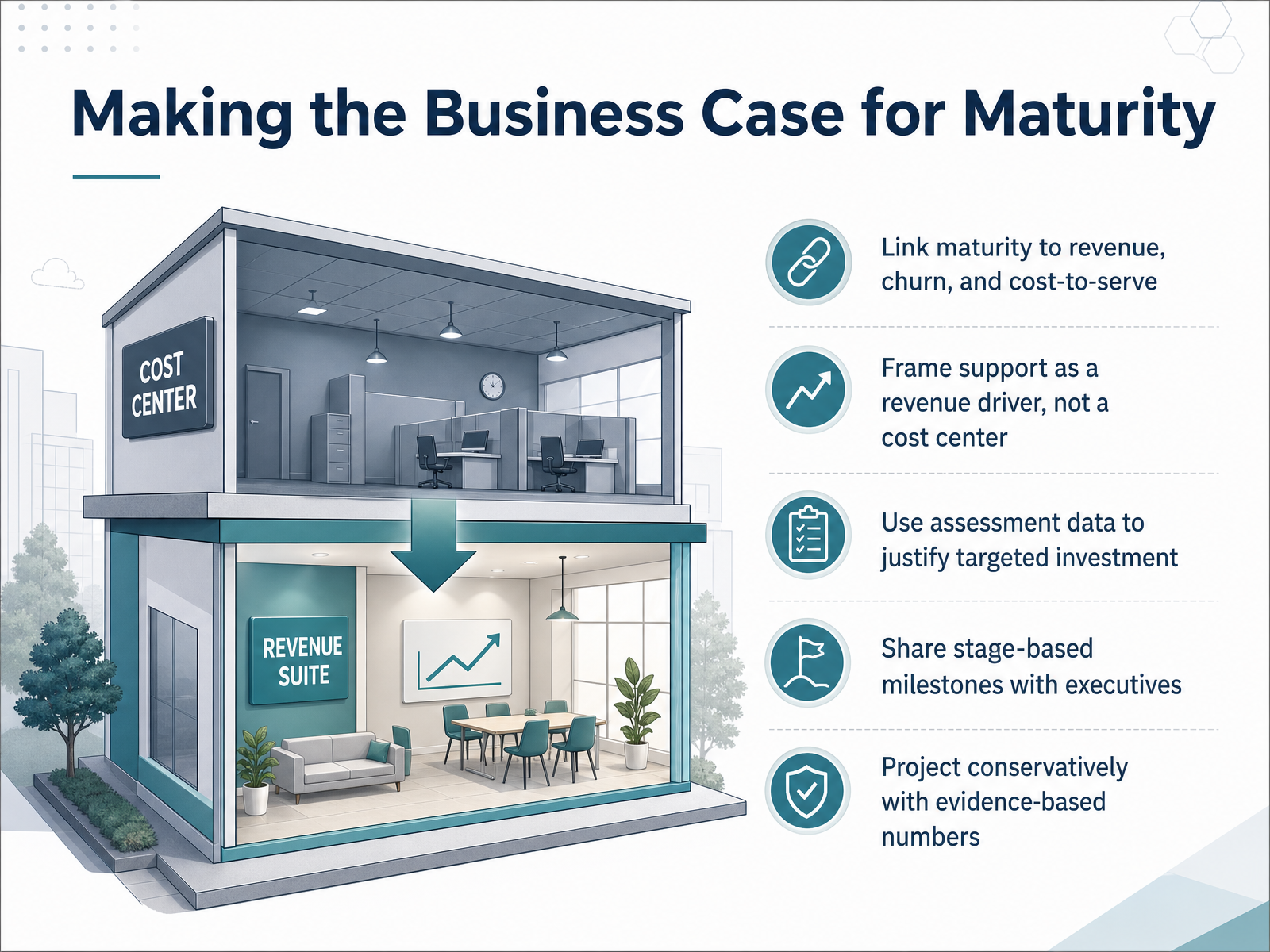
 - 12Making the Business Case for MaturityLet's talk about how you actually win the budget for this work, because maturity frameworks live or die on executive sponsorship. The core move is to link maturity directly to revenue, churn, and cost to serve. That means reframing support as a revenue driver, not a cost center. When you prevent churn or shorten time to resolution, you are protecting recurring revenue. Your assessment data gives you the evidence. Use it to show exactly where friction lives, where repeats happen, and where investment will remove the most cost. Executives do not respond to process elegance. They respond to stage-based milestones they can track. So show them a clear path, from reactive to proactive, with the expected financial impact. And here is the critical part, project conservatively. Use evidence-based numbers, not heroic assumptions. An honest projection builds credibility. An inflated one gets your next proposal ignored. Nail this, and you stop asking for headcount and start directing capital. Now, let's turn to what happens when support teams stagnate, and why that is a system problem as much as a human one.
 cbtw.techaventus.comfixate.nu+22 min
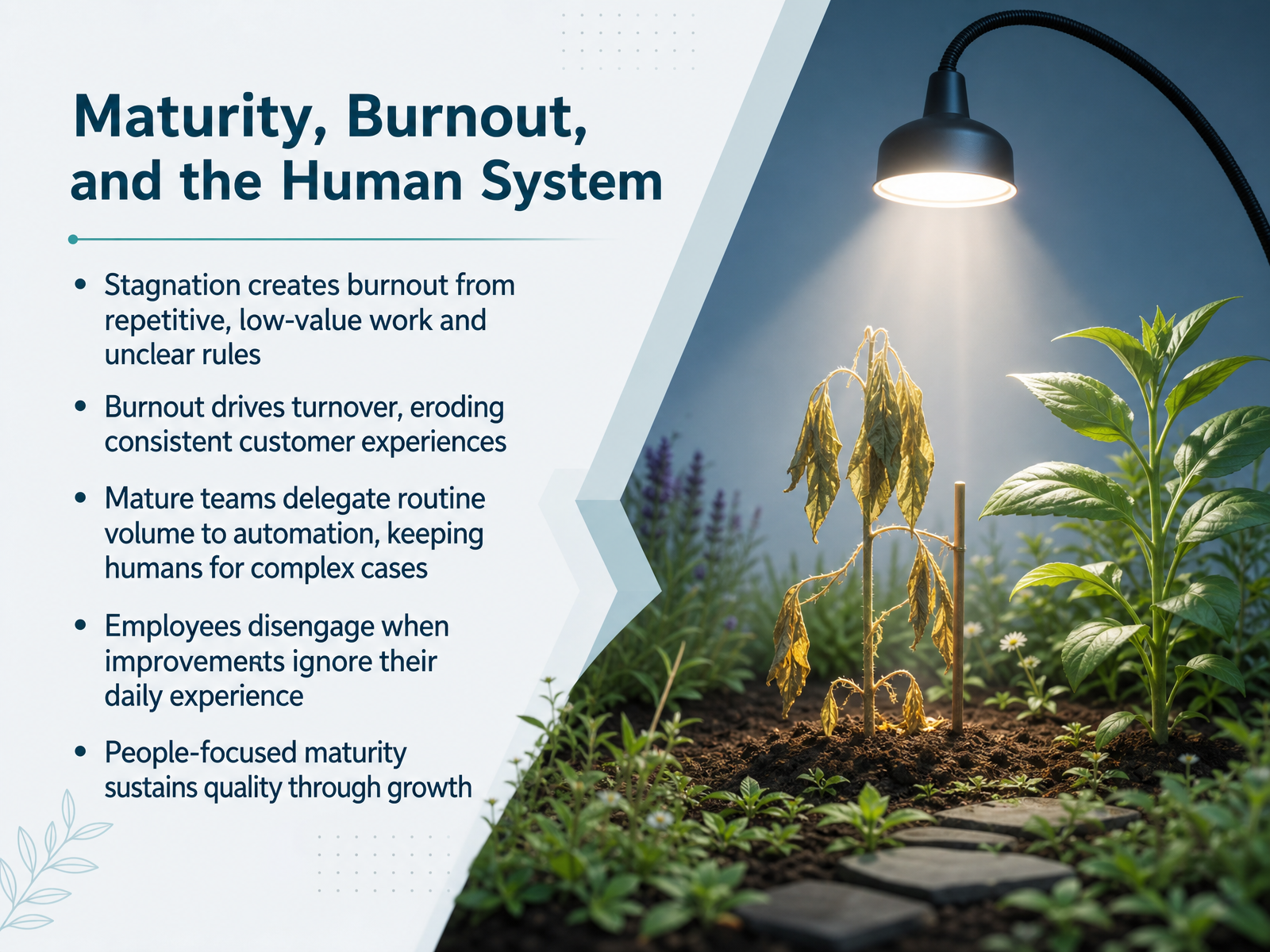
 - 13Maturity, Burnout, and the Human SystemLet’s talk about what maturity really costs if you ignore the human side. Stagnation isn’t just a plateau—it’s the quiet trigger for burnout. When your team spends most of their day repeating low-value work, answering the same questions, or guessing at unclear rules, the work itself drains them. And burnout doesn’t stay contained. It drives turnover, and every departure erodes the consistency your customers rely on. Seasoned agents leave; new hires take months to rebuild that judgment. Mature teams know this. They delegate routine volume to automation, not to offload responsibility, but to free their people for the complex cases that need empathy and problem-solving. That’s where humans add real value. But here’s the catch—your improvements will fail if they ignore the daily experience of the people delivering them. If you redesign processes without asking agents what’s actually breaking, you’ll lose their trust and their engagement. People-focused maturity means building growth paths, recognizing judgment work, and measuring success by quality, not just speed. That’s how you sustain quality and keep your best people. So as you plan your next maturity step, keep the human system at the center. Next, let’s look at the next steps your team can take to put these principles into action.
 cbtw.techaventus.comfixate.nu+22 min
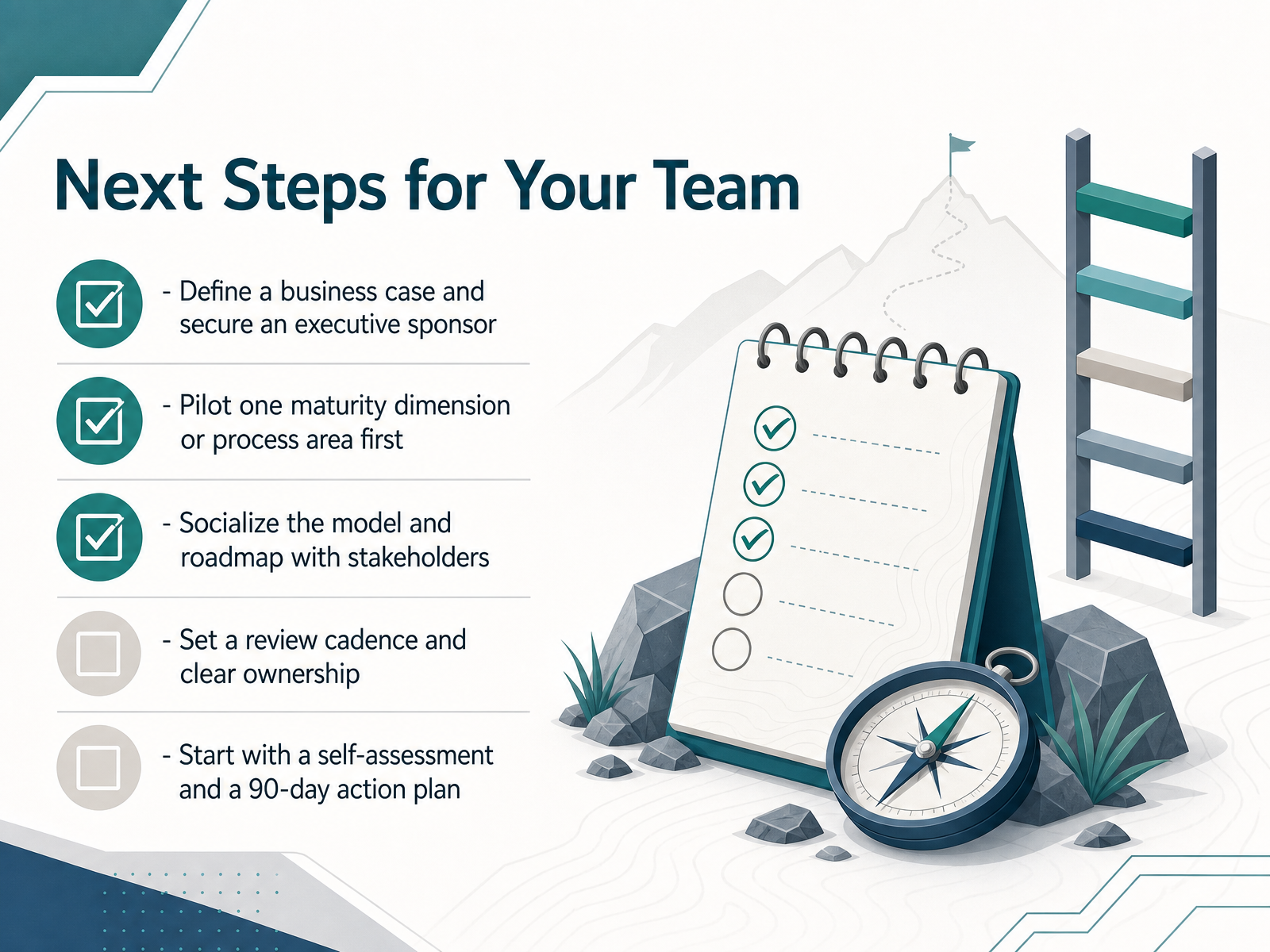
 - 14Next Steps for Your TeamWe've covered the landscape, and now it's about action. Defining a business case and securing an executive sponsor gives your maturity initiative the mandate it needs to survive contact with reality. Don't boil the ocean. Pilot one maturity dimension or process area first. That might be knowledge management or first contact resolution, not everything at once. Socialize the model and the roadmap early with stakeholders, whether it's operations, product, or finance. Their buy-in is what turns an assessment into a movement. Set a clear review cadence. Quarterly is often right, and make sure ownership is explicit, not shared into vagueness. Start with a self-assessment to capture honest current-state scores, and then compress your focus into a ninety-day action plan with three or four concrete initiatives. Realistic and measurable beats ambitious and forgotten. As you close out, remember that maturity is a direction, not a destination. You've got the framework, you know the stages, and the next step is yours to take. Thanks for your focus today. Go run that pilot, and let the results speak.
 qualtrics.comencompass-cx.comfranckardourel.com+21 min
Take the deck with you
Download this course as a file — free, no sign-up needed.
- PDF handoutEvery slide page, ready to print or share.15 pages · 3.7 MBDownload
- Narrated PowerPointThe deck that presents itself — every slide carries the digital human's narration video.15 pages · 26.9 MBDownload
- PowerPoint slidesThe full deck as a .pptx — open it in PowerPoint, Keynote, or Google Slides.15 pages · 3.6 MBDownload
Free to use in your own training — please keep the PersonWise credit page at the end.
Have your own deck? Turn it into a course
Sources consulted
Web sources consulted while building this course.
- The Definitive Support Experience Maturity Model — supportlogic.com
- Support Experience Maturity Model - SupportLogic — supportlogic.com
- Service maturity: How developed is your customer service? — leafworks.de
- Make this Customer Service Maturity Model Your Roadmap — johnnygrow.com
- The 4 stages of customer experience maturity and how to assess them — talkdesk.com
- How to Fix a Stuck Customer Service Team: Start with the System - APAC — cbtw.tech
- Why More Support Agents Won't Fix Customer Service Bottlenecks - Aventus — aventus.com
- Why Customer Support Gets Worse As Companies Grow | FIXATE — fixate.nu
- Why Customer Support Form Over Substance Is a Systems Problem - — consultevo.com
- The 11 Critical Problems Killing Your Support Team (And What To Do About Them) | by Kathrine Ianchenko | Feb, 2026 | Medium — medium.com
- https://www.crmxchange.com/uploadedFiles/Featured_White_Papers/PDF/CXO0062A_ICMI_White_paper_CX_Maturity_Model_0318.pdf — crmxchange.com
- Customer Experience Maturity Model v2.0.0 (GB962B) — tmforum.org
- Customer Experience Maturity Model: The 5 Levels — customerexperience.io
- The Service Excellence Maturity Model — page.topdesk.com
- Customer Service KPIs by Team Maturity: What to Track at Each Stage | Blog | Perspective AI — getperspective.ai
- Support Ops Maturity: Fixes by Stage — supportbench.com
- XMI_Assessment_CXMaturity — qualtrics.com
- Customer Experience Management (CXM) Maturity Assessment Test — encompass-cx.com
- CX Maturity Self-Assessment — franckardourel.com
- Customer Support and Service Delivery Plan Kit — artofservice.com.au