Brand Purpose Strategy: Goals and Tradeoffs
Begin
14 pages · ~28 min
Brand Purpose Strategy: Goals and Tradeoffs
Learn how to define a brand purpose strategy by evaluating goals, making strategic choices, and navigating tradeoffs for lasting impact.
What you’ll learn
- 01Brand Purpose Strategy: Goals, Choices, and TradeoffsWelcome. If you lead a brand, you already know that purpose is no longer a slogan or a CSR sideline. It is a strategic problem. And like any strategy problem, it comes down to three things: goals, choices, and tradeoffs. In this training, we will treat purpose as a business lever. We will clarify what your purpose must actually do for your company, how to anchor it in a way that survives scrutiny, and what it will genuinely cost you. Because make no mistake, a purpose that costs nothing is worth nothing. We will use practical frameworks and clear decision criteria, so you can walk away with a purpose that guides real decisions, not just marketing campaigns. Let's get to work. Next, we will look at why purpose matters more now than ever before.globenewswire.comhavasredgroup.comdeloitte.com+21 min
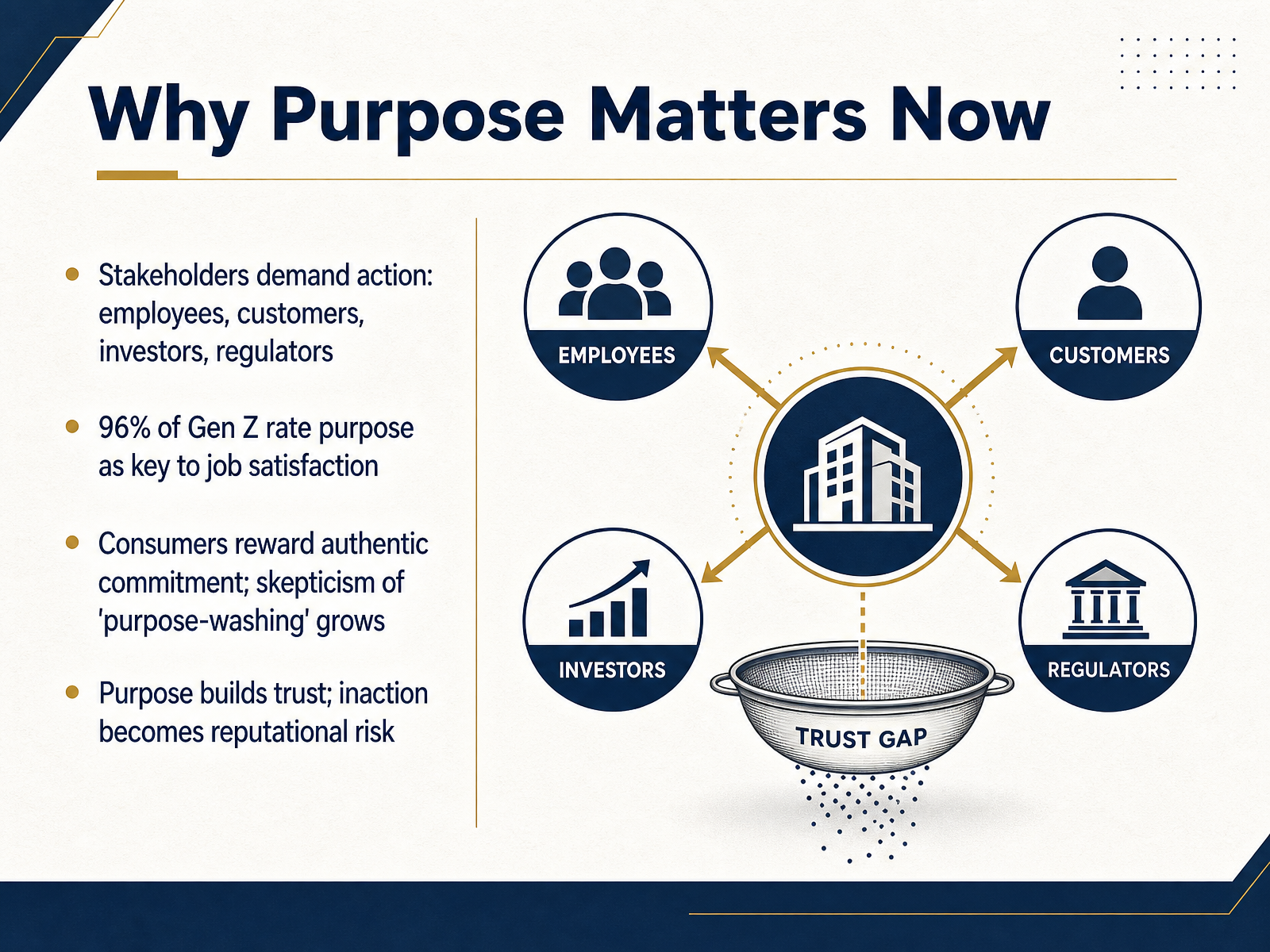
- 02Why Purpose Matters NowLet's talk about why purpose has moved from a nice-to-have to a core business imperative. The landscape has shifted. Employees, customers, investors, and regulators are all demanding action, not just words. This isn't abstract. For the next generation, purpose is a deciding factor. Ninety-six percent of Gen Z say purpose is key to their job satisfaction. And nearly forty percent have actually rejected a role or project based on their personal ethics. What they do is as loud as what they say. They vote with their feet. Your customers are paying attention too. They reward authentic commitment, but they are also highly skeptical of purpose-washing. They can spot a hollow promise. In fact, consumers are nearly three times more likely to trust companies they believe are genuinely making a positive difference. So consider this: building trust through authentic purpose is your greatest opportunity, and inaction is rapidly becoming a reputational risk. The data is clear. Purpose builds trust, and trust is the license to operate. To put it simply, silence is no longer safe. This brings us to a critical next step: clearing up the confusion between purpose, mission, vision, and values, so we can harness this power effectively.
 globenewswire.comhavasredgroup.comdeloitte.com+22 min
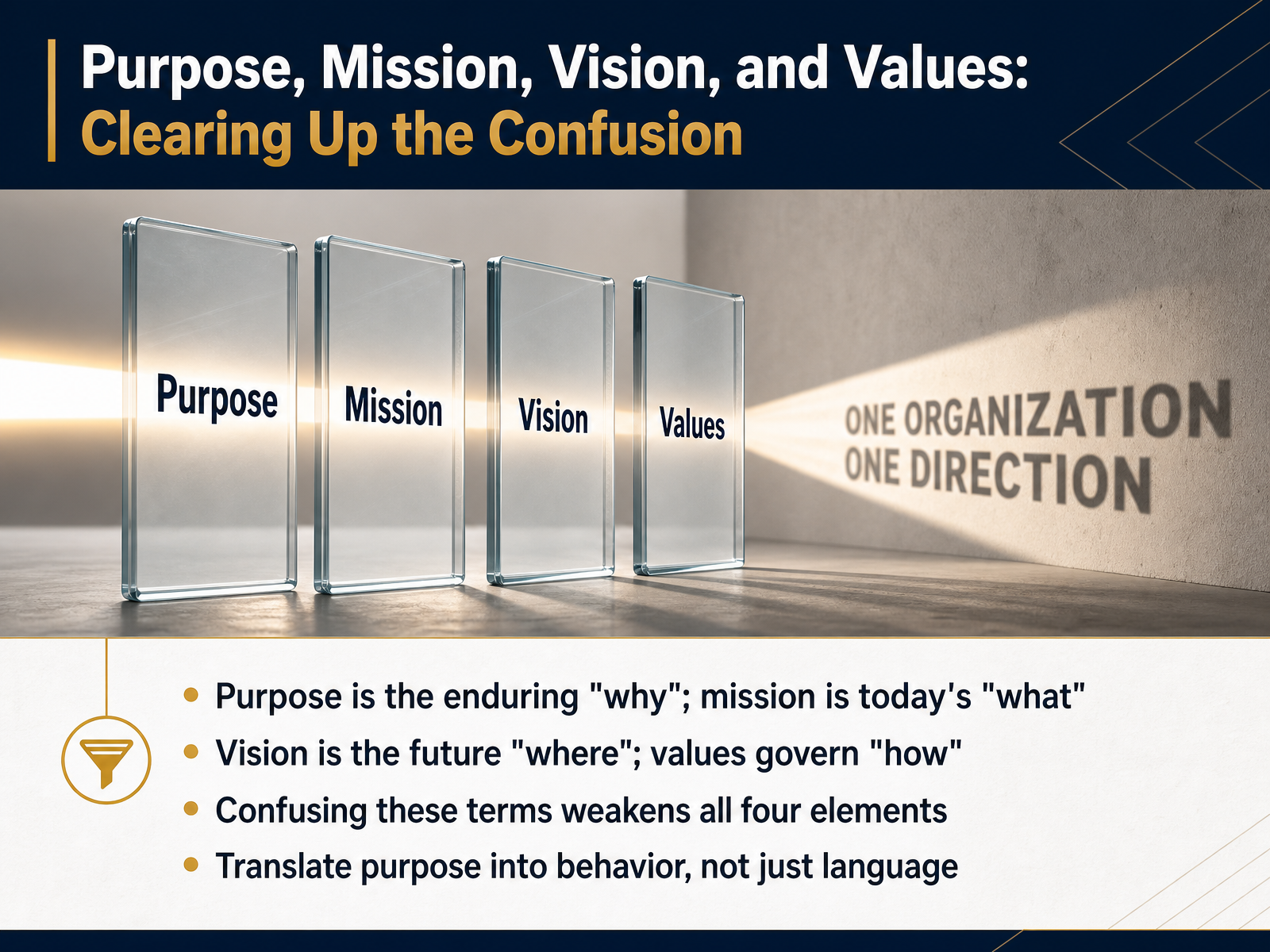
 - 03Purpose, Mission, Vision, and Values: Clearing Up the ConfusionLet's clear up a common source of tension. Purpose, mission, vision, and values are four different tools. Use them interchangeably, and you weaken all four. Purpose is your enduring why. It's the reason you exist beyond profit, and it stays stable for decades. Mission is today's what. It's the operational focus, and it can change as your business evolves. Vision is the where. It's the future state you're building toward, the north star that pulls the organization forward. Values govern the how. They are the non-negotiable principles that guide daily behavior. Here's the leadership challenge: defining these clearly is step one, but translating that clarity into behavior is the real work. A purpose that doesn't influence decisions is just decoration. Test it against your last three major choices. Did the purpose shape the outcome? If not, you have a tagline, not a strategy. Next, we'll look at how purpose acts as a strategic filter, not just a campaign theme.
 vivaldigroup.comwefirstbranding.combrandvelle.com+22 min
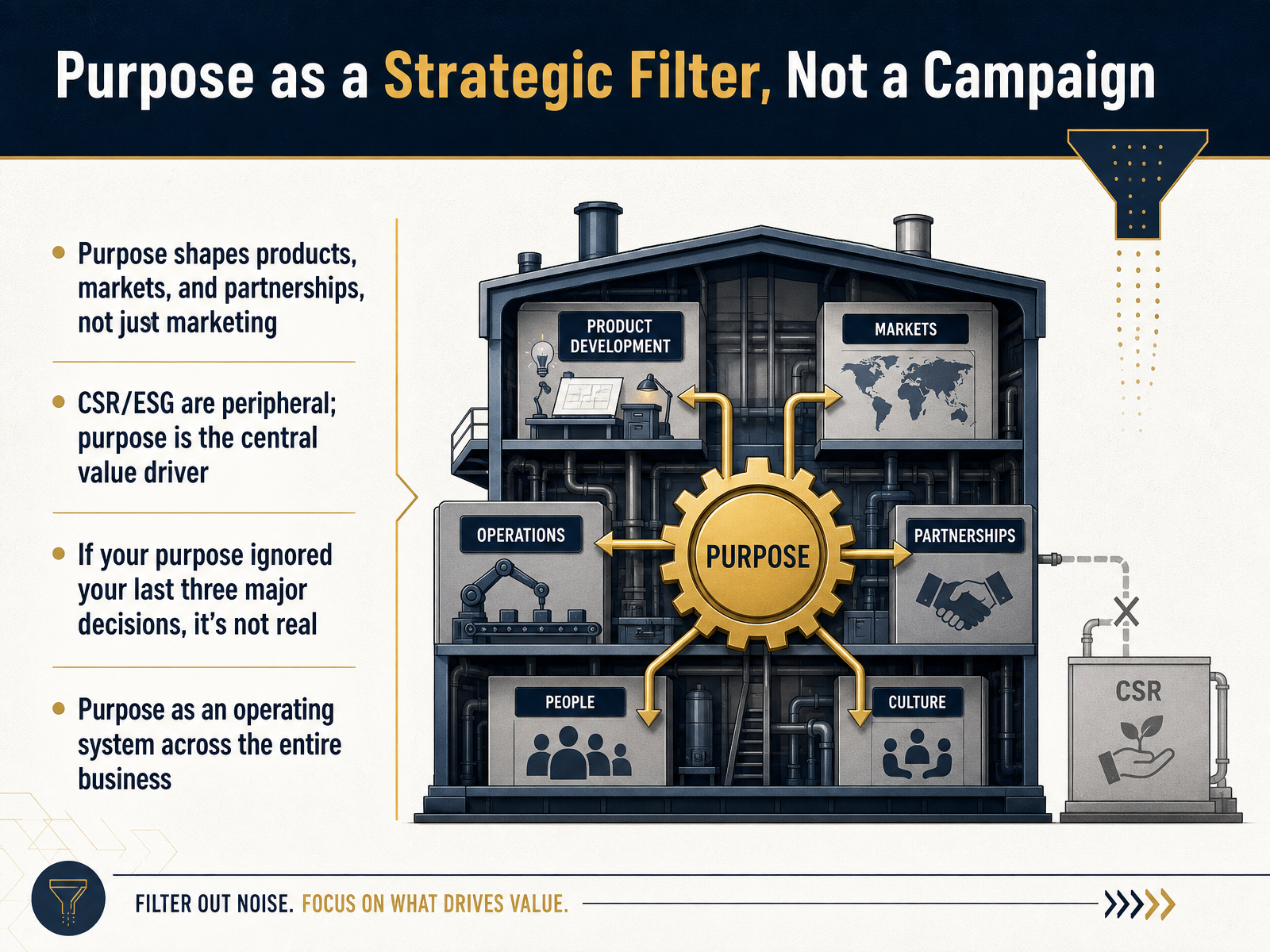
 - 04Purpose as a Strategic Filter, Not a CampaignLet’s shift how we think about purpose. It’s not a campaign. It’s a strategic filter. It should shape your products, your markets, your partnerships. Not just your marketing. CSR and ESG are important, but they’re often peripheral. They’re compliance-driven, risk-mitigation activities. Purpose is the central value driver. It lives in your P&L, not just in the sustainability appendix of your annual report. Here’s the practical test. If your purpose didn’t influence your last three major decisions, it isn’t your purpose. It’s a poster. Purpose is an operating system. It guides product development. It tells you which partnerships to refuse. It sets the boundaries for which markets you enter. So ask yourself this: are you using purpose as a filter for hard choices, or as a garnish for your brand story? That answer determines whether you have a strategy or a slogan. And with that, let’s look at where purpose actually creates measurable business value.
 vivaldigroup.comwefirstbranding.combrandvelle.com+21 min
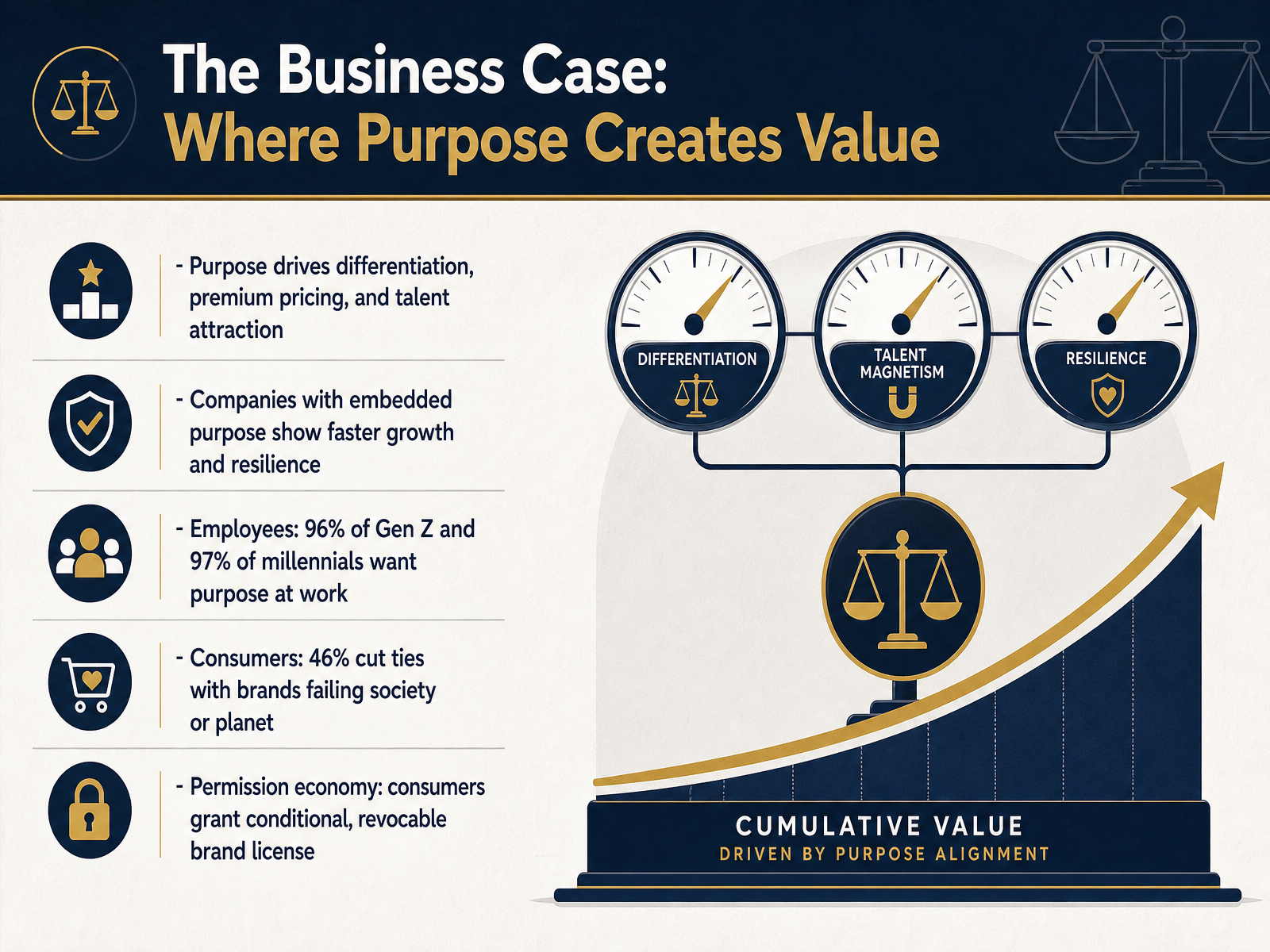
 - 05The Business Case: Where Purpose Creates ValueNow let's make the business case for brand purpose. Purpose isn't a soft ideal; it's a performance lever. Companies with deeply embedded purpose show faster growth and greater resilience. They also command premium pricing, because consumers reward brands that make a positive difference. Consider the talent side. Ninety-six percent of Gen Z and ninety-seven percent of millennials say purpose at work matters to their satisfaction and well-being. Many have even rejected employers over values. This is a talent filter, not a perk. Then look at consumers. Forty-six percent have cut ties with brands they see failing society or the planet. That's nearly half your customer base, ready to walk. We're in a permission economy now. Consumers grant brands a conditional, revocable license to act on their behalf. One misstep and that license is pulled. So purpose isn't a nice-to-have. It's the license to operate and grow. Next, we'll define your goals and what you want purpose to achieve.
 globenewswire.comhavasredgroup.comdeloitte.com+21 min
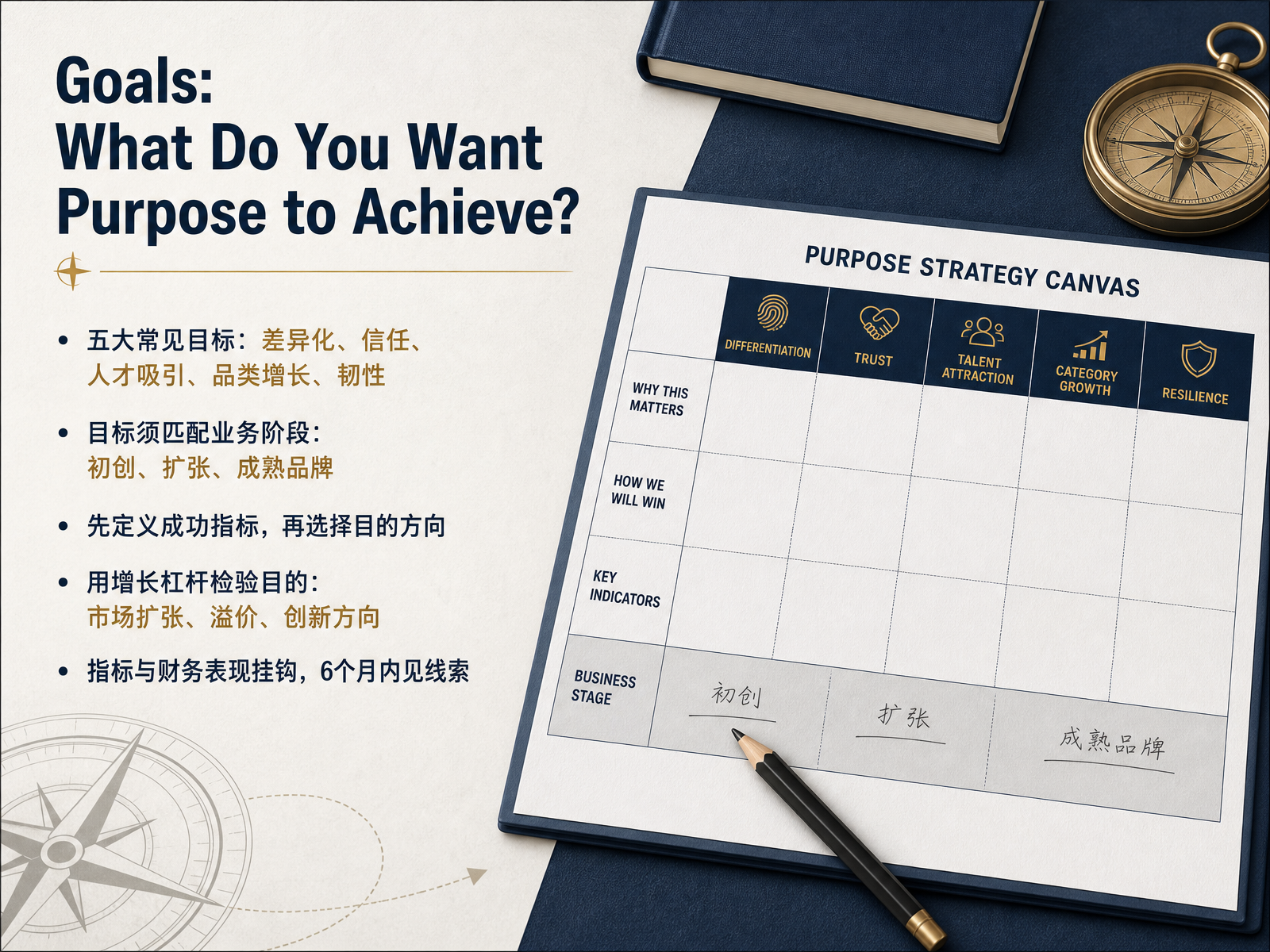
 - 06Goals: What Do You Want Purpose to Achieve?Now let’s talk about goals. What do you actually want your purpose to achieve? There are five common goals: differentiation, trust, talent attraction, category growth, and resilience. But your goal has to match your business stage. A startup needs differentiation to cut through. A scaling brand may lean into talent attraction. A mature brand might focus on resilience or category growth. Before you choose a purpose direction, define what success looks like. Then test your purpose against growth levers. Does it unlock market expansion? Does it justify a premium price? Does it point you toward new innovation? And here’s the discipline: tie your metrics to financial performance. Within six months, you should see early signals—brand sentiment shifts, consideration upticks, or pipeline movement. If you can’t draw a line from purpose to revenue in that window, your measurement framework needs a redesign. Purpose with a clear goal is a growth engine. Purpose without one is just a slogan. Next, let’s look at how to set metrics that make purpose real.
 marketingweek.comthedrum.comthestrategysignal.com+22 min
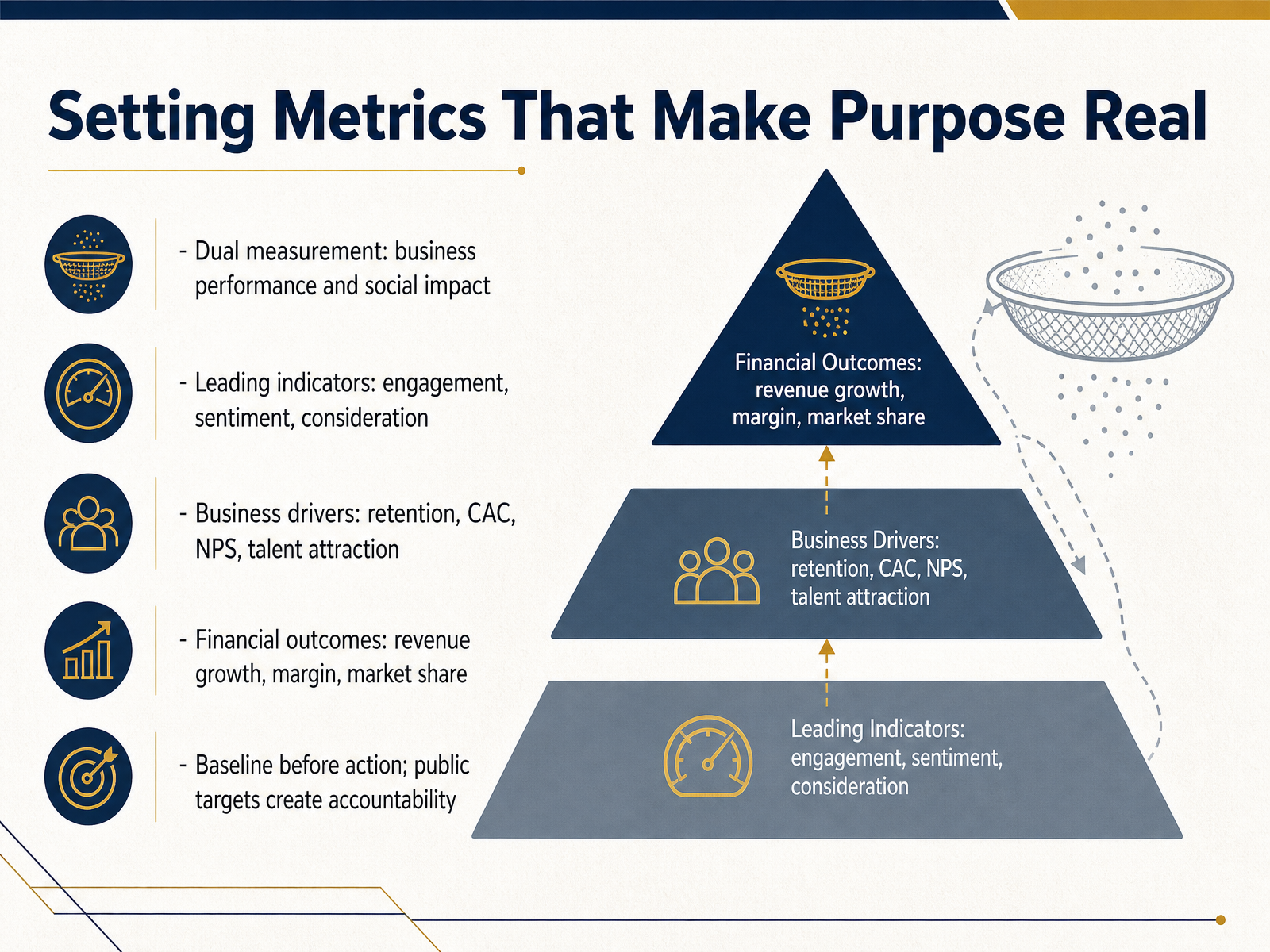
 - 07Setting Metrics That Make Purpose RealNow let's talk about setting metrics that make purpose real. The goal is to measure both business performance and social impact. Start with leading indicators—engagement, sentiment, consideration. These are early signals that tell you if the purpose is breaking through. Then move to business drivers: retention, customer acquisition cost, net promoter score, and talent attraction. These connect purpose to operational strength. Finally, track financial outcomes—revenue growth, margin expansion, and market share. But critical point: establish a baseline before you act. You cannot prove change without a starting point. And once you have a number, go public with it. Public targets create accountability. They focus the organization and give you a story to tell when you hit them. As one expert put it, once you put a number out there, the entire company orients toward achieving it. For example, Lifebuoy reallocated influencer budget to real-world impact and hit concrete outcomes—schools rebuilt, health check-ups delivered—while still tracking reach and engagement. That is the dual scorecard. If you cannot connect purpose to revenue within two reporting cycles, redesign your measurement. And when you meet a commitment, celebrate it. That is proof, not just promise. Next, we'll explore finding a credible purpose territory.
 marketingweek.comthedrum.comthestrategysignal.com+21 min
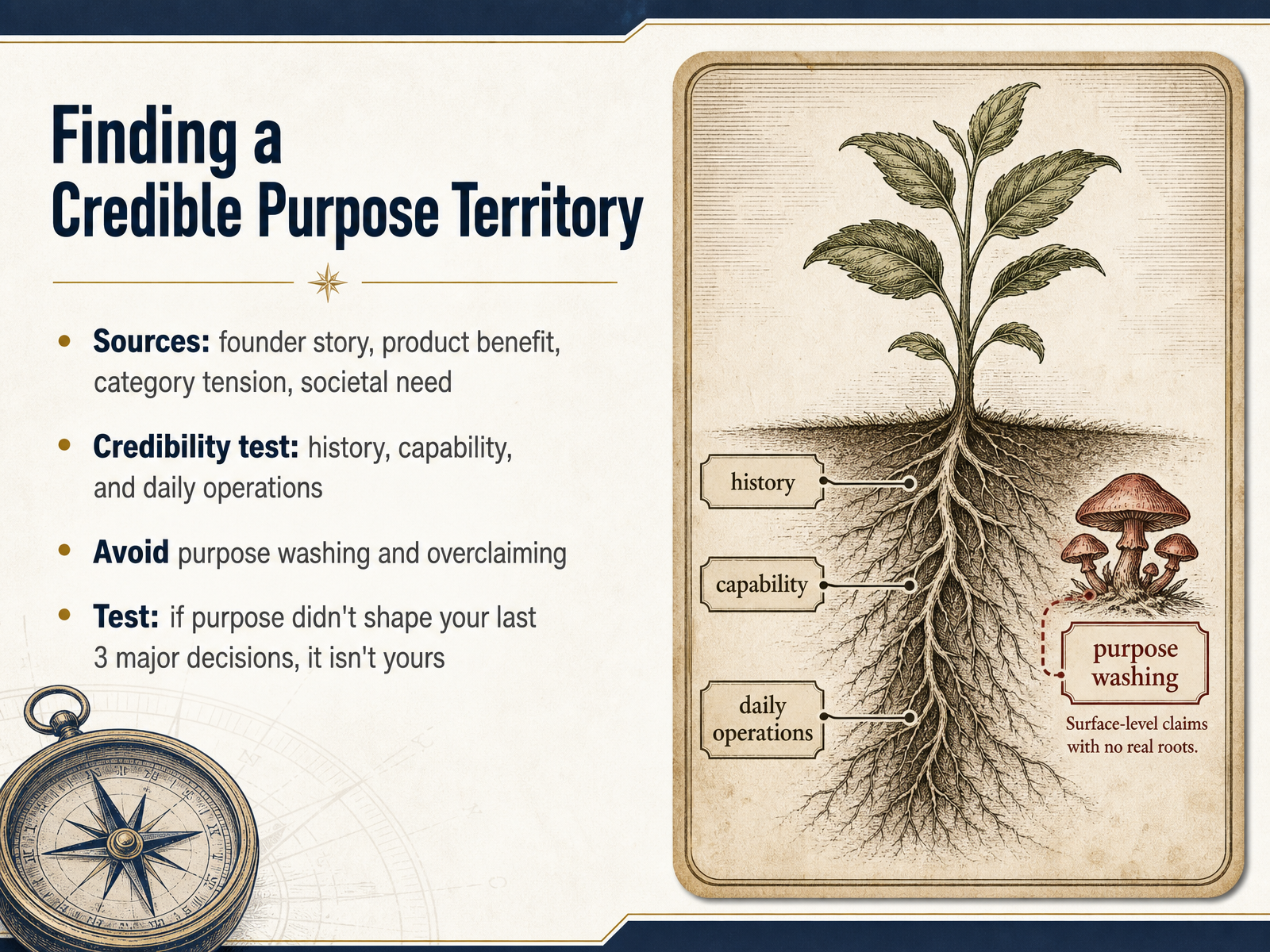
 - 08Finding a Credible Purpose TerritoryNow let's talk about where purpose actually comes from — and how to know if yours is real. Purpose isn't invented in a workshop. It's excavated from four sources: the founder's story, a core product benefit, a tension in the category you serve, or a genuine societal need you're positioned to address. One of these will anchor you. Now, here's the credibility test. Does your history support it? Do your capabilities back it up? Does it show up in your daily operations? If the answer to any of those is no, you don't have a purpose. You have a slogan. And that's dangerous. Purpose washing is the fastest way to lose consumer trust — the gap between what you claim and what you do will be exposed. So use the litmus test: if your purpose didn't shape your last three major decisions, it isn't yours. It's decoration. Next, we'll look at the choices — where to anchor your purpose in product, pricing, people, and partnerships.
 vivaldigroup.comwefirstbranding.combrandvelle.com+22 min
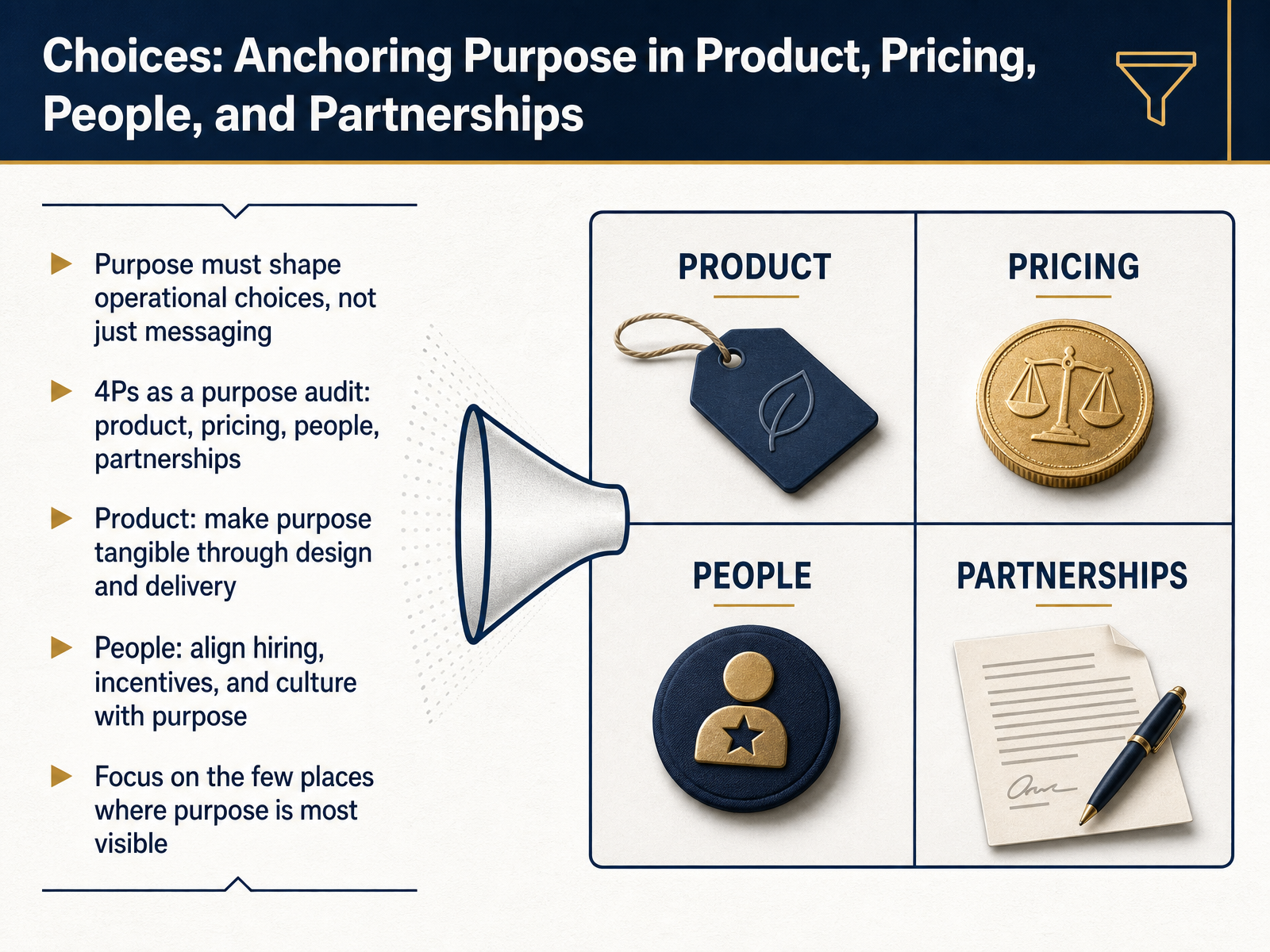
 - 09Choices: Anchoring Purpose in Product, Pricing, People, and PartnershipsPurpose must shape operational choices, not just your messaging. Use the four Ps as a purpose audit: product, pricing, people, and partnerships. Start with product. Make purpose tangible through design and delivery. Dove built its entire Real Beauty platform on a product that celebrated natural skin, and it worked because the product itself delivered on that promise. Then look at people. Align hiring, incentives, and culture with your purpose. If your team is measured only on short-term sales, your purpose will stay a poster on the wall. Partnerships matter, too. PepsiCo tied its brands to football culture globally and activated locally, turning a simple sponsorship into a growth engine. But here is the discipline: focus on the few places where purpose is most visible. You cannot be everywhere. Choose the product lines, the hiring criteria, and the partner relationships where your purpose creates real proof. That is where credibility is built, and where your strategy becomes undeniable. So as you move forward, get ready to weigh the tradeoffs: what you give up, and when you say no.
 marketingweek.comthedrum.comthestrategysignal.com+22 min
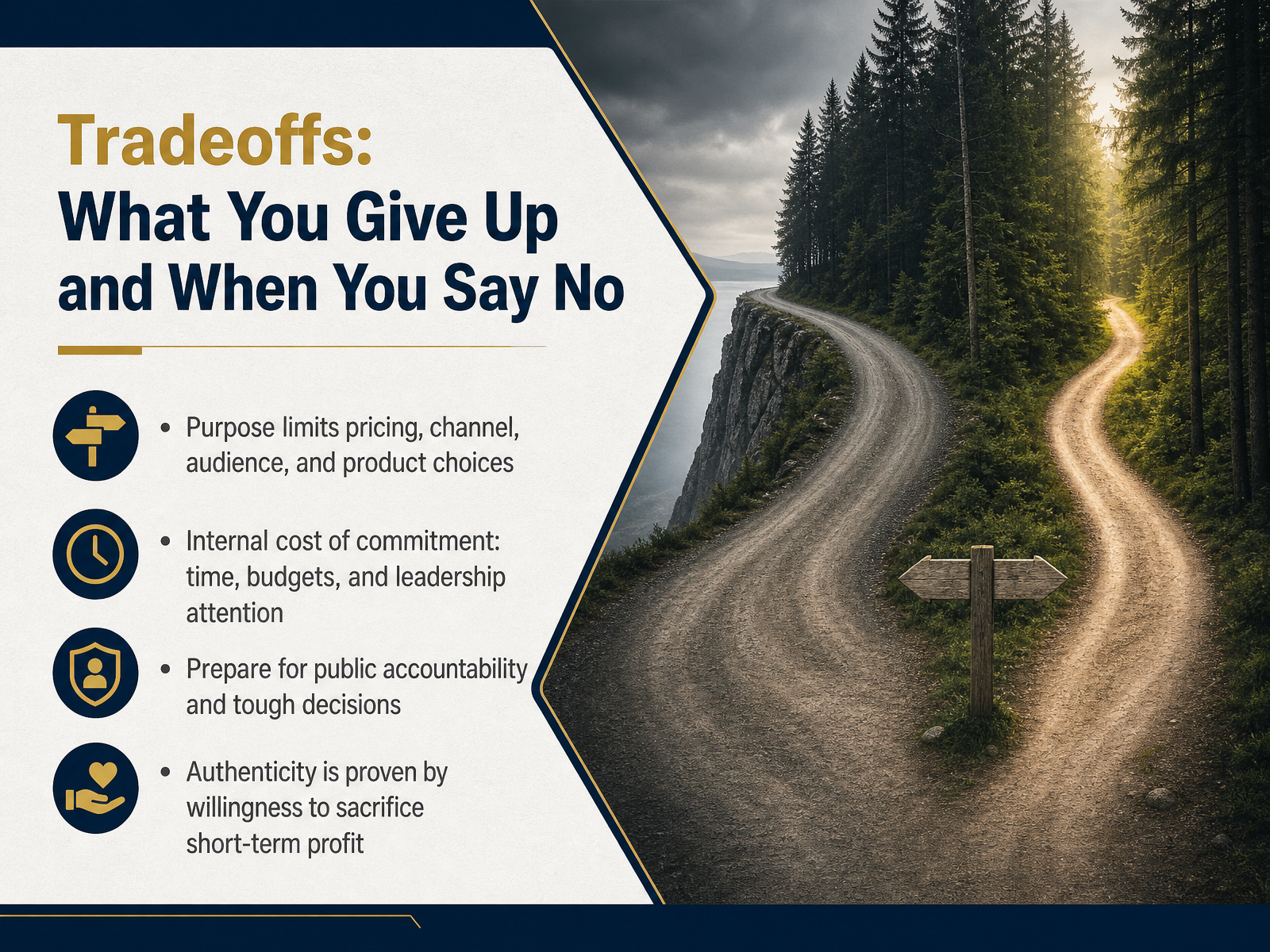
 - 10Tradeoffs: What You Give Up and When You Say NoLet’s talk about the real cost of purpose, because purpose is not free. It constrains your pricing, your channels, your audience, and even your product line. Every yes to a purpose is a no to something else. And that’s exactly how it should be. Internally, this commitment consumes time, budgets, and leadership attention. If you’re not prepared to spend those, your purpose is just decoration. You must also be ready for public accountability. The moment you stake a claim, your decisions will be scrutinized, and people will find inconsistencies. Authenticity is proven by your willingness to sacrifice short-term profit. Look at CVS. They walked away from two billion dollars in tobacco revenue to stand behind their health mission. Within five years, they earned it back, and their credibility was unmatched. So ask yourself, what are you willing to give up? The answer defines your brand far more than any mission statement. Now, let’s look at real case studies in purpose tradeoffs.
 doi.orgkcl.ac.ukjournal.unesa.ac.id+22 min
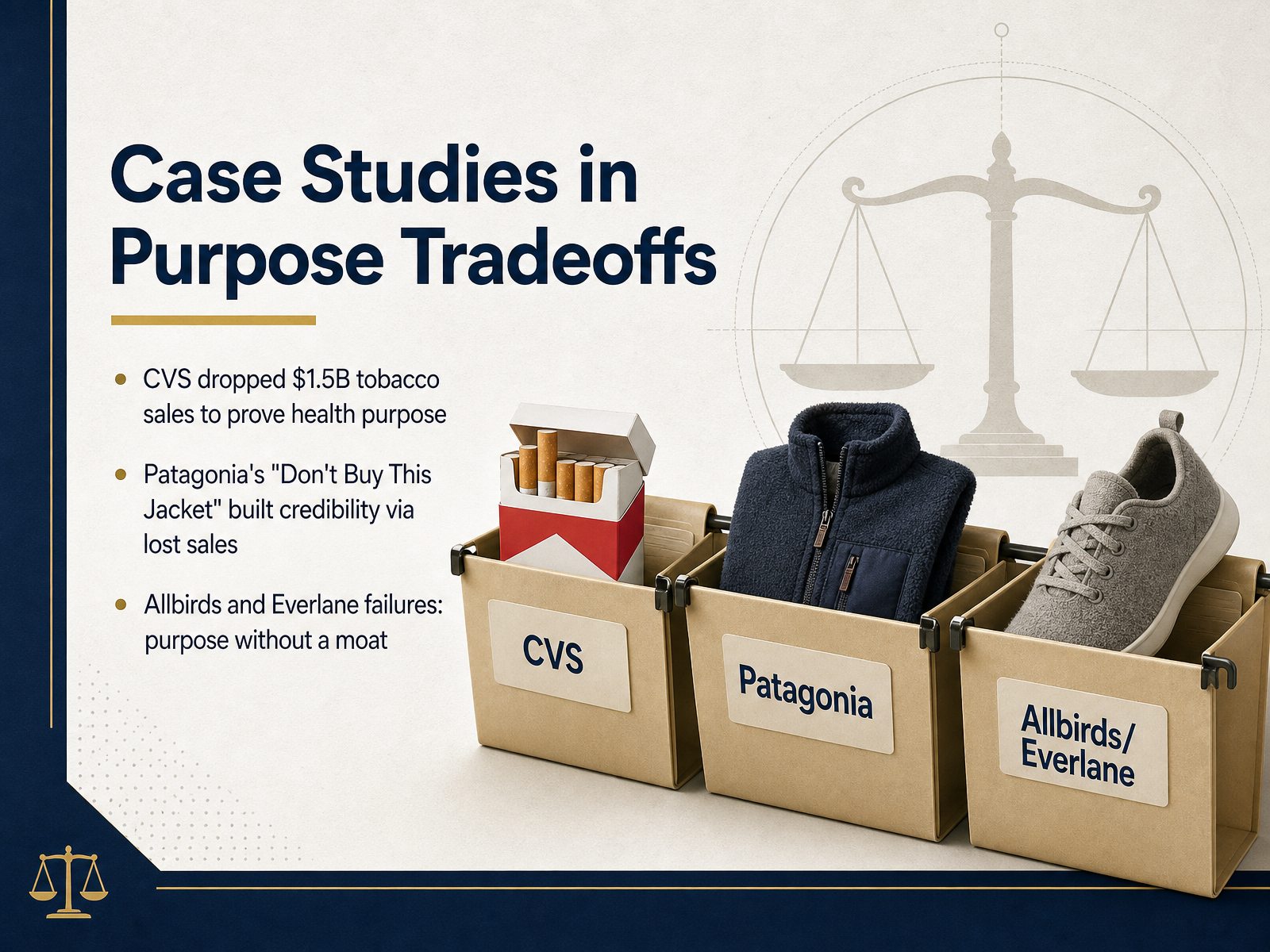
 - 11Case Studies in Purpose TradeoffsThree case studies show why these tradeoffs decide who wins and who loses. CVS walked away from one point five billion dollars in tobacco sales to prove its health purpose. The stock dipped, Wall Street winced. Within five years, the revenue came back, and the top line has since doubled. That is the willingness to lose, paid back in trust. Patagonia ran its famous Don't Buy This Jacket ad on Black Friday. It was the opposite of persuasion. Revenue grew thirty percent the following year. But that only worked because the brand was structurally built to mean it. Now look at Allbirds and Everlane. Purpose alone, without a moat, collapses. Allbirds sold its footwear for thirty nine million after a four billion valuation. Everlane sold to Shein after huge debt. Sustainability was their story, but never their defense. Their message had no structural cost behind it, so it held no weight. Purpose without structural commitment is not a strategy. It is a decoy. Now, let's turn this into an actionable strategy you can actually run.
 doi.orgkcl.ac.ukjournal.unesa.ac.id+22 min
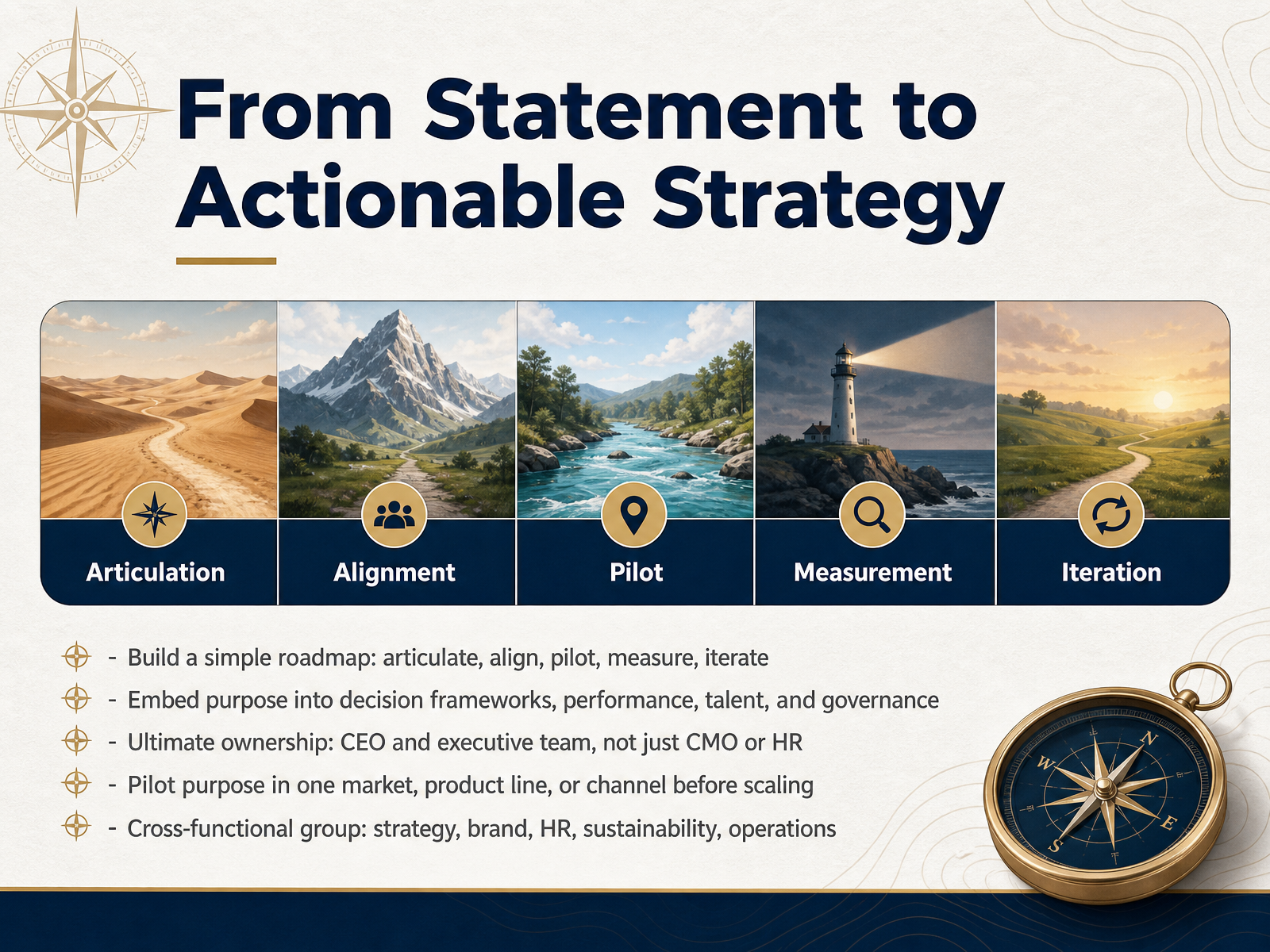
 - 12From Statement to Actionable StrategyA purpose statement is only the starting line. The real work is turning it into an actionable strategy. Build a simple roadmap: articulate, align, pilot, measure, and iterate. Do not boil the ocean. Embed purpose into your decision frameworks, performance systems, talent processes, and governance. That means investment decisions get filtered through it. Incentives reward it. Hiring looks for it. And the board owns it. Here is the critical point. Ultimate ownership sits with the CEO and the executive team, not the CMO or the HR director. If it lives only in marketing, it is a campaign. If it lives in the C-suite, it is a strategy. Pilot purpose in one market, one product line, or one channel before you scale. Prove the model, gather the data, then expand. And staff a cross-functional group that spans strategy, brand, HR, sustainability, and operations. That is the group that translates your purpose into roadmaps and metrics. When a clear team is accountable, purpose gets operationalized. Now, before you scale, let's look at the common failures that sink purpose initiatives—and how to avoid them.
 vivaldigroup.com1 min
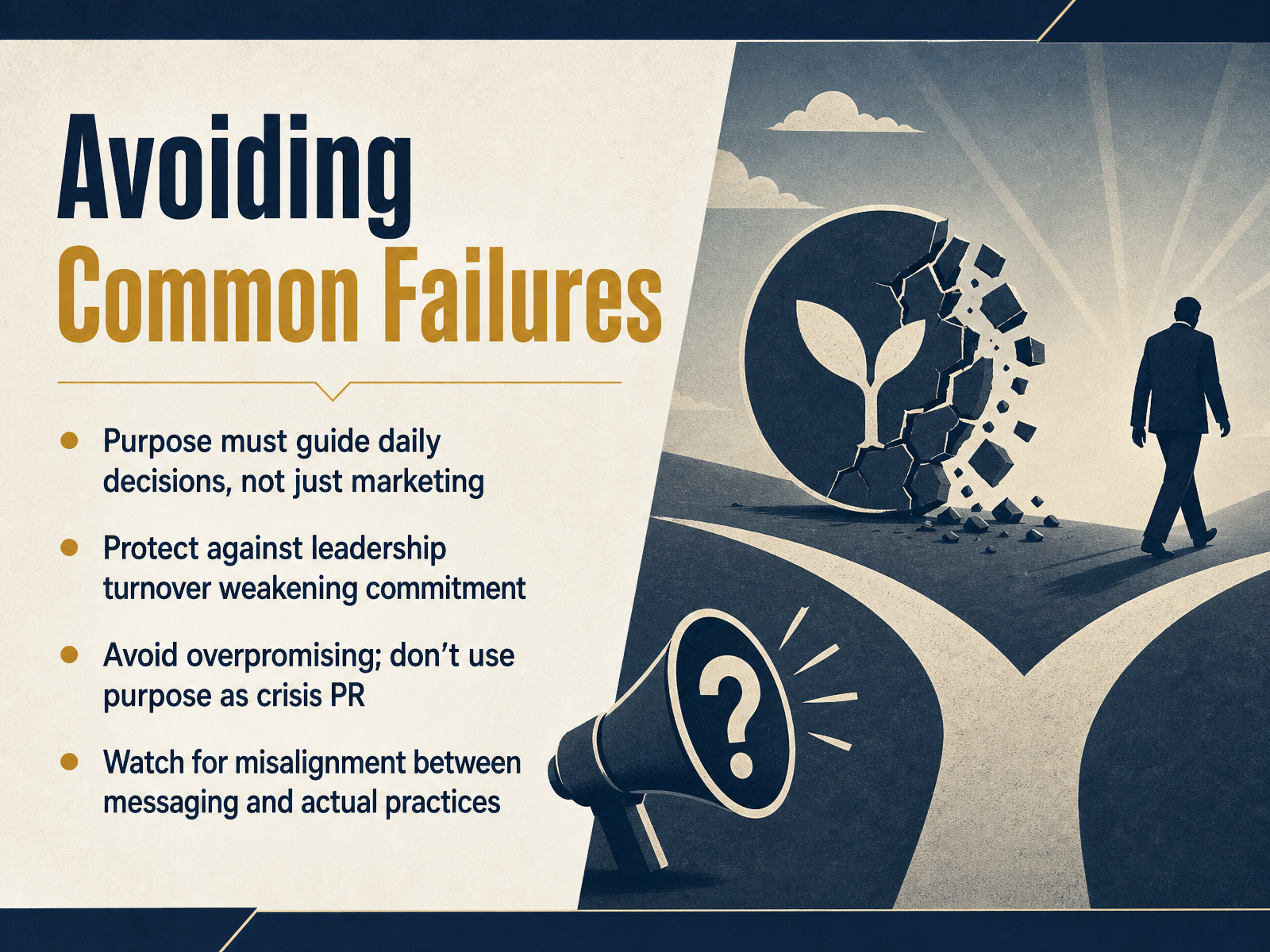
 - 13Avoiding Common FailuresLet's talk about avoiding common failures, because a purpose strategy fails in predictable ways. The first failure is treating purpose as a marketing slogan instead of a decision-making tool. Purpose must guide daily choices, not just campaigns. If your team doesn't ask, "Does this decision serve our purpose?" then your purpose is decoration. Second, protect against leadership turnover. When a champion leaves, commitment can fade. So institutionalize purpose in governance, in KPIs, in onboarding, so it survives any single person. Third, don't overpromise. Never use purpose as crisis PR. Consumers are highly skeptical, and research shows that when they detect a gap between words and actions, they punish the brand. Authenticity only works when you act as you preach. And fourth, watch for misalignment between messaging and actual practices. The fastest way to lose credibility is to claim values you don't operate by. Ensure your supply chain, your hiring, and your product decisions reflect your purpose. Keep it real. Keep it consistent. And purpose becomes your strongest asset. Now, let's look at the tools and next steps you can apply to your brand.
 doi.orgkcl.ac.ukjournal.unesa.ac.id+21 min
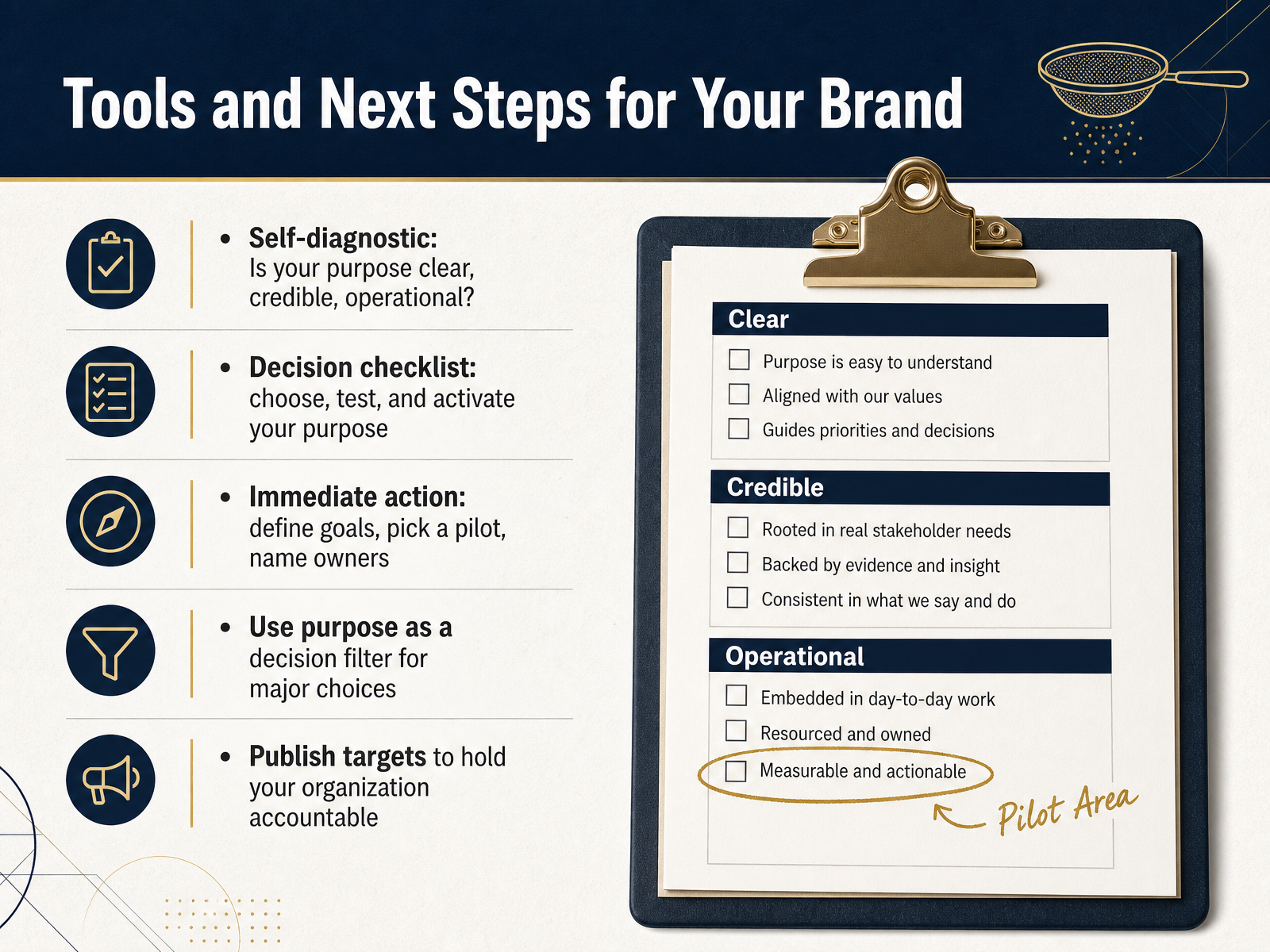
 - 14Tools and Next Steps for Your BrandSo here is where we turn insight into action. Start with a self-diagnostic. Is your purpose clear, credible, and operational? If you cannot point to a decision it changed last quarter, it is not working yet. Use the decision checklist to choose, test, and activate the purpose you have defined. Then, take immediate steps. Define your goals, pick one pilot project, and name the owners. Do not try to cascade everything at once. From here on, use your purpose as a decision filter for major choices. If it does not help you say no, it is just decoration. Finally, publish your targets. Putting a number in public holds your organization accountable and turns intention into a commitment. You now have the tools. The next move is yours. Take the first step this week and start building a brand that means something.
 vivaldigroup.comwefirstbranding.combrandvelle.com+21 min
Take the deck with you
Download this course as a file — free, no sign-up needed.
- PDF handoutEvery slide page, ready to print or share.15 pages · 5.0 MBDownload
- Narrated PowerPointThe deck that presents itself — every slide carries the digital human's narration video.15 pages · 16.0 MBDownload
- PowerPoint slidesThe full deck as a .pptx — open it in PowerPoint, Keynote, or Google Slides.15 pages · 5.0 MBDownload
Free to use in your own training — please keep the PersonWise credit page at the end.
Have your own deck? Turn it into a course
Sources consulted
Web sources consulted while building this course.
- The Benevity State of Corporate Purpose 2026 Report Finds — globenewswire.com
- PURPOSE REIMAGINED: — havasredgroup.com
- 2026 Gen Z and Millennial Survey — deloitte.com
- 2025 EdelmanTrust Barometer: Special Report - Brand Trust, From ... — edelman.com
- FleishmanHillard Unveils 'License to Lead' Research, Revealing a Growing Confidence Gap Between Executives and Stakeholders - FleishmanHillard — fleishmanhillard.com
- What Is Brand Purpose? A Practical Guide for Sceptical Leaders - Vivaldi Group — vivaldigroup.com
- Brand Purpose vs Mission vs Vision Explained - We First — wefirstbranding.com
- Brand foundation | Brandvelle — brandvelle.com
- Brand Purpose: What It Is, What It Isn't, and How to Write One That Holds — marclefton.com
- Brand Strategy Explained: The Framework, Components and Examples (2026 Guide) — Digital Polo Blog — digitalpolo.com
- PepsiCo’s global drinks CMO on why marketing’s 4Ps are ‘changing’ — marketingweek.com
- Inside Lifebuoy's purpose-driven model that mobilized 450 creators for free | The Drum — thedrum.com
- Dove Real Beauty: the purpose-driven strategy playbook — thestrategysignal.com
- Tata Tea's "Jaago Re" Campaign: Purpose-Driven Brand Strategy in a Commoditised Category — markhub24.com
- Porsche Black Mambas Campaign: Lessons in Purpose Marketing — marketingedge.com.ng
- Act as you preach! Authentic brand purpose versus “woke washing’s” impact on brand credibility: The moderating role of cause involvement and consumer skepticism — doi.org
- Purpose-washing — kcl.ac.uk
- Consumer perceptions of brand authenticity: a review of purpose-washing phenomena in branding | BISMA (Bisnis dan Manajemen) — journal.unesa.ac.id
- Act as you preach! Authentic brand purpose versus “woke ... — sciencedirect.com
- Brands Taking a Stand: Authentic Brand Activism or Woke Washing? — journals.sagepub.com