AI in Cybersecurity
Begin
14 pages · ~28 min
AI in Cybersecurity
This training explores how artificial intelligence is applied to cybersecurity, equipping security professionals with the knowledge to leverage AI for threat detection and defense.
What you’ll learn
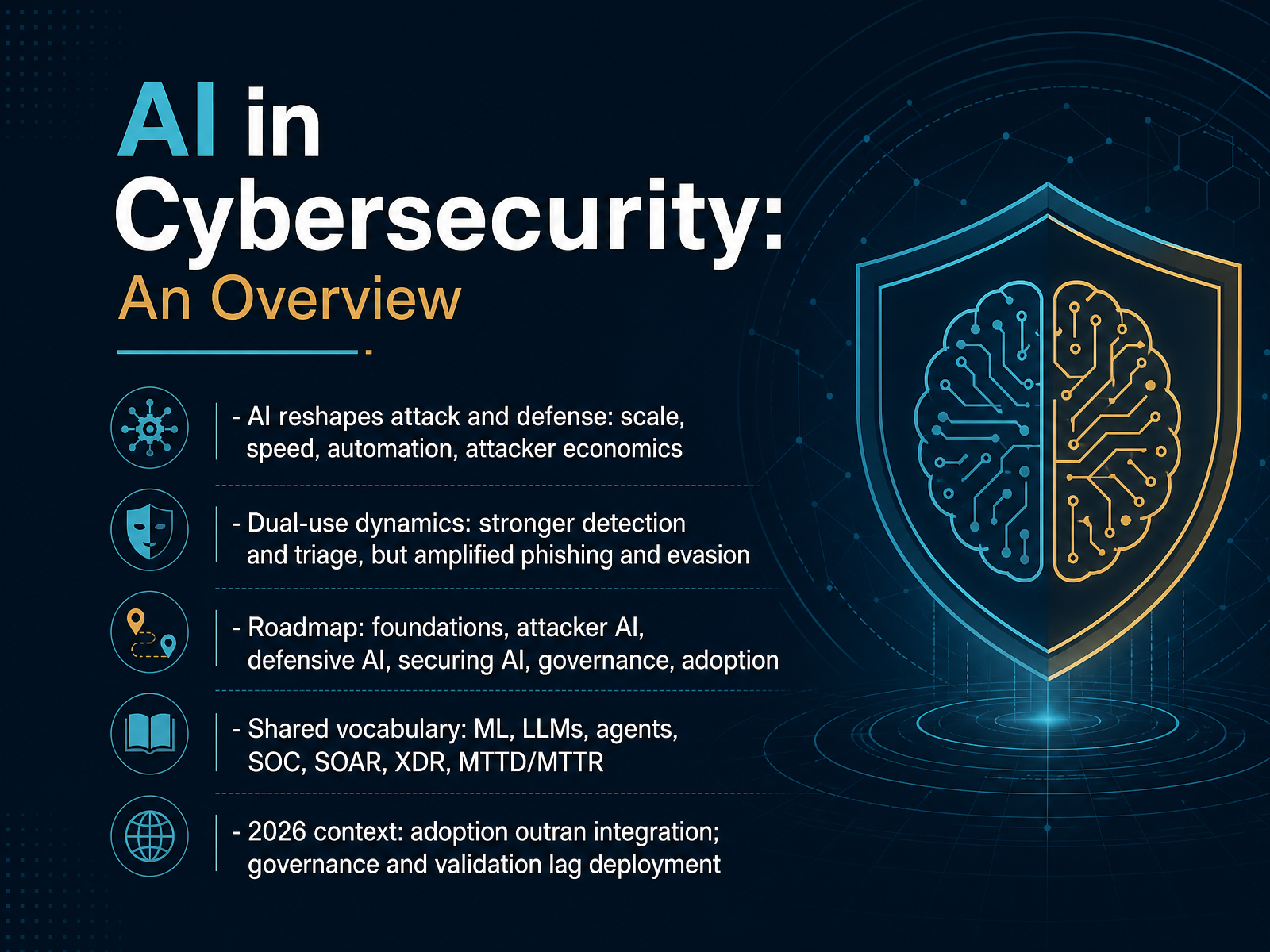
- 01AI in Cybersecurity: An OverviewWelcome. Over the next fourteen slides, we are going to look at AI in cybersecurity with clear eyes, no hype and no fear. The goal is simple. By the end, you should be able to make better decisions about where AI fits in your environment, and where it does not. So let us start with the big picture. AI reshapes both sides of the fight. It changes scale, speed, automation, and attacker economics. That is a dual-use dynamic. The same models that improve detection and triage can amplify phishing and evasion. The 2026 data shows this clearly. Seventy-eight percent of organizations reported confirmed or suspected AI-enabled attacks in the past year. And seventy-nine percent of security teams are using AI or machine learning, but only thirty-six percent have built it into a defined workflow. Adoption has outrun integration, and governance and validation lag behind deployment. Across this course, we will move through foundations, attacker AI, defensive AI, securing AI itself, governance, and adoption. We will also build a shared vocabulary around machine learning, large language models, agents, the security operations center, SOAR, XDR, and time to detect and respond. Keep one question in mind. In your environment, what would you need to see before you trust an AI output? Let us move into the background and core concepts.sans.orgmy.idc.comprophetsecurity.ai+22 min
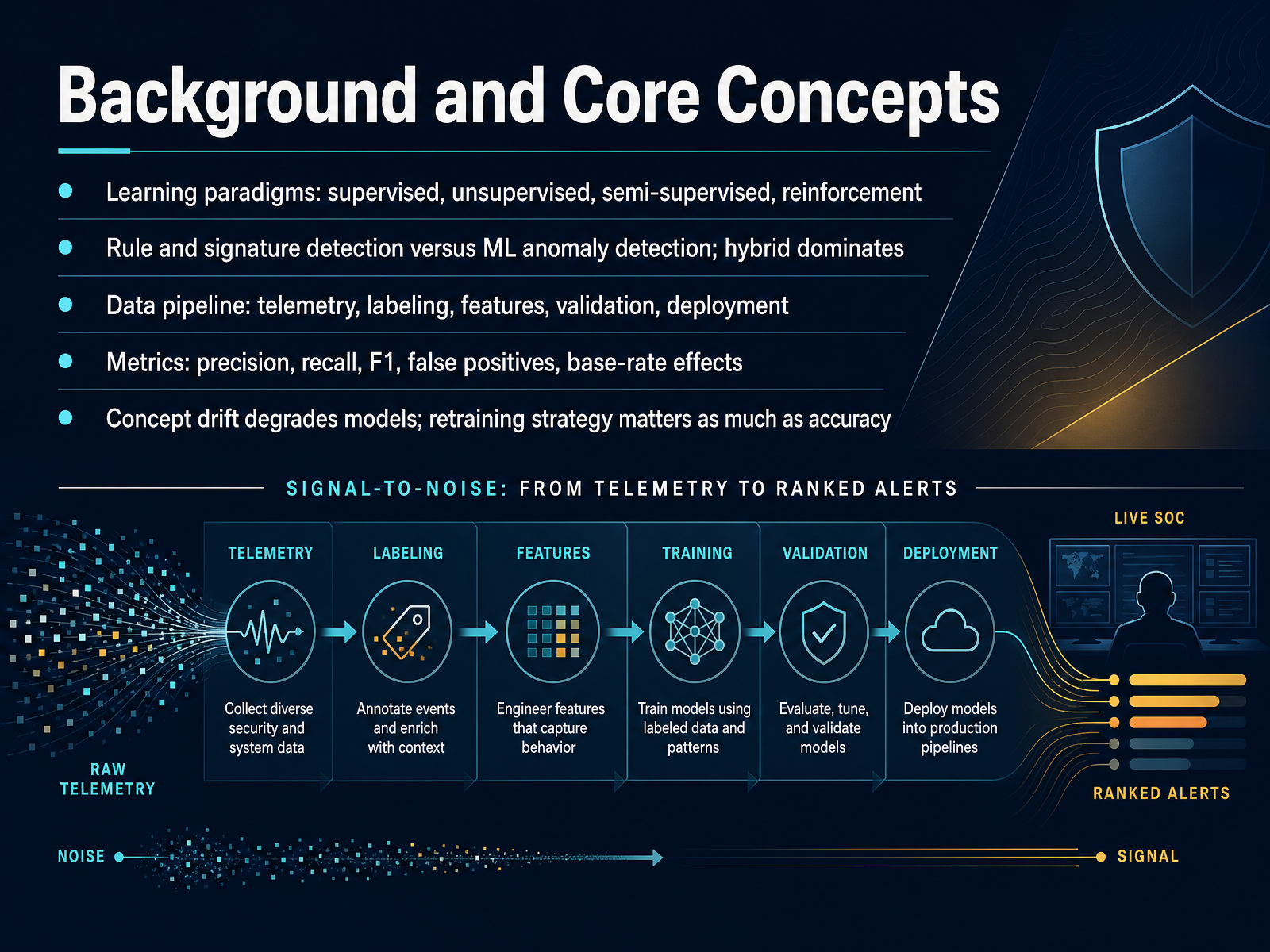
- 02Background and Core ConceptsLet us build the vocabulary you will need for the rest of this session. Machine learning in security rests on four paradigms. Supervised learning needs labeled data, so it is strong on known attacks but blind to novel ones. Unsupervised learning finds anomalies without labels, but tends to raise more false positives. Semi-supervised blends both and helps when labeling is expensive. Reinforcement learning learns by trial and reward. In practice, the most effective systems are hybrid. Rules and signatures catch known threats cheaply and explainably. Machine learning adds coverage for the unknown. Neither wins alone. Next, the data pipeline. Telemetry in, labeling, feature engineering, validation, then deployment. Each stage can silently break the model. Now metrics. Accuracy is nearly useless here, because attacks are a tiny fraction of traffic. Precision tells you how many alerts are real. Recall tells you what you missed. A detector with ninety-nine percent detection and a one percent false positive rate still produces mostly false alarms at realistic base rates. That is the base-rate effect, and it drives alert fatigue. Finally, concept drift. Attackers adapt, environments change, and models decay. A retraining strategy matters as much as offline accuracy. So treat detection as an operational lifecycle, not a one-time build. Let us look at how attackers exploit the same AI techniques.
 link.springer.comarxiv.orgarxiv.org+22 min
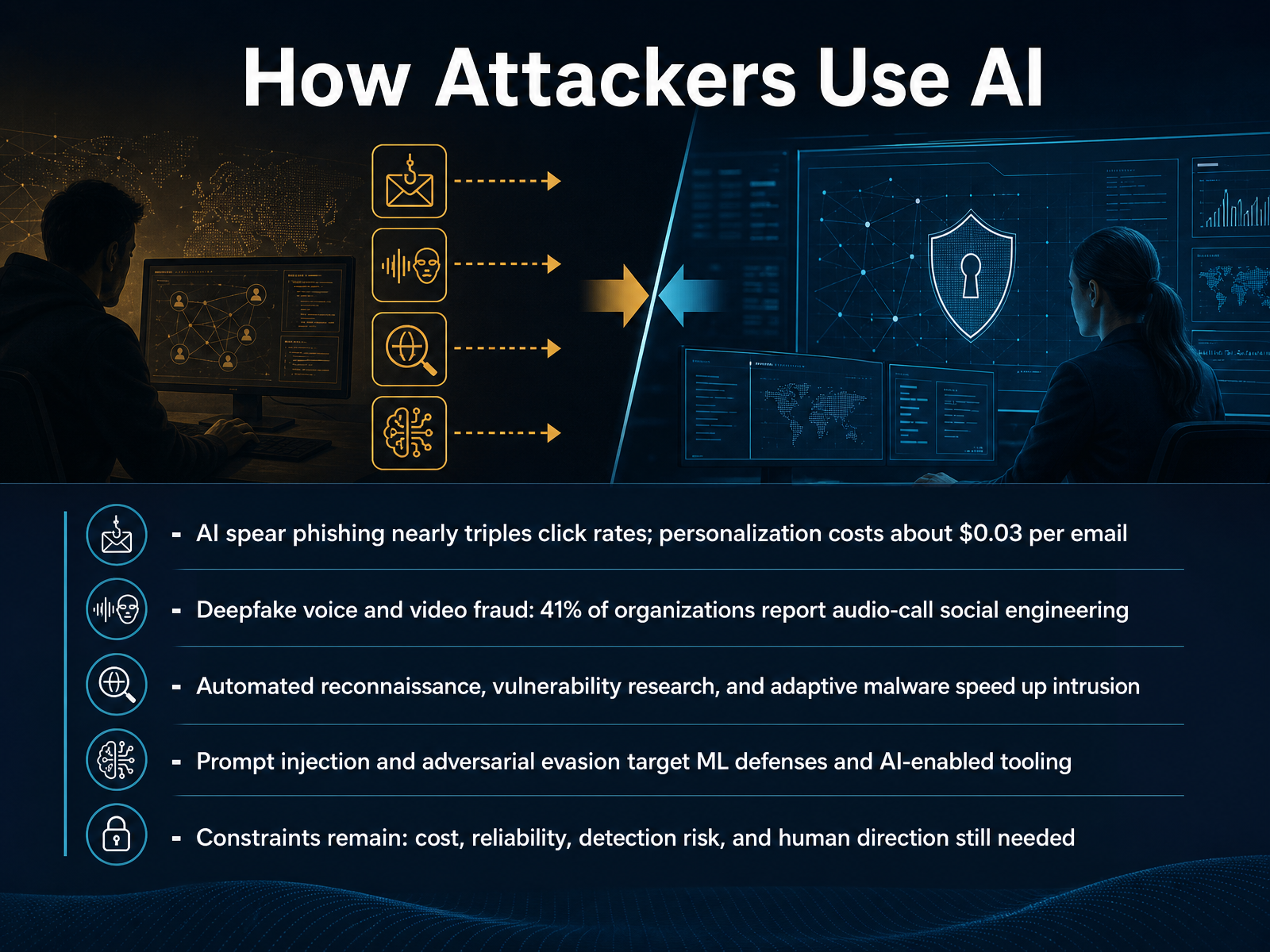
 - 03How Attackers Use AISo, how are attackers actually using AI today? The research is specific, so let's walk the key facts. First, spear phishing. A large study of seven thousand seven hundred participants found that AI-personalized email nearly triples the click rate compared to generic phishing. And personalization costs roughly three cents per email. That changes the economics of targeting your staff. Second, deepfakes. In a Gartner survey, forty one percent of organizations reported a deepfake combined with social engineering on an audio call. And one documented incident used a video deepfake conference call to defraud a firm of about twenty five million dollars. Third, automation. AI speeds up reconnaissance, vulnerability research, and adaptive malware, shrinking the time from disclosure to exploitation. Fourth, prompt injection and adversarial evasion now target machine learning defenses and AI-enabled tooling directly. But constraints remain. Cost, reliability, detection risk, and human direction still matter. So treat every voice, video, and email as unverified until out-of-band checks confirm it. Next, let's look at the defensive side, AI for Detection and Response.
 link.springer.comfrontiersin.orglabs.cloudsecurityalliance.org+22 min
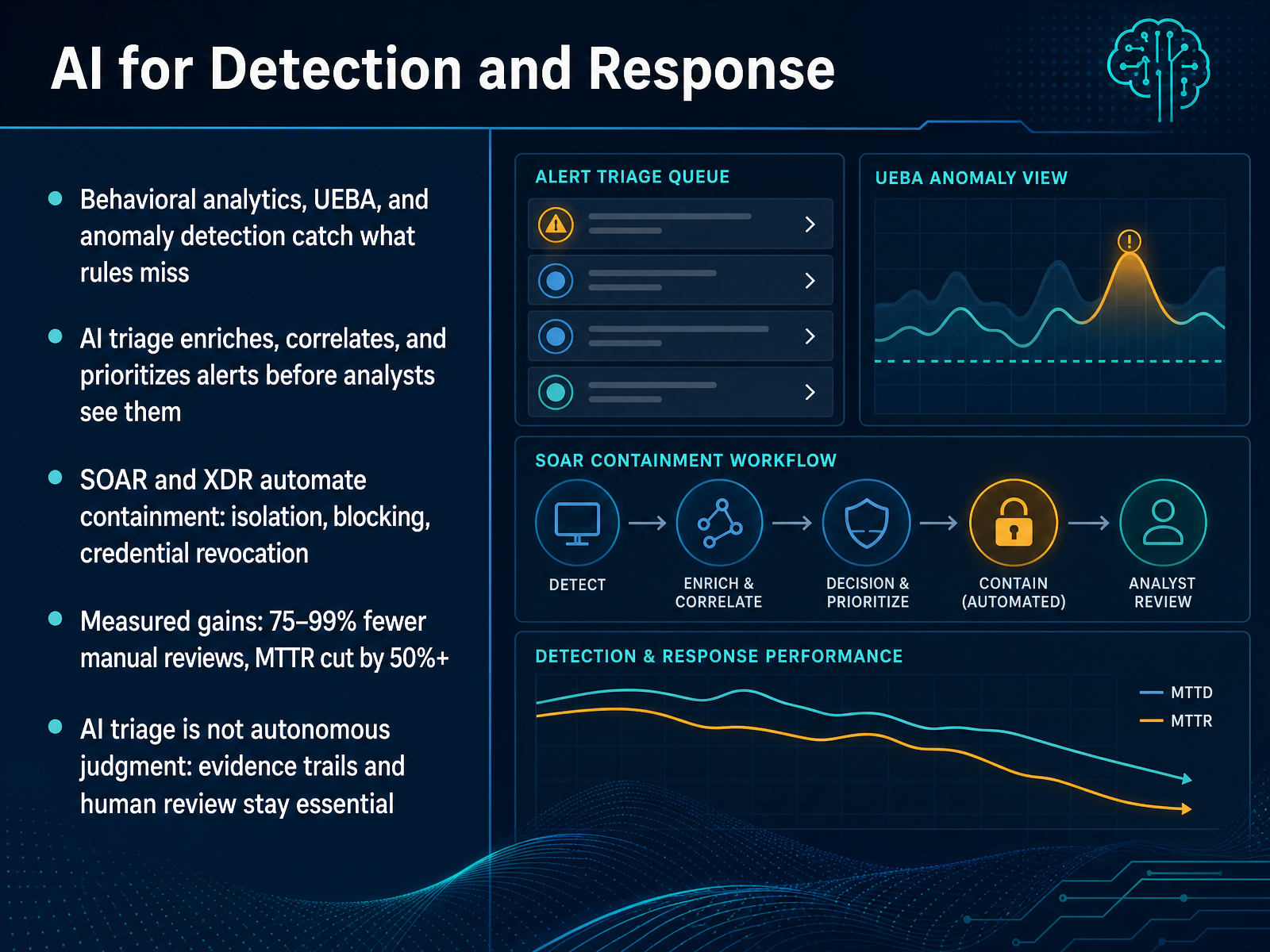
 - 04AI for Detection and ResponseLet's move from model fundamentals into the detection stack, where this shift is already shipping. Behavioral analytics, UEBA, and anomaly detection catch what static rules miss. Signature-based rules fail the moment an adversary changes tooling. Baseline-based analytics flag the deviation instead. Next, AI triage. It enriches, correlates, and prioritizes alerts before your analysts ever see them. Instead of an analyst spending ten to fifteen minutes pulling logs, identity records, and endpoint signals, the investigation arrives as an evidence-backed case with a recommended disposition. SOAR and XDR then automate containment. Endpoint isolation, IP blocking, credential revocation. These are logic-driven actions, so they execute in minutes rather than hours. The measured gains are real. Teams report seventy-five to ninety-nine percent fewer alerts needing manual review, and mean time to respond cut by more than half. One organization reduced human investigations by roughly ninety-nine percent, down to under twenty per month. But here is the part that matters to your governance. AI triage is not autonomous judgment. Every conclusion needs a traceable evidence trail, and humans still own escalation and response decisions. If you bolt AI onto the same alert queue without redesigning escalation thresholds, you get faster summaries and the same triage debt. Next, we look at the architectures underneath this, in LLMs, Agents, and the Agentic SOC.
 dropzone.aidxc.comswimlane.com+22 min
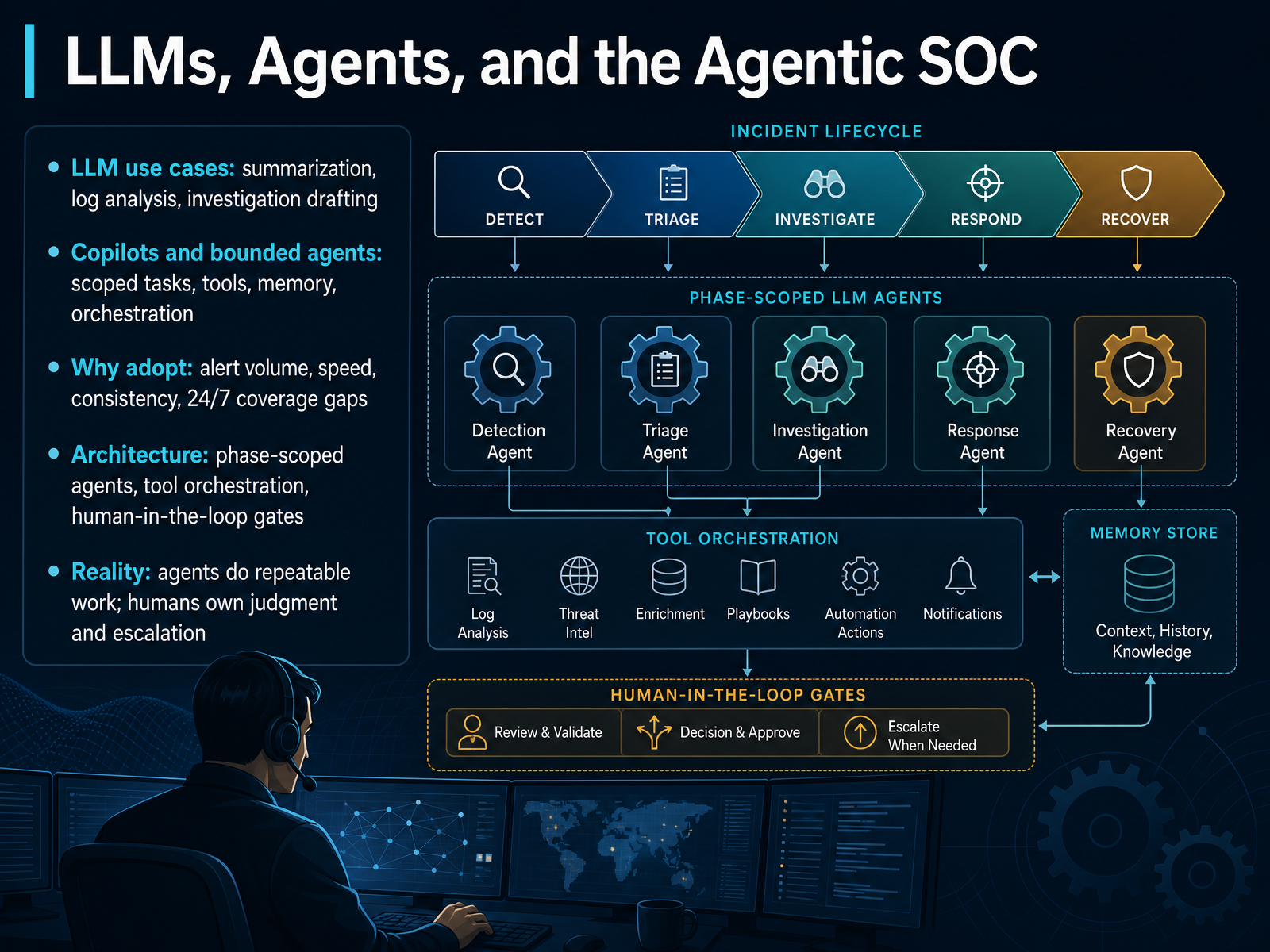
 - 05LLMs, Agents, and the Agentic SOCLet's talk about how large language models and agents actually fit into the SOC. Start with the simple wins. Summarization, log analysis, and drafting investigations. Your analysts already do this work. A model just makes the first pass faster. Think of these outputs as drafts, not conclusions. Now, copilots and bounded agents. Bounded is the key word. You scope the task, the tools, the memory, and the orchestration. Nothing open-ended. The reason to adopt is straightforward. Alert volume keeps growing. Agents give you speed, consistency, and coverage across shifts and time zones. On architecture, use phase-scoped agents with tool orchestration and human-in-the-loop gates. Human review is mandatory before any action with external effect. And here is the reality. Agents do the repeatable work. Your people own judgment and escalation. Treat agents as privileged applications. Scope permissions tightly, log everything, and keep the reasoning chain visible so analysts can check it. That framing sets up what comes next. Agentic AI Risks and Guardrails.
 1 min
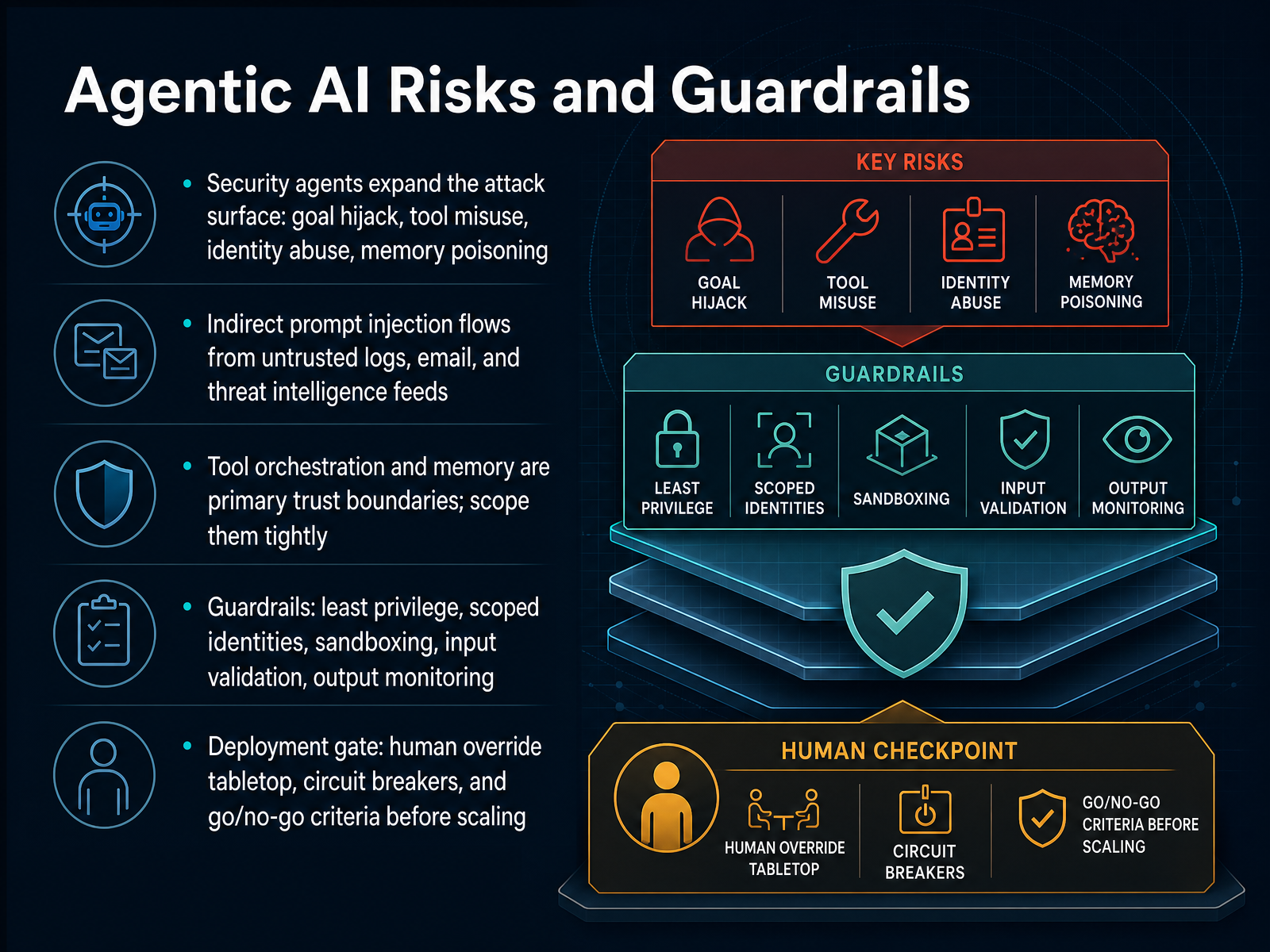
1 min - 06Agentic AI Risks and GuardrailsNow let's look at where agentic AI changes your risk picture. When a security agent can read telemetry, query your SIEM, and invoke containment tools, it becomes a privileged actor. That expands your attack surface in four ways. Goal hijack, where injected instructions redirect the agent's objective. Tool misuse, where legitimate tools are chained unsafely. Identity abuse, where delegated credentials are over-trusted. And memory poisoning, where corrupted context biases every future decision. A common delivery path is indirect prompt injection: untrusted content in logs, email, or threat intelligence feeds gets interpreted as instruction. EchoLeak in Microsoft 365 Copilot showed this is not theoretical. So treat tool orchestration and memory as your primary trust boundaries, and scope them tightly. Practical guardrails: least privilege, scoped identities, sandboxing, input validation, and output monitoring that flags behavior outside the defined scope. Before scaling, require a deployment gate: a human override tabletop, circuit breakers, and explicit go or no-go criteria. Start your agents in investigation and recommendation mode, not autonomous response. Next, we move into securing AI systems.
 2 min
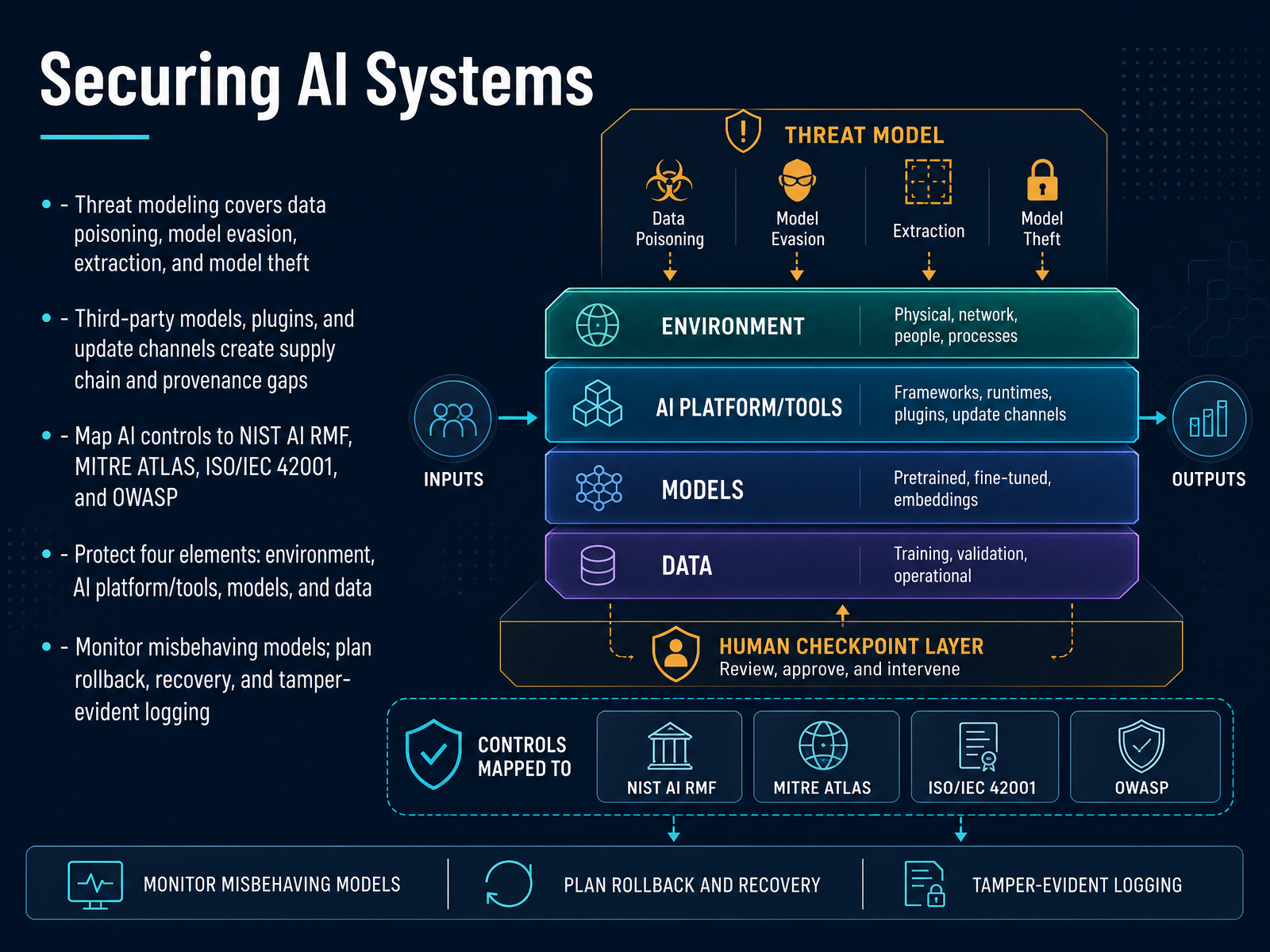
2 min - 07Securing AI SystemsNow let's talk about securing AI systems themselves. Start with threat modeling. Four risks should be on your list from day one: data poisoning, where an attacker corrupts training data; model evasion, where crafted inputs cause the wrong output; extraction, where an attacker reverse-engineers model behavior; and model theft. Then look upstream. Third-party models, plugins, and update channels introduce supply chain and provenance gaps. If you cannot prove where a model came from, treat it as untrusted. Your controls should map to frameworks your teams already know: the NIST AI Risk Management Framework, MITRE ATLAS, ISO/IEC 42001, and OWASP. ATLAS covers roughly seventy percent of existing controls, so you are connecting threats to controls you likely already run. Protect four elements: the environment, the AI platform and tools, the models, and the data. Finally, monitor for models that misbehave. Plan rollback and recovery before you need them, and keep tamper-evident logging so you can prove what happened. Next, we turn to Governance, Risk, and Compliance.
 2 min
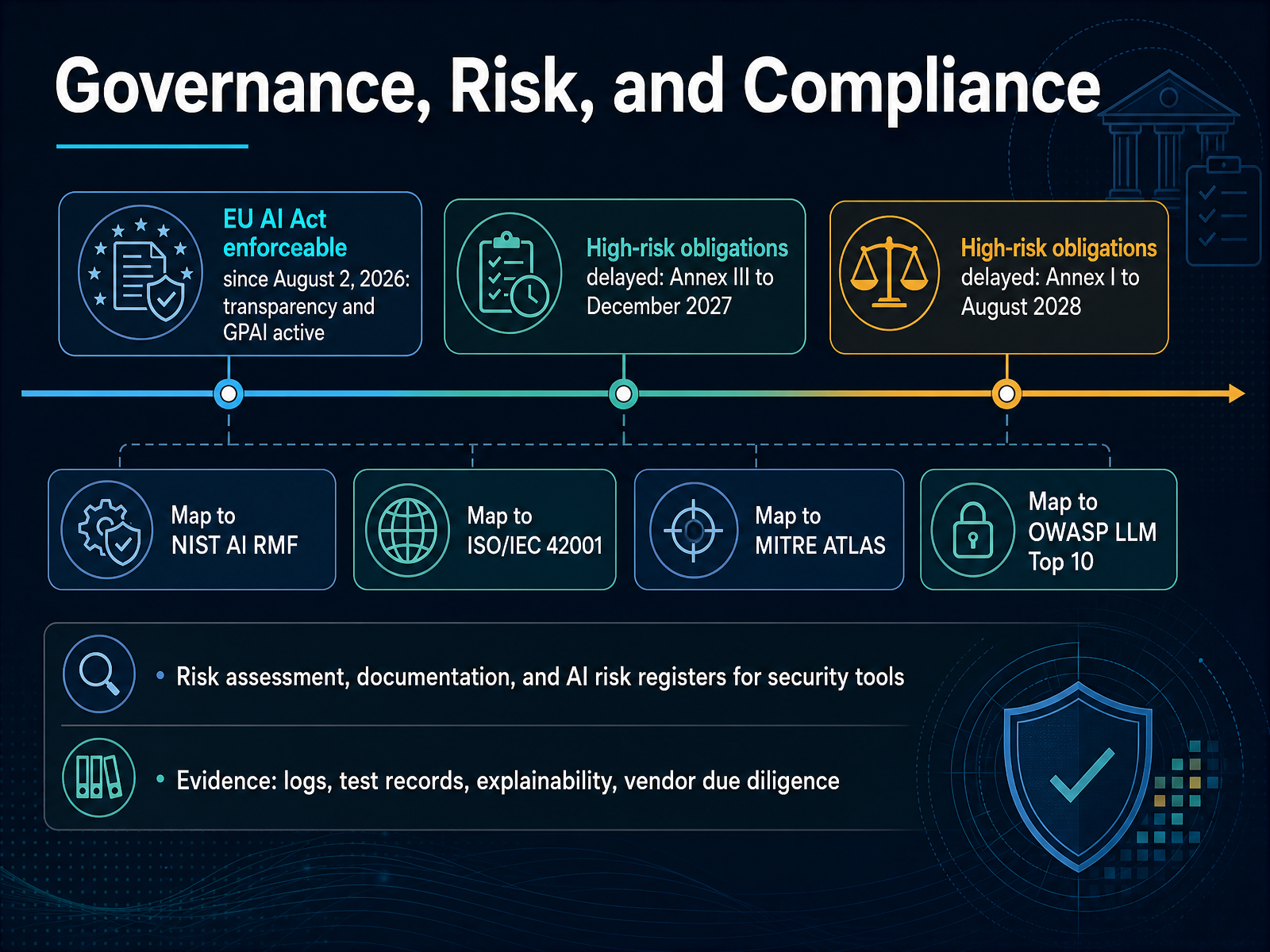
2 min - 08Governance, Risk, and ComplianceLet's turn to governance, risk, and compliance. As of August second, 2026, the EU AI Act is enforceable, and the transparency rules and general-purpose AI obligations are live now. High-risk obligations were delayed: Annex Three systems move to December second, 2027, and Annex One products to August second, 2028. Treat that delay as runway, not relief. Your practical path is to map controls to frameworks you may already use: the NIST AI Risk Management Framework, ISO/IEC 42001, MITRE ATLAS, and the OWASP LLM Top Ten. Build a risk assessment, documentation, and an AI risk register that covers your security tools, including vendor-supplied models. Then collect evidence: operational logs, test records, explainability notes, and vendor due diligence. As a rule of thumb, if you cannot produce an artifact for a claim, the regulator will treat it as unproven. Next, we will look at AI security program maturity and prioritization.
 2 min
2 min - 09AI Security Program Maturity and PrioritizationLet's talk about maturity and prioritization. Because a good program is built in stages, not all at once. The first rule is simple. Inventory first. You cannot secure AI systems you have not enumerated. You need three dimensions. The systems, the data each one can touch, and the owner who answers when something goes wrong. Next, use five maturity levels, from ad hoc to optimized. They span policy, enforcement, monitoring, and red teaming. Ad hoc means no inventory and no gate. Optimized means incident data feeds back into policy and controls. Then prioritize by risk and feasibility. Focus on data exposure, business impact, and attacker interest. Most security operations centers should start with vendor capabilities, then customize only where risk justifies the cost. Be honest about that trade-off. Finally, track real metrics. Coverage, validation results, false-positive load, time-to-respond, and control effectiveness. Do not target the highest level everywhere. A reasonable target is level three to four for foundational and structural categories, with selective depth where your exposure is greatest. That is how you make deliberate investments instead of chasing maturity for its own sake. Now let's move to the practical playbook and adoption roadmap.
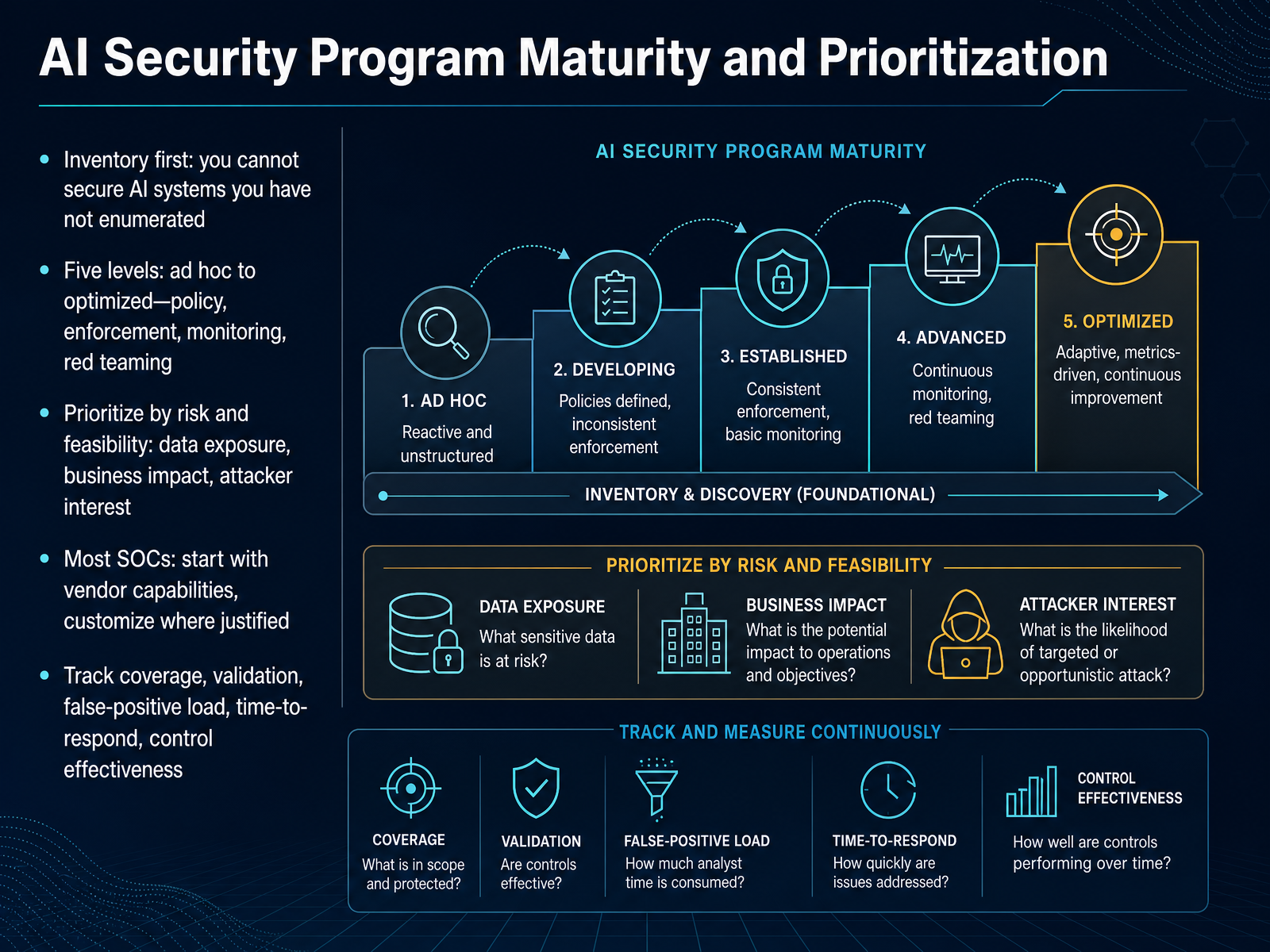 2 min
2 min - 10Practical Playbook and Adoption RoadmapLet's turn to a practical playbook and adoption roadmap. The data tells a clear story: seventy-nine percent of teams use AI, but only thirty-six percent have integrated it into a defined workflow. So start bounded. Pick high-volume, low-variance cases like phishing triage, enrichment, and summarization. When you pilot, set clear baselines, success metrics, elevated logging, and defined exit criteria. Then redesign the workflow itself: escalation thresholds and analyst responsibilities should shift around AI-assisted investigation. Watch for the common failure modes: unstructured use, no validation, integration gaps, and automation without governance. Scale only when you can demonstrate accuracy, human trust, auditability, and measurable risk reduction. Next, we'll walk through hands-on considerations and safe experimentation.
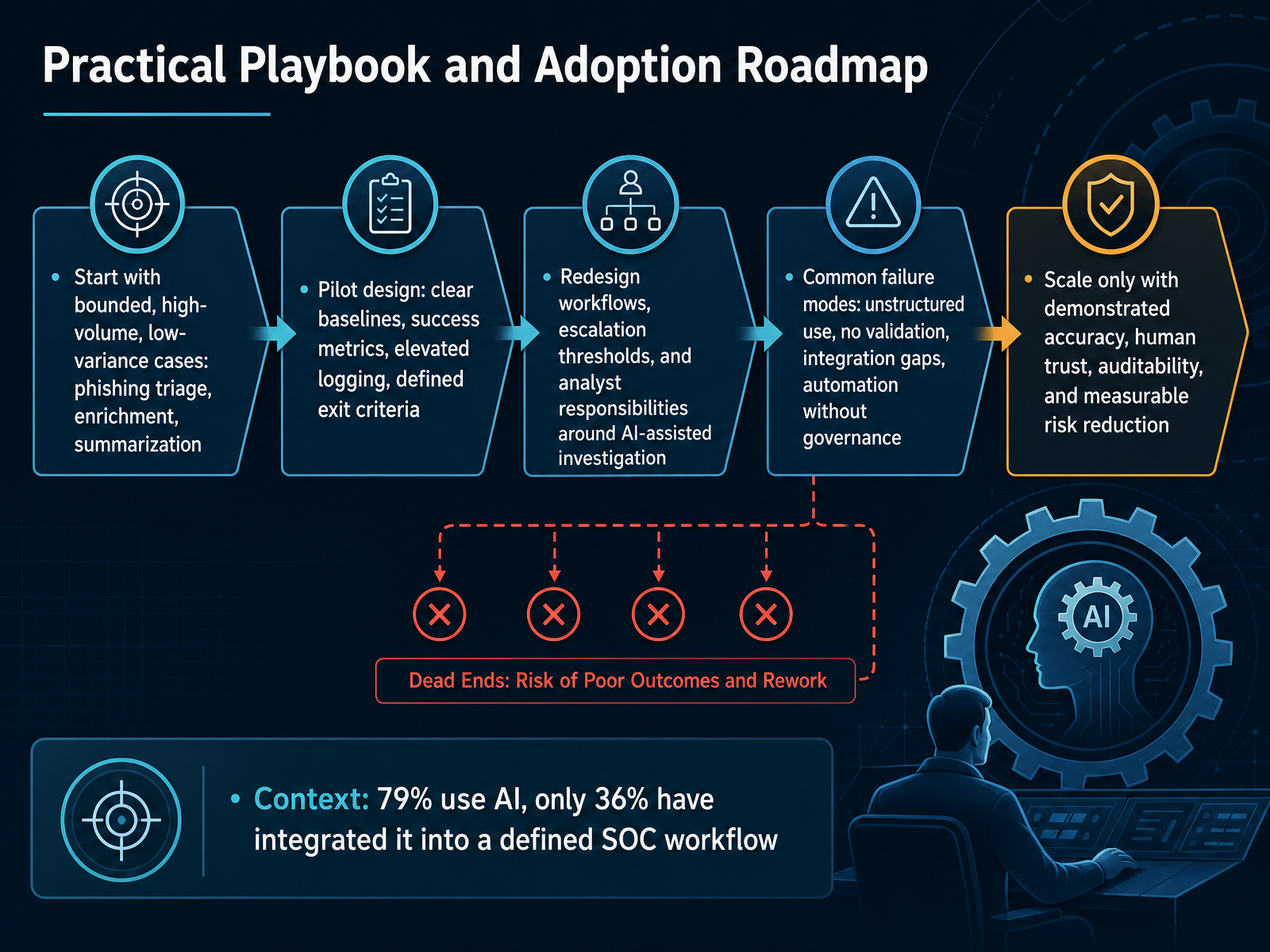 sans.orgmy.idc.comprophetsecurity.ai+21 min
 - 11Hands-On Considerations and Safe ExperimentationLet's talk about how you actually build these skills safely, without creating new risk for your organization. Start with lab ideas that map to real attacks: prompt injection, red teaming large language models, secure retrieval augmented generation pipelines, and agent tool misuse. The practical move is to run open source models locally, in your own environment. That keeps sensitive security data contained and lets you test aggressively without sending data to a third party. Then validate what you find. Use labeled benchmarks, red team exercises, and continuous comparison over time, because models and threats both drift. Tabletop the incidents too. Walk your team through a deepfake fraud attempt, an agent acting outside its authority, and a compromised model, so response is muscle memory, not improvisation. And set hard limits. Sandbox every test, define data handling rules up front, and require approval gates before any offensive work. Safe experimentation is what makes bold experimentation sustainable. Next, let's look at workforce, roles, and team readiness.
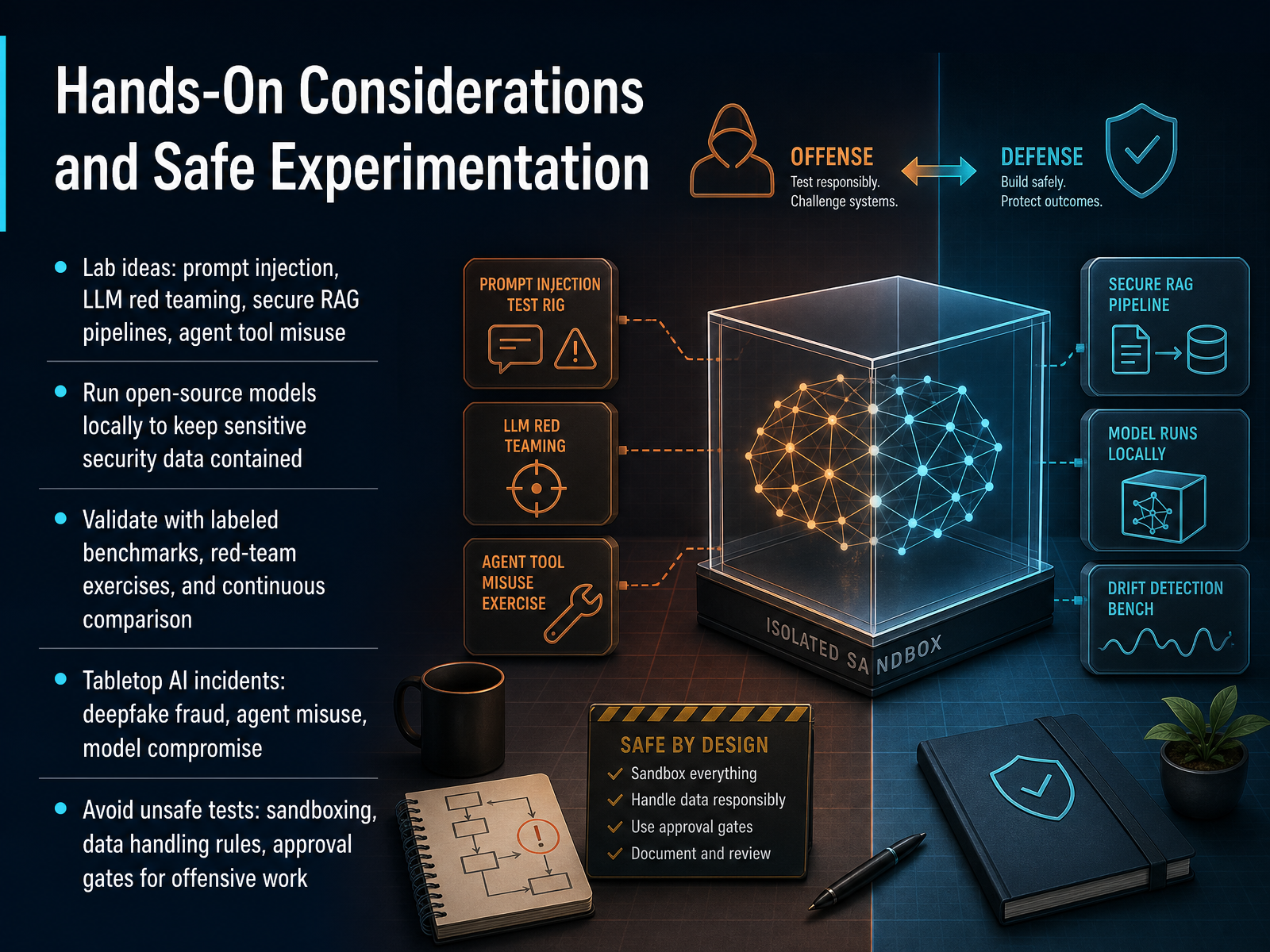 2 min
2 min - 12Workforce, Roles, and Team ReadinessNow, let's talk about your people, because tools do not run themselves. The core shift is this. AI extends existing roles rather than creating a separate job family. Analysts supervise AI outcomes and validate what the system produces. Detection engineers teach the system, tuning rules and models the way they tune signatures today. SOC leaders orchestrate autonomy, escalation, and accountability, deciding what the machine can close on its own and what must reach a human. The gaps you need to close are specific. Analysts need data literacy. Developers need AI security fundamentals. Adoption has outpaced integration, so training demand rose sharply this year. Practical paths include vendor-neutral certifications, hands-on labs, and role-aligned curricula, not one generic course for everyone. So start by mapping skills to roles you already have, and build from there. Looking ahead, we will examine trends and strategic decisions.
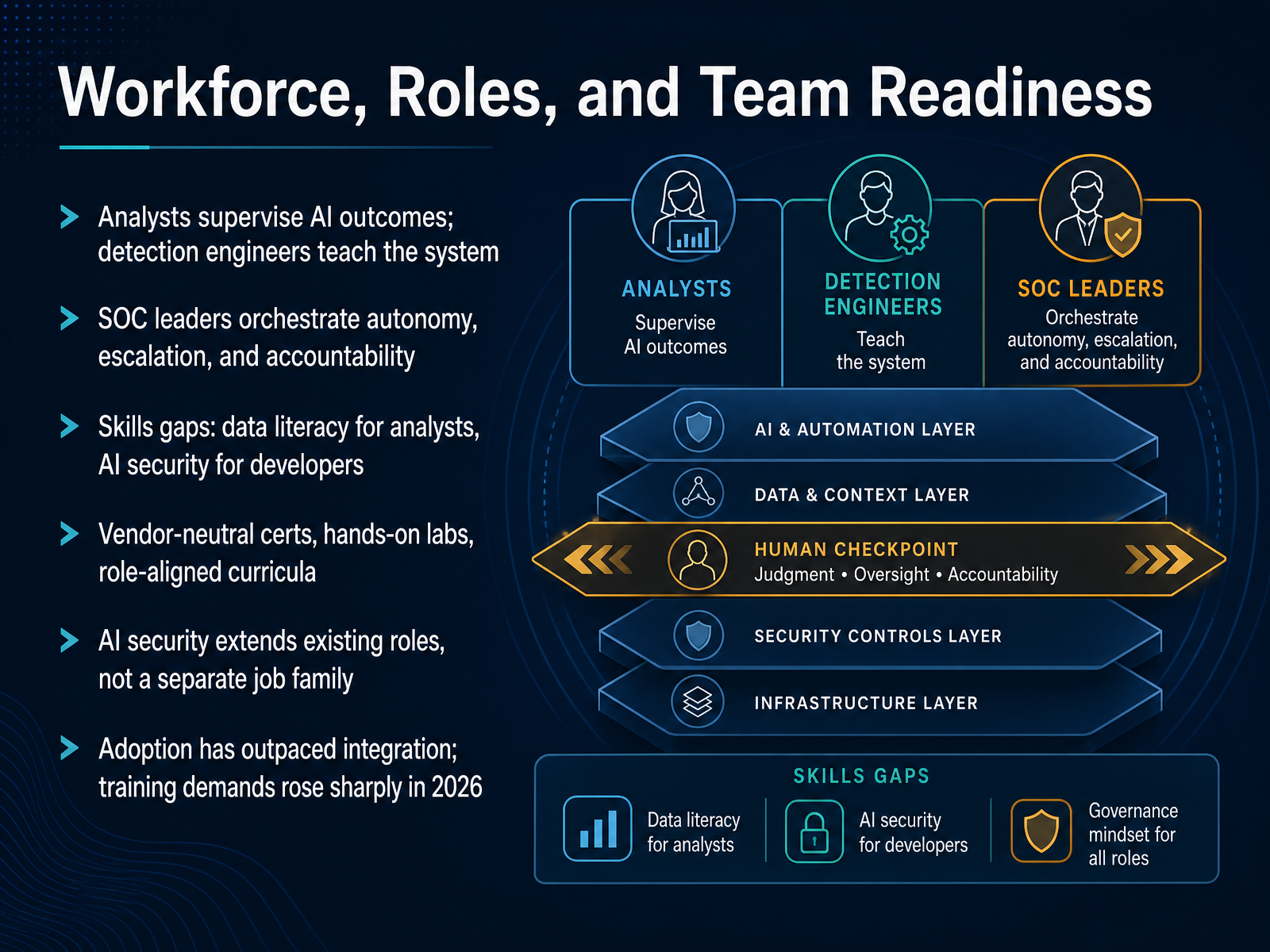 1 min
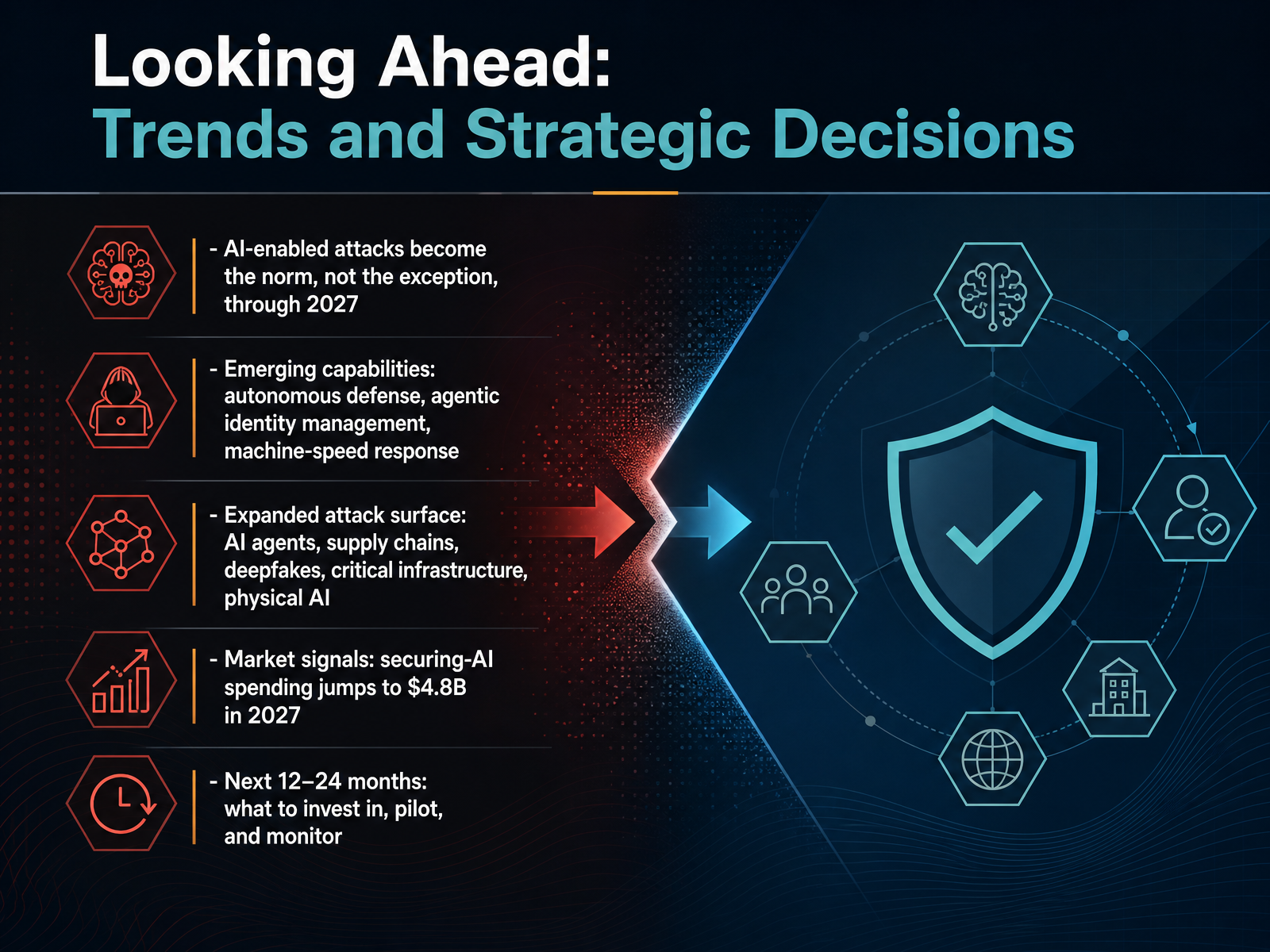
1 min - 13Looking Ahead: Trends and Strategic DecisionsLet's look ahead. The central forecast to plan against: by 2027, AI-enabled attacks are the norm, not the exception. The National Cyber Security Centre assesses this almost certainly increases the frequency and intensity of intrusions. Notably, most of that uplift comes from existing tactics being made faster, not from novel attack types. So ask your team where you're already exposed. Two trends matter for you. First, defence moves toward agentic identity management, where every AI agent holds its own managed identity with least privilege and just-in-time access. Second, machine-speed response becomes a baseline expectation. The attack surface expands too: AI agents, supply chains, deepfakes, critical infrastructure, and physical AI. Expect a digital divide, where systems keeping pace with AI threats pull ahead of those lagging behind. The market reflects that urgency. Gartner forecasts spending on securing AI will reach four point eight billion dollars in 2027, a sixty-eight point seven percent increase year over year, with AI usage control growing fastest. So over the next twelve to twenty-four months, decide three things. What you invest in now, what you pilot deliberately, and what you simply monitor. Prioritise identity, control over agents, and supply chain visibility. Let's now bring this together in our course wrap-up and decision checklist.
 2 min
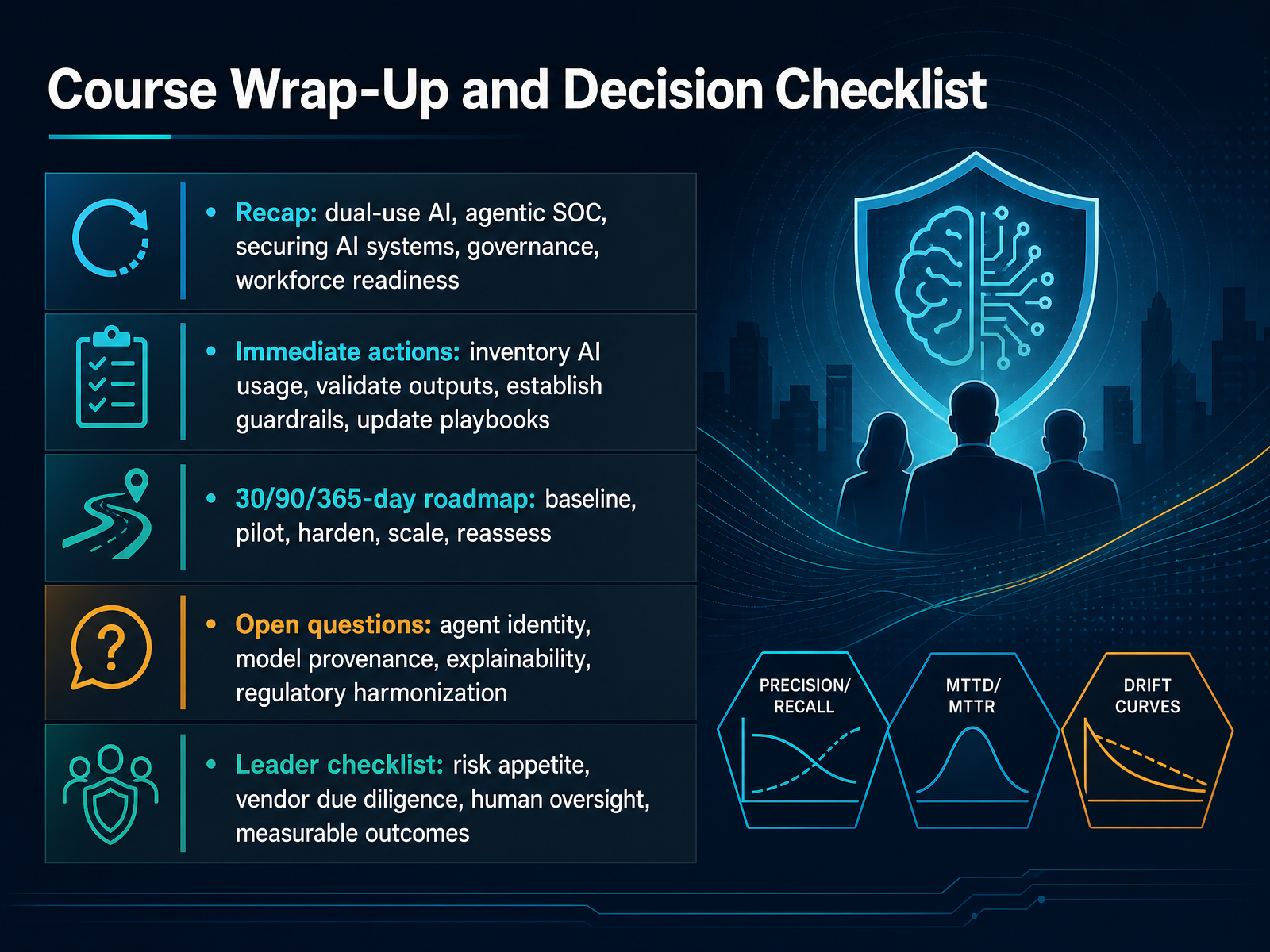
2 min - 14Course Wrap-Up and Decision ChecklistLet's close by turning everything we covered into decisions you can make, starting this week. The through-line is simple. AI is dual-use. Your SOC is becoming agentic. Your AI systems are now part of your attack surface. Governance is an operational control, not a document. And your workforce needs new validation skills. So start with four immediate actions. Inventory every place AI is used, including shadow tools your teams adopted quietly. Validate outputs against human judgment, not vendor accuracy claims. Set guardrails on data access and autonomy. Update your incident playbooks for AI failures. Then sequence the work. Baseline in thirty days. Pilot in ninety. Harden, scale, and reassess over the year. Plenty of open questions remain: agent identity, model provenance, explainability, and regulatory harmonization. Use the leader checklist to guide you. Define risk appetite, do vendor due diligence, require human oversight, and measure real outcomes. You do not need every answer today. You need honest visibility, disciplined validation, and a roadmap you can defend. Thank you for your attention. Keep asking, and stay ahead of the curve.
 sans.orgmy.idc.comprophetsecurity.ai+22 min
Take the deck with you
Download this course as a file — free, no sign-up needed.
- PDF handoutEvery slide page, ready to print or share.15 pages · 4.2 MBDownload
- Narrated PowerPointThe deck that presents itself — every slide carries the digital human's narration video.15 pages · 15.8 MBDownload
- PowerPoint slidesThe full deck as a .pptx — open it in PowerPoint, Keynote, or Google Slides.15 pages · 4.1 MBDownload
Free to use in your own training — please keep the PersonWise credit page at the end.
Have your own deck? Turn it into a course
Sources consulted
Web sources consulted while building this course.
- 2026 SANS SOC Survey Insights: A Decade of Evolution in Cyber Defense White Paper | SANS Institute — sans.org
- IDC Survey: Global AI-Driven SOC Survey, 2026 — From Automation to Conditional Autonomy — my.idc.com
- State of AI in the SOC 2026: 8 Key Takeaways | Prophet Security — prophetsecurity.ai
- AI Use in Cybersecurity Jumped From 50% to 78% in a Year. AI-Related Failures Rose Sharply Too. New SANS Institute Survey Reveals a Governance Gap. | SANS Institute — sans.org
- The State of SecOps & the Deployment of AI in the SOC | Ponemon-Sullivan Privacy Report — ponemonsullivanreport.com
- A Framework for Drift Detection and Adaptation in AI-driven Anomaly and Threat Detection Systems | International Journal of Information Security | Springer Nature Link — link.springer.com
- [2609.08623] Navigating the Latent Manifold: Proactive Concept Drift Adaptation for Resilient NIDS — arxiv.org
- Shift Detection and Adaptation for Network Intrusion Detection — arxiv.org
- Machine Learning for Network Intrusion Detection: An Analytical Review of Methods, Benchmark Datasets, and the Gap Between Reported and Operational Performance | International Journal of Information & Digital Security — emiratesscholar.com
- INSOMNIA: Towards Concept-Drift Robustness in Network Intrusion Detection — s2lab.cs.ucl.ac.uk
- Anti-phishing in the Era of Deepfakes | Springer Nature Link — link.springer.com
- Frontiers | Phishing 2.0: exploring the capabilities and risks of agentic AI-enabled attacks — frontiersin.org
- https://labs.cloudsecurityalliance.org/research/csa-research-note-ai-weaponized-phishing-systemic-risk-20260/ — labs.cloudsecurityalliance.org
- Evaluating AI Models’ Capability to Automate Voice Phishing Attacks — arxiv.org
- [2609.11404] Deep-Fake CAPTCHA: Mitigating Next-Generation Social Engineering Attacks — arxiv.org
- Real SOC Teams Cut MTTR by 90% With AI | Dropzone AI — dropzone.ai
- How DXC cut SOC investigation time 67.5% with Agentic AI | DXC Technology Customer Stories — dxc.com
- How Swimlane Cuts MTTR in Half — swimlane.com
- SOC alert triage and incident response - Enterprise AI Case ... — case-studies.ai
- AI SOC in real-world teams: what reduces MTTR and alert fatigue — nhimg.org