English Error Correction Mastery
Begin
14 pages · ~28 min
English Error Correction Mastery
This training helps English learners identify and correct frequent grammar, vocabulary, and usage mistakes to communicate more clearly and confidently.
What you’ll learn
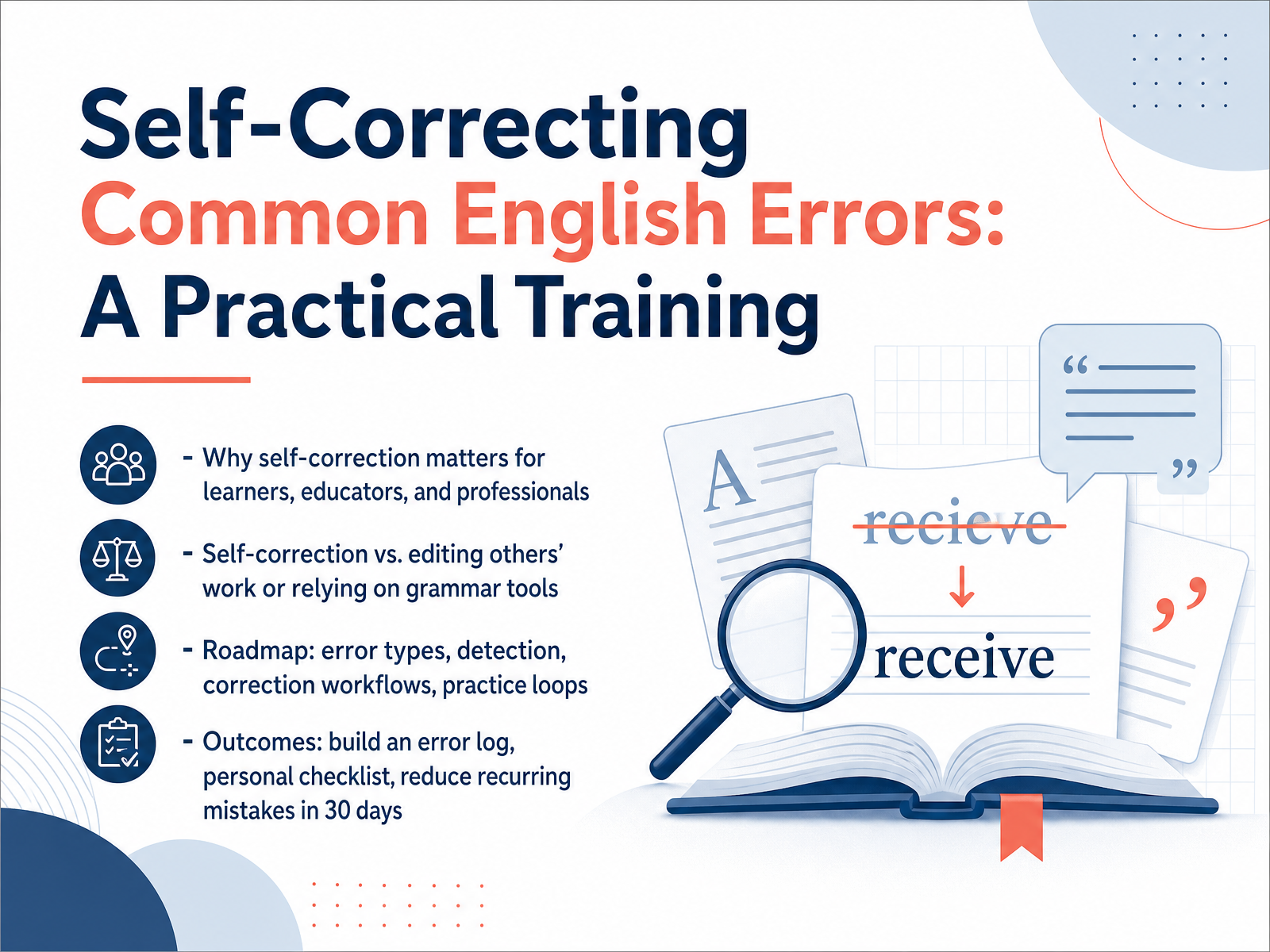
- 01Self-Correcting Common English Errors: A Practical TrainingWelcome. This is a practical training on self-correcting common English errors. Whether you are learning English, teaching it, or using it at work, this course will help you catch and fix your own mistakes. Self-correction matters because it builds your awareness of the language. When you correct yourself, you are not just fixing one sentence. You are training your brain to notice patterns. This is different from editing someone else's work or depending on grammar tools. Those have their place, but they do not build the same internal skill. Instead of relying on a tool to tell you what is wrong, you will learn to spot the issue yourself. Here is our roadmap. First, we will look at the most common error types. Then, we will practice detection techniques. After that, we will build simple correction workflows you can use in writing and speaking. Finally, we will set up practice loops that help you build a personal error log and checklist. Here is the goal. In thirty days, you can reduce your recurring mistakes in a measurable way. You will leave this course with a system for noticing, correcting, and tracking. Let's begin with why self-correction matters so much in daily communication.teachingenglish.org.ukm.busyteacher.orgtesl-ej.org+22 min
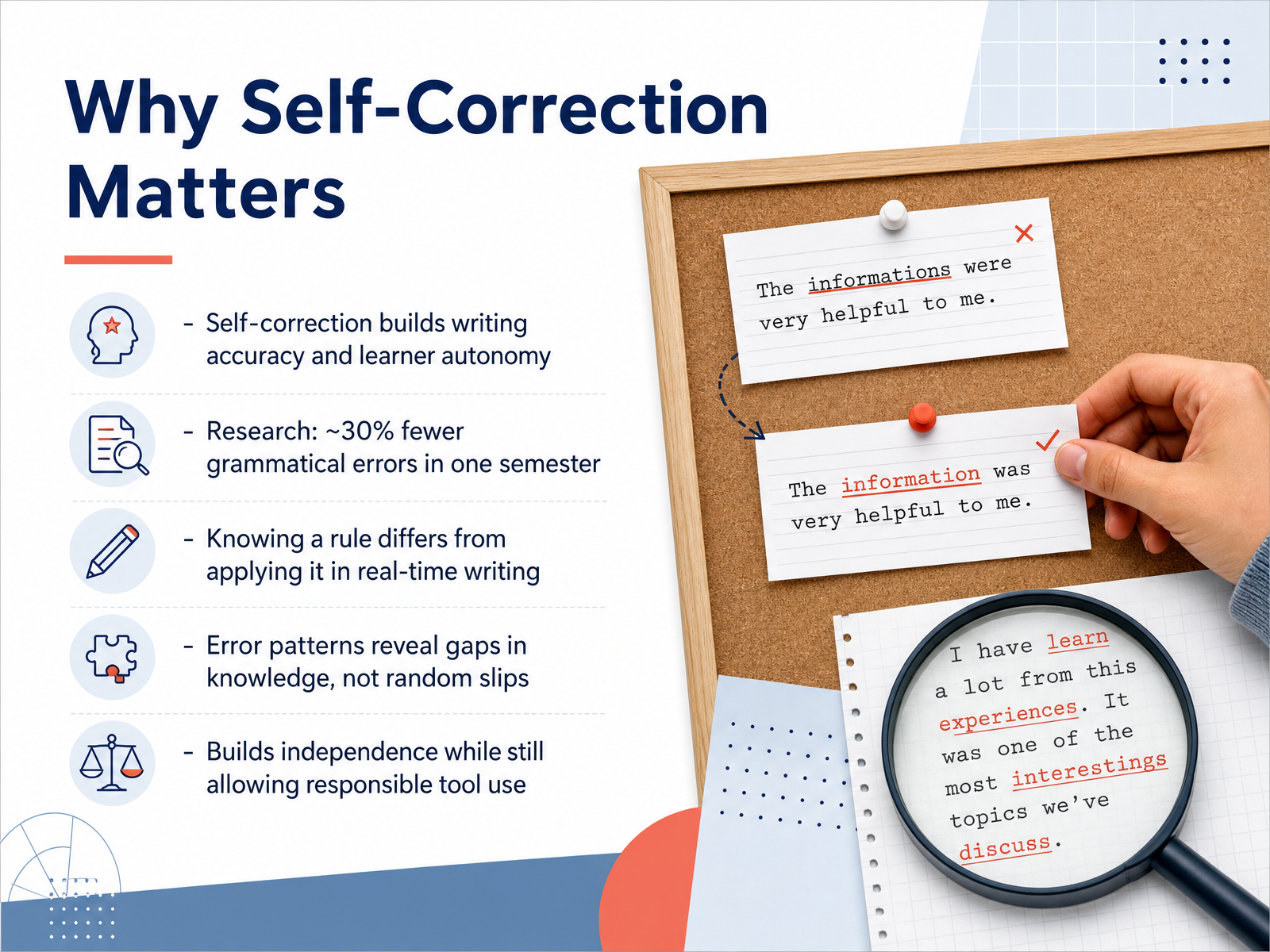
- 02Why Self-Correction MattersLet’s talk about why self-correction matters so much. Research shows that students who regularly find and fix their own errors can reduce grammatical mistakes by about thirty percent in a single semester. That is a significant gain. But here is the key point: knowing a grammar rule is not the same as applying it while you write. Self-correction is what connects those two. When you review your own work, your error patterns become visible. A mistake you repeat is not a random slip. It is a signal pointing to a gap in your knowledge. And that is valuable. By learning to catch these patterns yourself, you build independence. You become less dependent on a teacher or a tool to check every sentence. Speaking of tools, using grammar checkers is fine, but relying on them completely is not. Use them responsibly. Let them support your decisions, not make them for you. The goal is for you to become your own first editor. That skill will serve you in every email, report, and presentation you write. Now, let’s look at the difference between mistakes and errors, because the way you correct them depends on which one you are dealing with.
 doi.orgscielo.org.coijsra.net+21 min
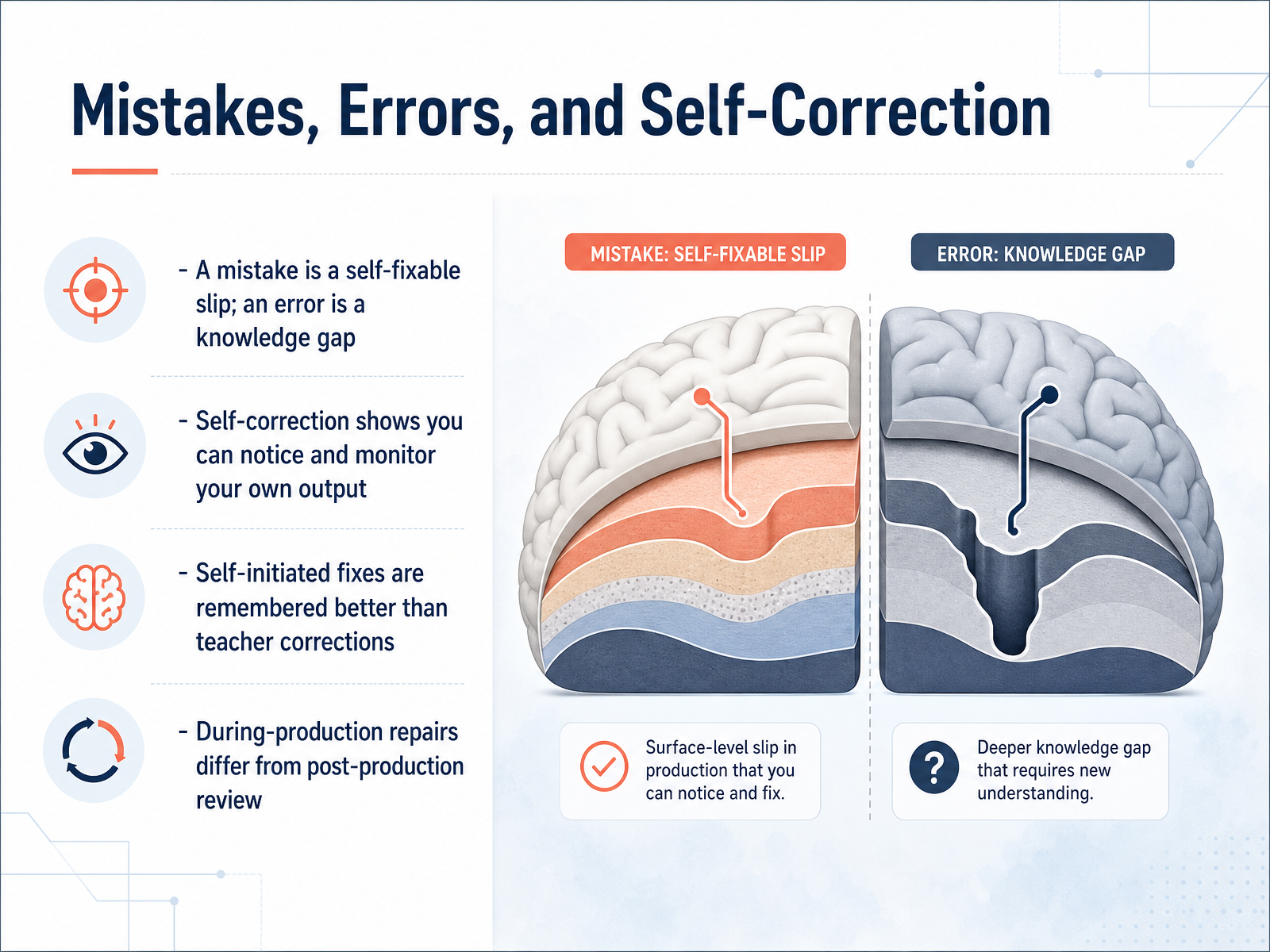
 - 03Mistakes, Errors, and Self-CorrectionLet’s look at the difference between a mistake and an error. A mistake is a slip. You know the rule, but you said it wrong by accident. You can fix it yourself. An error is a knowledge gap. You don’t know the correct form yet, so you need to learn it first. For example, if you say "I feel relax" and immediately change it to "I feel relaxed," that was a mistake. You recognized it and fixed it. But if you don’t know that "relaxed" is the correct adjective, that’s an error. Self-correction shows that you are paying attention to your own output. It proves you can monitor what you say and write. And here is the key point: when you notice and fix your own mistake, you remember it better than when a teacher corrects it for you. That’s why self-initiated fixes are more powerful. Finally, there are two timing types. During-production repair happens while you are speaking, like catching yourself mid-sentence. Post-production review happens after you finish, when you review a recording or a draft. Both are valuable. So as we move to the next part, let’s see which types of errors appear most often in English.
 teachingenglish.org.ukm.busyteacher.orgtesl-ej.org+22 min
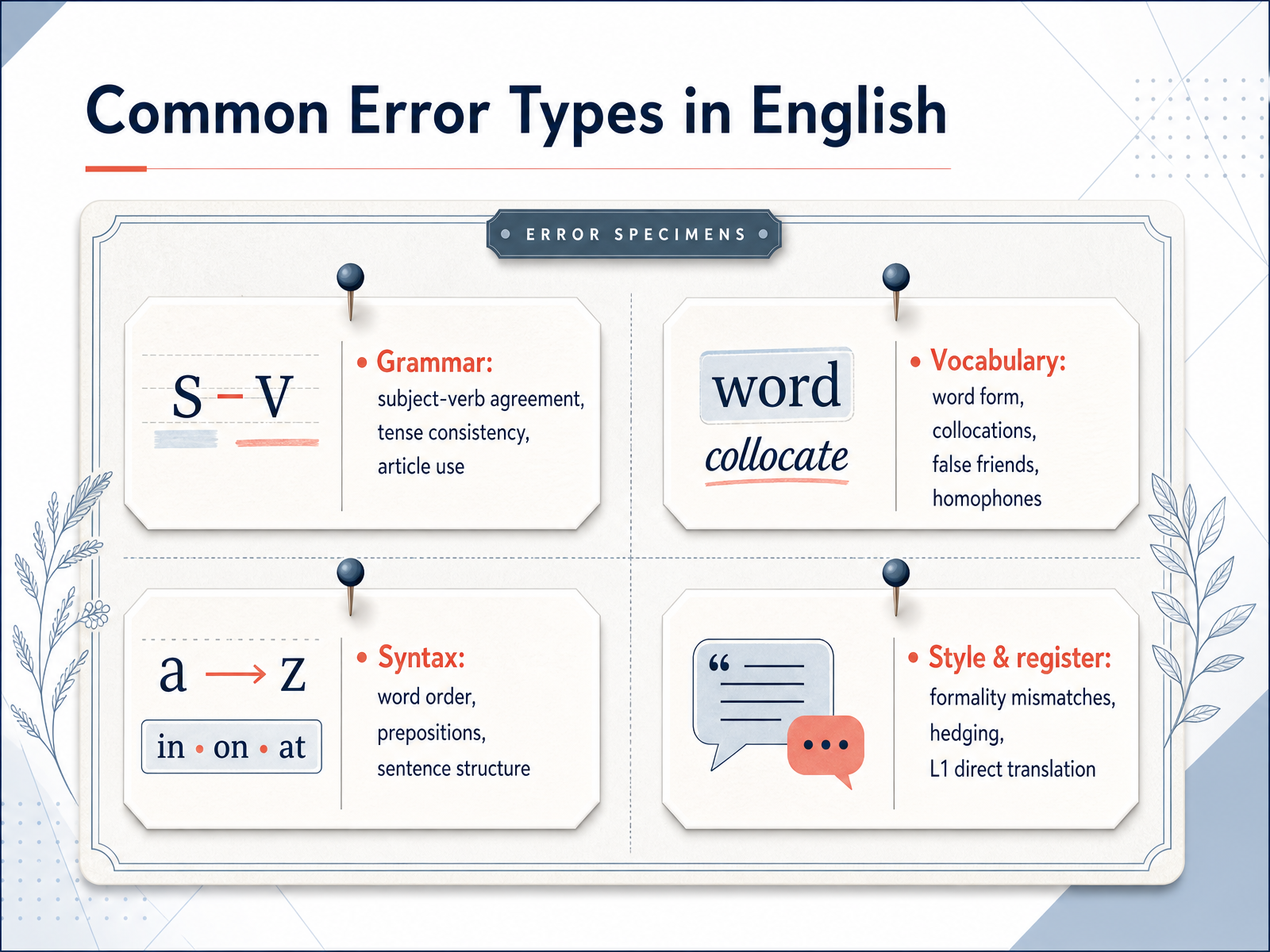
 - 04Common Error Types in EnglishLet’s look at where these errors tend to come from. Most English mistakes fall into a few clear categories. First, grammar. This covers subject-verb agreement, like when we say, "She go to work," instead of "She goes to work." It also includes keeping your tenses consistent, and using articles like "a," "an," and "the" correctly. Next, vocabulary. This is about choosing the right word form, like saying "decision" instead of "decide." It also involves collocations—words that naturally go together, like "make a decision," not "do a decision." And watch out for false friends and homophones, like "their" and "there." Then we have syntax, which is about word order, prepositions, and overall sentence structure. For example, "I explained him the problem" should be "I explained the problem to him." Finally, there is style and register. This means matching your level of formality to the situation, avoiding over-hedging with phrases like "I just thought maybe," and being careful not to translate directly from your first language. Knowing these categories helps you spot patterns in your own writing. Next, we’ll explore how your first language shapes the specific errors you make.
 eslinfo.compdfs.semanticscholar.orgejurnal.iainpare.ac.id+22 min
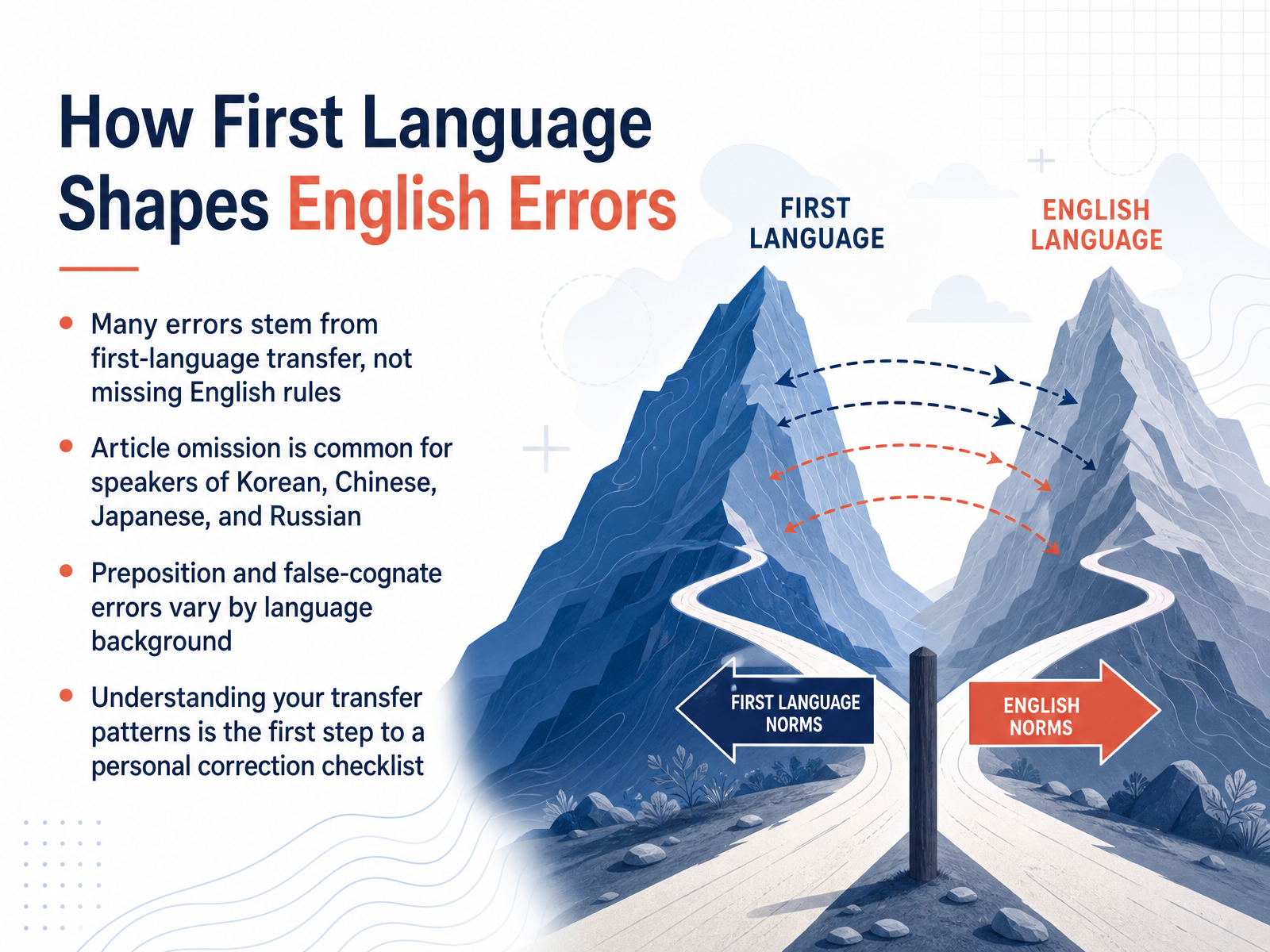
 - 05How First Language Shapes English ErrorsLet’s look at where these errors actually come from. Many of them are not random mistakes. They come from first-language transfer. That means your native language shapes how you build English sentences. For example, if your first language is Korean, Chinese, Japanese, or Russian, you might often leave out words like a and the. That is because those languages do not use articles the same way English does. You might say, I need new laptop, when you mean, I need a new laptop. Similarly, preposition choices and false friends vary by language background. A false friend is a word that looks familiar but means something different in English. Understanding which patterns come from your own language is the first step. Once you see the pattern, you can build a personal correction checklist. That checklist will make your self-editing much more effective. Now, let’s move on to sharpening your error detection skills.
 eslinfo.compdfs.semanticscholar.orgejurnal.iainpare.ac.id+21 min
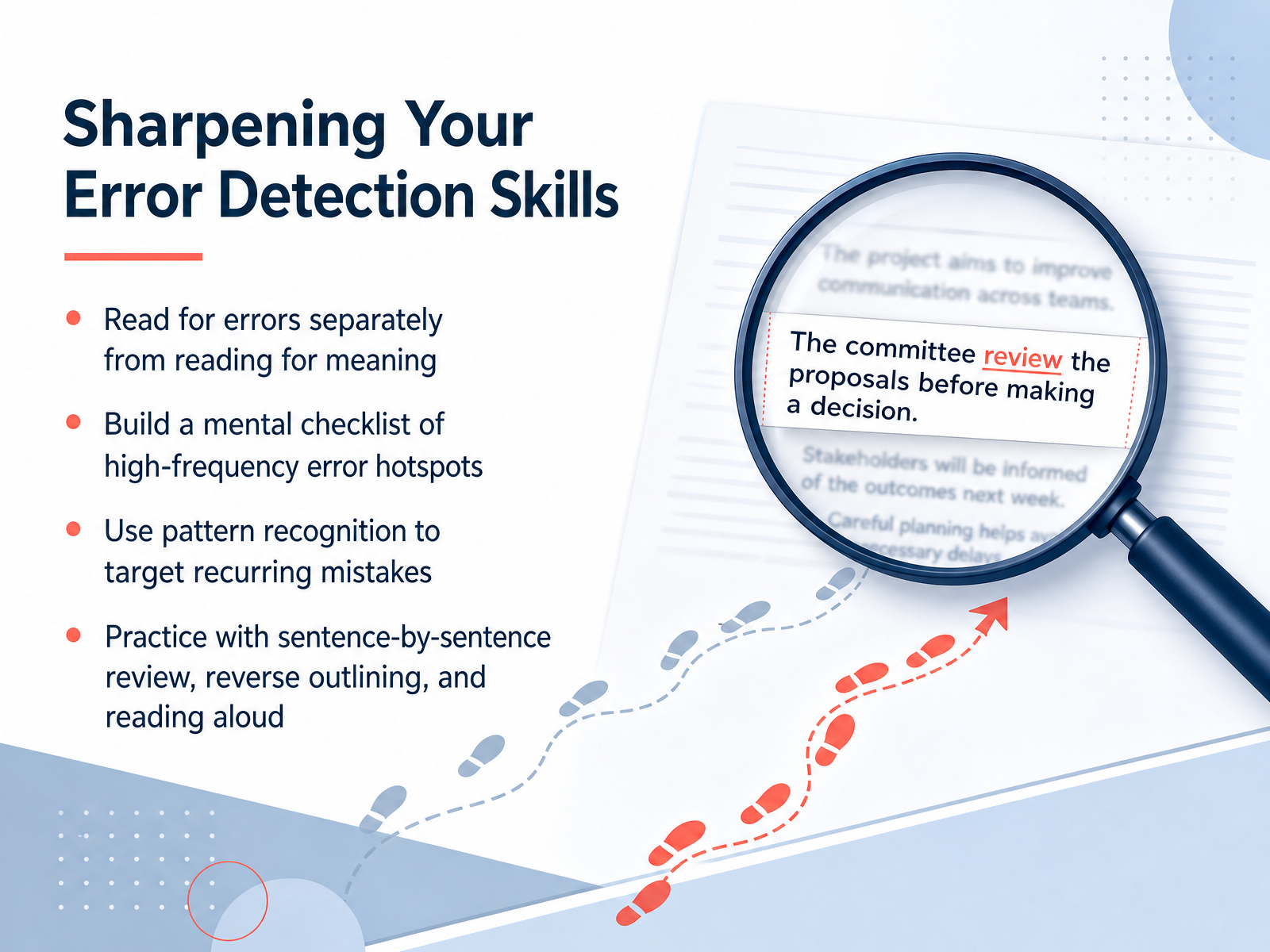
 - 06Sharpening Your Error Detection SkillsLet’s sharpen your error detection skills with a few practical techniques. First, read for errors separately from reading for meaning. When you read for meaning, your brain fills in the gaps. So do a second pass, and this time, focus only on how the sentences are built. Next, build a mental checklist of your high-frequency error hotspots. For most learners, those are articles, prepositions, and subject-verb agreement. Your checklist should be personal, so track the mistakes you make most often. Then use pattern recognition. If you know you tend to confuse “its” and “it’s,” you’ll spot that pattern much faster in your next draft. Finally, practice with three specific techniques. Review your writing sentence by sentence. Try reverse outlining, where you summarize each paragraph in one line to check the logic. And read your work aloud. Your ear will catch rhythm problems that your eyes often miss. Use these techniques consistently, and your self-editing will become faster and more accurate. Next, we’ll look at a systematic five-step correction workflow.
 imtiajwrites.comreadwritethink.orgquillbot.com+22 min
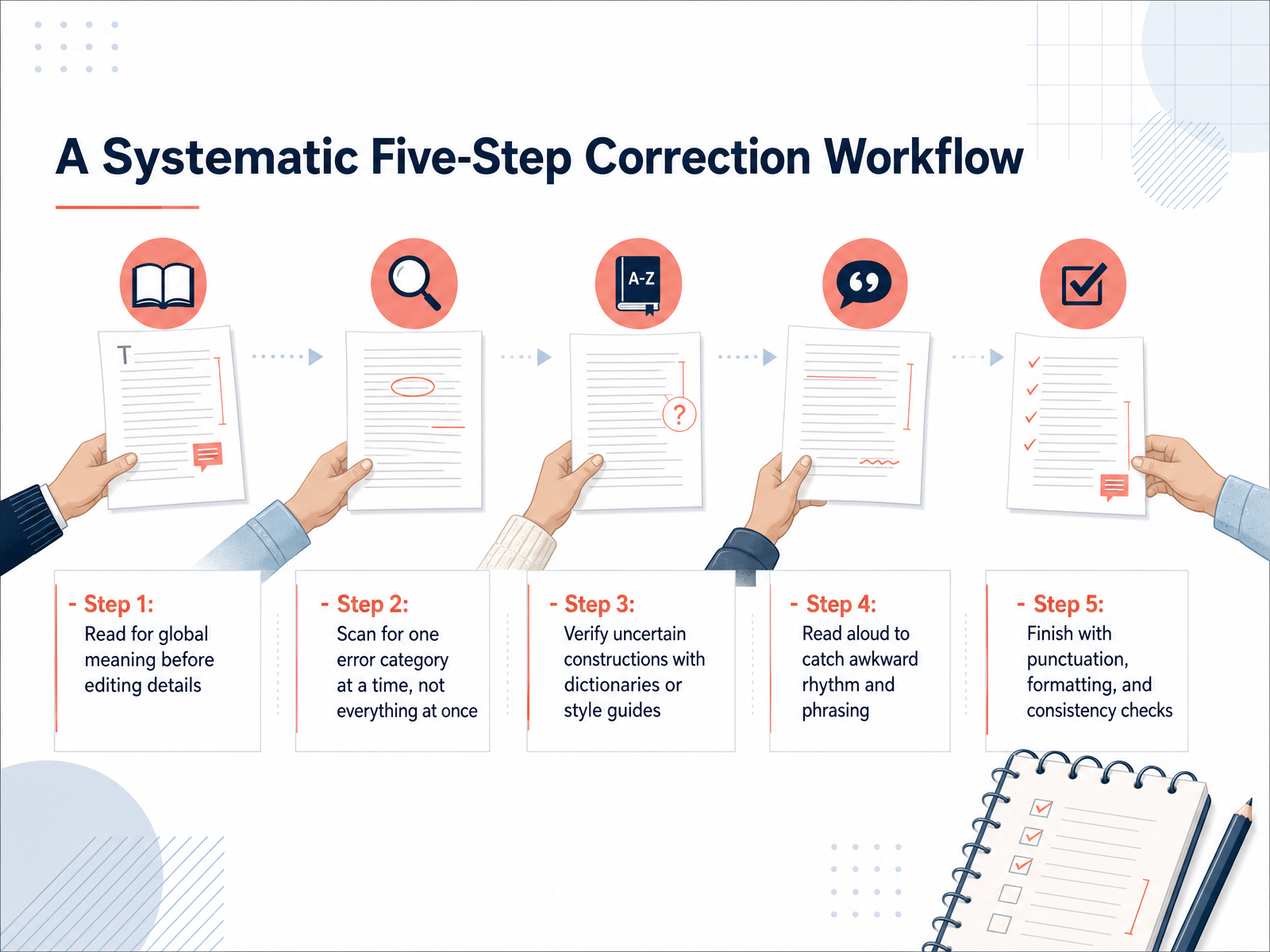
 - 07A Systematic Five-Step Correction WorkflowNow let's turn that checklist into a workflow you can actually follow. It has five steps. Step one: read for global meaning before you edit any details. Understand the main message first. Step two: scan for one error category at a time. Don't try to catch everything at once. Focus on articles in one pass, then prepositions in the next. Step three: verify uncertain constructions. If you're not sure about a phrase, check a dictionary or a style guide. That's what they're for. Step four: read your text aloud. This helps you catch awkward rhythm and phrasing that silent reading misses. Step five: finish with punctuation, formatting, and consistency checks. Check spelling style, date formats, and capitalization. This five-step workflow keeps your editing organized and effective. Next, we'll look at the single-pass method: editing one pattern at a time.
 imtiajwrites.comreadwritethink.orgquillbot.com+21 min
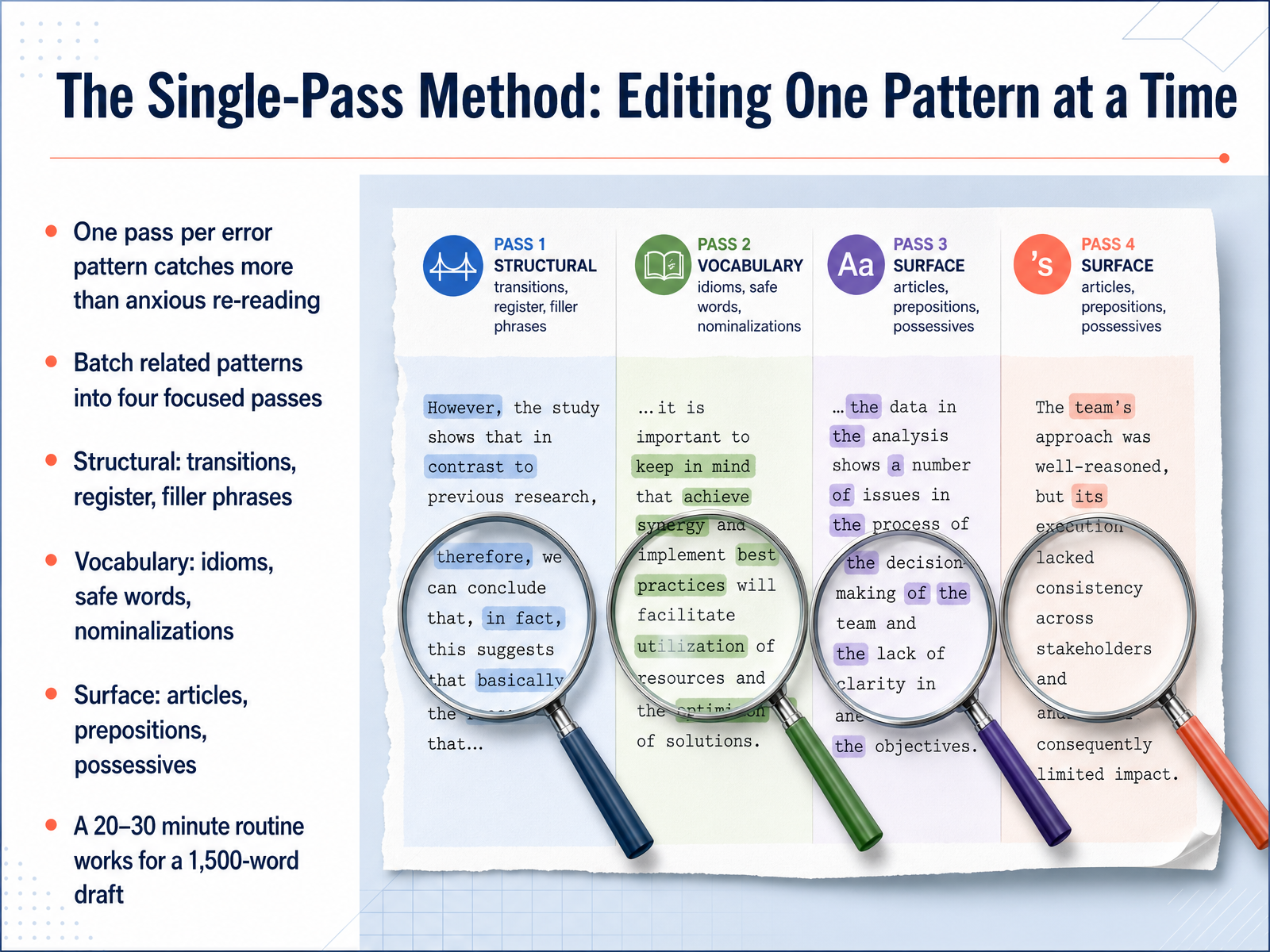
 - 08The Single-Pass Method: Editing One Pattern at a TimeSo how do you actually use these patterns? Not by re-reading your draft ten times and hoping. That approach misses most of what you are looking for. Instead, you run a single-purpose pass for each error type. One pass, one pattern. Here is how that works in practice. Start with a structural pass. Look only for transitions, register, and filler phrases. Cut anything that announces instead of saying. Then move to a vocabulary pass. Hunt for literal idioms, safe words like important or helpful, and nominalizations. Replace make a decision with decide. Next, a surface pass. Check articles, prepositions, and possessives one sentence at a time. This is the slowest pass, and it saves the most credibility at delivery. Four focused passes, about twenty to thirty minutes for a fifteen-hundred-word draft. That is faster than anxious re-reading, and it catches more. In the next section, we apply these same patterns to workplace communication.
 imtiajwrites.comreadwritethink.orgquillbot.com+21 min
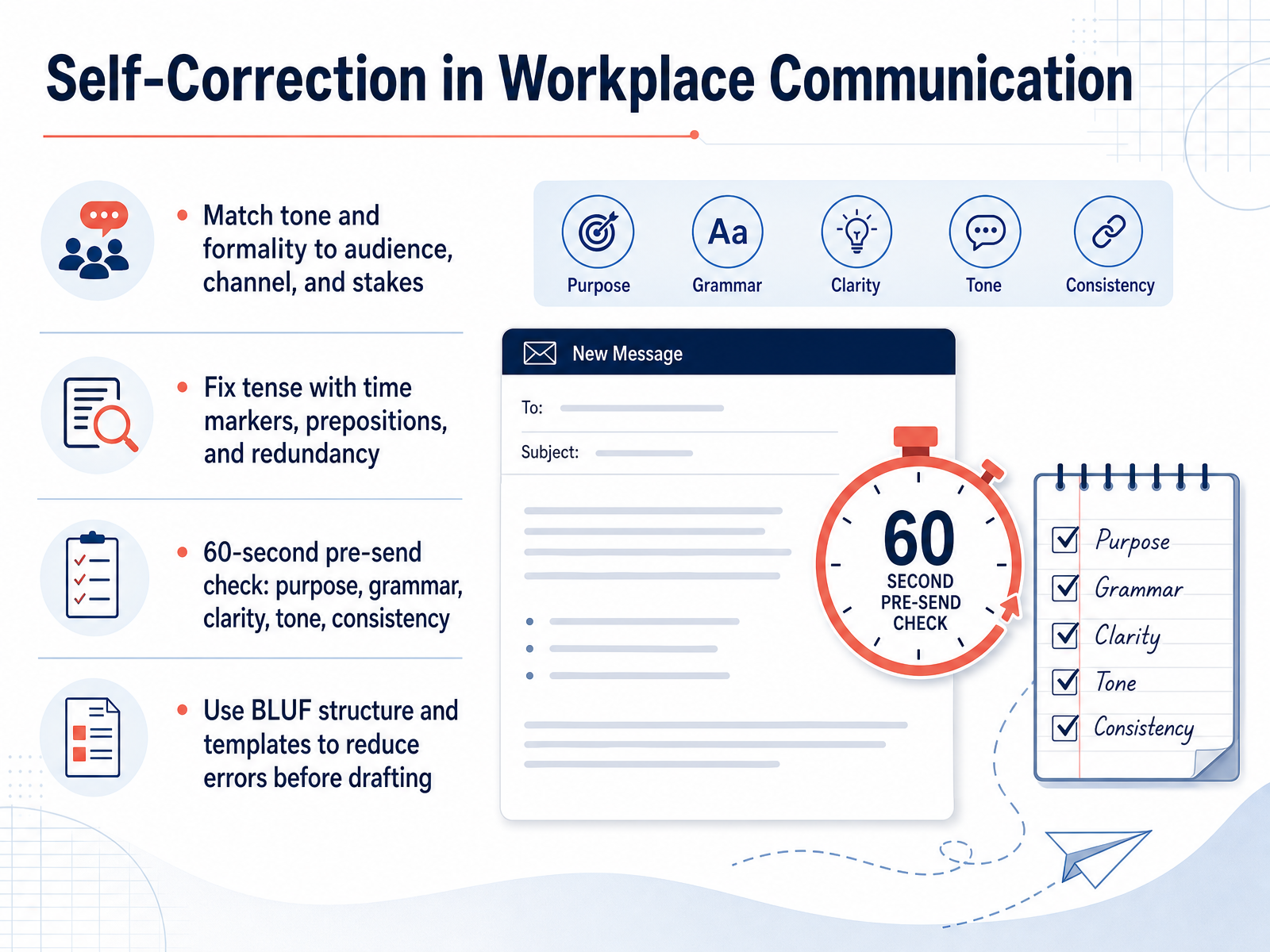
 - 09Self-Correction in Workplace CommunicationLet's put all of that into practice in the workplace. First, match your tone to your audience and the channel. An email to a new client should be more formal than a message to your team. Next, watch for tense with time markers. Say “I sent the report yesterday,” not “I have sent the report yesterday.” Before you hit send, do a sixty-second check. Ask yourself: What is the purpose? Is the grammar correct? Is the message clear? Does the tone match? And are my details consistent? Finally, use the BLUF structure, which means bottom line up front. State your main point and your request in the first two lines. This reduces errors before you even start drafting. A quick example: instead of “I was wondering if maybe we could meet sometime,” write “Could you meet Wednesday at two to discuss the budget?” A specific ask gets a specific answer. Now, let's look at how educators can apply these same techniques in their own teaching.
 fluentatdesk.comimtiajwrites.comreadwritethink.org+22 min
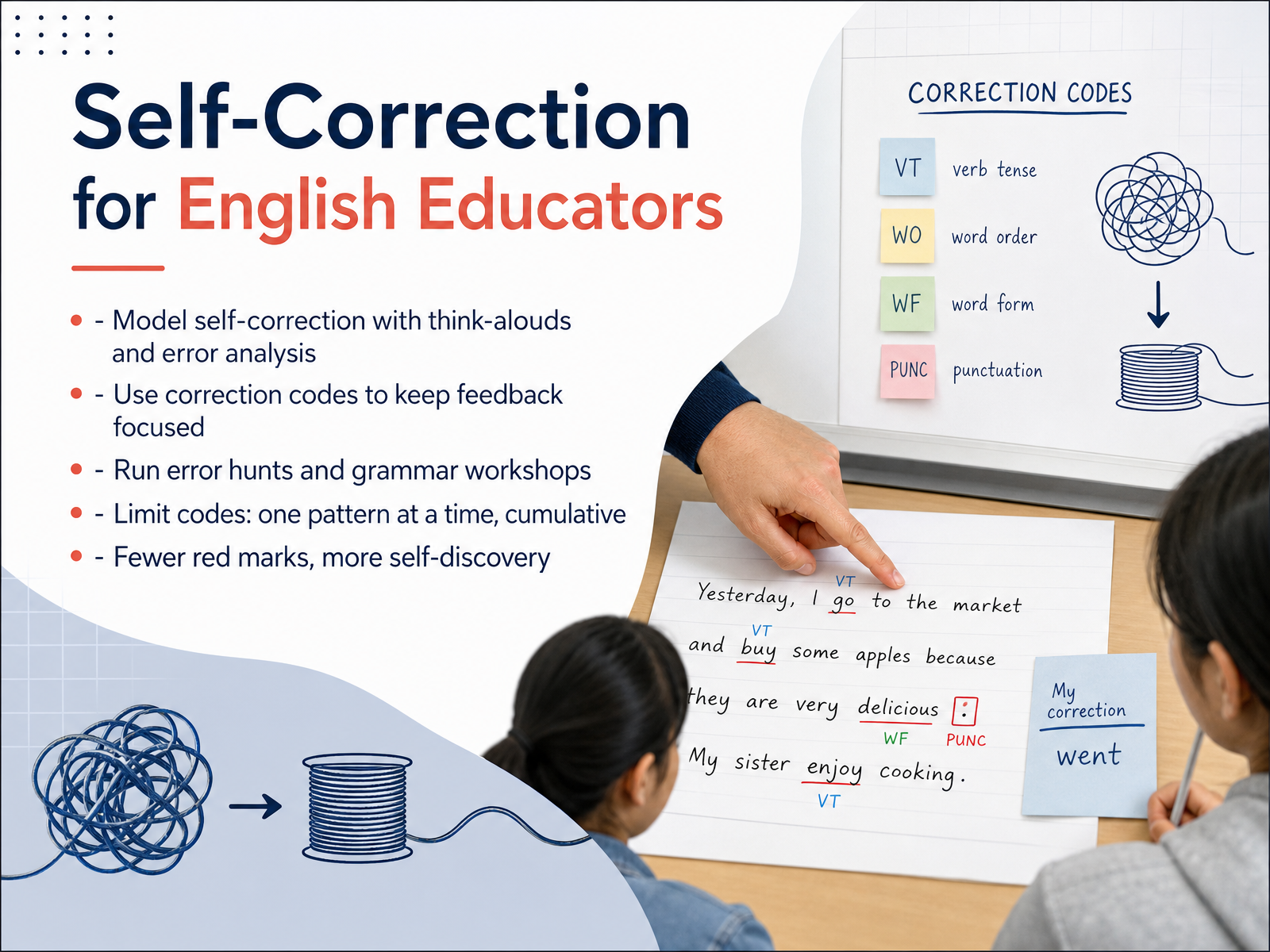
 - 10Self-Correction for English EducatorsNow let's turn to your role as an educator. The goal is to help your students become self-correctors, not just receivers of your red pen. Start by modeling your own thinking. When you correct a sample sentence, say your reasoning out loud. For example, 'This verb does not match its subject, so I need to change it.' This is a think-aloud. Next, use correction codes instead of writing out every fix. A simple 'VT' for verb tense, or 'WW' for wrong word, guides your student to find and solve the problem themselves. Here is the key: limit the codes. Focus on one pattern at a time, like capitalization, and only add another code when that first skill is solid. Build cumulatively. Then, run an error hunt. Put several sentences on the board, some correct and some not, and let students decide which ones work. These activities push students toward self-discovery. They learn to spot their own patterns, which is far more valuable than a page covered in marks. Fewer red marks, more self-discovery. Next, let's look at how to correct without over-correcting, and how to keep your feedback clear.
 scielo.org.coteachingenglish.org.ukm.busyteacher.org+22 min
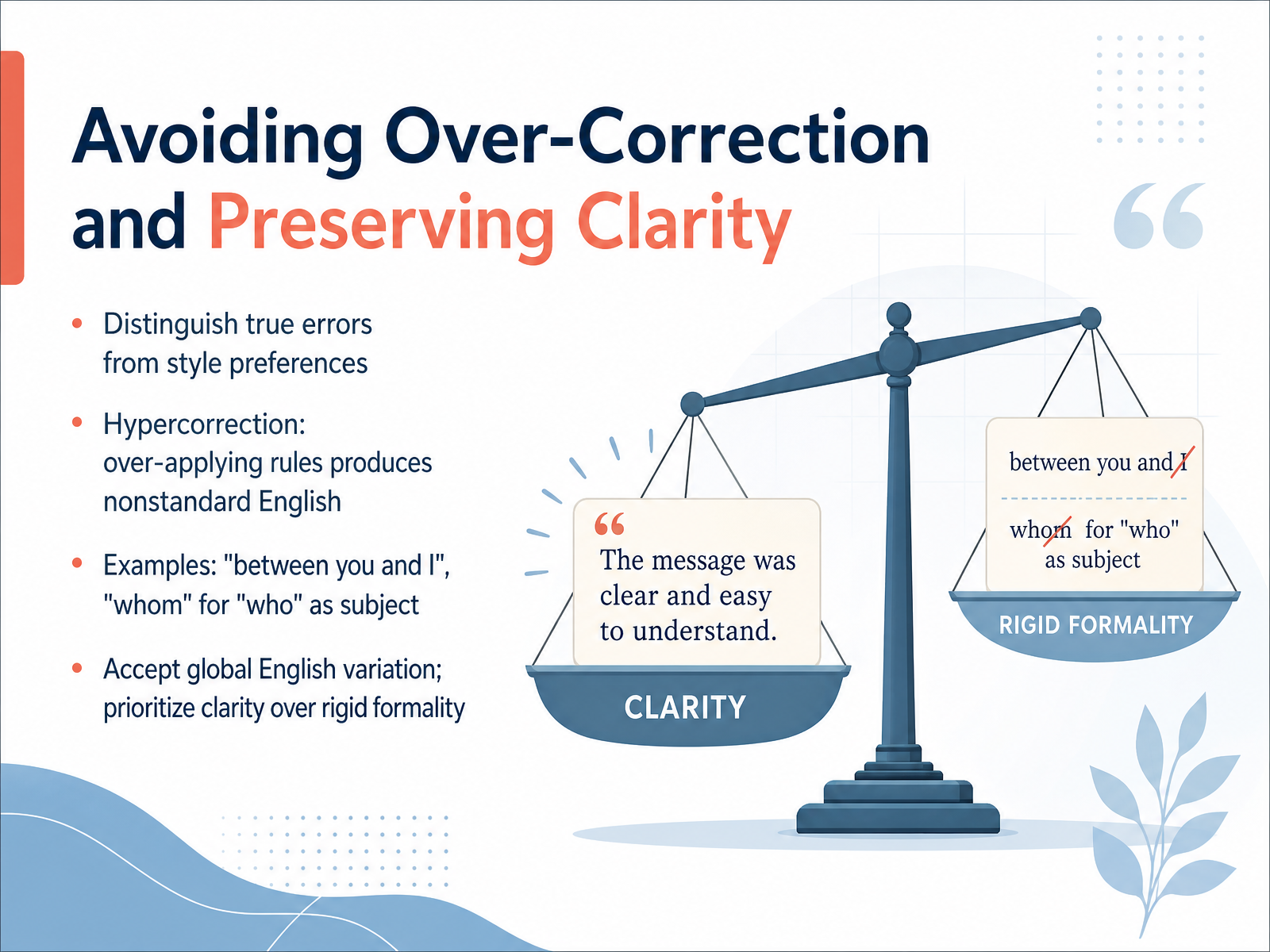
 - 11Avoiding Over-Correction and Preserving ClarityNow let us talk about something many careful speakers miss: over-correction, or hypercorrection. This happens when you apply a grammar rule so strictly that you actually create a new error. You already know the classic examples. Saying between you and I is not more correct; the proper form is between you and me. The word I is a subject, not an object of a preposition. Another common slip involves whom. People use whom to sound more formal, but if the word is doing the action, you must use who. So, Who is coming to dinner? is correct, not Whom is coming. Over-correcting often comes from a fear of sounding informal. But clarity matters more than rigid formality. English has many accepted global variations. What is standard in Singapore, for example, may differ from usage in London, and both can be perfectly clear. So, distinguish a true error from a simple style choice. The goal is polished, natural communication, not a performance of rule-following. Keep that balance in mind as we move to the next topic: using tools without losing your voice.
 2 min
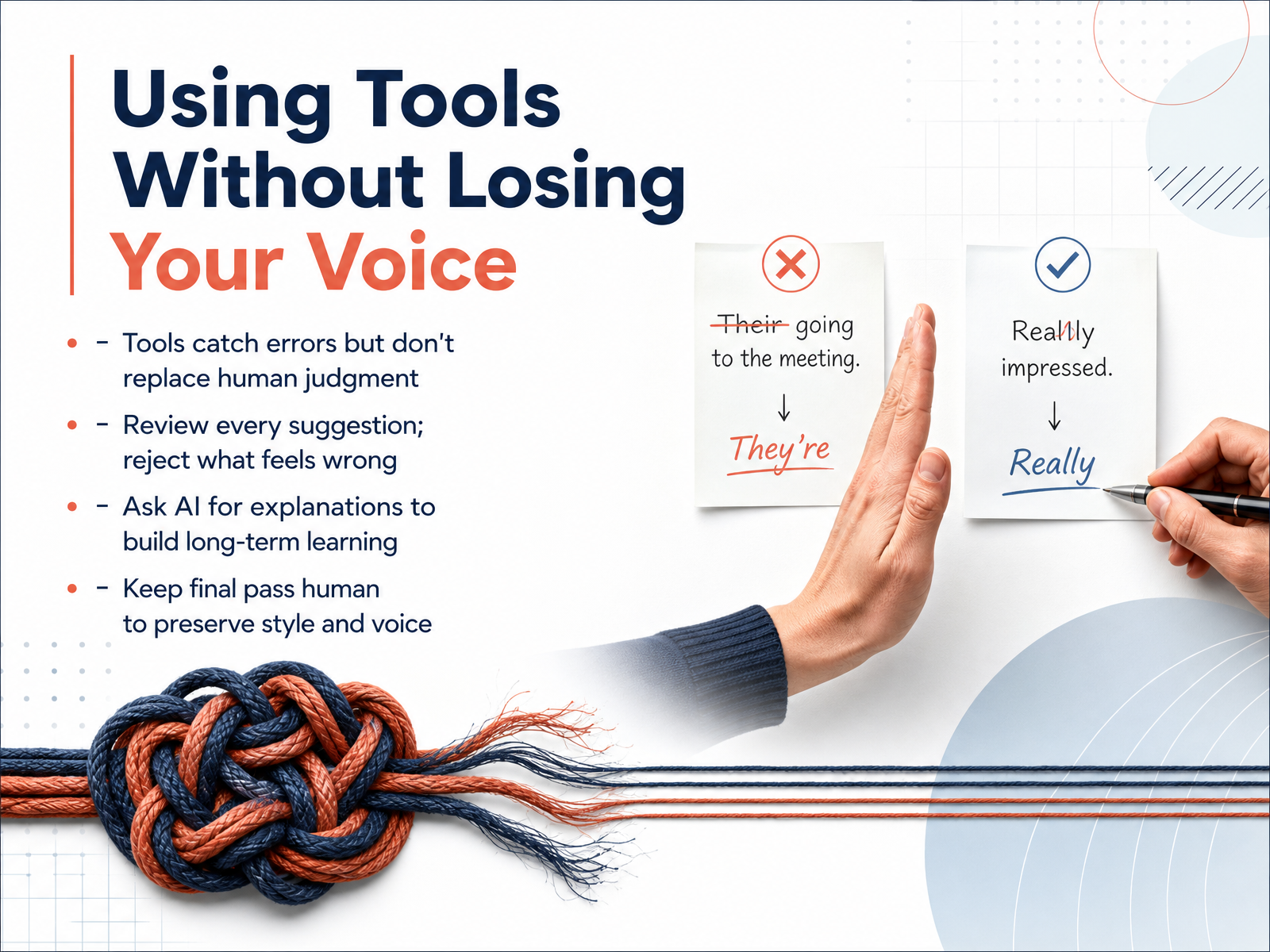
2 min - 12Using Tools Without Losing Your VoiceNow let's talk about using tools without losing your voice. Grammar checkers and AI assistants are excellent partners, but they don't replace your judgment. When a tool flags something, don't click accept automatically. Review the suggestion carefully and ask yourself if it matches your meaning. If a correction feels off, reject it. Trust your instincts. Also, use these tools to learn, not just to fix. Ask the AI to explain why it made a change. That explanation turns a quick correction into a lasting lesson. Finally, always do a final read-through yourself. Read the text aloud. That human pass is what keeps your style and personality intact. Remember, the tool is the assistant. You are the writer. Now, let's look at how to build an error log and practice loop to make these improvements permanent.
 1 min
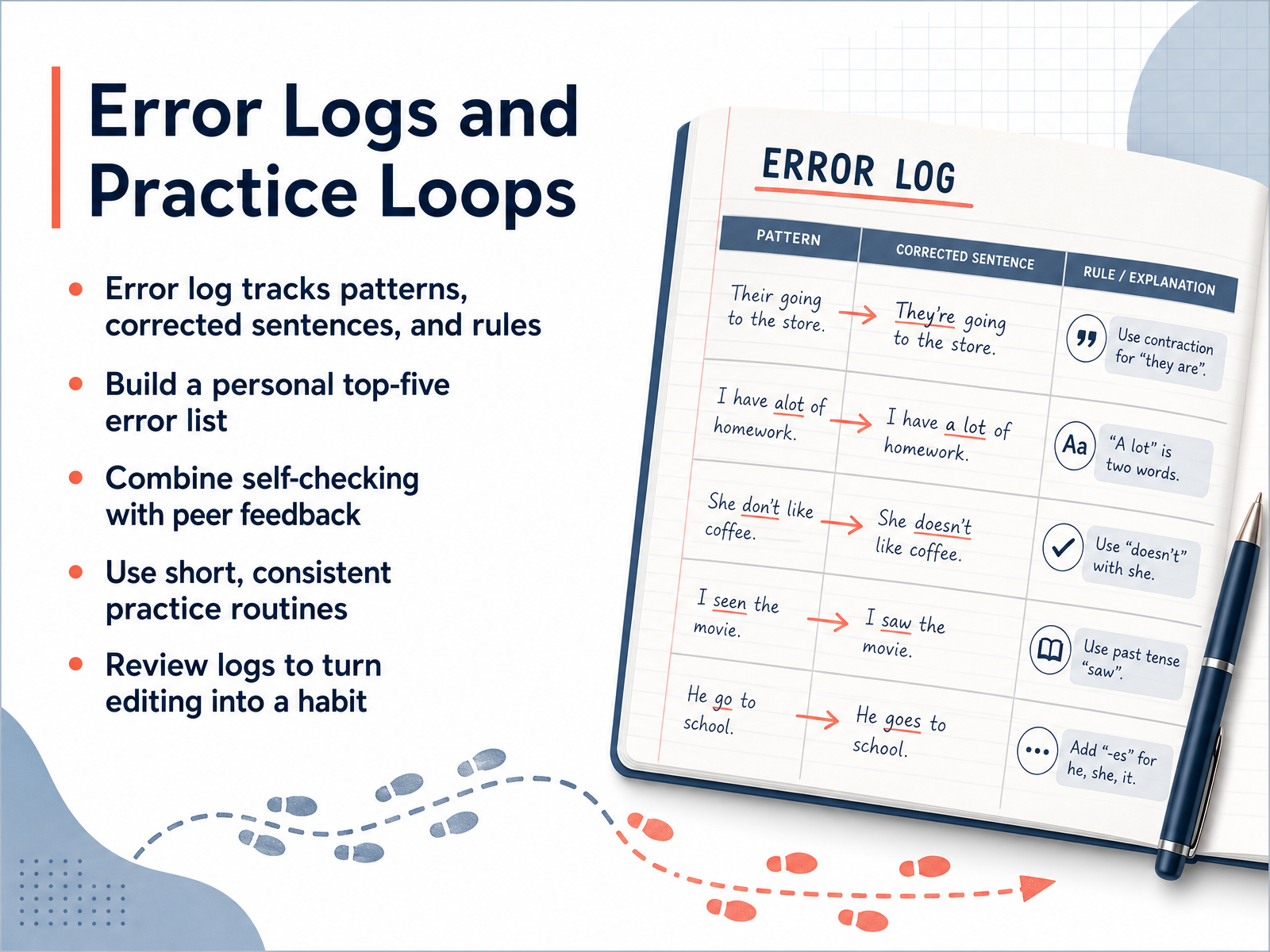
1 min - 13Error Logs and Practice LoopsLet's turn all of this into a system you can actually keep using. Start an error log. Every time you catch a mistake, write down the original error, the corrected sentence, and the rule that fixed it. Over time, patterns will appear. You'll see that you struggle with articles, or prepositions, or verb tense. Pick your top five patterns and build a personal checklist from them. That becomes your editing shortcut. Now, combine your self-checking with peer feedback. Ask a classmate to look at your writing with fresh eyes. They will catch things you've stopped seeing. Then, keep your practice short and consistent. Fifteen minutes of focused editing, three times a week, beats one long session every month. Review your error log before you write, not just after. That turns editing from a chore into a habit. Now, let's look at your next steps to make this stick.
 imtiajwrites.comreadwritethink.orgquillbot.com+22 min
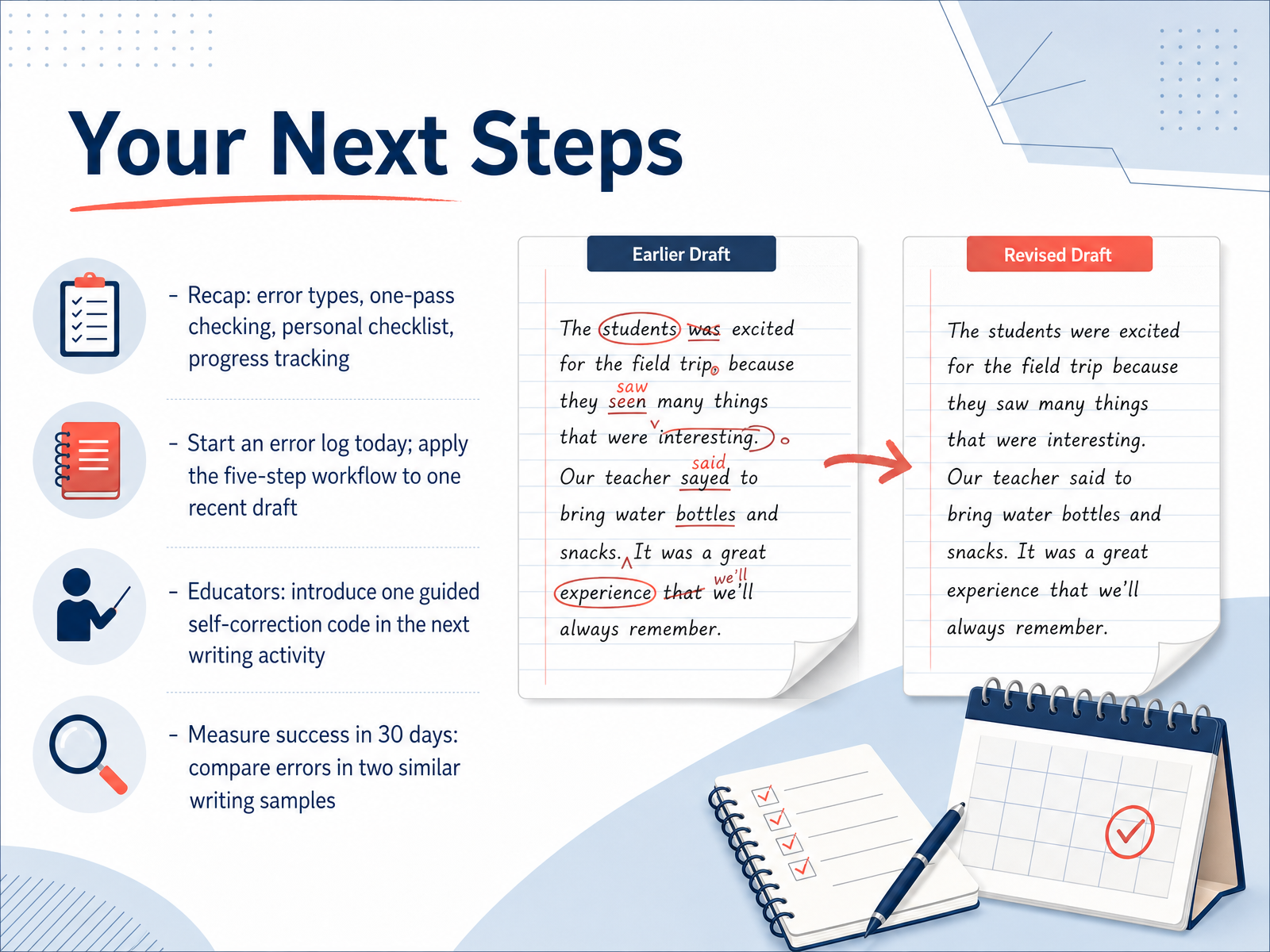
 - 14Your Next StepsYou have reached the final and most important step: applying what you have learned. Let us quickly recap. We covered the common error types, the value of a one-pass checking method, your personal checklist, and how to track your progress. Now, take action. Start an error log today. Choose one recent draft and apply the five-step workflow to it. For educators, introduce one guided self-correction code in your next writing activity. Do not mark everything. Begin with a single pattern. And here is your challenge: in thirty days, compare two similar writing samples. You will see the progress. Remember, self-correction is a skill you build with practice, not a talent you are born with. Thank you for your attention and effort. You are now equipped to edit with confidence, clarity, and control. Go ahead. Start your error log today.
 imtiajwrites.comreadwritethink.orgquillbot.com+22 min
Take the deck with you
Download this course as a file — free, no sign-up needed.
- PDF handoutEvery slide page, ready to print or share.15 pages · 3.7 MBDownload
- Narrated PowerPointThe deck that presents itself — every slide carries the digital human's narration video.15 pages · 15.5 MBDownload
- PowerPoint slidesThe full deck as a .pptx — open it in PowerPoint, Keynote, or Google Slides.15 pages · 3.6 MBDownload
Free to use in your own training — please keep the PersonWise credit page at the end.
Have your own deck? Turn it into a course
Sources consulted
Web sources consulted while building this course.
- Self-correction | TeachingEnglish | British Council — teachingenglish.org.uk
- 6 Great Ways to Help ESL Students Achieve Self-Correction — m.busyteacher.org
- Self-correction Profiles of L2 English Learners: A Longitudinal Multiple ... — tesl-ej.org
- Autonomy in acquisition: Exploring the transformative effects of self-error correction on ESL learners’ proficiency and motivation — ijsra.net
- Reformulation and Self-correction: Insights into correction strategies for EFL writing in a school context | Vigo International Journal of Applied Linguistics — revistas.uvigo.es
- The effects of teacher, peer and self-feedback on error correction with corpus use — doi.org
- Self and Peer Correction to Improve College Students ... — scielo.org.co
- SELF CORRECTION WORKS BETTER THAN TEACHER CORRECTION IN EFL SETTING — scf-lsa.info
- Peer-correction and Self-correction of Errors in Foreign ... — shs-conferences.org
- Top 130 Common Mistakes in English ESL Students Make — eslinfo.com
- Decoding the Challenges: A Study of English Writing Errors Among EFL Students — pdfs.semanticscholar.org
- PROFILING PREVALENT LINGUISTIC INACCURACIES IN UNDERGRADUATE ESL LEARNERS’ WRITING: AN ERROR-BASED STATISTICAL ANALYSIS — ejurnal.iainpare.ac.id
- An Error Analysis of Expository Essay Writing of English as Second Language (ESL) Undergraduate Learners in Pakistan — doi.org
- 100 Common ESL Grammar Mistakes — englishgrammar.org
- The Non-Native Writer's Self-Editing Checklist: 12 Patterns — imtiajwrites.com
- Editing Checklist for Self- and Peer Editing | Read Write Think — readwritethink.org
- Free Editing Checklist for Students | Revise & Polish Essays — quillbot.com
- Editing Checklist for ESL Writers: 10 Rewrite Tasks — 5minuteenglish.com
- Guide to Self-Editing — unh.edu
- Business Writing Mistakes Non-Native Speakers Should Avoid | FluentAtDesk — fluentatdesk.com