Begin
14 pages · ~28 min
Customer Success Manager Role Fundamentals
This training provides a clear overview of the Customer Success Manager role, covering core responsibilities, skills, and impact for new and aspiring CSMs.
A digital instructor presents all 14 pages. Hold “Ask” at any point and ask out loud — the answer comes from this course. No sign-up needed.
What you’ll learn
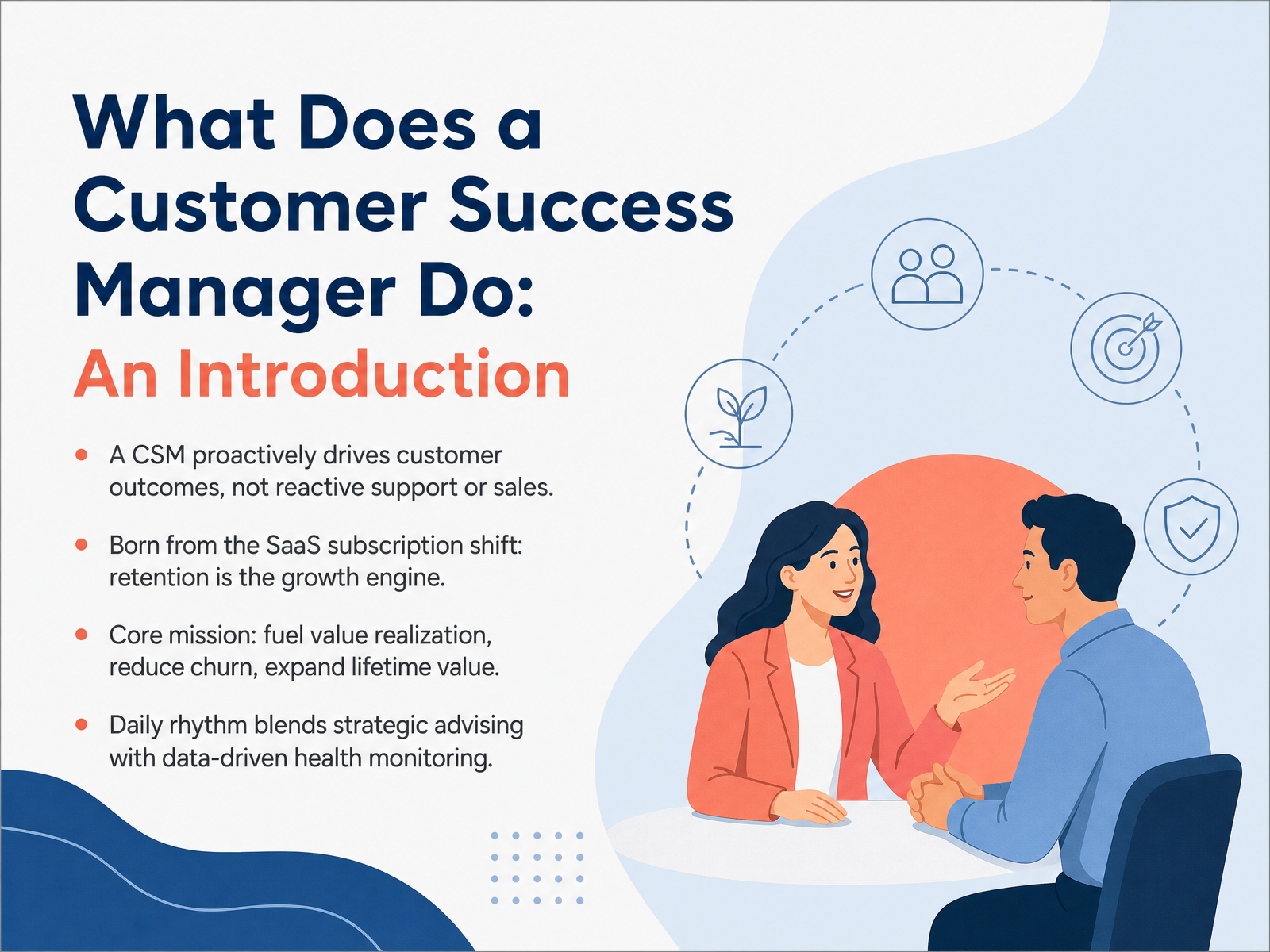
- 01What Does a Customer Success Manager Do: An IntroductionWelcome. Let's pull back the curtain on one of the most important roles in modern business: the Customer Success Manager, or CSM. Think of a CSM as a proactive guide. They aren’t a reactive support agent responding to tickets. And they aren’t a salesperson chasing the next deal. Instead, a CSM’s job is to ensure that after a customer buys software, they actually achieve the specific outcomes they were promised. This role was born from the subscription economy, where keeping a customer is just as important as landing one. In fact, industry data shows the median retention rate hovers around one hundred and two percent, meaning most SaaS companies only stay alive because CSMs continuously prove value. Their core mission is to fuel value realization, reduce churn, and expand lifetime value. On a typical day, they blend strategic advising with data-driven health monitoring. They’re reading usage signals to spot a customer who might leave, and setting up a coaching call before that ever happens. In this course, we’ll demystify that daily reality. Up next, we’ll dig into the business case and see exactly why customer success is the growth engine of any profitable subscription business.cust.cobenchmarkit.aisaasrise.com+22 min
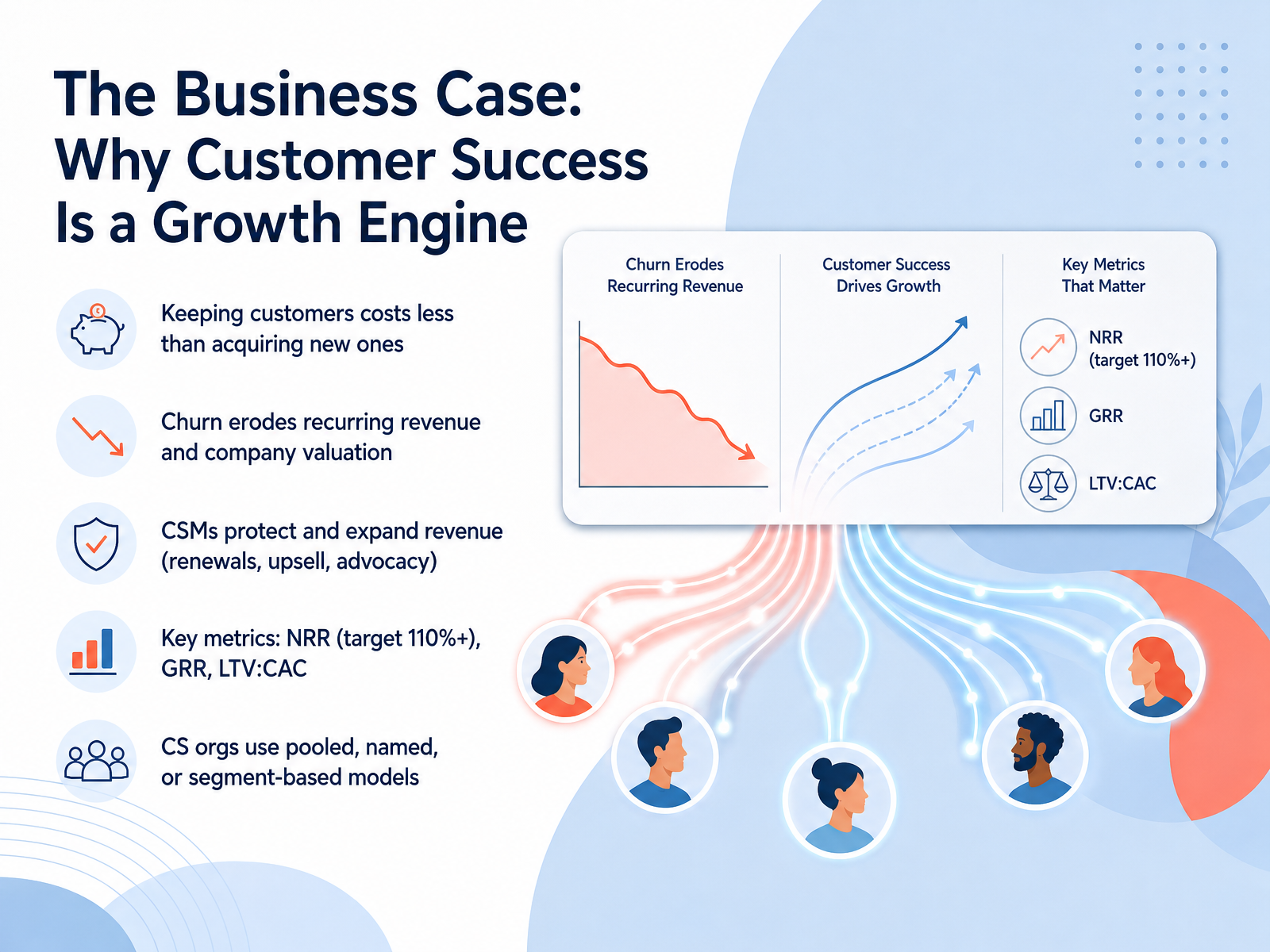
- 02The Business Case: Why Customer Success Is a Growth EngineNow, let's talk about why Customer Success isn't just a support function. Think of it as a growth engine, not a cost center. Here's the simple math: keeping a customer costs way less than finding a new one. When customers leave, that churn doesn't just drain this month's revenue. It erodes your recurring revenue base and, in a subscription business, it directly hits your company's valuation. So as a CSM, your job is to protect and expand revenue. You do that by driving renewals, spotting natural upsell opportunities, and turning happy customers into vocal advocates who bring you referrals. To measure this, we focus on a few key metrics. The big one is Net Revenue Retention, or NRR. A healthy target is 110 percent or higher, meaning your existing customer base is actually growing on its own. We also look at Gross Revenue Retention, or GRR, and the lifetime value to customer acquisition cost ratio. Companies structure their CS teams differently to hit these numbers. You'll see pooled models where a team shares accounts, named models where you own specific relationships, or segment-based models that focus on industries. In a moment, we'll get into the skills you'll need to thrive in this role, because the 2026 CSM is a fundamentally different job than it was a couple of years ago.
 cust.cobenchmarkit.aisaasrise.com+22 min
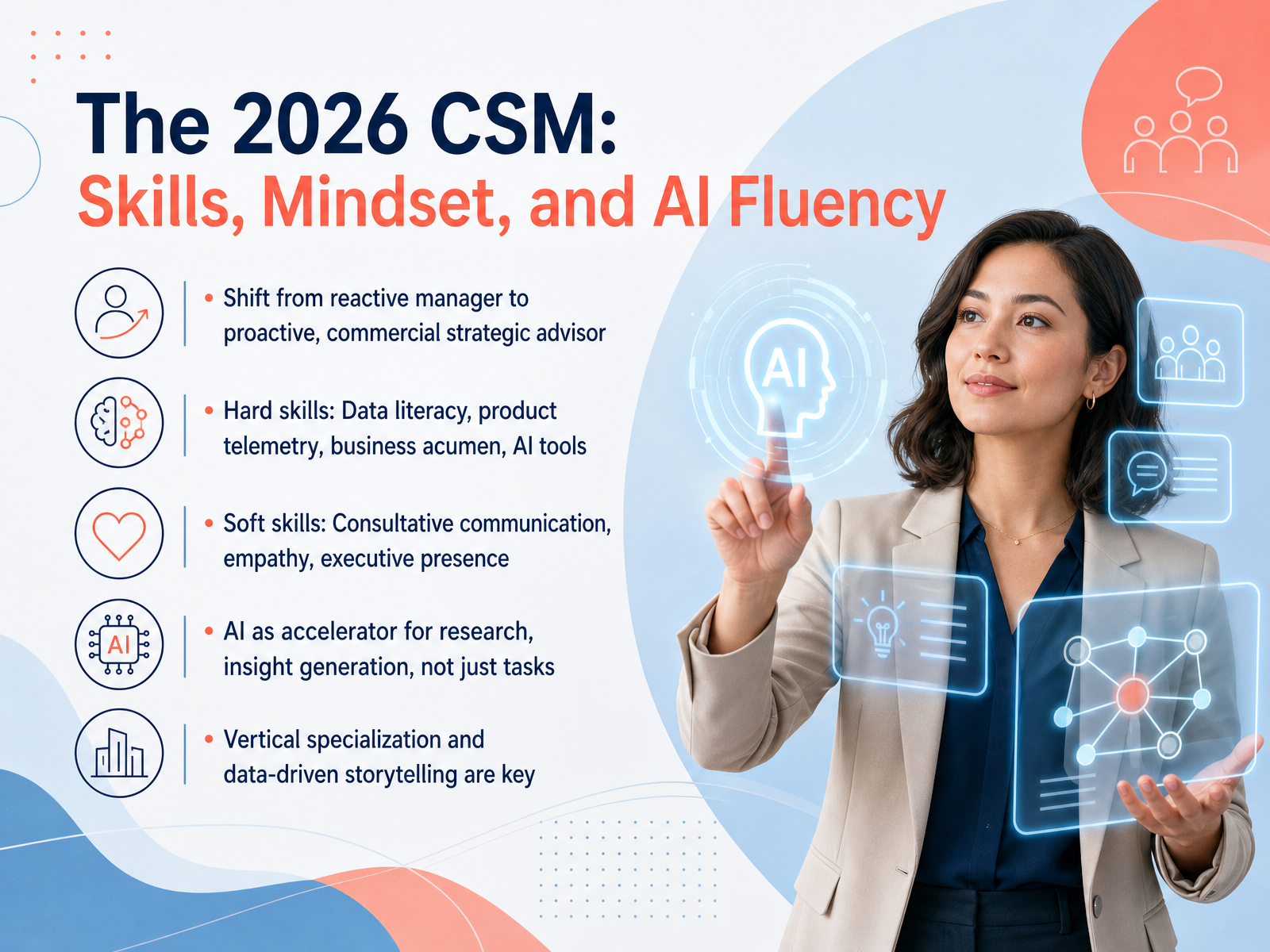
 - 03The 2026 CSM: Skills, Mindset, and AI FluencySo let's talk about what a CSM actually looks like in 2026. The days of being a reactive account manager who answers questions are fading fast. Today, you're expected to be a proactive, commercial strategic advisor. Your job isn't just to manage relationships. It's to connect the customer's business outcomes to your own company's revenue outcomes. Think about it this way: you're not just handling a renewal meeting. You're using product usage data to spot an adoption gap months before it becomes a churn risk, and then you guide the customer to close that gap. That requires a new blend of hard and soft skills. On the hard side, you need data literacy to read product telemetry, business acumen to understand your customer's financials, and fluency with AI tools. AI isn't here to replace you. It's an accelerator. You can use it to research a client's top corporate initiatives in minutes instead of hours, or to generate a first draft of a business review deck so you can focus on high-level strategy. But the human layer is still everything. Soft skills like consultative communication, genuine empathy, and an executive presence that lets you influence senior leaders? Those can't be automated. We're also seeing a rise in vertical specialization. The best CSMs don't just know 'customer success' in general. They know their customer's specific industry and can tell a compelling, data-driven story about the value only your product delivers. If you're building your career for this role, you need to be equal parts analyst, consultant, and storyteller. That's the modern CSM archetype. Up next, we'll map all of this onto the customer journey itself. Let's get into the customer lifecycle and how you orchestrate the entire post-sale journey.
 gainsight.comzendesk.comcrofirst.com+22 min
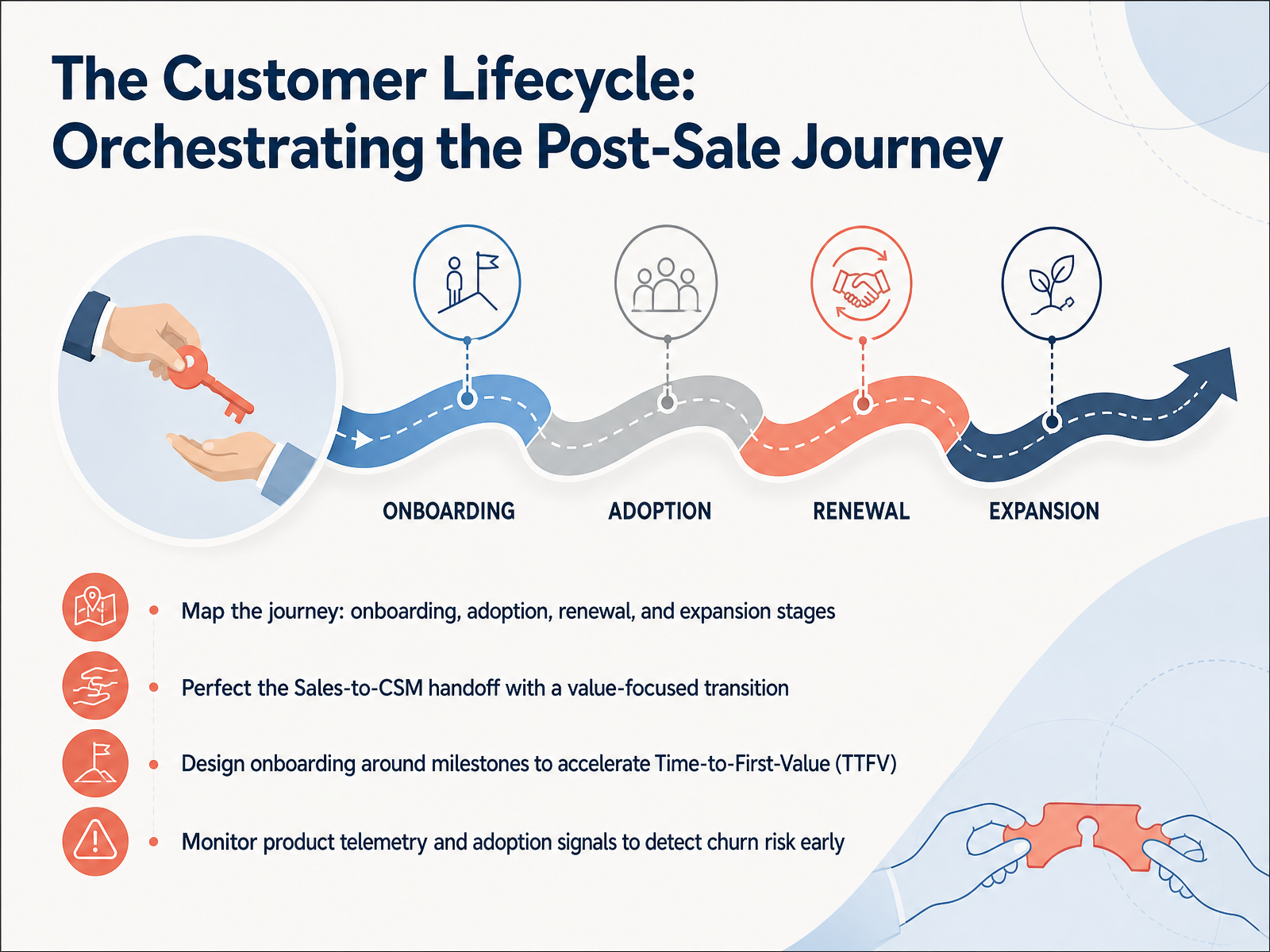
 - 04The Customer Lifecycle: Orchestrating the Post-Sale JourneyLet's map the full customer lifecycle, the post-sale journey you orchestrate. Think of it in four stages: onboarding, adoption, renewal, and expansion. Your work starts with a perfect handoff from sales. Move the conversation from what was sold to the value the customer expects to achieve. Then, design onboarding around milestones that accelerate time-to-first-value. Every day a customer doesn't see results is a day their trust erodes. Once they're live, you monitor product telemetry and adoption signals, not just for success stories but to detect churn risk early. For example, if a key user stops logging in, that's a signal to reach out before a renewal conversation ever starts. This proactive management is what separates a strategic advisor from reactive support. Next, we'll dig into how you quantify those signals and manage customer health with data-driven risk detection.
 gainsight.comzendesk.comcrofirst.com+22 min
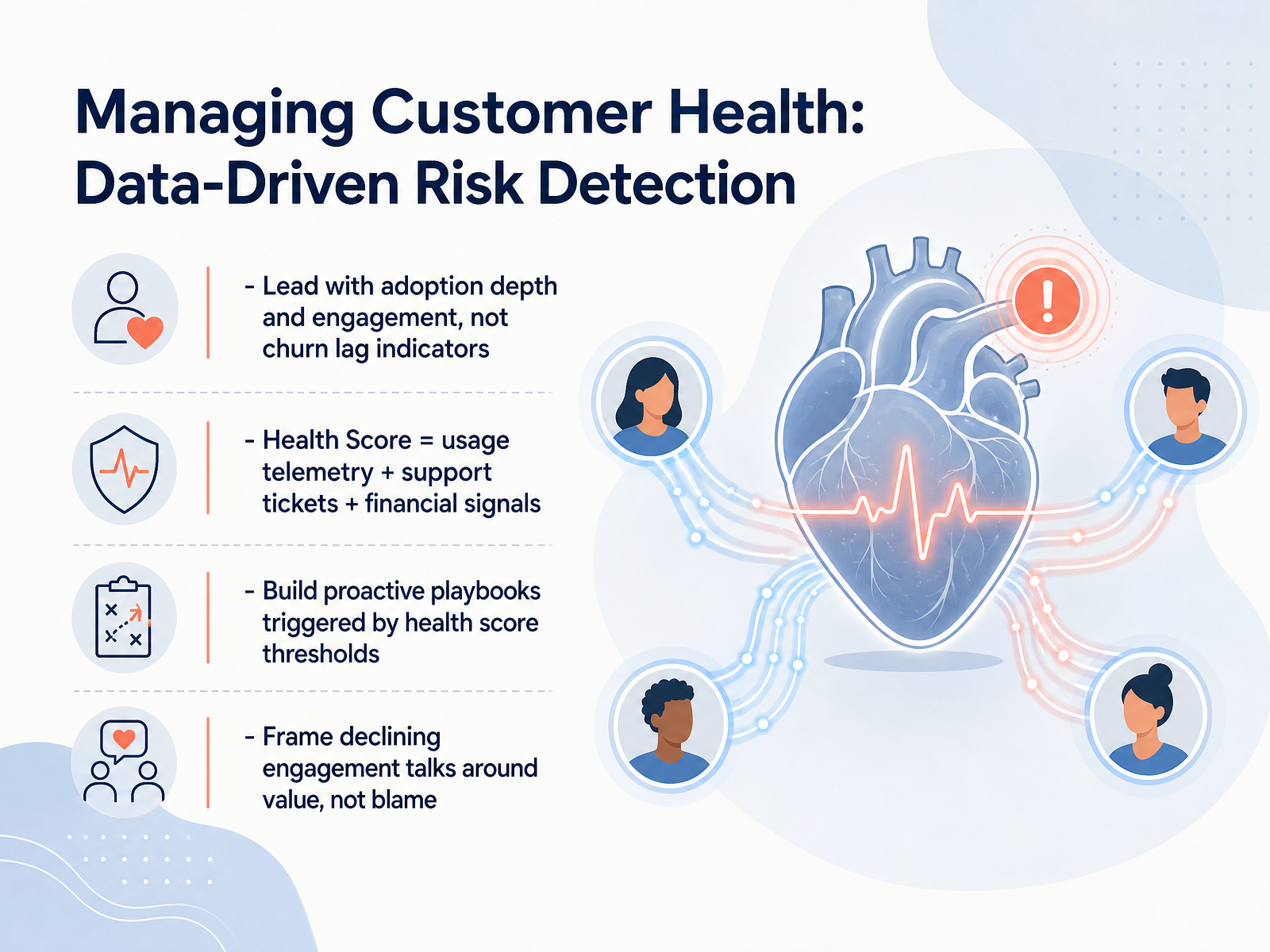
 - 05Managing Customer Health: Data-Driven Risk DetectionNow let's get tactical with customer health. Think of your customer relationships like a doctor thinks about a patient. You don't wait for a heart attack before checking their vitals. You lead with leading indicators, not lagging ones. Churn is the funeral; you need to spot the fever early. That means looking at adoption depth and engagement first. Are they actually using the core features? Are their key users logging in weekly or daily? Now, a real health score combines three signals. First, usage telemetry, the digital footprint inside your product. Second, support tickets, which show friction even if usage looks high. And third, financial signals like billing history or credit usage. When you mix these together, you stop guessing and start seeing patterns. Once you have that score, you need a playbook. Set thresholds that trigger automatic or team actions. Maybe a score dropping below seventy triggers a proactive outreach, not just an automated email. But here's the art in the science. When you have that conversation, don't go in with a blame list. Frame it around value, not failure. Say, 'I noticed a shift in usage and I want to make sure the team is still getting the full benefit.' That changes a churn risk meeting into a value advisory session. Up next, we'll look at the different models for delivering this kind of strategic engagement, from high-touch to digital-led CS.
 gainsight.comzendesk.comcrofirst.com+22 min
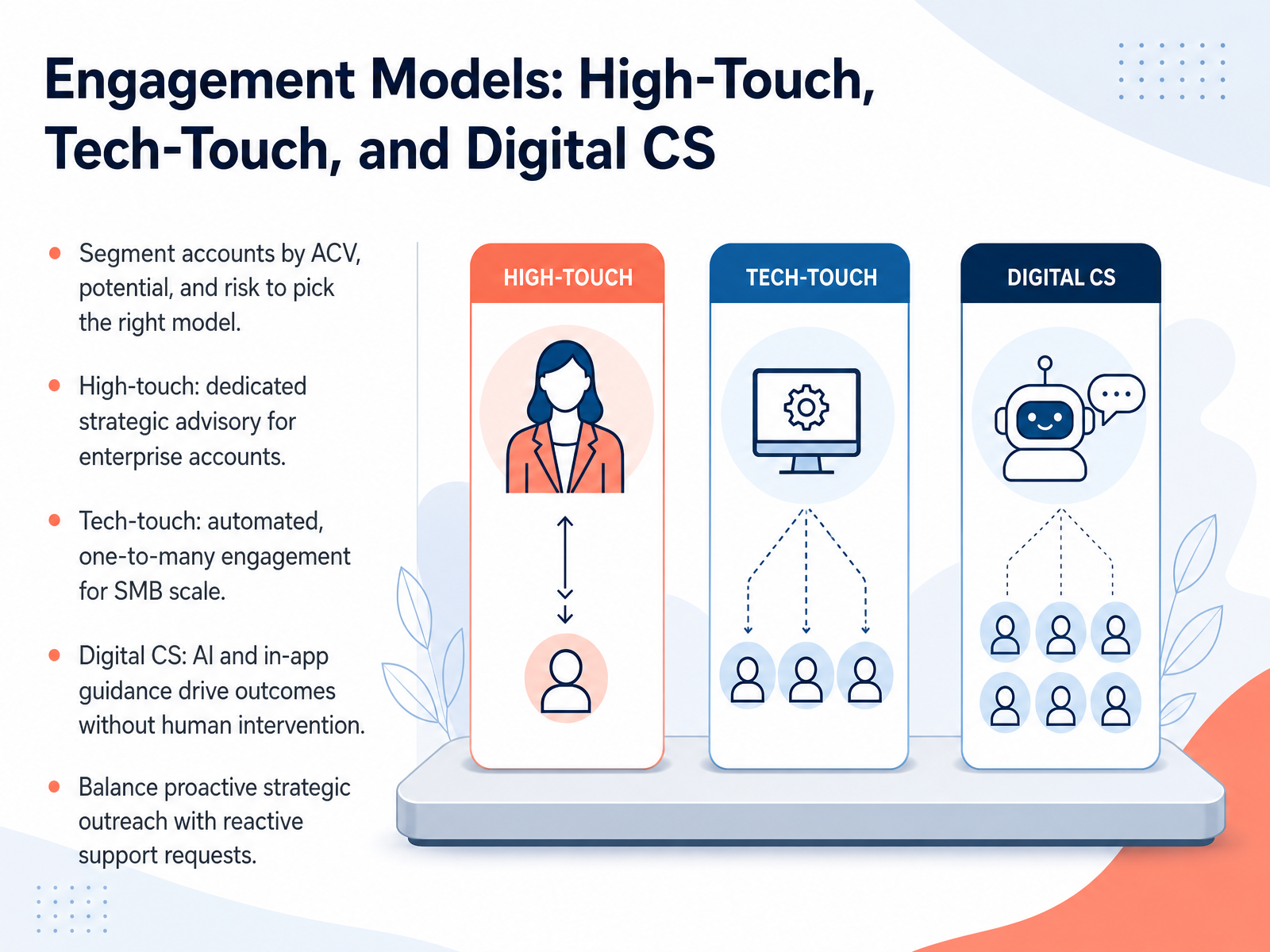
 - 06Engagement Models: High-Touch, Tech-Touch, and Digital CSNow, let’s talk about how you actually engage your customers. Not every account needs the same kind of attention, so we use three main models. The first is high-touch. Think of this as a white-glove service for your largest enterprise accounts, where a dedicated CSM acts as a strategic advisor focused on expansion and retention. The second is tech-touch. This is where you use automation to engage hundreds of SMB customers at once, scaling your outreach without hiring an army. The third is digital CS. Here, AI and in-app guidance do the heavy lifting, driving outcomes with little to no human intervention. Your job is to segment accounts based on their annual contract value, their growth potential, and their risk of churn. Then, you balance your time between proactive strategic outreach and those reactive support requests that always pop up. Coming up next, we’ll apply this strategic lens to the meeting room and break down Executive Business Reviews that actually drive decisions.
 gainsight.comzendesk.comcrofirst.com+21 min
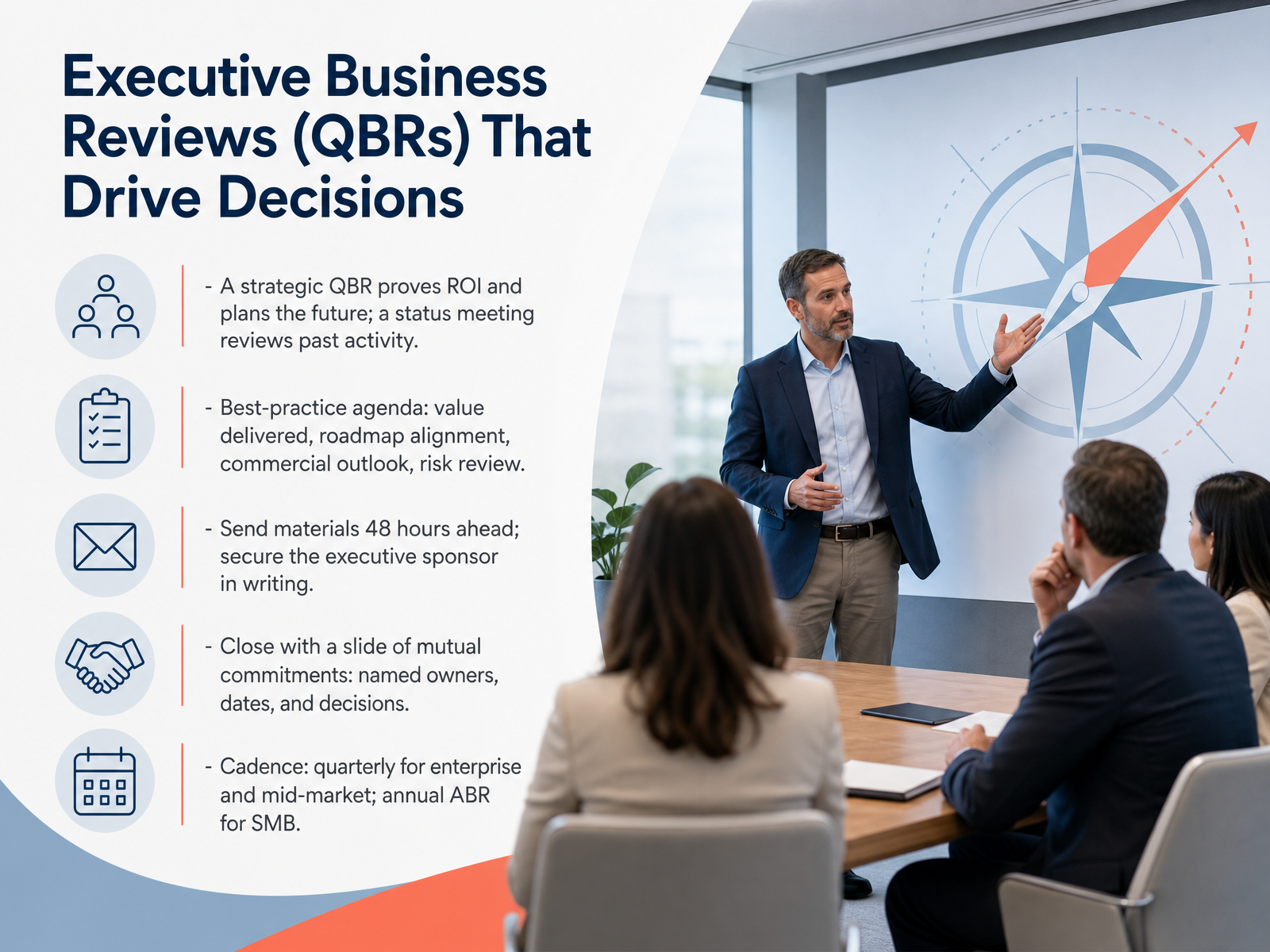
 - 07Executive Business Reviews (QBRs) That Drive DecisionsNow let's talk about the meeting that makes all this come together: the Executive Business Review—or QBR. But here is the single most important distinction you'll hear today. A strategic QBR proves return on investment and plans the future. A status meeting just reviews past activity. If your deck has no decision slide and the meeting ends without firm commitments, you've run a status meeting that the executive sponsor will eventually stop attending. So what does a real QBR agenda look like? First, present the value delivered in the customer's own business metrics—dollars saved, hours returned, not just feature counts. Next, align your product roadmap to their upcoming priorities and be honest about what you cannot do. Then have an explicit conversation about the renewal and expansion outlook. Finally, surface risks early—like an executive change or a product gap—and assign clear owners. Best practice: send the data package forty-eight hours ahead and confirm the executive sponsor's attendance in writing. Close with a slide titled "What we agreed to today," listing named owners, specific dates, and decisions. For enterprise accounts, run a full QBR every quarter. For mid-market, every four to six months plus an annual business review. For smaller accounts, an async annual summary often delivers the most value. That is the rhythm that keeps renewals predictable. Next up, we will explore how to use these insights for driving expansion, renewals, and building advocacy.
 churnbase.iosuccessknocks.comresources.rework.com+22 min
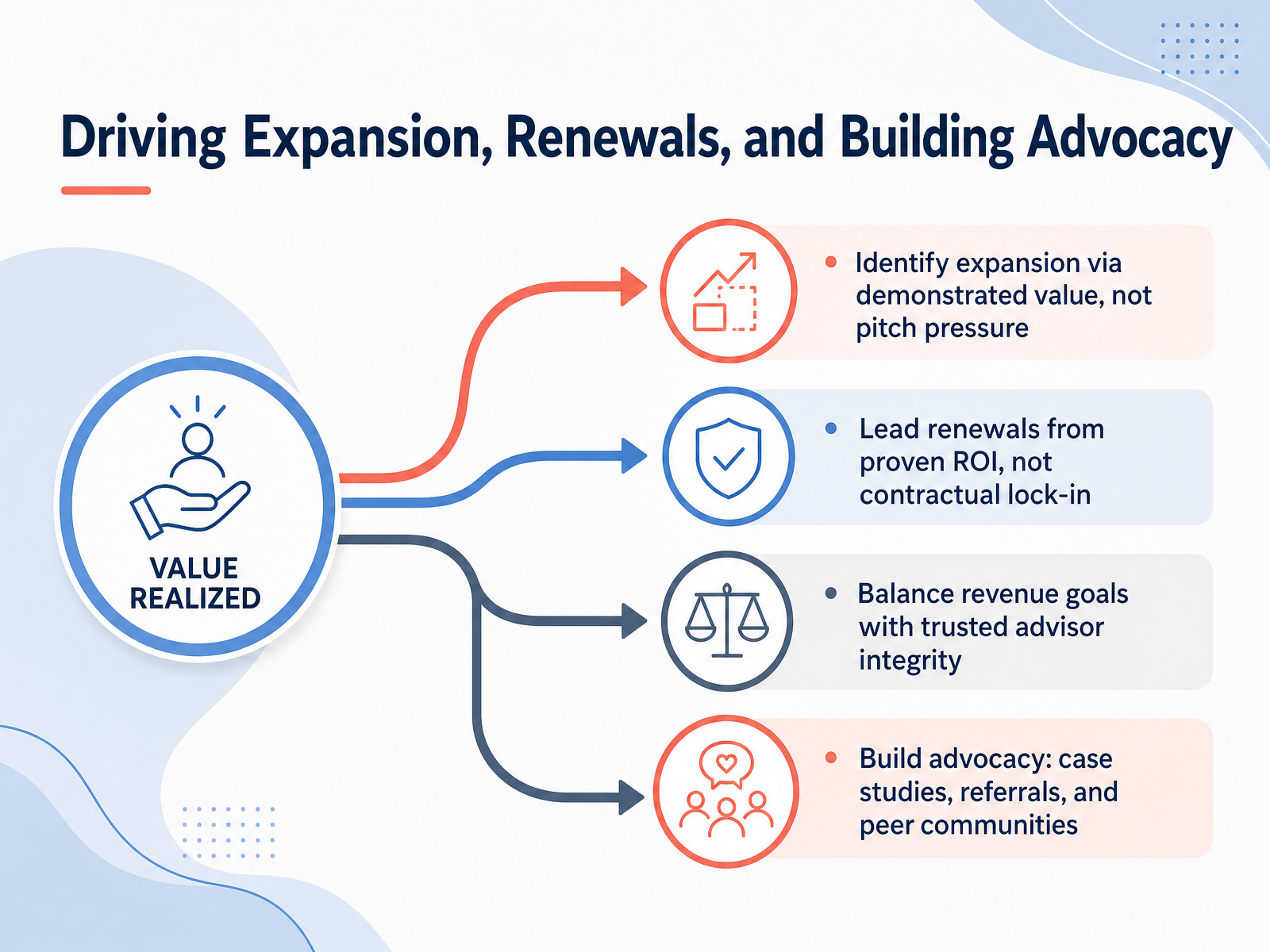
 - 08Driving Expansion, Renewals, and Building AdvocacyGrowing an account isn’t about applying sales pressure. It’s about connecting the dots between the value a customer has already achieved and the next logical outcome they could reach. Expansion opportunities emerge when we demonstrate that value clearly. Renewals work the same way. When you lead with proven ROI instead of contractual lock-in, the conversation shifts from cost to continued partnership. This is where the trusted advisor role really matters. You are balancing revenue goals with genuine integrity and long-term customer health. When that balance is right, advocacy follows naturally. Customers become case studies, they make referrals, and they actively participate in peer communities because the relationship is built on mutual success. So stay curious, demonstrate value consistently, and the commercial outcomes will follow. Next, let’s look at the technology that supports this approach: The 2026 CS Tech Stack, CSPs, AI, and Automation.
 gainsight.comzendesk.comcrofirst.com+22 min
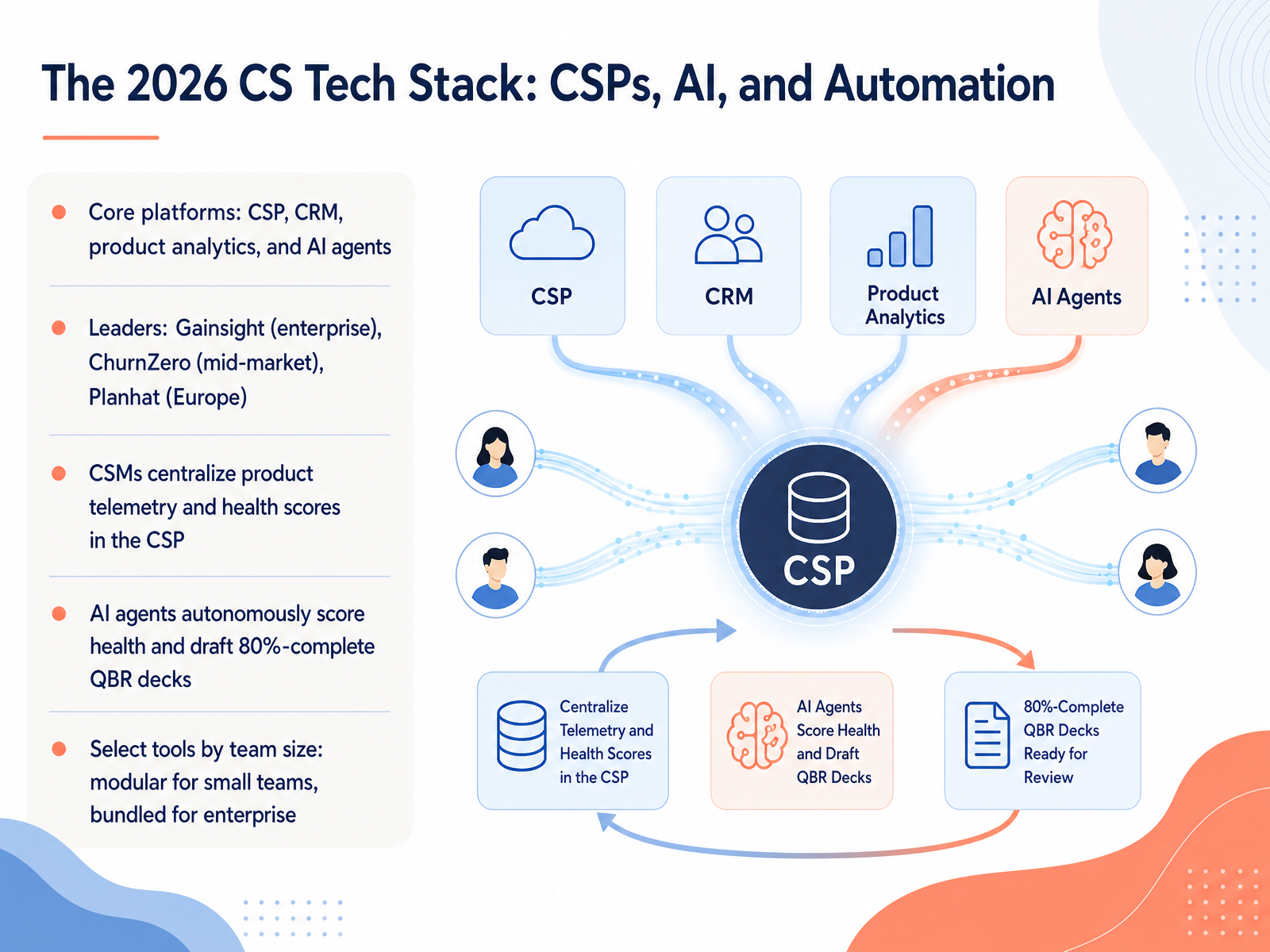
 - 09The 2026 CS Tech Stack: CSPs, AI, and AutomationLet's zoom in on the technology that runs beneath a modern CSM's feet in 2026. Think of the tech stack as three layers: the core platform, the AI layer, and the supporting tools. The central hub is the Customer Success Platform, or CSP. That's where you consolidate all your product telemetry—what users are actually clicking on—and your customer health scores. It's the single pane of glass for the CSM. Leaders here depend on your segment. For enterprise, it's Gainsight, now building what it calls a Customer OS. For the capital-efficient, mid-market sweet spot, ChurnZero remains incredibly strong, especially on churn prevention. And if you're in Europe or love the idea of unlimited users, keep an eye on Planhat. Now, the real shift is on top of this. AI agents are no longer a differentiator; they're table stakes. These agents autonomously score health and can draft a business review deck that's eighty percent complete before you even open it. Gainsight bundled its agents for large teams, while ChurnZero launched a marketplace with fourteen self-serve AI teammates. Finally, a practical note on how to choose: If you're a small, agile team, pick modular tools—like Vitally's fast, modern interface. If you're an enterprise with eighty CSMs and complex workflows, you likely need a bundled suite like Gainsight. The trap is buying enterprise complexity when all you really need is speed and clarity. Coming up next, we'll explore where this tech can take your own career, as we look at CSM career paths and role specializations.
 reports.letaido.itzendikt.comresearchandmarkets.com+22 min
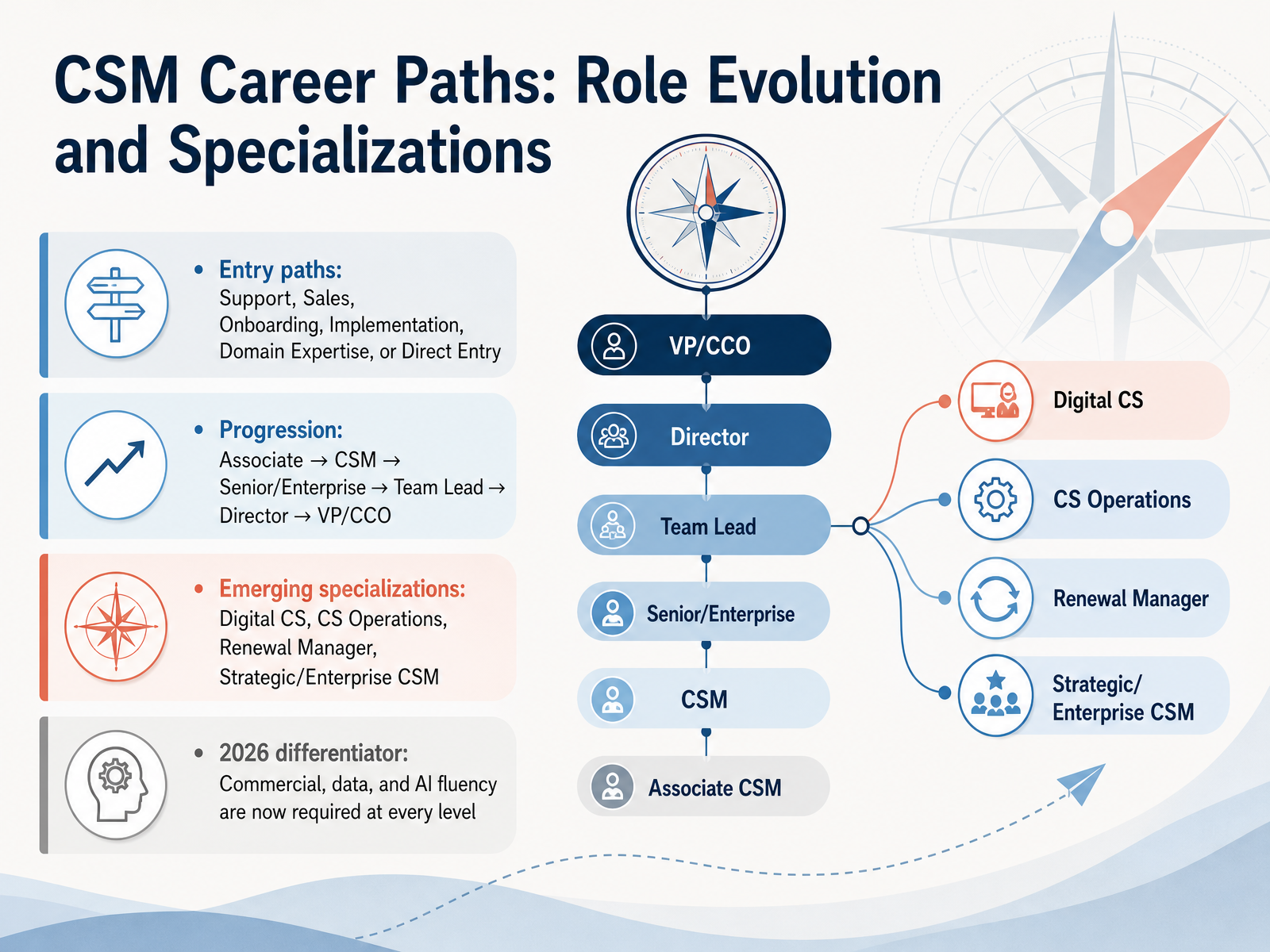
 - 10CSM Career Paths: Role Evolution and SpecializationsSo, you understand the job—now let’s talk about the journey. A career in Customer Success is rarely a straight line, and in 2026, the paths into this role are more diverse than ever. You might come from a support desk, where you already know the product pain points by heart. You could pivot from sales or onboarding, bringing deep commercial instinct and implementation know-how. Some of the best CSMs I’ve met started as domain experts—maybe you were once a marketer using the tool, and now you’re the guide for other marketers. And yes, direct entry is still an option, especially if you’re demonstrating data fluency and strategic thinking from day one.
From there, the progression usually moves from Associate CSM, to managing a full book of business, then stepping up to Senior or Enterprise CSM where you handle complex, high-touch accounts. The leadership track then opens into Team Lead, Director, and eventually VP or Chief Customer Officer, where your focus shifts from individual outcomes to designing the entire customer experience system.
Now, here’s where things get really interesting. The role is splintering into specializations. We’re seeing titles like Digital CSM, who might manage hundreds of accounts through scaled automation and in-app guidance, or CS Operations, the people building the dashboards and workflows that the whole team relies on. There’s a dedicated Renewals Manager track for those who love the commercial close, and the Strategic CSM path for big-dollar, high-touch partnerships. One thing ties all of this together: the differentiator. At every single level, commercial awareness, comfort with data, and A-I fluency aren’t just “nice-to-haves” anymore. They’re table stakes.
Feeling clear on the ladder? Good. Because next, we’ll anchor all of this ambition with what it actually means for your wallet and your skills. Let’s talk about compensation, certifications, and continuous learning.
 gainsight.comzendesk.comcrofirst.com+22 min
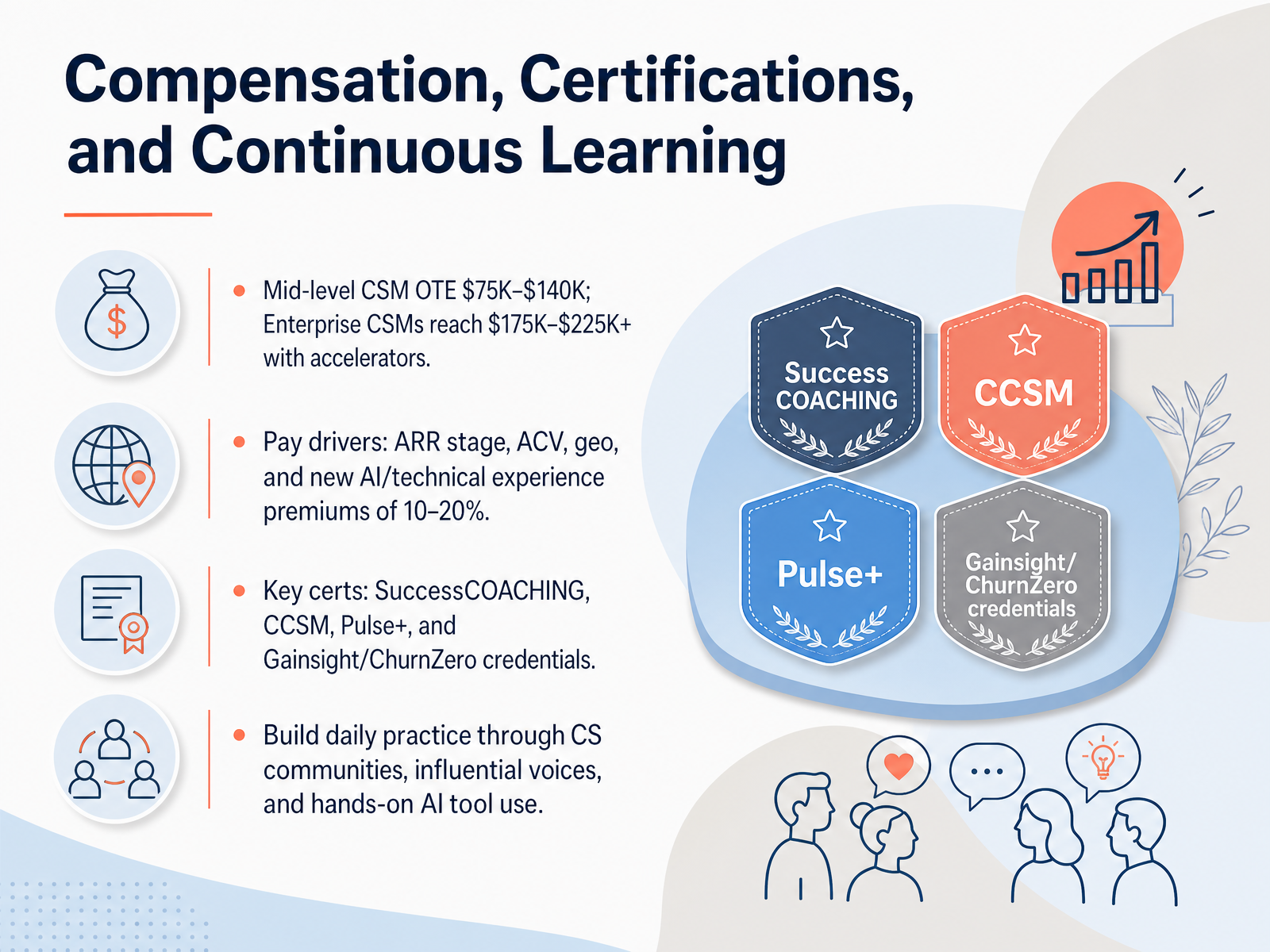
 - 11Compensation, Certifications, and Continuous LearningAlright, let's talk about money, credentials, and how you stay sharp. These are the practical building blocks for a CSM career. First, compensation. A mid-level CSM with a few years under their belt can expect on-target earnings, or OTE, between seventy-five thousand and one hundred forty thousand dollars. The real jump comes at the Enterprise level, where managing large, complex accounts and driving expansion can push total pay to one hundred seventy-five to two hundred twenty-five thousand dollars or more. Your paycheck is heavily influenced by the annual recurring revenue, or ARR, of your company, the average contract value of your deals, where you live, and a brand-new factor: hands-on AI experience. Being fluent with artificial intelligence tools can command a ten to twenty percent premium right now. Next, certifications. The right credentials signal that you're serious before you even walk in the door. The key ones to look at are the CCSM from Success Coaching, Pulse Plus from Gainsight, and the platform-specific certifications from ChurnZero. These show you know the frameworks and the software. Finally, continuous learning. Don't just collect certificates. Your daily practice should include joining CS communities on LinkedIn or Slack, following leading voices in the space, and, most importantly, building real muscle memory with AI tools. Try summarizing a mock customer health score. Draft a tricky renewal email with a generative AI assistant. The combination of credentials and hands-on practice is what makes you stand out. Now, let's turn that awareness inward with a self-assessment to prepare for your own career transition.
 2 min
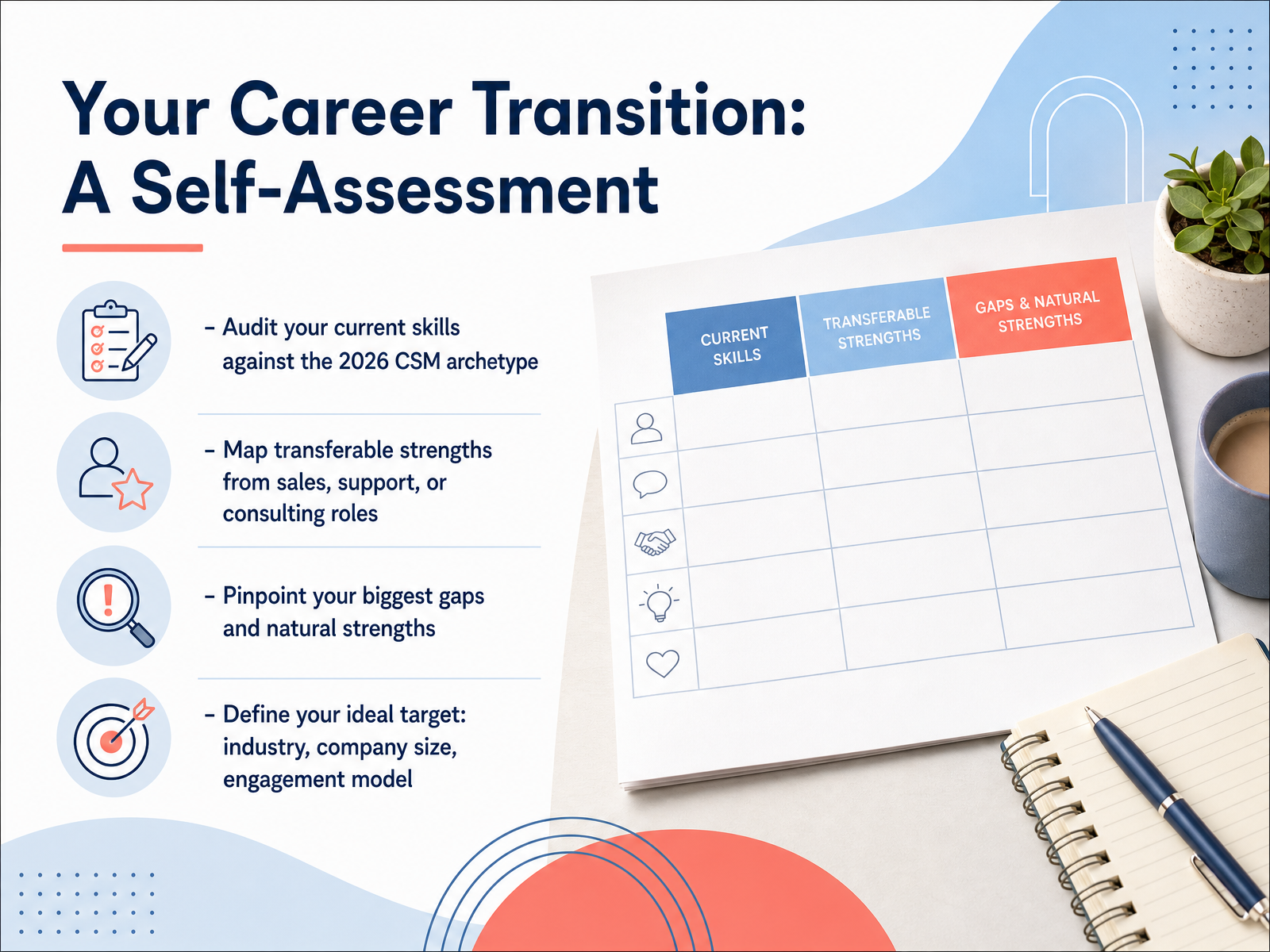
2 min - 12Your Career Transition: A Self-AssessmentAlright, let's get practical and map out your personal transition. The goal here is to audit your current skills against the 2026 CSM archetype. This role has evolved past managing relationships. Today, companies want commercial advisors who can interpret usage trends and connect customer outcomes directly to business growth. So, start by mapping your transferable strengths. If you come from sales, your renewal and discovery instincts are a huge asset. From support, your empathy and problem solving are already daily practice. From consulting, you know how to drive strategic outcomes, which is exactly the core of modern customer success. Next, pinpoint your biggest gaps honestly. The data shows nearly half of current CSMs lack commercial training. Ask yourself, can you read a health score, or do you freeze up in negotiation conversations? Identify those sharp edges. Finally, define your ideal target. Not just any CSM job, but the right one for you. Think about the industry you're passionate about, the company size that fits your style, and whether you want high-touch enterprise work or a digital-led scaled model. Knowing your destination makes every step forward far more effective. Next, we'll translate these insights into a compelling CS portfolio and narrative.
 gainsight.comzendesk.comcrofirst.com+22 min
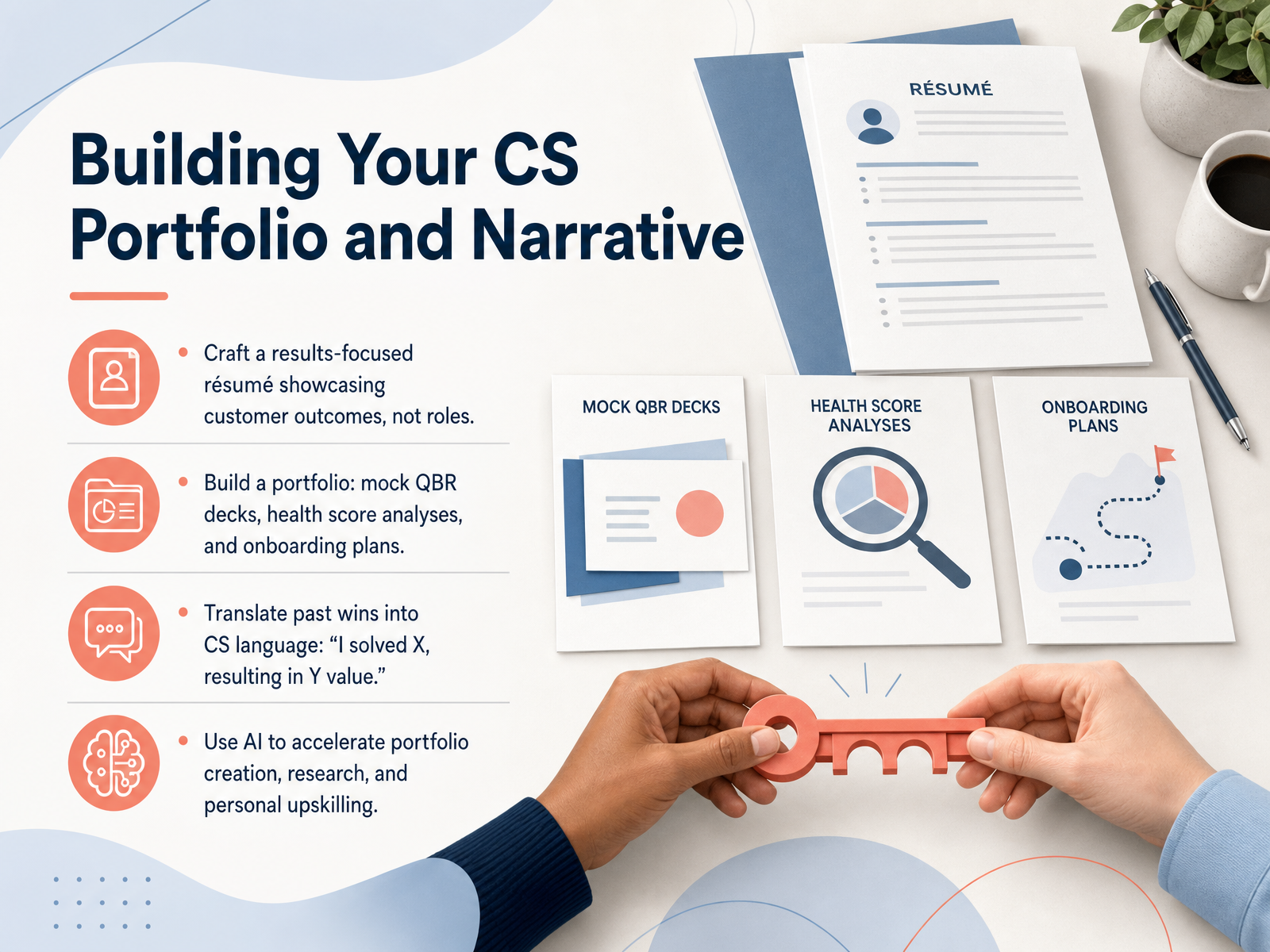
 - 13Building Your CS Portfolio and NarrativeNow let's talk about how you actually prove you can do this job, before you've even held the title. The answer is a portfolio that speaks the language of customer success. Start by rewriting your résumé. Instead of listing old roles and duties, frame every bullet point around customer outcomes. For example, don't just say you managed client accounts—say you solved a specific problem, resulting in a measurable value like twenty percent fewer support tickets or one hundred thousand dollars in retained revenue. Next, build concrete artifacts. You can create a mock Quarterly Business Review deck that follows the best-practice agenda: an executive summary, a value-realization slide showing ROI math, and a forward-looking action plan with named owners and dates. Or draft a health-score analysis using behavioral data to identify an account at risk, then outline a remediation plan. The key is translating your past wins into the customer success vocabulary of value delivered, risk managed, and outcomes achieved. Finally, use AI as your accelerator—to research a company's goals, draft an onboarding plan, or simulate a renewal conversation. Your portfolio isn't about proving you've had a CS title; it's about proving you can protect revenue and grow relationships, starting on day one. Let's wrap up the course with your 90-day plan to launch a CS career.
 churnbase.iosuccessknocks.comresources.rework.com+22 min
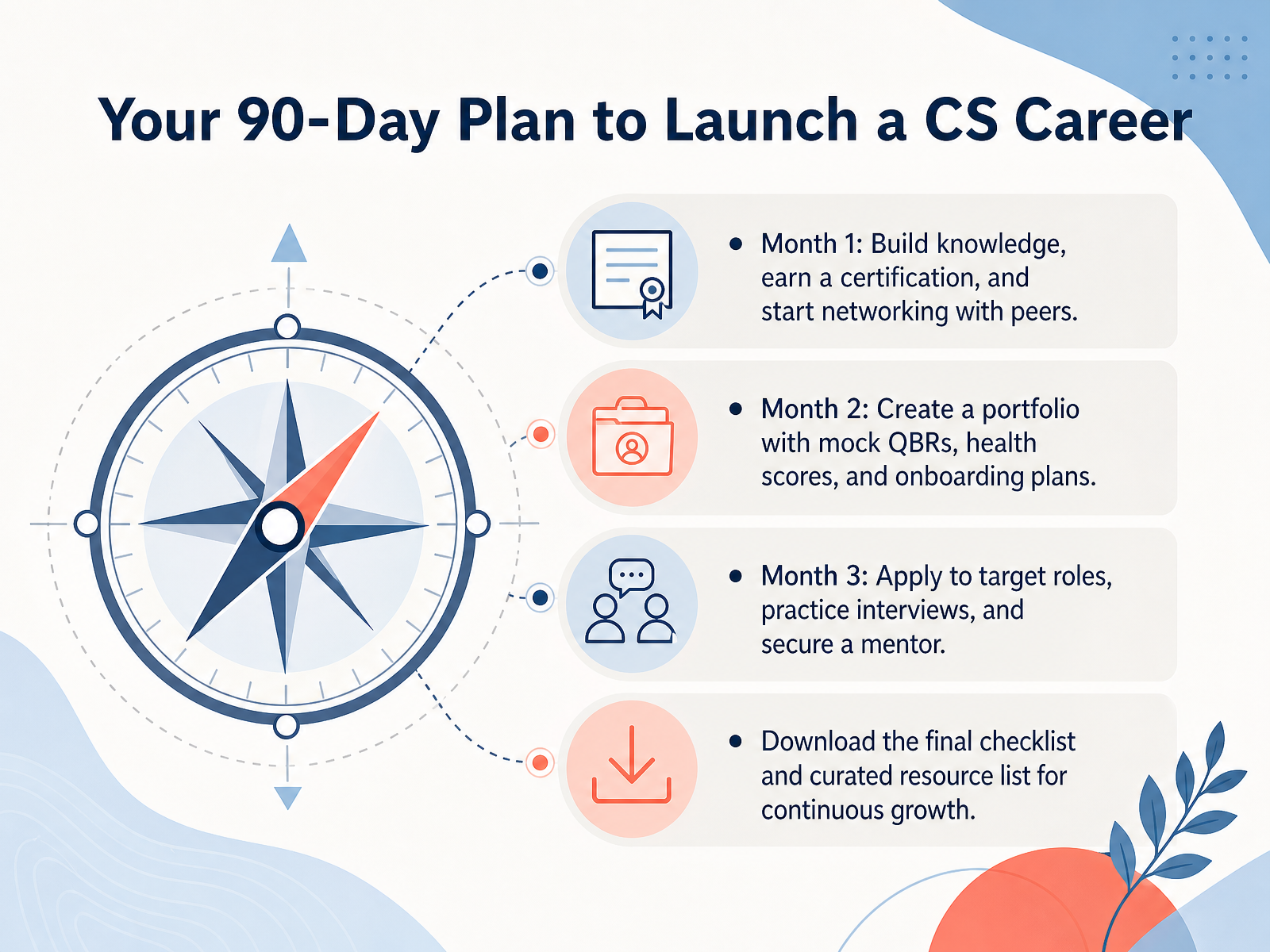
 - 14Your 90-Day Plan to Launch a CS CareerAlright, let's turn all this knowledge into a practical plan. Here’s your ninety-day map to launching a Customer Success career. Month one is all about building your foundation. Dive into resources, earn a recognized certification, and don't do it alone—start networking with peers in the CS community right away. Month two is where you create tangible proof of your skills. Build a small portfolio. This can include a mock quarterly business review deck, a sample customer health scorecard you designed, or an example onboarding plan you'd execute for a new client. These artifacts speak louder than a resume bullet point. Month three is go-time. Start applying for targeted roles, but spend equal energy on mock interviews. Practice explaining churn risk analysis or how you'd run a renewal conversation. And, crucially, find a mentor who can guide you. To support this entire journey, I've prepared a final checklist and a curated list of resources for your continuous growth. You can download both right now. Thank you for investing this time with me. You have a clear path forward, and the world needs more strategic, empathetic CS leaders. Now, go build that career.
 2 min
2 min
Take the deck with you
Download this course as a file — free, no sign-up needed.
- PDF handoutEvery slide page, ready to print or share.15 pages · 3.3 MBDownload
- Narrated PowerPointThe deck that presents itself — every slide carries the digital human's narration video.15 pages · 17.6 MBDownload
- PowerPoint slidesThe full deck as a .pptx — open it in PowerPoint, Keynote, or Google Slides.15 pages · 3.3 MBDownload
Free to use in your own training — please keep the PersonWise credit page at the end.
Have your own deck? Turn it into a course
Sources consulted
Web sources consulted while building this course.
- 2026 State of Customer Success - SaaS retention benchmarks - cust.co — cust.co
- 2026 SaaS & AI-Native Metrics | Benchmarkit — benchmarkit.ai
- The 2026 SaaS Benchmarks Report — saasrise.com
- SaaS Retention Benchmarks 2026: 80-98% by Stage (NRR + GRR) — retentioncheck.com
- Customer Revenue Leadership Study — info.churnzero.com
- The 2026 CS Survival Guide: Hire Ops, Consolidate Tools, Redefine Roles | Gainsight Software — gainsight.com
- What is a customer success manager, and what do they do? — zendesk.com
- Customer Success Hiring Guide 2026 — crofirst.com
- The State of Customer Success 2026 | TSIA Ebook — tsia.com
- Customer Success Manager Job Description [Updated for 2026] — indeed.com
- Customer Success QBR: What It Is, Agenda & Best Practices (2026) — churnbase.io
- Quarterly Business Review Best Practices 2026 — successknocks.com
- "Running a QBR That Customers Actually Look Forward To" — resources.rework.com
- SaaS QBR Playbook: How to Run Quarterly Business Reviews That Drive Renewal and Expansion — SaasDash.ai Blog — saasdash.ai
- The Quarterly Business Review (QBR): A Playbook to Stop Account Churn | ChurnDefense — churndefense.com
- Customer Success Platforms: Competitive Intelligence Report | March 2026 — reports.letaido.it
- Top 10 Customer Success Platforms for 2026 — zendikt.com
- Customer Success Platforms Market Report 2026 — researchandmarkets.com
- Best Customer Success Platforms 2026 — TechVendorIndex — techvendorindex.com
- Customer Success Software Options 2026 — viewpointanalysis.com