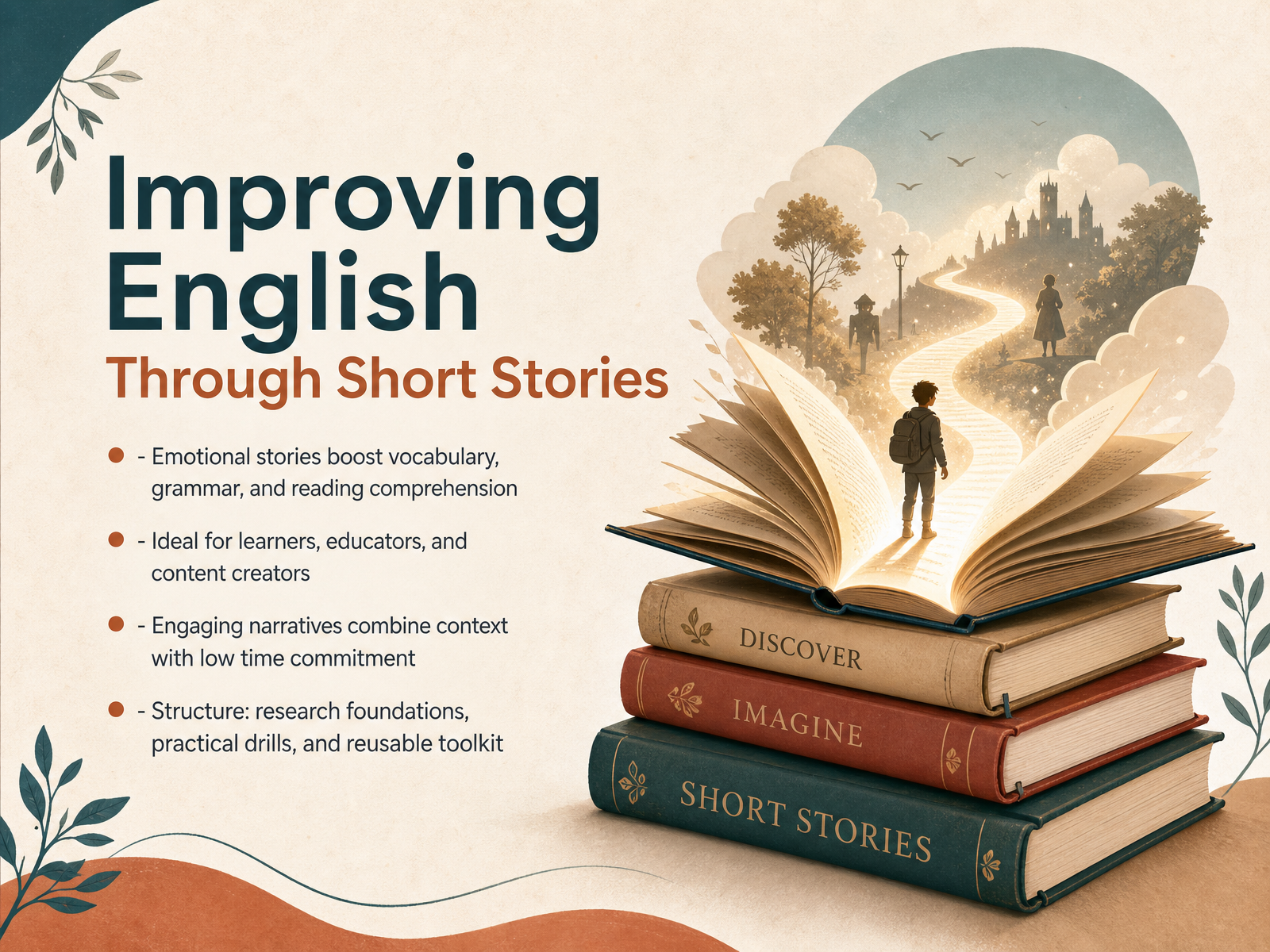
English Through Short Stories
Begin
14 pages · ~28 min
English Through Short Stories
This training helps English learners improve vocabulary, comprehension, and fluency by studying engaging short stories with guided exercises.
What you’ll learn
- 01Improving English Through Short StoriesWelcome. If you're learning English, teaching it, or creating content, this course is for you. We're going to explore a simple, proven way to get better at English: short stories. Research shows that emotional stories boost vocabulary, improve grammar, and sharpen reading comprehension. And best of all, they fit into a busy schedule. A great story gives you rich context without a huge time commitment. You get a complete experience, not a dry lesson. Over the next few steps, we'll look at the research, try some practical drills, and build a toolkit you can use again and again. You don't need to be advanced. You just need to be curious. Let's begin by looking at why stories work so well.omnialang.comoapub.orgrsdjournal.org+21 min
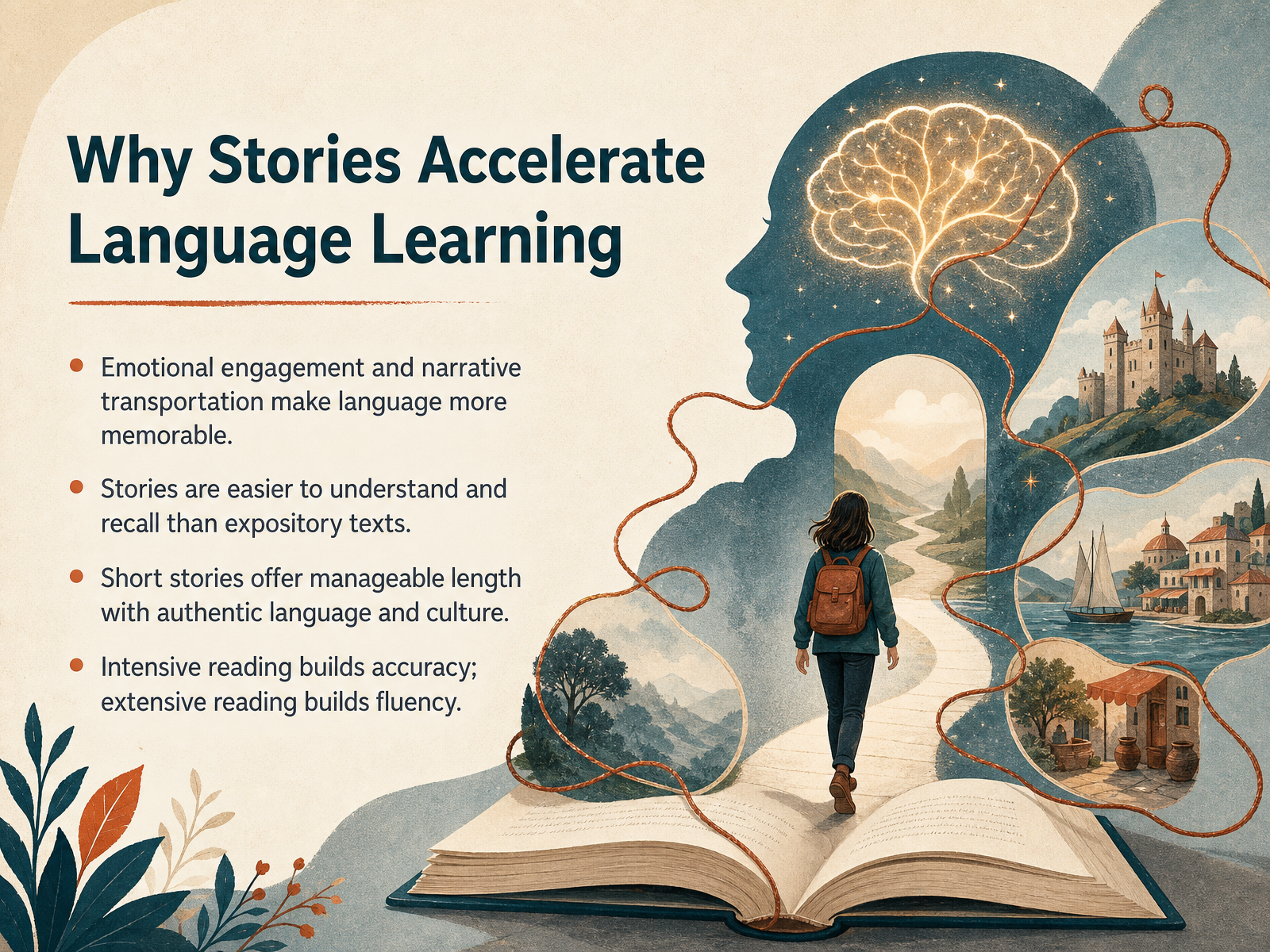
- 02Why Stories Accelerate Language LearningSo let's talk about why stories are such a powerful tool for learning. When you read a story, you're not just looking at words. You're feeling the emotion, following the plot, and caring about what happens next. This emotional engagement is what makes language memorable. Think about it. You might forget a grammar rule from a textbook. But you'll remember how a character felt when she finally opened that mysterious letter. Stories are also easier to understand and recall than expository texts. Research shows that people remember information presented as a narrative much better than the same information in a simple essay. A short story is the perfect length. It gives you authentic language and culture, but it's manageable. You can finish it, feel a sense of achievement, and move on to the next one. And here's the key balance. Intensive reading builds accuracy. You notice exactly how a sentence is put together. Extensive reading builds fluency. You read for pleasure, and the language starts to flow naturally. Both are essential. And stories give you both at the same time. Now, let's look at how to choose the right story for your level.
 readplusone.commnemoread.comarxiv.org+22 min
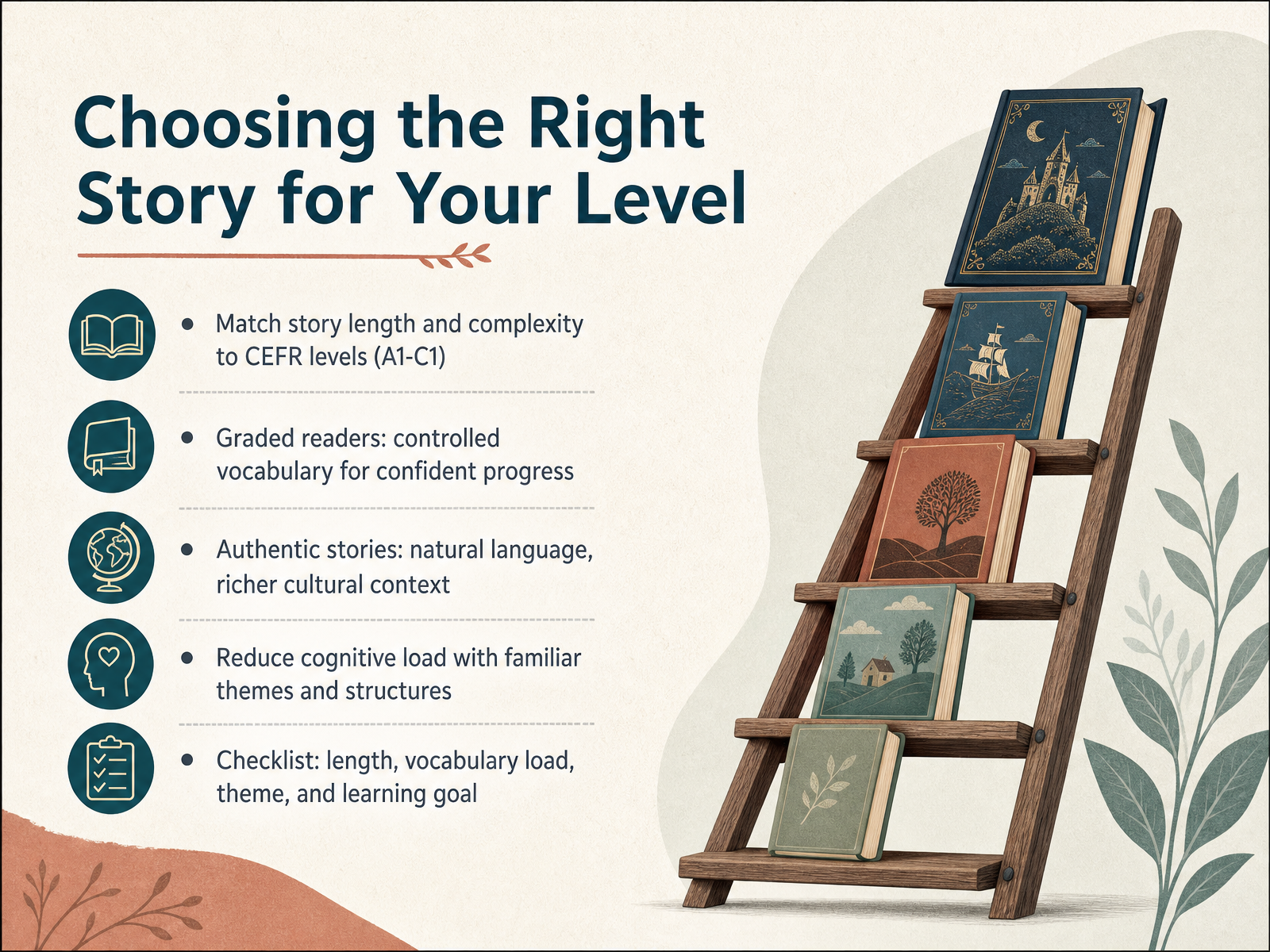
 - 03Choosing the Right Story for Your LevelNow, let's talk about choosing the right story for your level. This is where many learners get stuck, but it doesn't have to be complicated. Think of it like picking a book for a cozy evening. You want something enjoyable, not a chore. So, match the story to your CEFR level, from A1 for beginners to C1 for advanced learners. For confident progress, try graded readers. They use controlled vocabulary, so you can focus on the flow of the story without feeling lost. As you grow, authentic stories offer natural language and richer cultural context, like a window into everyday life. A good trick is to reduce the mental load by choosing familiar themes. If you already know the plot, you can focus on the new words. Before you start, run a quick mental checklist. Consider the length, the vocabulary load, the theme, and your specific learning goal. Are you reading for pleasure, or to master past tense verbs? A short, simple story about daily life is perfect for a beginner. An intermediate learner might enjoy a mystery with a twist. Choose something that challenges you just a little, but still feels like fun. Up next, we will dive into some core reading strategies to get the most out of every page.
 hachette.co.ukreadstories-learnenglish.comlexinglo.com+22 min
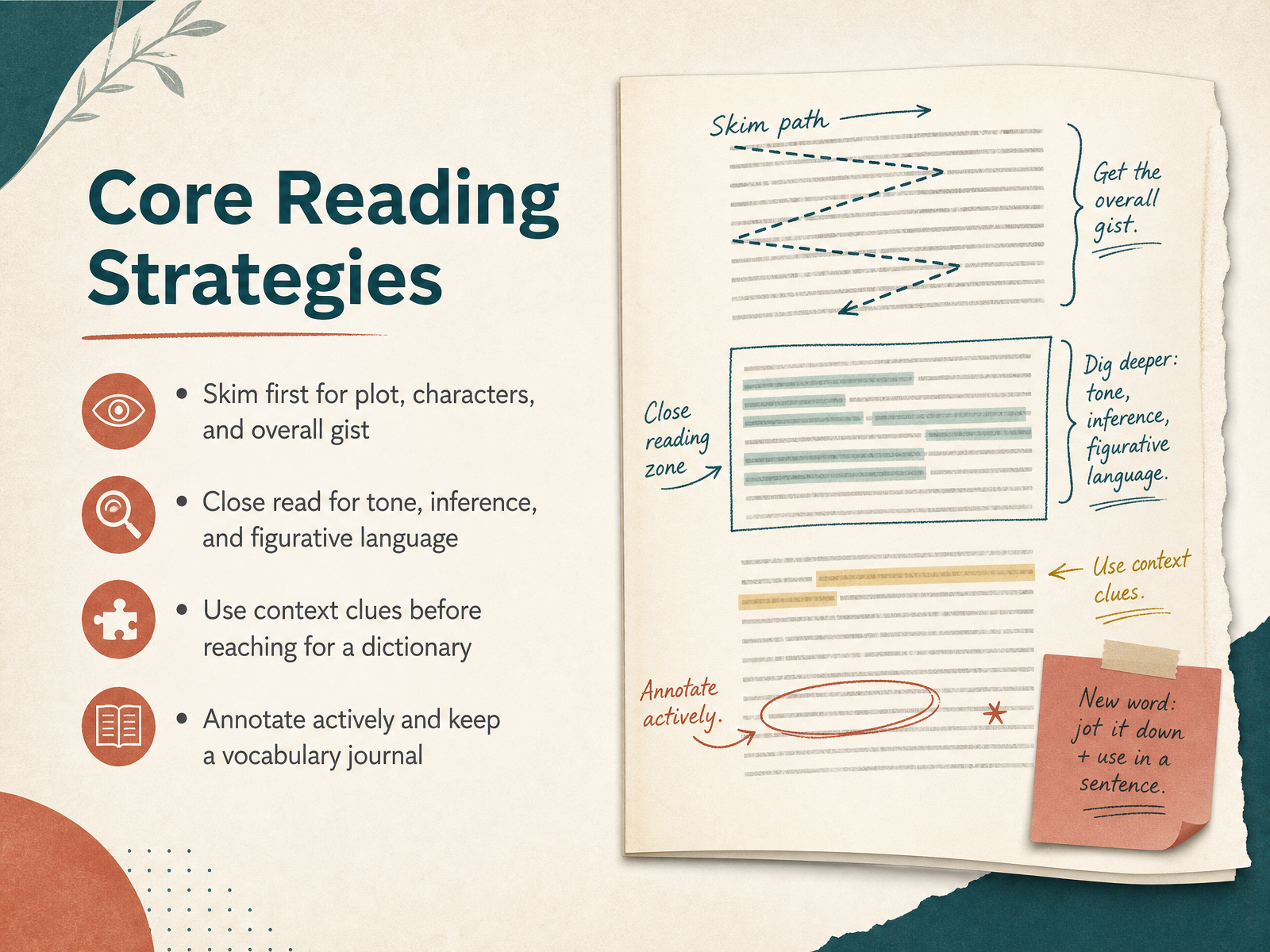
 - 04Core Reading StrategiesNow, let’s talk about how you’ll actually read these stories. You don’t have to understand every single word on the first pass. In fact, you shouldn’t. Start by skimming. Let your eyes move through the text quickly, just to get the gist. Who is the main character? Where are they? What’s the conflict? Think of this as a first meeting with the story. Next, go back for a closer read. This time, pay attention to the tone. Is the narrator happy, worried, sarcastic? Look for words that create pictures in your mind, like metaphors. When you hit a word you don’t know, pause. Try to guess the meaning from the sentences around it, before you ever reach for a dictionary. You’ll be surprised how much you can figure out on your own. And as you read, keep your pen moving. Annotate. Underline the moments that stand out, circle new expressions, and write down the ones you want to remember. Keep them in a small vocabulary journal, and review it often. This is how a story stops being just an exercise and starts being your own. Next, let’s look at how to build your vocabulary through story context.
 hachette.co.ukreadstories-learnenglish.comlexinglo.com+22 min
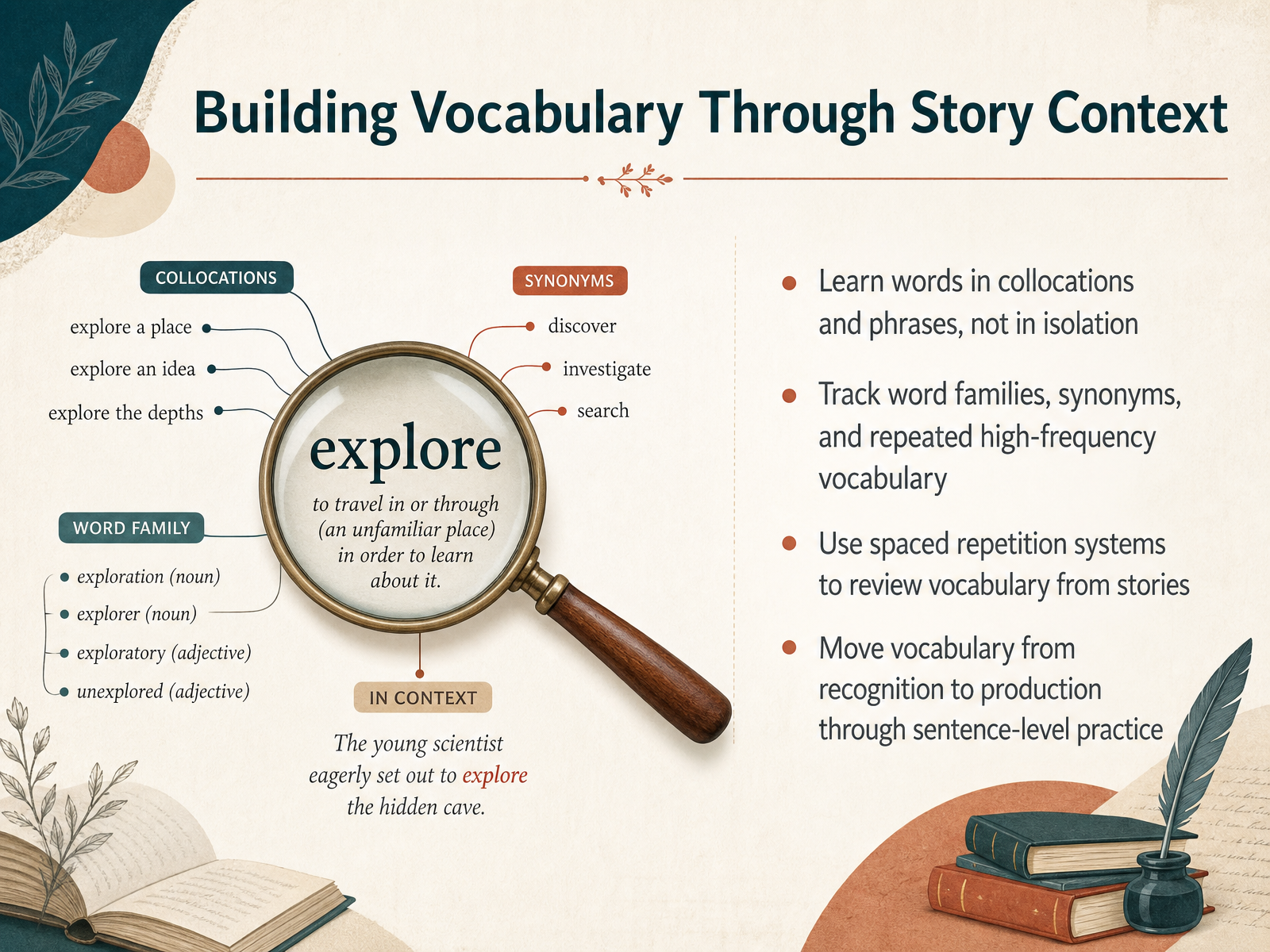
 - 05Building Vocabulary Through Story ContextNow let's talk about building vocabulary through story context. Don't memorize words alone. Learn them in chunks, in phrases, the way they actually appear together. Instead of learning the word 'break,' learn 'break the ice' or 'take a break.' That's how native speakers use them. As you read, notice word families and synonyms. If a word appears several times in a story, that's a sign it matters. High-frequency words deserve your attention. Use spaced repetition to review. This means revisiting words at growing intervals—a day later, then three days, then a week. Many apps do this automatically, weaving your review words back into new stories. This works much better than flashcards alone. Finally, move from recognition to production. Don't just recognize a word. Use it. Write one sentence with each new word after a chapter. Say it out loud. That small step turns passive knowledge into real language ability. And here's the exciting part—soon we'll practice speaking and writing from stories, so you can make these words your own.
 readplusone.commnemoread.comarxiv.org+21 min
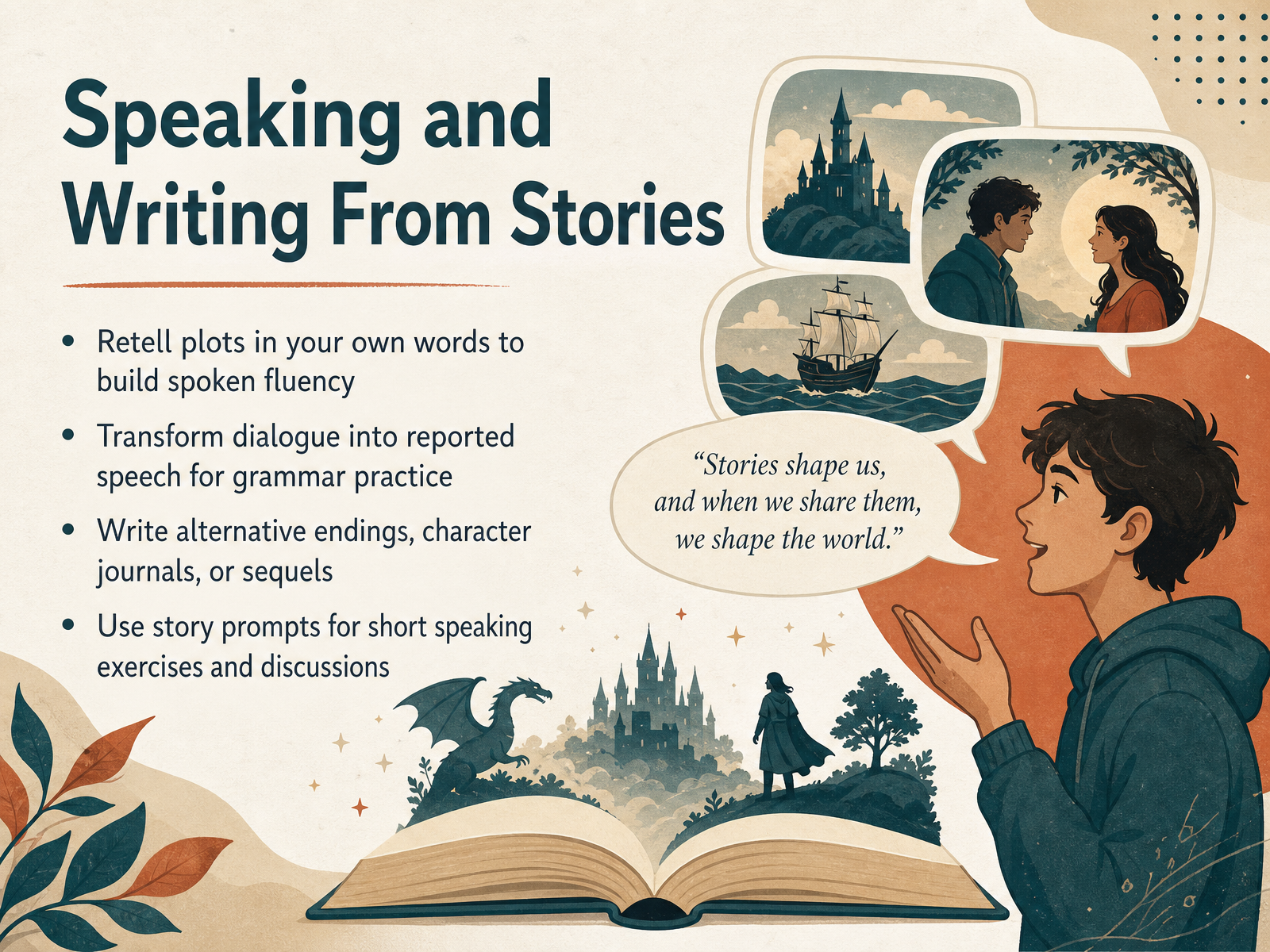
 - 06Speaking and Writing From StoriesNow let's bring the story to life in your own voice. Retell the plot in your own words. Don't worry about being perfect. Just focus on getting the main ideas out. This builds spoken fluency naturally. Next, try transforming dialogue into reported speech. So, instead of saying, "He said, 'I am tired,'" you say, "He said he was tired." It's a powerful grammar workout. Then, take your creativity further. Write an alternative ending. Keep a character journal. Or even write a sequel. These tasks deepen your connection to the story. Finally, use story prompts for short speaking exercises. Ask yourself, "What would I do in this situation?" Or discuss a character's decision with a friend. Every time you retell, transform, or reimagine, you're one step closer to fluency. Up next, we'll look at how to build complete lessons around short stories.
 manwrites.comrsdjournal.orgmanwrites.com+21 min
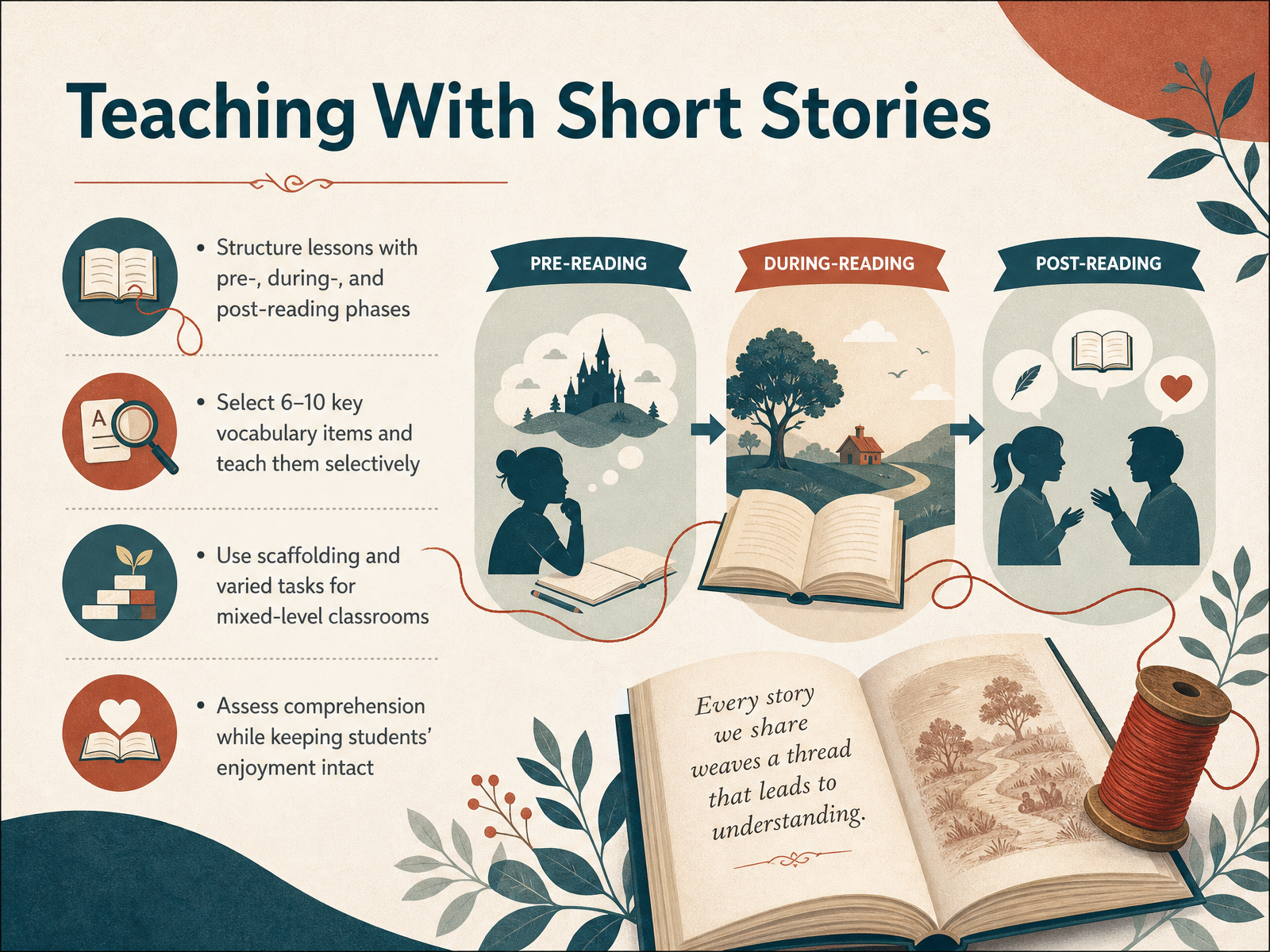
 - 07Teaching With Short StoriesNow, let's talk about teaching with short stories. The magic lies in structure. Think of your lesson as a journey. Start with pre-reading. Three to five engaging questions that activate what your students already know. For example, 'What would you do if a stranger left you a mysterious note?' Next, the during-reading phase. Read in sections, not all at once. Pause after each one. Ask simple comprehension questions first. Guide them early on. Then, you can ask predictive ones. 'What do you think happens next?' Now, about vocabulary. Resist the urge to teach every new word. Instead, choose selectively. Pick six to ten key words. Focus on words that are essential to the story. Choose useful phrases they can actually reuse in conversation. In a mixed-level classroom, scaffolding is your best friend. Use visual aids. Provide sentence starters. Offer simplified explanations. Give extension tasks to advanced learners. Finally, assessment. Check comprehension with discussions or short reflections. But always protect the joy of the story. You want finished the class feeling inspired, not just tested. So, structure your lesson, choose your words wisely, support every learner, and keep the magic alive. Coming up, we'll see how you can use stories as a content creator.
 manwrites.comrsdjournal.orgmanwrites.com+22 min
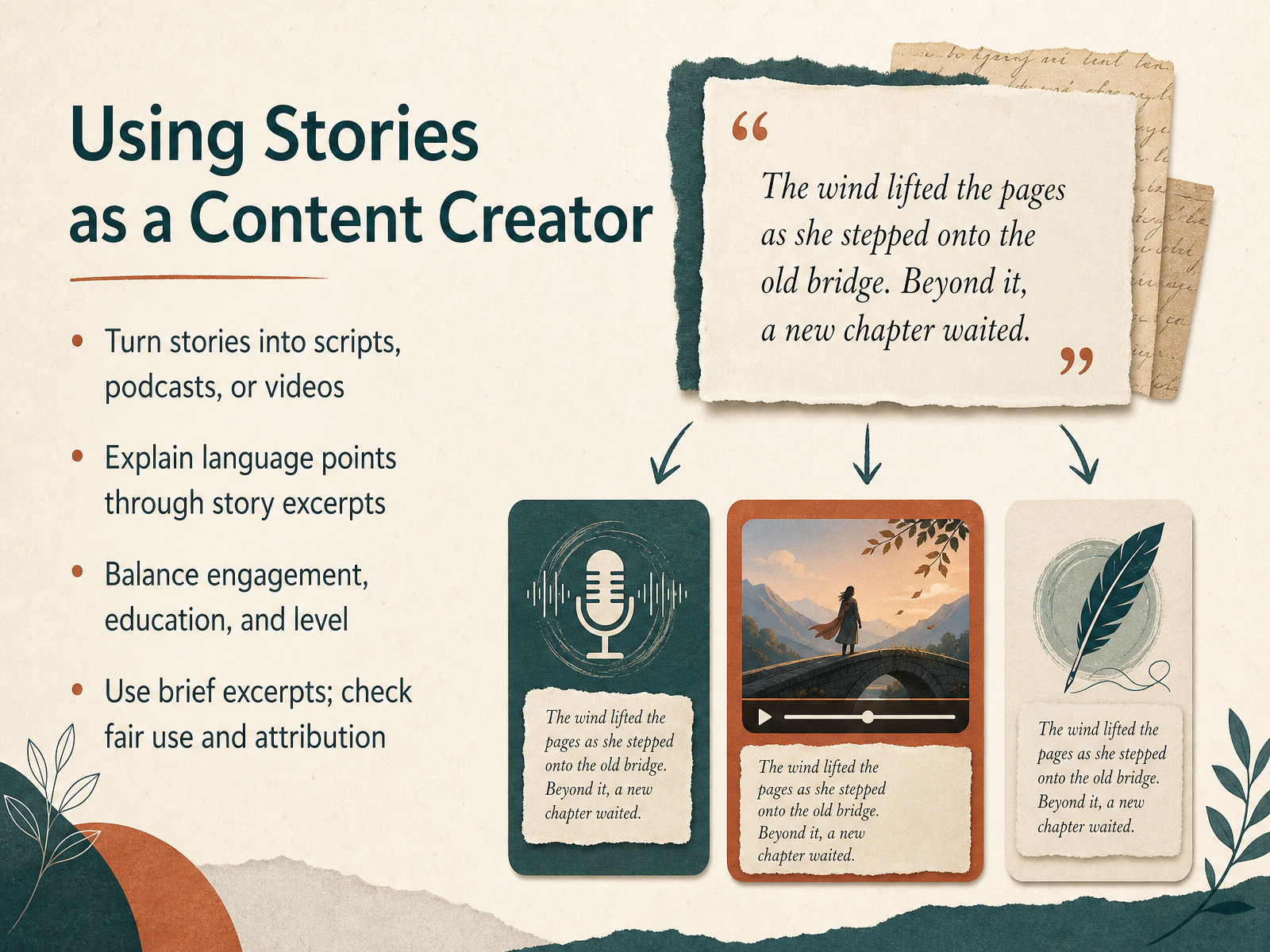
 - 08Using Stories as a Content CreatorNow, let’s talk about turning stories into content. If you’re a creator, stories are your raw material. You can adapt them into scripts, podcasts, or short videos. Each format lets learners hear the language in a new way. When you do this, your job is to balance three things: keeping it engaging, making it educational, and matching the learner’s level. Don’t overload a beginner with complex vocabulary, and don’t simplify too much for an advanced student. A great approach is to use brief excerpts to explain a point, like showing how past tense verbs work in context. Just remember, keep those excerpts short. Always check fair use rules, and always give credit to the original author. A few lines for teaching is often fine, but a full story is not. Ask yourself: Is my use transformative? Am I adding value? Am I keeping the amount small? If yes, you’re on solid ground. Now, let’s look at some common mistakes and how to avoid them.
 lib.uchicago.eduhachette.co.ukreadstories-learnenglish.com+22 min
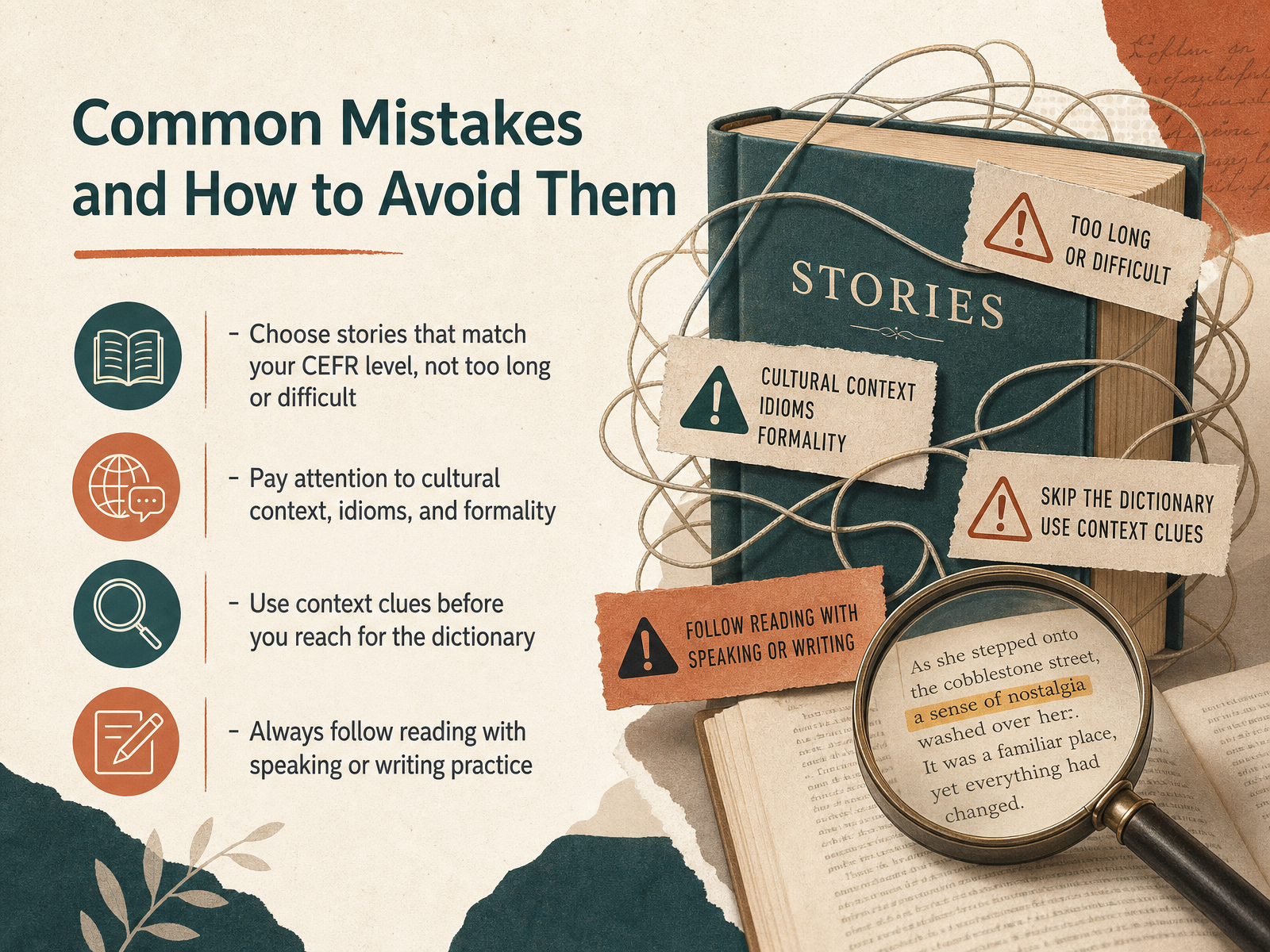
 - 09Common Mistakes and How to Avoid ThemLet's talk about the common mistakes and how to avoid them. First, choose stories that match your level. If it's too hard, you'll feel frustrated. If it's too easy, you'll get bored. Look for stories mapped to your CEFR level. For example, a beginner might choose an A2 story, while an intermediate learner might pick a B1 or B2 one. Next, pay attention to cultural context, idioms, and formality. English is full of expressions that don't translate directly. So when you meet phrases like "break the ice," don't just translate. Notice how the characters use them in the situation. Third, use context clues before you reach for the dictionary. This is a powerful habit. Try to guess the meaning from the words around it, and only check the dictionary if you're still lost. And finally, always follow reading with speaking or writing practice. Reading alone is passive. But when you retell the story, or write a short summary, you move that language from your eyes into your voice. Every small win counts. Now let's look at some practical next steps and build your story toolkit.
 hachette.co.ukreadstories-learnenglish.comlexinglo.com+22 min
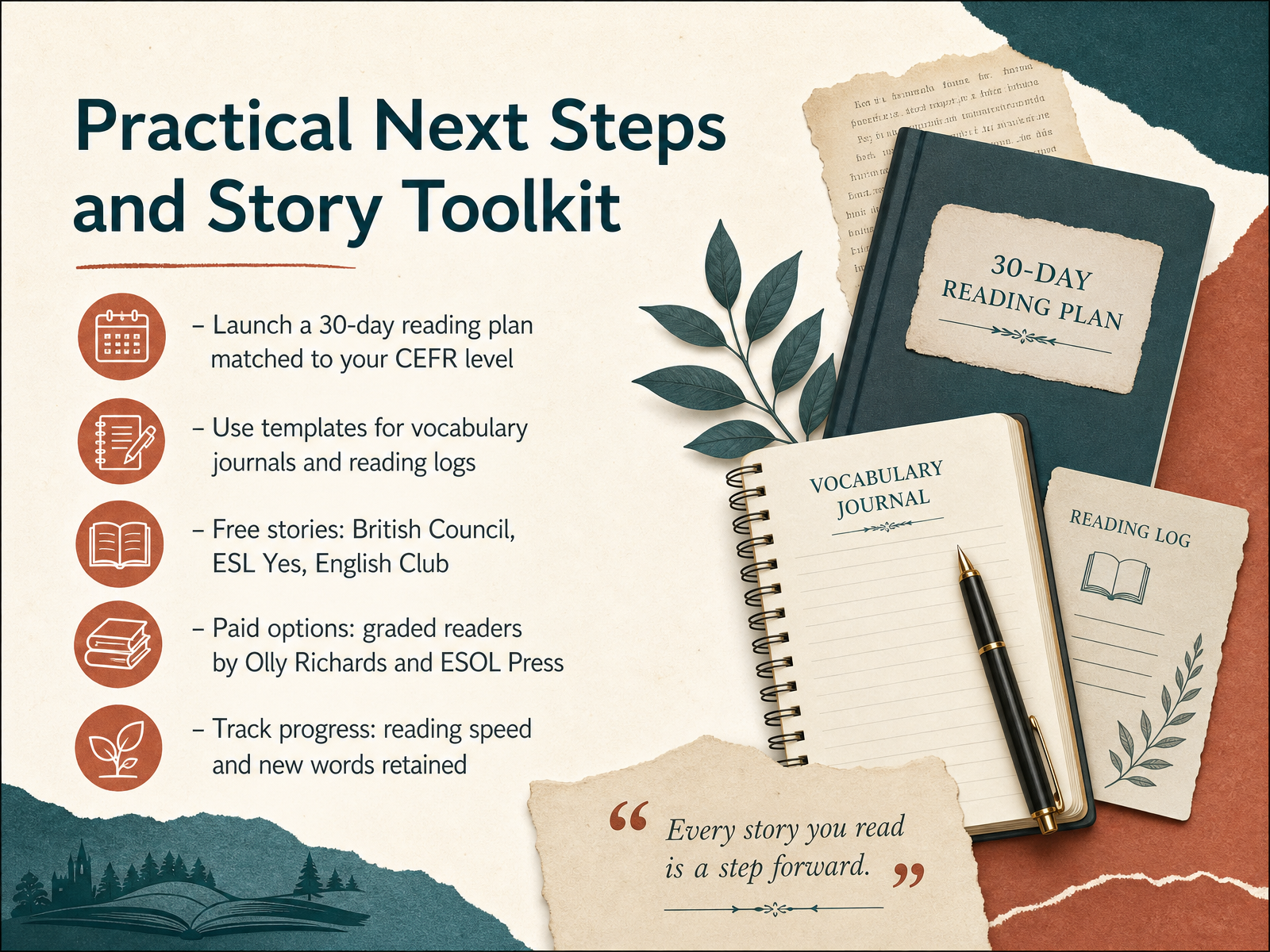
 - 10Practical Next Steps and Story ToolkitNow let's turn all of this into a practical plan. Here are your next steps. First, launch a thirty-day reading plan that matches your CEFR level. If you're at A2, choose A2 stories. If you're at B1, pick B1 stories. Match the level, and you'll understand about ninety-eight percent of the words. That feels good. Next, use templates for a vocabulary journal and a reading log. Write down new words, the sentence you found them in, and the date. It's simple, but it works. For free stories, visit the British Council's Story Zone, ESL Yes, and English Club. They all offer leveled stories with exercises. For paid options, try graded readers by Olly Richards or ESOL Press. They're carefully written for learners. Finally, track your progress. Measure your reading speed and count the new words you retain each week. Small numbers add up fast. Remember, you don't need perfection. You just need a story today, and another one tomorrow. Now, let's look at the evidence and research foundations behind all of this.
 readplusone.commnemoread.comarxiv.org+21 min
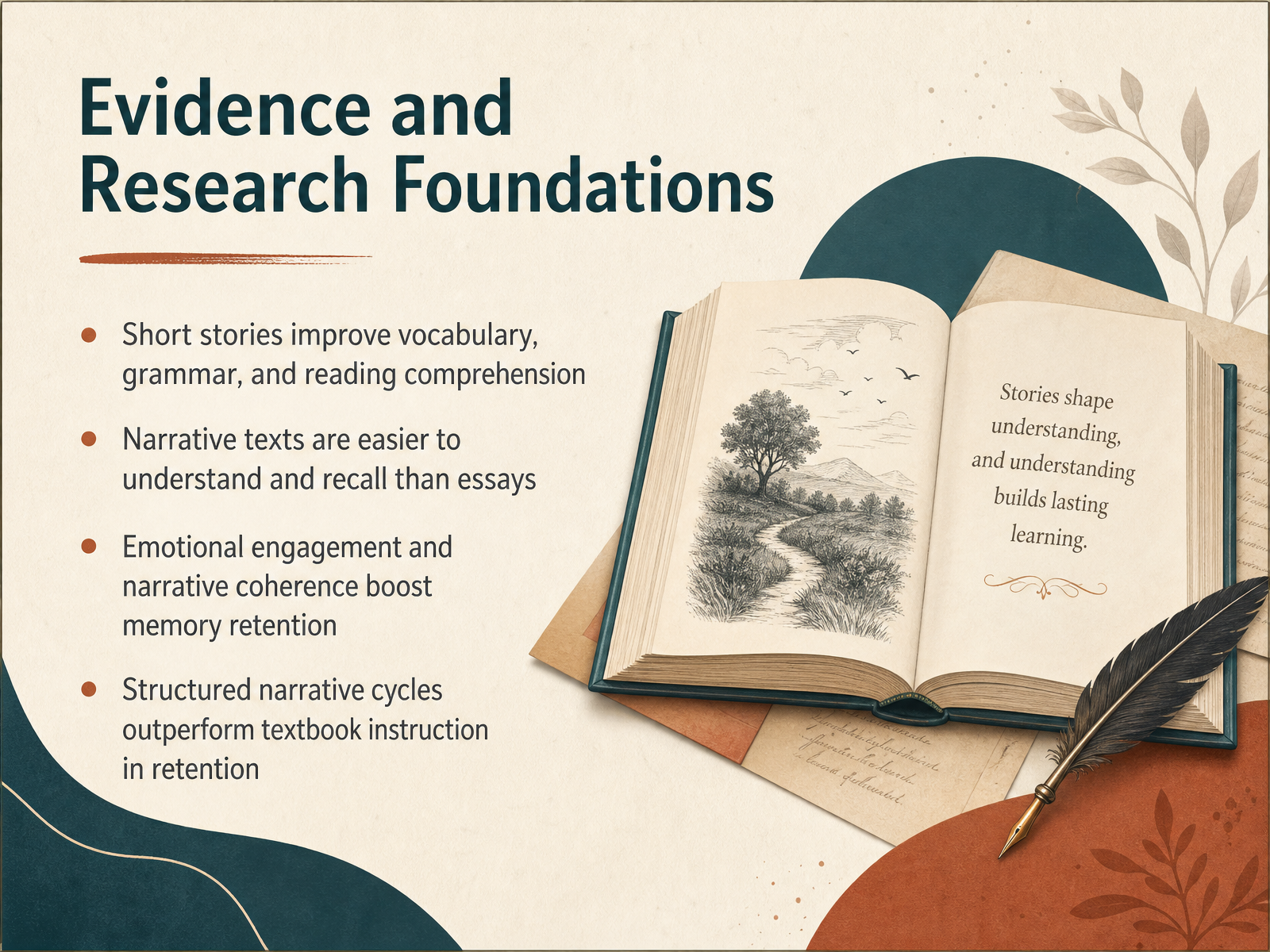
 - 11Evidence and Research FoundationsNow, let's look at what the research actually tells us. And the evidence is encouraging. Studies show that short stories improve vocabulary, grammar, and reading comprehension. One study with intermediate learners found that those who learned grammar through stories performed significantly better than those using traditional materials. Why does this work? Because stories are easier to understand and recall than essays. A large meta-analysis of over thirty-three thousand participants found that people consistently understood and remembered narrative texts better than expository ones. This is partly due to emotional engagement. When we care about a character, our brain pays closer attention, and that boosts memory retention. Furthermore, structured narrative cycles have been shown to outperform textbook instruction. In a six-week experiment, students using story-based learning gained significantly more in vocabulary and grammar than the control group. So the research is clear: stories aren't just enjoyable, they're effective. Now, let's see how modern tools and technologies can amplify this approach.
 omnialang.comoapub.orgrsdjournal.org+21 min
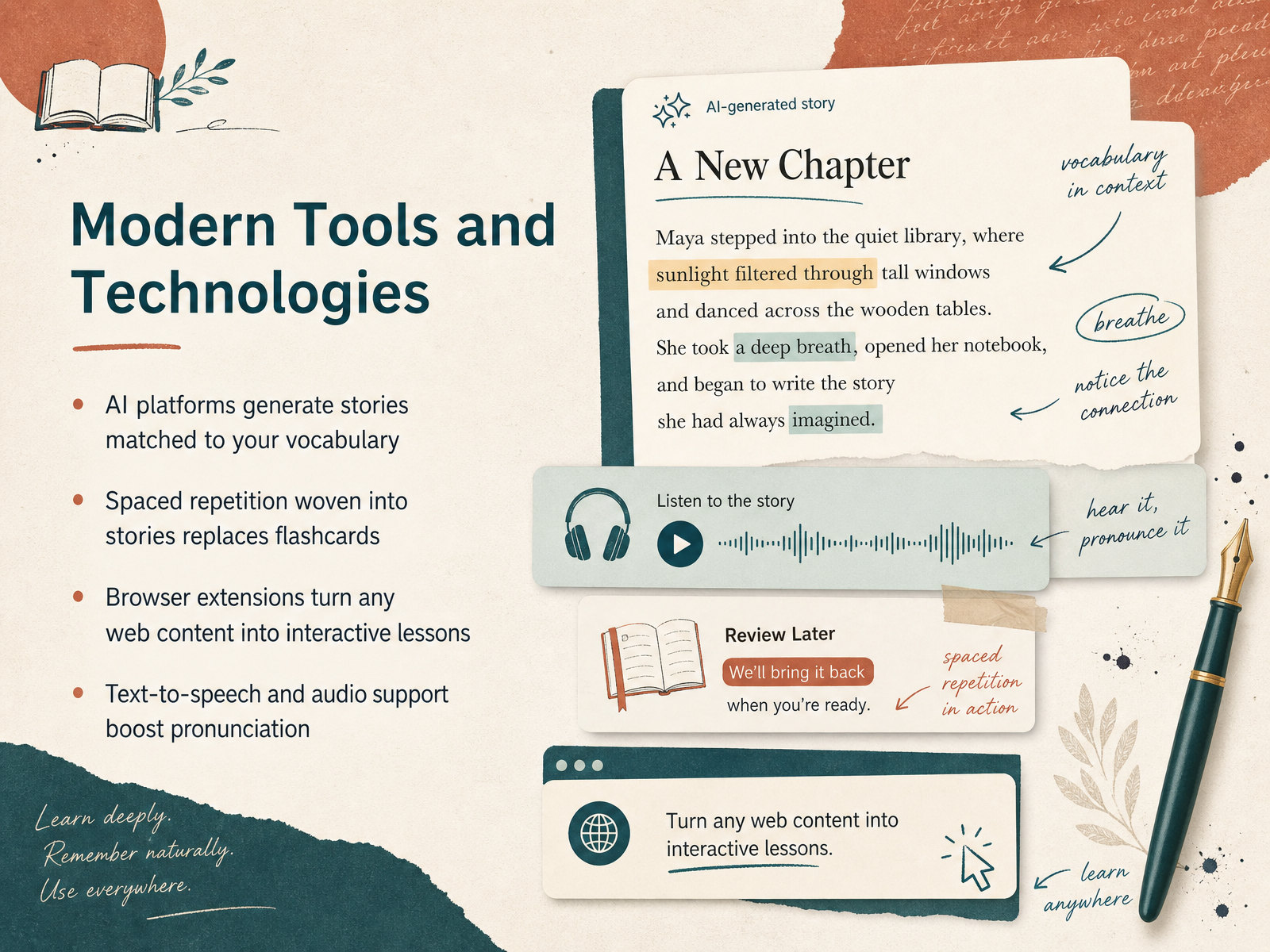
 - 12Modern Tools and TechnologiesNow let's talk about the tools that make all of this easier. AI platforms can now write stories that match your exact vocabulary level. They use words you already know, and slip in a few new ones, with clues in the story to help you guess the meaning. Spaced repetition is built into the story itself. That means a word you learned last week quietly appears again in this week's story. No flashcards, no drilling. It just comes back naturally, right when you're about to forget it. There are browser extensions too. They can turn any article you're reading into an interactive lesson. Click a word, and you get a definition, pronunciation, and an example sentence. And don't forget audio. Text-to-speech tools read stories aloud, so you can listen and follow along. That's great for pronunciation and for training your ear. The takeaway? Technology has already solved the hard part. Your job is simple. Pick a story, read it, and let the tools do the rest. Now, let's look at how to build your own story-based learning routine.
 readplusone.commnemoread.comarxiv.org+22 min
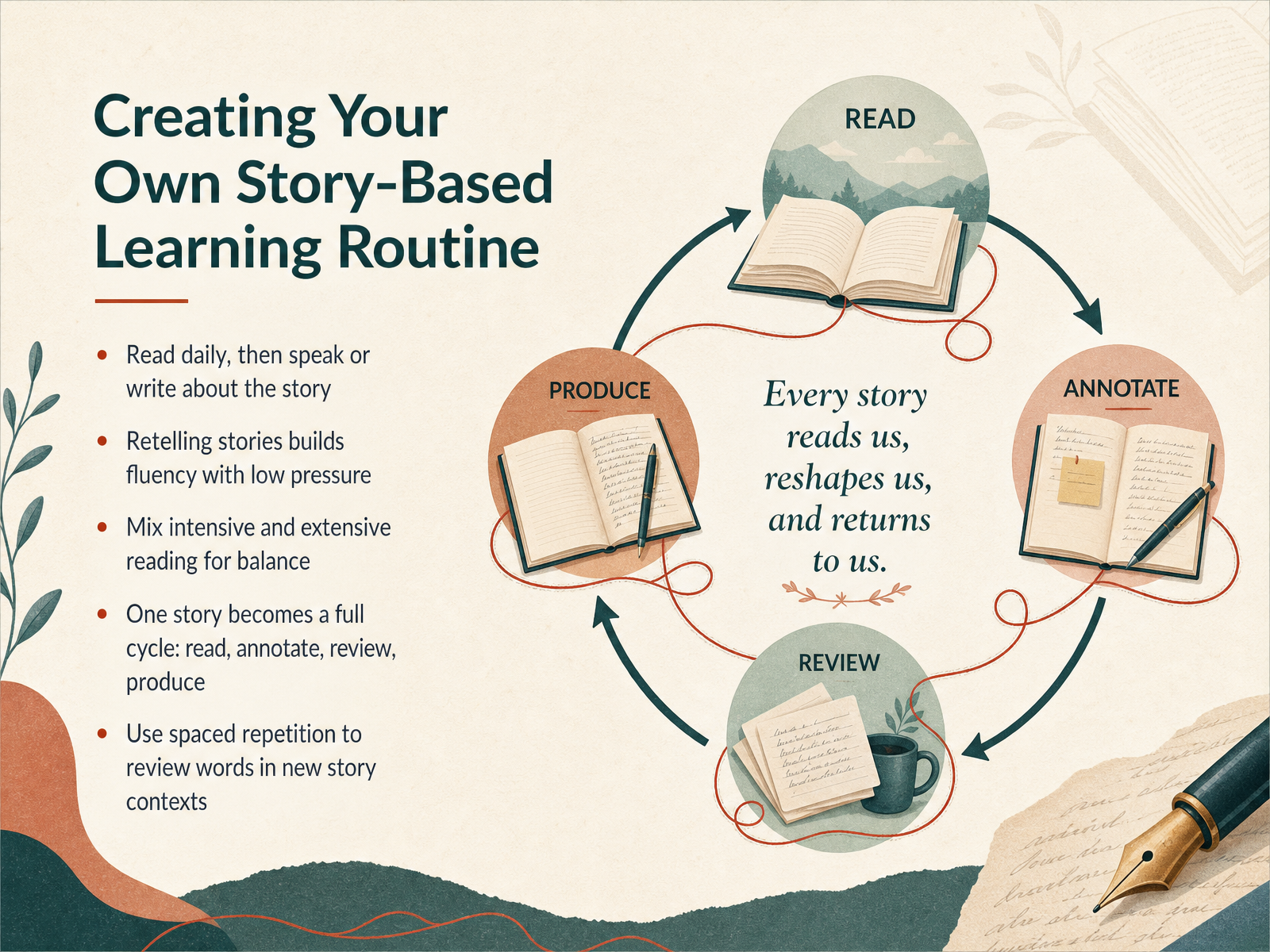
 - 13Creating Your Own Story-Based Learning RoutineSo now, let's turn your reading into a daily ritual. Read a little each day, then speak or write about what happened. Retelling a story is a low-pressure way to build fluency. Don't worry about perfection. Just get the main ideas out. You can also mix intensive reading, where you focus on details, with extensive reading, where you read for pleasure. One story can become a full learning cycle. Read it, annotate new words, review your notes, and then produce your own version. Finally, use spaced repetition. When a new word appears in a later story, after a few days, you remember it better. It's like meeting an old friend in a new place. That's how words stick. Now, let's bring everything together in a final summary and action plan.
 readplusone.commnemoread.comarxiv.org+22 min
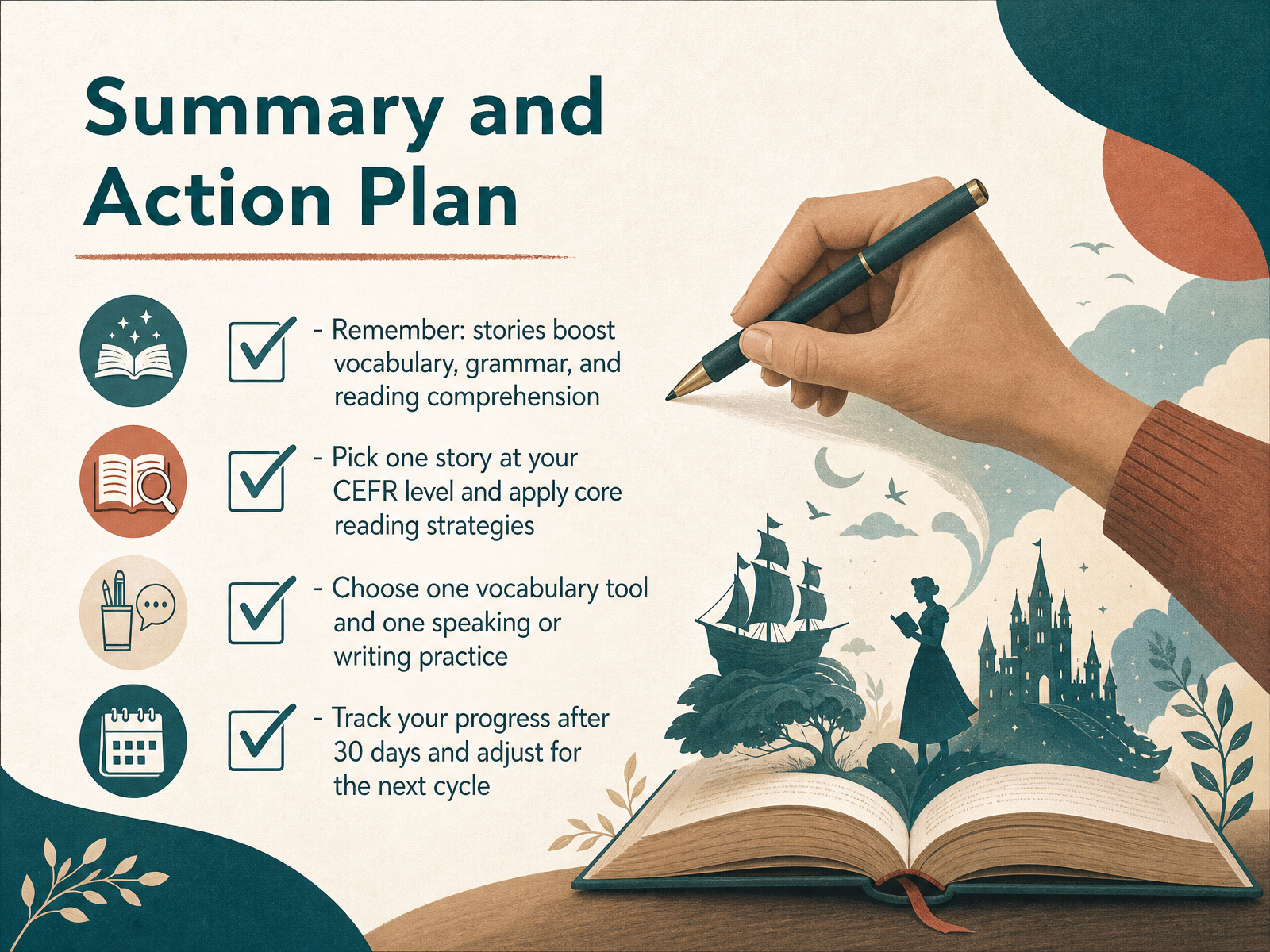
 - 14Summary and Action PlanHere we are at the finish line, and what a journey it has been. Let’s bring it all together. Remember, stories are your secret weapon. They build vocabulary, sharpen grammar, and boost reading comprehension all at once. So here is your action plan. First, pick one story that matches your CEFR level. Start there. Don’t jump ahead. Next, apply the core reading strategies we practiced. Predict, skim, and scan. Then, choose just one vocabulary tool and one speaking or writing practice. Keep it simple. Finally, track your progress after thirty days. See what worked, adjust, and start your next cycle. Learning a language is a marathon, not a sprint. Every story you finish is a step forward. So go ahead, open a book, and let the next chapter begin. Thank you for joining me, and happy reading.
 omnialang.comoapub.orgrsdjournal.org+22 min
Take the deck with you
Download this course as a file — free, no sign-up needed.
- PDF handoutEvery slide page, ready to print or share.15 pages · 5.3 MBDownload
- Narrated PowerPointThe deck that presents itself — every slide carries the digital human's narration video.15 pages · 16.2 MBDownload
- PowerPoint slidesThe full deck as a .pptx — open it in PowerPoint, Keynote, or Google Slides.15 pages · 5.3 MBDownload
Free to use in your own training — please keep the PersonWise credit page at the end.
Have your own deck? Turn it into a course
Sources consulted
Web sources consulted while building this course.
- Using Short Stories in EFL Classrooms for Teaching Practice | OMNIALANG: International Journal of Language Continuum — omnialang.com
- THE EFFECT OF READING SHORT STORIES ON GRAMMAR LEARNING IN INTERMEDIATE EFL LEARNERS | Kakar | European Journal of Foreign Language Teaching — oapub.org
- Short stories as a tool to teach English as a foreign language | Research, Society and Development — rsdjournal.org
- Using Short Stories to Teach Language Skills — researchgate.net
- (PDF) Enhancing Reading Proficiency in EFL Classrooms: The Role of Short Stories in Language Acquisition and Literacy Development — academia.edu
- ReadPlusOne - Learn Spanish by Reading Stories Made for You — readplusone.com
- MnemoRead - Master Languages Through Reading | Language Learning App — mnemoread.com
- SRS-Stories: Vocabulary-constrained multilingual story generation for language learning — arxiv.org
- SRS-Stories: Vocabulary-constrained multilingual story generation for language learning — doi.org
- Chaptera — The AI Reading Platform That Actually Helps You Learn — chaptera.io
- Short Stories in English for Beginners by Olly Richards | Hachette UK — hachette.co.uk
- English stories for learners | Famous Stories at Your Level — readstories-learnenglish.com
- 289+ English Short Stories with Audio & Dictation | A1-C1 — lexinglo.com
- Short Stories in English for Intermediate Learners (A2 and B1) with AUDIO — shop.kseacademy.com
- Step into English Complete Collection: 90 Short Stories (A2–C1) — antriparto.gumroad.com
- The Crow Man of Bath: A Free Short Story Lesson Plan for B1–B2 English Learners - Man Writes — manwrites.com
- How to Build a Story-Based English Lesson in 20 Minutes - Man Writes — manwrites.com
- How to use Short Stories to Teach Vocabulary and ... — abridgeacademy.com
- Writing a Short Story with a Twist ESL Lesson Plan | Twee — twee.com
- Fair Use and Other Educational Uses - UChicago Library — lib.uchicago.edu