Decision Memo Writing
Begin
14 pages · ~28 min
Decision Memo Writing
Learn to write clear, concise decision memos that effectively communicate recommendations and rationale to stakeholders.
What you’ll learn
- 01Writing a Decision Memo: Turning Ambiguity into Reviewable RationaleWelcome. In this course, we are going to walk through how to write a decision memo that actually gets a decision made. Think of a decision memo as a tool. It is a short, structured document. Its job is to take a messy, ambiguous problem, compare the real options in front of you, and recommend one clear path for approval. You typically use one when the choice touches budget, staffing, vendors, product direction, or any cross-functional work that needs a record. Unlike a status update or meeting minutes, a decision memo forces an explicit choice and creates an audit trail. By the end, you will be able to structure a memo that covers the problem, the options, your rationale, your recommendation, and any open conditions. Let us get started by clarifying what a decision memo is, and just as importantly, what it is not.blog.workhint.comumbrex.comnexalign.io+22 min
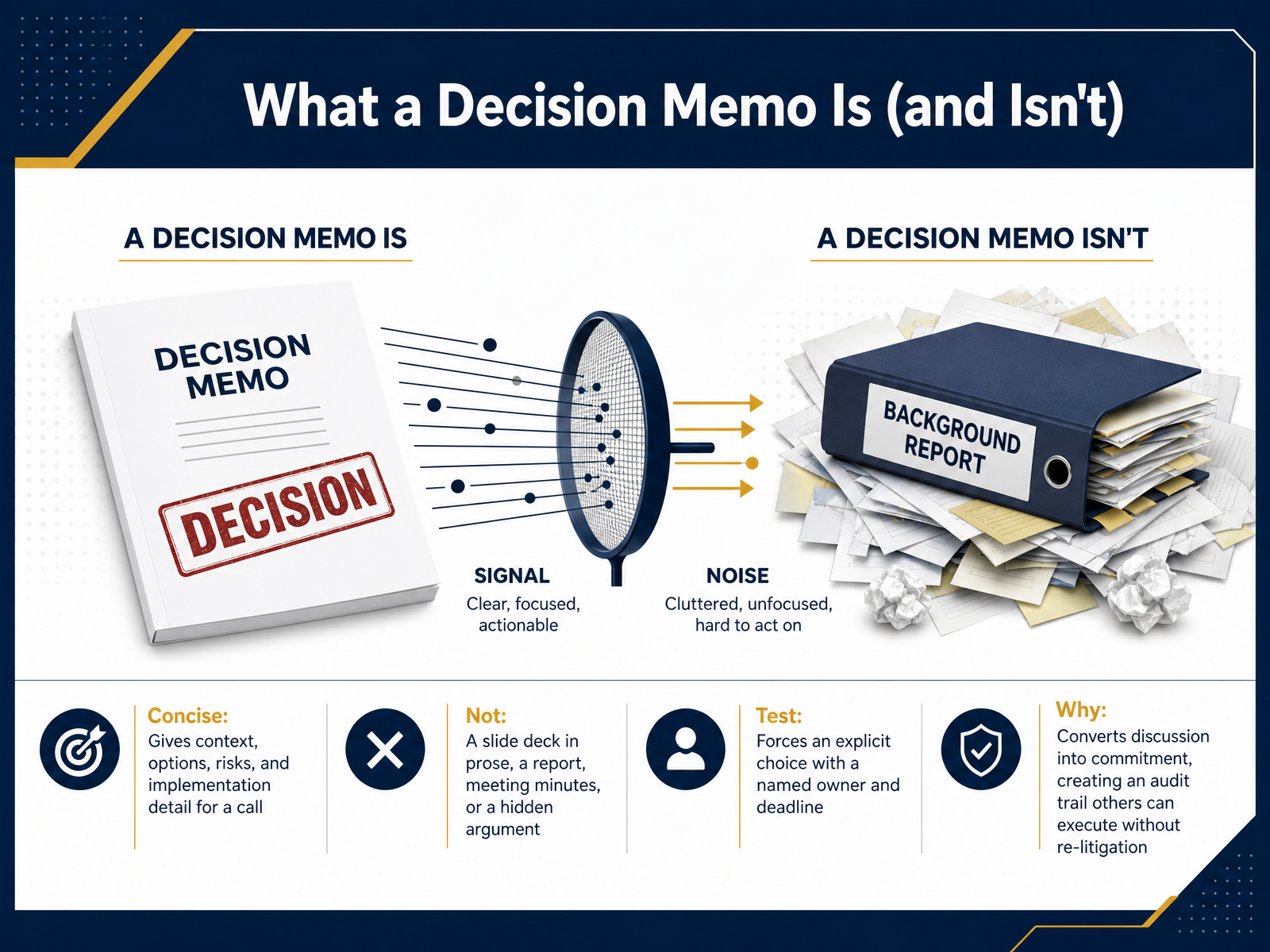
- 02What a Decision Memo Is (and Isn't)Now that you know why decisions need a specific format, let's define what a decision memo actually is, and what it definitely is not. Think of a decision memo as a concise document that gives a decision-maker everything they need to make a call. It does this by framing the context, presenting a small set of credible options, comparing the risks and trade-offs, and recommending one clear path forward. It also names the owner and sets a deadline for implementation. This turns scattered opinions into a single, clear recommendation and creates an audit trail that others can execute without re-litigating the decision. Here's the critical test: a decision memo forces an explicit choice. If the document does not ask for a yes or a no from a specific person by a specific date, it is not a decision memo. So, what is it not? It is not a slide deck written in prose, not a lengthy background report, not meeting minutes, and not a hidden argument that only pretends to present options. The goal isn't paperwork. The goal is converting discussion into commitment. With that definition clear, let's walk through the five core sections a reviewer will expect to see inside that document.
 blog.workhint.comumbrex.comnexalign.io+22 min
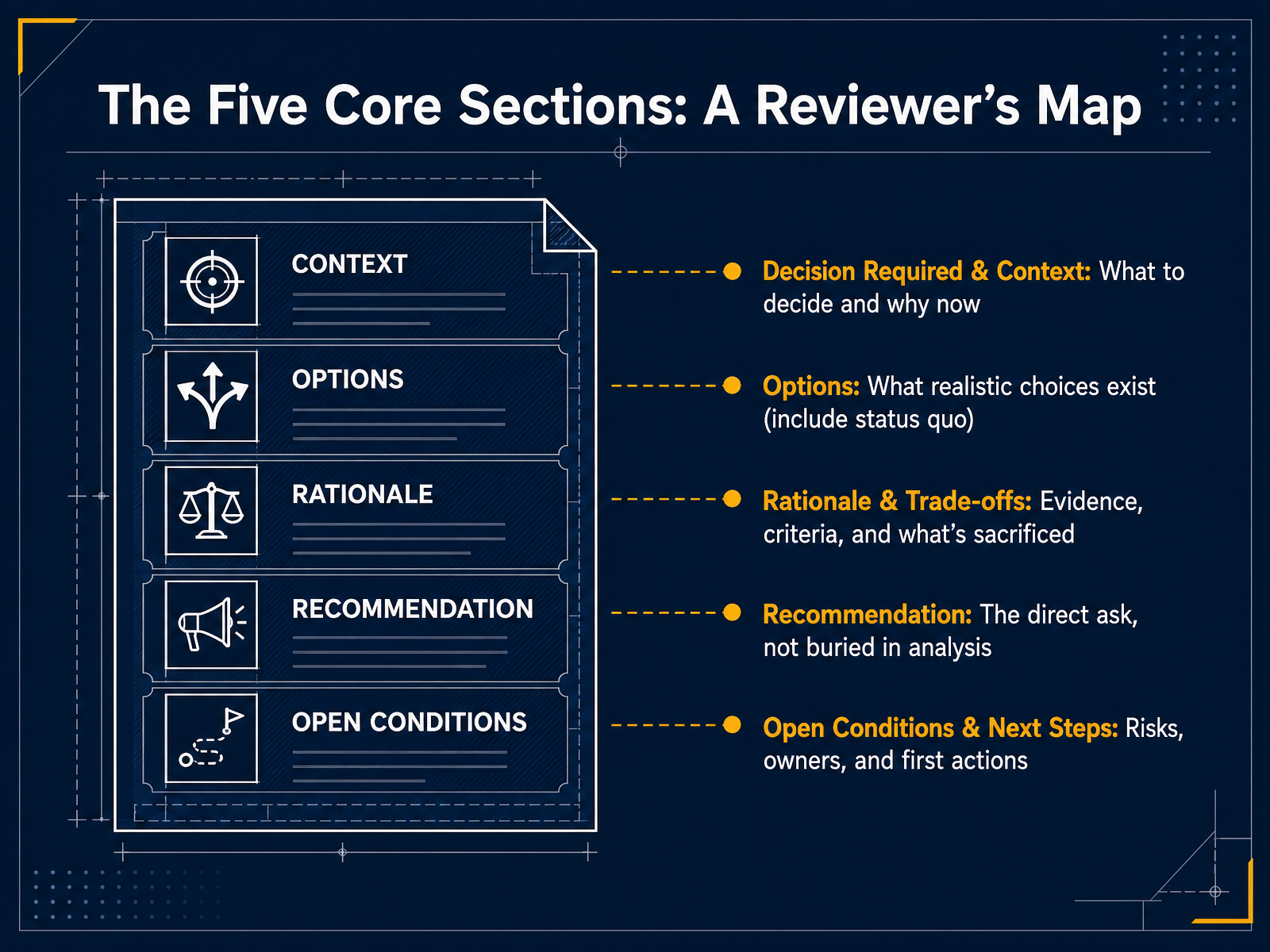
 - 03The Five Core Sections: A Reviewer's MapLet’s look at the five core sections that give a reviewer a clear map through your memo. Think of these as the explicit steps that turn a scattered discussion into an auditable choice. First, the Decision Required and Context: state exactly what needs to be decided and why it can’t wait. Second, Options: lay out the realistic choices, and always include the status quo. Third, Rationale and Trade-offs: this is where you present the evidence, the criteria, and what you’re sacrificing with each path. Fourth, the Recommendation: make the direct ask. Don’t bury your suggested course of action inside a long analysis. Finally, Open Conditions and Next Steps: name the risks, assign an owner, and define the very first actions. When you structure a memo this way, you give your decision-maker everything they need to approve, reject, or revise the request without having to restart the whole debate. Now let’s move into the first section and learn how to define the problem that drives the decision.
 blog.workhint.comumbrex.comnexalign.io+22 min
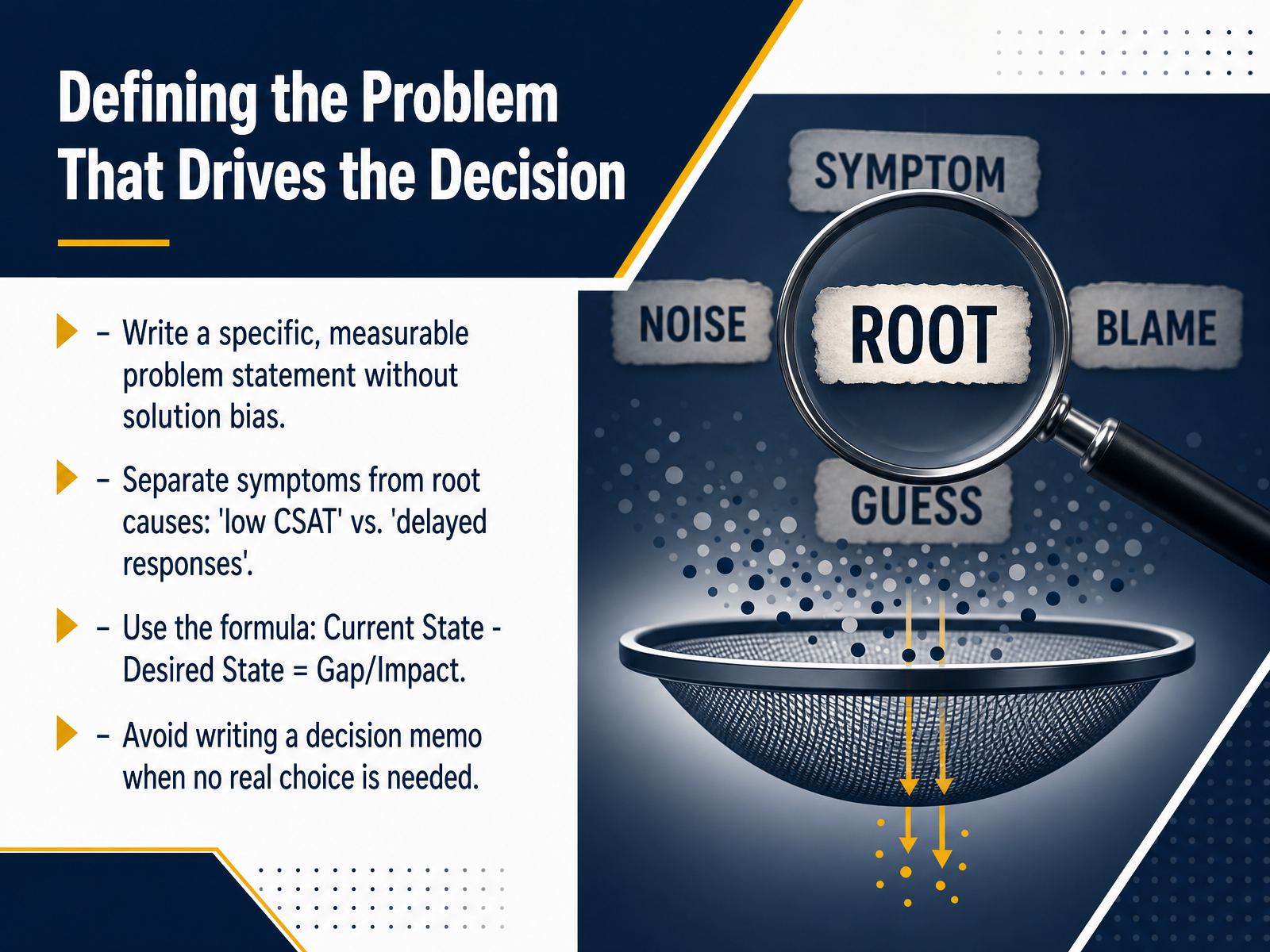
 - 04Defining the Problem That Drives the DecisionLet's talk about defining the problem, which is the engine of your entire memo. A good problem statement is specific, measurable, and free of any built-in solution. Your job here is to separate symptoms from root causes. For instance, 'low customer satisfaction' is a symptom, while 'delayed response times' is a root cause. A powerful formula to use is: Current State minus Desired State equals the Gap and its Impact. So, instead of saying 'we need a new portal,' you'd say 'our current manual entry creates a 48-hour lag, our target is real-time updates, and this gap causes three production stoppages per month.' Finally, one critical rule: don't write a decision memo when no real choice is needed. If there's only one viable path forward, you don't have a decision to make. Next, we'll build on this foundation by crafting comparable, credible options.
 scrum.orgmonday.comprojectmanager.com+21 min
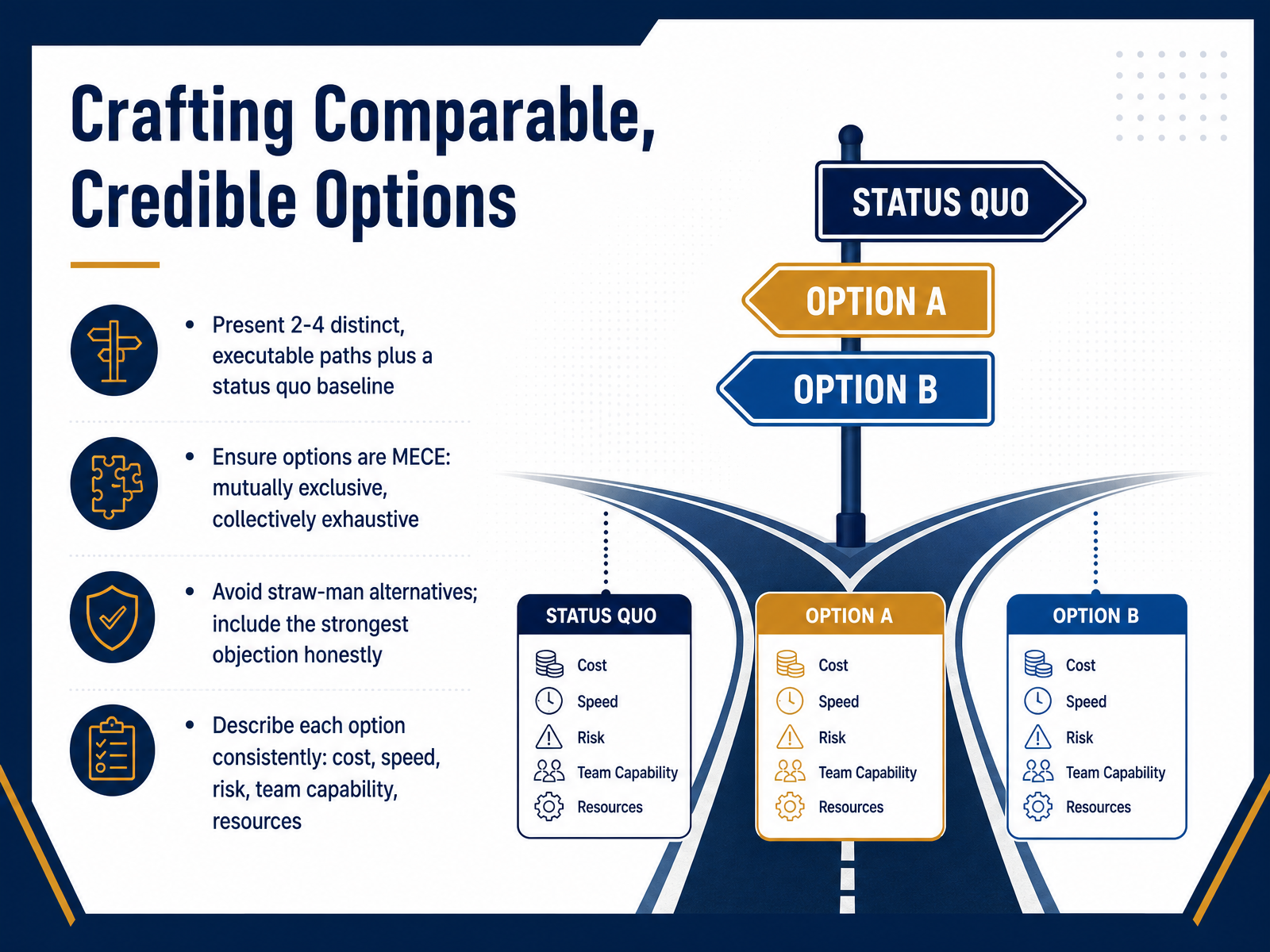
 - 05Crafting Comparable, Credible OptionsLet’s get practical and build the options section of your memo. You want to present two to four distinct, executable paths—plus the status quo as your baseline. The status quo shows what happens if you do nothing, so every other option is measured against it. For the rest, use the MECE rule: make them mutually exclusive, so no option overlaps with another, and collectively exhaustive, covering all realistic possibilities. Avoid straw-man alternatives designed to make one choice look artificially superior. Instead, include the strongest objection to your own preferred path right in the option description. Describe each option consistently across five dimensions: cost, speed, risk, team capability, and resources. That consistent structure lets decision makers scan and compare directly. For example, one option might score high on speed but low on team capability, while another is cheaper but slower. Laying that out honestly builds trust and credibility. Up next, we’ll move from options to the evaluation itself—Building the Evaluation: Criteria, Evidence, and Trade-offs.
 cometstudio.devgithub.comshorensteincenter.org+22 min
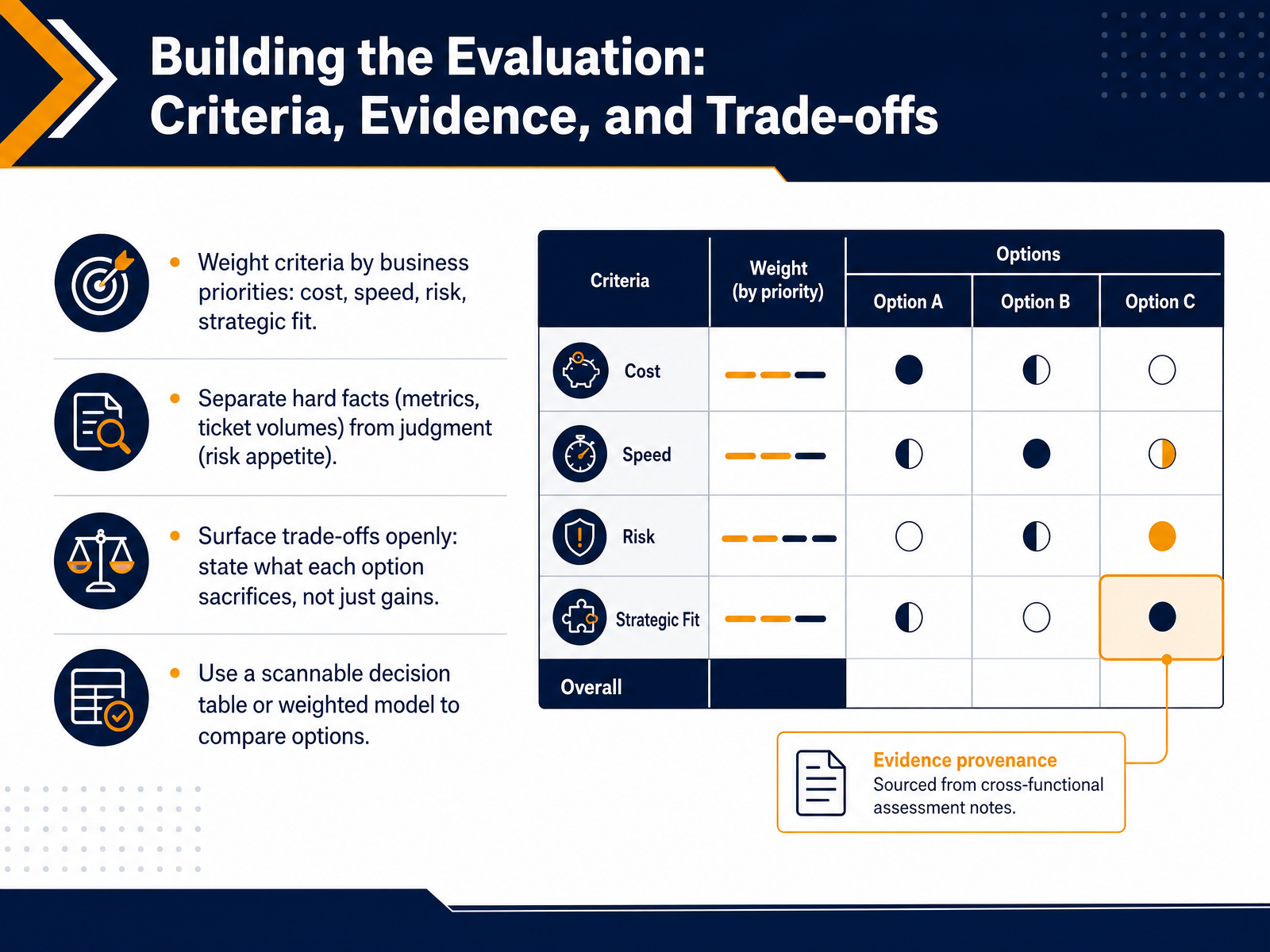
 - 06Building the Evaluation: Criteria, Evidence, and Trade-offsSo far we have named the problem and the options. Now we build the evaluation itself—the criteria, the evidence, and the trade-offs. First, weight your criteria by what the business actually prioritizes. Typical weights are cost, speed, risk, and strategic fit. If cost matters twice as much as speed, give it twice the weight before you score anything. Second, separate hard facts from judgment. Ticket volumes and cycle times are facts; statements about risk appetite are judgment. Label them clearly so a reviewer knows what is measured and what is estimated. Third, surface the trade-offs openly. State what each option sacrifices, not just what it gains. For example, Option A may cut cost by fifteen percent but sacrifices a quarter of delivery speed. Finally, put your comparison into a scannable decision table or a simple weighted model. Even a quick rating of one to five per option makes the logic visible and auditable. In short, weight before scoring, label facts versus judgment, call out the real compromises, and make the comparison easy to scan. Next we will move from analysis to action and cover how to state a clear, supportable recommendation.
 product-blueprint.comcursa.appbusiness-in-a-box.com+22 min
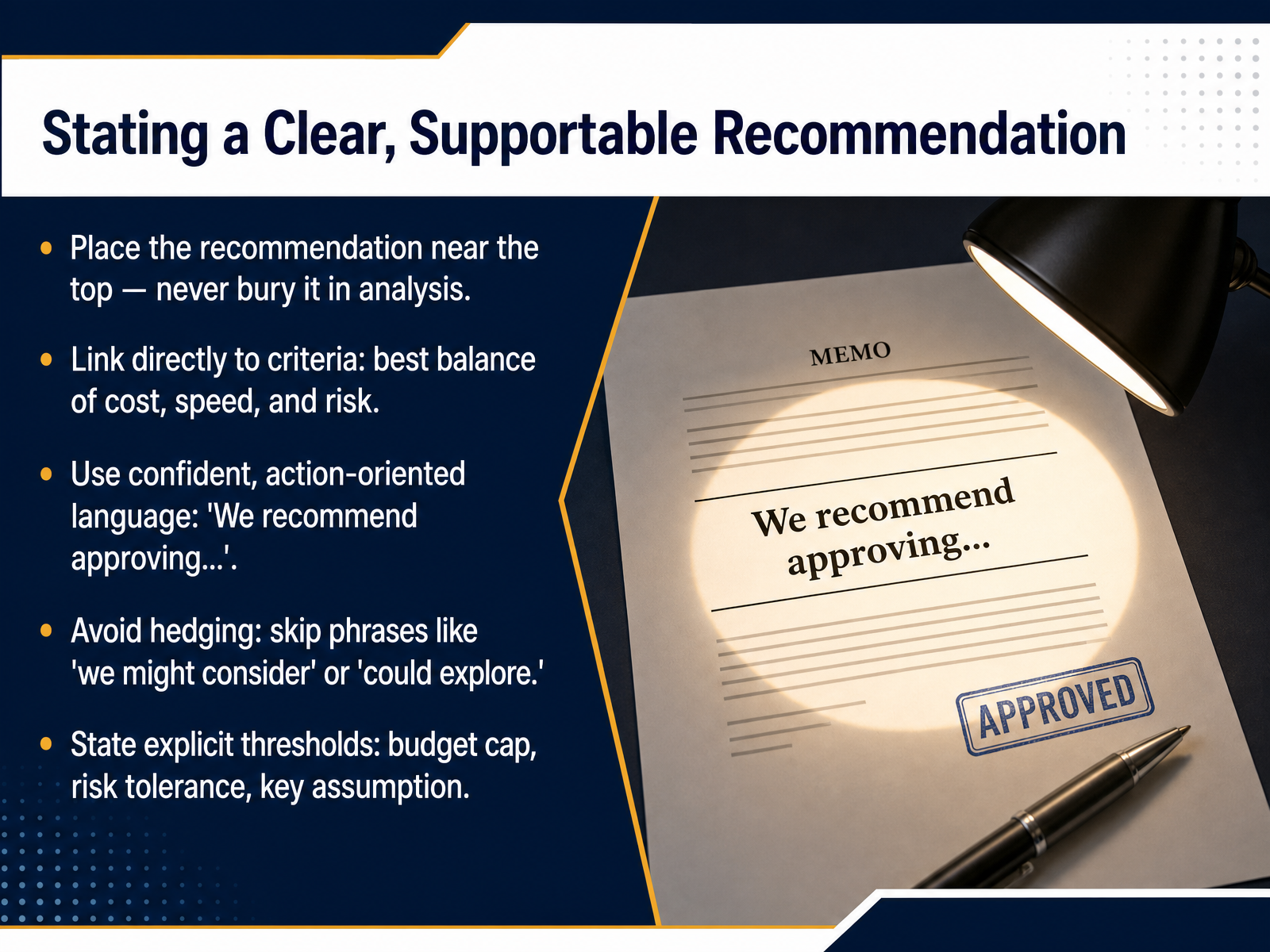
 - 07Stating a Clear, Supportable RecommendationSo you've walked through the options and the evidence. Now you reach the moment of truth: the recommendation. Here's how to write one that gets approved. First, place your recommendation near the top of the memo. Don't make your reader dig through three pages of analysis to find it. Tell them upfront. 'We recommend approving the Salesforce integration.' Second, tie your recommendation directly to your criteria. Make it clear this is the choice that delivers the best balance of cost, speed, and risk. Use confident, action-oriented language. Say 'we recommend,' not 'we might consider' or 'we could explore.' Those hedges make you sound uncertain, and an uncertain recommendation rarely gets a yes. Finally, state your explicit thresholds. For example, 'We recommend approving the new platform, with a budget cap of two hundred fifty thousand dollars, assuming our current risk tolerance remains unchanged and the vendor passes the security audit by June thirtieth.' This does two things. It shows you've thought through the guardrails, and it gives your decision maker a clear, qualified yes they can feel confident signing. Up next, we'll tackle how to manage risks and open conditions without killing the decision.
 blog.workhint.comproduct-blueprint.comcursa.app+22 min
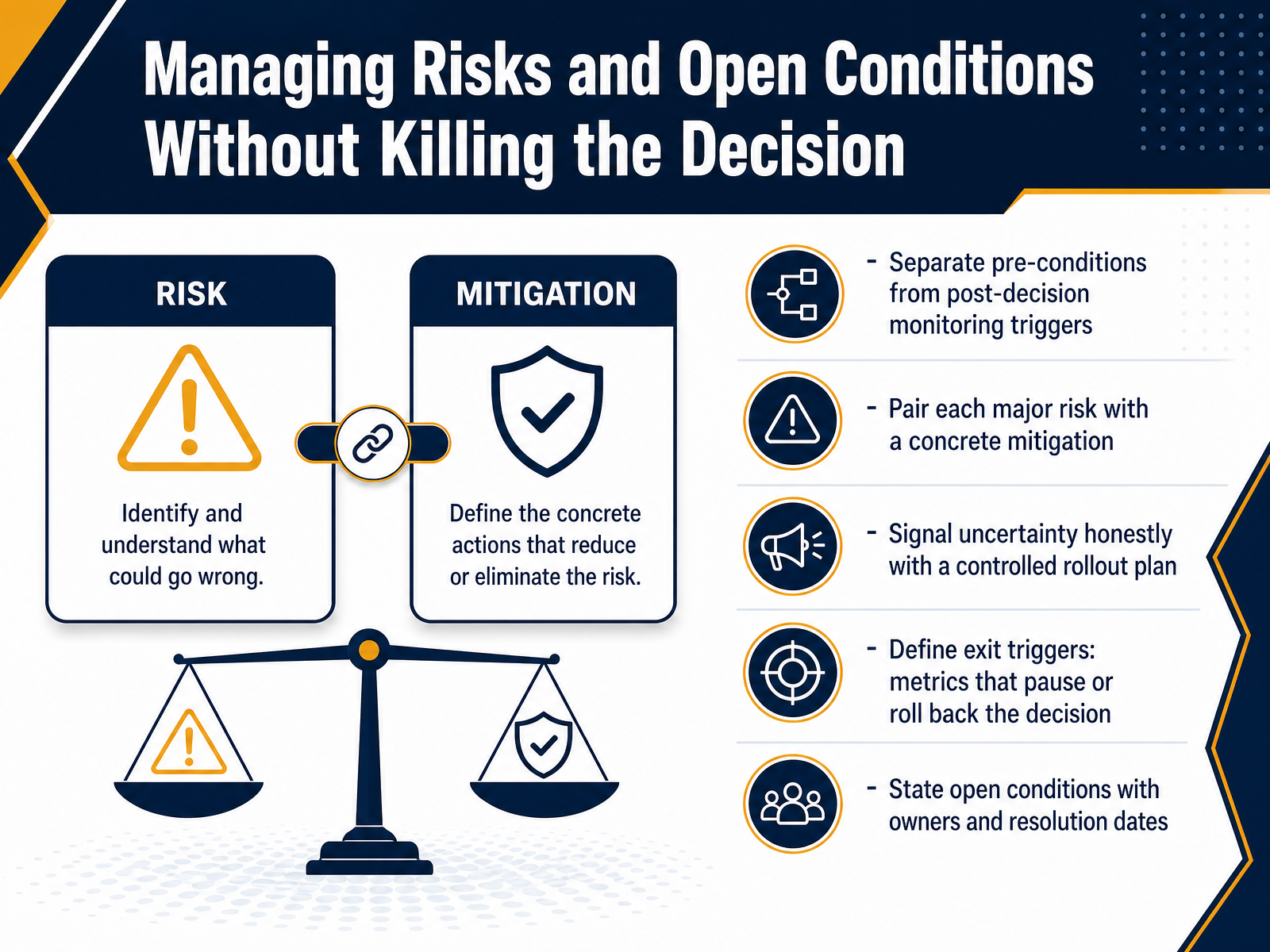
 - 08Managing Risks and Open Conditions Without Killing the DecisionNow, let's talk about managing the risks and open conditions—this is the section where you can honestly address uncertainty without killing the decision. Think of it as preempting the 'what ifs' so your reviewer doesn't have to. First, separate pre-conditions that must be met before the decision takes effect from monitoring triggers you'll track after implementation. Next, pair each major risk with a concrete mitigation. Don't just name the danger; explain what you're actively doing about it. Signal any remaining uncertainty by proposing a controlled rollout plan—starting small, checking guardrails, then expanding—which turns a binary leap into a managed sequence. You must also define 'exit triggers': those specific metrics that would cause you to pause or roll the decision back. Finally, list every open condition with a single owner and a hard resolution date. This keeps unresolved items operational instead of letting them float in the appendix. In practice, this means your reviewer sees a clear map of what's known, what's unknown, and who's handling each piece by when. Next, let's move from risk management to practical execution: actionable next steps that turn your approval into real momentum.
 blog.workhint.comproduct-blueprint.comcursa.app+22 min
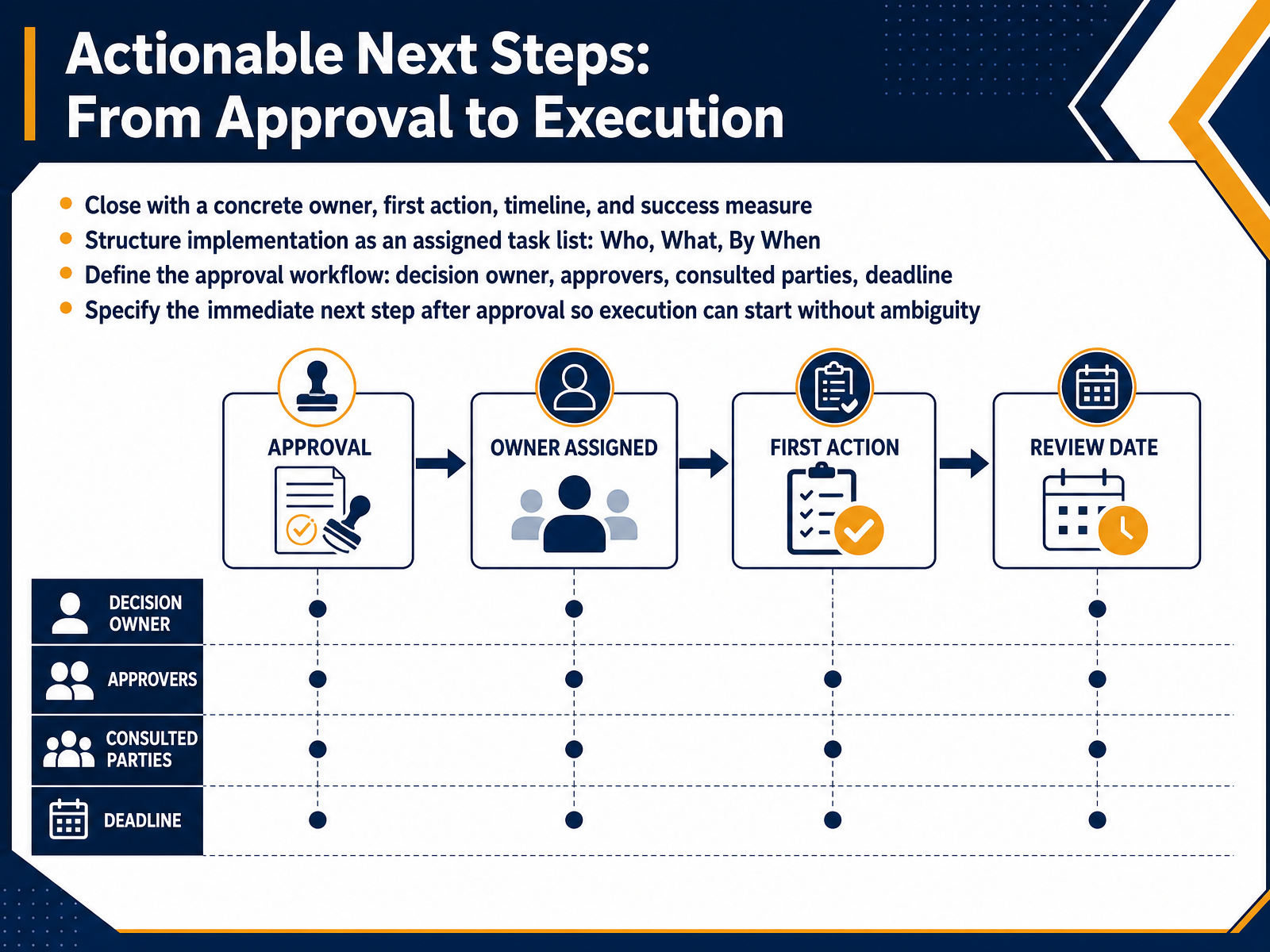
 - 09Actionable Next Steps: From Approval to ExecutionA decision without a clear next step is just an expensive writing exercise. So let's make sure your memo drives real action. First, close by naming a single concrete owner—one person accountable for the first move, not a whole department. Pair that with a specific action item, a timeline, and how you will measure success. Think of it as a mini task list: Who, What, By When. Next, define the approval workflow. Name the decision owner, list any required approvers or consulted parties, and state a hard deadline for a response. This prevents the memo from sitting in an inbox, waiting for someone to guess what to do. Finally, spell out the immediate next step after approval. Don't make the approver figure out what starts on Monday. Say it explicitly so execution begins without ambiguity. Over the next slide, we will look at how to keep busy executives engaged by writing for clarity, brevity, and scanability.
 blog.workhint.comproduct-blueprint.comcursa.app+22 min
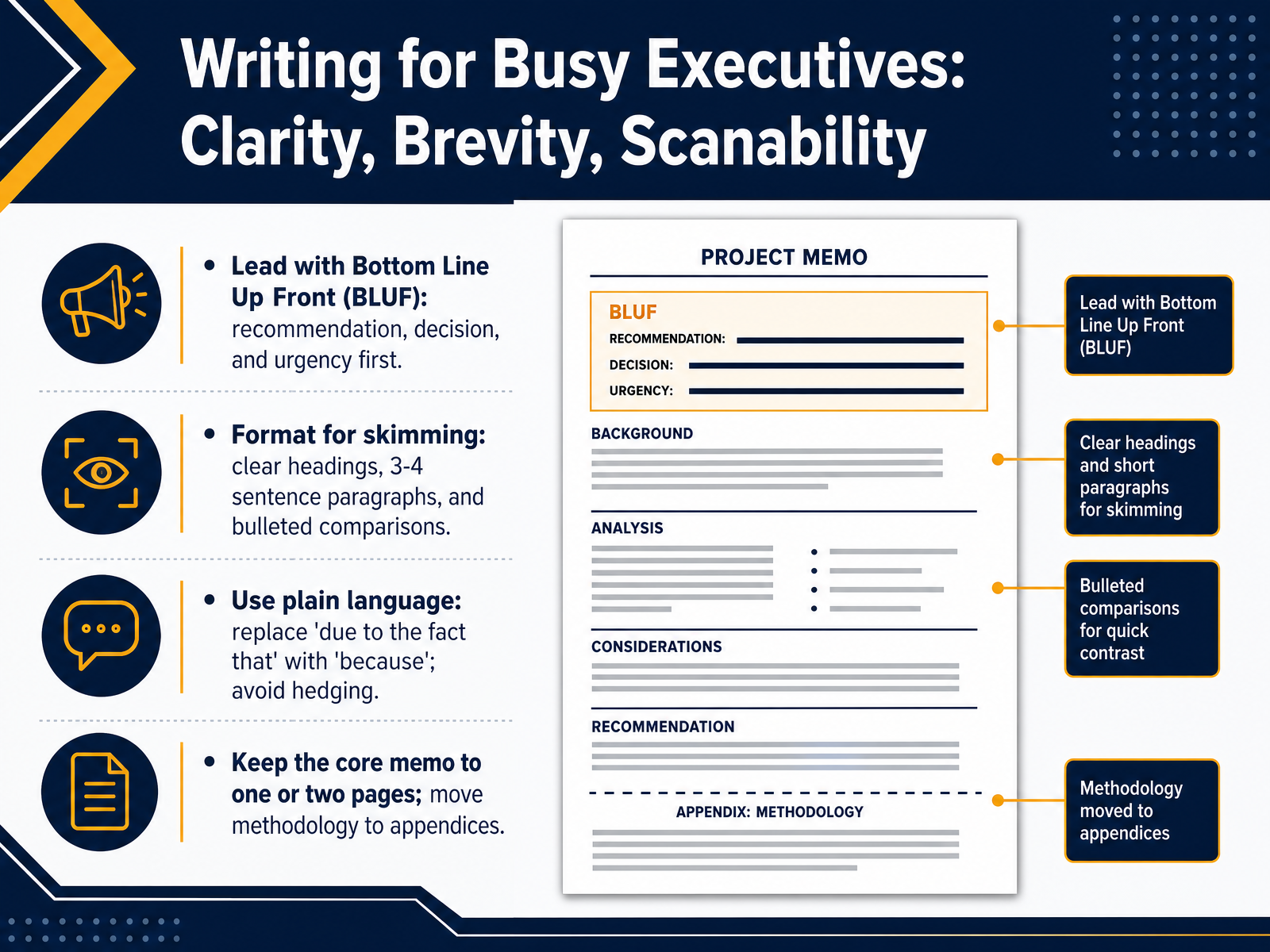
 - 10Writing for Busy Executives: Clarity, Brevity, ScanabilityHere’s the shift that makes your decision memo land: write for a busy executive, not a patient reader. Start with the bottom line up front—also called BLUF. That means your recommendation, the decision you need, and the urgency belong in the very first sentence. Don’t build up to it. Lead with it.
Next, format for the skim. Use clear headings, keep paragraphs to three or four sentences, and present comparisons in bullets. Executives rarely read word for word—they scan. Make that scanning effortless.
Now be ruthless with your language. Replace ‘due to the fact that’ with ‘because.’ Cut hedging words like ‘perhaps’ or ‘possibly.’ Confident, plain language signals a confident recommendation.
Finally, constrain yourself. Keep the core memo to one or two pages. If your methodology or supporting data is long, move it to an appendix. The executive needs the decision, not the full research trail.
That’s the formula: BLUF, scan-friendly structure, plain language, and a strict page budget. Up next, we’ll look at a stripped-down tool for fast operational decisions—the six-line quick memo.
 blog.workhint.comproduct-blueprint.comcursa.app+22 min
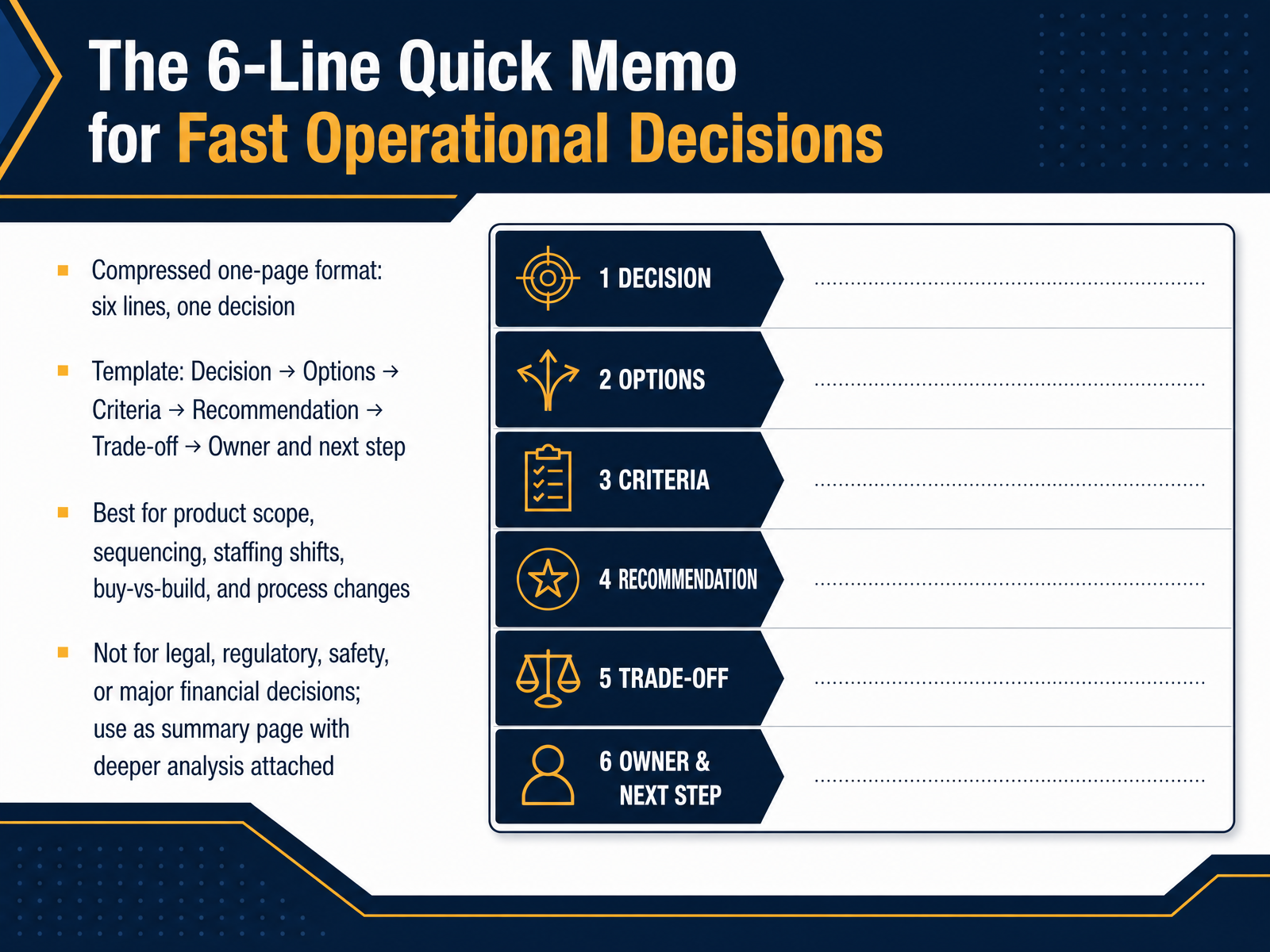
 - 11The 6-Line Quick Memo for Fast Operational DecisionsNow let’s look at the lightest tool in your kit: the six-line quick memo. This format is for fast operational decisions where you need a written record but don’t need a full analysis. The template is six lines, one decision. Line one states the decision. Line two lists two or three options, making sure they are mutually exclusive. Line three names the criteria you used to compare them. Line four gives your recommendation. Line five captures the single most important trade-off you’re accepting. And line six names the owner and the immediate next step. Think of it as a decision snapshot: product scope changes, sequencing trade-offs, staffing shifts, buy-versus-build calls, or process adjustments. These are all good fits for the quick memo. However, this format is not for legal, regulatory, safety, or major financial decisions. In those cases, use the quick memo as a cover page and attach the deeper analysis. When you learn to compress a decision into six clear lines, you make it easy for a busy manager to approve, reject, or redirect in minutes instead of days. Next, we move to the practice exercise: turning a vague request into a structured memo.
 cometstudio.devgithub.comshorensteincenter.org+22 min
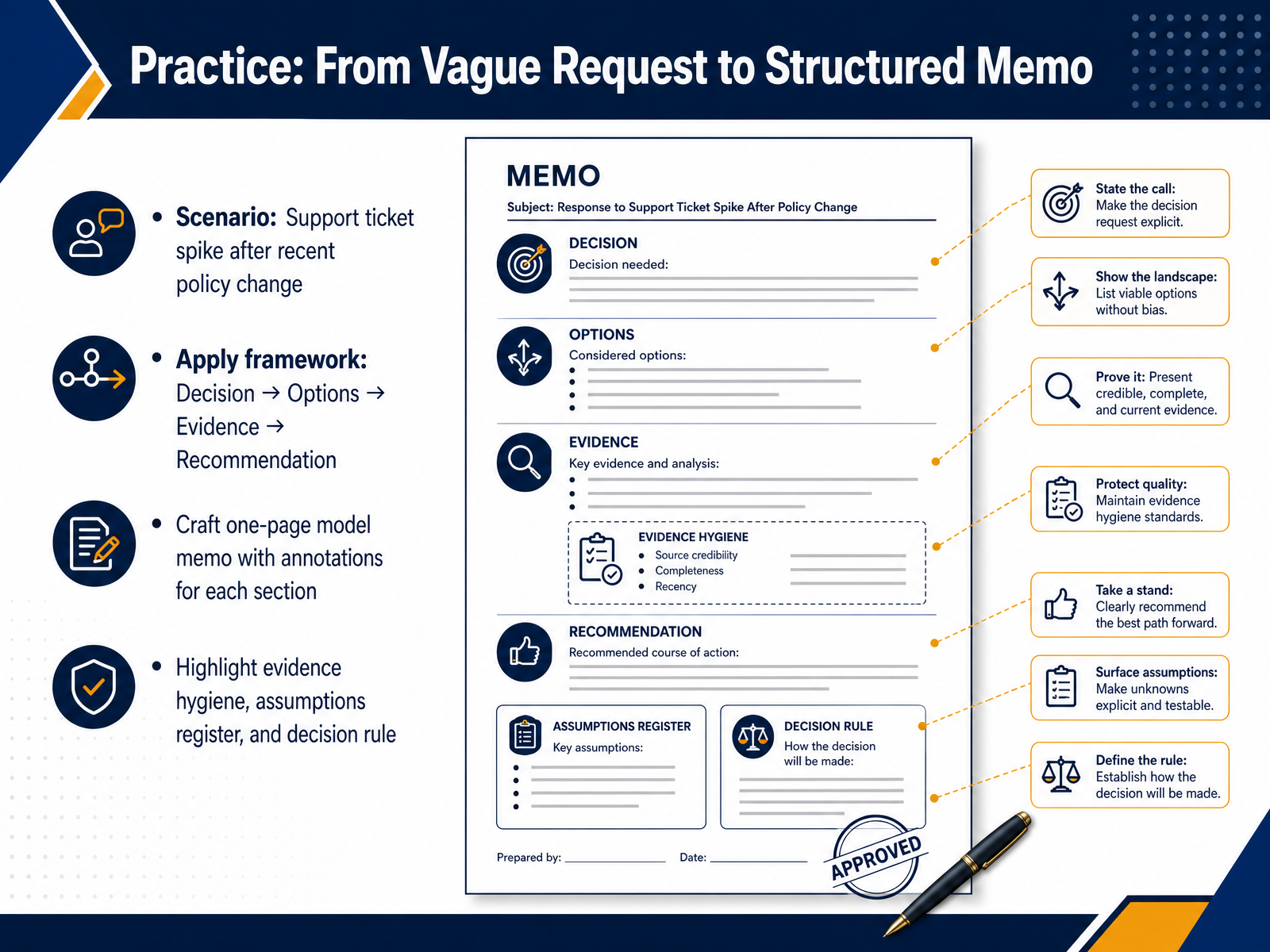
 - 12Practice: From Vague Request to Structured MemoNow let's apply the framework to a real scenario. Imagine a support ticket spike right after a policy change. Instead of getting lost in the noise, we'll write a one-page memo that turns that vague problem into a structured decision. First, we define the decision: should we roll back the policy, adjust it, or keep it and fix the messaging? Those become our distinct, MECE options. Next, we assemble evidence with real hygiene—we separate raw ticket tags from customer quotes, we add a provenance note so everyone knows where the numbers came from, and we deliberately include one disconfirming data point to keep the memo honest. Then, we build an assumptions register. For every belief we hold, we ask: what would prove it wrong? That keeps hidden risks from surfacing too late. Finally, we write a clear decision rule. For example, if escalations stay above a specific threshold for five days, we automatically choose rollback. That rule makes the recommendation reversible and testable. The result isn't just a write-up; it's an annotated model memo where every section—options, evidence, assumptions, and the decision rule—stands up to scrutiny. Up next, let's look at common traps and reviewer complaints to make sure your memo gets approved.
 blog.workhint.comumbrex.comnexalign.io+22 min
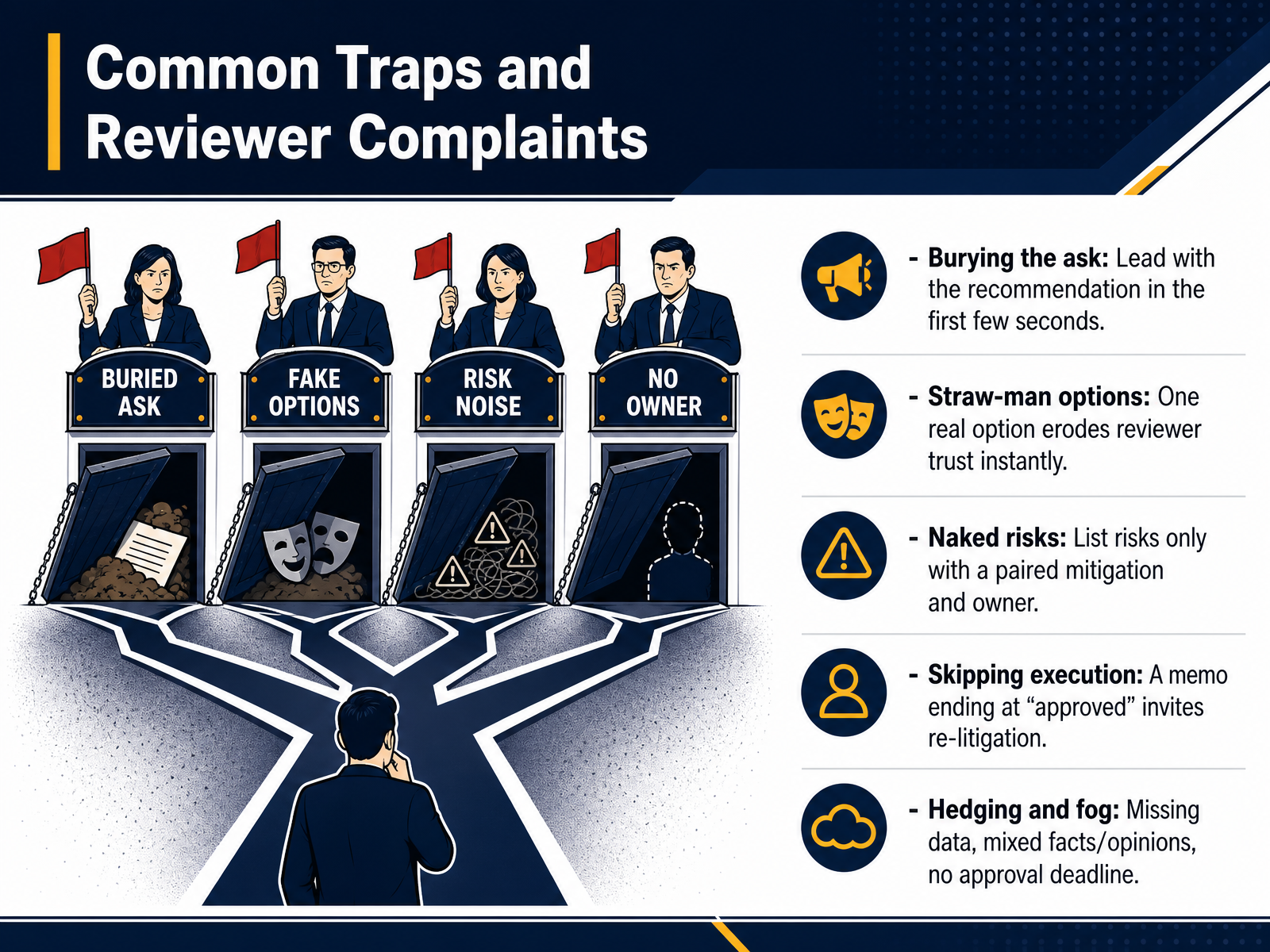
 - 13Common Traps and Reviewer ComplaintsNow we come to some of the most common traps that can undermine your decision memo before a reviewer even finishes reading it. First, burying the ask. If your recommendation is hidden on page three, you've already lost your audience. The memo should lead with the recommendation in the very first few seconds. Next, watch out for straw-man options. Presenting one real choice alongside a weak alternative erodes reviewer trust instantly; they can tell you've already decided. Here's a big one: naked risks. Never list a risk without pairing it with a mitigation and a named owner. Skipping execution is another trap. A memo that ends at the word 'approved' simply invites re-litigation later. And finally, avoid hedging and fog. That means missing data, blurring facts with opinions, and forgetting to include an approval deadline. To put it simply: be direct, be fair to the options, own the risks, and define what happens next. Up next, let's look at a practical pre-submission checklist that will help you catch these issues before you hit send.
 blog.workhint.comproduct-blueprint.comcursa.app+22 min
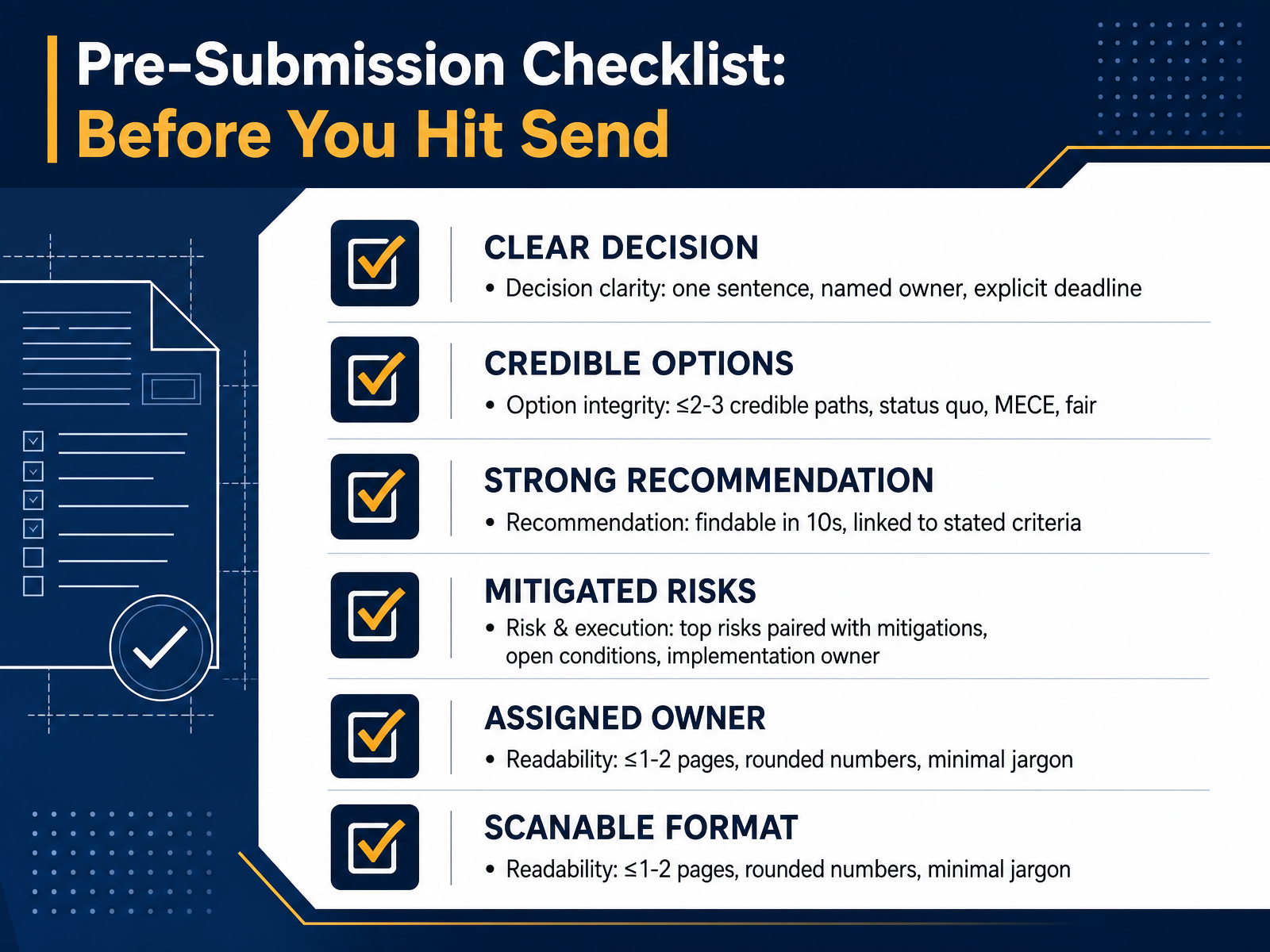
 - 14Pre-Submission Checklist: Before You Hit SendBefore you send your memo, let's walk through a quick final audit. These five checks will save you from the most common pitfalls. First, look at your decision clarity. Can you state the ask in one clean sentence that names the owner and an explicit deadline? If not, sharpen that before anything else. Second, double-check your option integrity. Make sure you present only two or three credible paths, always include the status quo, keep your list mutually exclusive, and be fair in describing each one. Third, test your recommendation for findability. A busy reviewer should be able to locate it in under ten seconds, and it must link directly to the criteria you declared earlier. Fourth, verify your risk and execution signal. Every top risk needs a paired mitigation and open conditions should have assigned owners, plus one person responsible for implementation. You never want a decision that floats after approval. Finally, read for readability. Keep the memo to one or two pages, round your numbers so they scan fast, and cut any jargon that might stall your reader. Run this checklist one last time, trust your draft, and send it with confidence. Thanks for completing this course—now go write memos that move people to act.
 blog.workhint.comproduct-blueprint.comcursa.app+22 min
Take the deck with you
Download this course as a file — free, no sign-up needed.
- PDF handoutEvery slide page, ready to print or share.15 pages · 3.9 MBDownload
- Narrated PowerPointThe deck that presents itself — every slide carries the digital human's narration video.15 pages · 14.5 MBDownload
- PowerPoint slidesThe full deck as a .pptx — open it in PowerPoint, Keynote, or Google Slides.15 pages · 3.7 MBDownload
Free to use in your own training — please keep the PersonWise credit page at the end.
Have your own deck? Turn it into a course
Sources consulted
Web sources consulted while building this course.
- How To Write A Decision Memo - The Workhint Blog — blog.workhint.com
- Decision-Quality Deliverables — umbrex.com
- Decision memo | DecisionOS by nexalign — nexalign.io
- Decision Memos That Actually Work: A Workflow for Evidence, - Calypso — calypso.ms
- Executive Decision Memo Template Transformation Governance — dunnixer.com
- Business Problem Statement Examples | Scrum.org — scrum.org
- Problem Statement Template: Free Guide With Examples — monday.com
- How to Write a Problem Statement: Example & Template Included — projectmanager.com
- How To Create Great Business Problem Statements - Edge Agility — edgeagility.com
- How To Write a Problem Statement Using a Simple Template - Shopify — shopify.com
- How to Write a Product Decision Memo — Template and Examples | Comet Studio — cometstudio.dev
- decision-memo-builder/SKILL.md — github.com
- OPTION AND DECISION MEMOS BASIC COMPONENTS — shorensteincenter.org
- management-consultant/commands/strategy-memo.md — github.com
- Integration Option Paper Template | NeoArc Studio — neoarcstudio.com
- Trade-off Memos: Strategic Decision-Making Tools for Executive Leadership – Product Blueprint — product-blueprint.com
- Decision Memo Templates: What to Say, What to Show, and Common Pitfalls : Course Practical Bayesian Statistics for Real-World Decisions: From Intuition to Implementation | Cursa — cursa.app
- Decision Matrix Template (Free Word) — business-in-a-box.com
- Decision Matrix Analysis — mindtools.com
- Business Decision Template: — capitalscoalition.org