Begin
13 pages · ~26 min
Logarithmic Scales: pH, Decibels, Earthquakes
This training explains logarithmic scales and how they apply to pH, decibels, and earthquake magnitude, helping learners interpret and work with these measurements confidently.
A digital instructor presents all 13 pages. Hold “Ask” at any point and ask out loud — the answer comes from this course. No sign-up needed.
What you’ll learn
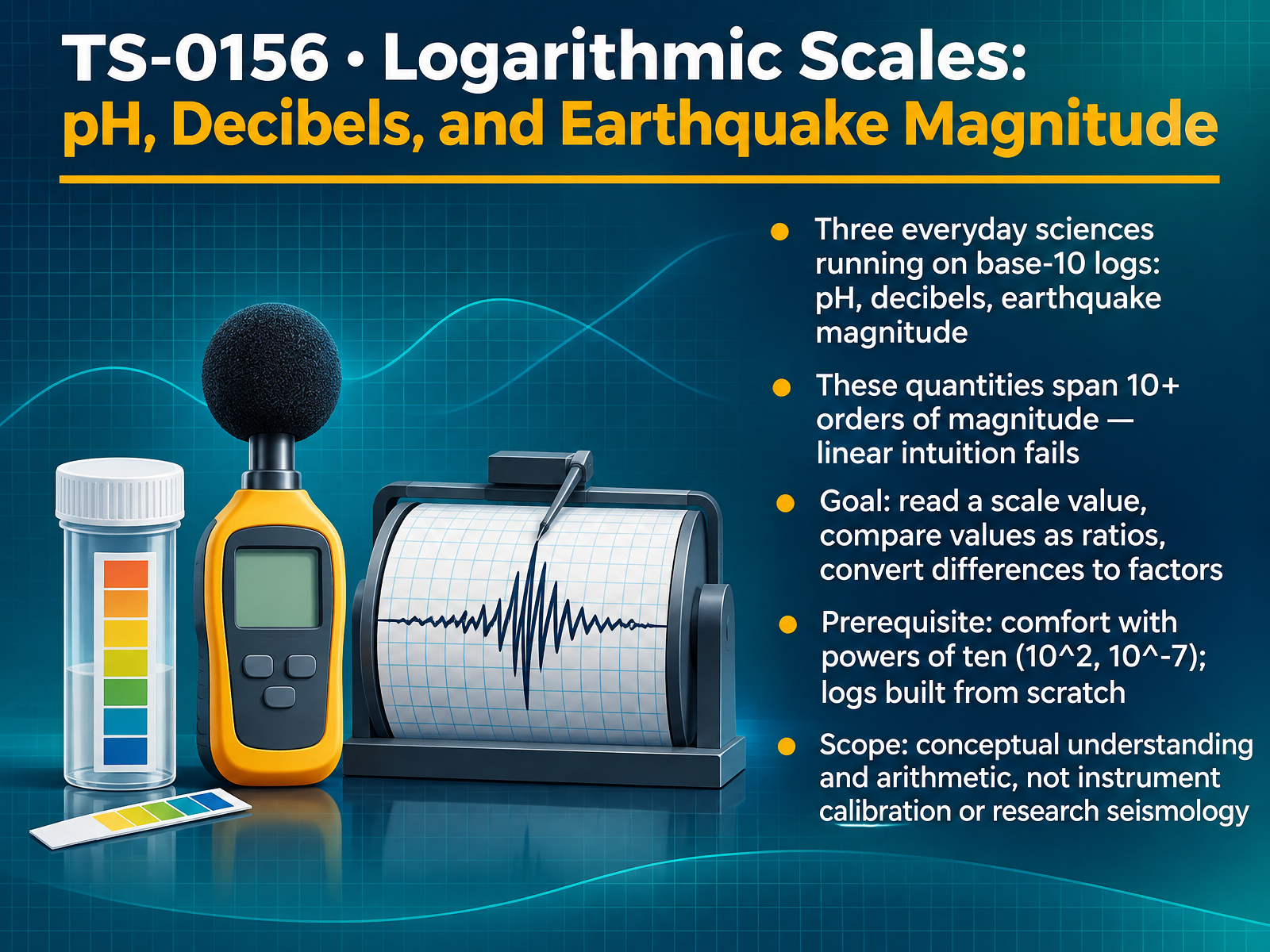
- 01TS-0156 · Logarithmic Scales: pH, Decibels, and Earthquake MagnitudeWelcome to this course on logarithmic scales. Today we look at three familiar measurements that all run on base-ten logarithms: pH, decibels, and earthquake magnitude. Each of these quantities spans more than ten orders of magnitude, so ordinary linear intuition fails. Reading a magnitude six as twice a magnitude three, for example, hides a huge difference. Our goal is practical: you will learn to read a scale value, compare two values as a ratio, and convert a difference on the scale into a factor. You only need comfort with powers of ten, like ten squared or ten to the negative seventh. We build logarithms from scratch. This is conceptual understanding and arithmetic, not instrument calibration or research seismology. Next, we look at why some quantities need a logarithmic scale.pathtoscience.orglivephysics.commath.libretexts.org+21 min
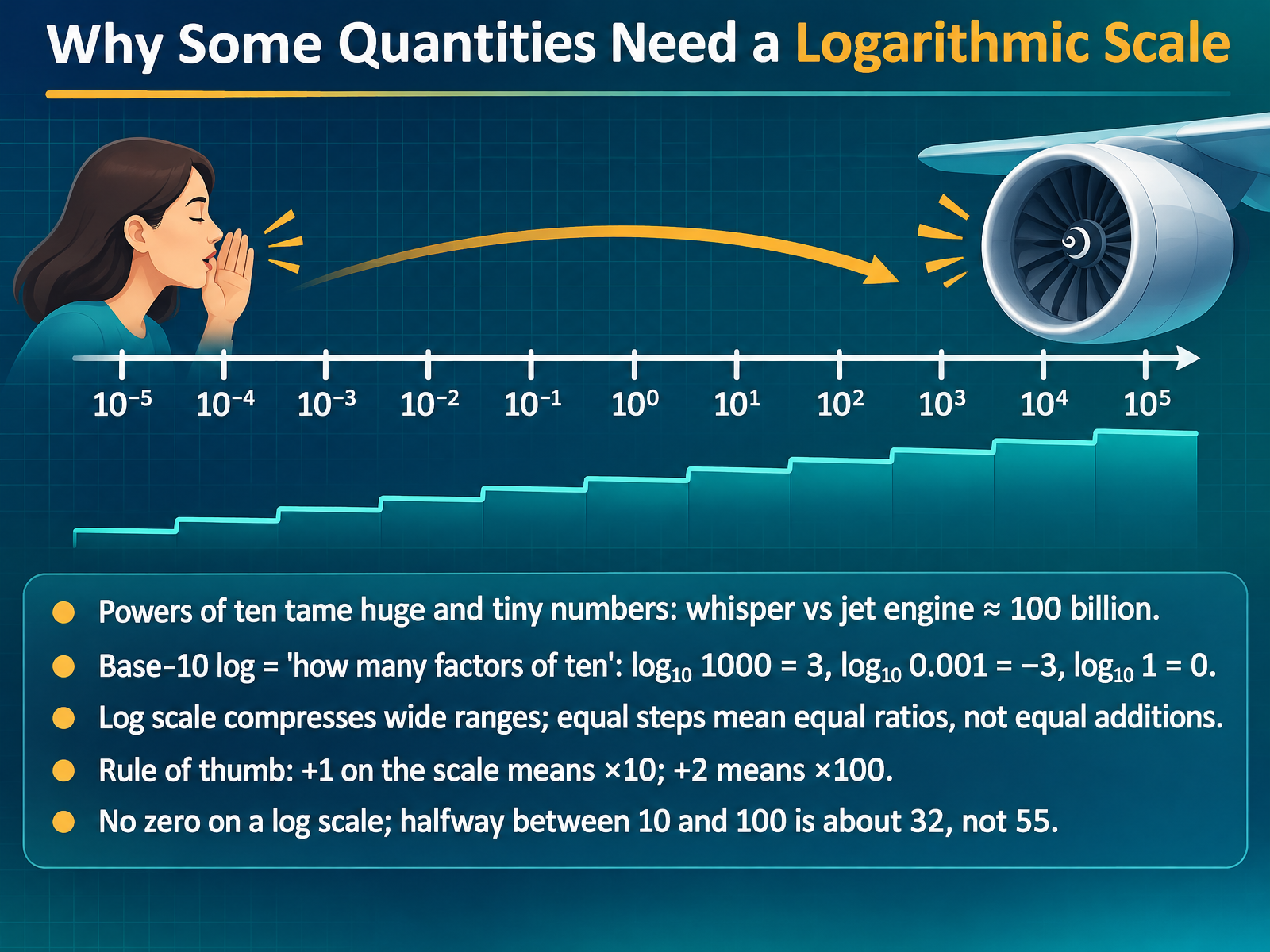
- 02Why Some Quantities Need a Logarithmic ScaleLet's turn to why some quantities need a logarithmic scale. Some ranges in nature are enormous. The sound of a whisper and the sound of a jet engine differ in intensity by a factor of about one hundred billion. Squeeze that onto an ordinary number line, and the small values collapse into an invisible dot. A base-ten logarithm fixes this by counting factors of ten. The log of one thousand equals three, because ten times ten times ten is one thousand. The log of zero point zero zero one equals negative three, and the log of one equals zero. On a log scale, equal steps mean equal ratios, not equal additions. As a rule of thumb, one step up on the scale multiplies by ten, and two steps multiply by one hundred. One consequence matters in practice: there is no zero on a log scale. And halfway between ten and one hundred is about thirty-two, not fifty-five. Next, we will refresh how to read and reverse powers of ten: Logarithm Refresher: Reading and Reversing Powers of Ten.
 pathtoscience.orglivephysics.commath.libretexts.org+21 min
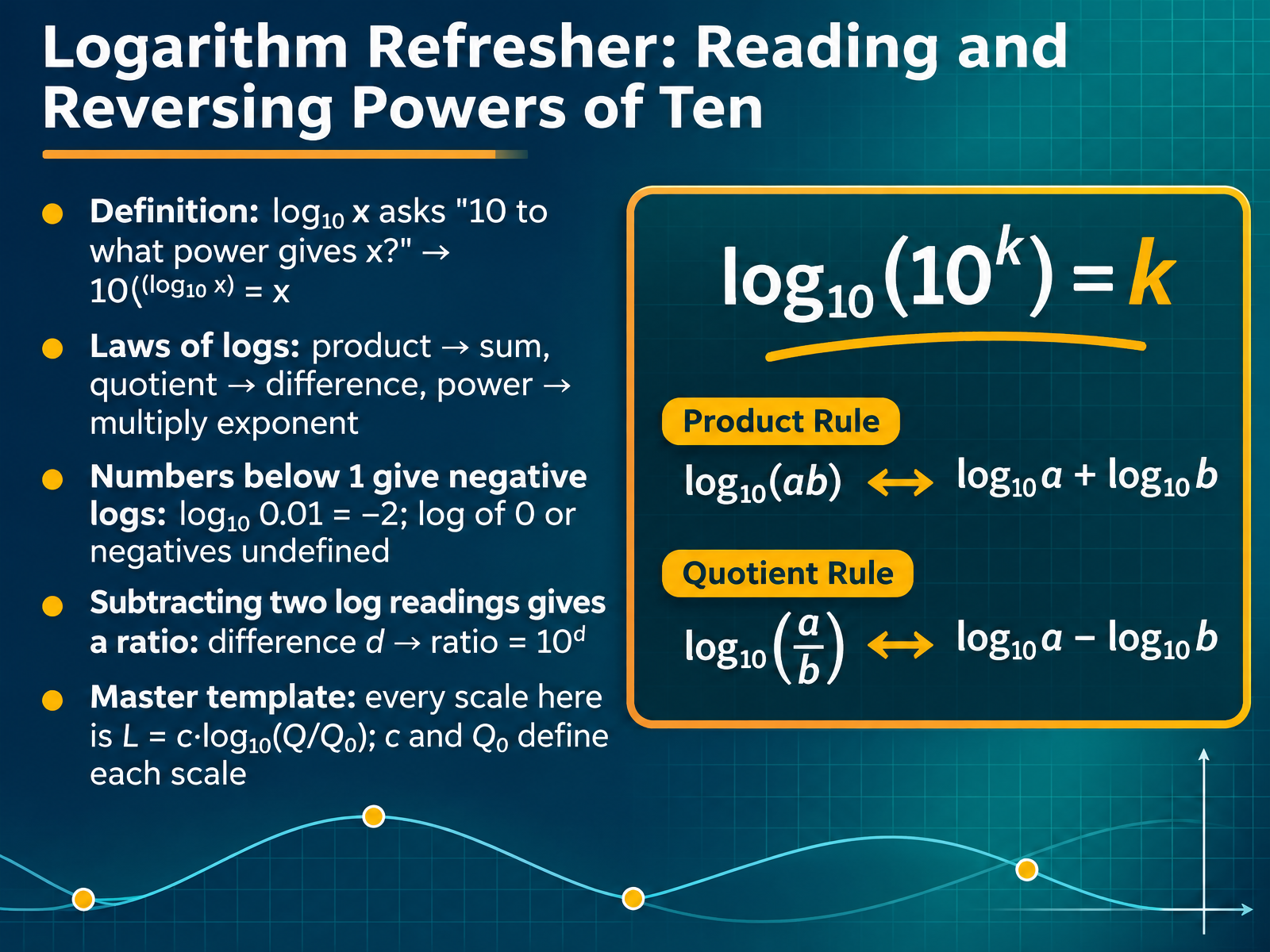
- 03Logarithm Refresher: Reading and Reversing Powers of TenBefore we apply these scales, let's refresh the logarithm itself. The base-ten logarithm of x asks one question: ten to what power gives x? So ten raised to the log of x returns x. Three laws follow. A product becomes a sum, a quotient becomes a difference, and a power moves its exponent to the front as a multiplier. Numbers below one give negative logs; for example, log of zero point zero one equals negative two, because ten to the negative two is zero point zero one. The log of zero or a negative number is undefined. Here is the payoff: subtracting two log readings gives a ratio. A difference d means the quantities differ by ten to the d. And every scale in this course fits one template: L equals c times the log of Q divided by Q zero, where c and Q zero define that particular scale. Next, we put this to work on pH: A Logarithm of Hydrogen Ion Concentration.
 openstax.orglisds.github.iocuemath.com+22 min
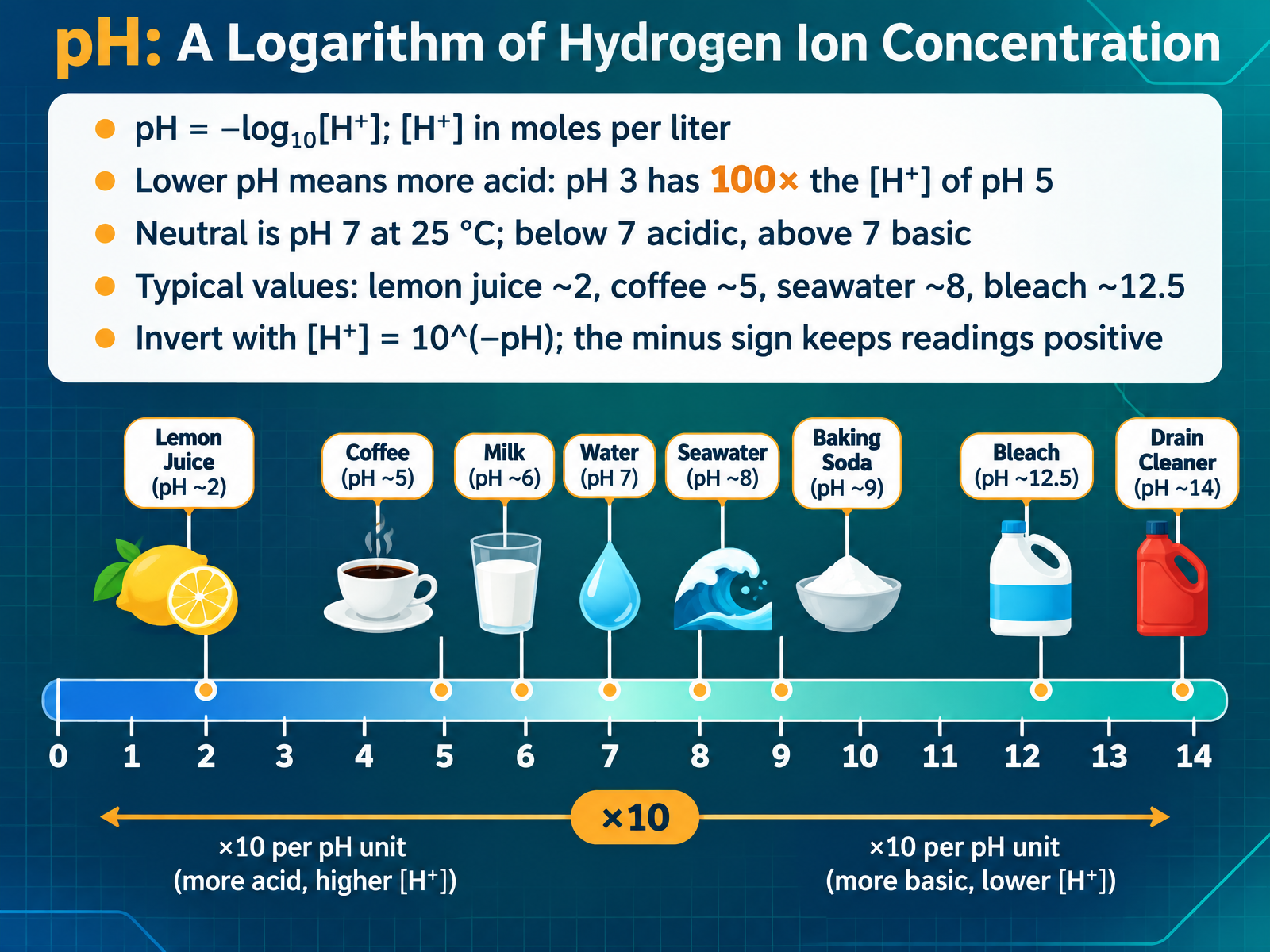
- 04pH: A Logarithm of Hydrogen Ion ConcentrationNow let's apply logarithms to one of chemistry's most familiar numbers, pH. pH equals negative log base ten of the hydrogen ion concentration, written in moles per liter. Because of that negative sign, lower pH means more acid. pH 3 has one hundred times the hydrogen ion concentration of pH 5. At twenty-five degrees Celsius, pH 7 is neutral. Below 7 is acidic, and above 7 is basic. You can anchor these numbers with everyday examples. Lemon juice is about pH 2, coffee about 5, seawater about 8, and bleach about 12.5. To go the other direction, invert the formula. The hydrogen ion concentration equals ten to the power of negative pH, and that minus sign is what keeps ordinary readings positive. Next, we turn to decibels: logarithms for sound and signal intensity.
 sciencenotes.orgencyclopedia.che.engin.umich.educhem.libretexts.org+21 min
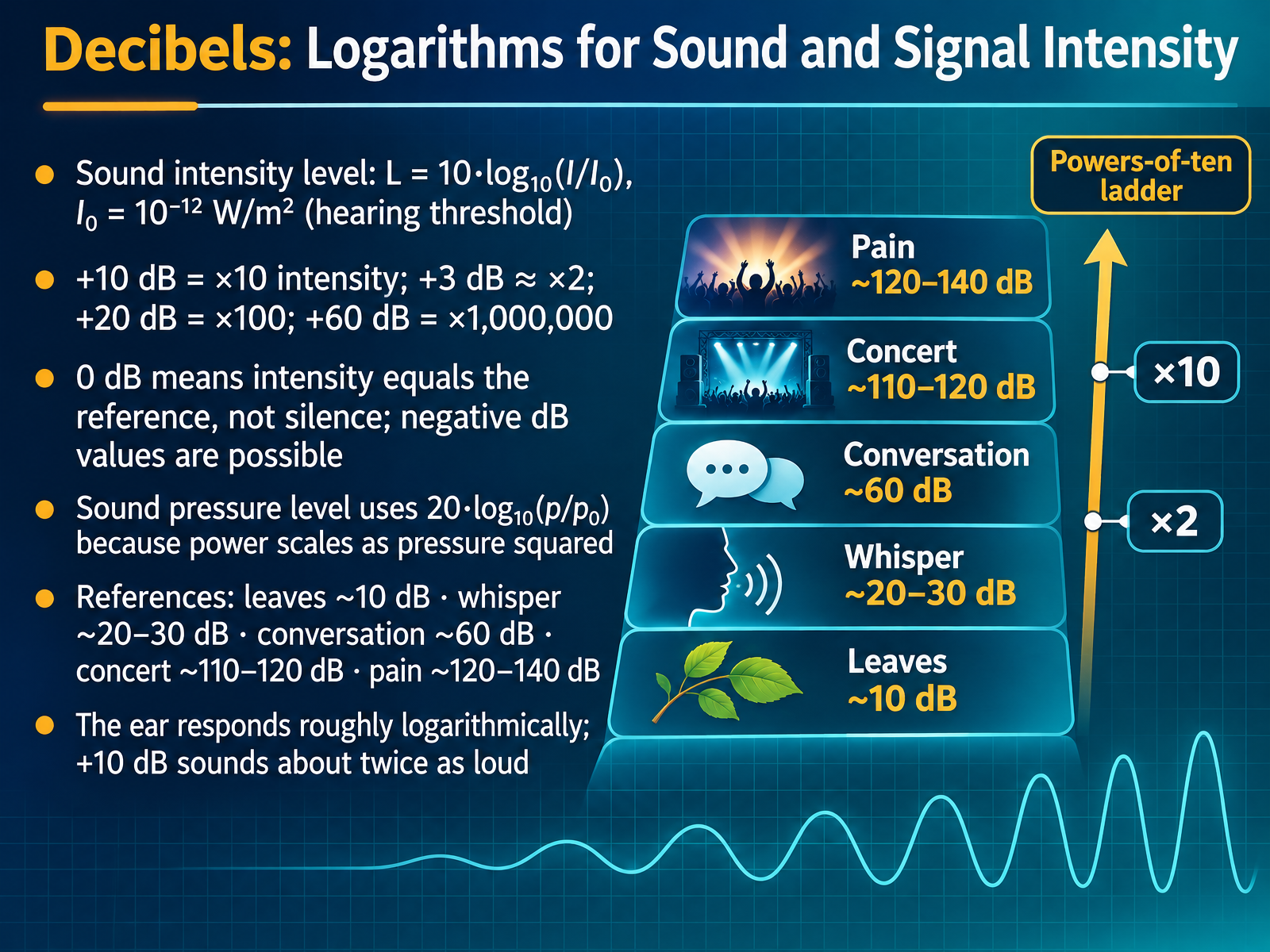
- 05Decibels: Logarithms for Sound and Signal IntensityNext, let us apply logarithms to sound. Sound intensity level in decibels equals ten times the base ten logarithm of the intensity divided by a reference intensity, ten to the power of negative twelve watts per square meter, the threshold of hearing. The key pattern: adding ten decibels multiplies intensity by ten, plus three decibels is roughly a doubling, plus twenty decibels is one hundred times, and plus sixty decibels is one million times. Note what zero decibels means: the intensity equals the reference, so it is not silence, and negative decibel values are possible. Sound pressure level uses twenty times the logarithm, because power scales as pressure squared. For familiar reference points, leaves rustle around ten decibels, a whisper is about twenty to thirty, conversation about sixty, a concert one hundred ten to one hundred twenty, and pain around one hundred twenty to one hundred forty. Your ear responds roughly logarithmically, so a ten decibel increase sounds about twice as loud. Next, we turn to earthquake magnitude, where the same logarithm idea operates on a massive scale.
 openstax.orgosha.govec.europa.eu+22 min
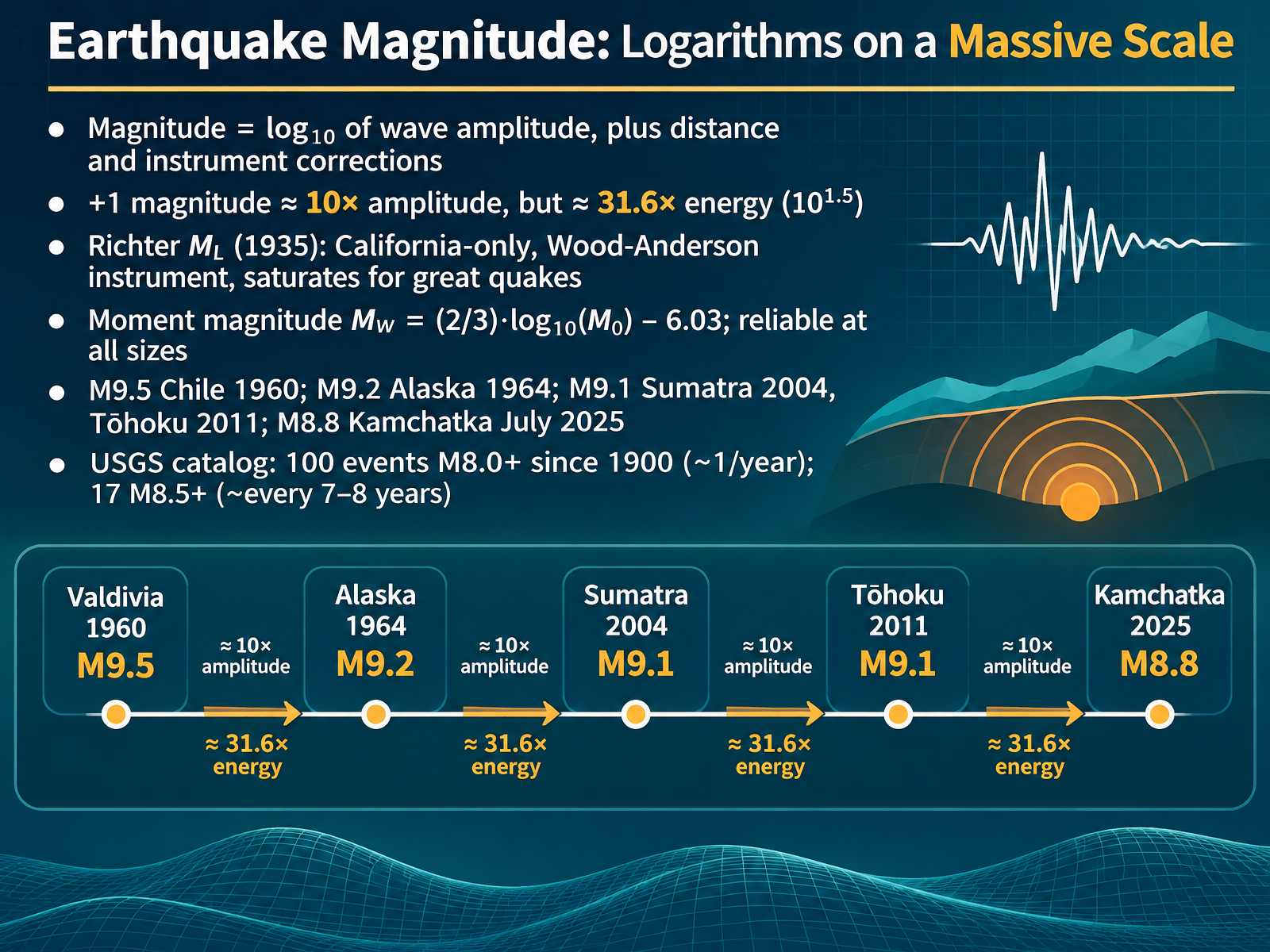
- 06Earthquake Magnitude: Logarithms on a Massive ScaleNow let's take the logarithm to its most dramatic scale: earthquake magnitude. Magnitude is a base ten logarithm of the wave amplitude, plus corrections for distance and for the instrument. That is why one extra magnitude point means about ten times the amplitude, but roughly thirty-one point six times the energy, because energy scales as ten to the power one point five. The original Richter scale, from 1935, was built for California, with the Wood-Anderson instrument, and it saturates for great earthquakes. That is why scientists now use moment magnitude: two thirds times the base ten log of seismic moment, minus six point zero three, reliable at every size. The great quakes show why this matters: Chile in 1960 at nine point five, Alaska in 1964 at nine point two, Sumatra in 2004 and Tōhoku in 2011 at nine point one, and Kamchatka in July 2025 at eight point eight. The USGS catalog lists about one hundred events of magnitude eight or above since 1900, roughly one a year, and seventeen at eight point five or above, about every seven to eight years. So read those big numbers with care. Next, we will work on reading and comparing values across the three scales.
 pathtoscience.orglivephysics.commath.libretexts.org+22 min
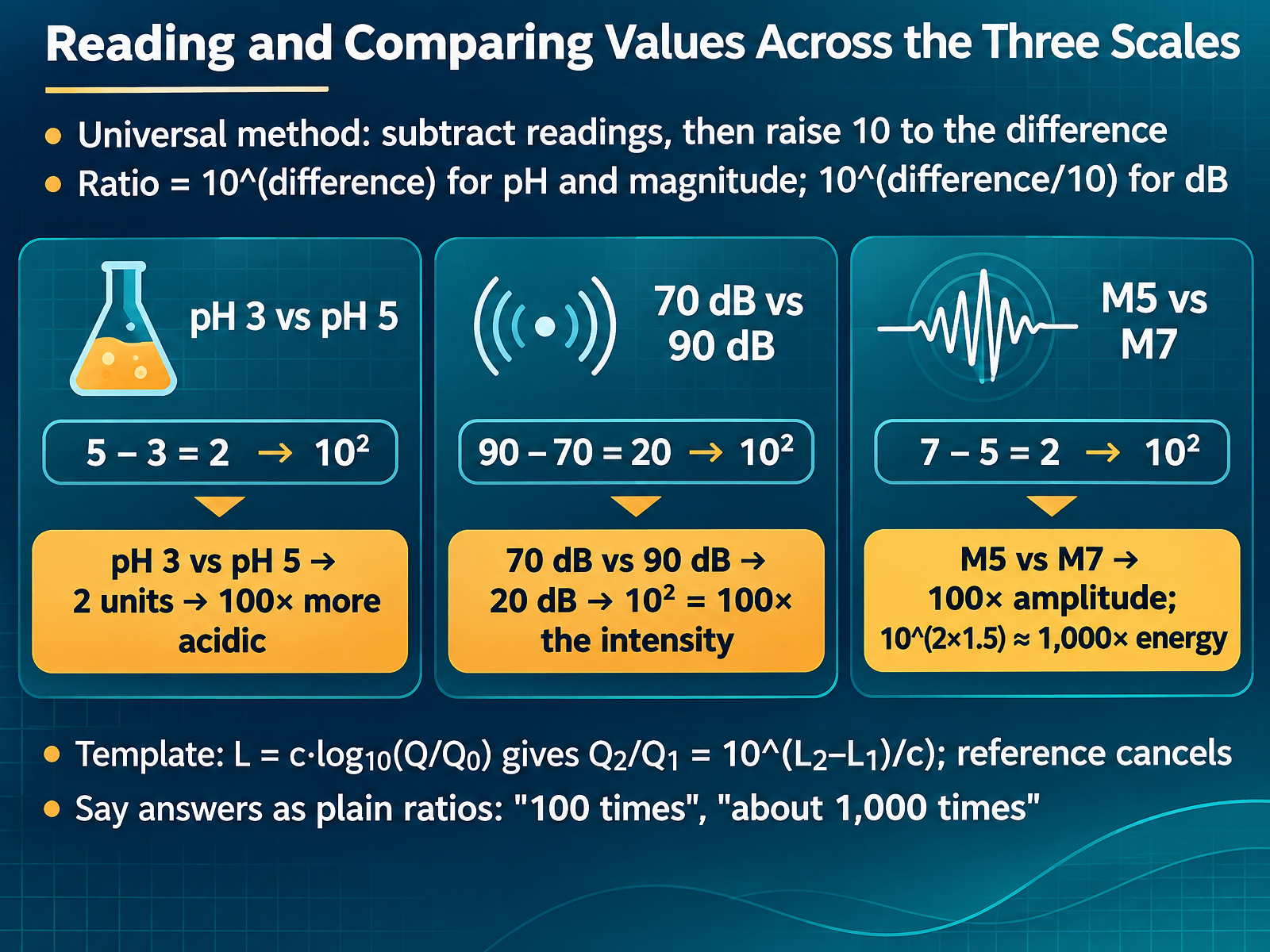
- 07Reading and Comparing Values Across the Three ScalesNow that you know what each scale means, let's compare values across all three. There is one method that works every time. Subtract the two readings, then raise ten to that difference. For pH and earthquake magnitude, the ratio is ten to the difference. For decibels, divide the difference by ten first, then raise ten to that result. Let's try it. pH three versus pH five: the difference is two units, so the second is not just a bit more acidic. It is one hundred times more acidic. Seventy decibels versus ninety decibels: a difference of twenty, divided by ten gives two, so ten squared equals one hundred times the intensity. For earthquakes, magnitude five versus magnitude seven is a difference of two, so one hundred times the amplitude. Energy grows faster, about thirty-two times per unit, so ten to the power two times one point five is approximately one thousand times the energy. Notice the general template. If a level equals c times log base ten of Q divided by Q zero, then the ratio Q two over Q one equals ten to the power L two minus L one, all divided by c. The reference value cancels out. So always say your answer as a plain ratio, like one hundred times, or about one thousand times. Next, let's look at common traps and how to correct them.
 themathindex.commath.libretexts.orgpathtoscience.org+22 min
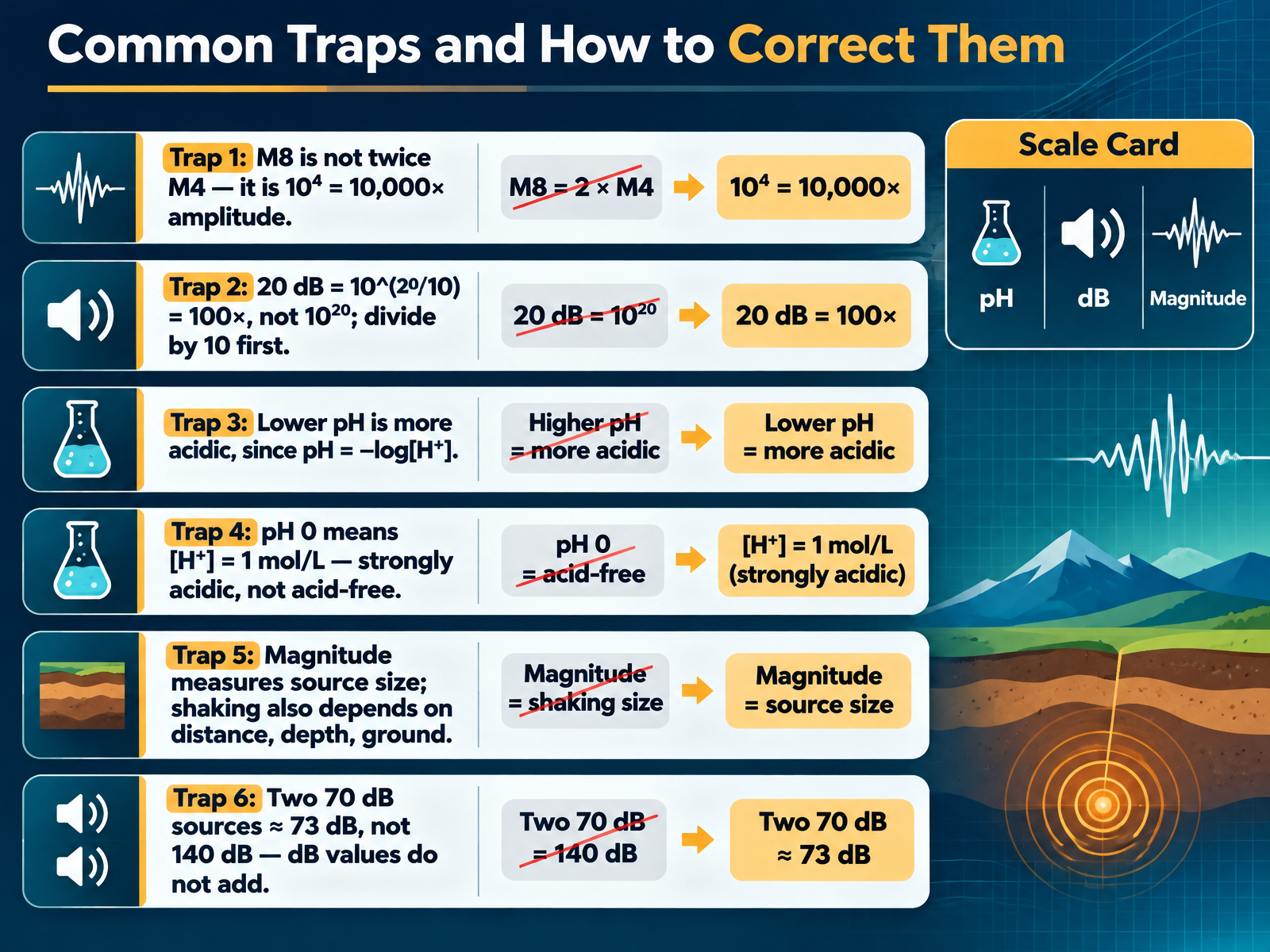
- 08Common Traps and How to Correct ThemNow let's look at the traps that catch people most often, and how to correct each one. First, a magnitude eight earthquake is not twice a magnitude four. Subtract the magnitudes to get four, then raise ten to that power. The amplitude ratio is ten to the fourth, which is ten thousand times. Second, a twenty decibel difference is not ten to the twentieth. In the decibel formula, the logarithm is multiplied by ten, so divide the difference by ten first. Ten to the power twenty divided by ten equals ten squared, or one hundred times the intensity. Third, a lower pH is more acidic, because pH equals negative log of the hydrogen ion concentration. Fourth, a pH of zero does not mean acid free. It means the concentration is one mole per liter, which is strongly acidic. Fifth, magnitude measures the size of the source. The shaking you feel also depends on distance, depth, and local ground conditions. Sixth, decibel values do not add. Two identical seventy decibel sources give about seventy three decibels, because doubling the intensity adds roughly three decibels. From scale reading to real-world decisions: health and safety.
 livephysics.comthemathindex.commath.libretexts.org2 min
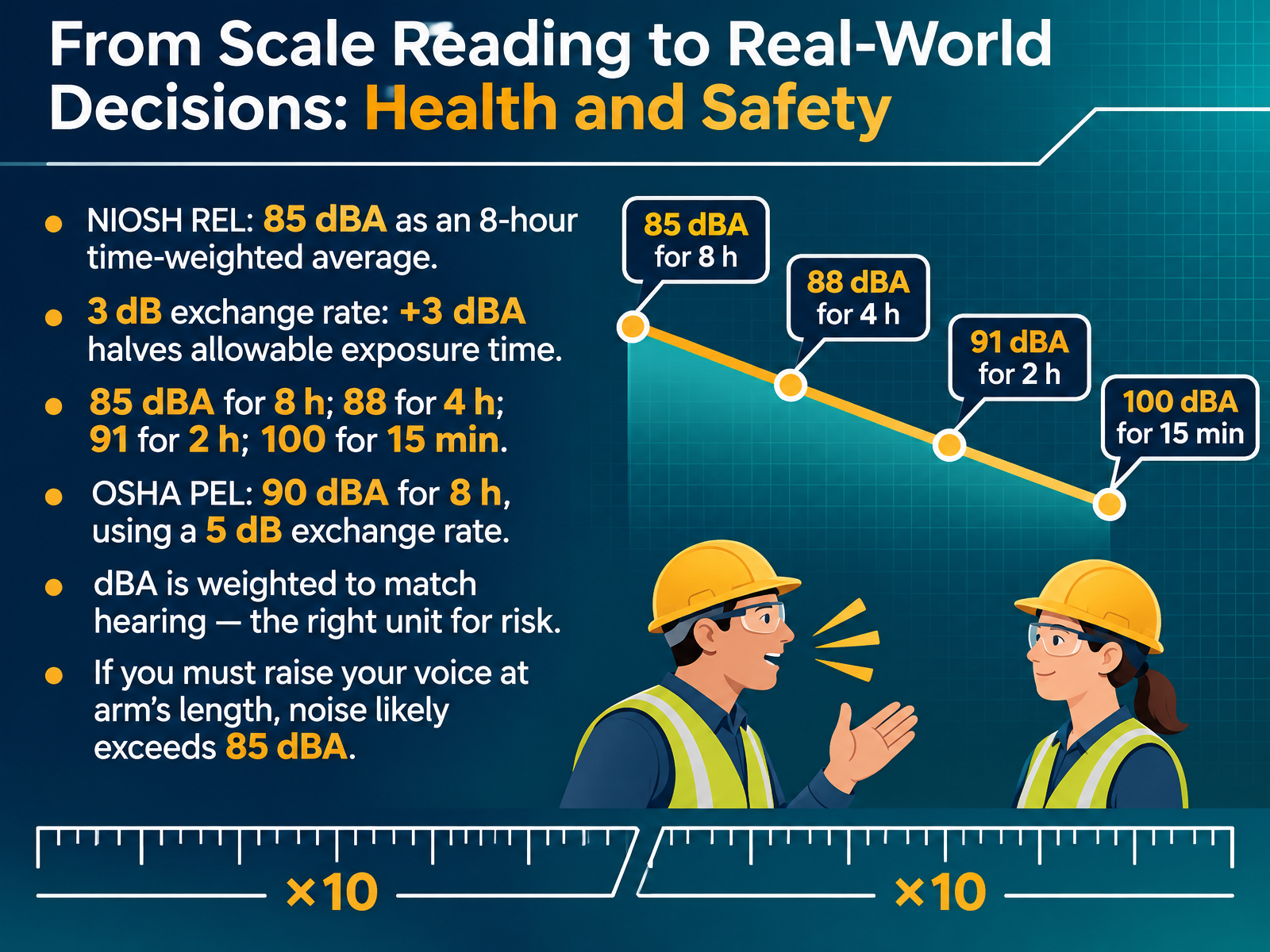
- 09From Scale Reading to Real-World Decisions: Health and SafetyLet's turn that scale reading into a real decision about health and safety. The National Institute for Occupational Safety and Health sets its recommended exposure limit at eighty-five A-weighted decibels averaged over an eight-hour shift. And the exchange rate is three decibels. Add three decibels, and the allowable exposure time is cut in half. So eighty-five is fine for eight hours, eighty-eight for four hours, ninety-one for two hours, and one hundred decibels for only fifteen minutes. The OSHA permissible exposure limit is less strict: ninety decibels for eight hours, using a five-decibel exchange rate. Use the A-weighted scale, written d B A, because it matches how your hearing responds, making it the right unit for risk. Here is a quick field check: if you must raise your voice to speak with someone at arm's length, the noise likely exceeds eighty-five d B A. Next, we will apply these same ideas to environment and preparedness.
 cdc.govopenstax.orgosha.gov+21 min
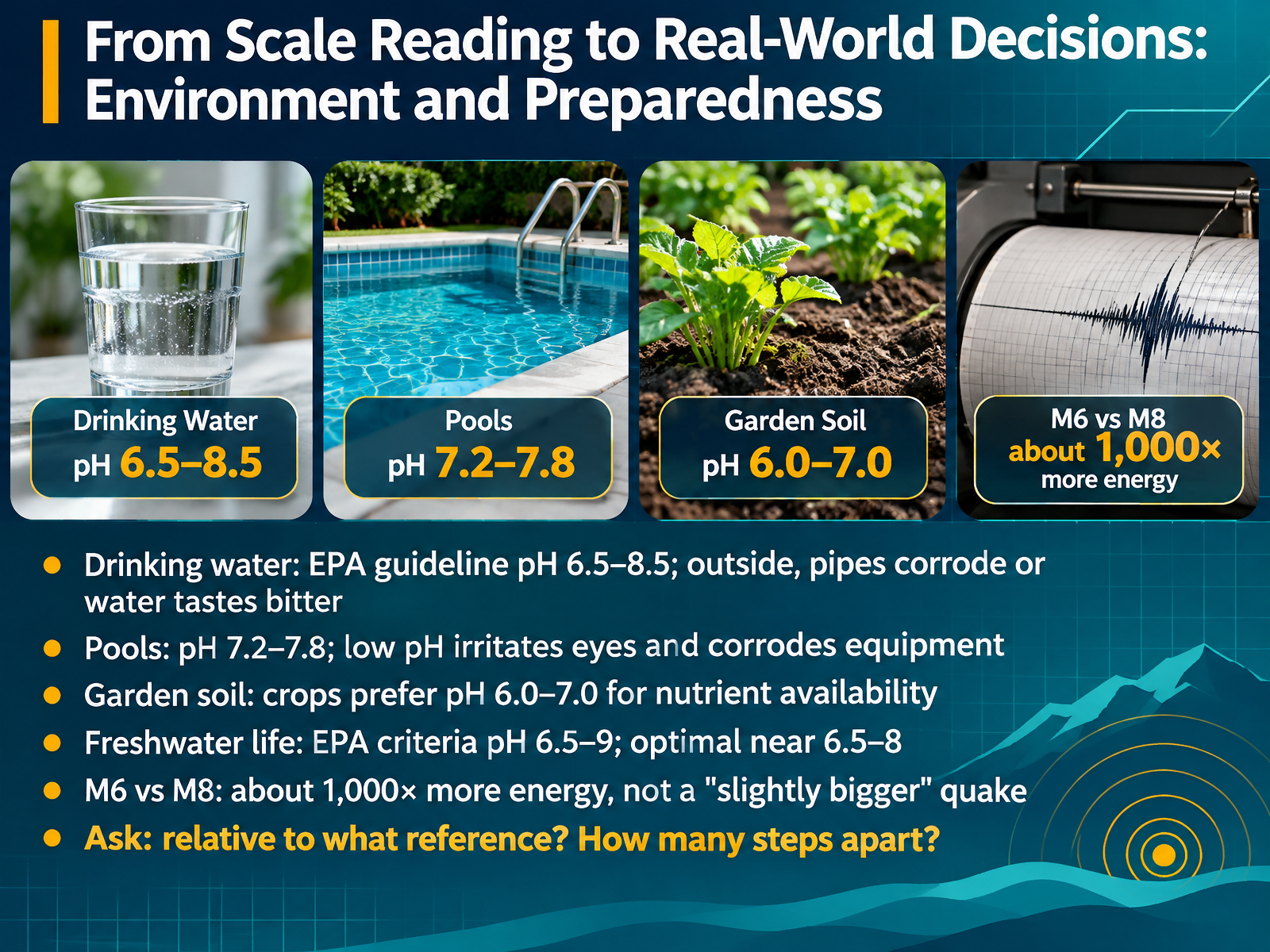
- 10From Scale Reading to Real-World Decisions: Environment and PreparednessNow let's turn scale readings into real decisions. pH matters in everyday settings. For drinking water, the E P A guideline is 6.5 to 8.5. Outside that range, pipes can corrode or the water tastes bitter. Pool water should sit at 7.2 to 7.8. Lower pH irritates eyes and corrodes equipment. Garden crops prefer soil around 6.0 to 7.0, where nutrients are most available. And for freshwater life, E P A criteria run 6.5 to 9, with optimal conditions near 6.5 to 8. Magnitude works the same way. A magnitude 8 quake releases about one thousand times more energy than a magnitude 6, not slightly more. So whenever you read a logarithm, ask two questions. Relative to what reference? And how many steps apart? That habit turns a number into an informed decision. Next, we put all three scales side by side.
 2 min
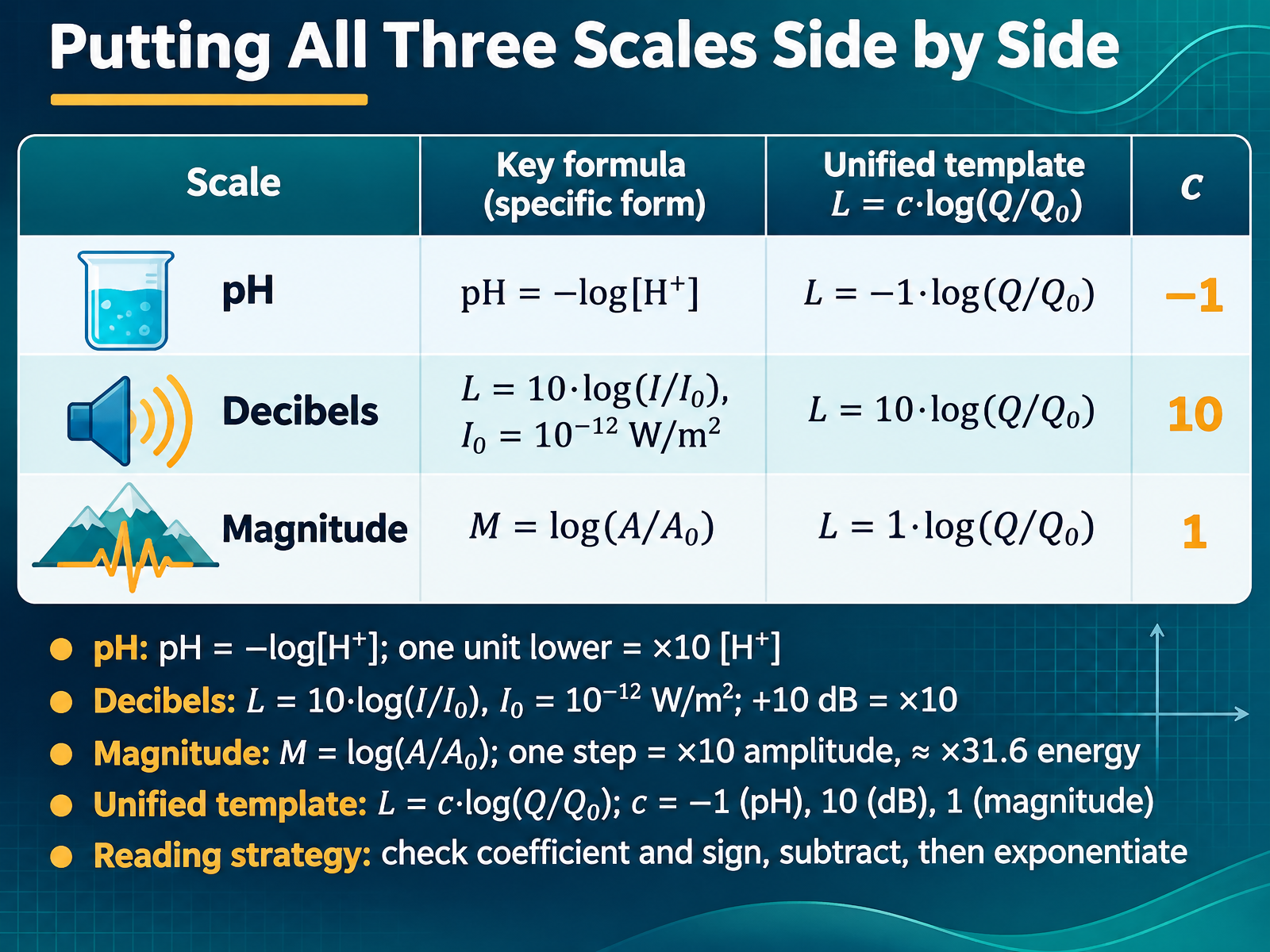
- 11Putting All Three Scales Side by SideLet us now put all three scales side by side. pH equals negative log of hydrogen ion concentration, so one unit lower means ten times more hydrogen ions. Decibels equal ten times log of intensity divided by a reference intensity of ten to the negative twelfth watts per square meter, so plus ten decibels means ten times the intensity. Magnitude equals log of amplitude divided by a reference amplitude, so one step is ten times the amplitude and approximately thirty one point six times the energy. Notice the unified template. Level equals a coefficient times log of quantity divided by reference. The coefficient is negative one for pH, ten for decibels, and one for magnitude. Here is your reading strategy. First check the coefficient and its sign, then subtract the two readings, and finally exponentiate. For example, a twenty decibel difference gives ten to the twentieth divided by ten, which is one hundred times the intensity. And a pH drop of two units means one hundred times more hydrogen ions. Keep that three step routine handy. Next, we turn to teaching and learning checkpoints.
 pathtoscience.orglivephysics.commath.libretexts.org+22 min
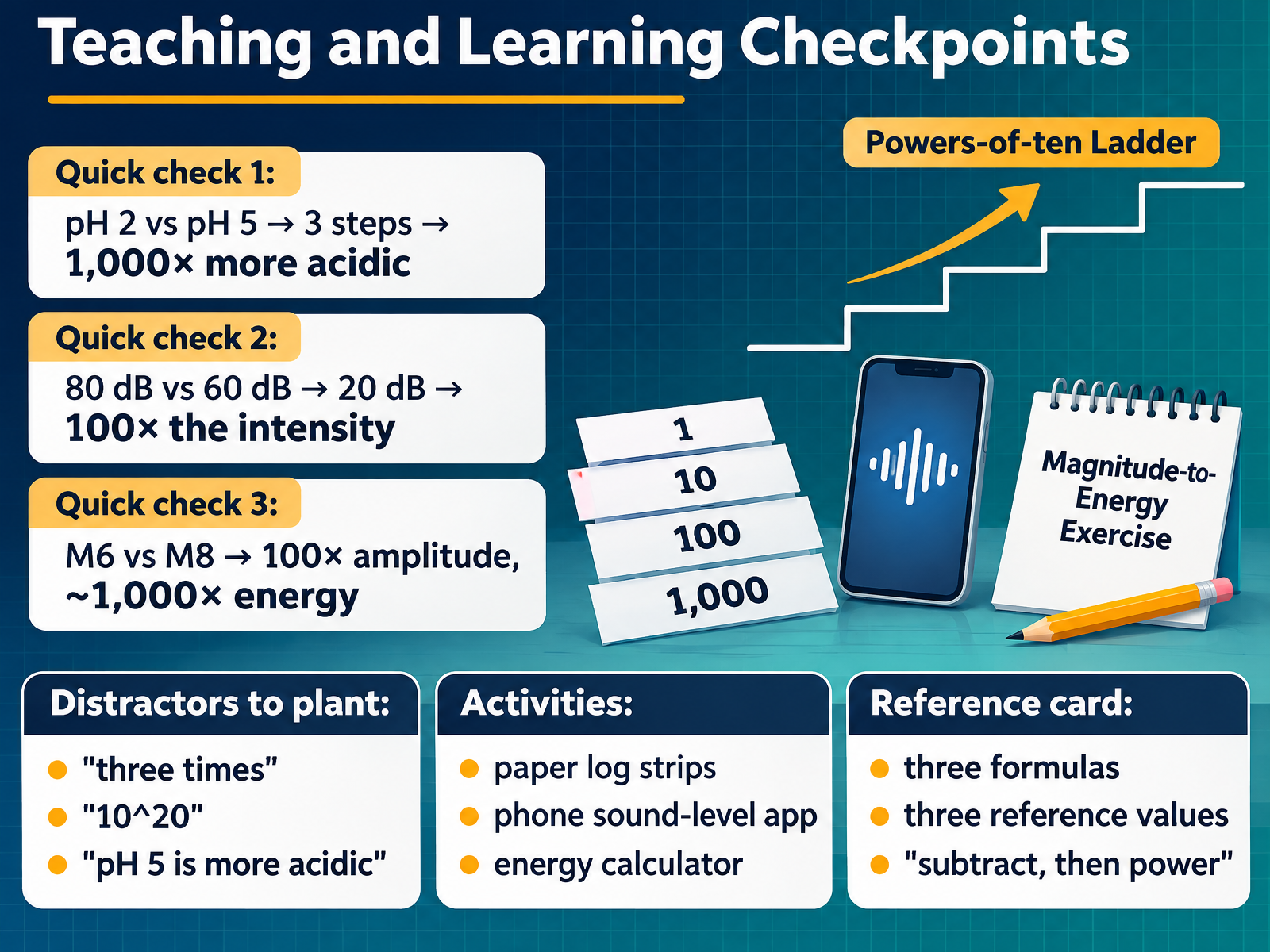
- 12Teaching and Learning CheckpointsLet's move on to teaching and learning checkpoints. These three quick checks show what mastery looks like. First, pH two versus pH five is three steps, so the lower pH is one thousand times more acidic. Second, eighty decibels versus sixty decibels is a twenty decibel gap, which means one hundred times the intensity. Third, magnitude six versus magnitude eight is one hundred times the amplitude, and about one thousand times the energy. Plant these distractors and let learners argue them down: three times, ten to the twentieth, and pH five is more acidic. Then run the activities: paper log strips, a phone sound-level app, and an energy calculator. Finally, hand out the reference card with three formulas, three reference values, and the rule subtract, then power. That rule is the whole method in three words. Wrap-Up: From 'How Much More?' to 'How Many Times More?'
 livephysics.comcdc.govsciencenotes.org+22 min
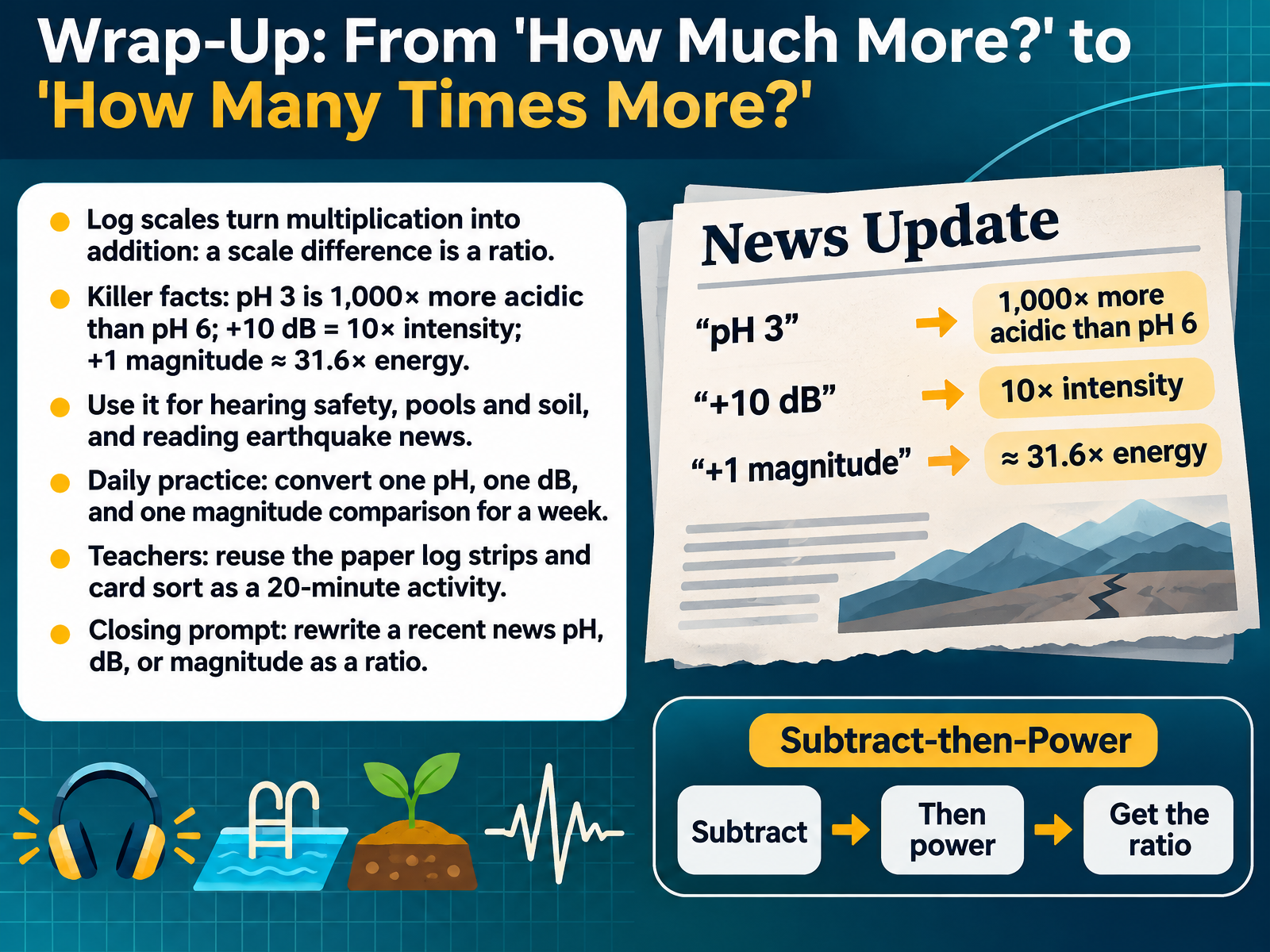
- 13Wrap-Up: From 'How Much More?' to 'How Many Times More?'Let's pull the whole lesson together. The big shift is this: on a log scale, you stop asking how much more and start asking how many times more. A difference on the scale is a ratio. Keep these three facts handy. pH three is one thousand times more acidic than pH six. Adding ten decibels means ten times the intensity. And one whole magnitude step means about thirty-one point six times more energy. Use this in real life: protect your hearing around loud sound, check pool and soil pH, and read earthquake news as ratios. For the next week, convert one pH, one decibel, and one magnitude comparison each day. Teachers, you can reuse the paper log strips and the card sort as a twenty-minute activity. Here is your closing prompt: take a recent news story with a pH, a decibel level, or a magnitude, and rewrite it as a ratio. You have built a skill you will use every time numbers span a huge range. Thank you for your attention, and keep asking how many times more.
 pathtoscience.orglivephysics.commath.libretexts.org+22 min
Take the deck with you
Download this course as a file — free, no sign-up needed.
- PDF handoutEvery slide page, ready to print or share.14 pages · 4.4 MBDownload
- Narrated PowerPointThe deck that presents itself — every slide carries the digital human's narration video.14 pages · 14.2 MBDownload
- PowerPoint slidesThe full deck as a .pptx — open it in PowerPoint, Keynote, or Google Slides.14 pages · 4.3 MBDownload
Free to use in your own training — please keep the PersonWise credit page at the end.
Have your own deck? Turn it into a course
Sources consulted
Web sources consulted while building this course.
- Logarithmic scales — pathtoscience.org
- Math, Logarithmic Scales — livephysics.com
- 18.4: Applications Involving Logarithmic Functions — math.libretexts.org
- Logarithmic Scales: pH, Decibels, Richter - The Math Index — themathindex.com
- Order of Magnitudes | Matt Rickard — mattrickard.com
- 6.5 Logarithmic Properties - College Algebra 2e | OpenStax — openstax.org
- A refresher on logarithms — Introduction to Data Science — lisds.github.io
- Logarithm (Logs) - Examples | Natural Log and Common Log — cuemath.com
- Log Properties (Product, Quotient, Power) - College Algebra | Varsity Tutors — varsitytutors.com
- Chapter 13 - Logarithms for Electronics | OERTX — oertx.highered.texas.gov
- The pH Scale of Common Chemicals — sciencenotes.org
- pH Measurement – Visual Encyclopedia of Chemical Engineering Equipment — encyclopedia.che.engin.umich.edu
- 7.6: The pH Scale — chem.libretexts.org
- pH as a Measure of Acid and Base Properties — hyperphysics.phy-astr.gsu.edu
- Acids & bases - ITW Reagents — itwreagents.com
- 17.3 Sound Intensity and Sound Level - College Physics 2e | OpenStax — openstax.org
- OSHA Technical Manual (OTM) - Section III: Chapter 5 | Occupational Safety and Health Administration — osha.gov
- 2. How is sound measured? — ec.europa.eu
- Understand Noise Exposure | Noise and Hearing Loss | CDC — cdc.gov
- How is Sound Measured? | NIDCD — nidcd.nih.gov