Plant Life Cycles: Growth & Reproduction
Begin
14 pages · ~28 min
Plant Life Cycles: Growth & Reproduction
An overview of plant life cycles, covering growth, reproduction, and seed development for biology students.
What you’ll learn
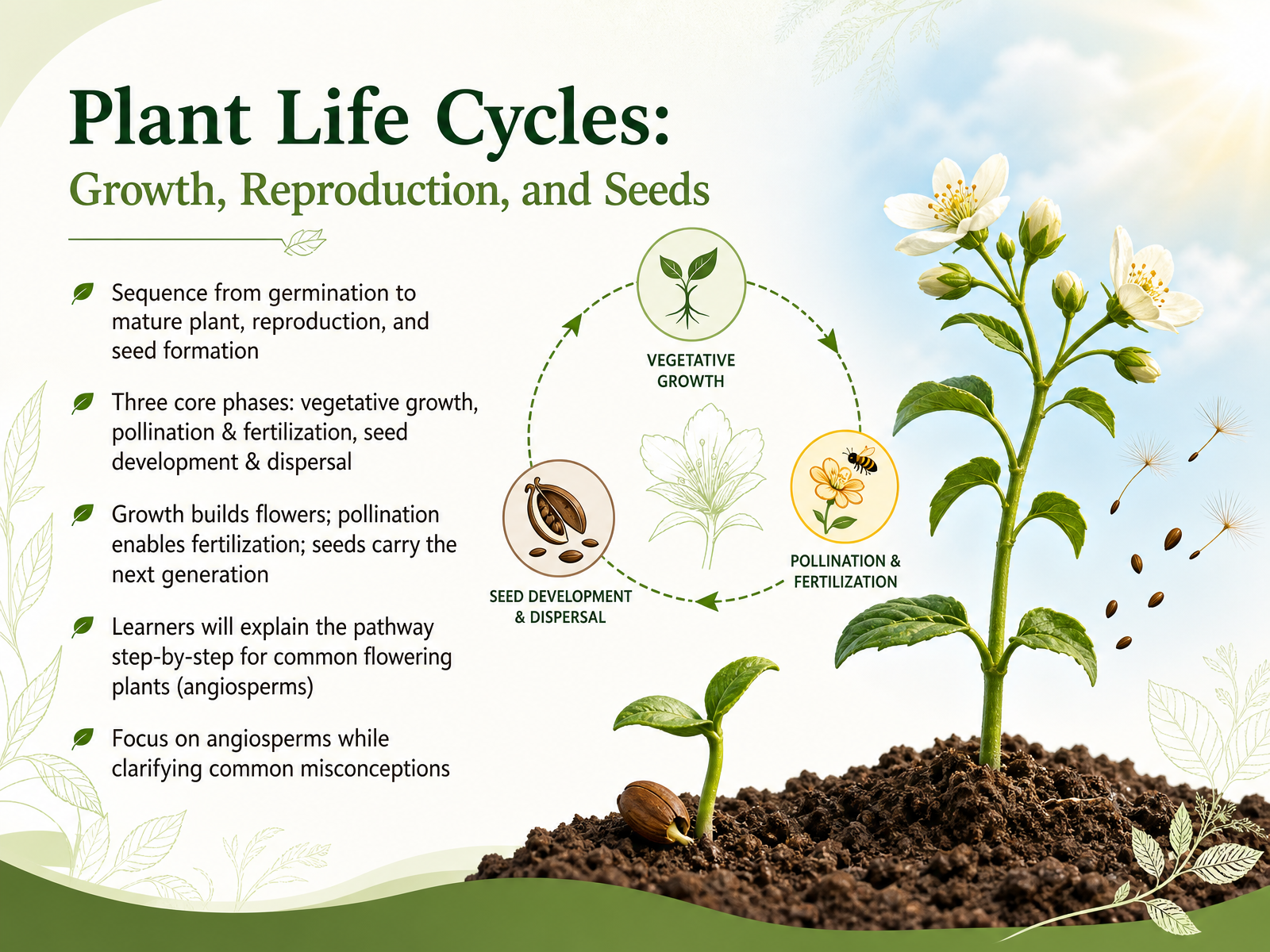
- 01Plant Life Cycles: Growth, Reproduction, and SeedsWelcome to this journey into the life cycle of flowering plants. Today, we're going to explore how a plant grows from a tiny seed, reproduces, and forms the next generation. Our goal is to build a clear step-by-step mental pathway, from germination through flowering, pollination, fertilization, and finally seed development. Many learners find it easy to mix up steps like pollination and seed dispersal, so we'll pay special attention to those connections. By the end, you'll be able to explain exactly what happens inside a flower, why seeds carry new life, and how common misconceptions can be avoided. Let's get started by understanding why looking at the whole life cycle matters before we zoom into the details.nature.compmc.ncbi.nlm.nih.govsciencedirect.com+22 min
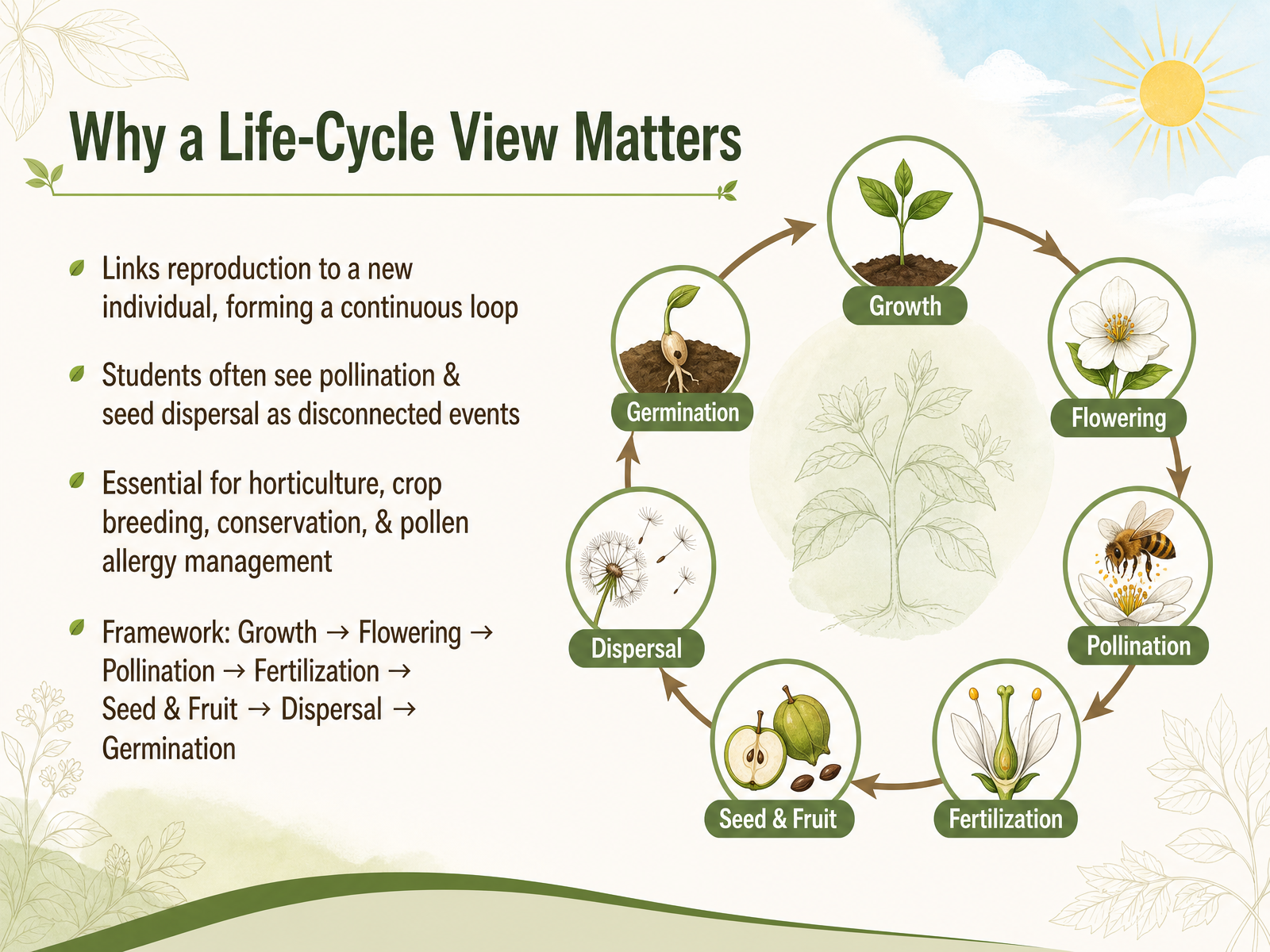
- 02Why a Life-Cycle View MattersNow that we've set the stage, let's ask a fundamental question: why does seeing plant reproduction as a continuous life cycle actually matter? Often, we learn about pollination, seeds, and fruit as separate, disconnected events. But in reality, these events link reproduction directly to the creation of a brand-new individual, forming one continuous loop from seed to seed. Research shows that many students mix up pollination and seed dispersal, treating them as isolated incidents rather than steps in a chain. This can lead to real-world misunderstandings, from confusing pollen allergies with floating seeds to missing the science behind crop breeding and conservation. To clear up that confusion, we'll follow a clear framework. We'll move step by step, starting with growth, then into flowering, pollination, fertilization, and the development of seeds and fruit. From there, we'll explore dispersal and finally germination, where the cycle begins again. With this map in mind, let's start at the very beginning in the next section, focusing on vegetative growth and the journey from seed to mature plant.
 learner.orgnph.onlinelibrary.wiley.comfiles.eric.ed.gov+22 min
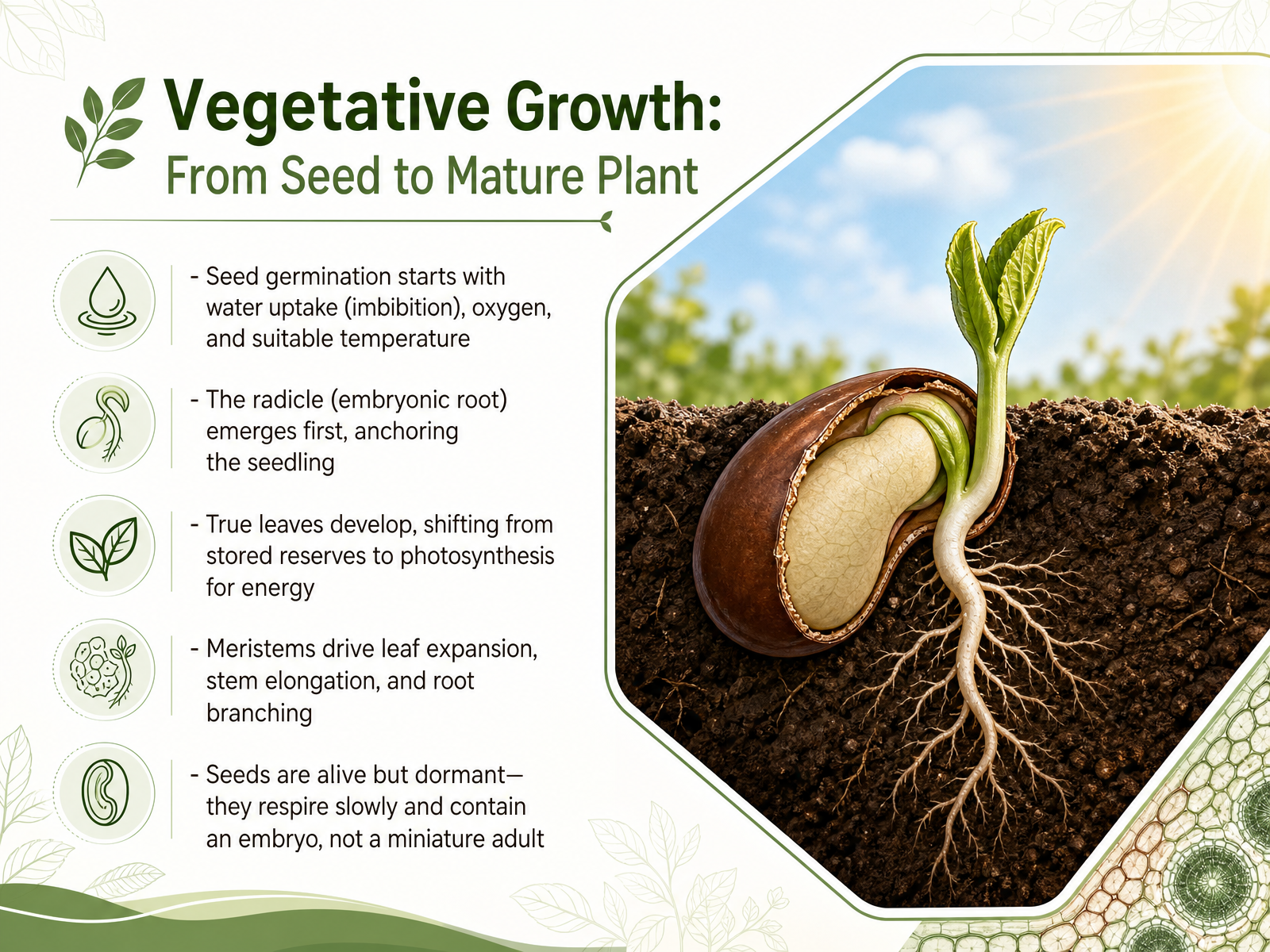
 - 03Vegetative Growth: From Seed to Mature PlantA seed might look quiet and lifeless, but it's actually a living, dormant embryo waiting for the right signals. Let's look at how it wakes up during vegetative growth. The process starts with imbibition – that's a sudden uptake of water that causes the seed coat to swell and soften. Along with moisture, the embryo needs oxygen and a suitable temperature to rev up its respiration. The first structure to emerge is the radicle, the embryonic root, which anchors the seedling and begins absorbing water. Soon after, true leaves develop and the plant switches from relying on stored food reserves to using photosynthesis for energy. Driving all this growth are meristems – regions of actively dividing cells that allow leaves to expand, stems to elongate, and roots to branch out. One key point to remember: a seed contains an embryo, not a miniature adult plant. Right now, we're seeing the plant build its vegetative body. Next, we'll explore the structures that shift the goal from growing to reproducing, in our section on Flower Structure and the Reproductive Transition.
 britannica.compmc.ncbi.nlm.nih.govmdpi.com+22 min
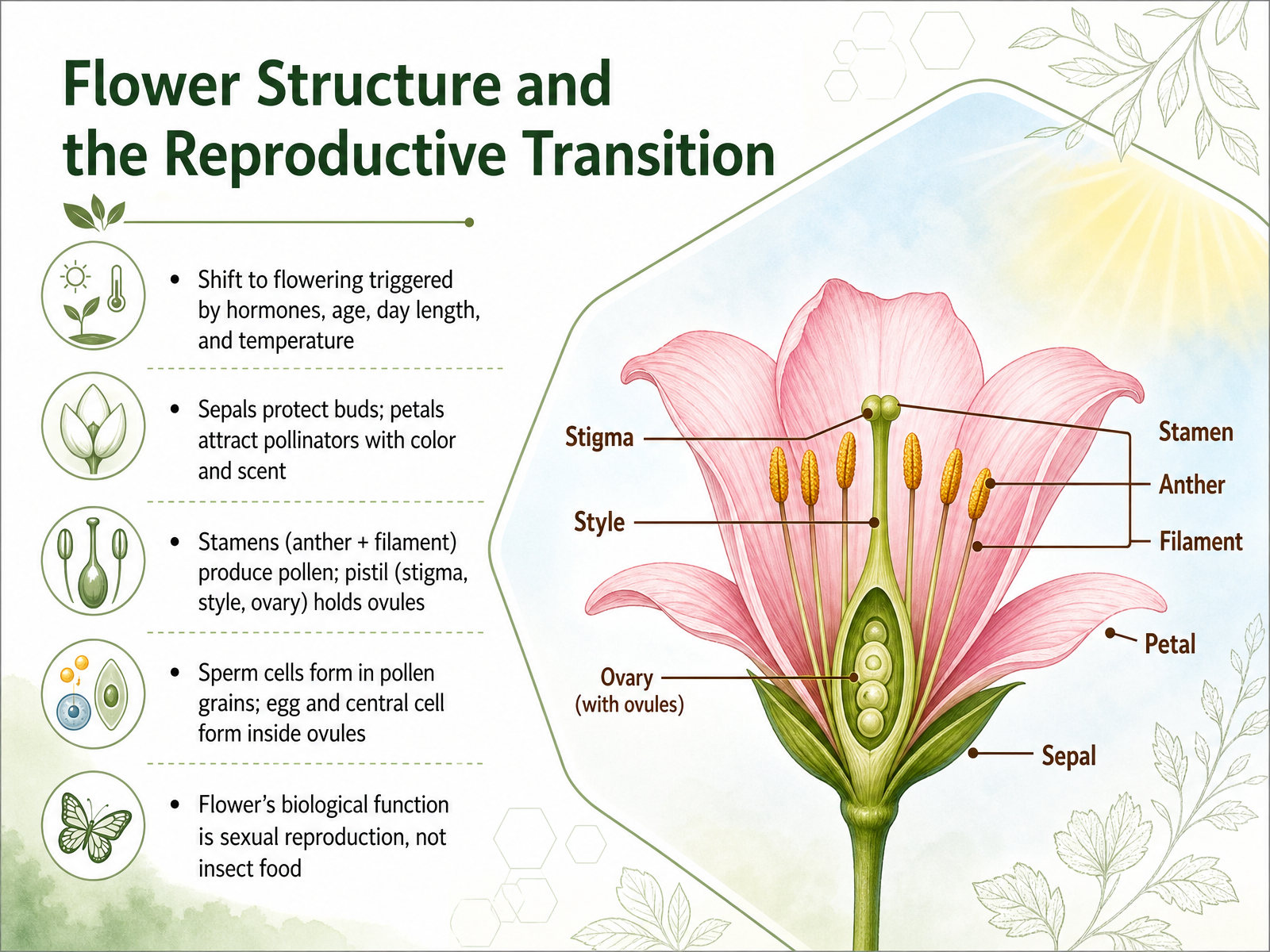
 - 04Flower Structure and the Reproductive TransitionNow that we understand the basics of the life cycle, let's look at the incredible structure that makes it all possible: the flower. The shift from simple growth to forming a flower is a huge deal for a plant. It’s not random; it’s triggered by internal signals like aging and hormones, combined with external cues like day length and temperature. Once the decision is made, the flower's architecture takes center stage. The green sepals on the outside protect the developing bud. As the flower opens, the colorful petals and their scent aren't there for us; their biological function is to attract pollinators like bees and butterflies. This brings us to the reproductive parts inside. The stamen is the male structure, made of a stalk called the filament topped by an anther where pollen grains are produced. Inside these pollen grains, sperm cells will eventually form. The female structure is the pistil, which has a sticky tip, the stigma, a neck called the style, and a swollen base called the ovary. Inside the ovary are the ovules. This is where the egg cell and another vital cell called the central cell develop. So, the flower is not food for insects; it is the plant’s way of achieving sexual reproduction, bringing sperm and egg together. Next, we will explore the first critical step in this journey: pollination, the process of moving pollen to the stigma.
 learner.orgnph.onlinelibrary.wiley.comfiles.eric.ed.gov+22 min
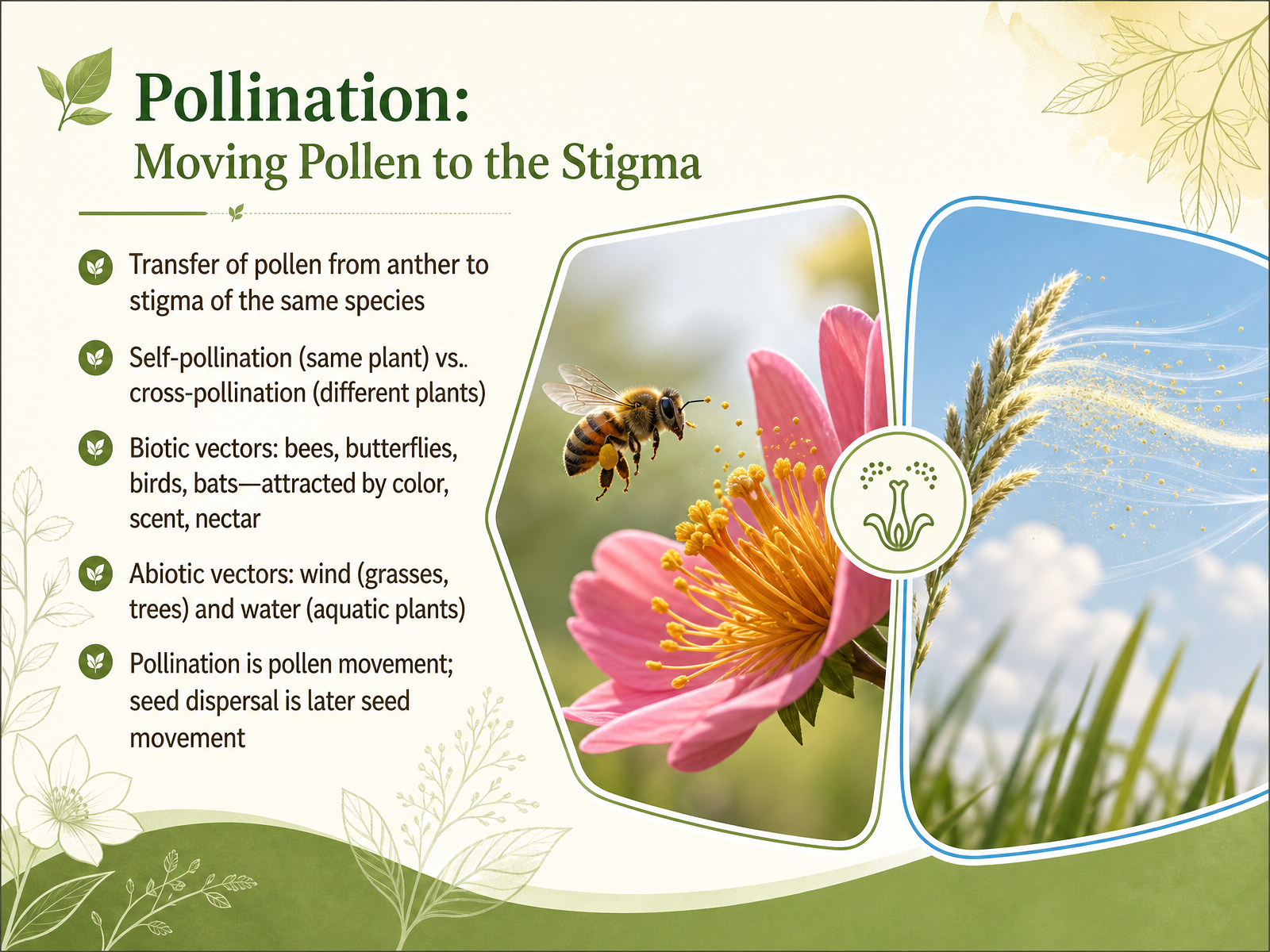
 - 05Pollination: Moving Pollen to the StigmaNow, let's explore how pollination actually works. Think of pollination as the moment when a pollen grain begins its journey. Specifically, it is the transfer of pollen from the male part of a flower—the anther—to the female part—the stigma. And this must happen between flowers of the same species for it to be successful. There are two main strategies here. In self-pollination, the pollen moves to a stigma within the same plant. In cross-pollination, the pollen travels to a stigma on a completely different plant. Cross-pollination mixes genetic material, which often leads to stronger offspring. To make this journey, plants rely on vectors. Biotic vectors are living creatures. The classic examples are bees, butterflies, birds, and even bats. Plants attract these helpers with bright colors, enticing scents, and a reward of sweet nectar. Abiotic vectors, on the other hand, are non-living. Wind is a major one for many grasses and trees, and water can transport pollen for some aquatic plants. One crucial point to remember: pollination is only the movement of pollen. It is not the same as seed dispersal, which happens much later. Next, we will follow the pollen grain on its next critical step: the pollen tube journey from the stigma to the ovule.
 britannica.comen.wikipedia.orgfs.usda.gov+22 min
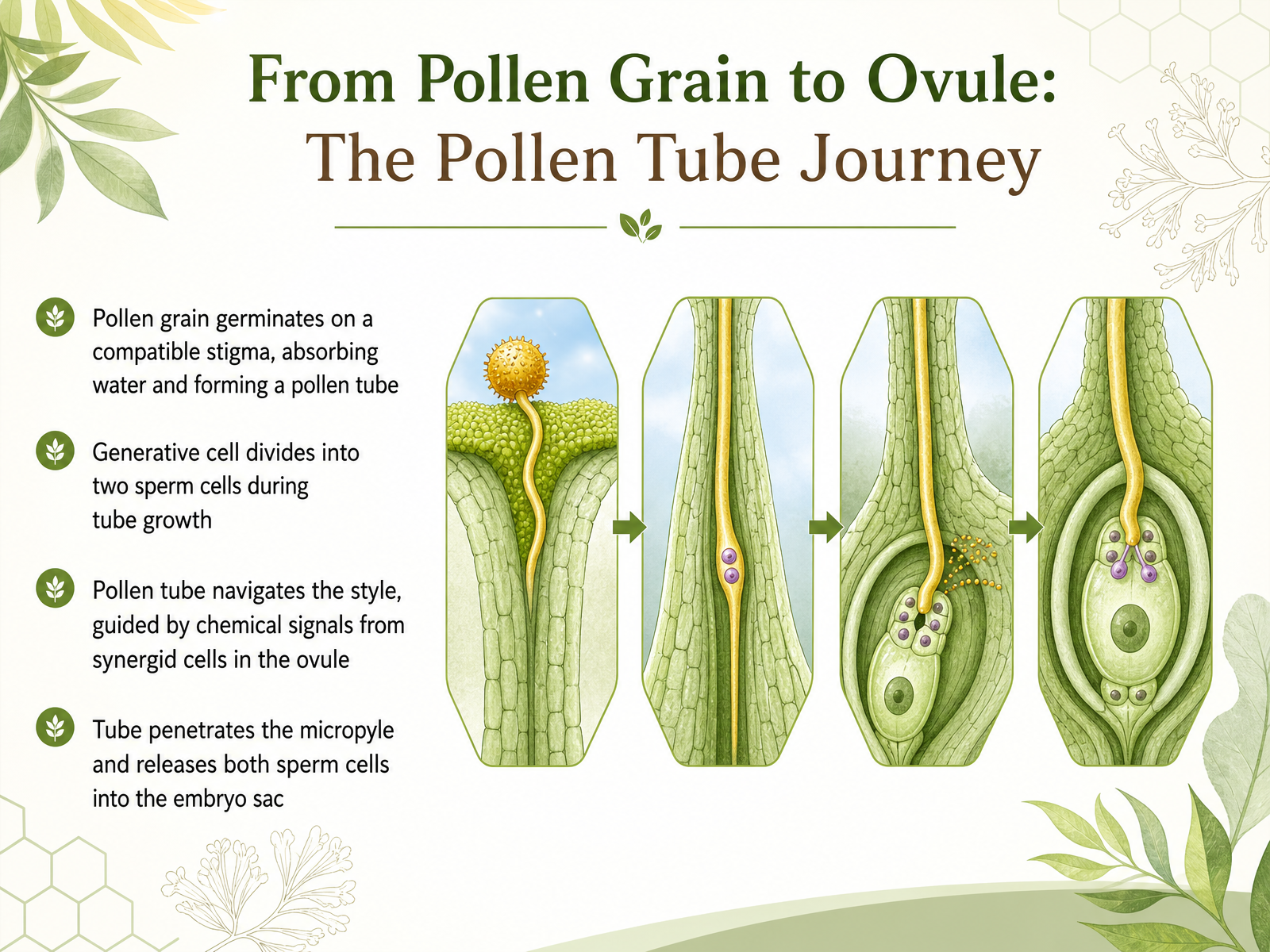
 - 06From Pollen Grain to Ovule: The Pollen Tube JourneyAfter a pollen grain lands on a compatible stigma, the next big challenge begins: delivering the sperm cells all the way down to the ovule. This starts when the pollen grain absorbs water and germinates, producing a structure called the pollen tube. Inside the growing tube, the generative cell divides to form two sperm cells. These are the male gametes that will eventually take part in fertilization. The pollen tube now has to navigate through the tissues of the style. It doesn't do this blindly. Special cells inside the ovule, called synergid cells, release chemical signals that guide the tube like a homing beacon. The tube follows these signals, growing toward a tiny opening in the ovule known as the micropyle. Once it reaches the micropyle, the pollen tube penetrates it and enters the embryo sac. Here, it releases both sperm cells, setting the stage for the unique process of double fertilization. Up next, we'll explore that defining trait of flowering plants.
 2 min
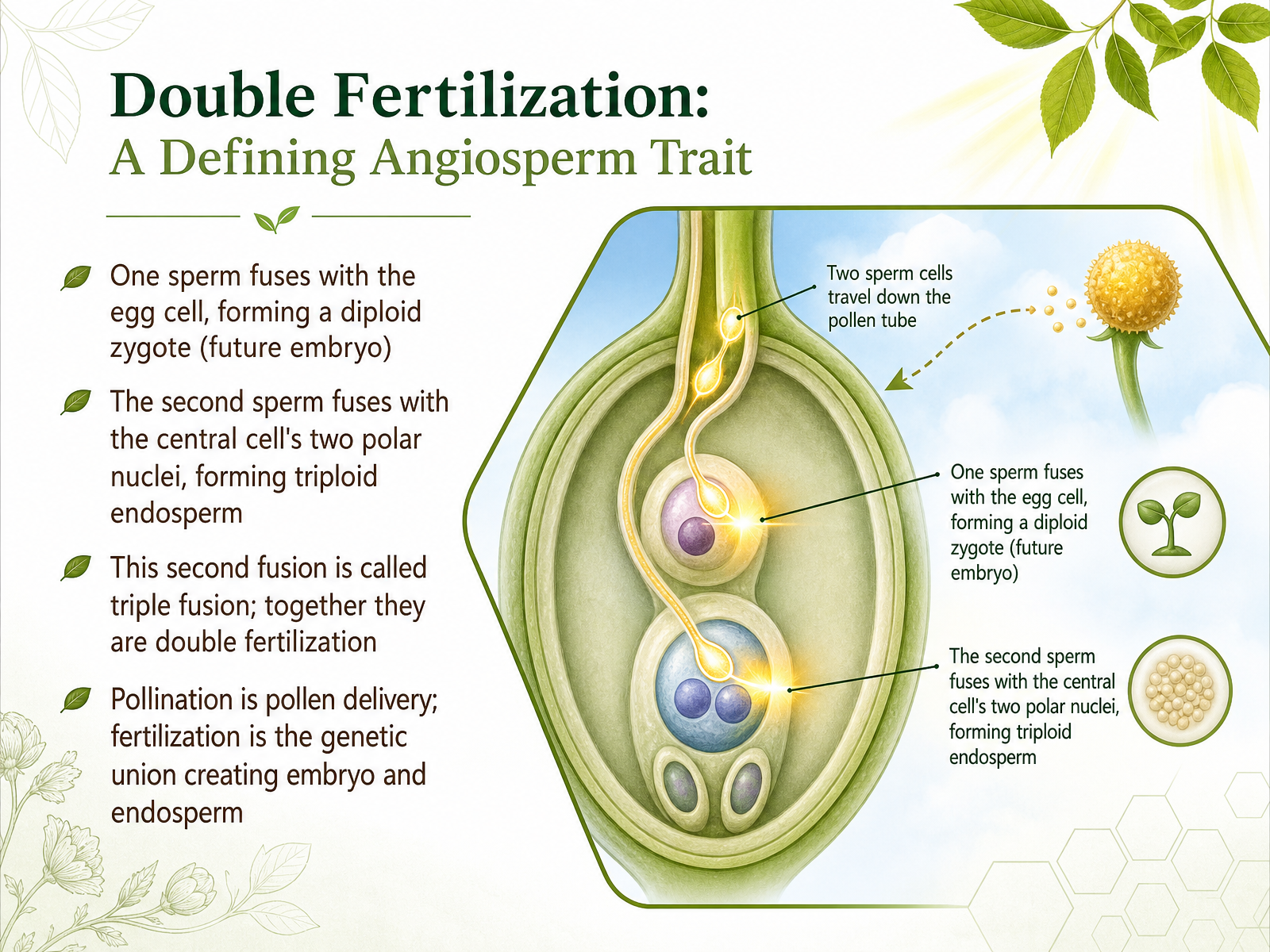
2 min - 07Double Fertilization: A Defining Angiosperm TraitNow let's look at what makes fertilization in flowering plants so unique. It's called double fertilization, and it's a defining trait of angiosperms. When the pollen tube reaches the ovule, it delivers two sperm cells, not just one. The first sperm fuses with the egg cell. This forms a diploid zygote, which will grow into the future embryo. The second sperm fuses with the central cell, specifically with its two polar nuclei. This creates a triploid cell, meaning it has three sets of chromosomes. That cell develops into the endosperm, a nutrient-rich tissue that will feed the growing embryo. This second fusion is also known as triple fusion. Together, these two events are what we call double fertilization. It's important to remember the difference between pollination and fertilization. Pollination is simply the delivery of pollen to the stigma. Fertilization is the actual genetic union that creates the embryo and the endosperm. Up next, we'll follow what happens after fertilization as we explore seed development, including the embryo, endosperm, and seed coat.
 nature.compmc.ncbi.nlm.nih.govsciencedirect.com+22 min
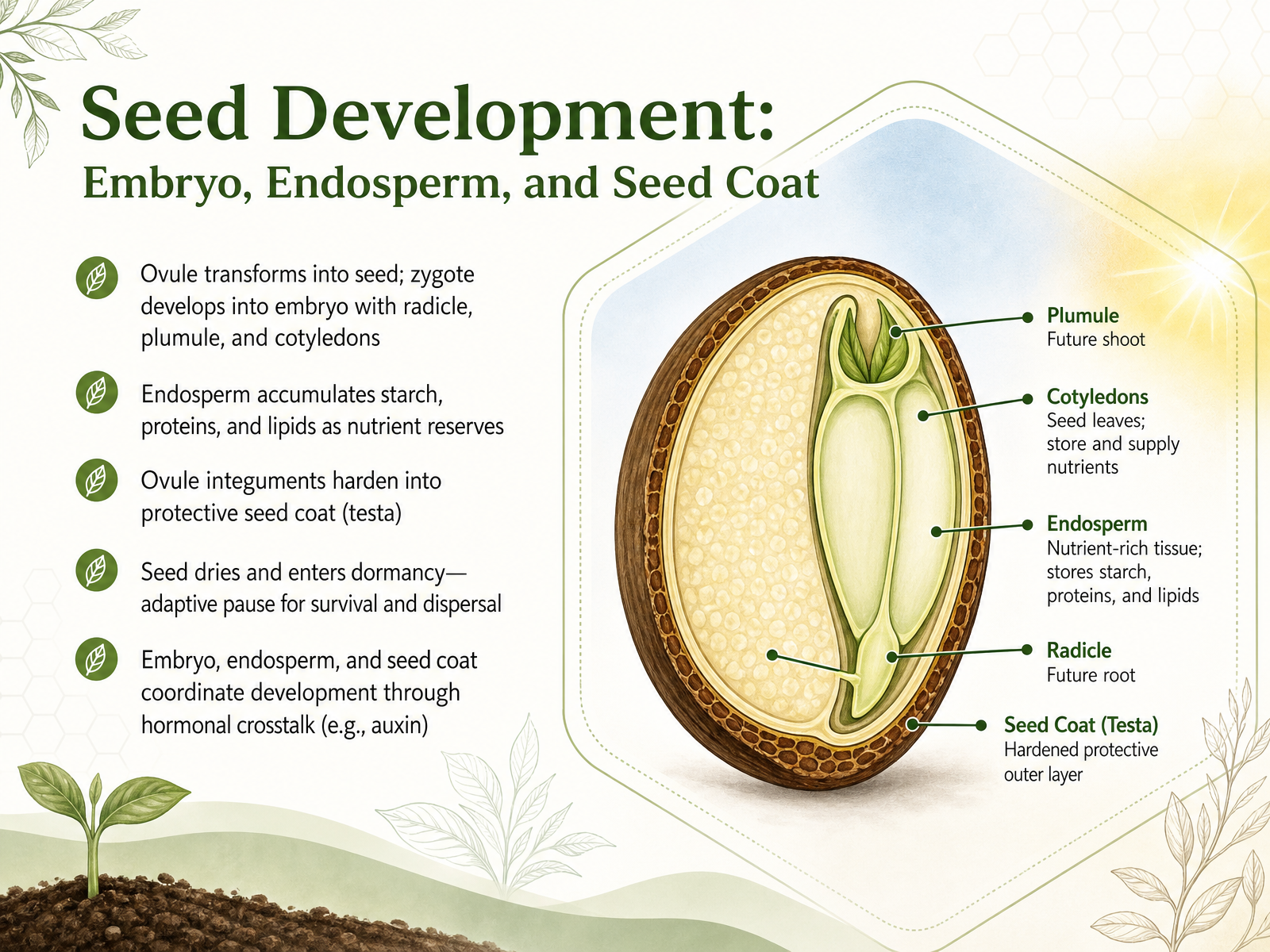
 - 08Seed Development: Embryo, Endosperm, and Seed CoatNow, let's follow the fertilized ovule as it transforms into a seed. Three essential parts form here. The zygote develops into the embryo, which already has a tiny root called the radicle, a shoot called the plumule, and seed leaves known as cotyledons. At the same time, a nutrient-rich tissue called the endosperm fills up with starch, proteins, and lipids. Think of the endosperm as a packed lunch for the baby plant. Meanwhile, the outer layers of the ovule harden into a protective seed coat, or testa. Once these structures are in place, the seed begins to dry out and enters dormancy. This is an adaptive pause—it waits until conditions are right for survival and dispersal. All of this coordinated development is guided by hormonal crosstalk, with auxin playing a key role in connecting the embryo, endosperm, and seed coat. Next, we'll move outward to see how the ovary itself takes on a new role during fruit formation.
 nature.compmc.ncbi.nlm.nih.govsciencedirect.com+22 min
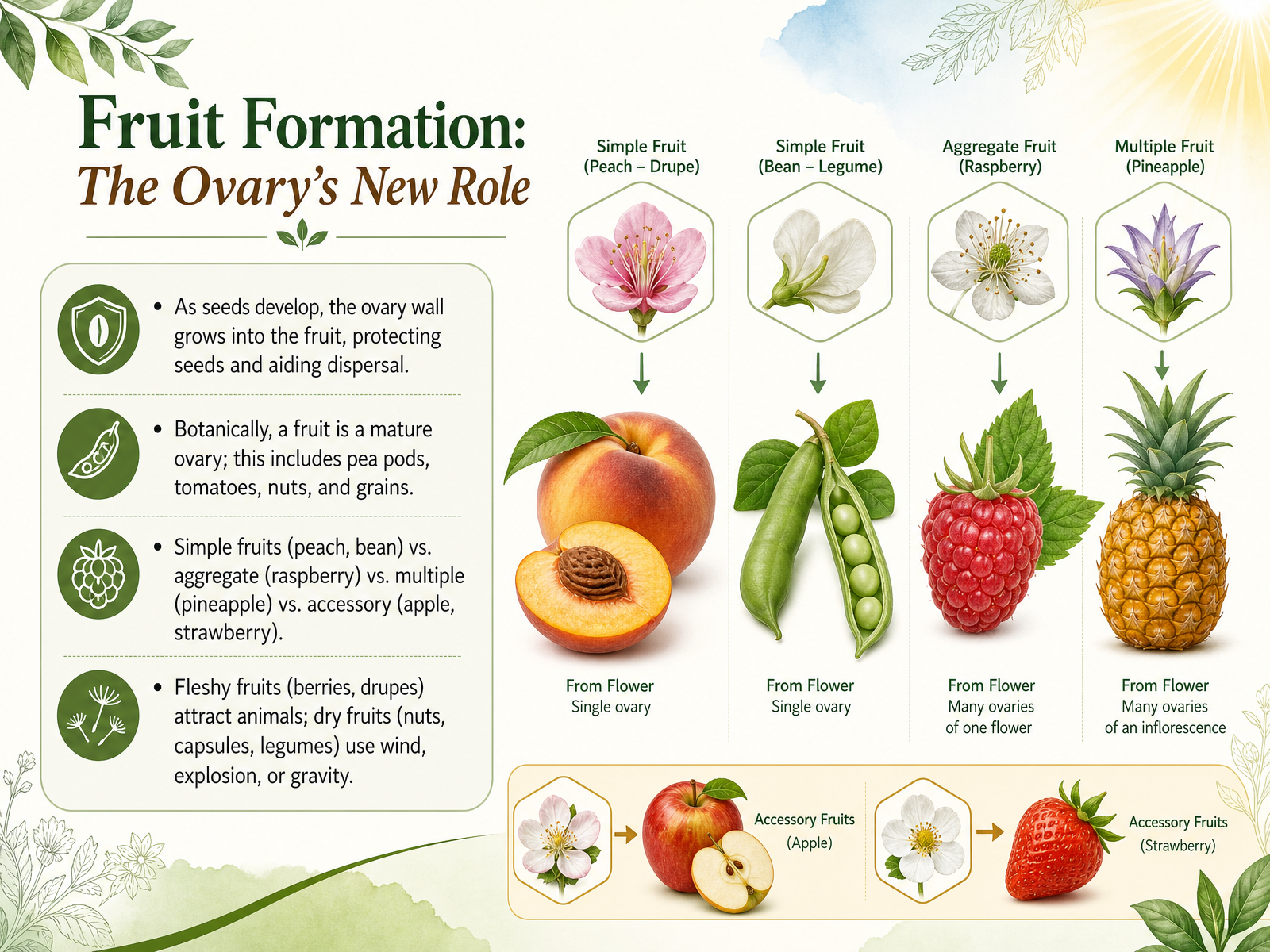
 - 09Fruit Formation: The Ovary’s New RoleNow we see why the ovary is so important. As the seeds develop, the ovary wall grows and transforms into the fruit. This is the plant's way of protecting the seeds and helping them travel to new places. Botanically speaking, a fruit is simply a mature ovary. That means pea pods, tomatoes, nuts, and grains are all true fruits, even if we call them vegetables in the kitchen. Fruits come in several types based on how they form. A simple fruit, like a peach or a bean, develops from a single ovary. An aggregate fruit, like a raspberry, comes from many separate carpels in one flower. A multiple fruit, like a pineapple, forms from a cluster of flowers that fuse together. An accessory fruit, such as an apple or a strawberry, includes other flower parts beyond just the ovary. The final form of the fruit also reveals its dispersal strategy. Fleshy fruits like berries and drupes are often sweet and colorful to attract animals who eat them and later deposit the seeds. Dry fruits like nuts, capsules, and pods often rely on wind, explosive tension, or gravity to release their seeds. Let’s take a closer look at how these strategies work in our next step: Seed Dispersal—spreading the next generation.
 learner.orgnph.onlinelibrary.wiley.comfiles.eric.ed.gov+22 min
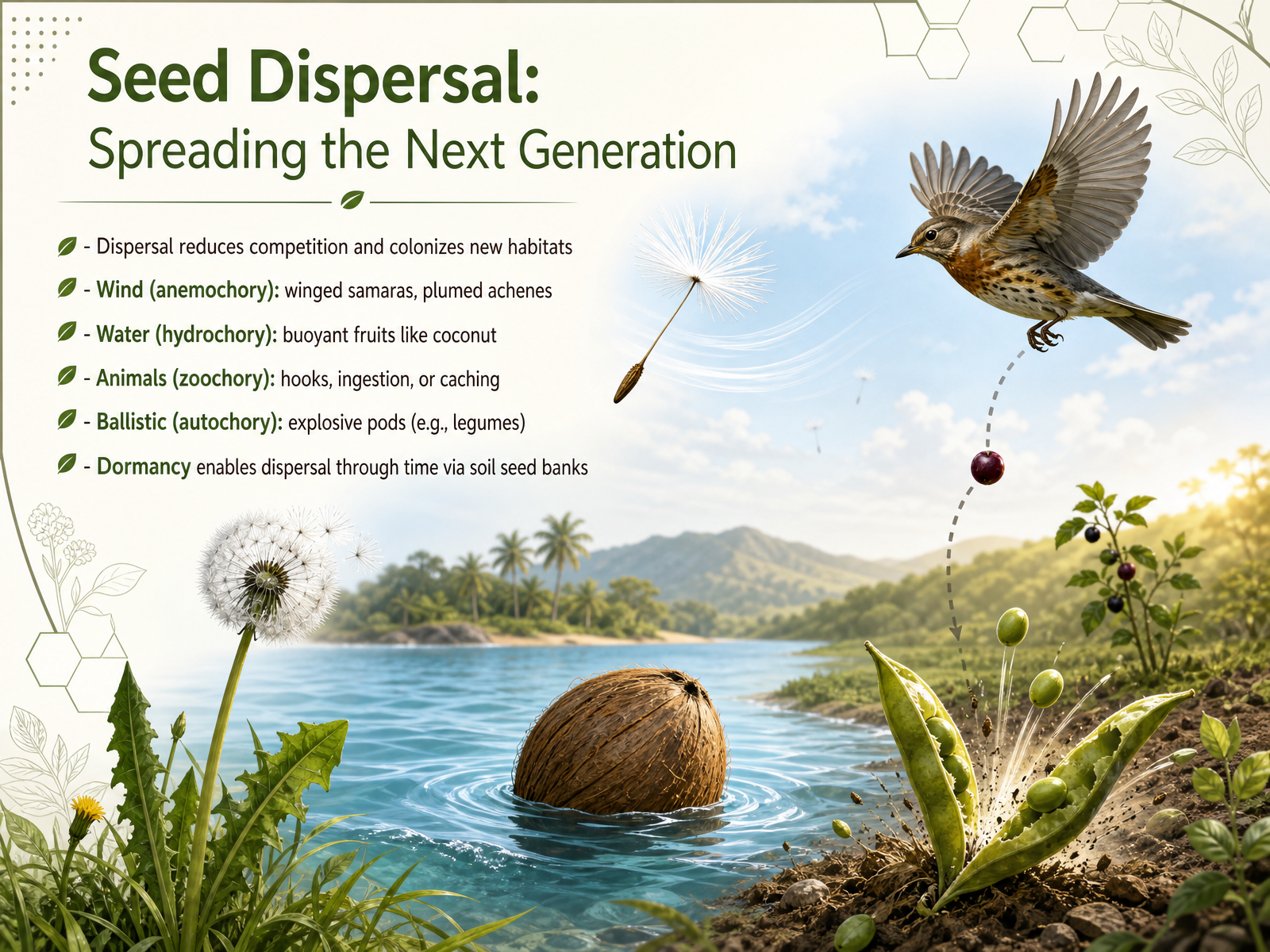
 - 10Seed Dispersal: Spreading the Next GenerationAfter fertilization, the developing seeds are housed inside the fruit, and now comes a critical challenge: moving those offspring away from the parent plant. This slide explores why and how seed dispersal happens. The main goal is to reduce competition for light, water, and space, and to colonize new habitats. Plants have evolved fascinating dispersal strategies for this journey. With wind dispersal, or anemochory, you see winged structures like maple samaras, or the plumed achenes of a dandelion that catch the breeze. Water dispersal, called hydrochory, relies on buoyant fruits, like the coconut, which can float across ocean currents to reach distant shores. Animal dispersal, or zoochory, takes many forms. Some seeds have hooks that latch onto fur, others pass safely through an animal’s digestive tract after being ingested, and forgetful squirrels can actually help by caching seeds that are never retrieved. Then there is ballistic dispersal, or autochory. Think of the explosive pods of legumes that dry out and snap open, physically launching seeds away from the plant. Finally, consider dispersal through time. Seed dormancy allows seeds to remain viable in the soil for months or even years, forming a seed bank that waits for the perfect moment to grow. Now that we’ve seen how seeds travel, let’s look at what happens when a seed finds the right conditions. Next, we’ll move to Germination: Completing the Cycle.
 learner.orgnph.onlinelibrary.wiley.comfiles.eric.ed.gov+22 min
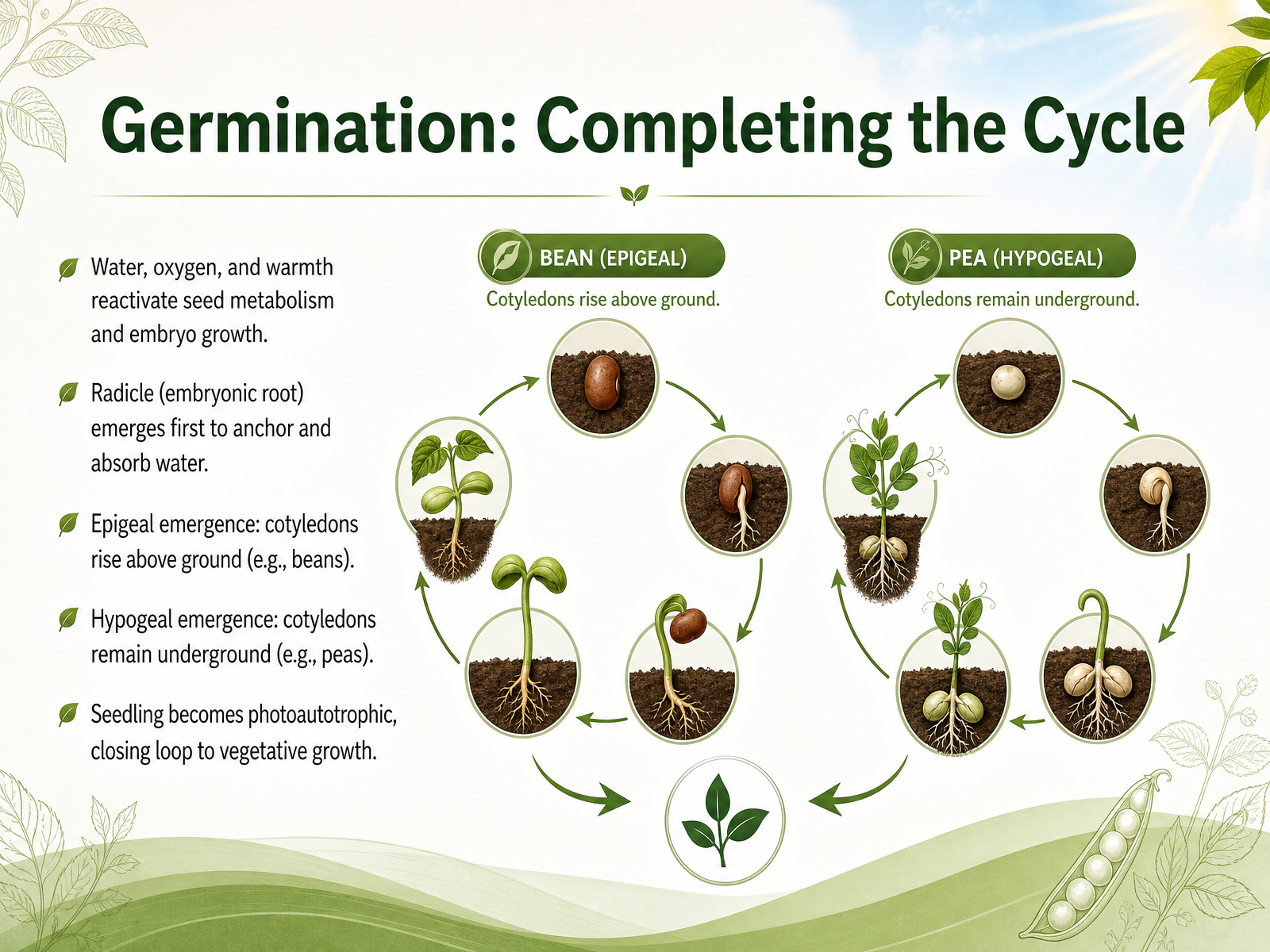
 - 11Germination: Completing the CycleNow, let's put the final piece in our plant life cycle puzzle: germination. Think of this as the moment the journey comes full circle. Inside every seed is an embryo, waiting for the right signals. Those signals are water, warmth, and oxygen. When a seed takes in water, it reactivates its metabolism and the embryo starts to grow. The very first structure to emerge is called the radicle. This is the embryonic root, and its job is to anchor the plant and begin absorbing water immediately. As growth continues, seedlings emerge from the soil in one of two distinct ways. In epigeal emergence, like you see with beans, the stem arches upward and actually pulls the cotyledons, or seed leaves, above the ground. In hypogeal emergence, found in plants like peas, the cotyledons stay right where they are, safe underground. Once those first true leaves appear, the seedling becomes photoautotrophic. That just means it can now photosynthesize its own food, and the loop closes, bringing the plant back to the vegetative growth stage we started with. Next, we'll map out the full pathway, looking at the causal links that connect every step of this sequence.
 britannica.compmc.ncbi.nlm.nih.govmdpi.com+22 min
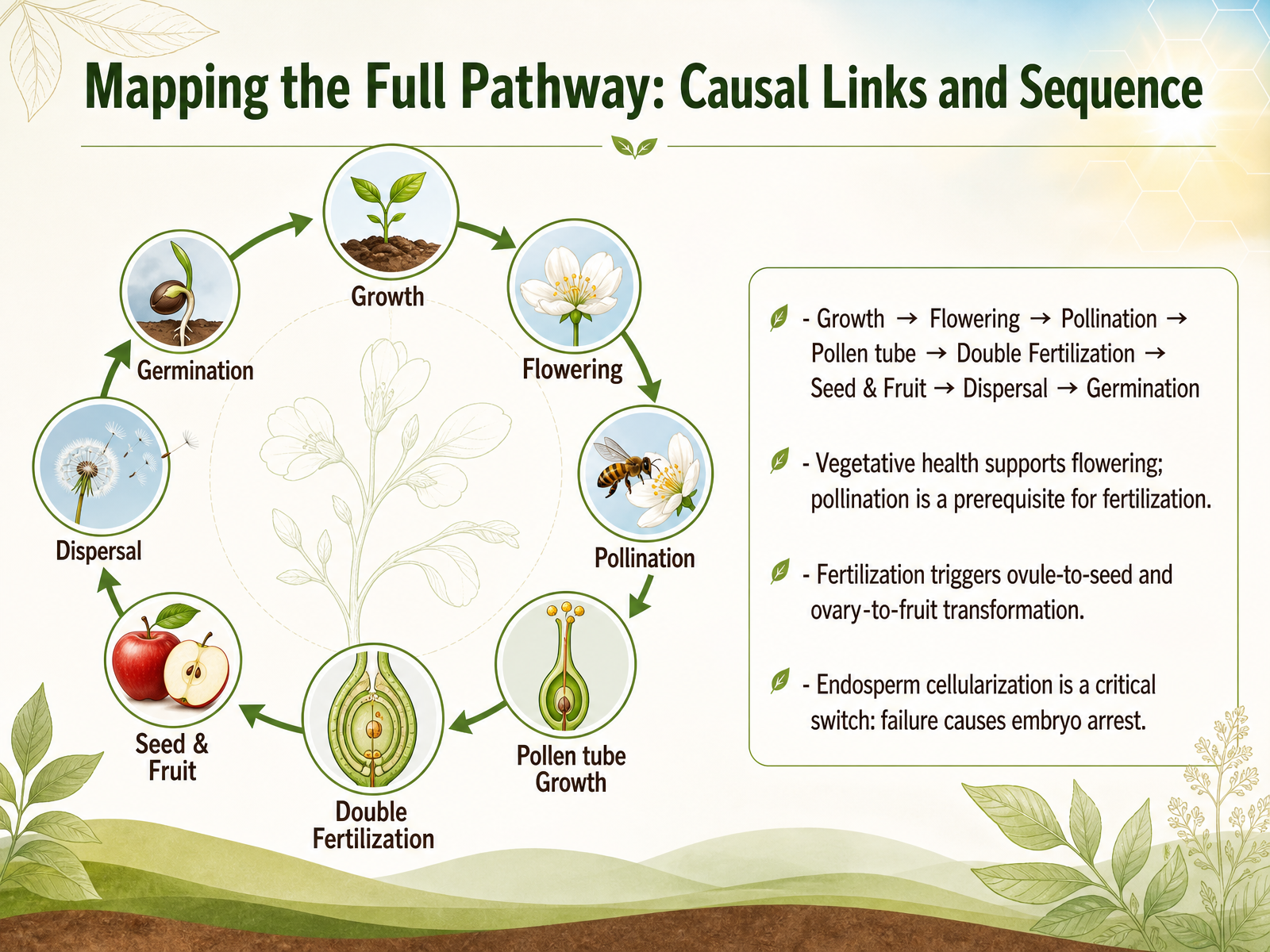
 - 12Mapping the Full Pathway: Causal Links and SequenceNow let's bring everything together by mapping the full causal pathway. Think of this as connecting the dots from the very beginning of growth, all the way to a new plant. The sequence begins with healthy vegetative growth, which supports flowering. Flowers enable pollination, where a pollen grain lands on the stigma. That pollen grain then grows a pollen tube, delivering two sperm cells to the ovule. This sets the stage for double fertilization. One sperm fertilizes the egg, forming the embryo. The other fertilizes the central cell, forming the endosperm. Fertilization is the critical trigger. It signals the ovule to transform into a seed, and the surrounding ovary to develop into a fruit. Inside the developing seed, the endosperm undergoes a process called cellularization. This is a pivotal switch. When the endosperm cellularizes, it effectively shifts nutrient flow to directly support the growing embryo. If this switch fails, the embryo cannot survive. After the seed matures, it is dispersed, and under the right conditions, germination begins, starting the cycle anew. Next, we'll address some common misconceptions and how to correct them.
 nature.compmc.ncbi.nlm.nih.govsciencedirect.com+22 min
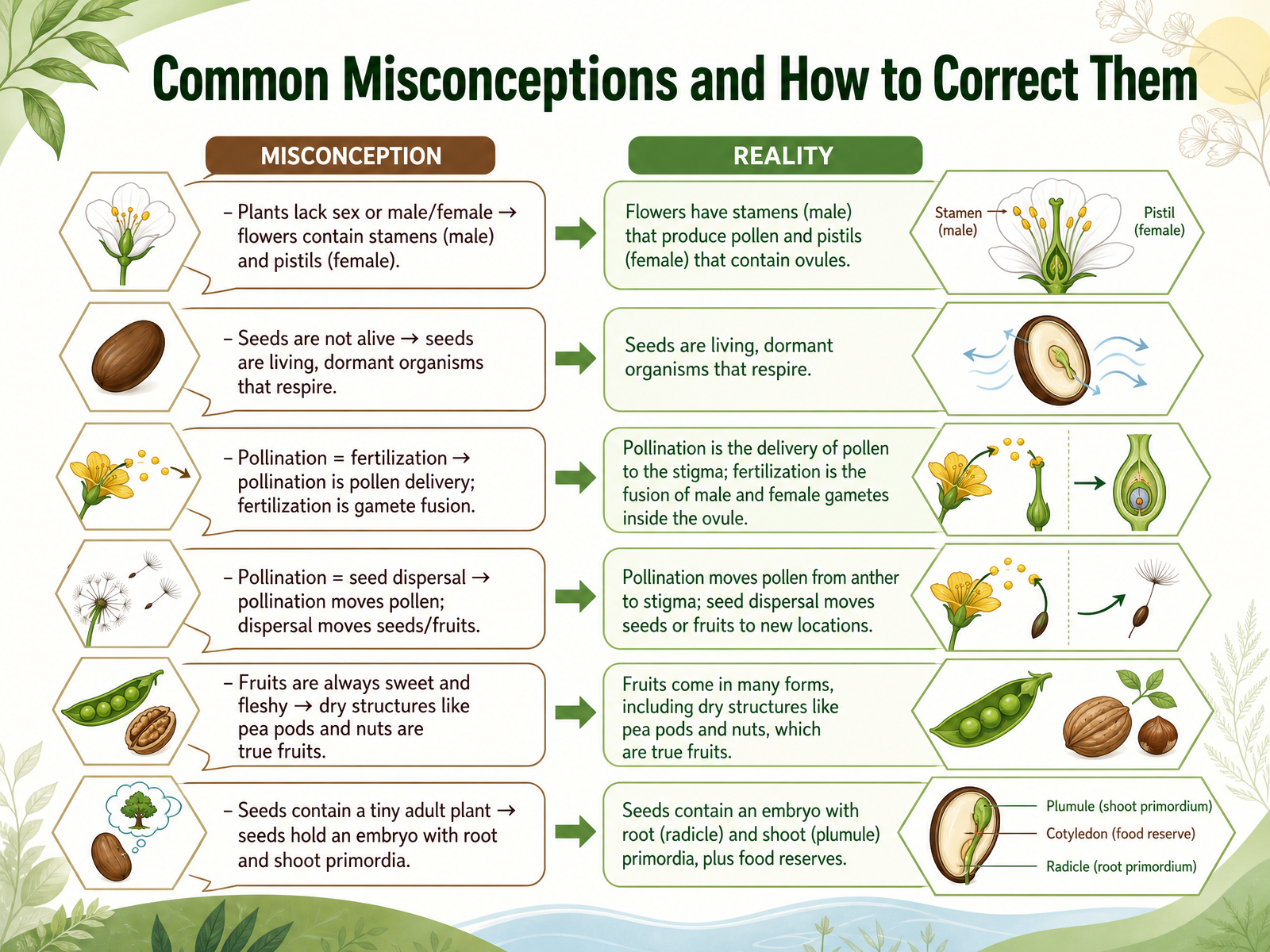
 - 13Common Misconceptions and How to Correct ThemLet’s pause and clear up some of the most common misconceptions about plant life cycles. First, plants are neither simply male nor female. Many flowers contain both the male stamen and the female pistil in the same bloom. Second, a seed is not a dead package. It is a living, dormant organism that respires and carries an embryo, not a miniature adult plant. Third, people often mix up pollination and fertilization. Pollination is simply the delivery of pollen grains; fertilization is the later fusion of gametes inside the ovule. In the same way, pollination is completely separate from seed dispersal. Pollination moves pollen; dispersal moves seeds or fruits. Finally, fruits are not always sweet and fleshy. A fruit is a ripened ovary, which means dry structures like pea pods and nuts are true fruits too. Recognizing these distinctions helps you see the plant life cycle clearly.
 learner.orgnph.onlinelibrary.wiley.comfiles.eric.ed.gov+22 min
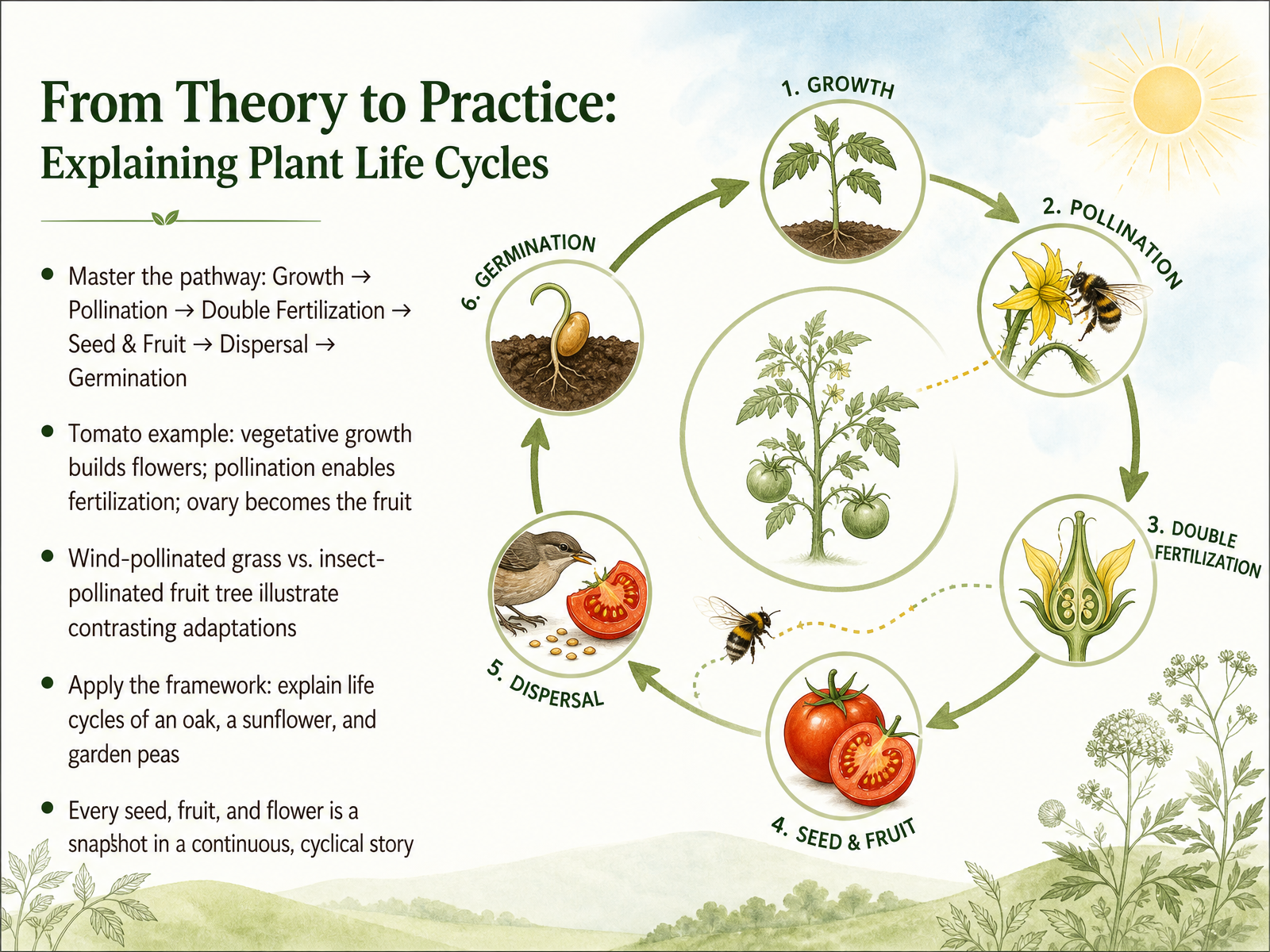
 - 14From Theory to Practice: Explaining Plant Life CyclesWelcome to the final step of our journey. Now that we've explored the plant life cycle in detail, let's bring it all together and put our understanding into practice. The master pathway we've learned is: Growth to Pollination, then Double Fertilization, leading to Seed and Fruit, followed by Dispersal, and finally, Germination. It's a continuous, cyclical story. Take the tomato as a perfect example. The vegetative growth builds the flower. Pollination enables the double fertilization inside. And what happens next? The ovary of that flower becomes the fruit we eat. We also saw how wind-pollinated grass and an insect-pollinated fruit tree illustrate contrasting adaptations. One relies on the breeze and produces lots of light pollen; the other uses bright colors and scents to attract a vector. Now, I challenge you to apply this framework: how would you explain the entire life cycle of a towering oak, a vibrant sunflower, and a humble garden pea? Remember, every single seed, every fruit, and every flower you see is a snapshot of this remarkable, unending journey.
 learner.orgnph.onlinelibrary.wiley.comfiles.eric.ed.gov+22 min
Take the deck with you
Download this course as a file — free, no sign-up needed.
- PDF handoutEvery slide page, ready to print or share.15 pages · 4.7 MBDownload
- Narrated PowerPointThe deck that presents itself — every slide carries the digital human's narration video.15 pages · 15.0 MBDownload
- PowerPoint slidesThe full deck as a .pptx — open it in PowerPoint, Keynote, or Google Slides.15 pages · 4.6 MBDownload
Free to use in your own training — please keep the PersonWise credit page at the end.
Have your own deck? Turn it into a course
Sources consulted
Web sources consulted while building this course.
- A transcriptional atlas of early Arabidopsis seed development suggests mechanisms for inter-tissue coordination | Nature Plants — nature.com
- Hormonal regulation and crosstalk during early endosperm and seed coat development — pmc.ncbi.nlm.nih.gov
- Review Genetic and epigenetic processes in seed development — sciencedirect.com
- Embryo-endosperm interactions — backoffice.biblio.ugent.be
- Regulation of the Early Phase of Seed Development: An Illustrative Review — doi.org
- Plant Life Cycles: Children's Ideas - Annenberg Learner — learner.org
- Understanding students' conceptions of plant reproduction to better teach ... — nph.onlinelibrary.wiley.com
- More Misconceptions to Avoid When — files.eric.ed.gov
- Misconceptions in Plant Life Cycle and Reproductive Mode — kci.go.kr
- Plant Life Cycles: A Closer Look - Annenberg Learner — learner.org
- Germination | Description, Process, Diagram, Stages, Types, & Facts — britannica.com
- Germination and the Early Stages of Seedling Development in ... - PMC — pmc.ncbi.nlm.nih.gov
- Transition from Seeds to Seedlings: Hormonal and Epigenetic Aspects — mdpi.com
- Seed and Seedling Biology — extension.psu.edu
- Germination and seedling development — ebsco.com
- Pollination | Definition, Process, Types, Agents Of, & Facts | Britannica — britannica.com
- Pollination — en.wikipedia.org
- What is Pollination? | US Forest Service — fs.usda.gov
- Types of Pollination: Self- and Cross-pollination and Agents of Pollination! — cropsreview.com
- Types of Pollination - Texas Farm Bureau — texasfarmbureau.org