Begin
14 pages · ~28 min
Static Electricity: Charges and Electric Fields
This training introduces the fundamentals of static electricity, helping learners understand electric charges and electric fields and how they interact.
A digital instructor presents all 14 pages. Hold “Ask” at any point and ask out loud — the answer comes from this course. No sign-up needed.
What you’ll learn
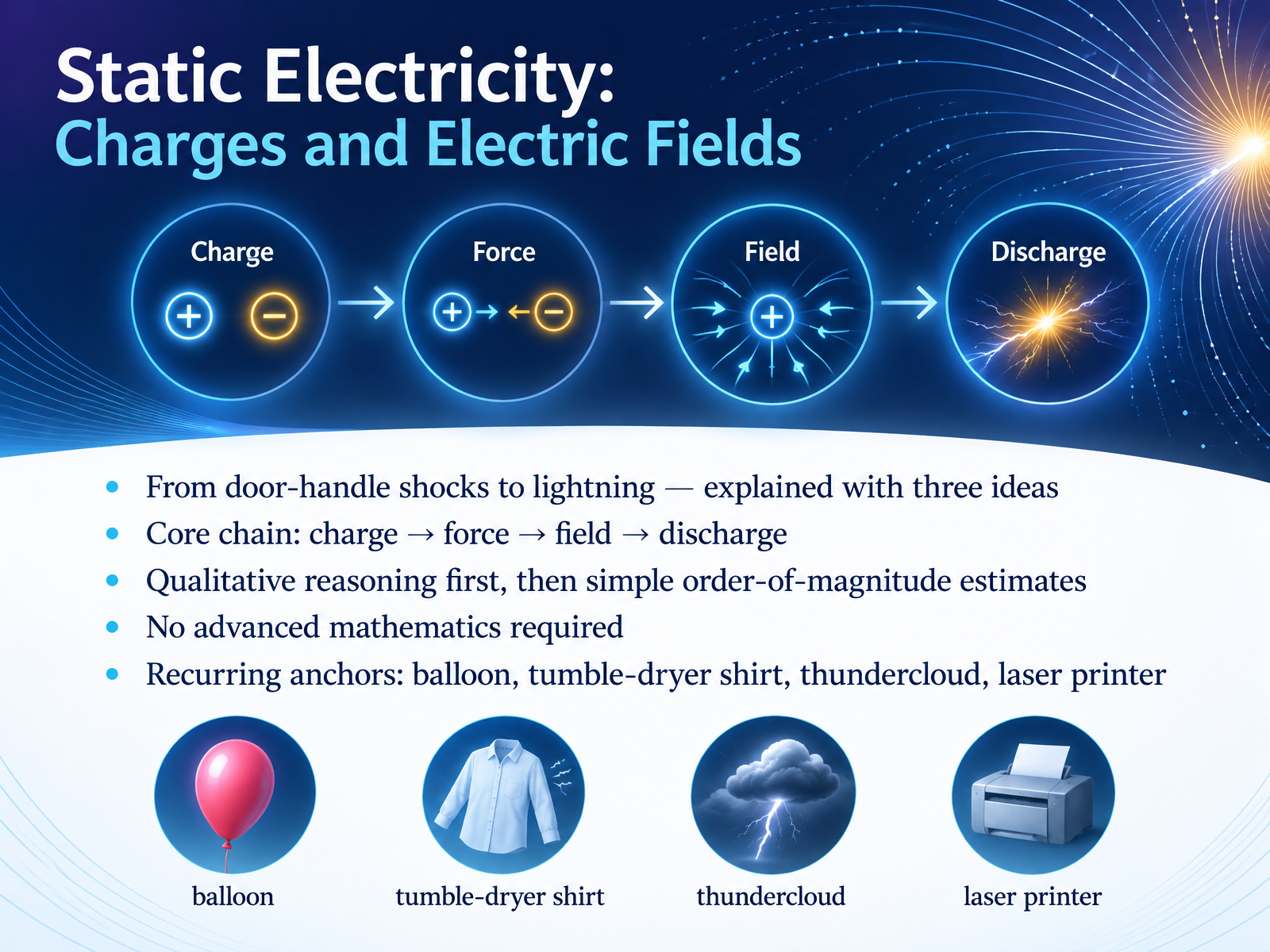
- 01Static Electricity: Charges and Electric FieldsWelcome. This course is about static electricity, the same effect behind a door-handle shock and a bolt of lightning. The goal is to explain both with three core ideas, arranged in a chain: charge, force, field, and discharge. Have you noticed how a balloon sticks to a wall, or a shirt clings after tumble drying? We will use those everyday anchors, plus a thundercloud and a laser printer, to build intuition. We start with qualitative reasoning, then add simple order-of-magnitude estimates. No advanced mathematics is required. Just clear physical thinking. Let's begin by looking at everyday static phenomena and the questions they raise.1 min
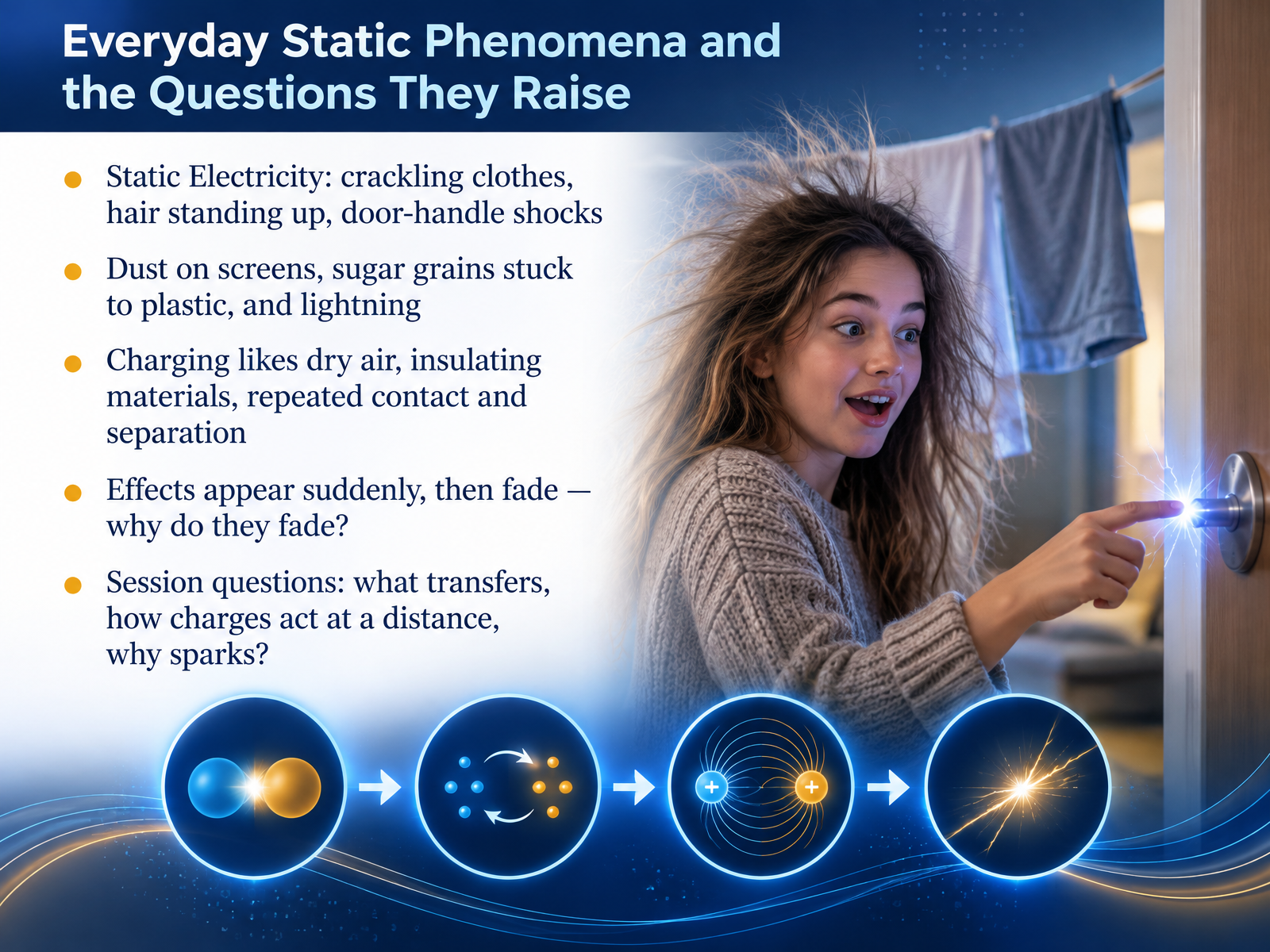
- 02Everyday Static Phenomena and the Questions They RaiseLet's begin with the static effects you have likely noticed. Have you ever pulled a sweater over your head and heard crackling? Or watched your hair lift toward a balloon? Those small door handle shocks belong to the same family. Think of dust clinging to a screen, sugar grains stuck to a plastic scoop, and lightning across the sky. Static charging tends to favor dry air and insulating materials, especially with repeated contact and separation. You may have noticed that these effects appear suddenly, then fade. That fading is worth asking about. Why would a charge build up and then quietly disappear? In this session, we will ask three questions. What actually transfers during charging? How do charges act on each other at a distance? And why do sparks form? Keep those questions in mind as we go. Next, we look at two kinds of charge and the conservation of charge.
 2 min
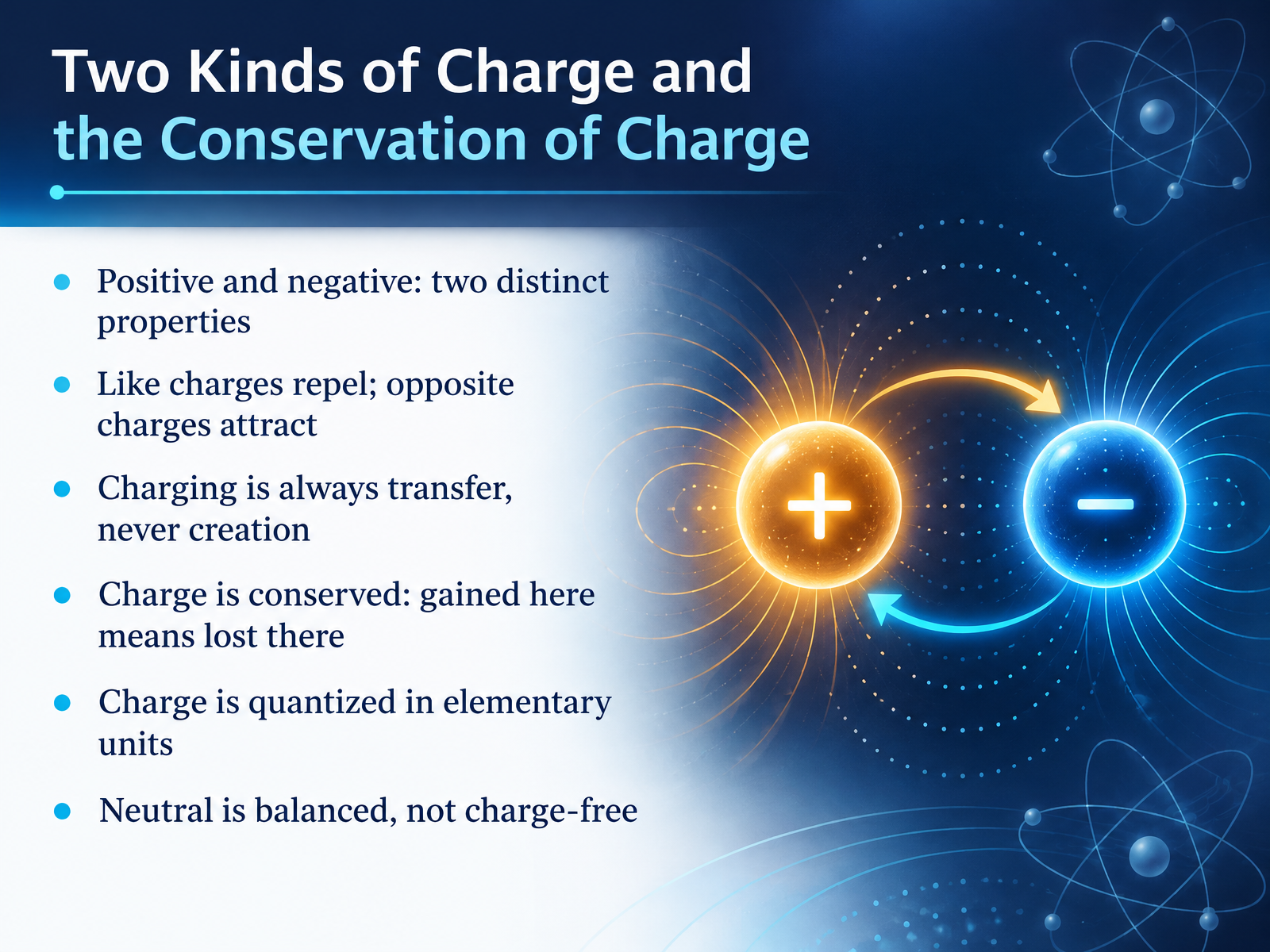
- 03Two Kinds of Charge and the Conservation of ChargeLet's look at charge itself. Charge comes in two distinct kinds: positive and negative. This isn't just a label. It's a real property of matter. And the rule is simple. Like charges repel. Opposite charges attract. So two positive objects push apart. A positive and a negative pull together. Now, here's an important point. When something becomes charged, charge is transferred, not created. Think of a balloon rubbed on your hair. Electrons move from hair to balloon. The balloon gains negative charge. The hair loses an equal amount. Charge is conserved. What is gained here is lost there. Charge also comes in tiny, indivisible units. We say it is quantized. Finally, neutral does not mean charge-free. It means positive and negative charges are balanced. In the next slide, we'll see how charging happens through friction, contact, and induction.
 2 min
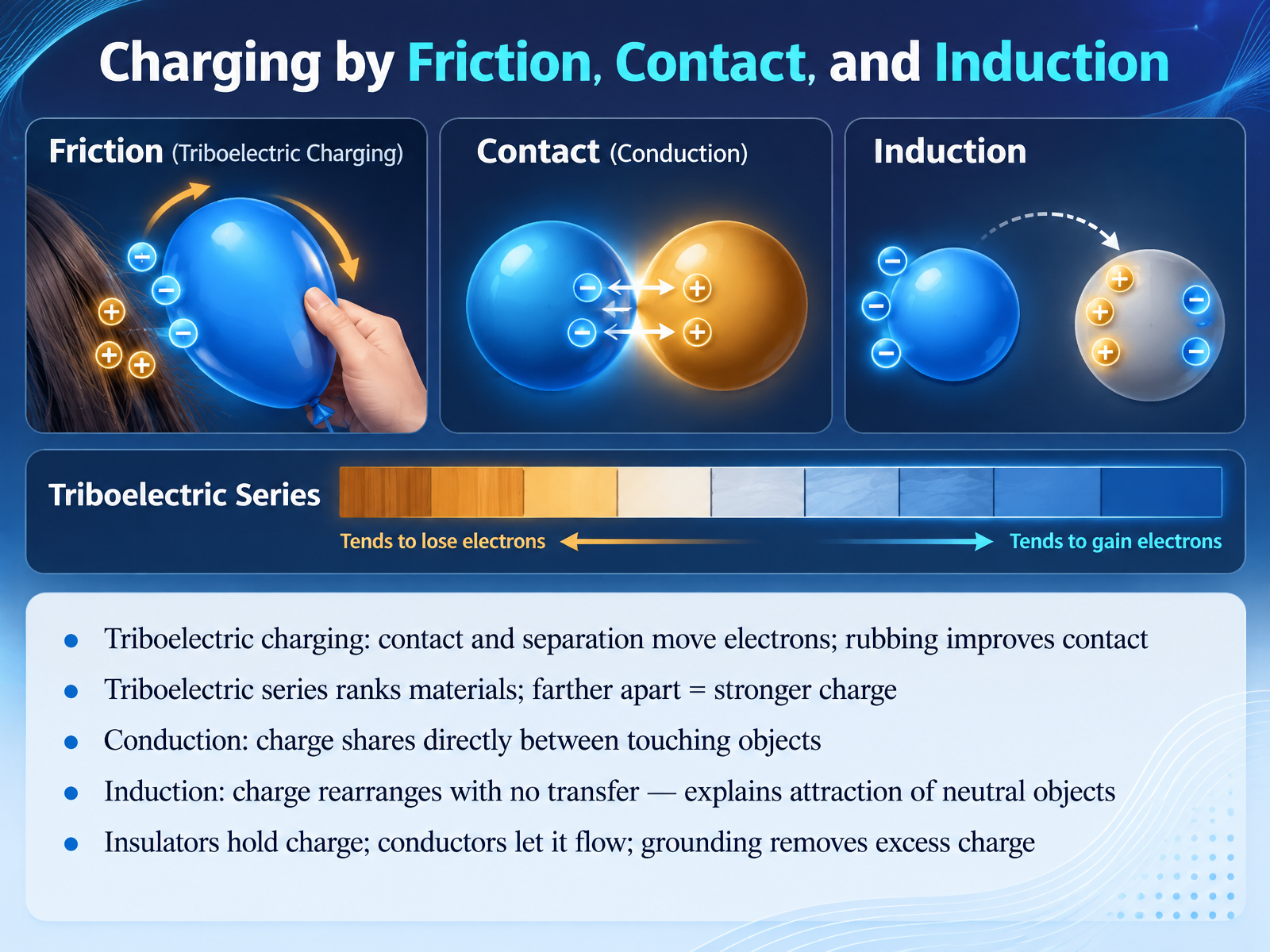
- 04Charging by Friction, Contact, and InductionNow let's look at three ways objects become charged. The first is charging by friction, also called triboelectric charging. When two different materials touch and then separate, electrons can move from one to the other. Rubbing simply improves the contact, so more charge transfers. Which material gains electrons depends on its position in the triboelectric series, a ranked list of materials. The farther apart two materials sit on that list, the stronger the charge. Next, conduction. When charged and neutral objects touch, charge shares directly between them. Induction is different. No charge is transferred. Instead, charge rearranges within an object, which helps explain why a charged rod attracts a neutral object. Finally, insulators tend to hold charge in place, while conductors let it flow. Grounding gives excess charge a path away. So in short, friction transfers charge, conduction shares it, and induction only rearranges it. Next, we turn to Coulomb's Law: The Force Between Charges.
 instructional-resources.physics.uiowa.edusciencedemonstrations.fas.harvard.eduscience.howstuffworks.com+22 min
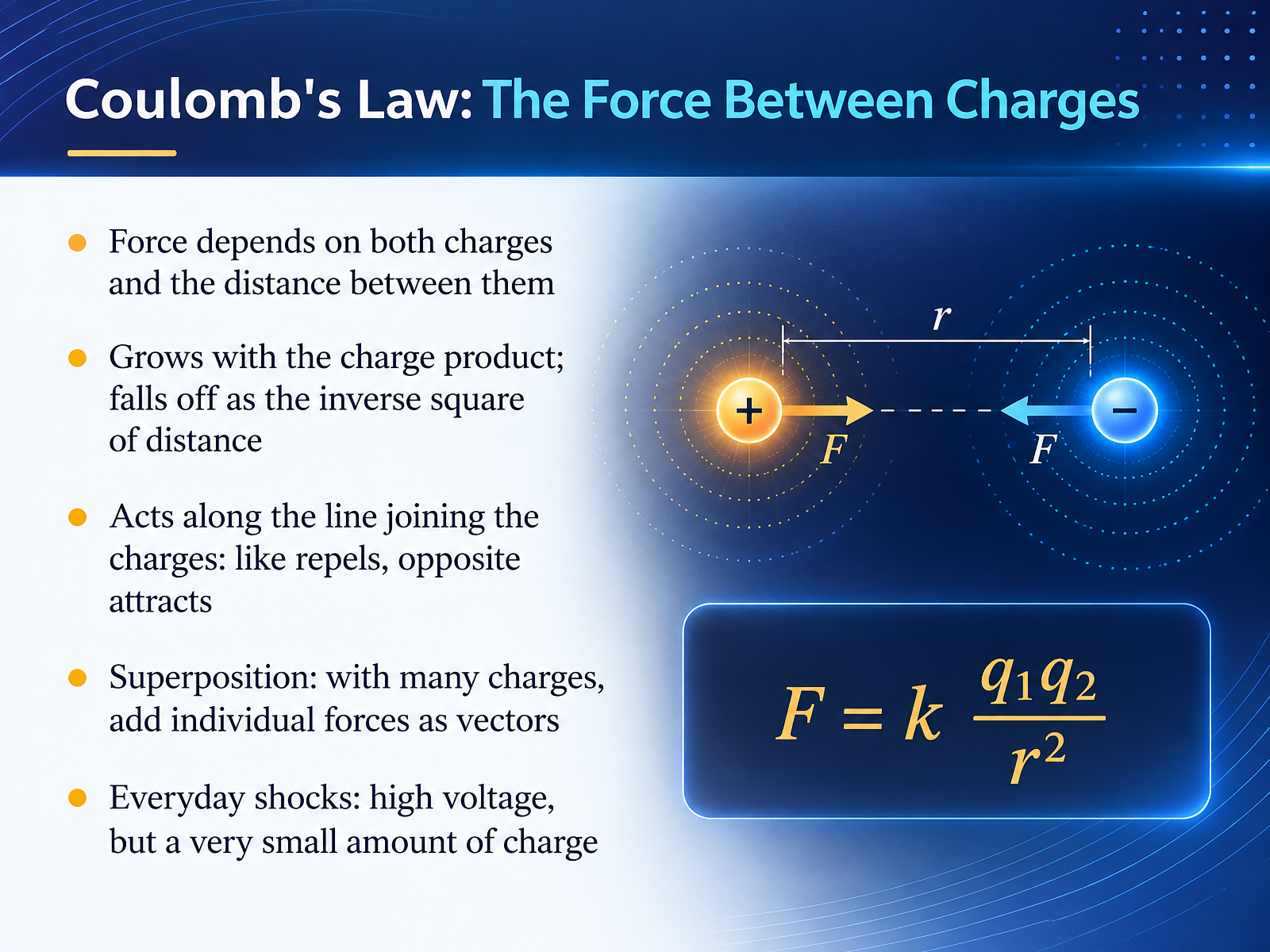
- 05Coulomb's Law: The Force Between ChargesSo far we have described how charges behave. Now let us put a number on the force between them, using Coulomb's Law. The force depends on two things: the size of each charge, and the distance between them. It grows with the product of the charges, so doubling either charge doubles the force. But it falls off as the inverse square of distance, so doubling the distance cuts the force to one quarter. The force acts along the line joining the charges. Like charges repel, and opposite charges attract. When many charges are present, you add the individual forces as vectors. This is called superposition. And here is a familiar example. A static shock involves high voltage, but only a very small amount of charge. So the force itself is small. Next, we look at the electric field, which describes force at a distance.
 2 min
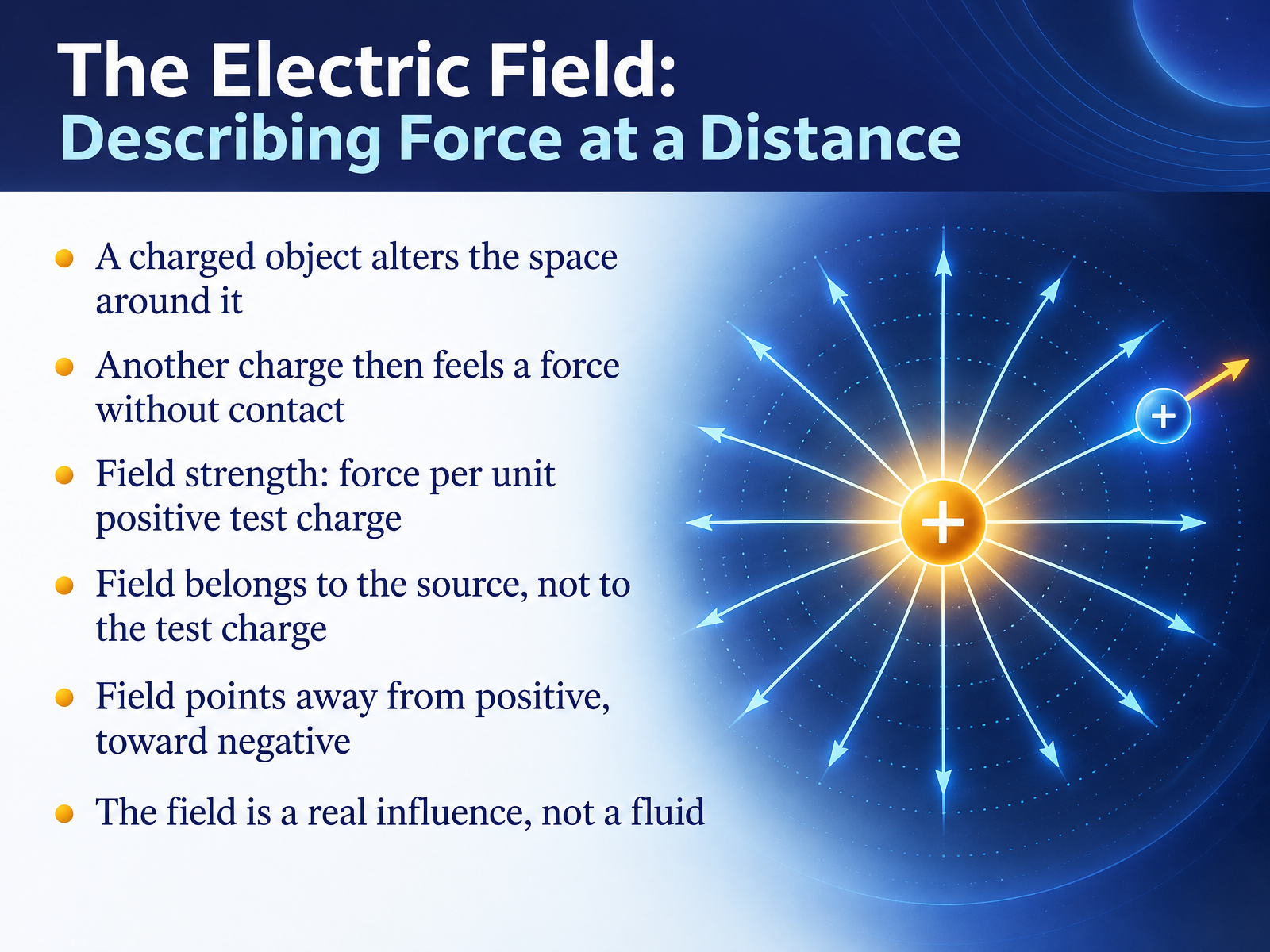
- 06The Electric Field: Describing Force at a DistanceNow that we've seen how charges push and pull each other, let's ask how that force reaches across empty space. A charged object alters the space around it. Another charge placed nearby then feels a force, even though nothing touches it. We describe that altered space with the electric field. Field strength is defined as the force per unit of positive test charge. One important point. The field belongs to the source charge, not to the test charge you use to measure it. By convention, the field points away from a positive source and toward a negative one. And here's the key idea. The field is a real influence in space, not a fluid or a substance flowing around. Keep that distinction in mind as we move on. Next, we'll look at how field diagrams picture this influence, in Reading Field Diagrams and Uniform Fields.
 google.iopscience.iop.orgjournals.aps.orgarxiv.org+21 min
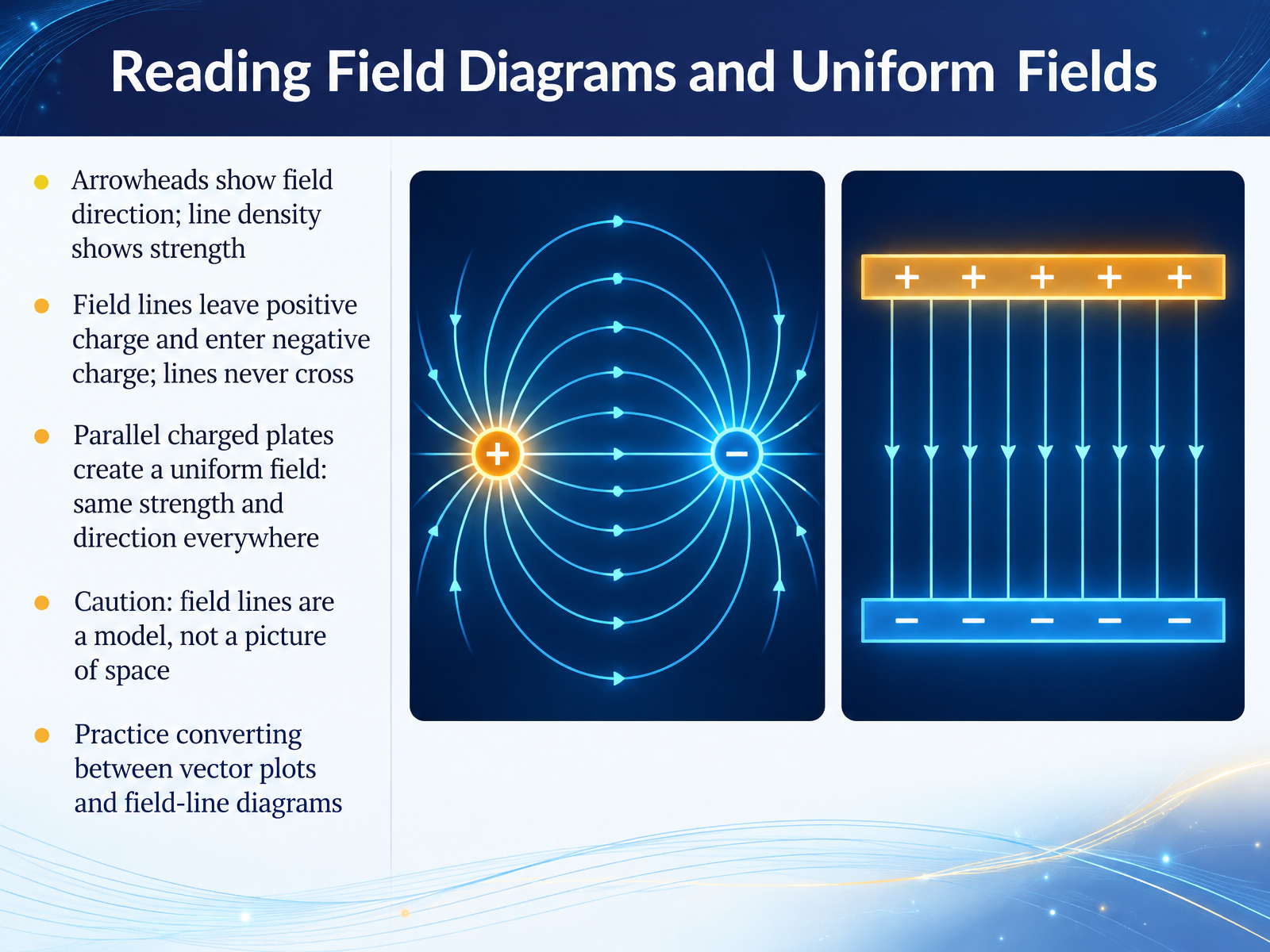
- 07Reading Field Diagrams and Uniform FieldsNow let us learn how to read field diagrams. Each arrowhead shows the direction of the field at that point. And the spacing of the lines tells you about strength. Where lines are closer together, the field is stronger. Where they spread apart, it is weaker. There is a simple rule for direction. Field lines leave a positive charge and enter a negative charge. Field lines also never cross. If they did, a test charge would have two directions at one point, which cannot happen. Now look at two parallel charged plates. Between them, the field lines are evenly spaced and point the same way. That is a uniform field, the same strength and direction everywhere inside. One caution. Field lines are a model, a tool for reasoning. They are not a picture of what actually fills the space. Students often stumble when converting between vector plots and field-line diagrams, so practise both directions and watch how line density encodes magnitude. Up next, we look at conductors, grounding, and electrostatic shielding.
 google.iopscience.iop.orgjournals.aps.orgarxiv.org+22 min
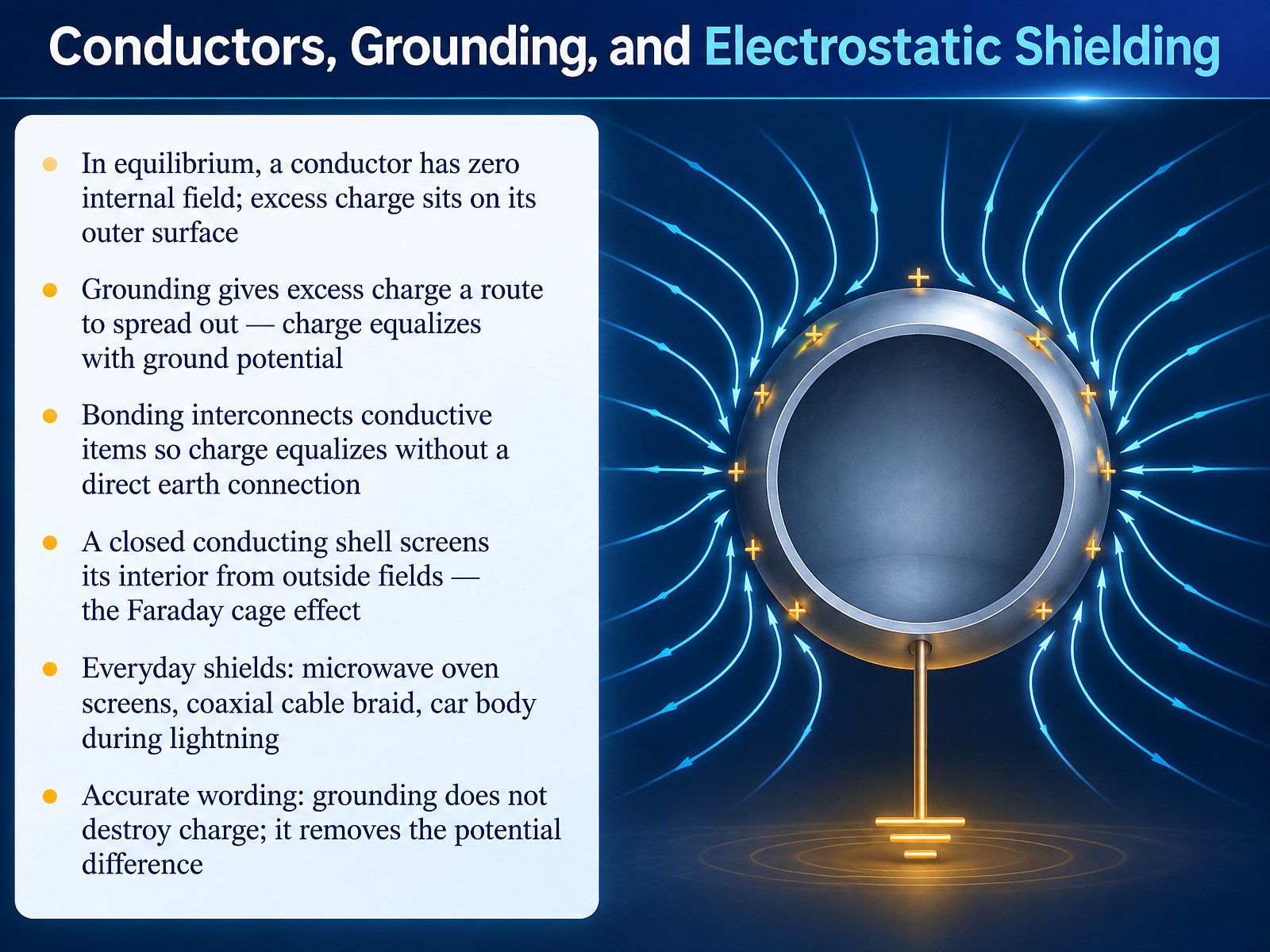
- 08Conductors, Grounding, and Electrostatic ShieldingNow let's see what happens when excess charge meets a conductor. In equilibrium, the electric field inside a conductor is zero, and excess charge sits on the outer surface. Grounding gives that charge a route to spread out, so it equalizes with ground potential. Bonding does something similar, connecting conductive items so charge equalizes without a direct earth connection. A closed conducting shell screens its interior from outside fields. This is the Faraday cage effect. You rely on it in microwave oven screens, coaxial cable braid, and a car body during lightning. One accurate wording matters here. Grounding does not destroy charge. It removes the potential difference. From strong fields to sparks, next we look at breakdown and lightning.
 nfpa.orgjniosh.johas.go.jpwebstore.ansi.org+21 min
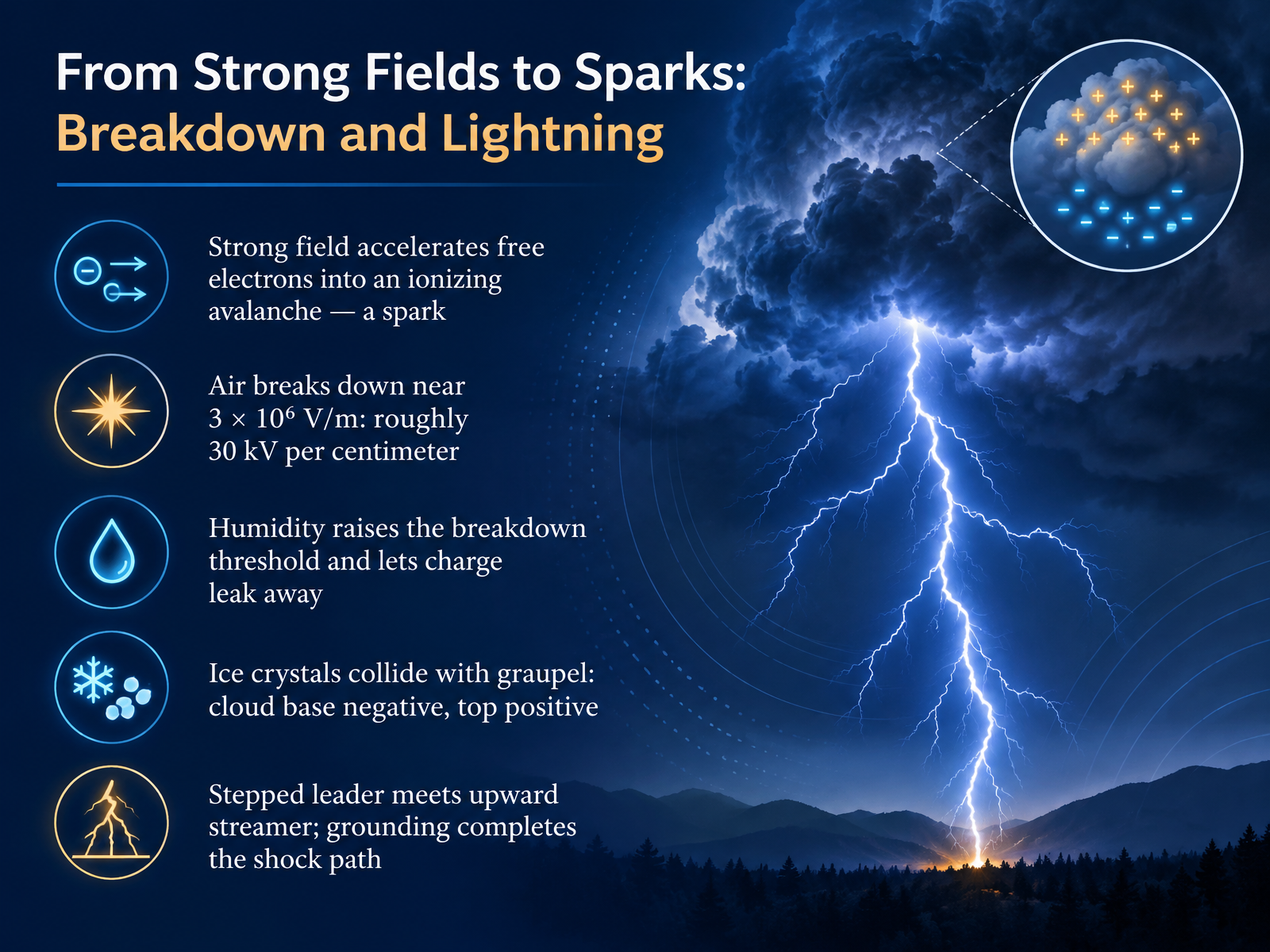
- 09From Strong Fields to Sparks: Breakdown and LightningNow let's connect strong electric fields to the sparks we actually see. When the field gets strong enough, free electrons accelerate between air molecules. Each collision can knock more electrons loose. That chain reaction is called an ionizing avalanche, and it creates a conducting path we see as a spark. In dry air at sea level, breakdown happens near three times ten to the sixth volts per meter. That's roughly thirty thousand volts per centimeter. Humidity matters too. Moisture raises the breakdown threshold and lets charge leak away, so humid air usually resists sparking more. Now scale this up to a thundercloud. Ice crystals collide with graupel, a soft hail. The lighter crystals carry positive charge upward, while heavier graupel carries negative charge toward the cloud base. Eventually, a stepped leader reaches down and meets an upward streamer rising from the ground. That connection completes the shock path we call lightning. Next, let's look at Static Electricity at Work: Applications and Hazards.
 google.iopscience.iop.orgdoi.orgsciencedirect.com+22 min
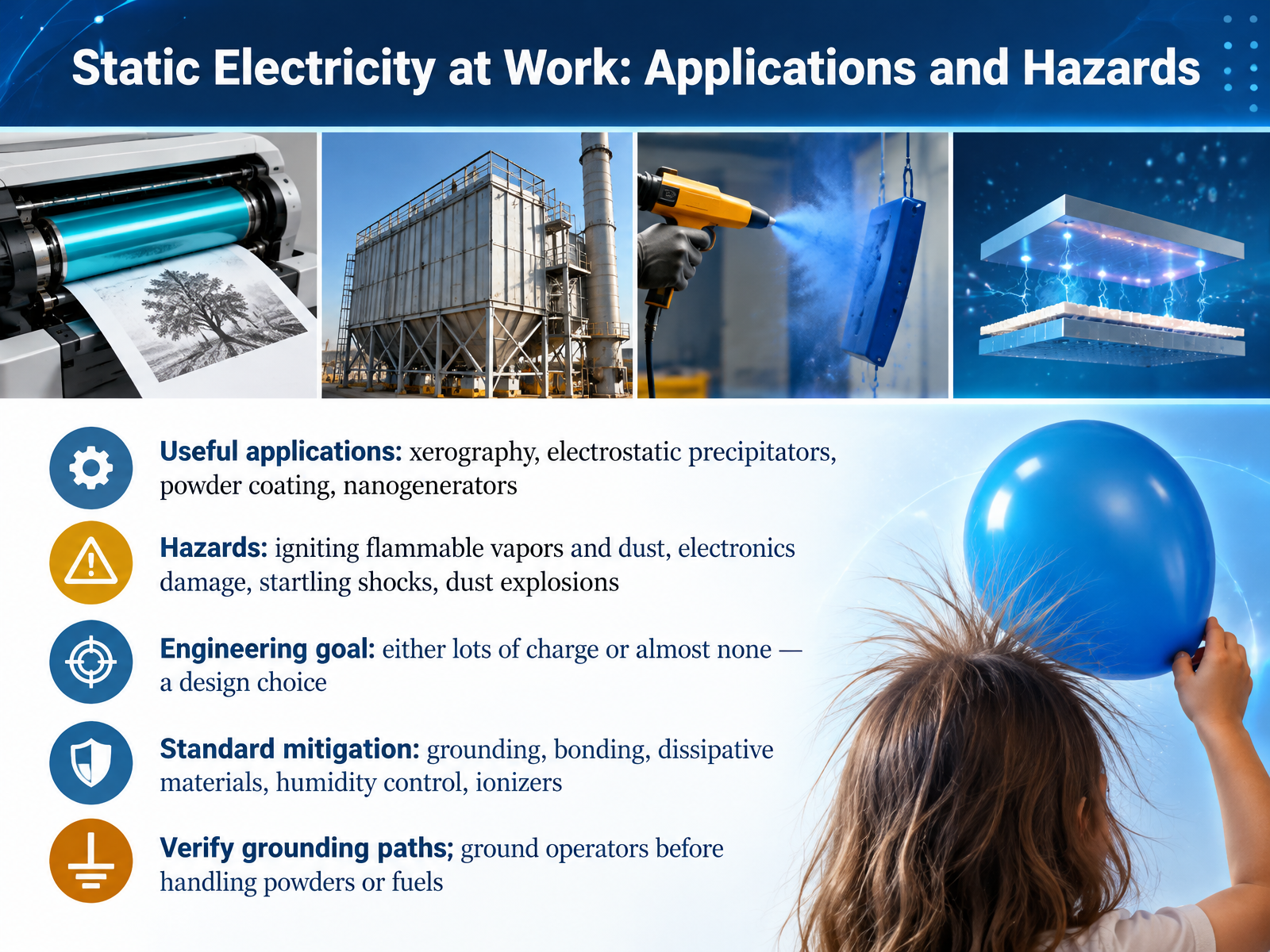
- 10Static Electricity at Work: Applications and HazardsNow let's look at static electricity in practice, both as a tool and as a hazard. Useful applications include xerography, electrostatic precipitators, powder coating, and nanogenerators. In those cases, charge is deliberately created and controlled. Hazards are the other side of the coin. Discharges can ignite flammable vapors and dust, damage electronics, give startling shocks, and contribute to dust explosions. So the engineering goal is a design choice. For a process, you either want a lot of charge or almost none. Standard mitigation includes grounding, bonding, dissipative materials, humidity control, and ionizers. The key practical step is to verify grounding paths, and to ground operators before they handle powders or fuels. Next, we'll look at safe demonstrations for home and classroom.
 nfpa.orgjniosh.johas.go.jpwebstore.ansi.org+22 min
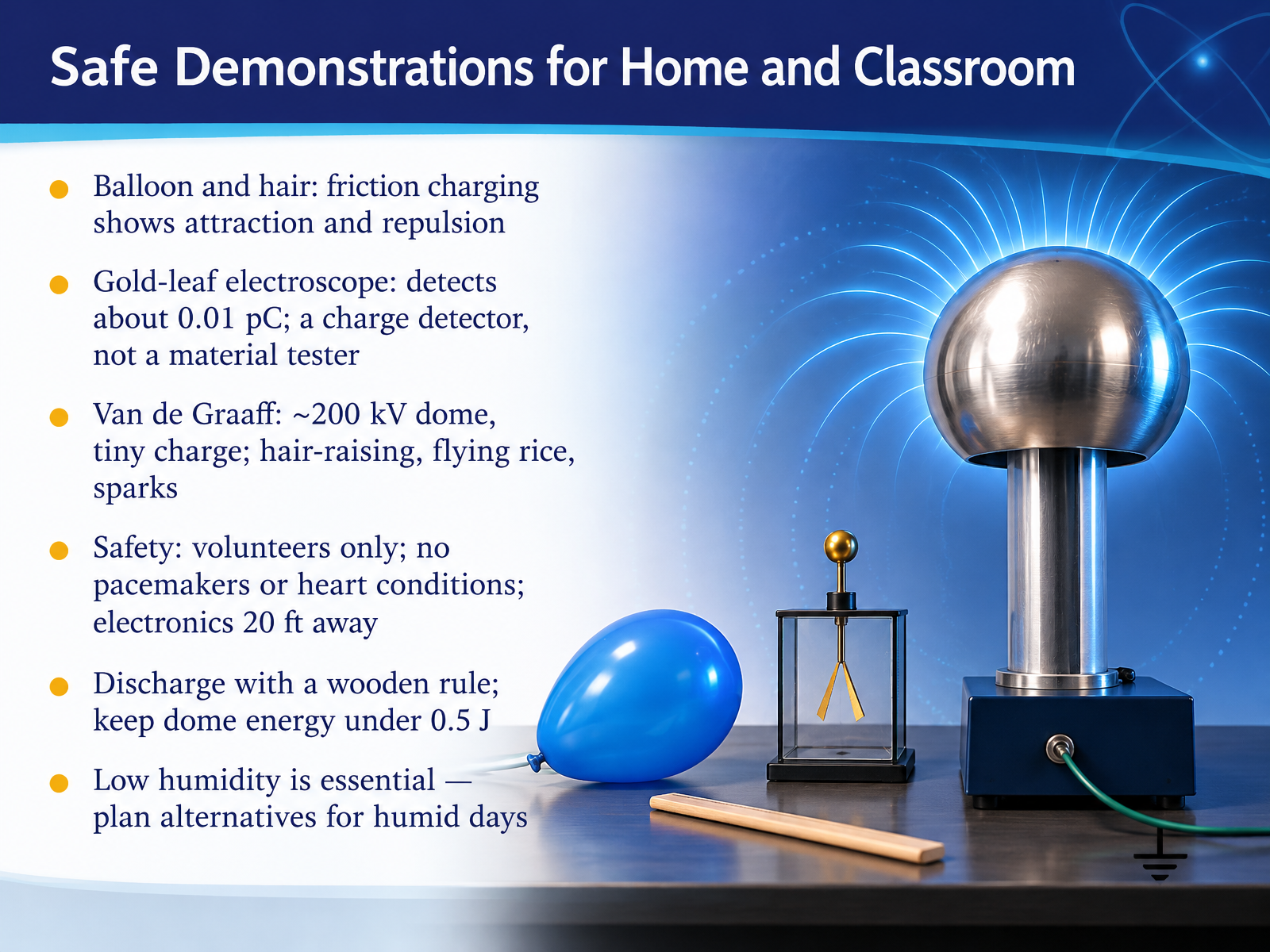
- 11Safe Demonstrations for Home and ClassroomLet's look at demonstrations you can safely run at home or in a classroom. Simple friction charging works with a balloon rubbed on hair. Bring the balloon close and you see attraction, and two charged balloons push apart. Next, a gold-leaf electroscope detects very small charges, around zero point zero one picocoulombs. Think of it as a charge detector, not a material tester. Then there is the Van de Graaff generator. A school dome can reach about two hundred thousand volts, but the total charge is tiny. You can see hair stand on end, rice fly off, and sparks jump. For safety, use volunteers only, and exclude anyone with a pacemaker or heart condition. Keep electronics at least twenty feet away. After hair demonstrations, discharge the person using a wooden rule. Keep the dome's stored energy under zero point five joules, and remember low humidity is essential, so plan alternatives for damp days. Next, we turn to misconceptions and how to correct them.
 2 min
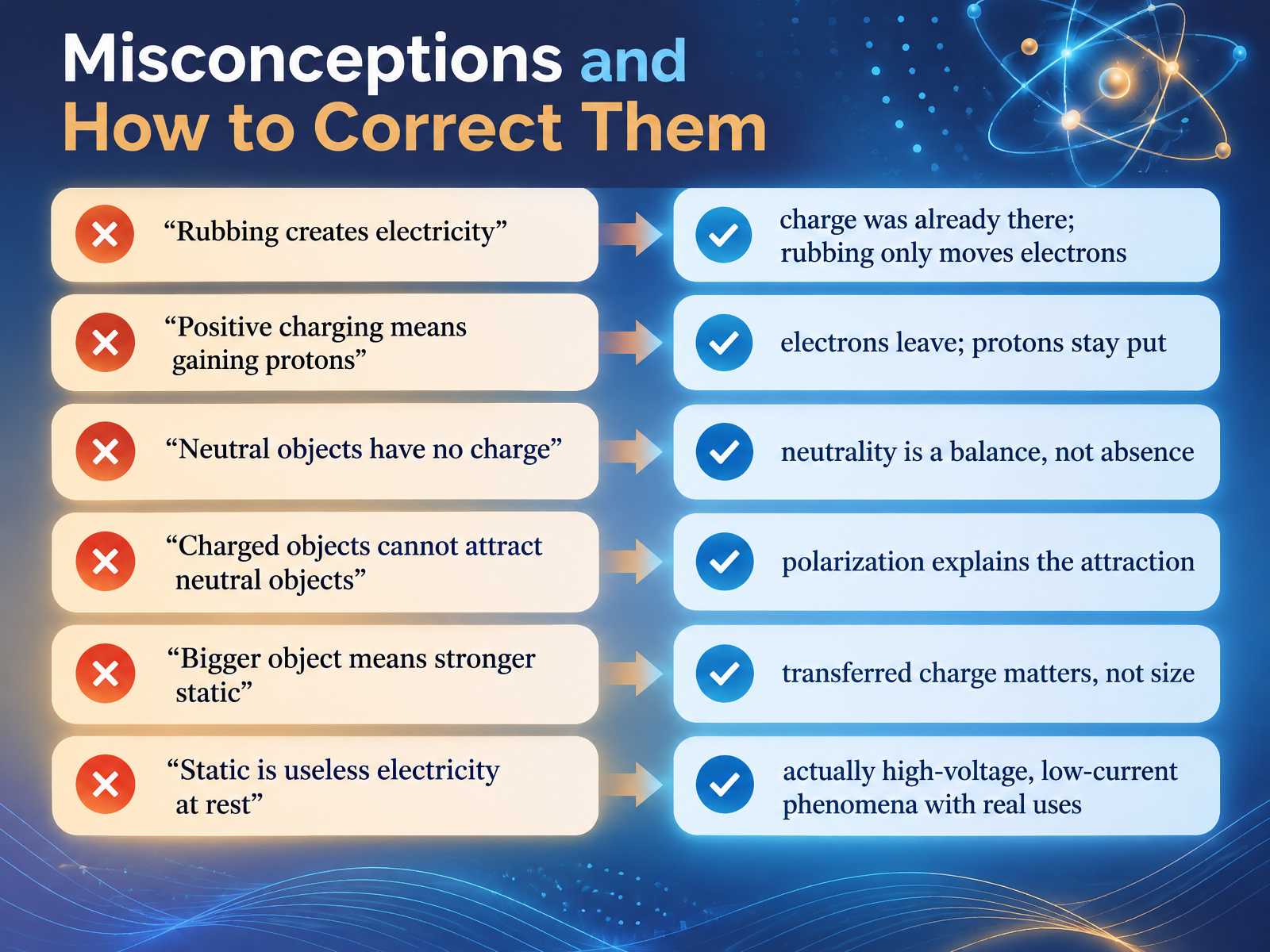
- 12Misconceptions and How to Correct ThemLet's clear up some common misconceptions that even careful learners carry. First, rubbing does not create electricity. The charge was already there; rubbing only moves electrons from one surface to another. Second, positive charging does not mean gaining protons. Electrons leave, and protons stay put. Third, a neutral object is not charge-free. Neutrality is a balance of positive and negative charge, not their absence. Fourth, charged objects can attract neutral objects, because the neutral object becomes polarized. Fifth, a bigger object does not automatically mean stronger static. What matters is how much charge was transferred. And sixth, static electricity is not useless. These are high-voltage, low-current effects with real uses, like printers and dust filters. So when you meet a claim about static, ask: where did the charge come from, and how did it move? That habit corrects most errors. Next, we'll look at quick checks, discussion prompts, and teaching tips.
 2 min
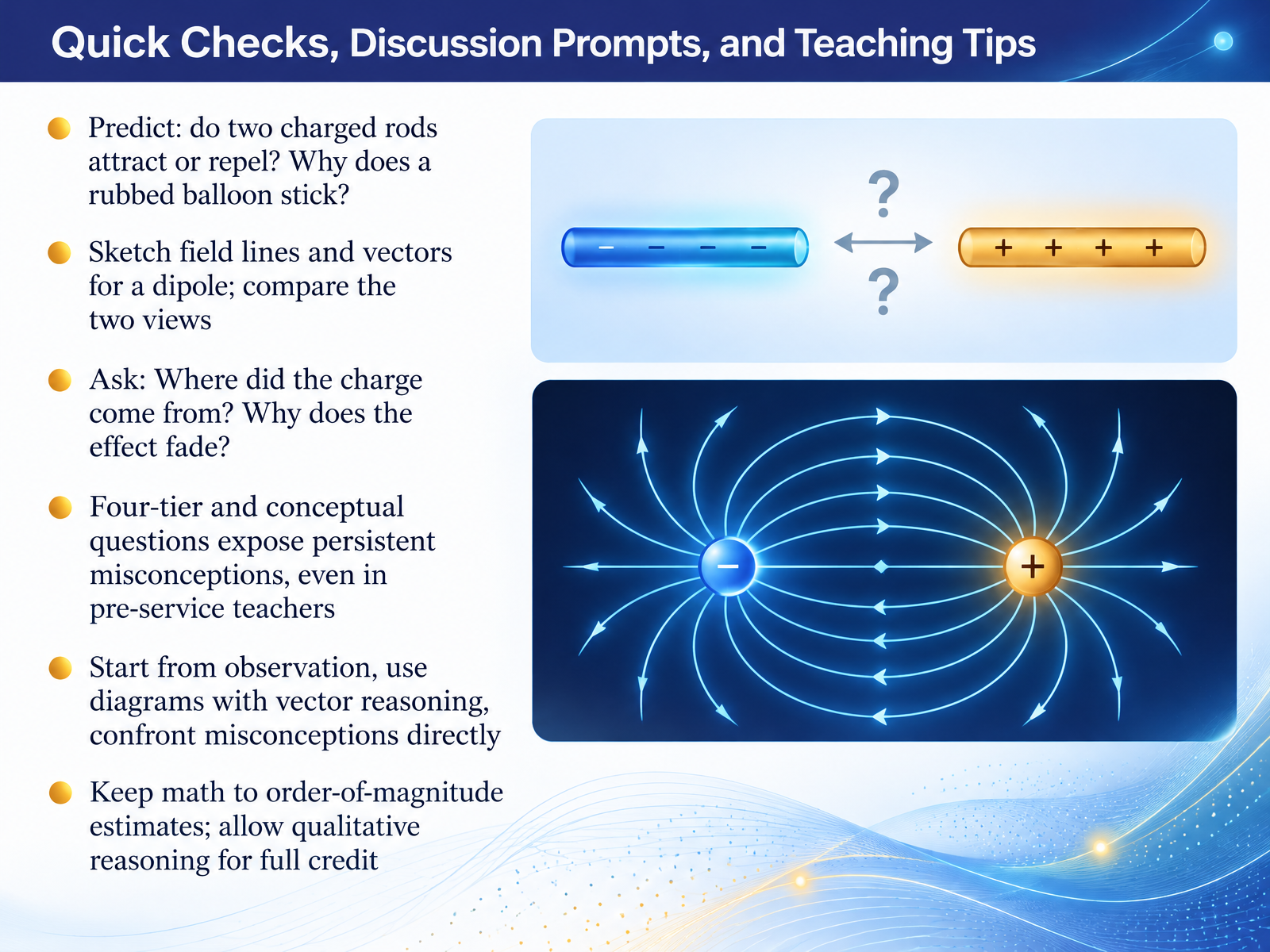
- 13Quick Checks, Discussion Prompts, and Teaching TipsLet's bring this together with some quick checks you can use in class or on your own. First, a prediction. If you rub two rods and bring them close, will they attract or repel? Have learners commit to an answer before testing. Then ask why a rubbed balloon sticks to a wall. Follow with a sketch: draw the field lines and the field vectors for a dipole, then compare what each view shows and hides. Ask where the charge came from, and why the effect fades. These questions surface persistent misconceptions, even in pre-service teachers. So start from observation, reason with vector diagrams, and confront misconceptions directly. Keep the math to order-of-magnitude estimates, and give full credit for sound qualitative reasoning. That lowers the barrier without lowering the physics.
 google.iopscience.iop.orgjournals.aps.orgarxiv.org+22 min
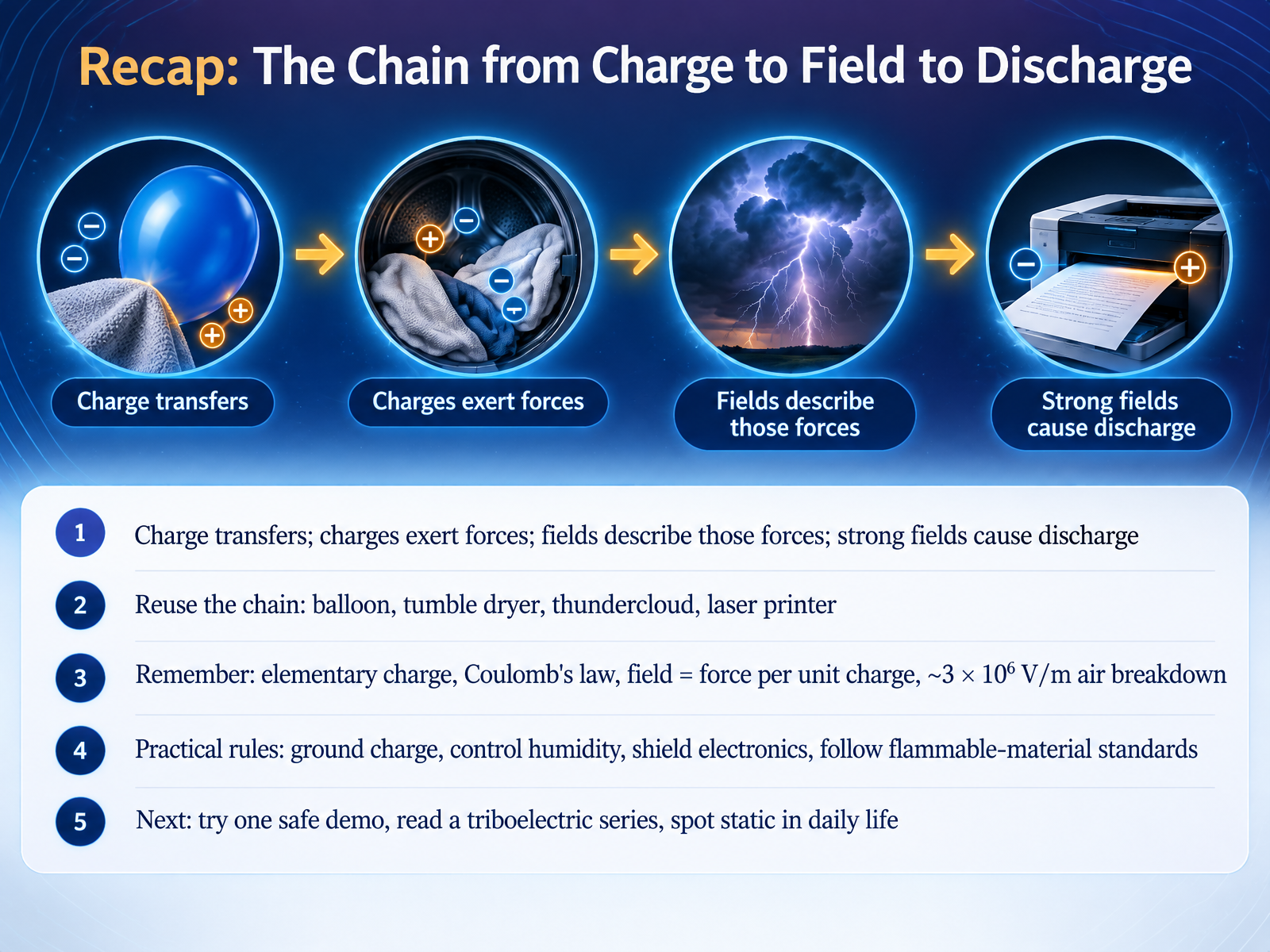
- 14Recap: The Chain from Charge to Field to DischargeLet's bring it all together. Charge transfers between materials. Those charges exert forces. Fields describe those forces. And strong enough fields cause discharge. You can trace that same chain in a balloon, a tumble dryer, a thundercloud, and a laser printer. Keep four ideas close. The elementary charge is the smallest free charge unit. Coulomb's law describes the force between charges. The field is force per unit charge. And air breaks down near three times ten to the sixth volts per meter, though humidity and pressure shift that value. Practically, we ground conductors, control humidity, shield electronics, and follow flammable-material standards. Next, try one safe demonstration, read a triboelectric series, and notice static in daily life. Thank you for working through this. You now have a solid chain to reason from, so keep asking why the charge moved.
 instructional-resources.physics.uiowa.edusciencedemonstrations.fas.harvard.eduscience.howstuffworks.com+22 min
Take the deck with you
Download this course as a file — free, no sign-up needed.
- PDF handoutEvery slide page, ready to print or share.15 pages · 4.1 MBDownload
- Narrated PowerPointThe deck that presents itself — every slide carries the digital human's narration video.15 pages · 12.6 MBDownload
- PowerPoint slidesThe full deck as a .pptx — open it in PowerPoint, Keynote, or Google Slides.15 pages · 4.0 MBDownload
Free to use in your own training — please keep the PersonWise credit page at the end.
Have your own deck? Turn it into a course
Sources consulted
Web sources consulted while building this course.
- 5A10.15 - Triboelectric Series | Instructional Resources and Lecture Demonstrations - Department of Physics & Astronomy | The University of Iowa — instructional-resources.physics.uiowa.edu
- Triboelectric Effects | Harvard Natural Sciences Lecture Demonstrations — sciencedemonstrations.fas.harvard.edu
- Static Electricity | HowStuffWorks — science.howstuffworks.com
- 56.06 -- Electrostatically charged rods — web.physics.ucsb.edu
- Quantifying the triboelectric series | Nature Communications — nature.com
- Investigating and improving introductory physics students’ understanding of the electric field and superposition principle — google.iopscience.iop.org
- Investigating and improving introductory physics students’ understanding of electric field and the superposition principle: The case of a continuous charge distribution — journals.aps.org
- Student understanding of symmetry and Gauss’s law of electricity — arxiv.org
- Electric field lines: The implications of students' interpretation on their understanding of the concept of electric field and of the superposition principle — pubs.aip.org
- Students' understanding of the concept of the electric field through conversions of multiple representations | Phys. Rev. Phys. Educ. Res. — journals.aps.org
- NFPA 77, Recommended Practice on Static Electricity (2024) — nfpa.org
- Recommendations for Requirements for Avoiding Electrostatic Hazards in Industry 2007 — jniosh.johas.go.jp
- Grounding — webstore.ansi.org
- Earthing - HSE — hse.gov.uk
- California Code of Regulations, Title 8, Section 6775. Static Electricity. — dir.ca.gov
- Effect of humidity on dielectric breakdown properties of air considering ion kinetics - IOPscience — google.iopscience.iop.org
- Influence of absolute humidity on the electrical breakdown in air — doi.org
- The humidity effect on the breakdown voltage characteristics and the transport parameters of air — sciencedirect.com
- Basic discharge processes in the atmosphere | Lightning Electromagnetics. Volume 2 — digital-library.theiet.org
- Effect of Humidity on the Breakdown of a 1-cm. Homogeneous Field Spark Gap in Air — nature.com