Begin
14 pages · ~28 min
Socratic Method: Learning Through Questions
This training teaches the Socratic method, helping learners use thoughtful questioning to deepen understanding and critical thinking. Ideal for educators and facilitators.
A digital instructor presents all 14 pages. Hold “Ask” at any point and ask out loud — the answer comes from this course. No sign-up needed.
What you’ll learn
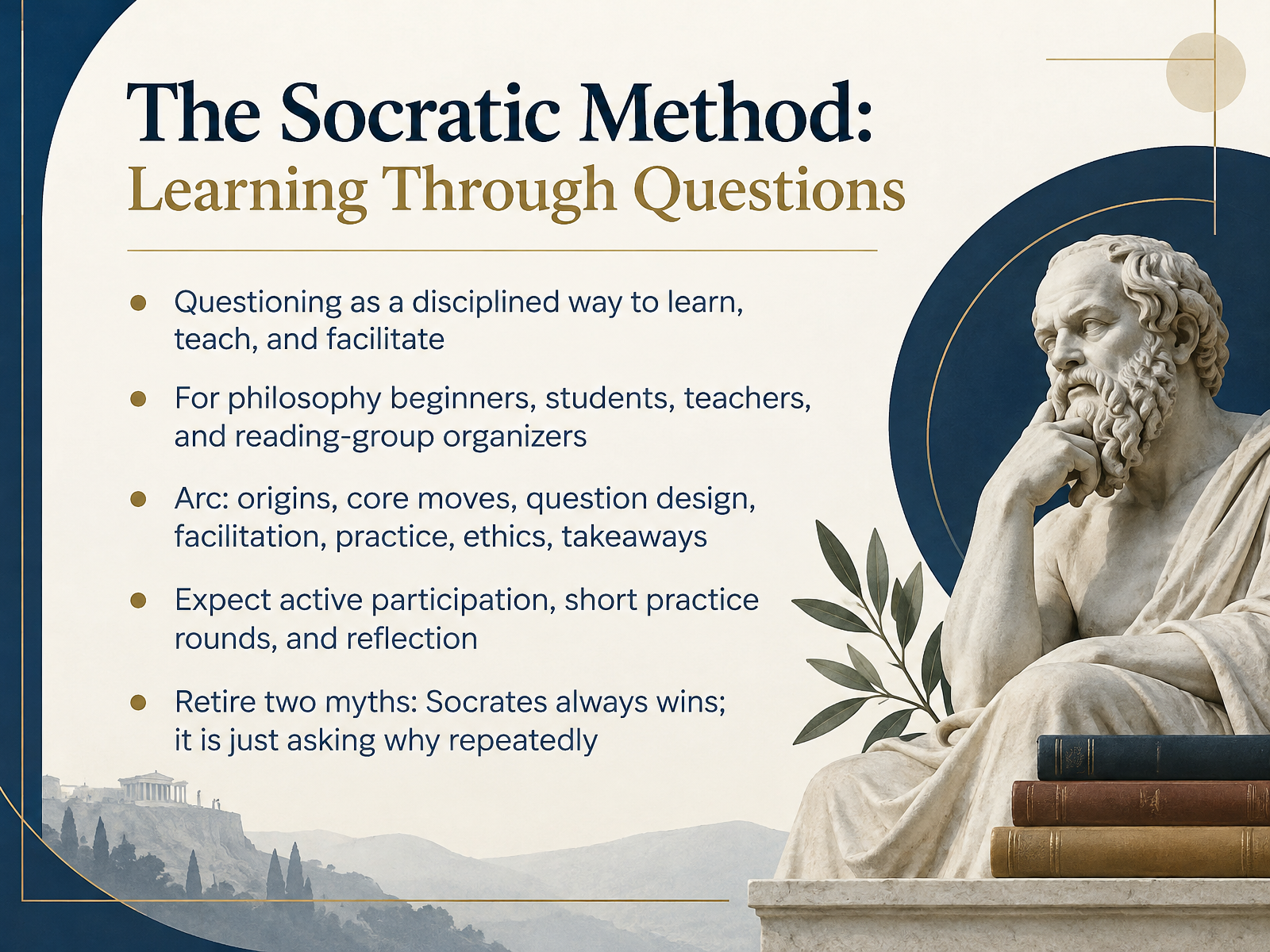
- 01The Socratic Method: Learning Through QuestionsWelcome. Over the next few slides, we'll explore the Socratic method as a disciplined way to learn, to teach, and to run a good discussion. So, here's my first question for you. When was the last time a question genuinely changed your mind? Take a moment. Answer silently. You might ask yourself what made that question work. This course is for philosophy beginners, students, teachers, and reading group organizers. We'll cover origins, core moves, question design, facilitation, practice, ethics, and takeaways. Expect to participate. There will be short practice rounds and time for reflection. One way to look at this is that the method is less about winning and more about thinking carefully together. Along the way, we'll retire two myths. That Socrates always wins. And that it is just asking why, over and over. In your next discussion, try listening for those assumptions. Let's begin with origins and the problem of sources.cambridge.orgjstor.orgcambridge.org+22 min
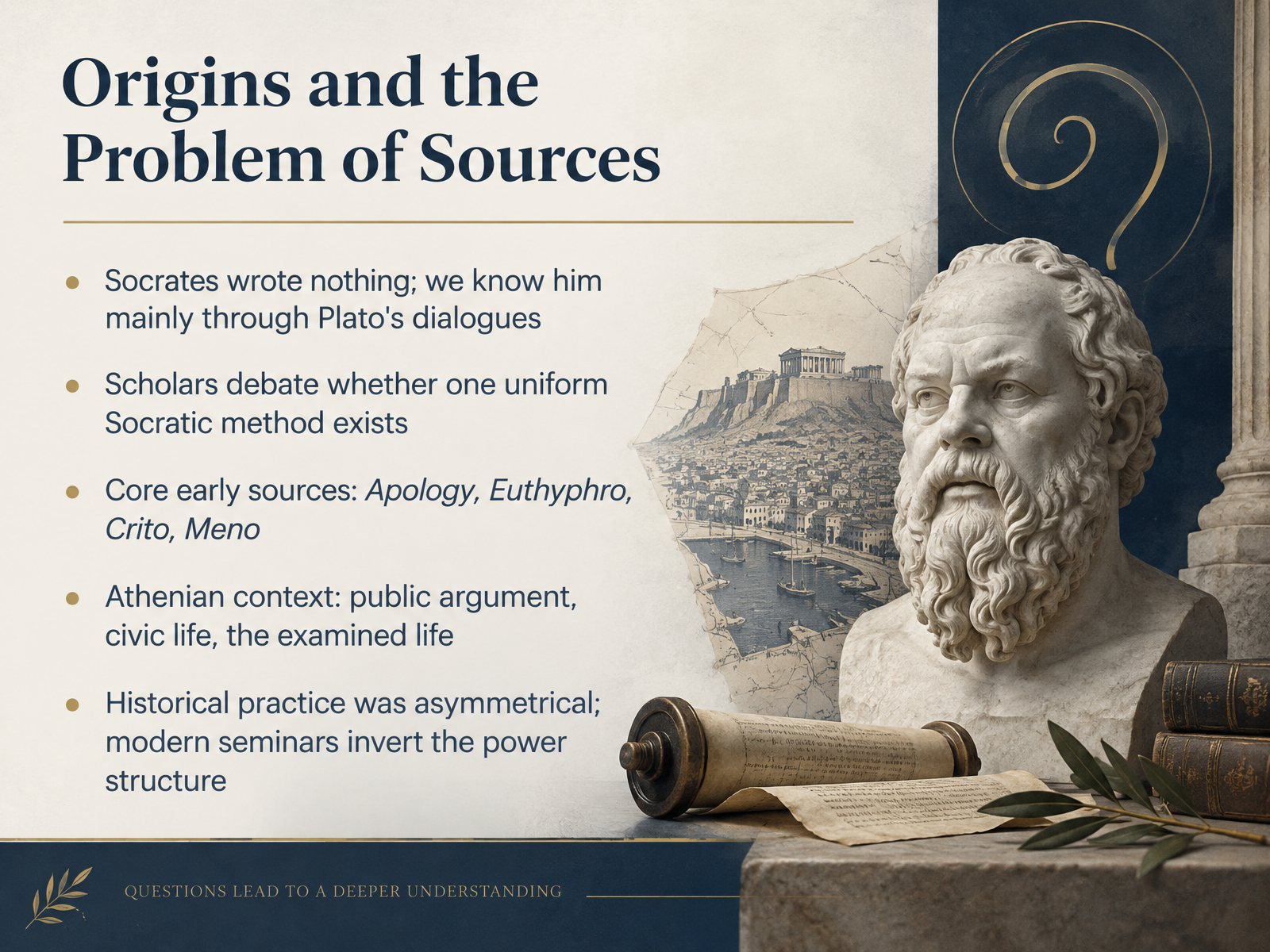
- 02Origins and the Problem of SourcesLet's begin with where this method comes from, and why the sources are trickier than they look. Here's a question to hold. If someone never wrote anything down, how do we know what they taught? Socrates wrote nothing. We know him mainly through Plato's dialogues, where he appears as a character. So one way to look at this is that we're meeting Socrates through someone else's portrait. Scholars still debate whether there is one uniform Socratic method at all. The core early sources are the Apology, Euthyphro, Crito, and Meno. Picture the Athenian setting: public argument, civic life, and the examined life. Historical practice was asymmetrical, with Socrates steering the questioning. Modern seminars invert that power structure, sharing the guidance across the group. In your next discussion, try naming which source you're drawing on. Next, we turn to core moves: elenchus, aporia, and maieutics.
 cambridge.orgjstor.orgcambridge.org+22 min
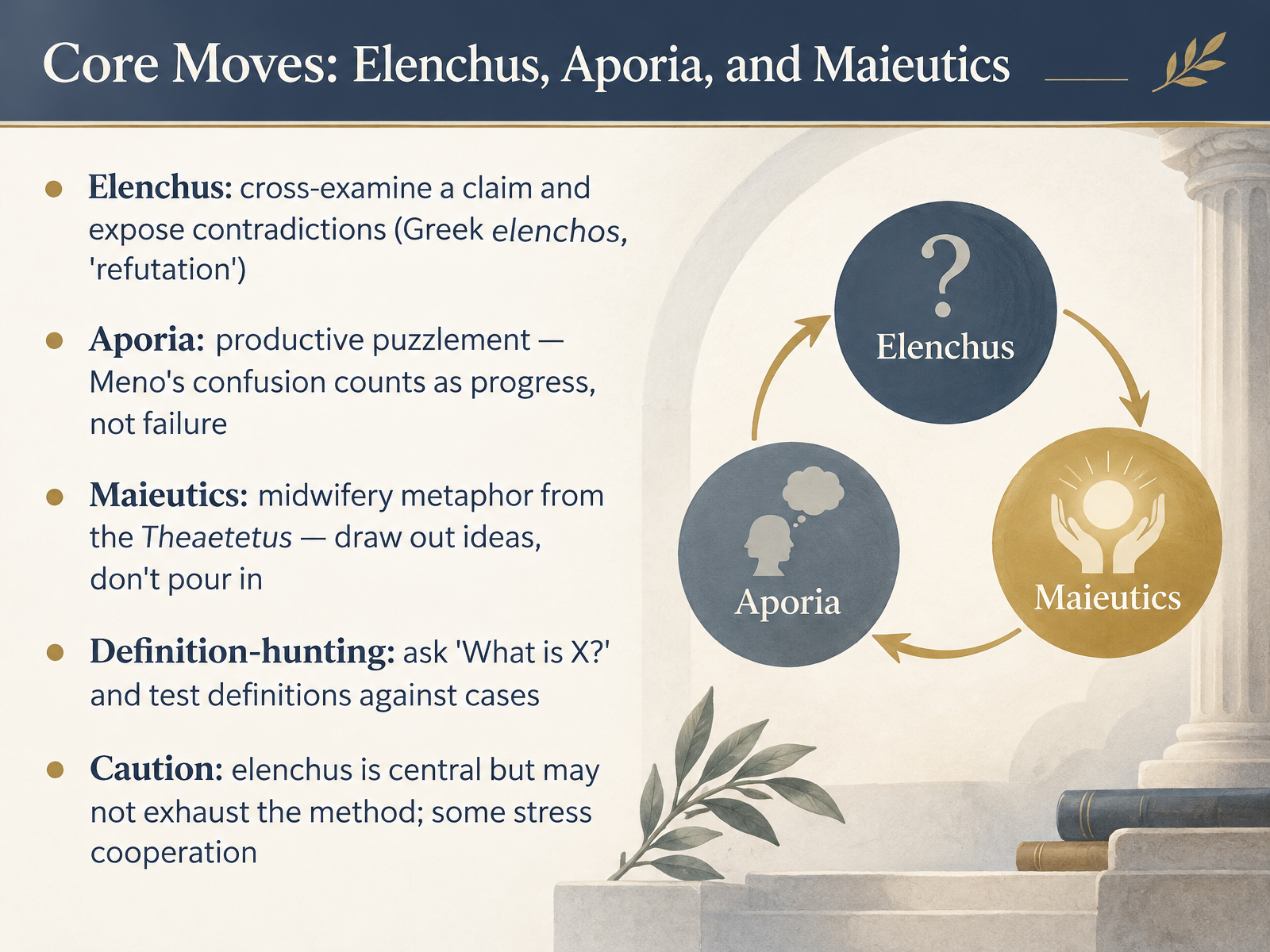
- 03Core Moves: Elenchus, Aporia, and MaieuticsLet's look at the core moves inside this method. Three names come up again and again. Elenchus, aporia, and maieutics. Elenchus means cross examination. You take a claim, ask what else the person believes, and gently show where those beliefs contradict each other. The Greek word means refutation. Here is a small example. Suppose someone says courage is endurance of the soul. You might ask, is ignorant endurance really a fine thing? They say no. So courage cannot simply be endurance. Aporia is the puzzlement that follows. It feels like being stuck, but Meno's confusion counts as progress, not failure. Maieutics comes from the Theaetetus. Socrates compares himself to a midwife. A midwife does not pour in a baby. She helps someone bring forth what is already within. So in your next discussion, try drawing ideas out rather than pouring them in. One caution. Elenchus is central, but it may not exhaust the whole method, and some scholars stress cooperation over confrontation. Next, let's look at the anatomy of a good Socratic question.
 iep.utm.eduocw.mit.eduplato.stanford.edu+22 min
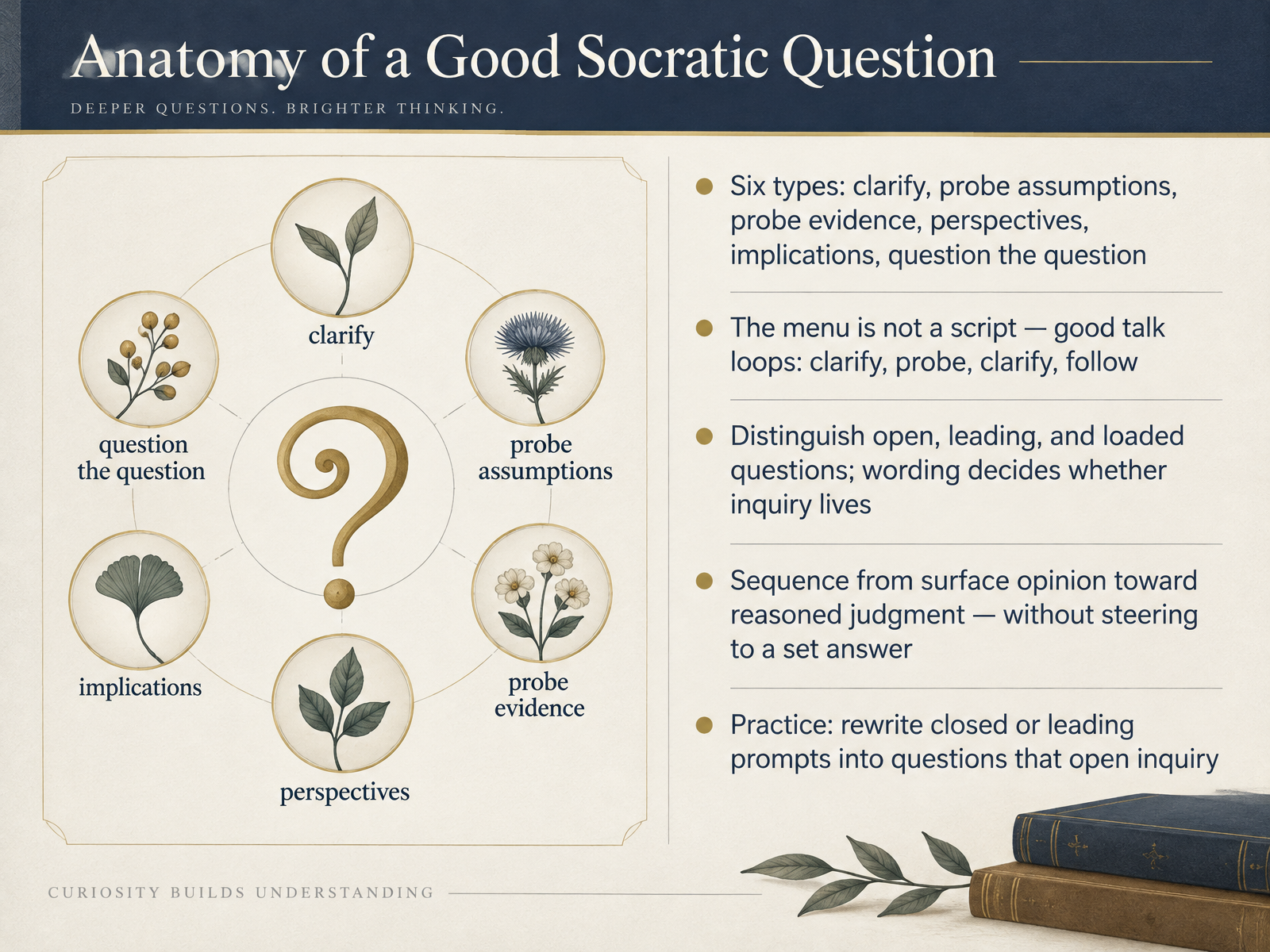
- 04Anatomy of a Good Socratic QuestionNow let's look inside a good Socratic question. There are six common types. Clarify: what do you mean by that? Probe assumptions: what are you taking for granted? Probe evidence: how do you know? Perspectives: how would someone who disagrees see this? Implications: if that is true, what follows? And finally, question the question: why does this matter? The list is a menu, not a script. Real talk loops. Clarify, probe, clarify again, then follow. In your next discussion, listen for the difference between open, leading, and loaded questions. Wording decides whether inquiry lives. Some of you might ask yourself: does my question invite thought, or steer toward my answer? Try this. Take one closed or leading prompt and rewrite it to open genuine inquiry. Keep the sequence moving from surface opinion toward reasoned judgment, without steering. Next, we turn to facilitating dialogue without lecturing.
 kinetics.engin.umich.edumindsera.comserc.carleton.edu+22 min
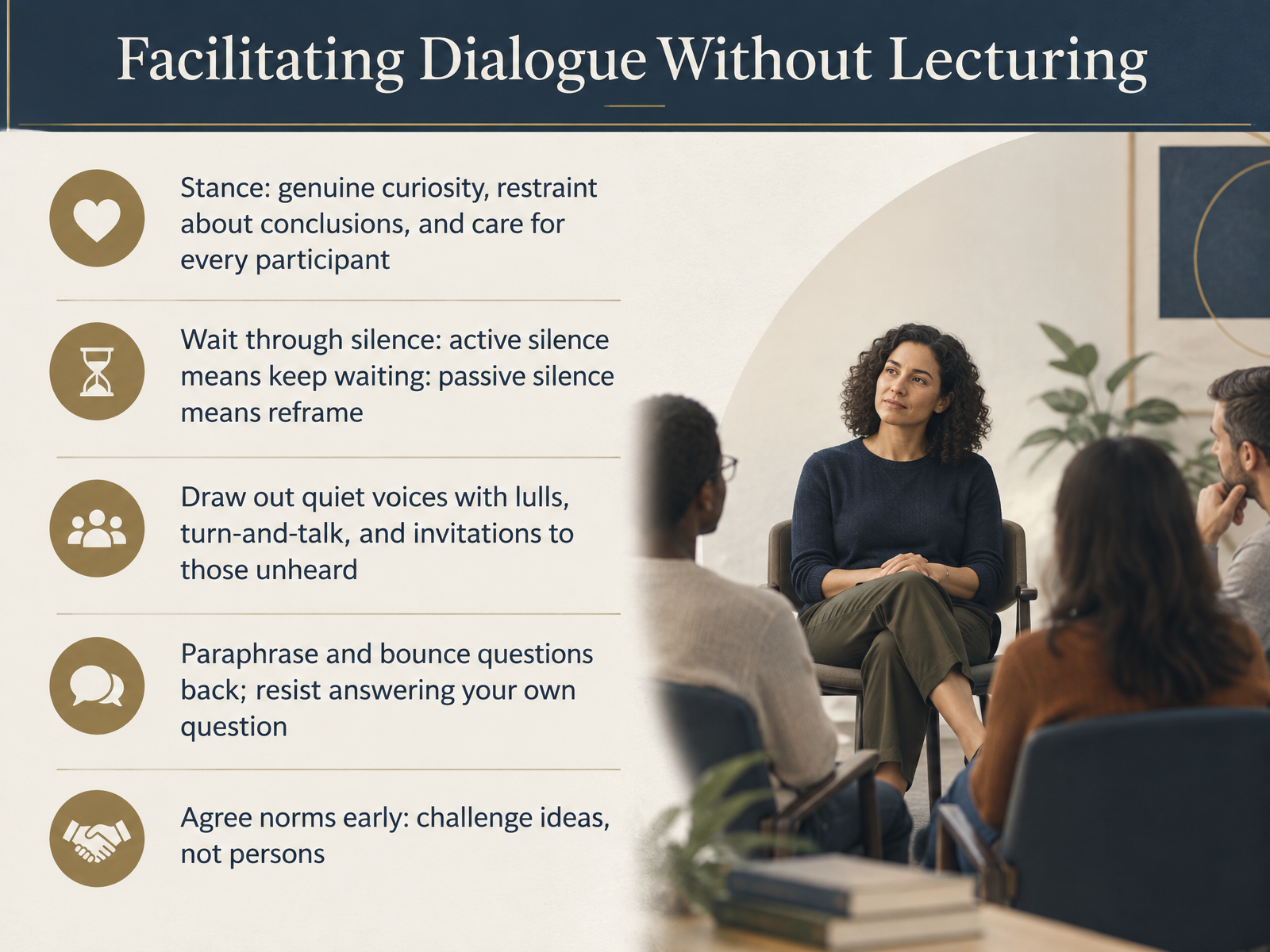
- 05Facilitating Dialogue Without LecturingSo how do you actually facilitate a dialogue without turning it into a lecture? Start with stance. Bring genuine curiosity, hold back from steering toward your own conclusion, and care about every participant. Then, wait through silence. Here is a useful distinction. Active silence means keep waiting. Passive silence means reframe, maybe by asking, how could we rephrase this question? To draw out quiet voices, wait for a lull, ask a new question, try a turn and talk, then invite someone who has not spoken yet. Paraphrase what you hear and bounce the question back. Resist answering your own question. In your next discussion, try agreeing on norms early, such as challenge ideas, not persons. Next, let us look at designing a Socratic seminar in the classroom.
 charlesamesfischer.commentorteaching.comkaporfoundation.org+21 min
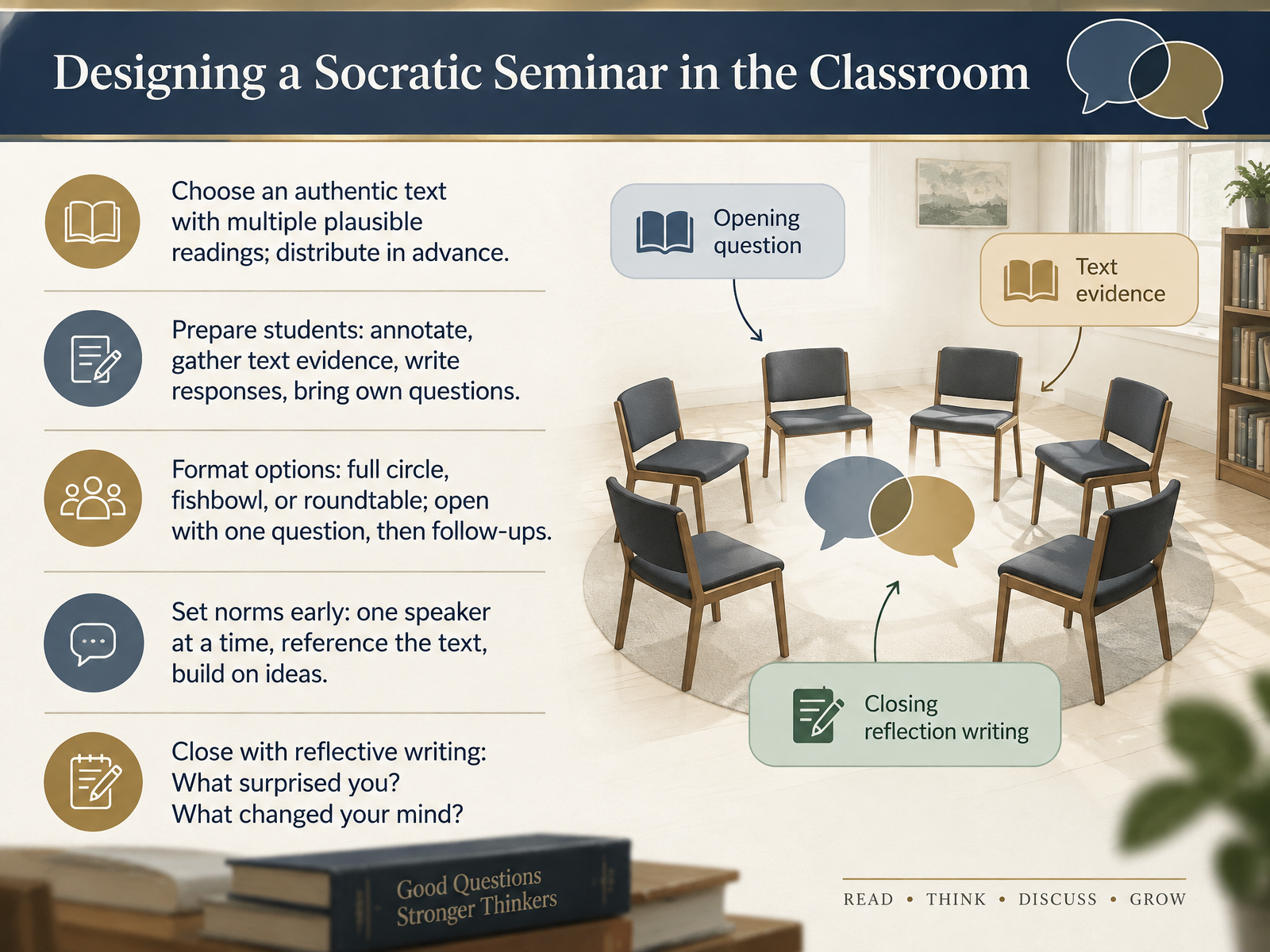
- 06Designing a Socratic Seminar in the ClassroomLet's turn to designing a Socratic seminar in your own classroom. First, choose an authentic text that supports more than one plausible reading, and share it in advance. Then prepare students: ask them to annotate, gather text evidence, write brief responses, and bring their own questions. For format, one way to look at this is a full circle, a fishbowl with an inner and outer circle, or a roundtable. Open with one question, then follow up. Set norms early: one speaker at a time, reference the text, build on ideas. In your next discussion, try closing with reflective writing. You might ask, what surprised you? What changed your mind? Next, we look at questioning across subjects and age groups.
 1 min
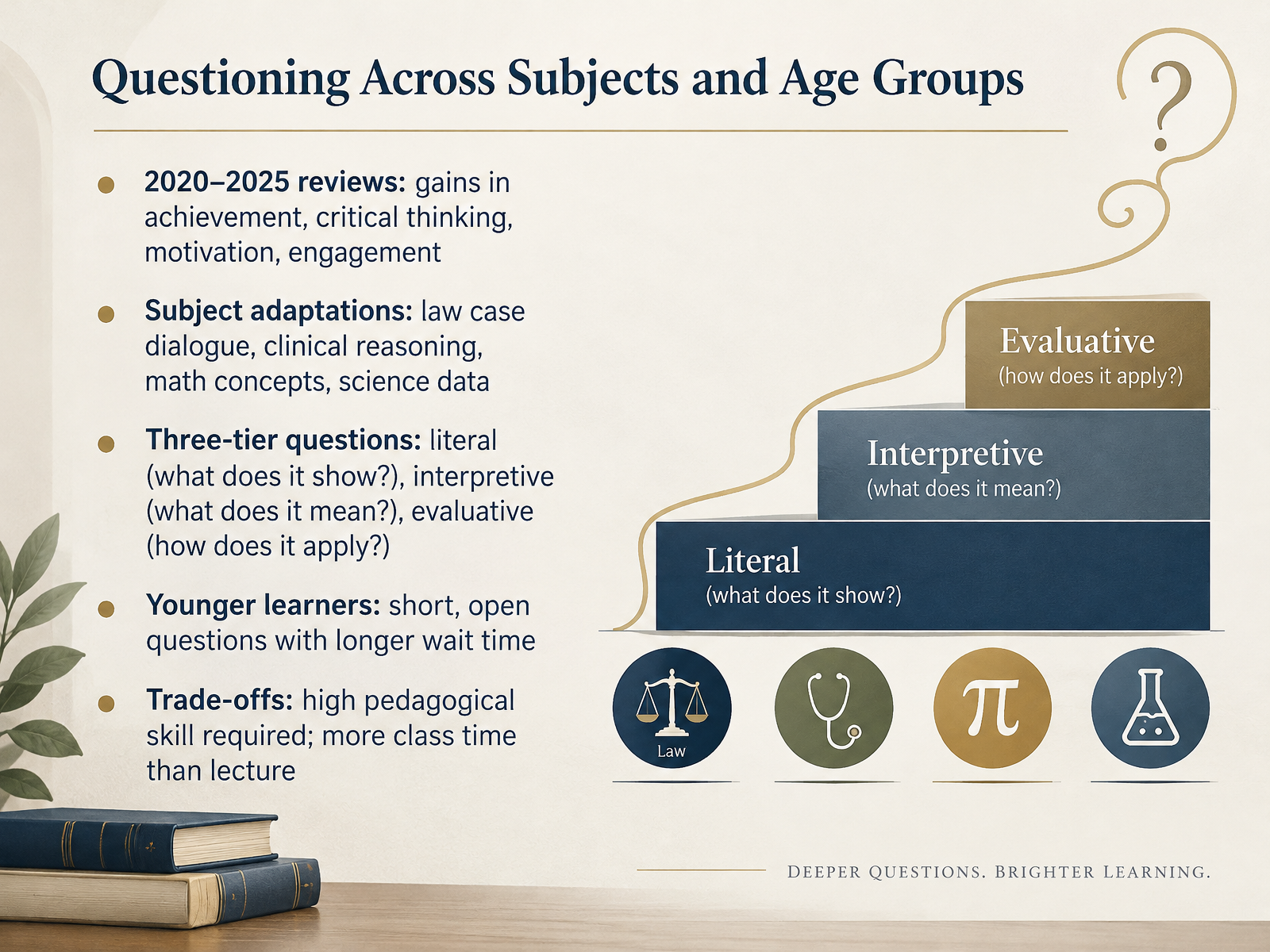
- 07Questioning Across Subjects and Age GroupsNow let's look at how questioning travels across subjects and age groups. A review of twenty studies from twenty twenty to twenty twenty-five found gains in achievement, critical thinking, motivation, and engagement. Subjects adapt the method differently. Law uses case dialogue. Medicine uses clinical reasoning. Math teachers question to build concepts, and science classes question data. One useful structure is three tiers of questions. Literal: what does it show? Interpretive: what does it mean? Evaluative: how does it apply? With younger learners, try short, open questions and wait longer before speaking. One trade-off to keep in mind: this approach asks a lot of pedagogical skill, and it takes more class time than lecture. Next, we turn to reading groups and everyday inquiry.
 en.wikipedia.org1 min
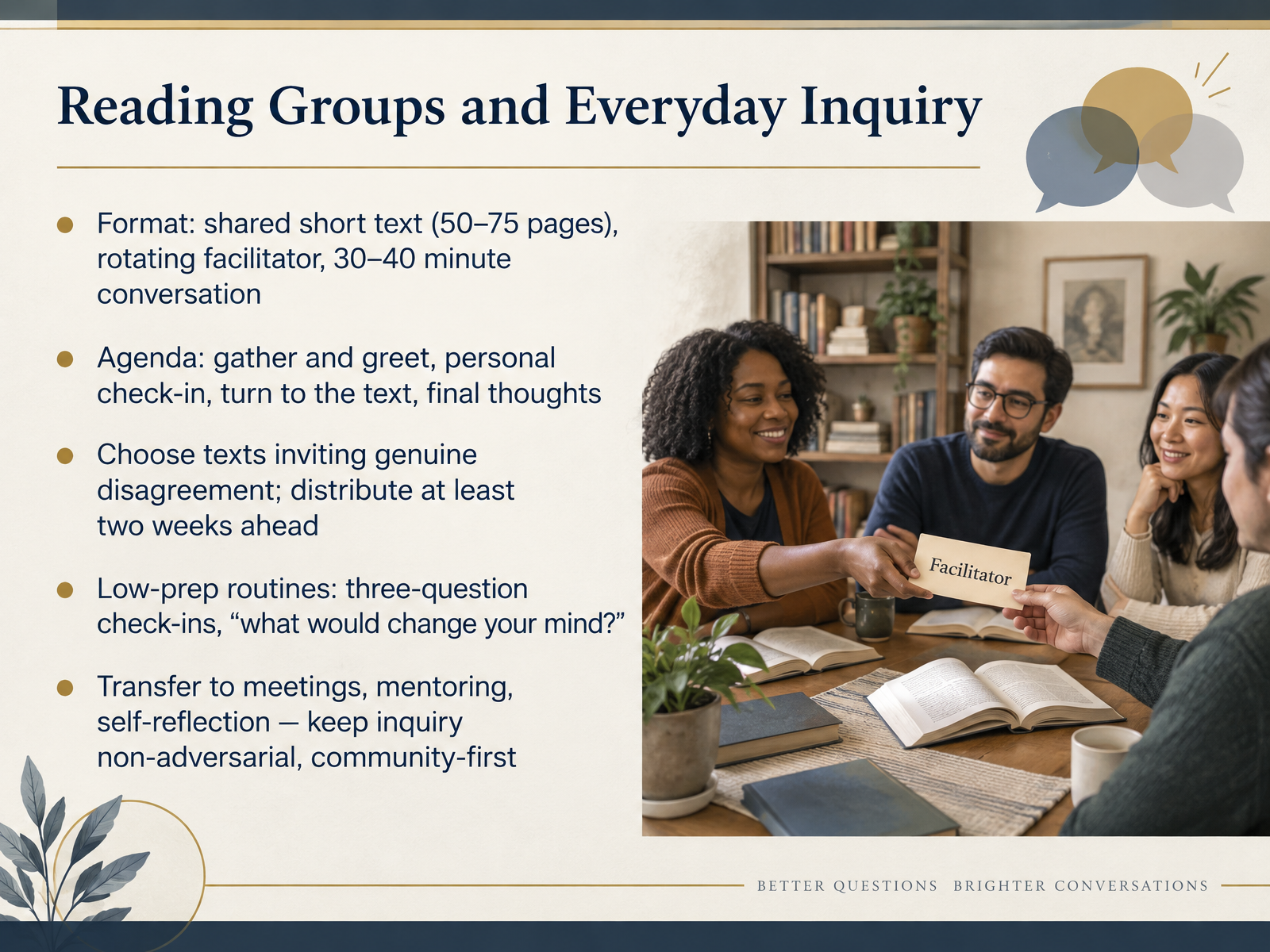
- 08Reading Groups and Everyday InquiryLet's bring this into reading groups and everyday inquiry. A simple format works well. Choose a shared short text of about fifty to seventy-five pages, rotate the facilitator, and set aside thirty to forty minutes for conversation. The agenda can stay light: gather and greet, a personal check-in, turn to the text, then final thoughts. When you choose texts, look for ones that invite genuine disagreement. And send them out at least two weeks ahead. You might ask yourself, does this text allow more than one honest reading? Two low-prep routines help. Start with a three-question check-in. And ask, what would change your mind? In your next discussion, try keeping inquiry non-adversarial. Put community first. These habits carry over into meetings, mentoring, and self-reflection. Next, let's look at common pitfalls and ethical boundaries.
 1 min
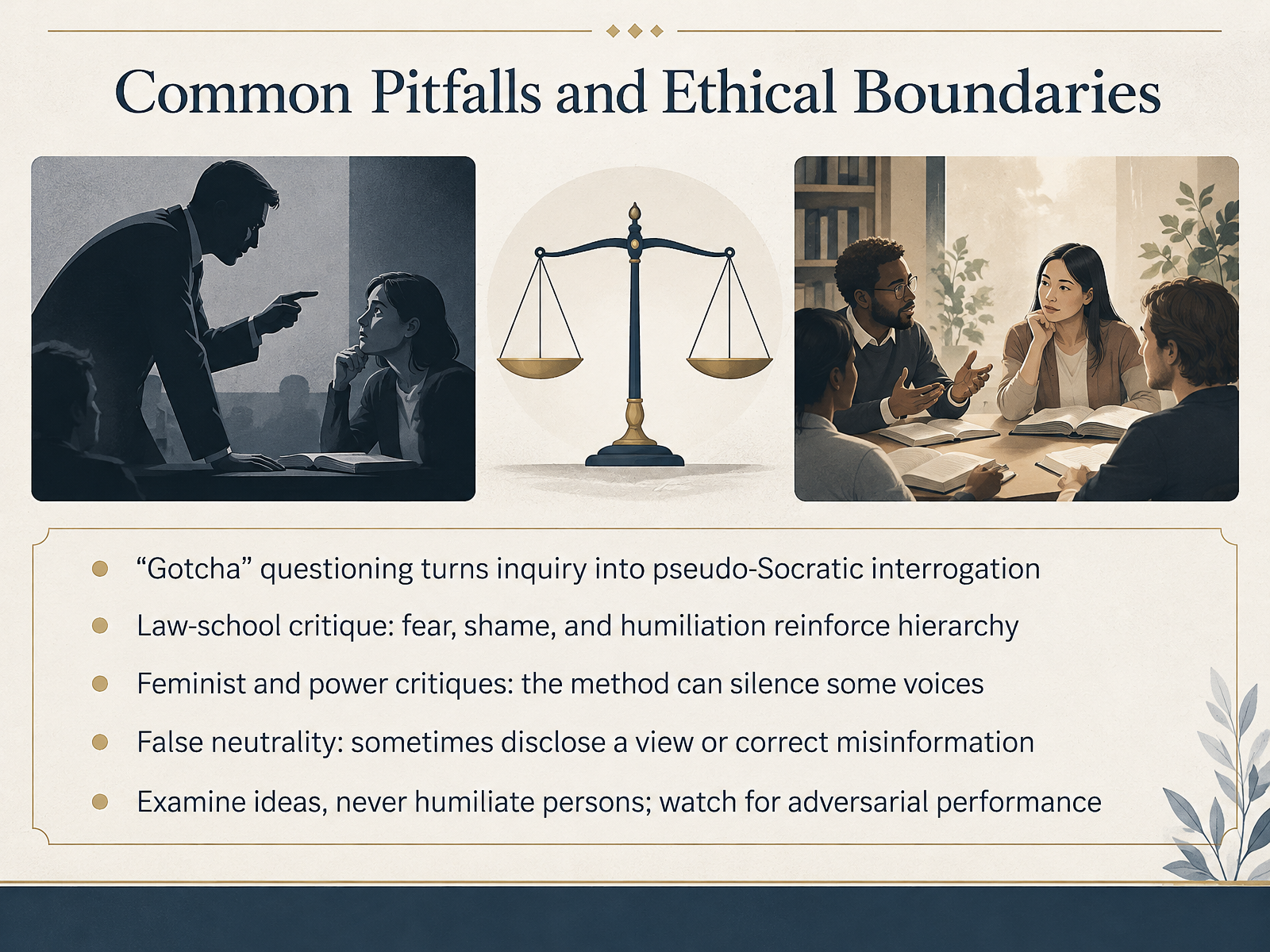
- 09Common Pitfalls and Ethical BoundariesNow let's look at where this method can go wrong. One pitfall is gotcha questioning, where inquiry turns into pseudo-Socratic interrogation. You might ask yourself, am I asking to understand this person's thinking, or to catch them out? In law-school critiques, fear, shame, and humiliation reinforce hierarchy. So one way to look at this is to ask whether the method is silencing some voices. And there's false neutrality. Sometimes the honest move is to disclose a view or correct misinformation. In your next discussion, try this. Examine ideas, never humiliate persons, and watch for adversarial performance. That keeps the questions humane and the inquiry shared. Next, in Practice Studio, you'll run a short Socratic inquiry.
 2 min
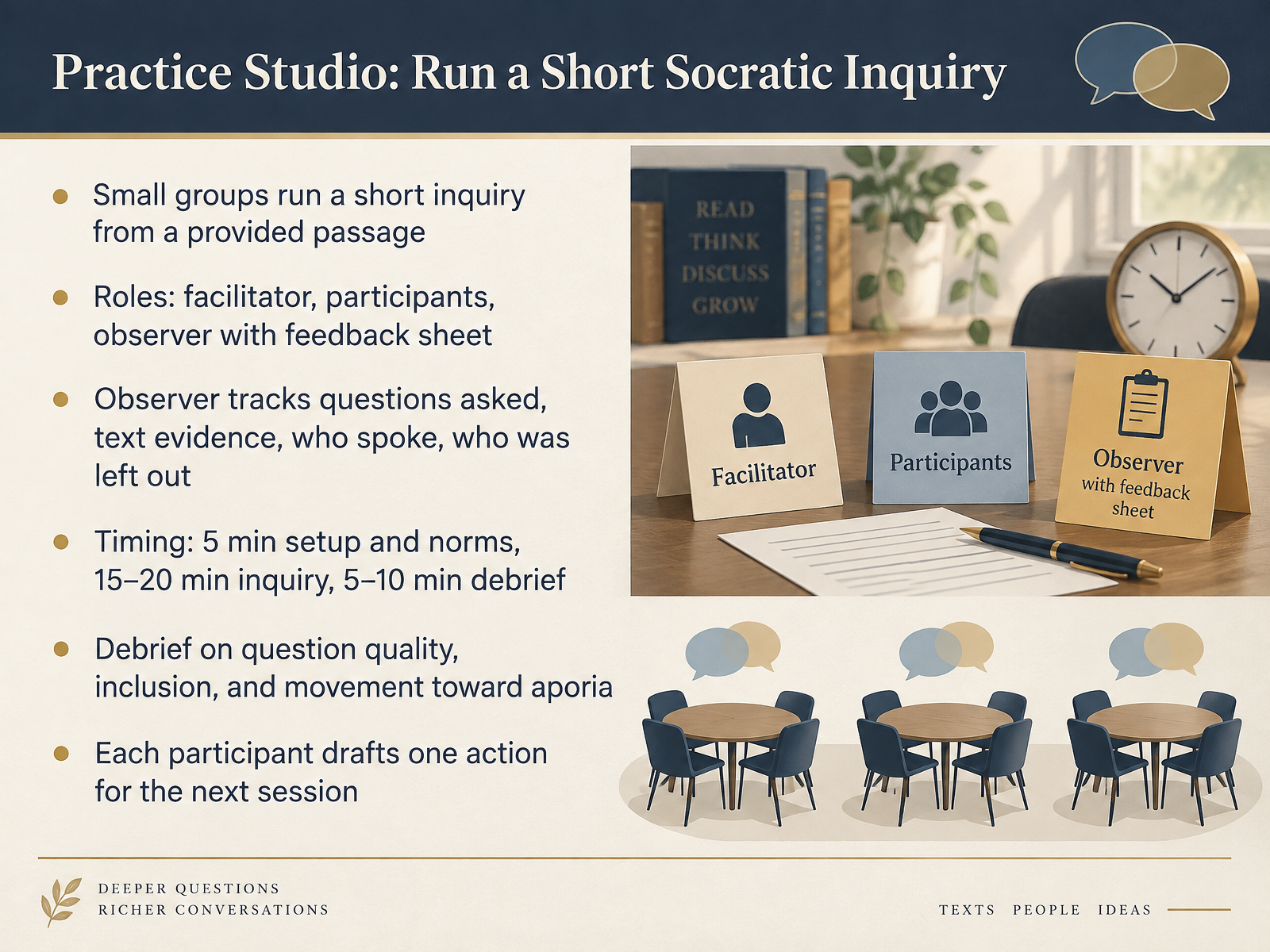
- 10Practice Studio: Run a Short Socratic InquiryNow let's put it into practice. In small groups, run a short Socratic inquiry on a passage you provide. Before you begin, set aside five minutes for setup and norms. Then run the inquiry for fifteen to twenty minutes. Assign three roles: a facilitator, participants, and an observer. The observer uses a feedback sheet to track three things. Which questions were asked? Where did people point to the text? And who spoke, and who was left out? One way to look at this is simple. The observer's notes are data, not judgment. Afterward, take five to ten minutes to debrief. Ask yourselves: How good were our questions? Was the group inclusive? And did we move toward aporia, that useful place of not knowing? Here's your next step. Each participant drafts one concrete action for the next session. In your next discussion, try tracking who hasn't spoken. That leads us to assessment that rewards reasoning, not volume.
 charlesamesfischer.commentorteaching.comkaporfoundation.org+22 min
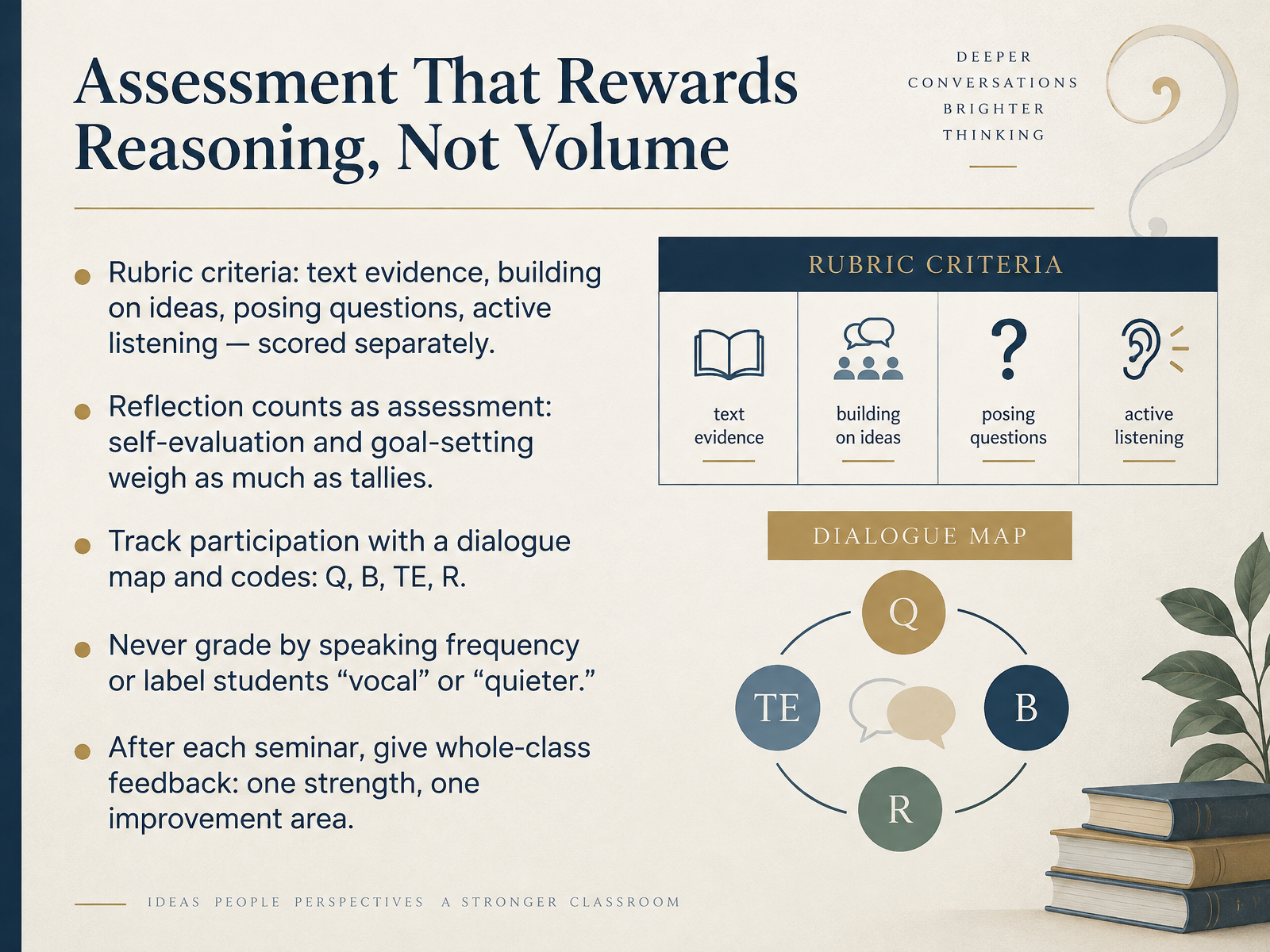
- 11Assessment That Rewards Reasoning, Not VolumeLet's look at how we assess a Socratic seminar. Here is one way to think about it. The rubric should reward reasoning, not volume. So score text evidence, building on ideas, posing questions, and active listening separately. Not one big participation tally. Now you might ask yourself, does reflection count? In this approach, yes. Self-evaluation and goal-setting weigh as much as your tallies. To track participation, try a simple dialogue map. While students talk, code each contribution. Q for questions. B for building. T E for text evidence. R for responding. Here is a caution. Never grade by how often someone speaks. And avoid labeling students as vocal or quieter. Labels stick, and they change behavior. After each seminar, give the whole class one strength and one improvement area. In your next discussion, try coding one seminar and sharing that feedback. That keeps the focus on reasoning. Where the Method Meets Its Limits.
 2 min
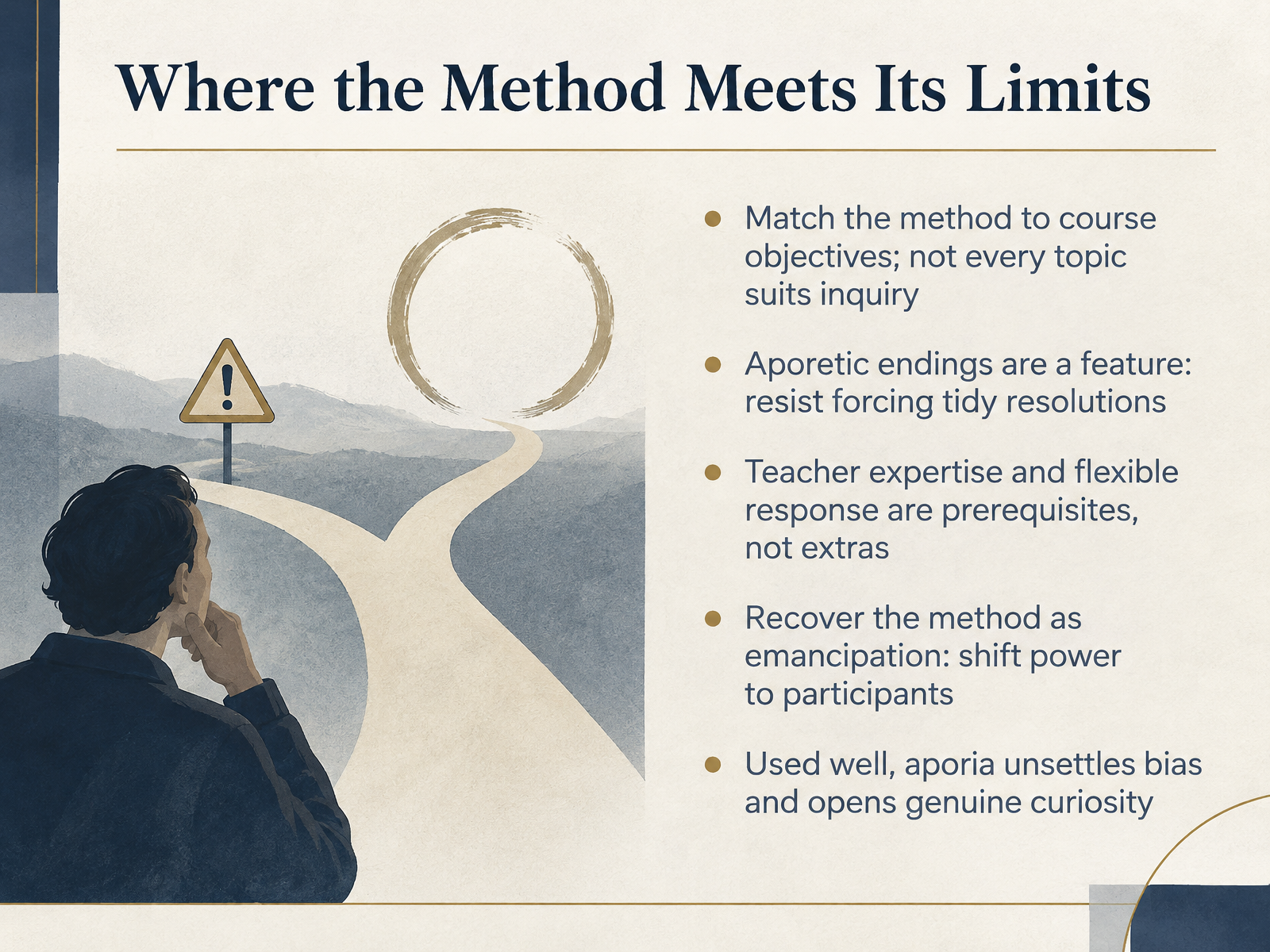
- 12Where the Method Meets Its LimitsNow let's turn to where the method meets its limits. One way to look at this is to ask yourself, does every topic really suit inquiry? Try matching the method to your course objectives, and let some content be taught directly. Next, when a discussion ends in aporia, that puzzlement is a feature, not a failure. Resist forcing a tidy resolution. You might ask yourself, can I sit with not knowing for a moment? Also remember that teacher expertise and flexible response are prerequisites, not extras. And used well, the method becomes emancipation. Shift power to participants by having students question each other, and by asking questions you don't already know the answer to. In your next discussion, try handing the questioning over and seeing what opens up. Next, we'll gather the key takeaways and a starter reading list.
 iep.utm.eduocw.mit.eduplato.stanford.edu+21 min
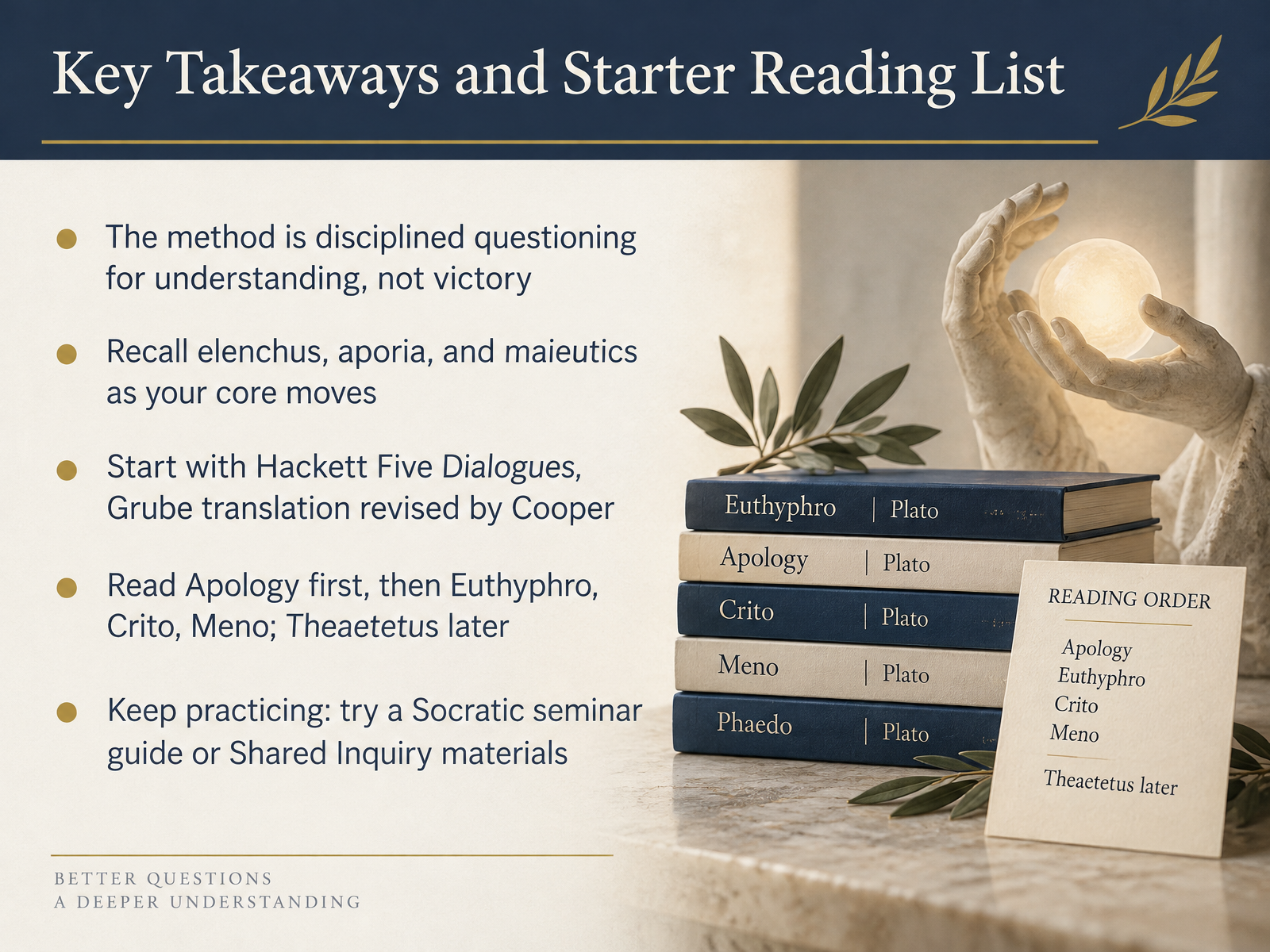
- 13Key Takeaways and Starter Reading ListLet's bring this together with a few takeaways you can carry into your next discussion. First, remember that the method is disciplined questioning for understanding, not victory. The goal is to think together, not to win. Second, keep three core moves in mind: elenchus, testing a belief through questions; aporia, the honest puzzlement that follows; and maieutics, helping someone give birth to their own ideas. And if you want a starting point for reading, try the Hackett Five Dialogues, in the Grube translation revised by Cooper. Read the Apology first, then Euthyphro, Crito, and Meno. Save the Theaetetus for later. Finally, keep practicing. You might ask yourself, in your next class or book club, which of these moves could I try? A Socratic seminar guide or Shared Inquiry materials can give you a useful structure. Now let's turn to the final slide: Self-Assessment and Next Steps.
 2 min
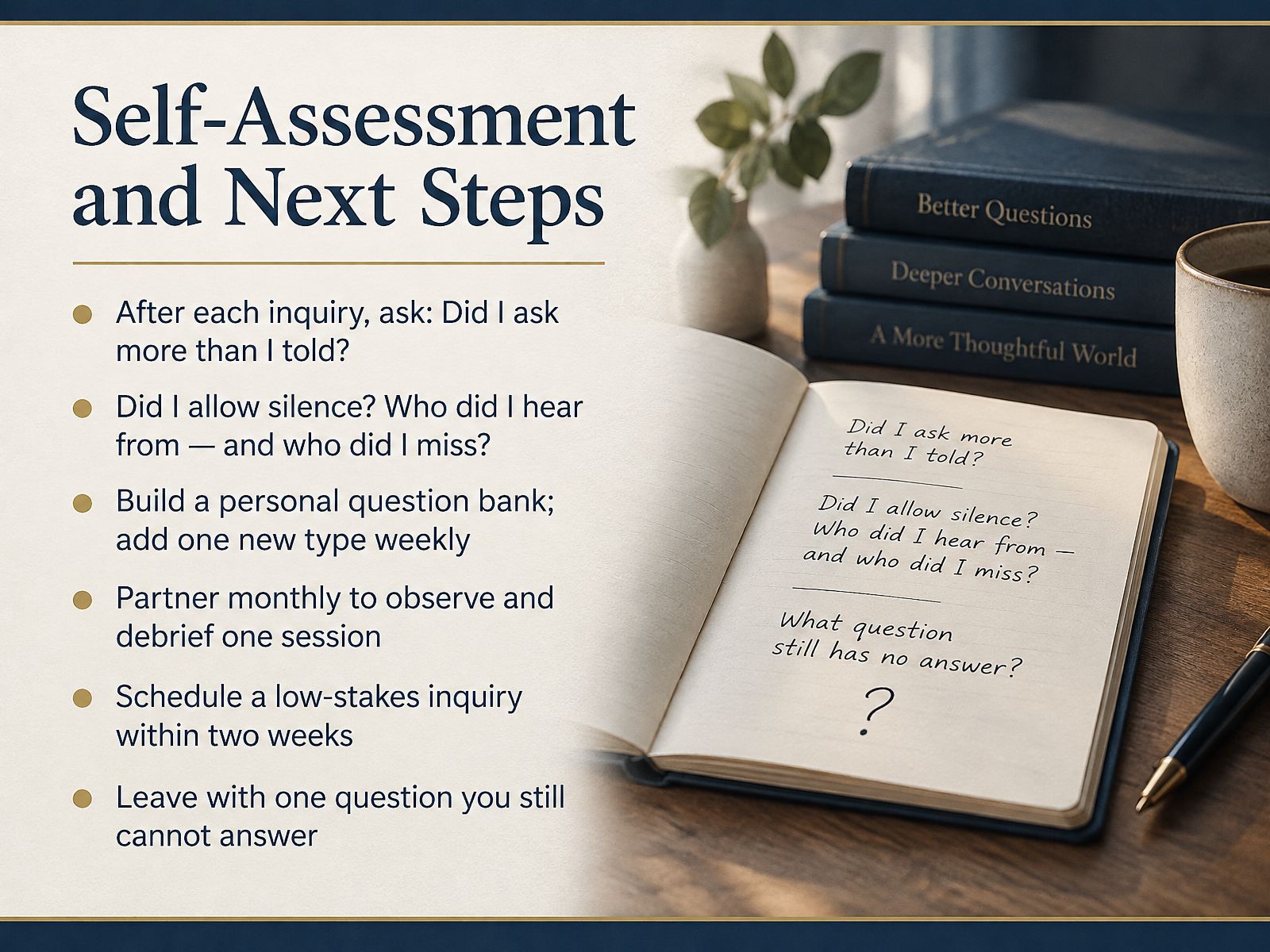
- 14Self-Assessment and Next StepsLet's close by turning the questions back on ourselves. After your next inquiry, ask: did I ask more than I told? Did I allow silence? And who did I hear from, and who did I miss? You might keep a small question bank and add one new type each week, such as a question about assumptions or consequences. Consider partnering monthly to observe and debrief one session. Then schedule a low-stakes inquiry within two weeks, so the habit takes root. Before you go, let one question stay with you, one you still cannot fully answer. Thank you for thinking with me. Keep asking, keep listening, and be patient with yourself. You are already becoming a better questioner.
 kinetics.engin.umich.edumindsera.comserc.carleton.edu+21 min
Take the deck with you
Download this course as a file — free, no sign-up needed.
- PDF handoutEvery slide page, ready to print or share.15 pages · 4.3 MBDownload
- Narrated PowerPointThe deck that presents itself — every slide carries the digital human's narration video.15 pages · 14.7 MBDownload
- PowerPoint slidesThe full deck as a .pptx — open it in PowerPoint, Keynote, or Google Slides.15 pages · 4.2 MBDownload
Free to use in your own training — please keep the PersonWise credit page at the end.
Have your own deck? Turn it into a course
Sources consulted
Web sources consulted while building this course.
- 8 - Socratic Method — cambridge.org
- Does Socrates Have a Method?: Rethinking the Elenchus in Plato's Dialogues and Beyond | JSTOR — jstor.org
- 1 - The Socratic elenchus: method is all — cambridge.org
- Socratic Philosophizing — doi.org
- The Structure of Enquiry in Plato's Early Dialogues — cambridge.org
- Socratic Method | Internet Encyclopedia of Philosophy — iep.utm.edu
- 24.01S16 Socratic Definition and the Elenchus — ocw.mit.edu
- Plato on Knowledge in the Theaetetus (Stanford Encyclopedia of Philosophy) — plato.stanford.edu
- Socratic method — en.wikipedia.org
- Introduction The Dialectic — oxfordphilsoc.org
- 6 types of Socratic Questions — kinetics.engin.umich.edu
- Socratic questioning: 6 types of questions, with examples — mindsera.com
- General Examples of Socratic Questions — serc.carleton.edu
- Questioning — criticalthinking.org
- Socratic Questioning: Examples, Techniques, and More — verywellmind.com
- Encouraging Students in Socratic Seminar - Charles Ames Fischer — charlesamesfischer.com
- Socratic Seminar Facilitation Best Practices: Guiding Meaningful Dialogue | Mentor Teaching — mentorteaching.com
- Socratic Seminar - Kapor Foundation — kaporfoundation.org
- Crafting and Conducting a Successful Socratic Seminar - National Council of Teachers of English — ncte.org
- Socratic Seminar — thatenglishteacher.com