Begin
13 pages · ~26 min
Cybersecurity Maturity Models Explained
A concise overview of cybersecurity maturity models for security professionals, explaining key frameworks and how to assess and improve an organization's security posture.
A digital instructor presents all 13 pages. Hold “Ask” at any point and ask out loud — the answer comes from this course. No sign-up needed.
What you’ll learn
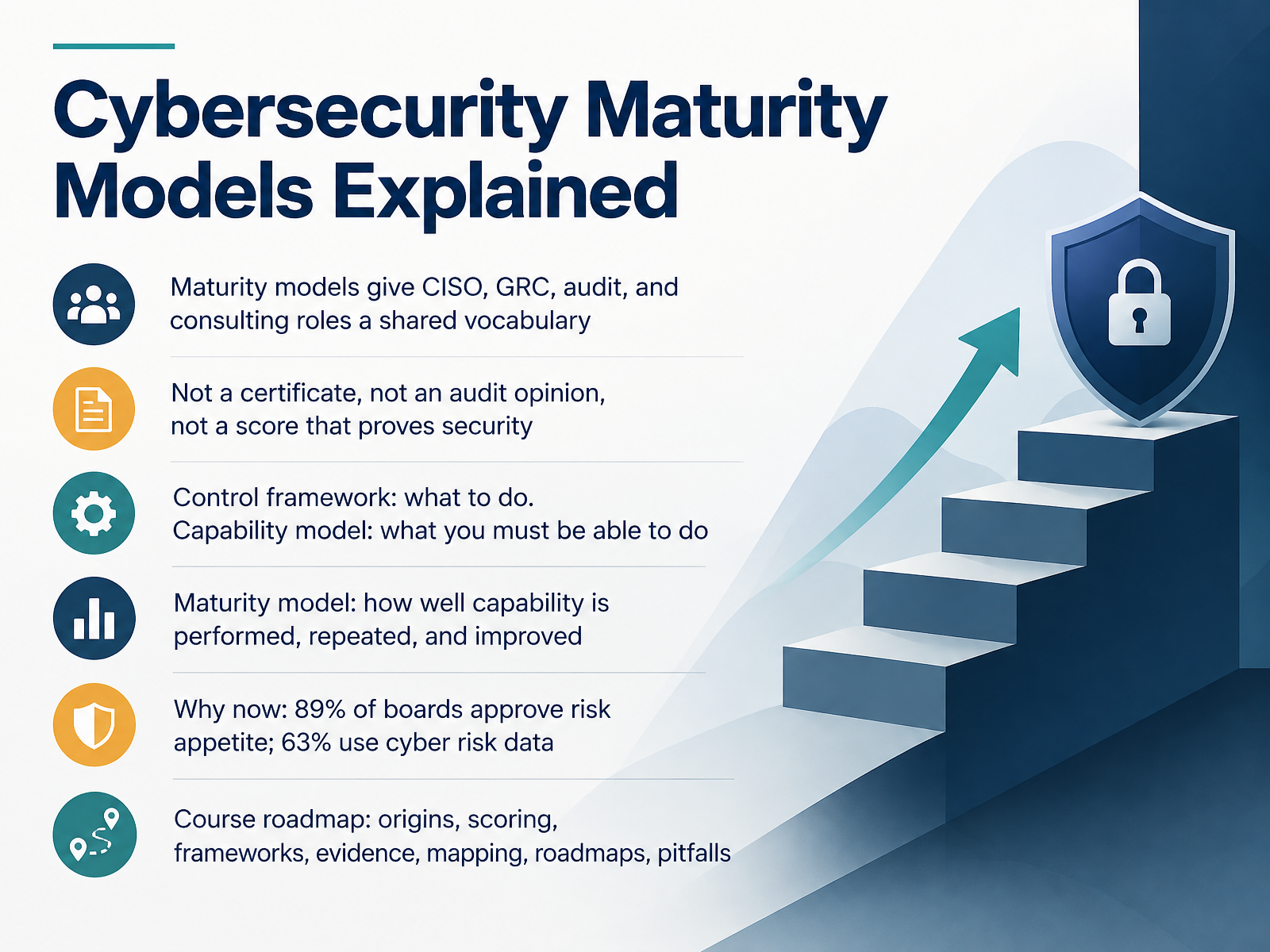
- 01Cybersecurity Maturity Models ExplainedWelcome. Over the next hour we will unpack cybersecurity maturity models, and what they actually mean for your program. This is not a fundamentals course. You already run governance, controls, and audit evidence. So we will treat models the way your board treats them, as a decision tool, not a certificate, not an audit opinion, and not a score that proves you are secure.
Maturity models give CISOs, GRC teams, auditors, and consultants a shared vocabulary. In practice, a control framework tells you what to do. A capability model tells you what you must be able to do. A maturity model measures how well that capability is performed, repeated, and improved. That distinction matters when you present to an audit committee.
Why now? Eighty nine percent of boards approve risk appetite, and sixty three percent now use cyber risk data. The trade-off to note is that a high score can hide a weak control. We will cover origins, scoring, frameworks, evidence, mapping, roadmaps, and pitfalls.
Let us start with background, from software process maturity to cyber maturity.decryptiondigest.comtechtarget.comkovrr.com+22 min
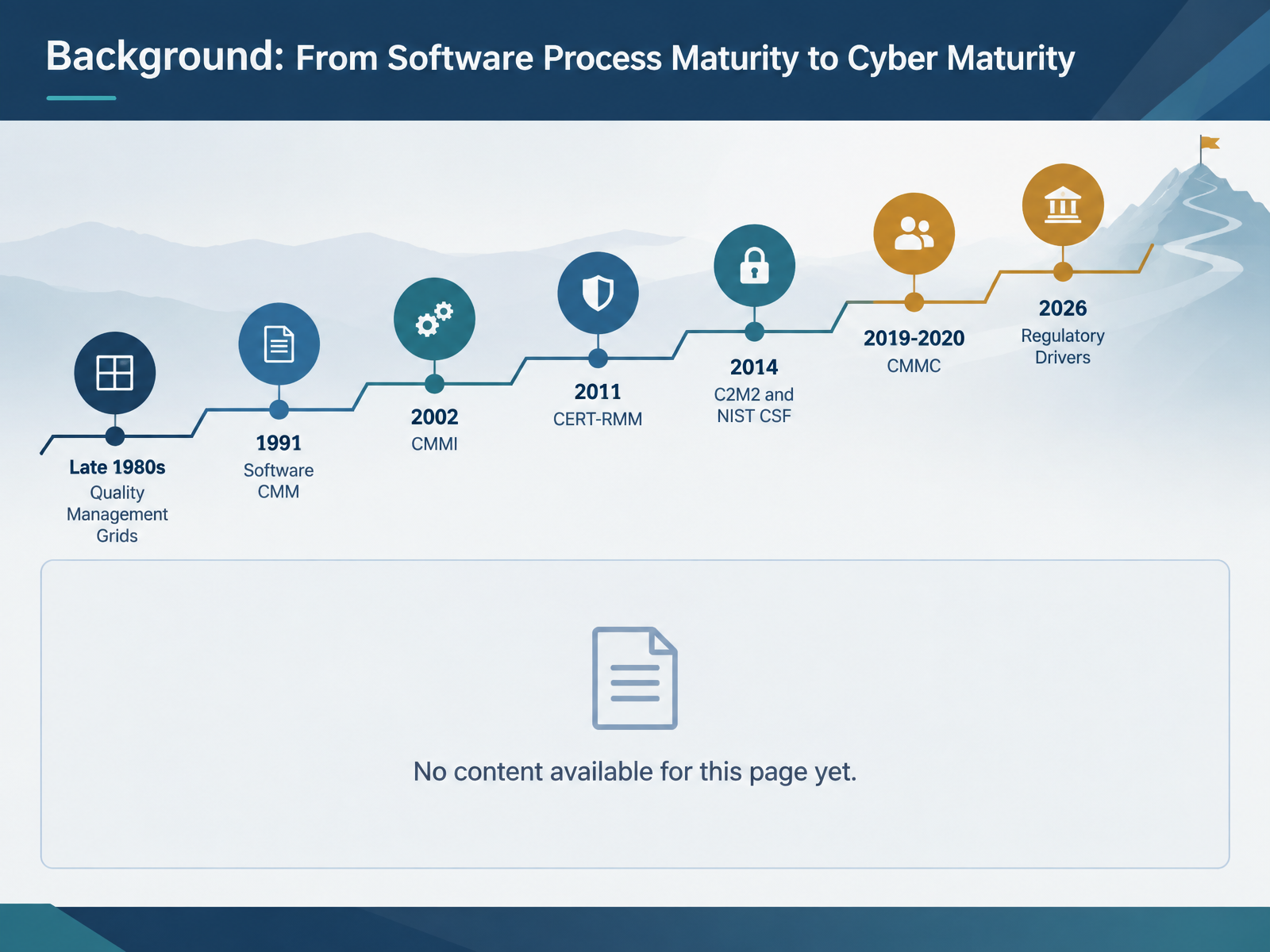
- 02Background: From Software Process Maturity to Cyber MaturityLet us ground this in where the models actually came from. Cyber maturity did not start in security. It started in software engineering. In the late eighties and nineties, the Software Engineering Institute built the Capability Maturity Model, and later CMMI, so the Department of Defense could judge whether software contractors ran disciplined, repeatable processes. The five-level scale and the language of institutionalized practice that we still use today came directly from that work. The pivotal shift came with CERT RMM, first published in 2011. That is where security itself was reframed as a process, something you define, measure, and improve, rather than a tool you buy. In practice, that lineage explains why CMMC draws so heavily on CERT RMM. What this means for your program is simple. The maturity scale you assess against is not arbitrary. It is a tested inheritance. The trade-off to note is that process maturity says little about risk reduction on its own, so pair the score with quantitative risk evidence. Let us now look at the core concepts and model anatomy.
 support.isaca.orgsei.cmu.educsrc.nist.gov+22 min
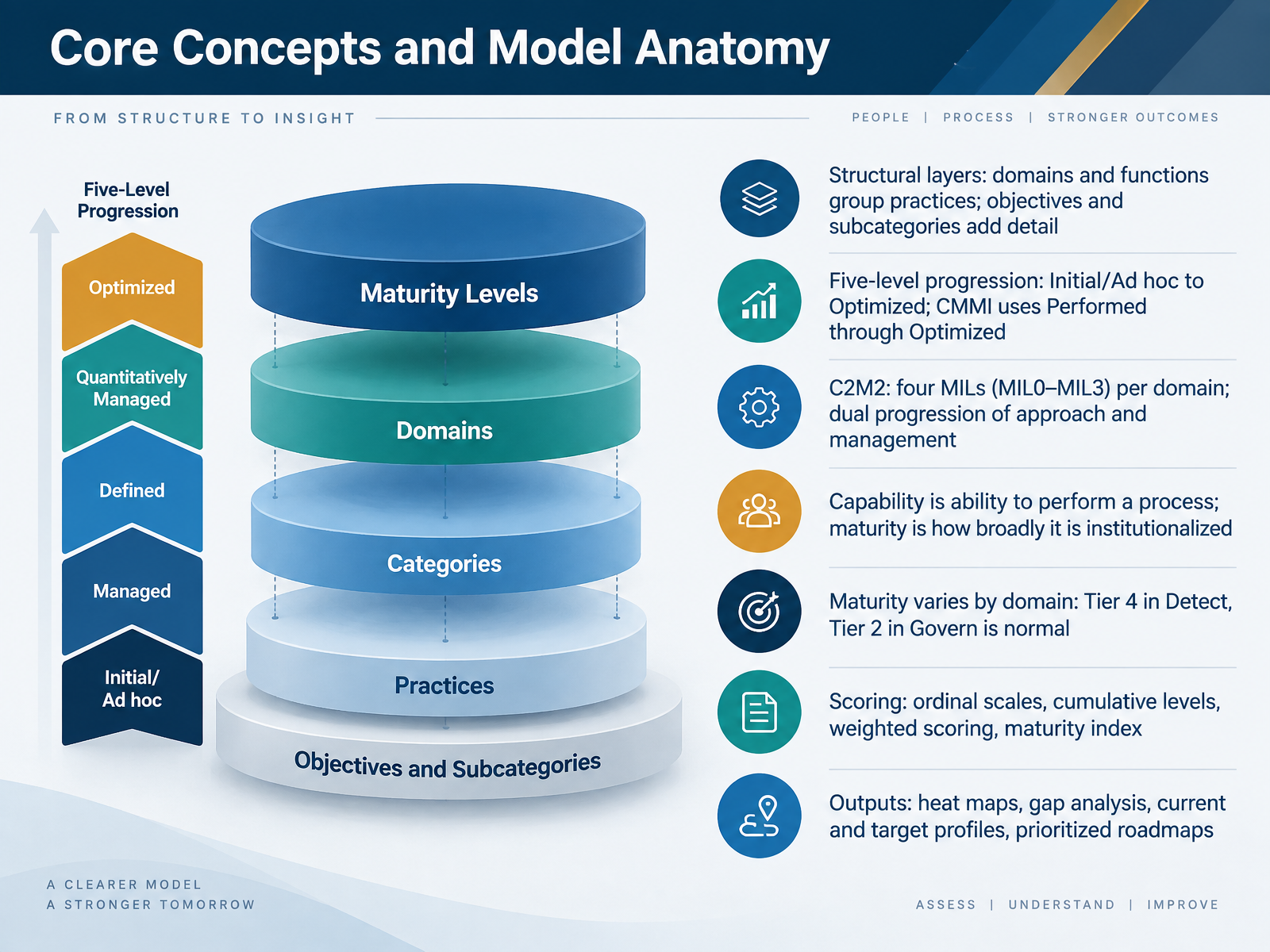
- 03Core Concepts and Model AnatomyLet us start with model anatomy, because the vocabulary differs across frameworks. Most models share structural layers. Domains and functions group practices, while objectives and subcategories add detail beneath them. C2M2, for example, organises 356 practices into 10 domains, each with objectives.
On progression, the familiar five-level scale runs from Initial or Ad hoc to Optimized. CMMI uses Performed through Optimized. C2M2 instead defines four maturity indicator levels, MIL zero through MIL three, applied per domain, with a dual progression of approach and management.
One distinction matters in practice. Capability is the ability to perform a process. Maturity is how broadly it is institutionalised. So maturity varies by domain. Tier four in Detect and Tier two in Govern is normal, not a failure. The trade-off to note is cost versus benefit.
Scoring approaches include ordinal scales, cumulative levels, weighted scoring, and maturity indices. Outputs are heat maps, gap analysis, current and target profiles, and prioritised roadmaps. Leading Frameworks: NIST CSF 2.0, C2M2, CMMC 2.0, and ISO.
 c2m2.doe.govdodcio.defense.govnationalcyber.org+22 min
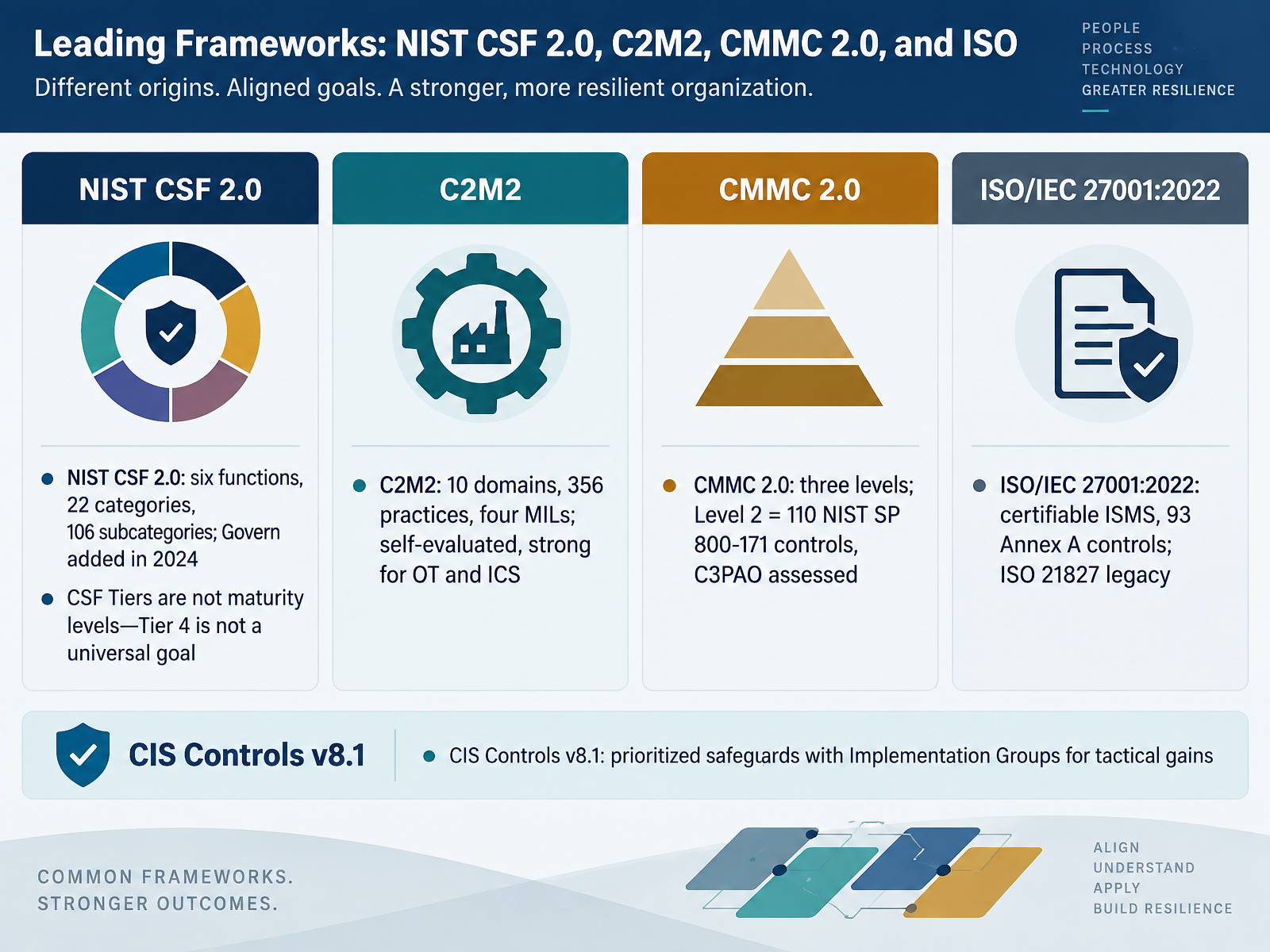
- 04Leading Frameworks: NIST CSF 2.0, C2M2, CMMC 2.0, and ISOLet us turn to the leading frameworks you will encounter in practice. NIST CSF 2.0 has six functions, twenty-two categories, and one hundred and six subcategories, with Govern added in 2024. One distinction to hold onto: the CSF Tiers are not maturity levels. Tier Four is not a universal goal. C2M2 offers ten domains, three hundred and fifty-six practices, and four maturity indicator levels. It is self-evaluated, and it is strong for operational technology and ICS environments. CMMC 2.0 has three levels. Level Two equals one hundred and ten NIST SP 800-171 controls, assessed by a C3PAO. ISO/IEC 27001:2022 is a certifiable ISMS with ninety-three Annex A controls, while ISO 21827 is legacy. Finally, CIS Controls version eight point one gives prioritized safeguards with Implementation Groups for tactical gains. The trade-off to note: these are not interchangeable. Choosing the right model, when NIST CSF, CMMC, C2M2, or a hybrid fits, is next.
 nccoe.nist.govcsrc.nist.govejournal.darunnajah.ac.id+21 min
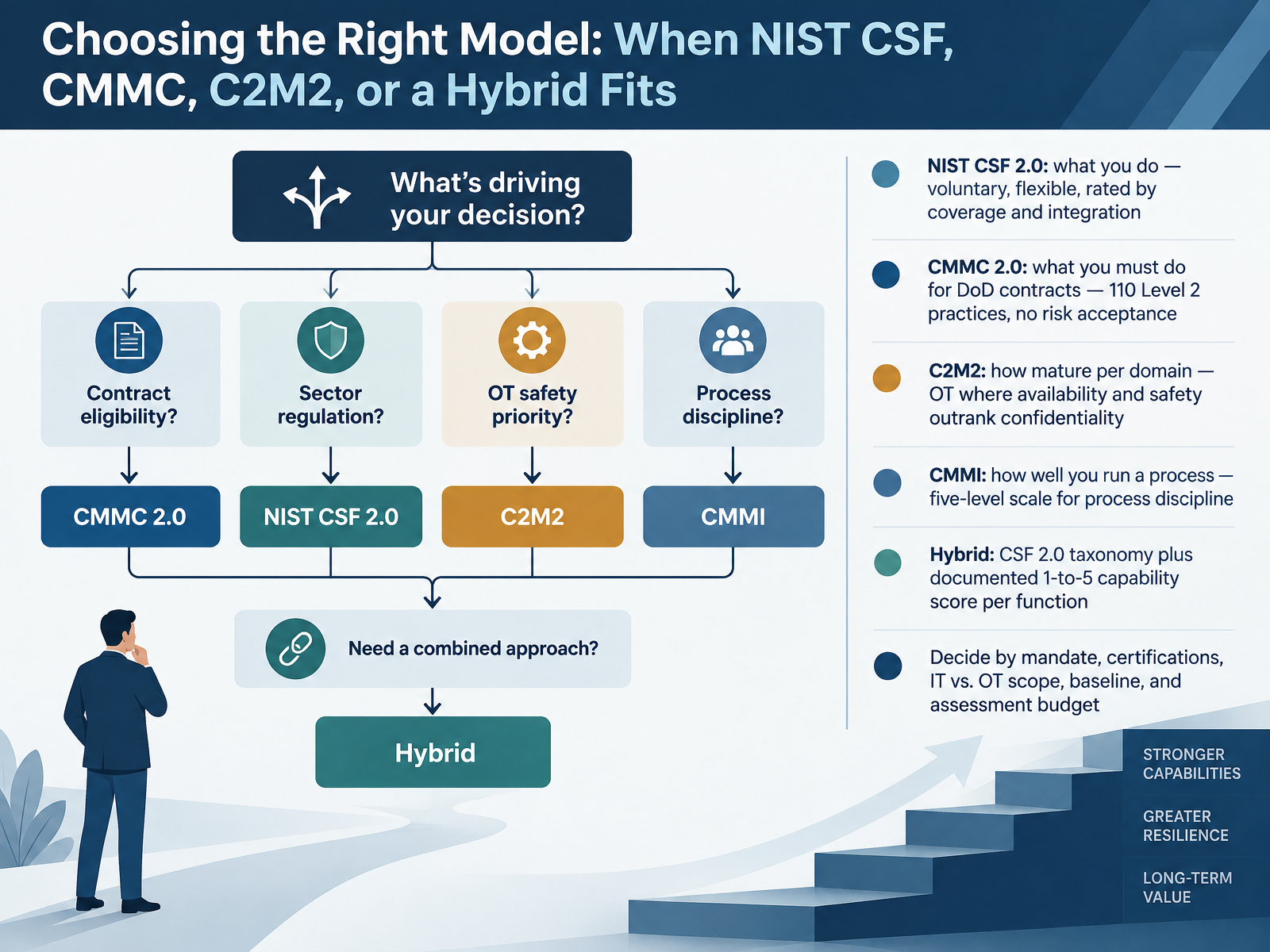
- 05Choosing the Right Model: When NIST CSF, CMMC, C2M2, or a Hybrid FitsNow, let's choose the right model. There is no single best framework, only the one that fits your mandate. NIST CSF 2.0 tells you what you do. It is voluntary and flexible, and you rate it by coverage and integration. CMMC 2.0 tells you what you must do for Department of Defense contracts, with one hundred ten Level 2 practices and no risk acceptance. C2M2 tells you how mature you are per domain, which matters in operational technology, where availability and safety outrank confidentiality. CMMI tells you how well you run a process, on a five-level scale for process discipline. Many teams land on a hybrid. Use CSF 2.0 as the taxonomy, then document a one-to-five capability score per function. In practice, decide by mandate, required certifications, information technology versus operational technology scope, your existing baseline, and assessment budget. What this means for your program is simple. Match the model to the obligation, not to the trend. That sets up our next topic, Assessment Methods and Evidence.
 nccoe.nist.govcsrc.nist.govejournal.darunnajah.ac.id+22 min
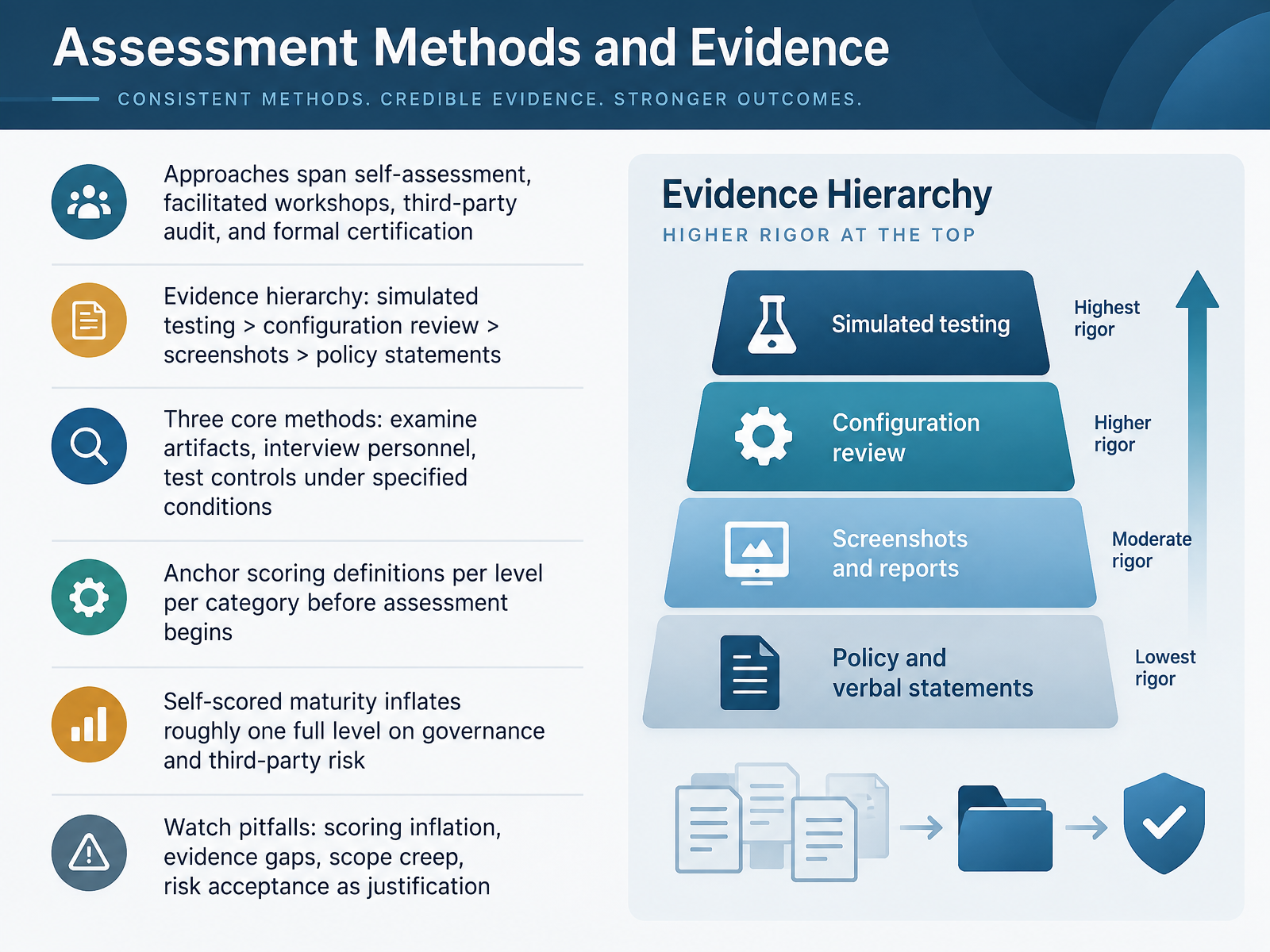
- 06Assessment Methods and EvidenceLet's turn to assessment methods and evidence. Approaches span self-assessment, facilitated workshops, third-party audit, and formal certification. But not all evidence is equal. There's a clear hierarchy: simulated testing ranks highest, then configuration review, then screenshots, and finally policy statements, which only show intent. In practice, assessors work with three core methods. Examine artifacts. Interview personnel. And test controls under specified conditions. Before assessment begins, anchor your scoring definitions for each level, in each category, in writing. This is the trade-off to note. Self-scored maturity inflates by roughly one full level on governance and third-party risk, precisely because evidence is hardest there. So watch four pitfalls: scoring inflation, evidence gaps, scope creep, and risk acceptance used as justification. Independent validation is your safeguard.
 decryptiondigest.comtechtarget.comkovrr.com+21 min
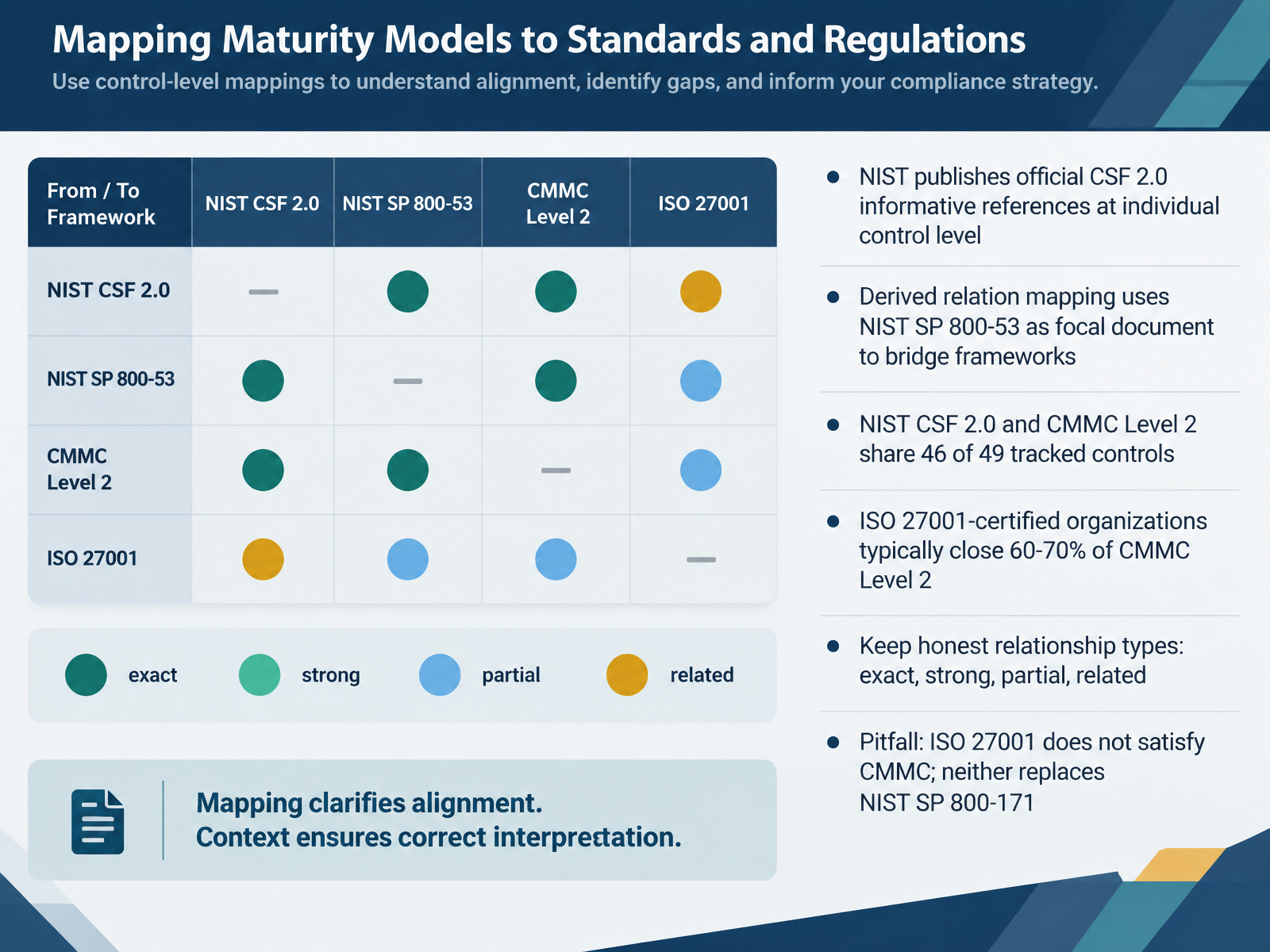
- 07Mapping Maturity Models to Standards and RegulationsNow let's map these maturity models to the standards and regulations you already report against. Start with what is authoritative. NIST publishes official CSF 2.0 informative references at the individual control level. That means you can trace a subcategory to a specific control, not a vague family reference. Where no official mapping exists, say so plainly. For bridging frameworks, derived relationship mapping uses NIST SP 800-53 as the focal document. You join both sides to the same reference, then flatten the results. In practice, NIST CSF 2.0 and CMMC Level 2 share forty-six of forty-nine tracked controls. And ISO 27001 certified organizations typically close sixty to seventy percent of CMMC Level 2. The trade-off to note is honesty in relationship types. Keep exact, strong, partial, and related distinct. An auditor still tests each framework on its own terms. The pitfall: ISO 27001 does not satisfy CMMC, and neither replaces NIST SP 800-171. Next, From Assessment to Action: Target Profiles, Roadmaps, and Metrics.
 nccoe.nist.govcsrc.nist.govejournal.darunnajah.ac.id+22 min
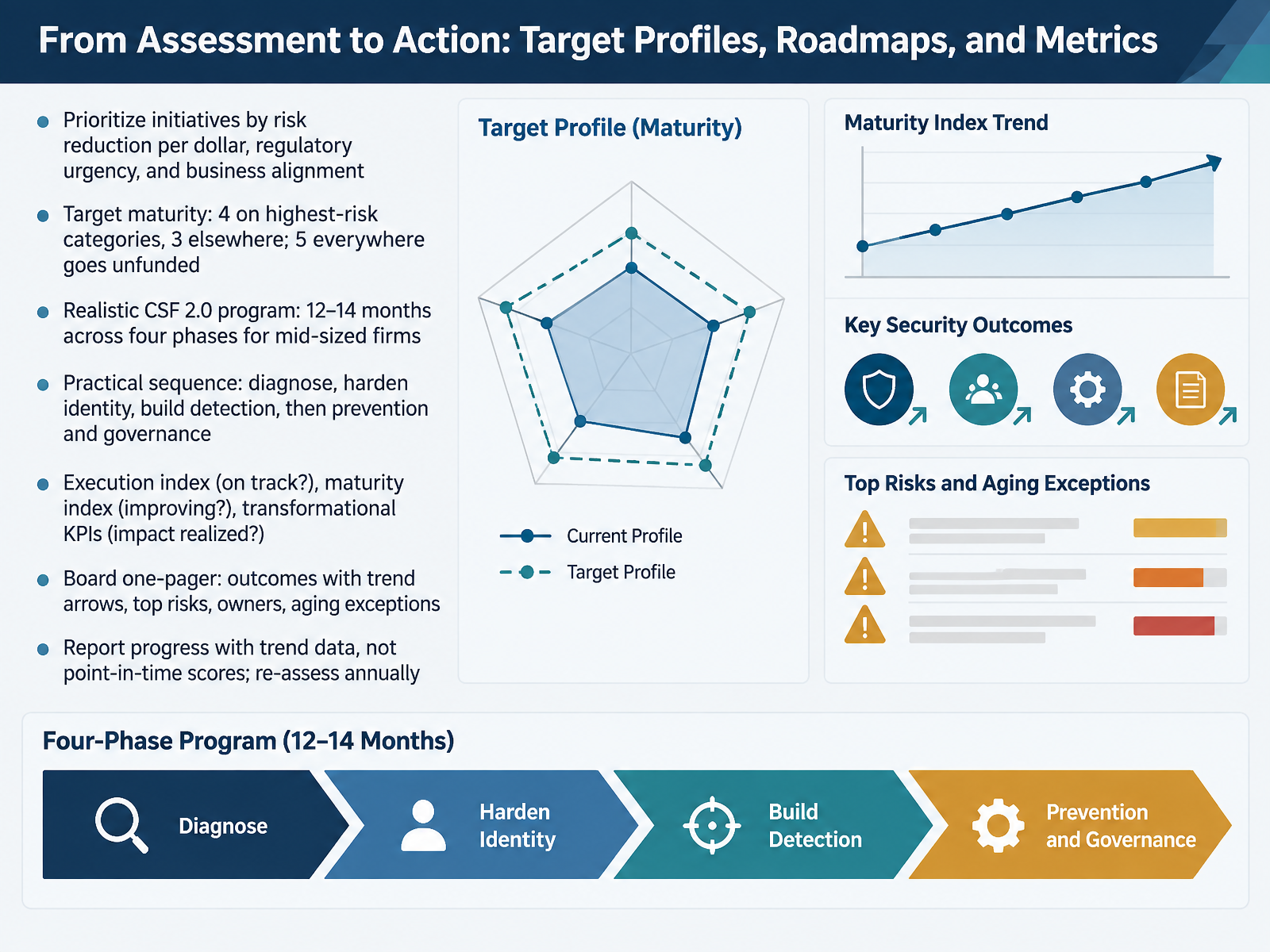
- 08From Assessment to Action: Target Profiles, Roadmaps, and MetricsSo once the assessment is done, the real work begins: turning findings into a funded plan. Prioritize initiatives by risk reduction per dollar, regulatory urgency, and business alignment. On target maturity, a defensible profile sets level four on your highest-risk categories and level three on the rest. Level five everywhere sounds ambitious, but in practice it goes unfunded. For a mid-sized firm, a realistic CSF 2.0 program runs twelve to fourteen months across four phases. The practical sequence matters: diagnose first, harden identity, build detection, then prevention and governance. For reporting, separate three questions. Execution index asks, are we on track. Maturity index asks, are we improving. Transformational KPIs ask, is impact realized. The board one-pager should show outcomes with trend arrows, top risks, owners, and aging exceptions. What this means for your program: report progress with trend data, not point-in-time scores, and re-assess annually. Next, we look at Common Pitfalls and Critical Perspectives.
 tld-isac.eu2 min
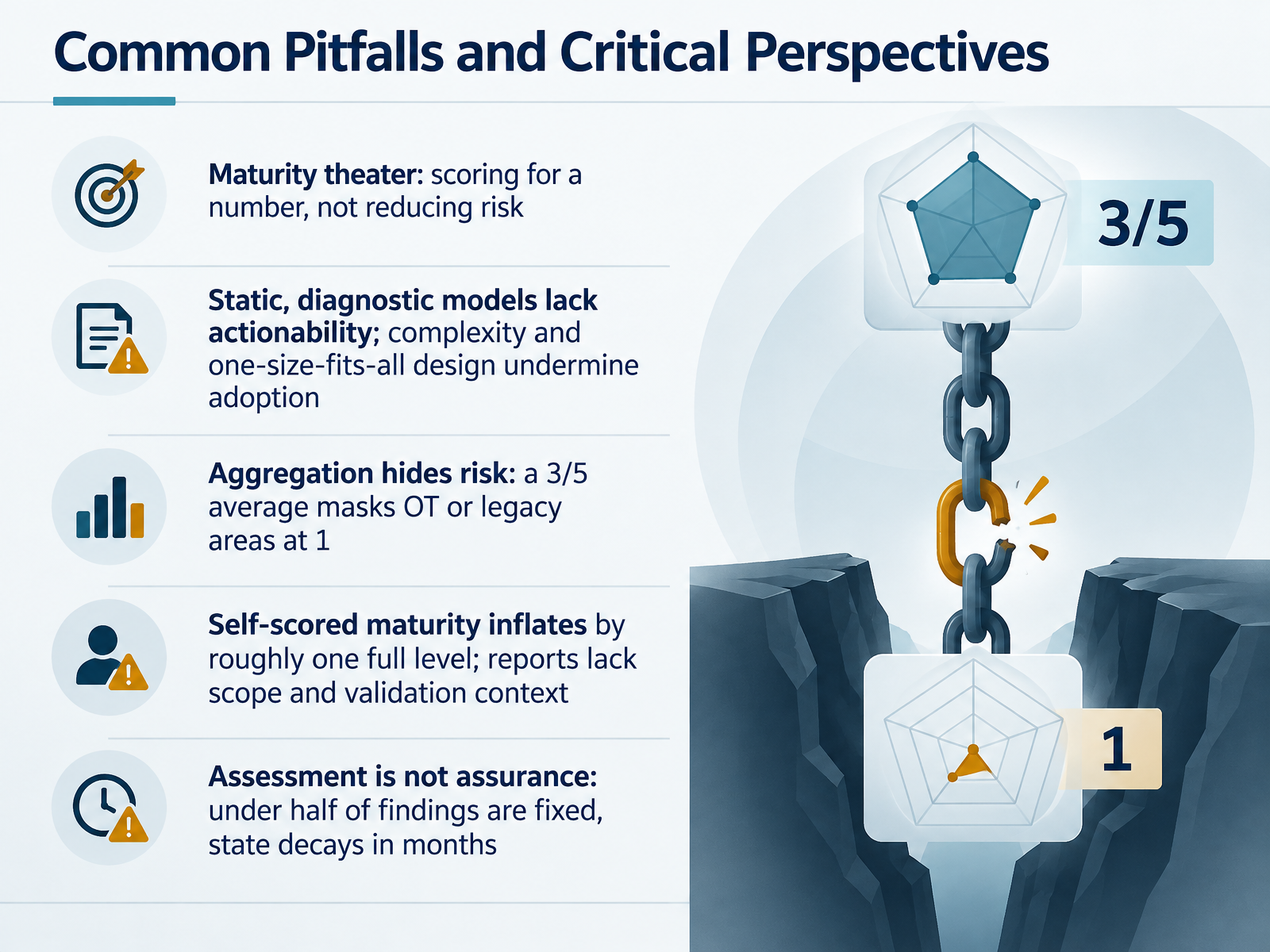
- 09Common Pitfalls and Critical PerspectivesLet's turn to the pitfalls that undermine maturity programs, because recognising them is what keeps your assessment credible.
First, maturity theater. Scoring for a number rather than reducing risk. In practice, a team optimises the score, not the control.
Second, static diagnostic models. They tell you where you are but not what to do next, and one-size-fits-all designs stall adoption.
Third, aggregation hides risk. A three out of five average can mask an OT or legacy area sitting at a one. The trade-off to note: threat actors target the weakest path, not the average.
Fourth, self-scored maturity inflates by roughly one full level on the hardest-to-evidence areas. Reports often lack scope and validation context, so ask who performed the work and what evidence backs it.
Fifth, assessment is not assurance. Under half of findings are actually fixed, and state decays within months.
What this means for your program: treat the score as a headline, not the analysis.
Next, we move into role-based playbooks for the CISO, security PM, GRC, audit, and consulting.
 c2m2.doe.gov2 min
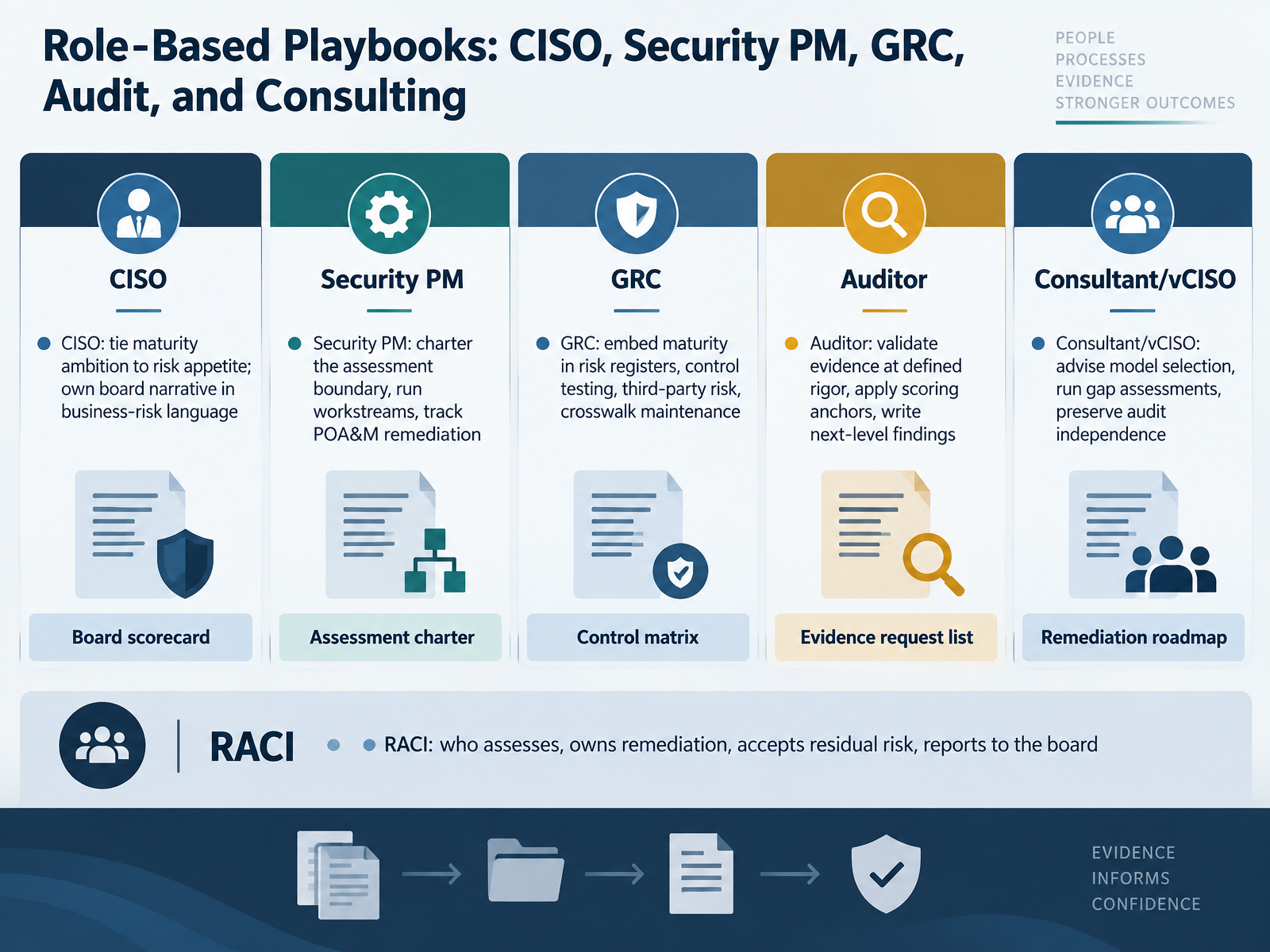
- 10Role-Based Playbooks: CISO, Security PM, GRC, Audit, and ConsultingLet's focus on role clarity, because maturity assessments stall when accountability stays vague. In practice, each role plays a distinct part. The CISO ties maturity ambition to risk appetite and owns the board narrative in business-risk language. The security program manager charters the assessment boundary, runs workstreams, and tracks remediation through the plan of action and milestones. GRC embeds maturity into risk registers, control testing, third-party risk, and crosswalk maintenance. Auditors validate evidence at a defined rigor, apply scoring anchors, and write findings aimed at the next maturity level. Consultants and virtual CISOs advise model selection and run gap assessments, while preserving audit independence. The trade-off to note: the same firm should not both design controls and independently attest to them. Finally, a RACI makes it explicit who assesses, who owns remediation, who accepts residual risk, and who reports to the board. Next, we move into the case exercise on drafting a maturity assessment scope.
 tld-isac.eu2 min
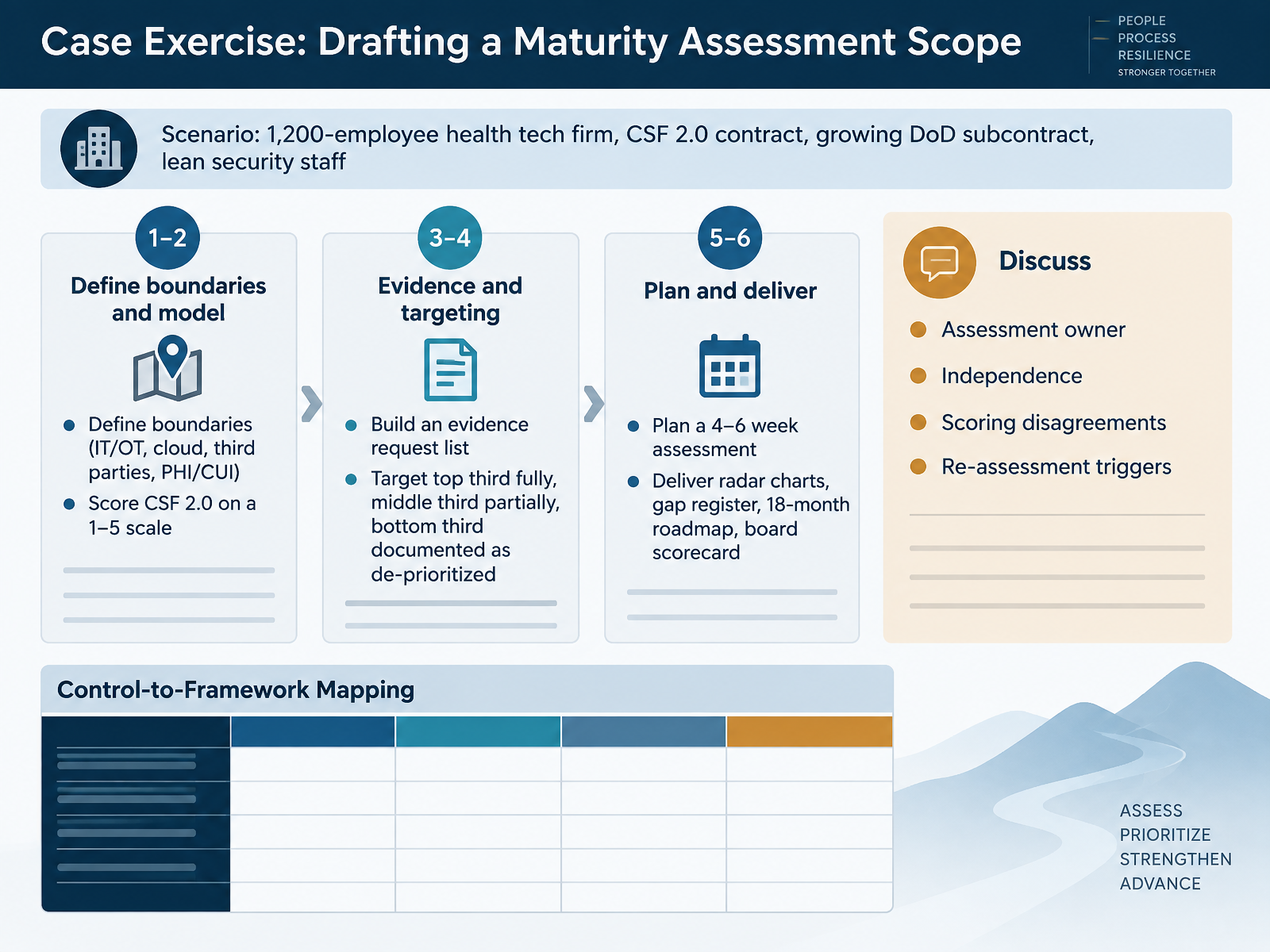
- 11Case Exercise: Drafting a Maturity Assessment ScopeLet us work through a case exercise on drafting a maturity assessment scope. Picture a health tech firm with about one thousand two hundred employees. They have a NIST CSF two point zero contract, a growing DoD subcontract, and a lean security staff. That combination drives everything.
First, define boundaries. In practice, that means IT and OT, cloud, third parties, and where PHI and CUI live. Then score CSF two point zero on a one to five scale.
Next, build an evidence request list. Target the top third fully, partially assess the middle third, and document the bottom third as deliberately de-prioritized. That rationale is itself an auditable artifact.
Plan a four to six week assessment. Deliverables: a radar chart, a gap register, an eighteen month roadmap, and a board scorecard.
Then discuss the hard questions. Who owns the assessment? How independent are they? How do you handle scoring disagreements? What triggers re-assessment? What this means for your program: scope is a governance decision, not just a technical one.
Adoption Roadmap: A Phased 12-18 Month Plan.
 tld-isac.eu2 min
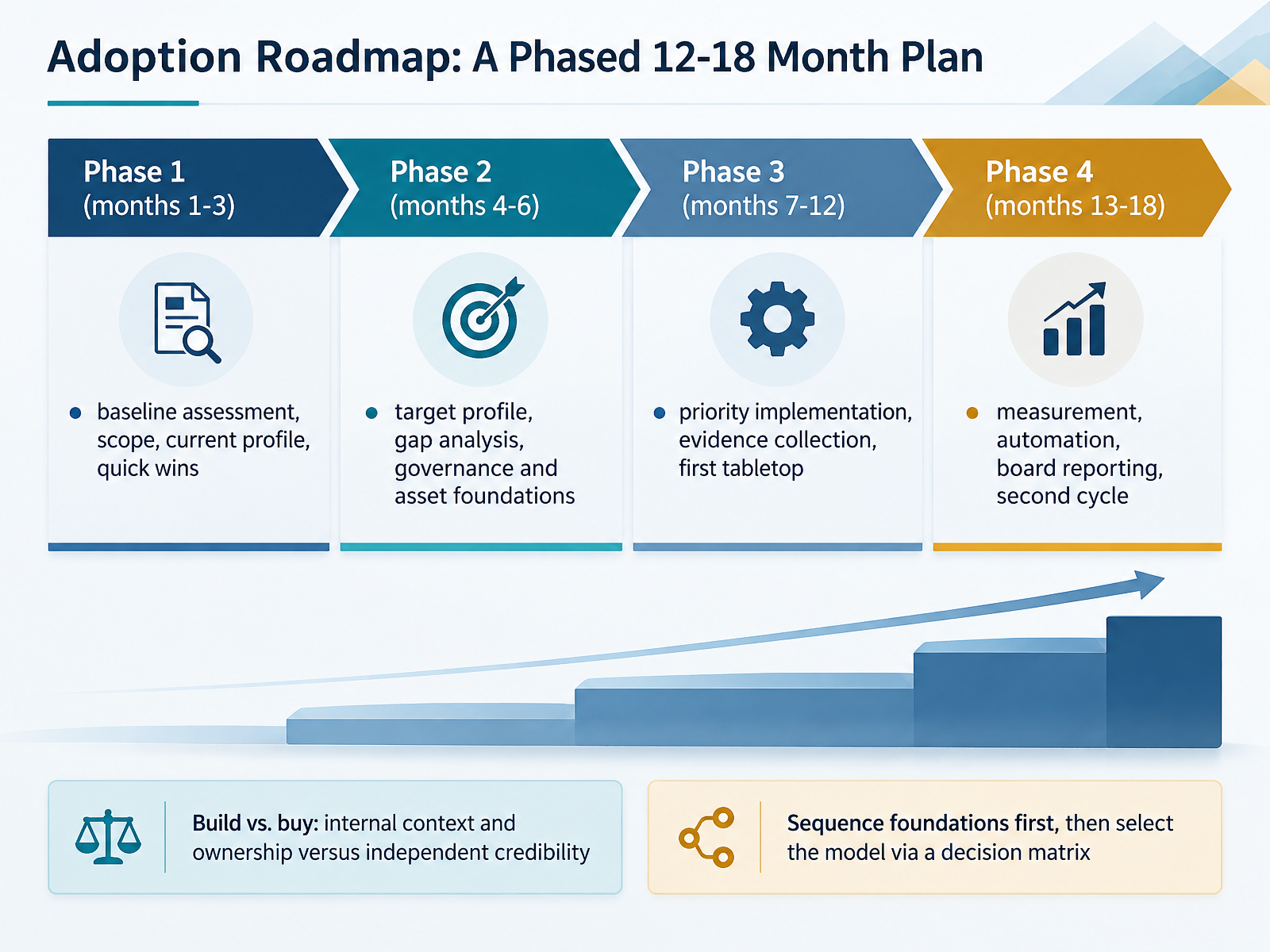
- 12Adoption Roadmap: A Phased 12-18 Month PlanNow, let's put the sequencing into practice with a phased twelve to eighteen month roadmap. In phase one, months one through three, you establish the baseline: scope, current profile, and a small set of quick wins. In practice, this is a rapid assessment, sixty to ninety days, not a months-long exercise. Phase two, months four through six, defines the target profile, completes gap analysis, and builds governance and asset foundations. The trade-off to note: skipping governance here produces what many call governance-hollow programs. Phase three, months seven through twelve, is delivery: priority implementation, evidence collection, and your first tabletop exercise. Phase four, months thirteen through eighteen, shifts to measurement, automation, board reporting, and the second cycle. On build versus buy, weigh internal context and ownership against independent credibility. What this means for your program: sequence foundations first, then select the model through a decision matrix. Next, we'll consolidate with key takeaways and next steps.
 tld-isac.eudecryptiondigest.comtechtarget.com+22 min
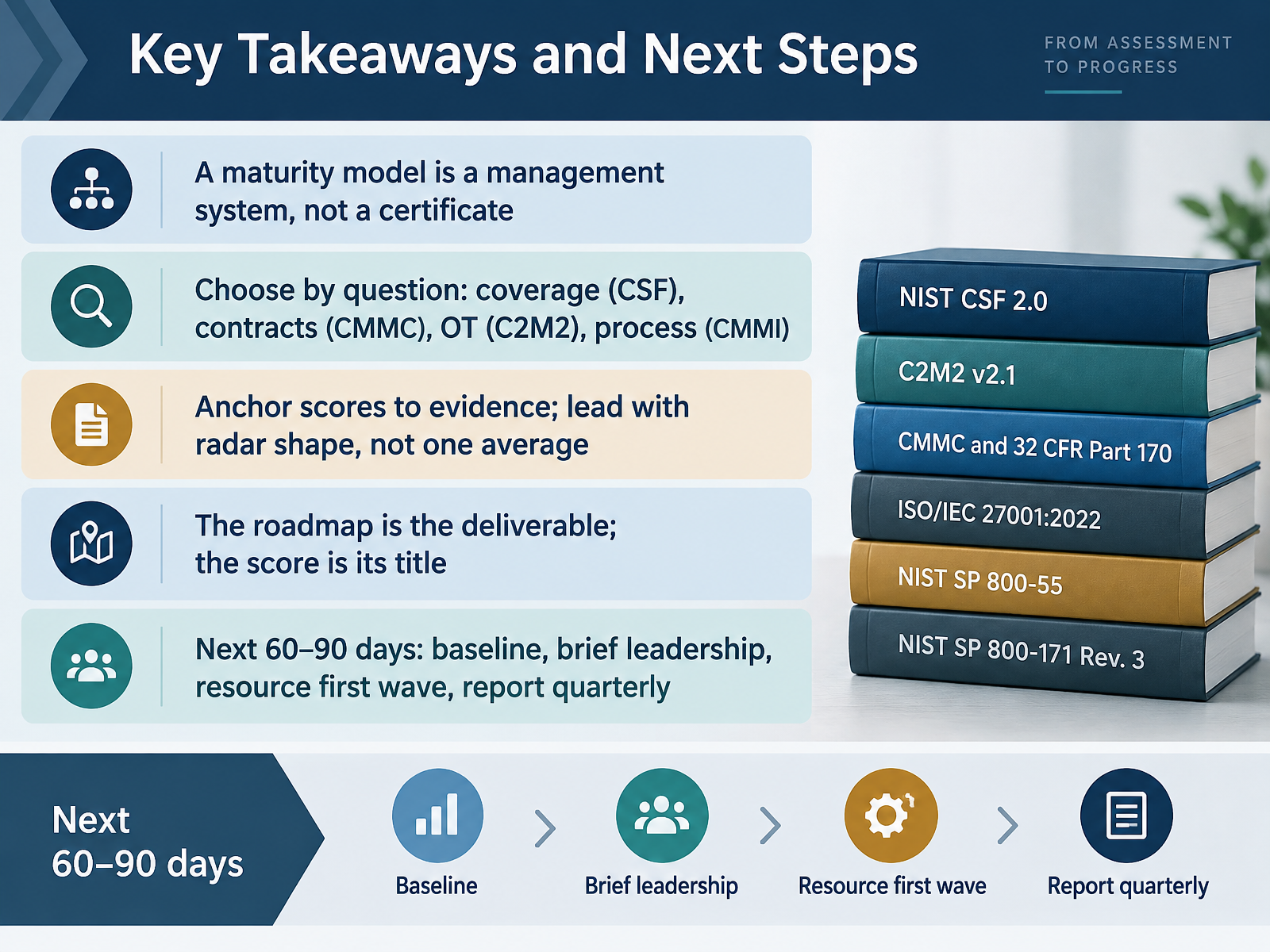
- 13Key Takeaways and Next StepsLet's close with what matters. First, a maturity model is a management system, not a certificate. It structures how you govern risk, and it earns its value through decisions, not a badge on a wall. Second, choose by question. Coverage points to the NIST Cybersecurity Framework. Contracts point to CMMC. Operational technology points to C2M2. And process discipline points to CMMI. Here's the trade-off to note. These are not interchangeable, and mixing them without mapping creates noise. Third, anchor every score to evidence. Lead with the radar shape, not one average, because a single number hides where you are thin. Remember, the roadmap is the deliverable. The score is just its title. In the next sixty to ninety days, baseline your current profile, brief leadership on the shape and the gaps, resource the first wave, and report progress quarterly. Thank you for your attention. You now have the language to defend these choices in the boardroom, so start small, stay evidence-led, and keep moving.
 nccoe.nist.govcsrc.nist.govejournal.darunnajah.ac.id+22 min
Take the deck with you
Download this course as a file — free, no sign-up needed.
- PDF handoutEvery slide page, ready to print or share.14 pages · 3.2 MBDownload
- Narrated PowerPointThe deck that presents itself — every slide carries the digital human's narration video.14 pages · 13.3 MBDownload
- PowerPoint slidesThe full deck as a .pptx — open it in PowerPoint, Keynote, or Google Slides.14 pages · 3.1 MBDownload
Free to use in your own training — please keep the PersonWise credit page at the end.
Have your own deck? Turn it into a course
Sources consulted
Web sources consulted while building this course.
- Security Program Maturity Assessment 2026: NIST CSF, CIS — decryptiondigest.com
- CISO's guide to implementing a cybersecurity maturity model | TechTarget — techtarget.com
- How To Implement a Cybersecurity Maturity Model | Kovrr Blog — kovrr.com
- https://tysonmartin.com/feeds/blog/information-security-program-maturity-model — tysonmartin.com
- State of Cyber Risk Management Report 2026 — guidepointsecurity.com
- CMMI: History of CMMI — support.isaca.org
- Building the Cybersecurity Maturity Model Certification 1.0 (CMMC 1.0) | CMU Software Engineering Institute — sei.cmu.edu
- NIST Cybersecurity Program History and Timeline | CSRC — csrc.nist.gov
- A History of the Capability Maturity Model for Software — exa.ai
- A Historical Perspective of Cybersecurity Frameworks | Seiso Security — seisollc.com
- C2M2 Version 2.1 June 2022 — c2m2.doe.gov
- https://dodcio.defense.gov/Portals/0/Documents/CMMC/ModelOverview.pdf — dodcio.defense.gov
- CYBERSECURITY MATURITY MODEL CERTIFICATION (CMMC) — nationalcyber.org
- The Cybersecurity Focus Area Maturity (CYSFAM) Model — mdpi.com
- CENTR Member Security Maturity Model — tld-isac.eu
- Cybersecurity Capability Maturity Model to NIST Cybersecurity Framework Mapping | NCCoE — nccoe.nist.gov
- INSTRUCTIONS (16x9 aspect ratio) — csrc.nist.gov
- https://ejournal.darunnajah.ac.id/index.php/joistech/article/download/317/198/ — ejournal.darunnajah.ac.id
- NIST CSF 2.0 vs CMMC — Framework Comparison | ControlMap — controlmapping.org
- Understanding the Cybersecurity Maturity Model Basics — riskaware.io