Begin
14 pages · ~28 min
Technical Writing Roadmap
This training helps aspiring and current technical writers build a practical career roadmap, covering core skills, tools, and growth steps to advance in the field.
A digital instructor presents all 14 pages. Hold “Ask” at any point and ask out loud — the answer comes from this course. No sign-up needed.
What you’ll learn
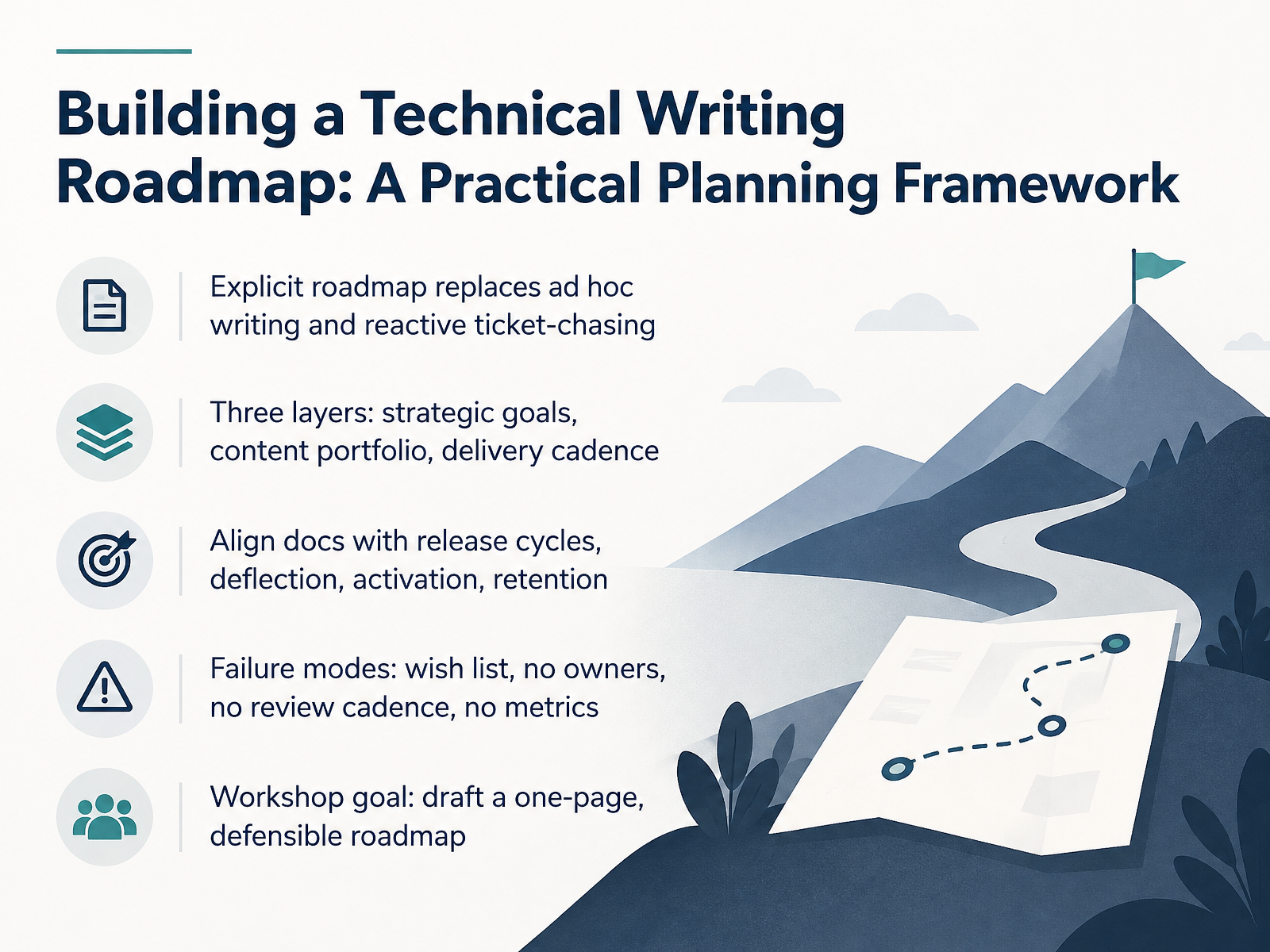
- 01Building a Technical Writing Roadmap: A Practical Planning FrameworkWelcome, everyone. Today we're building a technical writing roadmap, one you can actually defend when planning cycles get tight. If you lead documentation, manage writers, or partner with product teams, this session is for you.
Here's our core idea. An explicit roadmap replaces ad hoc writing and reactive ticket-chasing. Instead of waiting for support tickets to tell you what's missing, you decide in advance. The framework has three layers: strategic goals, your content portfolio, and delivery cadence. Strategic goals connect docs to business outcomes like release alignment, support deflection, activation, and retention. Content portfolio means knowing what you own and what you don't. Delivery cadence ties writing to your release rhythm, so documentation isn't an afterthought.
We'll also cover the failure modes to avoid. The wish list with no owners. No review cadence. No metrics. These patterns quietly erode trust and budget.
By the end, your goal is a one-page, defensible roadmap you can bring to your next planning conversation. Let's get started.
Why Documentation Planning Breaks in 2026.docsio.codaily.jovis.aimintlify.com+22 min
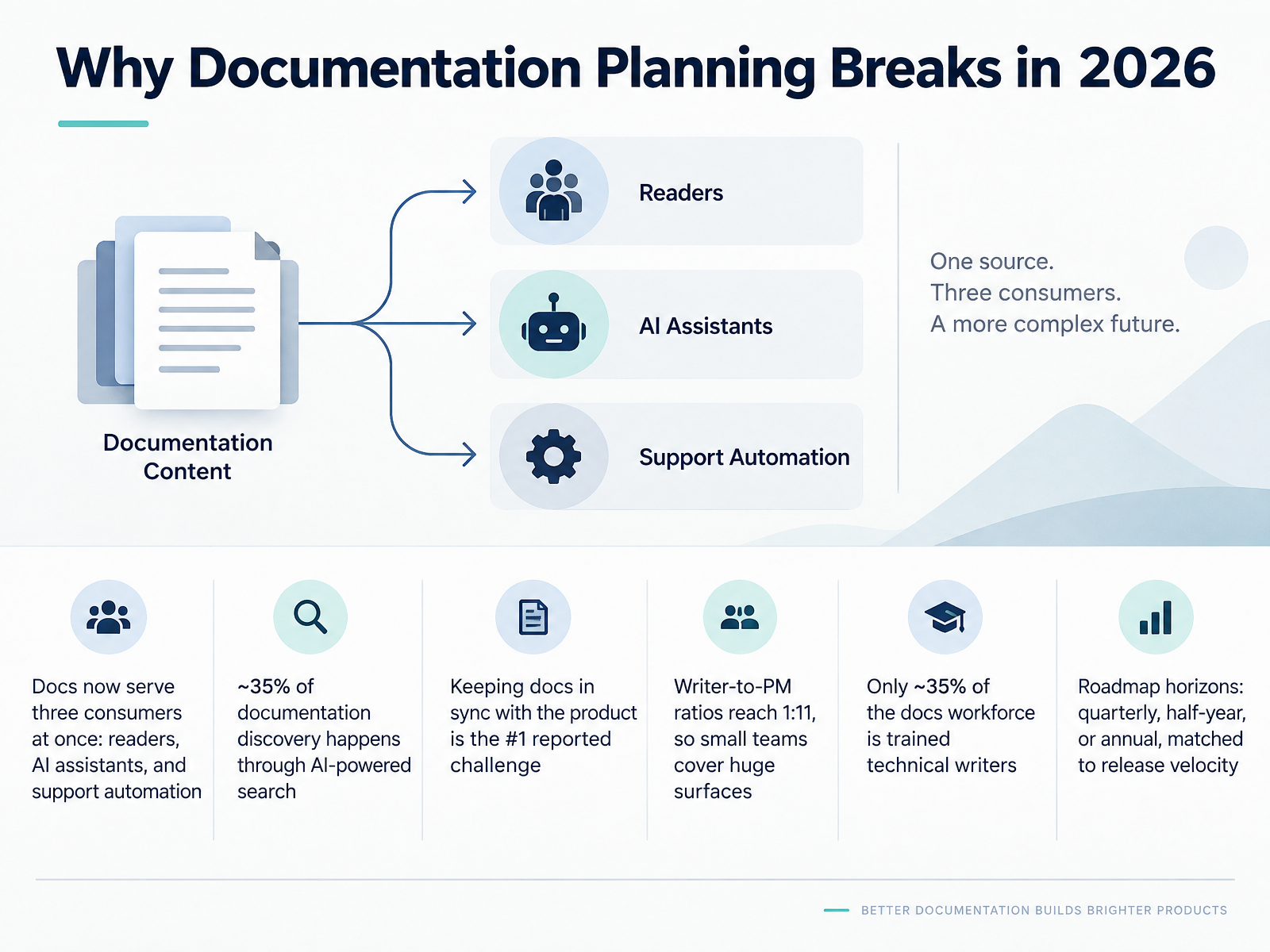
- 02Why Documentation Planning Breaks in 2026Let's get into why documentation planning breaks down in 2026. The core issue is that docs now serve three consumers at once: human readers, AI assistants, and support automation. And roughly thirty five percent of documentation discovery now happens through AI powered search. So a page that reads well for a person may parse poorly for a machine. Keeping docs in sync with the product is the number one reported challenge. Compounding that, writer to product manager ratios reach one to eleven, so small teams cover enormous product surfaces. And only about thirty five percent of the docs workforce is trained technical writers. That leaves a lot of the work to engineers, support, and product managers, which is where ownership gaps and cross team handoffs start to strain. One more decision point to hold: roadmap horizons. Quarterly, half year, or annual, matched to your release velocity. If you ship weekly, an annual docs plan is already out of date. So before you build a roadmap, be honest about the load, the mix of contributors, and the pace you're actually planning against. With that context, the logical next step is to measure where you stand today, so let's look at baseline assessment.
 stateofdocs.combardglobal.comstateofdocs.com+22 min
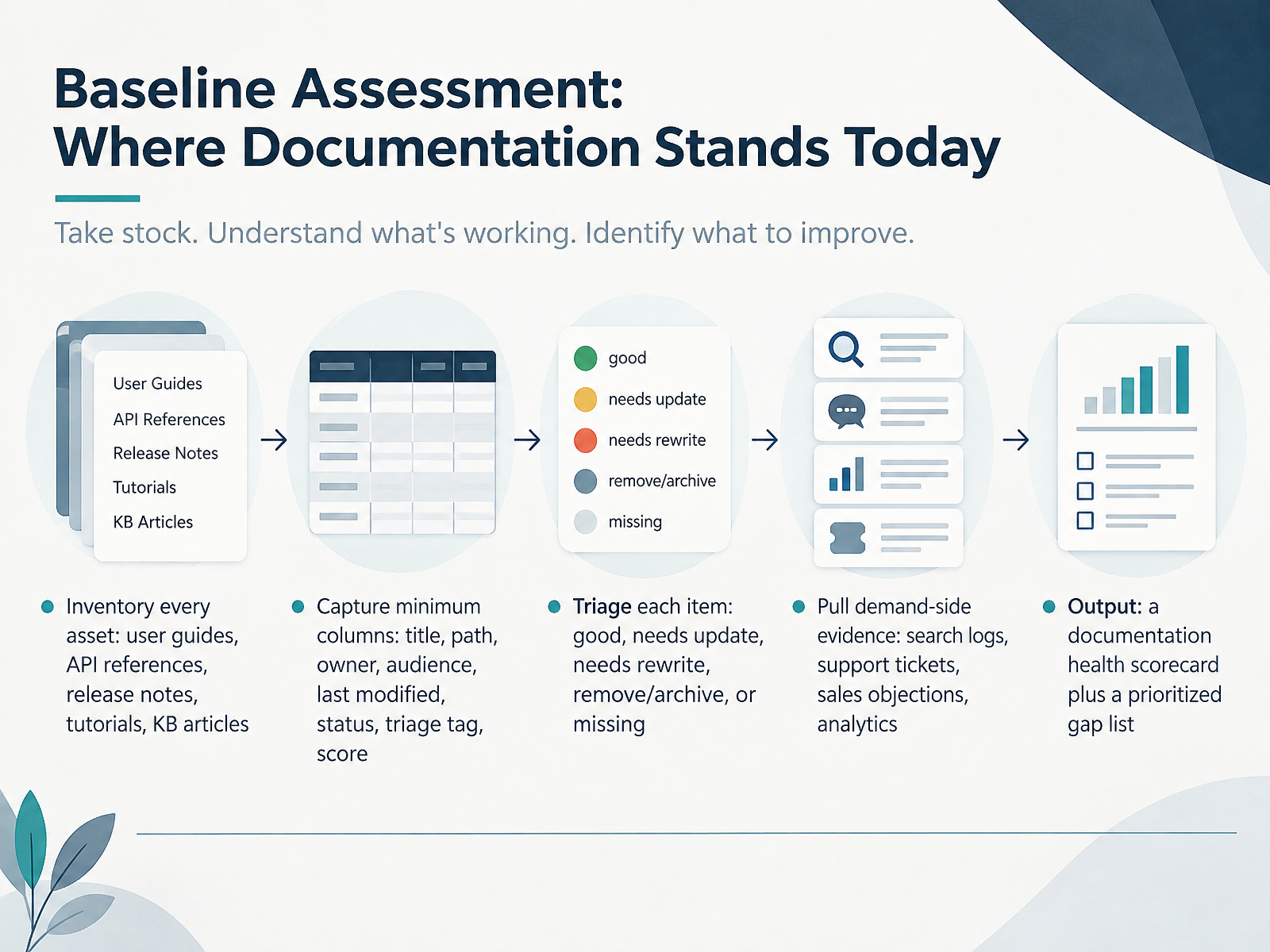
 - 03Baseline Assessment: Where Documentation Stands TodayBefore we plan any remediation work, we need an honest picture of what we actually have. That's what the baseline assessment gives us. Step one is a full inventory. Pull together every asset type: user guides, API references, release notes, tutorials, and knowledge base articles. Then capture a minimum set of columns for each item: title, path, owner, audience, last modified date, status, a triage tag, and a score. Don't overthink the tooling here. A spreadsheet works. What matters is completeness and consistency, so the data is comparable across teams. Next, triage each item into one of five buckets: good, needs update, needs rewrite, remove or archive, or missing. That last bucket matters most, because absent content is invisible until you go looking for it. Then bring in demand-side evidence. Search logs show what people ask for and can't find. Support tickets reveal where documentation is failing to deflect. Sales objections expose gaps that cost revenue. Analytics confirm which pages people actually reach. The output of this work is twofold: a documentation health scorecard, and a prioritized gap list. Those two artifacts become the foundation for everything that follows, so treat this assessment as an investment, not overhead. Next, we'll look at how to score content health at scale.
 teambench.aiideaplan.iowriterresource.com+22 min
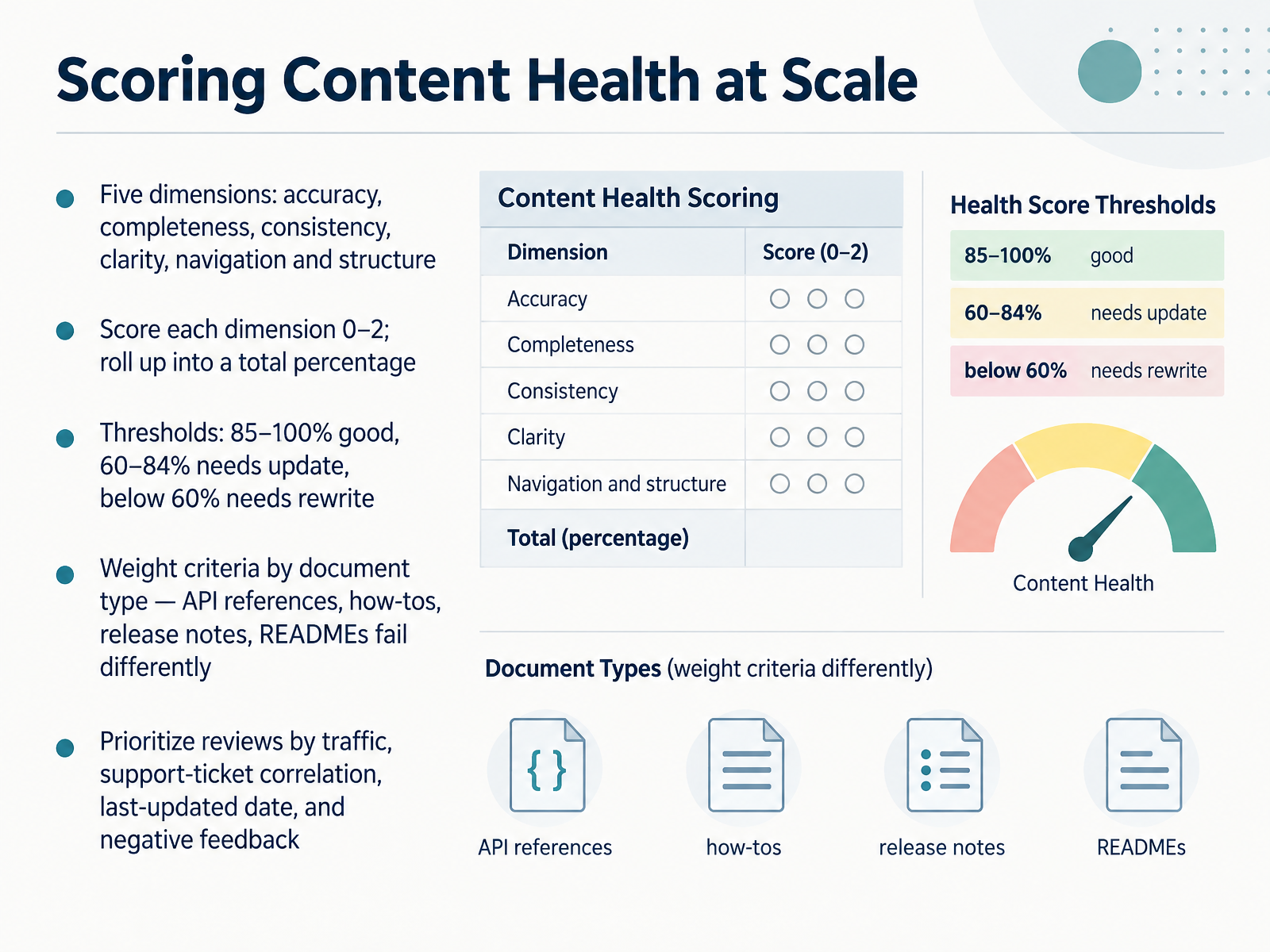
 - 04Scoring Content Health at ScaleSo how do we make that judgment repeatable across hundreds or thousands of pages? We score content health against five dimensions: accuracy, completeness, consistency, clarity, and navigation and structure. Accurate documentation is the highest-stakes dimension, because wrong documentation actively misleads users. For each dimension, reviewers assign a score from zero to two, then roll those scores into a total percentage. The thresholds are straightforward: eighty-five to one hundred percent is good, sixty to eighty-four percent needs an update, and below sixty percent needs a rewrite. Here is the strategic decision point. Weight your criteria by document type, because failure modes differ. API references fail when endpoints, parameters, or error responses are missing. How-tos fail when steps assume knowledge the reader does not have. Release notes fail when breaking changes are buried. READMEs fail when the quick start does not actually run. Then prioritize. Use page traffic, support-ticket correlation, last-updated date, and negative feedback to decide what gets reviewed first. High-traffic pages tied to support tickets and negative ratings earn attention before anything else. Next, we define audiences, jobs, and content types.
 teambench.aiideaplan.iowriterresource.com+22 min
 - 05Defining Audiences, Jobs, and Content TypesNow let's get concrete about who we write for and what we actually produce. Audience segmentation comes first. Draw clear lines between end users, developers, administrators, partners, and internal teams, because each group arrives with a different job. Write a job statement for each persona: when I am this persona, I want to do this job, so that I can reach this outcome. If a page can't name the job it serves in ten seconds, question whether it should exist. Then map content to the Diátaxis four: tutorials for learning, how-to guides for goals, reference for precise facts, and explanation for understanding. The discipline here is matching content type to the reader's moment of need, not to your product's internal structure. Finally, validate your audience assumptions. Use research, support ticket data, and search logs to confirm what you believe about your readers. That evidence turns persona guesses into defensible planning. Setting goals and choosing documentation KPIs comes next.
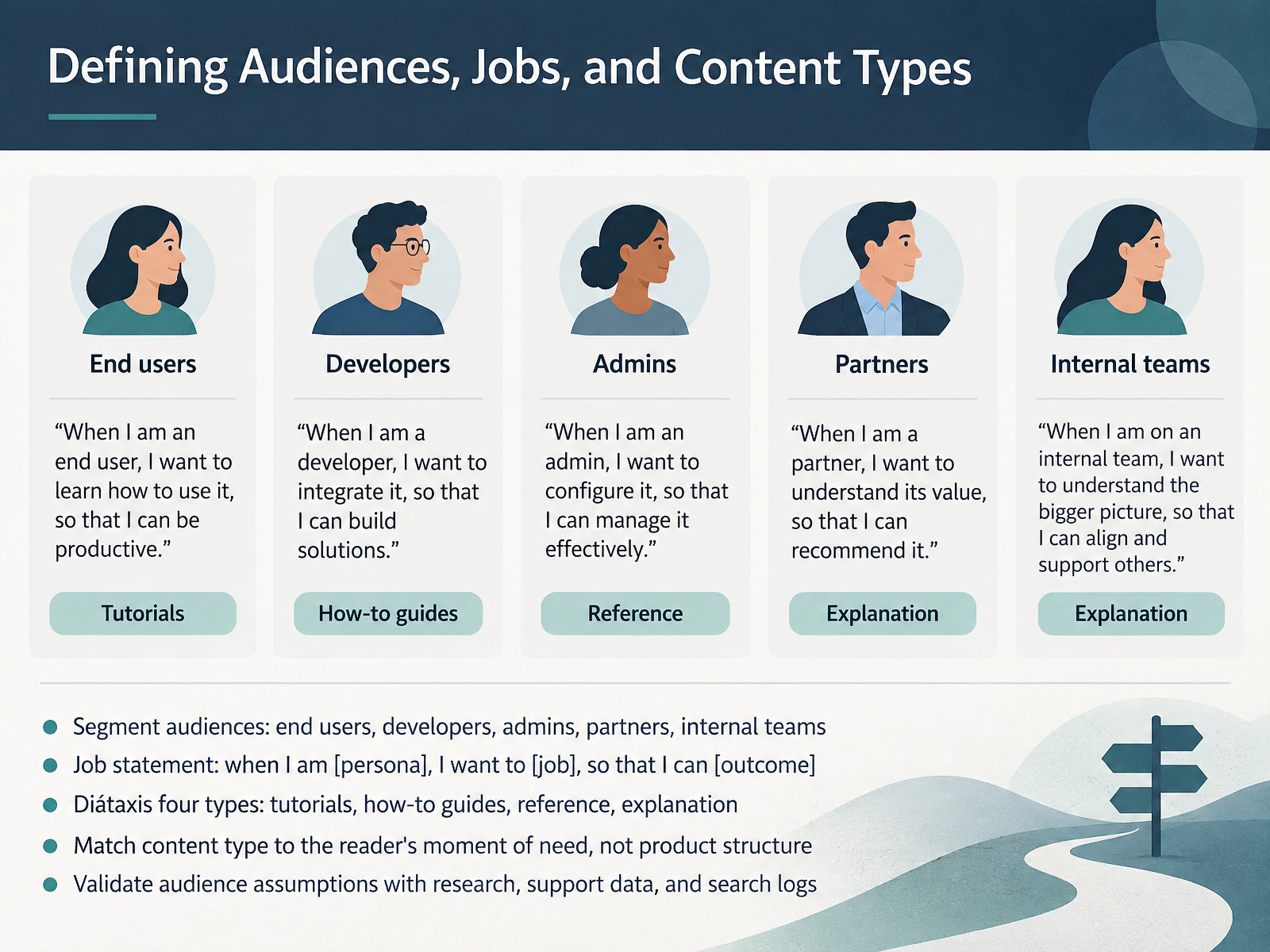 diataxis.frdiataxis.frdiataxis.fr+22 min
 - 06Setting Goals and Choosing Documentation KPIsNow that we have the roadmap structure, the next question is measurement. So let's talk about setting goals and choosing documentation KPIs. Start by translating business goals into documentation outcomes. If leadership wants less support load, faster onboarding, or higher adoption, name the specific docs outcome behind each one, then choose the metric that proves it. A core set covers ticket deflection, search success, article effectiveness, content gap rate, and freshness. But here is the decision point. Never report deflection alone. Pair it with re-contact rate and customer satisfaction, because fewer tickets can simply hide unresolved issues. And balance lagging metrics with at least one leading indicator, like time from product change to documentation update. Freshness signals, stale articles, broken links, outdated screenshots, predict ticket spikes early, which gives you time to act. One last discipline: publish only three to five metrics. Past six, you have built a dashboard nobody reads. Next, we move into prioritization: choosing what to do first.
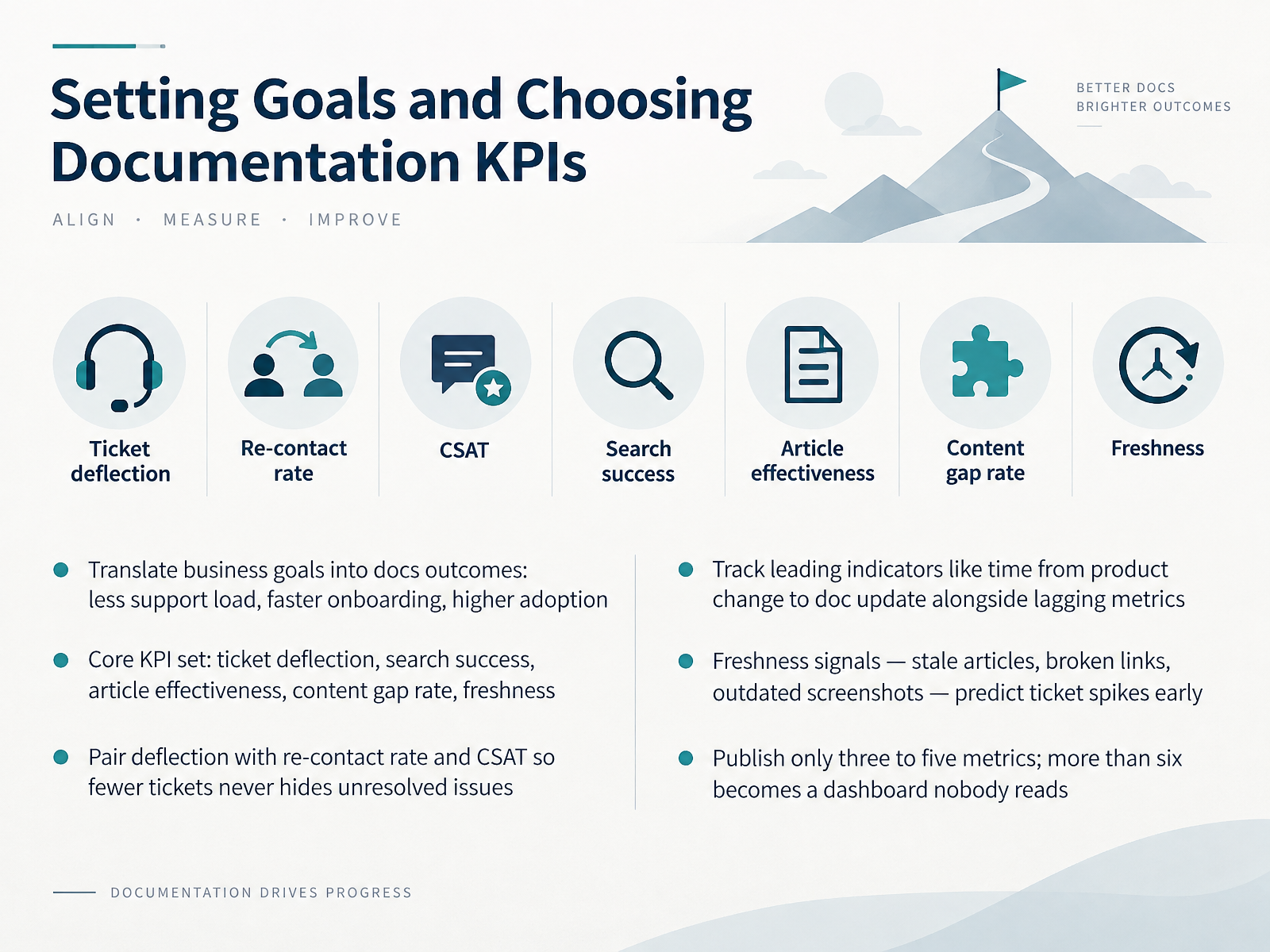 docsio.codaily.jovis.aimintlify.com+22 min
 - 07Prioritization: Choosing What to Do FirstNow let's talk about prioritization, choosing what to do first. Start with the impact versus effort matrix. Plot each candidate, then take the quick wins, high impact and low effort, first. Avoid low impact, high effort work, because it consumes capacity without returning value. When you need something more rigorous, reach for RICE. The score is reach times impact times confidence, divided by effort. Impact runs on a five point scale from three for massive down to zero point two five for minimal. Confidence is one hundred percent when you have evidence, eighty percent for partial evidence, and fifty percent when it is mostly a hypothesis. Here is the strategic caveat. RICE will sometimes push critical compliance work down the list. When that happens, switch to MoSCoW and protect the must haves. Then check your balance. New content is visible, but maintenance and debt reduction are what keep documentation trustworthy. And plan against real capacity, not optimism. One to two major writing projects per quarter is a realistic load per writer. Finally, document what you are consciously deferring, and why. That record protects your decisions in the next planning cycle. Next, let's look at roadmap structure and format.
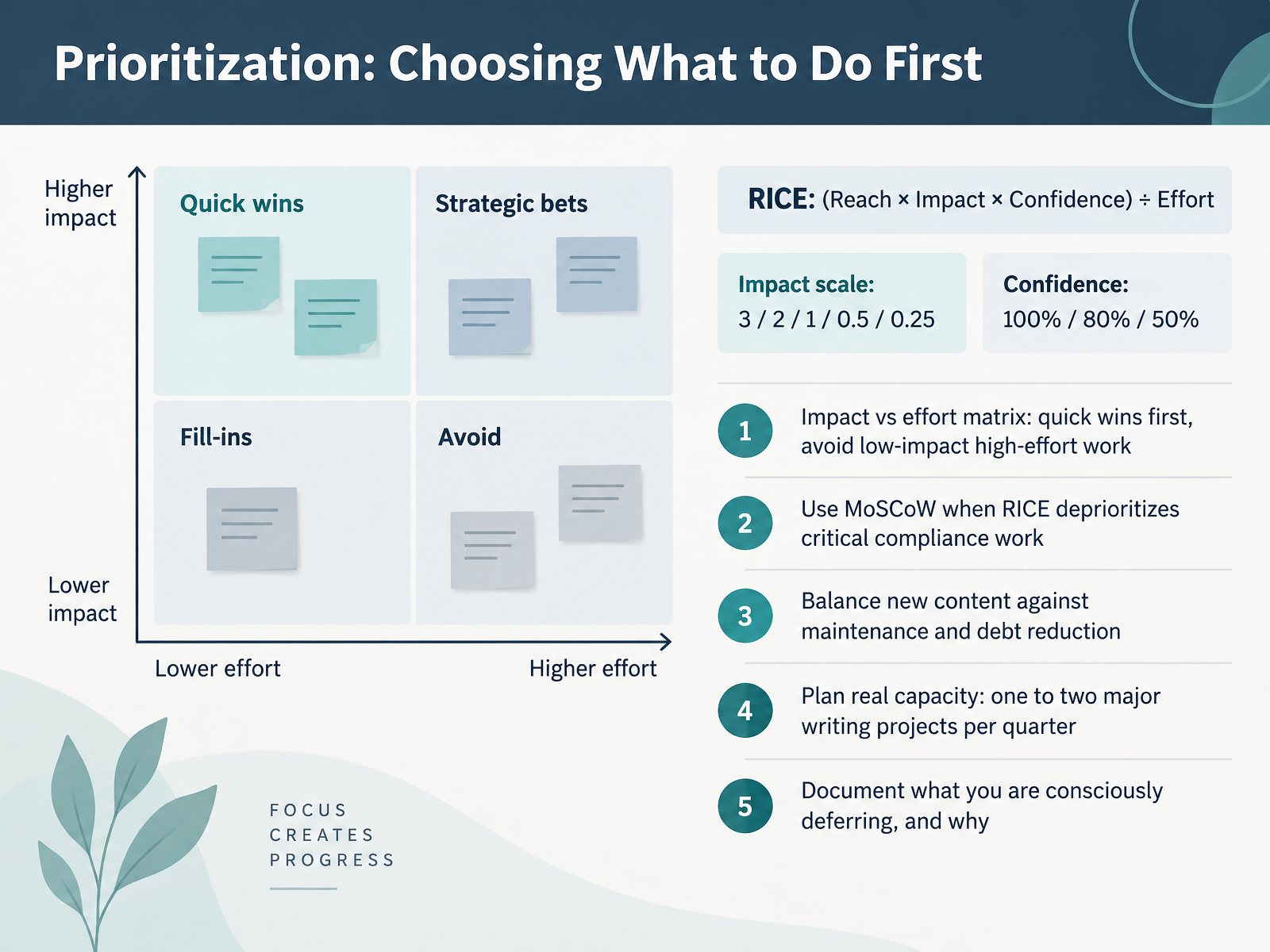 stateofdocs.combardglobal.comstateofdocs.com+22 min
 - 08Roadmap Structure and FormatLet's talk about roadmap structure and format. This is where strategy becomes something people can actually plan against. Seven core components belong in a documentation roadmap: vision, themes, initiatives, deliverables, timeline, owners, and metrics. Skip any one of those, and you get the failure modes we have all seen. Ownership gaps. Handoffs that stall. If a name is not attached to an initiative, assume it will not happen. On format, you have two main choices. A now, next, later view favors adaptability, which suits fast-moving products. Quarterly milestones signal commitment, which is what executives and partner teams want to see. The practical answer is to adapt one roadmap for three audiences. Executives get a one-page leadership version: themes, outcomes, and confidence levels. Your team works from a fuller view. The public version stays high-level and carefully worded. Push task detail into the tracker, not the roadmap. And treat the roadmap like a living document: version it, date it, and define who approves changes. That change control is what keeps a roadmap credible over time. Now, roadmap format is one half of the equation. The other half is how the work gets done day to day, which brings us to Contracts for Reliability and Teamwork.
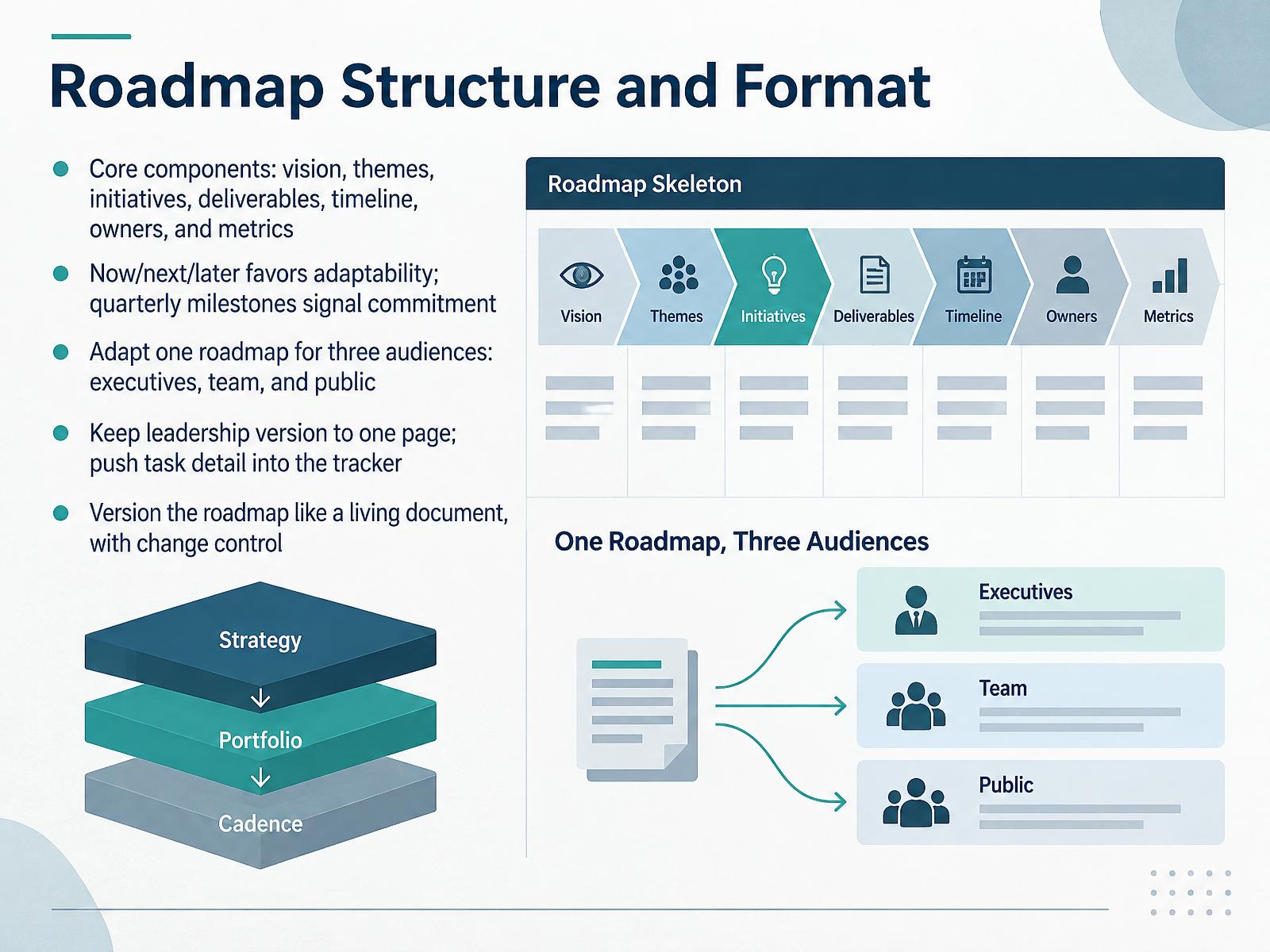 docsio.codaily.jovis.aimintlify.com+22 min
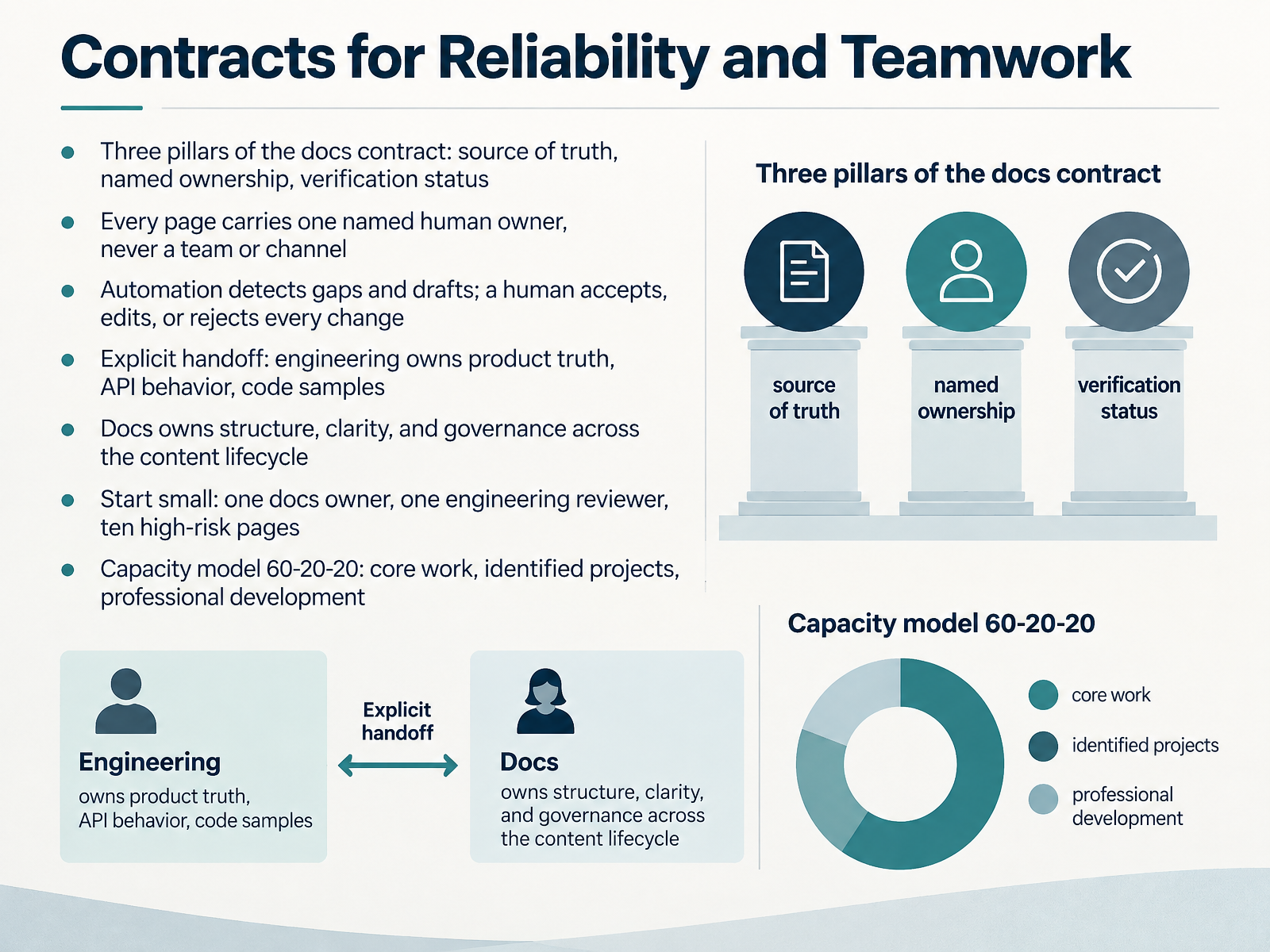
 - 09Contracts for Reliability and TeamworkLet's talk about contracts. Not legal documents, but the operating agreements that make documentation reliable and make cross-team work sustainable. Three pillars hold this up. First, source of truth. Second, named ownership. Third, verification status. On ownership, the rule is simple. Every page carries one named human owner. Never a team, never a Slack channel. When that person changes roles, ownership transfers explicitly, not by default. Automation can detect gaps and draft updates, but a human accepts, edits, or rejects every change. That boundary is what keeps trust intact. Now, the handoff needs to be explicit. Engineering owns product truth, API behavior, and code samples. Docs owns structure, clarity, and governance across the content lifecycle. And you don't have to start big. One docs owner, one engineering reviewer, ten high-risk pages. Prove the workflow before you scale it. Finally, consider a sixty twenty twenty capacity model. Sixty percent core work, twenty percent identified projects, twenty percent professional development. Next, we look at executing this roadmap with docs-as-code and automation.
 stateofdocs.combardglobal.comstateofdocs.com+22 min
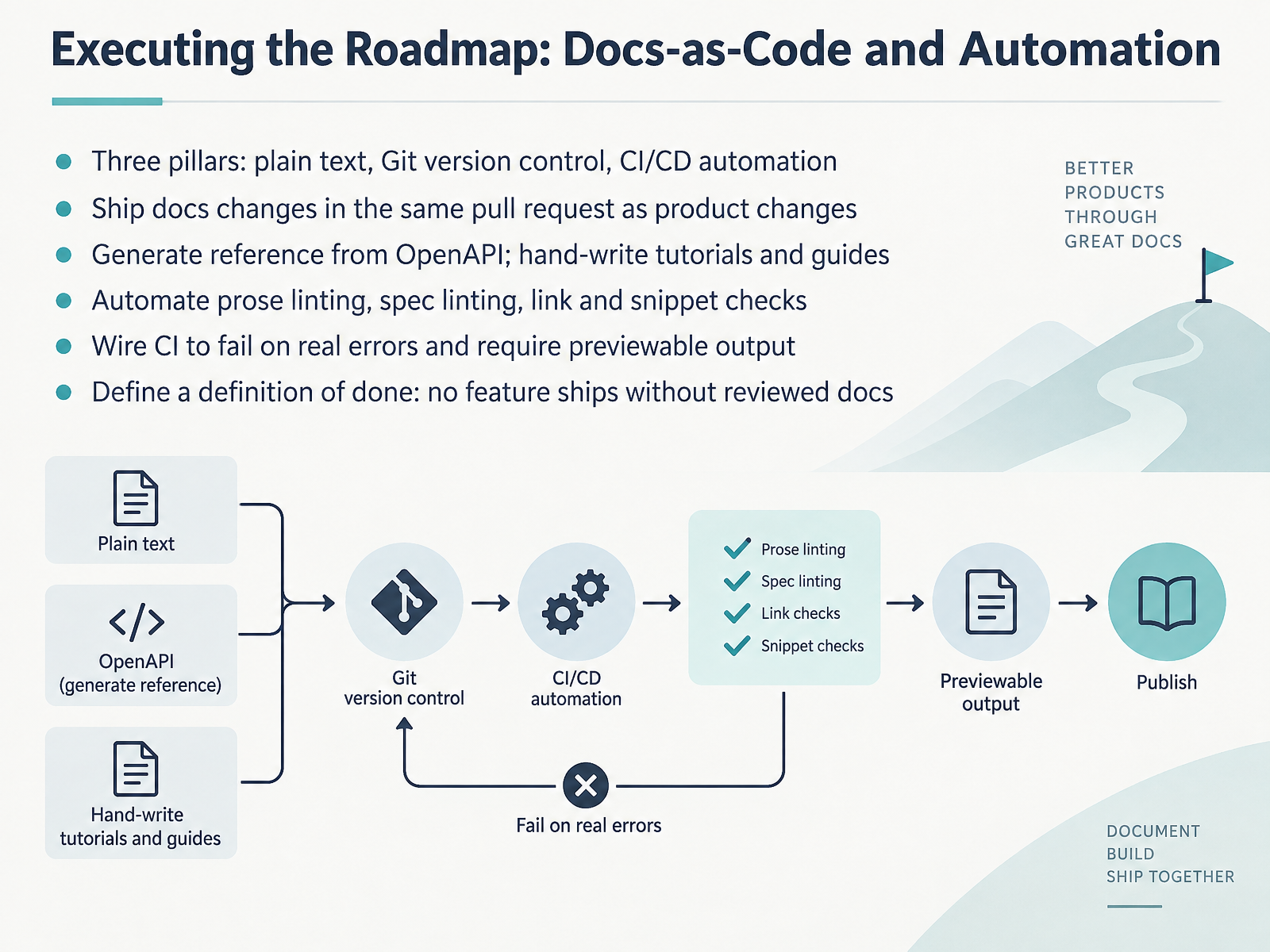
 - 10Executing the Roadmap: Docs-as-Code and AutomationNow let's talk about execution. A docs-as-code roadmap stands on three pillars: plain text, Git version control, and CI/CD automation. Plain text keeps content diffable and reviewable. Git gives every change history and accountability. Automation builds, validates, and publishes. The decision point here is process, not tooling. Require docs changes to ship in the same pull request as the product change. When the API surface shifts, generate the reference from your OpenAPI spec, and hand-write the tutorials and guides, because that is where human judgment earns its keep. Then put real checks in the pipeline: prose linting, spec linting, link and snippet checks. Wire CI to fail on genuine errors, and require previewable output so reviewers see rendered pages, not just raw diffs. Finally, define done. No feature ships without reviewed documentation. That single rule closes most ownership gaps. Next, we'll look at tracking progress, reviewing, and adapting.
 docsio.codaily.jovis.aimintlify.com+22 min
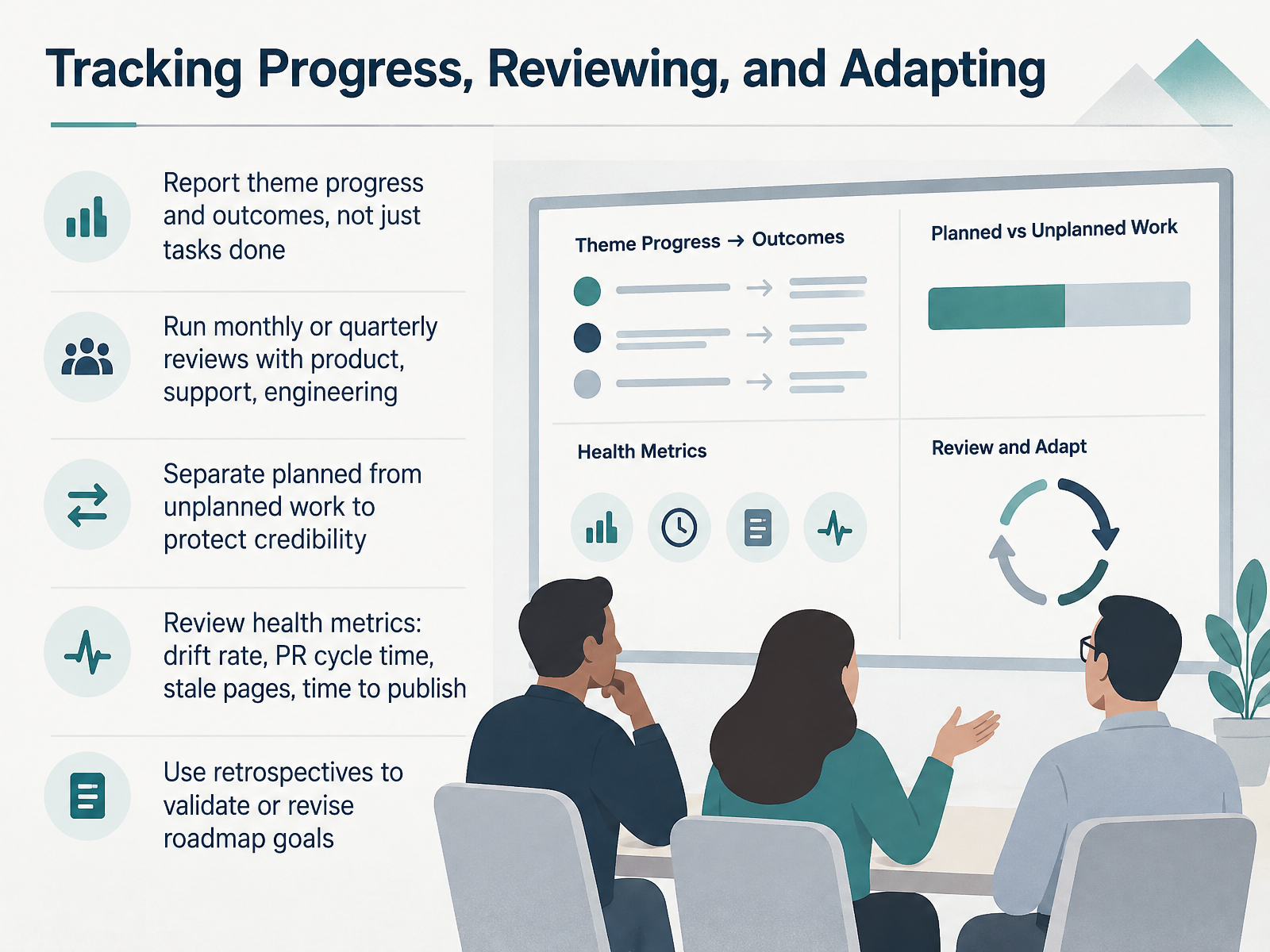
 - 11Tracking Progress, Reviewing, and AdaptingLet's talk about tracking progress, reviewing, and adapting. The core discipline here is reporting theme progress and outcomes, not just tasks completed. When you brief leadership, say what changed for users, not how many tickets you closed.
Cadence matters. Run monthly or quarterly reviews with product, support, and engineering. As you do, separate planned from unplanned work. Keep those two numbers distinct. That protects credibility, because unplanned work is real work, and hiding it makes every future estimate look unreliable.
Watch a small set of health metrics: drift rate, PR cycle time, stale pages, and time to publish. Drift rate is the count of pages where docs disagree with actual product behavior. Track it weekly or per release, and aim to drive it down.
Finally, use retrospectives to validate or revise the roadmap goals themselves. A roadmap that never changes after a retro isn't a plan, it's a wish.
Turning the Roadmap into a 30/60/90-Day Action Plan.
 stateofdocs.combardglobal.comstateofdocs.com+21 min
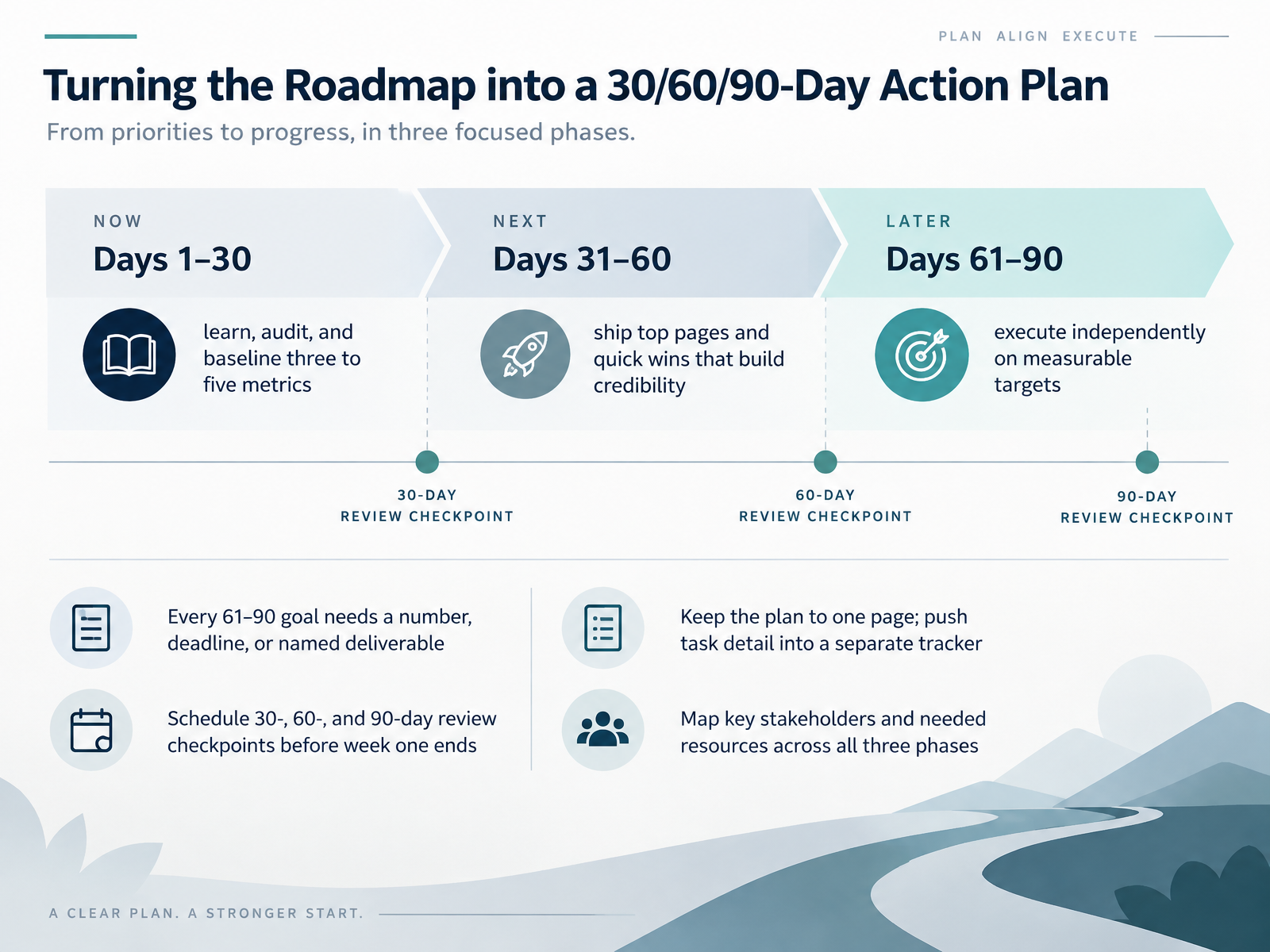
 - 12Turning the Roadmap into a 30/60/90-Day Action PlanLet's turn the roadmap into a thirty, sixty, ninety day action plan. In the first thirty days, learn the landscape, audit existing content, and baseline three to five metrics. Pick metrics you can actually measure, like search success rate, support ticket volume, or time to publish. In days thirty one to sixty, ship the top pages and quick wins that build credibility with your product partners. Then from day sixty one to ninety, execute independently against measurable targets. Here's the discipline that keeps this plan honest. Every sixty one to ninety day goal needs a number, a deadline, or a named deliverable. No vague intentions. Before week one ends, schedule your thirty, sixty, and ninety day review checkpoints, so nobody has to chase them later. Keep the whole plan to one page, and push task-level detail into a separate tracker. And across all three phases, map the key stakeholders and resources you'll need. Think of it as a contract with yourself and your partners. When the phases are explicit and the checkpoints are locked in, you spend less time negotiating scope and more time delivering. Next, we'll put this into practice in our workshop: Drafting a One-Page Roadmap.
 docsio.codaily.jovis.aimintlify.com+22 min
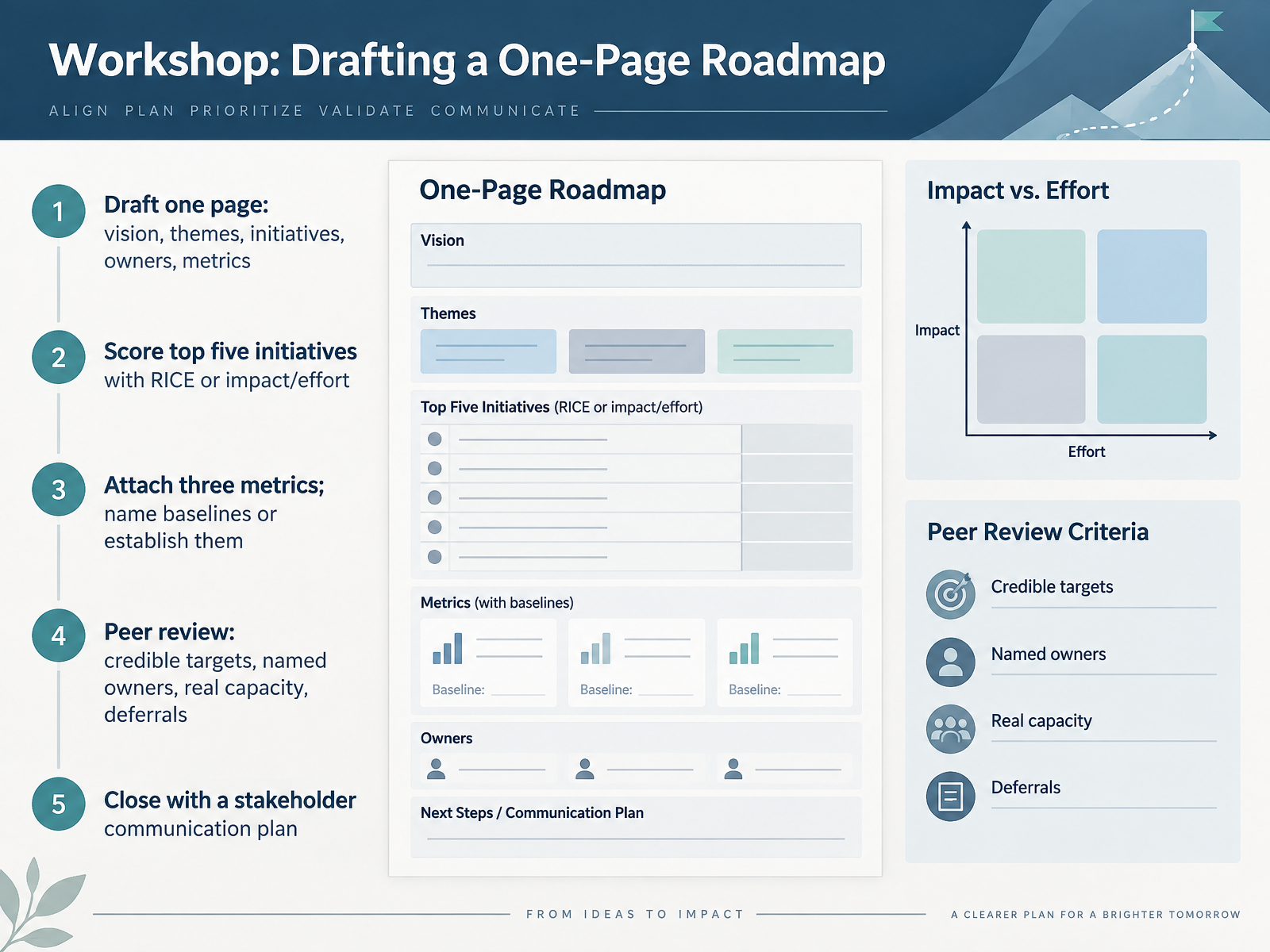
 - 13Workshop: Drafting a One-Page RoadmapLet's move into the workshop. Your task here is to turn everything we've discussed into a single page, and that constraint is deliberate. One page forces real choices. Start with vision, themes, initiatives, owners, and metrics. Then score your top five initiatives using RICE, which stands for Reach, Impact, Confidence, and Effort. If that feels heavy, impact versus effort is a fine substitute. Next, attach three metrics and either name the current baseline or commit to establishing it. During peer review, pressure-test four things: credible targets, named owners, real capacity, and what you are explicitly deferring. That deferral list is often where the plan earns its credibility. Close with a stakeholder communication plan, because a roadmap nobody has seen is not yet a roadmap. Remember, RICE gives you a defensible ranking, not a final answer. Round your numbers, and let strategy break close ties. Next, we'll look at risks, dependencies, and next steps.
 docsio.codaily.jovis.aimintlify.com+22 min
 - 14Risks, Dependencies, and Next StepsAs we wrap up, let's talk about the risks that quietly kill documentation roadmaps, and the next steps you can own right now.
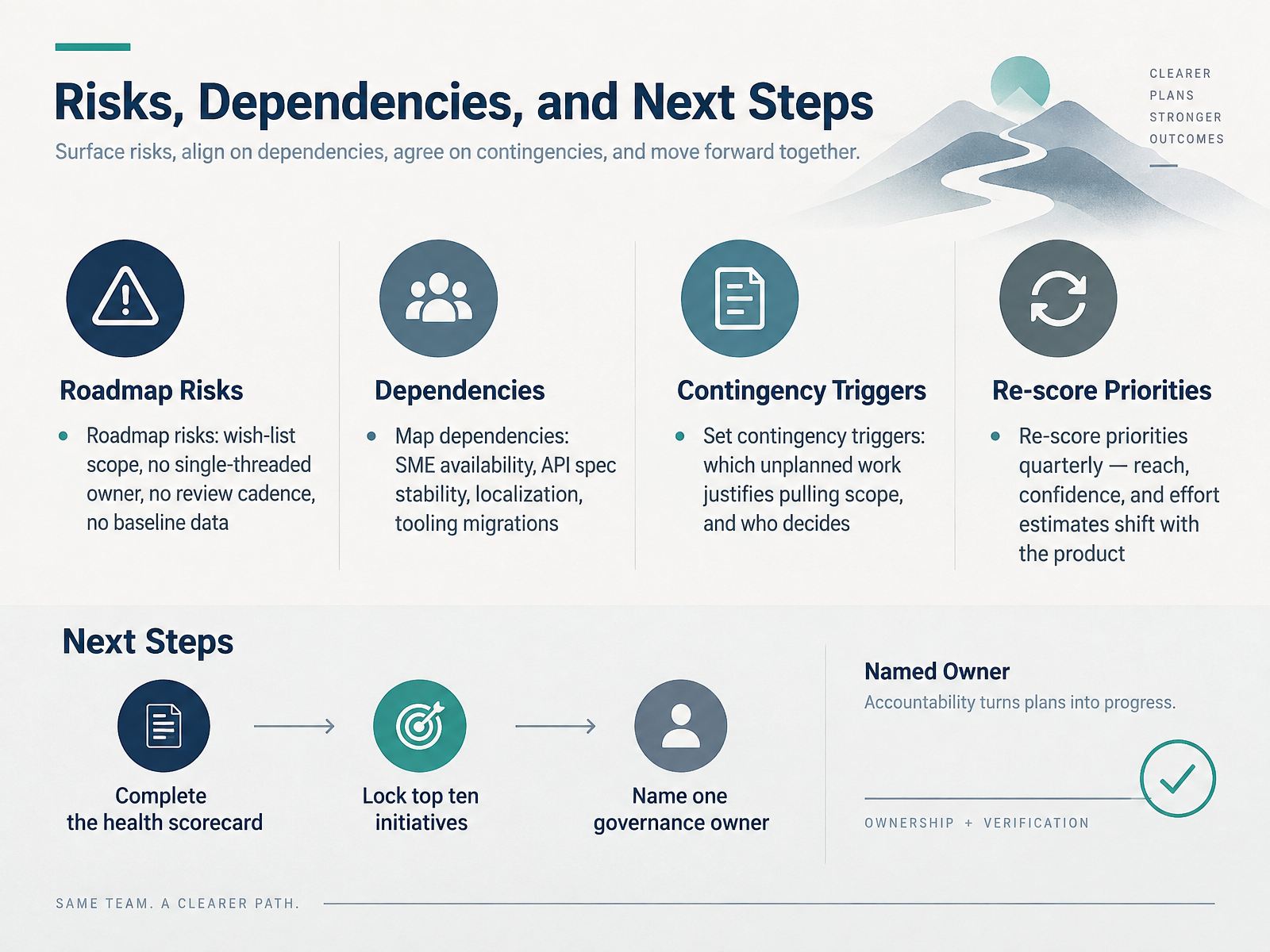
Four failure patterns show up again and again. Wish list scope, where everything is a priority and nothing ships. No single threaded owner, so accountability dissolves between teams. No review cadence, which lets stale pages pile up silently. And no baseline data, so you cannot prove progress when leadership asks. Name these risks out loud at your next planning session. Naming them is the first mitigation.
Then map your dependencies before they map you. Subject matter expert availability, API spec stability, localization timelines, and tooling migrations. Each one is a scheduling constraint you can track, not a surprise you absorb late in the quarter.
Next, set contingency triggers. Decide in advance which unplanned work justifies pulling scope off the roadmap, and who makes that call. A release slipping, a security fix, an executive request. If you define the trigger and the decision maker now, the conversation in the moment becomes a check against agreed criteria instead of a negotiation.
Finally, re-score priorities quarterly. Reach, confidence, and effort estimates shift as the product moves, and a ranking built in January is often wrong by April.
Your next steps are concrete. Complete the health scorecard, lock your top ten initiatives, and name one governance owner. That single owner keeps the roadmap honest, and the quarterly re-score keeps it relevant.
Thank you for working through this roadmap with me. You now have the structure and the language to defend your priorities. Go build the plan your team deserves.
 stateofdocs.combardglobal.comstateofdocs.com+22 min
Take the deck with you
Download this course as a file — free, no sign-up needed.
- PDF handoutEvery slide page, ready to print or share.15 pages · 3.3 MBDownload
- Narrated PowerPointThe deck that presents itself — every slide carries the digital human's narration video.15 pages · 15.9 MBDownload
- PowerPoint slidesThe full deck as a .pptx — open it in PowerPoint, Keynote, or Google Slides.15 pages · 3.2 MBDownload
Free to use in your own training — please keep the PersonWise credit page at the end.
Have your own deck? Turn it into a course
Sources consulted
Web sources consulted while building this course.
- Documentation Best Practices for 2026 | Docsio — docsio.co
- Turning Technical Roadmaps into Compelling Documentation | Drafted by Machines — daily.jovis.ai
- How to write technical documentation that developers actually use — mintlify.com
- Technical documentation in 2026: built for humans and AI — slite.com
- Documentation Strategy: A 2026 Playbook for Small Teams | Docsio — docsio.co
- https://www.stateofdocs.com/2026/docs-team-structure — stateofdocs.com
- How to Build an Effective Enterprise Documentation Team — bardglobal.com
- Documentation team structure - State of Docs Report 2025 — stateofdocs.com
- Technical Writing Management | The GitLab Handbook — handbook.gitlab.com
- Scaling a TechDocs Team from 1 to 100 (Part 1) - Lounge Scene — blog.thoward37.me
- Technical Writing Review: How to Check Documentation Quality at Scale | TeamBench — teambench.ai
- Documentation Audit Template for Product Managers — ideaplan.io
- How to Audit Your Existing Documentation — A Step-by-Step GuideA practical, step-by-step framework to audit existing documentation, including planning, inventory, quality checks, scoring, prioritization, and a sample audit report to help you turn messy docs into reliable, usable content. — writerresource.com
- Content Audit Checklist for Technical writers Blogs | Amplefound — amplefound.com
- Setting Up a Content Scoring Framework | Markup AI — markup.ai
- https://www.diataxis.fr/map/ — diataxis.fr
- Diátaxis framework — diataxis.fr
- Diátaxis — diataxis.fr
- Start here - Diátaxis in five minutes — diataxis.fr
- Content types - Mintlify Guides — mintlify.com