Data Science vs Software Engineering Tradeoffs
Begin
14 pages · ~28 min
Data Science vs Software Engineering Tradeoffs
This training clarifies the distinctions, tradeoffs, and use cases for data science versus software engineering roles, helping learners choose the right approach for their projects.
What you’ll learn
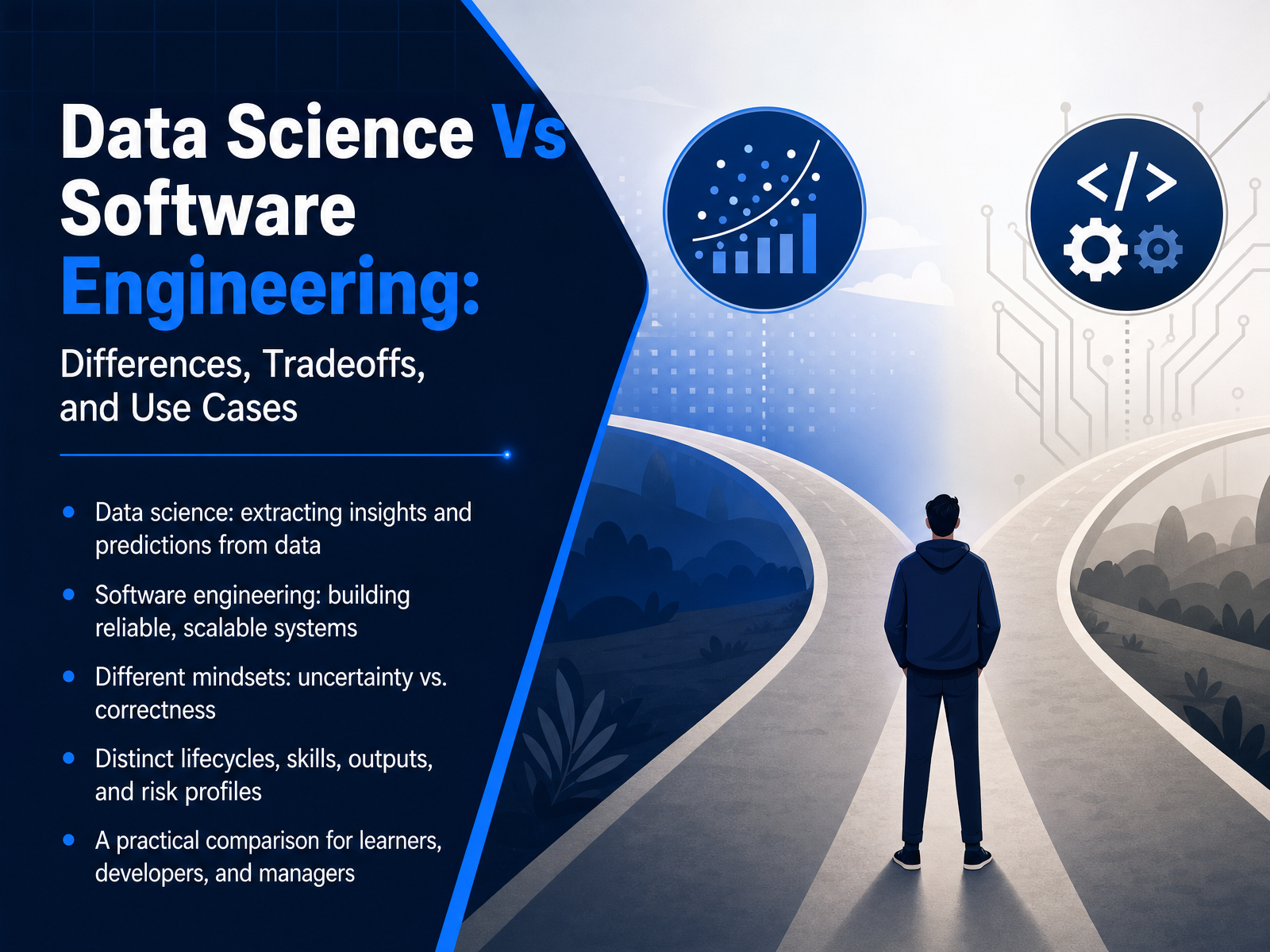
- 01Data Science Vs Software Engineering: Differences, Tradeoffs, and Use CasesWelcome. Today we’re comparing two fields that often get mixed up: data science and software engineering. Both are technical, both pay well, and both are essential. But they solve different kinds of problems. Data science is about extracting insights and predictions from data. Software engineering is about building reliable, scalable systems. The mindsets differ too. Data science embraces uncertainty and exploration. Software engineering focuses on correctness and structure. Their lifecycles, skills, outputs, and risk profiles are distinct. This session gives you a practical comparison, whether you’re a learner choosing a path, a developer working with data teams, or a manager deciding how to structure your organization. Let’s dig into what actually separates these two disciplines, and why the tradeoffs matter in real projects.drjoeshepherd.comkore1.comlucafiaschi.com+21 min
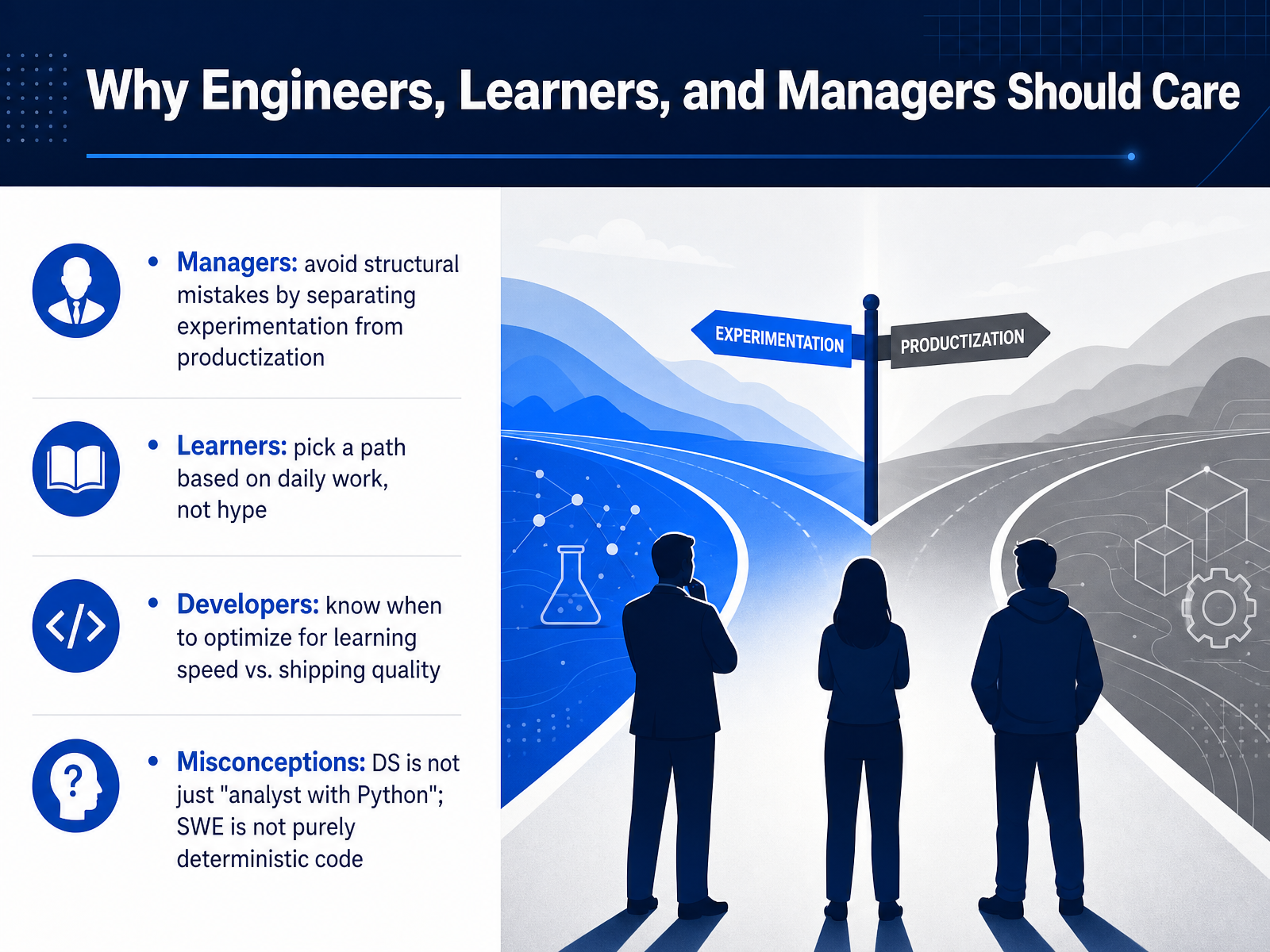
- 02Why Engineers, Learners, and Managers Should CareSo why should these differences matter to you? For managers, the biggest risk is structural. Teams often force data science and software engineering into one workflow, but they need two operating modes. Experimentation optimizes for learning speed. Productization optimizes for shipping quality. Mixing them up creates confusion about priorities and ownership. For learners, the choice should come from daily work, not hype. Software engineering offers a more structured path to building systems. Data science suits those who enjoy exploring open-ended questions with statistics. For developers, knowing when to optimize for learning versus quality is a career skill. And let's clear up two misconceptions. Data science is not just an analyst with Python. It involves statistical judgment and experimentation design. And software engineering is not purely deterministic code. It involves architecture decisions and managing complex systems. Both fields demand real problem solving. Keep these tradeoffs in mind as we look at the contrasting mindsets behind each discipline.
 drjoeshepherd.comkore1.comlucafiaschi.com+21 min
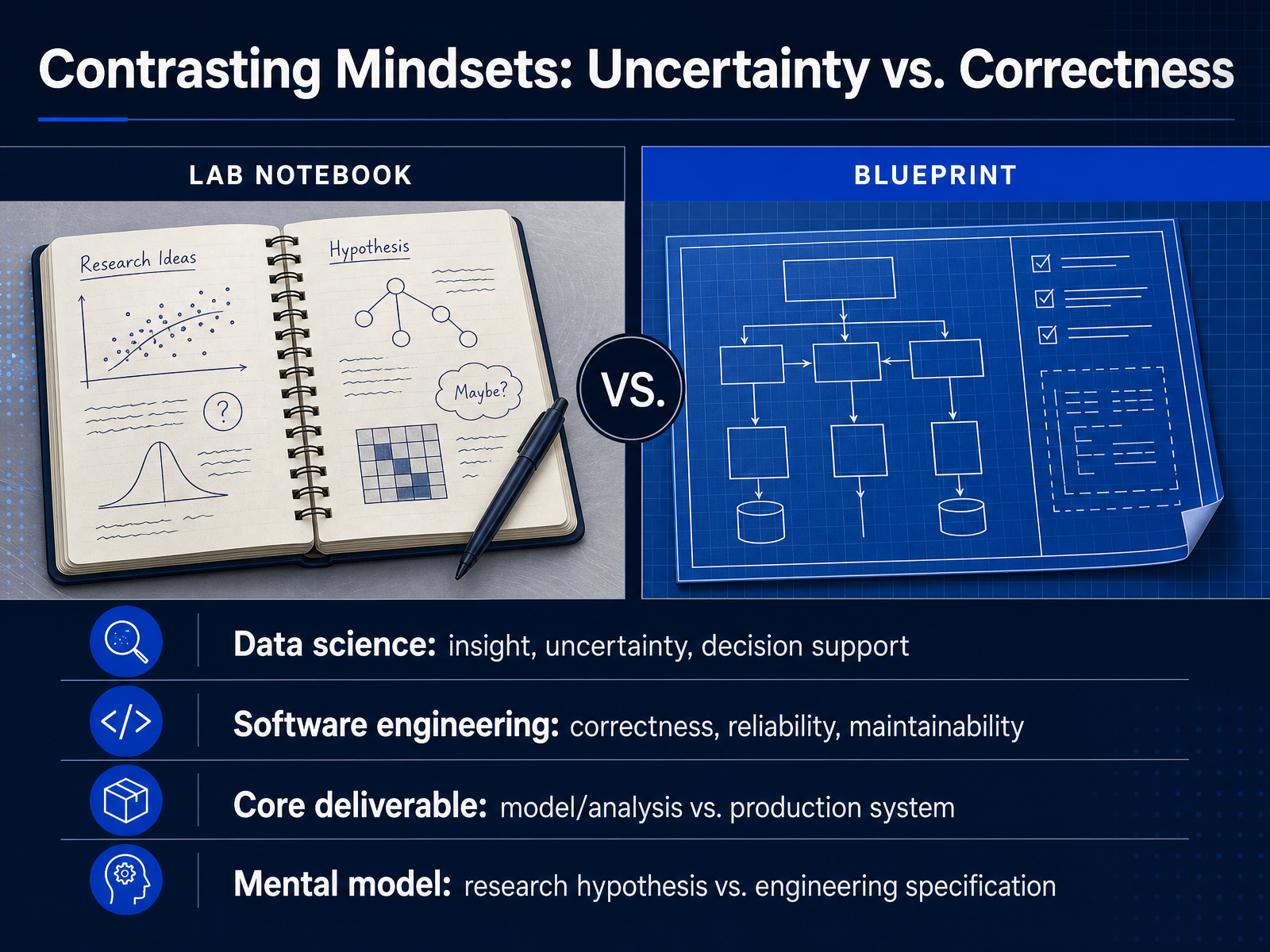
 - 03Contrasting Mindsets: Uncertainty vs. CorrectnessLet’s talk about the mindset difference, because that’s where the two fields truly diverge. Data science operates in a world of uncertainty. The goal is insight — you explore data, test hypotheses, and deal with probabilities. A model doesn’t give you a yes or no; it gives you a likelihood, and your job is to surface that uncertainty to decision makers. Software engineering, on the other hand, is about correctness. Code either does what it’s supposed to do, or it doesn’t. There’s a specification, a set of tests, and a definition of done. The core deliverable also differs: a data scientist produces a model or an analysis that supports a decision, while an engineer produces a production system that runs reliably. Think of the mental model this way: data science is research — you form a hypothesis and design an experiment to test it. Software engineering uses an engineering specification — you define the requirements up front and build to them. Neither mindset is better; they’re just different tools for different problems. The key is recognizing which mode you’re in — and leading accordingly. Next, let’s look at the data science lifecycle in practice.
 drjoeshepherd.comkore1.comlucafiaschi.com+22 min
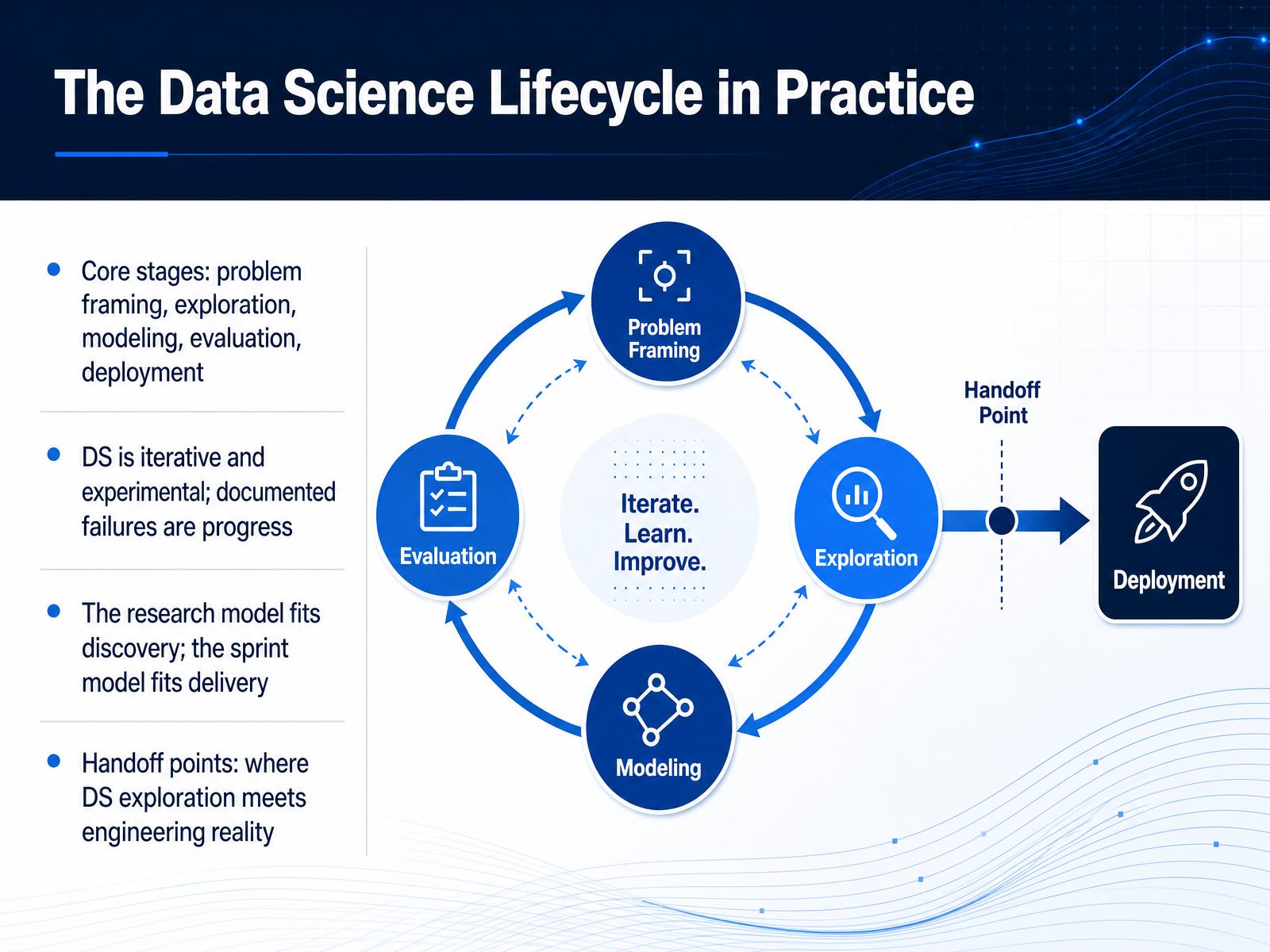
 - 04The Data Science Lifecycle in PracticeNow let’s look at how data science actually works in practice. The lifecycle has five core stages: problem framing, exploration, modeling, evaluation, and deployment. But here’s the key difference from software engineering. Data science is iterative and experimental. Documented failures are progress, not wasted effort. Think of it this way. If you’re testing a hypothesis about customer behavior and the data refutes it, that’s a valuable result. It narrows the search space. This is why the research model fits discovery work. You form a hypothesis, run an experiment, and learn from the outcome. The sprint model, by contrast, fits delivery. Once you have a viable approach, that’s when engineering rigor takes over, with versioned artifacts and automated tests. The critical moment is the handoff. That’s where data science exploration meets engineering reality. The team has to know whether they’re optimizing for learning speed or shipping quality. Apply the wrong operating model, and you either force feature delivery before the learning is done, or you let engineering stay stuck in ambiguity. So remember, data science is about narrowing uncertainty. Engineering is about locking in reliability. Now, let’s contrast that with the software engineering lifecycle.
 drjoeshepherd.comkore1.comlucafiaschi.com+22 min
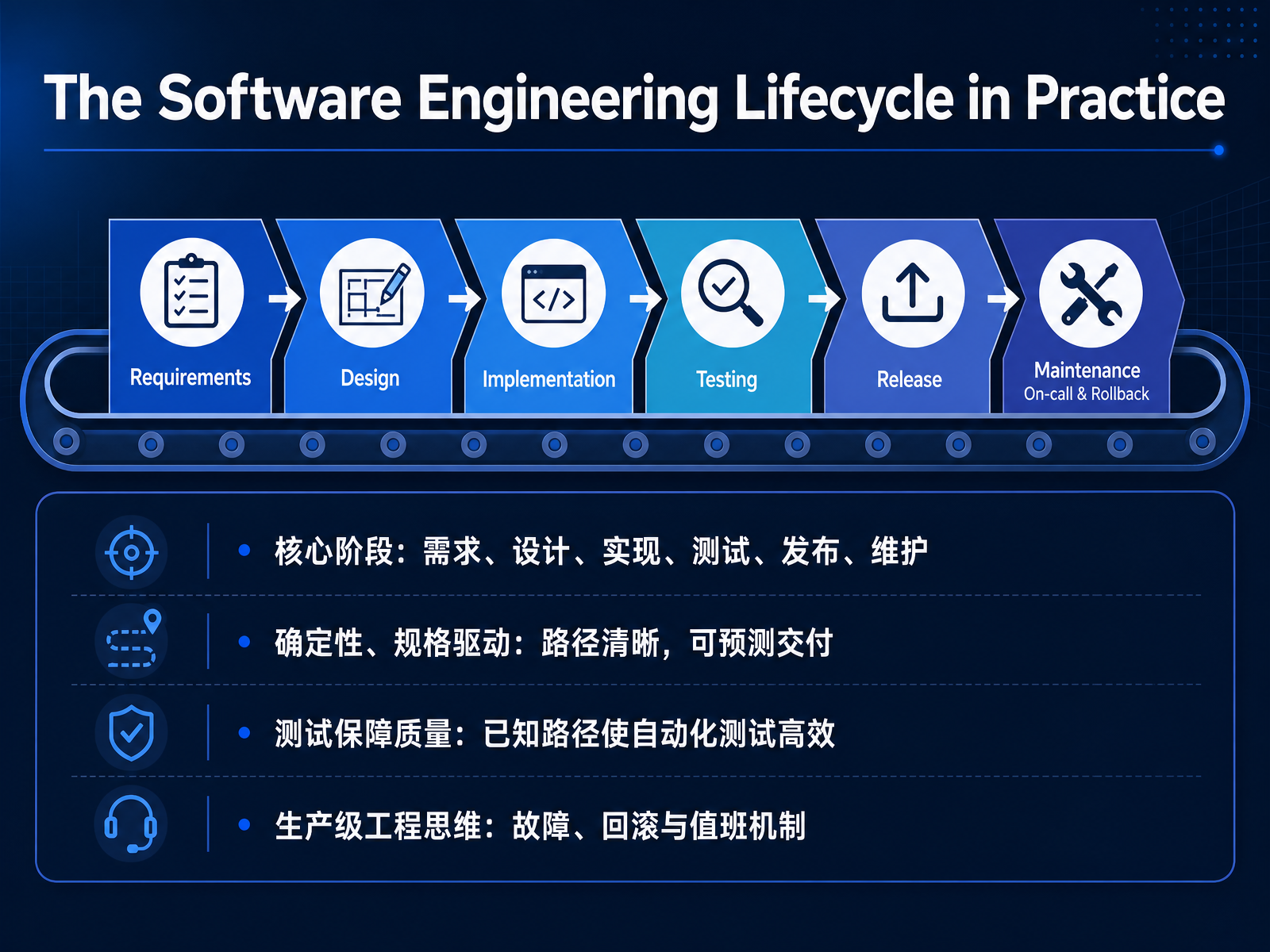
 - 05The Software Engineering Lifecycle in PracticeNow let's look at how a software engineering project actually runs its course. The lifecycle here is built around six core stages: requirements, design, implementation, testing, release, and maintenance. The key characteristic to remember is determinism. The requirements define a known destination, the design maps the route, and the implementation follows that map. Because the path is well understood, delivery is predictable. This is also what makes automated testing so effective. When you know exactly what the system should do, you can write tests that verify it does that consistently. In a codebase where behavior is deterministic, thousands of tests can run in minutes and catch regressions quickly. The final pillar is production-level engineering thinking. This includes designing for failure, planning rollbacks when a deployment breaks, and having on-call mechanisms so the right person gets alerted when something goes wrong at three in the morning. In practice, software engineering rewards rigor, predictability, and repeatability. This contrast becomes even sharper when we look at the actual skills and tools used in each discipline, which is where we're heading next.
 drjoeshepherd.comkore1.comlucafiaschi.com+21 min
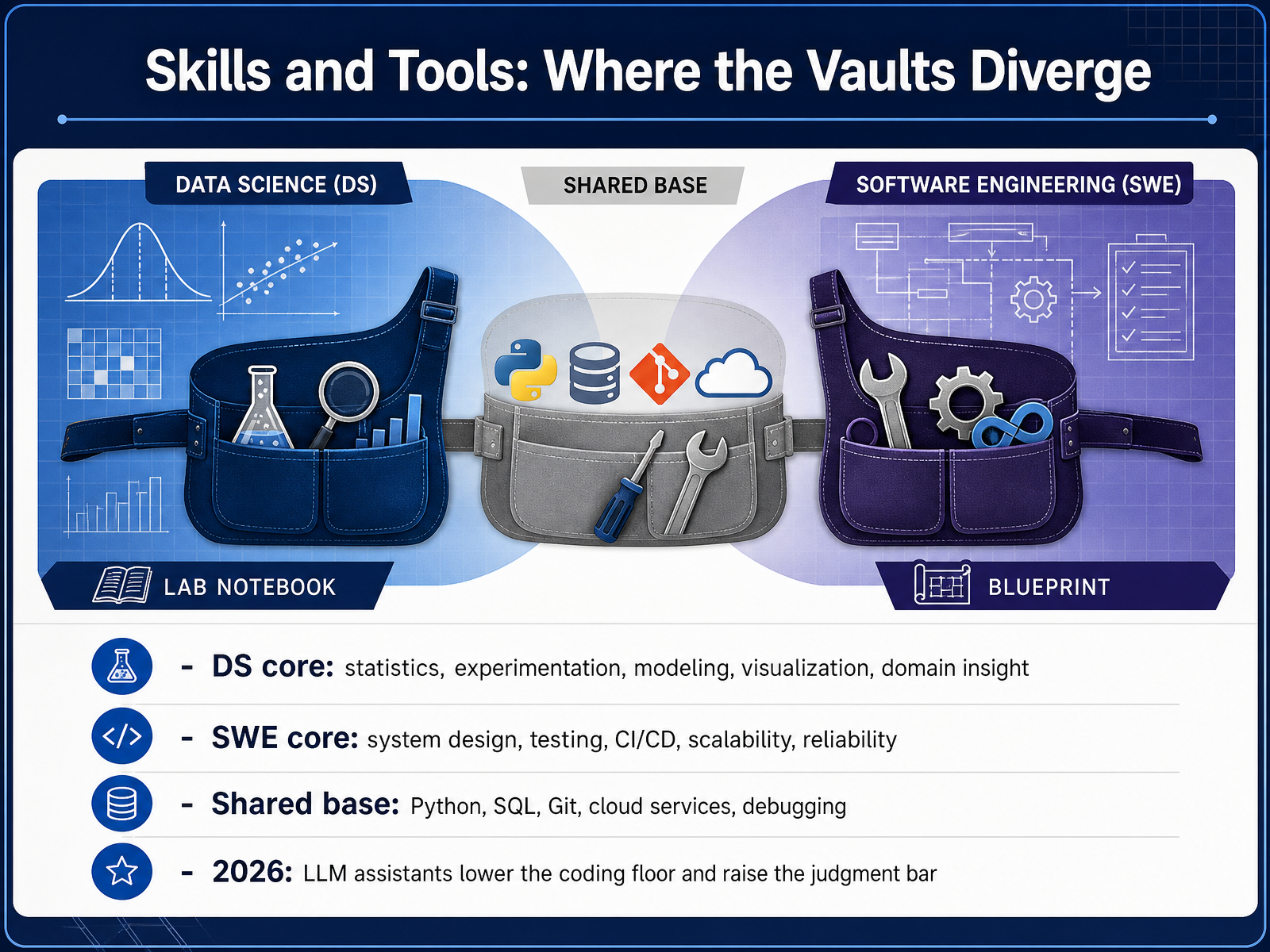
 - 06Skills and Tools: Where the Vaults DivergeLet's look at where the technical toolkits actually diverge. Data science is anchored in statistics, experimentation, modeling, and visualization, plus a deep understanding of the business domain. Think of it as detective work, where you're interrogating a dataset until it confesses something useful. The core of software engineering, in contrast, is system design, testing, continuous integration and delivery, scalability, and reliability. That's the builder's world, shipping code that runs in production, withstands traffic, and doesn't fall over at two a.m. That said, the foundation is largely shared. Both roles live in Python, SQL, Git, cloud services, and debugging. This overlap is exactly why so many professionals cross over. But here's the 2026 shift, and I want you to pause on this. Large language model assistants have lowered the coding floor. Boilerplate code and routine data cleaning are increasingly automated. But they've raised the judgment bar. The real value now comes from statistical reasoning and business framing on the data side, and from architecture decisions and production judgment on the engineering side. Your ability to tell when a model is wrong, or when a system design is fragile, is now the core skill. Now let's look at the key outputs and the different risks each discipline owns.
 deepcomps.comguvi.inwhatisthesalary.com+21 min
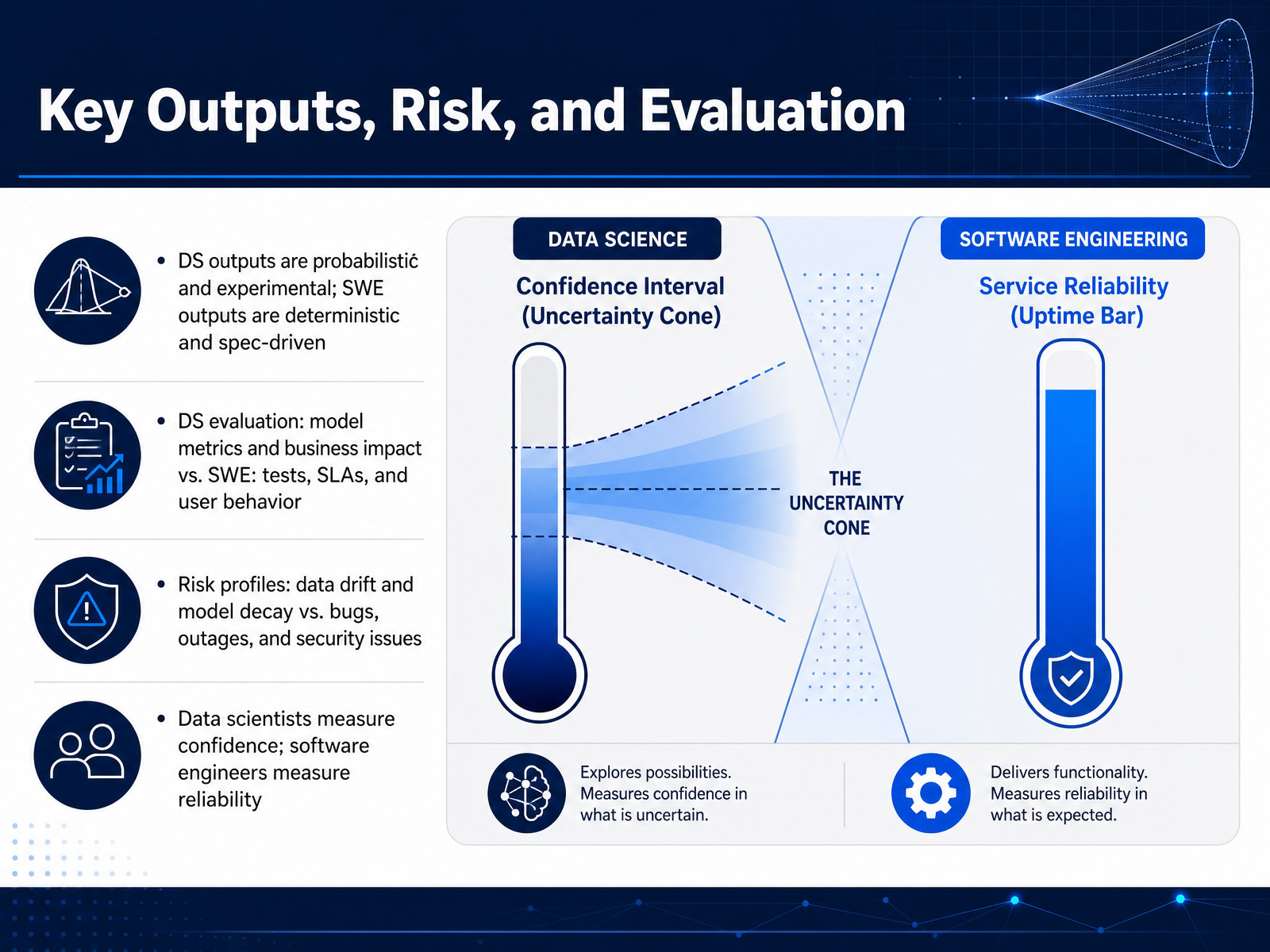
 - 07Key Outputs, Risk, and EvaluationNow let’s talk about what each field actually produces, how we judge success, and where the risks really live. Data science outputs are probabilistic and experimental. You build a model that predicts behavior with a certain level of confidence, not with absolute certainty. Software engineering, by contrast, is deterministic and spec-driven. You write code that either meets the specification or it doesn’t. The evaluation metrics are different too. Data scientists measure success through model metrics like accuracy or precision, and ultimately through business impact. Software engineers measure success through tests passed, service-level agreements, and observed user behavior. And the risk profiles are equally distinct. For data science, the quiet killers are data drift and model decay. The world changes, and the model slowly becomes less accurate. For software engineering, the risks are more immediate: bugs, outages, and security vulnerabilities. So here’s the core takeaway. Data scientists measure confidence in a prediction. Software engineers measure reliability of a system. Both are hard, but they are different kinds of hard. This distinction sets up the tradeoffs we’ll explore next.
 drjoeshepherd.comkore1.comlucafiaschi.com+22 min
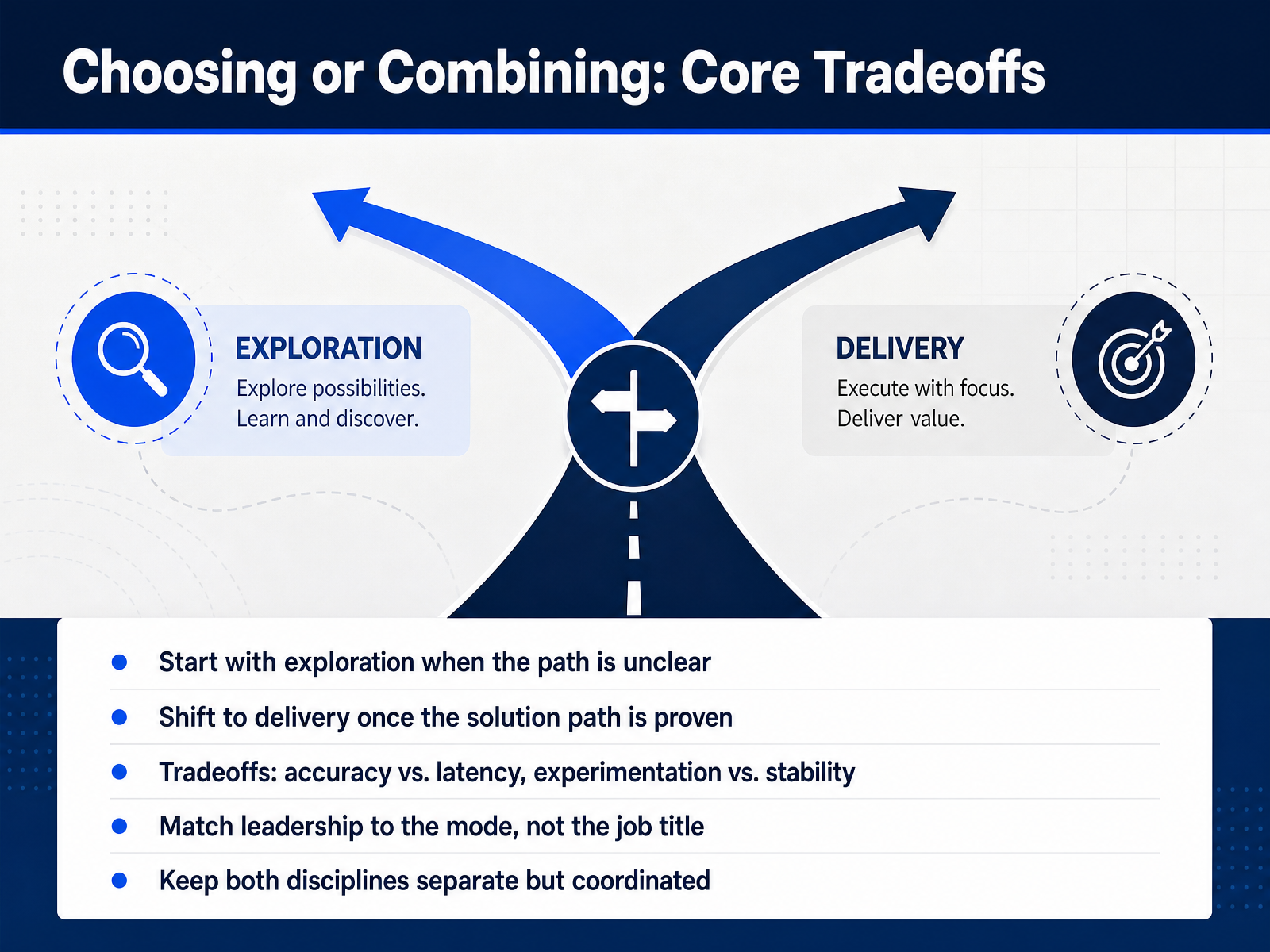
 - 08Choosing or Combining: Core TradeoffsSo how do you choose between these two disciplines? The pragmatic answer: start with exploration when the path is unclear, and shift to delivery once the solution path is proven. This is the fundamental tradeoff. Data science optimizes for learning speed, evidence quality, and fast iteration. Software engineering optimizes for reliability, maintainability, and production quality. The tension is real: accuracy versus latency, experimentation versus stability. The strongest organizations manage this tension not by choosing one side, but by treating them as two distinct operating modes. Match leadership to the mode, not the job title. During experimentation, you need someone who protects the team's time to explore. During productization, you need someone focused on shipping quality. And here's the key: keep the two disciplines separate but coordinated. Let data scientists explore without being forced into feature deadlines, and let engineers build without being blocked by endless ambiguity. Separate teams, separate backlogs, but shared objectives and a smooth handoff. Coming up, we'll look at real use cases and team structures that make this work in practice.
 drjoeshepherd.comkore1.comlucafiaschi.com+21 min
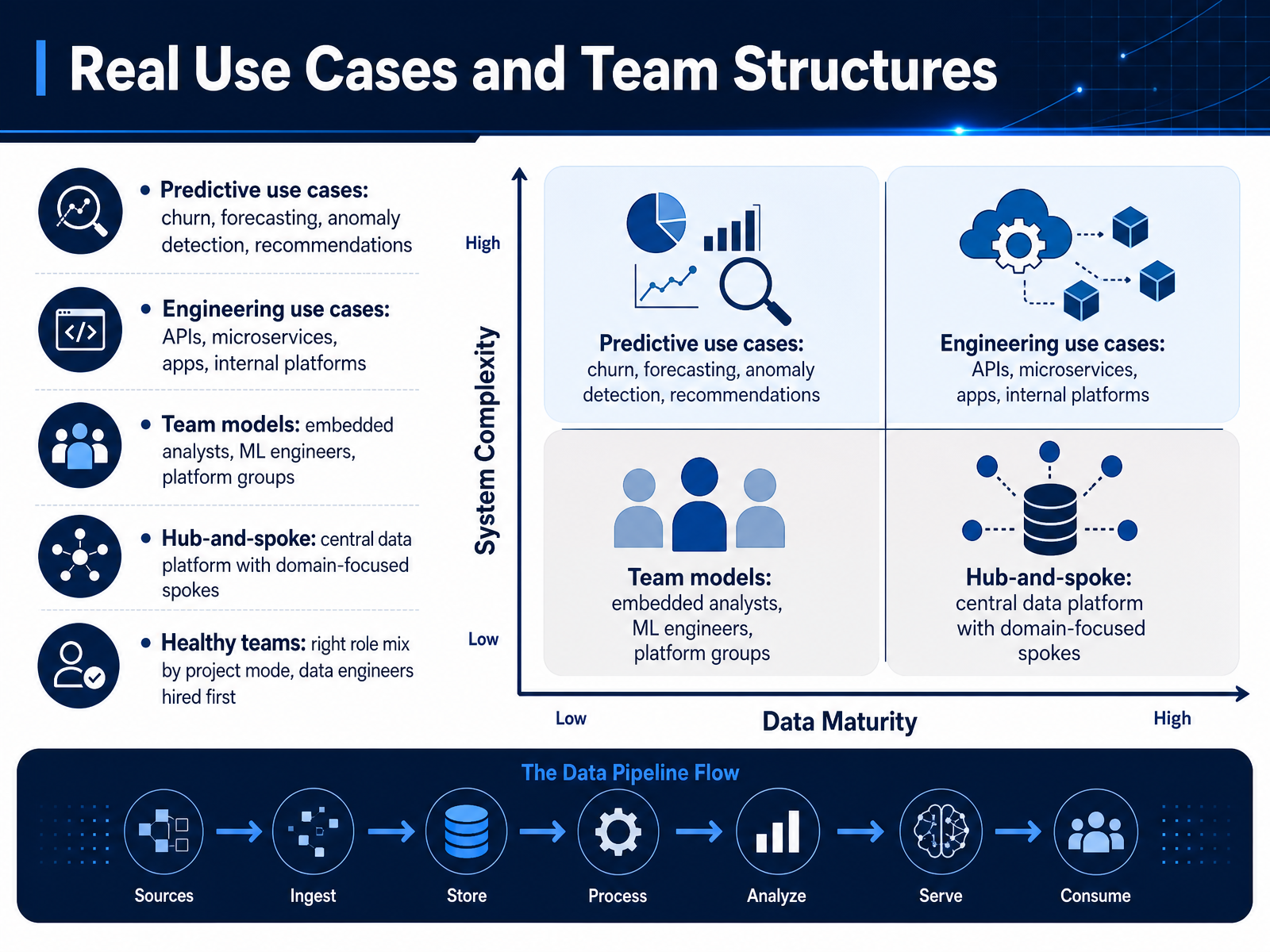
 - 09Real Use Cases and Team StructuresLet’s look at where these roles actually show up in practice. Predictive use cases like churn, forecasting, anomaly detection, and recommendations sit squarely in data science. Engineering use cases—APIs, microservices, apps, internal platforms—belong to software engineering. But the real insight is structural. Teams are not just a pile of data scientists and engineers. You need the right mix and the right model. Embedded analysts work inside business units for speed, while a central platform group handles infrastructure. That hub-and-spoke model balances autonomy with consistency. The order of hiring matters too. Data engineers come first, because clean, reliable data is the foundation. Scientists and ML engineers come after. And don’t forget the two operating modes: experimentation for learning, and productization for shipping. Match your team shape to your current mode, and you’ll avoid the classic clash of paces. Coming up, we’ll look at the overlap between ML engineering, MLOps, and AI engineering.
 drjoeshepherd.comkore1.comlucafiaschi.com+21 min
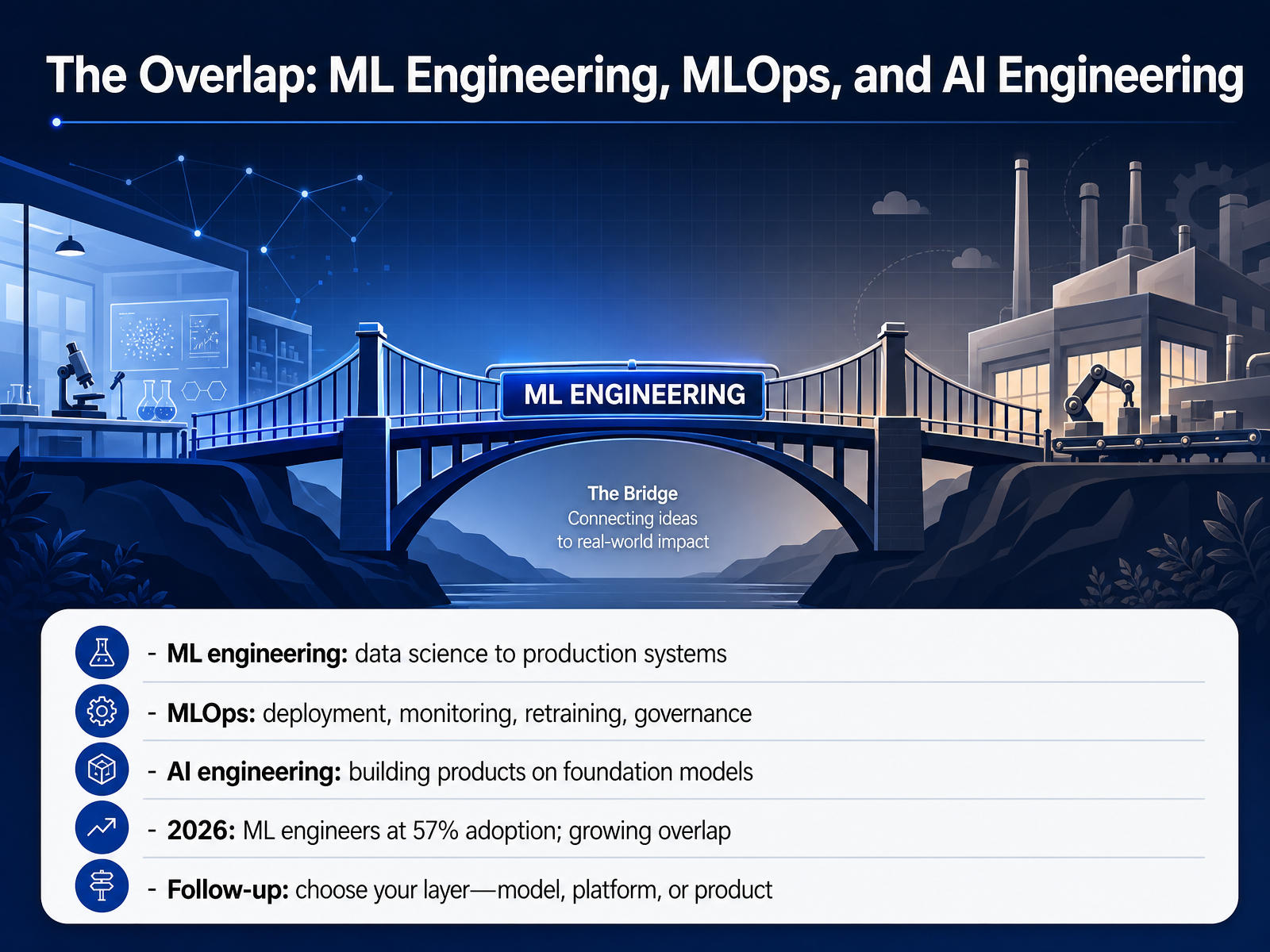
 - 10The Overlap: ML Engineering, MLOps, and AI EngineeringNow let’s look at the overlap that matters most in 2026. Machine learning engineering, MLOps, and AI engineering are where the two disciplines converge. ML engineering is the practice of taking a data scientist's model and turning it into a production system that can handle real traffic. MLOps is its operational backbone—deployment, monitoring, retraining, and governance. Meanwhile, AI engineering has emerged as the newest layer: building products on top of foundation models, with skills like retrieval and orchestration. The adoption numbers reflect this convergence. ML engineers are now present in 57 percent of companies, making them the critical bridge role in modern teams. This means the old binary of data science versus software engineering is fading. The real question is which layer suits you: the model layer, the platform layer, or the product layer. Understanding that distinction will shape how organizations structure their teams. Let's examine those patterns next.
 drjoeshepherd.comkore1.comlucafiaschi.com+22 min
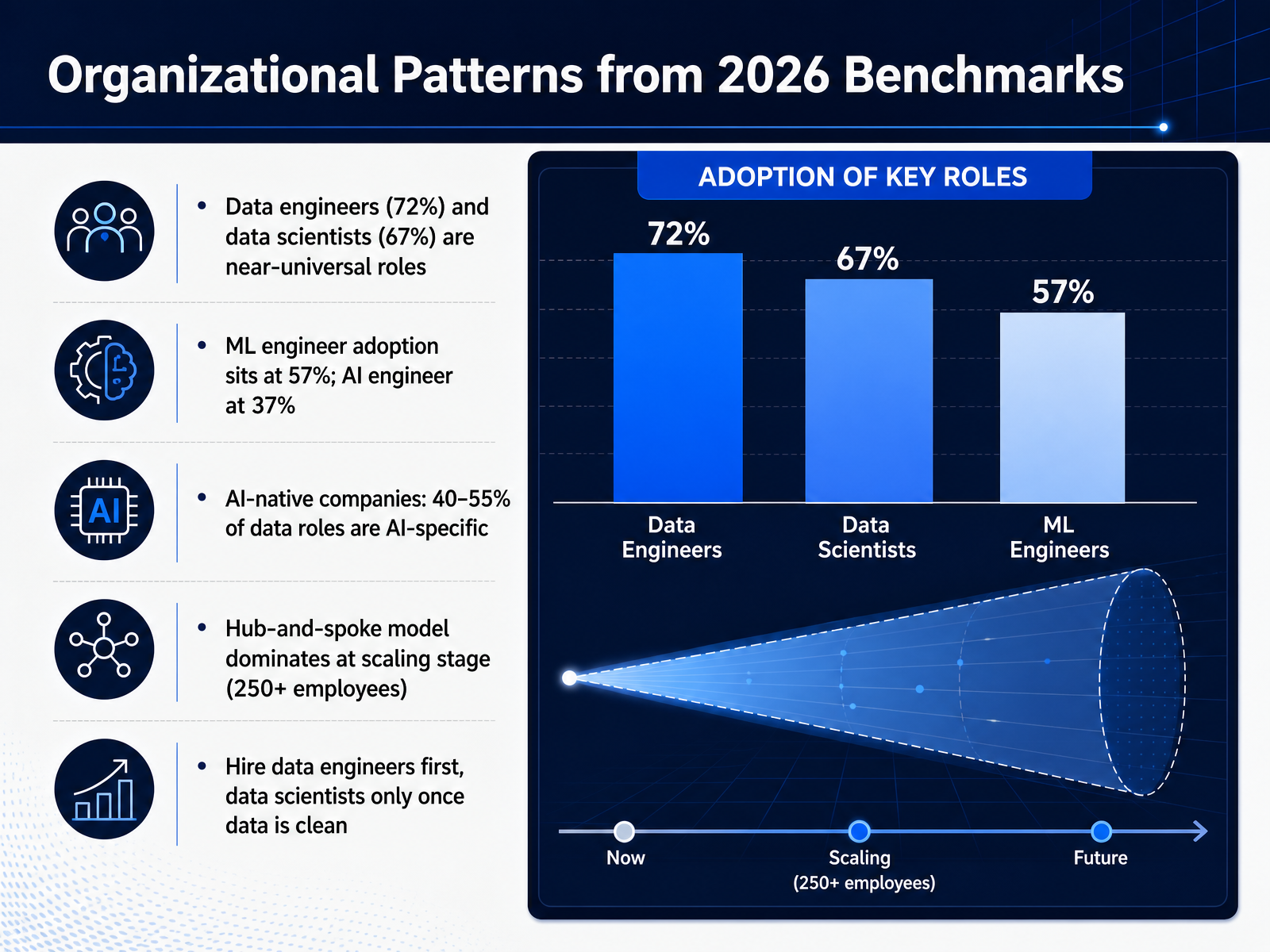
 - 11Organizational Patterns from 2026 BenchmarksNow, let's talk about what the 2026 benchmarks actually tell us. Data engineers and data scientists are near-universal, with seventy-two and sixty-seven percent adoption respectively. But the more interesting signal is what happens next. ML engineers appear in fifty-seven percent of teams, while the AI engineer title only shows up in thirty-seven percent. The difference is even starker in AI-native companies, where forty to fifty-five percent of all data roles are AI-specific. This is not a uniform shift; it is a targeted one. For the organizational structure, the hub-and-spoke model has become the dominant pattern for companies at the scaling stage, beyond two hundred and fifty employees. Why? Because you need centralized control over your data platform, but you also need embedded specialists who can move quickly inside business units. And the sequencing rule is simple. Hire your data engineers first, and only add data scientists once you have clean, reliable data worth modeling. Otherwise, you are paying senior money for someone to clean spreadsheets by hand. So, the takeaway: build the plumbing before you hire the mathematicians. With that foundation in mind, let's move on to the career paths, hiring, and transition strategies for these two disciplines.
 drjoeshepherd.comkore1.comlucafiaschi.com+21 min
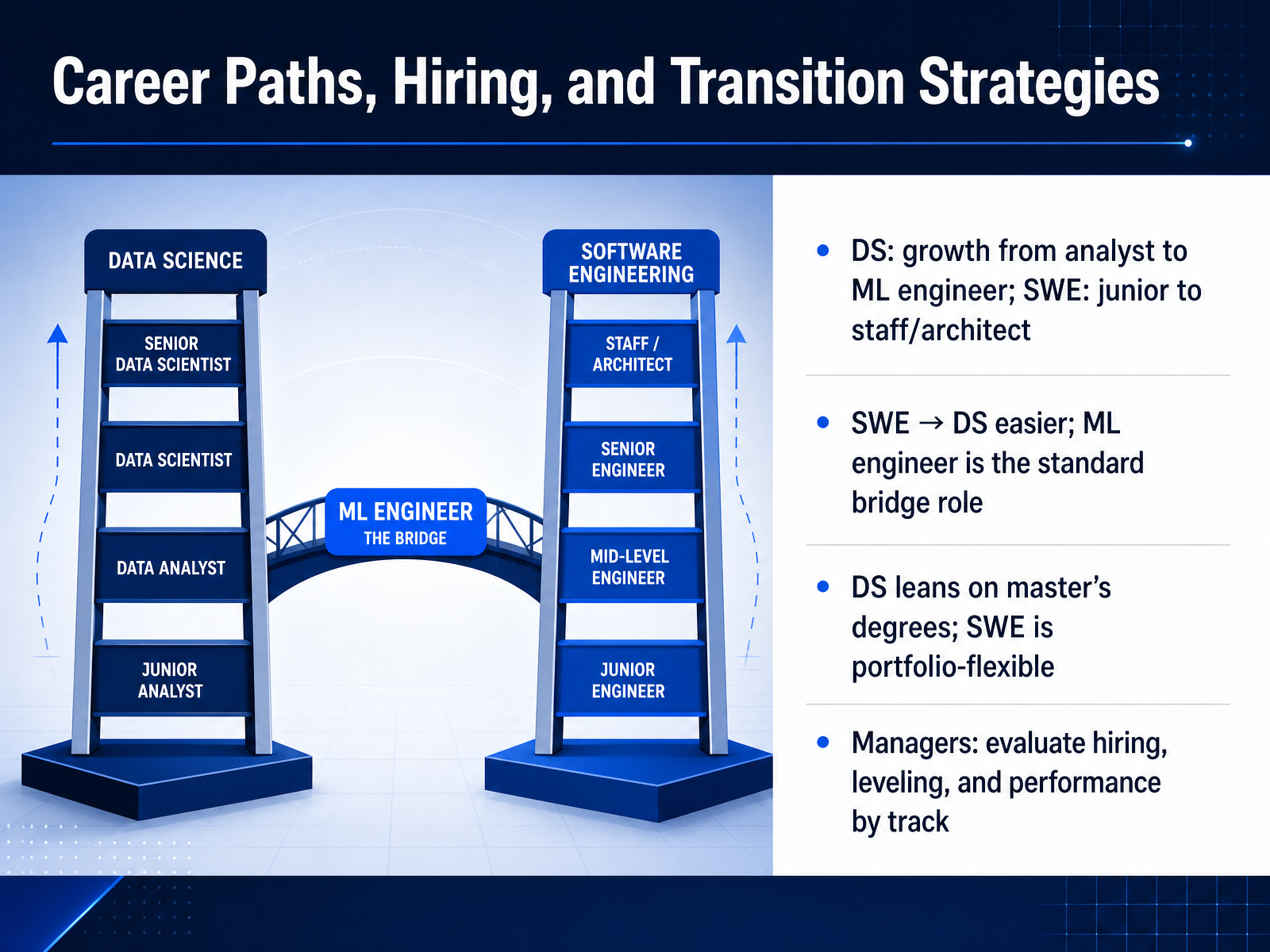
 - 12Career Paths, Hiring, and Transition StrategiesLet's look at how these differences play out in careers, hiring, and team building. In data science, growth typically runs from analyst to scientist to machine learning engineer. In software engineering, the ladder goes from junior to senior, then to staff or architect. One key insight: moving from software engineering into data science is the easier of the two transitions. Why? Engineers already understand production code and system hygiene. The gap is mostly statistics and experimental design. Machine learning engineer is the standard bridge role—it draws from both disciplines and often pays at engineering levels. Education requirements differ too. Data science roles, especially at larger companies, still lean on master's degrees. Software engineering is far more flexible; portfolios and bootcamps carry real weight. For managers, the takeaway is clear: don't use one track to evaluate the other. Data scientists should be judged on insight quality, experimental rigor, and decision impact. Engineers should be judged on system reliability, code quality, and shipping velocity. Level them separately, and you'll build a much stronger team. Now, let's tie this all together with a simple decision framework for project assignment.
 deepcomps.comguvi.inwhatisthesalary.com+22 min
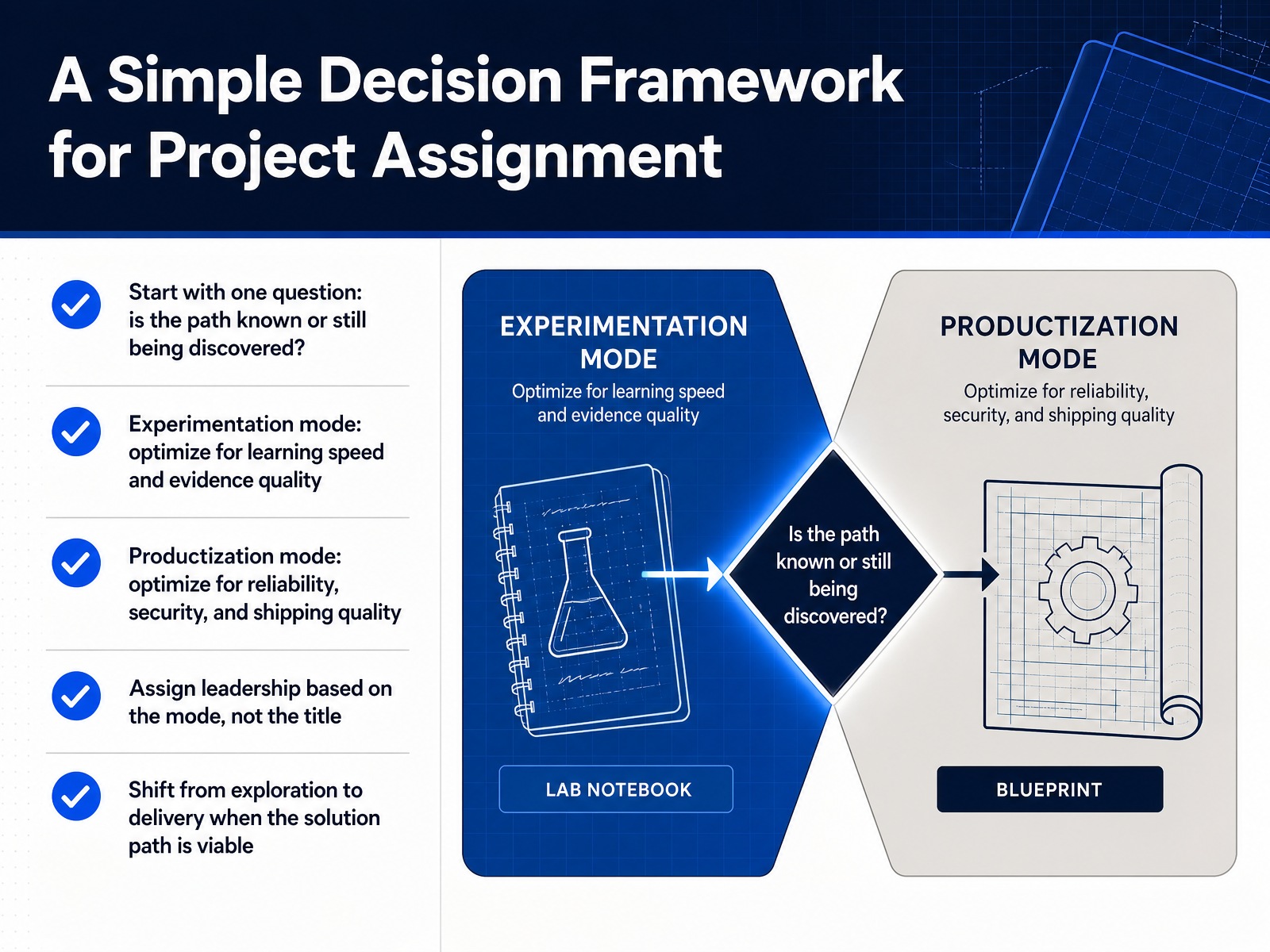
 - 13A Simple Decision Framework for Project AssignmentSo how do you decide which discipline leads a given project? Start with a single question: is the path known, or still being discovered? If the work is exploratory, you are in experimentation mode. Optimize for learning speed and evidence quality. Backlogs should emphasize experiments over features. Avoid pretending certainty exists before it does. If the solution path is viable, shift into productization mode. Now optimize for reliability, security, and shipping quality. The goal changes from learning to making the system real, robust, and supportable in production. Here is the key point: assign leadership based on the mode, not the title. If the team is still exploring, data science should lead. If the team is building against a clear path, engineering should lead. Defaulting everything to one side creates the wrong incentives. And when the mode shifts, leadership should shift with it. Make the operating mode visible to the whole team. Everyone should know whether the work is about learning or about shipping. This simple framework prevents the structural mistake of running both disciplines with the same cadence and expectations. It keeps data science from being treated like feature delivery before the learning is done, and it keeps engineering from being stuck in ambiguity longer than necessary. Next, let us pull these ideas into practical takeaways and clear next steps.
 drjoeshepherd.comkore1.comlucafiaschi.com+22 min
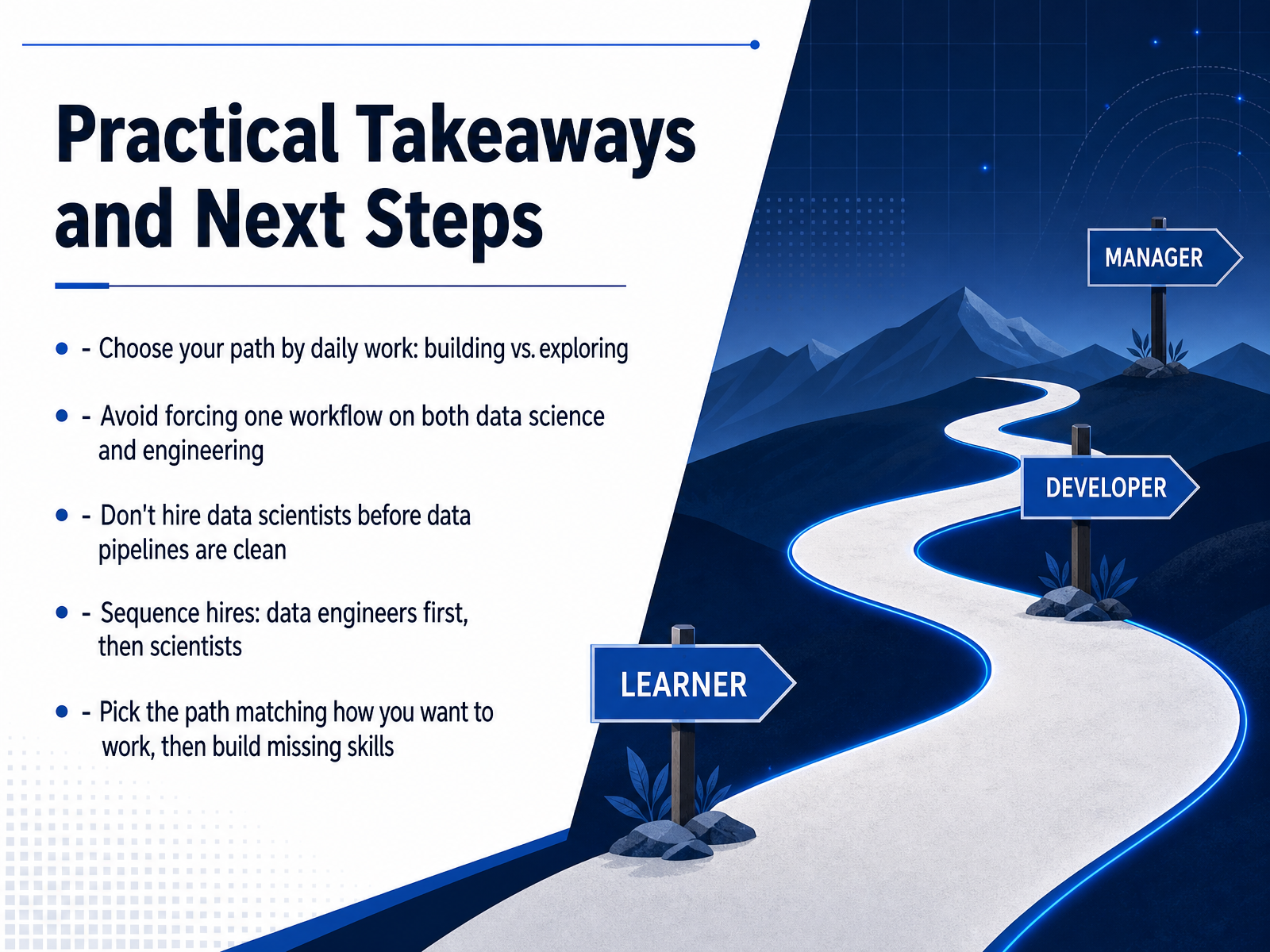
 - 14Practical Takeaways and Next StepsSo here’s the bottom line. Choose your path by daily work: building products or exploring questions. Don’t force one workflow on both. Data science thrives on experimentation, software engineering on shipping quality. And for teams, sequence matters. Hire data engineers first to build clean pipelines, then bring in data scientists to work with that trustworthy data. If you’re deciding for yourself, pick the path that matches how you want to work, then build the missing skills. Start with the fundamentals, get hands-on experience, and keep learning. Both paths are strong. The best choice is the one that fits you. Thanks for joining, and good luck with your next step.
 drjoeshepherd.comkore1.comlucafiaschi.com+21 min
Take the deck with you
Download this course as a file — free, no sign-up needed.
- PDF handoutEvery slide page, ready to print or share.15 pages · 3.8 MBDownload
- Narrated PowerPointThe deck that presents itself — every slide carries the digital human's narration video.15 pages · 15.4 MBDownload
- PowerPoint slidesThe full deck as a .pptx — open it in PowerPoint, Keynote, or Google Slides.15 pages · 3.7 MBDownload
Free to use in your own training — please keep the PersonWise credit page at the end.
Have your own deck? Turn it into a course
Sources consulted
Web sources consulted while building this course.
- AI Product Teams Need Two Operating Modes, Not One | Dr. Joe Shepherd — drjoeshepherd.com
- Data Team Org Chart 2026: How to Structure Your Data Org - KORE1 — kore1.com
- What Do Data Teams Actually Look Like in 2026? A Large LinkedIn Benchmark – Luca Fiaschi — lucafiaschi.com
- What a Modern Data Team Actually Looks Like in 2026 | ToggleHire — togglehire.com
- Data Science vs Data Engineering: Choosing Analysis or Infrastructure | Databricks Blog — databricks.com
- SWE vs Data Scientist 2026: Real Comp, Daily Tasks, How to Switch — deepcomps.com
- Data Science vs Software Engineering: Which to Choose? — guvi.in
- Software Engineer vs Data Scientist: 2026 Salary & Career Guide — whatisthesalary.com
- Software Engineer vs Data Scientist: Salary, Skills, Growth & Job Security in 2026 (The Real Industry Truth) — kaashivinfotech.com
- Data Science vs. Software Engineering: How to Choose Your ... — turingcollege.com