Nitrogen Cycle: Matter in Living Systems
Begin
13 pages · ~26 min
Nitrogen Cycle: Matter in Living Systems
Explore how nitrogen moves through ecosystems, from fixation to decomposition, and understand its role in sustaining life.
What you’ll learn
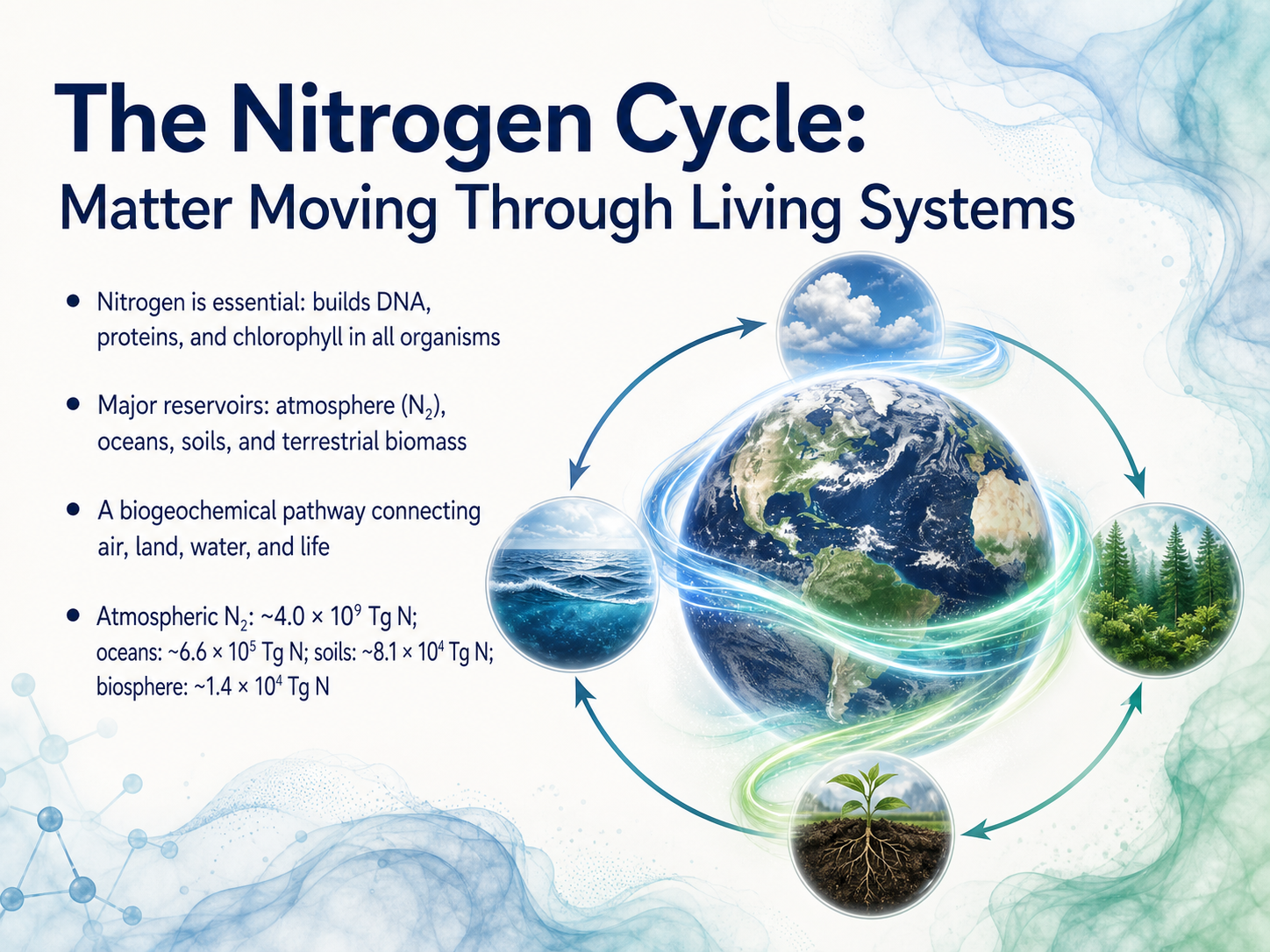
- 01The Nitrogen Cycle: Matter Moving Through Living SystemsWelcome. In this course, we explore the nitrogen cycle and how matter moves through living systems. Nitrogen is essential for all organisms—it builds DNA, proteins, and chlorophyll, which powers photosynthesis. But nitrogen isn't just sitting still inside plants and animals. It moves continuously between air, water, soil, and life. You'll see how this movement creates a global biogeochemical pathway that connects every part of our planet. To begin, let's look at where nitrogen is stored. The largest reservoir by far is the atmosphere, holding about four thousand million teragrams of nitrogen as dinitrogen gas. The oceans contain roughly six hundred sixty thousand teragrams of nitrogen. Soils hold about eighty-one thousand teragrams, and the living biosphere around fourteen thousand teragrams. These numbers show that most of Earth's nitrogen is in the air, while a much smaller fraction cycles through organisms. Over the next few slides, we'll trace how nitrogen moves from these reservoirs into living systems and back again. Next, we'll examine the chemical species and oxidation states that form the molecular backbone of this cycle.doi.orgmeetingorganizer.copernicus.orgpar.nsf.gov+22 min
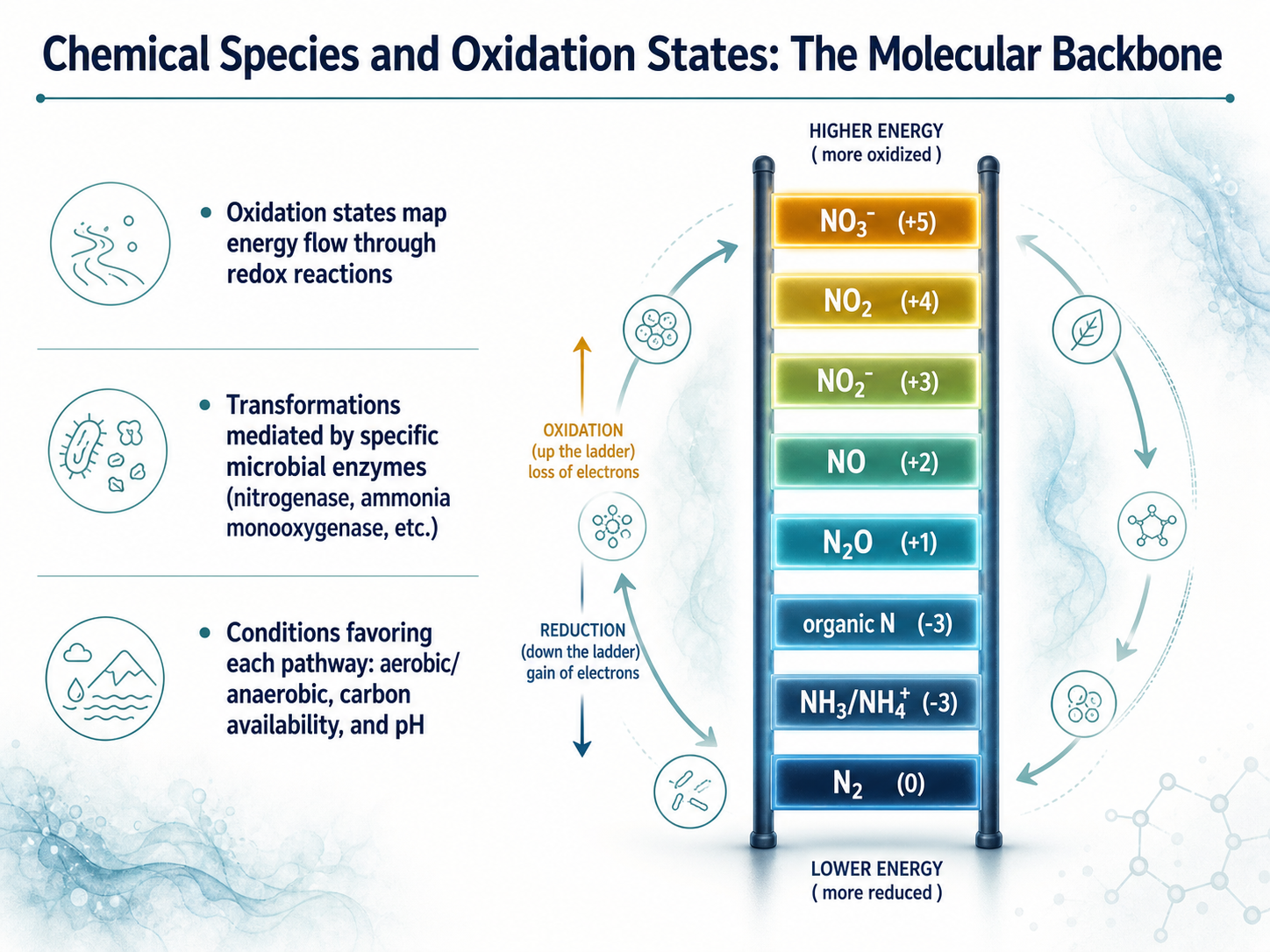
- 02Chemical Species and Oxidation States: The Molecular BackboneWe've seen how nitrogen moves through ecosystems. Now, let's look at the molecular backbone that makes this movement possible. Nitrogen can take on several chemical forms, each with a different oxidation state. You can think of these as the steps that track how energy flows through redox reactions. On your slide, you'll notice dinitrogen gas, or N two, at oxidation state zero. Organic nitrogen and ammonium, or NH four plus, sit at minus three. As we climb, we pass through nitrous oxide at plus one, nitric oxide at plus two, nitrite at plus three, nitrogen dioxide at plus four, and finally nitrate at plus five. These shifts don't happen on their own. Specific microbial enzymes drive each transformation. For example, nitrogenase converts N two gas into ammonia, while ammonia monooxygenase helps kick off nitrification. The pathway that gets activated depends on environmental conditions. A microbe's choice of route is shaped by whether oxygen is present, how much carbon is available, and the surrounding pH. Keeping these controls in mind will help you predict where certain nitrogen forms accumulate. Next, we'll focus on the starting point of the cycle: atmospheric nitrogen and the fixation challenge.
 nature.comlter.kbs.msu.eduen.wikipedia.org+22 min
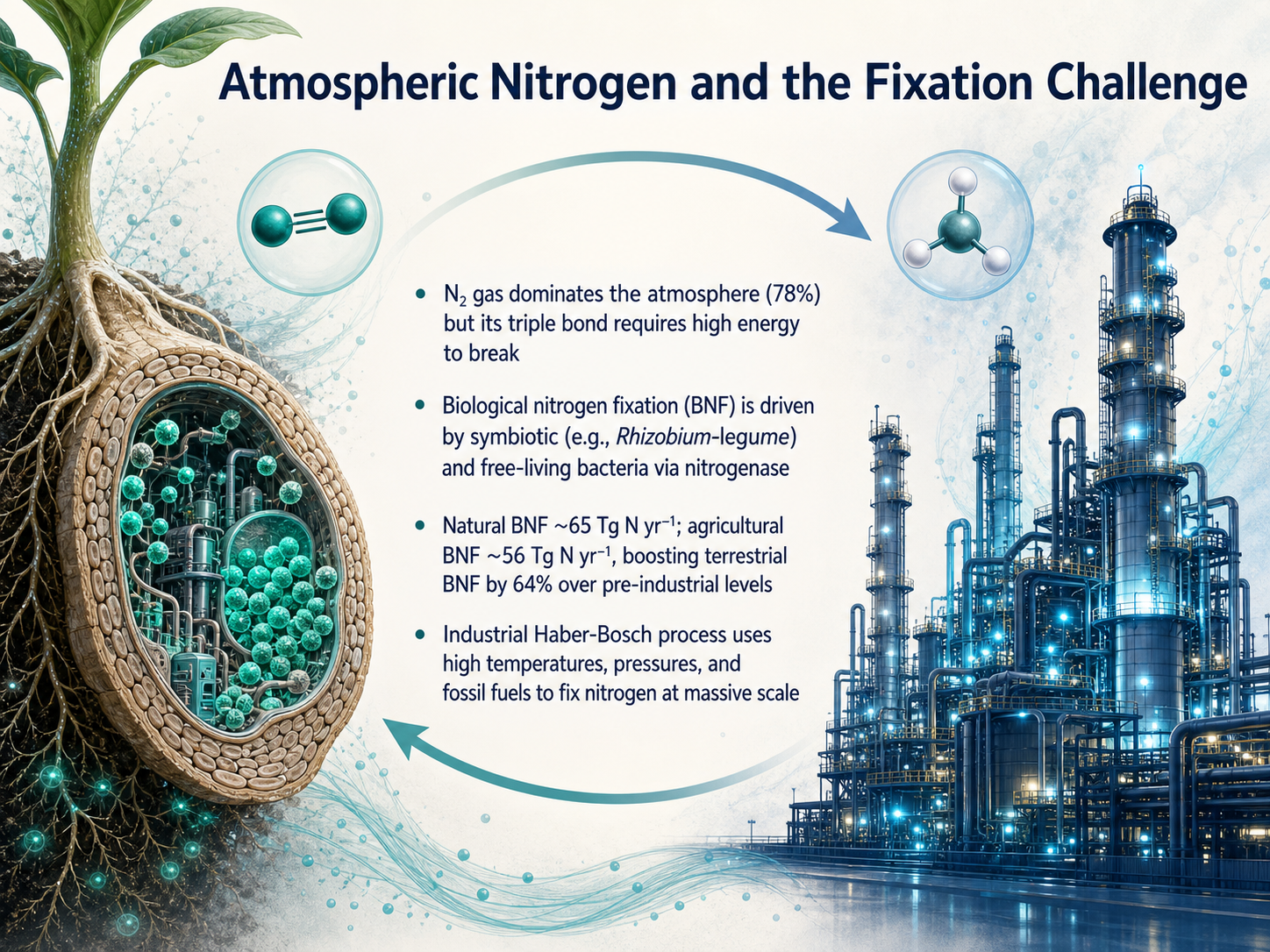
 - 03Atmospheric Nitrogen and the Fixation ChallengeNow let's look at where the nitrogen cycle truly begins: in the air around us. Nitrogen gas makes up about 78 percent of the atmosphere. Yet this abundant gas is largely inaccessible to living things. Why? Because nitrogen atoms are bound together by an extremely strong triple bond. Breaking that bond requires a lot of energy. You can think of it like a locked safe full of nutrients—the code is difficult to crack. Overcoming this fixation challenge is the critical first step for moving nitrogen from the atmosphere into soils, plants, and animals. In nature, the safe is cracked by specialized bacteria. Some, like Rhizobium, form partnerships in the roots of legumes. Others live freely in the soil. Both use a special enzyme to convert nitrogen gas into ammonia. Globally, this natural biological fixation provides about 65 million metric tons of nitrogen every year. Humans have dramatically amplified this process. By planting nitrogen-fixing crops like soybeans and alfalfa, agricultural fixation adds another 56 million metric tons annually. That boosts the planet's natural fixation rate by over 60 percent compared to pre-industrial times. We've also invented an industrial shortcut: the Haber-Bosch process. It uses high temperatures, extreme pressure, and fossil fuels to break nitrogen's triple bond on a massive scale, producing synthetic fertilizer. So, between enhanced biology and heavy industry, we are now injecting far more reactive nitrogen into the system than ever before. Next, we'll follow that fixed nitrogen down into the soil to explore ammonification and nitrification.
 nature.combeta.iopscience.iop.orglink.springer.com+22 min
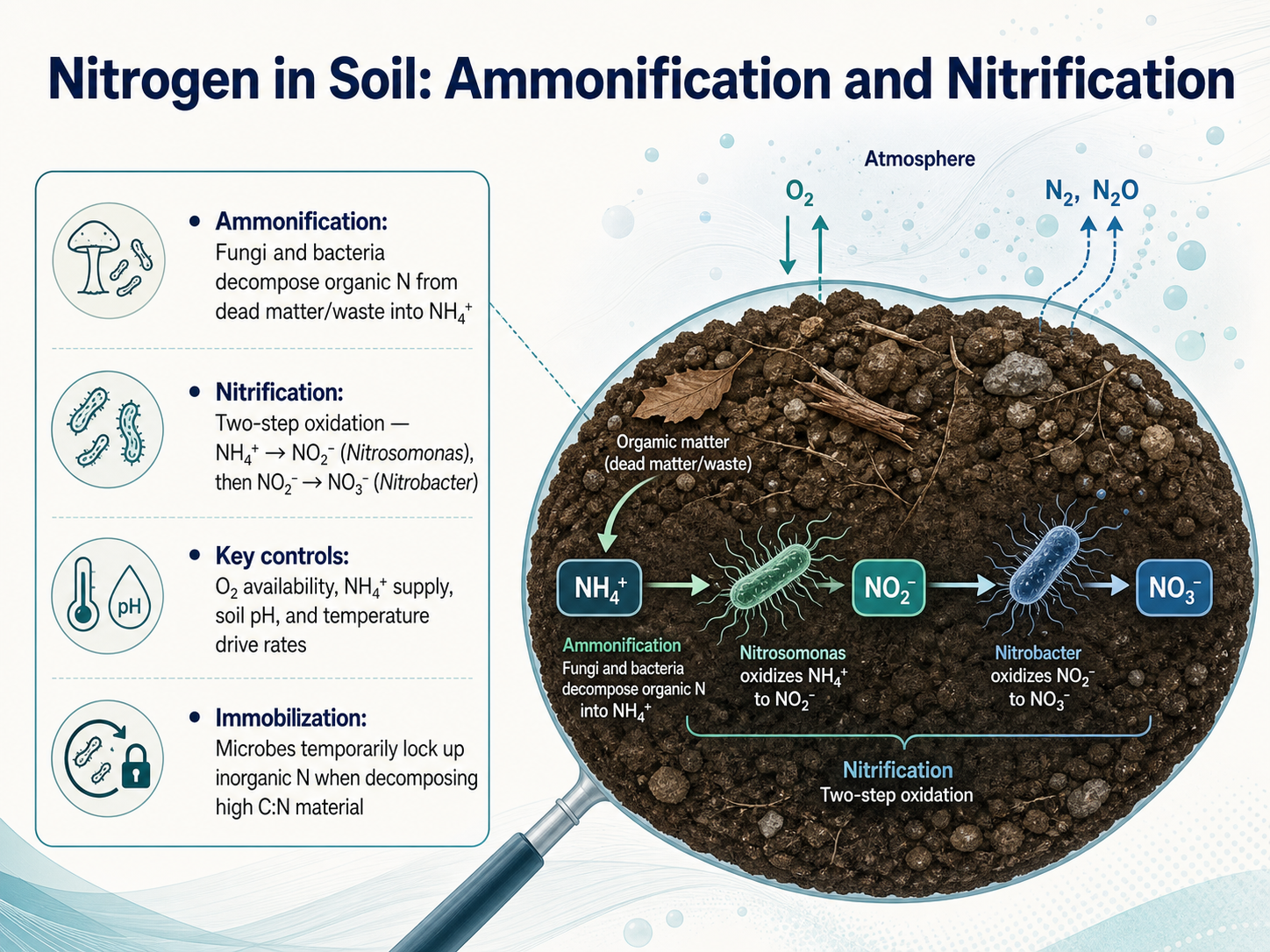
 - 04Nitrogen in Soil: Ammonification and NitrificationNow, let's focus on what happens to nitrogen once it's in the soil. We're going to look at two key processes: ammonification and nitrification. First, ammonification. When plants or animals die, or simply produce waste, fungi and bacteria get to work. They decompose that organic material, releasing the nitrogen inside as ammonium. You can think of this as the recycling crew turning complex leftovers into a simpler form. From there, ammonium does not stay still. We move to nitrification, a two-step process driven by specialized bacteria. First, bacteria like Nitrosomonas convert ammonium into nitrite. Then, a different group, like Nitrobacter, quickly oxidizes that nitrite into nitrate. Nitrate is a form plants can easily take up. How fast these steps happen depends on a few things: a good supply of oxygen, available ammonium, the soil's pH, and its temperature. There's also a twist called immobilization. If soil microbes are breaking down material with a very high carbon-to-nitrogen ratio, like straw, they need extra nitrogen to do the job. They'll temporarily take up the available ammonium and nitrate from the soil, locking it away in their own cells. This means the nitrogen is held up for a bit before becoming available again for plants. Next, we'll leave the soil and follow nitrogen underwater to explore pathways that lead to eutrophication.
 pmc.ncbi.nlm.nih.govlink.springer.comfrontiersin.org+22 min
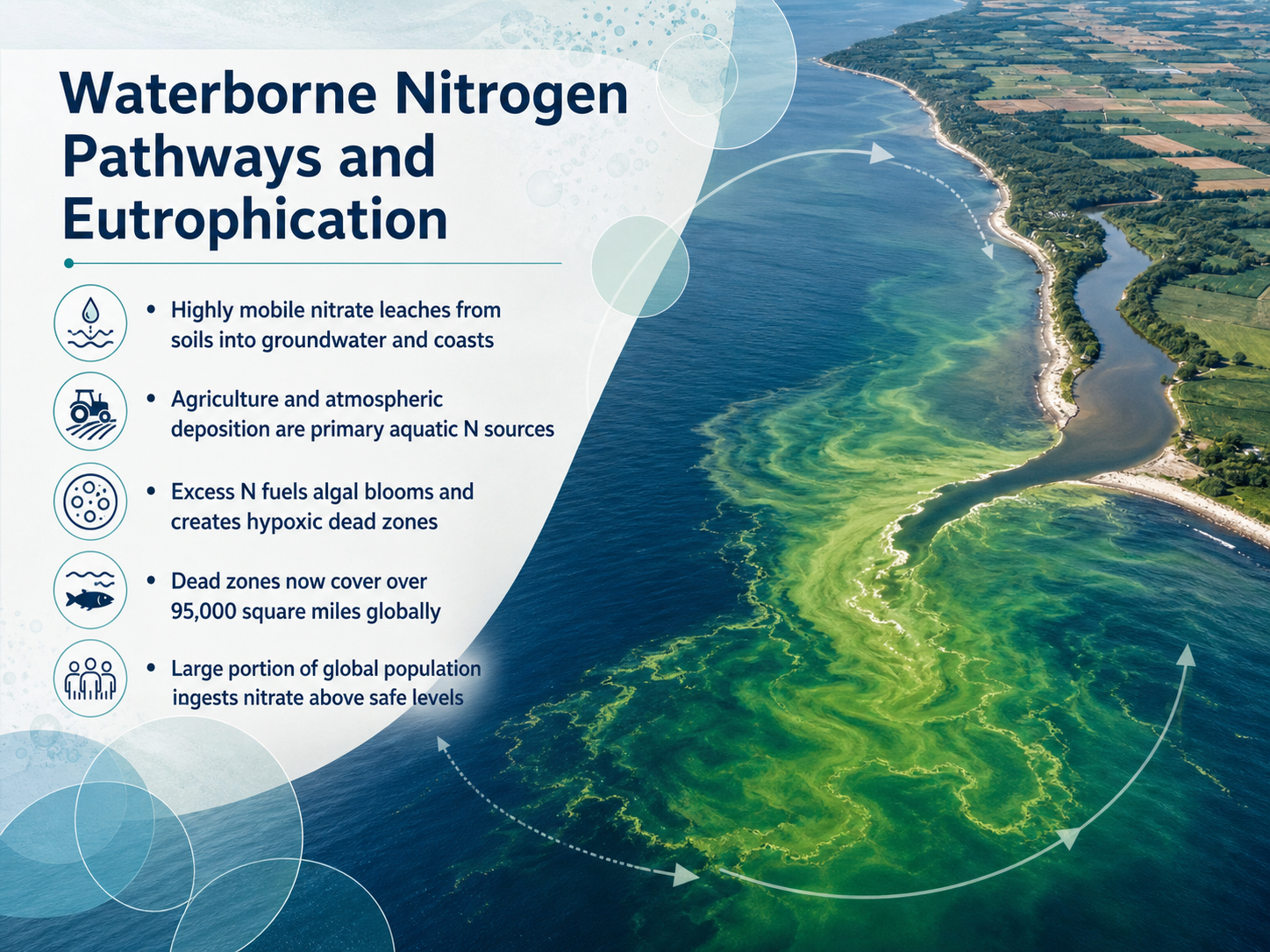
 - 05Waterborne Nitrogen Pathways and EutrophicationNow let's follow nitrogen as it moves through water. Nitrate is a form of nitrogen that dissolves very easily, so it doesn't stay put in the soil. Rainfall and irrigation wash it downward into groundwater, and from there it travels into streams, rivers, and eventually coastal waters. The two biggest sources of this waterborne nitrogen are fertilizer from farms and nitrogen compounds that settle out of the air from fuel burning. When too much nitrogen reaches a lake or a coastal area, it acts like a powerful fertilizer for algae. The algae explode into dense blooms. As those blooms die and decompose, the process pulls oxygen out of the water. That creates hypoxic dead zones where most marine life cannot survive. These dead zones now cover over ninety-five thousand square miles globally. The problem also cycles back to us. A large portion of the world's population drinks water with nitrate levels above what's considered safe. Next, we'll look at the process that returns nitrogen to the atmosphere: denitrification.
 2 min
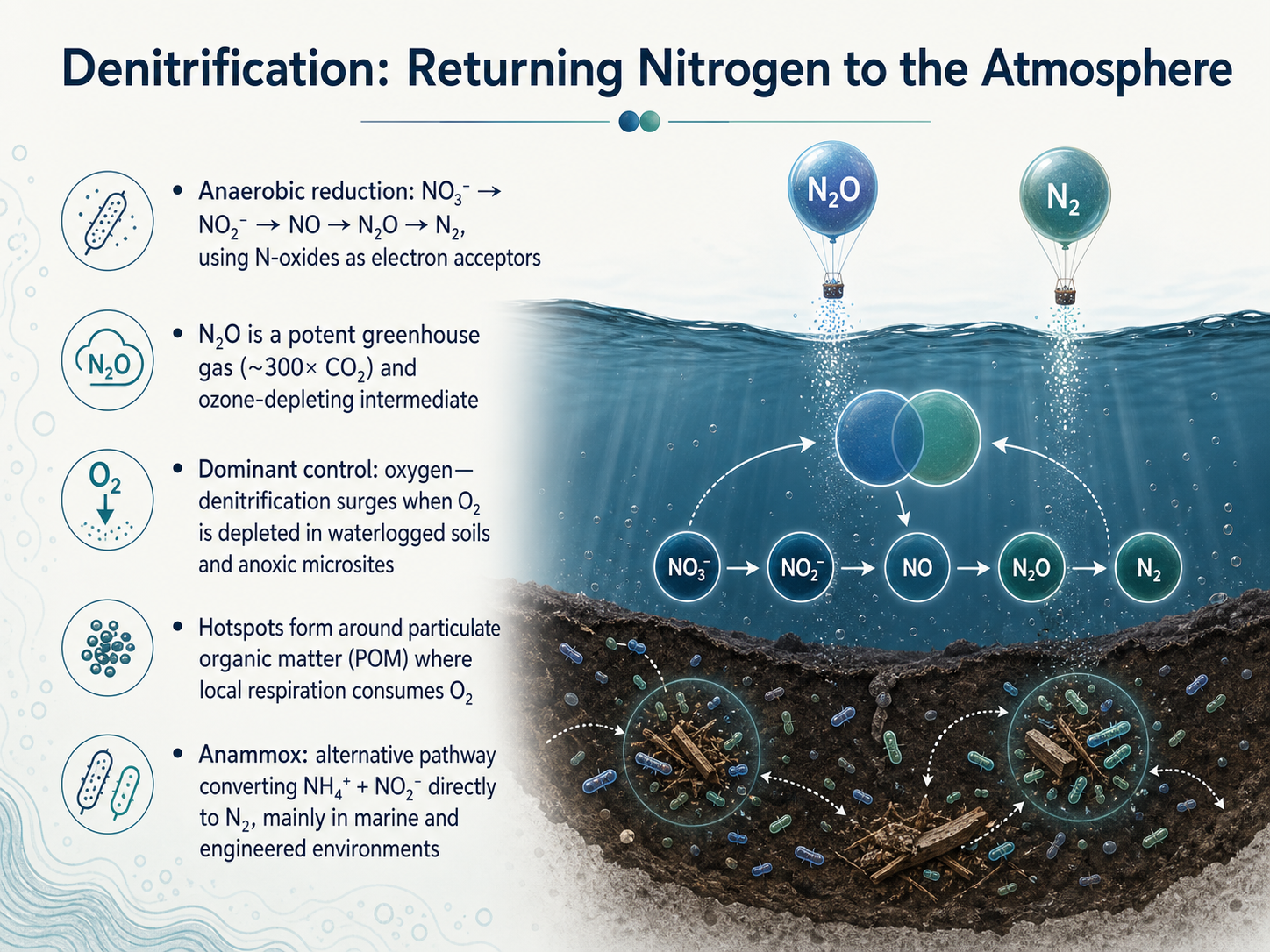
2 min - 06Denitrification: Returning Nitrogen to the AtmosphereNow let's explore the process that returns nitrogen back to the atmosphere: denitrification. When soils become waterlogged and oxygen runs low, many microbes switch their respiration. They use nitrogen oxides like nitrate and nitrite as alternative electron acceptors, reducing them step-by-step from nitrate to nitrite, then to nitric oxide, nitrous oxide, and finally to unreactive dinitrogen gas. You’ll notice that nitrous oxide is a key intermediate here. It’s a potent greenhouse gas, roughly three hundred times stronger than carbon dioxide, and it also damages the ozone layer. Where does this happen? Denitrification surges wherever oxygen is depleted. In well-drained soils, hotspots tend to form around particles of fresh organic matter. These bits of decaying material fuel intense microbial respiration that locally consumes all the oxygen, creating tiny anoxic pockets even in otherwise aerated soil. In marine and engineered settings, nature offers an alternative shortcut. Through the anammox process, specialized bacteria directly combine ammonium and nitrite to produce dinitrogen gas, completely bypassing the nitrous oxide step. So, the main takeaway is clear: oxygen is the master switch. Its absence in microsites is what drives fixed nitrogen back into the air. Next, we’ll see how living systems pull this newly available nitrogen back in, as we move into nitrogen assimilation into living systems.
 pmc.ncbi.nlm.nih.govlink.springer.comfrontiersin.org+22 min
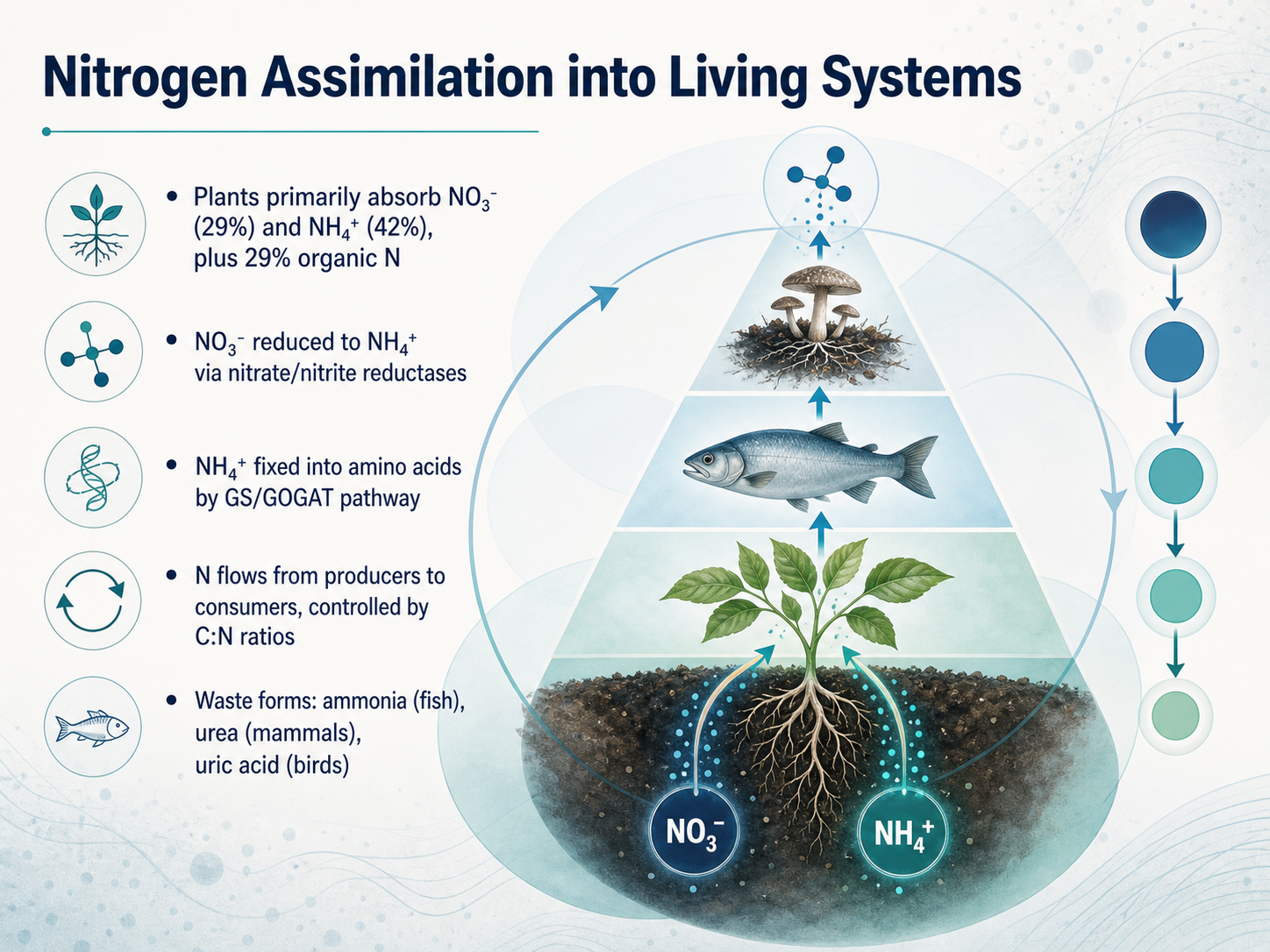
 - 07Nitrogen Assimilation into Living SystemsNow let's look at how this available nitrogen actually enters living systems. This step is called assimilation, and it’s where plants and microorganisms take nitrogen from the soil and build it into their own tissues. Globally, plants absorb a mix of nitrogen forms. On average, about 29 percent is taken up as nitrate, 42 percent as ammonium, and another 29 percent arrives as small organic nitrogen compounds. Once inside the plant, nitrate must be converted. Specific enzymes reduce it stepwise to ammonium through what's called the nitrate and nitrite reductase pathway. The ammonium, whether absorbed directly or just produced inside the plant, is then fixed into amino acids—the building blocks of proteins—by a key pathway known as GS/GOGAT. From there, the nitrogen flows up the food web, from producers to consumers, and its movement is largely regulated by the carbon-to-nitrogen ratios in their tissues. Finally, when organisms break down these proteins for energy, they excrete the leftover nitrogen as waste. The form that waste takes depends on the animal: fish release ammonia directly into the water, mammals like us produce urea, and birds and reptiles excrete uric acid. This whole process transfers nitrogen from the physical environment into the living world. Next, we’ll turn to how human activity has dramatically altered this global nitrogen cycle.
 doi.orgmeetingorganizer.copernicus.orgpar.nsf.gov+22 min
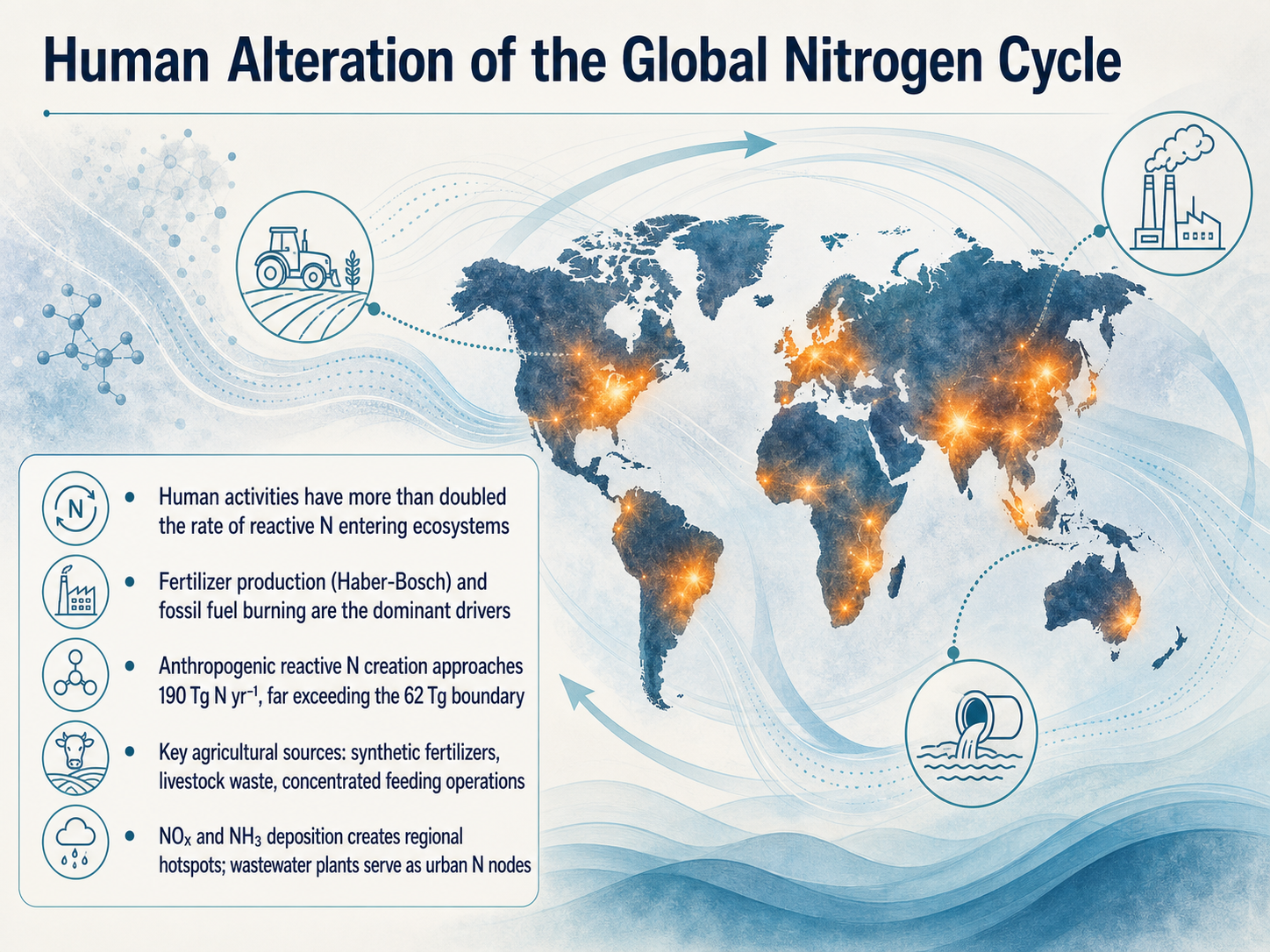
 - 08Human Alteration of the Global Nitrogen CycleHuman activities have dramatically accelerated the nitrogen cycle. In fact, we have more than doubled the rate at which reactive nitrogen enters ecosystems compared to pre-industrial times. The main driver is the Haber-Bosch process, which converts inert nitrogen gas into ammonia to produce synthetic fertilizers. Fossil fuel burning adds another major pulse of nitrogen oxides to the atmosphere. Together, these human sources generate roughly one hundred and ninety teragrams of reactive nitrogen each year. To put that in perspective, the safe planetary boundary is estimated at only sixty-two teragrams, so we are far beyond a sustainable limit. Agricultural hotspots—like synthetic fertilizer applications, livestock waste, and concentrated animal feeding operations—are primary sources. This nitrogen doesn't stay put. It moves through the air as ammonia and nitrogen oxides, creating regional pollution hotspots, while wastewater treatment plants act as concentrated nitrogen nodes in urban watersheds. Now let's follow what happens once this reactive nitrogen enters the environment; the next slide explores the nitrogen cascade and its chain of consequences.
 nature.combeta.iopscience.iop.orglink.springer.com+21 min
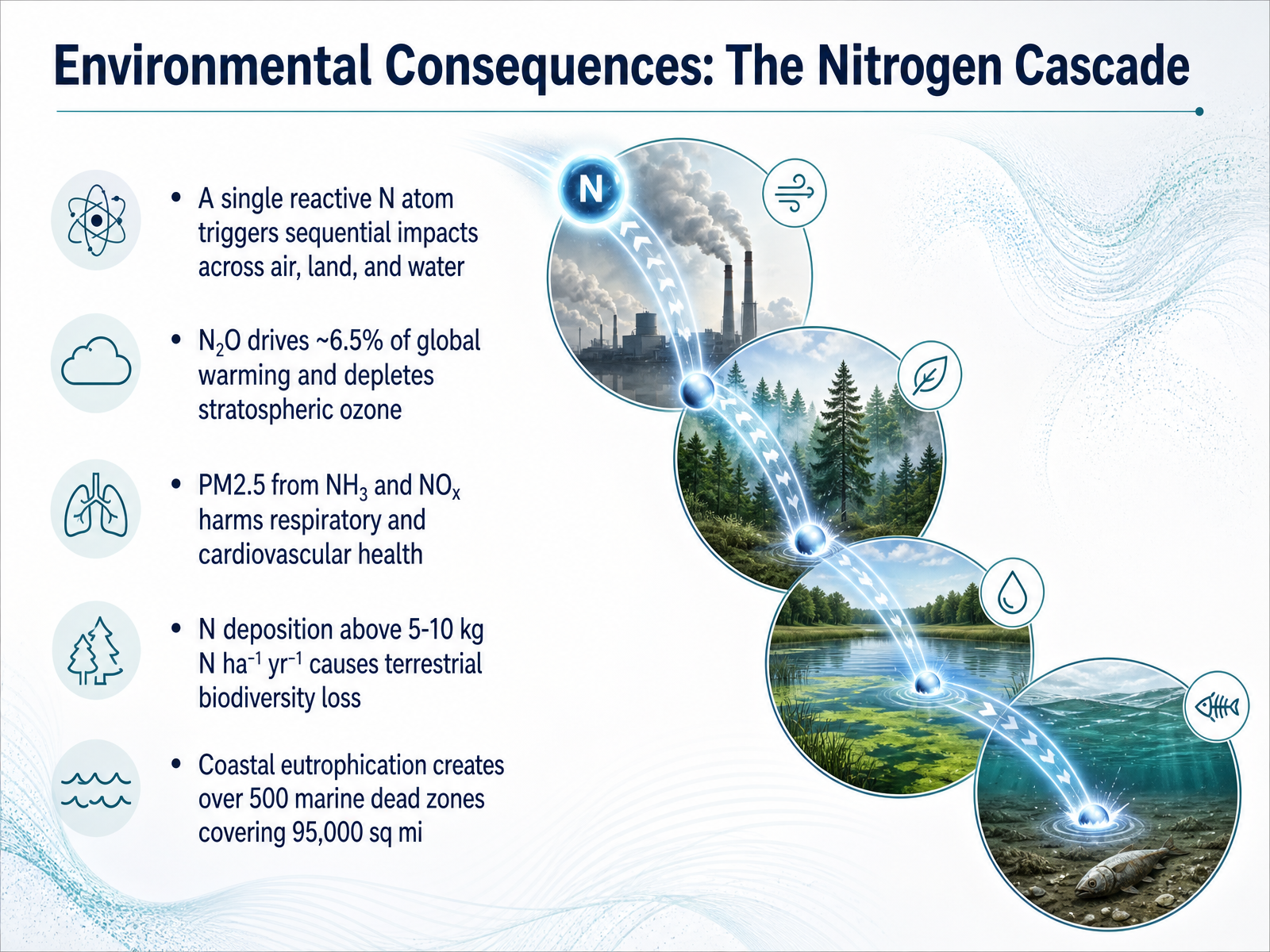
 - 09Environmental Consequences: The Nitrogen CascadeNow let’s look at what happens when reactive nitrogen escapes into the environment. Scientists call this the nitrogen cascade, because a single reactive nitrogen atom can set off a chain of impacts across air, land, and water. First, about six and a half percent of global warming is driven by nitrous oxide, a gas that also thins the protective ozone layer high above us. At ground level, ammonia and nitrogen oxides react to form fine particles called PM two point five. These tiny particles penetrate deep into our lungs and harm respiratory and cardiovascular health. On land, when nitrogen deposition exceeds five to ten kilograms per hectare per year, sensitive plant species disappear and biodiversity declines. And in coastal waters, excess nitrogen fuels algal blooms that strip away oxygen, creating dead zones. There are now over five hundred of these zones worldwide, covering roughly ninety-five thousand square miles. Each step in the cascade reminds us why managing nitrogen wisely is so urgent. Next, we’ll see how these pressures push against planetary boundaries and the nitrogen crisis.
 pmc.ncbi.nlm.nih.govlink.springer.comfrontiersin.org+22 min
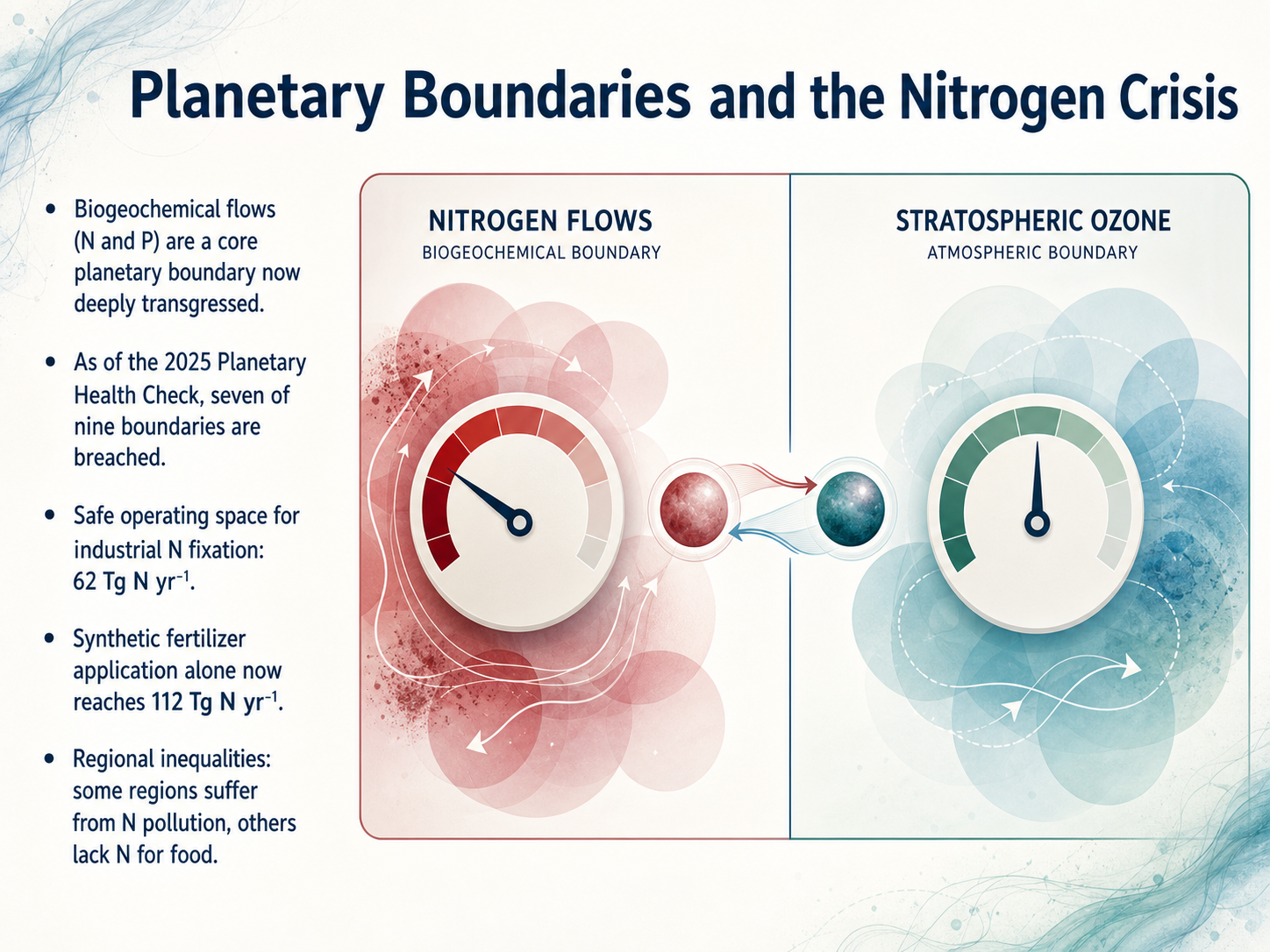
 - 10Planetary Boundaries and the Nitrogen CrisisNow let's step back and look at the big picture. Scientists track nine planetary boundaries, which are like vital signs for Earth's stability. A recent health check in 2025 confirmed that seven of these nine boundaries have now been breached. One of the most deeply transgressed is the flow of biogeochemical elements, specifically nitrogen and phosphorus. To stay safe, researchers set a limit for industrial nitrogen fixation at 62 teragrams per year. But our current use of synthetic fertilizer alone has soared to 112 teragrams per year. That means we are nearly doubling the safe operating space for nitrogen. This crisis isn't spread evenly, though. Some regions struggle with severe nitrogen pollution in their water and air, while other parts of the world lack enough nitrogen to grow sufficient food. This unequal distribution makes solving the nitrogen problem both an environmental and a social challenge. Next, we will explore how scientists measure and trace these nitrogen flows across the planet.
 2 min
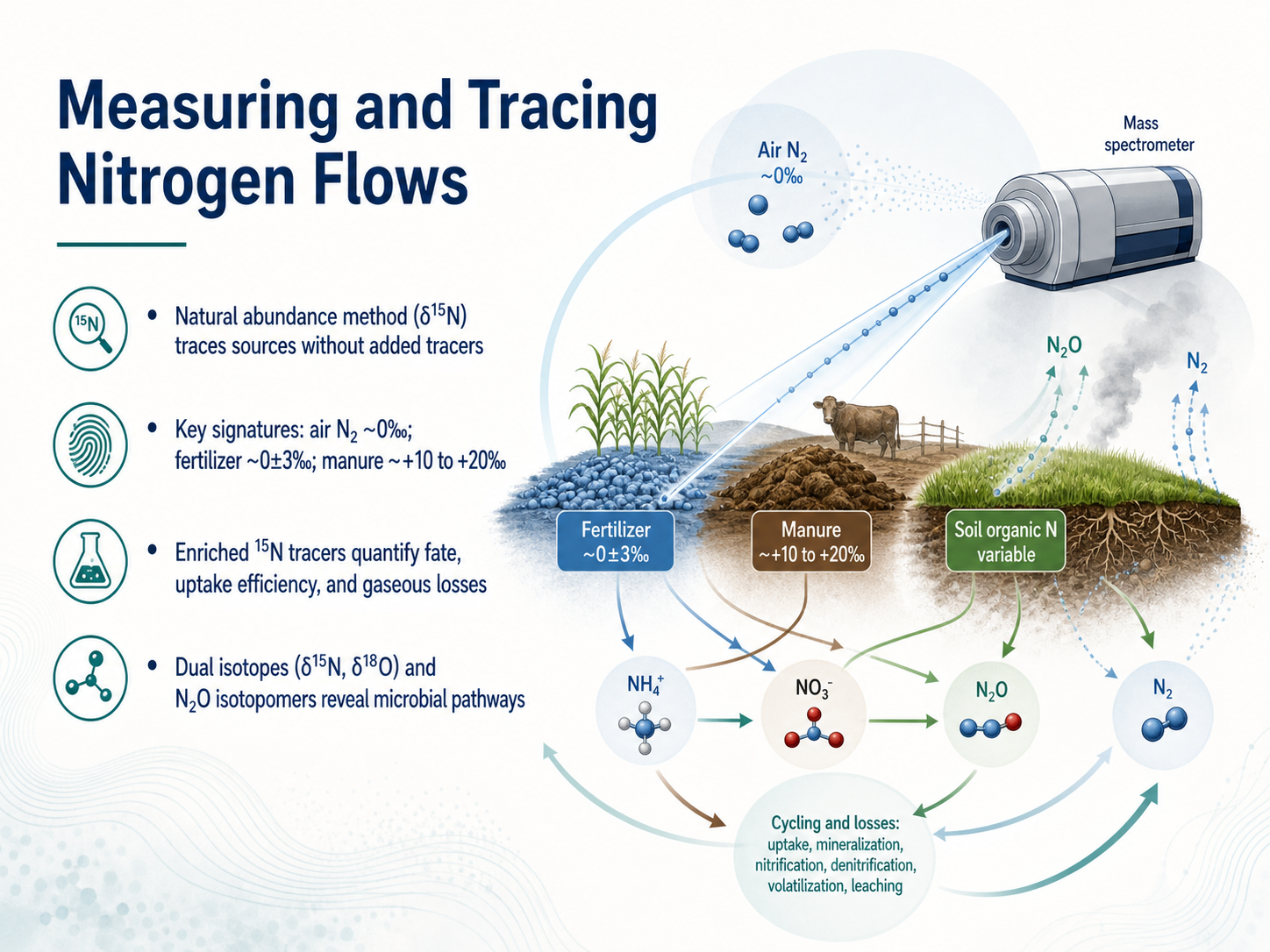
2 min - 11Measuring and Tracing Nitrogen FlowsNow, let's look at how scientists actually measure and trace nitrogen as it moves through the environment. Two powerful approaches help us follow these invisible paths. The first is the natural abundance method. This technique doesn't require adding any special tracers. Instead, it relies on the naturally occurring ratio of the heavier nitrogen isotope, nitrogen-15, to the lighter nitrogen-14, expressed as a value called delta 15 N. Different sources have distinct signatures, almost like fingerprints. For example, nitrogen in the air has a delta 15 N value close to zero per mil. Synthetic fertilizer has a similar value, usually between negative three and positive three per mil. In contrast, the nitrogen in manure has a much higher value, typically between positive ten and positive twenty per mil. By measuring these signatures, we can trace whether the nitrogen in a river or a plant came from soil, fertilizer, or animal waste. The second approach is the enriched tracer method. Here, we use a source of nitrogen that is artificially loaded with nitrogen-15. This allows us to precisely track its fate through a system, quantifying how much is taken up by crops, how much is lost as gas, and how much remains in the soil. To get an even deeper view, researchers use dual isotopes by also measuring oxygen ratios in nitrate, and analyze nitrogen-2-oxide isotopomers. These advanced measurements can reveal the specific microbial pathways producing greenhouse gases. Next, we will explore how all parts of the nitrogen cycle are responding to a changing climate.
 doi.orgmeetingorganizer.copernicus.orgpar.nsf.gov+22 min
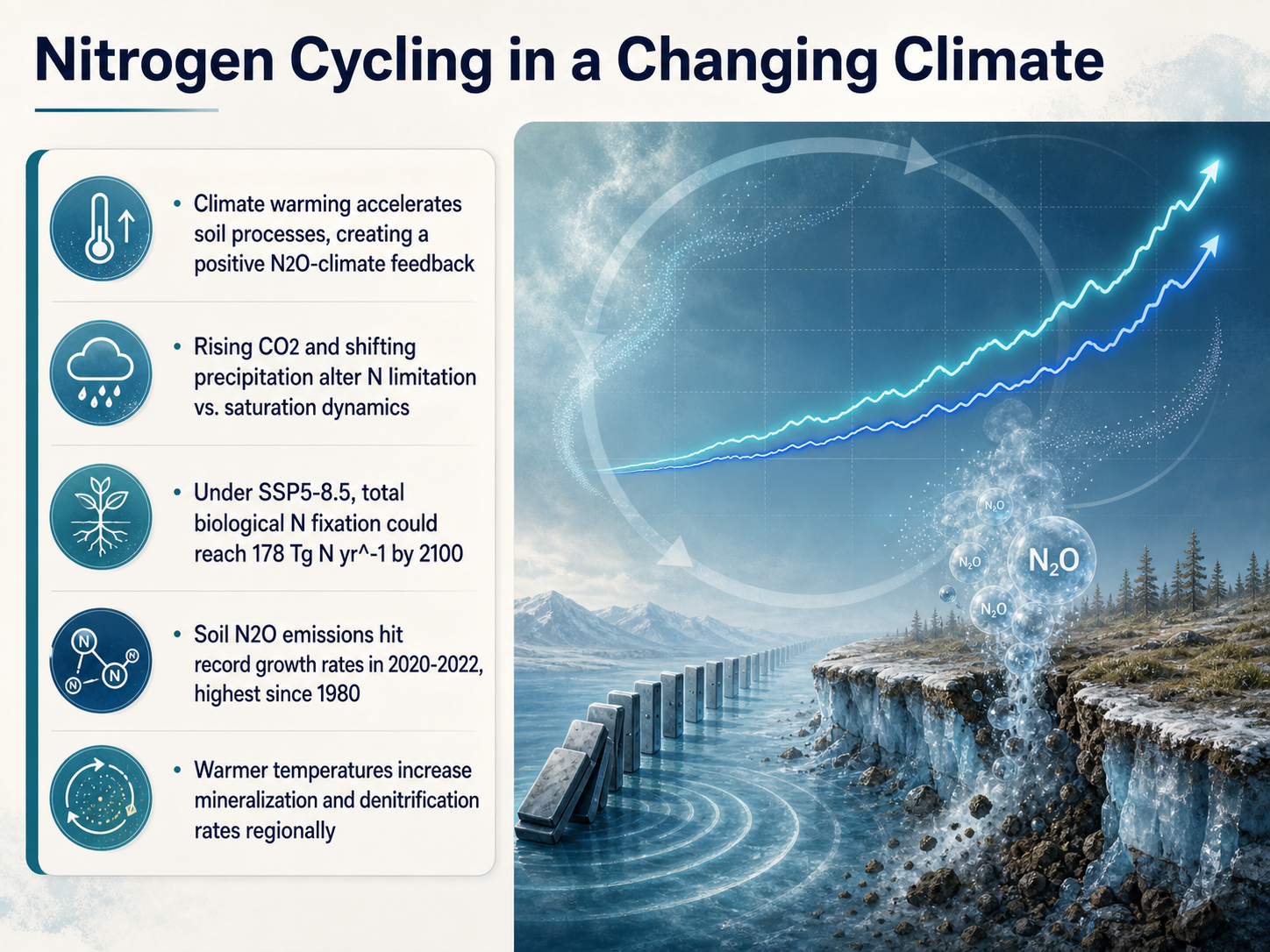
 - 12Nitrogen Cycling in a Changing ClimateNow let's connect what we've learned to a changing climate. Warming temperatures are speeding up soil processes like mineralization and denitrification, which in turn release more nitrous oxide, a very potent greenhouse gas. This creates what scientists call a positive feedback loop: more warming leads to more emissions, which drives further warming. You'll see this effect clearly in recent data. Soil nitrous oxide emissions hit record growth rates between 2020 and 2022, the highest we've measured since 1980. At the same time, rising carbon dioxide levels and shifting rainfall patterns are changing whether ecosystems face nitrogen limitation or nitrogen saturation. Under a high-emissions scenario, models project that total biological nitrogen fixation could reach 178 teragrams of nitrogen per year by the end of this century. This overall acceleration of the nitrogen cycle has serious implications for our climate. In our final slide, we'll explore strategies for sustainable nitrogen management.
 nature.combeta.iopscience.iop.orglink.springer.com+21 min
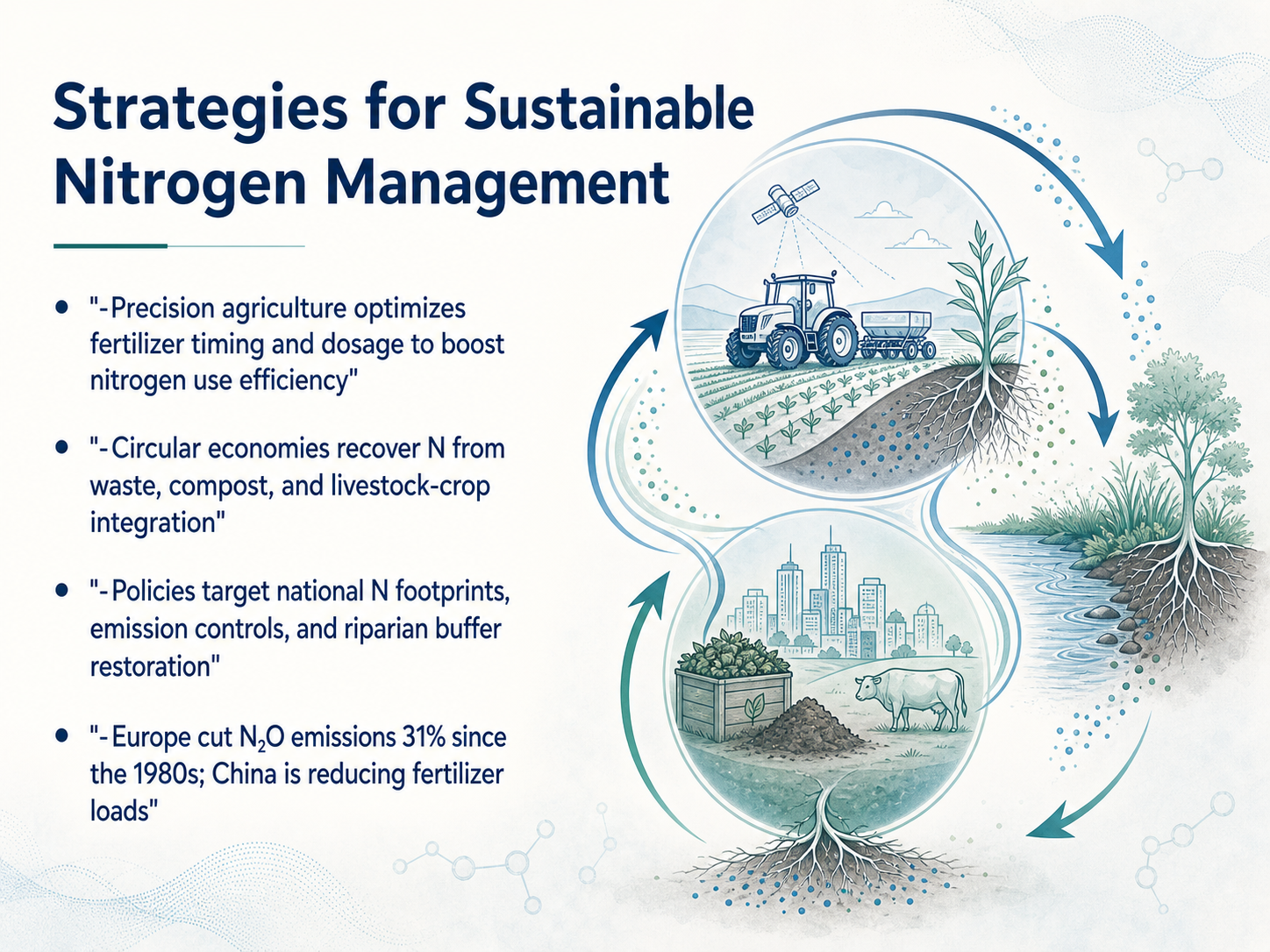
 - 13Strategies for Sustainable Nitrogen ManagementOn this final slide, let's see how we can manage nitrogen more sustainably. The challenge is clear: human activity now releases almost 190 million metric tonnes of reactive nitrogen into the environment each year, far beyond the safe boundary of about 62 million tonnes. But effective strategies are already at work. Precision agriculture, for example, optimizes exactly when and how much fertilizer a crop needs. This boosts nitrogen use efficiency and keeps more nutrients in the field instead of in rivers and air. Circular economy approaches also make a difference. By recovering nitrogen from livestock manure, food waste, and compost, we can reuse it as a resource. At the policy level, nations are setting targets to shrink their nitrogen footprints, control emissions, and restore natural filters like riparian buffers along streams. These efforts are showing results. Since the 1980s, Europe has cut its nitrous oxide emissions by 31 percent. China is now actively reducing its fertilizer loads. Restoring balance to the nitrogen cycle is a big task, but evidence proves that precise farming, smart recycling, and strong policies can move us forward. Thank you for joining this exploration. By understanding how nitrogen moves, you can see how our daily choices and larger systems can protect the planet's life-support processes.
 doi.orgmeetingorganizer.copernicus.orgpar.nsf.gov+22 min
Take the deck with you
Download this course as a file — free, no sign-up needed.
- PDF handoutEvery slide page, ready to print or share.14 pages · 4.4 MBDownload
- Narrated PowerPointThe deck that presents itself — every slide carries the digital human's narration video.14 pages · 19.2 MBDownload
- PowerPoint slidesThe full deck as a .pptx — open it in PowerPoint, Keynote, or Google Slides.14 pages · 4.4 MBDownload
Free to use in your own training — please keep the PersonWise credit page at the end.
Have your own deck? Turn it into a course
Sources consulted
Web sources consulted while building this course.
- Global dataset of nitrogen pool and flux estimates — doi.org
- Abstract EGU26-3763 — meetingorganizer.copernicus.org
- ABSTRACT: Nitrogen (N) is used in many of life’s fundamental biomolecules, and it is — par.nsf.gov
- Advances in Understanding the Marine Nitrogen Cycle in the GEOTRACES Era | Oceanography — tos.org
- A global dataset of gross nitrogen transformation rates across terrestrial ecosystems | Scientific Data — preview-nature.com
- The Nitrogen Cycle: Processes, Players, and Human Impact — nature.com
- Chapter 14 - Nitrogen Transformations — lter.kbs.msu.edu
- Nitrogen cycle — en.wikipedia.org
- The nitrogen cycle — sciencedirect.com
- The nitrogen cycle in soil: an overview of processes and properties of key microorganisms | Acta agriculturae Slovenica — journals.uni-lj.si
- Global terrestrial nitrogen fixation and its modification by agriculture | Nature — nature.com
- Improving the quantification of global free-living and symbiotic nitrogen fixation in natural terrestrial ecosystems: present-day estimates and 21st century projections - IOPscience — beta.iopscience.iop.org
- Global terrestrial nitrogen fixation and its modification by agriculture | Nature | Springer Nature Link — link.springer.com
- A global dataset of terrestrial biological nitrogen fixation | Scientific Data — nature.com
- Quantifying global biological nitrogen fixation with in-situ data and a process-based biogeochemistry model — doi.org
- Ammonia oxidation pathways and nitrifier denitrification are significant ... — pmc.ncbi.nlm.nih.gov
- The anaerobic soil volume as a controlling factor of denitrification: a review | Biology and Fertility of Soils | Springer Nature Link — link.springer.com
- Frontiers | Soil nitrate reducing processes – drivers, mechanisms for spatial variation, and significance for nitrous oxide production — frontiersin.org
- Soil Microbiology, Ecology and Biochemistry — lter.kbs.msu.edu
- Identifying soil N2O sources by combining laboratory experiments with process-based models | Biogeochemistry | Springer Nature Link — link.springer.com