Begin
14 pages · ~28 min
Facilitating UX Design Workshops
This training equips UX facilitators to plan and lead effective design workshops, covering activities, group dynamics, and techniques for driving collaborative, user-centered outcomes.
A digital instructor presents all 14 pages. Hold “Ask” at any point and ask out loud — the answer comes from this course. No sign-up needed.
What you’ll learn
- 01Facilitating a UX Design WorkshopWelcome. If you're here, you've probably run a few of these already. You've stood at the whiteboard, watched good input stall, and asked yourself when a workshop will actually help, and when it just burns people's time.
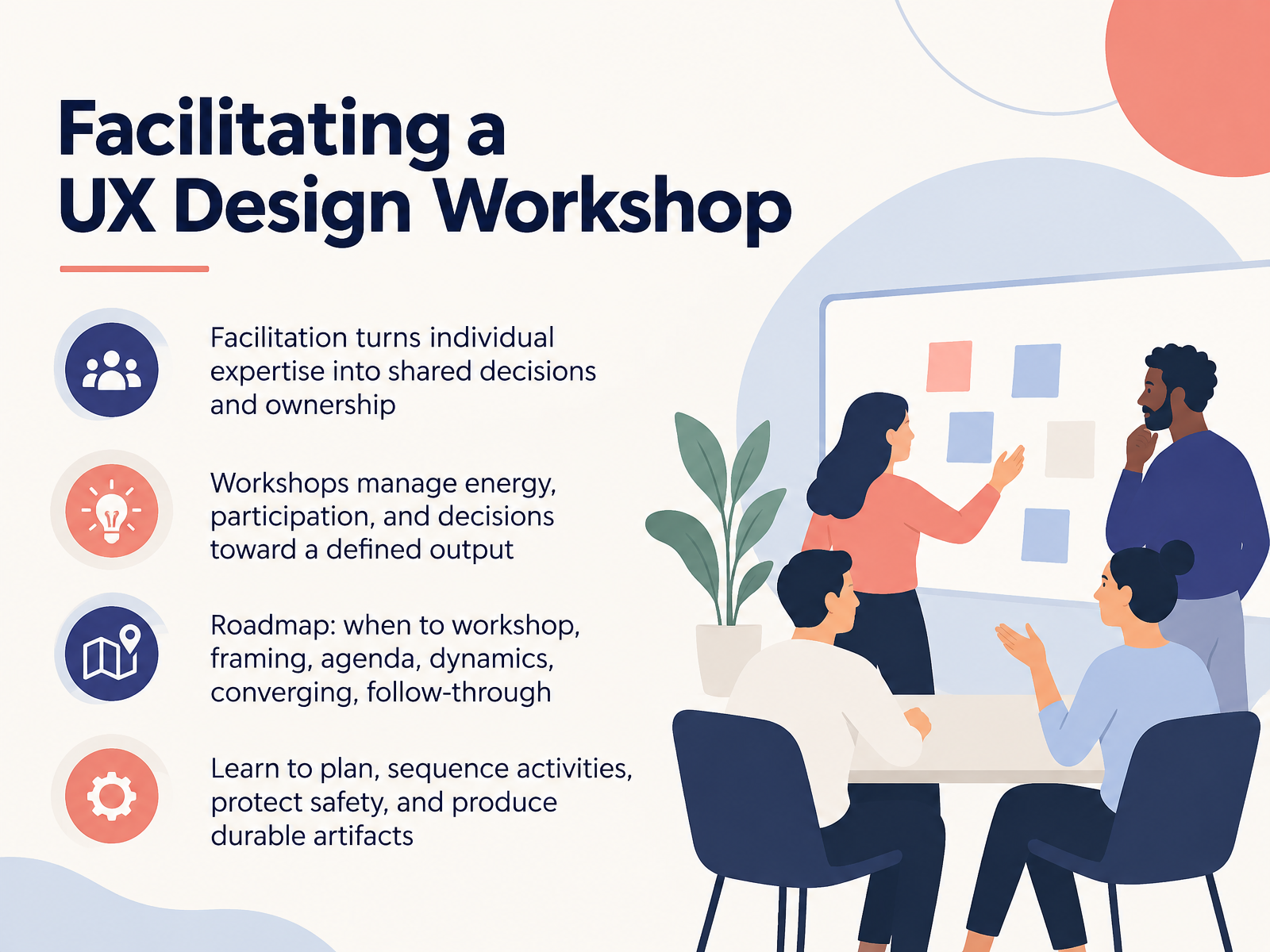
So this course is about facilitation as a craft, not a format. Facilitation is what turns individual expertise into shared decisions and real ownership. Think about the moment a stakeholder blocks the flow. Your job isn't to push back, or to pick a side. It's to design the room so the group can get there without you.
A workshop manages three things at once: energy, participation, and decisions, all pointed at one defined output. Miss any of those, and you end up with a wall of sticky notes and no direction.
Here's our roadmap. When to workshop, framing, agenda, group dynamics, converging, and follow-through. Along the way, we'll work on planning, sequencing activities, protecting psychological safety, and producing artifacts that still hold up weeks later.
Let's start with the first big question. When is a workshop the right tool at all?iaf-members.orgiaf-world.orgiaf-world.org+22 min
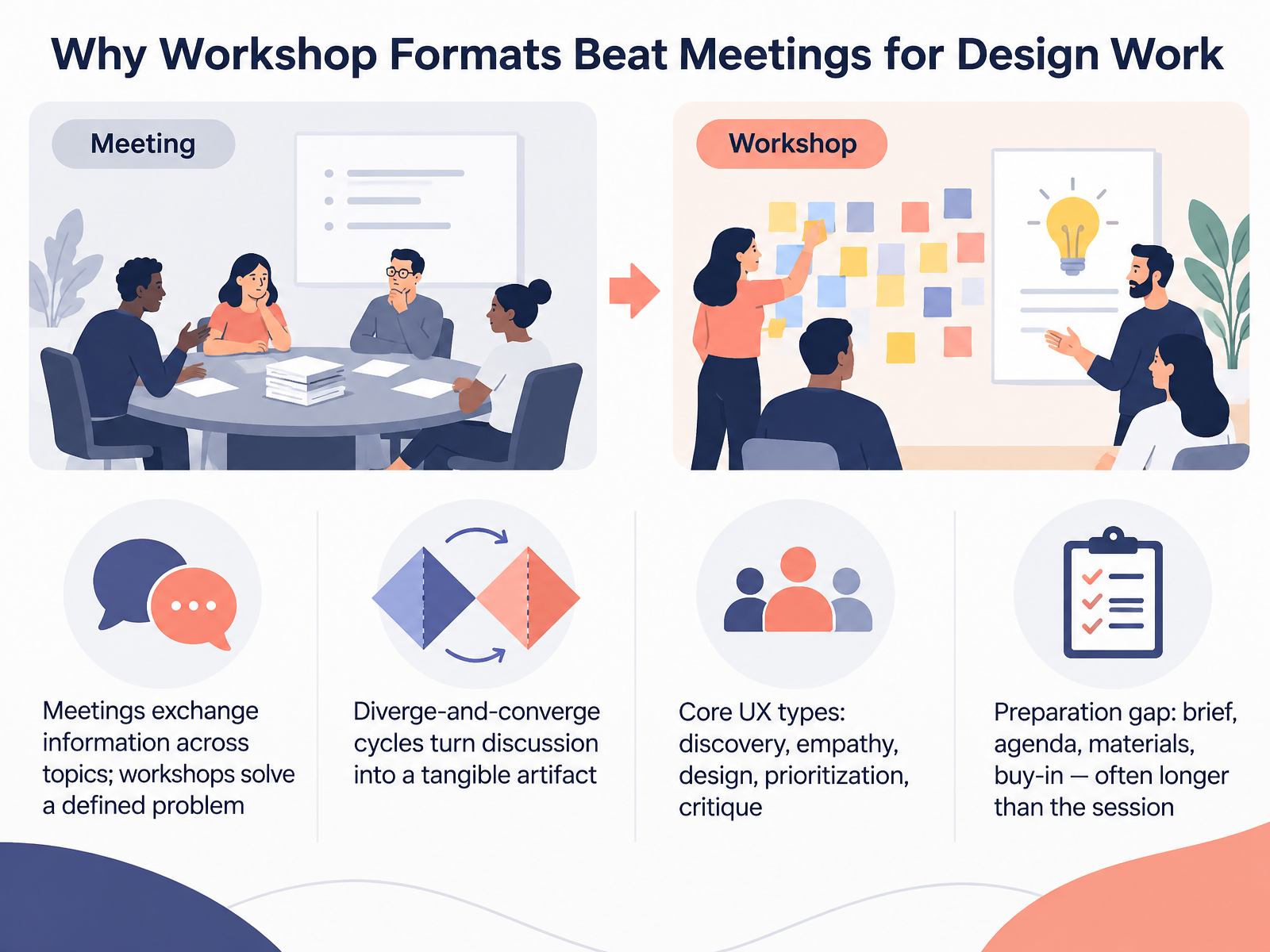
- 02Why Workshop Formats Beat Meetings for Design WorkSo why do workshops outperform meetings for design work? Because the two formats do genuinely different jobs. A meeting exchanges information across several topics. It's shallow and broad. A workshop solves one defined problem, deep and focused. That's the trade-off you're buying into. And when things get stuck, say a stakeholder blocks the flow, a workshop gives you a structured way through instead of another status update. The mechanism is diverge and converge. The room generates options, then narrows them. That cycle is what turns discussion into a tangible artifact you can actually carry into the next sprint. In UX, we lean on five core types: discovery, empathy, design, prioritization, and critique. Different problems, different formats. Now here's the part people underestimate. The preparation gap. Brief, agenda, materials, buy-in. That work often runs longer than the session itself. Budget for it honestly. We'll come back to this. We'll pick this up when we look at when a workshop is the right and wrong choice.
 nngroup.comworkshopweaver.comblog.logrocket.com+22 min
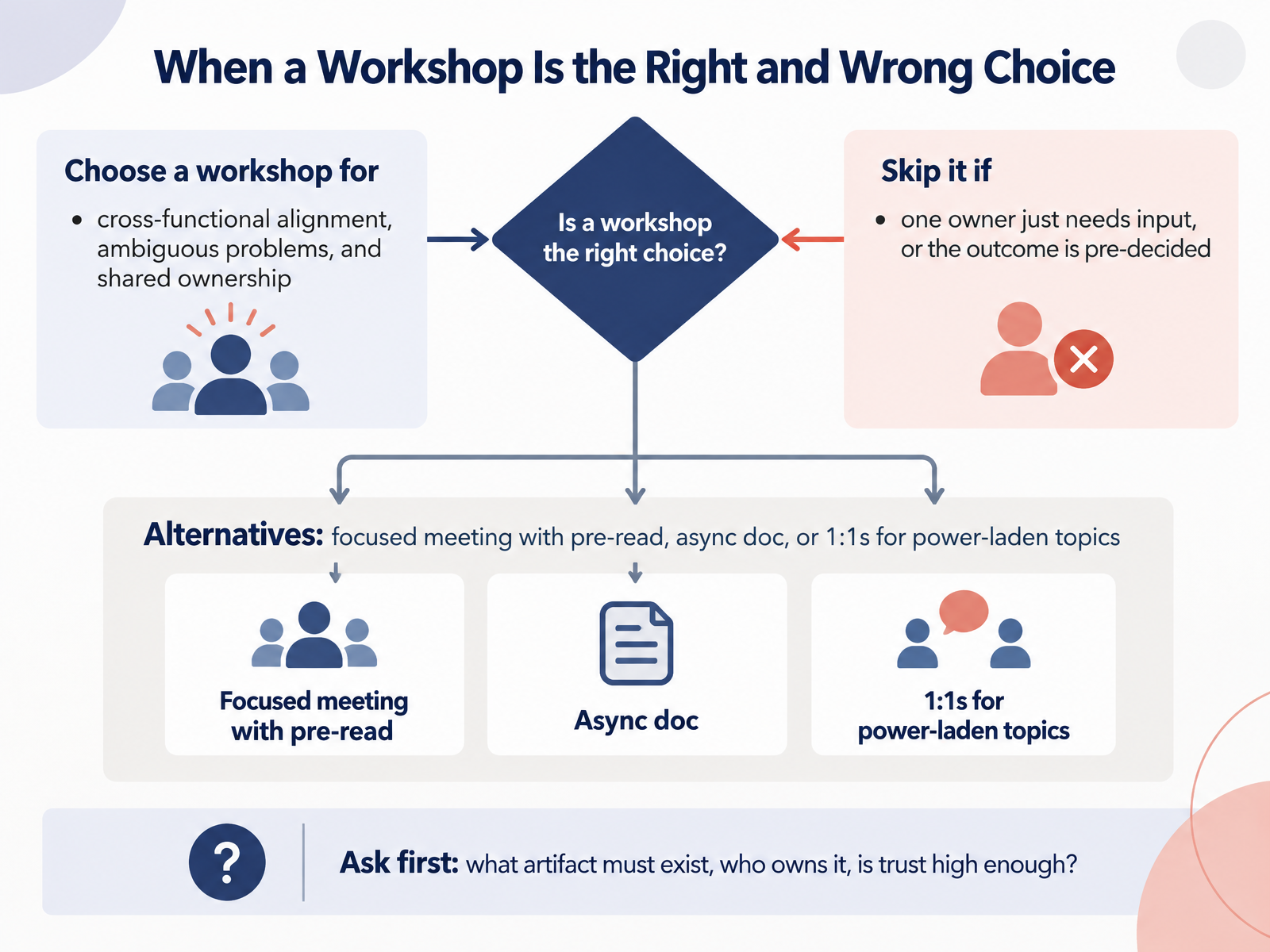
 - 03When a Workshop Is the Right and Wrong ChoiceSo let's talk about when a workshop is the right call, and when it's the wrong one. The honest answer is that workshops are the right format for cross-functional alignment, for genuinely ambiguous problems, and for building shared ownership of an outcome. If a stakeholder blocks the flow because two teams have conflicting priorities, a facilitated session is often the only place those trade-offs get negotiated in real time. But skip the workshop when one owner just needs input, or when the outcome is already decided. That's when the room becomes theater. Everyone feels their opinion was predetermined to be dismissed, and they disengage. Instead, consider a focused meeting with a pre-read, an async document, or a series of one-on-ones for power-laden topics where people won't speak candidly in a group. Before you book the room, ask three questions. What artifact must exist when we're done? Who owns it? And is trust high enough for honest conversation? If you can't name the owner, you need a different format. Next, we'll get into defining a sharp goal, success criteria, and a workshop brief.
 nngroup.comworkshopweaver.comblog.logrocket.com+22 min
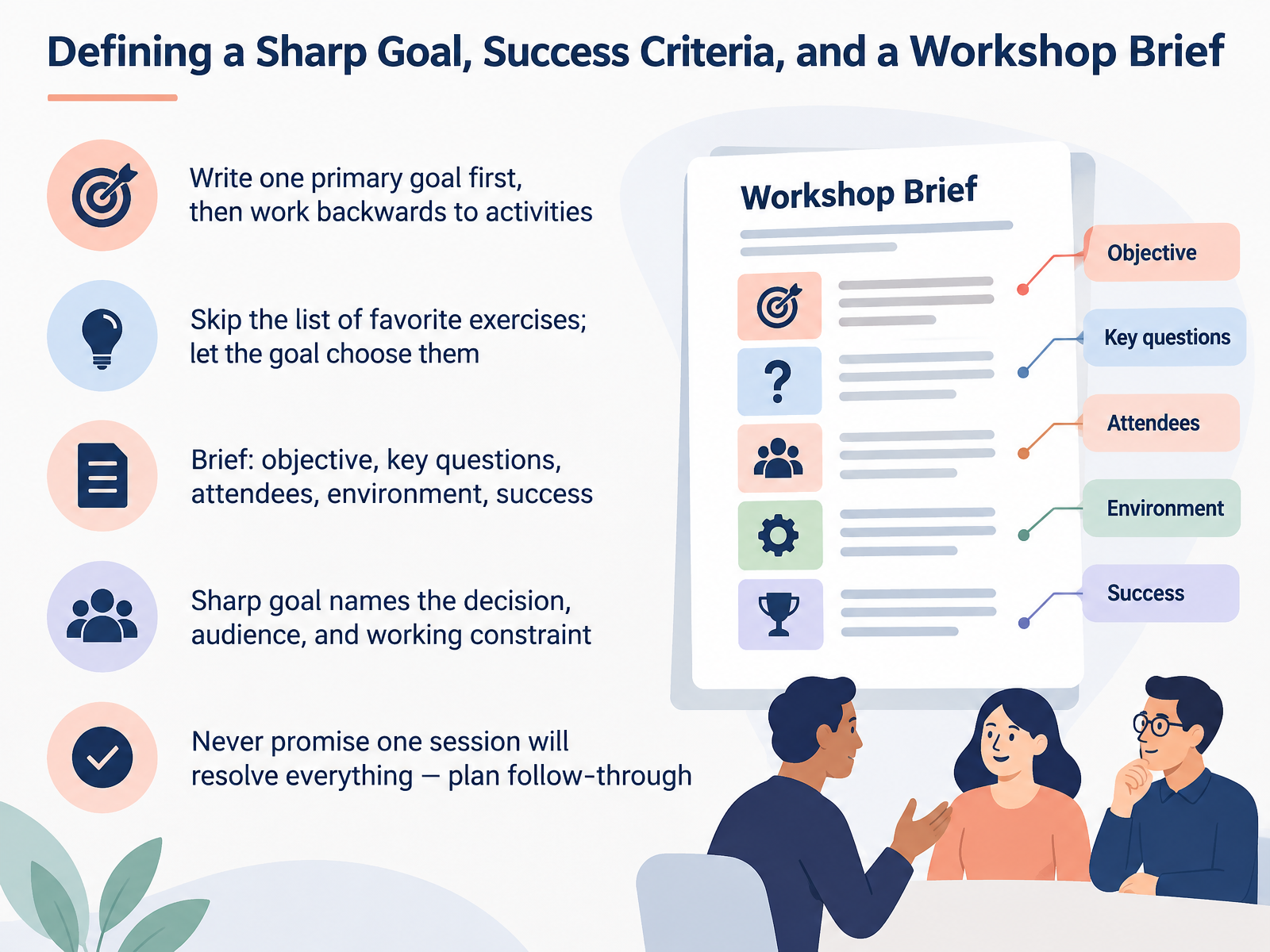
 - 04Defining a Sharp Goal, Success Criteria, and a Workshop BriefLet's talk about the foundation of any workshop that actually earns its place on the calendar. A sharp goal. Start with one primary goal and write it first. Then work backwards to your activities. And here is the discipline part. Skip the list of your favorite exercises. Let the goal choose them. If the goal is prioritizing a backlog, dot voting fits. If it is aligning on user needs, an empathy activity does the work. Once the goal is clear, write a brief. Keep it to one page. Objective, key questions, attendees, environment, and your definition of success. A sharp goal names three things. The decision you are making, the audience affected, and the working constraint you are operating under. For example, a goal might be, align marketing and engineering on onboarding priorities within a two hour session. See how that names the decision, the audience, and the constraint? And be honest about scope. Never promise that one session will resolve everything. Plan the follow-through before you send the invite. Because when a stakeholder blocks the flow in the room, you want the next step already agreed on. So write the goal, write the brief, and let both guide what happens in the room. That sets us up nicely for the next piece. Framing the Challenge with How Might We Questions.
 nngroup.comworkshopweaver.comblog.logrocket.com+22 min
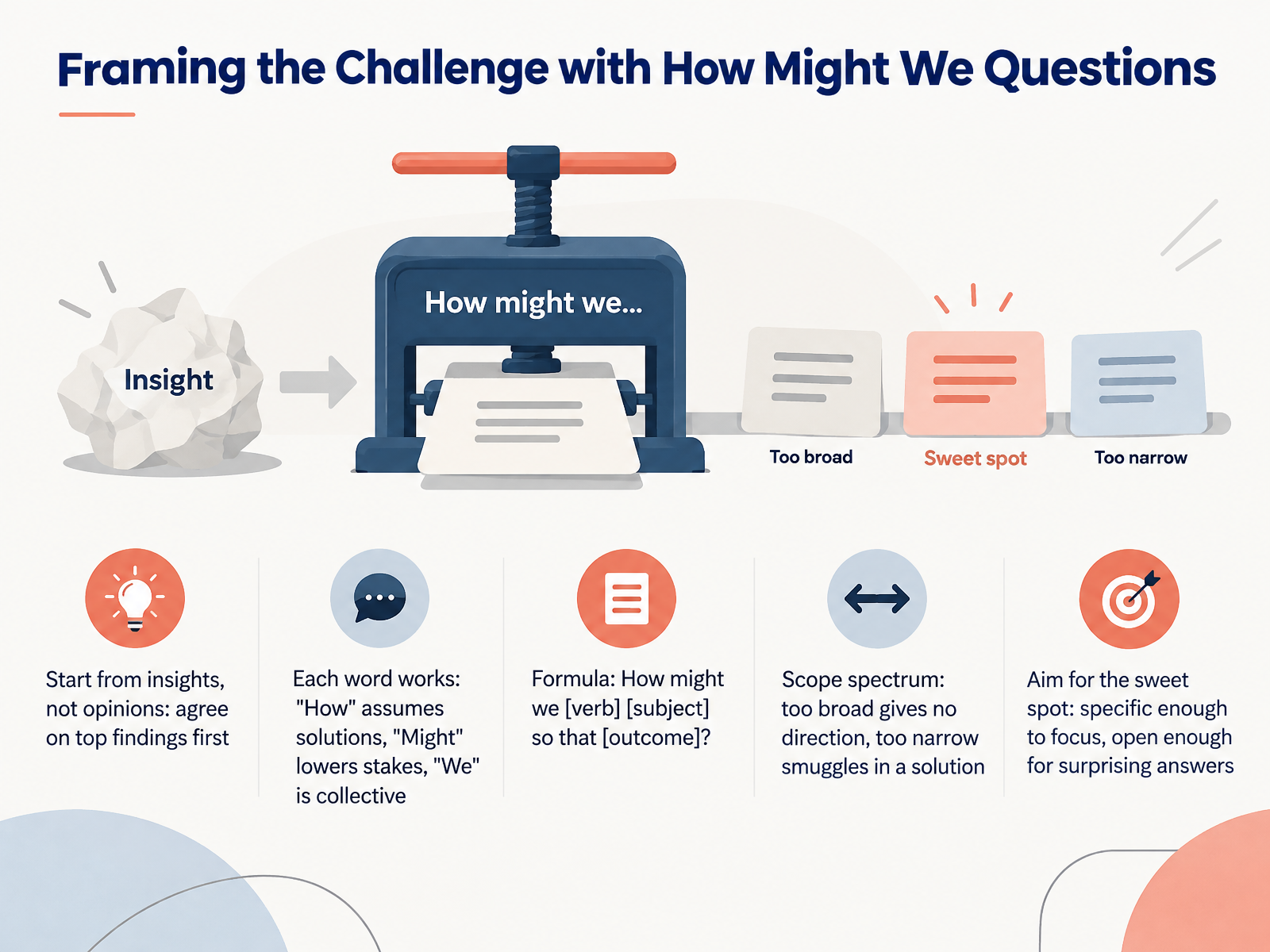
 - 05Framing the Challenge with How Might We QuestionsLet's talk about how we actually frame the challenge facing the room, using How Might We questions. This is where research hands off to ideation, so start from insights, not opinions. Before anyone writes a single question, agree on the top findings together. A quick dot vote works well here. Now, each word is doing work. "How" assumes a solution exists and pulls people out of debating whether it's possible. "Might" lowers the stakes, signaling these are candidates, not commitments. And "We" makes it collective, so the problem belongs to the team, not to one person. The working formula is: how might we, verb, subject, so that, outcome? So a finding like "users abandon onboarding at step three" becomes "how might we show users the value before step three?" Now watch your scope. Too broad, and you get no direction at all. Too narrow, and you've smuggled a solution into the question. You're aiming for the sweet spot: specific enough to focus energy, open enough for surprising answers. Coming up next, we'll write and choose these questions with the team.
 nngroup.comforgov.qld.gov.auworkshopweaver.com+22 min
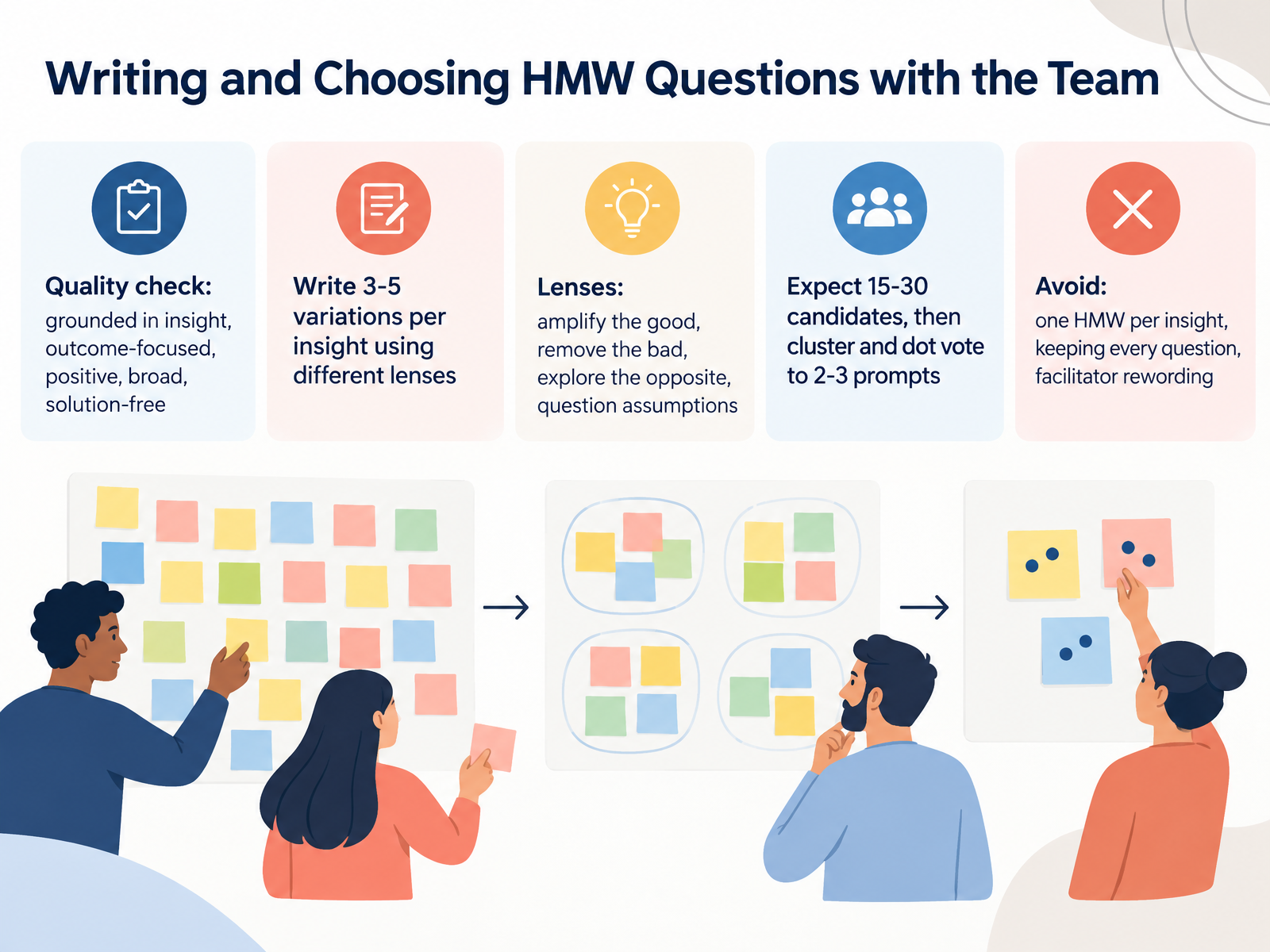
 - 06Writing and Choosing HMW Questions with the TeamNow let's talk about writing and choosing your How Might We questions with the team. This is where a lot of sessions quietly go sideways. Before anyone ideates, quality-check each question against five things. Is it grounded in a real insight? Does it track a desired outcome? Is it phrased positively? Is it broad enough to invite many ideas? And does it avoid smuggling in a solution? If it fails on any of those, rewrite it together, don't just move on. Next, write three to five variations per insight using different lenses. Amplify the good, remove the bad, explore the opposite, question an assumption. Each lens opens a genuinely different solution space, which is exactly the point. Expect fifteen to thirty candidates to pile up, then cluster the duplicates and dot vote down to two or three prompts. A few failure modes to name honestly. One HMW per insight anchors the room to the first framing, which is rarely the strongest. Keeping every question spreads your ideation window too thin to develop anything. And when the facilitator rewrites the group's phrasing, participants stop owning the challenge. So let them own it. Next, we'll cover audience, roles, and pre-workshop logistics.
 nngroup.comforgov.qld.gov.auworkshopweaver.com+22 min
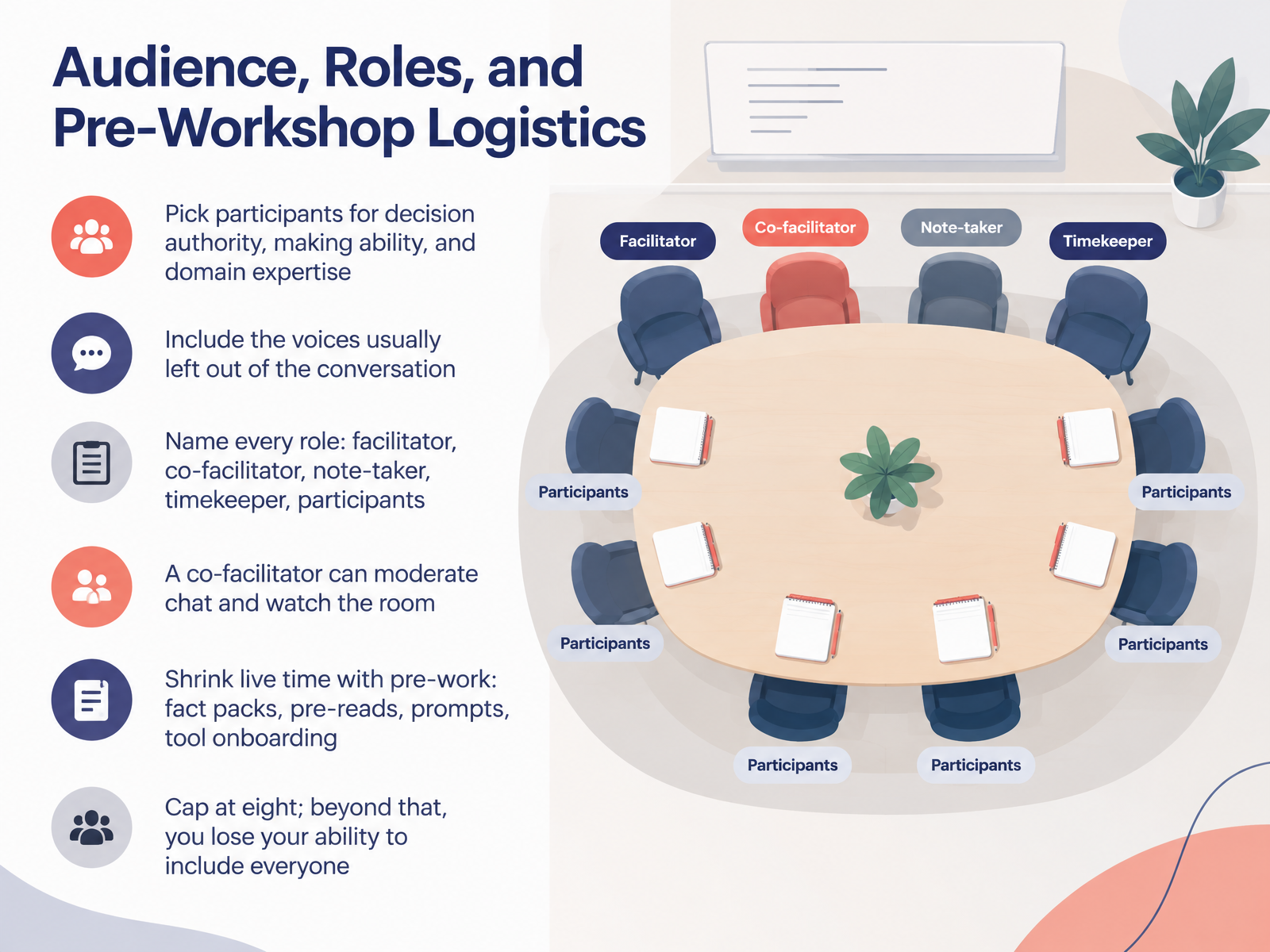
 - 07Audience, Roles, and Pre-Workshop LogisticsNow let's talk about who's in the room, and what has to happen before anyone walks in. Start with decision authority, making ability, and domain expertise. If the person who can actually greenlight the outcome isn't there, you're collecting opinions, not decisions. And deliberately include the voices usually left out, like support, sales, or a customer-facing team. Name every role out loud: facilitator, co-facilitator, note-taker, timekeeper, participants. A co-facilitator isn't a luxury. They moderate chat, watch faces, and catch the person who's been quiet for twenty minutes. Then shrink your live time with pre-work: fact packs, pre-reads, prompts, and tool onboarding. Finally, cap it at eight. Around eight people you start to lose your ability to include everyone, and you can feel it when a stakeholder blocks the flow. Next, we'll look at choosing formats and tools for in-person, remote, and hybrid.
 nngroup.comworkshopweaver.comblog.logrocket.com+22 min
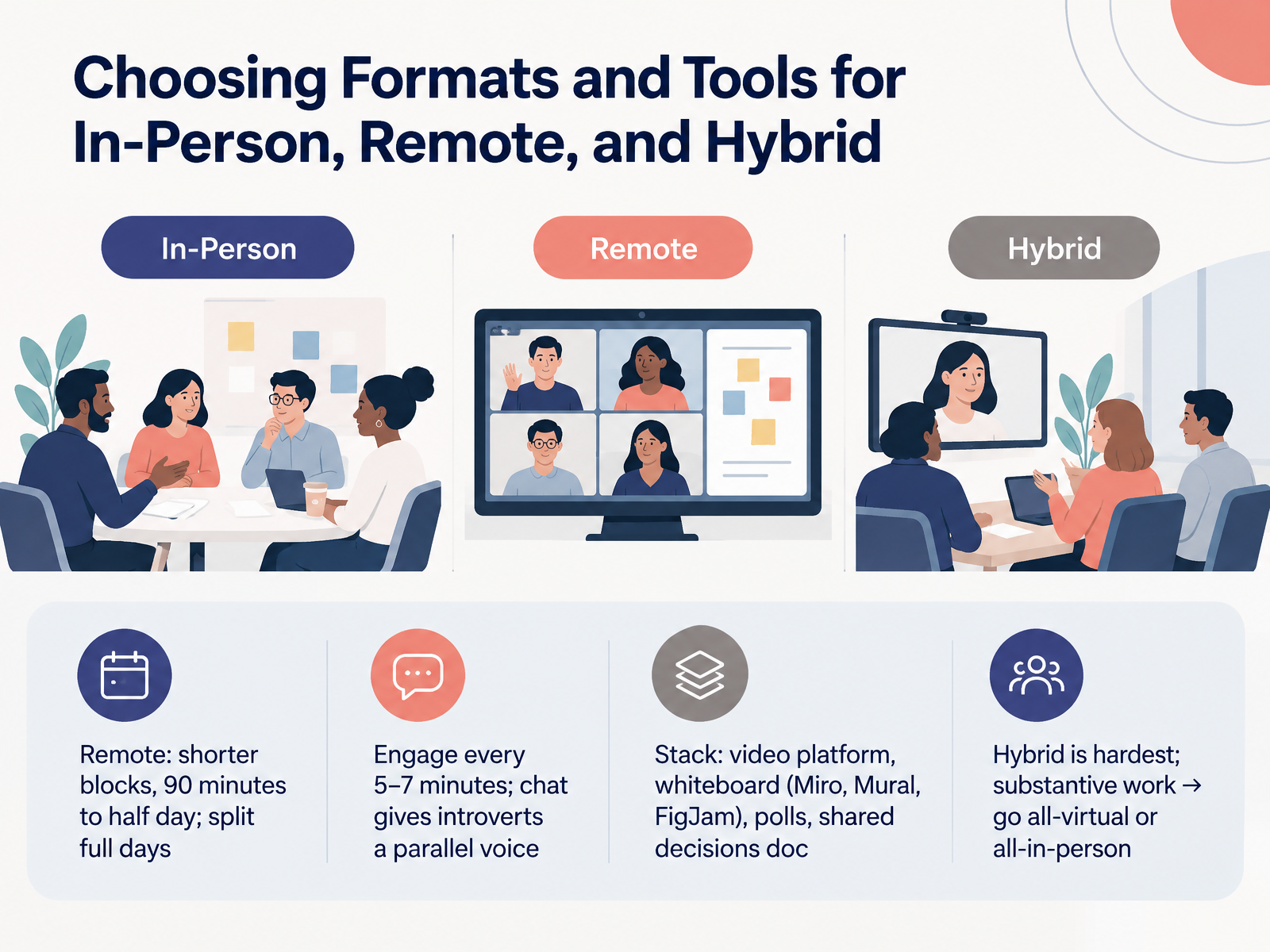
 - 08Choosing Formats and Tools for In-Person, Remote, and HybridLet's talk about formats and tools. Remote sessions need shorter blocks, so I aim for ninety minutes to a half day, and I split full days into two or three sessions across a week. The between-session time does quiet work for you, because people process and arrive sharper. Engagement needs to happen every five to seven minutes: a poll, a chat prompt, a two-minute silent write before anyone speaks. And watch the chat, it's a parallel voice that pulls introverts in. For the stack, keep it lean. A video platform, a whiteboard like Miro, Mural, or FigJam, quick polls, and one shared decisions doc where calls get captured live. Now, hybrid. Hybrid is the hardest format, full stop. The room becomes the dominant group and remote folks become second-class citizens. If the session involves substantive work, choose all-virtual or all-in-person. If hybrid is unavoidable, give everyone a laptop and run every activity on the same digital board. That evens the field. Next, we look at designing the agenda around diverge-and-converge cycles.
 fountn.designfusefacilitation.canngroup.com+21 min
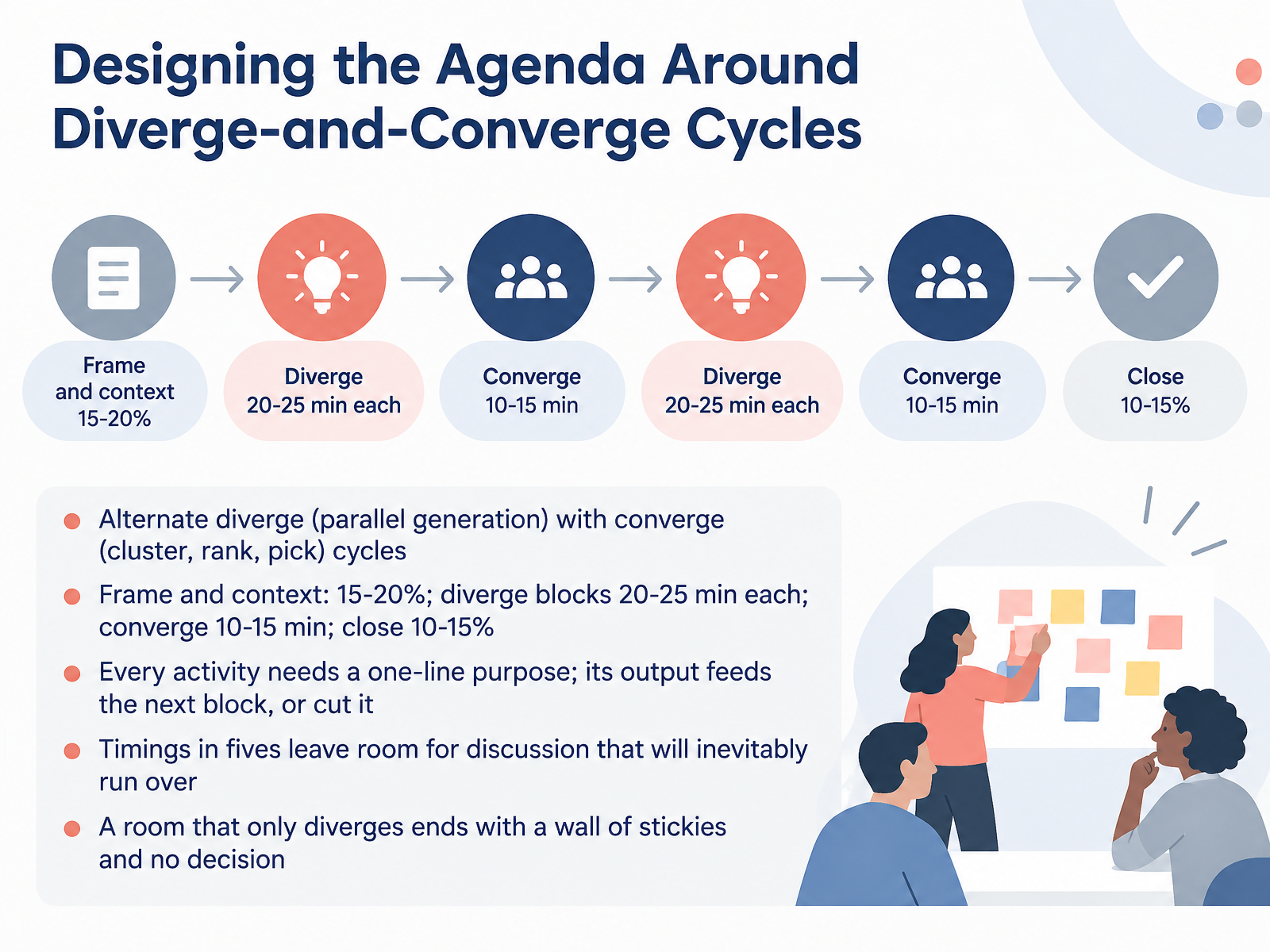
 - 09Designing the Agenda Around Diverge-and-Converge CyclesSo let's talk about how you actually shape the agenda. The backbone of almost any effective session is the alternation of diverge and converge cycles. Diverge is parallel generation. Everyone works independently, wide and messy, before narrowing anything. Converge is where you cluster, rank, and pick. And here's the trap: a room that only diverges ends up with a wall of stickies and no decision. A room that only converges jumps straight to the first idea somebody said out loud. So alternate them.
Now the proportions. Frame and context is about fifteen to twenty percent. Diverge blocks run twenty to twenty five minutes each. Converge and share, ten to fifteen minutes. Close, ten to fifteen percent. And every activity needs a one line purpose. If its output doesn't feed the next block, cut it. When a stakeholder blocks the flow and wants to debate early, park it and protect the cycle.
One practical habit: keep your timings in fives. Five, ten, fifteen. That leaves room for the discussion that will inevitably run over. Next, let's look at the activity library and pacing choices that fill these cycles.
 fountn.designnngroup.comblog.logrocket.com2 min
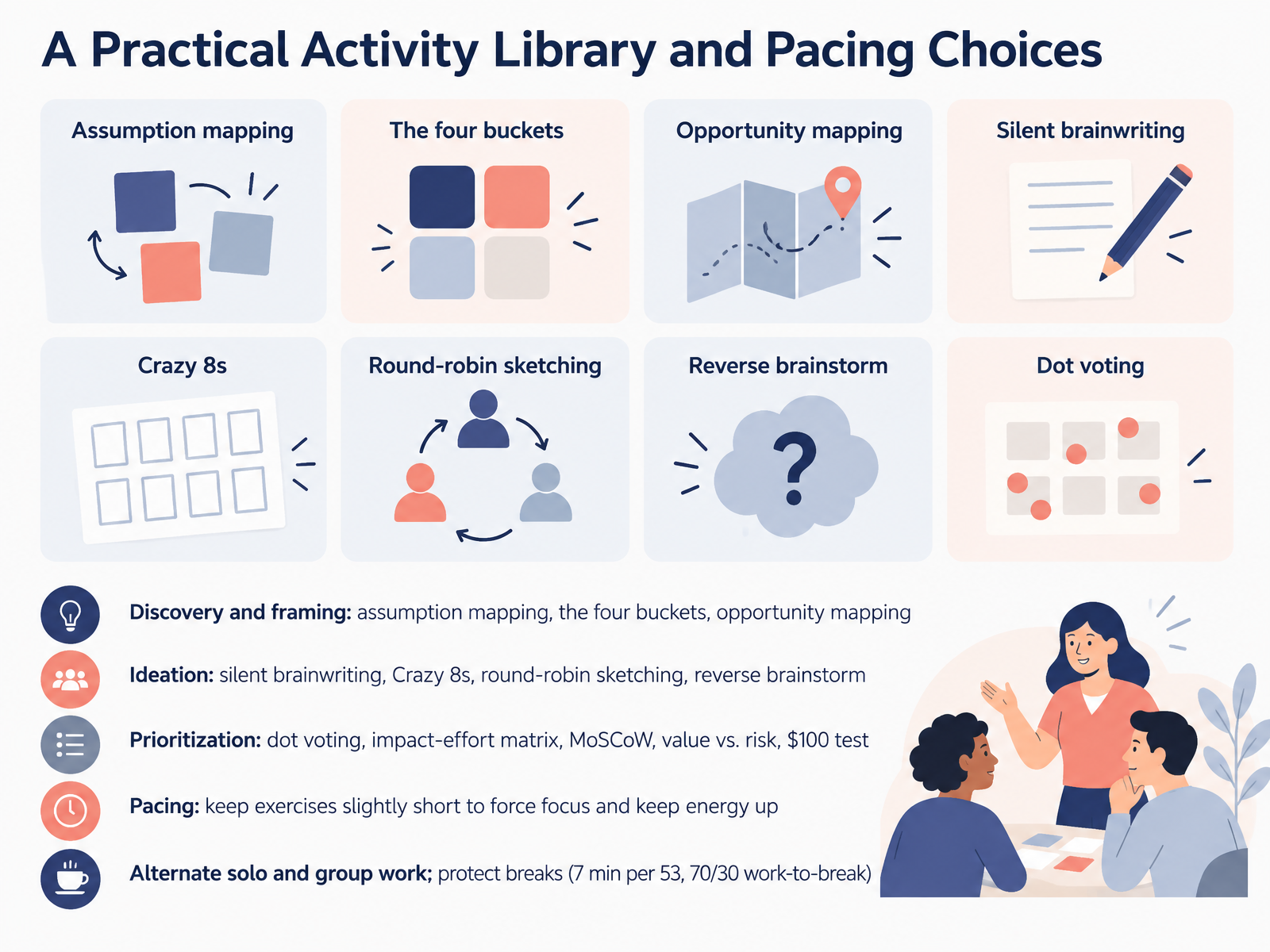
 - 10A Practical Activity Library and Pacing ChoicesNow let's pull the activities together and talk about timing. Think of this as your library, not a checklist. For framing, you've got assumption mapping, the four buckets, and opportunity mapping. When you're generating ideas, silent brainwriting, Crazy Eights, round-robin sketching, and reverse brainstorm all work, though reverse brainstorm is best saved for a stuck room. For prioritization, dot voting, the impact-effort matrix, MoSCoW, value versus risk, and the hundred dollar test each give you a different decision. The real craft is in how you pace them. Keep exercises slightly short. That urgency forces focus and keeps energy up. Alternate solo and group work so the quiet voices land before the loud ones dominate. And protect breaks, roughly seven minutes every fifty-three, holding to a seventy thirty work-to-break rhythm. People fade, and you lose the room. Next, we'll look at opening the session, agreements, warm-ups, and psychological safety.
 blog.logrocket.comfountn.designnngroup.com1 min
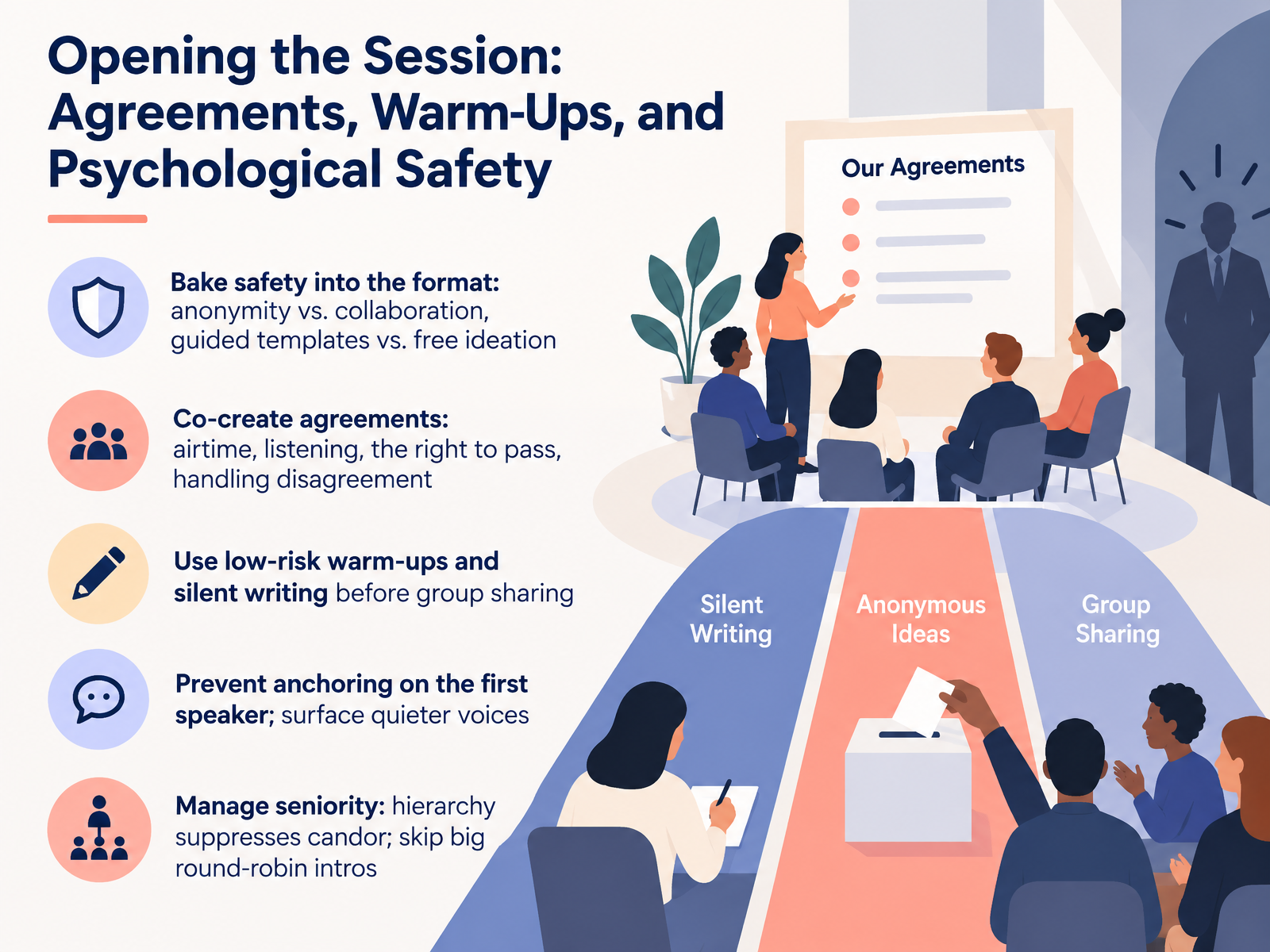
 - 11Opening the Session: Agreements, Warm-Ups, and Psychological SafetySo let's talk about the opening. This is where you either earn the room's candor or quietly lose it. And the biggest lever isn't your icebreaker. It's the format itself. Anonymity versus collaboration, guided templates versus free ideation. If you're working with a hierarchical team, or a group in conflict, anonymity first. Silent writing, private dot voting, then share. Because if the first speaker is the most senior person in the room, everyone else is now anchoring on that idea. So co-create agreements. Airtime, active listening, the right to pass, and how you'll handle disagreement. Write them where everyone can see. Then warm up with something low-risk. Silent writing for three to five minutes, pairs, then the full room. And skip the big round-robin intros. That's where titles show up and candor walks out. Let people share naturally. Now, what happens when a stakeholder blocks the flow mid-session? That's where we go next.
 2 min
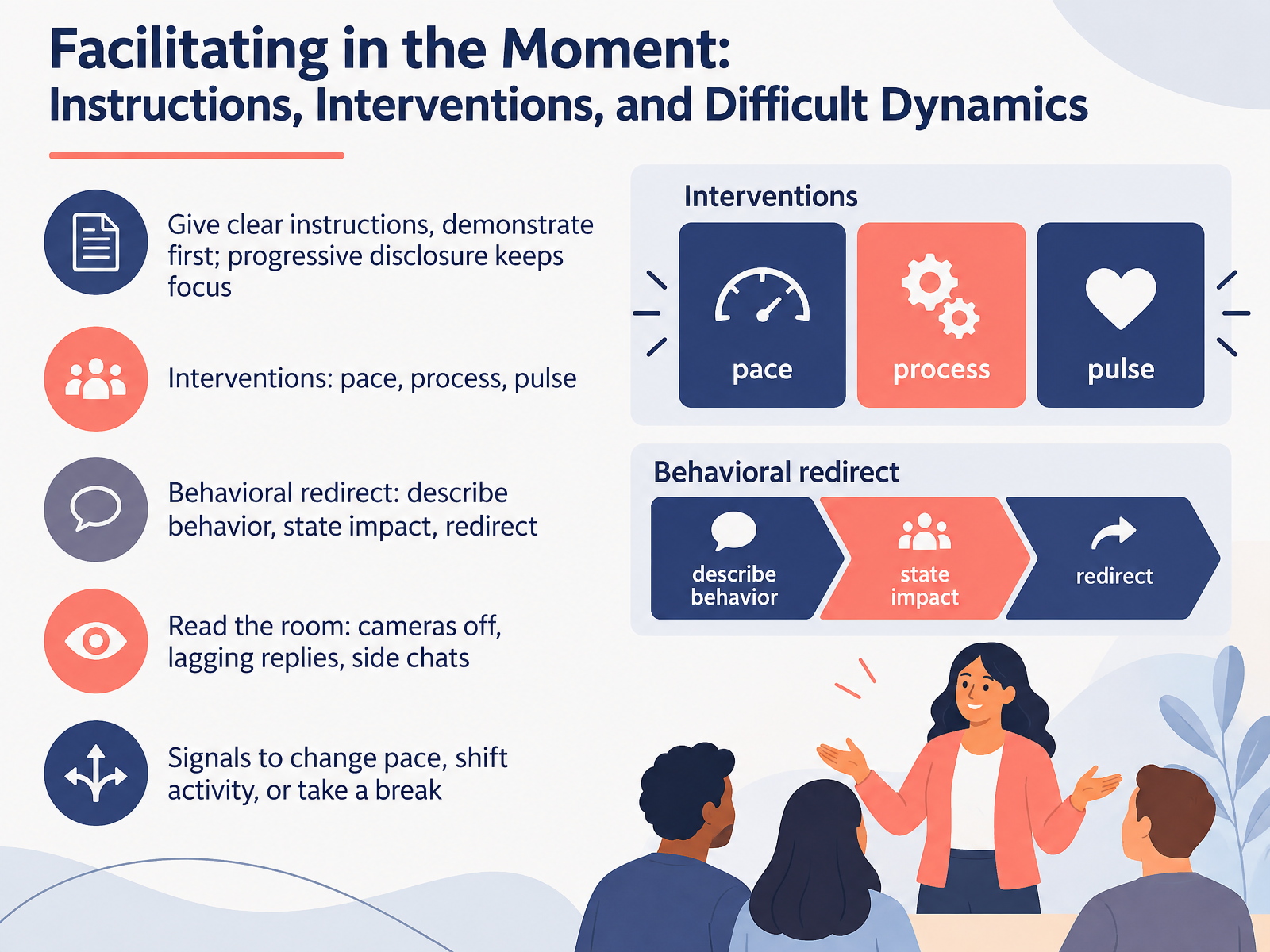
2 min - 12Facilitating in the Moment: Instructions, Interventions, and Difficult DynamicsNow let's talk about what happens once the room is moving. In-the-moment facilitation comes down to clear instructions, clean interventions, and reading the signals people send you. When you give instructions, demonstrate first, and use progressive disclosure. Show one step, let people do it, then reveal the next, so attention stays on the current task instead of the whole agenda. When something drifts, you have three intervention levers: pace, process, and pulse. If a stakeholder blocks the flow in a hard debate, name the behavior, state its impact, then redirect. "I'm noticing we're circling one point, and I'm concerned we'll lose the quieter voices. Let's hear from two people who haven't spoken." And yes, disruption sometimes carries a real point worth hearing, so weigh that before you step in. Read the room too. Cameras off, lagging replies, side chats. Those are signals to shift activity, change pace, or simply take a break. Next, we'll look at converging: decision models, prioritization, and consent.
 fountn.designfusefacilitation.canngroup.com+22 min
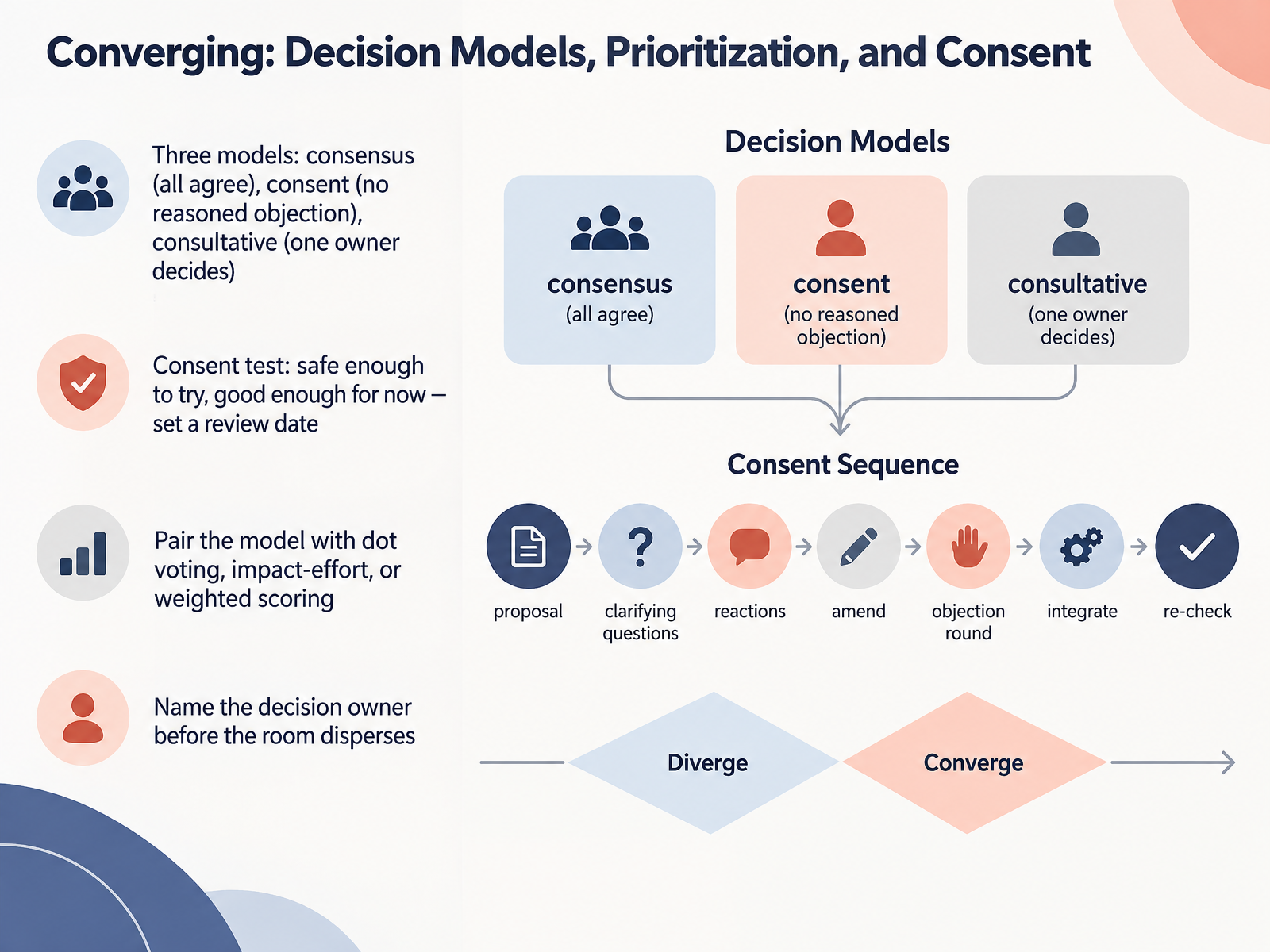
 - 13Converging: Decision Models, Prioritization, and ConsentNow let's talk about convergence, because this is where workshops often stall. You need to choose a decision model before you need it. Consensus means everyone agrees, and one objection blocks it. Consent means no reasoned objection, just safe enough to try and good enough for now, with a review date set. Consultative means one named owner decides. For the consent test, ask the room directly: is this safe enough to try, and good enough for now? Then run the sequence. Present the proposal, take clarifying questions only, hear brief reactions, let the owner amend, run an objection round, integrate the objection, then re-check, going around again. And pair the model with a method. Dot voting for quick preference, impact-effort for trade-offs, weighted scoring when criteria are clear. Before anyone leaves the room, name the decision owner out loud. So the takeaway is simple: pick the model, run the sequence, and name the owner. Next, we'll look at closing, documentation, and building a facilitation practice.
 blog.logrocket.com2 min
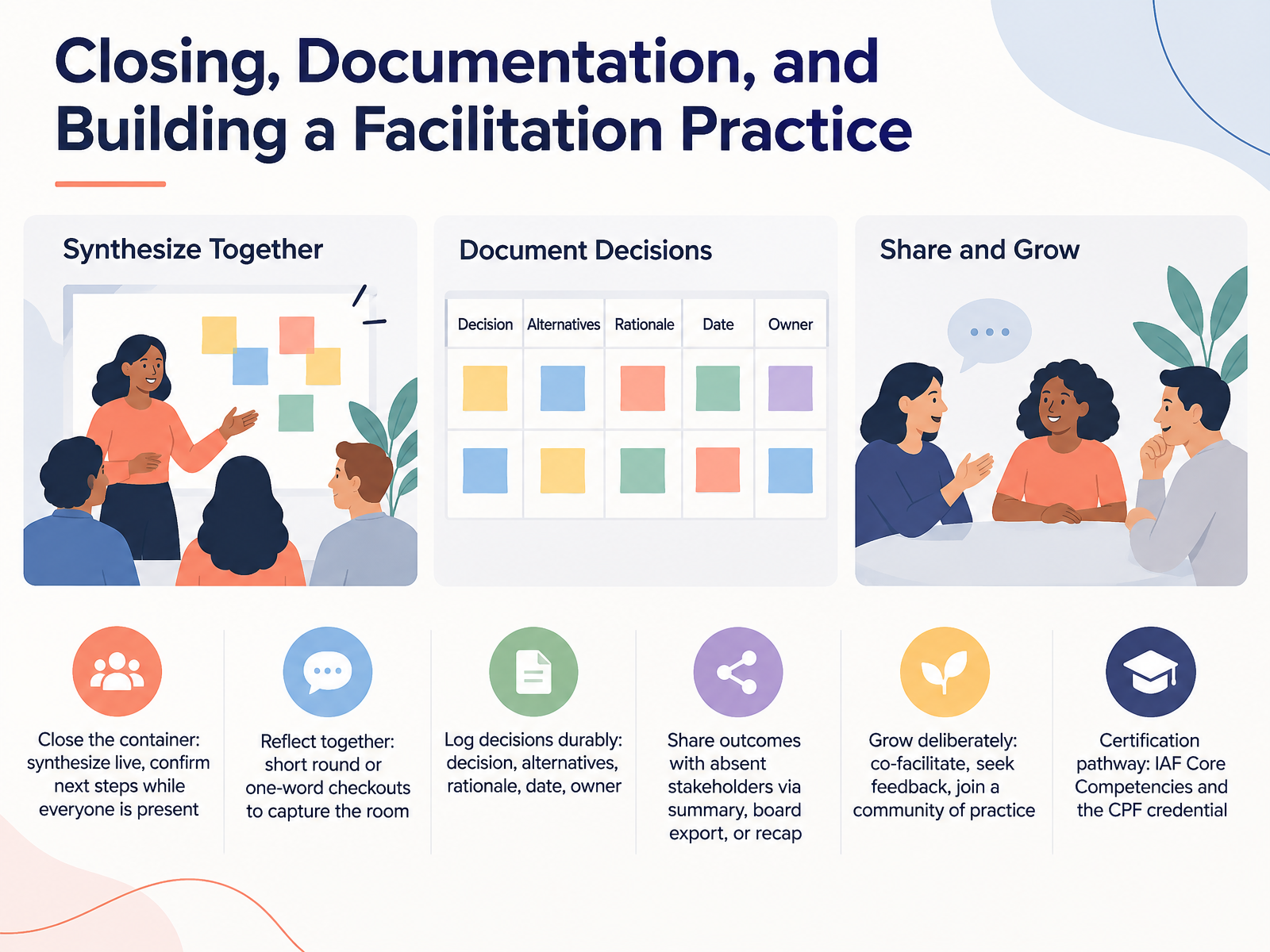
 - 14Closing, Documentation, and Building a Facilitation PracticeLet's close this out with the part that often gets rushed. Before anyone leaves the room, synthesize what you heard and confirm next steps out loud. When a stakeholder blocks the flow late in the session, that live close is your chance to park the objection with a named owner, not a vague promise to follow up. Then run a quick round, maybe one word each, to capture the temperature of the room while it's still honest. Afterward, log decisions durably: the decision, the alternatives you rejected, the rationale, the date, and who owns it. That's the difference between a decision and a debate you'll have again in three weeks. Share outcomes with the people who weren't there through a short summary or a board export. And grow deliberately. Co-facilitate, ask for feedback, join a community of practice. If you want a structured path, the IAF Core Competencies are the backbone, and the Certified Professional Facilitator credential is assessed against them. You've got the tools now. Go run the room well, and thank you for learning with me.
 iaf-members.orgiaf-world.orgiaf-world.org+22 min
Take the deck with you
Download this course as a file — free, no sign-up needed.
- PDF handoutEvery slide page, ready to print or share.15 pages · 3.1 MBDownload
- Narrated PowerPointThe deck that presents itself — every slide carries the digital human's narration video.15 pages · 13.4 MBDownload
- PowerPoint slidesThe full deck as a .pptx — open it in PowerPoint, Keynote, or Google Slides.15 pages · 3.1 MBDownload
Free to use in your own training — please keep the PersonWise credit page at the end.
Have your own deck? Turn it into a course
Sources consulted
Web sources consulted while building this course.
- IAF Core Competencies | IAF World - Members — iaf-members.org
- The IAF Core Competencies — iaf-world.org
- IAF CORE COMPETENCIES — iaf-world.org
- IAF CORE COMPETENCIES — iaf-members.org
- IAF Assessment Standards for Facilitation Training Programs — iaf-world.org
- UX Workshops vs. Meetings: What's the Difference? - NN/G — nngroup.com
- The Meeting You Should Have Instead of a Workshop | Workshop Weaver Blog — workshopweaver.com
- A designer's guide to UX workshop types and how to run them - LogRocket Blog — blog.logrocket.com
- When Do Design Workshops Work (or Not)? — research.ed.ac.uk
- The Diary of a Strategist — zachhill.substack.com
- Using “How Might We” Questions to Ideate on the Right Problems — nngroup.com
- How might we | For government | Queensland Government — forgov.qld.gov.au
- How Might We: Steps, Timing & Tips | Workshop Weaver — workshopweaver.com
- What is How Might We (HMW)? — updated 2026 | IxDF — ixdf.org
- How to Write Effective How Might We Questions — designthinkerlabs.com
- 33 Activity Ideas for Remote UX Workshops - Fountn — fountn.design
- Virtual Facilitation: Online Workshops | FUSE Facilitation — fusefacilitation.ca
- Facilitating AI-Enhanced Workshops: From Ideation to Action - NN/G — nngroup.com
- Facilitating Remote Workshops: Proven Techniques for Success - Remote Sparks — remotesparks.com
- How to Perfect and Leverage Remote UX Workshops — toptal.com