Delegating Work Clearly
Begin
14 pages · ~28 min
Delegating Work Clearly
Learn to delegate work effectively by communicating clear outcomes, providing necessary context, and following through to ensure successful task completion.
What you’ll learn
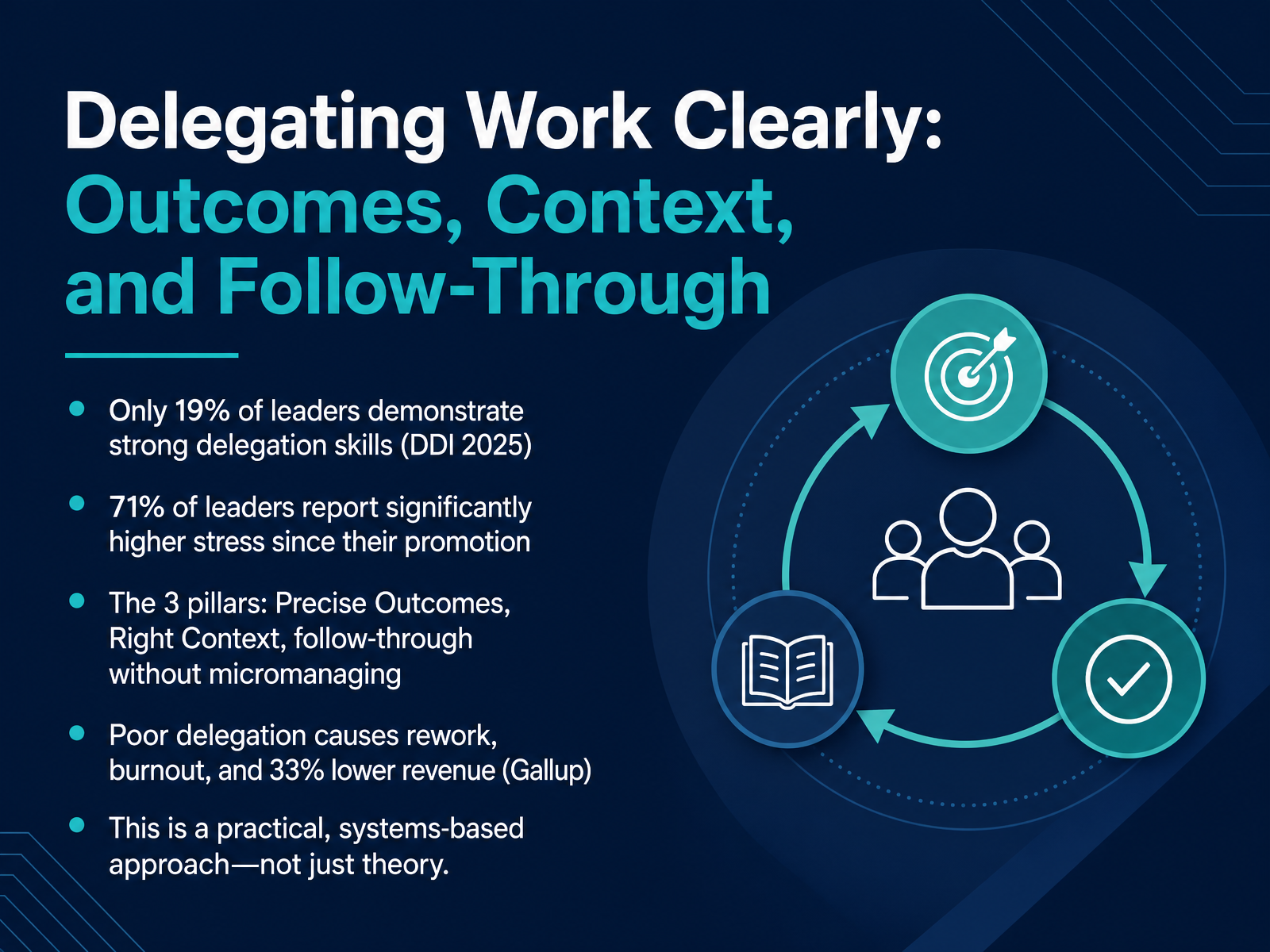
- 01Delegating Work Clearly: Outcomes, Context, and Follow-ThroughWelcome. Today we are breaking down delegation as a practical skill, not a management theory. The data makes this urgent. DDI found that only 19 percent of leaders demonstrate strong delegation skills, yet it has five times the impact of any other method for preventing burnout. That stat alone should tell you this is not a soft topic, it is a core performance lever. We also know that 71 percent of leaders report significantly higher stress since stepping into their current role, and poor delegation leads to rework, burnout, and 33 percent lower revenue according to Gallup. In this course, we focus on three real-world pillars: setting precise outcomes, providing the right context, and scheduling follow-through without micromanaging. This is a systems-based approach you can use immediately. Let's get started by looking at the high cost of ambiguity and abdication.prnewswire.comdelegatesolutions.comey.com+22 min
- 02The High Cost of Ambiguity and AbdicationThere is a hard difference between delegating and just dumping tasks. Real delegation transfers ownership and context. Abdication just throws work over the wall and walks away. That gap is expensive. Research from Gallup shows leaders who delegate well generate 33 percent more revenue. McKinsey found that clear decision authority speeds up cycles by 25 to 30 percent. Vague instructions don't just delay work, they burn people out. DDI reports that 71 percent of leaders face high stress, but only 19 percent are effective at delegating. And when abdication goes big, the costs are public. Look at Zimmer Biomet. Their ERP rollout collapsed, lawsuits followed, and the damage hit 172 million dollars. That's the cost of ambiguity. Let's look at how delegation is becoming a strategic system in the next slide.
 prnewswire.comdelegatesolutions.comey.com+21 min
 - 03The New Era of Delegation: A Strategic SystemSo, delegation is no longer just a "nice to have" management habit. It's a strategic system. The data is pretty stark. According to DDI's 2025 Global Leadership Forecast, only nineteen percent of rising leaders actually show strong delegation skills. That leaves a huge number of managers falling into what we call bottleneck patterns. Over seventy percent identify as either a Time Optimist, always underestimating how long work takes; an Interventionist, who delegates but then jumps back in; or an Isolationist, who just holds on to too many decisions. The real shift here is moving from just handing off tasks to what we call "Thinking Delegation." That means you're transferring the judgment and the decision rights, not just the to-do item. When you treat delegation as a structured system instead of a personal style, you create a genuine competitive advantage for your team and your whole organization. Let's dive into the first pillar of building that system—defining outcomes with precision.
 prnewswire.comdelegatesolutions.comey.com+21 min
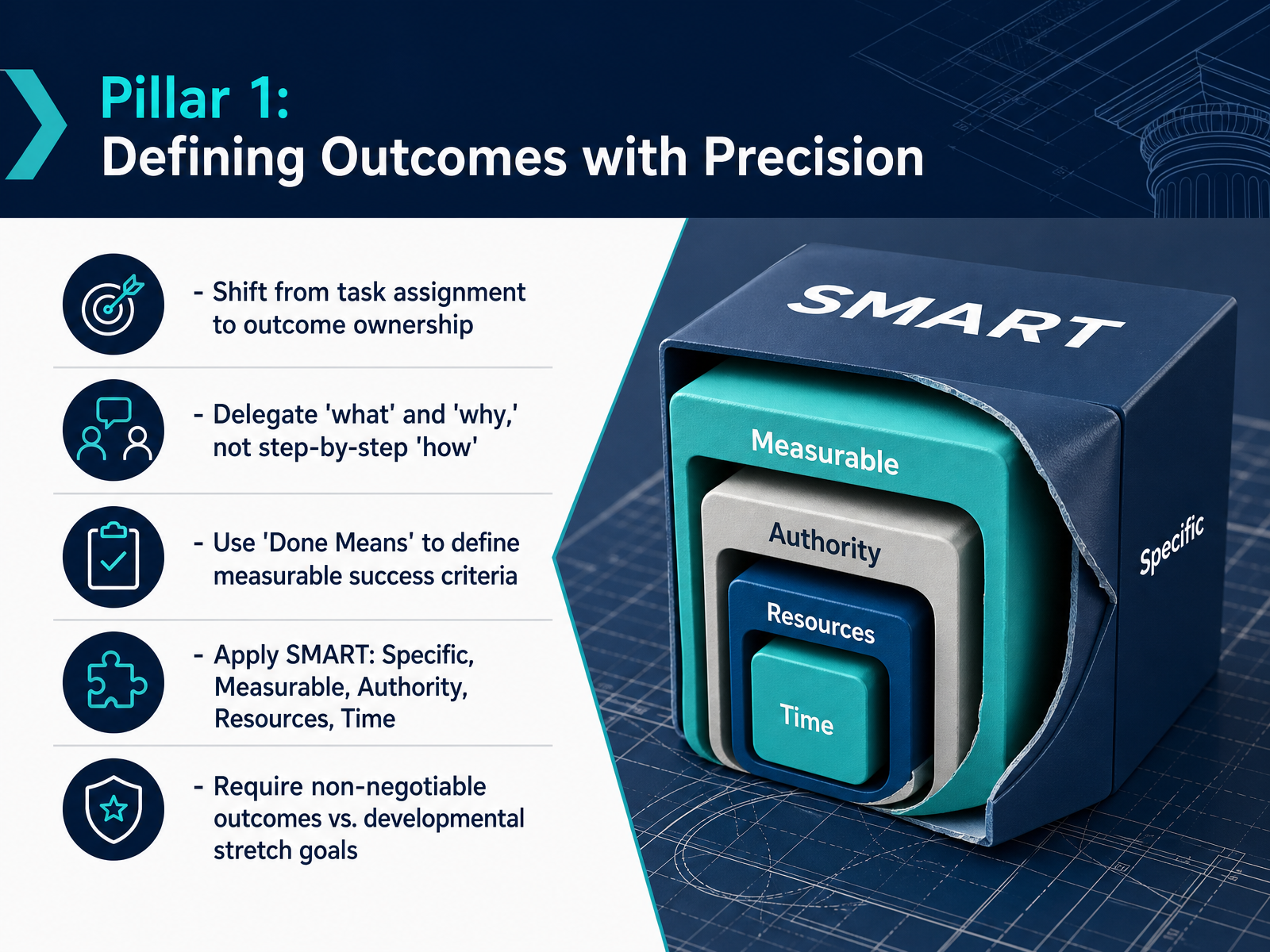
 - 04Pillar 1: Defining Outcomes with PrecisionNow let's get into the first pillar: defining outcomes with precision. This is where real delegation starts, and it requires a shift in thinking. Stop assigning tasks and start assigning ownership. When you hand off work, delegate the ‘what’ and the ‘why,’ but not the step-by-step ‘how.’ Micromanaging the process kills initiative and keeps you chained to the work. To get the result without controlling the method, use a simple tool: ‘Done Means.’ Define what success looks like in measurable terms. You can layer on the SMART framework— Specific, Measurable, Authority, Resources, and Time—to tighten that clarity even further. Just be sure to distinguish between non-negotiable outcomes and developmental stretch goals. You need the first to run the business, and the second to grow your people. Clear outcomes turn vague requests into committed ownership. Up next, we’ll look at how to support that ownership through Pillar Two: providing the right context.
 prnewswire.comdelegatesolutions.comey.com+22 min
 - 05Pillar 2: Providing the Right ContextNow let's talk about pillar two: providing the right context. If you just hand someone a task without the 'why,' you're asking them to work blind. Research consistently shows that when people understand the purpose behind the work, their engagement and the quality of their judgment both go up. So share the bigger picture. Connect the task to team goals or company priorities. But context also includes constraints. Be explicit about the budget, the real timeline, any dependencies you know about, and the guardrails they should work within—those are not restrictions; they are clarity. A key caution here: filter the noise. Share only the context that helps them make sound decisions. Don't drown them in backstory. When you provide the right context, you transfer ownership, not just instructions. Now, a great context only works if you match the task to the right person. Let's explore that next in 'Matching the Person to the Outcome.'
 pure.au.dkideas.repec.orglink.springer.com+21 min
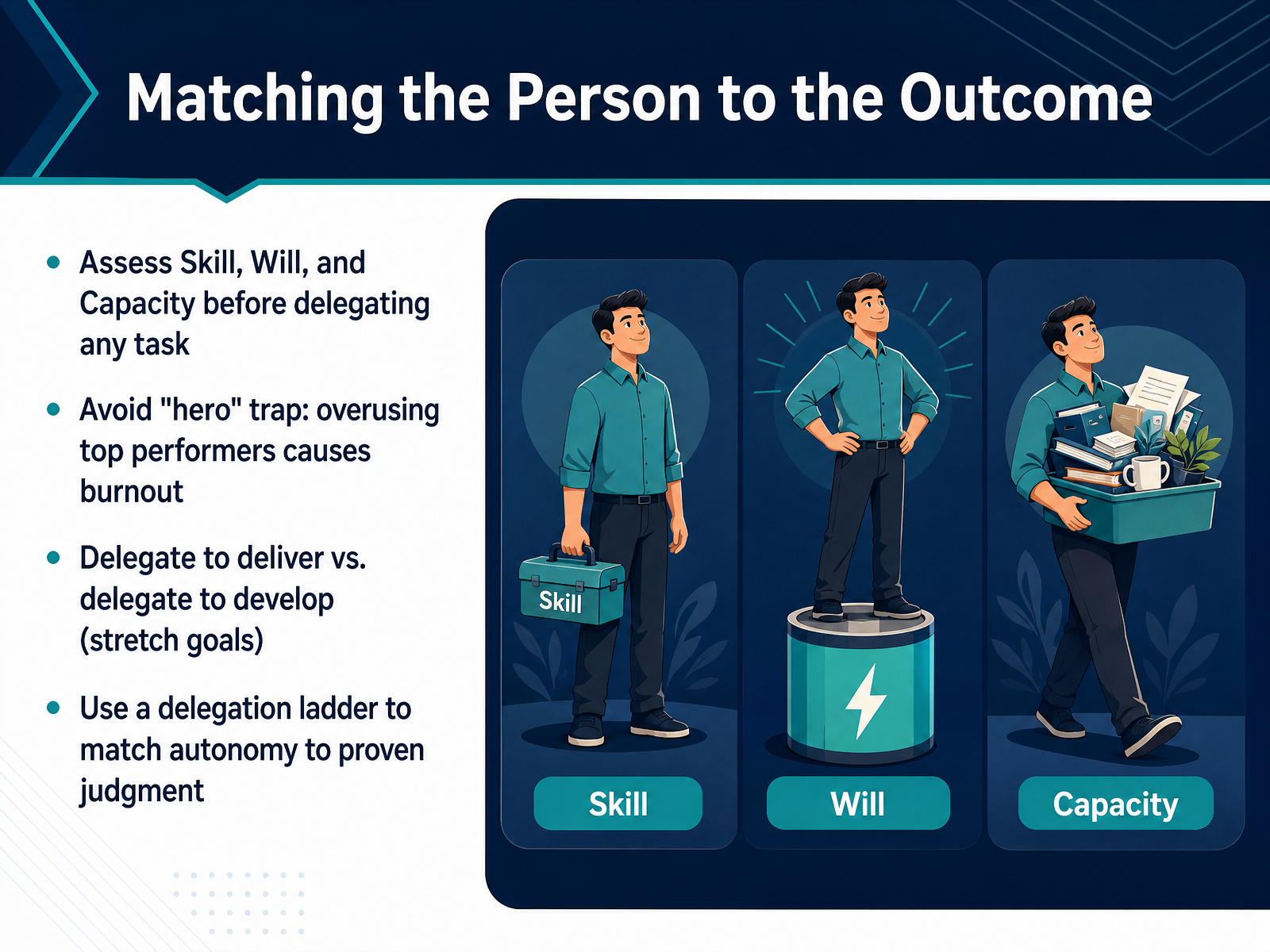
 - 06Matching the Person to the OutcomeLet's get practical about who you choose for the work. Before you hand anything off, quickly assess three things: skill, will, and capacity. Does the person actually have the ability? Are they interested and motivated? And do they realistically have the bandwidth? If any of those is missing, you're setting them up to struggle. Next, watch out for the hero trap. It is tempting to always give critical tasks to your top performer, but overusing them leads straight to burnout. Instead, think about two paths. There is delegate to deliver, for work where you need a reliable result right now, and delegate to develop, where you use a stretch assignment to grow someone's judgment over time. A practical tool here is the delegation ladder. You match someone's autonomy to their proven judgment. If they are new, they might just follow a process. If they have shown strong decision-making, they can own the outcome. The key takeaway: stop thinking about who can just do the task, and start thinking about who is the right match for the outcome. Up next, we'll walk through the delegation conversation: a repeatable structure.
 pure.au.dkideas.repec.orglink.springer.com+22 min
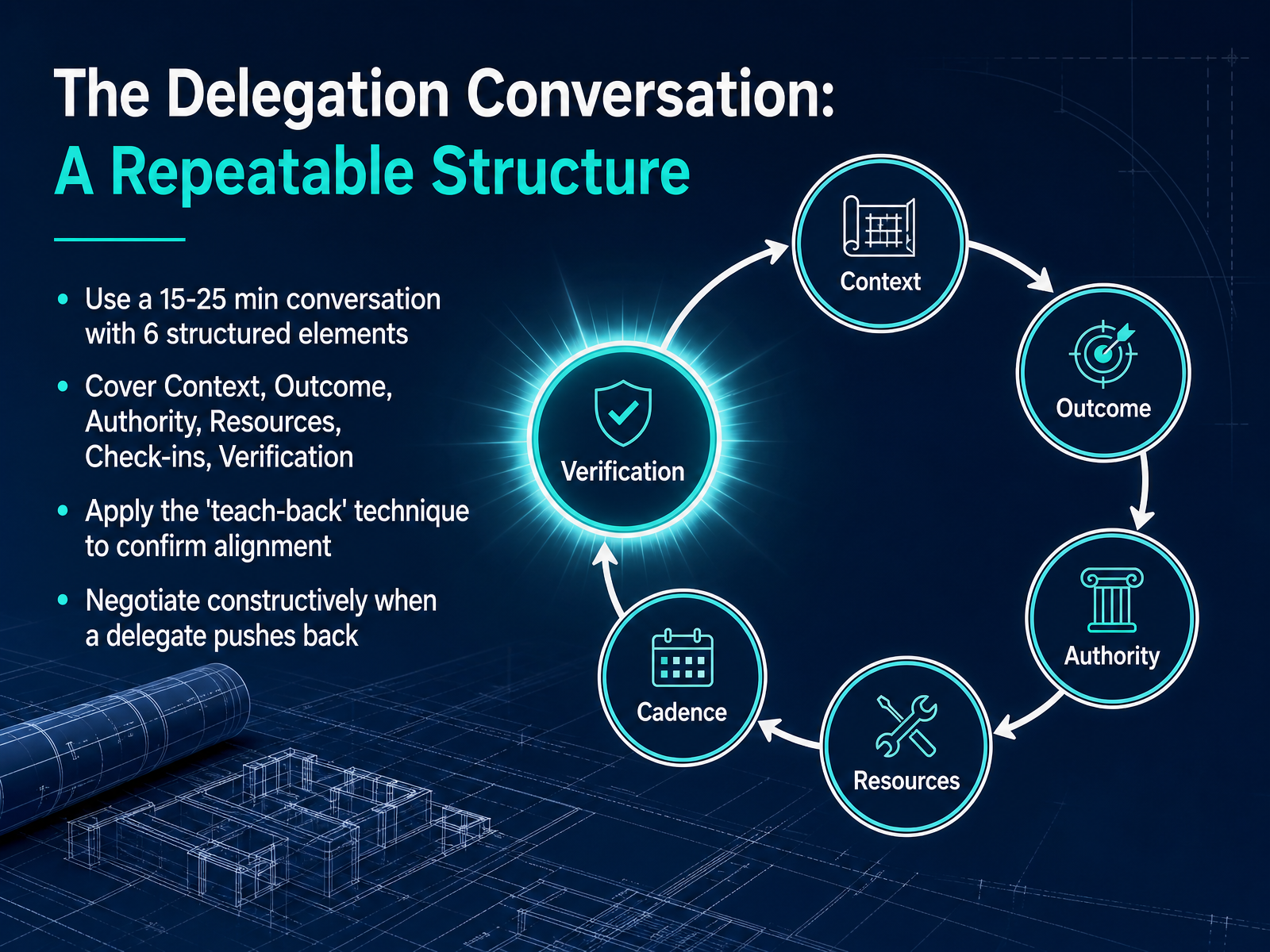
 - 07The Delegation Conversation: A Repeatable StructureLet's look at the delegation conversation itself and give it a repeatable structure. Think of this as a fifteen to twenty-five minute focused discussion, not a quick hallway request. It has six clear elements. You cover context, the specific outcome you need, the person's authority level, resources available, check-in points, and how you will verify the work is done right. Inside that conversation, use the teach-back technique. Simply ask, 'Just so we are aligned, can you walk me back through the task as you understand it?' This reveals gaps instantly. And if the person pushes back, don't shut it down. Negotiate constructively. Listen for whether they need more clarity, a different timeline, or tighter scope. That negotiation actually builds commitment. So, make every delegation a structured discussion. Next, we will establish a decision-rights matrix to remove guesswork.
 sloanreview.mit.eduleadingwithheart.comworkahomie.com+22 min
 - 08Establishing a Decision-Rights MatrixNow let's bring that clarity into a single, shared tool: the decision-rights matrix. This is where you remove guesswork and make delegation feel safe for everyone. You define three categories for decisions in advance: things a team member can decide alone, things they need to inform you about, and things that require your approval. Then you map this out against real work. Your template should cover concrete areas like budget thresholds, technical changes, and external communications. These are the spots where vague authority usually creates bottlenecks. A shared matrix acts as a guardrail. It empowers your team to move fast on their own, while you manage risk without needing to hover. When everyone can see the lines, autonomy goes up and bottlenecks come down. You delegate with confidence, and your team acts with clarity. Next, we'll look at Pillar 3: Follow-Through Without Micromanaging.
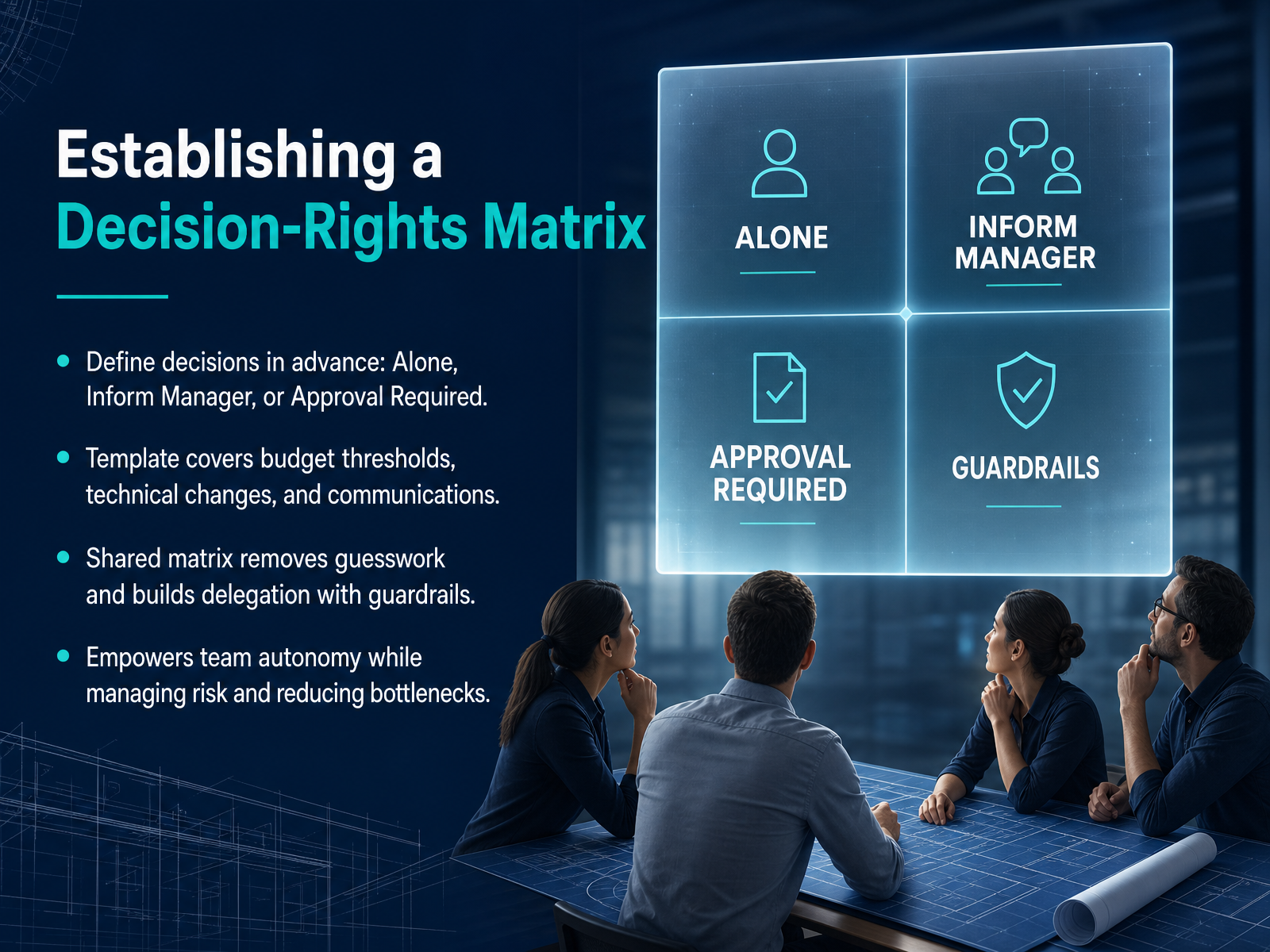 sloanreview.mit.eduleadingwithheart.comworkahomie.com+22 min
 - 09Pillar 3: Follow-Through Without MicromanagingNow let's talk about the third pillar: follow-through without micromanaging. Interference is reactive and comes from your anxiety. Scheduled checkpoints, on the other hand, support autonomy. You want to use milestone-based leading indicators, not lagging status reports. Instead of asking for a general update, check progress on specific deliverables that predict the final outcome. Use async-first tools like shared dashboards or weekly written updates. These give you visibility without sending a disruptive ping or calling an unnecessary meeting. Finally, when you see a problem, redirect by coaching with questions instead of rescuing. For example, ask, "What are your options here?" This builds their judgment. Next, we will look at how to adapt delegation for remote and hybrid teams.
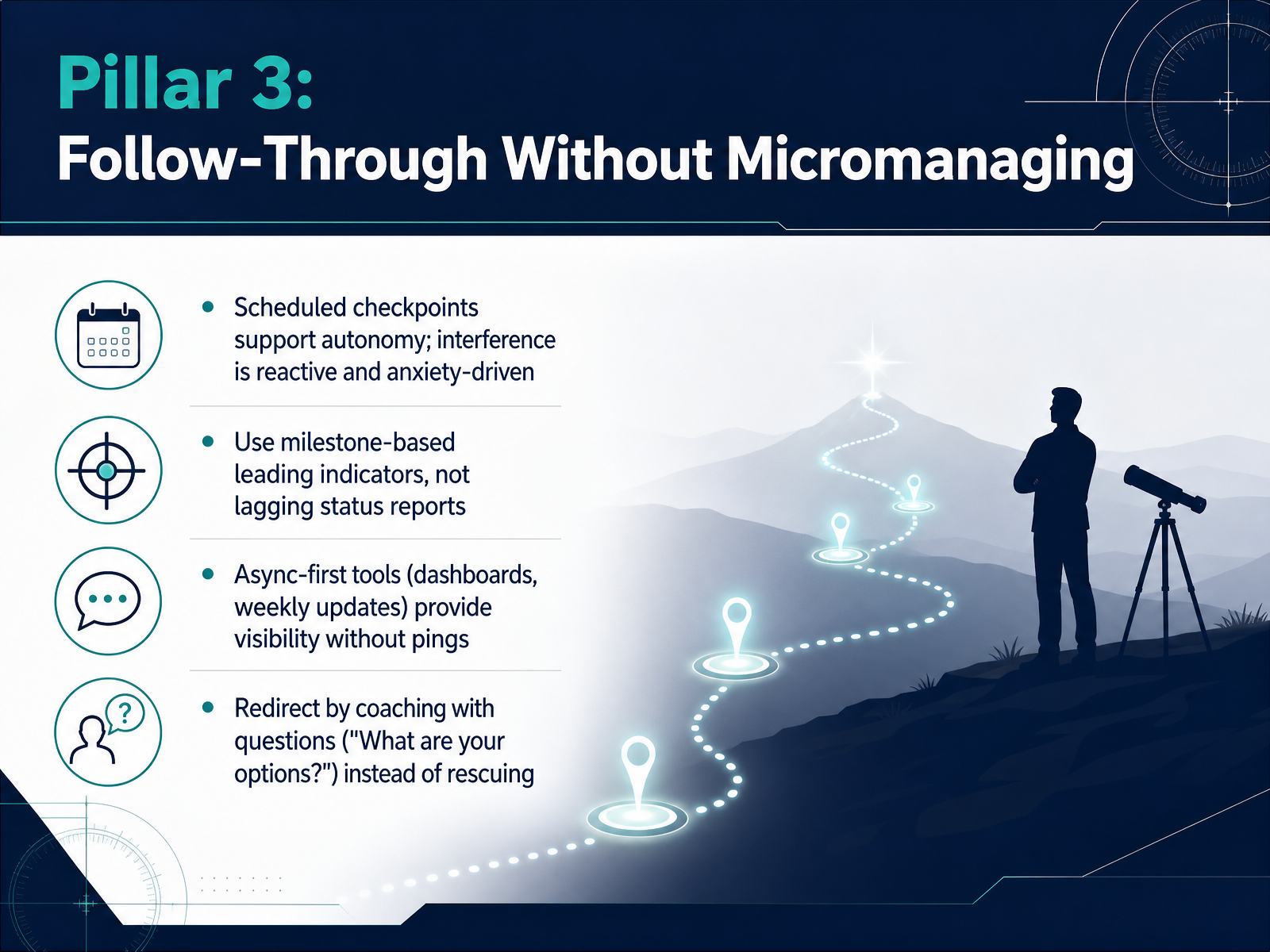 sloanreview.mit.eduleadingwithheart.comworkahomie.com+21 min
 - 10Adapting Delegation for Remote and Hybrid TeamsDelegating in a remote or hybrid team changes the rules. You lose the quick desk-side conversation, so virtual distance takes over. That comes in three forms: physical separation, operational gaps in your systems, and affinity distance, which is the emotional disconnect between team members. Clarity isn't just helpful here. It's the whole game. Start by writing down every outcome and every deadline. Over-communicate the context deliberately, because people can't read the room or pick up on hallway chatter. Then, shift to shorter, more frequent check-ins. Don't let weeks slip away. Focus each one on live priorities and current blockers. Next, build a delegation knowledge base using asynchronous tools like Loom, Notion, or Trello. Record a process once and never explain it live again. Finally, set clear rules for your own availability. If you send messages at midnight, you silently train people to be always on. Write your hours down and stick to them. To make remote delegation work, replace visibility with written clarity, and replace proximity with structured follow-through. Now, let's look at how to give and receive feedback on delegated work.
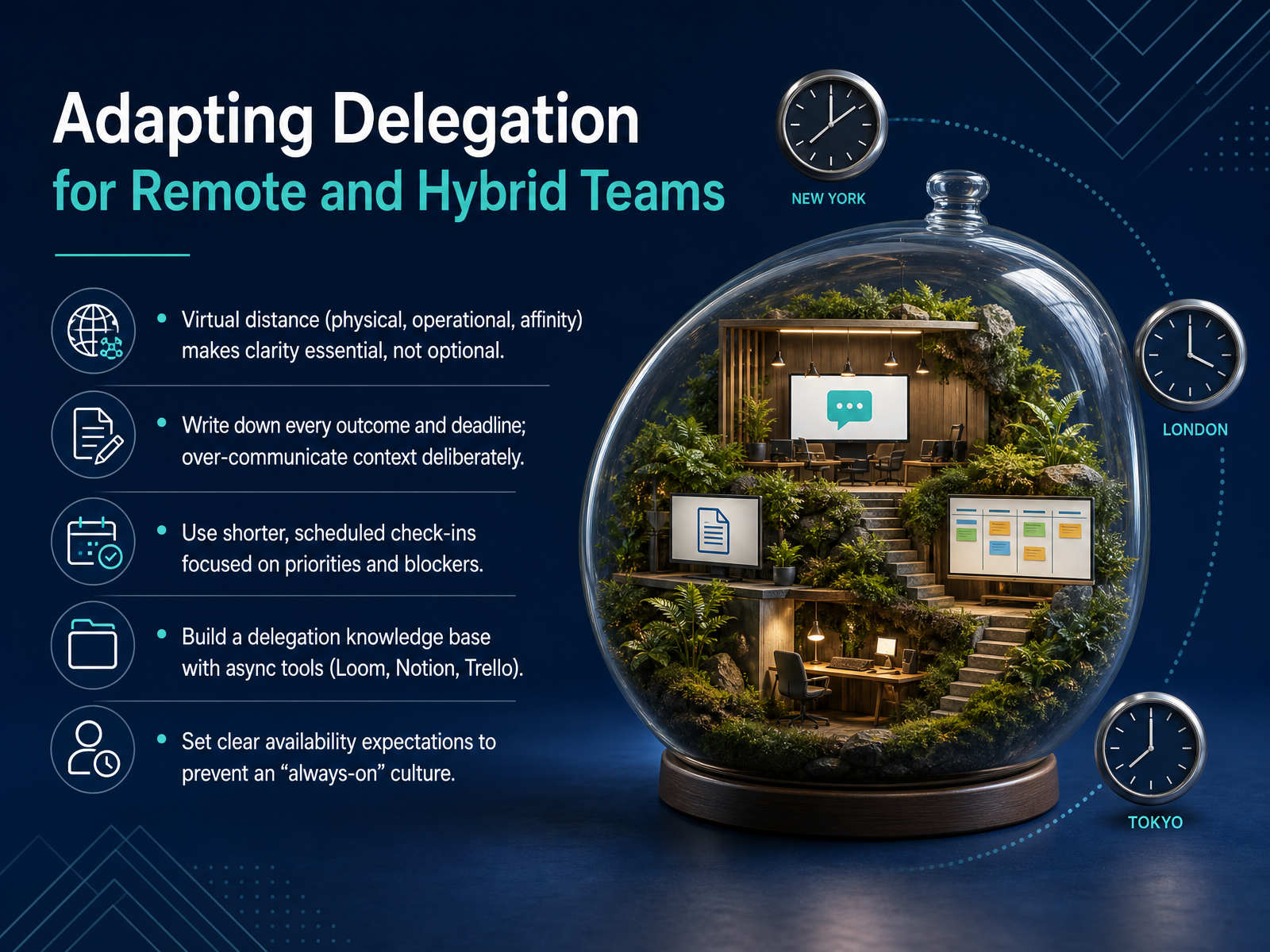 sloanreview.mit.eduleadingwithheart.comworkahomie.com+22 min
 - 11Giving and Receiving Feedback on Delegated WorkNow, let’s talk about something most people skip: giving and receiving feedback after work is delegated. Feedback is where trust either solidifies or cracks. When things go well, use the SBI model: name the Situation, the specific Behavior you observed, and the Impact it had. That makes your praise concrete, not just polite. When things go wrong, resist the urge to start with the person. Audit your own delegation clarity first. Were the guardrails clear? Did they have the full context? Only then assess their judgment. And here is a powerful upward question: ask your team, “What could I clarify better next time I hand off work?” This does two things. It surfaces gaps in your own process, and it builds the psychological safety that research links directly to performance. Finally, celebrate wins publicly. Autonomy only thrives in a positive social context. When you spotlight someone’s ownership in front of the team, you reinforce the culture you’re trying to build. Next, we’ll look at common pitfalls and how to avoid them.
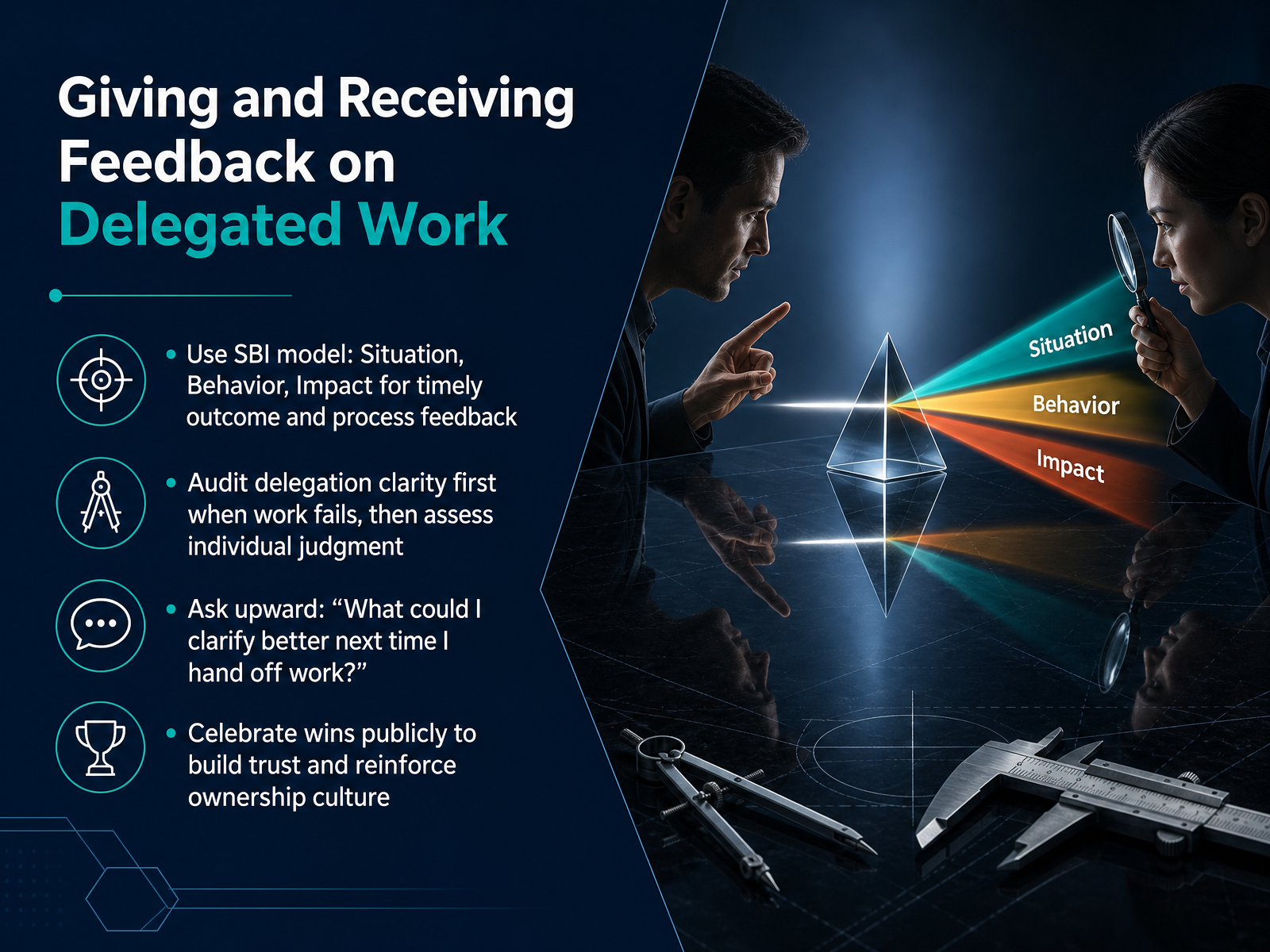 pure.au.dkideas.repec.orglink.springer.com+22 min
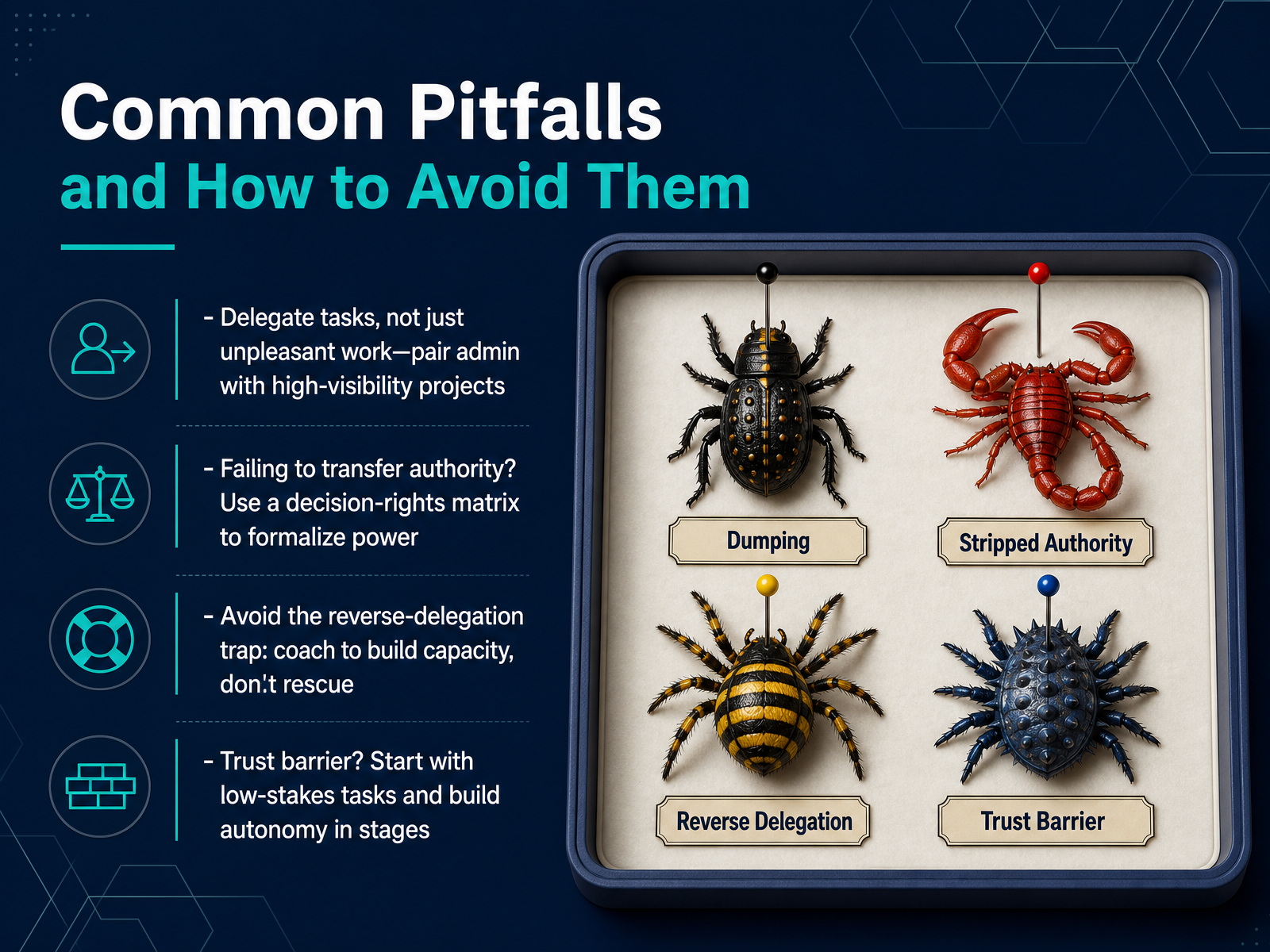
 - 12Common Pitfalls and How to Avoid ThemDelegation mistakes are predictable, which means they are also preventable. Let's walk through the four most common pitfalls and exactly how to avoid them. First, the work you hand off matters. If you only delegate unpleasant admin tasks, your team notices. Pair necessary administrative work with high-visibility projects that build skills and ownership. Second, many leaders hand off tasks but keep all the decision power. That creates a bottleneck. Use a simple decision-rights matrix to formalize what someone can decide alone, what requires informing you, and what needs your approval. This turns vague trust into clear authority. Third, watch for the reverse-delegation trap. Someone brings you a problem and you take it back. Instead, coach them to bring a recommendation. Ask 'What do you think we should do?' before offering your view. This builds capacity instead of dependency. Finally, if trust is holding you back, don't wait until you feel ready. Start with a single low-stakes task, define the outcome clearly, and build autonomy in stages as they demonstrate good judgment. Now let's move to the next step and diagnose your own delegation habits.
 prnewswire.comdelegatesolutions.comey.com+22 min
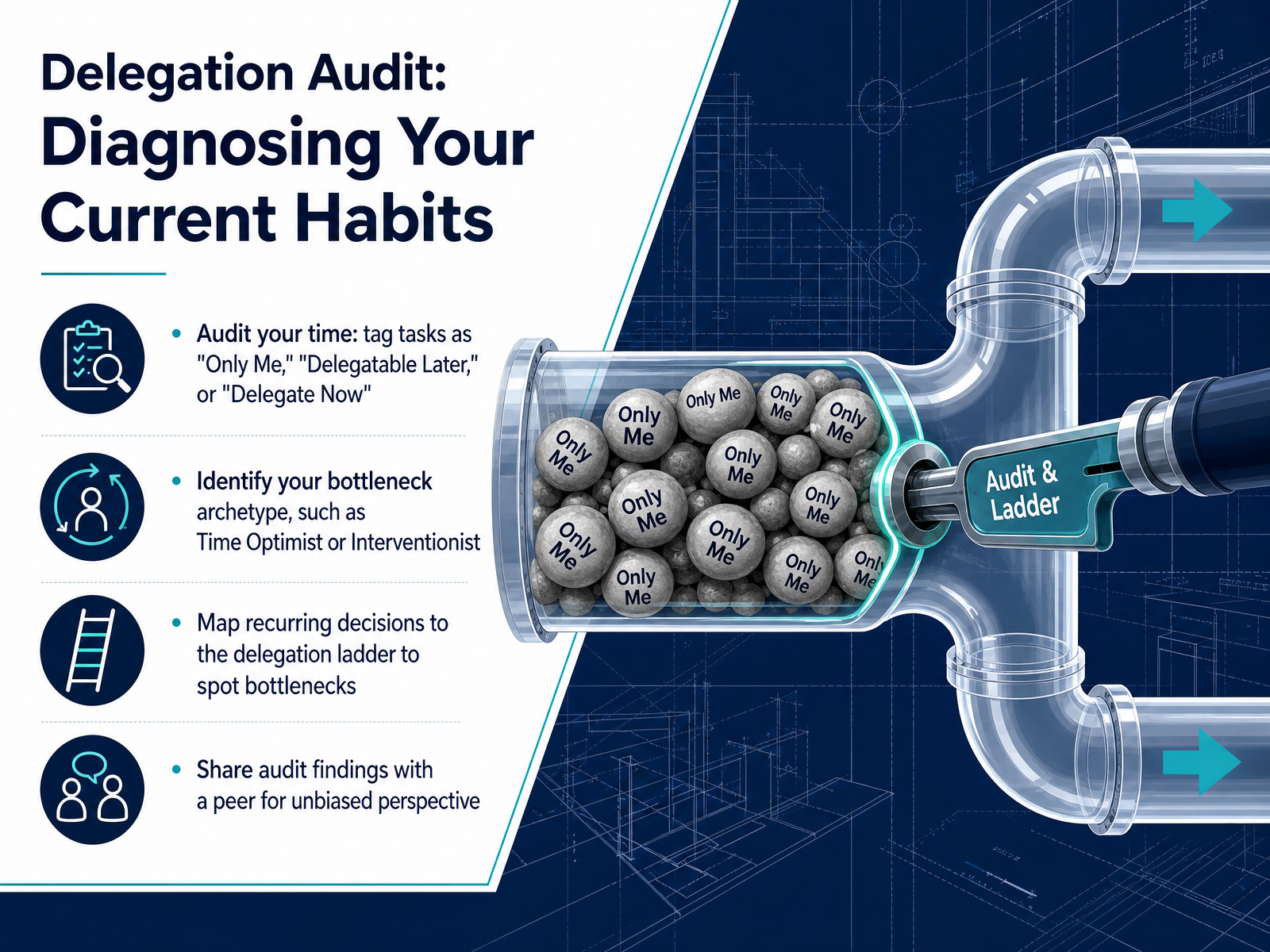
 - 13Delegation Audit: Diagnosing Your Current HabitsLet's get practical and run a quick delegation audit on your own work. Start with a simple time audit. For one week, tag every task you touch as 'Only Me,' 'Delegatable Later,' or 'Delegate Now.' You'll likely find more in that third column than you expect. Next, identify your bottleneck archetype. Most leaders fall into a pattern—like the Time Optimist who underestimates workload, or the Interventionist who delegates but then jumps back in. Naming your pattern makes it fixable. Then, map your recurring decisions to the delegation ladder. Are you owning decisions that someone else could research, recommend, or even decide? That's your bottleneck. Finally, share your audit findings with a trusted peer. You need an unbiased perspective to see what you're accidentally hoarding. Let's now turn this diagnosis into real momentum with your 30-Day Delegation Action Plan.
 prnewswire.comdelegatesolutions.comey.com+22 min
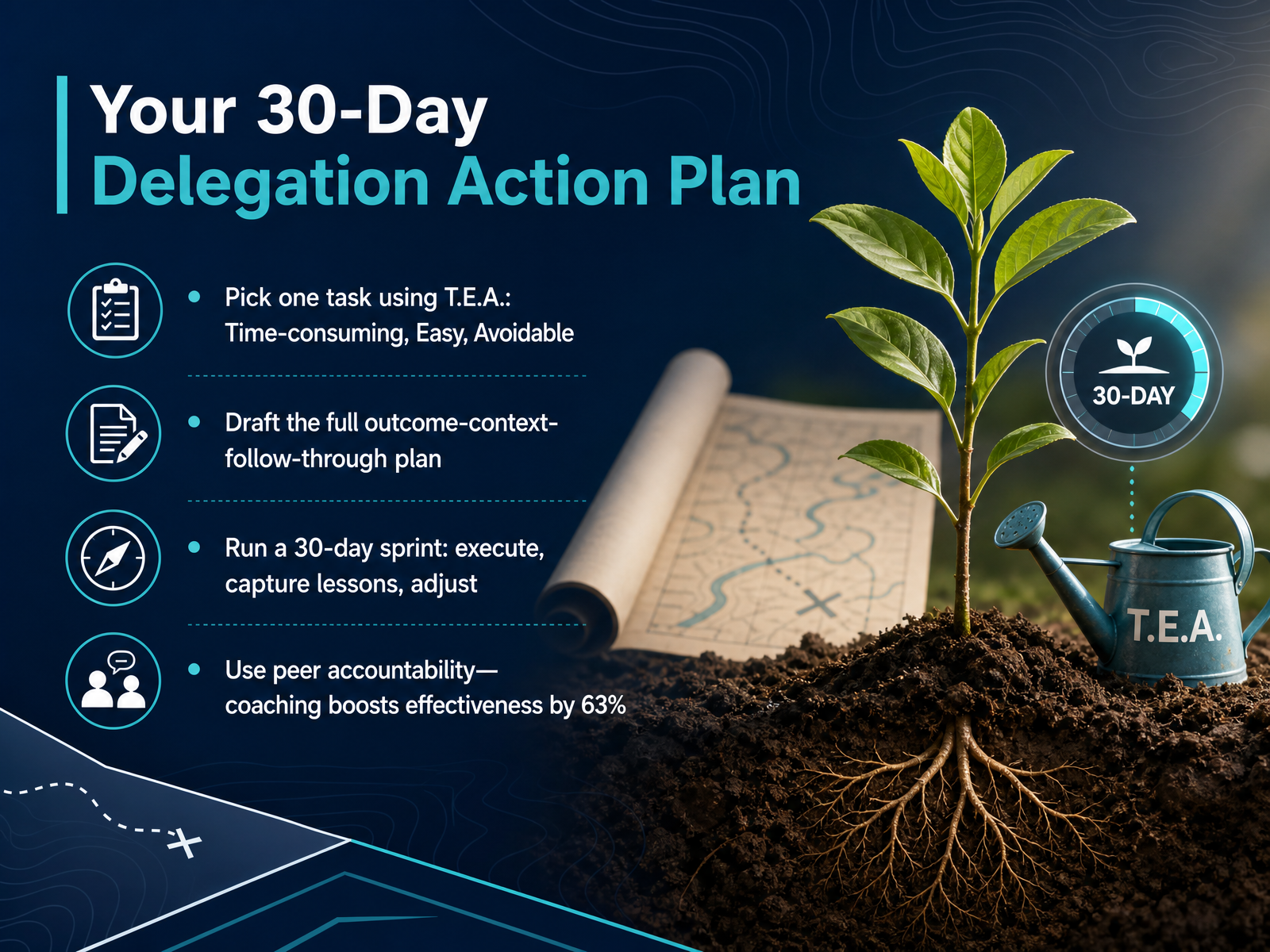
 - 14Your 30-Day Delegation Action PlanWe have covered a lot of ground. Let's turn that into a concrete 30-day plan so you walk out of here ready to act. Your first job this week is to pick one task using the T.E.A. filter. Find something time-consuming, easy to train, and avoidable for you. Just one task. Next, draft the full plan we discussed: define the outcome, give them the context and boundaries, and schedule the follow-through. Spend the next three weeks running a lean 30-day sprint. Execute the handoff, capture what works and what doesn't, and adjust your approach. And do not do it alone. Use a peer accountability partner to debrief your progress. Research shows coaching boosts delegation effectiveness by 63 percent. That is your plan. Pick one task, hand it off with clarity, iterate over 30 days, and bring in support. You now have everything you need to stop being the bottleneck and start building a more capable, autonomous team. Thank you, and good luck.
 sloanreview.mit.eduleadingwithheart.comworkahomie.com+22 min
Take the deck with you
Download this course as a file — free, no sign-up needed.
- PDF handoutEvery slide page, ready to print or share.15 pages · 4.0 MBDownload
- Narrated PowerPointThe deck that presents itself — every slide carries the digital human's narration video.15 pages · 13.3 MBDownload
- PowerPoint slidesThe full deck as a .pptx — open it in PowerPoint, Keynote, or Google Slides.15 pages · 4.0 MBDownload
Free to use in your own training — please keep the PersonWise credit page at the end.
Have your own deck? Turn it into a course
Sources consulted
Web sources consulted while building this course.
- New DDI Data Shows Only 19% of Rising Leaders Have the Delegation Skills Needed To Prevent Burnout — prnewswire.com
- State of Delegation 2026 — delegatesolutions.com
- Ernst & Young LLP and the Society for Corporate Governance release “The delegation edge: A guide to successful delegation and authority” | EY - US — ey.com
- Executive Delegation Statistics | Stealth Agents — stealthagents.com
- 2025 Executive Productivity Report — prialto.com
- Delegating or failing to care: Does relationship with the supervisor change how job autonomy affect work outcomes? - Aarhus University — pure.au.dk
- Following the chain of command? How managers balance benefits and risks in granting autonomy to employees — ideas.repec.org
- Bringing Self-Determination Theory to the Forefront: Examining How Human Resource Practices Motivate Employees of All Ages to Succeed | Journal of Business and Psychology | Springer Nature Link — link.springer.com
- Effects of autonomy support on innovation: resolving the dilemma of pa... — bishtref.com
- Self-Determination Theory and Workplace Outcomes - PMC — pmc.ncbi.nlm.nih.gov
- Embrace Delegation as a Skill to Strengthen Remote Teams — sloanreview.mit.edu
- Delegating to Remote Teams Effectively: Best Practices — leadingwithheart.com
- Best Tips on How to Delegate for Remote Founders - Workahomie — workahomie.com
- Task Delegation - How to Delegate Effectively | nCluster — ncluster.tech
- How to Delegate Effectively for Remote Team Success | Nine Archs LLC — ninearchs.com