Begin
14 pages · ~28 min
Neutron Stars and Stellar Remnants
Learn how neutron stars form and behave, exploring their key properties, structure, and role in stellar evolution for astronomy students and enthusiasts.
A digital instructor presents all 14 pages. Hold “Ask” at any point and ask out loud — the answer comes from this course. No sign-up needed.
What you’ll learn
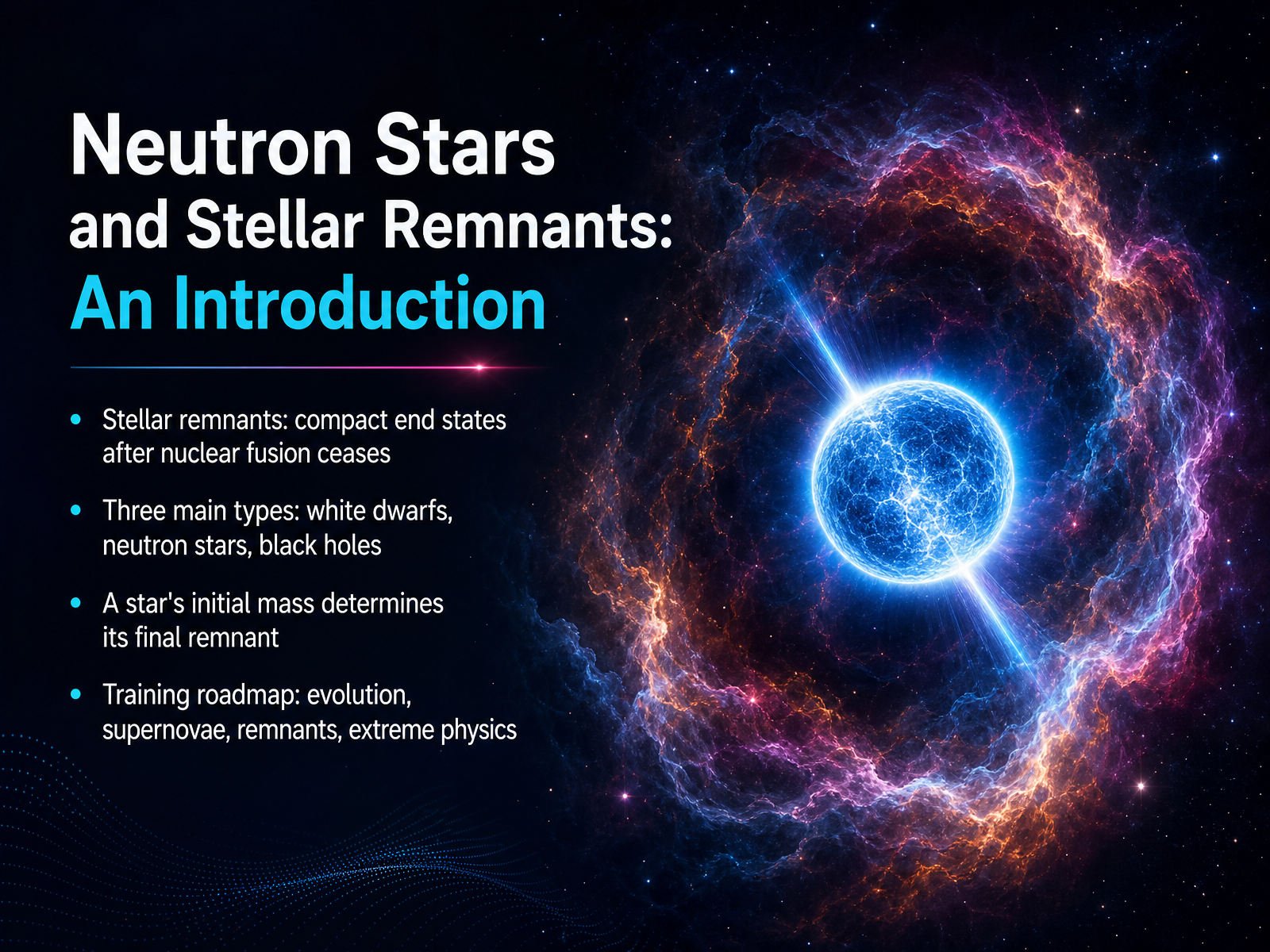
- 01Neutron Stars and Stellar Remnants: An IntroductionWelcome to Neutron Stars and Stellar Remnants. If you have ever wondered what happens after a star dies, this is the perfect place to begin. When a star exhausts its nuclear fuel, it does not simply fade away. It collapses into one of three compact end states, a white dwarf, a neutron star, or a black hole. Which path a star takes depends almost entirely on one thing, the mass it was born with. In this course, we will trace the full journey. We will start with stellar evolution, then move through the violence of supernovae, and finally explore the strange physics of the remnants themselves. Think of this first video as your roadmap. By the end, terms like degeneracy pressure, pulsars, and event horizons will feel less like mysteries and more like pieces of an amazing cosmic story. Now, let us begin that story where every remnant starts, in the life of a star itself.2 min
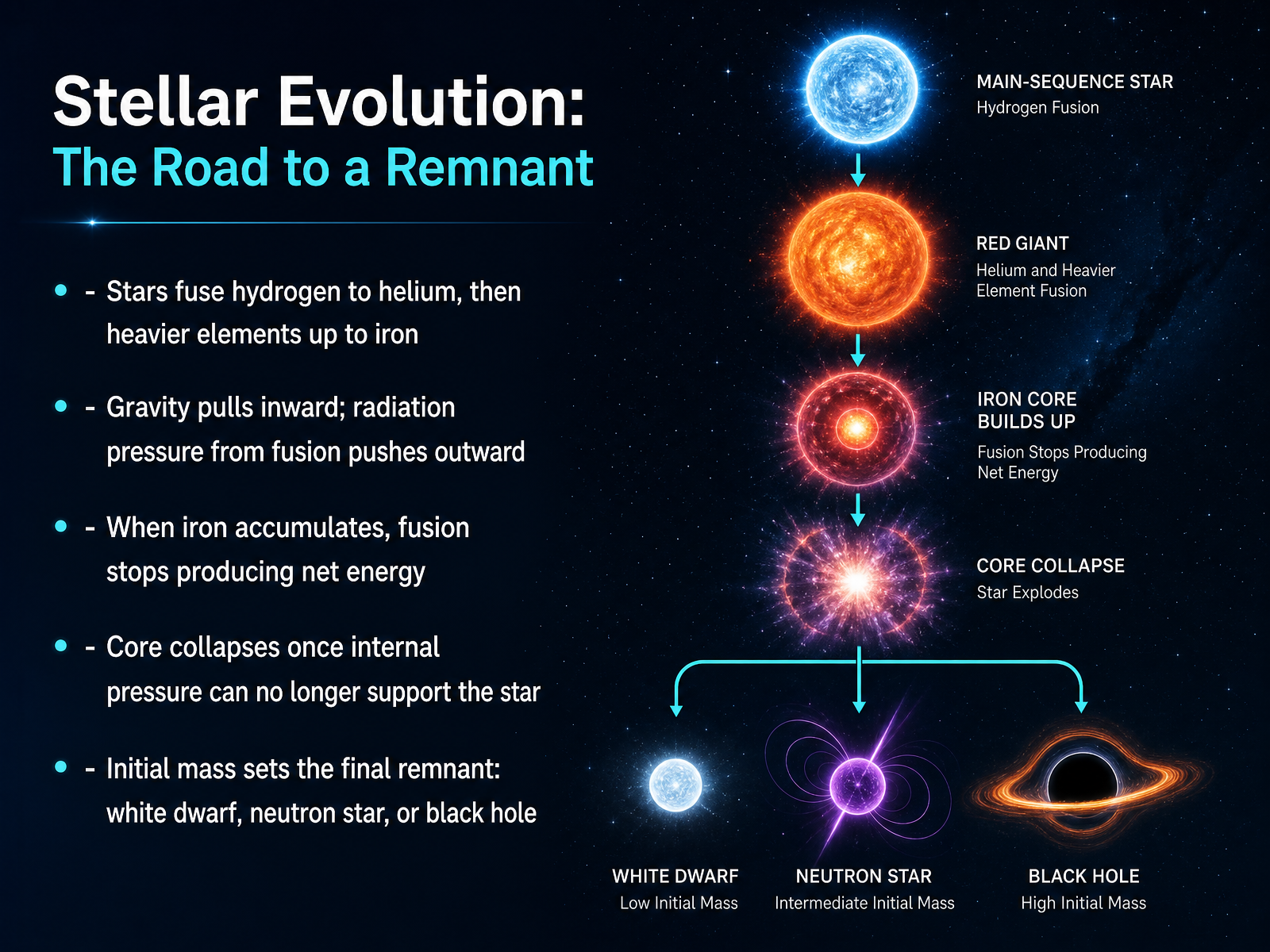
- 02Stellar Evolution: The Road to a RemnantNow let's trace the journey a star takes before it can become a stellar remnant. For most of a star's life, it is locked in a beautiful tug of war. Gravity constantly pulls all that gas inward, while the energy from nuclear fusion in the core pushes outward. In this balance, the star burns bright and stable. Deep inside, the star is an element factory. It starts by fusing hydrogen into helium. As it ages, it works its way up the periodic table, creating carbon, oxygen, and eventually iron. But iron is the end of the line. Fusing iron does not release energy. In fact, it costs energy. So once a star builds an iron core, the outward pressure that once held it up suddenly disappears. Within seconds, the core collapses under its own weight. What remains after that collapse depends almost entirely on how massive the star was at birth. Smaller stars leave behind white dwarfs. More massive stars can crush matter into neutron stars. And the most massive stars collapse all the way into black holes. So the star's initial mass writes its final chapter. Next, let's look at one spectacular way these remnants are born, in a supernova.
 1 min
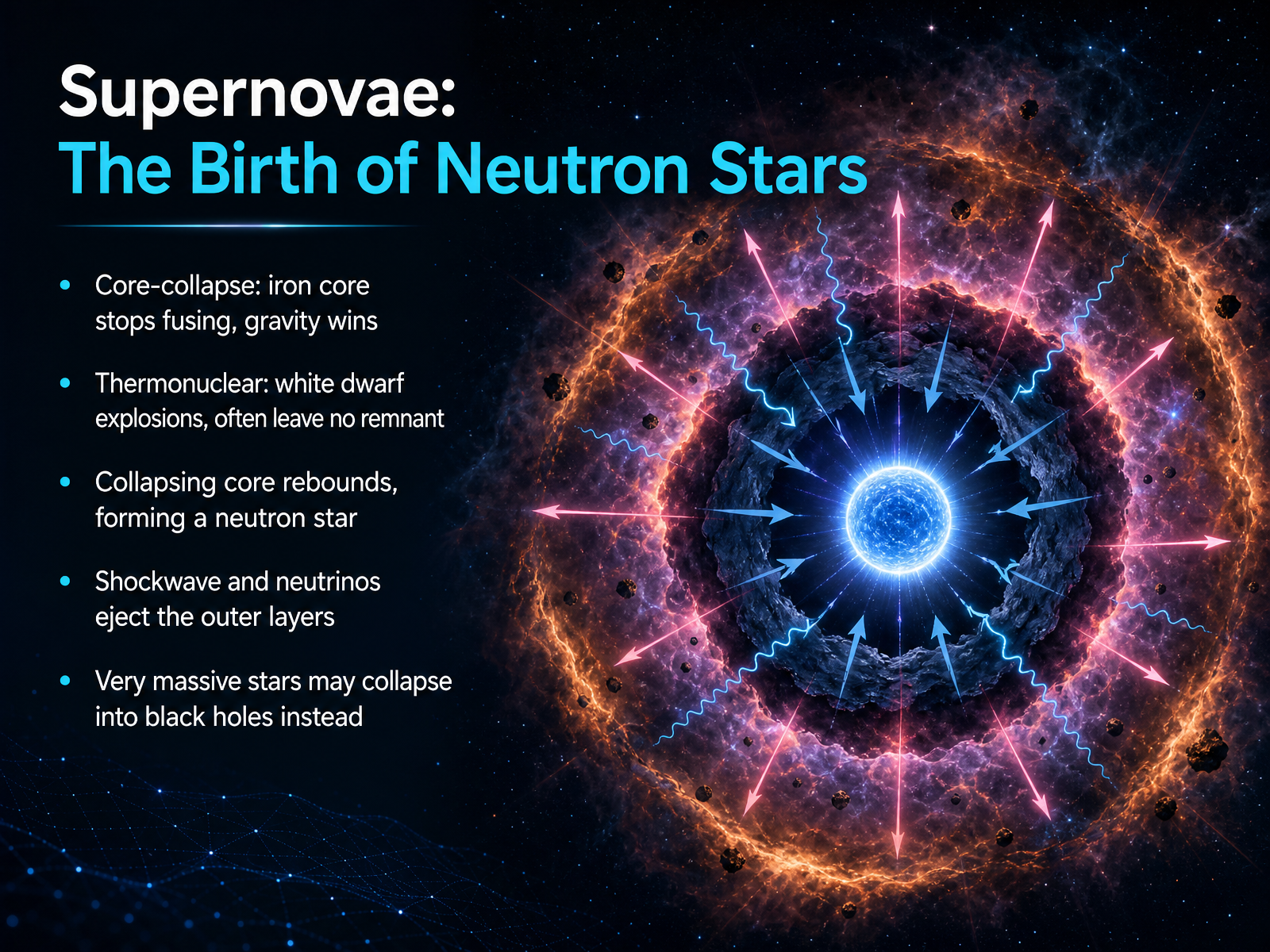
1 min - 03Supernovae: The Birth of Neutron StarsNow we come to the moment a neutron star is born. It begins with a supernova, but not all supernovae are the same. In a core collapse supernova, a massive star builds up an iron core. Iron cannot fuse to release energy, so gravity suddenly wins. The core collapses in less than a second, and then it rebounds. That rebound sends out a shockwave, and a flood of neutrinos helps blast the outer layers into space. What stays behind is an incredibly dense core, a neutron star. In thermonuclear supernovae, a white dwarf explodes entirely and often leaves no remnant at all. And for the most massive stars, even a neutron star is not the end. Gravity keeps crushing the core until a black hole forms. So the type of explosion decides the type of leftover. Next, let us look directly at what makes a neutron star so extreme.
 1 min
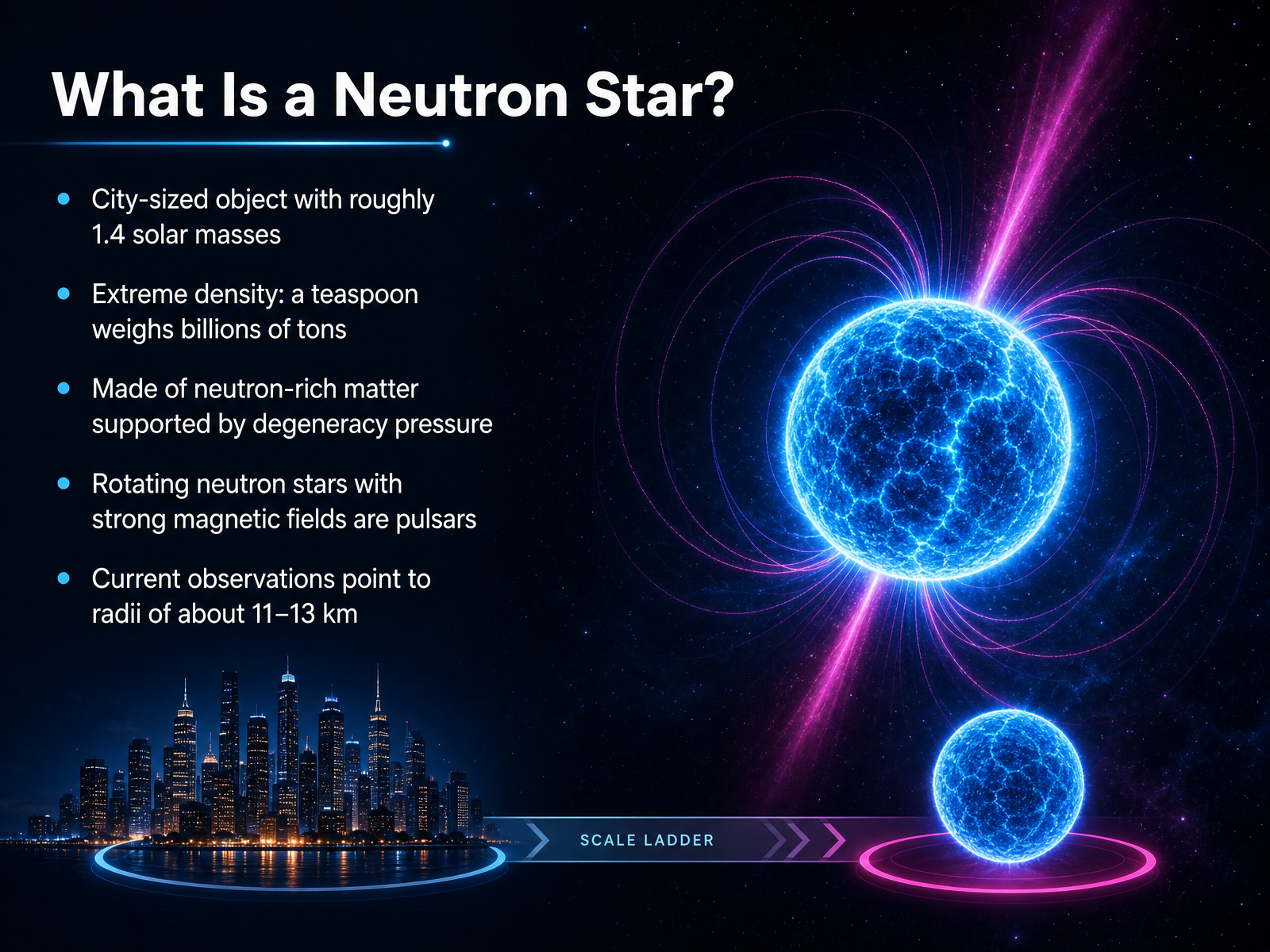
1 min - 04What Is a Neutron Star?Now, let's get to the core question. What exactly is a neutron star? Imagine cramming a mass one point four times greater than our entire Sun into a sphere the size of a city. Its radius is only about eleven to thirteen kilometers. That's what we're dealing with. The density is truly mind-boggling. A single teaspoon of this material would weigh billions of tons on Earth. It is the densest stable matter we know of. So, what prevents this object from collapsing further into a black hole? It's held up by something called degeneracy pressure, a quantum mechanical force that resists squeezing neutrons together. Some neutron stars also spin incredibly fast and possess intense magnetic fields. When these beams sweep past Earth like a lighthouse, we call them pulsars. So, a neutron star is a tiny, ultra-dense sphere of neutron-rich matter held up by quantum physics, creating some of the most extreme conditions in the universe. Next, let's compare these objects to the other possible leftovers from stellar death: white dwarfs and black holes.
 sciencedirect.comiopscience.iop.orgindico.cern.ch+22 min
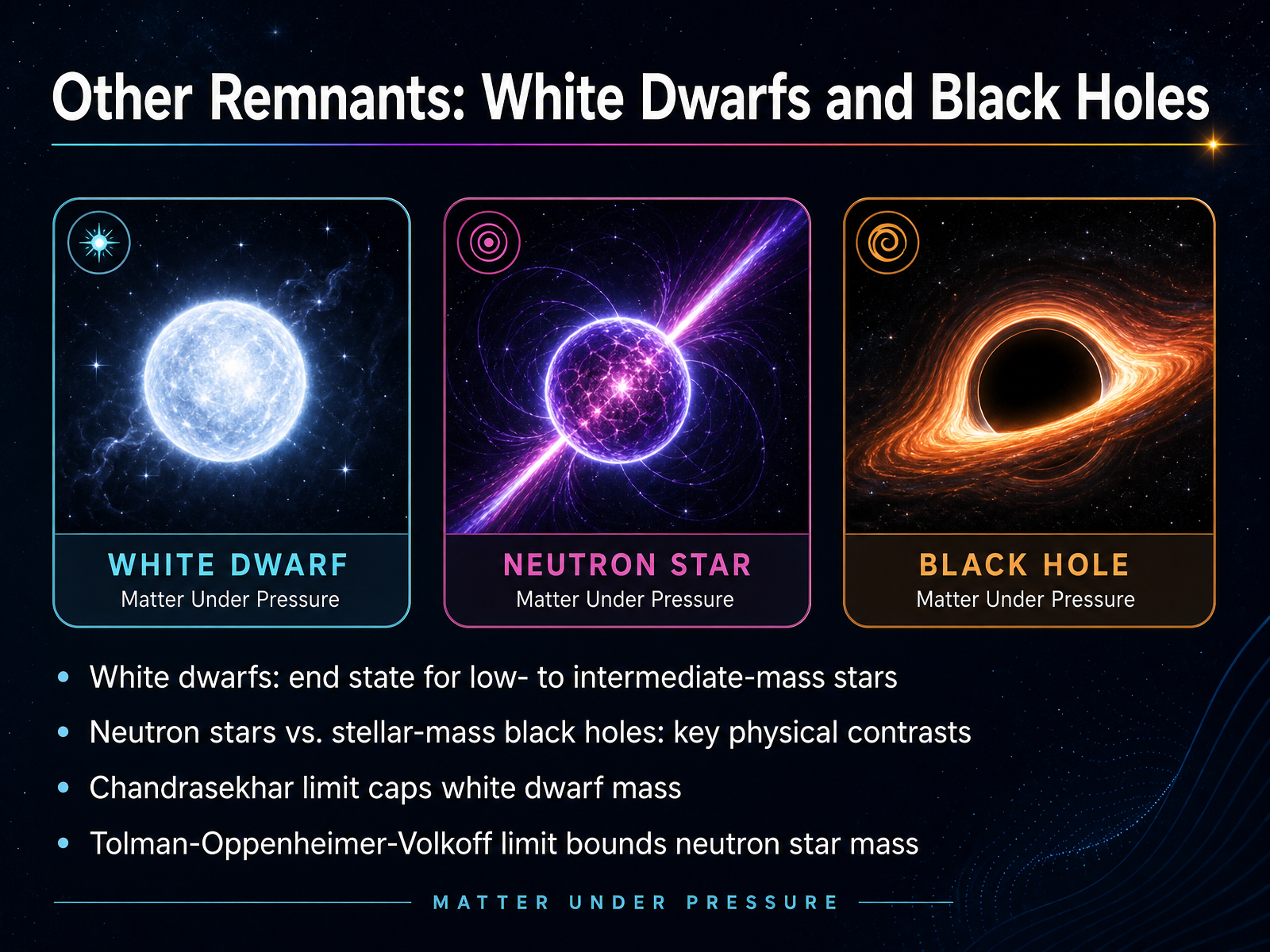
 - 05Other Remnants: White Dwarfs and Black HolesSo far, we have focused on neutron stars. But they are not the only possible leftovers when a star dies. Let's zoom out and look at the full family of stellar remnants. For a star like our Sun, the end state is much calmer. It becomes a white dwarf, a dense Earth-sized ember that slowly cools over billions of years. Neutron stars and black holes, on the other hand, are the extreme outcomes. A neutron star is a solid surface you could theoretically stand on. A black hole has no surface. It is a point of no return. The difference comes down to mass. Physics sets strict rules here. The Chandrasekhar limit, about one point four solar masses, caps how massive a white dwarf can get. Push past that, and it collapses further. Similarly, the Tolman-Oppenheimer-Volkoff limit, or TOV limit, bounds a neutron star. Above roughly two to three solar masses, not even neutron pressure can hold. The core collapses into a black hole. So the line between a neutron star and a black hole is truly a mass limit written by gravity. Next, let's meet some spinning neutron stars that act like cosmic lighthouses, the pulsars.
 2 min
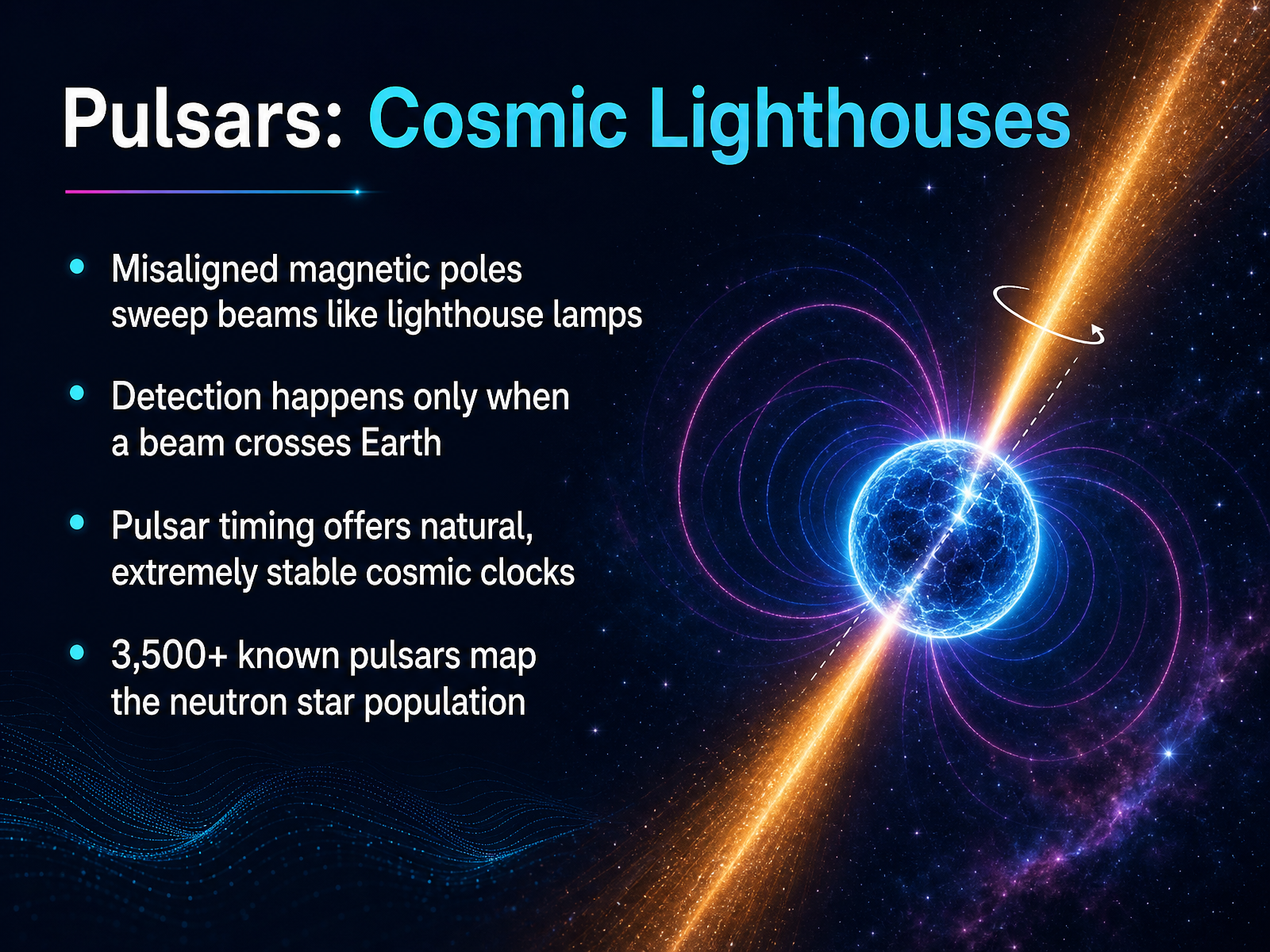
2 min - 06Pulsars: Cosmic LighthousesNow imagine that neutron star spinning, with its powerful magnetic field tilted at an angle to its spin axis. The magnetic poles fire intense beams of radiation into space, and as the star rotates, those beams sweep around like the lamp of a lighthouse. If one of those beams happens to cross our line of sight here on Earth, we detect a pulse of radio waves with every rotation. That is a pulsar. We only see the ones that point toward us, which means for every pulsar we do detect, there are many more out there whose beams never cross our path. These pulses arrive with astonishing regularity, so steady that pulsar timing rivals the best atomic clocks. We have now cataloged more than three thousand five hundred of these cosmic lighthouses, each one marking the location of a neutron star and helping us map the stellar graveyard of our galaxy. Up next, we push the magnetic story even further with magnetars, neutron stars that take magnetic fields to a whole new extreme.
 heasarc.gsfc.nasa.goviopscience.iop.orgarxiv.org+21 min
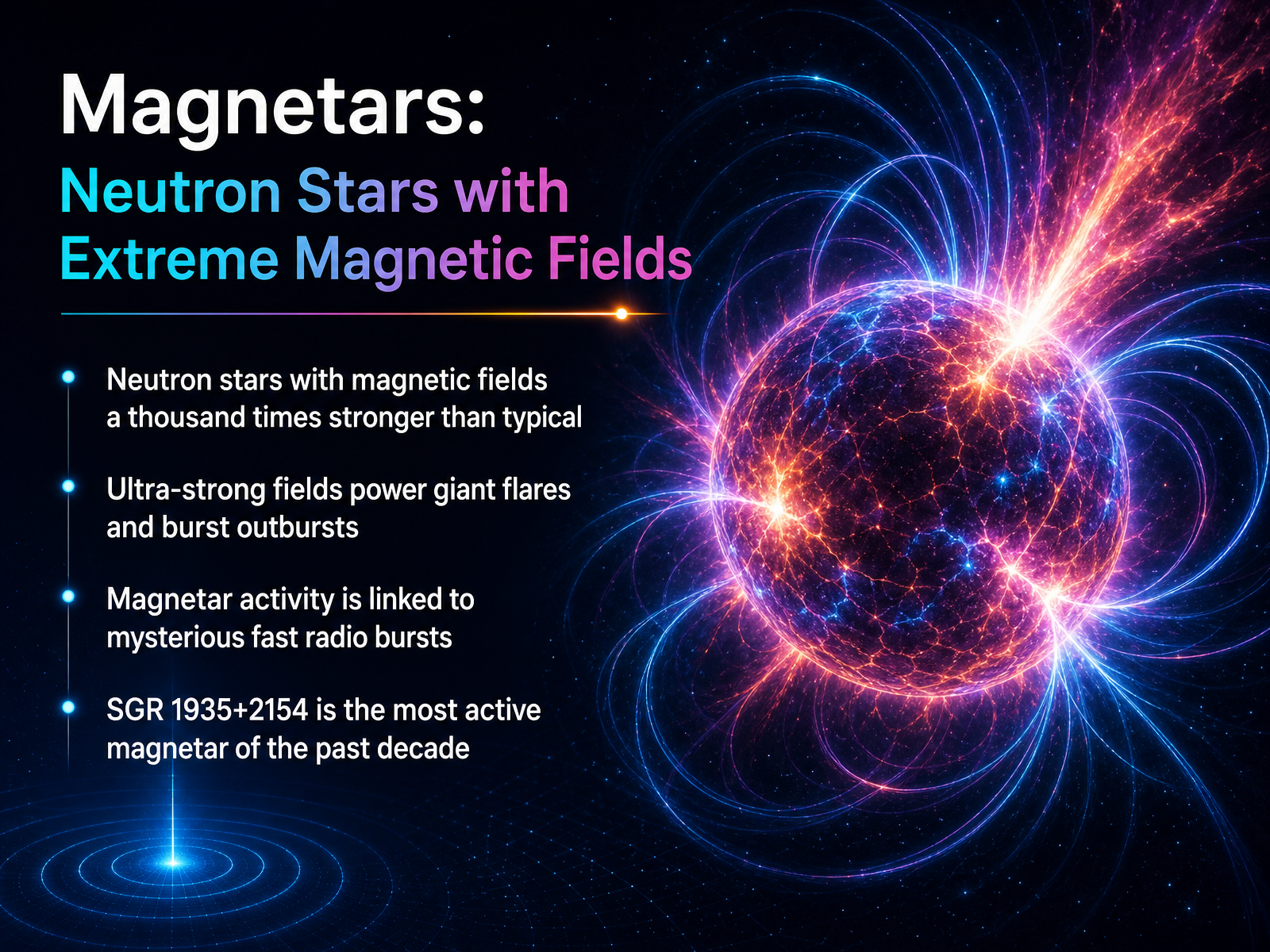
 - 07Magnetars: Neutron Stars with Extreme Magnetic FieldsNow let's talk about the most extreme members of an already extreme family: magnetars. If a typical neutron star has a magnetic field that's a trillion times stronger than Earth's, a magnetar cranks that up by another factor of a thousand. Imagine a magnet so powerful, it could erase the magnetic strip on every credit card on Earth from halfway to the moon. That energy doesn't just sit quietly. It powers gigantic flares and sudden, violent outbursts of X-rays and gamma rays. But here is where the story gets really interesting. These intense magnetic fields are now linked to one of astronomy's biggest modern mysteries: fast radio bursts. These are millisecond flashes of radio energy from deep space, and we now know magnetars can produce them. The star that gave us this crucial connection is SGR 1935 plus 2154, the most active magnetar of the past decade. Its outbursts have been captured by telescopes around the world. Up next, we'll shift focus from these incredible magnetic fields to the fundamental question of size and mass, as we start measuring neutron stars themselves.
 iopscience.iop.orgaanda.orgaanda.org+22 min
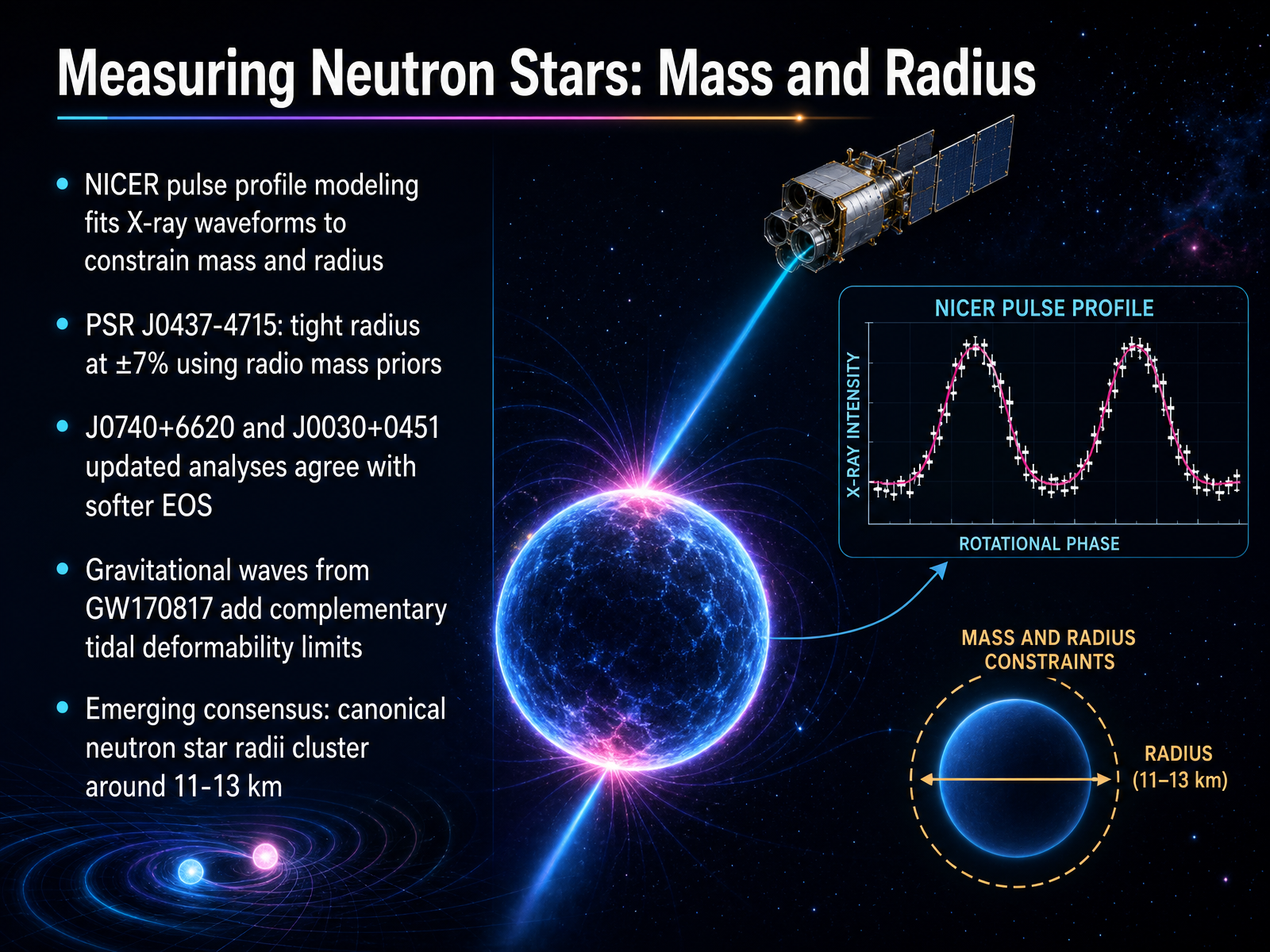
 - 08Measuring Neutron Stars: Mass and RadiusSo how do we actually measure something as small as a city, but as massive as a star, from hundreds of light-years away? The answer is surprisingly clever. We watch its heartbeat. NASA's NICER telescope on the International Space Station captures the X-ray pulses from a spinning neutron star, and by modeling how the star's own gravity bends that light, we can map its size. One of the cleanest cases is a pulsar called J0437-4715. Thanks to a tight radio-based mass measurement, its radius is now pinned down to within about seven percent. Likewise, updated analyses of pulsars J0740 and J0030 point to a softer equation of state, meaning matter inside is a bit more squeezable than we once thought. And remember those gravitational wave ripples from GW170817? They add an independent check by measuring how much a neutron star stretches before it merges. All these lines of evidence are converging. For a standard neutron star, one with about one point four times the Sun's mass, the radius is clustering right around eleven to thirteen kilometers. It is a remarkable consensus. Next, let's step back from the X-rays and listen to the universe itself, with gravitational waves from neutron star mergers.
 sciencedirect.comiopscience.iop.orgindico.cern.ch+22 min
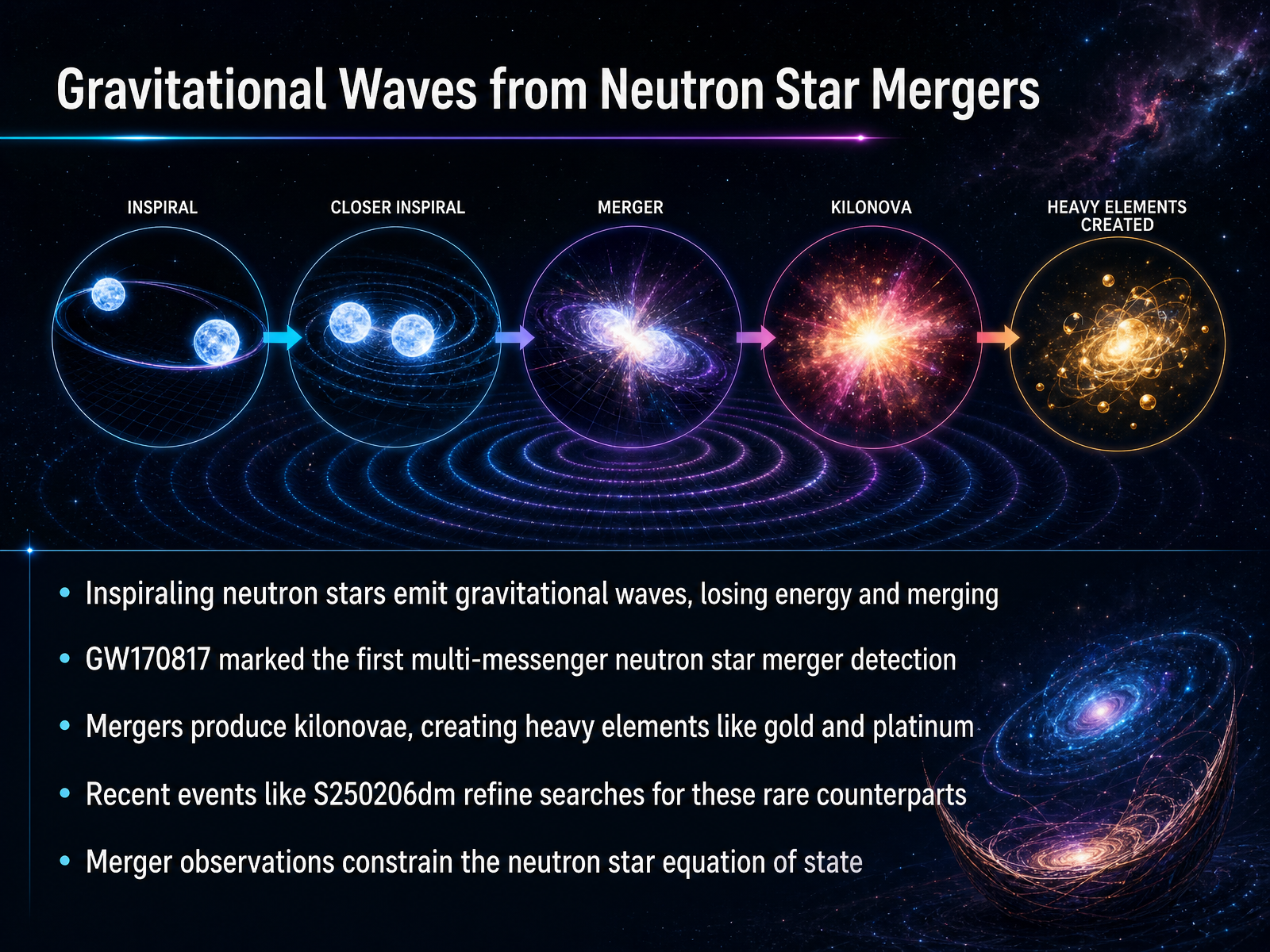
 - 09Gravitational Waves from Neutron Star MergersNow imagine two neutron stars locked in a spiral dance. As they orbit faster and closer, they ripple space time with gravitational waves and lose energy. Eventually they merge in one of the most violent events in the universe. In twenty seventeen, GW170817 gave us the first multi-messenger view of such a merger, connecting gravitational waves with light. These mergers create kilonovae, cosmic forges that build heavy elements like gold and platinum. Recent candidates such as S250206dm are sharpening how astronomers search for these rare explosions. Each detection also constrains the neutron star equation of state, the rulebook for matter at extreme density. Up next, we look inside neutron stars themselves to see how that extreme physics plays out.
 iopscience.iop.orggoogle.iopscience.iop.orgiopscience.iop.org+21 min
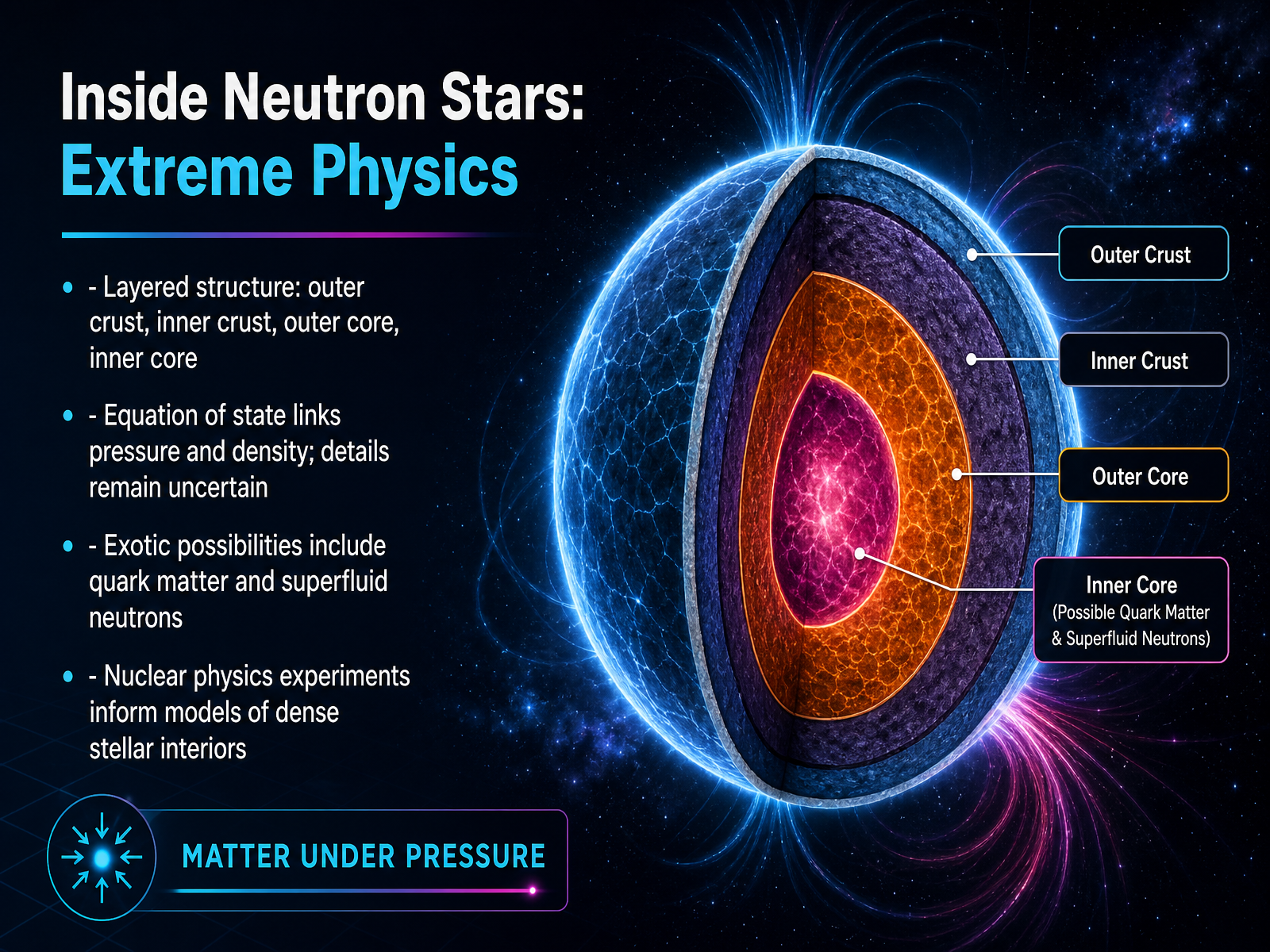
 - 10Inside Neutron Stars: Extreme PhysicsSo, what is actually happening inside one of these objects? Let's open up a neutron star and take a journey downward. The structure is layered. We have an outer crust, an inner crust, an outer core, and an inner core. To understand what holds all of that together, physicists use something called an equation of state. It is a mathematical link between pressure and density. But here is the catch. The exact details of that equation are still uncertain. At these extreme densities, matter could become very exotic. We are talking about free quarks, or neutrons flowing without any friction in a superfluid state. How do we even begin to test these ideas? The answer is surprisingly close to home. Experiments in nuclear physics labs collide heavy ions to try and recreate these conditions on a tiny scale. Those results then help us build better models of these dense cores. Let's look next at what current data is telling us about this extreme state of matter.
 1 min
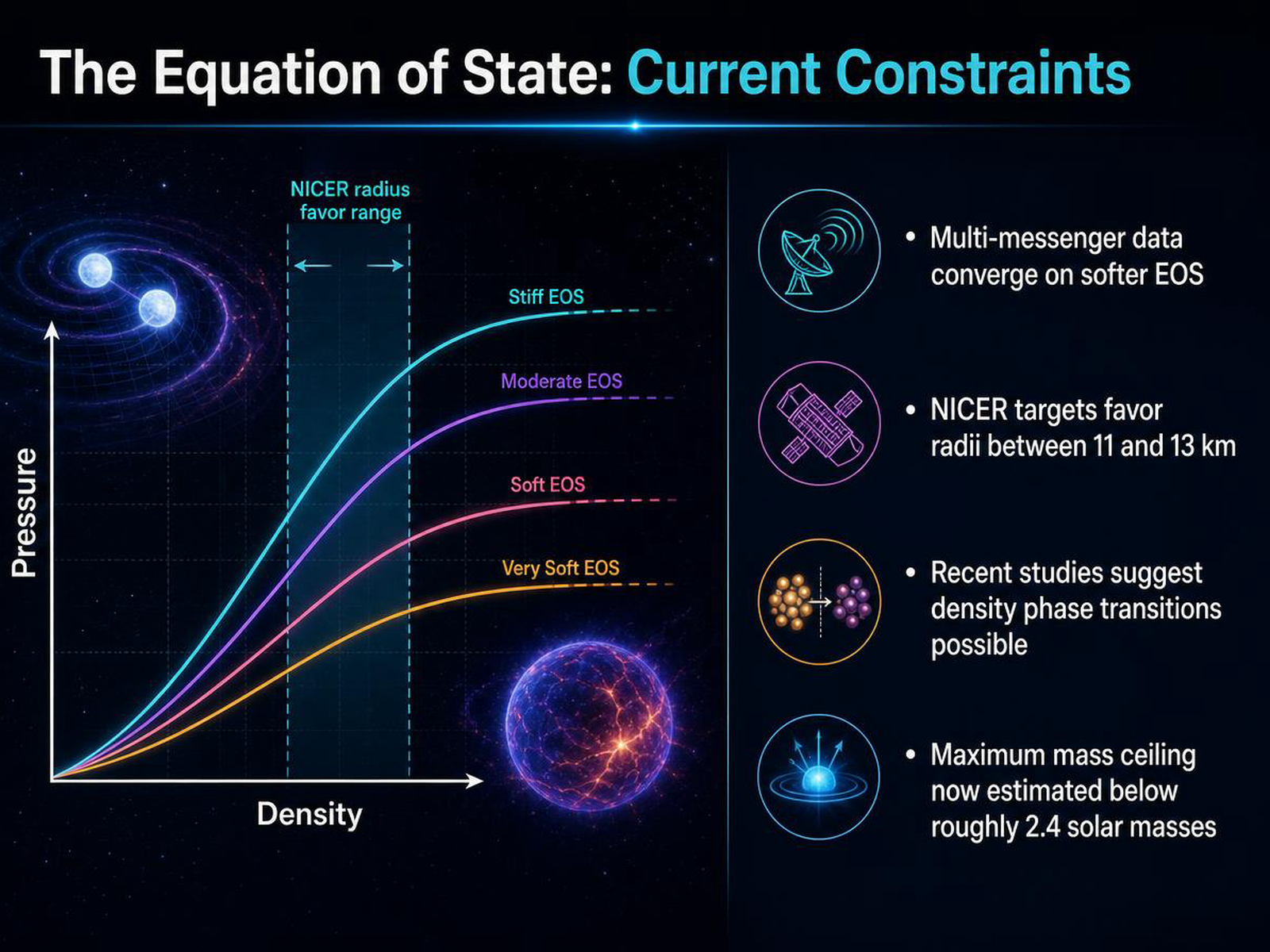
1 min - 11The Equation of State: Current ConstraintsSo where do all these cross-checks leave us? The picture is getting sharper, and it's exciting. Multi-messenger data is converging on a softer equation of state, meaning neutron stars are likely a bit more compact than we once thought. Instruments like NICER are now constraining the radii of typical neutron stars to a surprisingly narrow window, between roughly eleven and thirteen kilometers. Think about that: a mass greater than the Sun, squeezed into a sphere smaller than many cities. But the story gets even more interesting. Recent studies suggest the possibility of density phase transitions deep in the core, perhaps where neutrons give way to more exotic forms of matter. And the absolute ceiling? The maximum mass for a neutron star is now estimated to be below roughly two point four solar masses. This is a fantastic example of how combining observations from across the electromagnetic spectrum and gravitational waves is allowing us to map the true nature of these cosmic laboratories. Next, let's zoom out from the core and look at these incredible objects as a population in our galaxy.
 sciencedirect.comiopscience.iop.orgindico.cern.ch+21 min
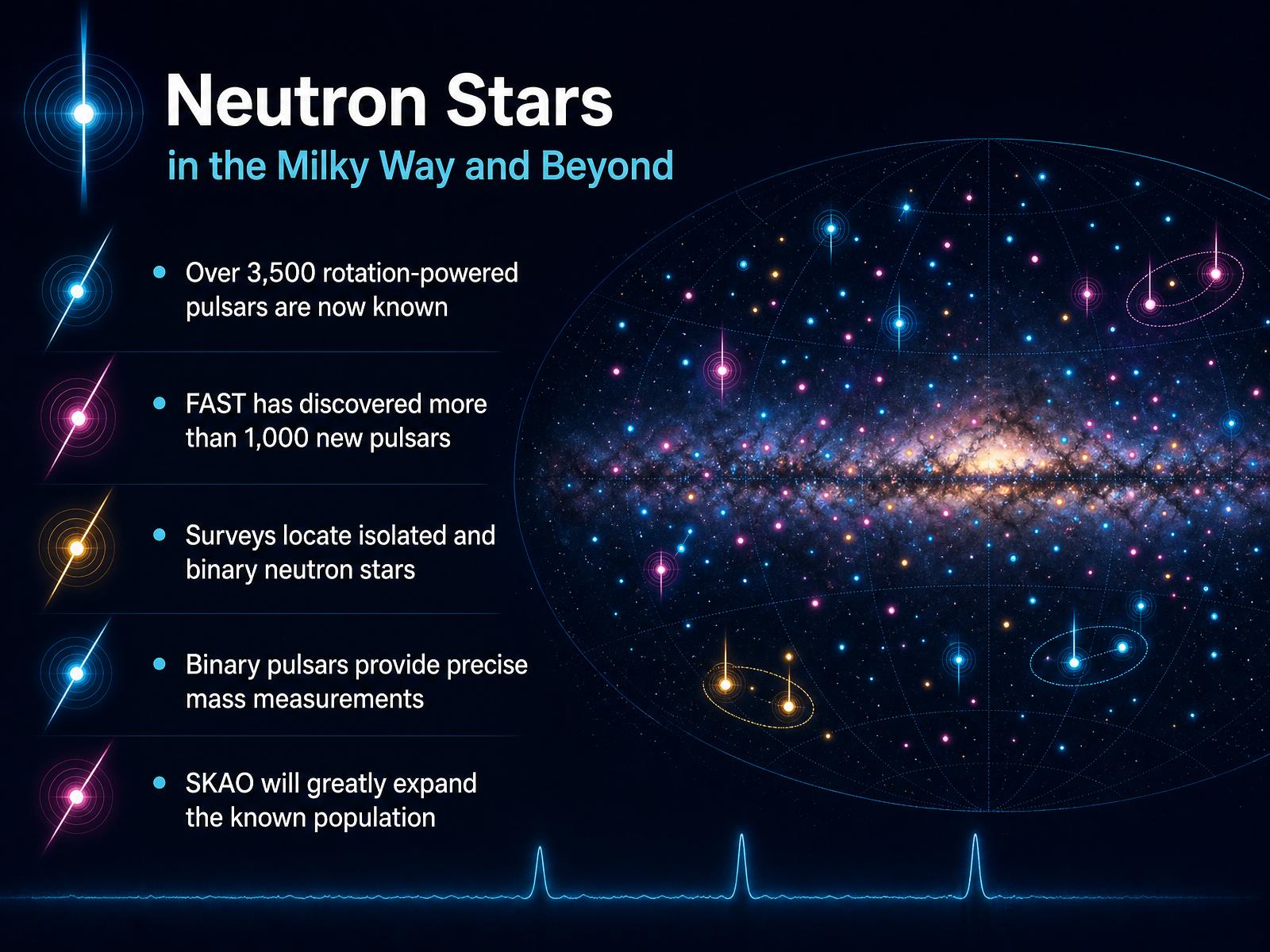
 - 12Neutron Stars in the Milky Way and BeyondSo just how many of these cosmic lighthouses are out there? Right now, the known population of rotation-powered pulsars has climbed past three thousand five hundred. And the pace of discovery is accelerating. The Five-hundred-meter Aperture Spherical radio Telescope, or FAST, has single-handedly added more than one thousand new pulsars to that list. Surveys are now systematically hunting both isolated neutron stars and those locked in binary systems. Those binary pulsars are especially valuable, because their orbits give us incredibly precise ways to measure a neutron star's mass. And the story is far from over. The upcoming Square Kilometre Array Observatory is expected to dramatically expand our census, potentially revealing thousands more. It might even uncover entirely new kinds of neutron stars we haven't imagined yet. This growing catalog sets the stage for our next question: why do these extreme objects matter as cosmic laboratories?
 heasarc.gsfc.nasa.goviopscience.iop.orgarxiv.org+22 min
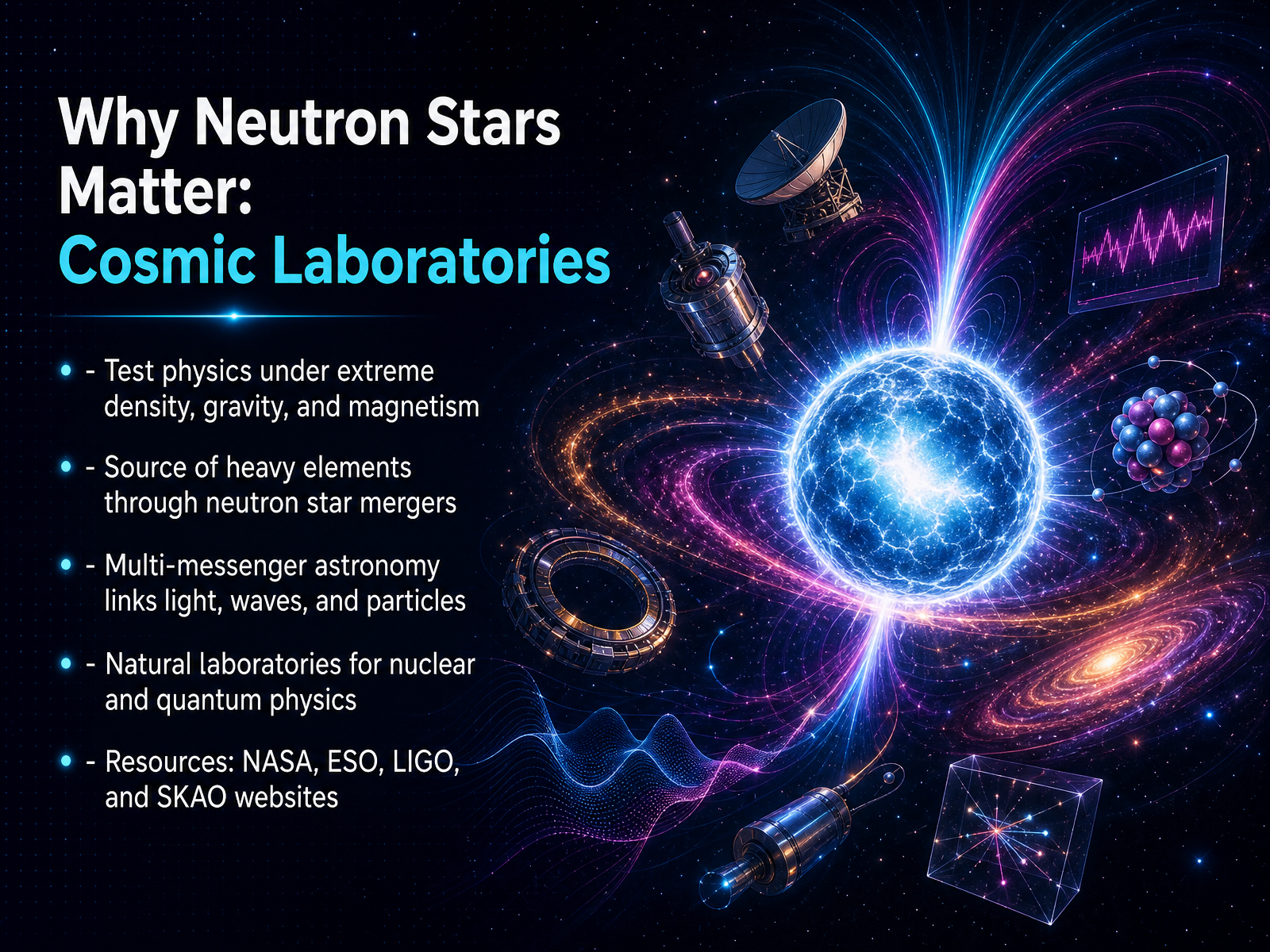
 - 13Why Neutron Stars Matter: Cosmic LaboratoriesNow we come to the real payoff. Why do neutron stars matter beyond being fascinating objects? Because they are the most extreme natural laboratories in the universe. Think of them as ready-made physics experiments we could never build on Earth. They squeeze matter to densities where a single teaspoon would weigh about a billion tons. Their magnetic fields are trillions of times stronger than our Sun's. Testing physics under those conditions pushes our theories to the breaking point. Neutron stars are also nature's element factories. When two of them merge, the explosion forges heavy elements like gold, platinum, and uranium. So some of the atoms in your jewelry or electronics were likely born in a neutron star collision billions of years ago. This discovery opened the era of multi-messenger astronomy. We now study the same cosmic event through gravitational waves, light, and particles together. That combined view gives us a much richer picture than any single signal alone. For nuclear and quantum physics, neutron stars act as natural laboratories. Their cores may contain exotic states of matter we cannot recreate in any facility on Earth. To explore more, you can visit websites from NASA, ESO, LIGO, and SKAO. Those resources offer real data, images, and mission updates. Next, we will wrap up with the key takeaways and some practical next steps for your own exploration.
 2 min
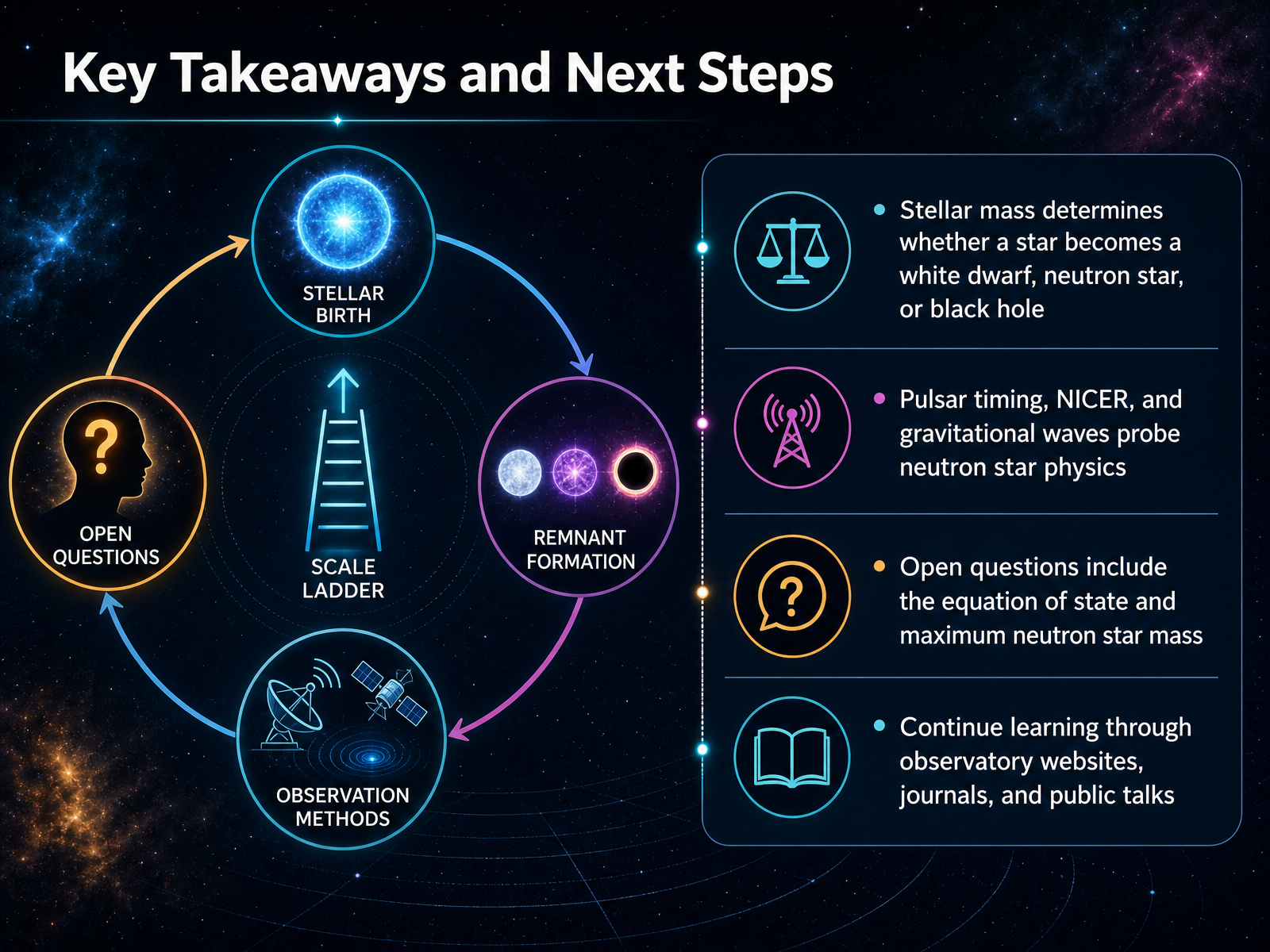
2 min - 14Key Takeaways and Next StepsSo where does that leave us? The whole story of a star's afterlife comes down to one simple question. How massive was it when it ran out of fuel? A star like our Sun will fade into a white dwarf. A much heavier one collapses into a neutron star. And the most extreme of all becomes a black hole. We also saw how astronomers can now listen to neutron stars. Pulsar timing, NICER, and gravitational waves give us real data from these tiny, strange objects. And yet, big questions remain. We still do not know the exact equation of state for neutron star matter, or the true upper limit for how massive a neutron star can become before it collapses. That means there is real science waiting to be done. I encourage you to visit observatory websites, read journal updates, and join public talks. You now know enough to follow those conversations and ask sharp questions. Thank you for spending this time exploring stellar remnants with me. Keep looking up, and keep asking what happens after the light fades.
 2 min
2 min
Take the deck with you
Download this course as a file — free, no sign-up needed.
- PDF handoutEvery slide page, ready to print or share.15 pages · 4.8 MBDownload
- Narrated PowerPointThe deck that presents itself — every slide carries the digital human's narration video.15 pages · 16.2 MBDownload
- PowerPoint slidesThe full deck as a .pptx — open it in PowerPoint, Keynote, or Google Slides.15 pages · 4.7 MBDownload
Free to use in your own training — please keep the PersonWise credit page at the end.
Have your own deck? Turn it into a course
Sources consulted
Web sources consulted while building this course.
- Observational constraints on neutron star matter equation ... — sciencedirect.com
- A NICER View of the 1.4 M⊙ Edge-on Pulsar PSR J0614-3329 - IOPscience — iopscience.iop.org
- Neutron Star Mass-Radius Constraints from NICER X-ray ... — indico.cern.ch
- Confronting new NICER mass-radius measurements with phase transition in dense matter and twin compact stars - IOPscience — iopscience.iop.org
- PSR J1231–1411 Revisited: Pulse Profile Analysis of X-Ray Observation - IOPscience — iopscience.iop.org
- ATNFPULSAR - ATNF Pulsar Catalog — heasarc.gsfc.nasa.gov
- A New X-Ray Census of Rotation Powered Pulsars - IOPscience — iopscience.iop.org
- Understanding the Neutron Star Population with the SKAO Telescopes — arxiv.org
- Binary population synthesis of the Galactic canonical pulsar population | Publications of the Astronomical Society of Australia | Cambridge Core — cambridge.org
- Modeling the Radial Distribution of Pulsars in the Galaxy - IOPscience — iopscience.iop.org
- The First FRB-associated X-Ray Bursting Episode of SGR 1935+2154: Swift-BAT Observations and Multi-instrument Comparisons with Fermi GBM, INTEGRAL/ISGRI, and Insight-HXMT - IOPscience — iopscience.iop.org
- GECAM discovery of a peculiar magnetar X-ray burst (MXB 221120) from SGR J1935+2154 associated with a fast radio burst — aanda.org
- Discovering overlooked extragalactic magnetar giant flare candidates in ... — aanda.org
- GRB 241107A: A Giant Flare from a Close-by Extragalactic Magnetar? - IOPscience — google.iopscience.iop.org
- [2602.10895v1] GECAM discovery of the second FRB-associated Magnetar X-ray Burst from SGR J1935+2154 — arxiv.org
- Kilonova Constraints for the LIGO/Virgo/KAGRA Neutron Star Merger Candidate S250206dm: GW-MMADS Observations - IOPscience — iopscience.iop.org
- AT2025ulz and S250818k: Deep X-Ray and Radio Limits on Off-axis Afterglow Emission and Prospects for Future Discovery - IOPscience — google.iopscience.iop.org
- Pan-STARRS Follow-up of the Gravitational-wave Event S250818k and the Light Curve of SN2025ulz - IOPscience — iopscience.iop.org
- Optimizing Kilonova Searches: A Case Study of the Type IIb SN 2025ulz in the Localization Volume of the Low-significance Gravitational Wave Event S250818k - IOPscience — iopscience.iop.org
- Search for eccentric NSBH and BNS mergers in the third observing run of Advanced LIGO and Virgo — journals.aps.org