Data Engineering for ML
Begin
14 pages · ~28 min
Data Engineering for ML
This training teaches data engineers how to prepare and manage data pipelines for machine learning workflows, covering key concepts and best practices.
What you’ll learn
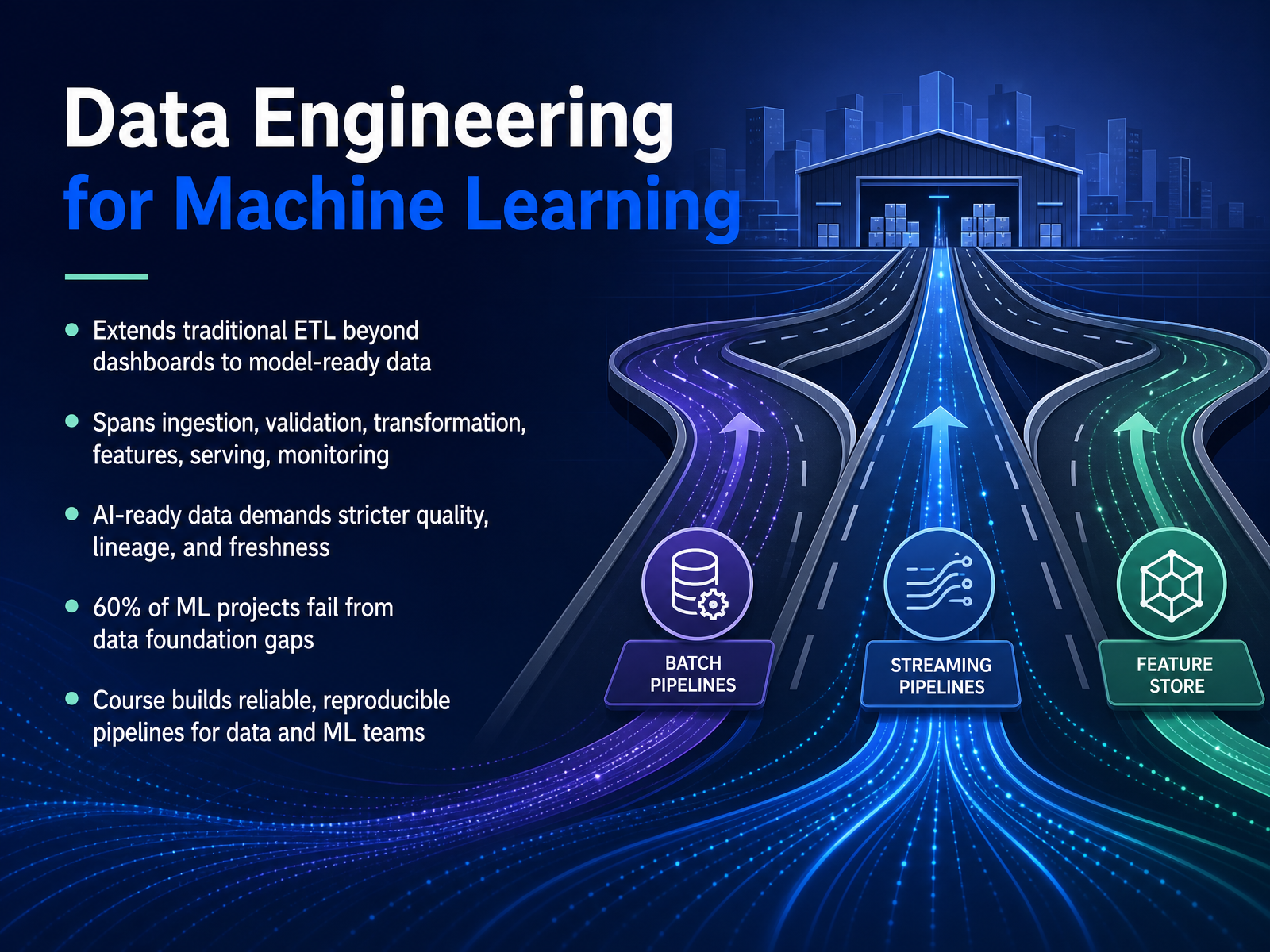
- 01Data Engineering for Machine LearningWelcome to Data Engineering for Machine Learning. In this course, we'll bridge the gap between foundational data work and the practical demands of putting models into production. Our goal is to help you build reliable, reproducible data systems that data scientists and machine learning models can actually depend on. Let's start with the big picture. Traditional ETL is built for dashboards and reporting. Data engineering for machine learning extends that idea. It's about delivering model-ready data. This means the work spans far more than just moving data from point A to point B. It covers the entire lifecycle: ingestion, validation, transformation, feature engineering, serving, and continuous monitoring. The core shift is that AI-ready data demands much stricter quality, full lineage, and guaranteed freshness. A small drift in a report might be a minor annoyance, but a subtle shift in training data can silently degrade a model's performance over time. In fact, research from Gartner indicates that around sixty percent of machine learning projects stall or fail, not because the model is flawed, but because the data foundation underneath it was never built for production. This course will give you the frameworks and practical tools to build those solid foundations, so your data and machine learning teams can work together effectively. Next, we'll explore exactly why machine learning data systems fail in ways traditional analytics pipelines do not.databricks.comlatentview.comdotdatalabs.ai+21 min
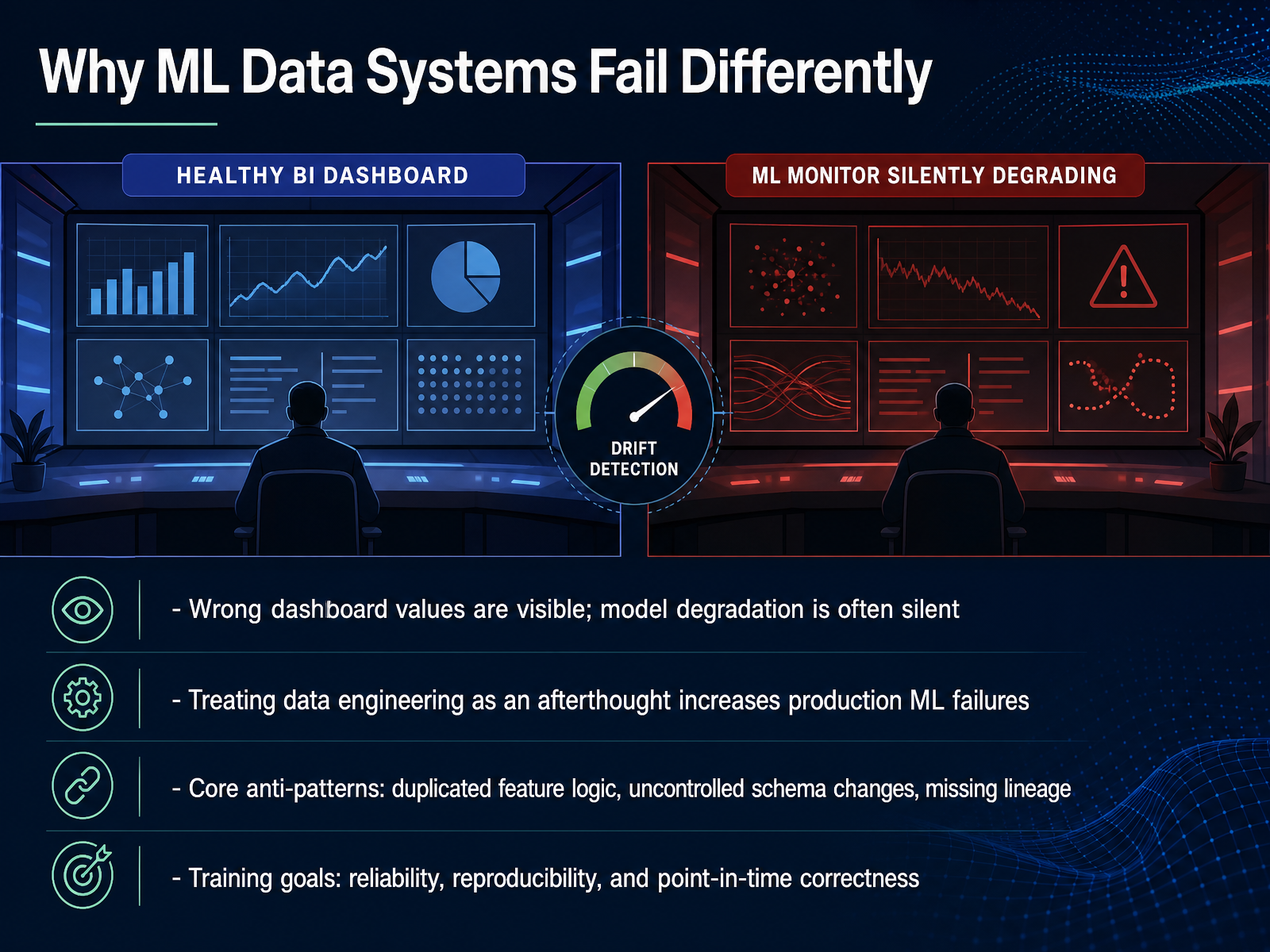
- 02Why ML Data Systems Fail DifferentlyHere is the core problem behind most production machine learning failures. In traditional analytics, if a dashboard value is wrong, you can see it immediately. But machine learning is different. Models often degrade silently, which means a model can keep serving predictions while its accuracy quietly erodes. This is why treating data engineering as an afterthought is so dangerous. When that happens, we see repeated anti-patterns. You might have duplicated feature logic, where the same calculation is coded differently in training and serving. You might face uncontrolled schema changes that break downstream systems without warning. Or you might lack proper lineage, making it impossible to trace where a feature came from. Our goal in this section is to shift the focus. We are training for three things: reliability, reproducibility, and point-in-time correctness. These are the core principles we will build on next as we explore ML data requirements and quality dimensions.
 databricks.comlatentview.comdotdatalabs.ai+21 min
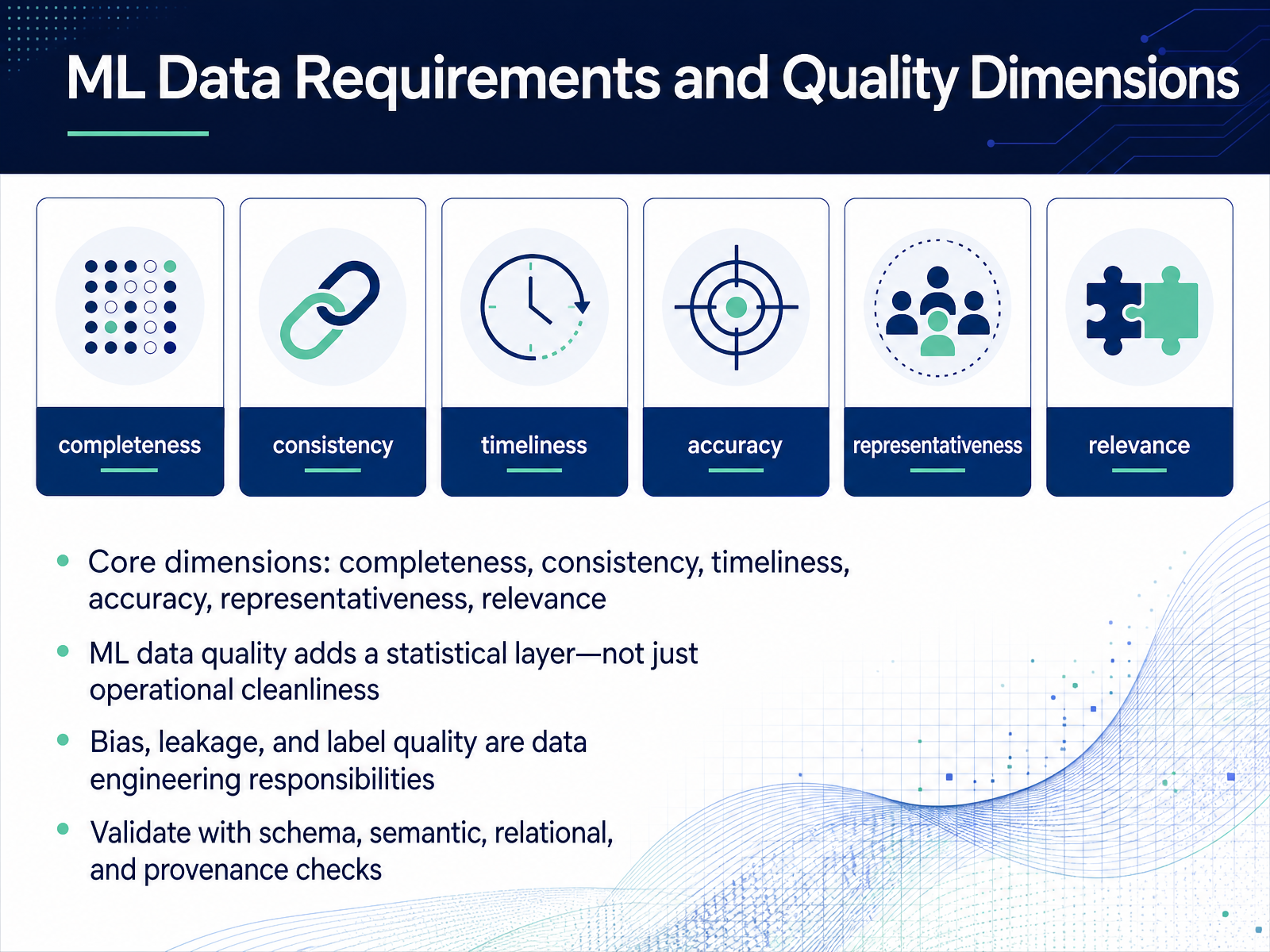
 - 03ML Data Requirements and Quality DimensionsNow let's talk about what machine learning actually demands from your data. We often start with the familiar operational dimensions: completeness, consistency, timeliness, accuracy, representativeness, and relevance. But ML adds a statistical layer on top of these. A dataset can be operationally clean, yet still fail to teach a model the right patterns if its statistical distribution doesn't match the real world. This means bias, data leakage, and label quality are not just modeler's problems. They are data engineering responsibilities. To catch these issues, we need to layer our validation. Schema checks verify structure and data types. Semantic checks confirm that values are plausible for the domain. Relational checks ensure logical coherence across fields, and provenance checks give us a clear line of sight into where the data came from. These four layers together form the quality gate that protects your model from silent data errors. Let's apply these ideas by exploring how we formalize them with data contracts and pre-training validation.
 itu.intatlan.comwebstore.iec.ch+22 min
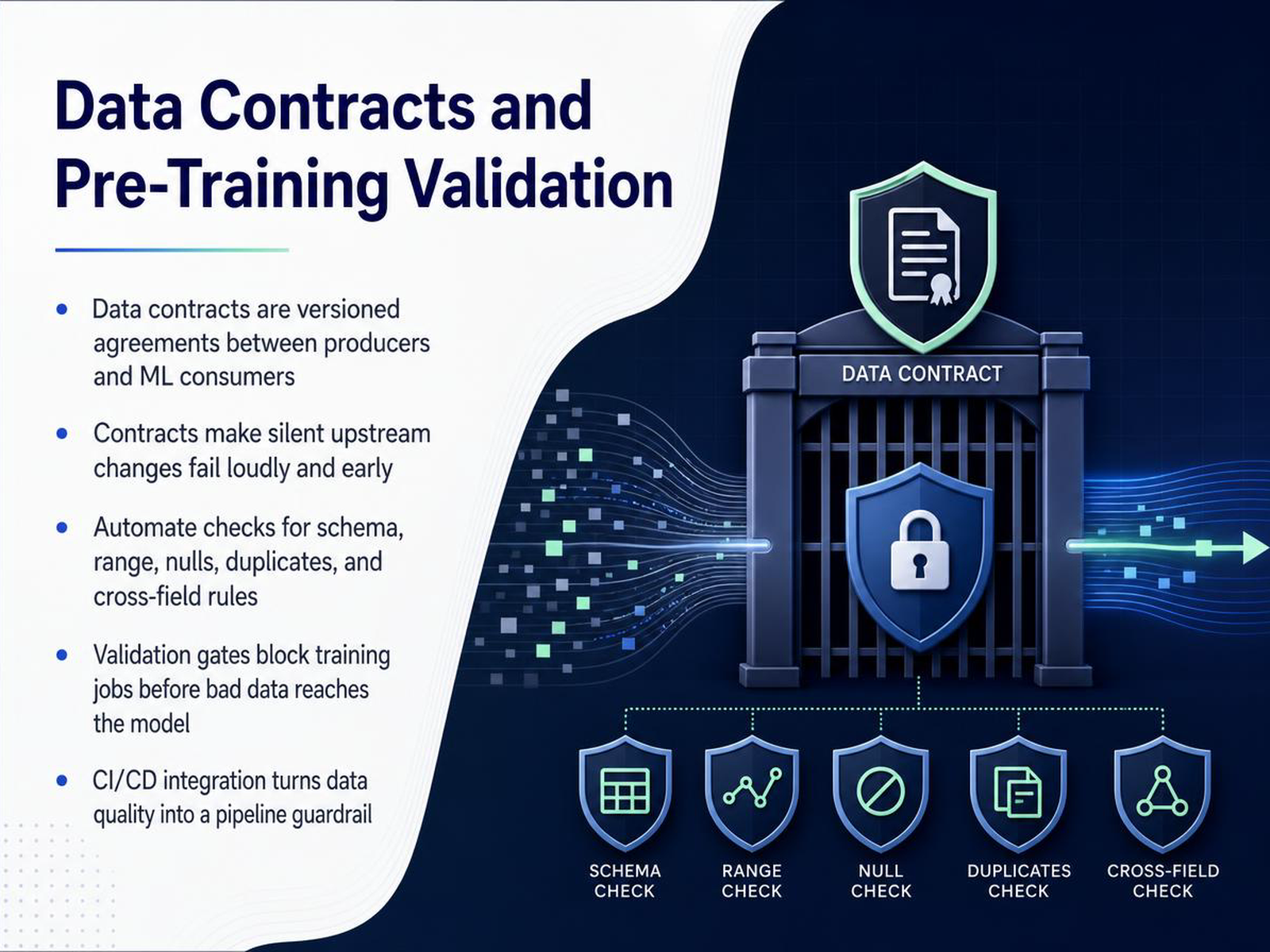
 - 04Data Contracts and Pre-Training ValidationLet's move from why data quality matters to how we actually enforce it before training begins. This slide is about data contracts and pre-training validation. A data contract is a versioned agreement between producer teams and the machine learning consumers of that data. It pins down the schema, the allowed value ranges, and the freshness guarantees. The benefit is clear: contracts turn silent upstream changes into loud, early failures. Instead of discovering a broken column two weeks into a training run, you find out immediately at the ingest point. To support that, we automate checks for schema, ranges, nulls, duplicates, and even cross-field rules, like making sure a delivery date never comes before an order date. These validation gates sit directly in the pipeline. If a check fails, the training job is blocked. This prevents bad rows from ever reaching the model. By integrating these checks into our CI/CD process, data quality stops being a manual review and becomes a continuous, automated guardrail. Next, we'll look at the practical side of getting that data in: sources, ingestion, and storage formats.
 itu.intatlan.comwebstore.iec.ch+21 min
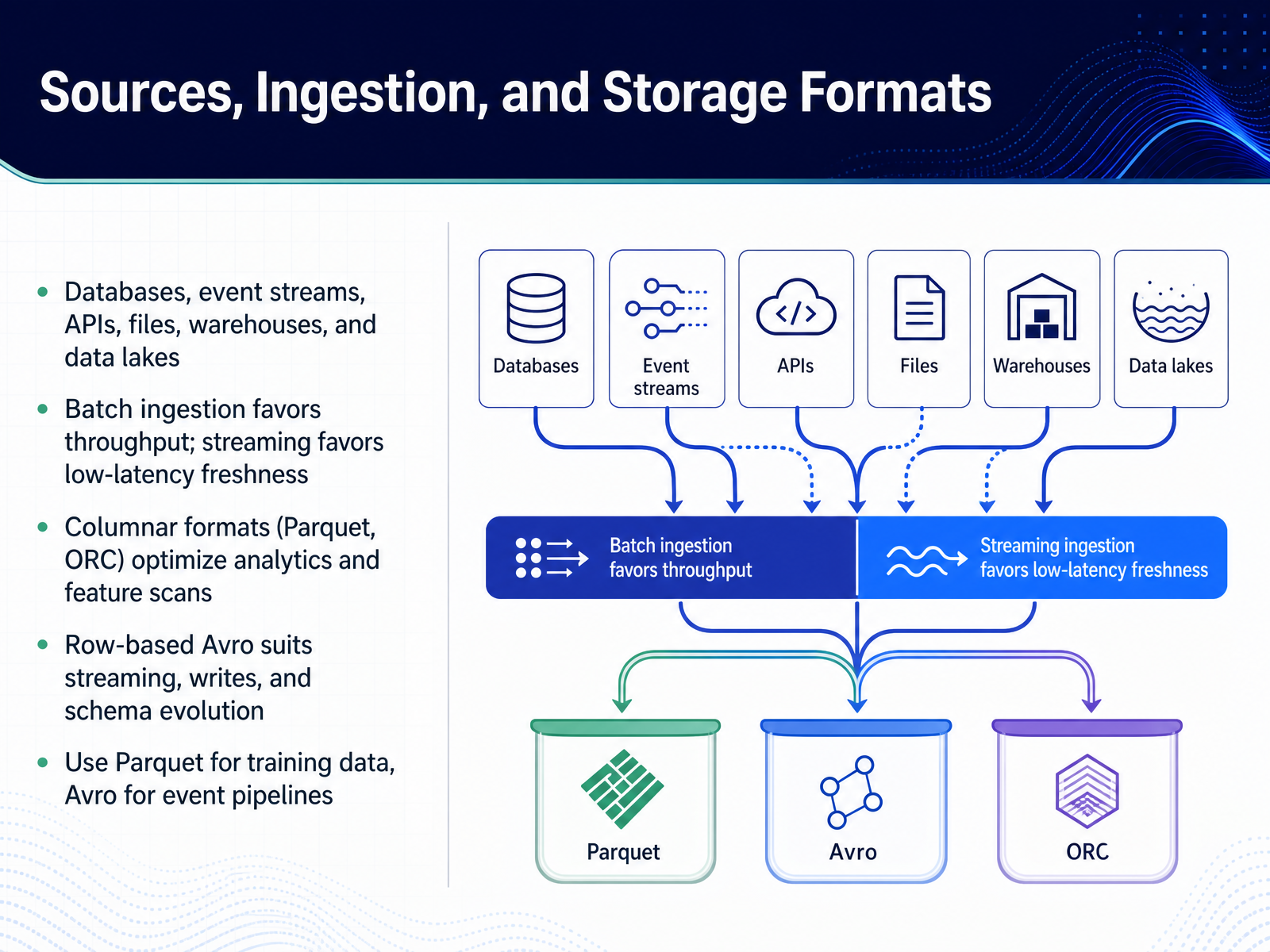
 - 05Sources, Ingestion, and Storage FormatsNow let’s talk about where data comes from and what happens after you land it. Sources can include databases, event streams, APIs, files, warehouses, and data lakes. Each source pushes you toward a different ingestion strategy. Batch ingestion favors throughput, which means moving large volumes efficiently. Streaming ingestion favors low latency freshness, so your models see new events quickly. The storage format you choose matters just as much. Columnar formats like Parquet and ORC optimize analytics and feature scans, because they let engines read only the columns a query needs. Row based Avro is better for streaming, fast writes, and schema evolution, since entire records travel together. For most machine learning training data, Parquet is the safe default. For event pipelines, Avro is the natural fit. In practice, mature systems often use both. Avro carries events upstream, and Parquet stores data downstream for model training and analysis. That brings us to processing architectures for ML pipelines.
 zilliz.comdatatrain.aizeroentropy.dev+22 min
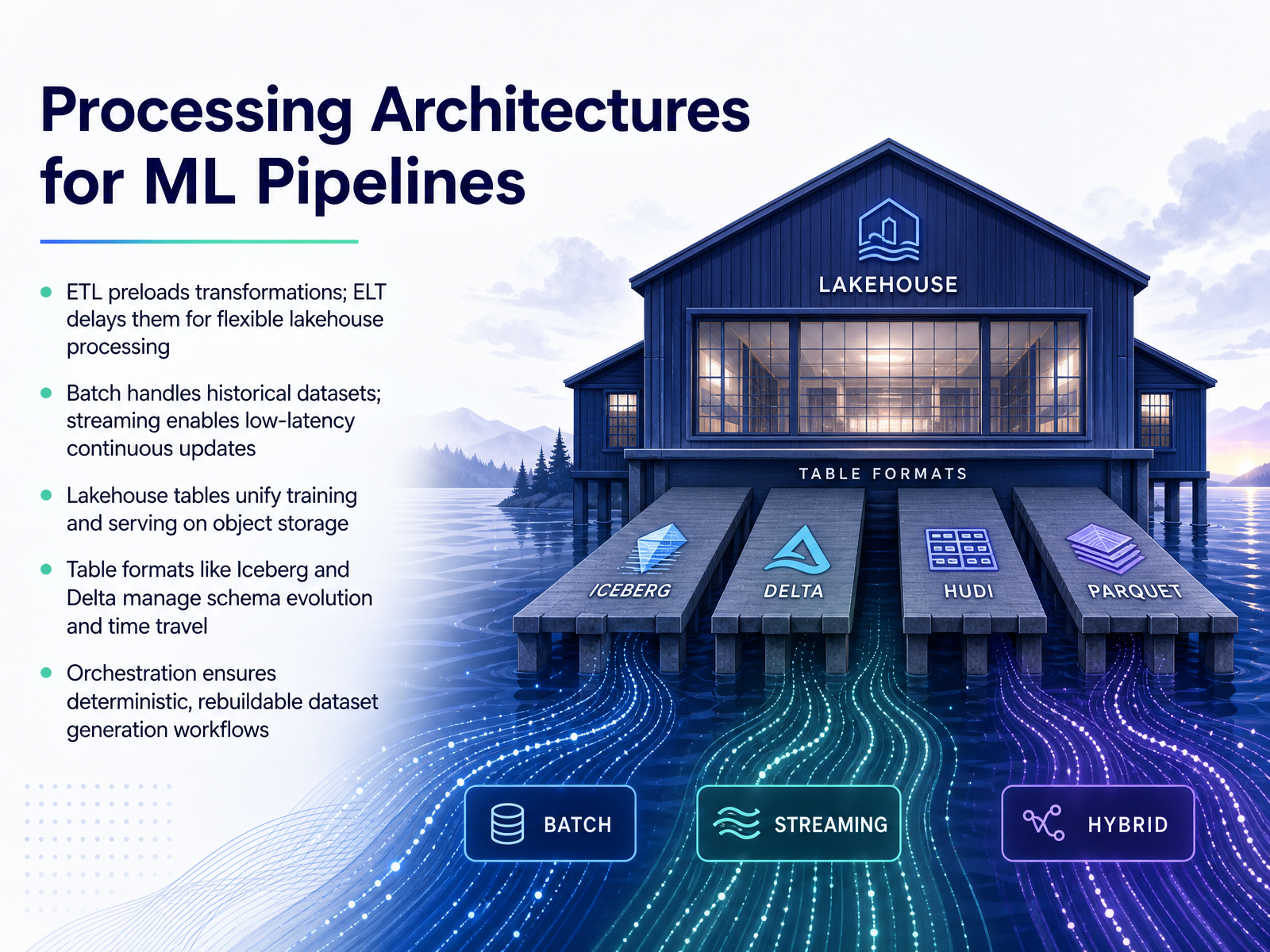
 - 06Processing Architectures for ML PipelinesNow let's look at how processing architectures shape your machine learning pipelines. The first choice is between ETL and ELT. ETL applies transformations before loading, which gives you control early. ELT stores raw data first and transforms later, which is more flexible for lakehouse processing. Next, batch processing works well for historical datasets and model retraining. Streaming, on the other hand, supports continuous, low-latency updates, which is critical when models need fresh inputs. A modern lakehouse can unify both training and serving on object storage. Table formats like Iceberg and Delta manage schema evolution and time travel, so you can audit changes and reproduce past states. Finally, orchestration makes your dataset generation deterministic and rebuildable. That reproducibility matters when a model behaves unexpectedly and you need to trace exactly which data produced it. Next, we will move from architecture into feature engineering and feature stores.
 vector-labs.aiusenix.orgarxiv.org+21 min
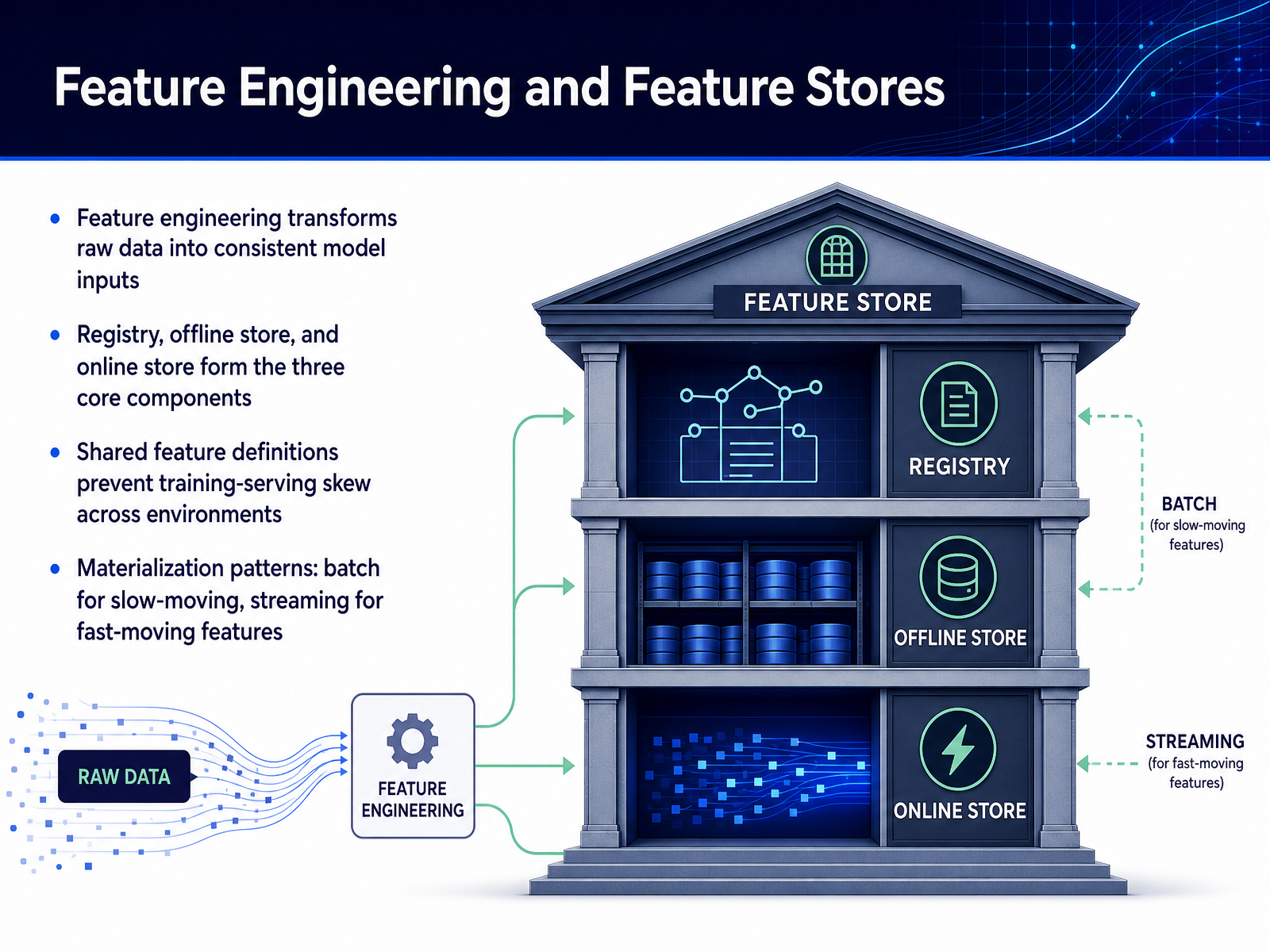
 - 07Feature Engineering and Feature StoresNow let's look at feature engineering and feature stores. Feature engineering transforms raw data into consistent inputs for your models. Without it, your model is learning from noise. A feature store gives that process structure. It has three core components. The registry acts as a catalog of feature definitions. The offline store keeps historical data for training. And the online store serves features in milliseconds for real-time predictions. Shared definitions are critical here. When you define a feature once and use it everywhere, you prevent training-serving skew. That is the silent killer where the model performs great in the lab but fails in production because the data changed. Finally, materialization patterns matter. Batch jobs work well for slow-moving features like customer segments. Streaming pipelines are better for fast-moving features like the number of transactions in the last five minutes. Match the speed of your data to the speed of your pipeline. Up next, we'll look at point-in-time correctness and serving consistency.
 2 min
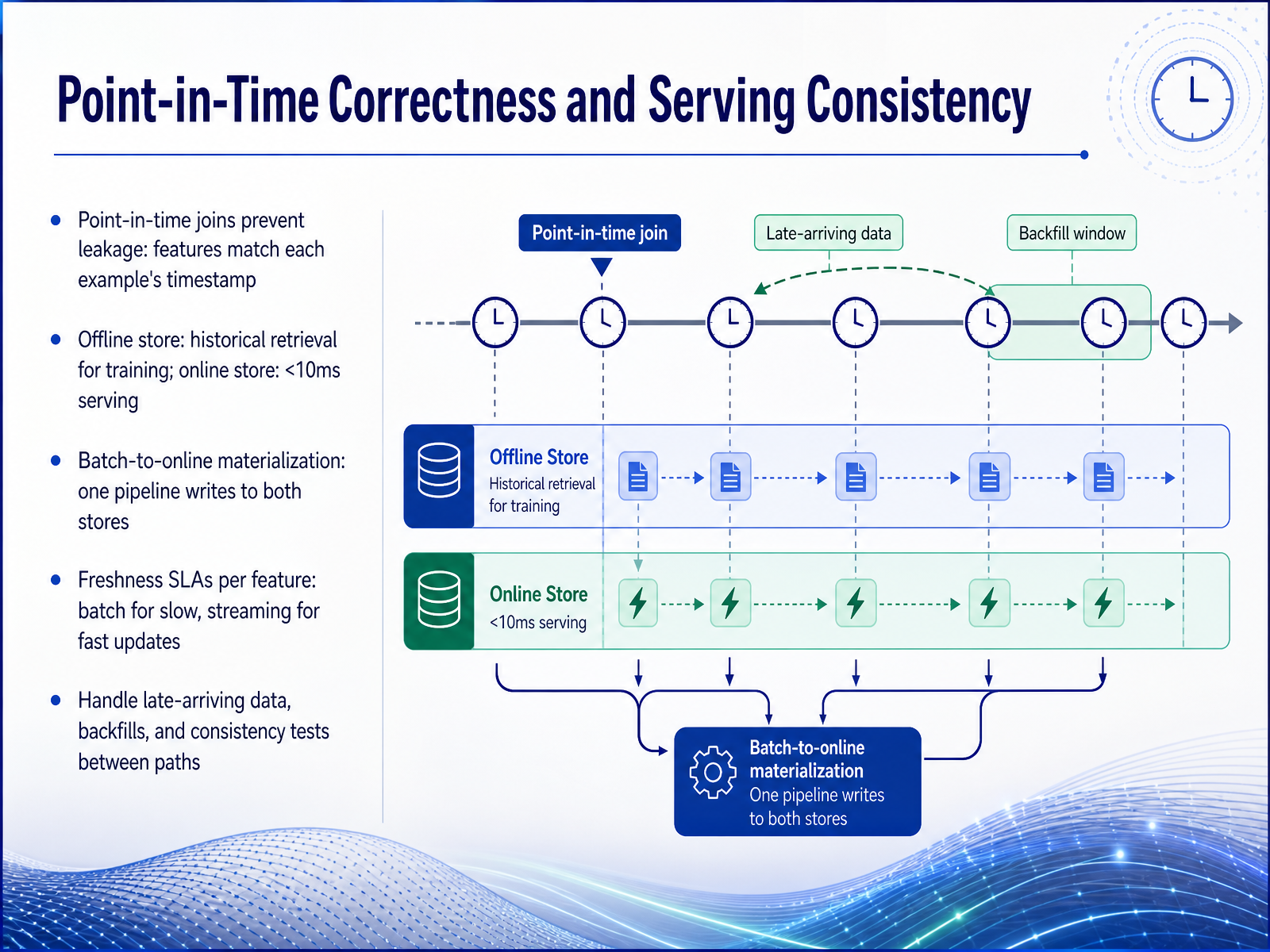
2 min - 08Point-in-Time Correctness and Serving ConsistencyNow let's focus on a subtle but critical issue: point-in-time correctness and serving consistency. When we generate training data, each example has a timestamp for when the label or event actually occurred. A point-in-time join ensures the features for that example match what was known at that exact moment. This prevents data leakage, where future information accidentally improves training performance but destroys real-world accuracy. On the serving side, the online store must return the latest feature values in under ten milliseconds. That speed is essential for live predictions. The offline and online stores are not separate systems with separate logic. One materialization pipeline writes to both. Batch jobs update slower-moving features, while streaming ingestion updates fast-changing ones. Freshness becomes a service level agreement per feature, not one global rule. Operational challenges remain. Late-arriving data must be handled with event-time processing. Backfills must be versioned and carefully replayed. Finally, consistency tests must compare batch and streaming outputs for the same time window. This catches any drift before it silently degrades your model. Next, we'll build on these ideas in reproducible training data pipelines.
 2 min
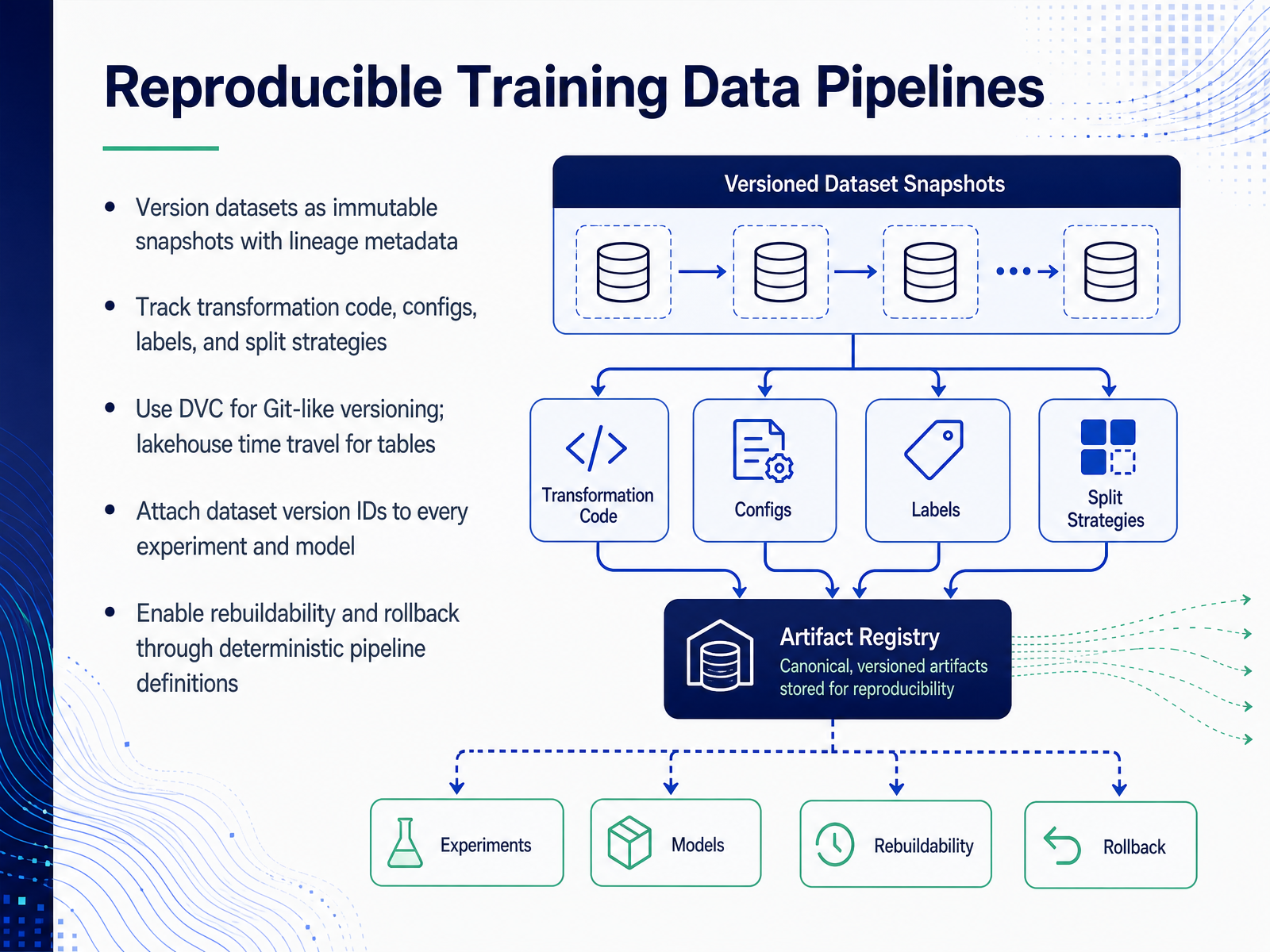
2 min - 09Reproducible Training Data PipelinesLet's move on to the idea of reproducible training data pipelines. At its core, this is about turning your datasets into immutable snapshots. Instead of treating your training data as a living, changing bucket, you freeze it at a specific moment in time. Alongside that snapshot, you store lineage metadata that explains exactly where the data came from and how it was processed. This means you also have to track the transformation code, the configuration files, the label versions, and even your train and test split strategies. Without those details, a snapshot is just a pile of files. Tools like DVC give you Git-like versioning for large data files, while lakehouse architectures offer time travel to view tables as they existed in the past. The practical payoff is that every experiment and every model you train gets a dataset version ID attached to it. When a model behaves unexpectedly months later, you can rebuild the exact data state that produced it. This approach gives you true rebuildability and rollback, powered by deterministic pipeline definitions rather than tribal knowledge. Up next, we will build on this foundation to look at scaling distributed machine learning data workloads.
 1 min
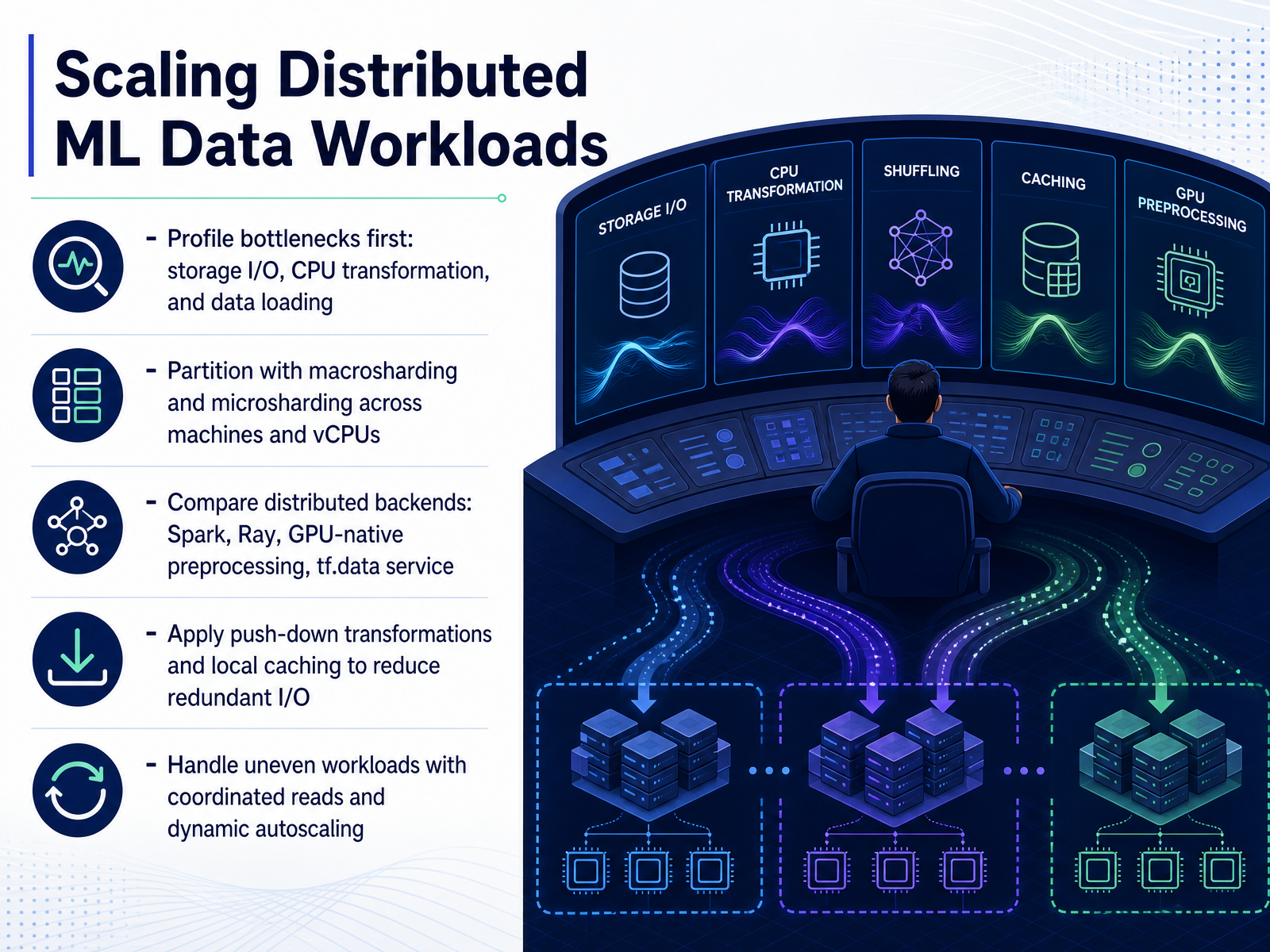
1 min - 10Scaling Distributed ML Data WorkloadsNow let’s look at scaling distributed data workloads for machine learning. First, profile before you scale. The bottleneck is rarely where you expect it. It might be storage I O, CPU bound transformations, or data loading into the training loop. Once you know the real constraint, partitioning helps. Use macrosharding to split directories and files across machines, and microsharding to split work across virtual CPUs within each machine. When choosing a backend, compare your options. Spark is strong for large batch E T L, Ray is flexible for Python native pipelines, and G P U native preprocessing or the tf data service can reduce host level overhead. Where possible, push down transformations and use local caching to avoid repeating expensive reads and conversions. Finally, uneven workloads create stragglers. Coordinated reads and dynamic autoscaling can keep all trainers moving at the same pace. The takeaway is simple: scale based on measured bottlenecks, not assumptions. Next, we’ll move into operationalizing and monitoring M L data.
 2 min
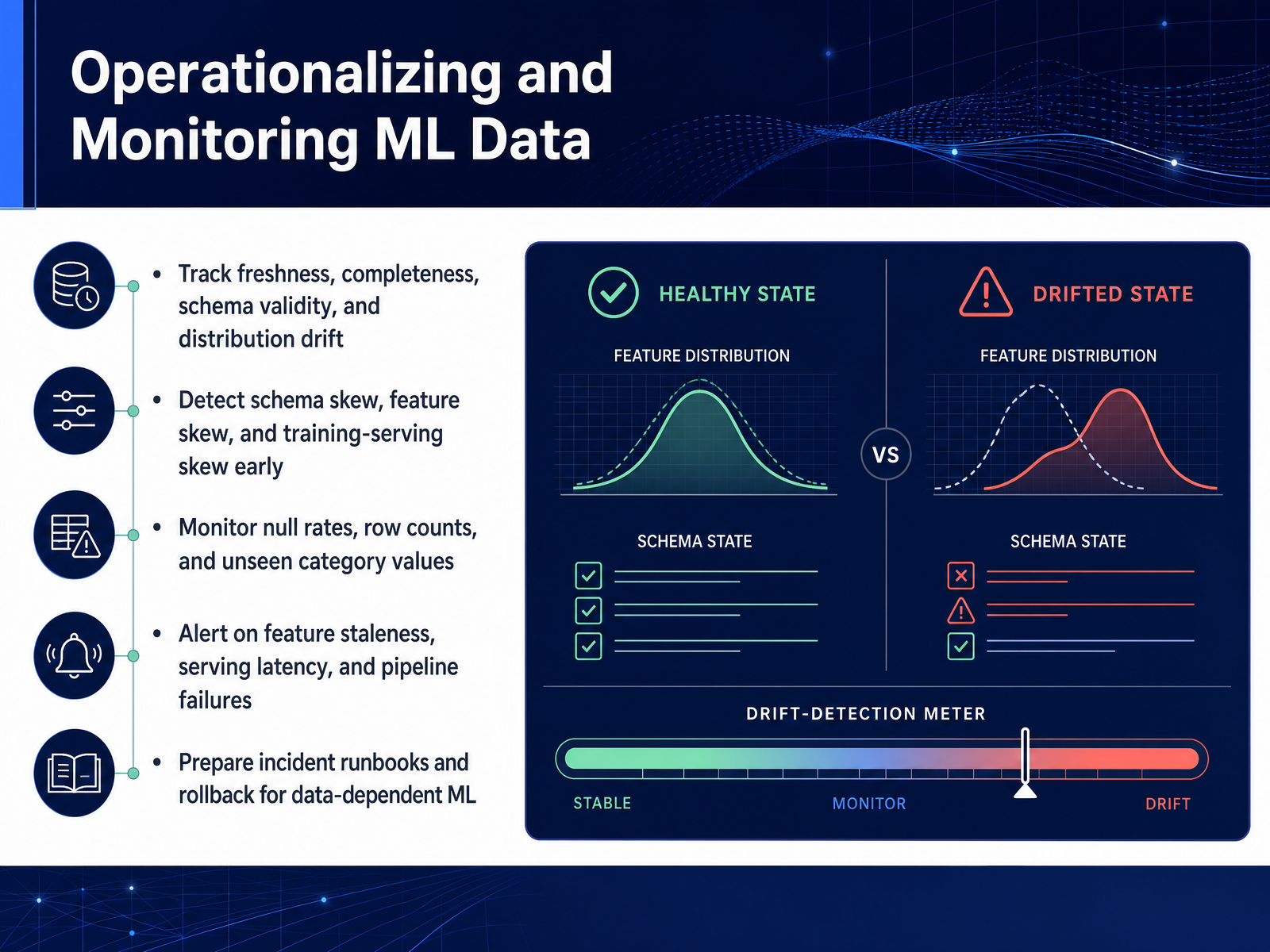
2 min - 11Operationalizing and Monitoring ML DataNow let's turn to the operational side: keeping an eye on the data that feeds your models in production. This is where we move from building pipelines to actively protecting them. The core monitoring areas are freshness, completeness, schema validity, and distribution drift. Think of freshness as whether your data is current. Completeness asks if anything is unexpectedly missing, which we track through null rates and row counts. Schema validity ensures the data structure matches what your model expects. Drift, on the other hand, is about changes over time. We watch for schema skew, where the input format shifts, feature skew, where the feature engineering code behaves differently, and training-serving skew, where the distribution of live data differs from the training set. Catching these problems early is crucial because a model will often keep making confident predictions even when its inputs have silently degraded. Beyond data, we also need alerts for operational health like feature staleness, serving latency, and pipeline failures. The most mature teams prepare for these events before they happen, with incident runbooks and clear rollback strategies that account for data dependencies. Next, we'll look at the practical tools and platforms that can help you implement these monitoring patterns.
 2 min
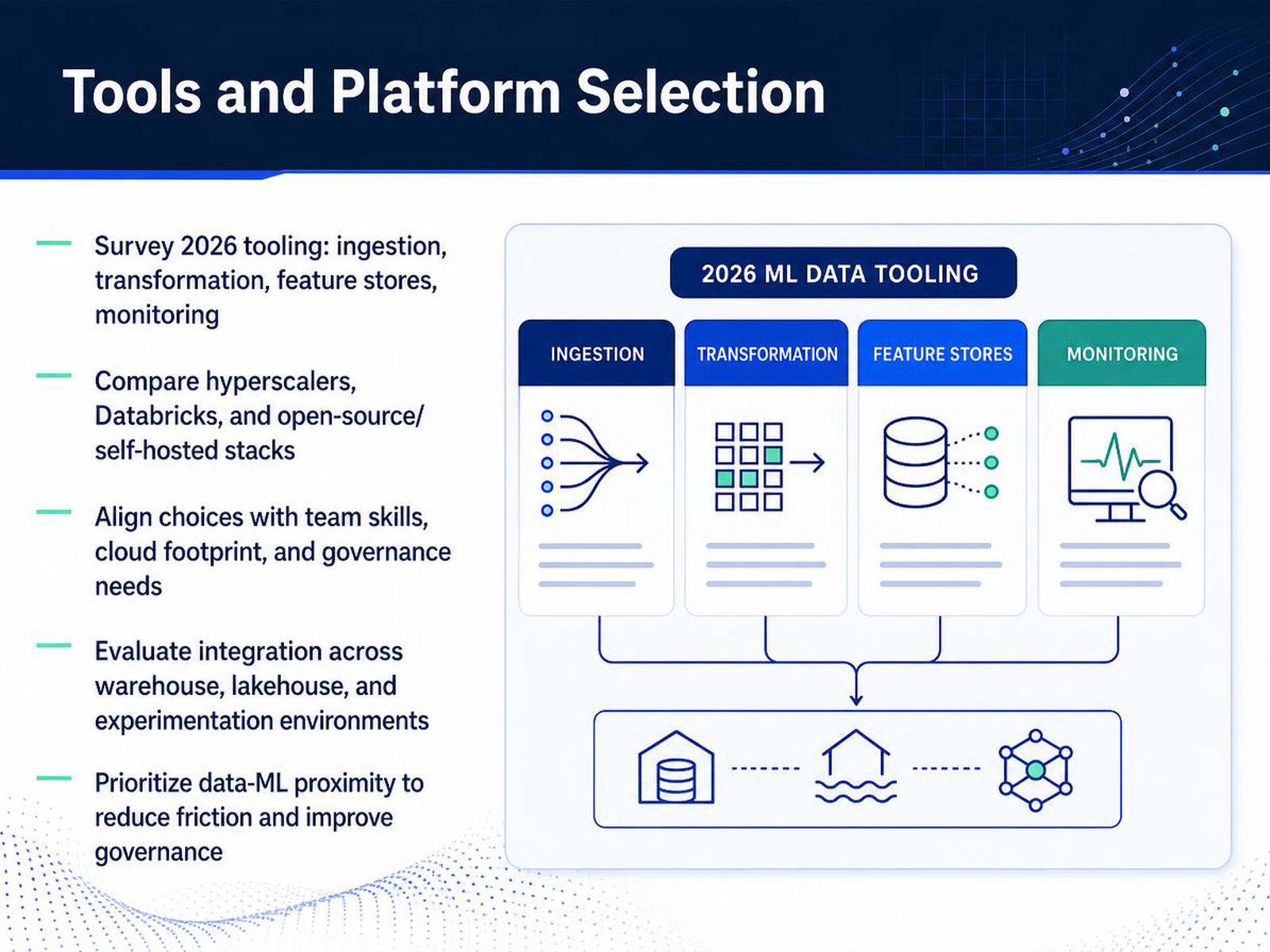
2 min - 12Tools and Platform SelectionNow let's turn to one of the most consequential choices your team will make: tool and platform selection. In 2026, the landscape has consolidated. Hyperscaler platforms like Sagemaker, Vertex AI, and Azure ML are vying for dominance, but Databricks has emerged as a strong contender specifically because it keeps data engineering and machine learning close together. When your data scientists spend forty percent of their time on data preparation, that proximity dramatically reduces friction. But this decision isn't just about features. You need to align your choice with your team's actual skills, your existing cloud footprint, and your governance requirements. Ask yourself whether your team can truly operate a self-hosted open-source stack, or if the operational burden will outweigh the licensing savings. Finally, evaluate how well your chosen tools work across your warehouse, lakehouse, and experimentation environments. Prioritizing that integration, especially through a unified governance layer, is often the key to a system that is both reliable and auditable. Next, we'll look at how these theories translate into practice with case studies and patterns.
 2 min
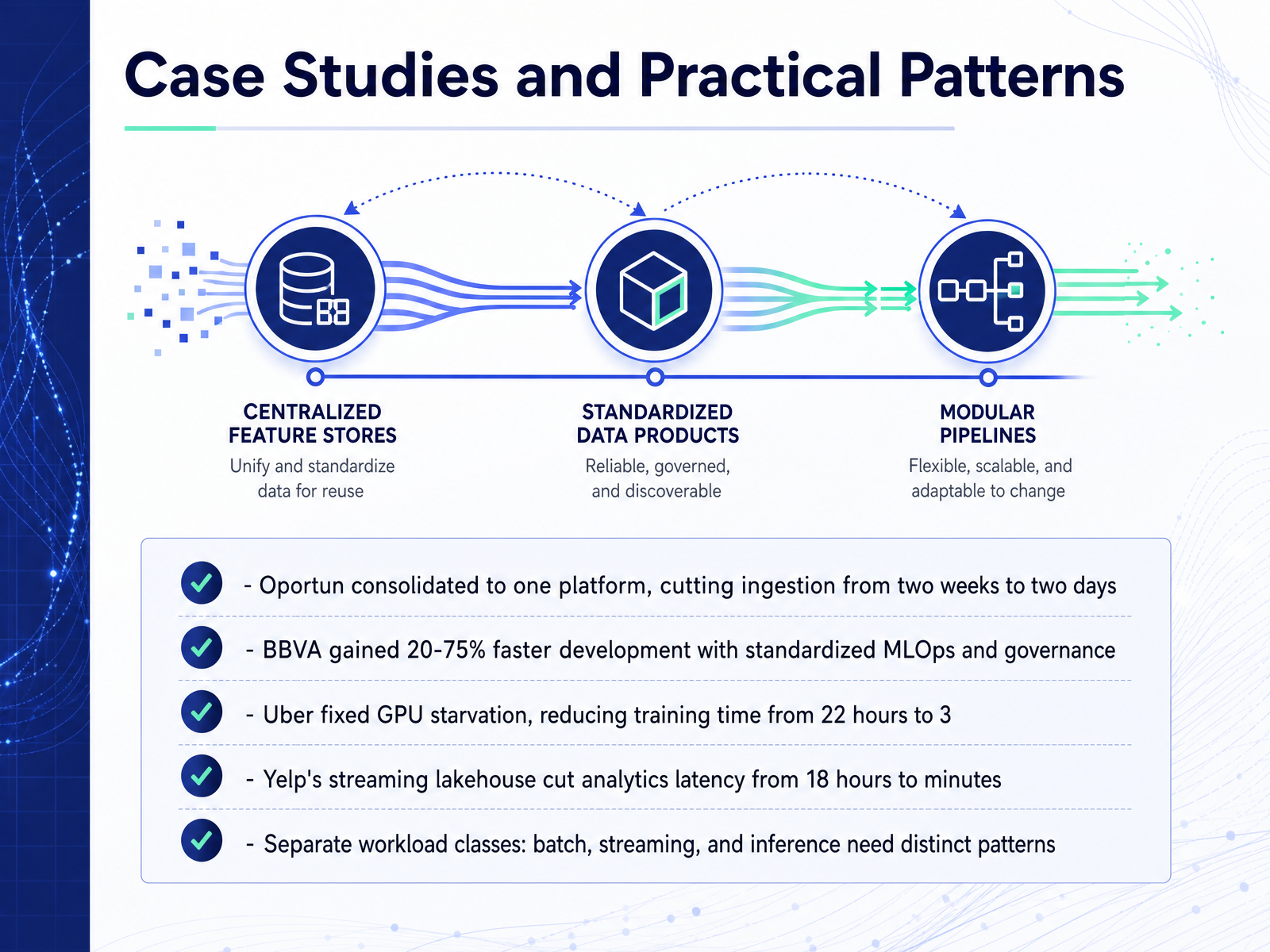
2 min - 13Case Studies and Practical PatternsNow let us look at some real world outcomes, because these patterns show up consistently across industries. Oportun consolidated its data and machine learning work onto a single platform. The result was striking: ingestion that used to take two weeks now takes about two days. BBVA standardized its MLOps and governance, and saw development time drop by twenty to seventy five percent across pilot teams. Uber faced a different problem. Their GPUs were starving for data, sitting mostly idle. By fixing the data loading bottleneck, they cut training time from twenty two hours down to three. Yelp moved to a streaming lakehouse and reduced analytics latency from eighteen hours to just minutes. The common thread is not a single tool. It is workload separation. Batch processing, streaming analytics, and model inference have different requirements, and they need distinct architectural patterns. Trying to force all three through one pipeline usually creates exactly the bottlenecks these teams had to unwind. With these lessons in mind, let us move to the final slide on next steps and the learning path ahead.
 2 min
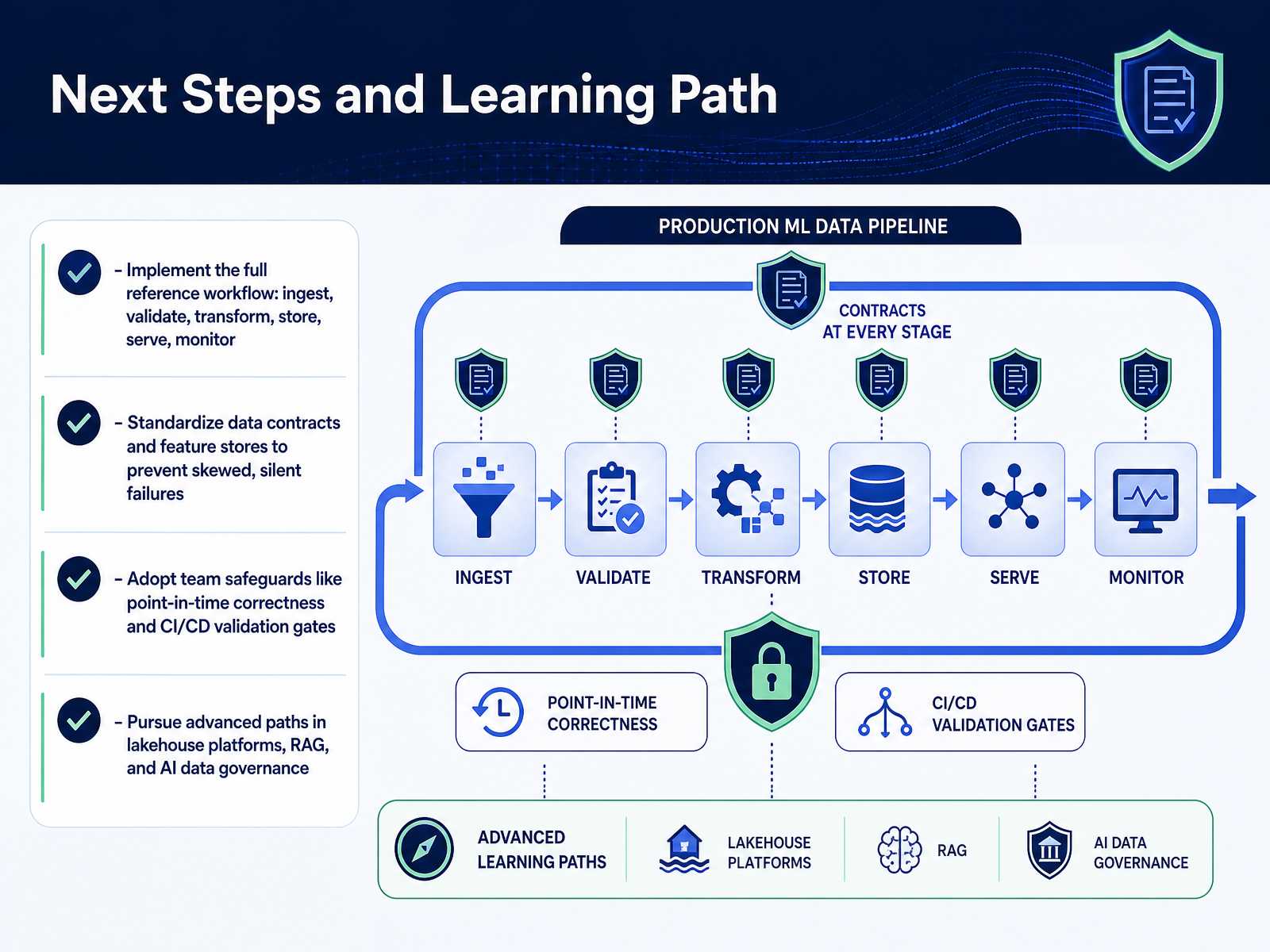
2 min - 14Next Steps and Learning PathThat brings us to the end of the course, so let's map out your immediate next steps. First, take what you have learned and implement the full reference workflow from end to end. That means moving through ingest, validate, transform, store, serve, and monitor on a real use case, even if it starts small. Second, standardize your data contracts and feature stores. This discipline is what prevents skewed, silent failures from creeping in. Third, adopt team safeguards like point-in-time correctness and CI CD validation gates. Make these part of every pipeline change, not a manual review after something breaks. Finally, continue your learning in advanced areas like lakehouse platforms, retrieval augmented generation, and AI data governance. These are the places where the field is moving quickly, and your foundation is exactly what you need to succeed there. To summarize, reliable data engineering is the backbone of every successful machine learning system. You now have a clear, actionable path to build it. Thank you for your attention, and good luck as you put these practices to work in your own teams.
 databricks.comlatentview.comdotdatalabs.ai+22 min
Take the deck with you
Download this course as a file — free, no sign-up needed.
- PDF handoutEvery slide page, ready to print or share.15 pages · 4.1 MBDownload
- Narrated PowerPointThe deck that presents itself — every slide carries the digital human's narration video.15 pages · 16.4 MBDownload
- PowerPoint slidesThe full deck as a .pptx — open it in PowerPoint, Keynote, or Google Slides.15 pages · 4.0 MBDownload
Free to use in your own training — please keep the PersonWise credit page at the end.
Have your own deck? Turn it into a course
Sources consulted
Web sources consulted while building this course.
- Data Engineering for AI: A Practical Guide for Data Professionals | Databricks Blog — databricks.com
- Data Engineering for AI: Foundations, Components, and Best Practices — latentview.com
- Data Engineering for AI: What ML Teams Must Know | DOT Data Labs Blog — dotdatalabs.ai
- Data Engineering for AI: The Infrastructure That Intelligence Runs On - IABAC — iabac.org
- What Is AI Data Engineering? 2026 Enterprise Guide - Asterdio — asterdio.com
- https://www.itu.int/dms_pub/itu-t/opb/fg/T-FG-AI4H-2023-7-PDF-E.pdf — itu.int
- AI Training Data Quality: Dimensions, Validation & Best Practices — atlan.com
- ISO/IEC 5259-4:2024 | IEC — webstore.iec.ch
- Dataset Validation: Best Practices for ML Engineers | DOT Data Labs Blog — dotdatalabs.ai
- Data Quality for Machine Learning: A Guide — dsstream.com
- Parquet vs ORC vs Avro: File Formats for AI Workloads - Zilliz Vector Database — zilliz.com
- Leveraging the Right Data Formats for Efficient AI Processing – DataTrain.AI — datatrain.ai
- Data formats: Parquet, Arrow, JSONL, and ML storage choices — zeroentropy.dev
- Data formats in analytical DBMSs: performance trade-offs and future directions | The VLDB Journal | Springer Nature Link — link.springer.com
- A Deep-Dive in Open‑Data Formats: Parquet, ORC, and Avro — community.ibm.com
- Your ML Data Pipeline in 2026: A New Architecture — vector-labs.ai
- Teaching the Old Dog New Tricks: Building Efficient Data Pipelines for Large-Scale LLM Pre-Training (Operational Systems) | USENIX — usenix.org
- ByteHouse: ByteDance’s Cloud-Native Data Warehouse for Real-Time Multimodal Data Analytics — arxiv.org
- Towards Next-Generation LLM Training: From the Data-Centric Perspective — arxiv.org
- End-to-End Declarative Data Analytics: Co-designing Engines, Interfaces, and Cloud Infrastructure — cidrdb.org