Begin
14 pages · ~28 min
Customer Education Types
This training introduces the types of customer education and helps learners identify which approaches best fit different customer needs and learning goals.
A digital instructor presents all 14 pages. Hold “Ask” at any point and ask out loud — the answer comes from this course. No sign-up needed.
What you’ll learn
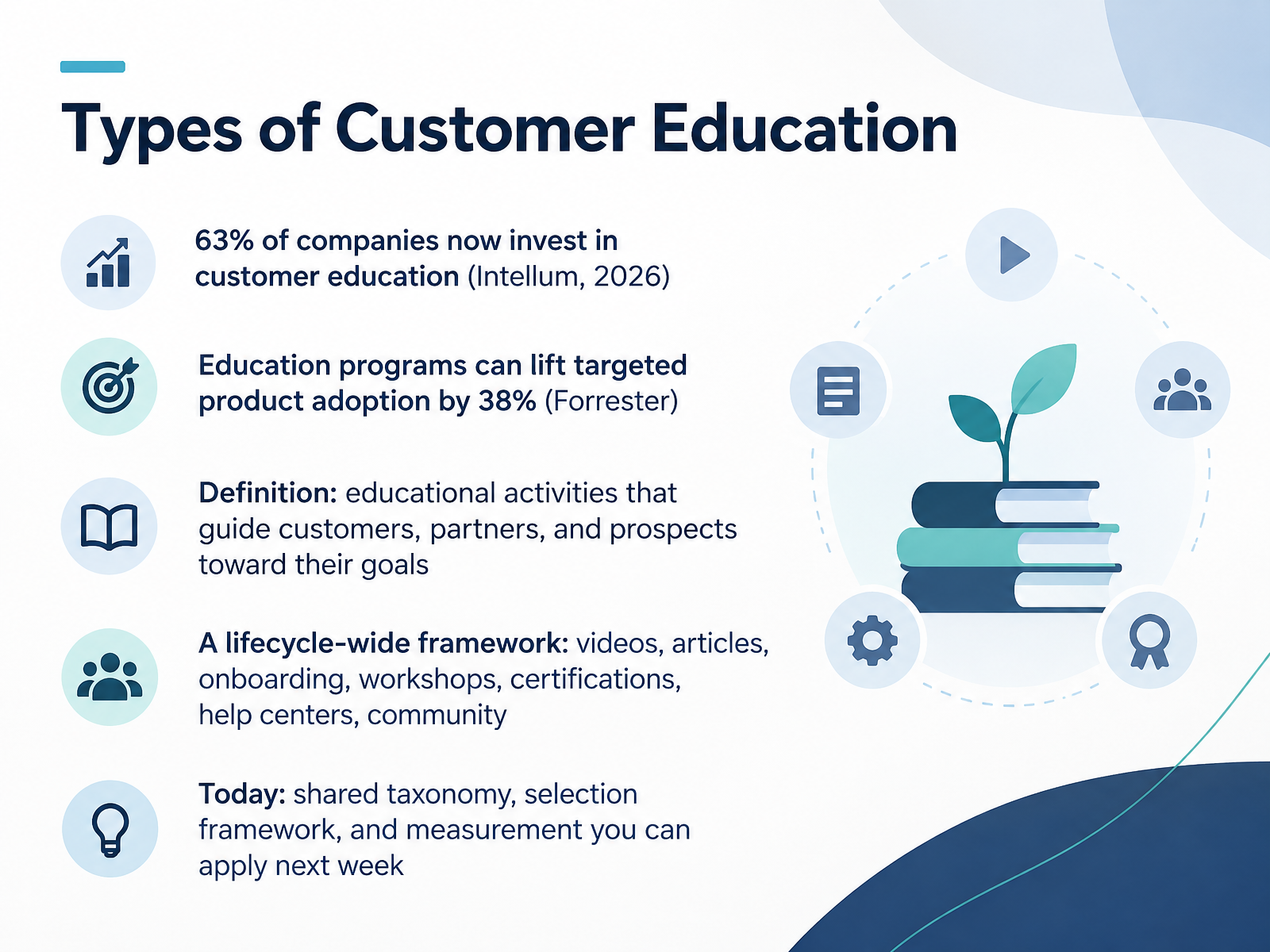
- 01Types of Customer EducationWelcome. Today we're framing one of the questions customer education teams wrestle with most: what actually counts as customer education, and which type do you build next? Quick context. Intellum's twenty twenty-six report found that sixty-three percent of companies now invest in customer education. And Forrester found education programs can lift targeted product adoption by thirty-eight percent. So the investment is real. The challenge is scope. Here's the definition we'll use. Customer education is any educational activity that guides customers, partners, and prospects toward their own goals, through their relationship with your product or service. Notice how broad that is. It's a lifecycle-wide framework: videos, articles, onboarding, workshops, certifications, help centers, community. You don't need all of them. You need the right ones for your stage and audience. By the end of this session, you'll have a shared taxonomy, a selection framework, and a measurement approach you can apply next week. Let's start with definitions and boundary lines.thinkthru.cointellum.comdocsio.co+22 min
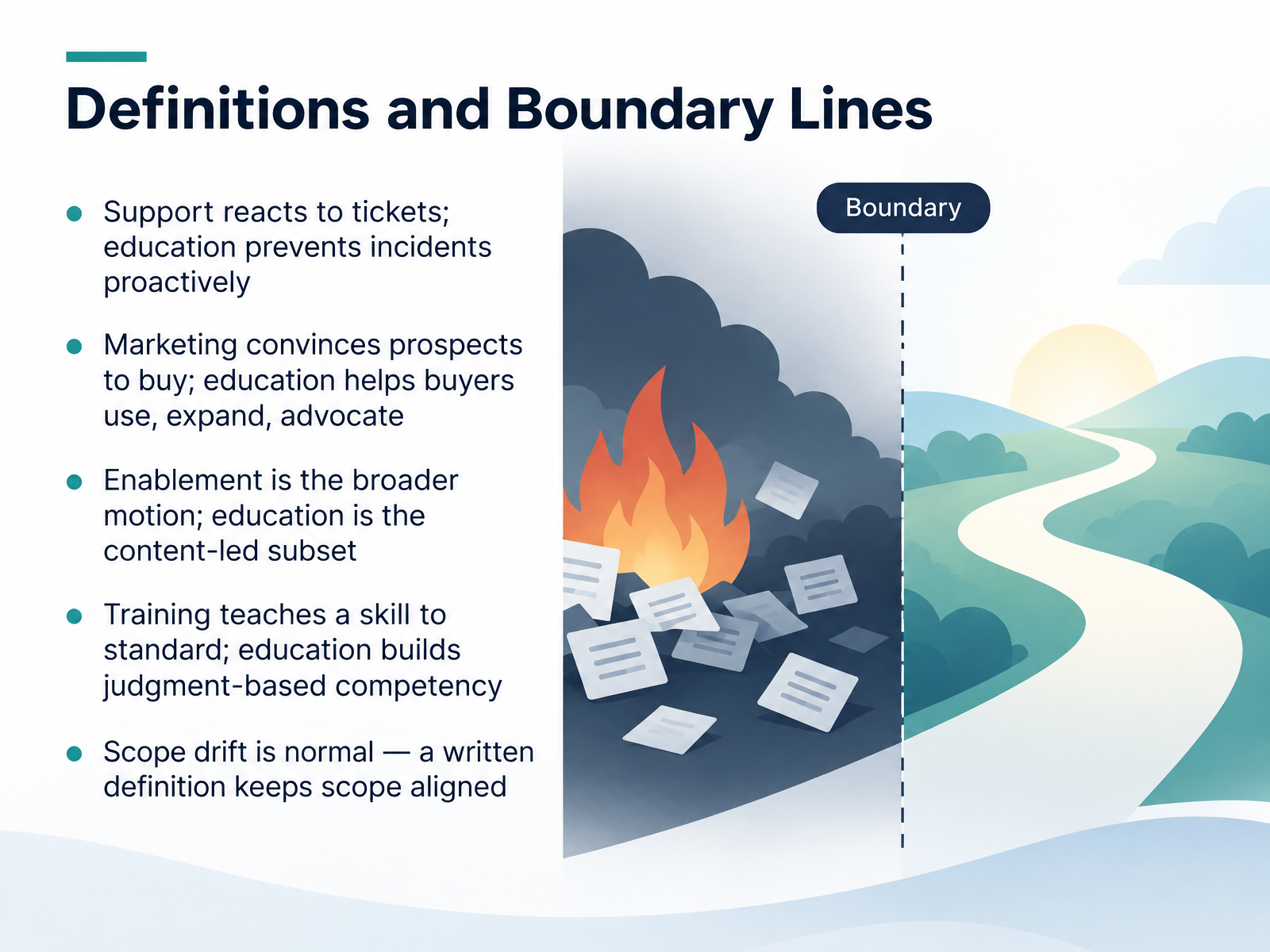
- 02Definitions and Boundary LinesLet's draw some clear boundary lines. Support reacts to tickets. Education prevents incidents from happening in the first place. Marketing convinces prospects to buy. Education helps buyers actually use the product, expand, and advocate. Enablement is the broader motion, and education is the content-led subset within it. Training teaches a skill to a defined standard. Education builds judgment-based competency, so people can adapt. And scope drift? That's normal. A written definition keeps scope aligned when new requests arrive. Here's the practical takeaway. Pick one clear line per team, write it down, and revisit it quarterly. That shared language makes the next question easier: what types of education do we actually offer? That's exactly what we'll map out next, in A Practical Taxonomy of Education Types.
 1 min
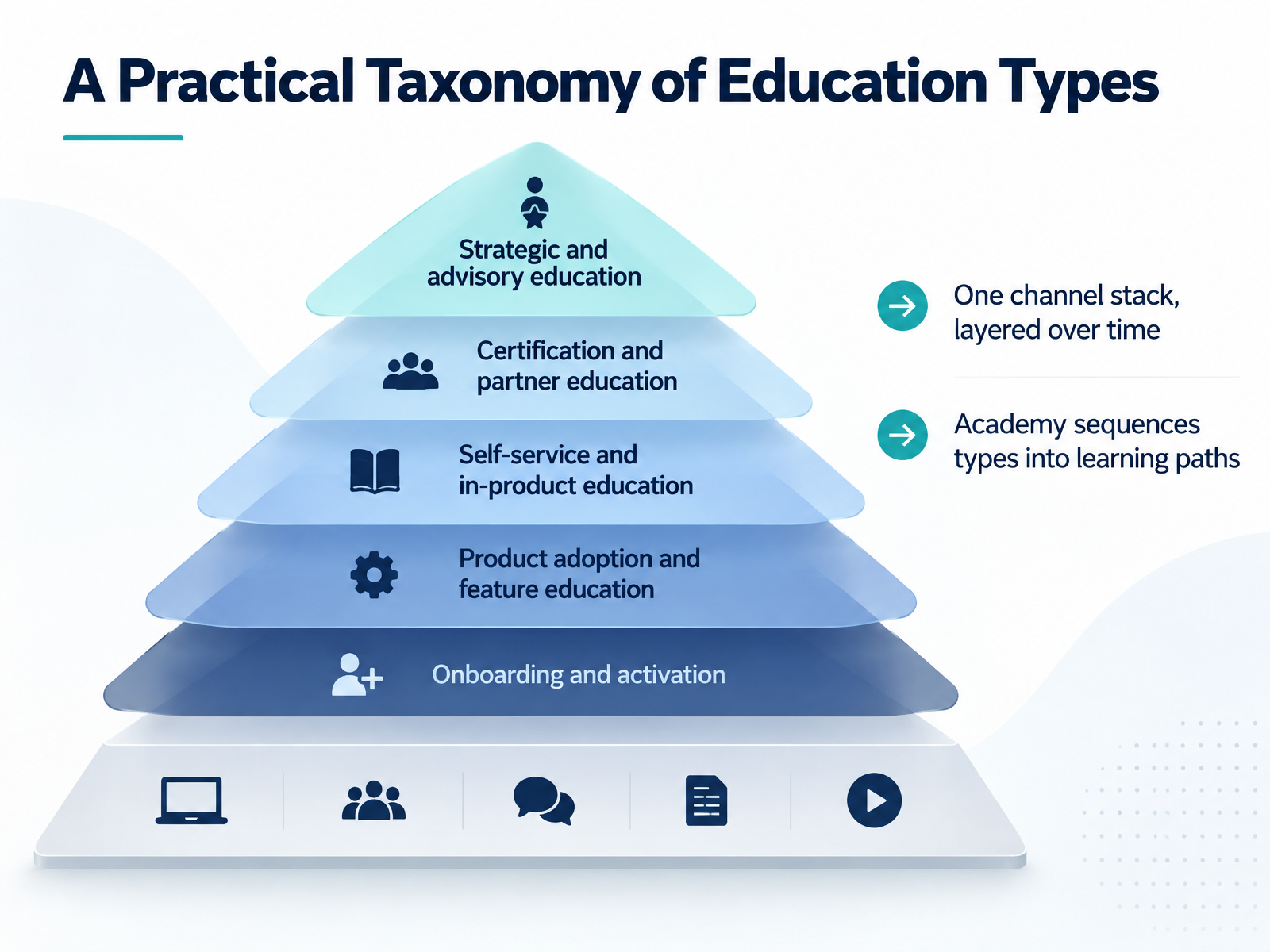
- 03A Practical Taxonomy of Education TypesLet's break this down into a practical taxonomy of education types. First, onboarding and activation, which gets new customers to their first win. Next, product adoption and feature education, building depth over time. Then self-service and in-product education, meeting users where they already work. Certification and partner education scale expertise through others. And strategic and advisory education helps your most mature customers solve bigger problems. Notice these are not separate channel stacks. They layer over time, across one shared delivery stack. An academy is how you sequence them into coherent learning paths. So ask yourself, which type is underbuilt in your current mix? Next, we'll look closely at onboarding and activation education.
 1 min
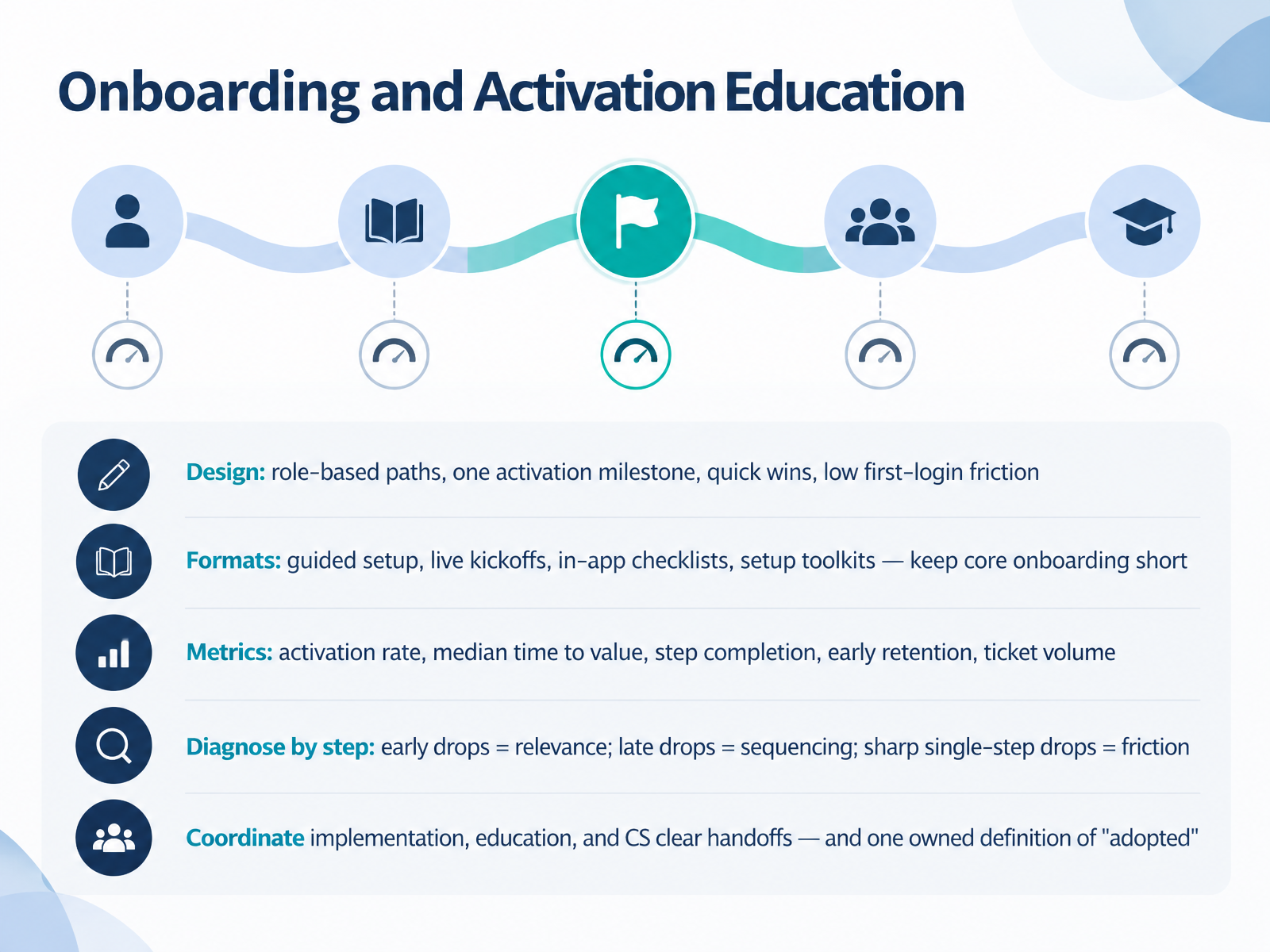
- 04Onboarding and Activation EducationLet's move into onboarding and activation education. Your design goal here is simple: role-based paths, one activation milestone, quick wins, and low friction at first login. Keep the core short. Use guided setup, live kickoffs, in-app checklists, and setup toolkits as supporting formats. Now, how do you know it's working? Watch activation rate, median time to value, step completion, early retention, and ticket volume. And diagnose by step. Early drops usually signal a relevance problem. Late drops point to sequencing. A sharp drop at a single step is friction. Finally, coordinate implementation, education, and customer success with clear handoffs, and agree on one owned definition of adopted. That shared definition prevents conflicting success claims. Next, we'll look at product adoption and feature education.
 clueso.iomindstamp.comsupademo.com+22 min
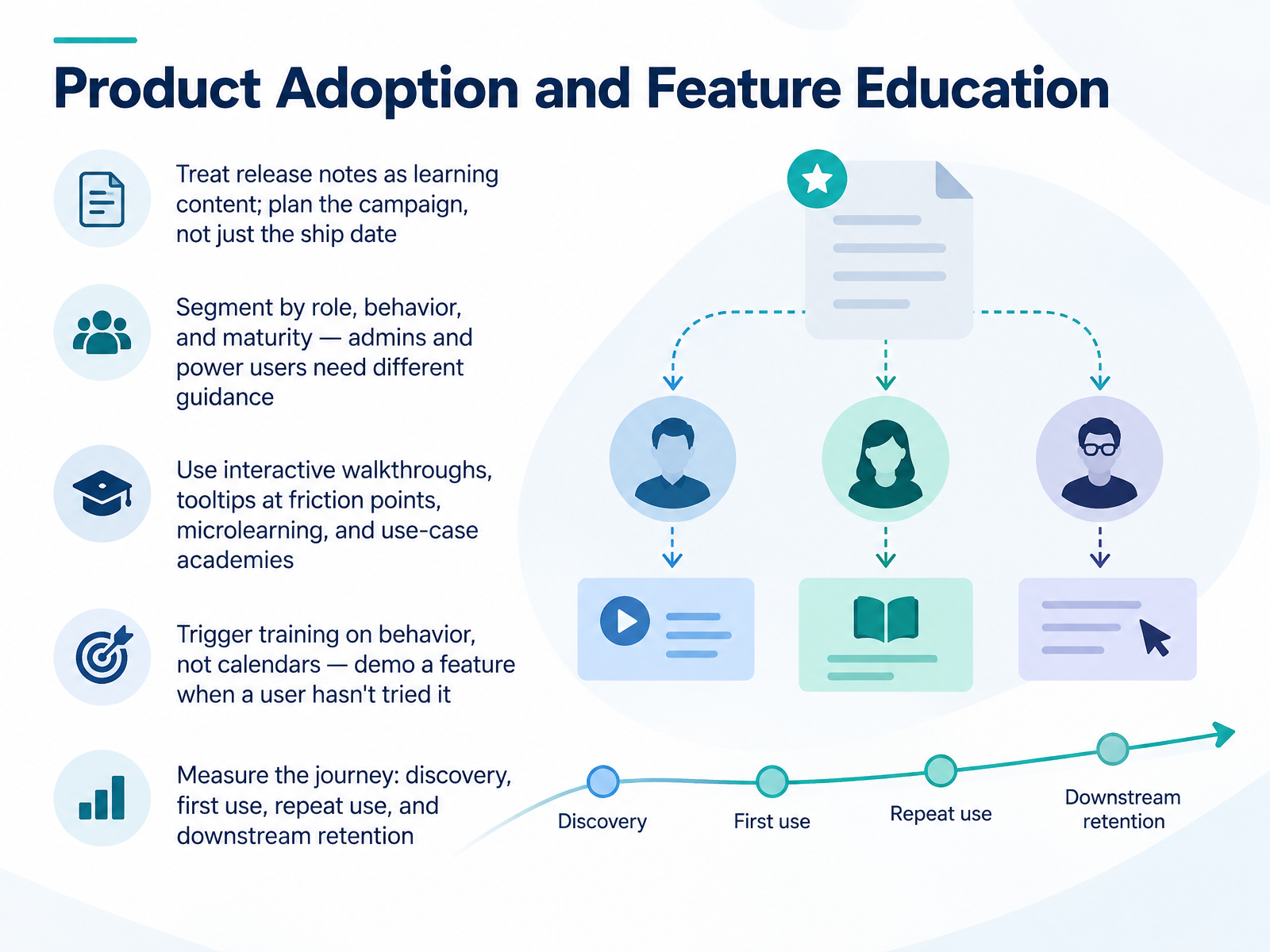
- 05Product Adoption and Feature EducationLet's turn to product adoption and feature education. Start by treating release notes as learning content. Plan the campaign, not just the ship date. Then segment by role, behavior, and maturity, because admins and power users need very different guidance. For formats, reach for interactive walkthroughs, tooltips at friction points, microlearning, and use-case academies. And trigger training on behavior, not calendars. If a user hasn't tried a feature, that's your cue to show it. Measure the journey across discovery, first use, repeat use, and downstream retention. Next, we'll look at self-service and in-product education.
 supademo.comuserpilot.comproductplan.com+21 min
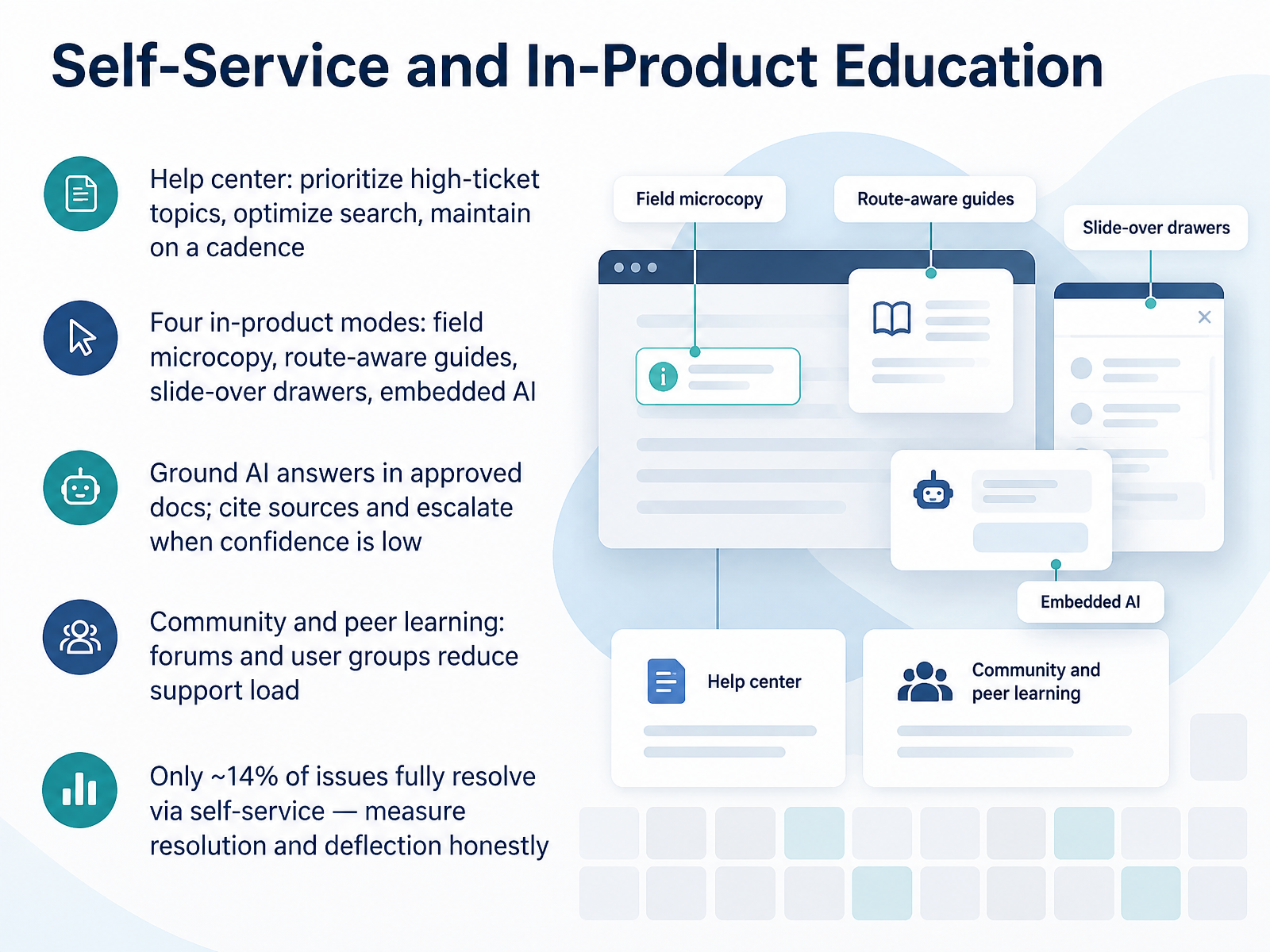
- 06Self-Service and In-Product EducationLet's turn to self-service and in-product education. Start with your help center. Prioritize high-ticket topics, optimize search, and maintain content on a set cadence so answers stay current. Then design for in-product help across four modes: field microcopy, route-aware guides, slide-over drawers, and embedded AI. Keep AI grounded in approved docs, cite the source, and escalate when confidence is low. Community and peer learning, like forums and user groups, reduce support load too. But be honest: only about fourteen percent of issues fully resolve through self-service. Measure resolution and deflection carefully, and don't overstate what self-service actually delivers. Next, we'll look at certification and partner education.
 help.userflow.comknowledge-base.softwarezesto.cc+22 min
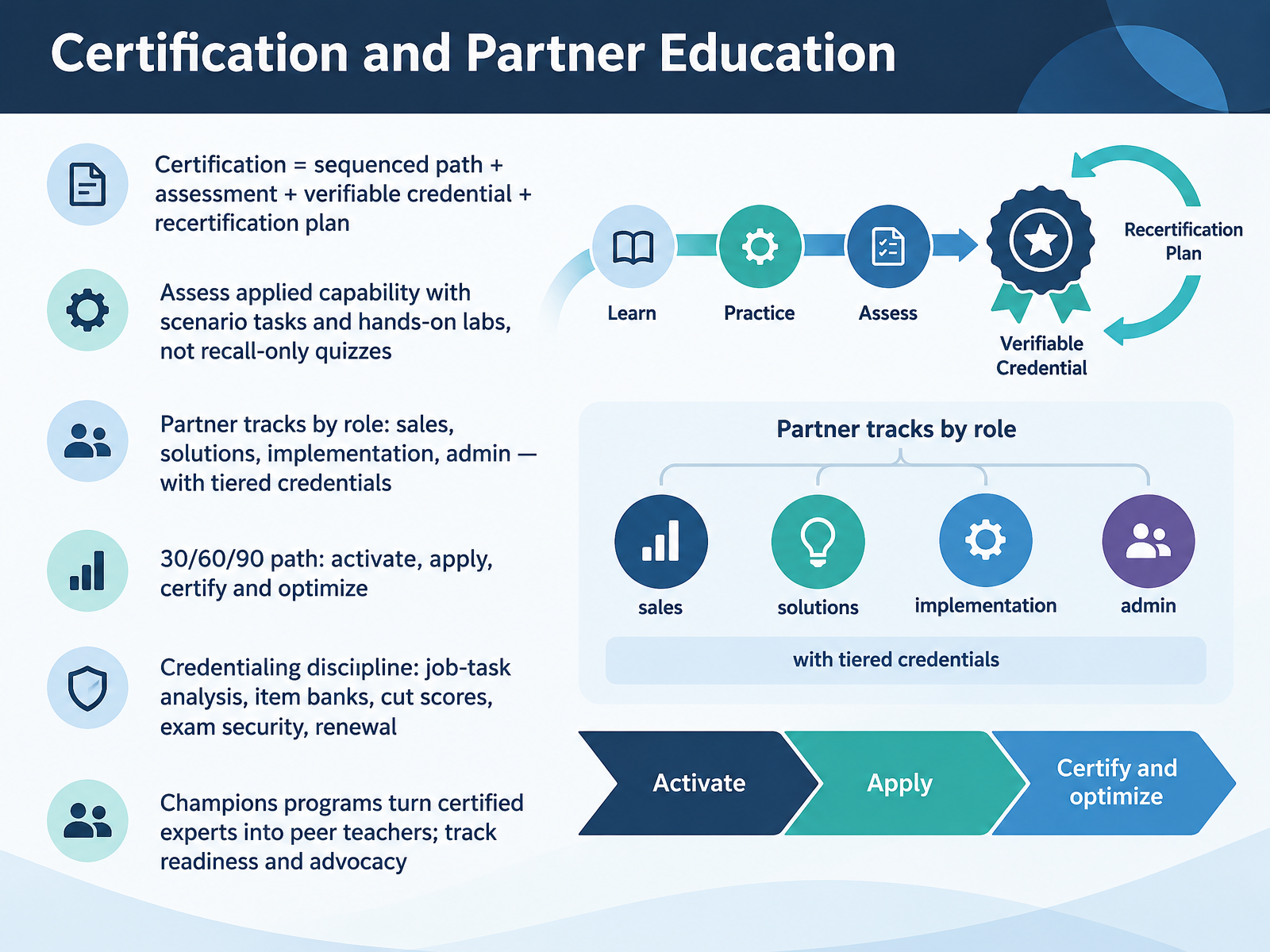
- 07Certification and Partner EducationNext, let's look at certification and partner education. A real certification is more than a badge. It's a sequenced path, an assessment, a verifiable credential, and a recertification plan working together. So assess applied capability, not recall. Use scenario tasks and hands-on labs that mirror the job. Then build partner tracks by role, for sales, solutions, implementation, and admin, with tiered credentials at each level. A practical structure is the thirty, sixty, ninety path: activate, apply, then certify and optimize. Behind the scenes, credentialing discipline matters. That means job-task analysis, item banks, cut scores, exam security, and renewal. Finally, champions programs turn certified experts into peer teachers, so track their readiness and advocacy. Now let's move on to strategic and advisory education.
 2 min
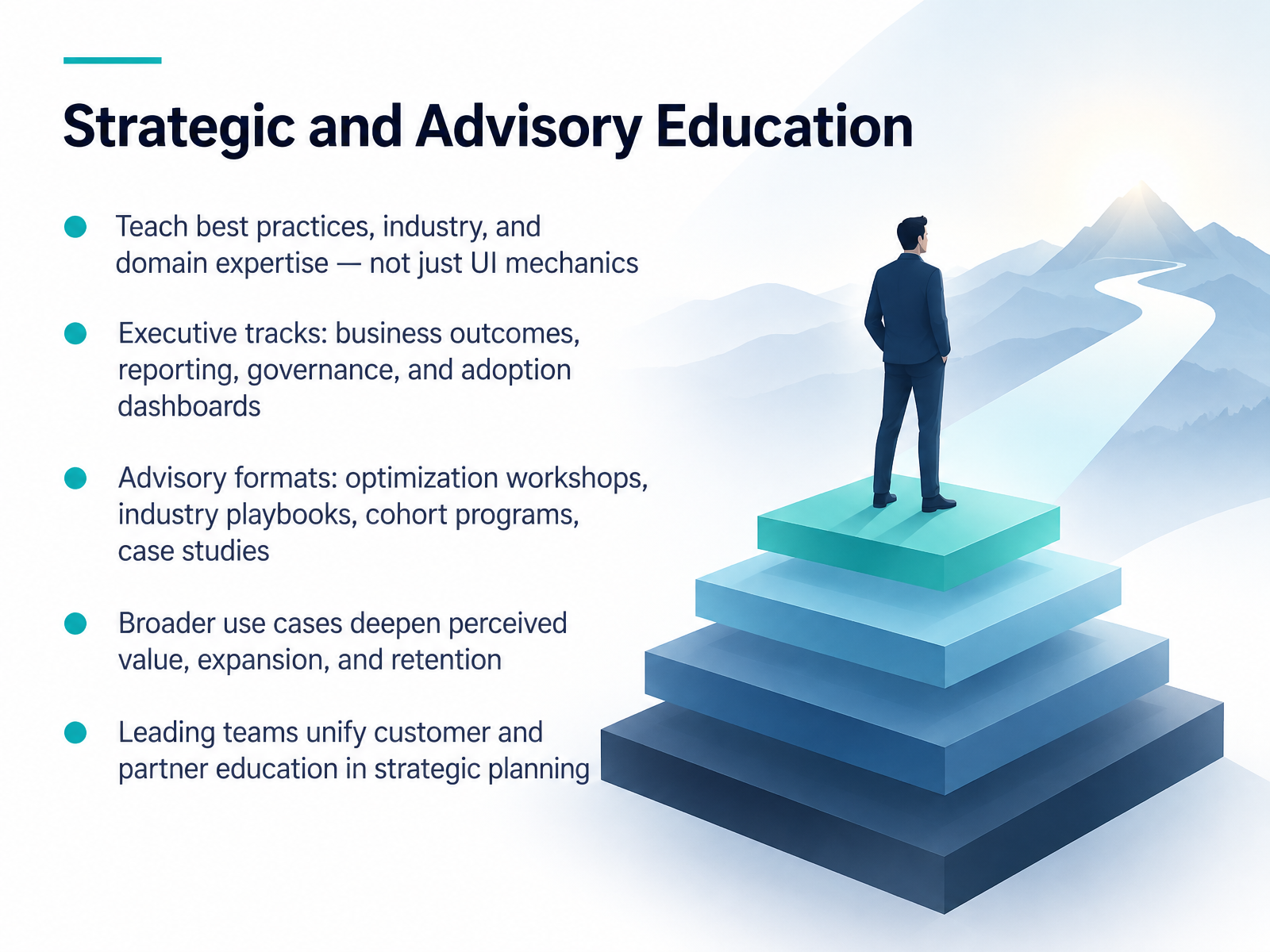
- 08Strategic and Advisory EducationNow let's look at strategic and advisory education. This goes beyond teaching UI mechanics. We teach best practices, industry context, and domain expertise. For executive tracks, focus on business outcomes, reporting, governance, and adoption dashboards. Advisory formats include optimization workshops, industry playbooks, cohort programs, and case studies. When you address broader use cases, you deepen perceived value, which supports expansion and retention. And leading teams unify customer and partner education in strategic planning. So ask yourself: are you educating users, or advising them? Next, we'll look at choosing the right mix by audience and lifecycle.
 1 min
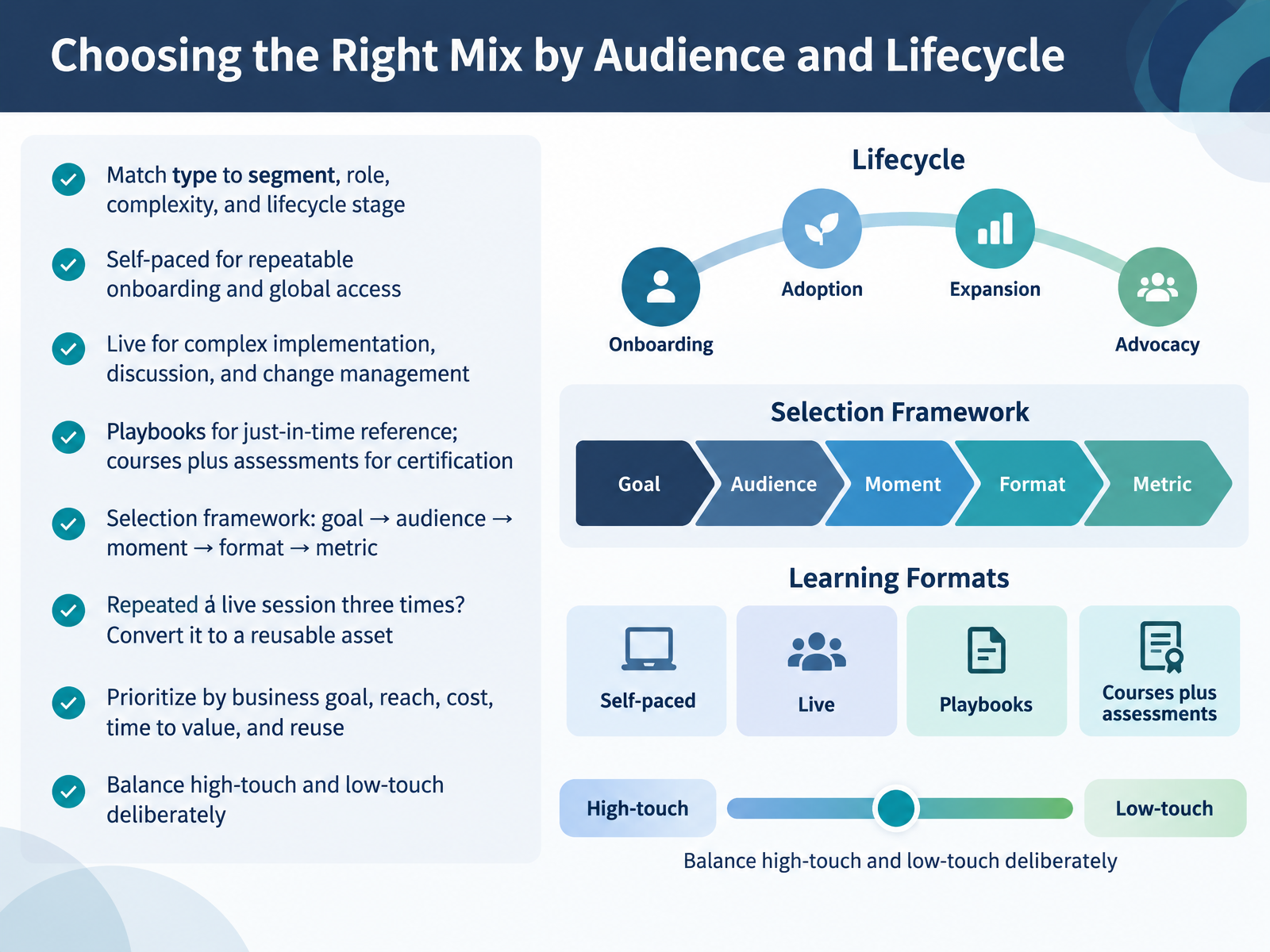
- 09Choosing the Right Mix by Audience and LifecycleSo how do you decide the right mix? Match the type to the audience segment, the role, the complexity, and the lifecycle stage. Self-paced works for repeatable onboarding and global access across time zones. Live is for complex implementation, discussion, and change management, where customers need context and back-and-forth. Playbooks serve just-in-time reference, while courses plus assessments carry certification. Keep a simple selection framework in mind: goal, audience, moment, format, metric. And here is a useful trigger. If you have repeated a live session three times, convert it into a reusable asset. Prioritize by business goal, reach, cost, time to value, and reuse. Then balance high-touch and low-touch deliberately. That discipline shapes the next question, which is how you actually build the content. We will look at that in Course Creation and Instructional Design.
 2 min
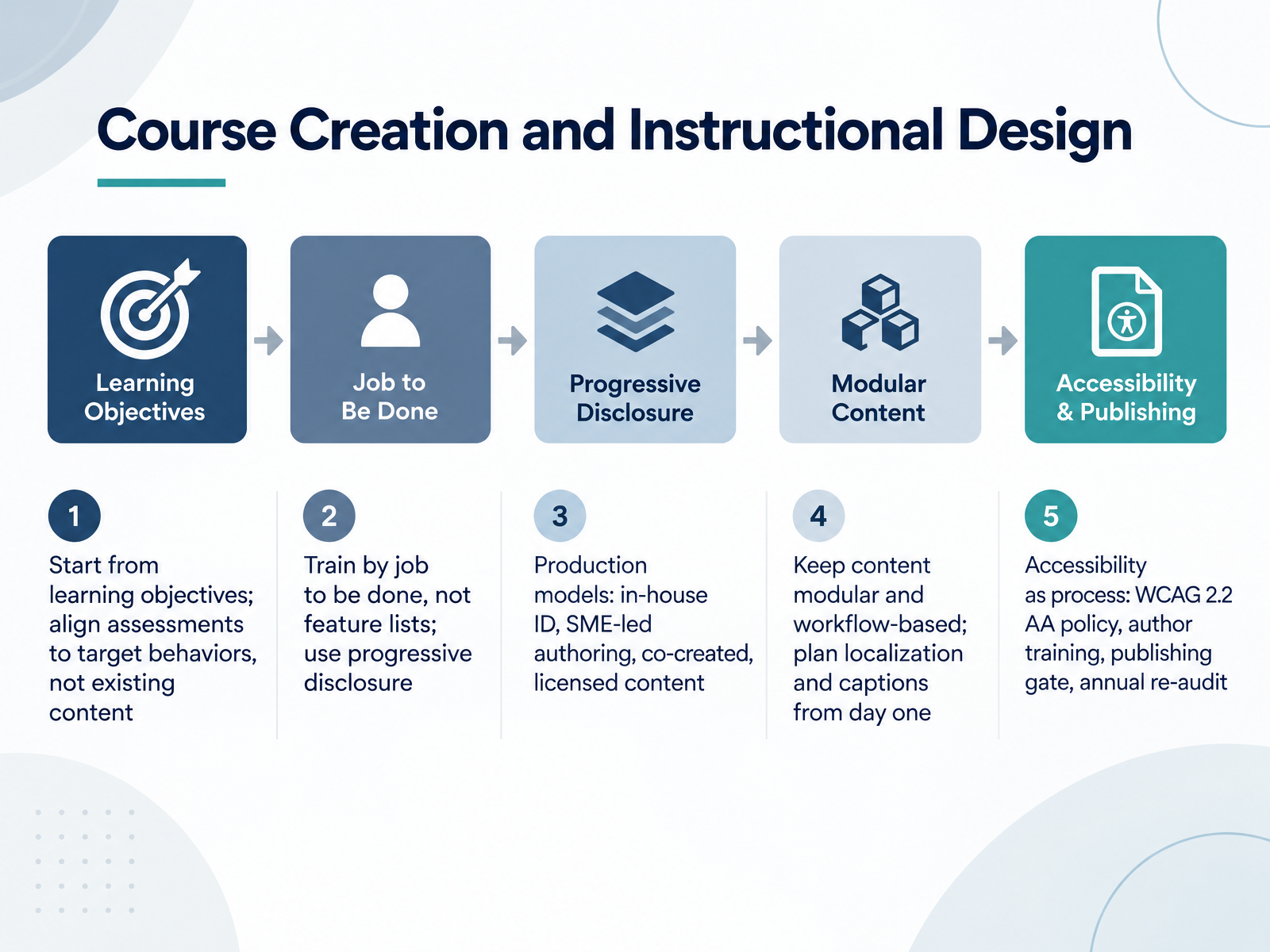
- 10Course Creation and Instructional DesignLet's look at how we actually build that content. Start with learning objectives, and align assessments to the target behaviors, not to whatever content already exists. Train by job to be done, not by feature list, and use progressive disclosure so learners aren't overwhelmed on day one. On production, you have four realistic models: in-house instructional designers, subject-matter-led authoring, co-created content with product teams, and licensed content. Pick deliberately. Keep modules short and workflow-based, and plan localization and captions from day one, since retrofitting captions into a translated course is far more expensive. Finally, treat accessibility as a process, not a project: adopt WCAG two point two double A as written policy, train authors, install a publishing gate, and re-audit annually. That's what keeps compliance from decaying as content grows. Next, we'll move into Content Operations, Tooling, and Governance.
 2 min
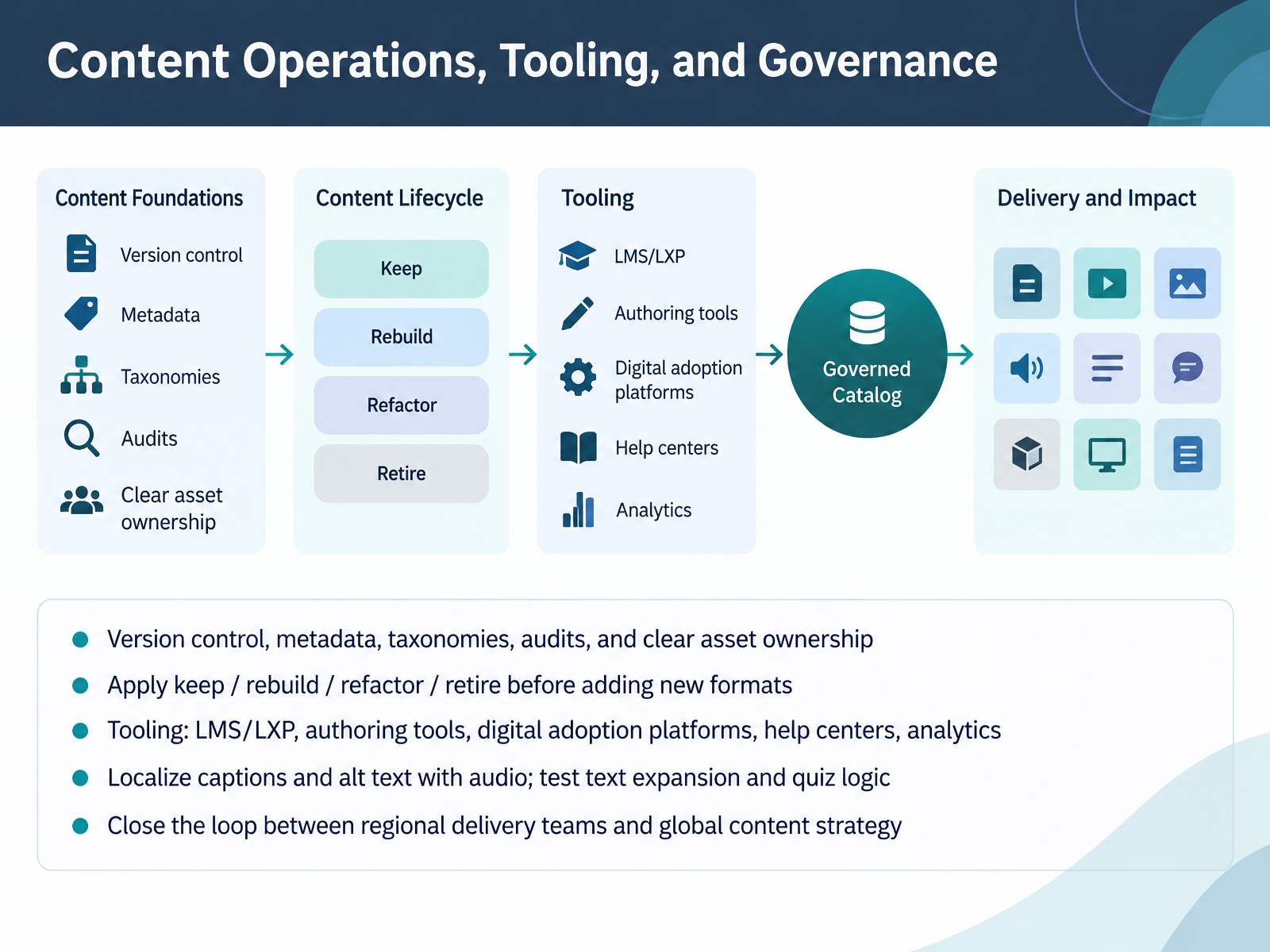
- 11Content Operations, Tooling, and GovernanceNow let's talk about the operational backbone behind all of this: content operations, tooling, and governance. Start with the basics. You need version control, metadata, taxonomies, regular audits, and clear asset ownership, so everyone knows who owns what. Before adding new formats, run the keep, rebuild, refactor, retire review. That discipline protects learner time and keeps your catalog healthy. Your tooling spans LMS or LXP, authoring tools, digital adoption platforms, help centers, and analytics. Pick tools that fit your governance model, not the other way around. For localization, localize captions and alt text alongside the audio, then test text expansion and quiz logic in each language. Finally, close the loop between regional delivery teams and global content strategy. Regional teams see the learner reality; global teams set the standards. Next, we'll look at measuring effectiveness without overclaiming.
 2 min
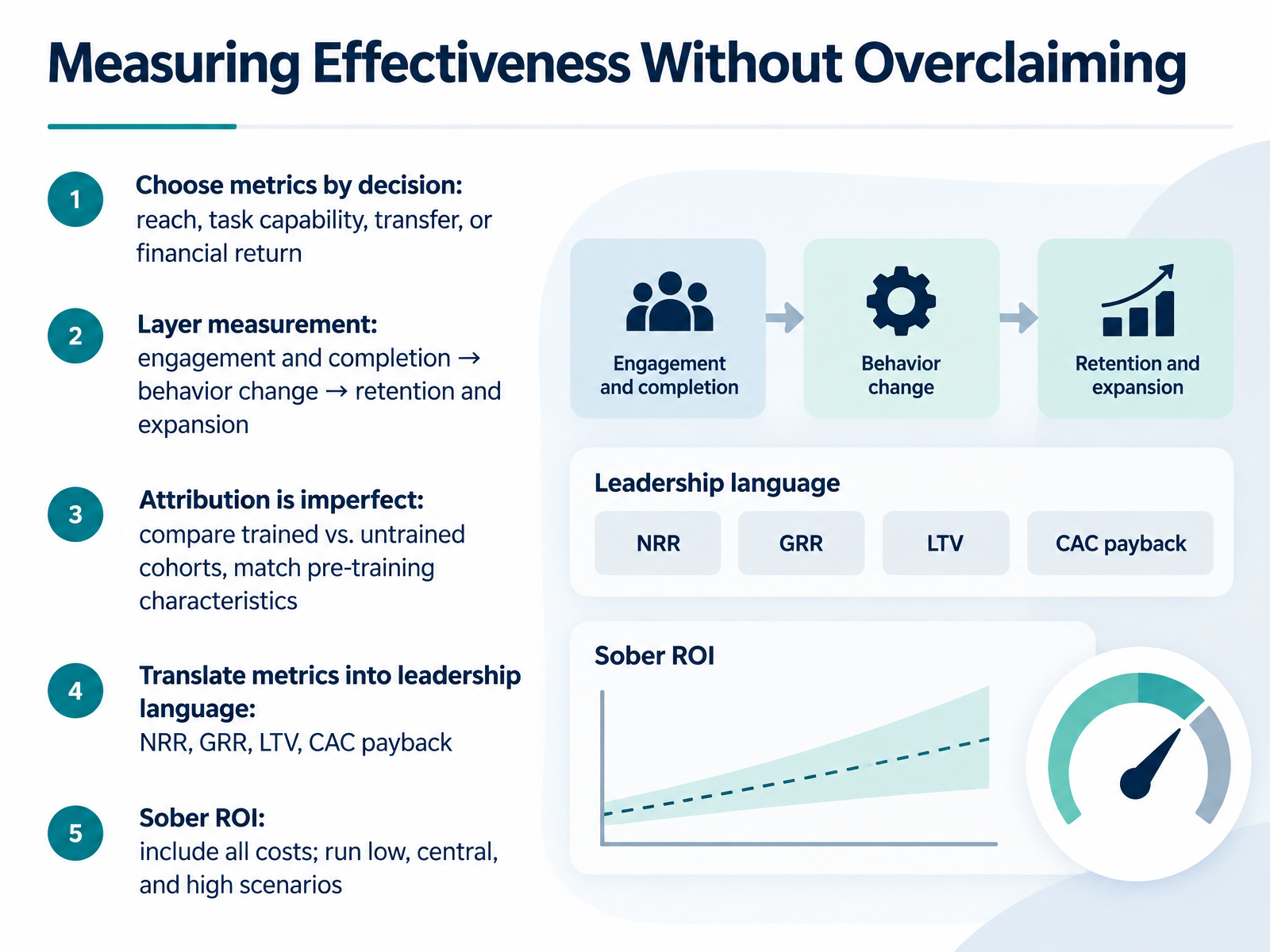
- 12Measuring Effectiveness Without OverclaimingNow let's talk about measuring effectiveness without overclaiming. Start with the decision you need to make. Reach, task capability, transfer, or financial return. Each one calls for a different metric, so match the measure to the question. Then layer your measurement. Engagement and completion first, behavior change next, and retention and expansion last. Attribution is imperfect, and that's fine. Compare trained and untrained cohorts, and match them on pre-training characteristics like account age, size, and prior usage. Then translate your metrics into leadership language. Net revenue retention, gross revenue retention, lifetime value, and CAC payback. Finally, keep ROI sober. Include all costs, and run low, central, and high scenarios so a single unverified assumption doesn't carry the whole case. Next, let's look at common pitfalls and how to avoid them.
 1 min
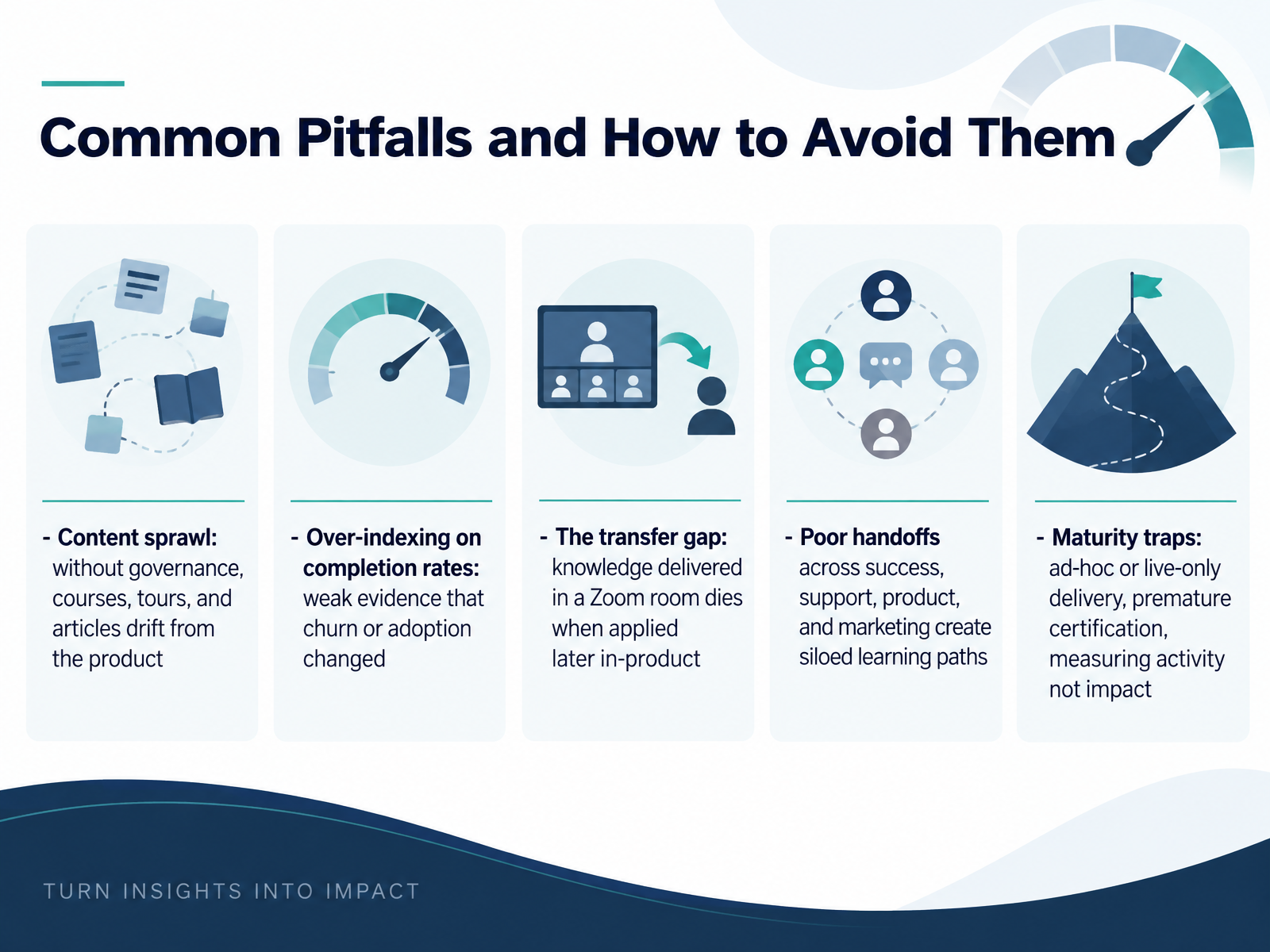
- 13Common Pitfalls and How to Avoid ThemLet's talk about the pitfalls that trip up even experienced customer education teams. Content sprawl is the first. Without governance for courses, tours, and articles, they drift from the product. Run a portfolio audit of keep, rebuild, refactor, and retire. Next, over-indexing on completion rates. Finishing a course is weak evidence that churn or adoption changed. Pair completion with product usage and retention data. Then the transfer gap. Knowledge delivered in a Zoom room dies when learners apply it in-product later. Connect learning to real tasks with in-product guidance and follow-up practice. Poor handoffs across success, support, product, and marketing create siloed learning paths. Name clear owners and shared intake. And watch maturity traps: ad-hoc or live-only delivery, premature certification, and measuring activity instead of impact. Pick one pitfall to fix this quarter. Next, let's move into your action plan for auditing and expanding your portfolio.
 2 min
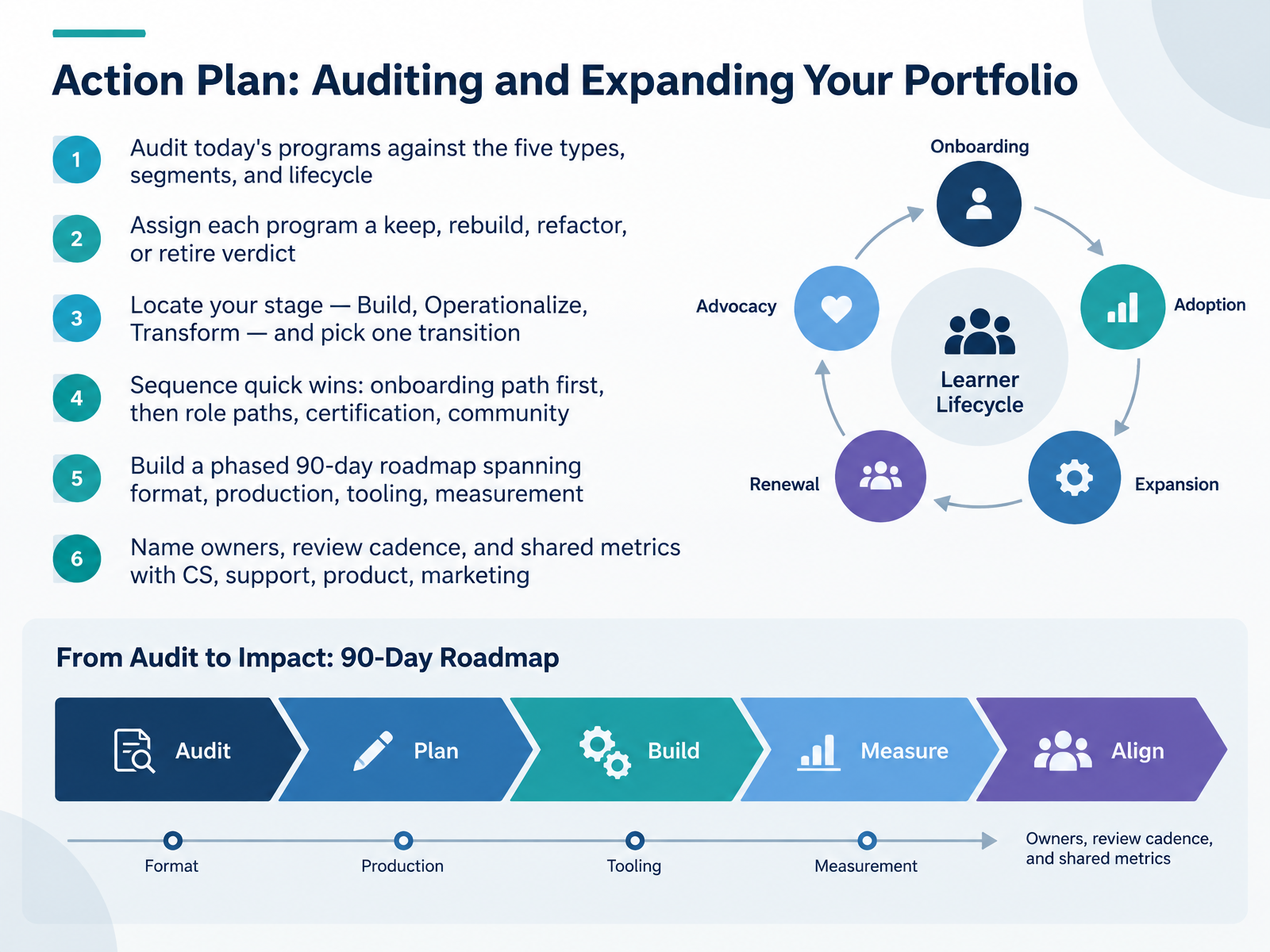
- 14Action Plan: Auditing and Expanding Your PortfolioLet's close with a practical action plan. Start by auditing today's programs against the five types, your segments, and the lifecycle. Then give each program one verdict: keep, rebuild, refactor, or retire. Next, locate your stage, Build, Operationalize, or Transform, and pick a single transition to work on. Sequence your quick wins deliberately: onboarding path first, then role paths, certification, and community. Build a phased ninety-day roadmap that spans format, production, tooling, and measurement. Finally, name owners, set a review cadence, and agree on shared metrics with customer success, support, product, and marketing. That's the whole course in one line: audit honestly, sequence tightly, and measure together. Thank you for your time and attention today. You now have a clear, practical path forward. Go pick your first transition, and take that first step. You've got this.
 1 min
Take the deck with you
Download this course as a file — free, no sign-up needed.
- PDF handoutEvery slide page, ready to print or share.15 pages · 3.0 MBDownload
- Narrated PowerPointThe deck that presents itself — every slide carries the digital human's narration video.15 pages · 11.6 MBDownload
- PowerPoint slidesThe full deck as a .pptx — open it in PowerPoint, Keynote, or Google Slides.15 pages · 2.9 MBDownload
Free to use in your own training — please keep the PersonWise credit page at the end.
Have your own deck? Turn it into a course
Sources consulted
Web sources consulted while building this course.
- Defining Customer Education: A Strategy for Retention, Adoption, and Success | ThinkThru — thinkthru.co
- What is a Customer Academy? | Intellum — intellum.com
- Customer Education: The Complete SaaS Guide for 2026 | Docsio — docsio.co
- What Does "Customer Education" Really Mean? — Echtus — echtus.com
- What is customer education? The ultimate guide — zendesk.com
- SaaS customer onboarding: the complete guide (with checklist) — clueso.io
- Customer onboarding best practices for SaaS and B2B teams — mindstamp.com
- 15 Customer Onboarding Metrics and KPIs to Track in 2026 | Supademo Blog — supademo.com
- Pocus - The product-led guide to customer onboarding — pocus.com
- The Top Customer Onboarding Metrics to Prioritize in 2026 — onramp.ai
- In-app training for SaaS: Best practices and examples | Supademo Blog — supademo.com
- How to Drive Feature Adoption in 2026: Strategies for Human Users and AI Agents — userpilot.com
- Structuring Feature Rollouts to Maximize Product Adoption | ProductPlan — productplan.com
- How to Drive Feature Adoption: Strategies, Metrics & Playbook — clickup.com
- New Feature Onboarding: How To Make Users Engage With Additions to Your Product — userpilot.com
- https://help.userflow.com/docs/boost-self-support — help.userflow.com
- In-App Knowledge Base: Contextual Help, Embedded Search, and Product-Led Support - Knowledge Base Software — knowledge-base.software
- In product help is the help center customers actually use | Zesto — zesto.cc
- Keep users in your product. Give them answers, right where they are. — clickhelp.com
- Resource Centers | UserGuiding — userguiding.com