Begin
14 pages · ~28 min
Planetary System Formation
This training explains how planetary systems form, covering the processes and stages from dust and gas to fully developed planets for astronomy enthusiasts and students.
A digital instructor presents all 14 pages. Hold “Ask” at any point and ask out loud — the answer comes from this course. No sign-up needed.
What you’ll learn
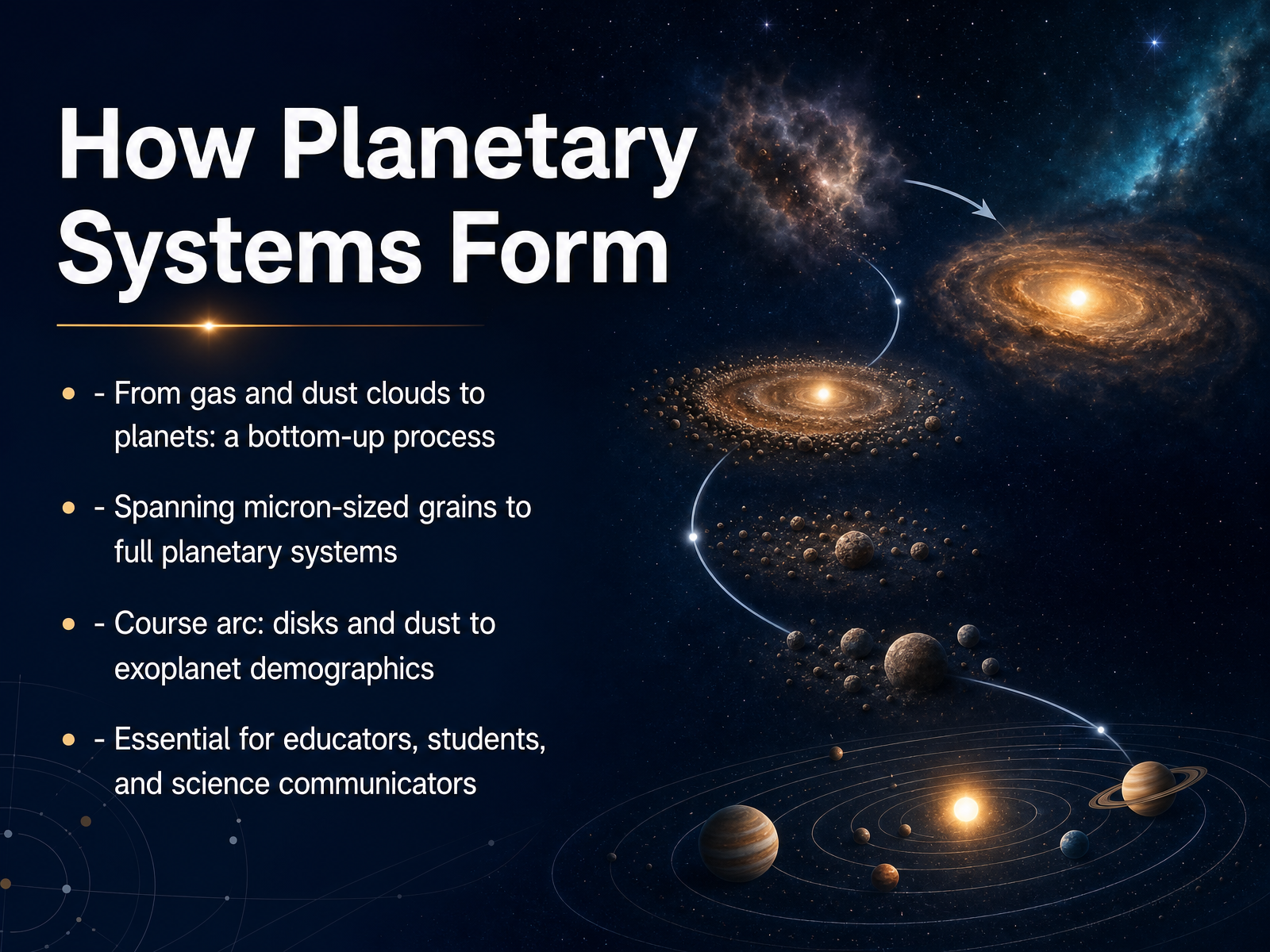
- 01How Planetary Systems FormWelcome, everyone. Have you ever looked up at the night sky and wondered how all of those planets came to be? Today, we're going to explore that very question. This course is a guided journey from the swirling gas and dust of space to the complex planetary systems we observe. We call this a bottom-up process, because it starts incredibly small. We begin with micron-sized dust grains, tinier than a grain of sand, and we trace how they collide and stick together step by step. Our path will take us through the birth of protoplanetary disks and the formation of planetesimals. We will then connect these ideas directly to what we see today, like the vast demographics of exoplanets discovered around other stars. This foundation is essential for educators, students, and science communicators like you. So, let's embark on this journey together. Next, we'll dig into the modern paradigm that explains this incredible process from the ground up.arxiv.orgarxiv.orgarxiv.org+21 min
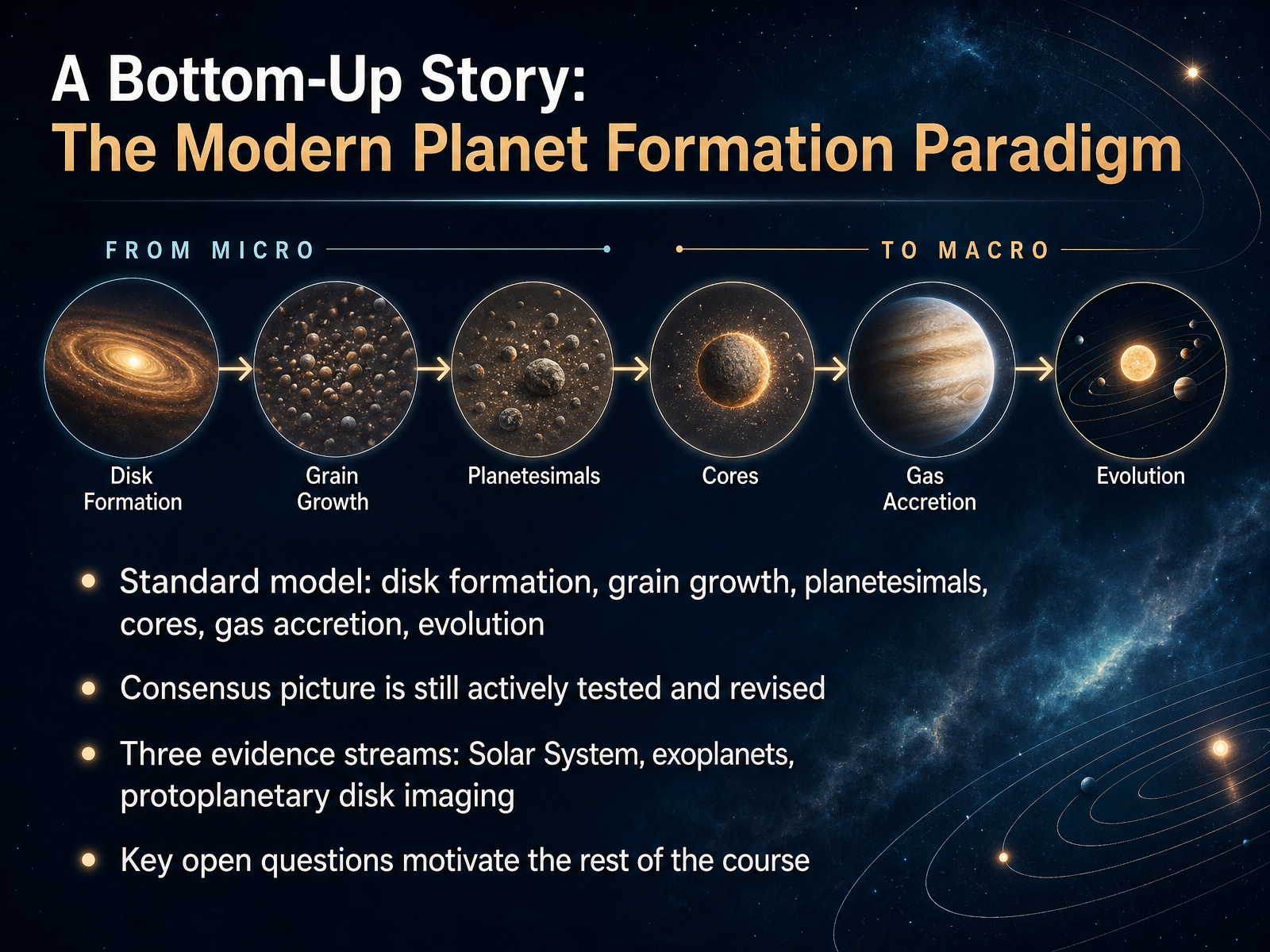
- 02A Bottom-Up Story: The Modern Planet Formation ParadigmSo how do we go from a swirling disk of gas and dust to a mature planetary system? The modern paradigm is a bottom-up story, starting small. Micron-sized grains collide and stick, growing into pebbles, then kilometer-scale planetesimals, and eventually planetary cores. If a core gets massive enough, it can capture surrounding gas and grow into a giant planet. This sequence—disk formation, grain growth, planetesimal formation, core growth, gas accretion, and finally system evolution—is our best working model. But it's important to stress that this picture is still actively tested and revised. Our understanding draws on three streams of evidence: the detailed census of our own Solar System, the thousands of exoplanets we now know, and direct imaging of protoplanetary disks around young stars. Each stream has its own strengths and its own puzzles. Key open questions remain, and we'll let them guide the rest of our exploration. Now, let's step back to the very beginning and look at the starting ingredients: molecular clouds and the birth of protoplanetary disks.
 arxiv.orgarxiv.orgarxiv.org+22 min
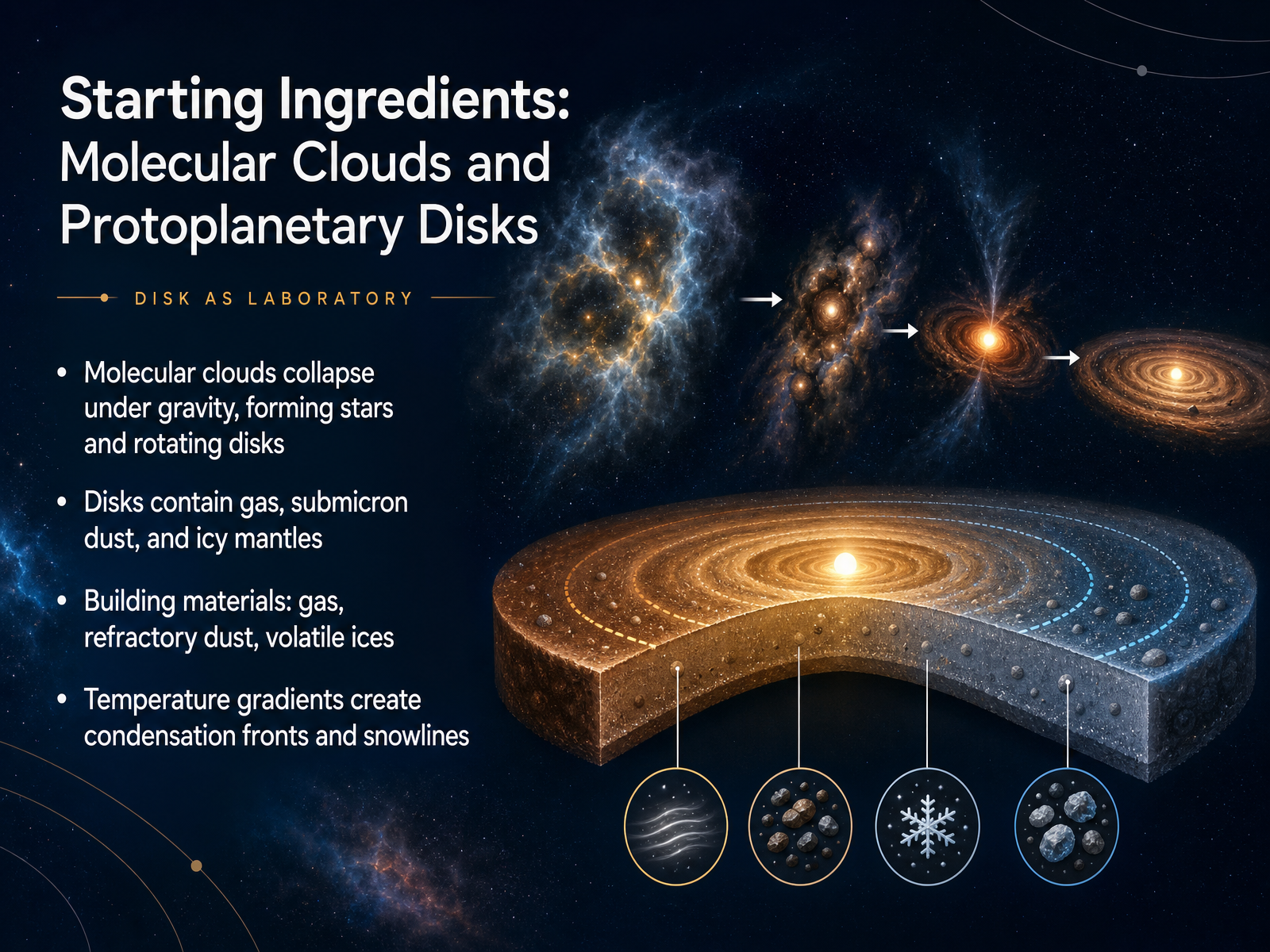
 - 03Starting Ingredients: Molecular Clouds and Protoplanetary DisksLet’s trace everything back to the very beginning. Planets don’t start as planets — they start inside vast, cold molecular clouds. These clouds are mostly hydrogen and helium gas, laced with tiny dust grains and frozen molecules. When one of these clouds collapses under its own gravity, most of the material falls inward to form the young star. But some of it, because of angular momentum, spreads out into a rotating disk around it. That’s the protoplanetary disk — the true birthplace of planets. In this disk we find the essential building materials: gas, submicron dust, and volatile ices. The gas supplies the bulk of the mass for giant planet atmospheres. The dust is the refractory, rocky material that will clump into cores. And the ices — water, carbon dioxide, methane and more — freeze onto those grains in the cold outer regions. Now, here’s the important twist: the disk is not uniform in temperature. Close to the star it’s hot; further out it’s cold. This temperature gradient creates condensation fronts, or snowlines — boundaries where specific volatiles freeze out onto dust grains. The water snowline, for instance, is where water transitions from vapor to ice, and its position shapes the whole chemistry of planet formation. So, think about it: can you identify where in the disk the icy building blocks become available for planetesimals?
 annualreviews.orgarxiv.orgaanda.org+21 min
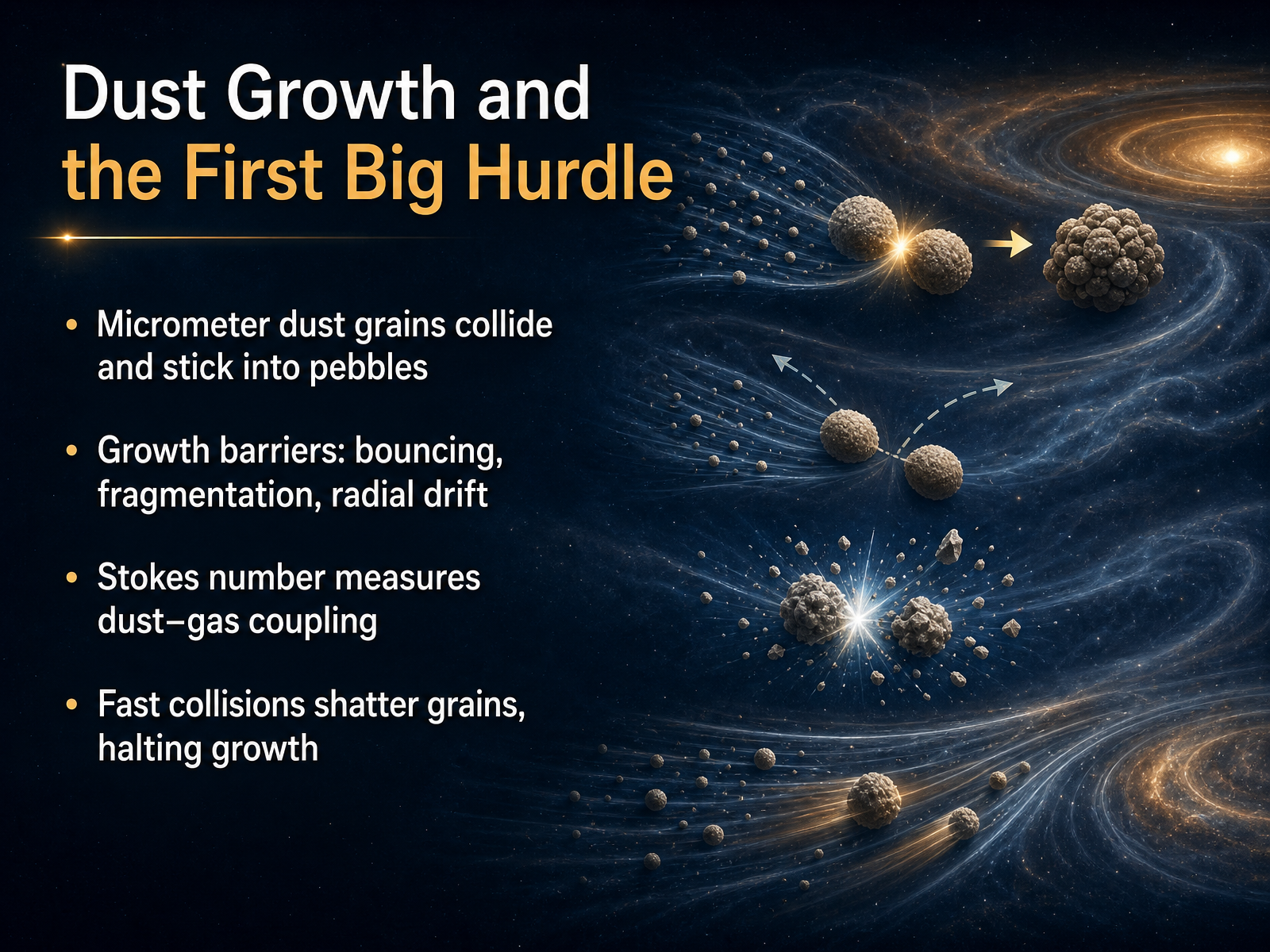
 - 04Dust Growth and the First Big HurdleNow we come to a moment where the story of planet formation hits its first serious obstacle. We begin with dust grains, only a few micrometers across, silently drifting in the disk. Left to the gentle physics of collision and sticking, these grains should grow into pebbles. And indeed, they do, at first. But as they grow, they run into what we call growth barriers. The first is bouncing, where grains hit each other and simply rebound instead of sticking. The second is fragmentation, where collisions become so fast that the aggregates shatter back into smaller pieces. And the third is radial drift, where larger grains feel gas drag in a way that spirals them inward toward the star before they can grow further. This is where the Stokes number becomes essential. It measures how tightly a grain is coupled to the gas. A very low Stokes number means the grain moves almost perfectly with the gas. A high one means it barely notices the gas at all. Grains in the intermediate range are the ones that drift fastest, and they are also the ones that most often collide at high speed. The result is a frustrating bottleneck. Fast collisions shatter the fragile aggregates, halting growth precisely when it should be accelerating. So how do we push past these barriers? In the next step, we will see how dense clumps of dust offer an escape route, turning this obstacle course into a pathway from pebbles to planetesimals.
 aanda.orgiopscience.iop.orgiopscience.iop.org+22 min
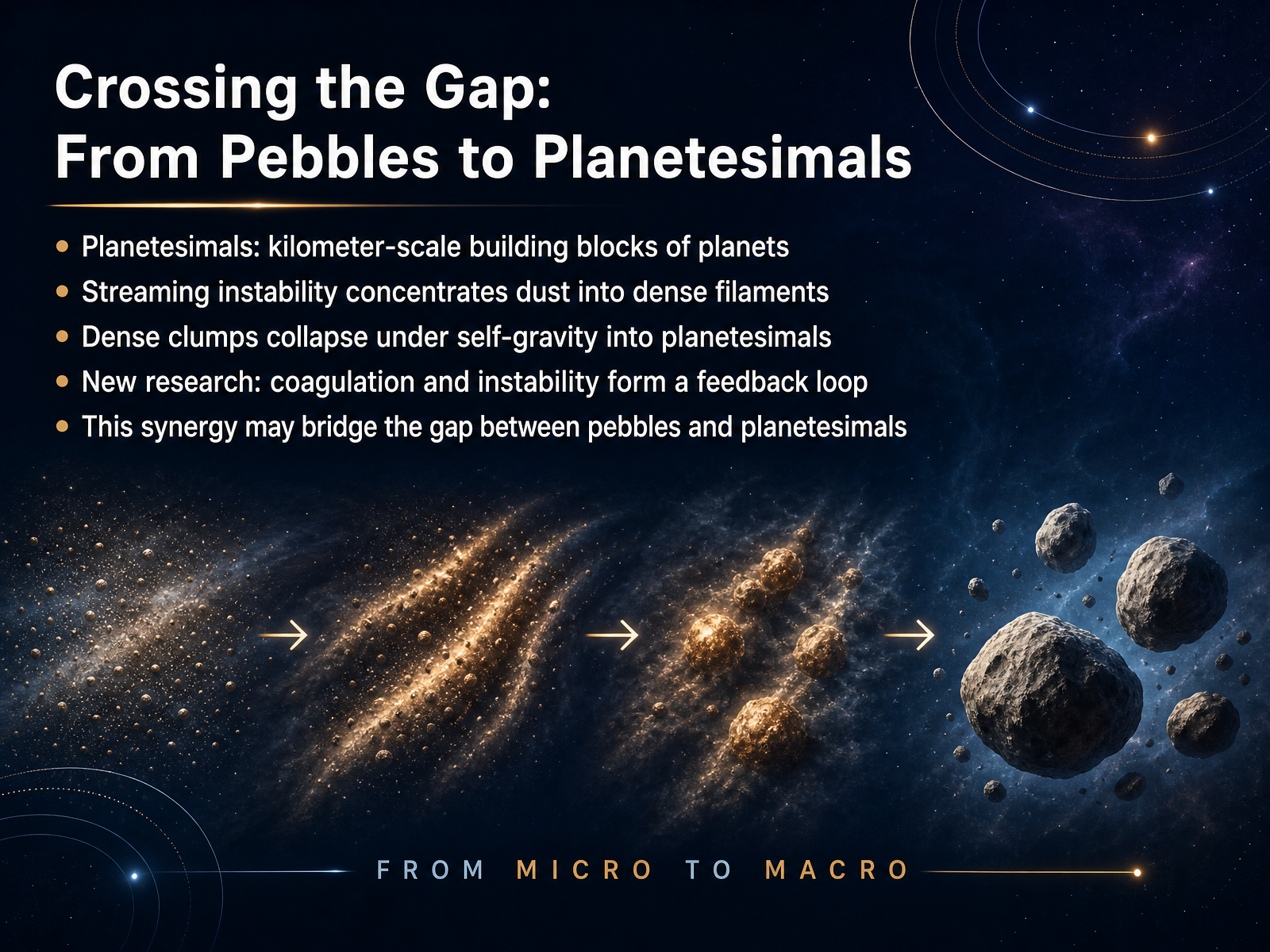
 - 05Crossing the Gap: From Pebbles to PlanetesimalsSo let's zoom in on the critical leap: the gap between pebbles and planetesimals. For decades, this was one of planet formation's stubborn puzzles. Dust grains stick together through coagulation, but they struggle to grow beyond a certain size. Meanwhile, the streaming instability—a process where dust and gas interact to concentrate solids—needs fairly large grains to work. So how do we bridge this gap? Recent research suggests that these two processes don't just work in sequence; they feed each other in a feedback loop. As the streaming instability gathers dust into dense, filament-like clumps, those clumps become calm, shielded environments where coagulation thrives. Grains collide gently, and without disruptive impacts, they grow larger. These larger grains then make the streaming instability even more effective, further concentrating the dust. Eventually, some clumps become so dense that they collapse under their own gravity, forming kilometer-scale planetesimals. This synergy may be the missing key—a positive feedback where each process boosts the other, turning cosmic dust into the building blocks of worlds. Before moving on, consider this: what conditions in a protoplanetary disk would favor this feedback loop operating at full strength? Next, we'll examine how the snow line and disk chemistry influence this entire process.
 aanda.orgiopscience.iop.orgiopscience.iop.org+22 min
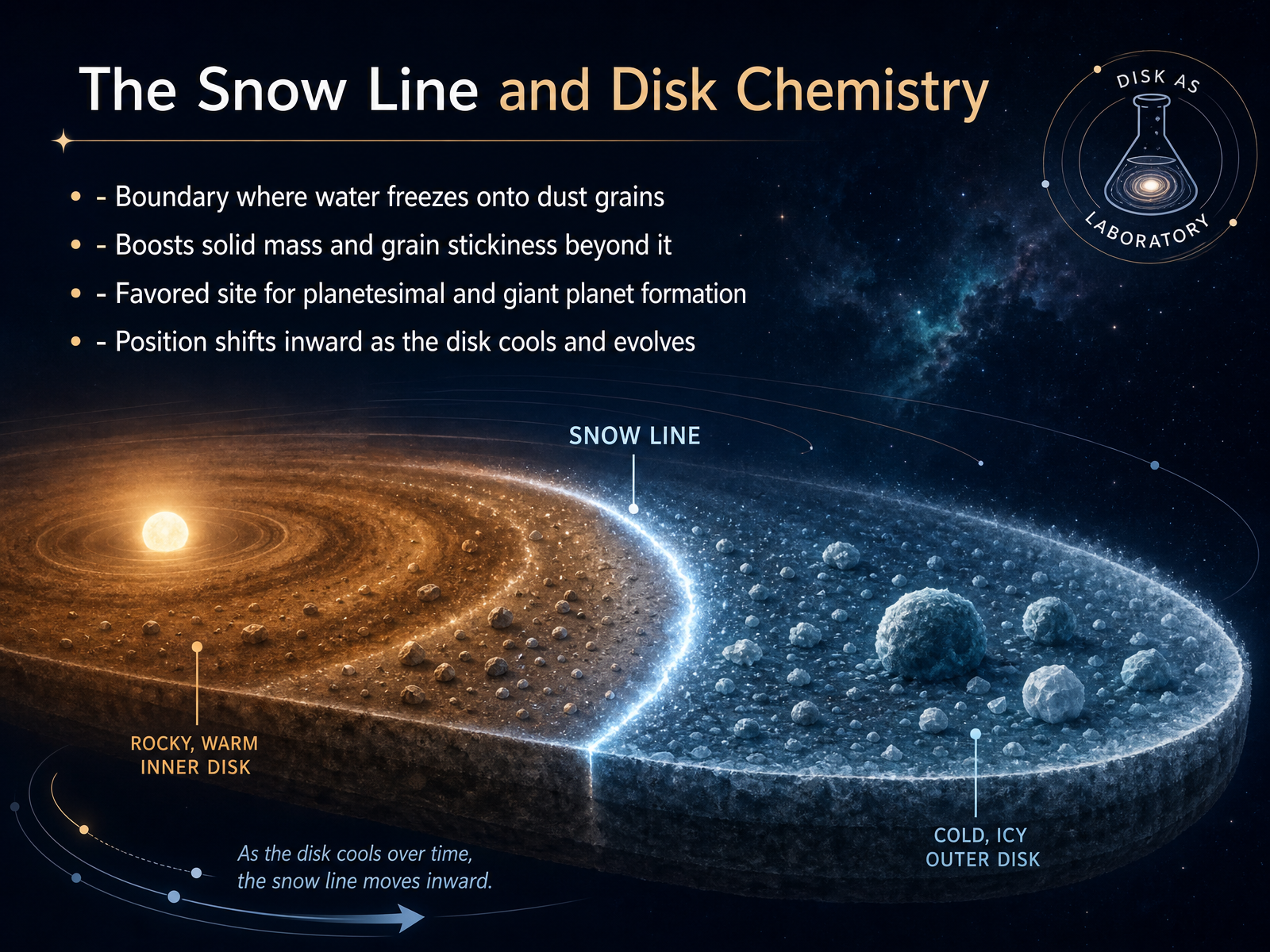
 - 06The Snow Line and Disk ChemistryNow, let’s talk about one of the most important boundaries in the disk: the snow line. This is the region where the temperature drops enough for water vapor to condense into ice on the surface of dust grains. And this simple phase change does something incredible. Beyond the snow line, that ice coating effectively doubles the amount of solid material available to build planets. But it doesn’t just add mass—the ice makes the grains stickier, which means they collide and clump together far more easily than bare silicates do. In fact, we’ve observed that giant planet formation is strongly favored just beyond this boundary. The increased solid surface density, coupled with the enhanced stickiness, creates ideal conditions for the first planetesimals to form through processes like the streaming instability. The snow line isn’t static, though. As the disk cools and evolves over time, its position migrates inward, which means the region of enhanced planet-forming material gradually sweeps closer to the star. So, if the snow line is the starting gun for building giant planet cores, what happens after those first seeds of rock and ice form? Let’s shift our focus to the next stage and explore how planetesimals and pebbles come together to build full-fledged planetary cores.
 aanda.orgiopscience.iop.orgiopscience.iop.org+22 min
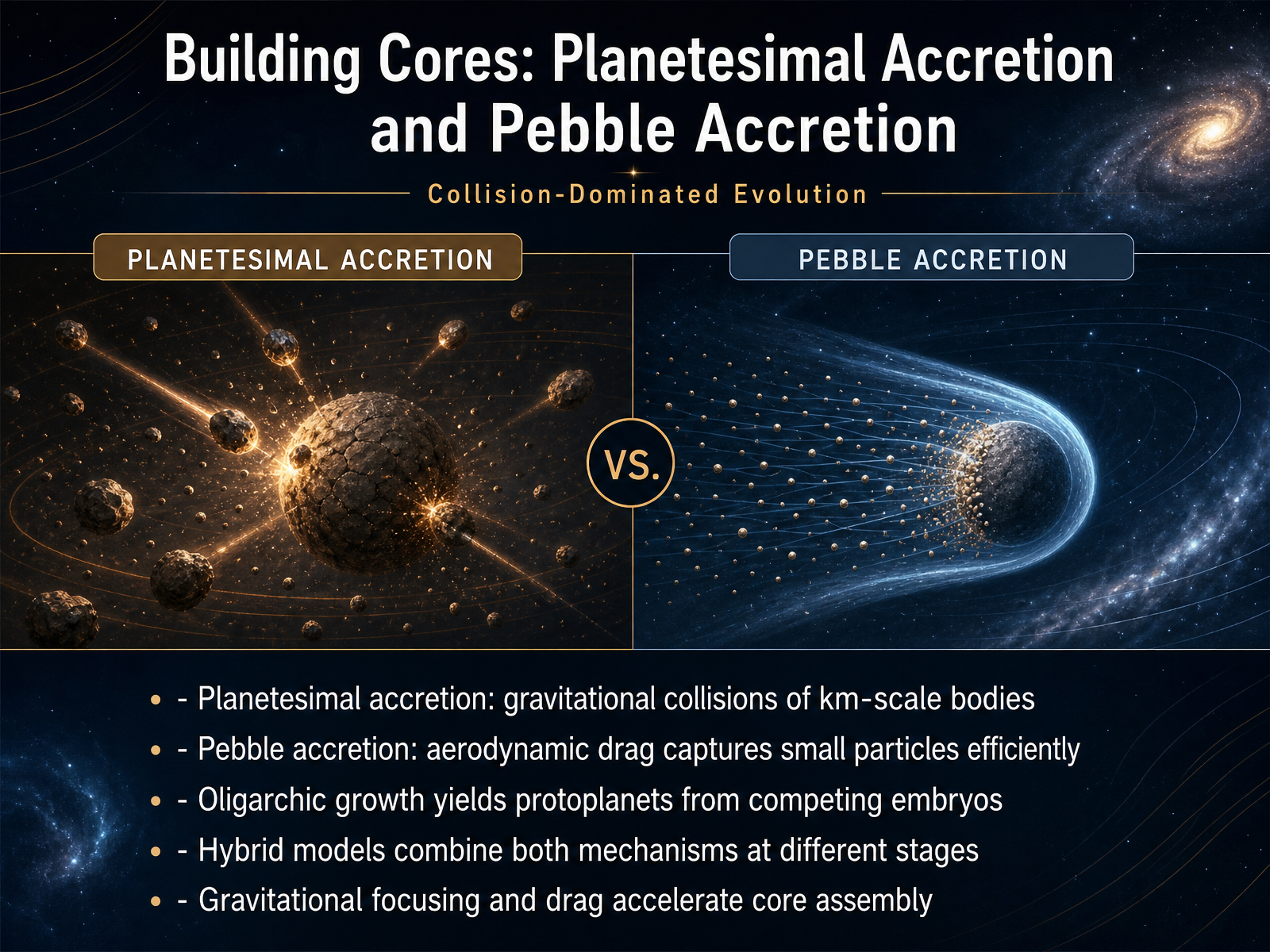
 - 07Building Cores: Planetesimal Accretion and Pebble AccretionNow we move from loose building blocks to assembling actual cores. Let’s compare two key mechanisms. Planetesimal accretion is the classic route: kilometer-scale bodies collide gravitationally, with gravitational focusing boosting the odds of growth. Pebble accretion, by contrast, relies on drag from the gas disk to channel tiny particles into a growing protoplanet’s envelope, capturing them far more efficiently. In practice, growth often shifts from planetesimal collisions early on to pebble accretion once a protoplanet is massive enough. This leads to oligarchic growth, where competing embryos dominate their feeding zones and sweep up nearby material. Ultimately, the fastest route to assembling an Earth-mass core combines both mechanisms, as aerodynamic drag and gravitational focusing accelerate the process. So which mechanism, planetesimal or pebble accretion, do you think dominates in the early stages of core growth? Next, we’ll explore how these cores transition into giants.
 arxiv.orgarxiv.orgarxiv.org+21 min
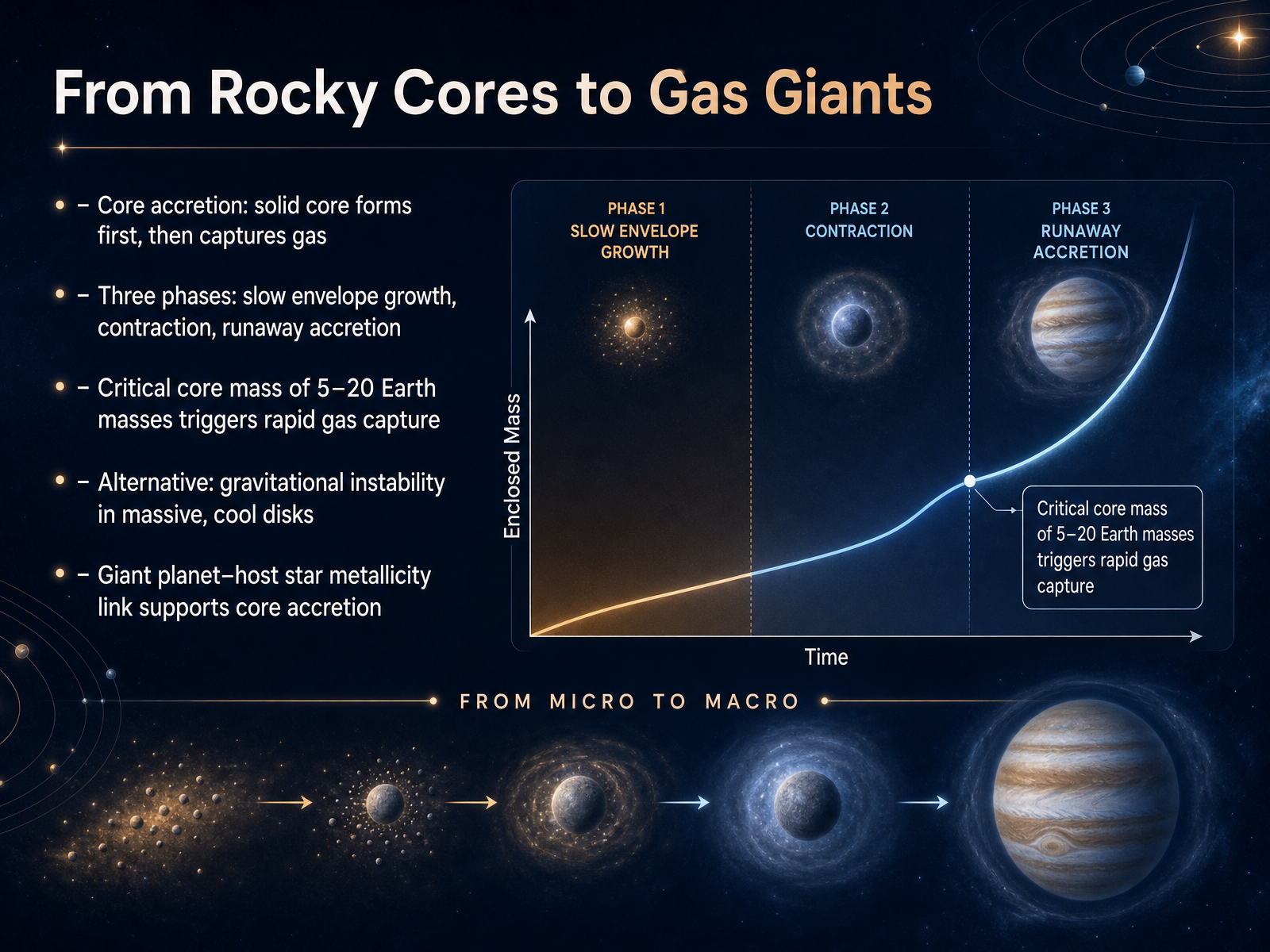
 - 08From Rocky Cores to Gas GiantsSo how does a rocky core become a gas giant? The answer is core accretion, and it has three distinct phases. First, a solid core forms from colliding planetesimals. It grows slowly, holding onto a small envelope of gas. During this slow phase, the envelope stays in equilibrium, supported by the heat from incoming solids. But as the core grows past a critical mass, usually between five and twenty Earth masses, the balance breaks. The envelope can't radiate its heat fast enough, and it contracts. This triggers the third phase: runaway gas accretion, where the planet pulls in hundreds of Earth masses of hydrogen and helium from the disk. There is an alternative, called gravitational instability, where massive, cool disks fragment directly into giant planets. But here is the key clue that favors core accretion: giants are found more often around metal-rich stars. More metals mean more solid building blocks, which means bigger cores, which means gas giants. So when you look at a Jupiter-mass planet, you are likely seeing the outcome of a solid start. Now, once these giants form, their gravitational dance with the disk begins. That leads us to our next topic: planetary migration and orbital architecture.
 arxiv.orgarxiv.orgarxiv.org+22 min
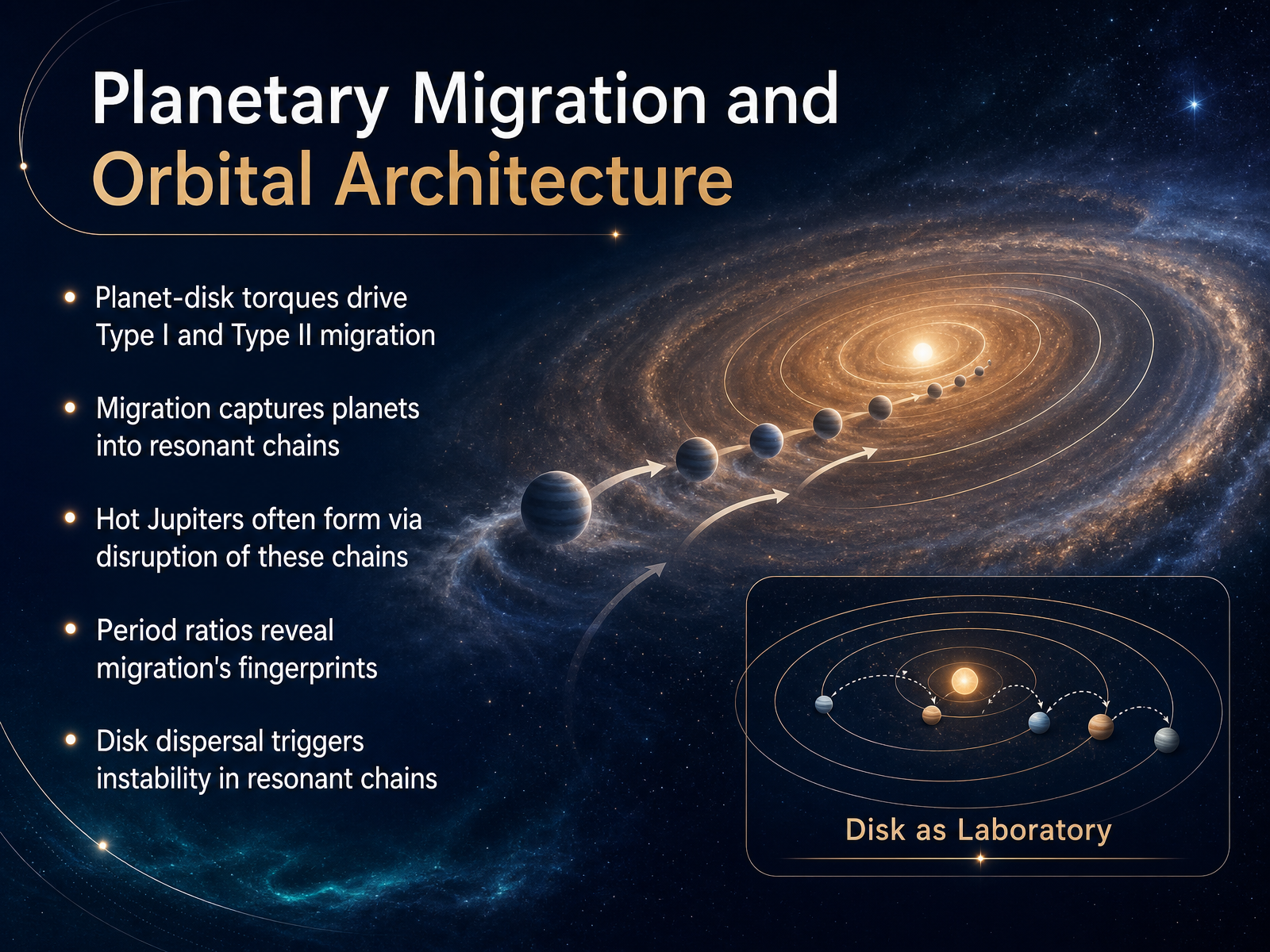
 - 09Planetary Migration and Orbital ArchitectureNow let’s turn to a force that reshapes entire systems: planetary migration. As planets grow, they exchange angular momentum with the gas disk around them. Smaller planets feel Type I migration, a slow inward drift. Giant planets, however, can open a gap in the disk and undergo the slower, Type II migration. This convergent migration is what locks neighboring planets into resonant chains, where their orbital periods form simple integer ratios like three to two. These chains are delicate. When the gas disk disperses, the damping that held them in place vanishes. Instability follows, often within a few million years. The orbits cross, planets scatter, and some are flung inward. This disruption is one leading pathway to hot Jupiters, gas giants that end up orbiting their stars in just days. The fingerprints of this story are visible in the period ratios we observe, and in the fact that hot Jupiters rarely have close companions, while warmer Jupiters often do. So, when you look at a system’s orbital spacing, what clues tell you whether it migrated smoothly or was violently reshaped? Next, we’ll explore what happens after the dust settles, in the late stages of impacts and dynamical sculpting.
 arxiv.orgarxiv.orgarxiv.org+22 min
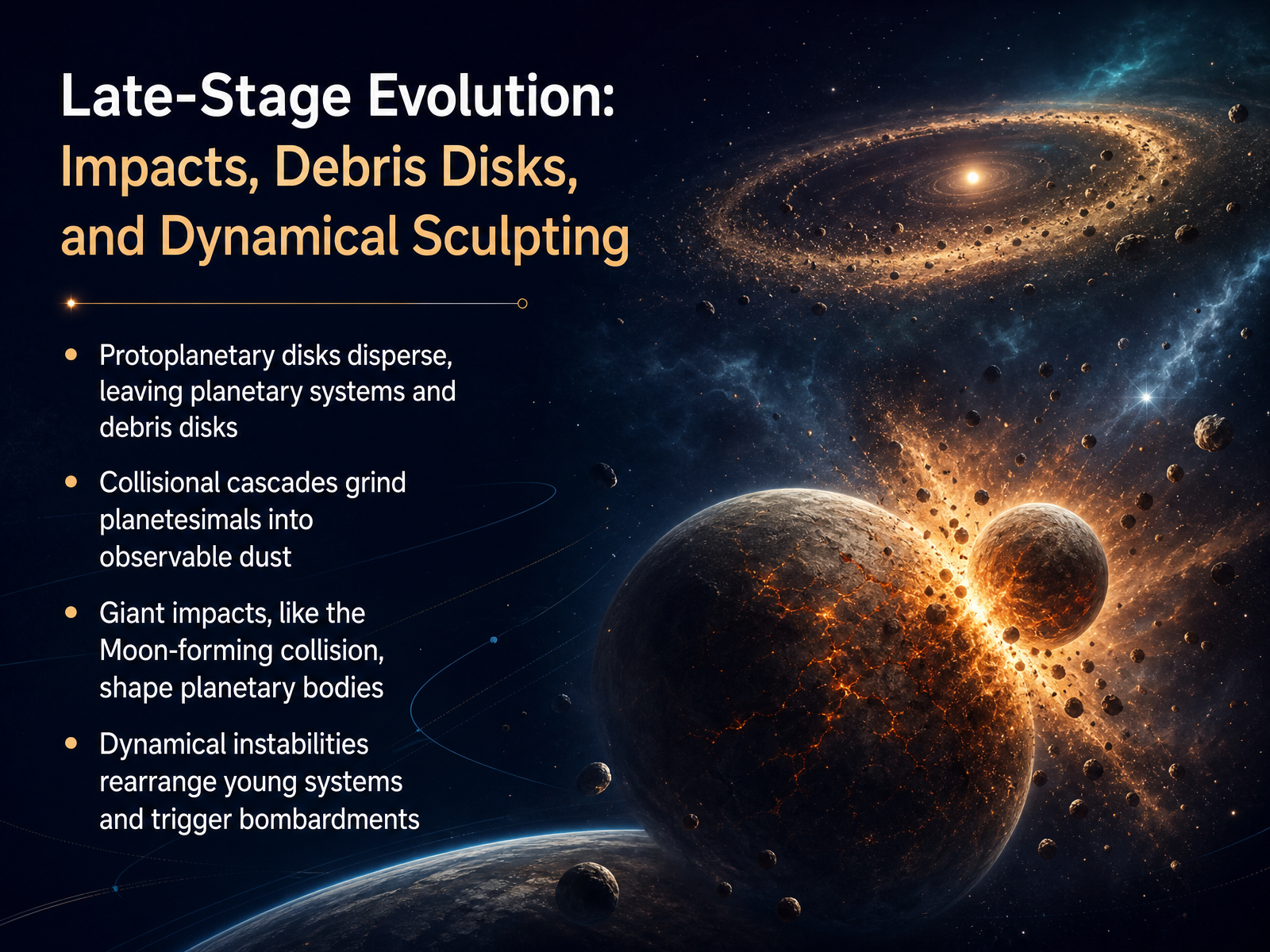
 - 10Late-Stage Evolution: Impacts, Debris Disks, and Dynamical SculptingNow let’s look at the late stages of planetary system evolution. Once the protoplanetary disk disperses, we’re left with the planets themselves, plus a debris disk—a cloud of leftover planetesimals, dust, and gas. In our own Solar System, the asteroid belt and Kuiper belt are prime examples. Over time, collisions between these leftover bodies trigger what we call collisional cascades, grinding them down into fine dust that we can observe around other stars. Some of the most dramatic events are giant impacts—collisions between planetary embryos. The leading theory for the Moon’s origin is a Mars-sized body striking the early Earth. Such impacts leave behind distinct debris signatures that we can actually detect around young stars. And finally, dynamical instabilities can rearrange entire systems. As giant planets scatter, they may send showers of planetesimals inward, causing bombardment episodes like the Late Heavy Bombardment our own Moon experienced. So, the key checkpoint is this: what are the main processes that shape a planetary system after its disk dissipates?
 arxiv.orgarxiv.orgarxiv.org+22 min
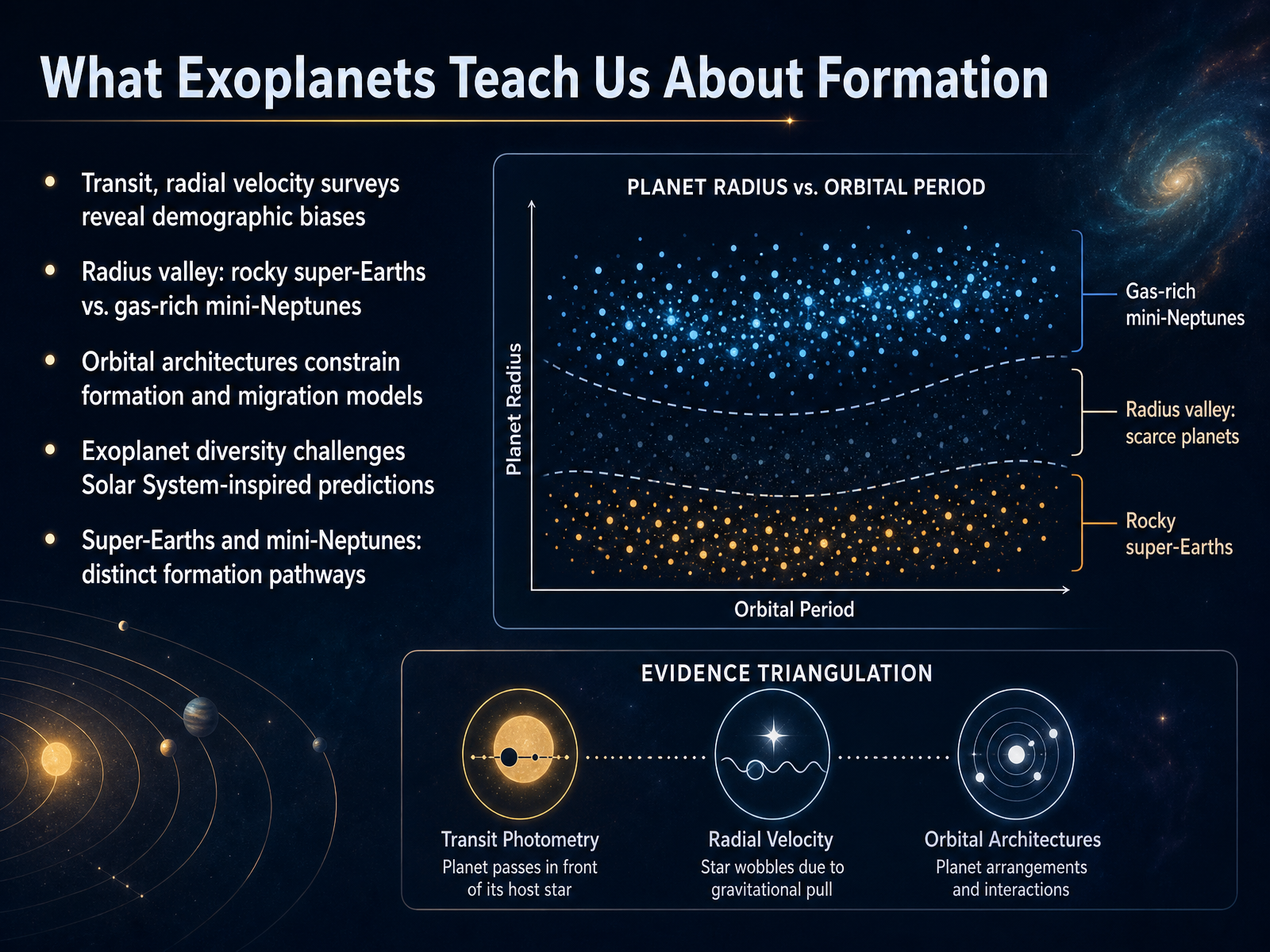
 - 11What Exoplanets Teach Us About FormationNow let's see what exoplanets reveal about planet formation. Survey methods like transits and radial velocity have given us a demographic census, and the results are striking. There's a clear radius valley around 1.8 Earth radii. Below it sit rocky super-Earths, and above it, gas-rich mini-Neptunes. This split suggests these two classes likely form through different pathways. Super-Earths seem to grow from inner rings of rocky material via planetesimal accretion, while mini-Neptunes start beyond the water snowline and grow by pebble accretion. Their orbital architectures also differ. Super-Earths experience more violent dynamical histories, with scattering and giant impacts, whereas mini-Neptunes evolve more quietly. These patterns challenge our Solar-System-centric expectations and push us to refine our models. The key takeaway is that exoplanet demographics give us a statistical laboratory to test formation theory. Next, we'll look at how we can observe planet formation in real time.
 1 min
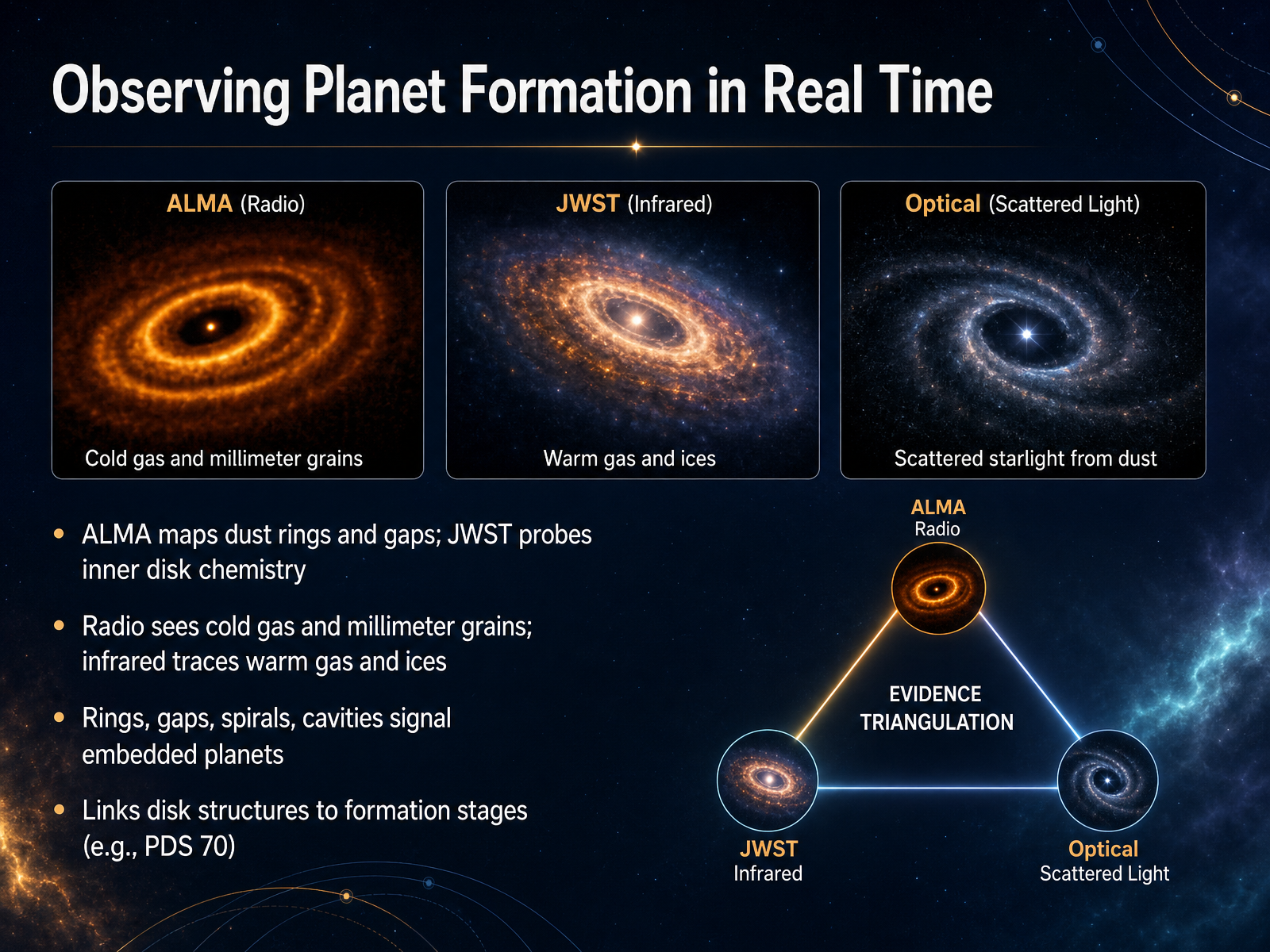
1 min - 12Observing Planet Formation in Real TimeNow let's look at how we observe planet formation in real time, using two powerful tools: ALMA and the James Webb Space Telescope. ALMA, in Chile, maps the cold outer disk, capturing the glow of millimeter-sized dust grains and cold gas. JWST, in space, probes the inner disk chemistry, tracing warm gas and ices in infrared light. Together, they give us a complete chemical inventory, from the terrestrial planet-forming zone to the outer regions where comets assemble. When we look at these disks, we see structures: rings, gaps, spirals, and cavities. These are the fingerprints of embedded planets, carving their paths through the material. A perfect example is PDS 70, where we have directly imaged two protoplanets. ALMA reveals the gaps they've cleared, while JWST detects water vapor in the inner disk, a crucial ingredient for potential rocky worlds. These observations link the disk's structure to its stage of formation. Before we move on, let's pause for a moment. If you see a ring and a gap in a protoplanetary disk, what is the most likely cause? We'll explore that and more as we address some common misconceptions next.
 annualreviews.orgarxiv.orgaanda.org+22 min
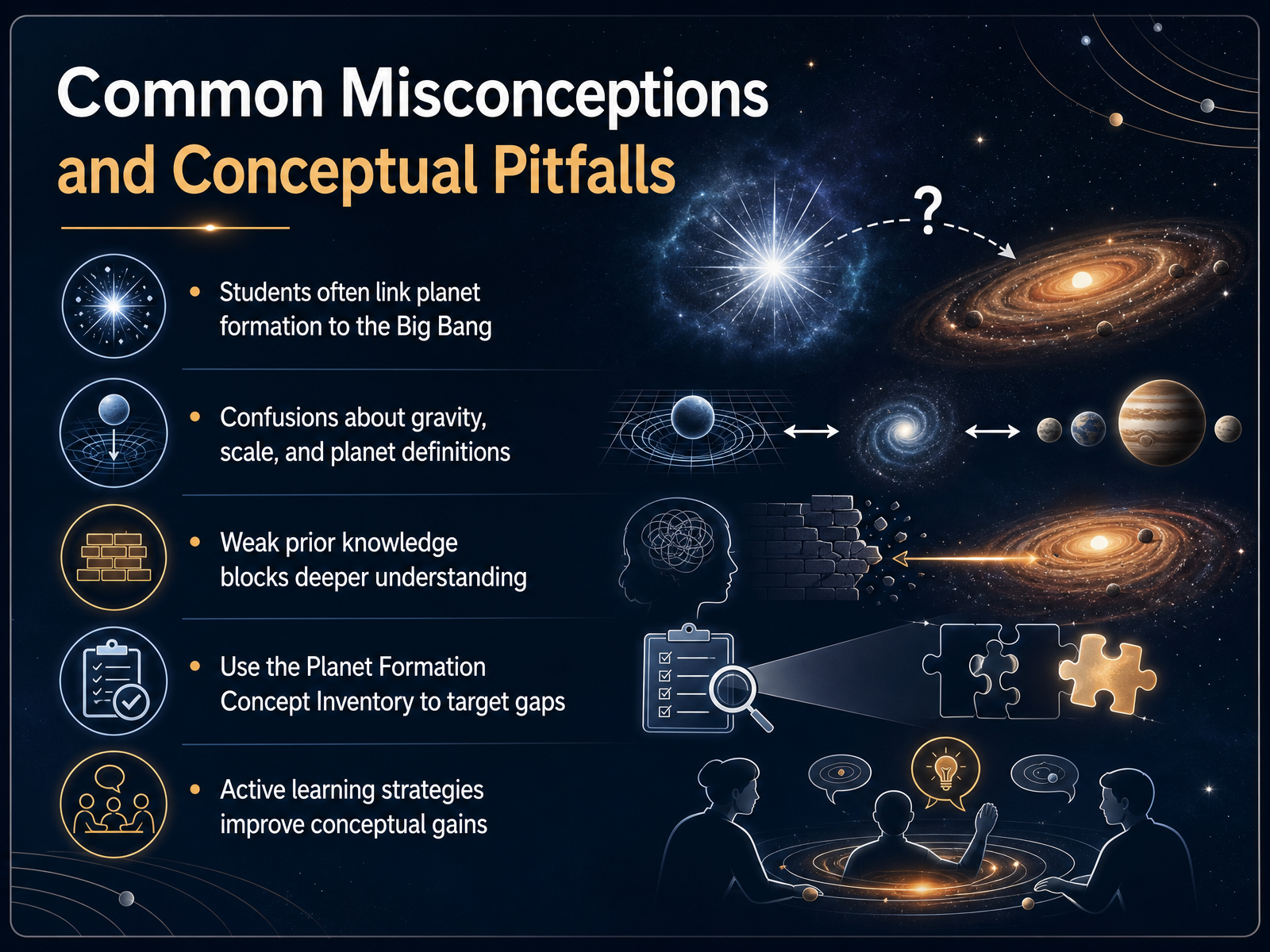
 - 13Common Misconceptions and Conceptual PitfallsLet’s take a moment to clear up some common misconceptions about planet formation. One of the most frequent pitfalls is linking our Solar System’s birth directly to the Big Bang. In reality, the Big Bang created the universe’s raw ingredients, but planets formed billions of years later, from a rotating disk of gas and dust around our young Sun. Gravity then did the heavy lifting, drawing material together into planetesimals and eventually into worlds. We also often run into confusion about gravity, scale, and even what counts as a planet. For instance, many students struggle to separate mass from density, which blocks a deeper understanding of how worlds grow. To target these gaps, researchers developed the Planet Formation Concept Inventory, a reliable diagnostic tool that pinpoints exactly where understanding breaks down. Once we identify those weak spots, active learning strategies like collaborative tutorials become powerful. Studies show these methods lead to significantly higher learning gains than lecture alone. So, as we teach, let’s keep the Big Bang and planet formation in their rightful places, and use every tool we have to build a solid cosmic foundation. Up next, we’ll explore practical ways to teach and communicate this amazing story of planetary origins.
 2 min
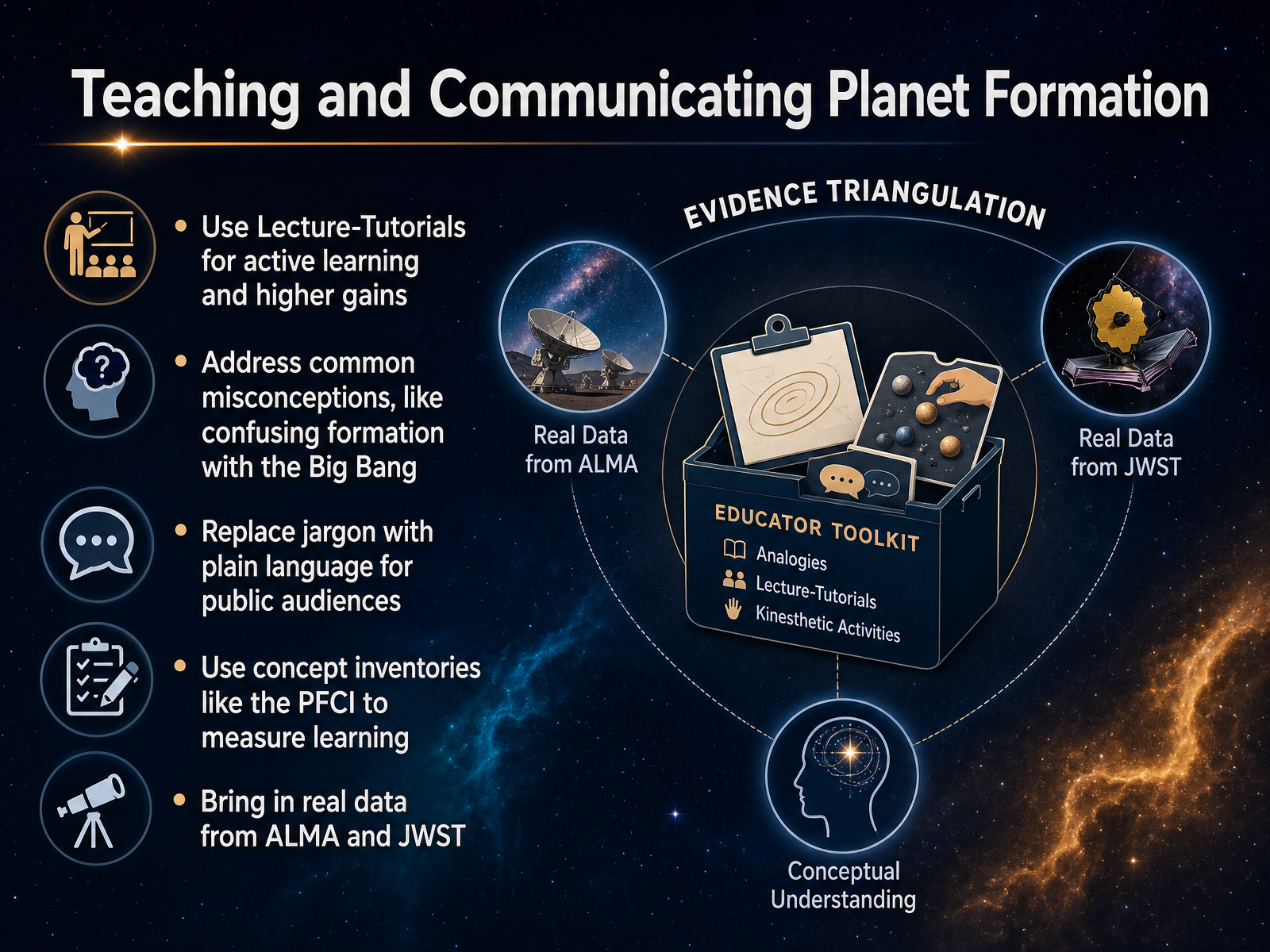
2 min - 14Teaching and Communicating Planet FormationWe have covered a lot of ground, from collapsing clouds to forming planets. Now, let's talk about how we can share this story. As educators and communicators, our goal is to spark that same curiosity we feel. One of the best tools we have is the Lecture-Tutorial, which gets learners actively working through concepts in small groups. Research shows this leads to much higher learning gains than a traditional lecture. However, we must also address common misconceptions head-on. Many students, for example, think our Solar System formed directly from the Big Bang. We know it actually formed from a collapsing cloud of gas and dust billions of years later. To connect with public audiences, we need to replace jargon with plain language. We can measure our success using concept inventories like the Planet Formation Concept Inventory. And finally, we can bring the subject to life with real data from observatories like ALMA and JWST, showing them actual images of disks where planets are forming right now. That is what makes this science so exciting. Thank you for joining me on this journey. Now, go out there and share the wonder of planetary formation with others. You have the tools to make it clear, engaging, and truly memorable.
 2 min
2 min
Take the deck with you
Download this course as a file — free, no sign-up needed.
- PDF handoutEvery slide page, ready to print or share.15 pages · 4.6 MBDownload
- Narrated PowerPointThe deck that presents itself — every slide carries the digital human's narration video.15 pages · 30.0 MBDownload
- PowerPoint slidesThe full deck as a .pptx — open it in PowerPoint, Keynote, or Google Slides.15 pages · 4.6 MBDownload
Free to use in your own training — please keep the PersonWise credit page at the end.
Have your own deck? Turn it into a course
Sources consulted
Web sources consulted while building this course.
- Planet formation theory: an overview — arxiv.org
- [2604.09011] The formation of planetary systems: physics, populations, and architectures — arxiv.org
- Planet formation - observational constraints, physical processes, and compositional patterns — arxiv.org
- Planetary formation and early phases — comptes-rendus.academie-sciences.fr
- Astrophysics of Planet Formation — cambridge.org
- Protoplanetary Disk Chemistry | Annual Reviews — annualreviews.org
- Chapter 0 Protoplanetary disk chemistry and structure — arxiv.org
- Consistent dust and gas models for protoplanetary disks - I. Disk shape, dust settling, opacities, and PAHs | Astronomy & Astrophysics (A&A) — aanda.org
- Protoplanetary Disks and their Evolution — sites.astro.caltech.edu
- Gas, Ice Surfaces, and Ice Mantles of Dust Grains - IOPscience — iopscience.iop.org
- Positive feedback: How a synergy between the streaming instability and dust coagulation forms planetesimals | Astronomy & Astrophysics (A&A) — aanda.org
- Dust Coagulation Assisted by Streaming Instability in Protoplanetary Disks - IOPscience — iopscience.iop.org
- Effects of Dust Coagulation on Streaming Instability - IOPscience — iopscience.iop.org
- Coexistence of coagulation and streaming instabilities in protoplanetary disks | Astronomy & Astrophysics (A&A) — aanda.org
- Positive feedback: How a synergy between the streaming instability and dust coagulation forms planetesimals | Astronomy & Astrophysics (A&A) — aanda.org
- Giant planet formation at the pressure maxima of protoplanetary disks - II. A hybrid accretion scenario | Astronomy & Astrophysics (A&A) — aanda.org
- Planet Formation around Stars of Various Masses: The Snow Line and the Frequency of Giant Planets - IOPscience — iopscience.iop.org
- On the Location of the Snow Line in a Protoplanetary Disk - IOPscience — iopscience.iop.org
- Hints for a Turnover at the Snow Line in the Giant Planet Occurrence Rate - IOPscience — iopscience.iop.org
- Planetesimal formation starts at the snow line — aanda.org