Begin
10 pages · ~20 min
Frontend Edge Computing on Cloud Platforms
A concise training on frontend cloud platforms and edge computing for developers, covering how to deploy and optimize modern web applications.
A digital instructor presents all 10 pages. Hold “Ask” at any point and ask out loud — the answer comes from this course. No sign-up needed.
What you’ll learn
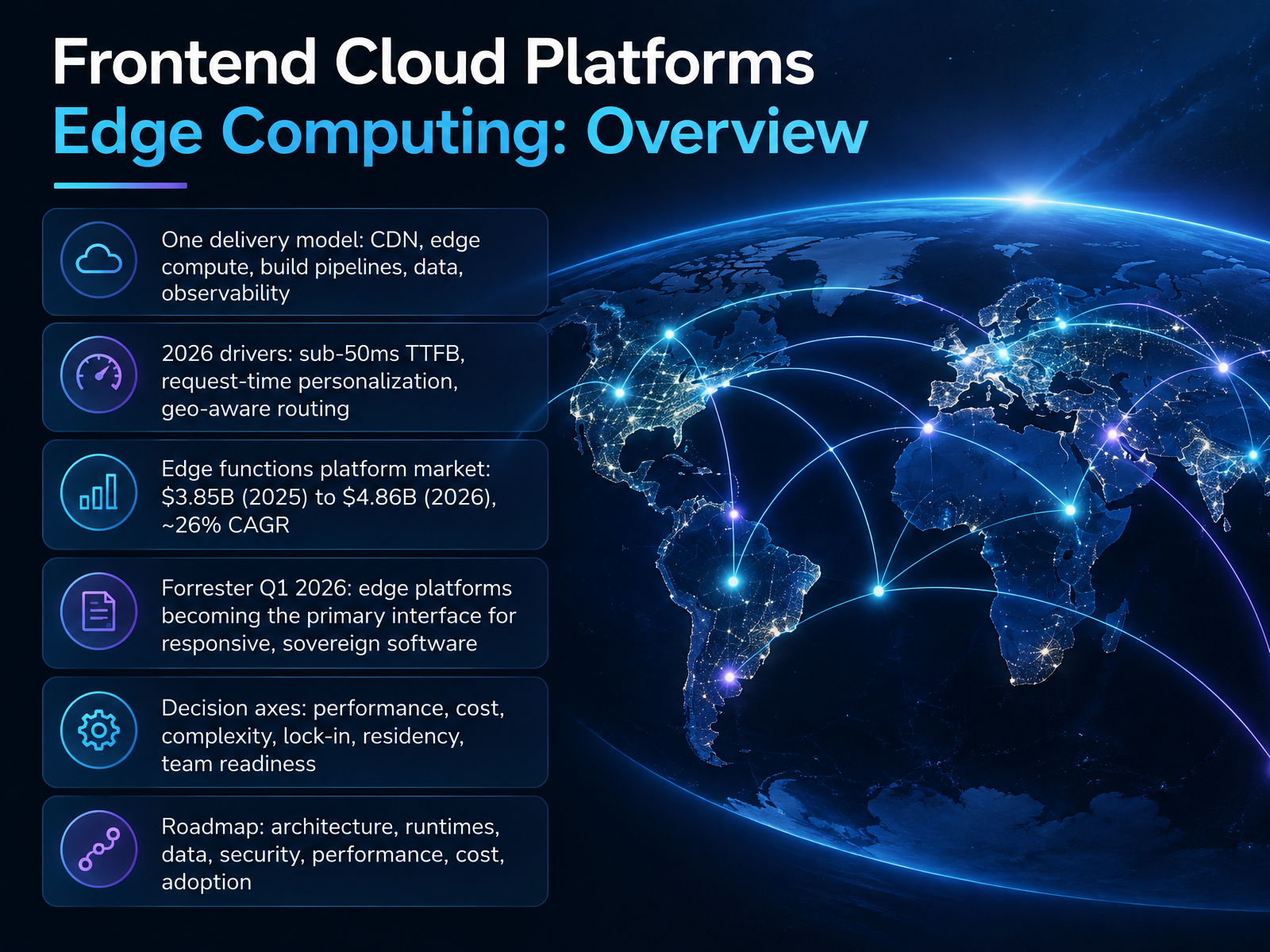
- 01Frontend Cloud Platforms Edge Computing: OverviewWelcome. Over the next ten slides we are going to evaluate frontend cloud platforms and edge computing the way you would in an architecture review. Not a vendor pitch, a decision framework. We will treat the platform as one delivery model: CDN, edge compute, build pipelines, data, and observability working together. The 2026 drivers are concrete. Sub fifty millisecond time to first byte, request-time personalization, and geo-aware routing. The edge functions platform market reflects that momentum, roughly three point eight five billion dollars in 2025, four point eight six billion in 2026, about twenty six percent compound annual growth. Forrester's Q1 2026 Wave frames these platforms as becoming the primary interface for responsive, sovereign software. And sovereign is the new word in that sentence. Our decision axes will be performance, cost, complexity, lock-in, residency, and team readiness. From there, a roadmap: architecture, runtimes, data, security, performance, cost, and adoption. Plenty of trade-offs ahead, so let us ground the rest in how we got here. Background: From CDN Caching to Edge Execution.gartner.comforrester.comgiiresearch.com+22 min
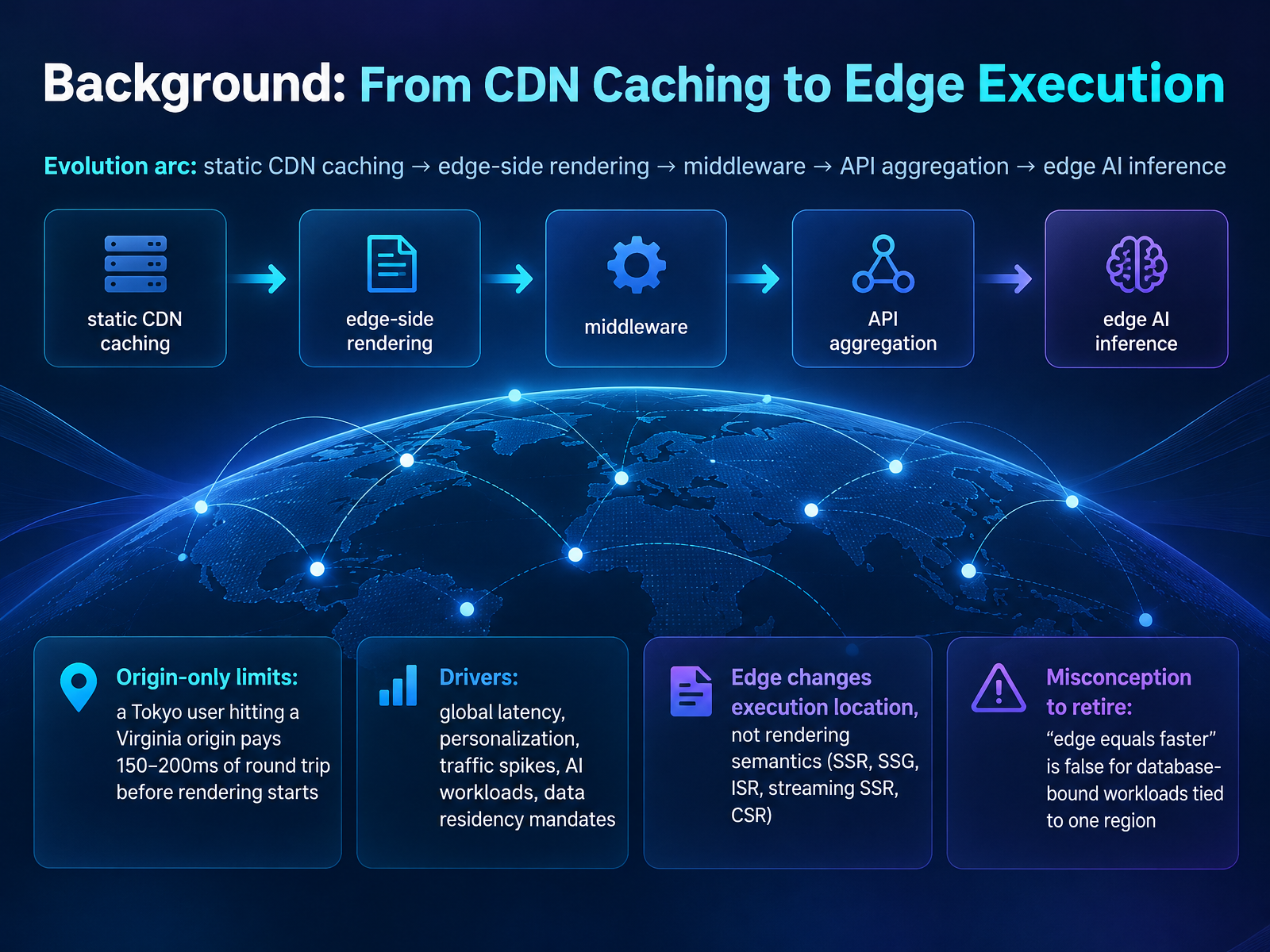
- 02Background: From CDN Caching to Edge ExecutionMoving on, let's talk about how we got here. The evolution arc runs from static CDN caching, to edge-side rendering, to middleware, then API aggregation, and now edge AI inference. The original driver was distance. A user in Tokyo hitting a Virginia origin pays one hundred fifty to two hundred milliseconds of round trip before rendering even starts. So the drivers are global latency, personalization, traffic spikes, AI workloads, and data residency mandates. But here's the key distinction: the edge changes where execution happens, not your rendering semantics. Server-side rendering, static generation, incremental static regeneration, streaming, and client-side rendering all still apply. And retire one misconception now. Edge equals faster is false for database-bound workloads tied to one region. You just move the round trip from the user-to-server hop to the server-to-database hop. Next, we'll ground this in core concepts and terminology.
 web.develtherion.comedilec.com+21 min
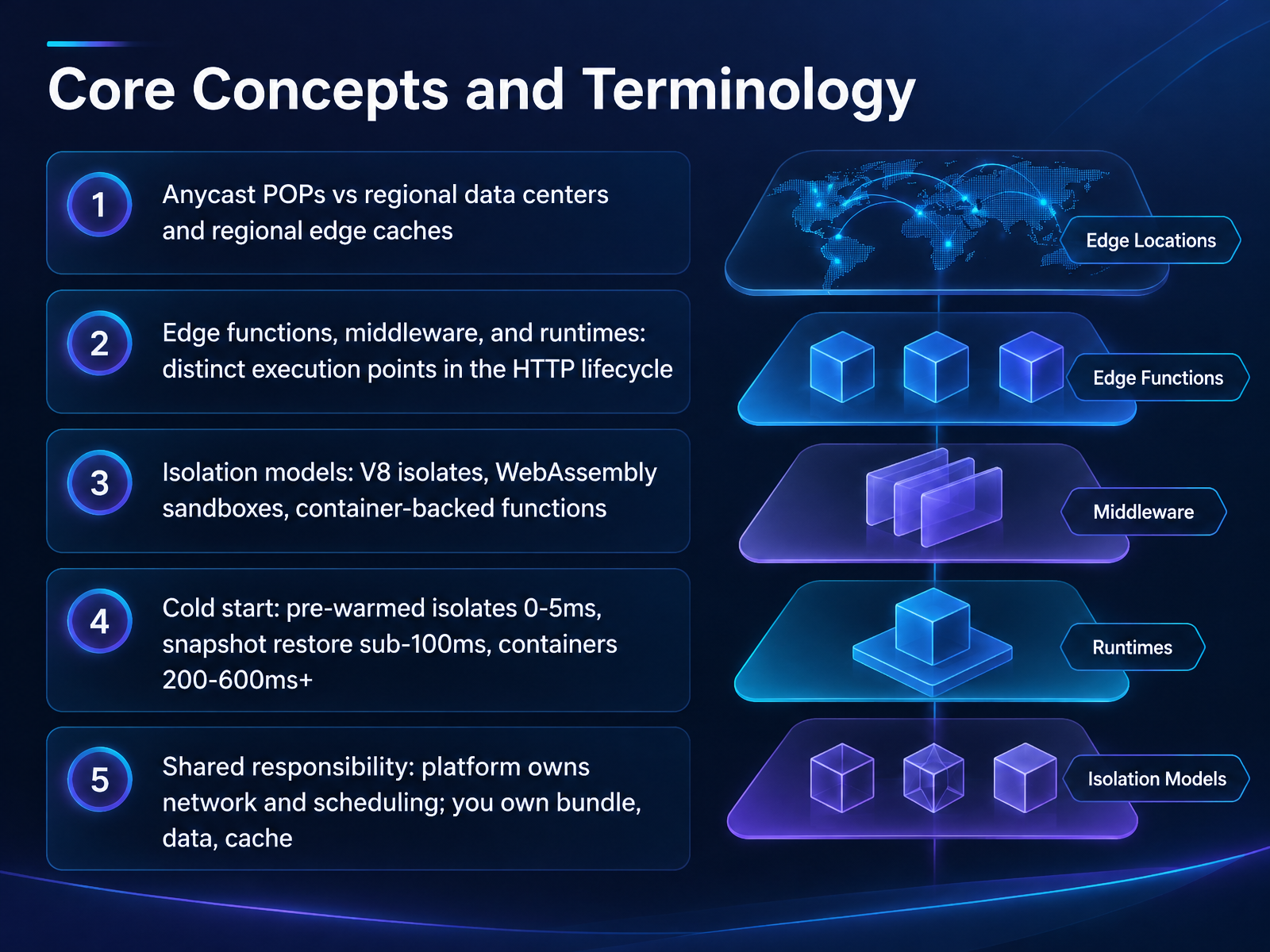
- 03Core Concepts and TerminologyLet's ground the terminology before we make architecture calls. First, anycast POPs versus regional data centers and regional edge caches. Anycast routes a user to the nearest healthy point of presence. A regional cache sits further back and serves a whole region. Know which tier your request terminates in, because it decides your latency floor. Second, execution points in the HTTP lifecycle. Edge functions and middleware run before origin on request paths, often rewriting headers, redirects, and auth checks. Middleware is your request-time hook. Now isolation models. V8 isolates share a process and memory is isolated per tenant. WebAssembly sandboxes give you per-request instances with strong isolation but extra input and output overhead. Container-backed functions give you the full runtime, at the cost of provisioning. That maps directly to cold start. Pre-warmed isolates typically land around zero to five milliseconds. Snapshot restore stays under one hundred milliseconds. Containers run two hundred to six hundred milliseconds or more. And shared responsibility. The platform owns the network, scheduling, and isolate lifecycle. You own your bundle size, your data access pattern, and your cache headers. So audit those before you pick a runtime. Next, we move into the platform architecture and delivery model.
 dl.acm.orgarxiv.orgfaculty.cc.gatech.edu+22 min
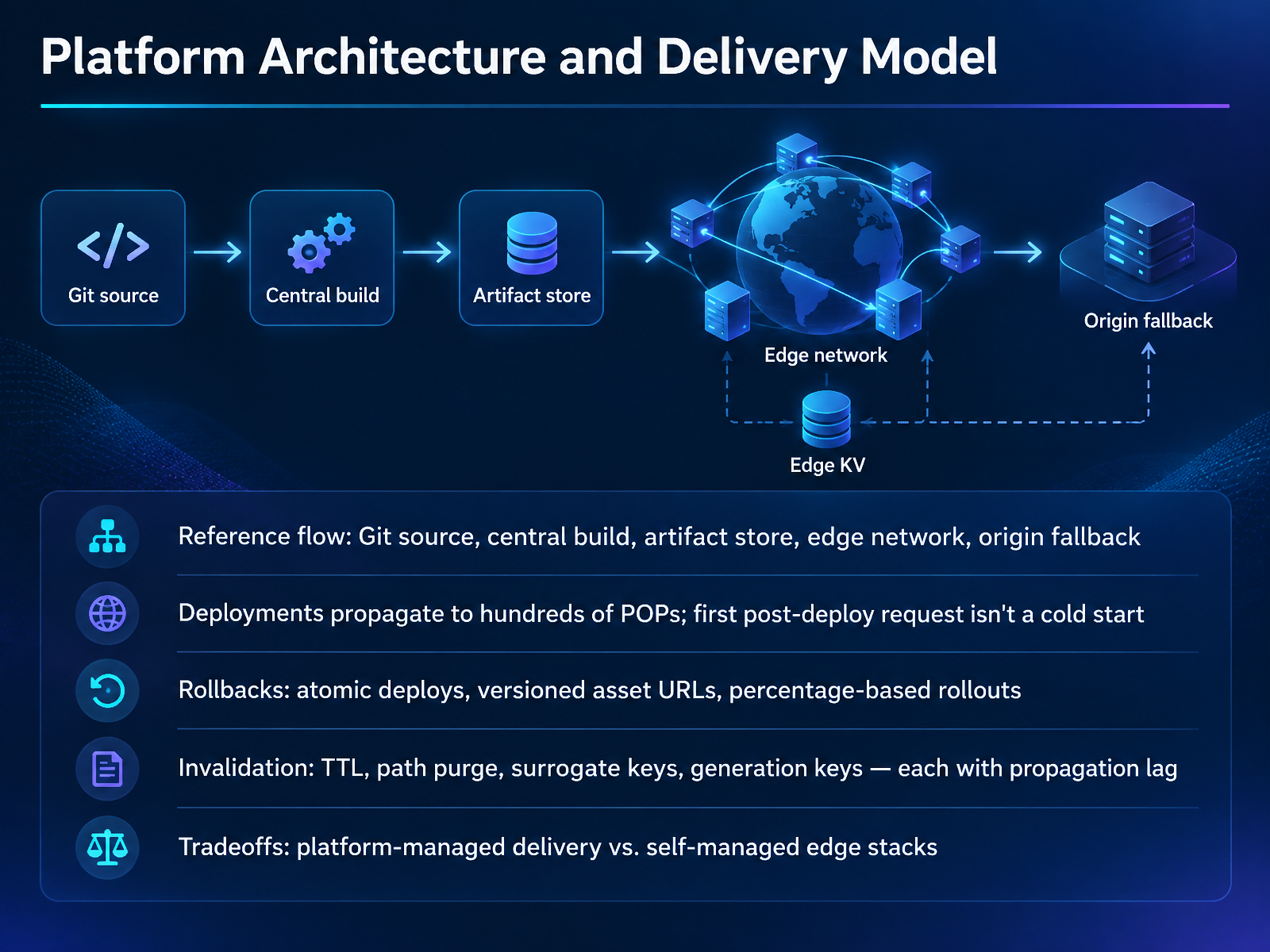
- 04Platform Architecture and Delivery ModelLet's break down how a frontend cloud platform actually delivers your app. The reference flow is simple: your Git repo triggers a central build, the build produces an artifact stored in an artifact store, that artifact gets distributed to the edge network, and if a request misses the edge cache, it falls back to origin. When you deploy, that artifact propagates to hundreds of points of presence. One important distinction: the first request after a deploy is not a cold start. It's a one-time propagation and compile cost per location, and no keep-alive strategy changes it. Rollbacks are handled two ways worth knowing: atomic deploys, where the whole version switches at once, and percentage-based rollouts, where you send a slice of traffic to the new version first. For invalidation, you have four levers: TTL, path purge, surrogate keys, and generation keys. Each has propagation lag, so pick based on how long stale content is acceptable. The core tradeoff: platform-managed delivery is faster to operate, but self-managed edge stacks give you more control at the cost of more infrastructure work. Next, we'll look at edge runtimes and execution constraints.
 nextjs.orgnetlify.comnetlify.com+21 min
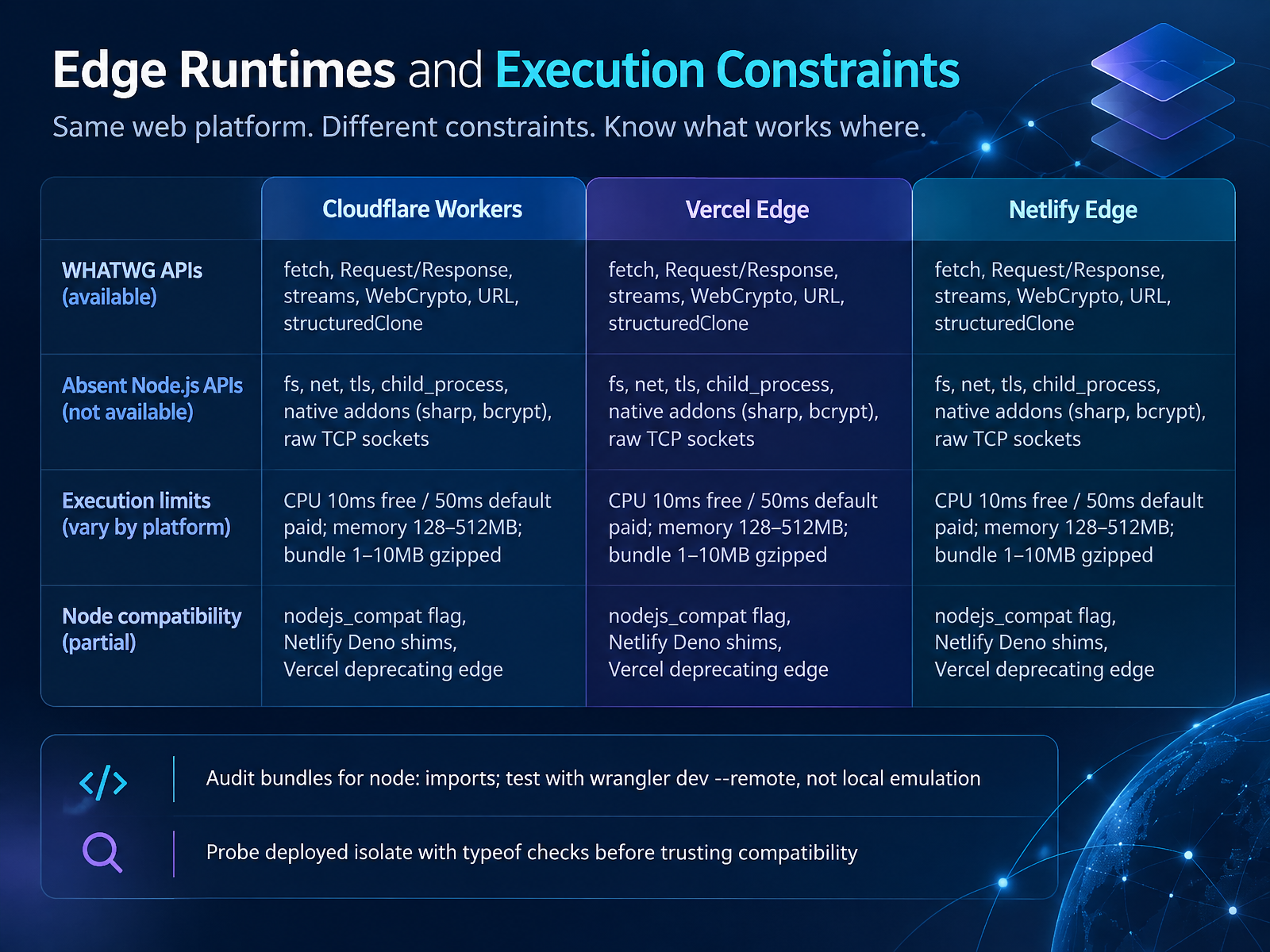
- 05Edge Runtimes and Execution ConstraintsNow let's get concrete about edge runtimes and the constraints you'll actually hit. The good news first. Every major platform gives you the same WHATWG core: fetch, Request and Response, streams, WebCrypto, URL, and structuredClone. That shared surface is what makes code portable across Cloudflare Workers, Netlify's Deno runtime, and similar isolates. The catch is what's absent everywhere. No fs, no net, no tls, no child_process, and no native addons. So sharp, bcrypt, better-sqlite3, anything shipping a dot node binary, simply cannot run. No raw TCP sockets either, which is why Postgres and Redis drivers with connection pools fail or hang. Use HTTP-based clients or a proxy instead. Limits vary by platform and plan, so treat these as ranges. CPU budgets run from around ten milliseconds on free tiers to fifty milliseconds default on paid, though some providers allow much higher ceilings. Memory lands between one hundred twenty-eight and five hundred twelve megabytes. Bundles cap between one and ten megabytes gzipped. Node compatibility is partial and config-gated. On Cloudflare you flip the nodejs_compat flag. Netlify resolves node specifiers through Deno shims. Vercel is deprecating its edge runtime in favor of Node. So audit your bundles for node colon imports, and test against real infrastructure with wrangler dev remote, not local emulation, because local dev resolves modules production never exposes. And before you trust compatibility, probe the deployed isolate with typeof checks. Now that the runtime surface is clear, let's look at data, state, and caching at the edge.
 dl.acm.orgarxiv.orgfaculty.cc.gatech.edu+22 min
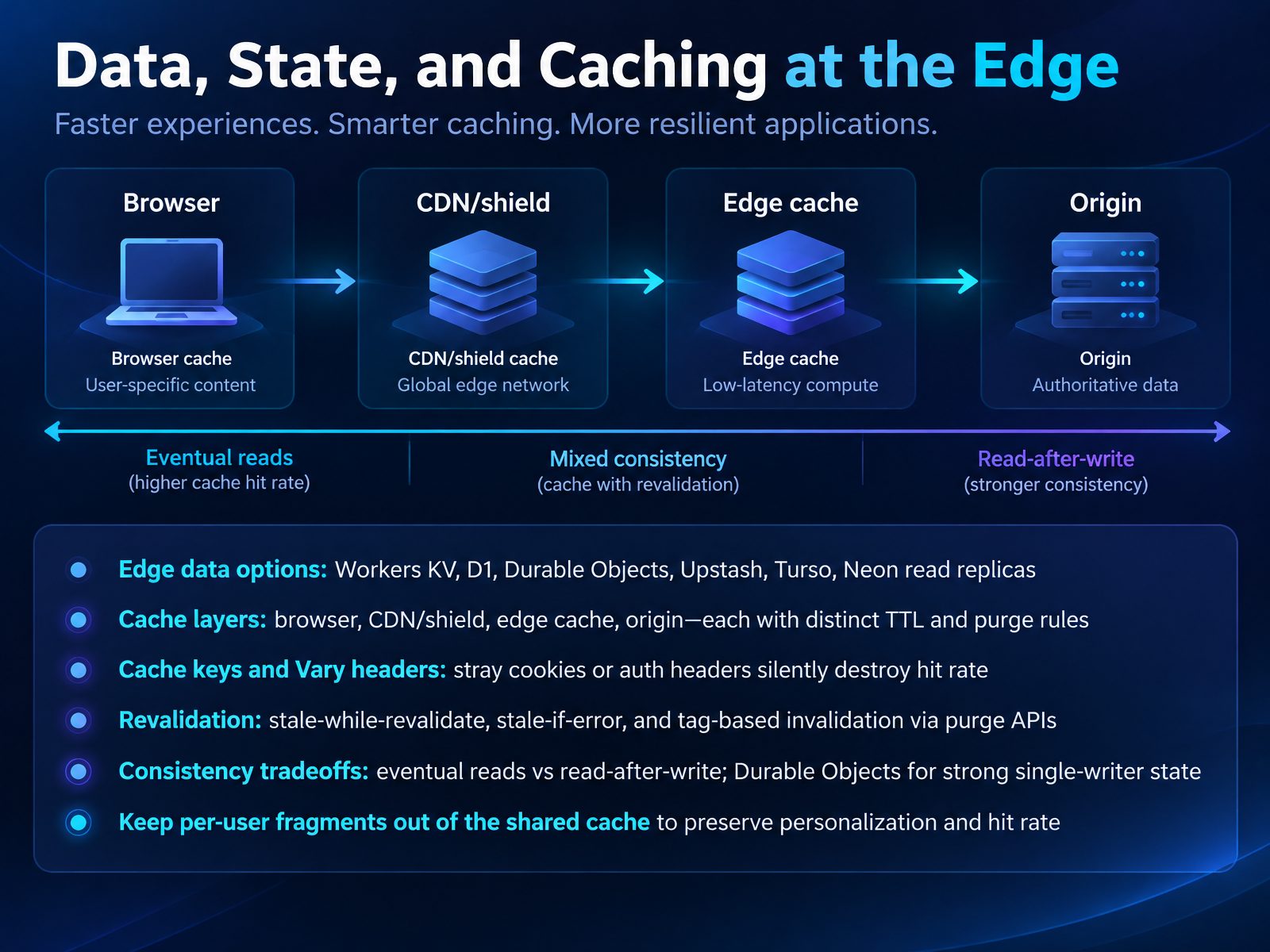
- 06Data, State, and Caching at the EdgeNow let's talk about data, state, and caching at the edge. Start with your data layer. Workers KV is eventually consistent, writes can take about a minute to propagate, so it fits feature flags and read-heavy lookups, not counters or carts. D1 gives you SQLite near the Worker. Durable Objects give you a single writer per object, which is what you reach for when read-after-write actually matters. Upstash, Turso, and Neon read replicas fill the gaps for Redis semantics, replicated SQLite, and Postgres reads. Next, the cache layers: browser, CDN or shield, edge, origin. Each has its own TTL and purge rules, and they can disagree. Then watch your cache keys. A stray cookie or Authorization header in Vary silently destroys hit rate, so keep per-user fragments out of the shared cache. For revalidation, use stale-while-revalidate, stale-if-error, and tag-based purge APIs so you invalidate groups, not everything. Just remember the consistency tradeoff: eventual reads are cheap, strong single-writer state costs more. That sets up the next slide, Security, Compliance, and Data Residency.
 nextjs.orgnetlify.comnetlify.com+22 min
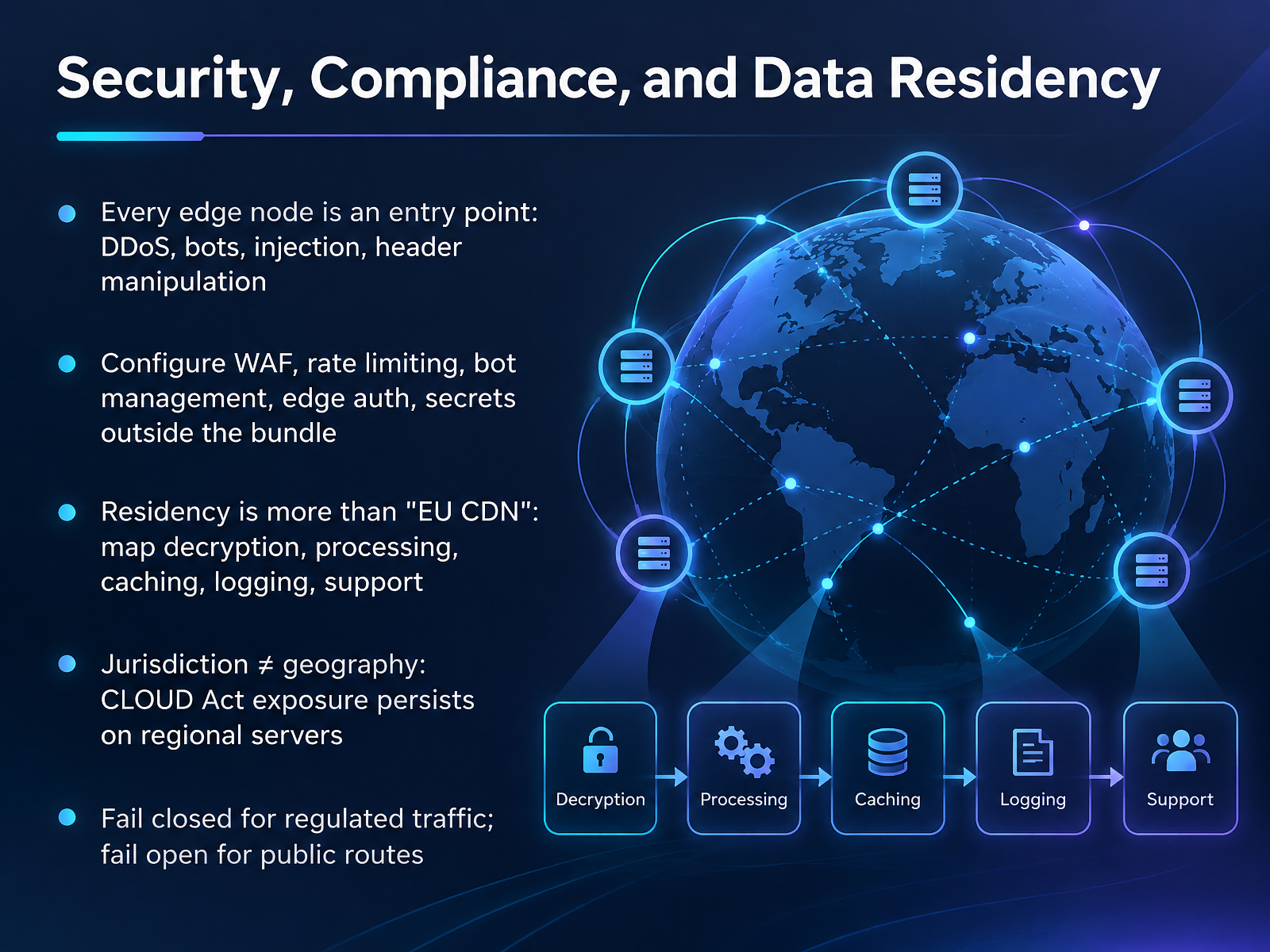
- 07Security, Compliance, and Data ResidencyLet's turn to security, compliance, and data residency. Treat every edge node as an entry point. You are exposed to DDoS, bots, injection, and header manipulation. Configure WAF, rate limiting, bot management, and edge auth. Keep secrets out of the bundle. Now the part teams get wrong. Residency is more than, quote, an EU CDN. Map where requests are decrypted, processed, cached, and logged, including support access. A request can enter in Paris, get inspected elsewhere, and leave metadata in a global log. GDPR does not require all data to stay in the EU, but Chapter Five governs transfers, and sector rules are stricter. Jurisdiction is not geography. A regional server under a US-headquartered provider still faces CLOUD Act exposure. No contract clause overrides that statute. So define rules per data type and journey, then test them. One more decision: fail closed for regulated traffic, and fail open for public routes. Never let regulated requests silently fall back to an unrestricted global path. Rehearse that failure before an incident does it for you. Next, Performance Engineering and Measurement.
 2 min
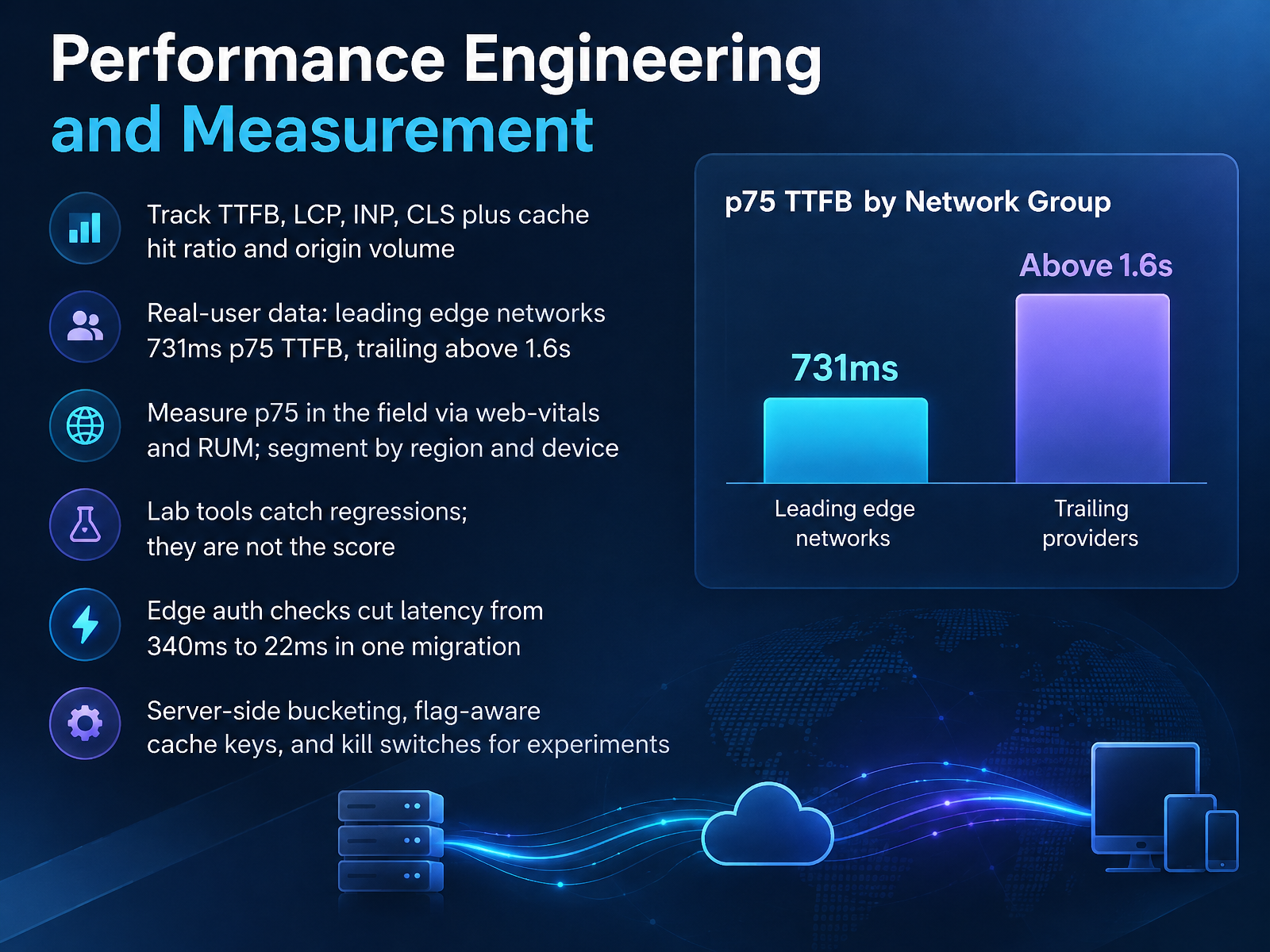
- 08Performance Engineering and MeasurementLet's move on to performance engineering and measurement. First, agree on the scoreboard: time to first byte, largest contentful paint, interaction to next paint, and cumulative layout shift. Add two operational metrics: cache hit ratio and origin volume. That is your build-time versus request-time balance in numbers. Field data tells the real story. Across leading edge networks, p seventy-five time to first byte sits at seven hundred thirty-one milliseconds. The trailing providers are above one point six seconds. That gap is architecture, not tuning. Measure p seventy-five in the field with the web vitals library and your RUM pipeline. Segment by region and device, because mobile tails hide behind desktop averages. Lab tools catch regressions in CI; they are not the score. Edge auth checks cut latency from three hundred forty milliseconds to twenty-two milliseconds in one migration. Finally, run experiments safely: server-side bucketing, flag-aware cache keys so variants do not poison the cache, and kill switches you can flip without a deploy. Next, we'll look at cost, tradeoffs, and platform selection.
 2 min
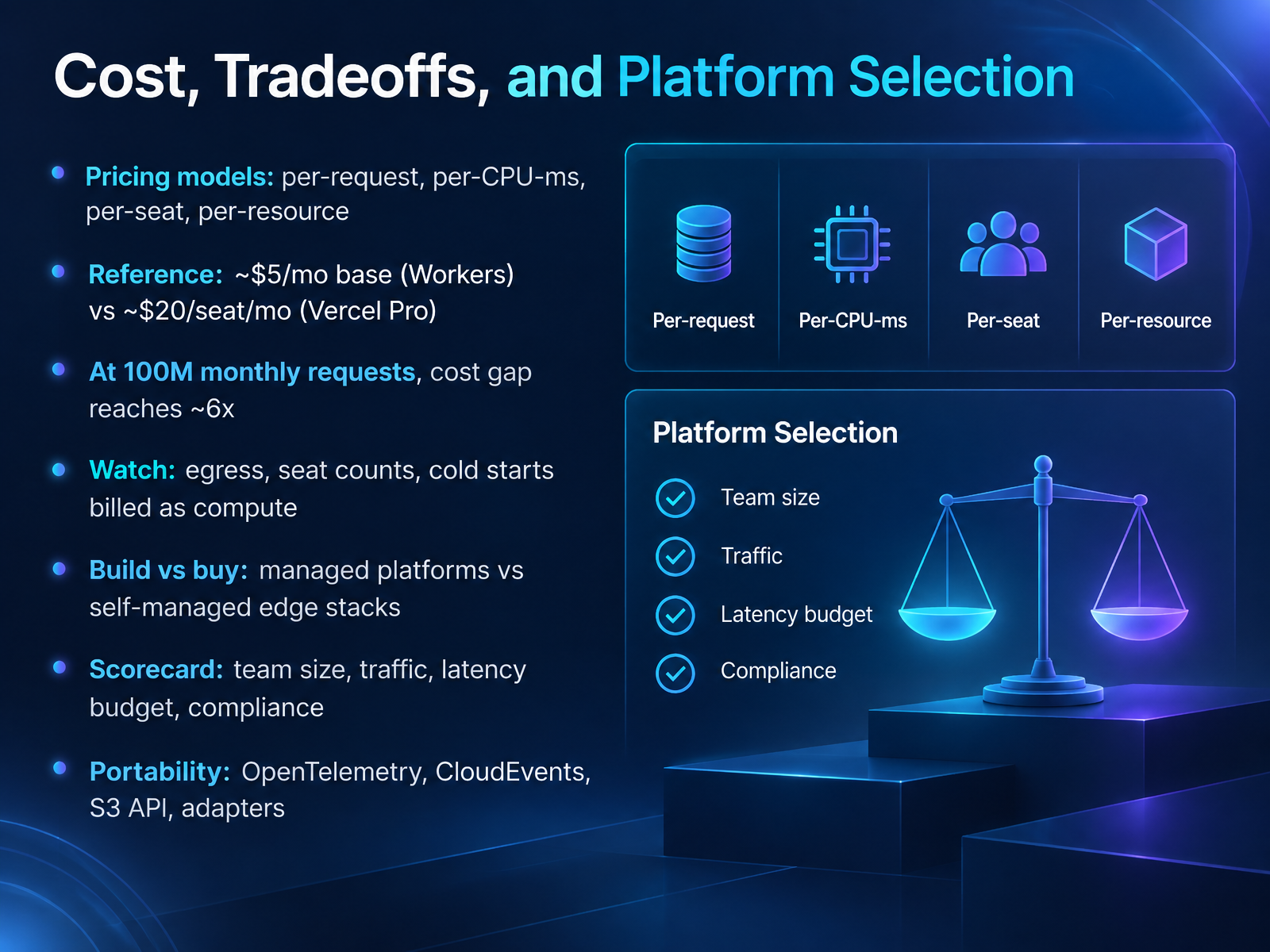
- 09Cost, Tradeoffs, and Platform SelectionLet's close the loop on cost, tradeoffs, and platform selection. Pricing models vary: per-request, per-CPU-millisecond, per-seat, per-resource. The reference points matter. A Workers base runs about five dollars a month, against roughly twenty dollars per seat per month for Vercel Pro. At one hundred million monthly requests, that gap reaches about six times. So watch egress, seat counts, and cold starts billed as compute. Then decide build versus buy: managed platforms versus self-managed edge stacks. Score it on team size, traffic, latency budget, and compliance. For portability, standardize on OpenTelemetry, CloudEvents, the S3 API, and thin adapters. Next, the adoption roadmap and practical next steps.
 gartner.comforrester.comgiiresearch.com+21 min
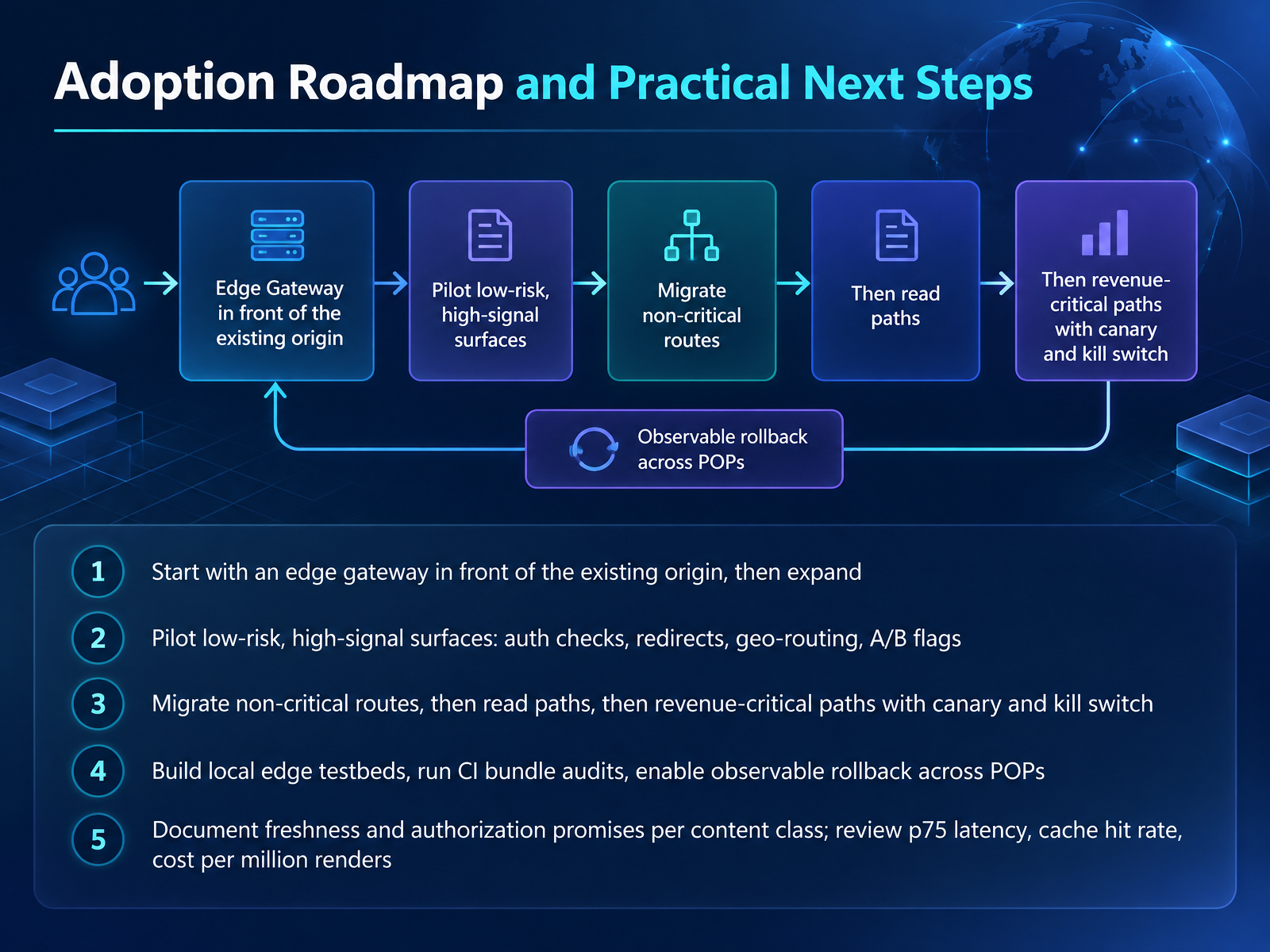
- 10Adoption Roadmap and Practical Next StepsLet's close with a rollout plan you can actually defend in an architecture review. Start with an edge gateway in front of your existing origin. No re-platforming. That alone gives you auth checks, redirects, geo-routing, and feature flags at the edge, before the request ever reaches your servers.
Pilot the low-risk, high-signal surfaces first. Then migrate in order: non-critical routes, then read paths, then revenue-critical paths with a canary and a kill switch. That word canary matters. Stage it, like eight brands, then eight hundred, then all. Watch the field data at every step.
Build local edge testbeds so latency realism shows up in development, not production. Run CI bundle audits, because a fast handler on a bloated isolate is still slow. And make rollback observable across every POP.
Finally, document two promises per content class: how fresh, and who's authorized. Then track p seventy-five latency, cache hit rate, and cost per million renders. Those three numbers settle most arguments.
Start small, measure, expand. Thanks for working through this course. You have a solid decision framework now. Go instrument one latency-sensitive path and prove the win.
 nextjs.orgnetlify.comnetlify.com+22 min
Take the deck with you
Download this course as a file — free, no sign-up needed.
- PDF handoutEvery slide page, ready to print or share.11 pages · 2.7 MBDownload
- Narrated PowerPointThe deck that presents itself — every slide carries the digital human's narration video.11 pages · 13.0 MBDownload
- PowerPoint slidesThe full deck as a .pptx — open it in PowerPoint, Keynote, or Google Slides.11 pages · 2.6 MBDownload
Free to use in your own training — please keep the PersonWise credit page at the end.
Have your own deck? Turn it into a course
Sources consulted
Web sources consulted while building this course.
- Market Guide for Edge Computing Platforms — gartner.com
- The Edge Development Platforms Landscape, Q4 2025 | Forrester — forrester.com
- Frost Radar(TM) - Edge Distribution Platforms, 2026 — giiresearch.com
- Best Edge Computing Platforms Reviews 2026 — gartner.com
- Edge Computing Market Size & Forecast Report 2031 — mordorintelligence.com
- Rendering on the Web | Articles | web.dev — web.dev
- Edge rendering architecture: when to move SSR to the edge — eltherion.com
- Edge Rendering Architecture: Choose SSR, ISR, and CDN Invalidation Boundaries | Edilec — edilec.com
- Rendering Models Explained: SSR vs SSG vs CSR vs Islands — newstack.dev
- Edge Rendering | Unpacked — unpacked.danielhowells.com
- Cold Start Latency in Serverless Computing: A Systematic ... — dl.acm.org
- Lumos: Performance Characterization of WebAssembly as a Serverless Runtime in the Edge-Cloud Continuum — arxiv.org
- Opportunities for Optimizing the Container Runtime — faculty.cc.gatech.edu
- Managing Cold Starts in Serverless Environments | Edge Middleware — edge-middleware.com
- Edge compute compared: Cloudflare Workers, Lambda@Edge, and Fastly Compute — blog.crawlex.net
- Deploying Next.js to different platforms — nextjs.org
- Give your sites the edge — netlify.com
- SWR and Fine Grained Cache Control on Netlify — netlify.com
- Vercel CDN Cache — vercel.com
- Frontend Development Platform — cloudflare.com