Begin
14 pages · ~28 min
Teaching Critical Thinking: Practical Workflow
This training helps educators and instructors learn a practical workflow for teaching critical thinking skills to their students.
A digital instructor presents all 14 pages. Hold “Ask” at any point and ask out loud — the answer comes from this course. No sign-up needed.
What you’ll learn
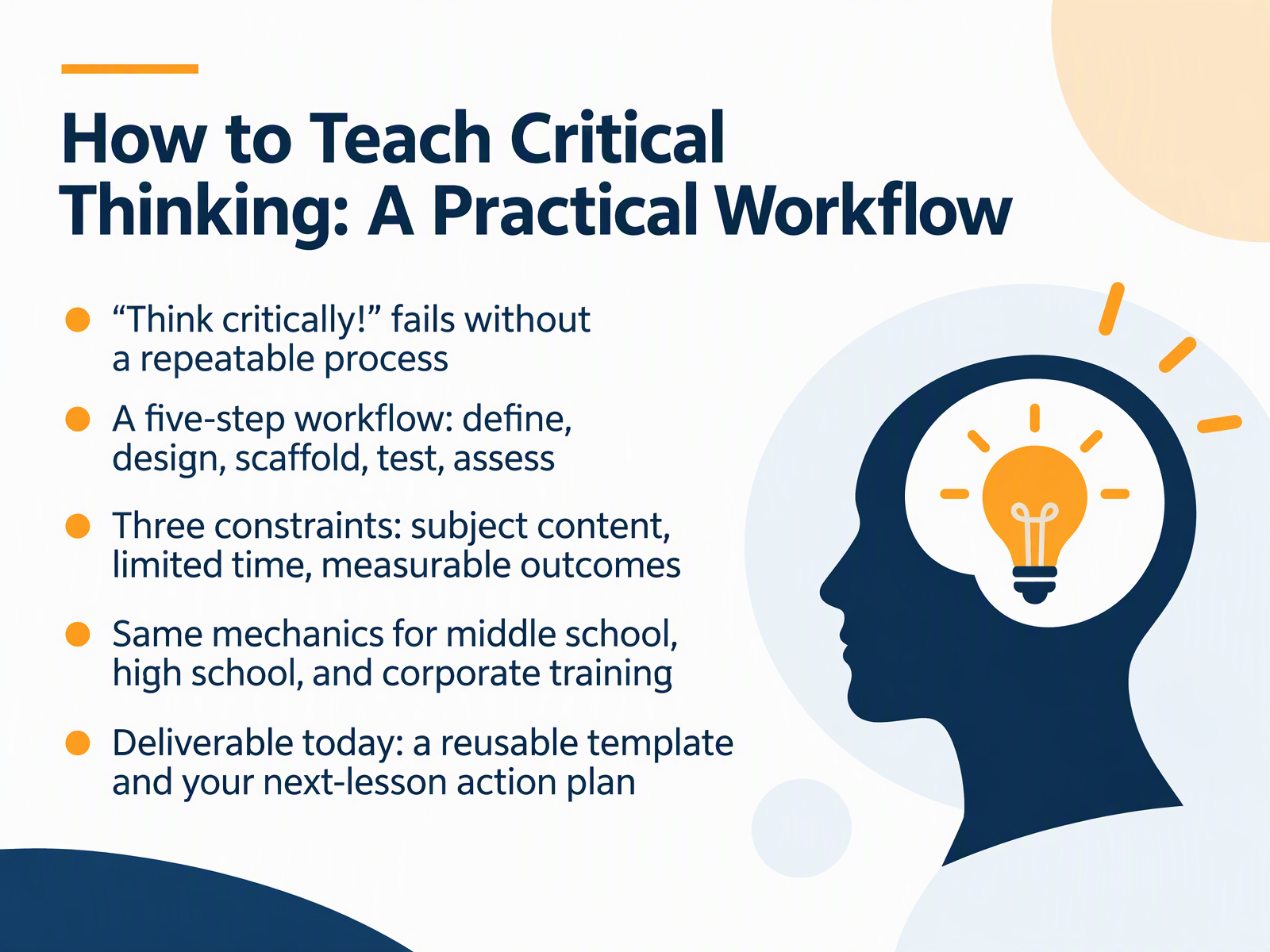
- 01How to Teach Critical Thinking: A Practical WorkflowWelcome. I'm glad you're here. Today we're tackling a challenge you've probably met head-on: telling learners to think critically, and watching nothing change. Here's our starting point. That instruction fails without a repeatable process. So this session gives you one. A five-step workflow: define, design, scaffold, test, and assess. We'll keep three real constraints in view throughout: your subject content, limited time, and measurable outcomes. And here's the good news. The same mechanics work in middle school, high school, and corporate training. By the end, you'll have a reusable template and a concrete action plan for your next lesson. Next, let's look at why thinking critically is not a lesson plan.pubmed.ncbi.nlm.nih.govdoi.orgdoi.org+21 min
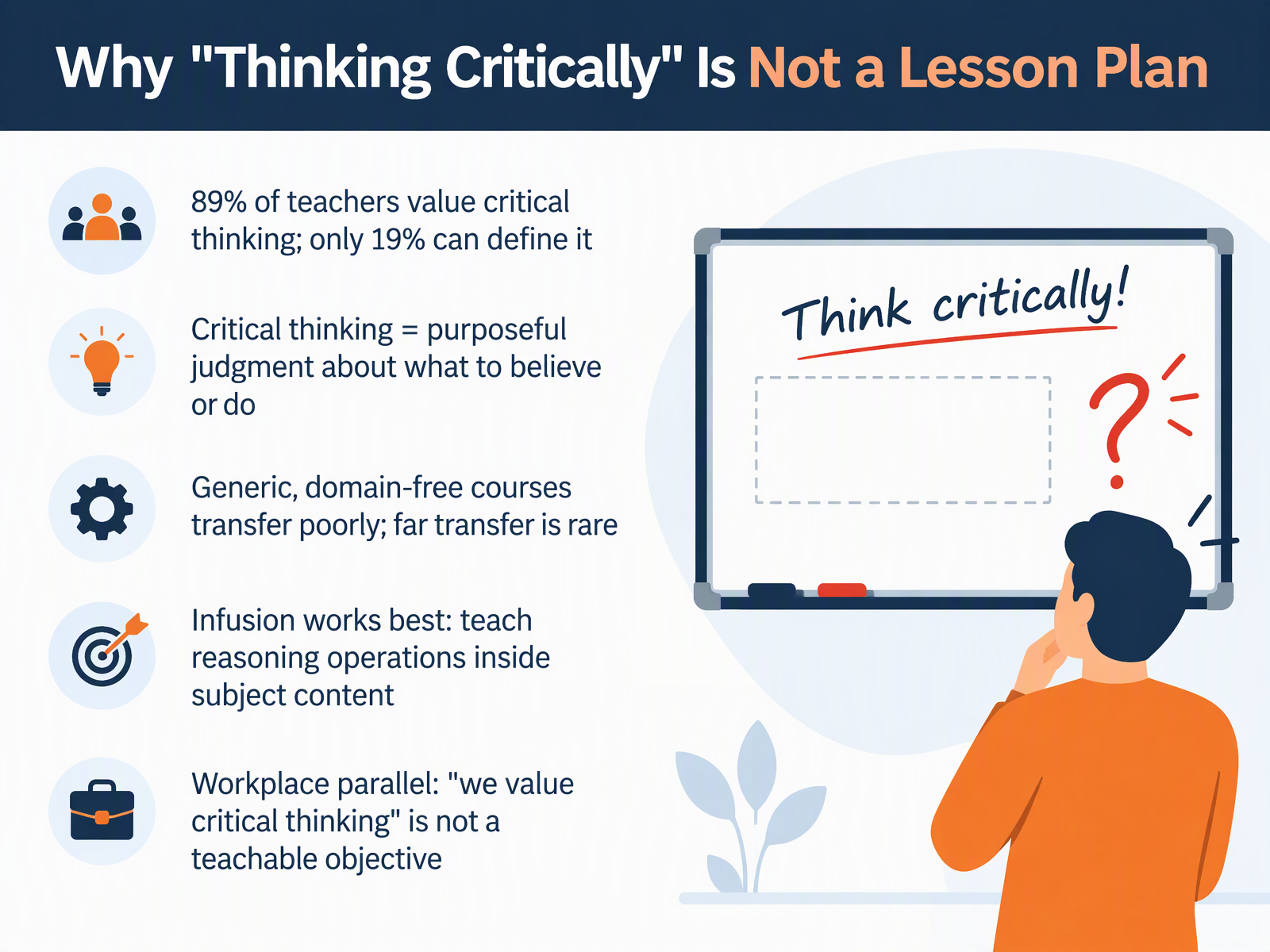
- 02Why 'Thinking Critically' Is Not a Lesson PlanLet's be honest about a common problem. Eighty-nine percent of teachers say critical thinking matters. But only nineteen percent can clearly define it. That gap matters, because you can't design instruction around a slogan. Here is a working definition you can use. Critical thinking means purposeful judgment about what to believe or what to do. So it is not a mood, and it is not general intelligence. Next, be careful with generic, stand-alone courses. They teach skills students often only apply on the exact tasks they practiced. Broad transfer to new domains is rare. In practice, infusion works better. That means teaching reasoning operations inside your actual subject content, so students argue with evidence in history, or weigh variables in science. The workplace parallel is simple. Saying we value critical thinking is not a teachable objective. Turn it into a concrete reasoning move students can practice. Let's look at the five step workflow at a glance.
 pubmed.ncbi.nlm.nih.govdoi.orgdoi.org+21 min
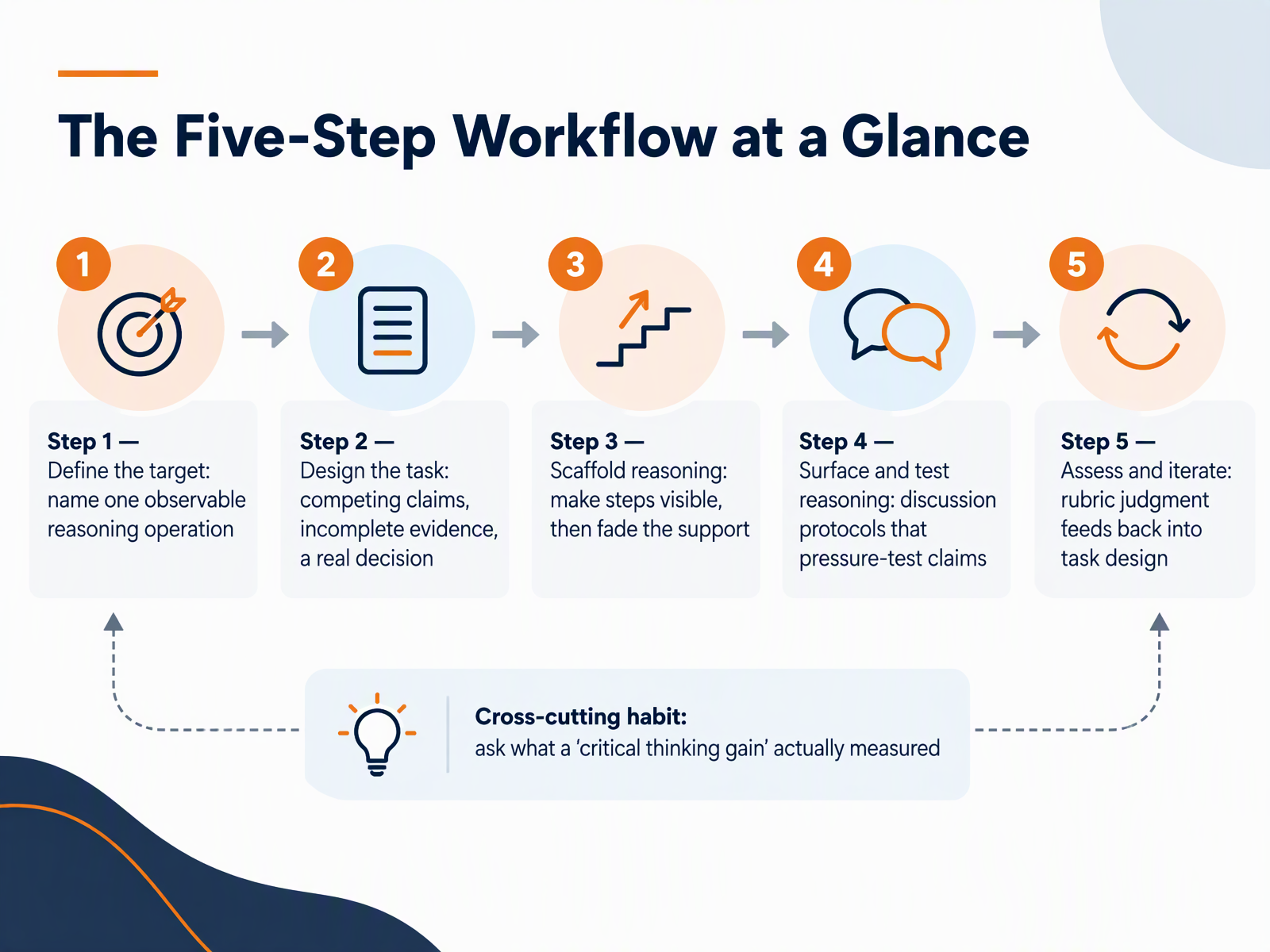
- 03The Five-Step Workflow at a GlanceLet's move to the workflow itself. Here are the five steps at a glance. First, define the target. Name one observable reasoning operation, something you could actually see a learner do, like weighing two conflicting sources. Next, design the task. Give learners competing claims, incomplete evidence, and a real decision to make. Then scaffold the reasoning. Make the steps visible at first, with a checklist or sentence frames, and fade that support over time. Step four: surface and test reasoning. Use discussion protocols that pressure-test claims, so reasoning gets challenged out loud. Step five: assess and iterate. Rubric judgment should feed straight back into your task design. In practice, keep one habit running across all five steps: ask what a critical thinking gain actually measured. If you cannot point to the evidence, you have not measured it yet. Defining the Thinking Target.
 pubmed.ncbi.nlm.nih.govdoi.orgdoi.org+22 min
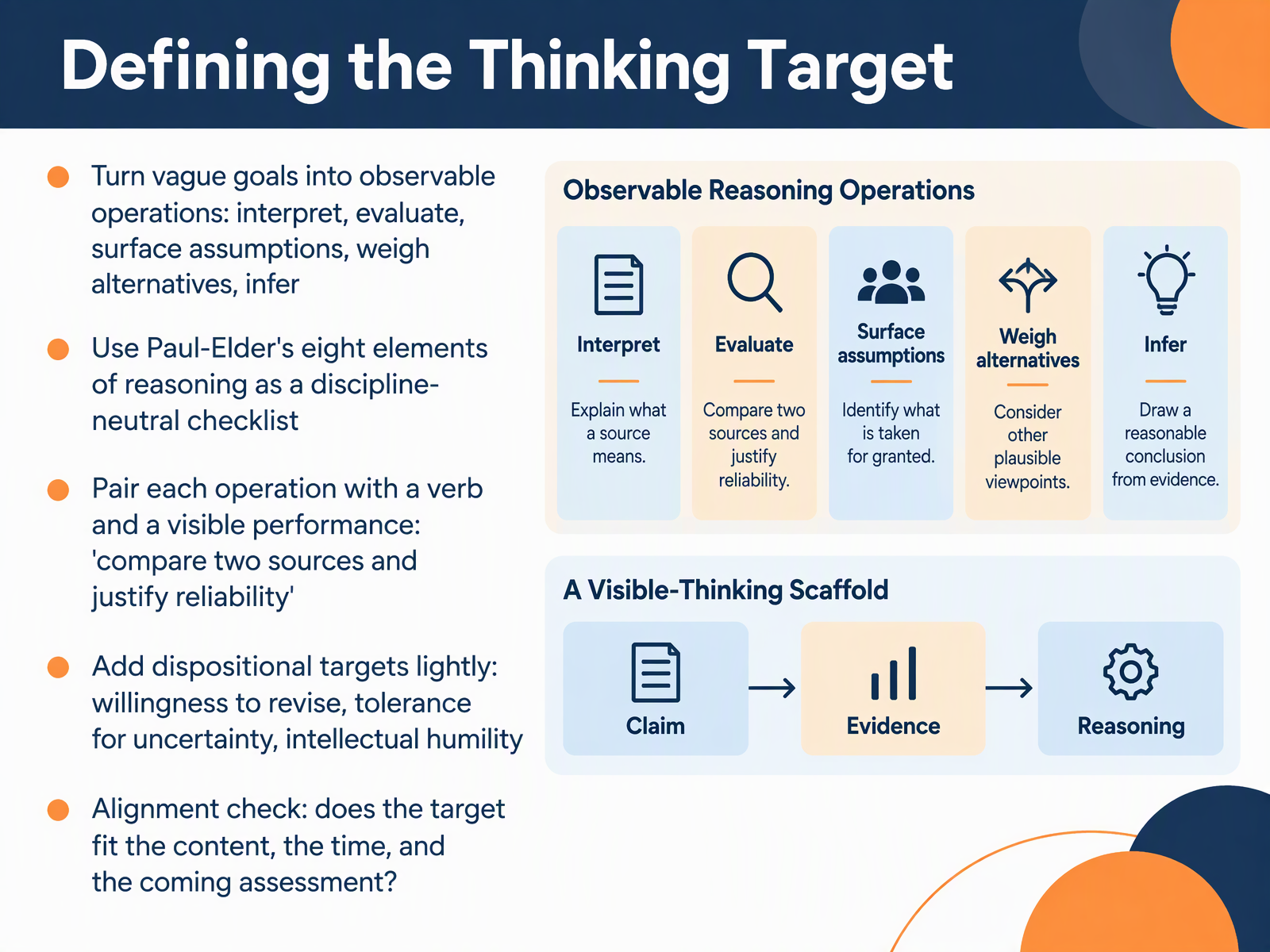
- 04Defining the Thinking TargetLet's turn a vague goal into a thinking target you can actually see. First, convert words like "think critically" into observable operations: interpret, evaluate, surface assumptions, weigh alternatives, and infer. Next, use the Paul-Elder eight elements of reasoning as a discipline-neutral checklist. The elements include purpose, question at issue, assumptions, point of view, information, concepts, inferences, and implications. In practice, pair each operation with a verb and a visible performance. For example, "compare two sources and justify which is more reliable." Add dispositional targets lightly, such as willingness to revise, tolerance for uncertainty, and intellectual humility. Then run an alignment check. Does the target fit your content, your available time, and the assessment that's coming? If not, shrink the target until it does. Next, we'll look at designing tasks that force reasoning.
 criticalthinking.orgcriticalthinking.orgcriticalthinking.org+22 min
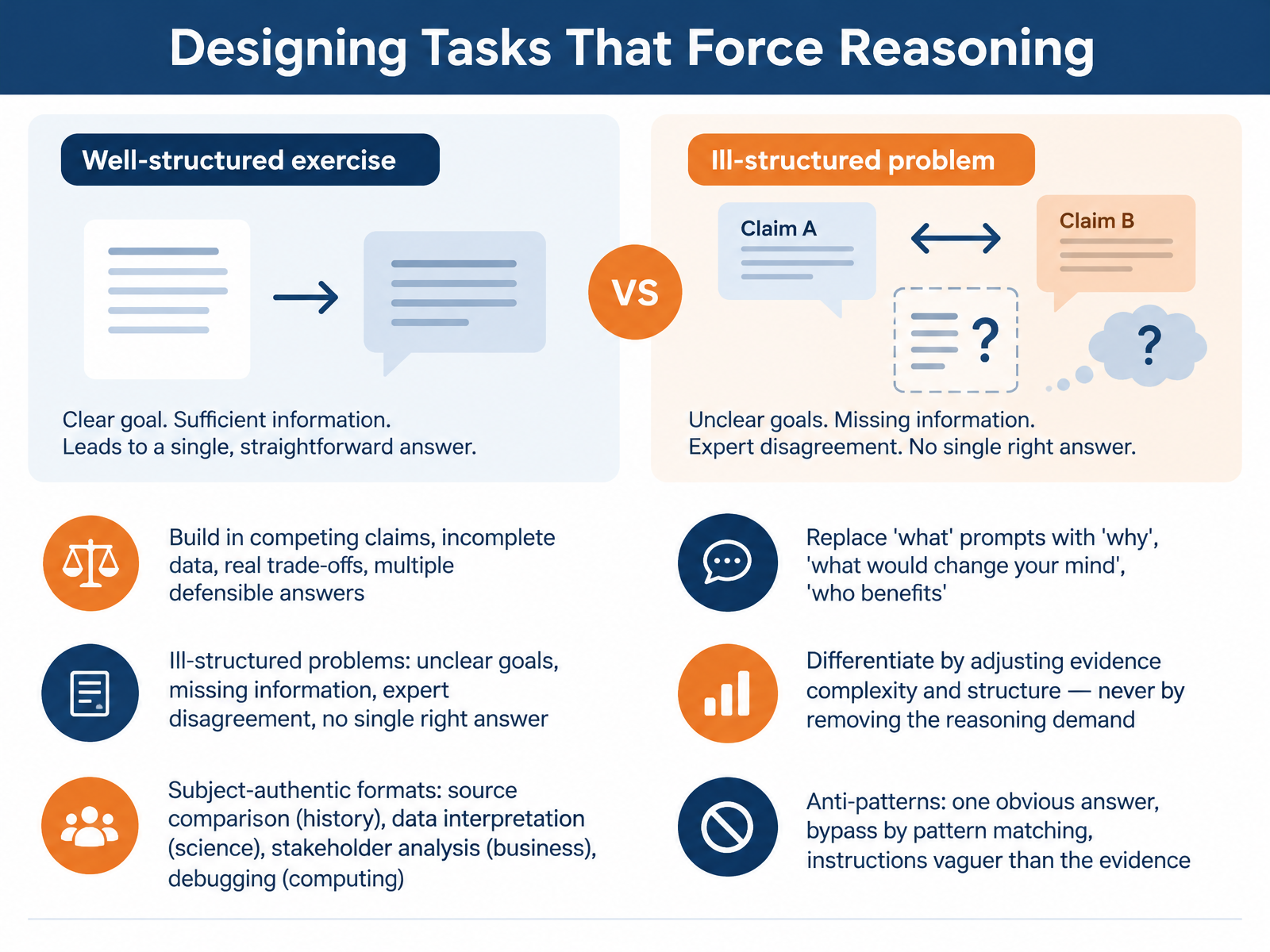
- 05Designing Tasks That Force ReasoningNow let's look at the tasks themselves. A task that forces reasoning is deliberately ill-structured. That means unclear goals, missing information, expert disagreement, and no single right answer. So first, build in competing claims, incomplete data, and real trade-offs. Next, make the format authentic to your subject. In history, compare sources. In science, interpret data. In business, analyze stakeholders. In computing, debug code. Then replace what prompts with why. Ask, what would change your mind? Or, who benefits? Differentiate by adjusting the complexity of evidence and structure, never by removing the reasoning demand. Watch for three anti-patterns: one obvious answer, tasks students can bypass by pattern matching, and instructions vaguer than the evidence. Next, we'll look at scaffolding the reasoning process.
 utmcdex.utm.myscholarworks.iu.eduwww1.udel.edu+22 min
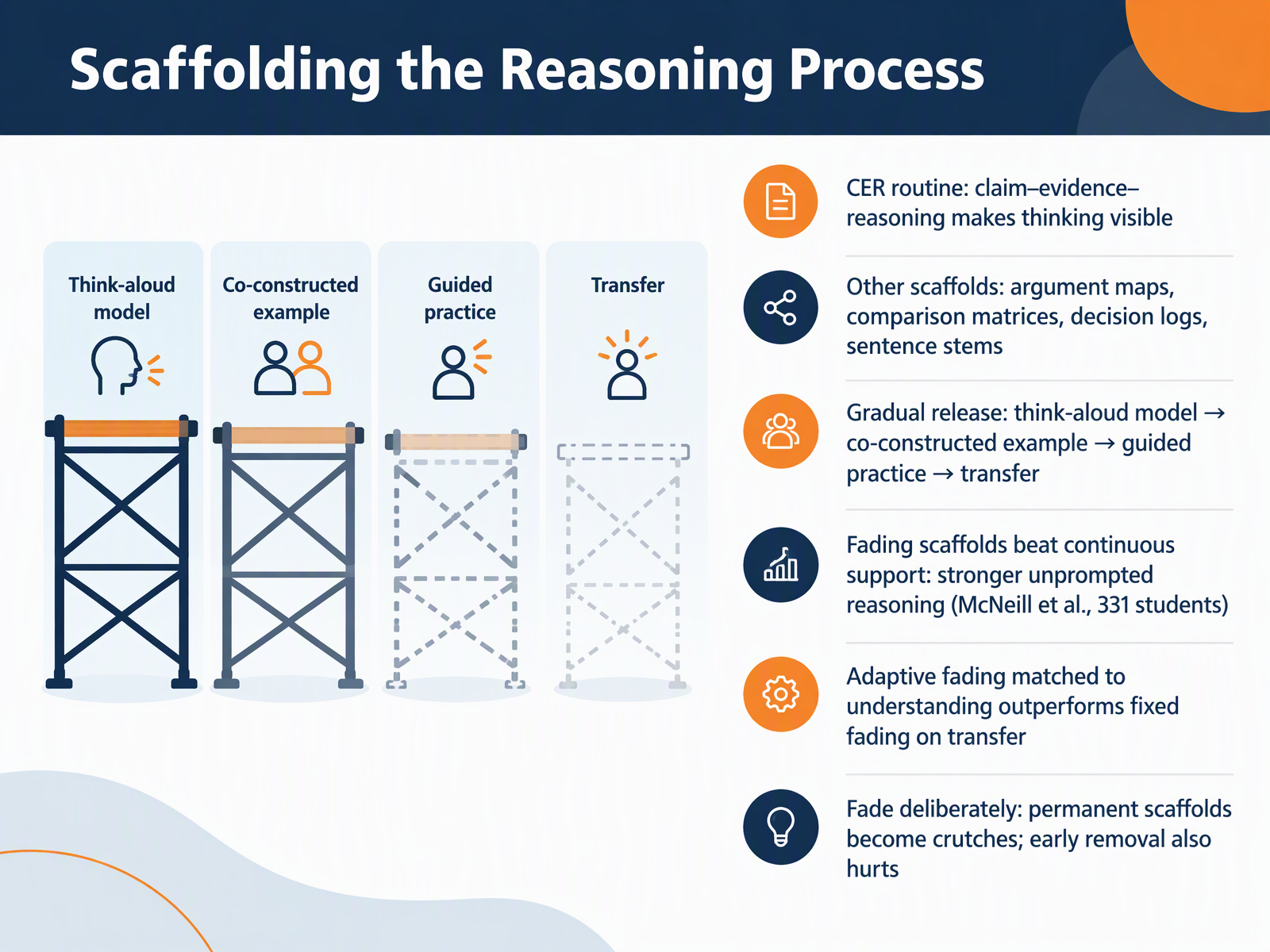
- 06Scaffolding the Reasoning ProcessNow let's look at how you scaffold the reasoning process itself. Start with the CER routine: claim, evidence, reasoning. It makes thinking visible, so you can see where a learner's logic breaks down. Other scaffolds work well too, such as argument maps, comparison matrices, decision logs, and sentence stems. Next, plan for gradual release. Model your own thinking aloud, build one example together, run guided practice, then hand it over for transfer. Here's the key finding. In a study of three hundred thirty-one students, faded scaffolds beat continuous support, producing stronger unprompted reasoning. And adaptive fading, matched to what learners actually understand, outperforms fixed fading on transfer. So fade deliberately. Permanent scaffolds become crutches, but removing them too early also hurts. Next, we'll look at structured discussion and how to test reasoning out loud.
 doi.orgcadrek12.orgscholarworks.montana.edu+22 min
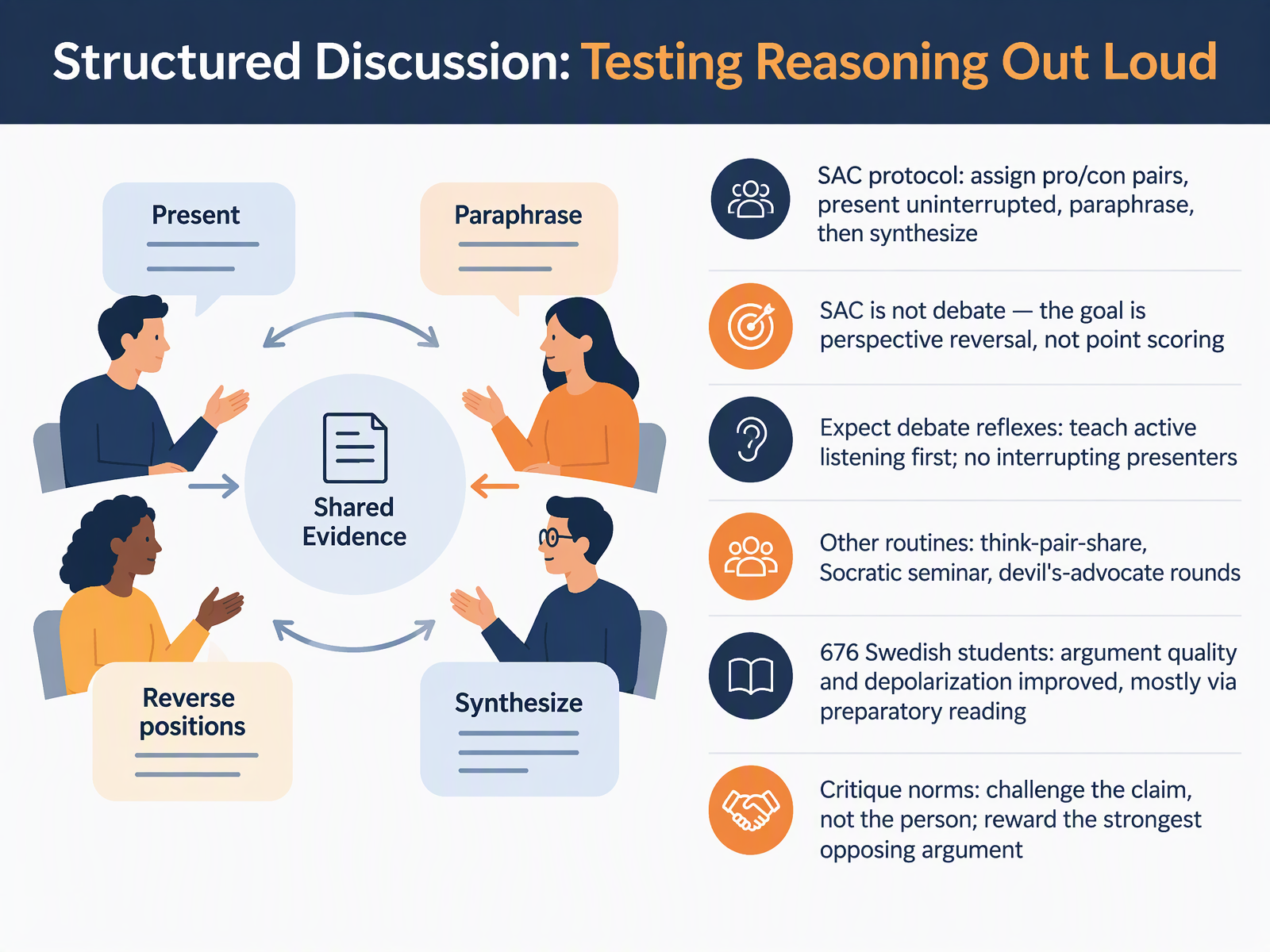
- 07Structured Discussion: Testing Reasoning Out LoudNow let's look at structured discussion, where students test their reasoning out loud. The core routine here is the SAC protocol, short for Structured Academic Controversy. First, assign each pair a pro or con position. Each side presents uninterrupted. Then the listeners paraphrase what they heard before roles switch. Finally, students synthesize the strongest arguments from both sides. Make one thing clear from the start. SAC is not a debate. The goal is perspective reversal, not point scoring. Expect debate reflexes, so teach active listening first and set one firm rule. No interrupting presenters. Other routines you can use include think-pair-share, Socratic seminar, and devil's-advocate rounds. In one study of six hundred seventy-six Swedish students, argument quality improved and polarization dropped, mostly through preparatory reading. So give them good reading before they talk. Set clear critique norms too. Challenge the claim, not the person, and reward the strongest opposing argument. When Debate and Consensus Go Wrong.
 2 min
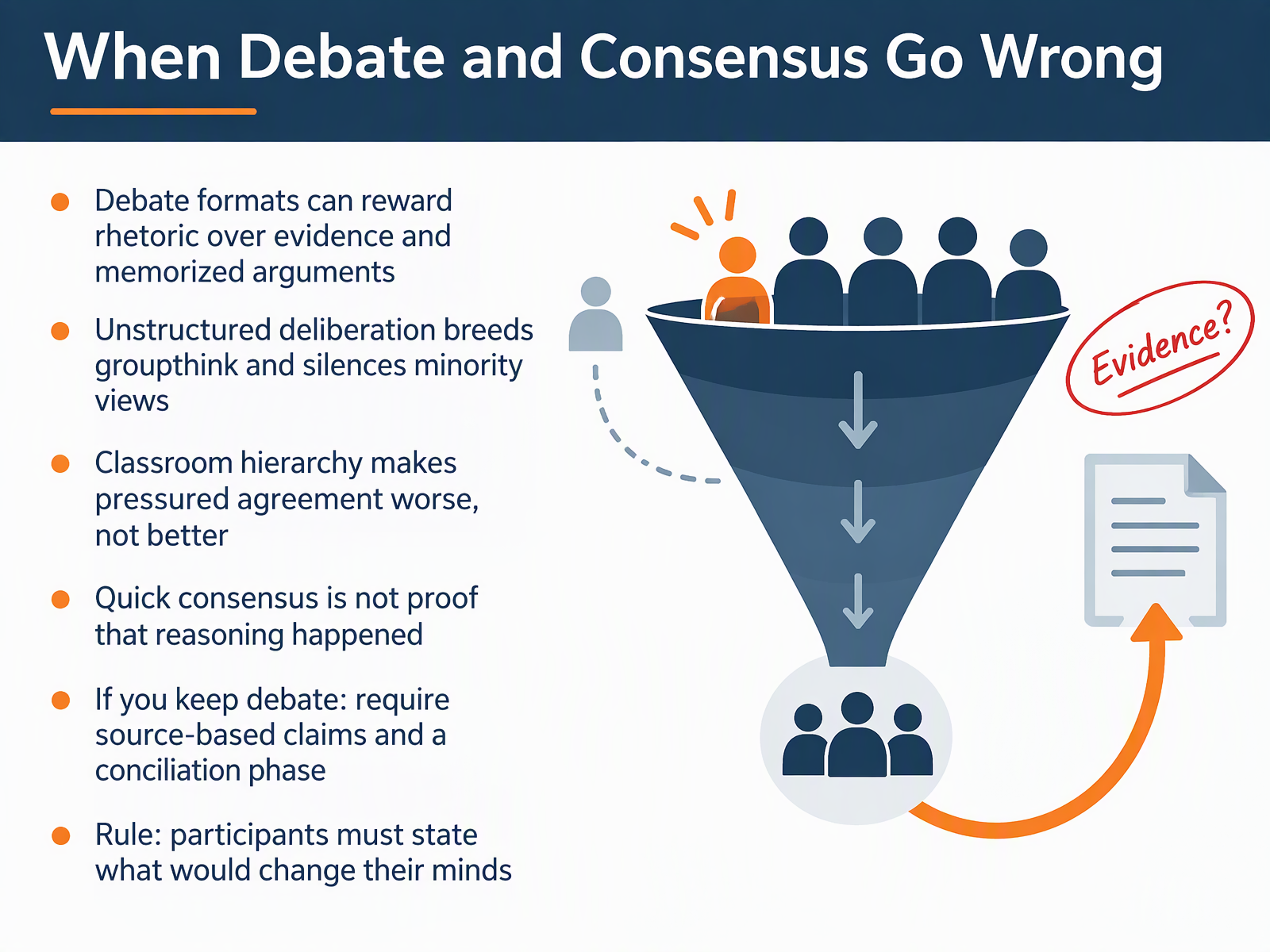
- 08When Debate and Consensus Go WrongNow let's look at where debate and consensus quietly go wrong. First, debate formats can reward rhetoric over evidence, so students memorize winning lines instead of building source-based claims. Next, unstructured deliberation breeds groupthink and silences minority views. In practice, in a classroom, the hierarchy makes pressured agreement worse, because students are incentivized to agree with the teacher and with confident peers. And quick consensus is not proof that reasoning happened. If you keep debate, require source-based claims and add a conciliation phase, where each side names the strongest opposing argument. One simple rule helps: every participant must state what would change their mind. That single question exposes memorized arguments and turns agreement into reasoning. Next, we turn to assessing critical thinking, not recall.
 1 min
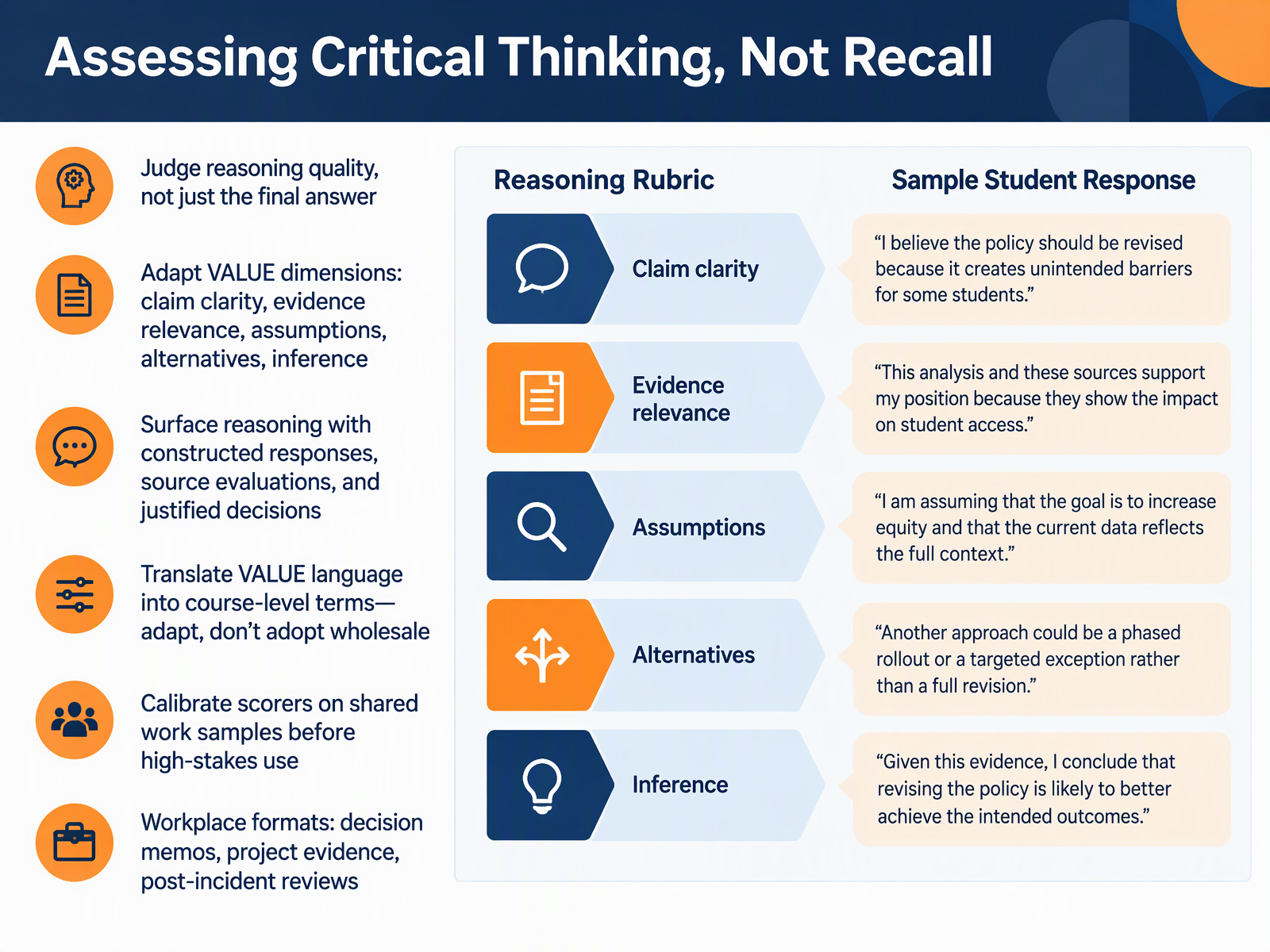
- 09Assessing Critical Thinking, Not RecallNext, let's look at how you assess this. Judge the quality of reasoning, not just the final answer. A correct conclusion reached by luck is not the same as a defended claim. So adapt the VALUE dimensions to your context: claim clarity, evidence relevance, assumptions, alternatives, and inference. To surface reasoning, ask for constructed responses, source evaluations, and justified decisions rather than multiple-choice recall. And translate VALUE language into course-level terms. Adapt, don't adopt wholesale. Before using scores for high-stakes decisions, calibrate your scorers on shared work samples, so two raters reach the same judgment. In workplace settings, try decision memos, project evidence, and post-incident reviews. Building a reusable lesson and course template.
 1 min
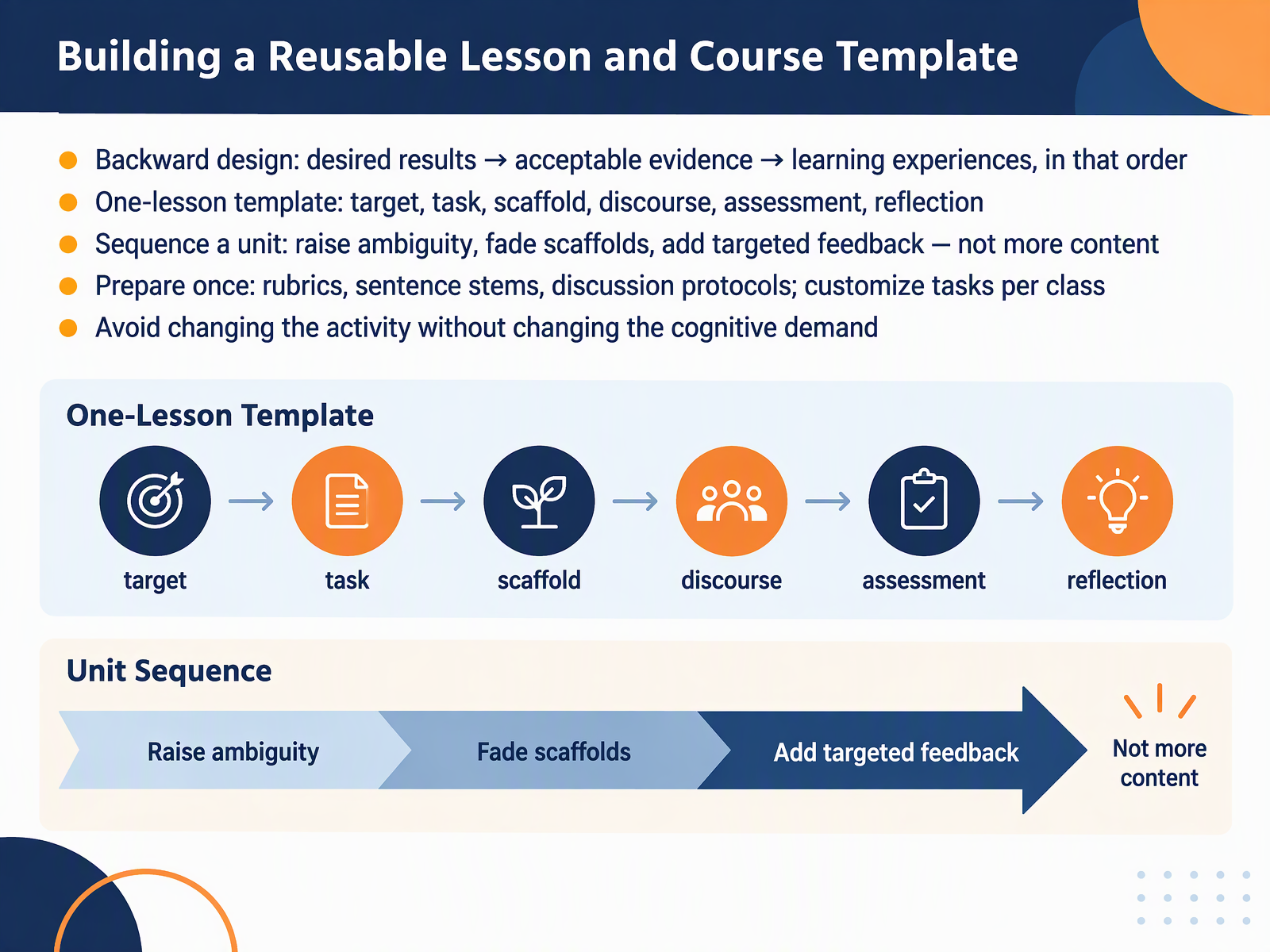
- 10Building a Reusable Lesson and Course TemplateNow let's make your planning reusable. First, design backward. Name your desired results, then the evidence that would prove them, then the learning experiences. Build each lesson from six parts: target, task, scaffold, discourse, assessment, and reflection. Next, sequence a unit by raising ambiguity, fading scaffolds, and adding targeted feedback. Notice what you are not doing: adding more content. In practice, prepare the reusable pieces once, like rubrics, sentence stems, and discussion protocols, then customize the task for each class. One warning: do not change the activity without changing the cognitive demand. Keep the thinking just as rigorous when you swap the topic. Next, we look at common pitfalls and evidence checks.
 doi.orgcadrek12.orgscholarworks.montana.edu+22 min
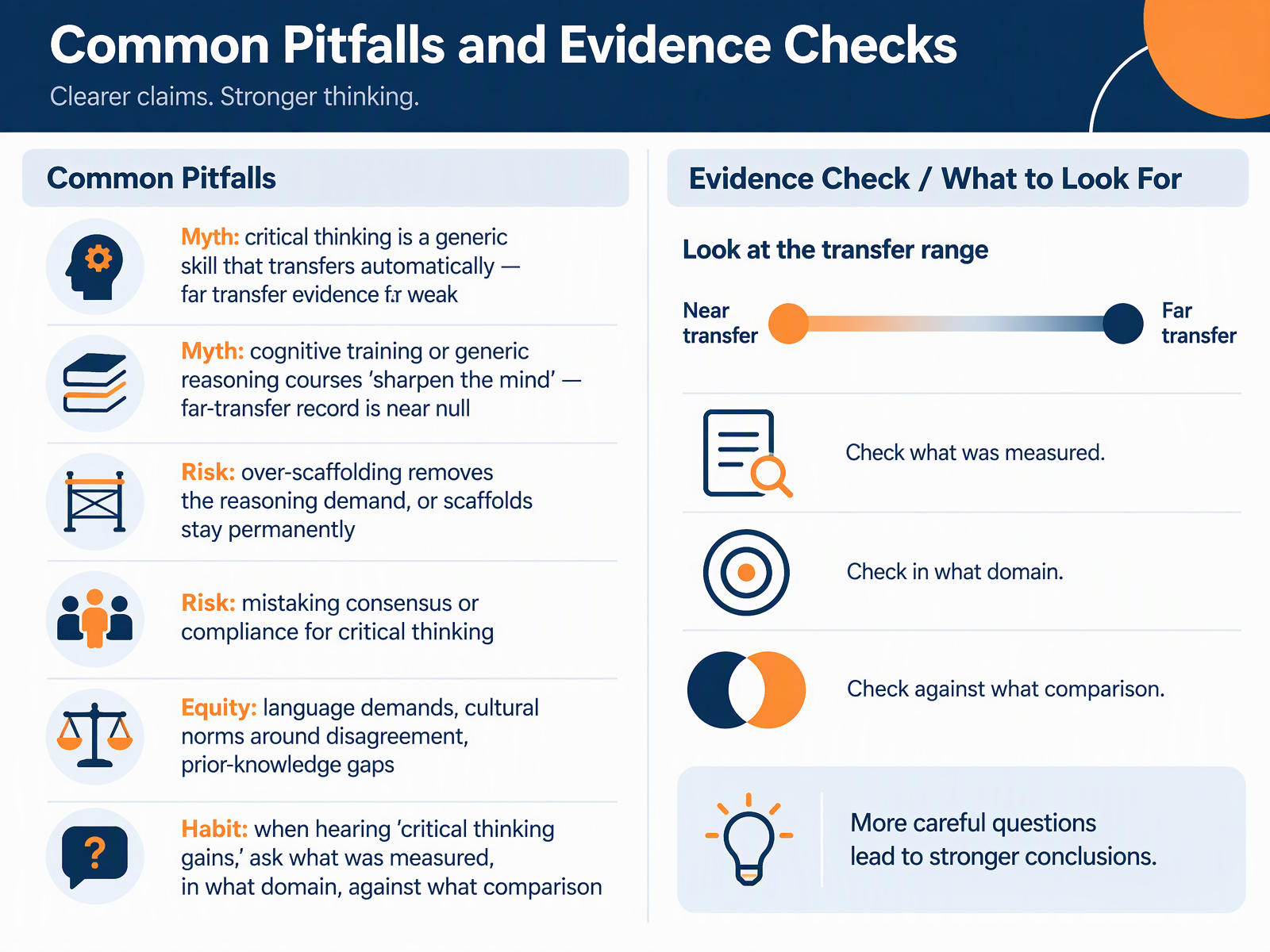
- 11Common Pitfalls and Evidence ChecksNow let's look at common pitfalls and evidence checks. First, two myths. Critical thinking is not a generic skill that transfers automatically. Far transfer evidence is weak. And generic cognitive training courses don't sharpen the mind; the far-transfer record is near null. Next, two risks. Over-scaffolding removes the reasoning demand, or scaffolds stay in place permanently. And beware mistaking consensus or compliance for critical thinking. Keep equity in view too: language demands, cultural norms around disagreement, and prior-knowledge gaps all shape who speaks up. In practice, build one habit. When you hear critical thinking gains, ask what was measured, in what domain, and against what comparison. That question will keep your design honest. Next, we'll look at making it stick through culture, feedback, and iteration.
 pubmed.ncbi.nlm.nih.govdoi.orgdoi.org+21 min
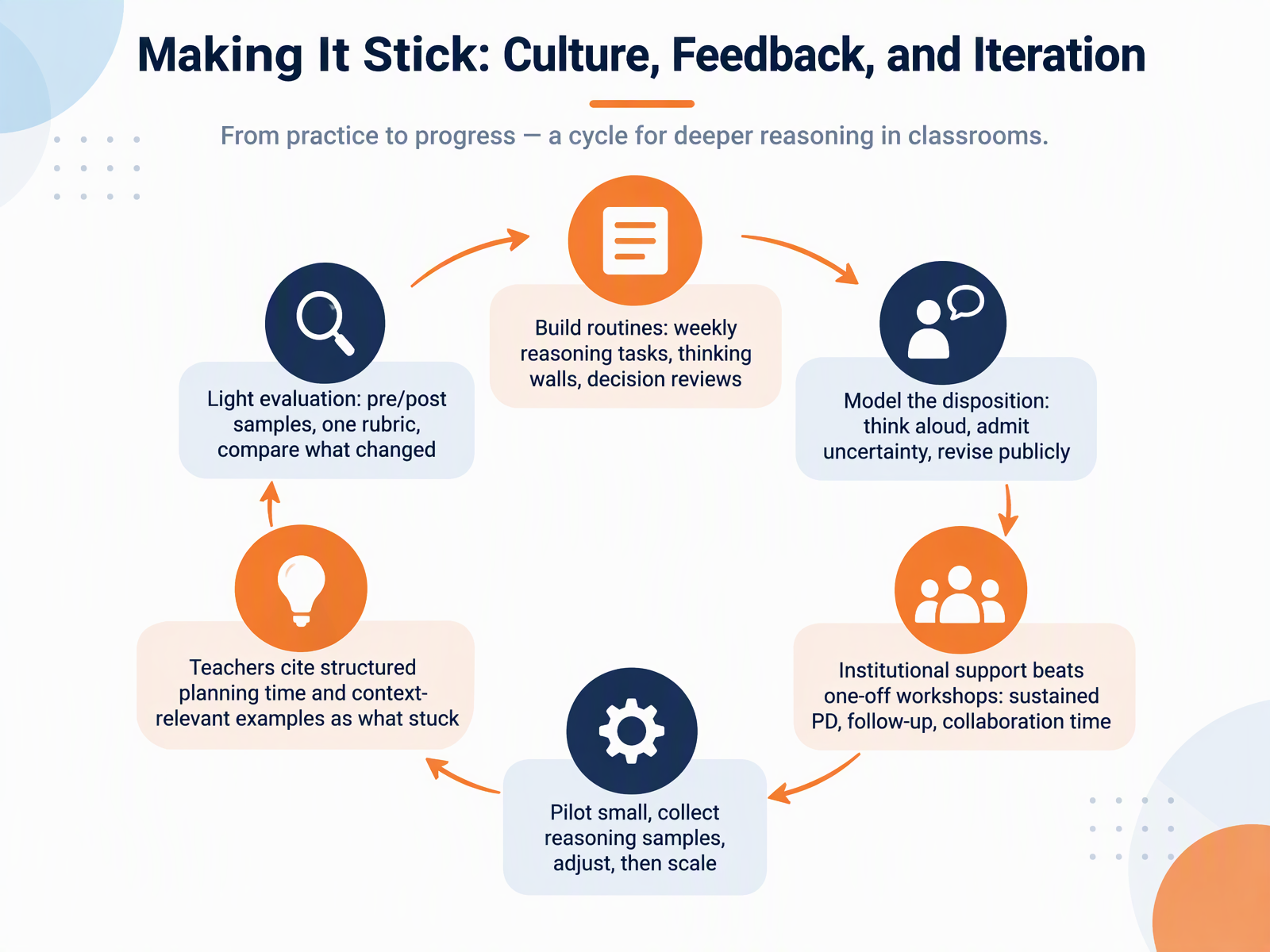
- 12Making It Stick: Culture, Feedback, and IterationNow, let's talk about making it stick. First, build routines: a short weekly reasoning task, a thinking wall, or a five-minute decision review. Next, model the disposition. Think aloud, admit uncertainty, and revise your own view publicly. In practice, institutional support beats one-off workshops. Sustained professional development, follow-up, and shared collaboration time matter more than a single training day. Teachers consistently cite structured planning time and context-relevant examples as what actually stuck. So pilot small, collect reasoning samples, adjust, then scale. Keep evaluation light: pre and post samples, one clear rubric, and compare what changed. That keeps the work honest without burying you in data. Next up, we'll pull this together in the Action Plan: Your Next Lesson or Course.
 2 min
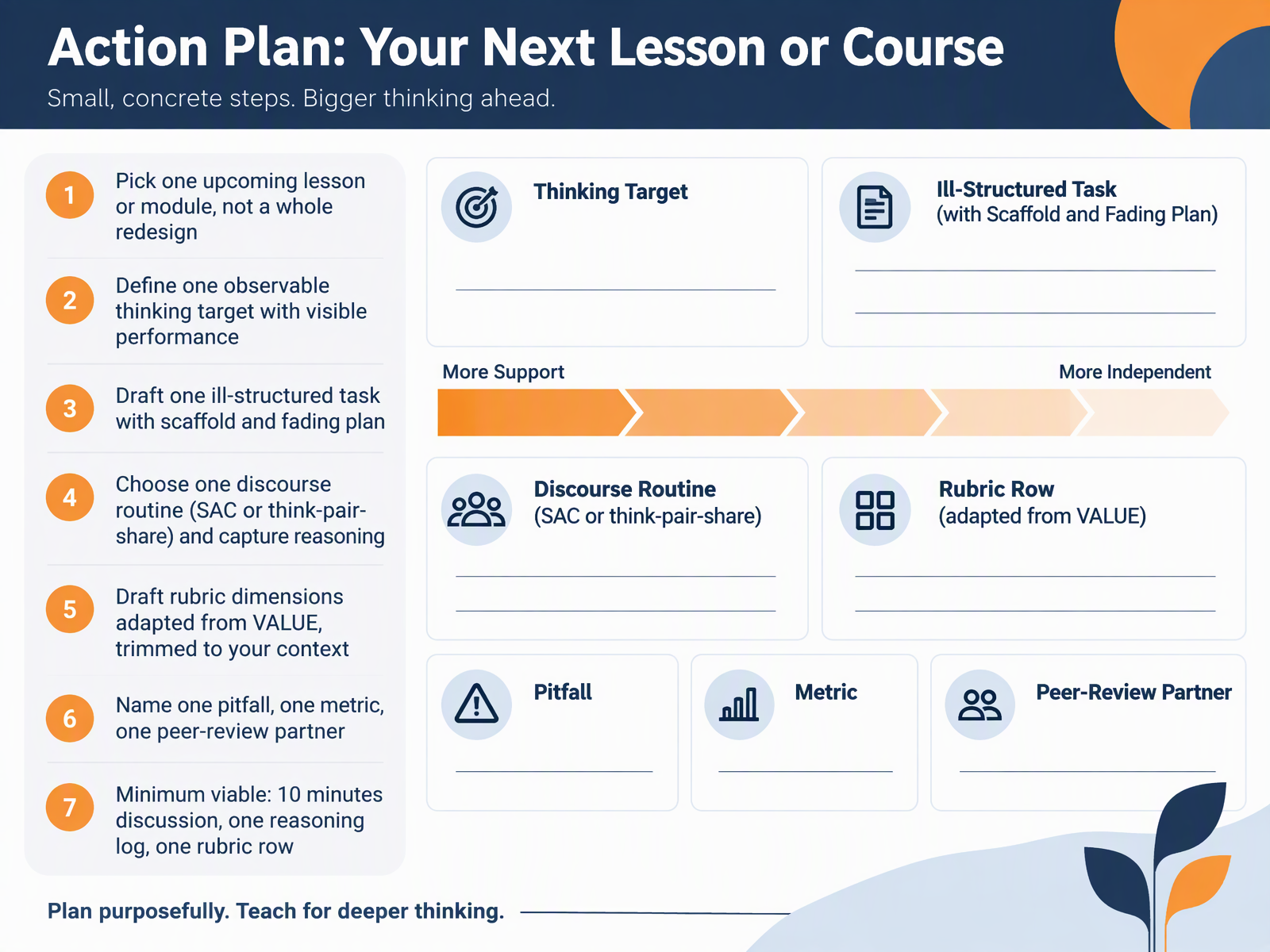
- 13Action Plan: Your Next Lesson or CourseSo let's make this real. Your action plan is small on purpose. First, pick one upcoming lesson or module, not a whole redesign. Next, define one observable thinking target, something you can actually see students do. Then draft one ill-structured task, with a scaffold and a plan for fading it. Choose one discourse routine, structured academic controversy or think-pair-share, and capture the reasoning in a log. Draft a few rubric dimensions adapted from the VALUE critical thinking rubric, trimmed to your context. Finally, name one pitfall, one metric, and one peer-review partner. If time is tight, go minimum viable: ten minutes of discussion, one reasoning log, one rubric row. That is enough to start. Let's pull the whole workflow together next.
 utmcdex.utm.myscholarworks.iu.eduwww1.udel.edu+22 min
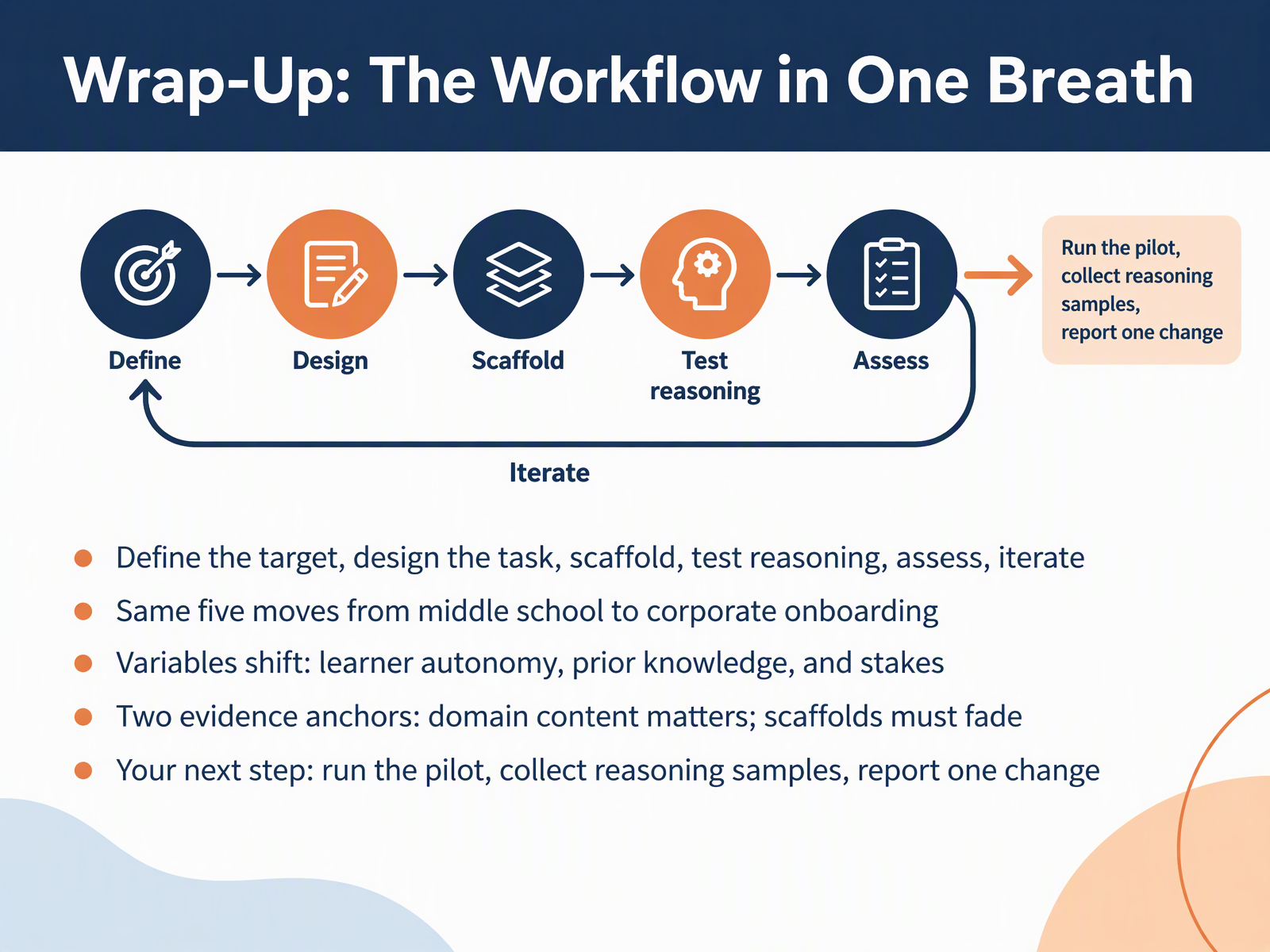
- 14Wrap-Up: The Workflow in One BreathLet's bring the whole workflow together in one breath. You define the target, design the task, scaffold it, test the reasoning, assess, and iterate. And here's the encouraging part: those same five moves work from middle school to corporate onboarding. What changes are the variables. Learner autonomy, prior knowledge, and the stakes. Two evidence anchors keep you honest. First, domain content matters, so reasoning grows inside your subject, not around it. Second, scaffolds must fade, because support that never fades becomes a crutch. So your next step is simple. Run the pilot, collect a few reasoning samples, and report one change you'll make. Thank you for working through this with me. You already have what you need, so go try one small iteration, and let the evidence guide the next one.
 pubmed.ncbi.nlm.nih.govdoi.orgdoi.org+22 min
Take the deck with you
Download this course as a file — free, no sign-up needed.
- PDF handoutEvery slide page, ready to print or share.15 pages · 3.2 MBDownload
- Narrated PowerPointThe deck that presents itself — every slide carries the digital human's narration video.15 pages · 12.2 MBDownload
- PowerPoint slidesThe full deck as a .pptx — open it in PowerPoint, Keynote, or Google Slides.15 pages · 3.1 MBDownload
Free to use in your own training — please keep the PersonWise credit page at the end.
Have your own deck? Turn it into a course
Sources consulted
Web sources consulted while building this course.
- Teaching critical thinking for transfer across domains. ... — pubmed.ncbi.nlm.nih.gov
- A systematic review and meta-analysis of instructional strategies to teaching critical thinking skills and dispositions — doi.org
- A Critical Analysis of Critical Thinking Interventions in Higher Education — doi.org
- The effects of teaching strategies on learning to think critically in primary and secondary schools: an overview of systematic reviews — doi.org
- Systematic design of domain-specific instruction on near ... — lirias.kuleuven.be
- The Miniature Guide to Critical Thinking: Concepts & Tools — criticalthinking.org
- The Elements of Reasoning and the Intellectual Sta — criticalthinking.org
- Defining Critical Thinking — criticalthinking.org
- Paul-Elder Framework for Critical Thinking — criticalthinking.org
- Chapter 7. The Standards for Thinking - Critical Thinking: Tools for Taking Charge of Your Professional and Personal Life, Second Edition [Book] — oreilly.com
- Designing Problems to Promote Higher-Order Thinking — utmcdex.utm.my
- Essential elements of lessons designed to promote critical thinking — scholarworks.iu.edu
- UD PBL Clearinghouse: Problem Writing Guide — www1.udel.edu
- VDC/Ill-Structured PS — cotf.edu
- Fostering critical literacy: The art of assignment design — techstyle.lmc.gatech.edu
- Supporting Students' Construction of Scientific Explanations by Fading Scaffolds in Instructional Materials — doi.org
- Building Argumentation Skills in the Biology Classroom: An Evolution Unit That Develops Students’ Capacity to Construct Arguments from Evidence — cadrek12.org
- Writing arguments with evidence: the claim-evidence-reasoning framework and scientific literacy — scholarworks.montana.edu
- Exploring the impact of the reasoning flow scaffold (RFS) on students’ scientific argumentation: based on the structure of observed learning outcomes (SOLO) taxonomy — pubs.rsc.org
- Supporting Black Students in Sixth-Grade Science Through a Social Constructivist Approach: A Mixed-Methods Action Research Study — scholarcommons.sc.edu