Begin
14 pages · ~28 min
Plato's Allegory of the Cave Explained
This training explains Plato's Allegory of the Cave, helping learners understand its meaning and philosophical significance.
A digital instructor presents all 14 pages. Hold “Ask” at any point and ask out loud — the answer comes from this course. No sign-up needed.
What you’ll learn
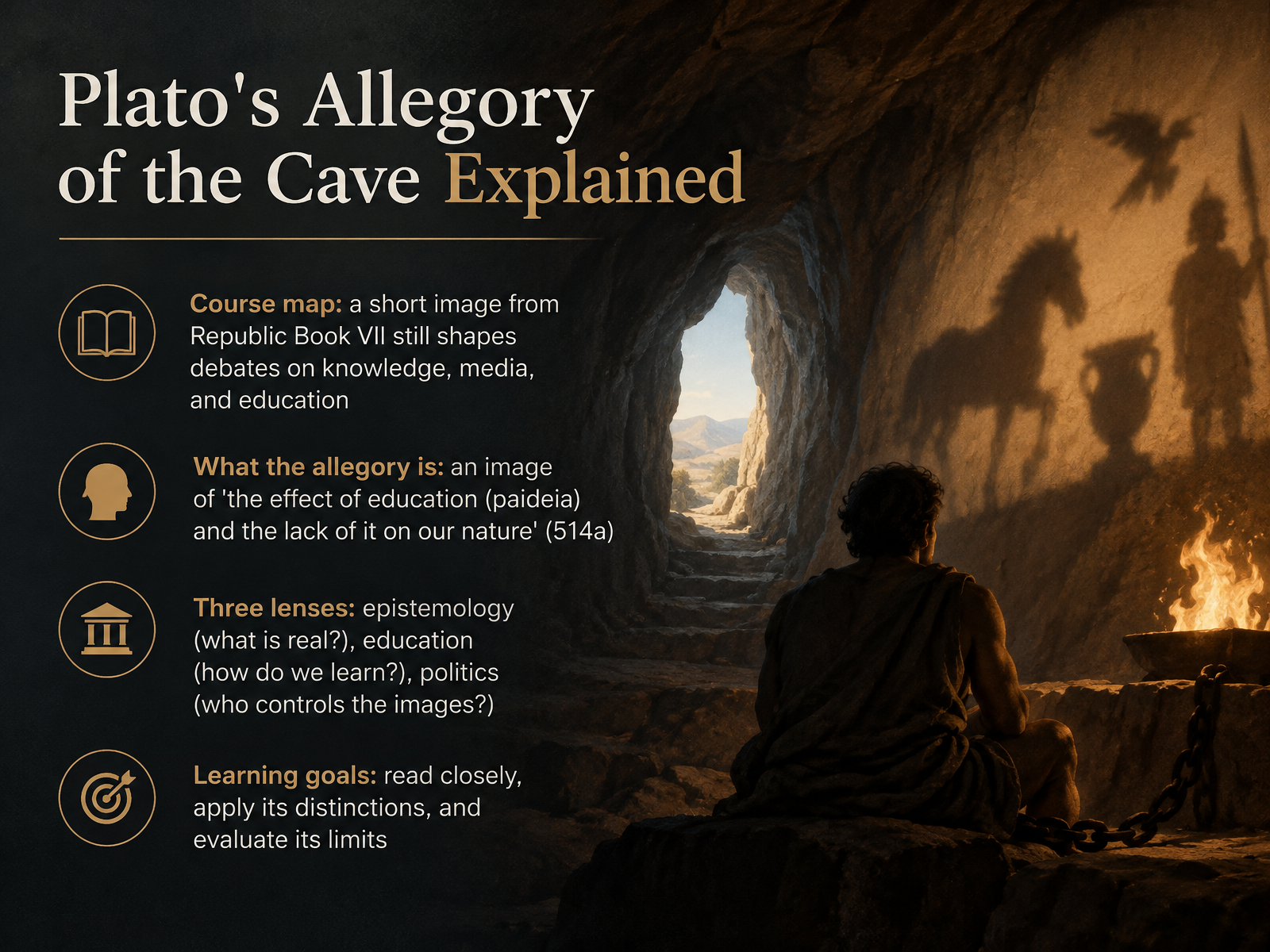
- 01Plato's Allegory of the Cave ExplainedWelcome. Today we're going to work through one of the most famous images in philosophy: Plato's Allegory of the Cave. It comes from Book Seven of the Republic. It's a short image, but it still shapes debates about knowledge, media, and education. Here's our plan. First, we'll look at what the allegory actually is. Plato calls it an image of the effect of education, or paideia, and the lack of it on our nature. Then we'll examine three lenses. Epistemology asks what is real. Education asks how we learn. Politics asks who controls the images. Our learning goals are simple. We'll read closely, apply the allegory's distinctions, and evaluate its limits. You don't need prior background. Think of this as a puzzle we're examining together, not a set of conclusions I'll hand you. Let's begin with the background: Athens, Socrates, and the Republic.classics.mit.eduphilolibrary.crc.nd.eduweb.stanford.edu+22 min
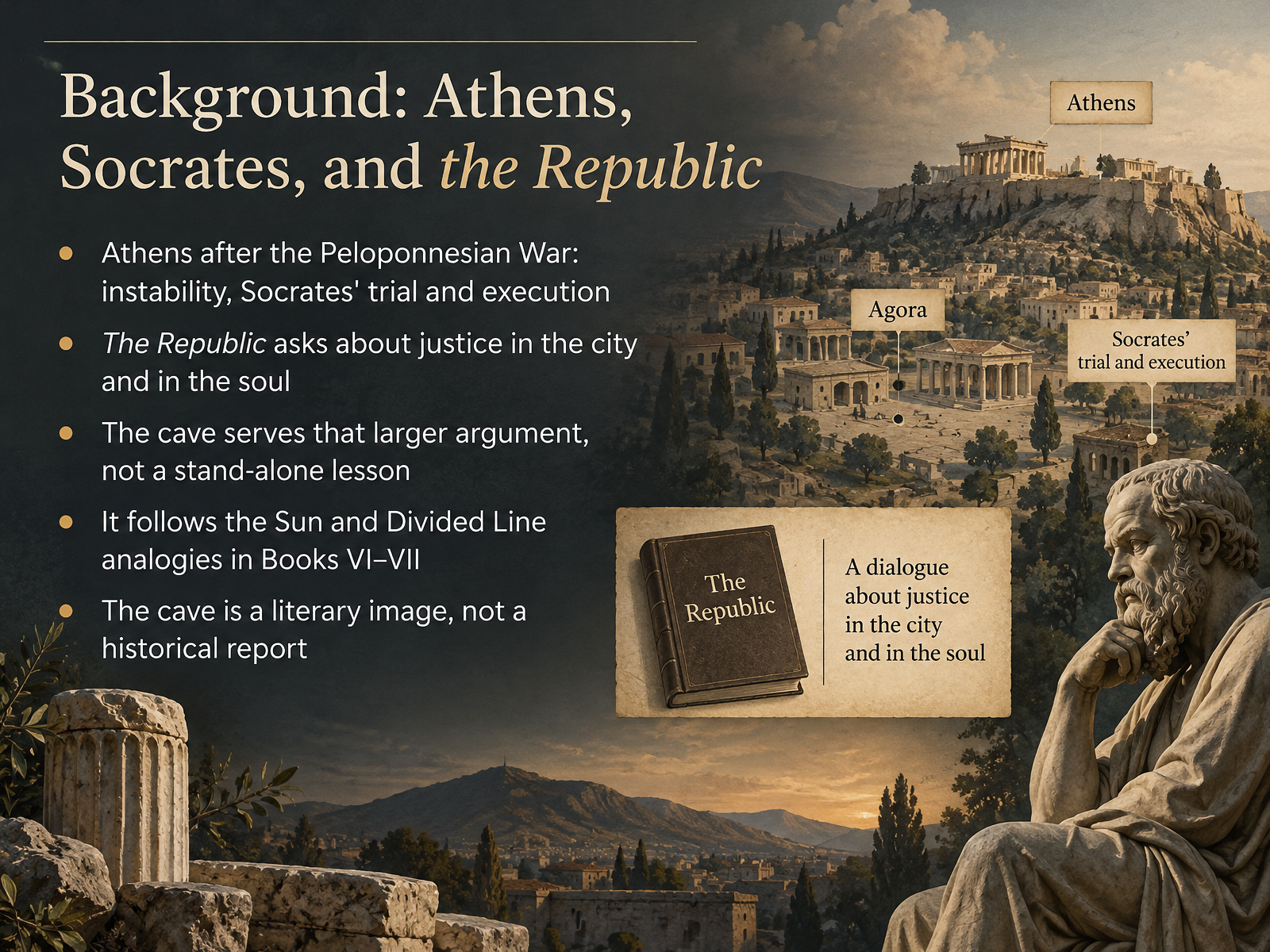
- 02Background: Athens, Socrates, and the RepublicBefore we walk through the cave itself, let's set the scene. Plato was writing in Athens after the Peloponnesian War, a time of political instability. Socrates, his teacher, was put on trial and executed. That loss shaped how Plato thought about justice. Now consider this. The Republic asks a big question. What is justice, both in the city and in the soul? The cave is not a stand-alone lesson. It serves that larger argument. It also follows two earlier images in Books Six and Seven, the Sun and the Divided Line. And one more point. The cave is a literary image, not a historical report. So as we go through it, we're examining a picture designed to make us think. Next, we'll look at the narrative, stage by stage.
 classics.mit.eduphilolibrary.crc.nd.eduweb.stanford.edu+21 min
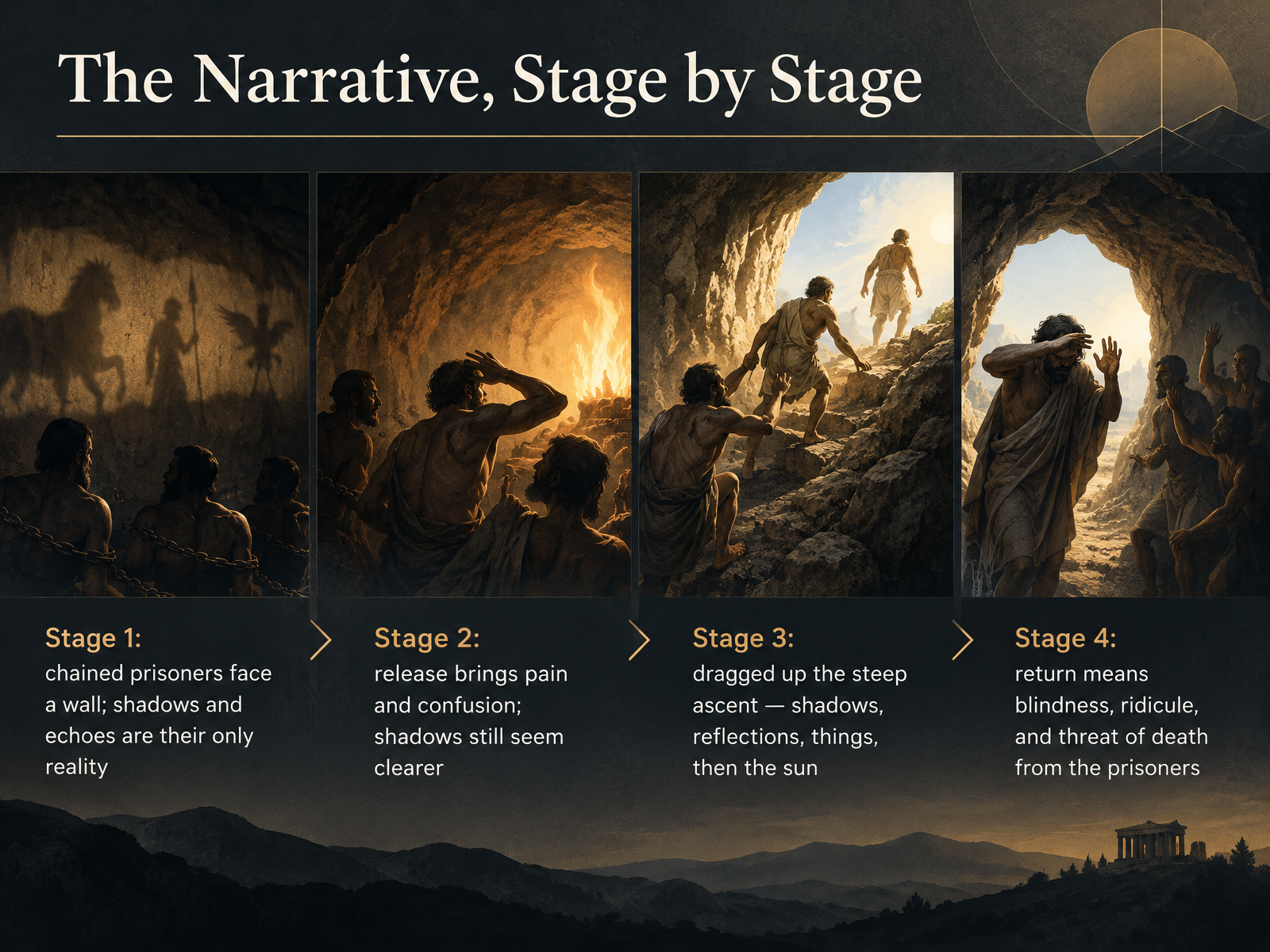
- 03The Narrative, Stage by StageLet's walk through the story itself, stage by stage. Stage one. Prisoners have been chained since childhood, facing a wall. Behind them is a fire, and objects pass in front of it, casting shadows. Echoes bounce off the wall. For the prisoners, these shadows and echoes are the whole of reality. Stage two. One prisoner is released. The light hurts. Everything is confusing, and the shadows still seem clearer than the things now being pointed out. Stage three. The prisoner is dragged up a steep ascent. Outside, the eyes adjust slowly. First shadows, then reflections in water, then the things themselves, and finally the sun. Stage four. The prisoner returns. In the dark cave, he cannot see well. The others laugh, and they conclude the journey ruined his eyesight. Plato adds that they would kill anyone who tried to drag them out. Notice the pattern. Each step is uncomfortable before it becomes clearer. Now, what does all this stand for? Let's turn to decoding the symbols.
 classics.mit.eduphilolibrary.crc.nd.eduweb.stanford.edu+22 min
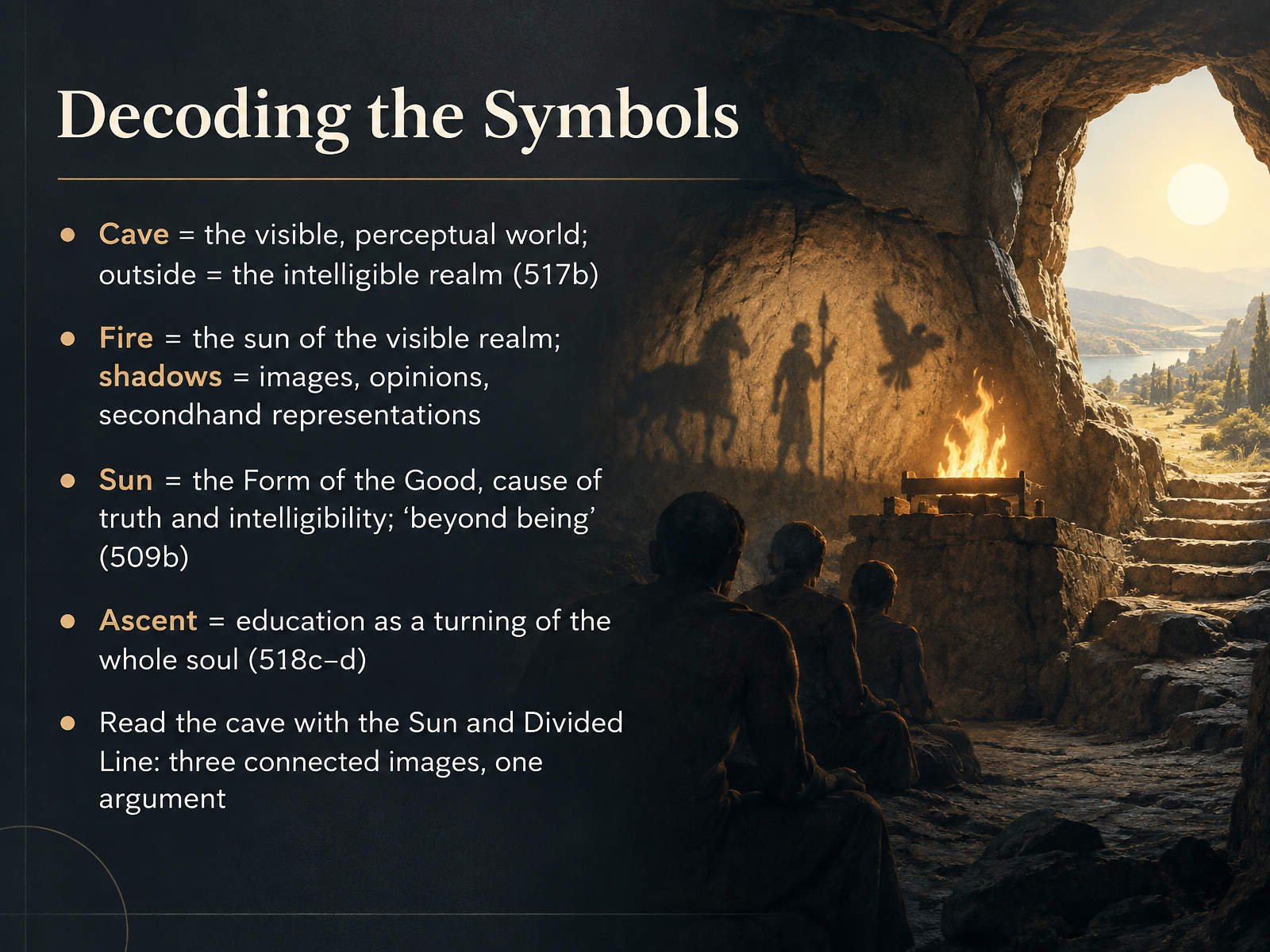
- 04Decoding the SymbolsNow let's decode the symbols, one at a time. The cave stands for the visible world, the world we perceive through our senses. The world outside stands for the intelligible realm, grasped by reason. The fire is like the sun of the visible realm. And the shadows are images, opinions, secondhand representations. The sun outside is the Form of the Good, the cause of truth and intelligibility, and Plato says it is beyond being. Notice the parallel. Just as the sun lets the eye see, the Good lets the mind know. Now consider the ascent. Education is not pouring knowledge into a soul that lacks it. It is a turning of the whole soul toward what is more real. So read the cave together with the Sun and the Divided Line. Three connected images, one argument. Next, we look at that argument more closely, in Knowledge, Opinion, and the Divided Line.
 plato.stanford.eduen.wikipedia.orgbooks.openbookpublishers.com+21 min
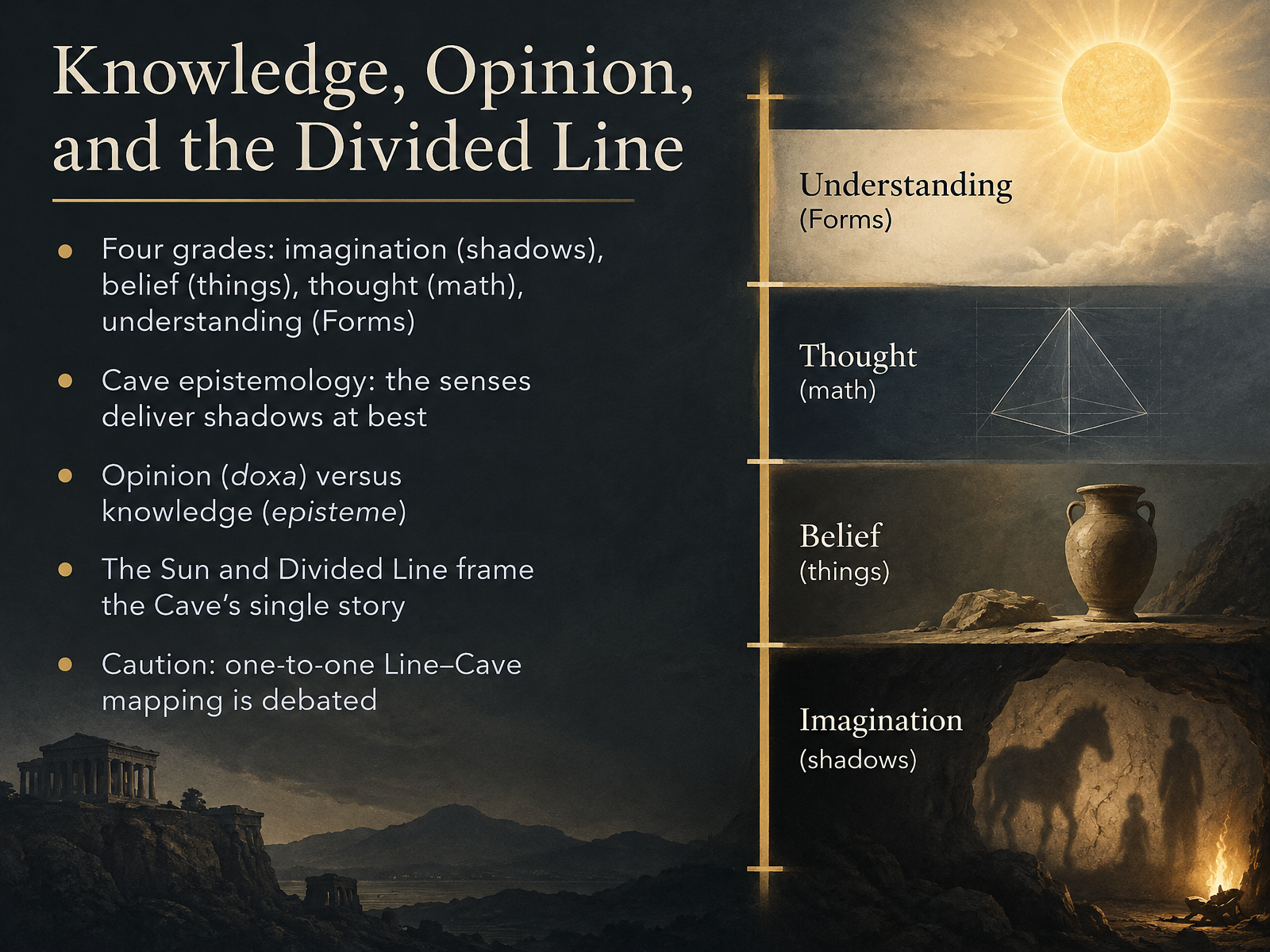
- 05Knowledge, Opinion, and the Divided LineLet's connect the Cave to Plato's wider picture, starting with the Divided Line. He sorts knowledge into four grades: imagination, which deals with shadows; belief, which deals with ordinary things we see and touch; thought, which works with mathematics; and understanding, which grasps the Forms. Notice that the senses sit low on this ladder. For Plato, they deliver shadows at best. That is why he separates opinion, doxa, from knowledge, episteme. Opinion is changeable and tied to appearances. Knowledge is stable and tied to what truly is. Now consider this. The Sun and the Divided Line aren't separate lessons. They're frames that let you read the Cave as one single story about the soul turning from darkness toward light. One caution, though: mapping each part of the Line onto each stage of the Cave in a neat one-to-one way is debated by scholars, so hold that loosely. Next, we'll look at education as the turning of the whole soul.
 plato.stanford.eduen.wikipedia.orgbooks.openbookpublishers.com+22 min
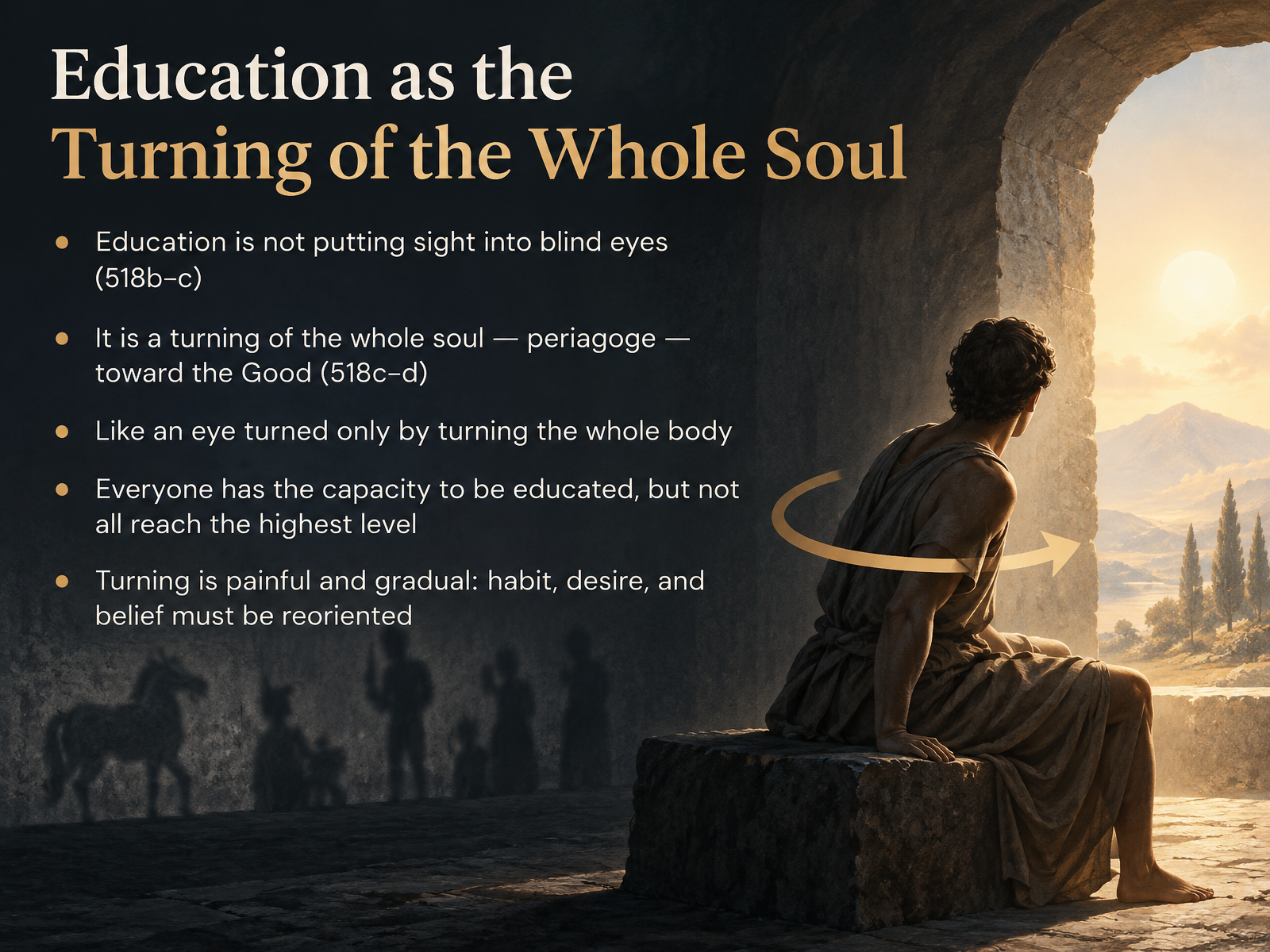
- 06Education as the Turning of the Whole SoulLet's take this idea a step further. In the Republic, at 518b and c, Socrates rejects a common picture of education. It is not putting sight into blind eyes. The power to learn is already there. Education is not inserting knowledge into an empty soul. Now consider what he offers instead. Education is a turning of the whole soul, what Plato calls periagoge, toward the Good. His image is an eye that can only be turned by turning the whole body. The same goes for the soul. Now here is a puzzle worth sitting with. Everyone has the capacity to be educated, but not everyone reaches the highest level. And the turning is painful and gradual. Habit, desire, and belief all have to be reoriented. So the question is not whether we have sight, but where we are looking. Next, we turn to why the returning is so demanding. Why the Prisoner Must Go Back.
 perseus.tufts.edujournals.uchicago.eduperseus.tufts.edu+21 min
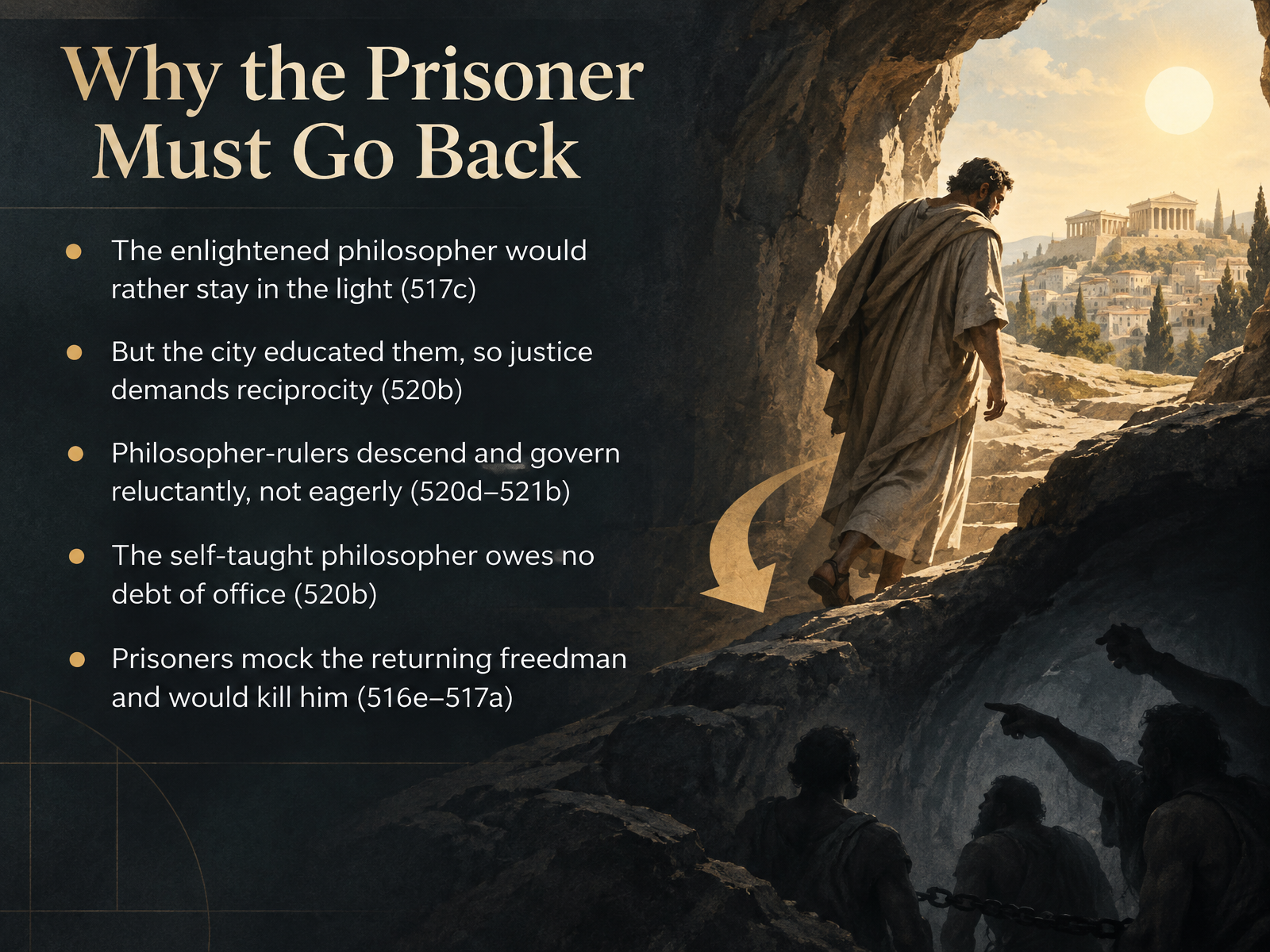
- 07Why the Prisoner Must Go BackNow, let's ask why the prisoner must go back. Socrates is blunt about it. The enlightened philosopher would rather stay in the light, contemplating the Forms. That life is better, and he knows it. So why return? Here is the key idea. The city educated him. His insight was not self-made. And justice demands reciprocity. In other words, he owes a debt, and the currency is governing. Notice a qualification, though. Plato says a self-taught philosopher, one who grew on his own and owes no debt for his upbringing, has justice on his side if he is not keen to rule. So the duty falls on those the city formed. And how do they rule? Reluctantly, not eagerly. Plato actually treats that reluctance as a virtue, because rulers who do not crave power are less likely to fight over it. Now consider the cost. The returning freedman stumbles in the dark. The prisoners mock him, saying his eyesight was ruined up there. And Socrates adds that, if they could, they would kill anyone who tried to drag them out. So the return is just, and also dangerous. That tension is the heart of this slide. And it leads us to our next question: politics and power. Who holds the puppets?
 plato.stanford.eduen.wikipedia.orgbooks.openbookpublishers.com+22 min
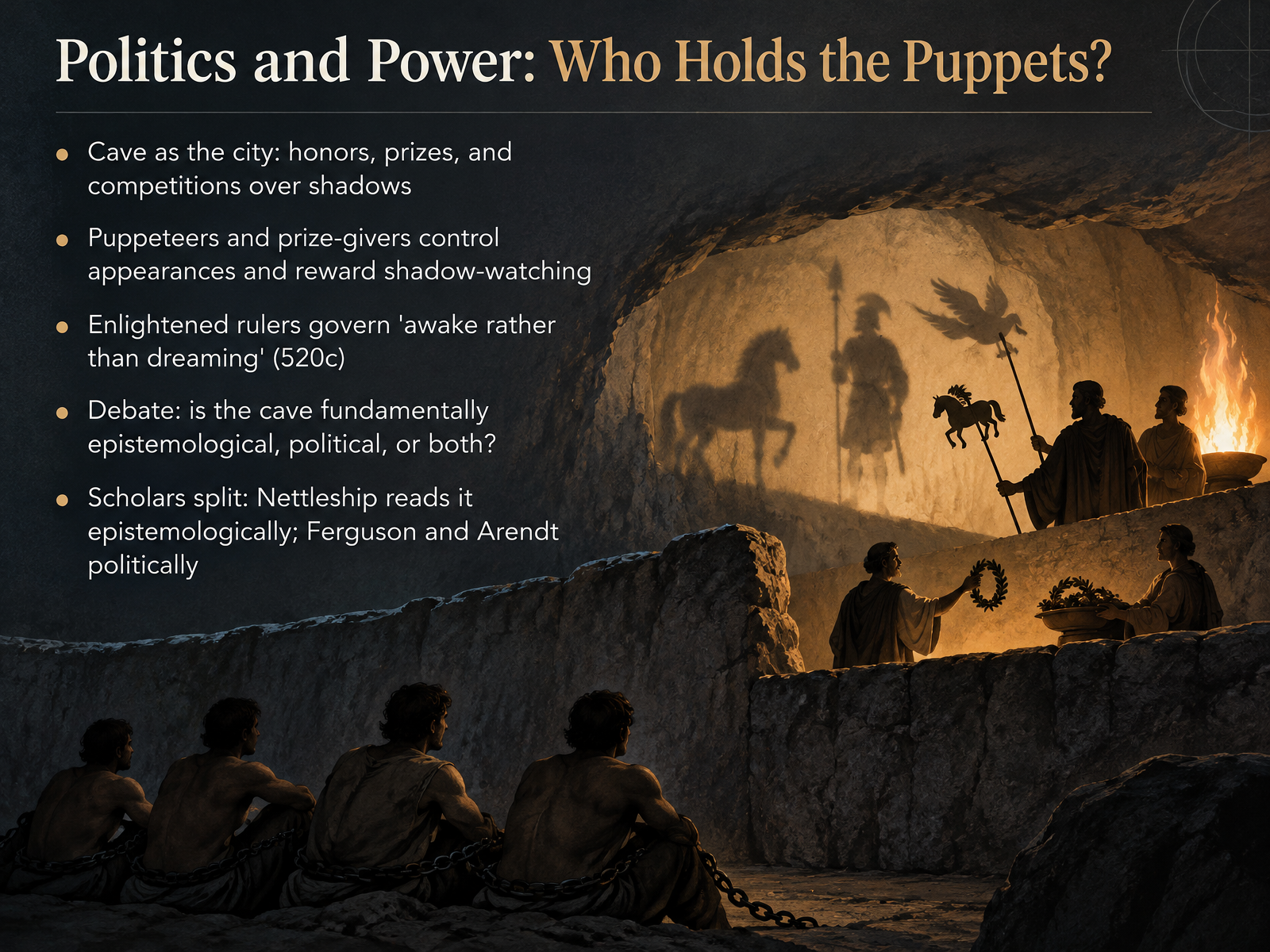
- 08Politics and Power: Who Holds the Puppets?Now let's look at the cave as a city. Inside it, honors, prizes, and competitions all revolve around shadows. The puppeteers and prize-givers control appearances, and they reward whoever is best at watching shadows. For Plato, enlightened rulers would govern differently, awake rather than dreaming, as he puts it at 520c. So here is the debate worth pausing on. Is the cave fundamentally about knowledge, about politics, or both? Scholars split. Nettleship reads it epistemologically, as a picture of our intellectual limits. Ferguson and Arendt read it politically, as a clash between the philosopher and a corrupt political condition. Ask yourself which reading the text supports. Next, we turn to the modern cave: screens, feeds, and algorithms.
 philarchive.orgdoi.orgcambridge.org+21 min
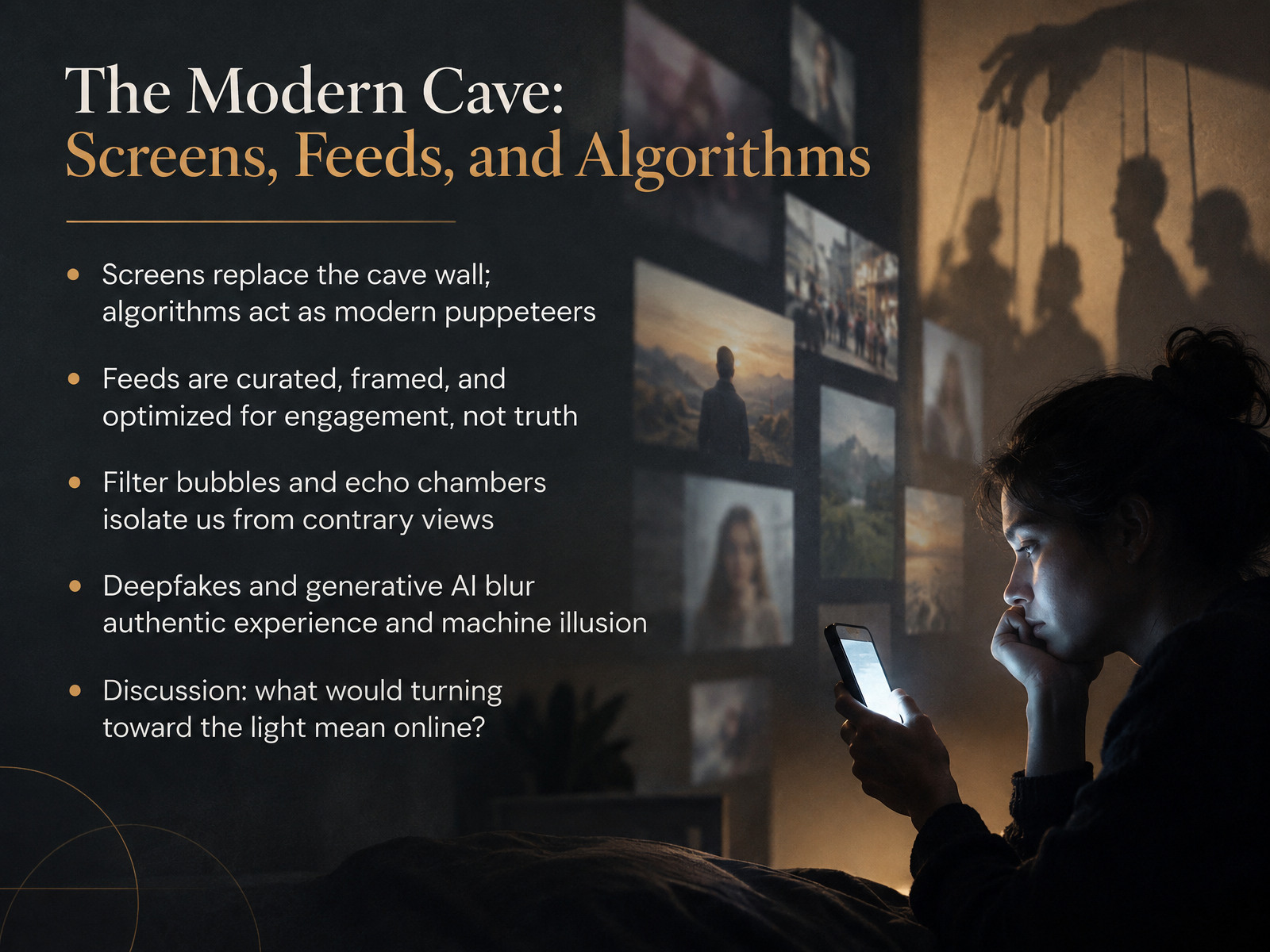
- 09The Modern Cave: Screens, Feeds, and AlgorithmsLet's bring the allegory into the present. Think of your screen as the cave wall, and the algorithms behind your feed as the modern puppeteers. They decide which shadows you see, and in what order. Feeds are curated, framed, and optimized for engagement, not for truth. That distinction matters. Filter bubbles and echo chambers then narrow what reaches us, so contrary views quietly disappear. And with deepfakes and generative AI, the line between authentic experience and machine-made illusion gets harder to locate. Now consider this question, and take a moment with it. What would turning toward the light actually mean online? Perhaps it means deliberately seeking sources that challenge us, checking how a claim was made, and noticing when a platform is shaping our attention. Keep that question open as we move on. Next, we look at the strengths of the allegory.
 philosophynow.orgphilarchive.orgdoi.org+22 min
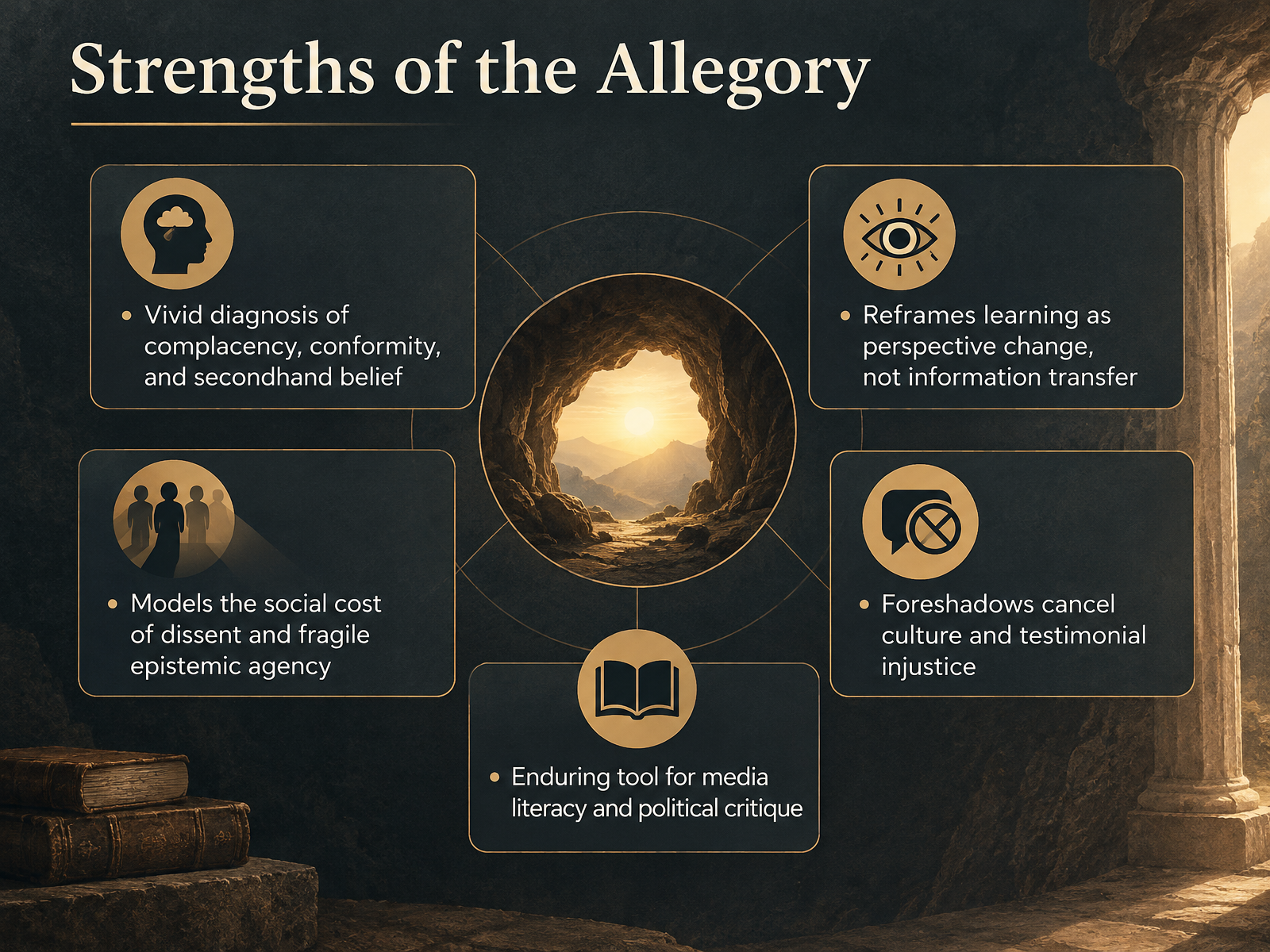
- 10Strengths of the AllegoryLet's turn now to the strengths of the allegory. Its most famous strength is diagnosis. It gives us a vivid picture of complacency, conformity, and secondhand belief. When prisoners mistake shadows for reality, we recognize our own habits of accepting what we are shown without asking how it was made. Now consider a second strength. The allegory reframes learning as a change of perspective, not simply the transfer of information. Education, in Plato's image, turns the whole soul around. Third, it models the social cost of dissent. The returning prisoner is ridiculed and silenced, which helps us see how fragile our independence of judgment can be. That picture also foreshadows modern worries about cancel culture and what philosophers call testimonial injustice, meaning disbelief that comes from prejudice rather than evidence. Finally, it remains an enduring tool. It gives us a shared vocabulary for media literacy and political critique, from filter bubbles to propaganda. So the lasting value is this. The allegory does not just tell us that we might be wrong. It helps us ask how our views are shaped, and what it costs to question them. That leads naturally to the next slide, Criticisms and Limits.
 philarchive.orgdoi.orgcambridge.org+22 min
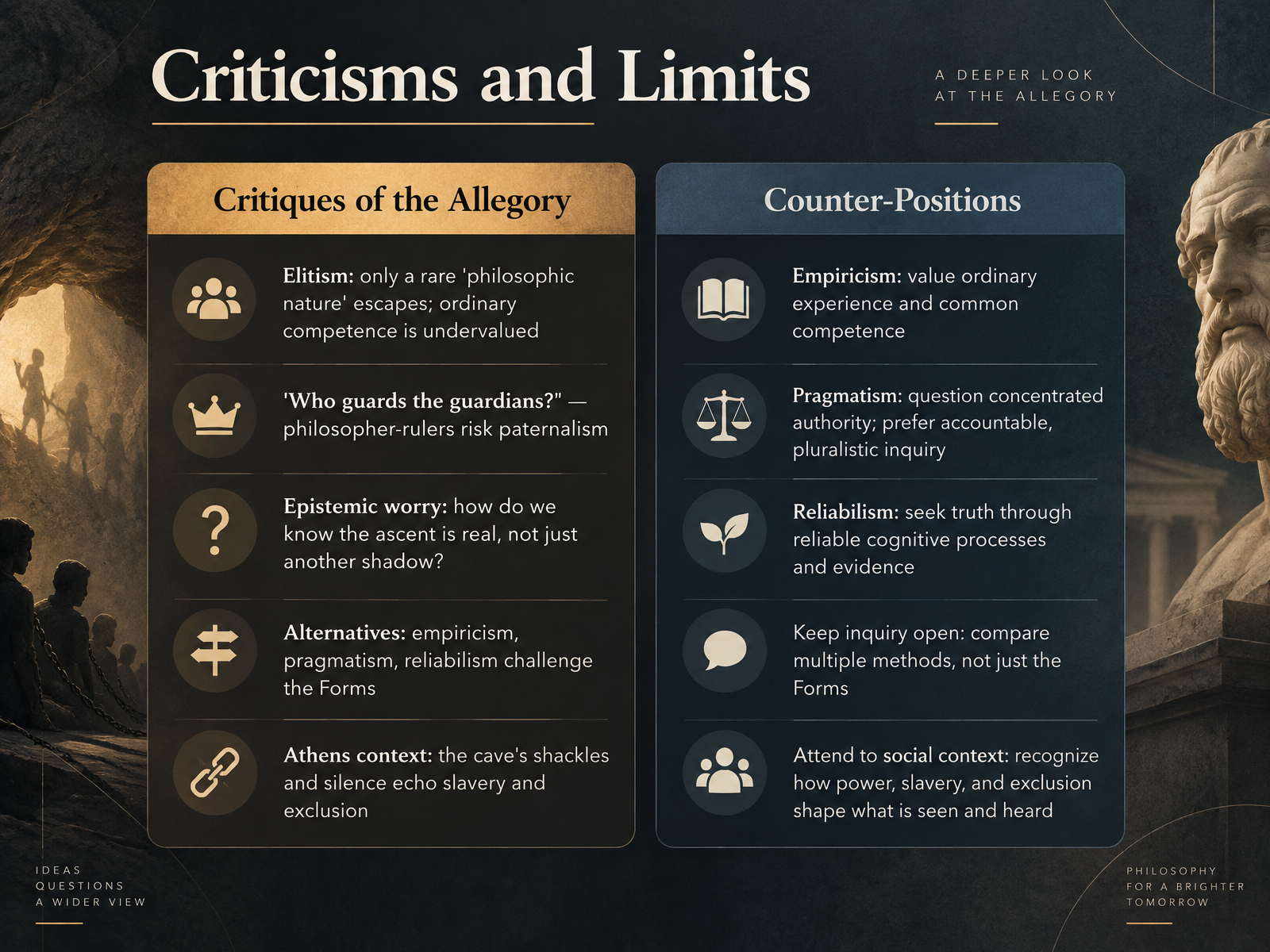
- 11Criticisms and LimitsLet's turn now to criticisms and limits. The allegory invites pushback, and that is part of its value. First, elitism. Plato says only a rare philosophic nature escapes the cave, and ordinary competence gets little credit. Second, who guards the guardians? Philosopher-rulers may slide into paternalism, deciding for everyone else. Third, an epistemic worry. How do we know the ascent is real, and not just another set of shadows? Fourth, alternatives like empiricism, pragmatism, and reliabilism challenge the theory of Forms. And fifth, the Athenian context. The cave's shackles and silence echo slavery and exclusion. Now consider this: do these objections weaken the allegory, or sharpen it? Next, we will practice close reading and application, through the Reading Workshop.
 philarchive.orgdoi.orgcambridge.org+22 min
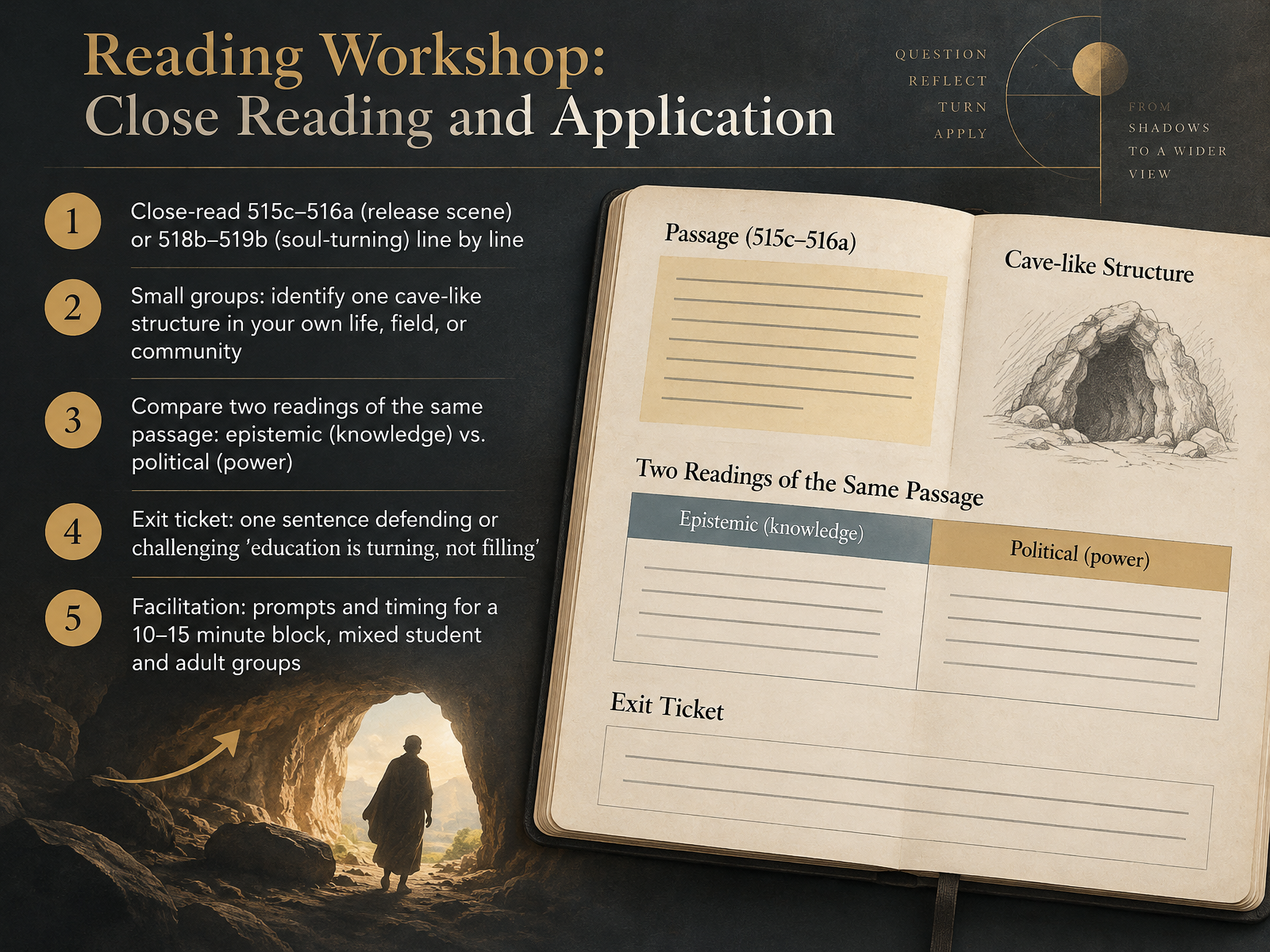
- 12Reading Workshop: Close Reading and ApplicationNow let's put the text to work in a reading workshop. Your task is close reading. Choose one passage. Either the release scene at 515c to 516a, where the prisoner is dragged into the light. Or 518b to 519b, where education is described as turning the whole soul, not filling it. Read it line by line and ask what each image is doing. Then, in small groups, name one cave-like structure in your own life, your field, or your community. A workplace norm, a social feed, a classroom habit. Next, compare two readings of the same passage. One epistemic, focused on knowledge. One political, focused on power. Notice how the same words can support both. Your exit ticket is one sentence defending or challenging this claim. Education is turning, not filling. With mixed groups, allow around five minutes for close reading, five for discussion, and two for the exit ticket. Now let's gather the key takeaways.
 perseus.tufts.edujournals.uchicago.eduperseus.tufts.edu+22 min
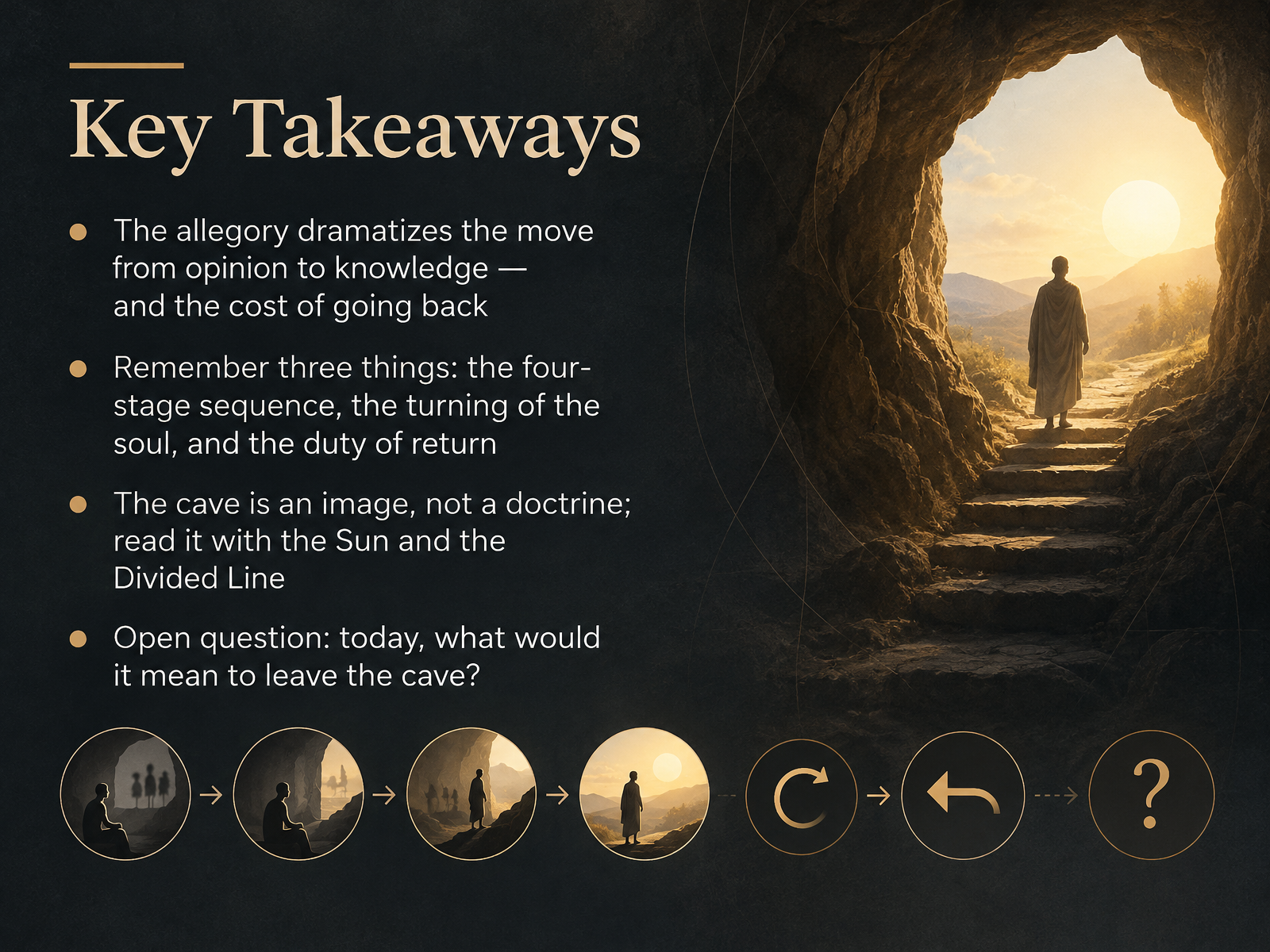
- 13Key TakeawaysLet's pull the main threads together. First, the allegory dramatizes the move from opinion to knowledge, and it does not hide the cost of going back. The freed prisoner returns, his eyes unused to the dark, and is mocked for it. Now consider this. Three things are worth keeping. Remember the four-stage sequence. Remember the turning of the whole soul, where education redirects a power we already have rather than pouring knowledge in. And remember the duty of return. Also, keep the cave in context. It is an image, not a doctrine, so read it alongside the Sun and the Divided Line. Here is an open question to carry with you. Today, what would it mean to leave the cave? Next, we look at Further Reading and Translations.
 classics.mit.eduphilolibrary.crc.nd.eduweb.stanford.edu+22 min
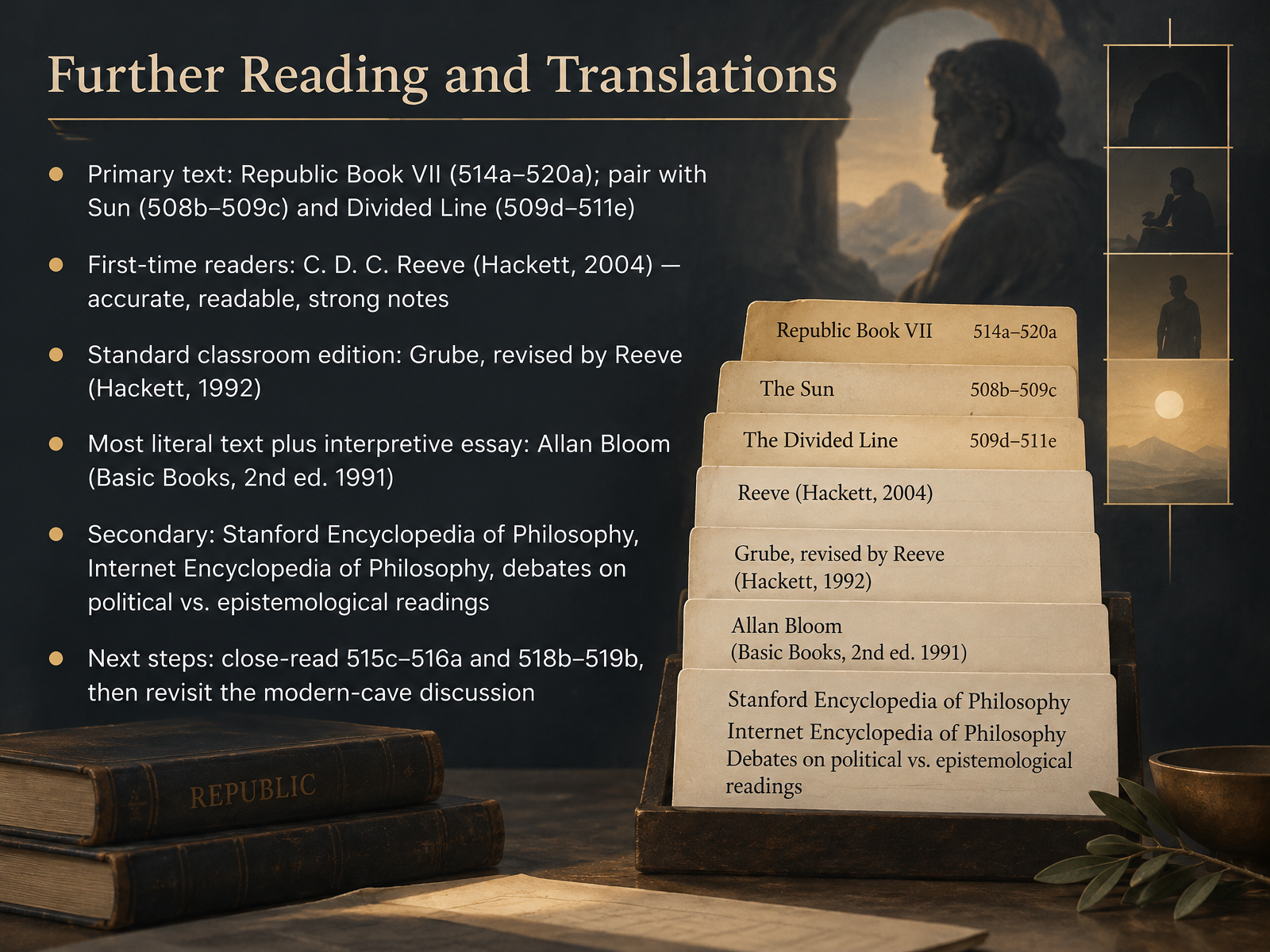
- 14Further Reading and TranslationsSo, where do you go from here? Start with the primary text: Book Seven of the Republic, lines 514a to 520a. Then read it alongside the Sun analogy and the Divided Line, because the three images work together. For a first read, C. D. C. Reeve's translation from Hackett, 2004, is accurate, readable, and has strong notes. The standard classroom edition is Grube, revised by Reeve, from 1992. If you want the most literal text, plus a long interpretive essay, try Allan Bloom's second edition, 1991. For secondary reading, the Stanford and Internet Encyclopedia of Philosophy entries are reliable, and look at the debate over political versus epistemological readings. Your next step: close-read 515c to 516a and 518b to 519b, then revisit our modern-cave discussion. You now have a toolkit, not just a summary. Thank you for thinking this through with me. Keep reading closely, and keep asking what the shadows might be hiding.
 plato.stanford.eduen.wikipedia.orgbooks.openbookpublishers.com+22 min
Take the deck with you
Download this course as a file — free, no sign-up needed.
- PDF handoutEvery slide page, ready to print or share.15 pages · 4.6 MBDownload
- Narrated PowerPointThe deck that presents itself — every slide carries the digital human's narration video.15 pages · 14.5 MBDownload
- PowerPoint slidesThe full deck as a .pptx — open it in PowerPoint, Keynote, or Google Slides.15 pages · 4.5 MBDownload
Free to use in your own training — please keep the PersonWise credit page at the end.
Have your own deck? Turn it into a course
Sources consulted
Web sources consulted while building this course.
- The Internet Classics Archive | The Republic by Plato — classics.mit.edu
- The Allegory of the Cave Plato’s Republic, Book 7 – The Philosophy Teaching Library — philolibrary.crc.nd.edu
- X:\web\local\apache\services\xfer\39DFF1D6-6962-B880\CAVE.wpd — web.stanford.edu
- Allegory of the cave — en.wikipedia.org
- Plato's Republic: the allegory of the cave — plato-dialogues.org
- Plato’s Middle Period Metaphysics and Epistemology (Stanford Encyclopedia of Philosophy) — plato.stanford.edu
- Allegory of the cave — en.wikipedia.org
- Plato's 'Republic' - 11. The Allegory of the Cave — books.openbookpublishers.com
- The ‘Simile Of Light’ In Plato'S Republic | The Classical Quarterly | Cambridge Core — cambridge.org
- Plato and the cave allegory. An interpretation beginning with verbs of knowledge — doi.org
- Plato, Republic, Book 7, section 518c — perseus.tufts.edu
- The Soul-Turning Metaphor in Plato’s Republic Book 7 | Classical Philology: Vol 117, No 3 — journals.uchicago.edu
- Plato, Republic, Book 7, section 518d — perseus.tufts.edu
- 11 - Blindness and reorientation: education and the acquisition of knowledge in the Republic — cambridge.org
- Plato: The Republic | Internet Encyclopedia of Philosophy — iep.utm.edu
- Peter Kahl, The Silent Shadows: Epistemic Clientelism and Plato’s Cave - PhilArchive — philarchive.org
- The Allegory of the Cave and the Problem of Platonism in Hannah Arendt and Leo Strauss — doi.org
- PRISON-BREAKING FROM PLATO’S CAVE | The Classical Quarterly | Cambridge Core — cambridge.org
- Slavery in Plato's Allegory of the Cave: Alain Badiou, Jacques Rancière, and the Militant Intellectual from the Global South — doi.org
- Plato’s Cave & Social Media | Issue 165 | Philosophy Now — philosophynow.org