Begin
14 pages · ~28 min
Metaphor, Irony & Symbolism in Literature
This training teaches learners to identify and interpret metaphor, irony, and symbolism in literary texts, building practical analysis skills for students and readers of literature.
A digital instructor presents all 14 pages. Hold “Ask” at any point and ask out loud — the answer comes from this course. No sign-up needed.
What you’ll learn
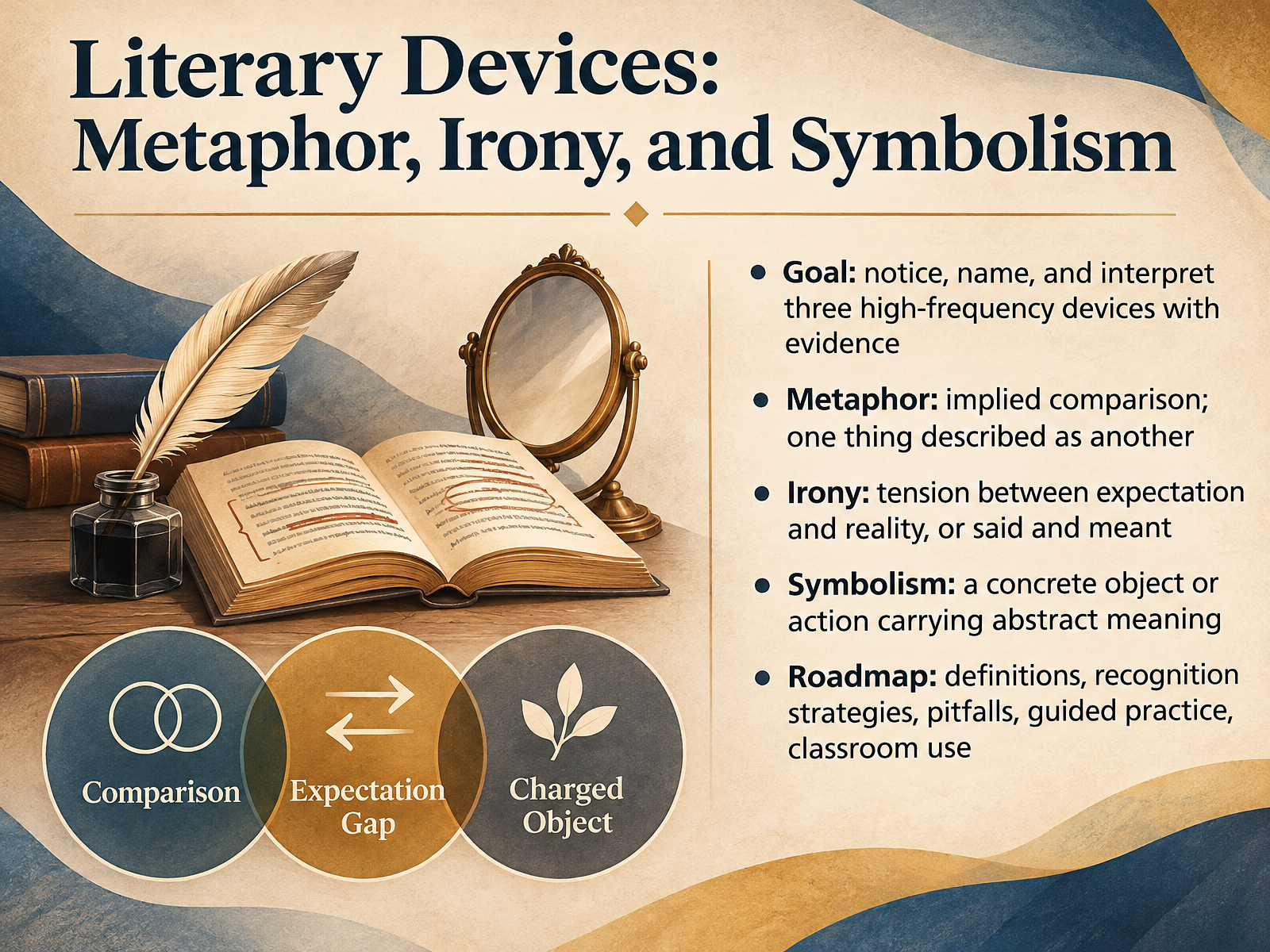
- 01Literary Devices: Metaphor, Irony, and SymbolismWelcome. Today we're going to build a simple, reliable habit: noticing, naming, and interpreting three literary devices you'll meet everywhere, and backing your reading with evidence from the text. First, metaphor. A metaphor is an implied comparison. One thing is described as another, without the words like or as. When Hamlet calls Claudius a snake, he isn't literally a reptile. The comparison carries the meaning for you. Second, irony. Irony lives in tension: between what we expect and what happens, or between what is said and what is meant. Someone who steps into a storm and says, wonderful weather, is speaking ironically. Their words say one thing, their meaning another. Third, symbolism. A symbol is a concrete object or action that carries abstract meaning. A white dove stands for peace. Notice the difference as we go. Metaphor makes a comparison openly. Symbolism lets a physical thing quietly point beyond itself. Irony turns on a mismatch. Here's your roadmap. We'll cover definitions, ways to recognize each device, common pitfalls, guided practice with real passages, and finally classroom use. For now, take one text at hand. Find a single line where something is compared, stated against expectation, or quietly standing for more. Hold onto it. Next, we'll map the full course together: Course Map and Learning Goals.owl.purdue.edupoets.orgwww2.hunter.cuny.edu+22 min
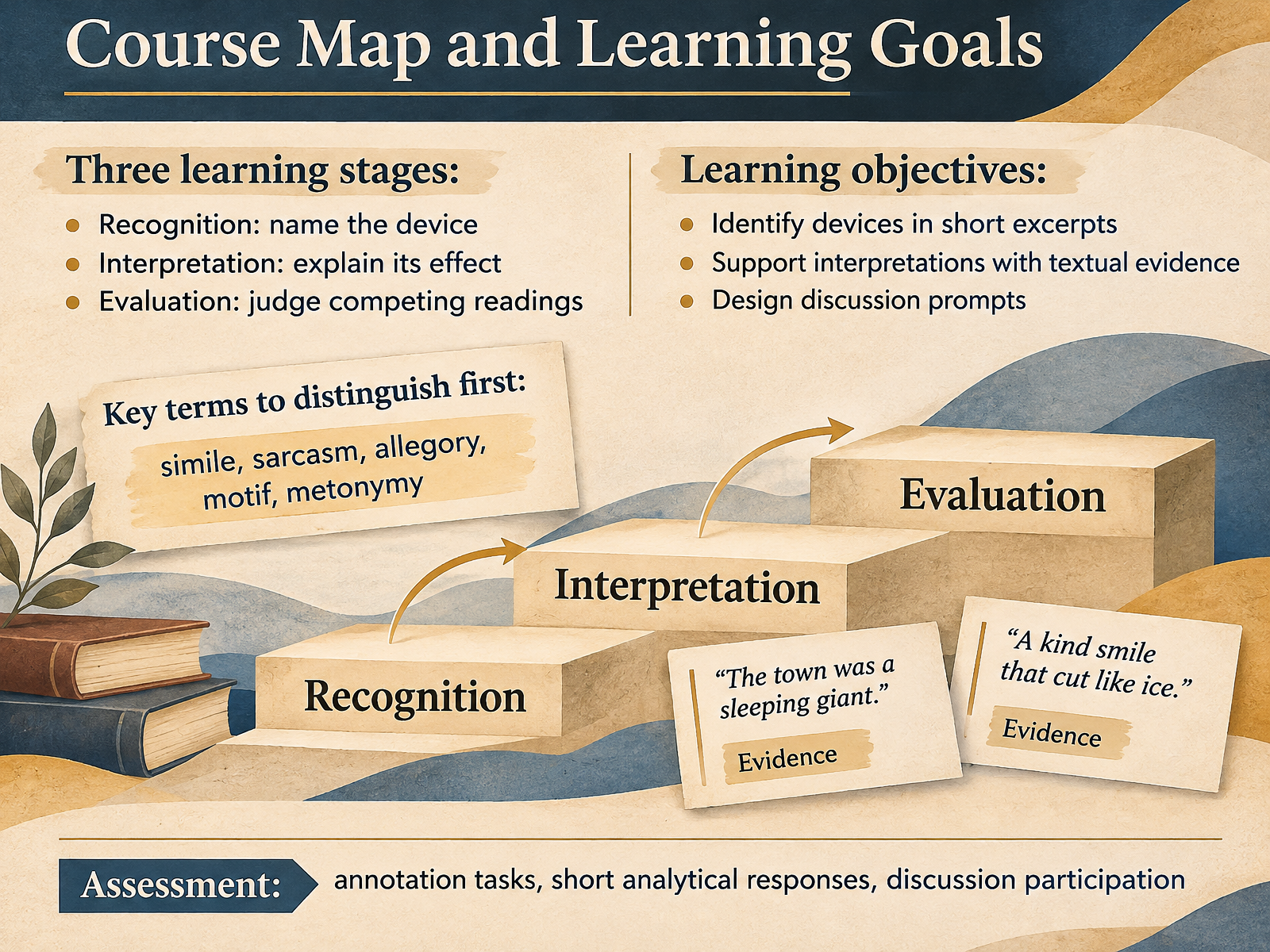
- 02Course Map and Learning GoalsHere's our roadmap. Think of this course as three stages, each building on the one before. First, recognition: can you name the device you're looking at? Second, interpretation: can you explain what it does to the reader? And third, evaluation: can you weigh competing readings and judge which holds up? By the end, you'll identify devices in short excerpts, support your interpretations with textual evidence, and even design your own discussion prompts. Before we dive in, we'll separate a few easy-to-confuse terms, including simile, sarcasm, allegory, motif, and metonymy. Your work will be assessed through annotation tasks, short analytical responses, and discussion participation. So keep a pencil and a text nearby, because this course is hands-on. Let's begin with metaphor, moving from simple comparison to conceptual mapping.
 owl.purdue.edupoets.orgwww2.hunter.cuny.edu+22 min
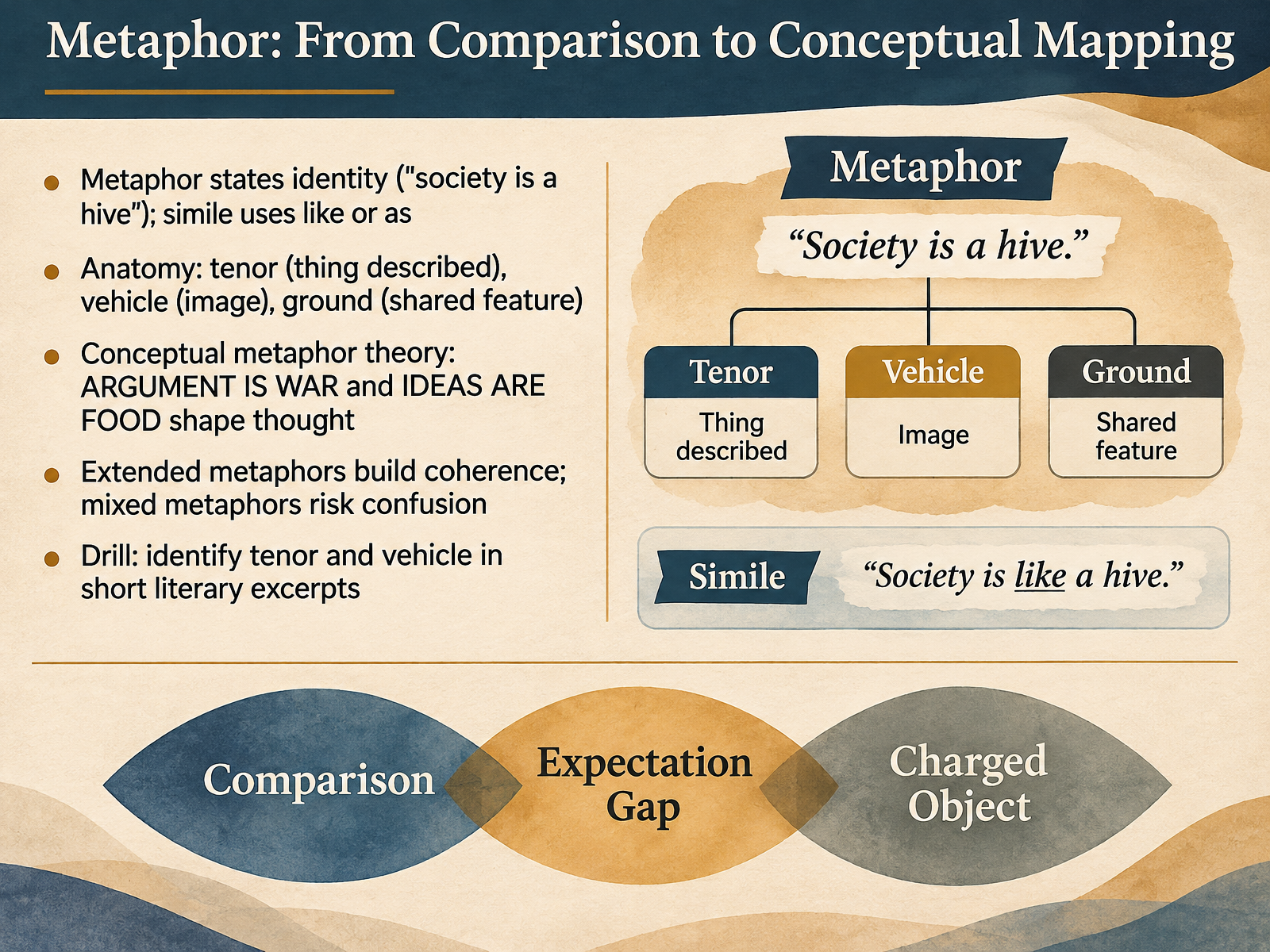
- 03Metaphor: From Comparison to Conceptual MappingNow let's look closely at metaphor. A metaphor states that one thing is another. "Society is a hive" is a metaphor. A simile, by contrast, uses like or as: "society is like a hive." Here's the difference. Metaphor says identity. Simile says similarity.
To analyze a metaphor, name three parts. The tenor is the thing being described. The vehicle is the image used to describe it. The ground is the feature they share. In "society is a hive," society is the tenor, the hive is the vehicle, and busy cooperation is the ground.
Lakoff and Johnson went further. They argued that metaphor shapes how we think, not just how we speak. ARGUMENT IS WAR and IDEAS ARE FOOD are conceptual metaphors. They give us phrases like "defending a position" or "digesting an idea."
Extended metaphors carry one image through a whole passage and build coherence. Mixed metaphors jumble images and risk confusion. So pause here and try this. Find a short passage and name its tenor and vehicle. Next, we'll put metaphor to work in recognition and interpretation.
 press.uchicago.eduacademic.oup.comjstor.org+22 min
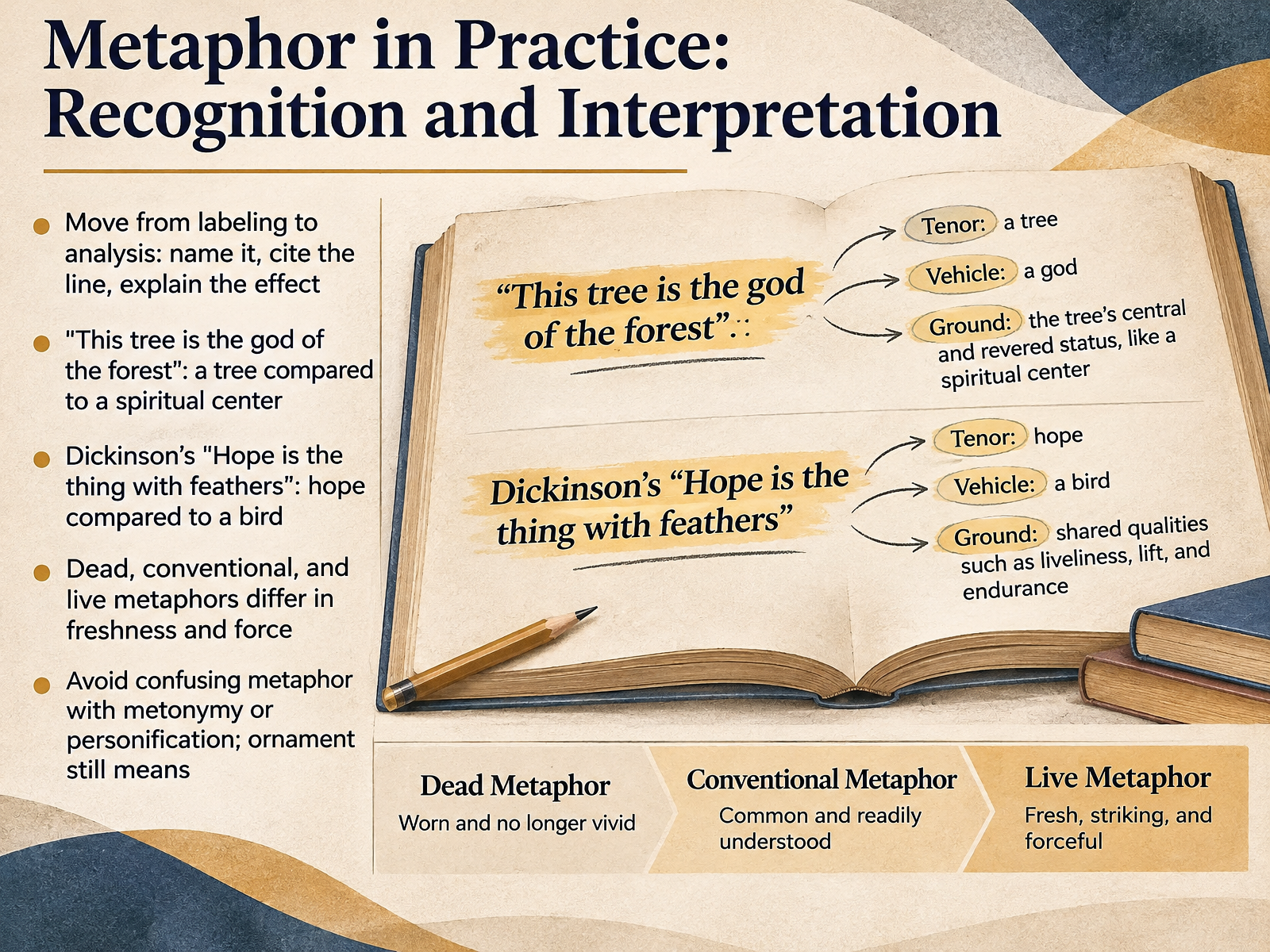
- 04Metaphor in Practice: Recognition and InterpretationNow let's put metaphor to work. Move from labeling to analysis with three steps. Name it. Cite the line. Explain the effect. Take this line: "This tree is the god of the forest." The tree is compared to a spiritual center, something strong and immovable. Notice how much one word carries. Then there's Dickinson's "Hope is the thing with feathers." Here, hope is compared to a bird, something that perches and sings. Here's the difference: dead metaphors are worn smooth, conventional ones are familiar, and live metaphors still surprise you with force. Also, avoid confusing metaphor with metonymy or personification. A metaphor is still ornament, but ornament that means. Pause and try this on a text at hand, then we'll turn to irony: types, signals, and interpretation.
 owl.purdue.edupoets.orgwww2.hunter.cuny.edu+21 min
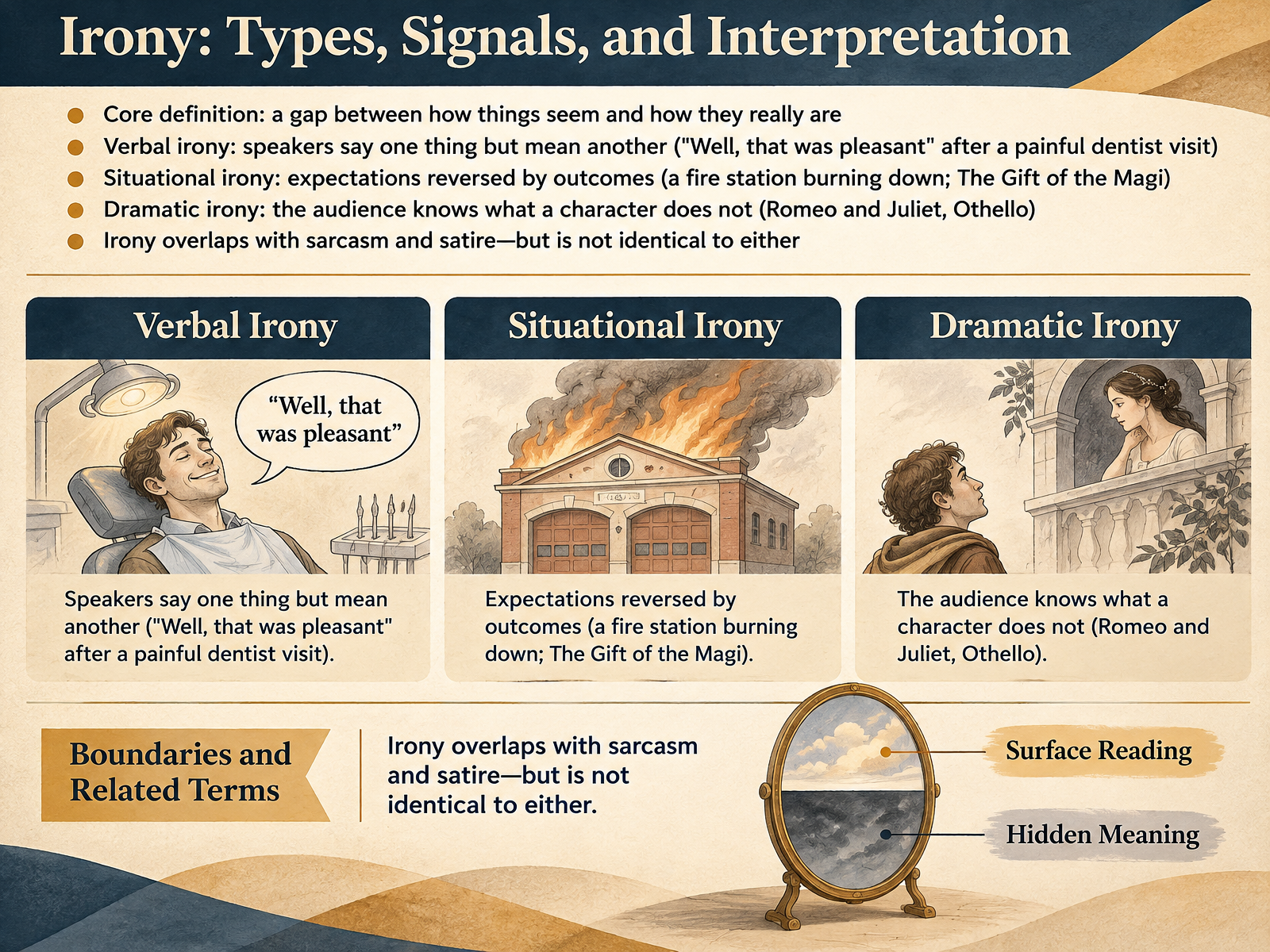
- 05Irony: Types, Signals, and InterpretationNow let's turn to the trickiest of the three, irony. At its core, irony is a gap between how things seem and how they really are. There are three main types you'll meet in reading. First, verbal irony, where a speaker says one thing but means another. After a painful dentist visit, someone might say, "Well, that was pleasant." The words and the meaning sit far apart. Second, situational irony, where an outcome reverses what we expected. A fire station burning down is the classic example. In The Gift of the Magi, a wife sells her hair to buy a watch chain, while her husband sells his watch to buy her combs. Third, dramatic irony, where the audience knows what a character does not. In Romeo and Juliet, we know Juliet is only sleeping as Romeo drinks the poison. Here's the difference to hold onto. Irony overlaps with sarcasm and satire, but it isn't identical to either. Sarcasm is verbal irony aimed to wound. Satire uses irony to expose and criticize. So pause here and ask, where exactly is the gap in the text in front of you? Let's look next at reading irony with evidence.
 liberalarts.oregonstate.edulitcharts.comliterarydevices.com+22 min
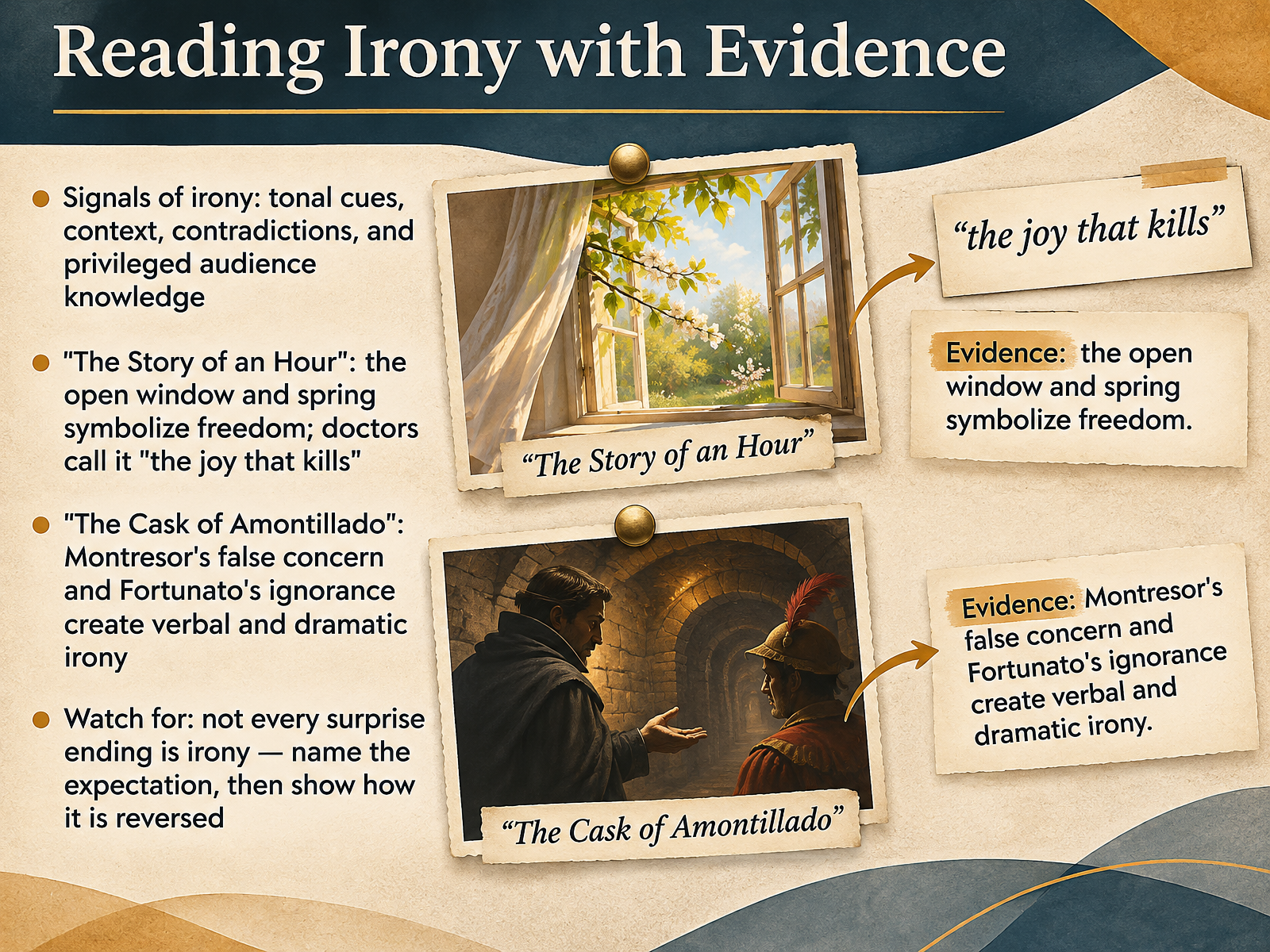
- 06Reading Irony with EvidenceNow let's look at reading irony with evidence. First, what signals tell you irony is present? Watch for tonal cues, context, contradictions, and privileged audience knowledge, meaning you know more than the character does. In Kate Chopin's The Story of an Hour, the open window and the spring symbolize freedom. Yet the doctors call her death the joy that kills. You know her joy was freedom, so the label is ironic. In The Cask of Amontillado, Montresor's false concern and Fortunato's ignorance create both verbal and dramatic irony. Here's the difference: verbal irony says one thing while meaning another, and dramatic irony gives the audience information a character lacks. Now try this. Not every surprise ending is irony. Name the expectation, then show how it's reversed. That's your evidence. Next, we'll turn to symbolism: objects, actions, and meaning.
 liberalarts.oregonstate.edulitcharts.comliterarydevices.com+22 min
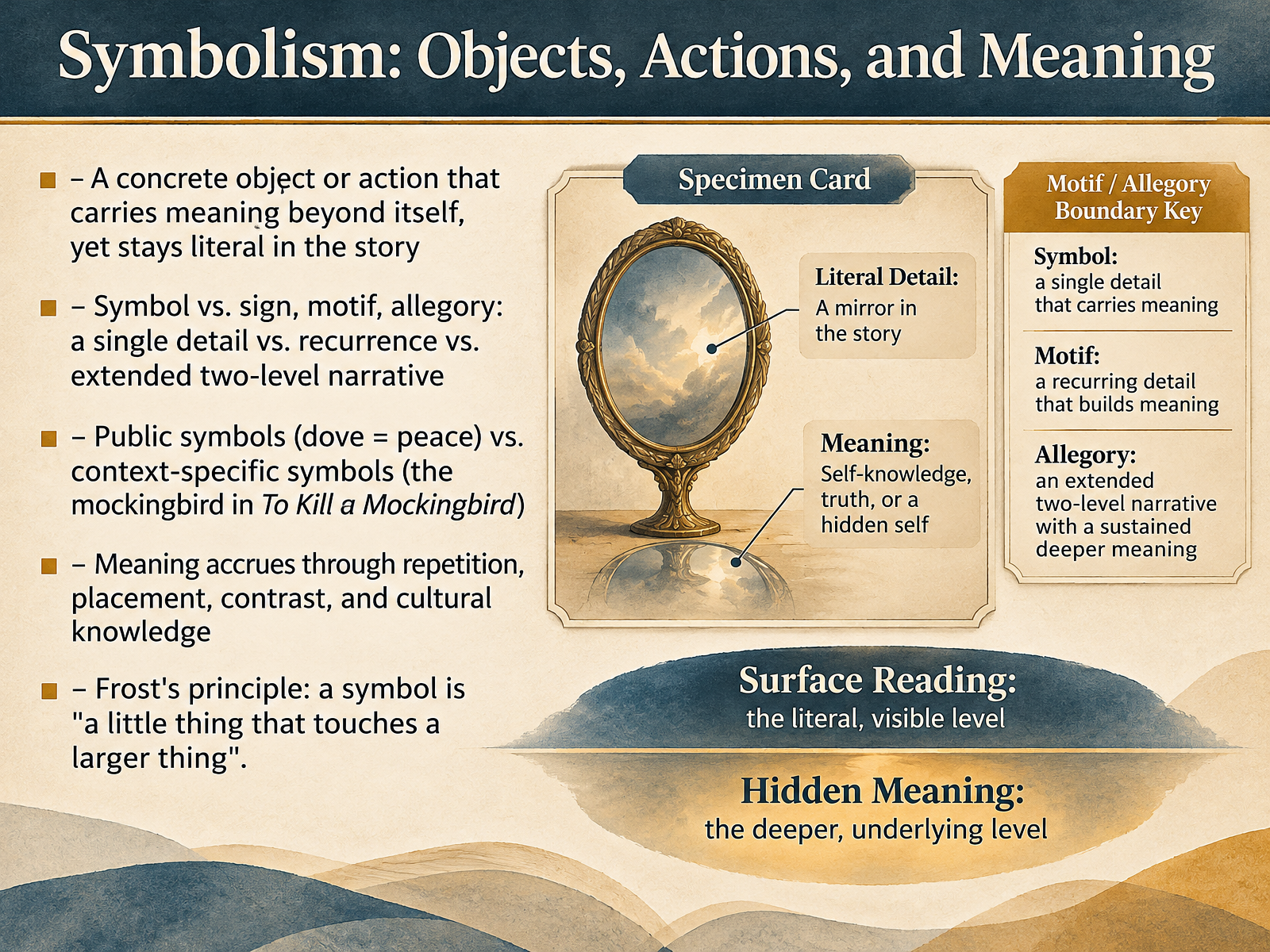
- 07Symbolism: Objects, Actions, and MeaningNow let's look at symbolism, where objects and actions carry meaning beyond themselves. A symbol stays literal in the story. A flag is still a piece of cloth, but it also points toward a nation, a cause, or a memory. Here's the difference between close terms. A symbol is a single detail with extra meaning. A motif is a recurring element whose repetition builds significance. An allegory is an extended narrative with a second level running throughout, like Animal Farm. Some symbols are public, like a dove for peace. Others are context-specific. In To Kill a Mockingbird, the mockingbird symbolizes innocence because it harms no one and simply sings. Meaning accrues through repetition, placement, contrast, and cultural knowledge. Robert Frost put it well: a symbol is a little thing that touches a larger thing. So pause here and ask: in the text in front of you, which concrete detail keeps returning, and what larger idea does it touch? Next, we'll see symbolism in practice, through repetition and restraint.
 litcharts.comsparknotes.comowl.purdue.edu+22 min
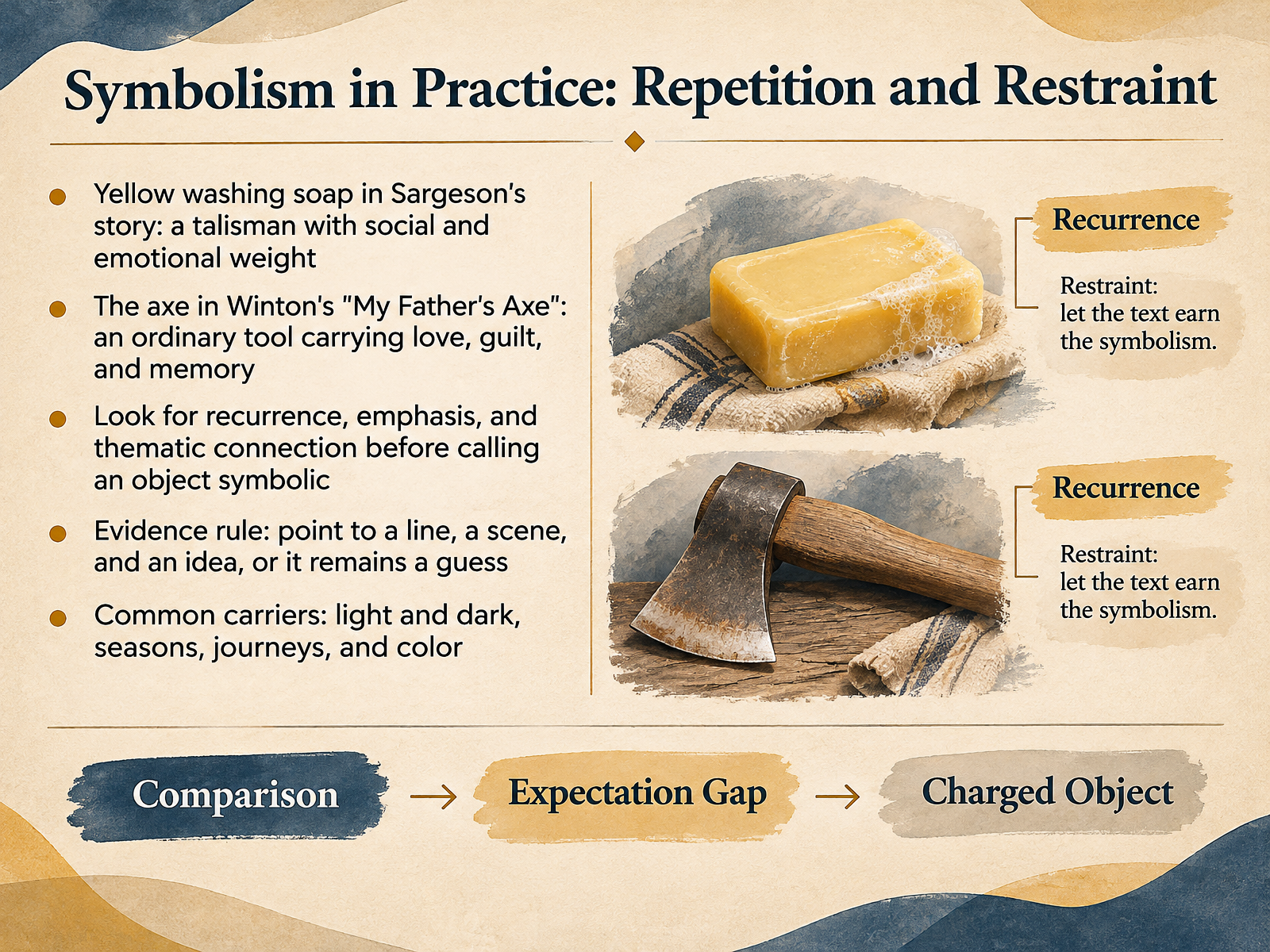
- 08Symbolism in Practice: Repetition and RestraintNow let's see symbolism in practice, with repetition and restraint. First, the piece of yellow washing soap in Frank Sargeson's story. The narrator calls it a talisman, an object that seems to work wonders. It carries social and emotional weight. Think of what stands behind it: poverty, pride, and a woman holding her ground. Then there's the axe in Tim Winton's My Father's Axe. It's an ordinary tool, yet it carries love, guilt, and memory. Here's the difference between a symbol and a repeated detail. Before you call an object symbolic, look for recurrence, emphasis, and a thematic connection. Use the evidence rule: point to a line, a scene, and an idea, or it remains a guess. And watch for common carriers, such as light and dark, seasons, journeys, and color. Next, we'll put this into a close-reading workflow.
 markedbyteachers.comlitcharts.comsparknotes.com+22 min
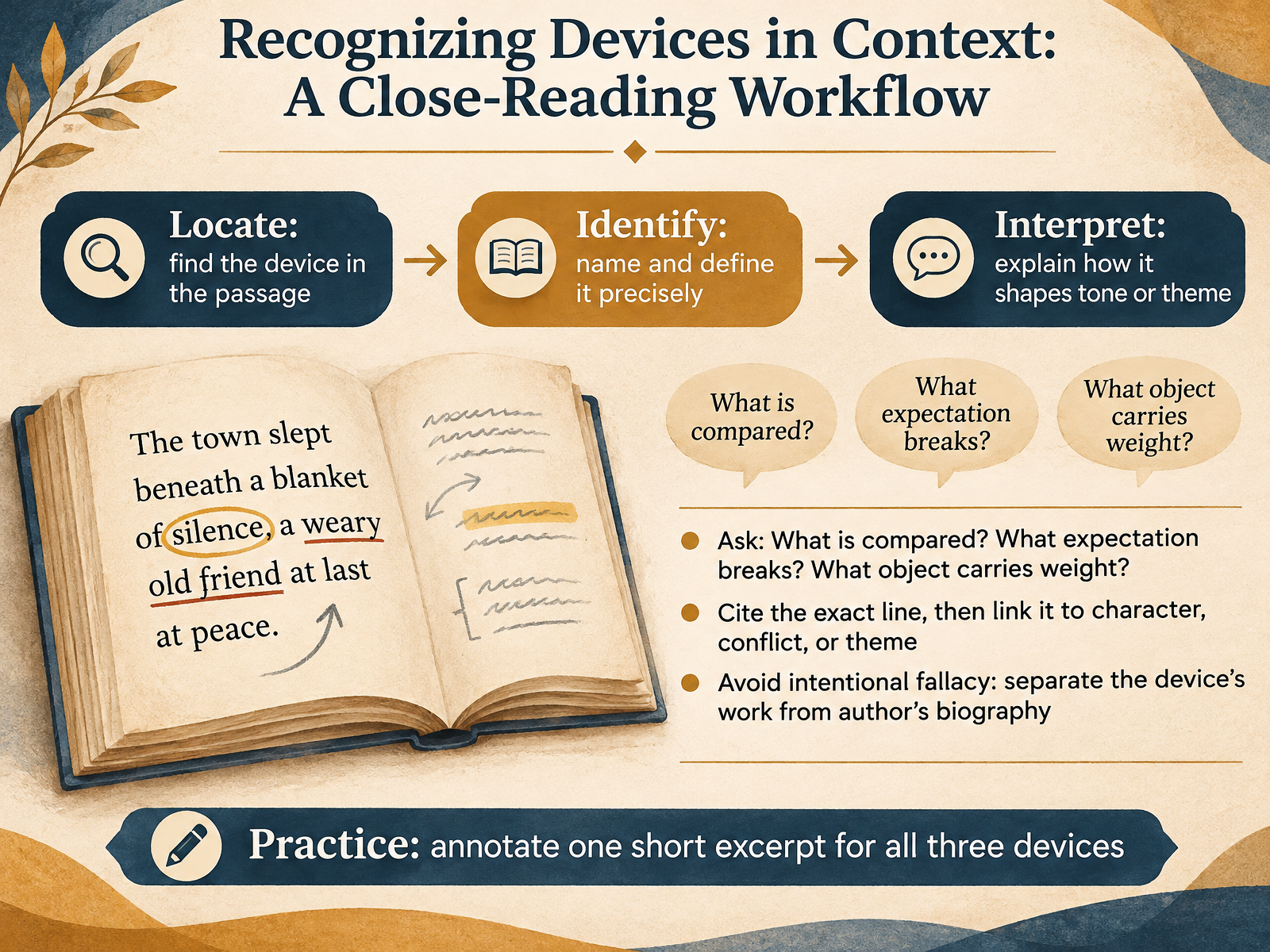
- 09Recognizing Devices in Context: A Close-Reading WorkflowNow let's bring all three devices into a close-reading workflow. First, locate the device in the passage. Then identify it and define it precisely. Next, interpret how it shapes tone or theme, and ask yourself three quick questions: What is compared? What expectation breaks? What object carries weight? Here's the difference that matters. Cite the exact line, then link it to character, conflict, or theme. Avoid the intentional fallacy by separating the device's work from the author's biography. Naming a device is only the setup, so explain what it actually does. Now try this: annotate one short excerpt for all three devices. Then we'll turn to common pitfalls and misinterpretations.
 owl.purdue.edupoets.orgwww2.hunter.cuny.edu+21 min
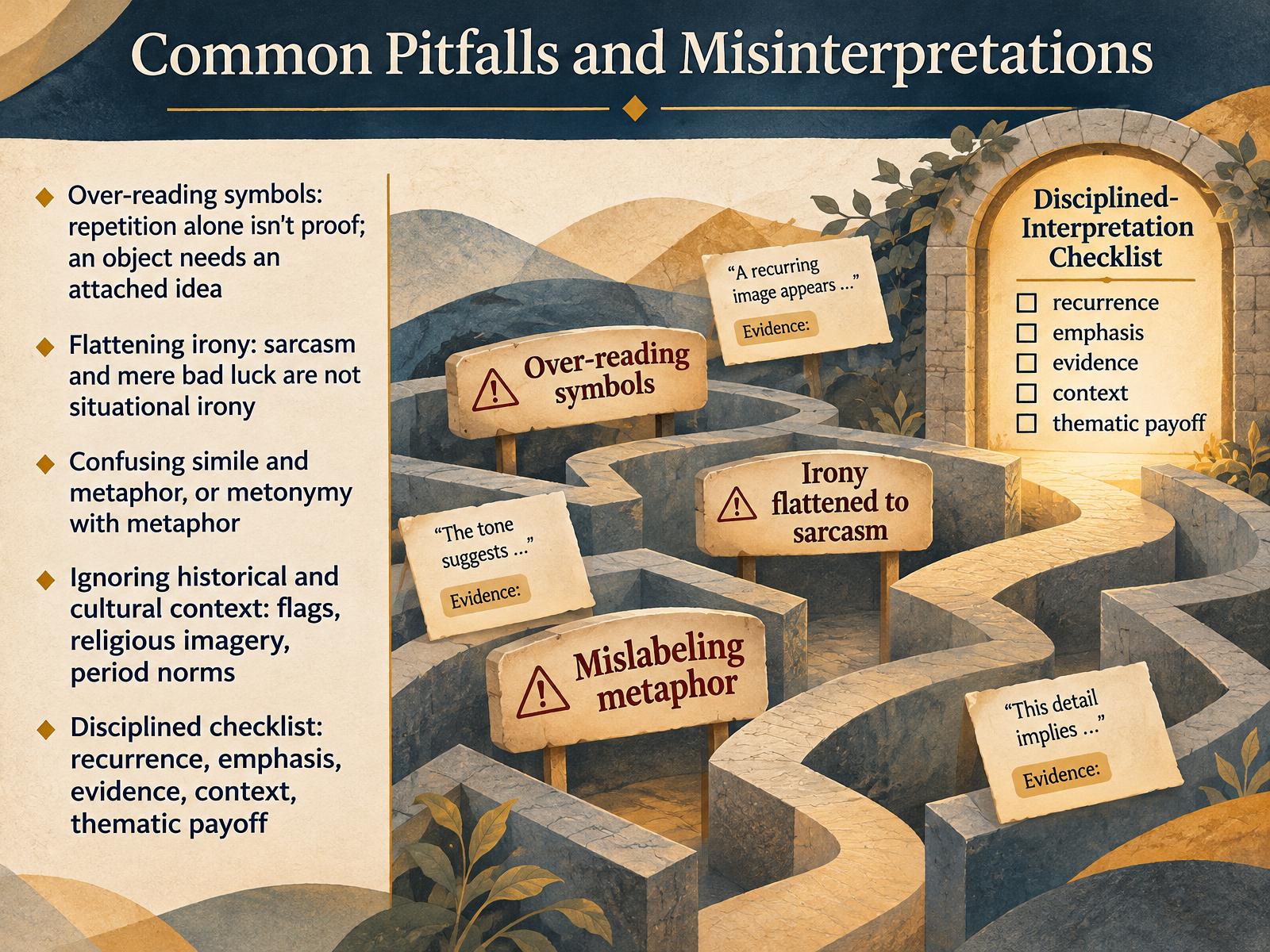
- 10Common Pitfalls and MisinterpretationsNow let's talk about the traps. Even strong readers fall into them, so these are worth naming. First, over-reading symbols. Repetition alone is not proof. A red coat appearing twice is just a repeated detail unless the text keeps attaching an idea to it, like shame or power. Here's the difference with irony. Sarcasm is verbal irony, but mere bad luck is not situational irony. Situational irony needs a clear gap between what was expected and what actually happens. Also, don't confuse a simile with a metaphor. A simile uses like or as. A metaphor says one thing is another. And metonymy swaps a related thing for the thing itself, like the crown for the monarchy. It is not the same as metaphor. Finally, context matters. Flags, religious imagery, and period norms carry meaning that changes across time and culture. So use a disciplined checklist. Ask about recurrence, emphasis, evidence, context, and thematic payoff. That keeps your reading grounded. Next, we move into Classroom Activities: Recognition to Interpretation.
 owl.purdue.edupoets.orgwww2.hunter.cuny.edu+22 min
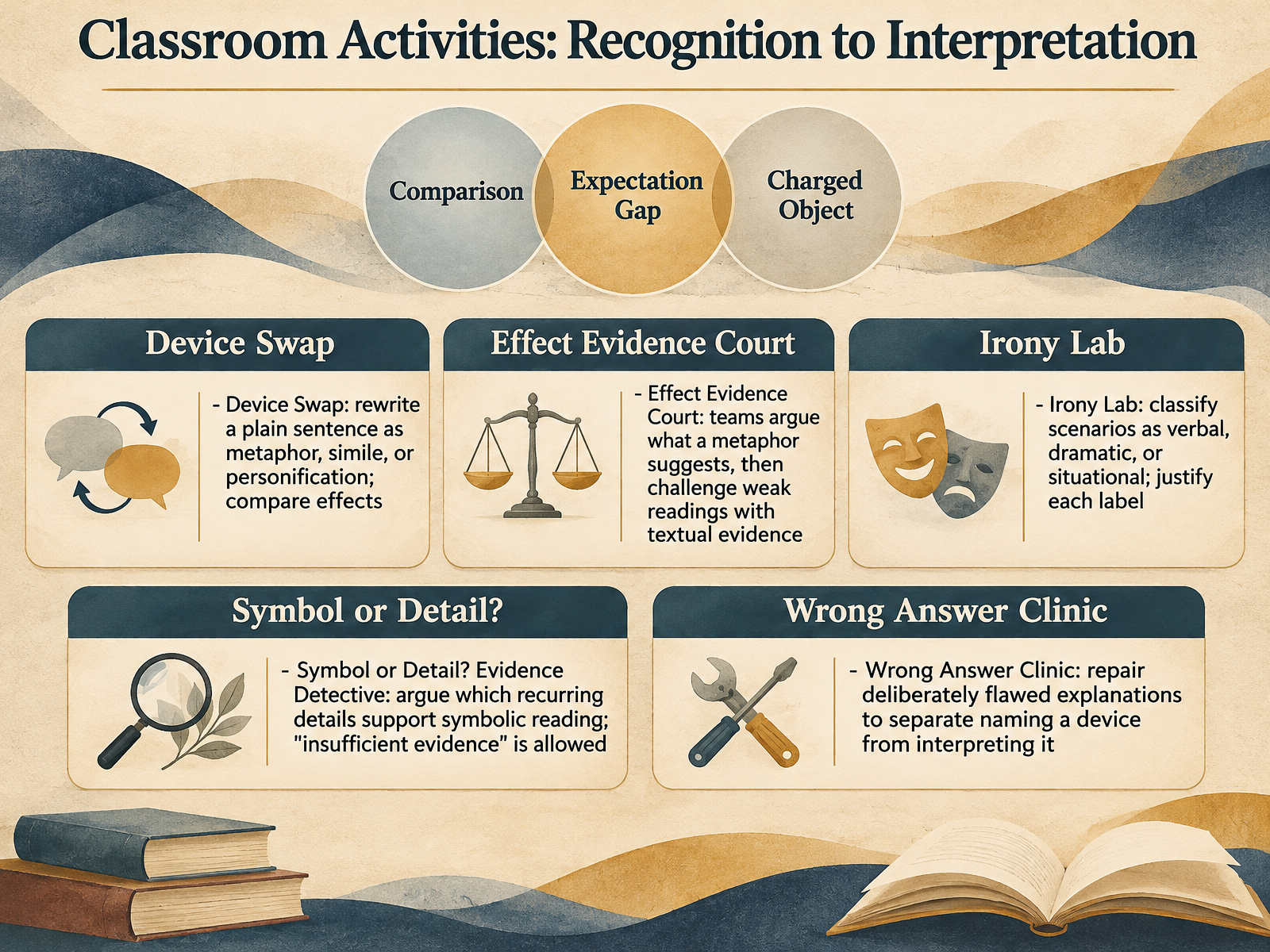
- 11Classroom Activities: Recognition to InterpretationNow let's turn these skills into classroom activities that push from recognition to interpretation. First, Device Swap. Give teams a plain sentence, like the rain was heavy. They rewrite it as a metaphor, a simile, or personification, then compare how each choice changes the tone. Next, Effect Evidence Court. Teams argue what a metaphor suggests, and opponents challenge weak readings with the actual words on the page. Ask, interested in what, and which word creates that effect? Irony Lab comes next. Teams classify scenarios as verbal, dramatic, or situational, and justify each label by naming the expectation and the contradiction. Then Symbol or Detail? Evidence Detective. Students argue which recurring details support a symbolic reading, using repetition, context, and character reaction. Insufficient evidence is a valid answer. Finally, Wrong Answer Clinic. Give them a flawed explanation, and they repair the label and the reasoning. The goal throughout is simple. Naming a device is step one. Supporting an interpretation with evidence is the real work. Next, we'll look at designing discussion prompts and assessments.
 2 min
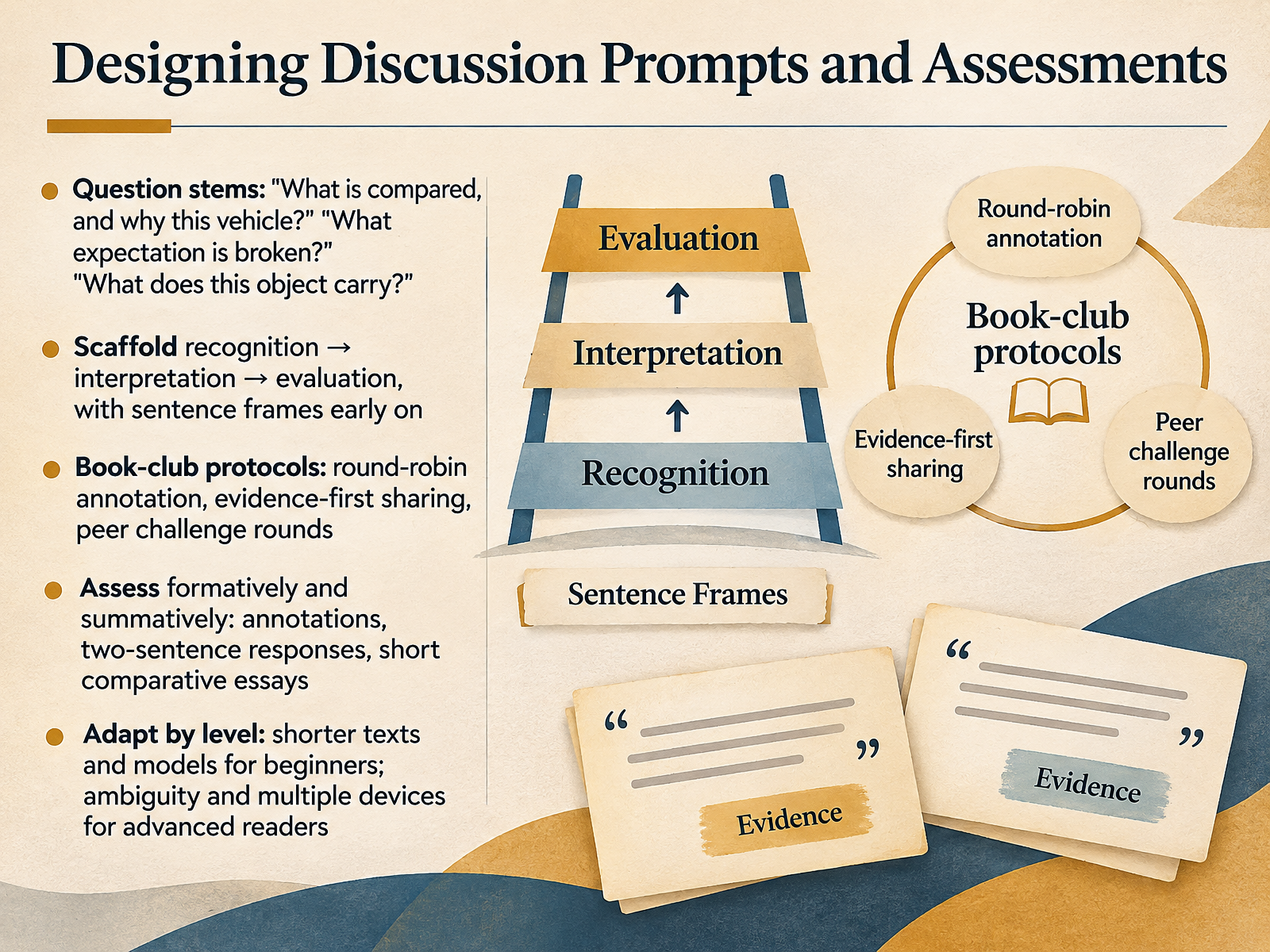
- 12Designing Discussion Prompts and AssessmentsNow let's turn devices into questions you can actually ask. Start with three question stems. What is compared, and why this vehicle? What expectation is broken? And what does this object carry? Then scaffold from recognition, to interpretation, to evaluation. Early on, give sentence frames like, the writer uses blank to suggest blank. In book clubs, try round-robin annotation, evidence-first sharing, and peer challenge rounds. Assess formatively with annotations and two-sentence responses, and summatively with short comparative essays. Adapt by level. Beginners need shorter texts and models. Advanced readers can handle ambiguity and multiple devices in one passage. Next, we'll put this into practice in Guided Practice: Reading a Short Text Together.
 2 min
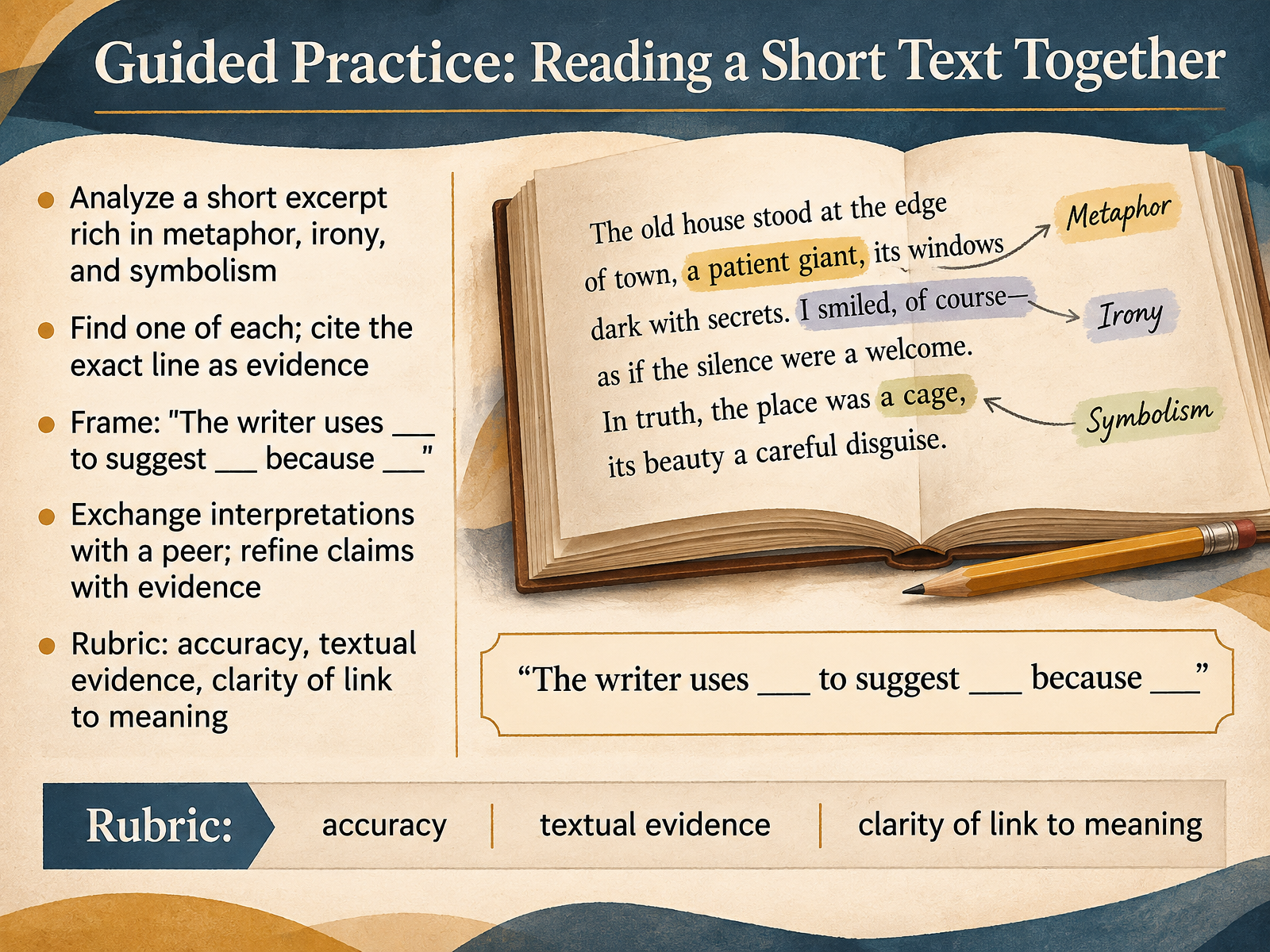
- 13Guided Practice: Reading a Short Text TogetherNow it's your turn to practice. Here, you'll read a short excerpt together and find one metaphor, one moment of irony, and one symbol. For each, cite the exact line as evidence. Use this frame: the writer uses blank to suggest blank because blank. That third blank is where you explain the link to meaning, not just label the device. A common mistake is spotting a device and stopping there. Naming it is only the setup. Then exchange interpretations with a peer. Ask each other: which words support that claim? Refine your thinking with evidence. You'll be judged on three things: accuracy, textual evidence, and clarity of the link to meaning. So take a moment. Which line will you choose, and why does it matter? Next, we'll move into synthesis, take-home practice, and next steps.
 markedbyteachers.com1 min
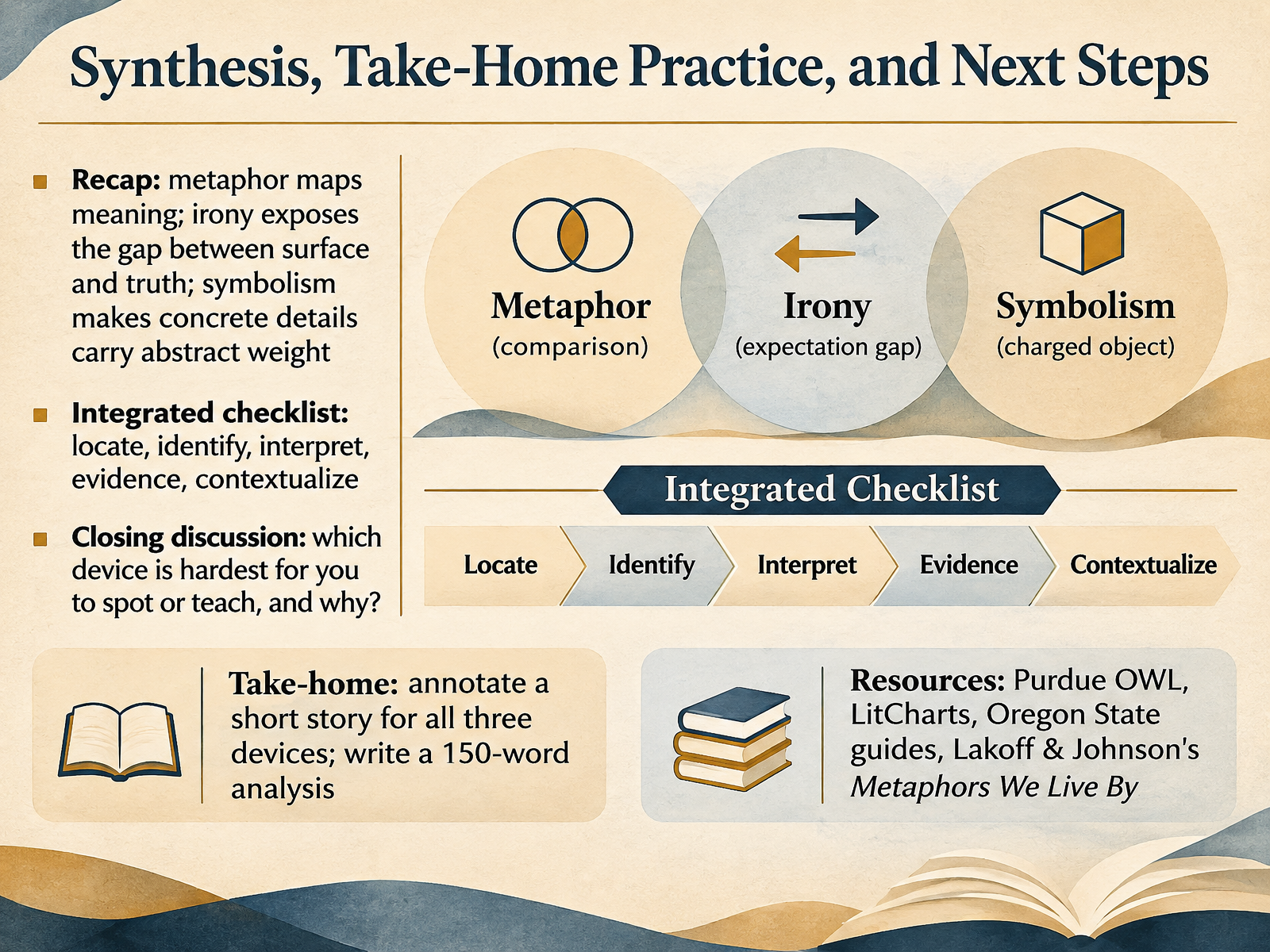
- 14Synthesis, Take-Home Practice, and Next StepsLet's bring it all together. Metaphor maps meaning from one thing onto another. Irony exposes the gap between surface and truth. And symbolism lets a concrete detail carry abstract weight. Here's a checklist you can reuse: locate the device, identify its type, interpret its effect, cite the evidence, and contextualize it within the whole text. For take-home practice, annotate a short story for all three devices, then write a one hundred fifty word analysis. For further reading, try Purdue OWL, LitCharts, and the Oregon State guides, plus Lakoff and Johnson's Metaphors We Live By. One last question to discuss: which device is hardest for you to spot or teach, and why? Thank you for joining me. Keep reading closely, and trust what you notice.
 owl.purdue.edupoets.orgwww2.hunter.cuny.edu+22 min
Take the deck with you
Download this course as a file — free, no sign-up needed.
- PDF handoutEvery slide page, ready to print or share.15 pages · 6.4 MBDownload
- Narrated PowerPointThe deck that presents itself — every slide carries the digital human's narration video.15 pages · 16.3 MBDownload
- PowerPoint slidesThe full deck as a .pptx — open it in PowerPoint, Keynote, or Google Slides.15 pages · 6.4 MBDownload
Free to use in your own training — please keep the PersonWise credit page at the end.
Have your own deck? Turn it into a course
Sources consulted
Web sources consulted while building this course.
- Literary Terms - Purdue OWL® - Purdue University — owl.purdue.edu
- Poetry Glossary | Academy of American Poets — poets.org
- WRITING FOR ENGLISH COURSES Glossary of Literary Terms — www2.hunter.cuny.edu
- Select Literary Devices | Utah Valley University — uvu.edu
- Literary Device Dictionary — human.libretexts.org
- Metaphors We Live By, Lakoff, Johnson — press.uchicago.edu
- Metaphor | Oxford Bibliographies in Linguistics | Oxford Academic — academic.oup.com
- Conceptual Metaphor in Everyday Language — jstor.org
- The metaphorical structure of the human conceptual system — doi.org
- Development and Critiques of Conceptual Metaphor Theory — doi.org
- What is Irony? || Oregon State Guide to Literary Terms | Oregon State University — liberalarts.oregonstate.edu
- Irony - Definition and Examples | LitCharts — litcharts.com
- Irony Examples and Definition - Literary Devices — literarydevices.com
- 9: (Mis)Communication — digfir-published.macmillanusa.com
- Irony Definition: Different Types of Irony in Literature | Writers.com — writers.com
- Symbolism - Definition and Examples | LitCharts — litcharts.com
- Definitions of Literary Terms and Devices | Sparknotes — sparknotes.com
- Symbolism | English & Literature — eliexplains.org
- AP English Literature 5.3: Symbol, Allegory & Motif – Notes & Practice | APrep — aprepstudy.com
- Commentary on a passage taken from "The Blindfolded Horse" - International Baccalaureate World Literature - Marked by Teachers.com — markedbyteachers.com