Begin
14 pages · ~28 min
Knowledge Management Cycle Essentials
Learn the knowledge management cycle, its purpose, and practical examples to effectively capture, share, and apply organizational knowledge.
A digital instructor presents all 14 pages. Hold “Ask” at any point and ask out loud — the answer comes from this course. No sign-up needed.
What you’ll learn
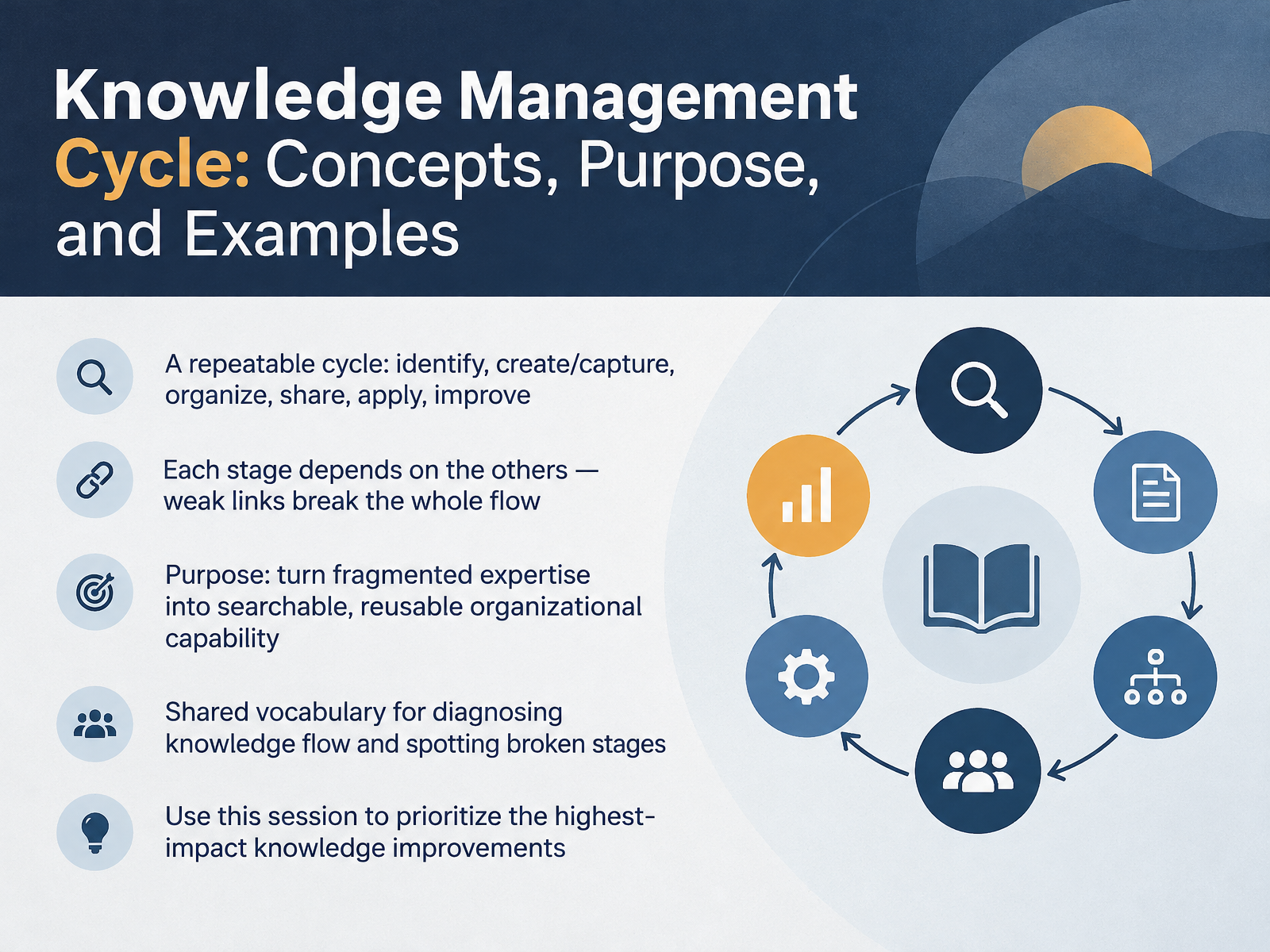
- 01Knowledge Management Cycle: Concepts, Purpose, and ExamplesWelcome. In this session, we will walk through the knowledge management cycle, and look at why it matters in practice. A useful way to frame it is as a repeatable cycle. Identify, create or capture, organize, share, apply, and improve. Each stage depends on the others. A weak link breaks the whole flow. For example, if knowledge is captured but never organized with clear ownership and metadata, people cannot find or trust it, so sharing and reuse stall. The purpose of the cycle is to turn fragmented expertise into searchable, reusable organizational capability. That gives you and your teams a shared vocabulary for diagnosing knowledge flow and spotting the broken stage. Use this session to prioritize the highest-impact knowledge improvements. As a takeaway, before your next team discussion, name the one stage in your flow that is weakest, and treat it as the first fix. Next, we will look at the background. Why knowledge work needs a cycle.apqc.orgbloomfire.comeis.mdx.ac.uk+21 min
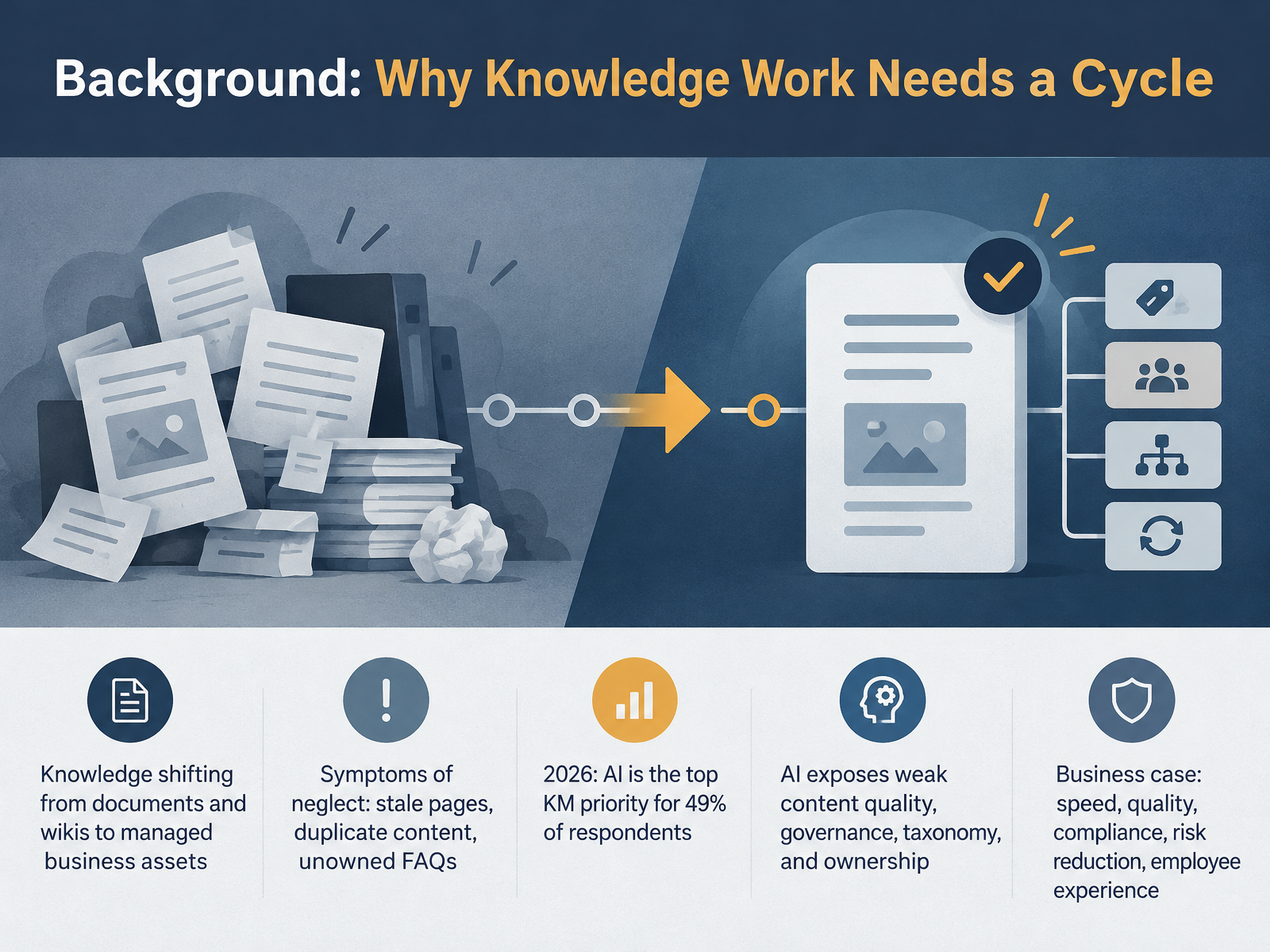
- 02Background: Why Knowledge Work Needs a CycleLet's look at why knowledge work needs a cycle in the first place. Knowledge has shifted from documents and wikis that people informally maintain to managed business assets. When that management is neglected, the symptoms are familiar. Pages go stale. Content gets duplicated. Frequently asked questions end up with no clear owner. Those are not cosmetic issues. In twenty twenty-six, forty-nine percent of respondents named AI as their top knowledge management priority. But AI also exposes weak content quality, governance, taxonomy, and ownership. A model can only work with what the repository actually contains. That is the business case for a cycle. Speed, quality, compliance, risk reduction, and employee experience all depend on content that is current and owned. So when you next discuss AI in your team, start with content health and ownership, not the tool.
 1 min
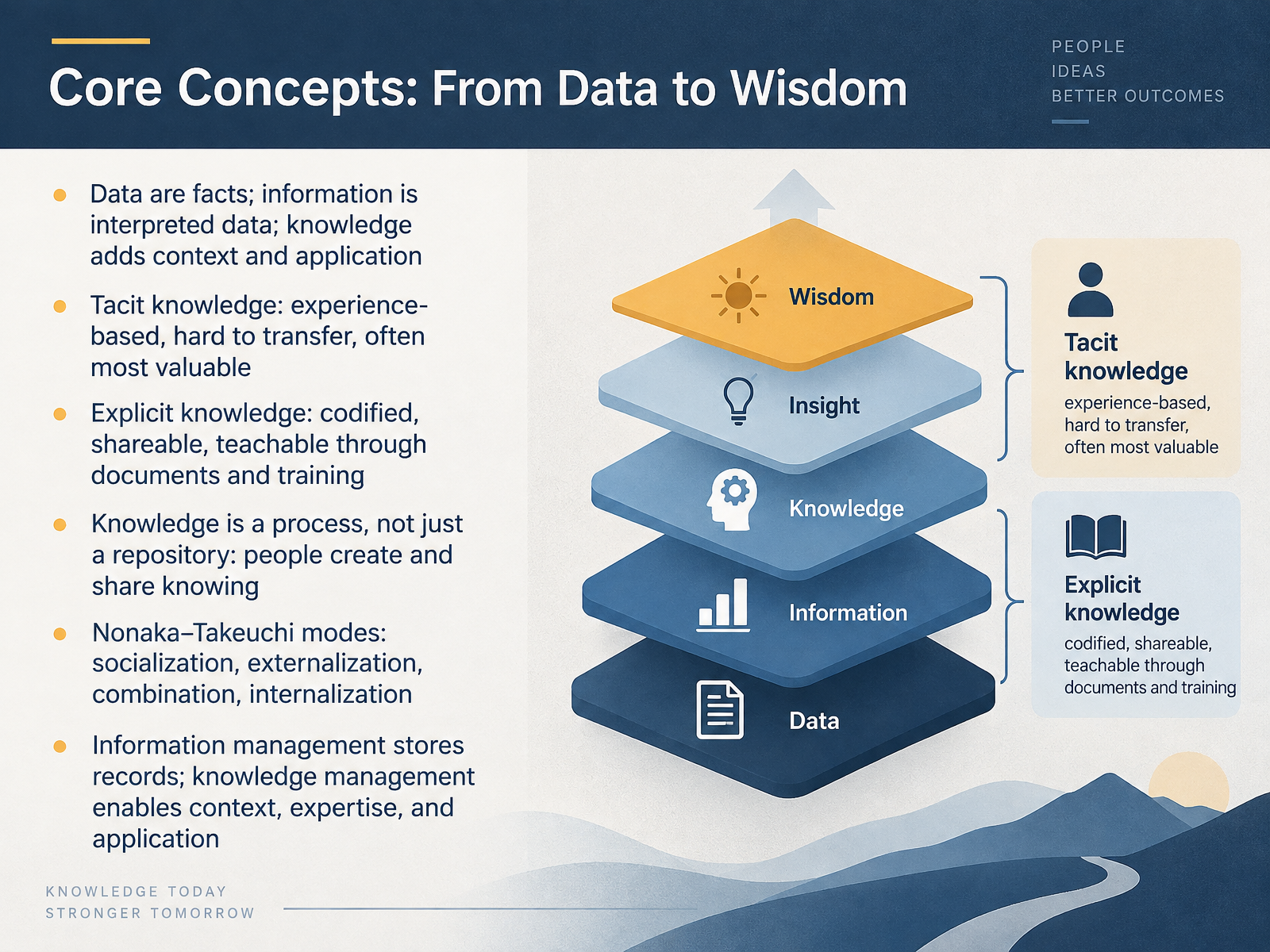
- 03Core Concepts: From Data to WisdomLet's move into the core concepts behind knowledge work, starting with the ladder from data to wisdom. Data are just facts. Information is data that has been interpreted. Knowledge adds context and application on top of that. Take a support queue: raw ticket timestamps are data, a monthly trend report is information, and knowing which fix actually resolves the customer's issue is knowledge. We usually split knowledge into two types. Tacit knowledge is experience based, hard to transfer, and often the most valuable, like a senior engineer's instinct for where a system will fail. Explicit knowledge is codified and shareable, such as a runbook or a training module. Keep in mind that knowledge is a process, not just a repository. People create and share knowing through four modes from Nonaka and Takeuchi: socialization, externalization, combination, and internalization. And information management stores records, while knowledge management enables context, expertise, and application. Here is your takeaway: in your next team discussion, sort the knowledge in question into tacit or explicit, then name which conversion mode you are relying on. That will move the conversation past storage and toward application. Next, we look at the cycle at a glance, including its stages and loops.
 nationalacademies.orgfao.orgdoi.org+22 min
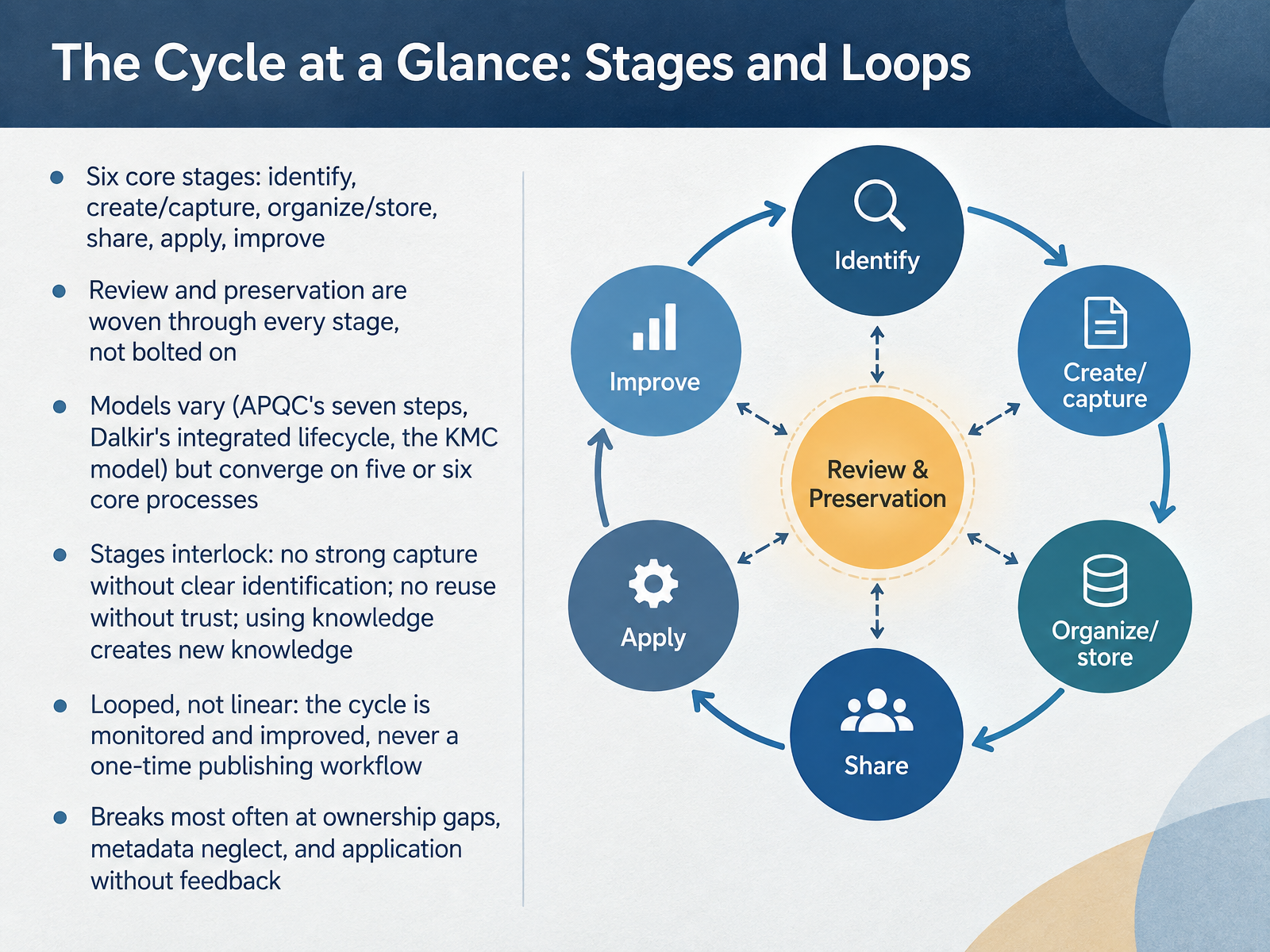
- 04The Cycle at a Glance: Stages and LoopsLet's look at the cycle as a whole. Most models settle on six core stages: identify, create or capture, organize or store, share, apply, and improve. Names vary. APQC lists seven steps, Dalkir offers an integrated lifecycle, and the KMC model uses seven non-sequential phases. But they converge on the same five or six core processes. Two activities are woven through every stage rather than bolted on: review and preservation. For example, a lessons-learned document needs validation before it is shared, and it needs an owner and a review date so it stays trustworthy. The stages interlock. You cannot capture well without clear identification. You get no reuse without trust. And using knowledge often creates new knowledge. So the cycle is looped, not linear. It is monitored and improved, never a one-time publishing workflow. In practice, it breaks most often at ownership gaps, neglected metadata, and application without feedback. As a takeaway, when you review your own knowledge flow, check ownership and metadata first. Those two gaps explain most stalls. Next, we turn to stage one: identify critical knowledge.
 apqc.orgbloomfire.comeis.mdx.ac.uk+22 min
- 05Stage 1: Identify Critical KnowledgeLet's turn to the first stage of the cycle: identifying critical knowledge. This stage starts with a needs assessment. We ask which knowledge is business critical, which is at risk of being lost, and which is requested most often. Then we run a gap analysis, comparing the knowledge a process or role requires against what already exists. With that picture, we prioritize by business impact, loss risk, frequency of use, and regulatory exposure. Here's a concrete example. If only one engineer understands your billing system, and that person plans to retire, that knowledge scores high on both impact and loss risk. The 2026 priority is to prepare those business-critical domains for search, recommendations, and reuse. The common trap is treating every request as critical. When everything is urgent, nothing gets resourced. The practical takeaway is to bring a short list to your next team discussion, ranked by impact and loss risk, with a reason written beside each item. That gives you a defensible starting point. Next, we move to stage two: capture knowledge, including tacit expertise.
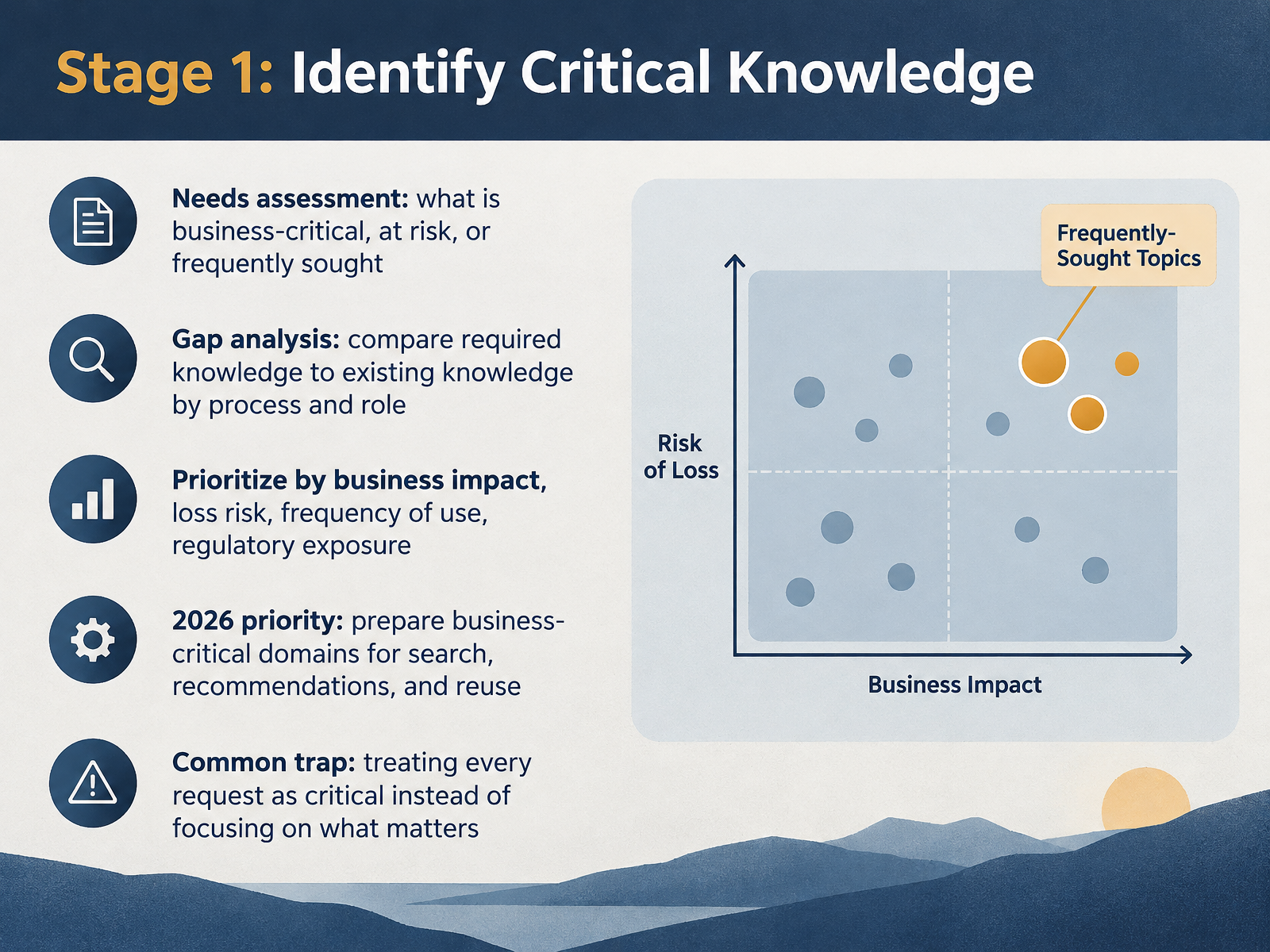 apqc.orgbloomfire.comeis.mdx.ac.uk+22 min
- 06Stage 2: Capture Knowledge, Including Tacit ExpertiseLet's move to Stage 2: capturing knowledge, including tacit expertise. Capture methods range from interviews and observation to after-action reviews, process docs, call transcripts, and subject-matter expert sessions. Elicitation splits into two approaches. Direct methods ask the expert to explain, using interviews, think-aloud protocols, and teach-back. Indirect methods infer what the expert knows, through card sorting, repertory grids, or document analysis. A practical combination is audio diaries plus facilitated debriefing, which turns individual experience into shareable knowledge. For example, a project lead records a difficult decision weekly, then a facilitator debriefs those entries and distills the lessons for other teams. The most sustainable approach is capture as a byproduct of work: lessons learned, project reviews, and post-incident reviews. Avoid the trap of capturing everything. Capture what matters, chosen against a defined need. Takeaway for your next team discussion: pick one tacit expertise area, choose one direct and one indirect method, and define what you will not capture.
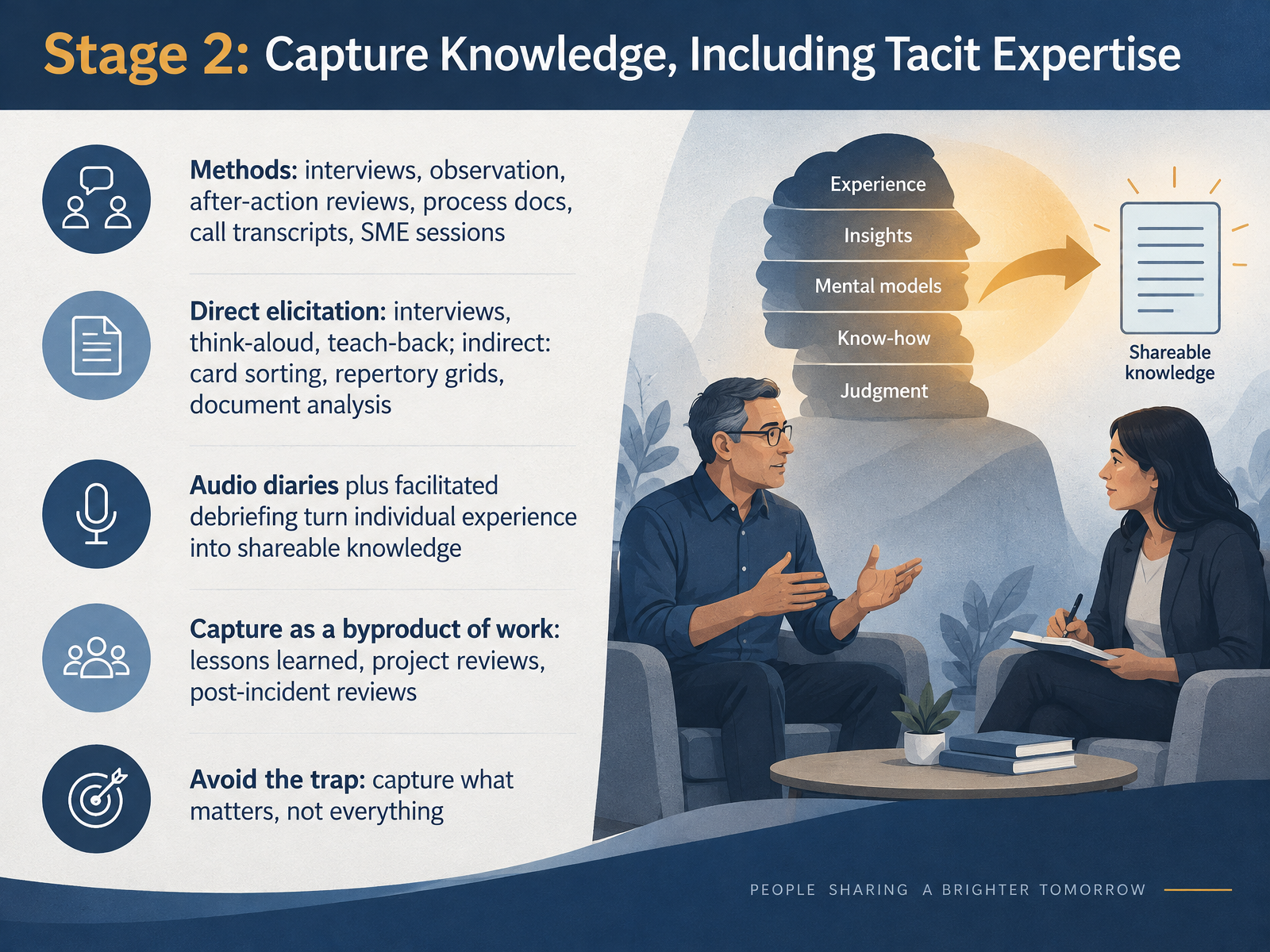 mural.maynoothuniversity.iedoi.orgusir.salford.ac.uk+22 min
- 07Stage 3: Organize, Store, and GovernMoving on, stage three is where structure and governance do their work. Taxonomies and controlled vocabularies make knowledge findable and filterable. For example, a support team uses a consistent product category field so agents can filter articles by product line. That only works if the metadata is purposeful. Fields should support search, navigation, and lifecycle management, and each one should serve a practical purpose. Structure also needs people behind it. Name a taxonomy owner, plus category stewards for each major area, so the structure stays current. Use a RACI model and a change request process for taxonomy updates. A new field like content type, for instance, goes through review before it goes live. And communicate changes regularly, because a governed taxonomy only works when people know what changed and why. Governed content produces governed outcomes. Ungoverned content produces ungoverned risk. So a practical takeaway for your next team discussion is this. Confirm who owns your taxonomy, and how a change request gets reviewed and communicated. Next, stage four, share, apply, and reinforce.
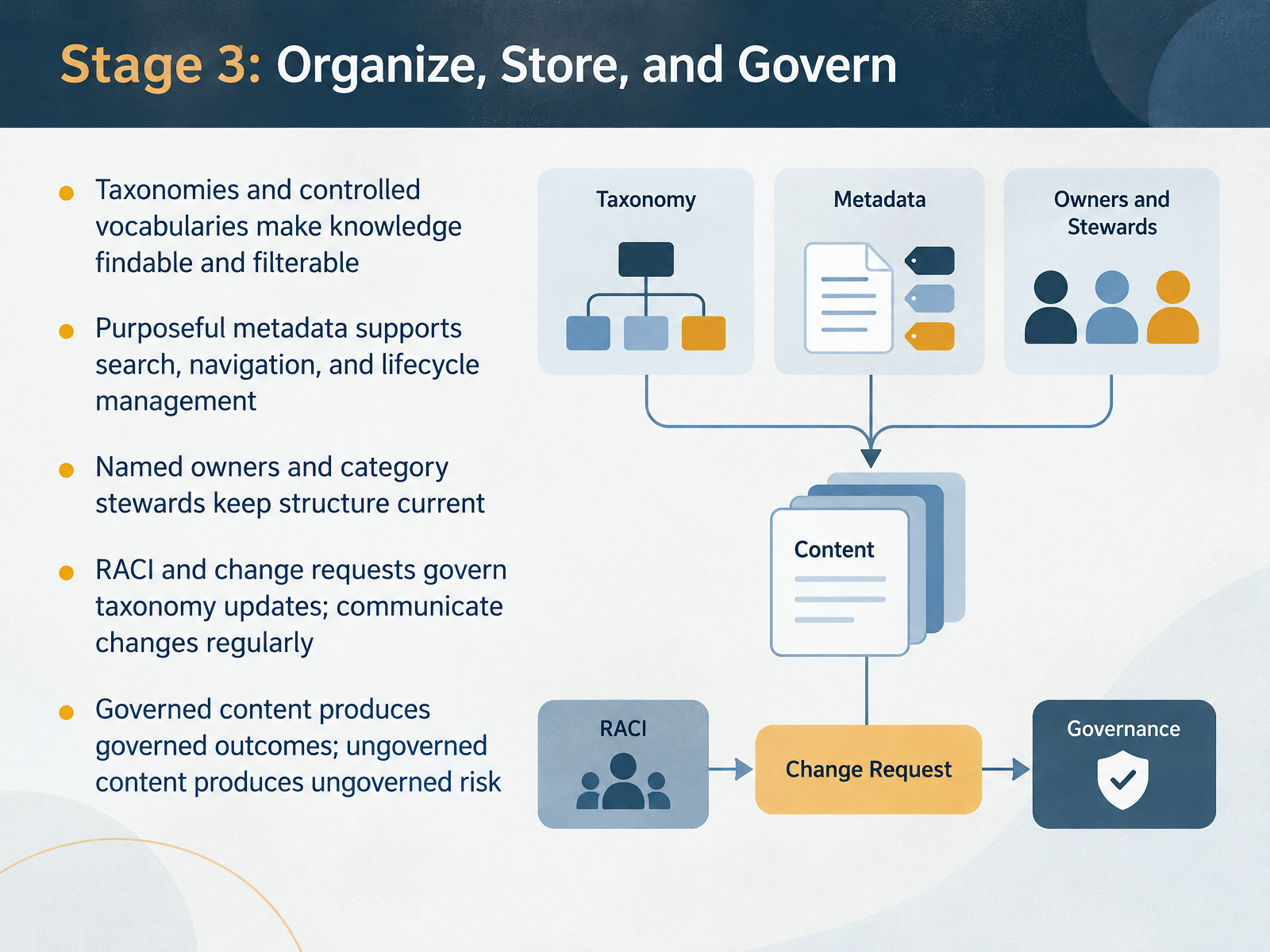 enterprise-knowledge.comtaxonomystrategies.comons.gov.uk+22 min
- 08Stage 4: Share, Apply, and ReinforceNow we reach Stage Four, Share, Apply, and Reinforce. This is where knowledge actually moves. Sharing happens through channels: search, communities of practice, enablement sessions, and help embedded in the workflow. Then you turn knowledge into something usable, such as job aids, decision guides, training, and AI-ready assets. Encouraging contribution matters too. Incentives, recognition, and a safe space for dialogue all make a difference. Watch community health closely. Experts who don't share and isolated members create bottlenecks. For example, participation data often shows a small group doing most of the sharing. Finally, measure application, not just activity: search success, reuse in daily work, and time-to-answer. A practical takeaway for your next team discussion: pick one measure of reuse and one bottleneck to address this quarter. Next, we look at Stage Five: Evaluate and Refresh for Relevance.
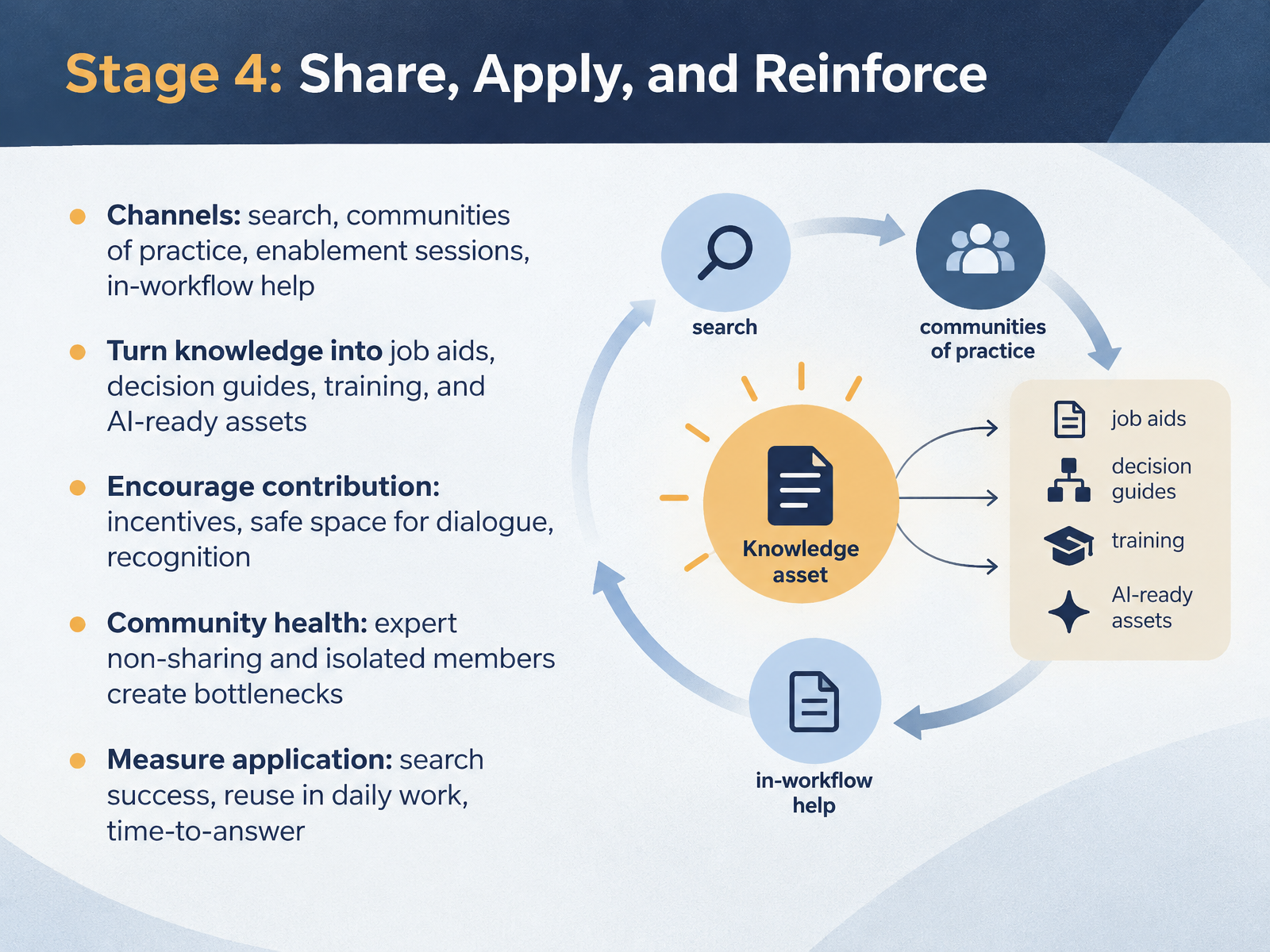 1 min
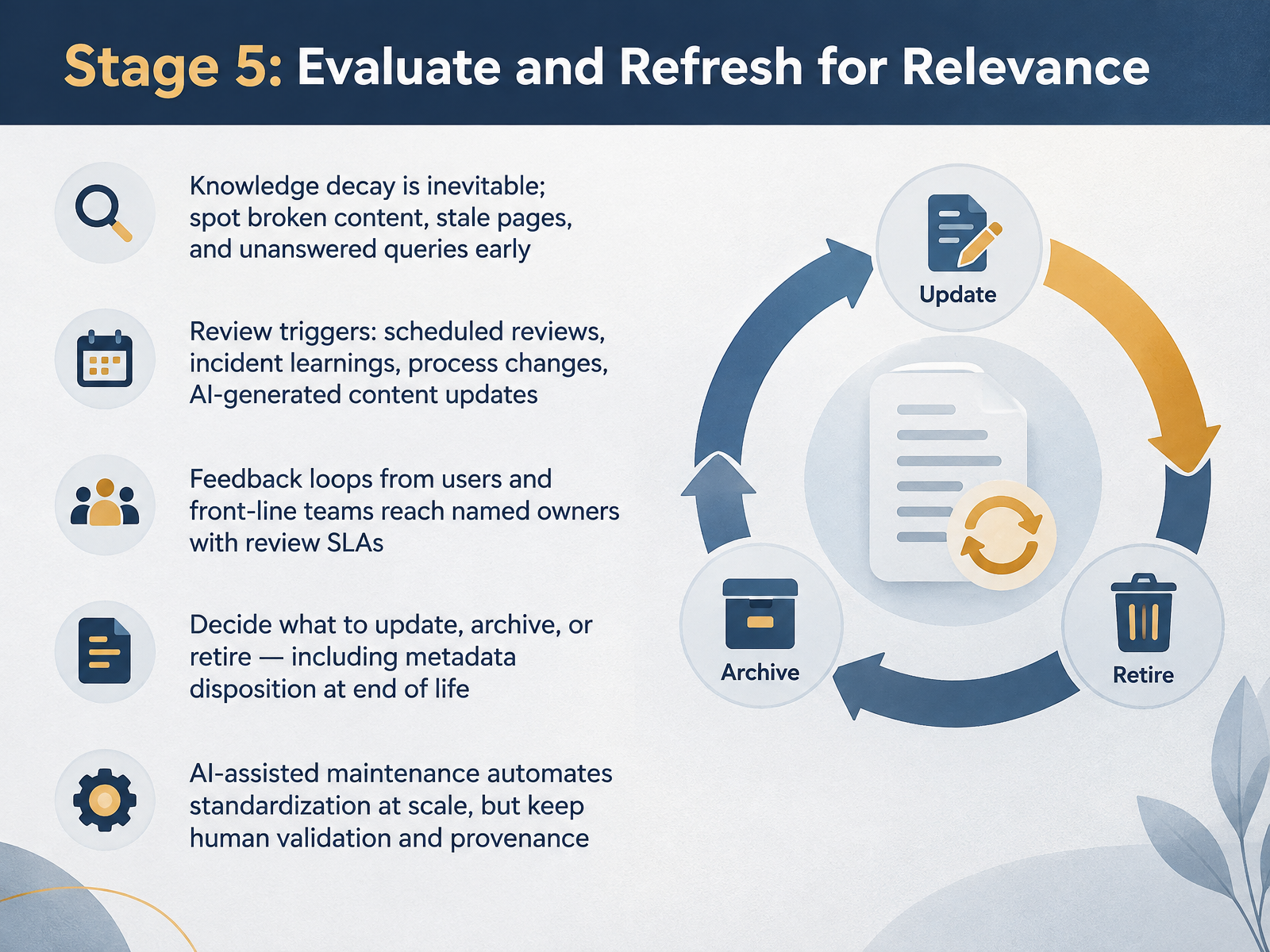
- 09Stage 5: Evaluate and Refresh for RelevanceLet's turn to the fifth stage of the cycle: evaluate and refresh for relevance. Knowledge decay is inevitable, so you look for the warning signs early. Broken links, stale pages, and unanswered queries. A common example is a process guide that still describes a tool your team retired last quarter. Here's why it matters. If you're accountable for knowledge flow, unreviewed content quietly erodes trust across every team that depends on it. Set clear review triggers. Scheduled reviews, incident learnings, process changes, and updates to AI-generated content. Then close the loop. Feedback from users and front-line teams should reach a named owner, with a review service level agreement attached. When content no longer serves a purpose, make a decision. Update it, archive it, or retire it. And that includes handling its metadata at end of life. AI-assisted maintenance can standardize content at scale, but keep human validation and provenance checks in place. Your takeaway for your next team discussion: name an owner and a review trigger for your highest-use content. That moves us to the next slide, Purpose and Value: What the Cycle Delivers.
 enterprise-knowledge.comtaxonomystrategies.comons.gov.uk+22 min
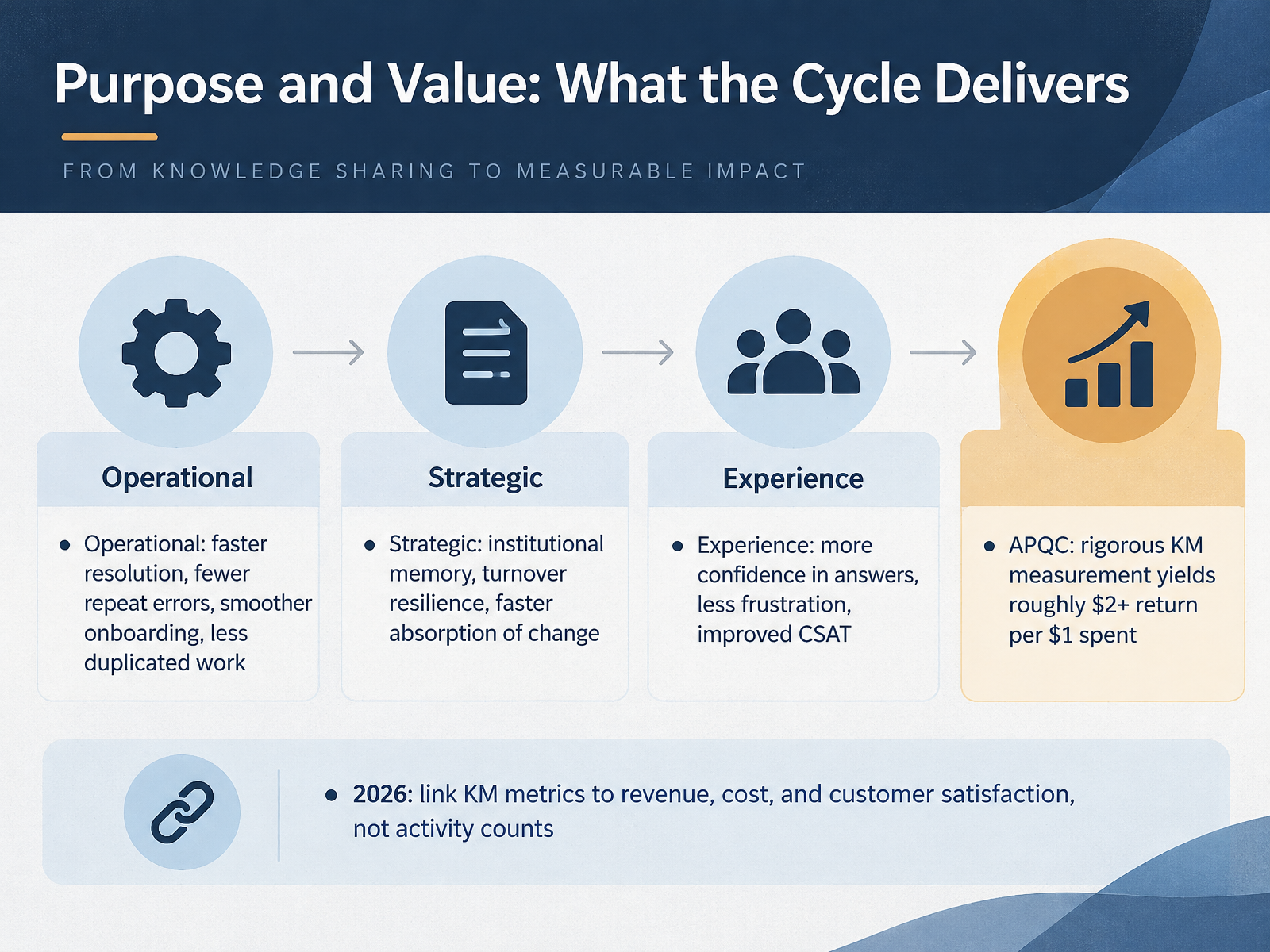
- 10Purpose and Value: What the Cycle DeliversSo what does the cycle actually deliver? Start with operations. Faster resolution, fewer repeat errors, smoother onboarding, and less duplicated work. One team closes a ticket in ten minutes because the answer is already written down. That is why it matters to you as someone accountable for knowledge flow across teams. Strategically, the value is institutional memory. When a senior expert leaves, the work does not leave with them. Turnover resilience, and faster absorption of change. For the people doing the work, the value shows up as experience. More confidence in answers, less frustration, and improved customer satisfaction. And there is a hard number behind this. APQC research finds that organizations measuring knowledge management rigorously see a return of roughly two dollars or more for every dollar spent per participating employee. The direction for twenty twenty six is to link knowledge metrics to revenue, cost, and customer satisfaction, not activity counts. A page view is not a business outcome. Takeaway for your next team discussion: name one operational, one strategic, and one experience outcome you can measure, then connect each to a business number. Next, we look at Measuring Cycle Health: Leading and Lagging Indicators.
 2 min
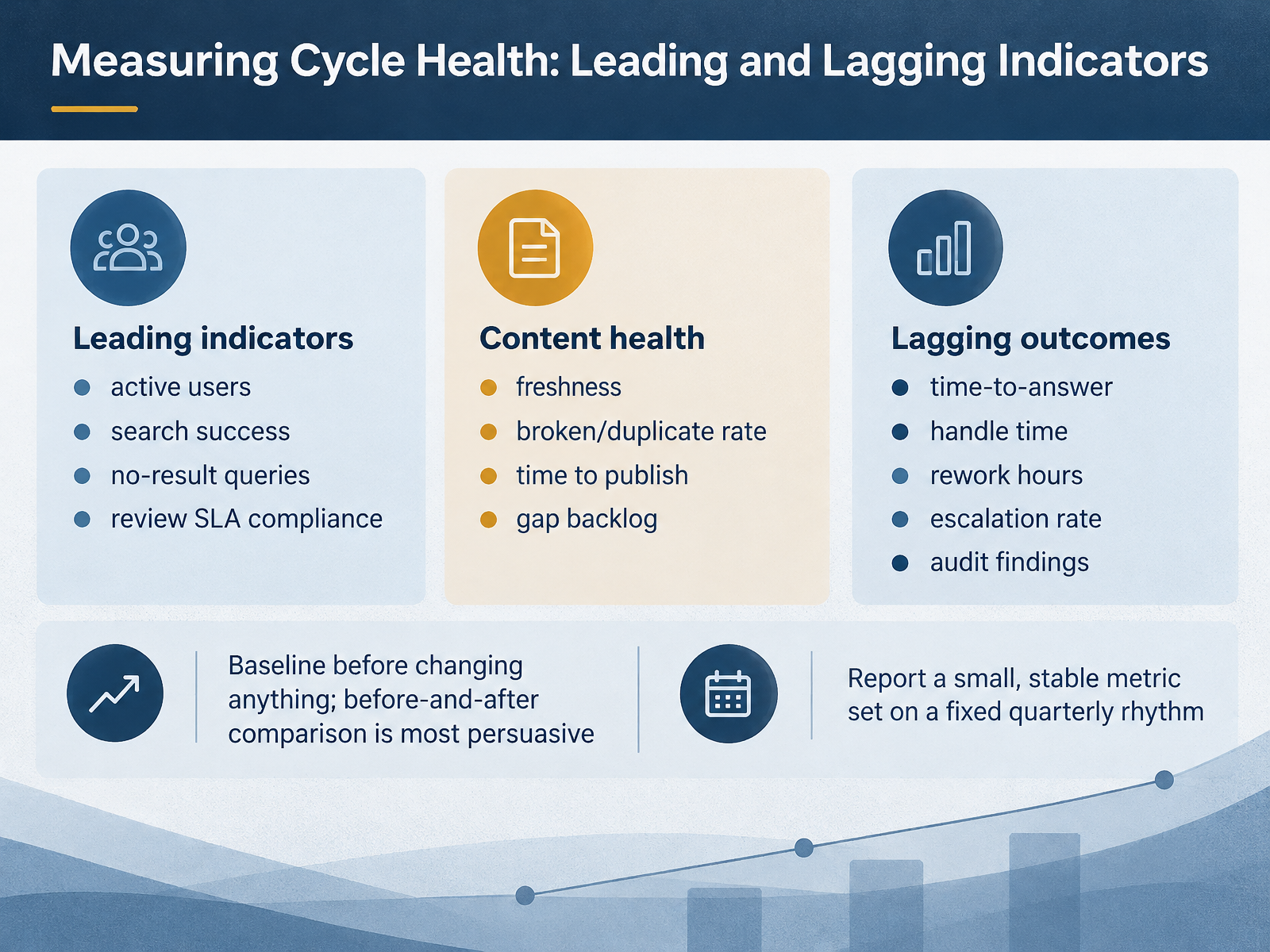
- 11Measuring Cycle Health: Leading and Lagging IndicatorsNext, let's look at how we measure cycle health. We split metrics into two groups. Leading indicators tell you whether the knowledge system is being adopted and maintained. That includes active users, search success, no-result queries, and review SLA compliance. Content health sits alongside them: freshness, broken or duplicate rate, time to publish, and the size of the gap backlog. Lagging outcomes show business impact, such as time-to-answer, handle time, rework hours, escalation rate, and audit findings. Here's a simple example. A drop in no-result queries tells you findability is improving before handle time moves. Baseline before you change anything, because a before-and-after comparison is the most persuasive evidence. Then report a small, stable metric set on a fixed quarterly rhythm. That consistency builds more trust with finance than an occasional flurry of impressive numbers. For your next team discussion, agree on one leading and one lagging metric per priority use case. That leads us into our worked example on operations and support knowledge.
 1 min
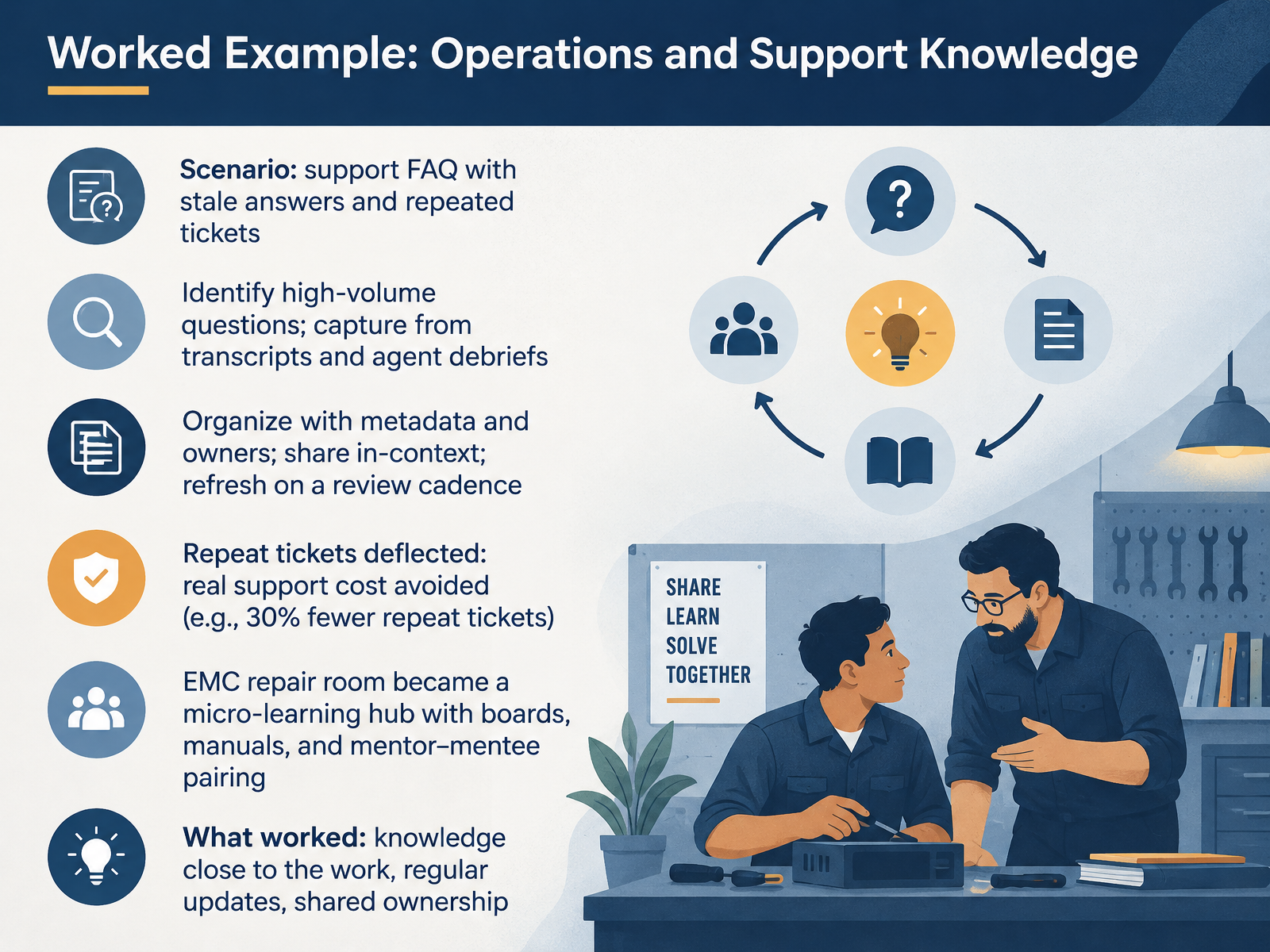
- 12Worked Example: Operations and Support KnowledgeLet's walk through a worked example. A support team had a knowledge base full of stale answers, and the same tickets kept coming back. First, they identified the highest volume questions. Then they captured answers from support transcripts and agent debriefs, so the knowledge reflected what actually happens on calls. Next came organization. Each article got metadata and a named owner, it was shared in context where agents work, and it was refreshed on a review cadence. The payoff was measurable. Repeat tickets deflected meant real support cost avoided, for example thirty percent fewer repeat tickets. Now, a second example from Erdenet Mining Corporation, where the repair room became a micro-learning hub, with boards, manuals, and mentor and mentee pairing. What worked in both cases was knowledge close to the work, regular updates, and shared ownership. For your next team discussion, ask which high-volume questions lack an owner and a review date. Next, we look at onboarding and institutional memory.
 2 min
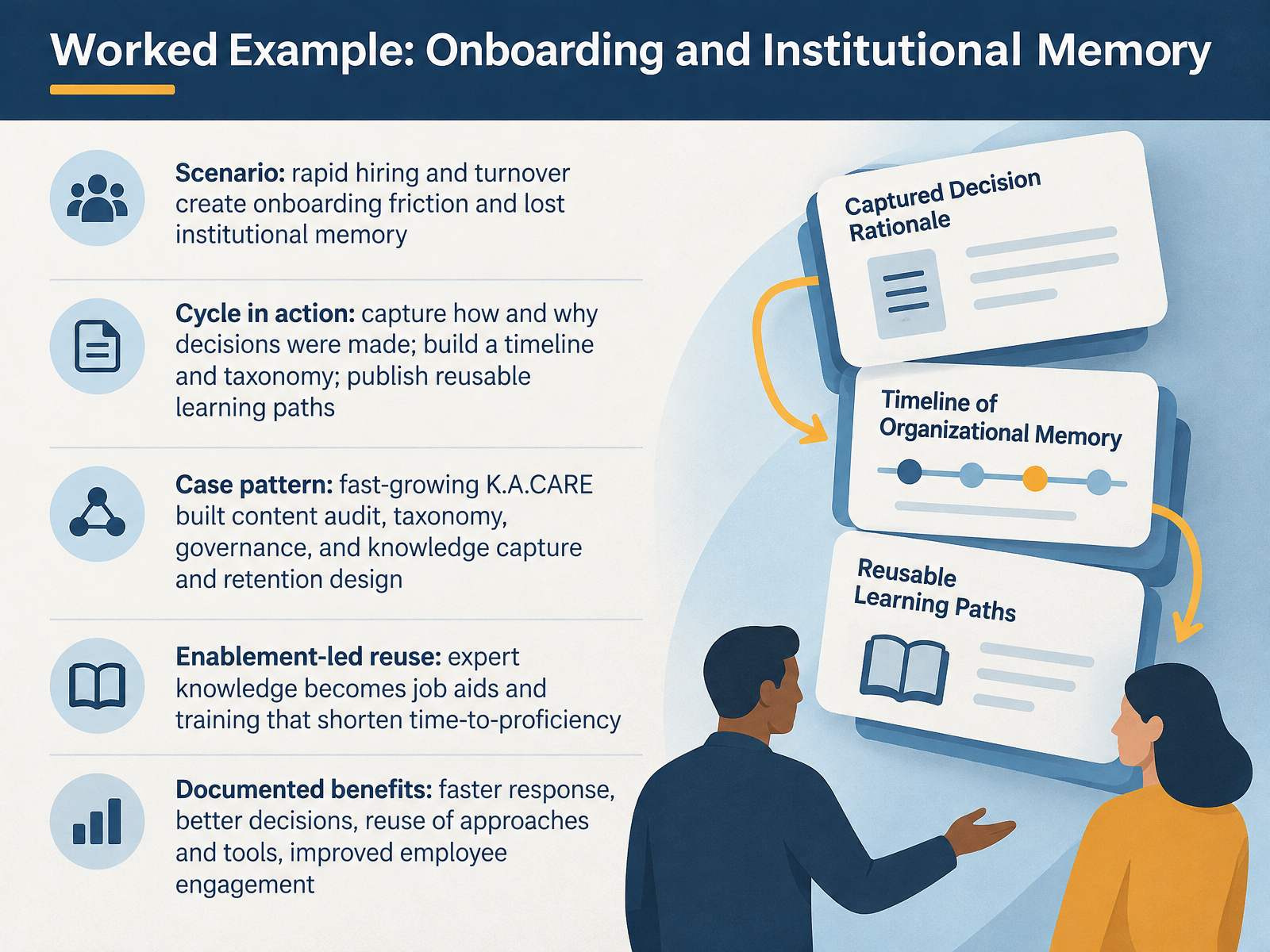
- 13Worked Example: Onboarding and Institutional MemoryLet's walk through a worked example that ties the cycle to onboarding and institutional memory. The scenario is common. Rapid hiring and turnover create onboarding friction, and hard-won institutional memory quietly disappears. Here, the cycle runs in a clear order. We capture how and why decisions were made, not just what was decided. We build a timeline and a taxonomy so that knowledge stays findable. Then we publish reusable learning paths that new hires can follow. A useful case pattern comes from K.A.CARE, a fast-growing organization that built a content audit, a taxonomy, governance, and a knowledge capture and retention design. The reuse was enablement-led. Expert knowledge became job aids and training that shortened time-to-proficiency. The documented benefits were faster response, better decisions, reuse of approaches and tools, and improved employee engagement. The takeaway for your next team discussion is simple. Treat onboarding as a knowledge capture event, and ask who owns the timeline and taxonomy behind it. Next, we look at Putting It into Practice: A 30-60-90 Day Adoption Plan.
 2 min
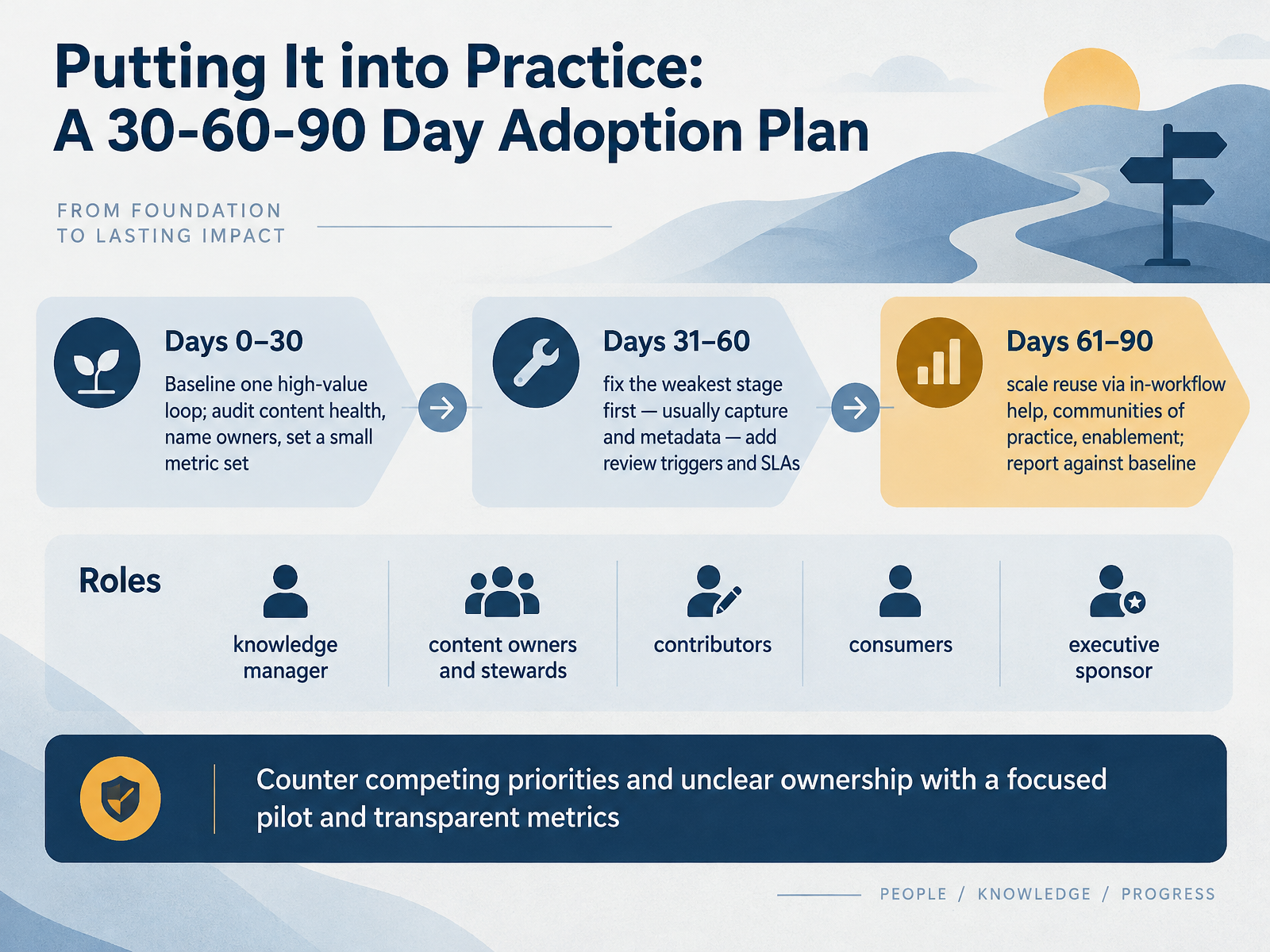
- 14Putting It into Practice: A 30-60-90 Day Adoption PlanLet's close with a practical adoption plan. In the first thirty days, baseline one high value knowledge loop. Audit content health, name owners, and set a small metric set. For example, track search success and content freshness in one team's onboarding playbook. In days thirty one to sixty, fix the weakest stage first, usually capture and metadata, then add review triggers and service level agreements. From day sixty one to ninety, scale reuse through in-workflow help, communities of practice, and enablement, and report against your baseline. Define roles clearly: a knowledge manager, content owners and stewards, contributors, consumers, and an executive sponsor. Counter competing priorities and unclear ownership with a focused pilot and transparent metrics. The takeaway is simple. Start narrow, measure honestly, and expand with evidence. Thank you for your attention, and I encourage you to bring this plan to your next team discussion.
 2 min
Take the deck with you
Download this course as a file — free, no sign-up needed.
- PDF handoutEvery slide page, ready to print or share.15 pages · 4.2 MBDownload
- Narrated PowerPointThe deck that presents itself — every slide carries the digital human's narration video.15 pages · 15.7 MBDownload
- PowerPoint slidesThe full deck as a .pptx — open it in PowerPoint, Keynote, or Google Slides.15 pages · 4.2 MBDownload
Free to use in your own training — please keep the PersonWise credit page at the end.
Have your own deck? Turn it into a course
Sources consulted
Web sources consulted while building this course.
- Can you explain the process of knowledge management cycle? — apqc.org
- Knowledge Management Cycle | Bloomfire — bloomfire.com
- Lecture 3: The Knowledge Management Cycle — eis.mdx.ac.uk
- KNOWLEDGE MANAGEMENT CYCLE: A SCIENTIFIC LITERATURE REVIEW — doi.org
- การศกษาองคประกอบของกระบวนการจดการความร: การวจยเอกสาร — so04.tci-thaijo.org
- Read "The Business Case for Knowledge Management: A Guide" at NAP.edu — nationalacademies.org
- ABC of Knowledge Management — fao.org
- ‘Tacit Knowledge’ Versus ‘Explicit Knowledge’ Approaches to Knowledge Management Practice — doi.org
- Perspective—Tacit Knowledge and Knowledge Conversion: Controversy and Advancement in Organizational Knowledge Creation Theory — doi.org
- Notions of Knowledge Management | Springer Nature Link — link.springer.com
- Knowledge elicitation techniques in a knowledge management context — mural.maynoothuniversity.ie
- Extracting expertise from experts: Methods for knowledge acquisition — doi.org
- Knowledge management for small medium enterprises: capturing and communicating learning and experiences — usir.salford.ac.uk
- https://aisel.aisnet.org/cgi/viewcontent.cgi?article=1838&context=amcis2004 — aisel.aisnet.org
- Audio diary and debriefing for knowledge management in SMEs — usir.salford.ac.uk
- Best Practices for Successful Metadata Governance - Enterprise Knowledge — enterprise-knowledge.com
- Taxonomy Governance Best Practices — taxonomystrategies.com
- Taxonomy Best Practice Evaluation Framework — ons.gov.uk
- How should knowledge taxonomies and metadata be designed? — apqc.org
- Knowledge Base Taxonomy Design: Category Structure, ... — matrixflows.com