Begin
14 pages · ~28 min
Stellar Formation and Evolution
This training explains stellar formation and evolution, helping learners understand the life cycle of stars from birth to final stages.
A digital instructor presents all 14 pages. Hold “Ask” at any point and ask out loud — the answer comes from this course. No sign-up needed.
What you’ll learn
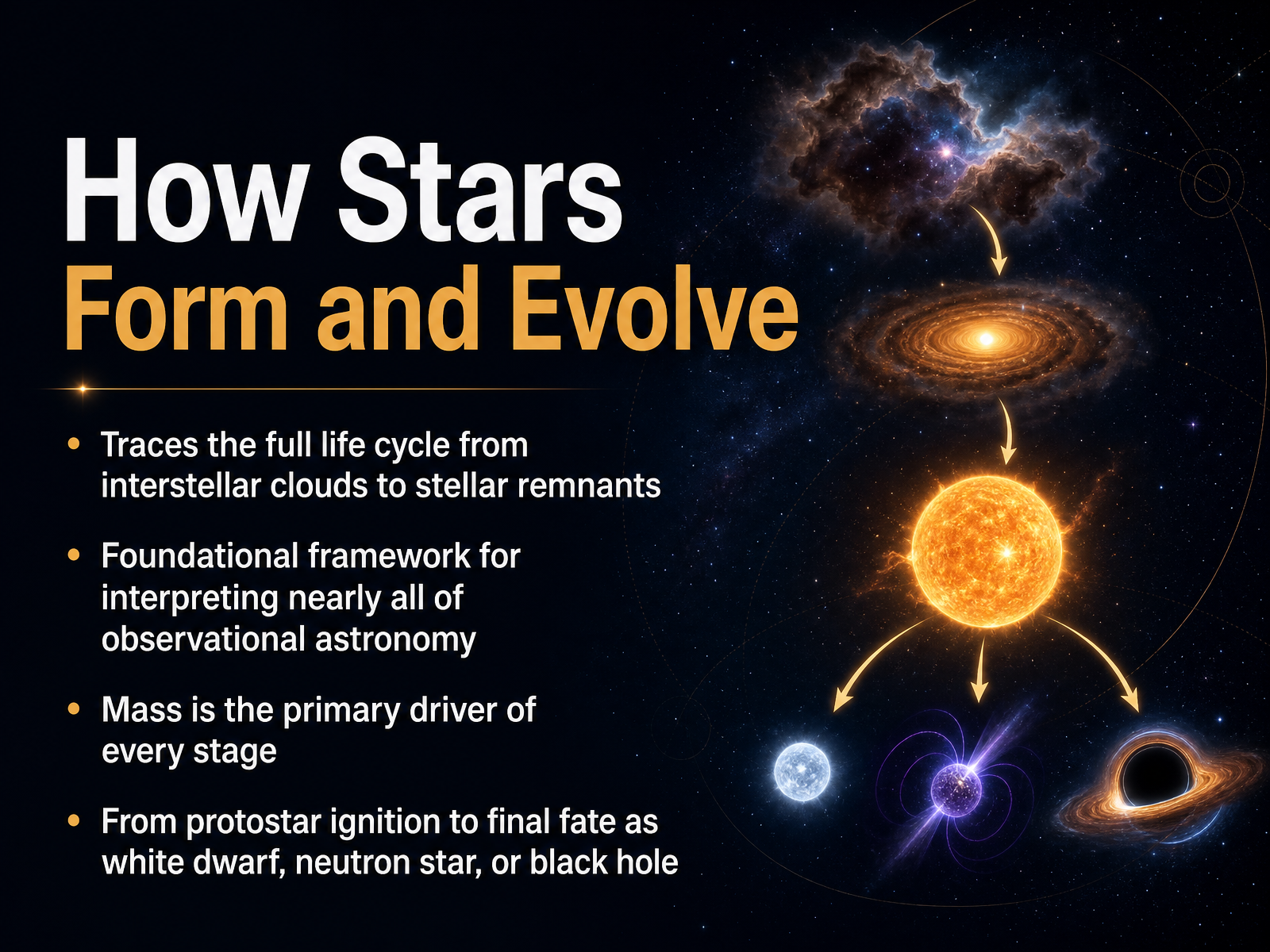
- 01How Stars Form and EvolveWelcome. In this course, we are going to trace one of the most remarkable stories in the universe, the full life cycle of a star. We will follow these objects from their quiet beginnings inside vast interstellar clouds, through their long and luminous middle years, and finally to the strange remnants they leave behind: a white dwarf, a neutron star, or a black hole. The framework we build here is foundational. Almost everything we observe in astronomy, from the light of distant galaxies to the chemical makeup of our own planet, connects back to the lives of stars. And the single factor that drives every stage of this story is mass. Mass determines how quickly a star forms, how brightly it shines, how long it lives, and how it ultimately ends. Once a protostar ignites, everything that follows is written, in a sense, by that one number. So with that in mind, let us begin where every star begins, in the cold, dark clouds of interstellar space. Next, we will explore the birthplaces of stars.britannica.comen.wikipedia.orgbritannica.com+22 min
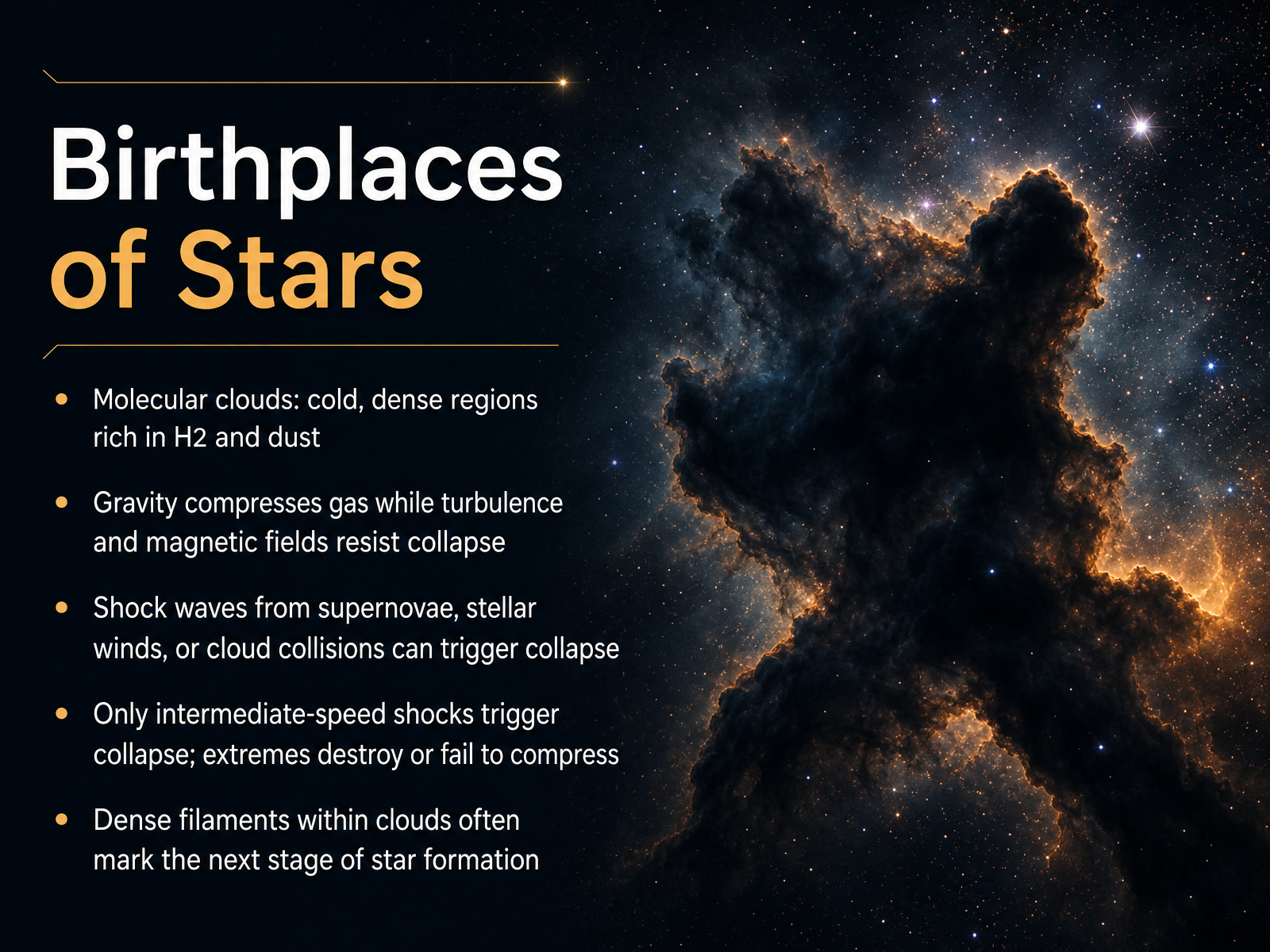
- 02Birthplaces of StarsNow let's look at where stars are born. Their birthplaces are molecular clouds, which are vast, cold, dark regions of space filled with molecular hydrogen and dust. Inside these clouds, gravity is constantly pulling gas inward, while turbulence and magnetic fields push back, resisting collapse. So what tips the balance? Often, it's a shock wave from a nearby supernova, powerful stellar winds, or even a collision between two clouds. But not just any shock will do. If the shock is too slow, it fails to compress the gas enough. If it's too fast, it shreds the cloud apart. Only an intermediate-speed shock can trigger the gravitational collapse needed to form a star. Once this process begins, dense filaments within the cloud often mark the very next stage of star formation. Up next, we'll trace that journey from cloud core to protostar.
 iopscience.iop.orgacademic.oup.comiopscience.iop.org+22 min
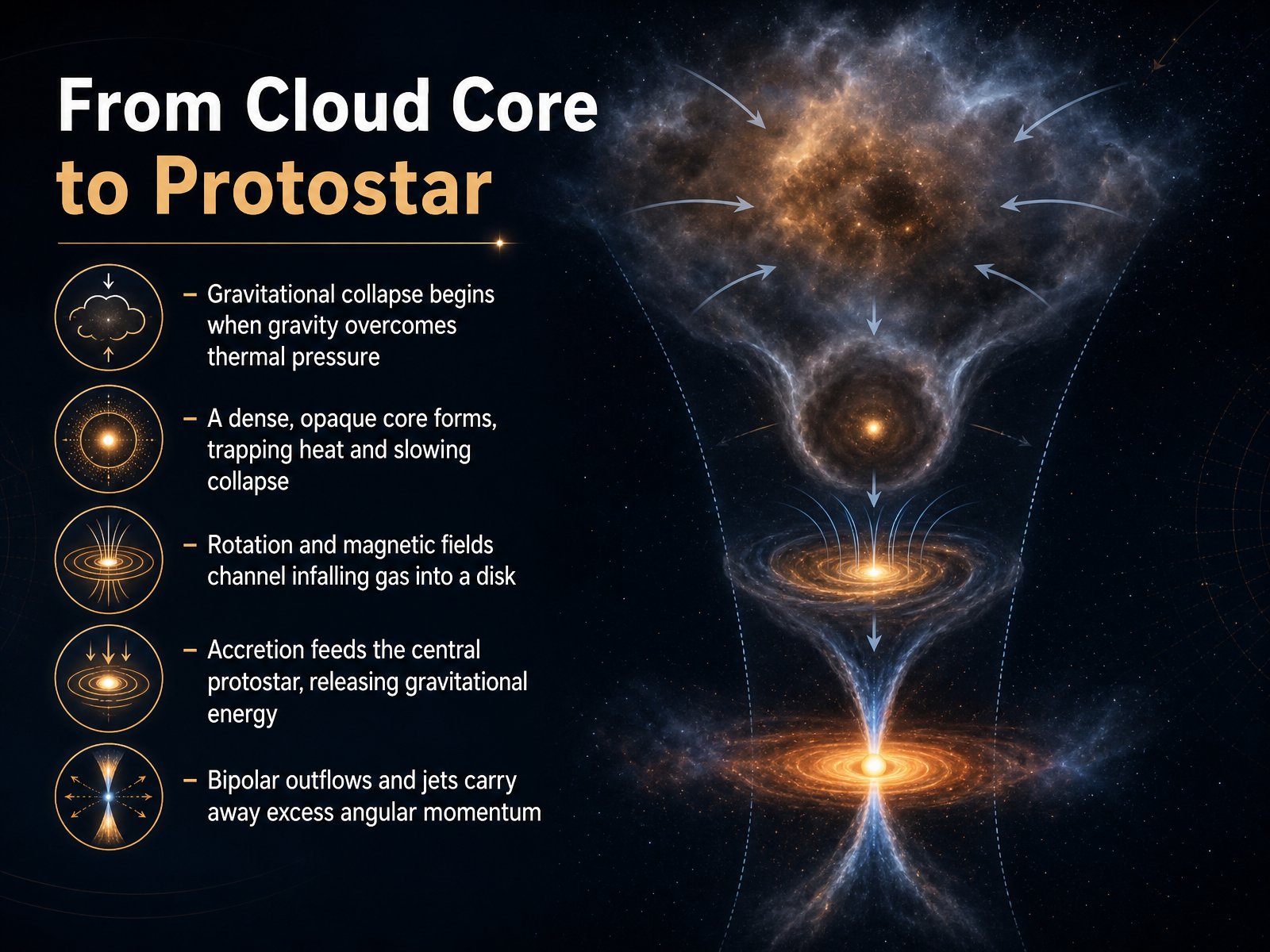
 - 03From Cloud Core to ProtostarNow let's zoom in on the very heart of the action, the moment a cloud core becomes a protostar. This begins when gravity finally wins. Deep inside a molecular cloud, a pocket of gas and dust becomes dense enough that its own gravity overcomes the outward push of thermal pressure. Once that threshold is crossed, collapse is inevitable. As the material falls inward, the core becomes dense and opaque, meaning it starts trapping the heat released by gravitational contraction. That trapped heat slows the collapse, but it cannot stop it. Now here is where things get beautifully complicated. The collapsing gas has rotation, and it carries magnetic fields with it. These forces channel the infalling material into a swirling disk around the central object. From that disk, matter spirals inward, accreting onto the growing protostar. Each infalling parcel of gas releases gravitational energy as it slams into the star and the disk, and that energy is what makes the protostar shine before any nuclear fusion has begun. But there is a catch. All that rotating material must shed angular momentum, otherwise the system would spin itself apart. The solution comes in spectacular form, bipolar outflows and narrow jets that blast away from the poles of the disk, carrying excess momentum with them. And with that elegant machinery in place, the young system is finally clear to take the next step: the road to the main sequence.
 crossfield.ku.edustaff.fnwi.uva.nliopscience.iop.org+22 min
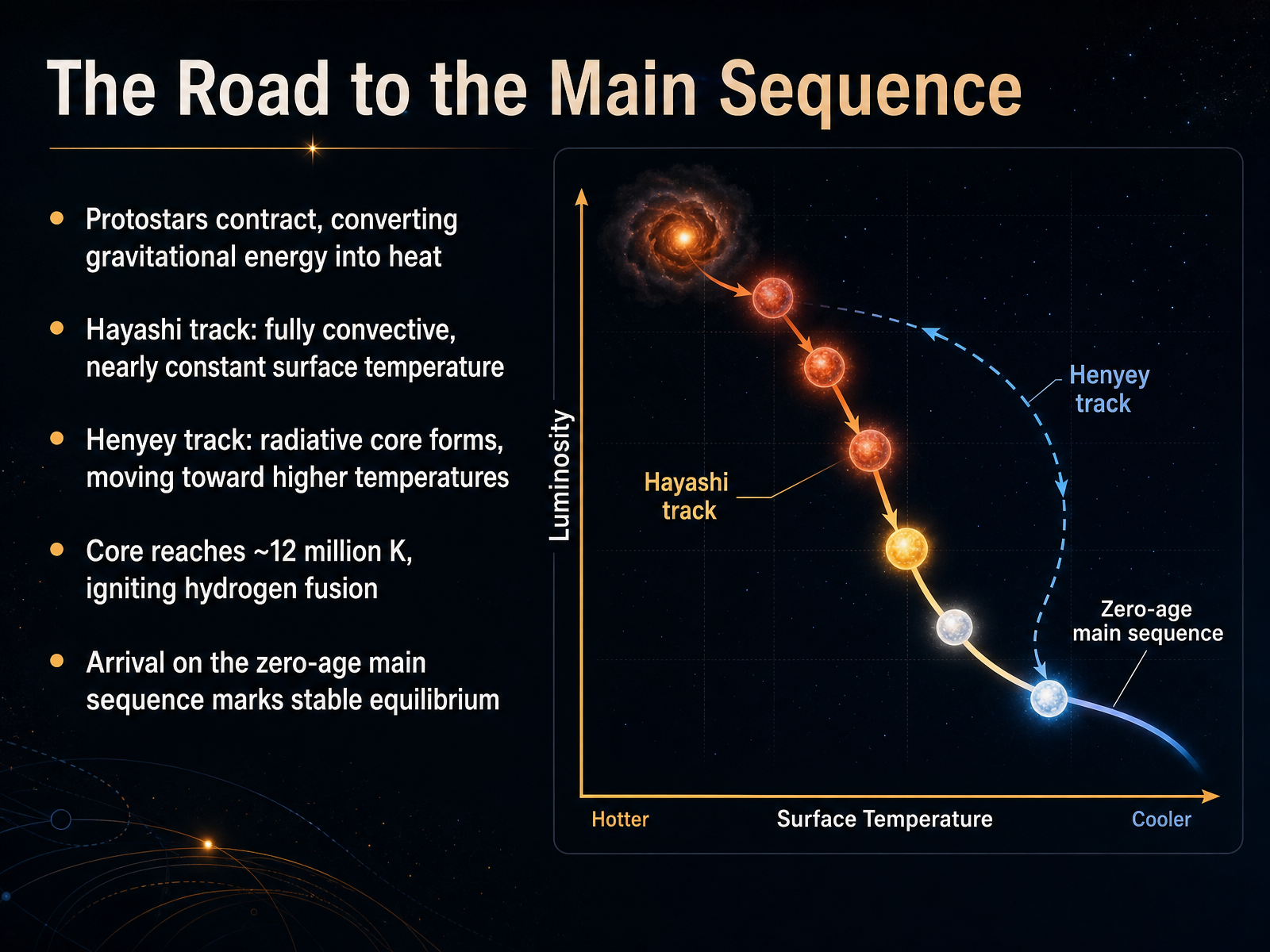
 - 04The Road to the Main SequenceSo how does a protostar actually travel to the main sequence? It's a journey defined by two distinct paths on the H-R diagram. First, a young star contracts along the Hayashi track. During this phase, it is fully convective, and the surface temperature stays remarkably steady, even as it shrinks and dims. Think of it as the star finding its footing. For stars above a certain mass, things change when the core heats up enough to become radiative. This triggers a shift onto the Henyey track, where the star develops a radiative core and its surface temperature begins to climb. But the real milestone comes when the core temperature reaches about twelve million Kelvin. At that extreme heat, protons finally have enough energy to fuse into helium. This ignites hydrogen fusion and halts contraction, allowing the star to settle into stable equilibrium on what we call the zero-age main sequence. The star is now a true star. Next, let's look at what life is like on the main sequence.
 crossfield.ku.edustaff.fnwi.uva.nliopscience.iop.org+22 min
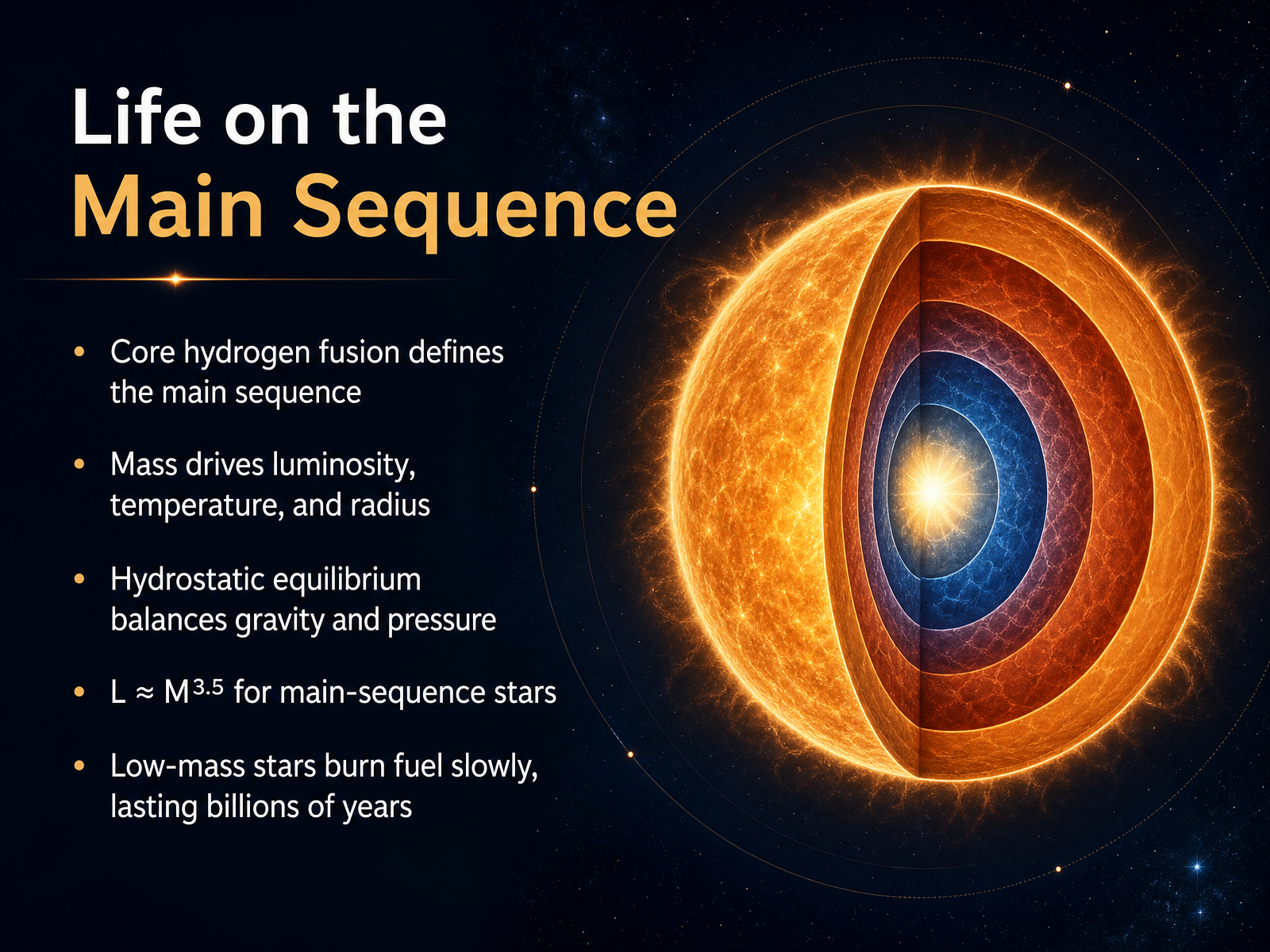
 - 05Life on the Main SequenceNow we arrive at the longest and most stable chapter of a star's life, the main sequence. For the vast majority of a star's existence, it is defined by a sublime balance. In the core, hydrogen atoms are fused into helium, releasing tremendous energy. That energy pushes outward, while gravity pulls everything inward. This state of balance is called hydrostatic equilibrium. For a main sequence star, its mass dictates nearly everything. Luminosity, temperature, and radius are all determined by how much matter the star contains. We see this in the mass luminosity relation. For most of these stars, luminosity scales with mass to the power of 3.5. This means a star twice as massive as our sun is not just twice as bright, but roughly eleven times brighter. This relationship has profound consequences for stellar lifetimes. You might think a massive star with more fuel would last longer, but the opposite is true. It burns through its fuel so rapidly that its life is dramatically shortened. Low mass stars, in contrast, are remarkably frugal. They burn their hydrogen slowly, allowing them to shine for hundreds of billions, or even trillions of years. Massive stars, on the other hand, spend their fuel prodigiously and face a much shorter future. Let's look next at exactly why massive stars live fast and die young.
 en.wikipedia.orgatnf.csiro.auopen.edu+22 min
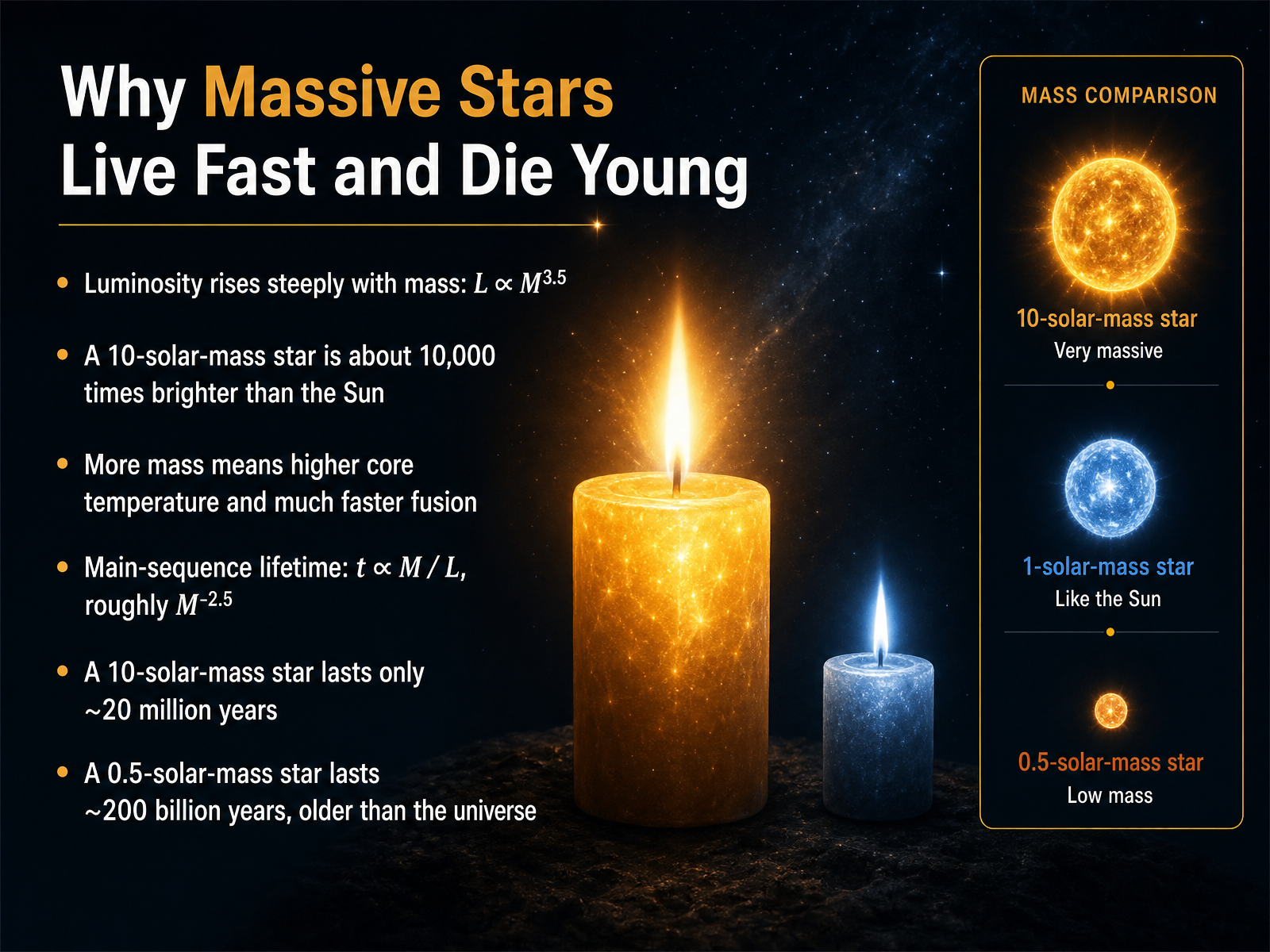
 - 06Why Massive Stars Live Fast and Die YoungNow think about mass as a kind of stellar engine, and you will see why massive stars live fast and die young. Luminosity climbs steeply with mass, roughly to the three point five power. That means a star with ten times the Sun's mass shines about ten thousand times brighter. The extra mass squeezes the core harder, raising its temperature and forcing hydrogen to fuse at a far faster rate. Life on the main sequence is a race between fuel and burn rate, and brightness wins. A ten solar mass star burns through its core hydrogen in roughly twenty million years. Compare that with the Sun's ten billion. And a half solar mass star can linger for around two hundred billion years, longer than the universe has existed. So mass is destiny. More mass means a shorter, more spectacular life. Next, we will see what happens when a star begins leaving the main sequence.
 en.wikipedia.orgatnf.csiro.auopen.edu+22 min
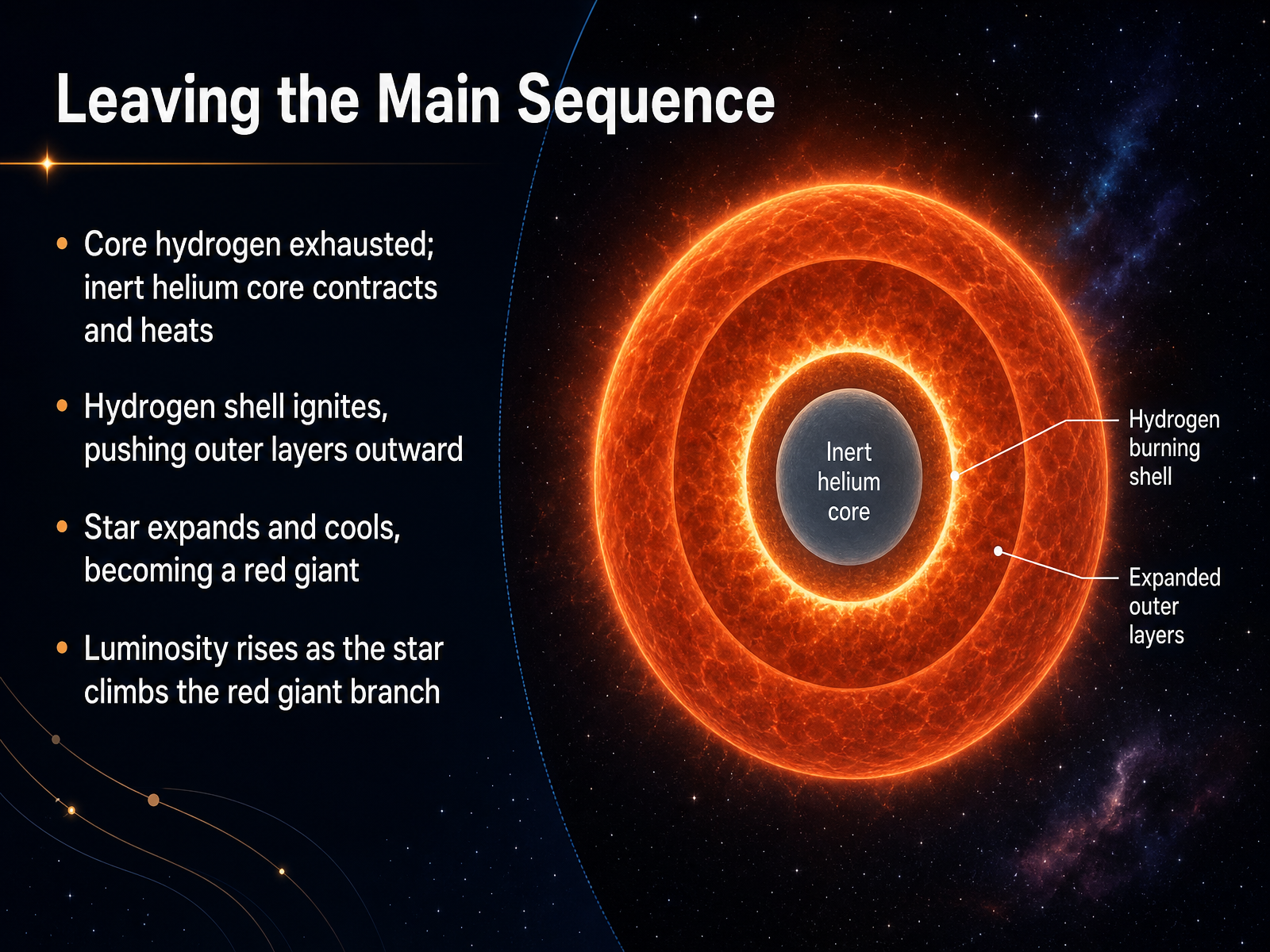
 - 07Leaving the Main SequenceLeaving the main sequence changes a star in ways that are both peaceful and profound. Once the hydrogen in the core is exhausted, nuclear fusion there stops. The core, now made almost entirely of helium, has no energy source to hold itself up. So it begins to contract under its own weight. That contraction heats the core, and the increase in temperature spreads outward. In a thin shell just around the helium core, leftover hydrogen reaches ignition and starts fusing into helium. This hydrogen shell burning releases a tremendous amount of energy. The new energy pushes on the outer layers from below, causing the star to swell dramatically. As those outer layers expand, they spread their heat over a much larger surface. The surface cools, and the star glows redder. It has become a red giant. And because of that enormous surface area, even though each square meter is cooler, the total light output climbs. The star brightens as it moves upward along the red giant branch. The balance inside the star has shifted completely, from a stable core burning hydrogen, to a restless system powered by a thin shell around a collapsing heart. Next, we will follow this path as we explore the fate of low and intermediate mass stars.
 1 min
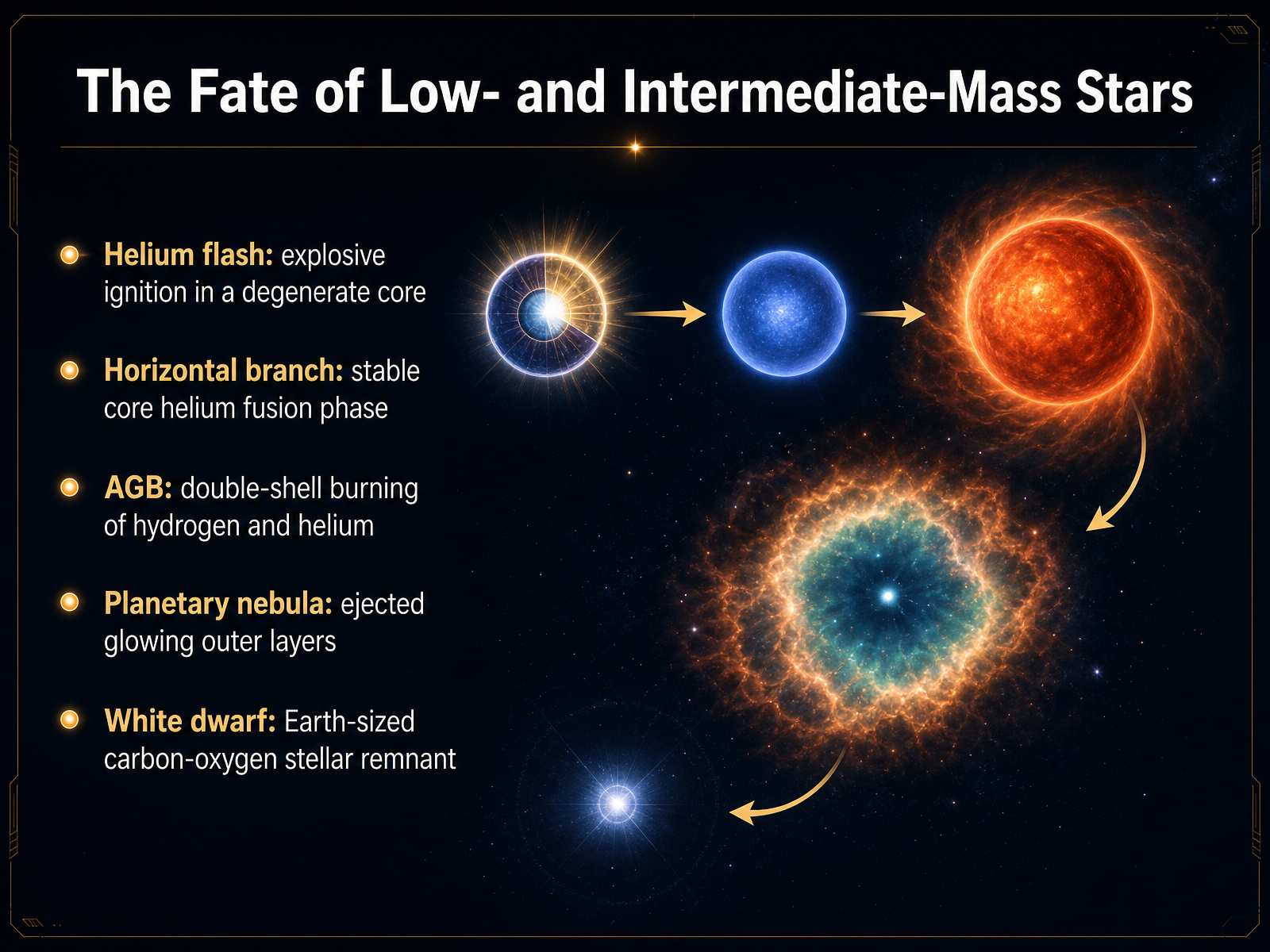
1 min - 08The Fate of Low- and Intermediate-Mass StarsSo, what finally happens to a star like our Sun? As the helium core becomes degenerate, it grows hotter and denser until helium ignites all at once. That is the helium flash, an explosive burst of fusion, yet hidden deep inside the star. After the flash, the core settles into stable helium fusion. Astronomers call this calmer phase the horizontal branch. Eventually, the helium runs low, leaving carbon and oxygen behind. The star swells again, this time burning hydrogen and helium in separate shells around the core. We call this the asymptotic giant branch, or AGB. In this unstable phase, the outer layers are so loosely held that they drift away, forming a glowing shell we see as a planetary nebula. The hot core that remains is a white dwarf, an Earth-sized remnant made mostly of carbon and oxygen. It no longer fuses elements. Instead, it simply cools, slowly fading over billions of years. Next, let us look inside white dwarfs to understand what supports them.
 1 min
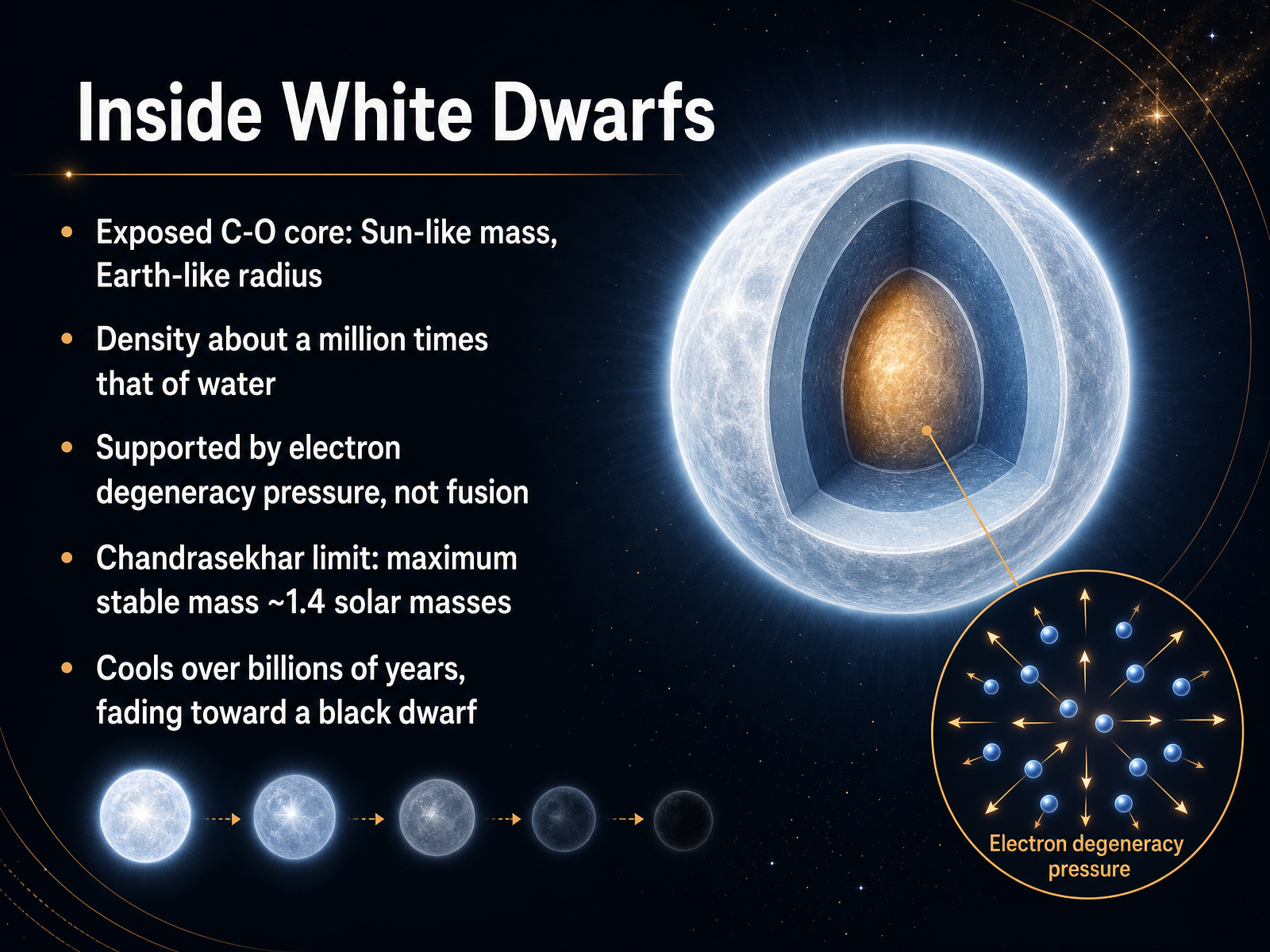
1 min - 09Inside White DwarfsLet's step inside a white dwarf and see what it's really made of. This is the exposed carbon-oxygen core of a star like our Sun, squeezed into a sphere roughly the size of Earth. The density here is staggering, about a million times that of water. A single teaspoon of this material would weigh over a ton on Earth. Yet no fusion is happening inside. So what holds it up against its own crushing gravity? The answer is electron degeneracy pressure, a quantum mechanical effect where electrons resist being squeezed into the same state. This creates a powerful outward push, but it has a strict limit. The Chandrasekhar limit, about one point four solar masses, is the maximum mass this pressure can support. Lightweight white dwarfs can be more massive than heavy ones because gravity compresses them further. With no internal energy source, white dwarfs simply cool over billions of years, gradually fading toward a cold, dark object called a black dwarf. Now let's turn to what happens when stars are too massive to end their lives this way.
 2 min
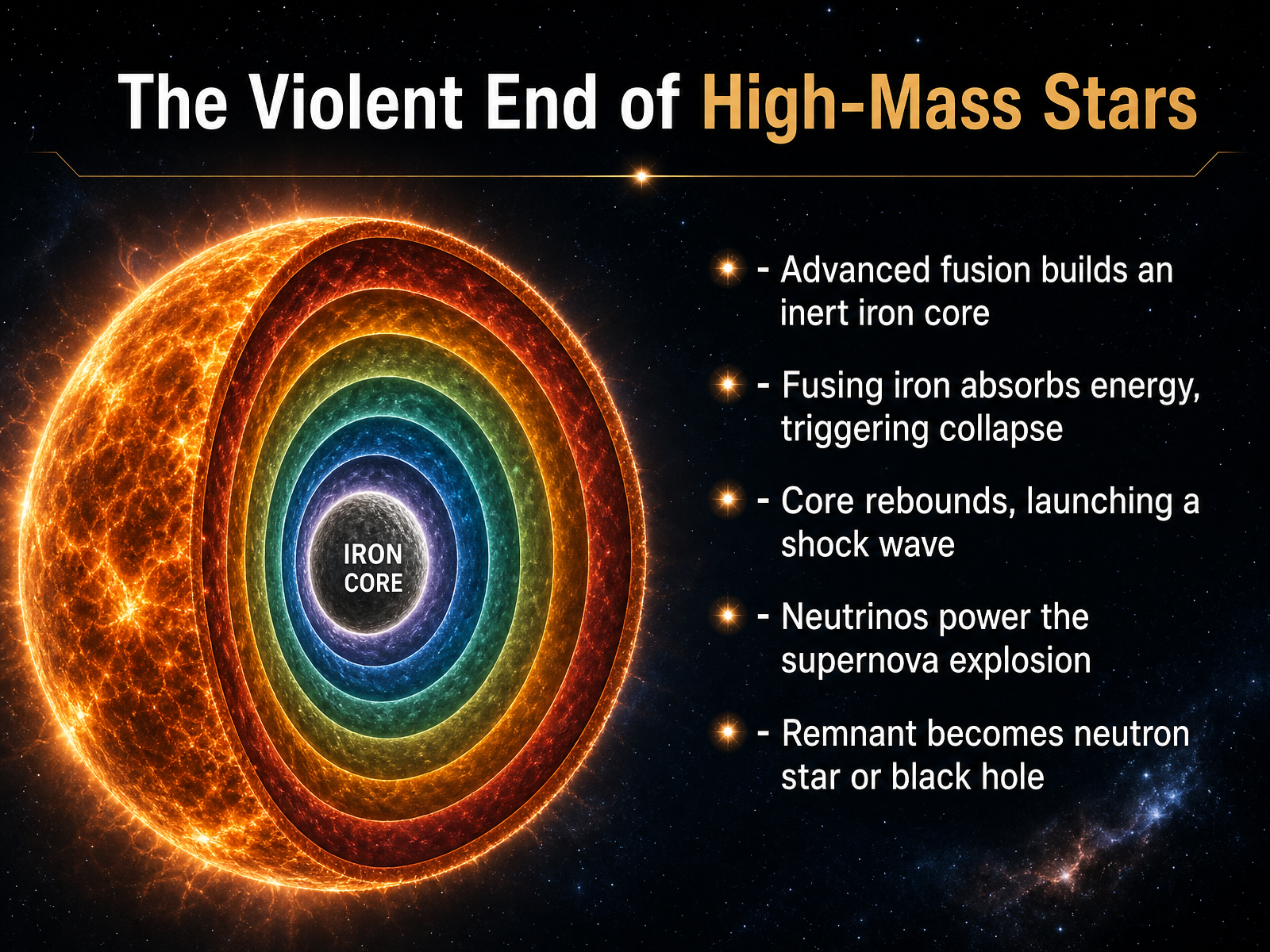
2 min - 10The Violent End of High-Mass StarsFor high-mass stars, the end is not gentle. As advanced fusion builds layer upon layer of heavier elements, the core eventually fills with inert iron. Now, iron is the tipping point. Unlike the fusion of lighter elements, fusing iron actually absorbs energy instead of releasing it. With no outward energy to support it, the core collapses catastrophically. Then, in an instant, the core rebounds. This launches a powerful shock wave outward, but the shock alone isn't enough to escape the infalling star. That is where neutrinos come in. A staggering burst of these ghostly particles, released during the core's collapse, re-energizes the shock wave and powers the titanic explosion we call a supernova. What remains behind depends on the mass of that collapsing core. Lower-mass cores leave behind a neutron star, an object of unimaginable density. But the most massive cores continue their collapse, forming a black hole, a region of spacetime from which not even light can escape. Next, let's explore these fascinating remnants in detail.
 2 min
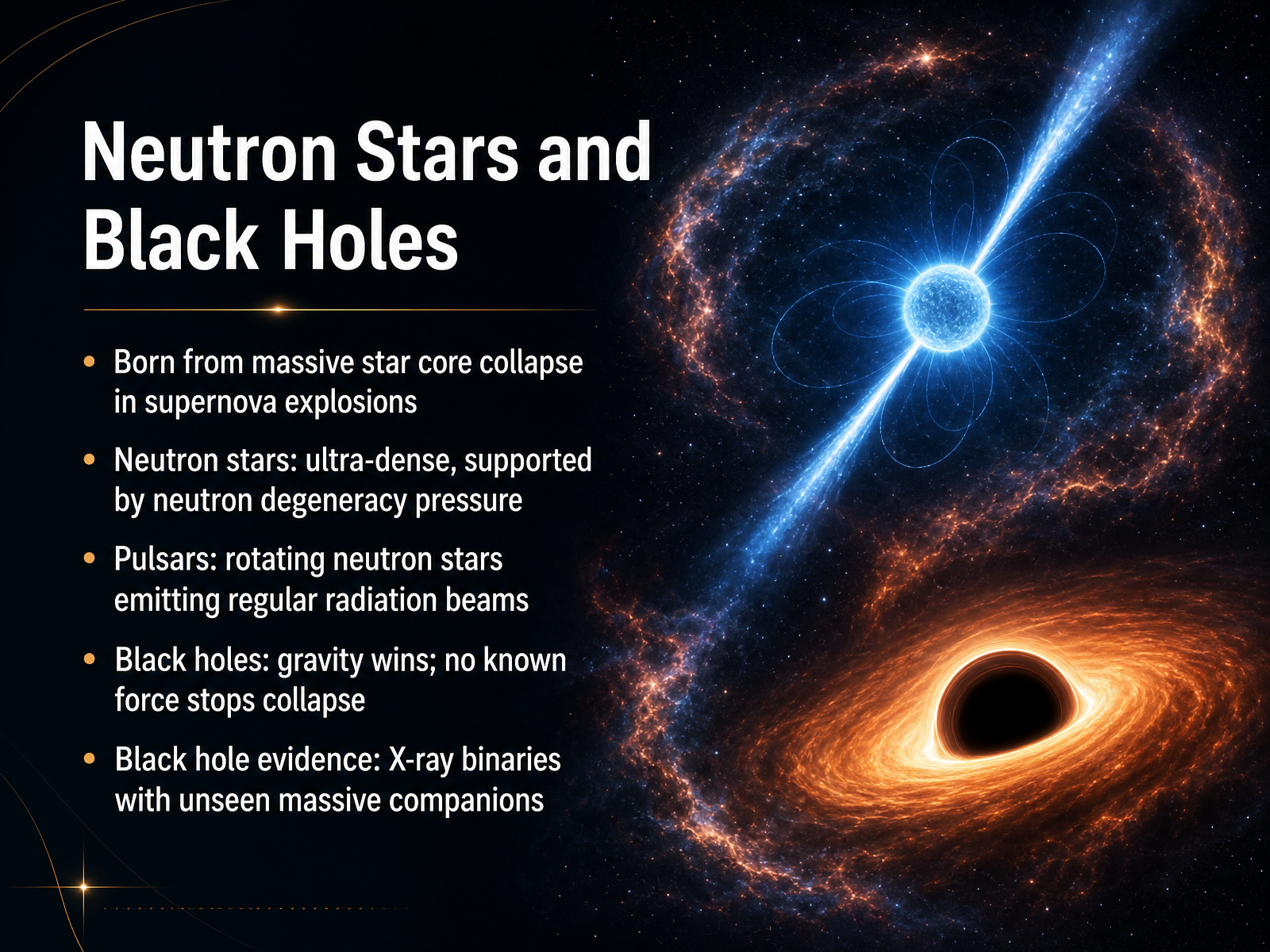
2 min - 11Neutron Stars and Black HolesNow we reach the most extreme endpoints of stellar evolution. When the core of a very massive star collapses in a supernova, what remains is either a neutron star or a black hole. A neutron star packs between about one point two and two point one times the Sun's mass into a sphere only about twelve to thirteen kilometers across. It is supported against further collapse by neutron degeneracy pressure, a quantum mechanical limit that prevents neutrons from being squeezed into the same state. Some neutron stars are pulsars, rotating rapidly and sweeping beams of radiation across space like a cosmic lighthouse. But when the core is too massive, no known force can stop the collapse. Gravity wins, and a black hole forms. We cannot see black holes directly, but we detect them through their influence. In X-ray binaries, gas from a companion star heats up as it spirals toward an unseen massive object, producing bright X-ray emission. The companion's orbit and the X-ray glow together give us strong evidence that a black hole is there. Next, we will compare these remarkable stellar remnants side by side.
 1 min
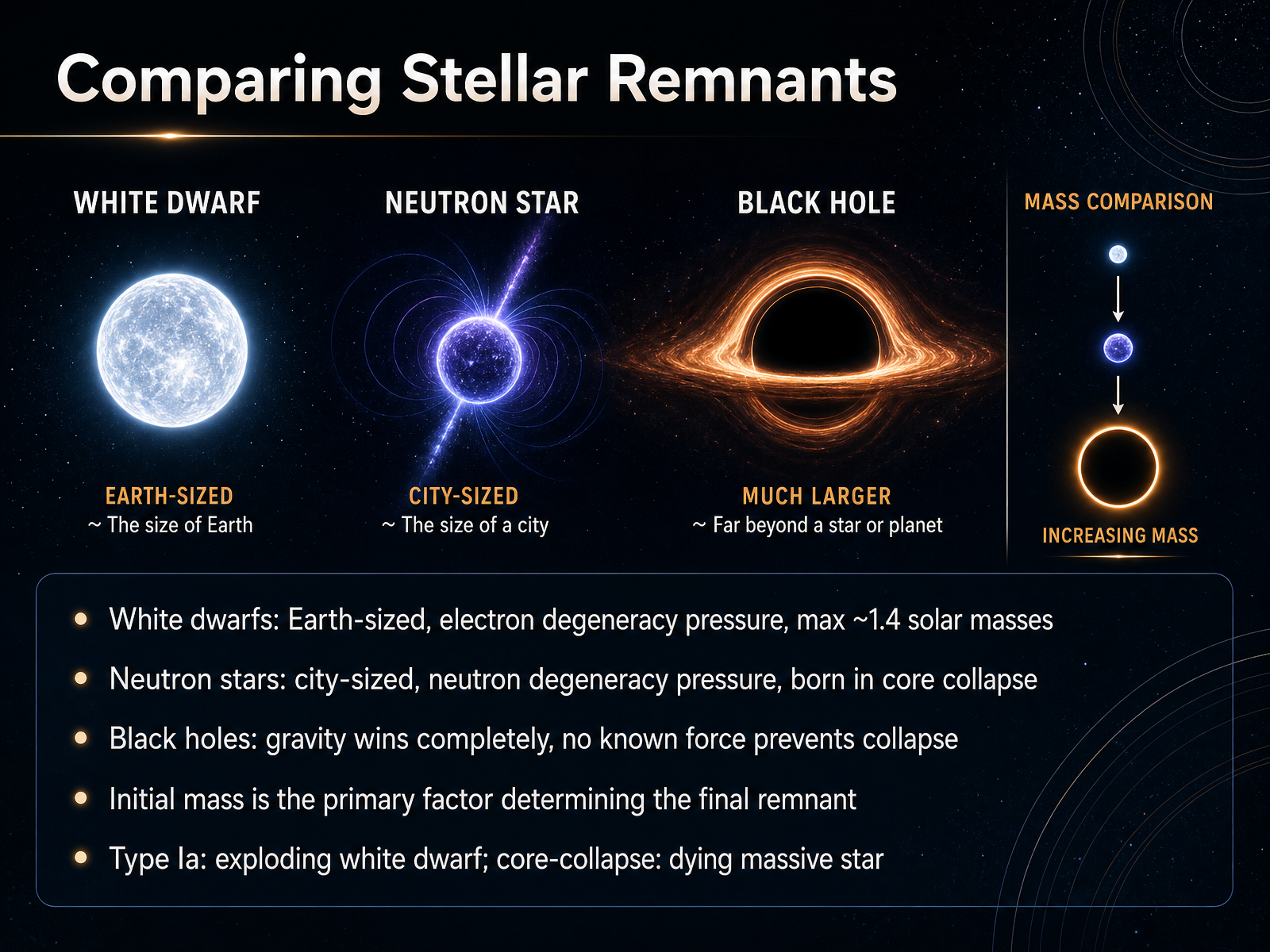
1 min - 12Comparing Stellar RemnantsNow let's put these stellar remnants side by side. A white dwarf is about the size of Earth, supported by electron degeneracy pressure, and it has a maximum mass of roughly one point four solar masses. A neutron star is far more extreme. It packs more than the Sun's mass into a sphere the size of a city, held up by neutron degeneracy pressure. It forms from the collapsing core of a massive star. But a black hole is different. Gravity wins completely, and no known force can stop the collapse. The key factor that determines which remnant a star leaves behind is its initial mass. Also, not all supernovae are the same. A Type Ia supernova is an exploding white dwarf, while a core collapse supernova marks the death of a massive star. These differences help astronomers read the history of stars. Next, we will explore how stellar evolution appears in the H-R diagram.
 1 min
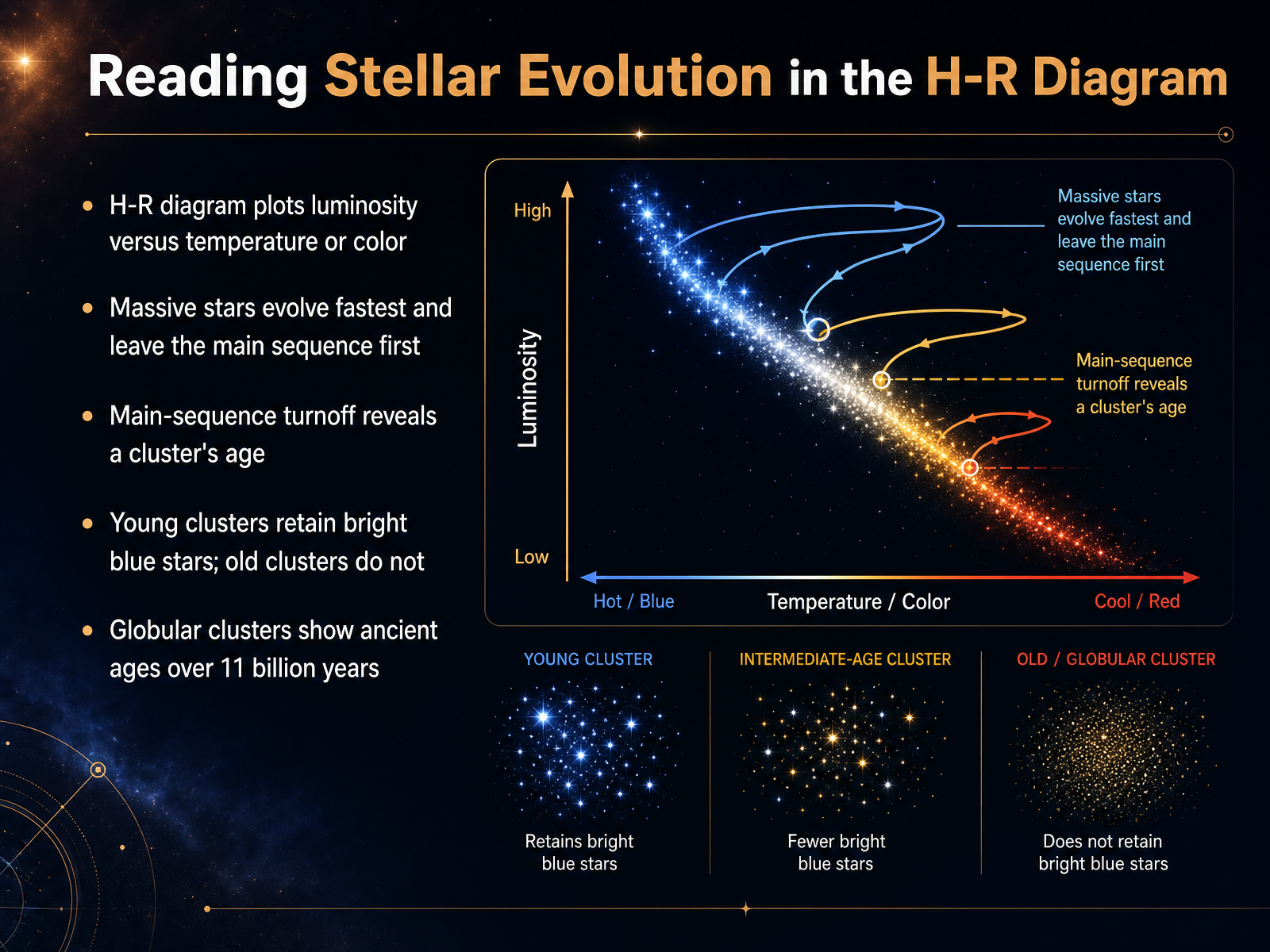
1 min - 13Reading Stellar Evolution in the H-R DiagramNow let us see how all of this shows up in a single, powerful diagram. The Hertzsprung-Russell diagram plots stellar luminosity against surface temperature or color, and it becomes a kind of cosmic clock when we look at star clusters. Remember that massive stars burn through their fuel fastest. So in a cluster, they are the first to leave the main sequence and move toward the red giant region. That departure point is called the main-sequence turnoff, and it reveals the cluster's age. A young cluster still has bright blue stars high on the main sequence, while an old cluster does not. In fact, when we examine globular clusters, their turnoff points sit low on the main sequence, giving ages of at least eleven billion years. These ancient clusters are among the oldest structures we can observe, and they help us set a lower limit on the age of the universe itself. Up next, we will bring everything together in our key takeaways and common misconceptions.
 1 min
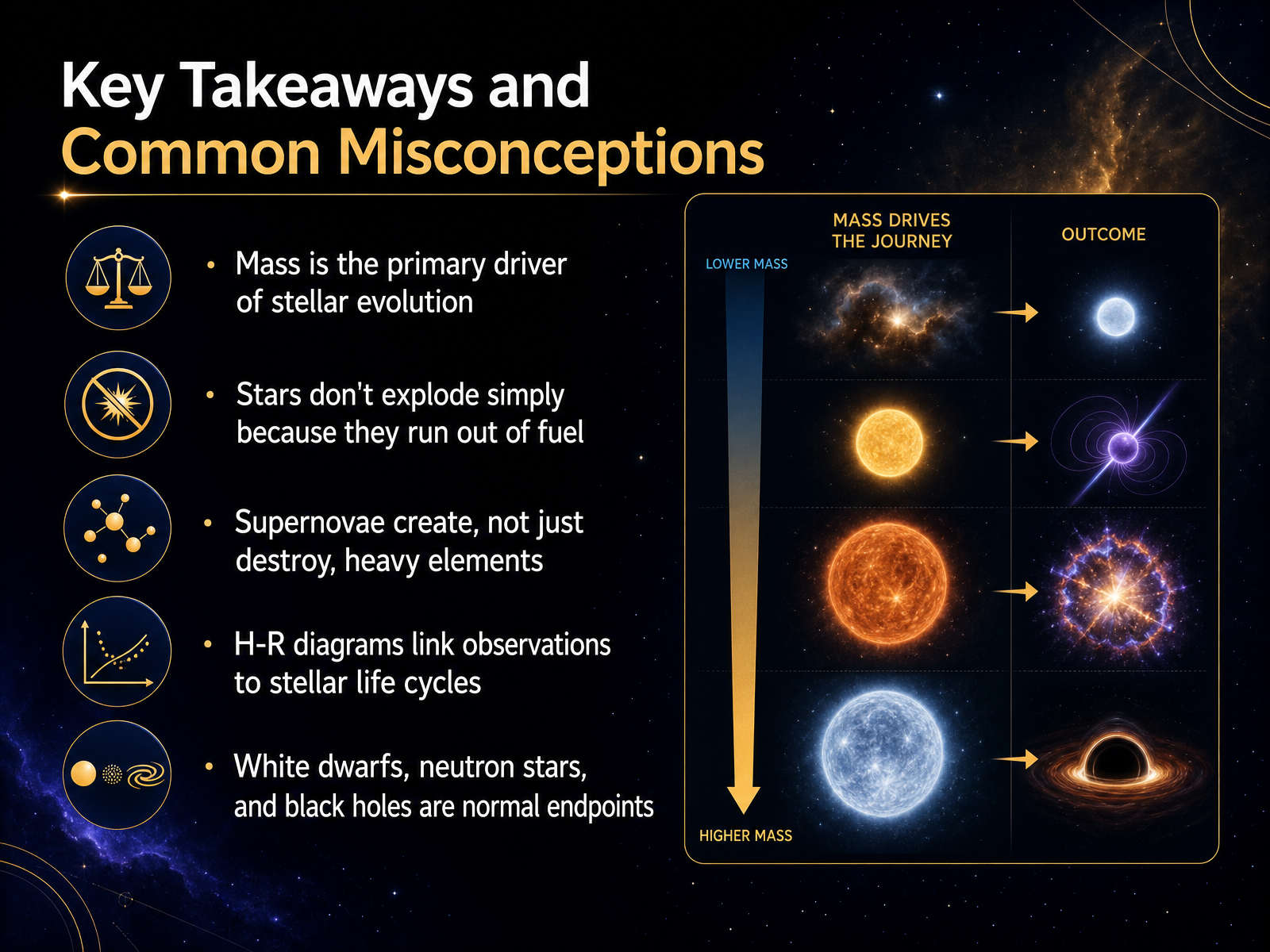
1 min - 14Key Takeaways and Common MisconceptionsAs we arrive at the end of our journey, let's bring a few essentials into focus. Mass is the primary driver of stellar evolution. A star's birth mass sets its temperature, its lifetime, and the way it will eventually die. That leads us to a common misconception. Stars don't explode simply because they run out of fuel. A supernova happens when the core collapses, or reignites, in a sudden and catastrophic release of energy. And that explosion does more than destroy. Supernovae forge and scatter heavy elements, the calcium in your bones, the iron in your blood, the oxygen you breathe. They are creators as much as destroyers. We also saw how the H R diagram connects what we observe, brightness and temperature, to the hidden life cycles of stars. And remember, white dwarfs, neutron stars, and black holes are not strange failures. They are normal endpoints for stars of different masses. Keep asking what the light is telling you. The universe is still waiting to be read. Thank you for learning with me today, and I hope you carry this sense of discovery into your next look at the night sky.
 2 min
2 min
Take the deck with you
Download this course as a file — free, no sign-up needed.
- PDF handoutEvery slide page, ready to print or share.15 pages · 4.2 MBDownload
- Narrated PowerPointThe deck that presents itself — every slide carries the digital human's narration video.15 pages · 15.7 MBDownload
- PowerPoint slidesThe full deck as a .pptx — open it in PowerPoint, Keynote, or Google Slides.15 pages · 4.1 MBDownload
Free to use in your own training — please keep the PersonWise credit page at the end.
Have your own deck? Turn it into a course
Sources consulted
Web sources consulted while building this course.
- Star formation and evolution — britannica.com
- Stellar evolution - Wikipedia — en.wikipedia.org
- Stellar evolution | astronomy | Britannica — britannica.com
- Stellar Evolution | COSMOS — astronomy.swin.edu.au
- Stellar Evolution - The Life and Death of Stars — atnf.csiro.au
- Star Formation Triggered by Shocks - IOPscience — iopscience.iop.org
- Triggered star formation and its consequences — academic.oup.com
- GMC Collisions as Triggers of Star Formation. VII. The Effect of Magnetic Field Strength on Star Formation - IOPscience — iopscience.iop.org
- Numerical Simulations of Triggered Star Formation. I. Collapse of Dense Molecular Cloud Cores - IOPscience — beta.iopscience.iop.org
- GMC COLLISIONS AS TRIGGERS OF STAR FORMATION. I. PARAMETER SPACE EXPLORATION WITH 2D SIMULATIONS - IOPscience — iopscience.iop.org
- 18 Stellar Evolution: The Rest of the Picture — crossfield.ku.edu
- Protostars & pre-main-sequence — staff.fnwi.uva.nl
- Stellar evolution toward the main sequence - IOPscience — iopscience.iop.org
- Revisiting the pre-main-sequence evolution of stars — aanda.org
- Protostars and Pre-Main Sequence Evolution — astro.princeton.edu
- Mass–luminosity relation — en.wikipedia.org
- Main Sequence Stars - Australia Telescope National Facility — atnf.csiro.au
- Astronomy with an online telescope: Week 6: 4.2 Stellar lifetime as a function of mass | OpenLearn - Open University — open.edu
- Main Sequence Lifetime | COSMOS — astronomy.swin.edu.au
- 22.1 Evolution from the Main Sequence to Red Giants - Astronomy | OpenStax — openstax.org