Begin
14 pages · ~28 min
Change Leadership in Management
This training helps managers understand change leadership concepts, purpose, and real-world examples to guide teams through organizational change effectively.
A digital instructor presents all 14 pages. Hold “Ask” at any point and ask out loud — the answer comes from this course. No sign-up needed.
What you’ll learn
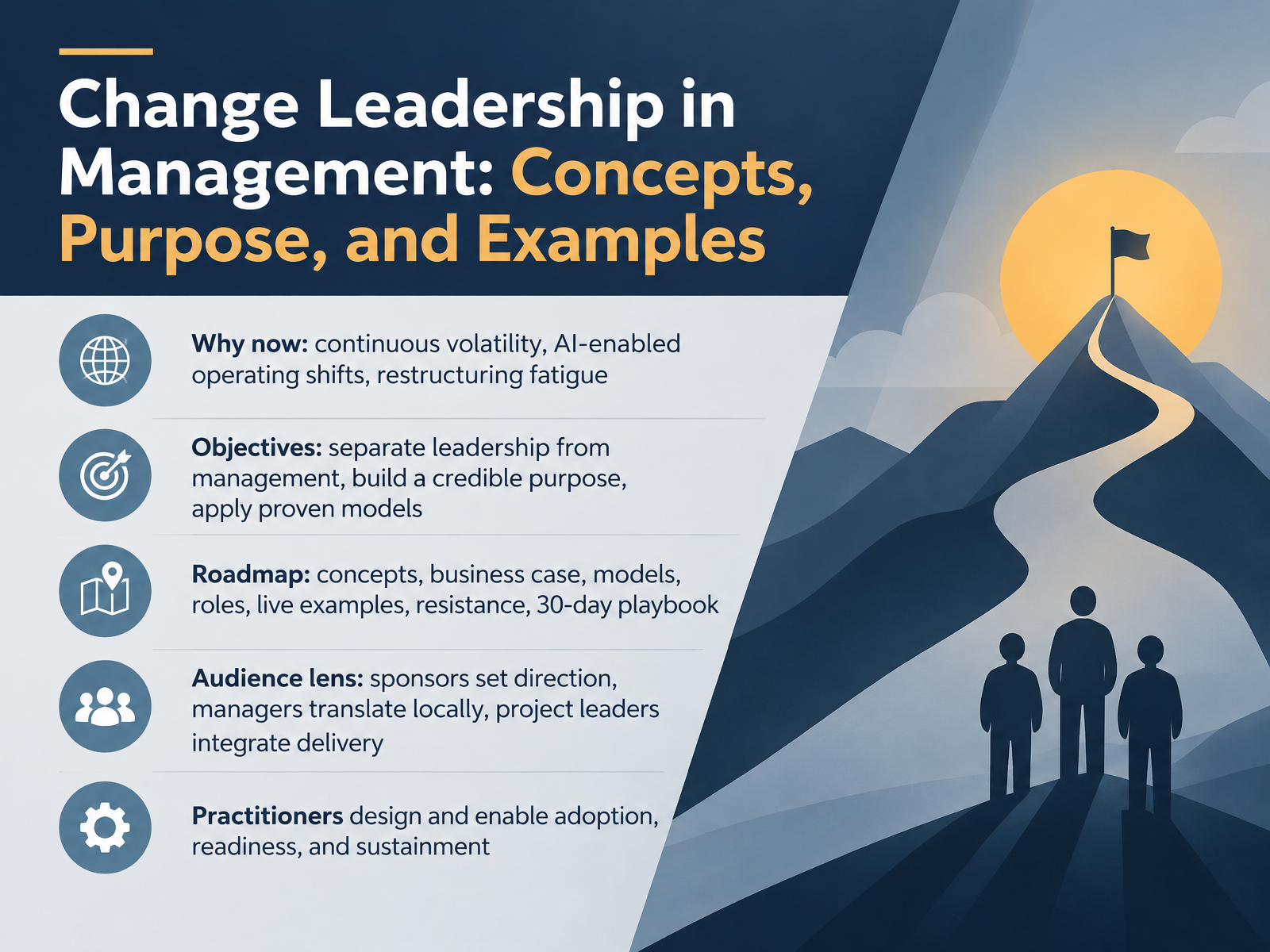
- 01Change Leadership in Management: Concepts, Purpose, and ExamplesWelcome. I'm glad you're here. This course is called Change Leadership in Management: Concepts, Purpose, and Examples. It's built for sponsors, people managers, project leaders, and change practitioners. So think of this as a working session among peers, not a lecture.
Let's start with why this matters now. You're operating in continuous volatility. AI is reshaping how work gets done. And many teams are carrying restructuring fatigue. In that climate, the difference between a change that lands and one that stalls is rarely the plan. It's the leadership around it.
Over the next slides, we'll do three things. First, separate change leadership from change management, because the words get used interchangeably and that blurs accountability. Change leadership sets direction and builds commitment. Change management provides the structured work that helps people adopt. Second, we'll build a credible purpose you can defend. And third, we'll apply proven models.
Here's the roadmap. Concepts, the business case, models, roles, live examples, resistance, and a thirty day playbook.
And a word on your lens. Sponsors set direction. Managers translate locally. Project leaders integrate delivery. Practitioners design and enable adoption, readiness, and sustainment.
Let's begin with the background, and why change leadership is now a management discipline.prosci.comprosci.comempower.prosci.com+22 min
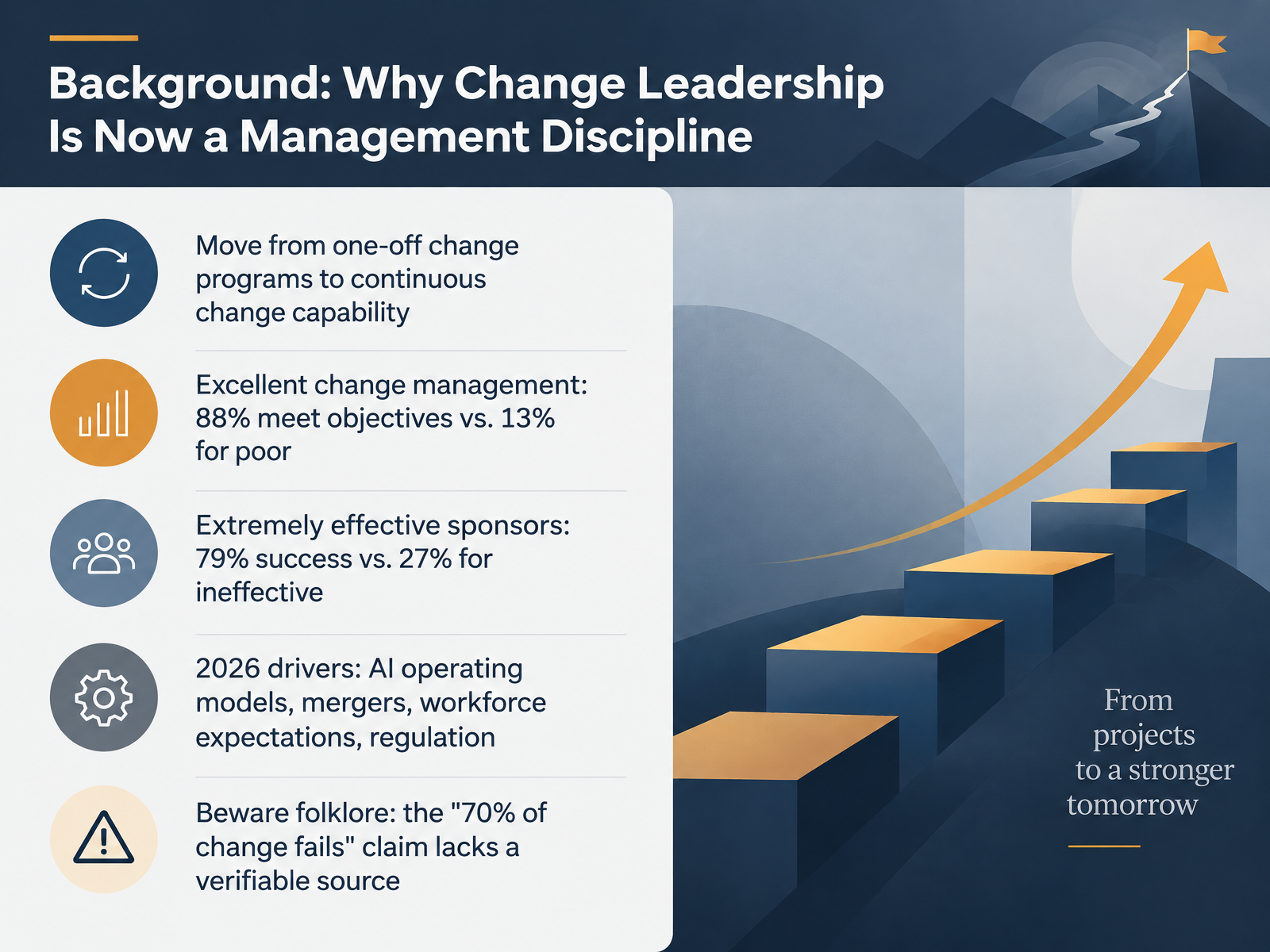
- 02Background: Why Change Leadership Is Now a Management DisciplineLet's start with context. Change leadership has shifted from an occasional project skill to a standing management discipline. The reason is practical. Change no longer arrives as one-off programs. It arrives continuously, so the capability has to live inside the business. The data supports this. Prosci research found that projects with excellent change management met objectives eighty-eight percent of the time, against thirteen percent for poor change management. And with extremely effective sponsors, success was seventy-nine percent, versus twenty-seven percent with extremely ineffective sponsors. Now look ahead. The drivers for 2026 are AI operating models, mergers, shifting workforce expectations, and regulation. One caution for sponsors. The familiar claim that seventy percent of change fails lacks a verifiable source. Don't build a business case on folklore. Use evidence you can defend. Next, we separate change leadership from change management.
 prosci.comprosci.comprosci.com+22 min
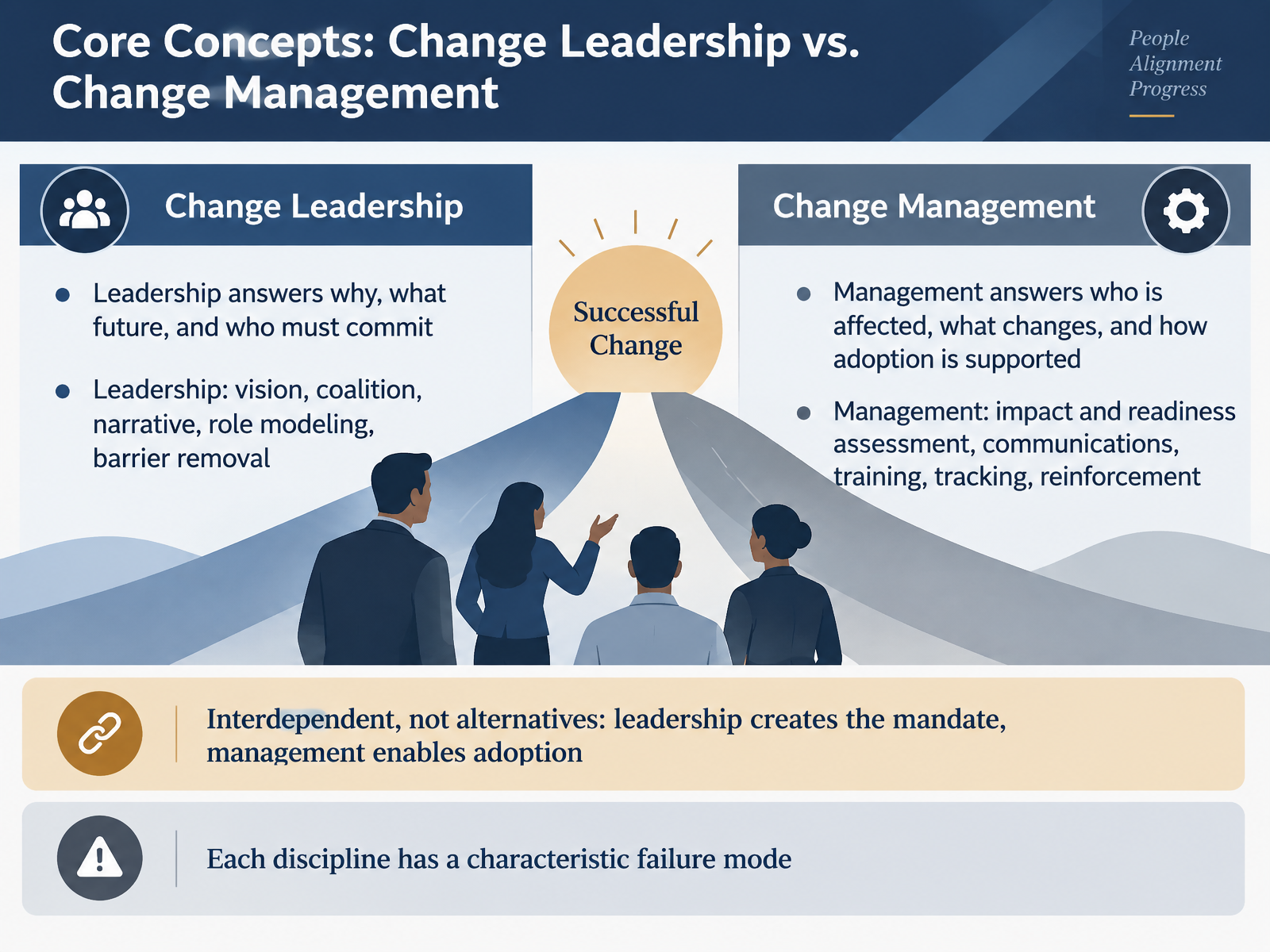
- 03Core Concepts: Change Leadership vs. Change ManagementLet's draw a line that often gets blurred. Change leadership and change management are not rival approaches. They answer different questions. Leadership answers why we must change, what future we are creating, and who must commit. Management answers who is affected, what changes for them, and how adoption will be supported. In practice, leadership shows up as vision, a coalition, a narrative, role modeling, and removing barriers. Management shows up as impact and readiness assessment, communications, training, tracking, and reinforcement. Here's a concrete example. A sponsor decides to consolidate three regional service centers into one shared process, and funds the transition. That's leadership. The change practitioner then maps which teams are affected, builds the training plan, and tracks adoption after go-live. That's management. They are interdependent. Leadership creates the mandate. Management enables adoption. And each has a characteristic failure mode. Leadership without management produces compelling language with no resources or decisions behind it. Management without leadership produces well-run activity plans with no credible purpose. So as a sponsor or manager, your job is not to pick a side. It's to make sure both are visibly owned. That brings us to the next question. What is the business case for leading change well?
 prosci.comepw.comtd.org+22 min
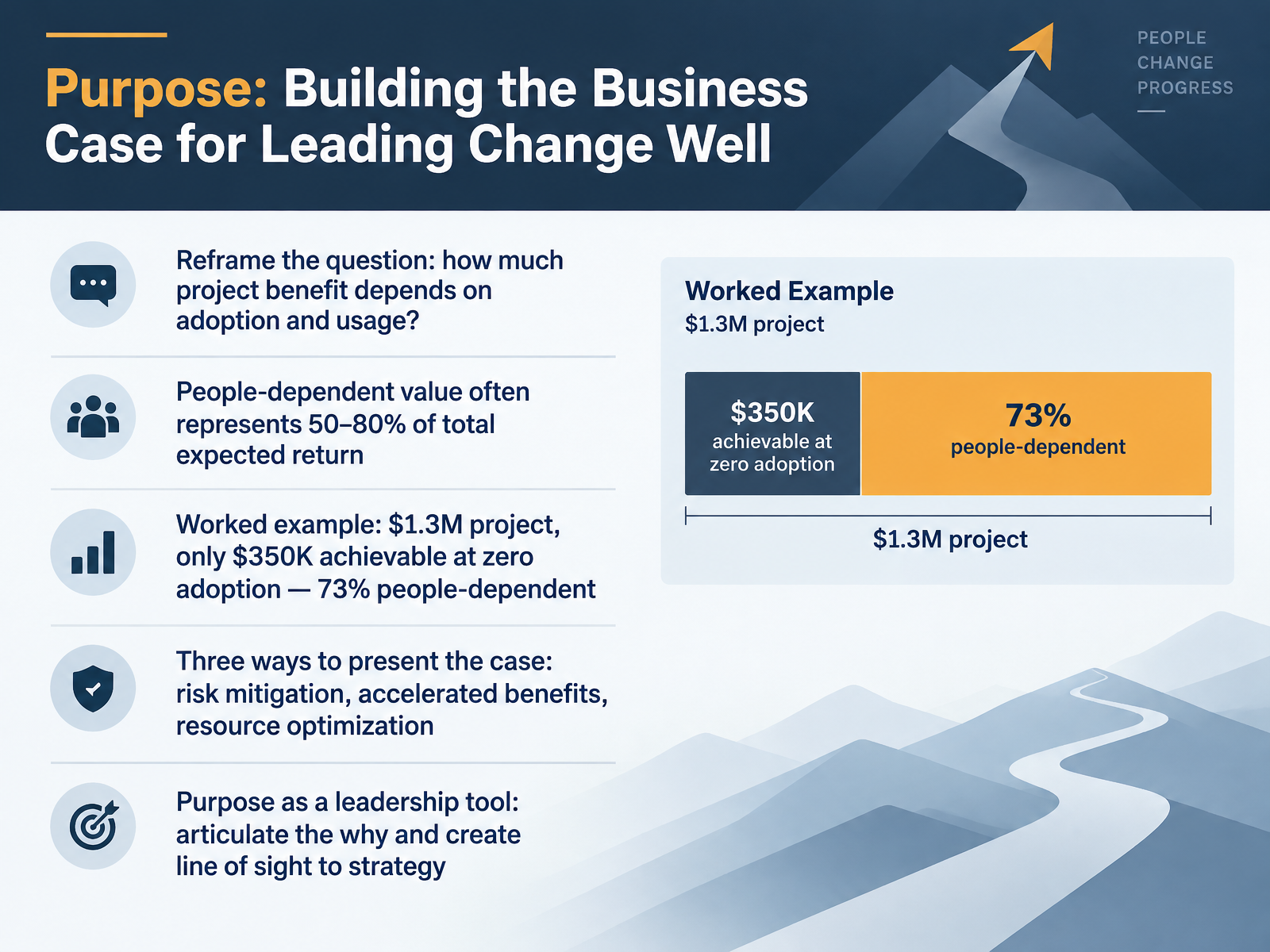
- 04Purpose: Building the Business Case for Leading Change WellLet's turn to purpose, and how you build the business case for leading change well. Start by reframing the question. Instead of asking what the return on change management is, ask how much of this project's benefit actually depends on people adopting and using the change. For technology, process, and enterprise transformations, that people-dependent value often runs fifty to eighty percent of the total expected return. Here's a worked example. A process project expects one point three million dollars in benefits. If adoption and usage were zero, only three hundred fifty thousand dollars would be achievable. That leaves nine hundred fifty thousand dollars, or seventy-three percent, people-dependent. Present that in three ways. As risk mitigation: without change leadership, you risk capturing only twenty-seven percent of the benefits. As accelerated benefits: faster adoption means faster value. And as resource optimization: fewer support tickets and less rework. Finally, use purpose as a leadership tool. Articulate the why, and create a clear line of sight from each person's work to the strategy. Next, we look at measuring what matters: readiness, adoption, sustainment, and benefits.
 prosci.comprosci.comempower.prosci.com+22 min
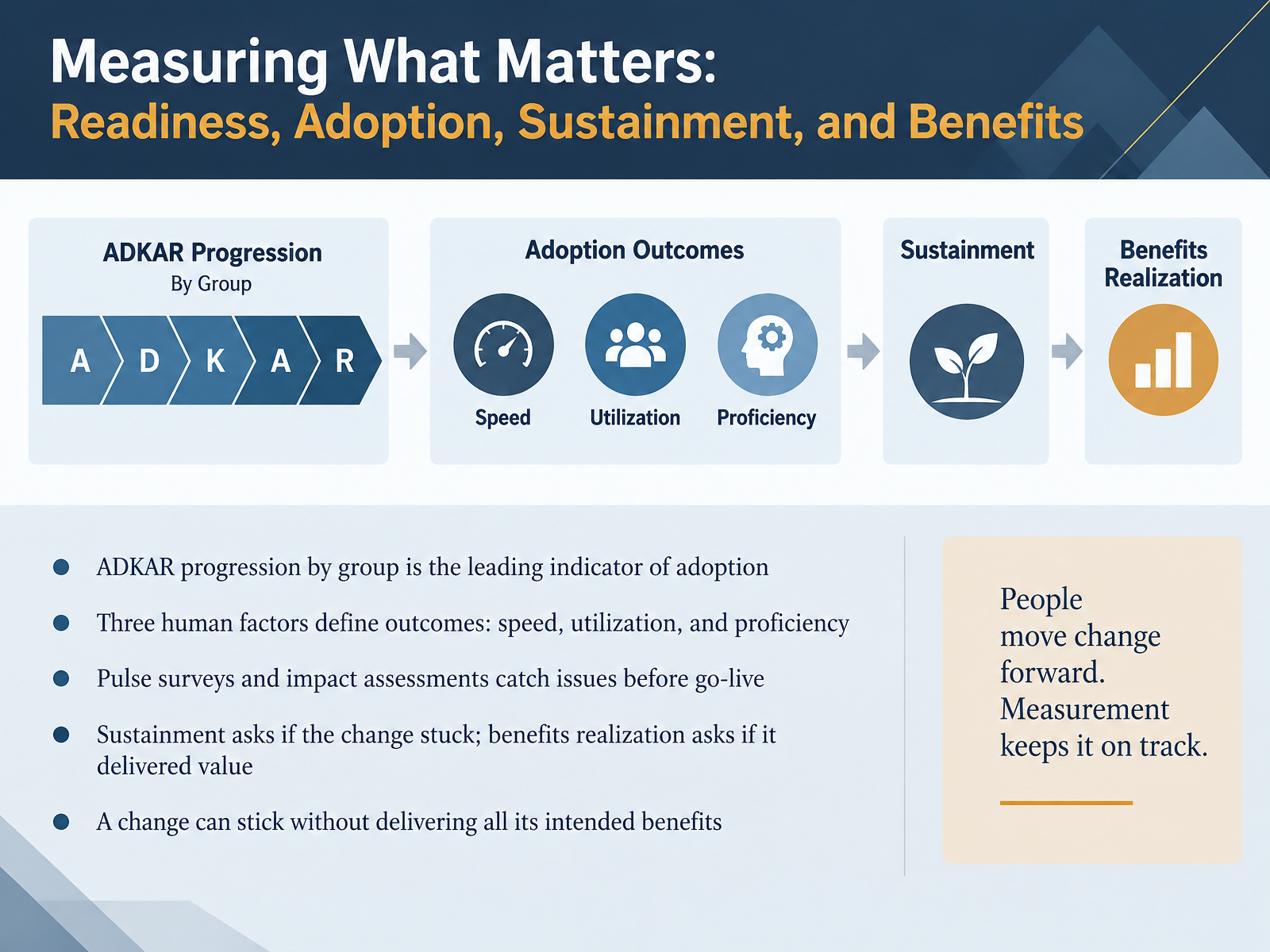
- 05Measuring What Matters: Readiness, Adoption, Sustainment, and BenefitsNow let's talk about measuring what matters. Measure readiness, adoption, sustainment, and benefits, but keep them distinct. ADKAR progression by group is your leading indicator of adoption. If one group is stuck at Awareness or Desire, you will see it in adoption later. So track it early. Three human factors define outcomes: speed, utilization, and proficiency. How quickly people adopt, how many use the change, and how well they use it. For example, a new system with high logins can still show low proficiency if people only use it partially. Pulse surveys and impact assessments catch issues before go-live, while there is still time to act. Then two separate questions. Sustainment asks whether the change stuck. Benefits realization asks whether it delivered the intended value. A change can stick without delivering all its benefits, so measure both. Next, we look at foundational models for leading change.
 prosci.comprosci.comempower.prosci.com+21 min
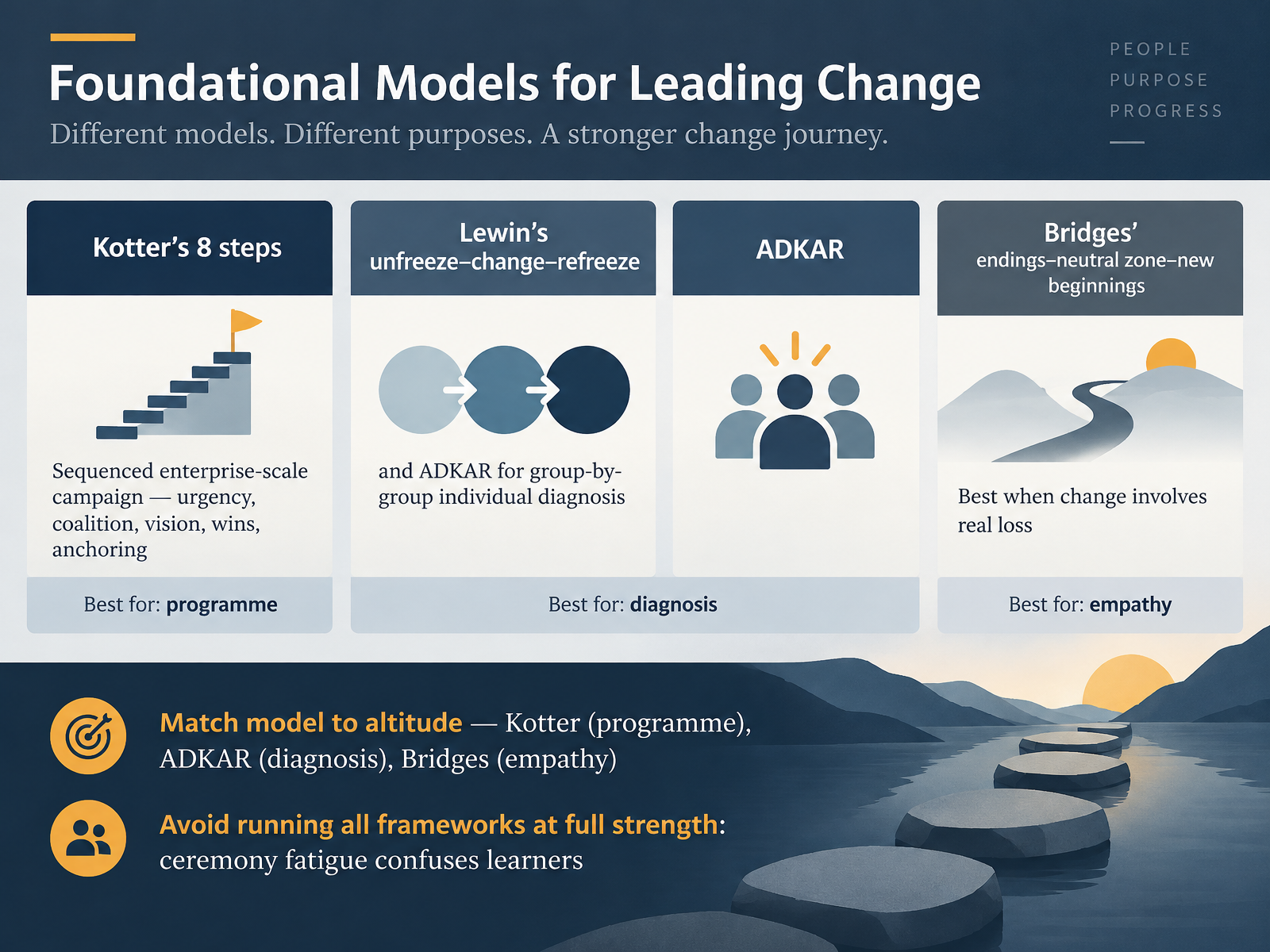
- 06Foundational Models for Leading ChangeLet's look at the foundational models for leading change, and how to match each one to the job in front of you. Kotter's eight steps is a sequenced, enterprise-scale campaign. Urgency, a guiding coalition, vision, short-term wins, and anchoring the change in culture. Use it when the change is strategic and cross-functional. Lewin's unfreeze, change, refreeze, and ADKAR, are useful for group-by-group diagnosis. ADKAR names five checkable states: awareness, desire, knowledge, ability, and reinforcement. So you can ask which element is missing for this team. Bridges' endings, neutral zone, and new beginnings is best when the change involves real loss, such as a role or identity shift. For example, a manager who loses long-standing local relationships needs the ending named, not rushed. The practical rule is to match model to altitude. Kotter for the programme, ADKAR for diagnosis, Bridges for empathy. And avoid running all frameworks at full strength. That produces ceremony fatigue and confuses learners about which framework governs their experience. Next, we turn to role expectations, and how sponsors, managers, project leaders, and practitioners each contribute.
 uwaterloo.cathebehavioralscientist.comdoi.org+22 min
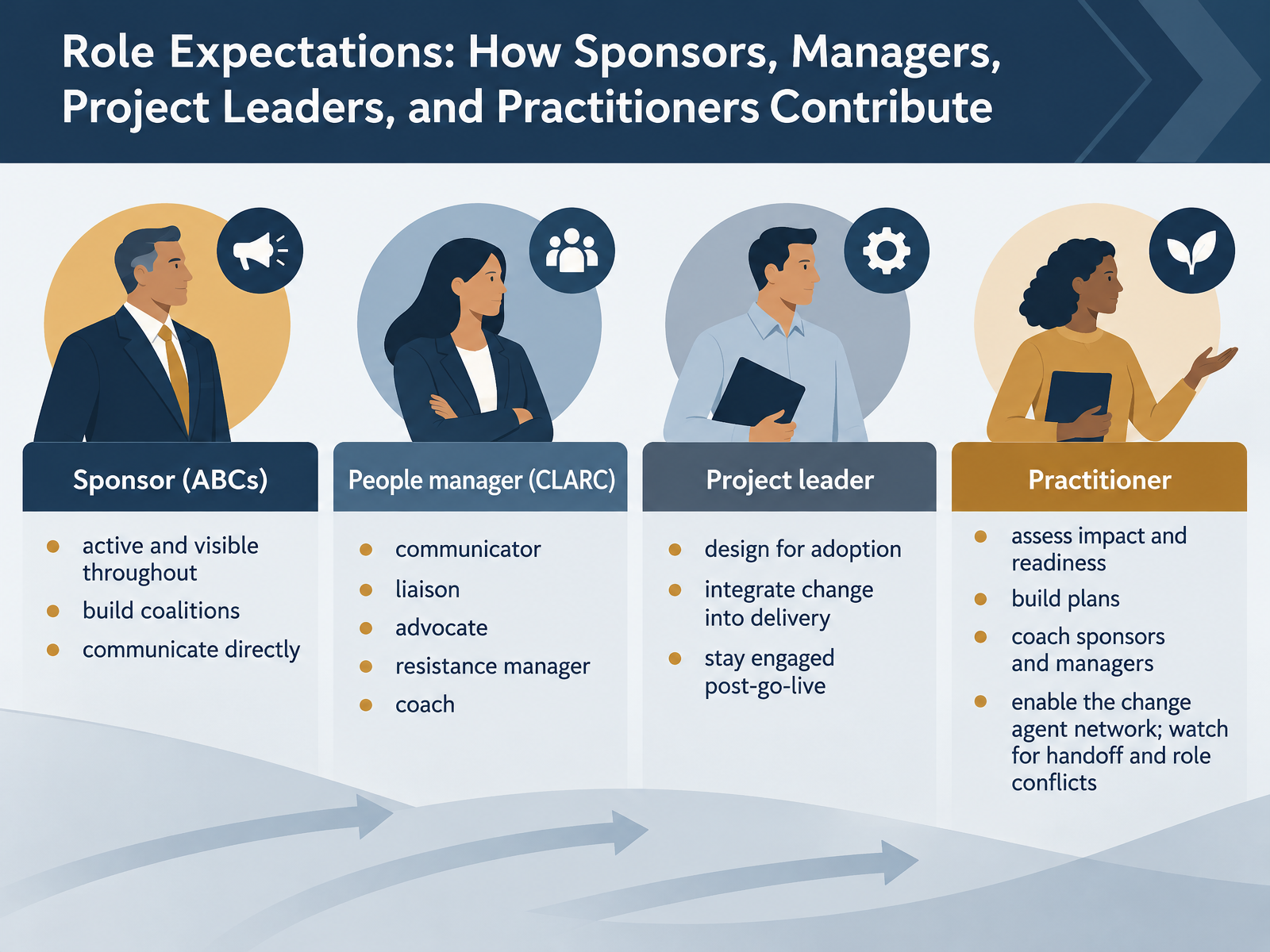
- 07Role Expectations: How Sponsors, Managers, Project Leaders, and Practitioners ContributeLet's turn to role expectations, and who contributes what. Start with the sponsor, defined by the A B C s. Actively and visibly participate throughout the effort. Build a coalition of leaders who give the change credibility. And communicate directly with employees, because people want the business reasons from the top. Next, people managers, defined by C L A R C. They are the communicator, the liaison to the project team, the advocate, the resistance manager, and the coach. In practice, a manager explains what the new system means for their team's daily work. Project leaders design for adoption, integrate the people side into delivery, and stay engaged after go-live rather than moving on. Practitioners assess impact and readiness, build the plans, and coach sponsors and managers. One caution. Practitioners also enable the change agent network and watch for handoff and role conflicts, because unclear ownership is where change quietly stalls. Next, we'll look at an example of leading an AI-enabled operating model change.
 prosci.comprosci.comepw.com+22 min
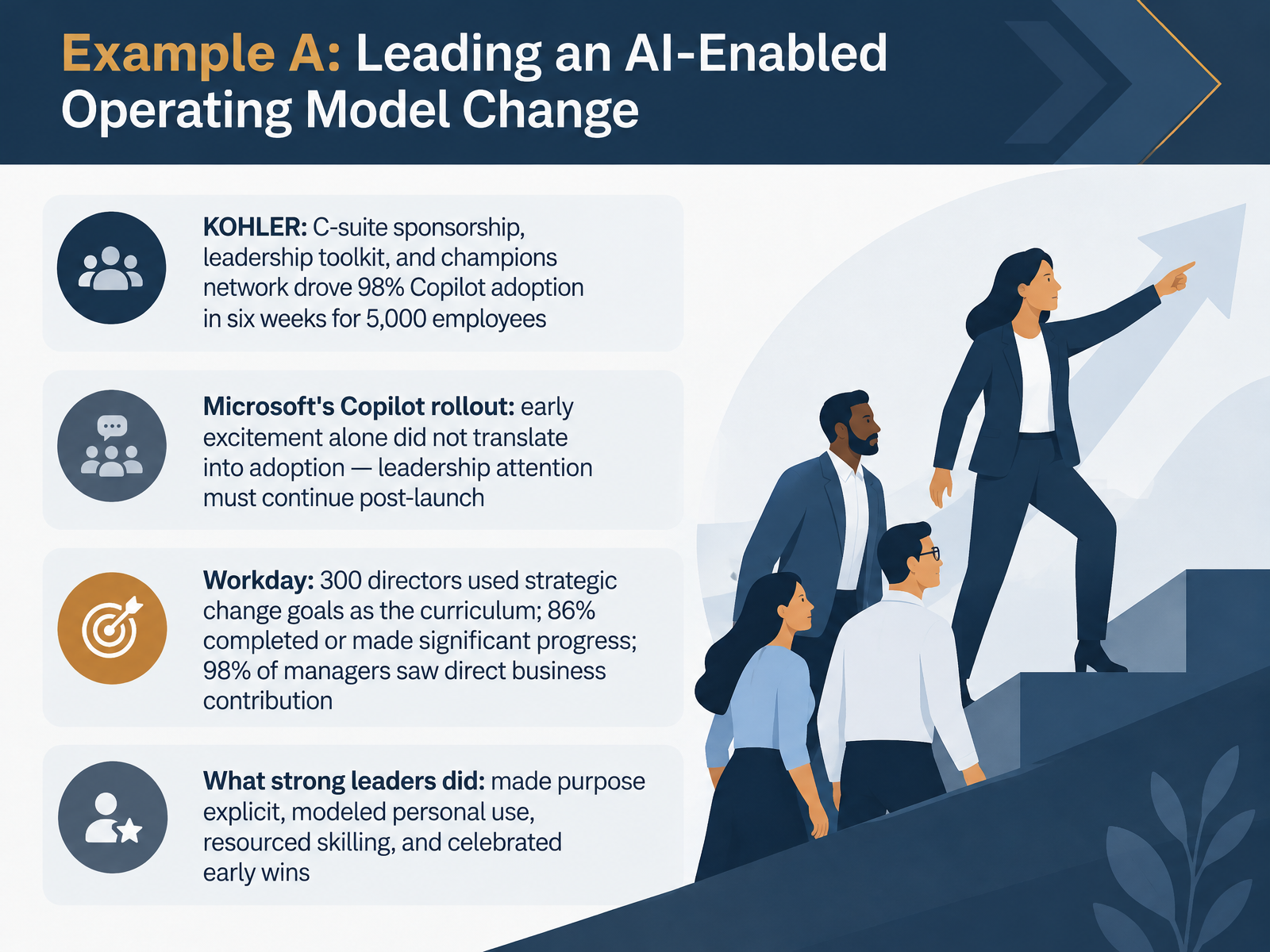
- 08Example A: Leading an AI-Enabled Operating Model ChangeLet's look at how this plays out in practice, starting with an AI-enabled operating model change. Kohler shows what strong sponsorship can do. With C-suite backing, a leadership toolkit, and a champions network, they reached ninety-eight percent Copilot adoption across five thousand employees in just six weeks. Contrast that with Microsoft's own Copilot rollout. Early excitement alone did not translate into adoption, and leadership attention had to continue well after launch. Workday took a different angle. Three hundred directors used strategic change goals as the curriculum. Eighty-six percent completed those goals or made significant progress, and ninety-eight percent of managers saw a direct business contribution. So what did strong leaders do? They made the purpose explicit. They modeled personal use. They resourced skilling. And they celebrated early wins. The implication for you is simple. Sponsorship is not a launch event. It is sustained attention, visible behavior, and practical investment in people. Next, we turn to two more examples, post-merger integration and frontline transformation.
 prosci.comprosci.comprosci.com+22 min
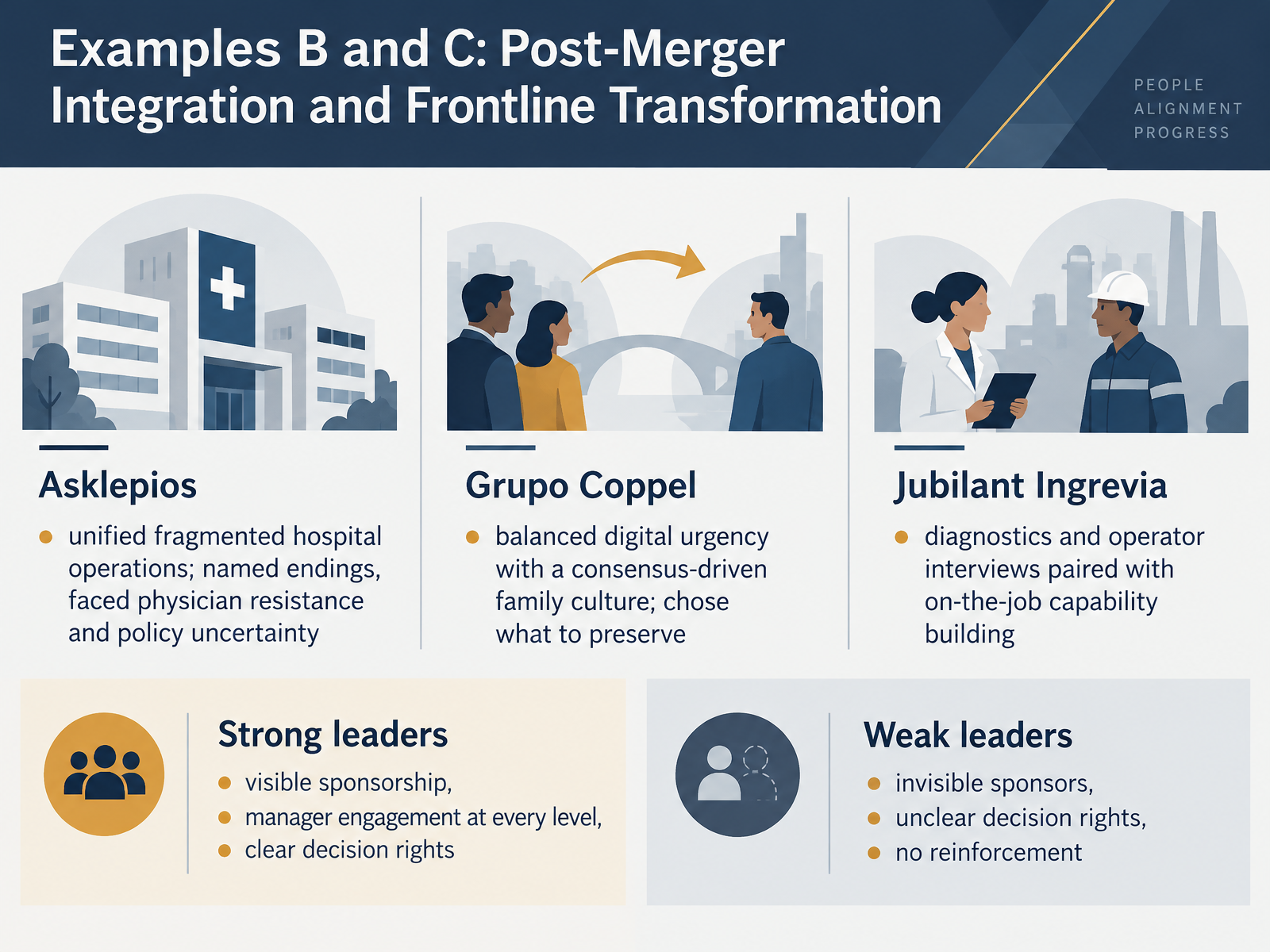
- 09Examples B and C: Post-Merger Integration and Frontline TransformationLet's look at two more examples, each with a clear leadership lesson. Asklepios, a large European hospital group, unified fragmented operations across Hamburg. They named what was ending, and they faced real physician resistance and policy uncertainty head-on, rather than waiting for it to fade. Grupo Coppel, Mexico's largest family-owned retailer, balanced digital urgency with a consensus-driven family culture. Their leaders deliberately chose what to preserve, not just what to reinvent. Jubilant Ingrevia paired diagnostics and operator interviews with hands-on capability building on the job. The pattern across all three: strong leaders provide visible sponsorship, engage managers at every level, and make decision rights clear. Weak leaders go invisible, leave decision rights ambiguous, and never reinforce the new behavior. The implication for you is direct. Before your next phase, check your own visibility and your decision rights. So how do you spot trouble early? Next, we look at resistance and change fatigue, and how to read the signals.
 uwaterloo.cathebehavioralscientist.comdoi.org+22 min
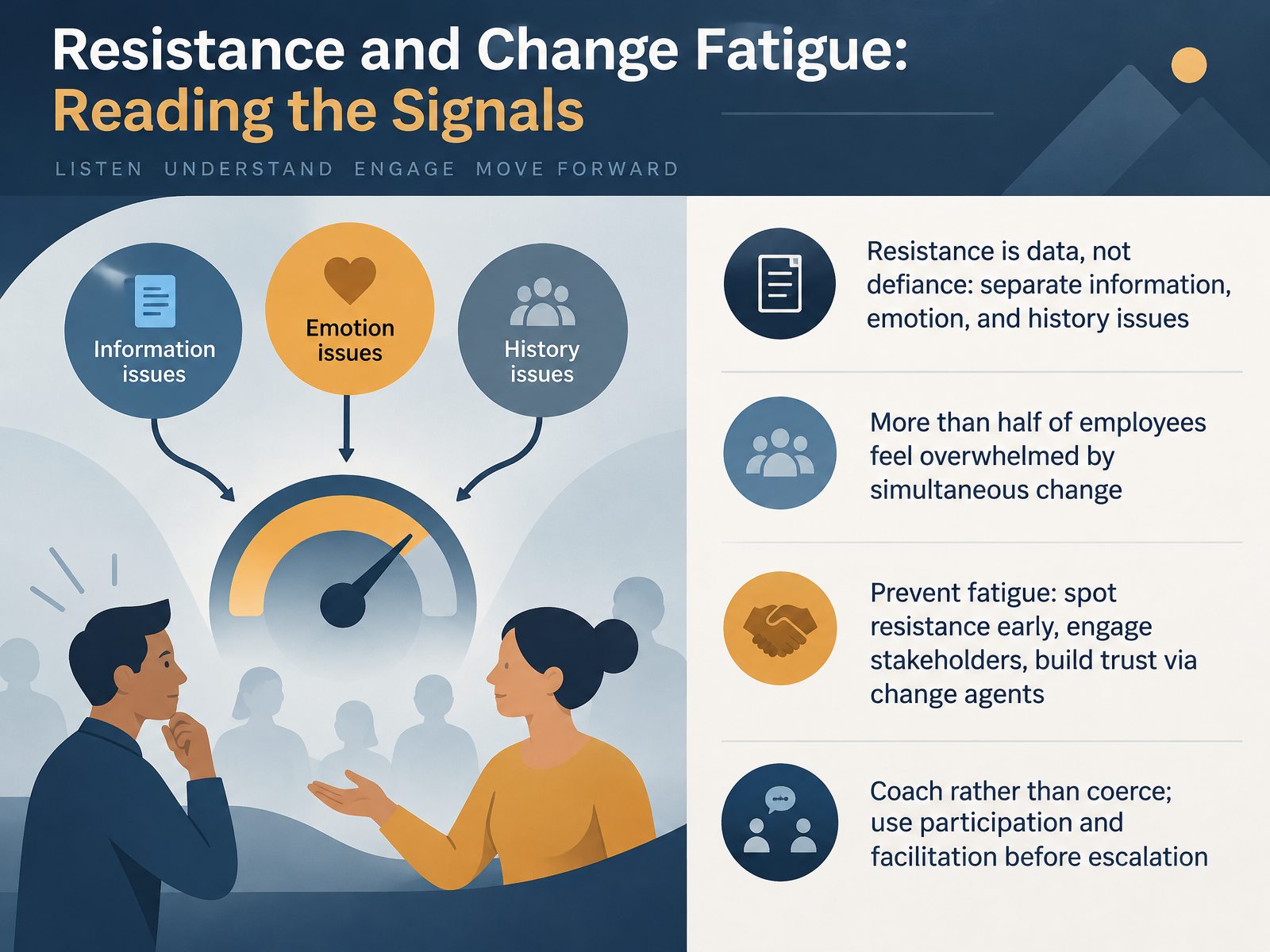
- 10Resistance and Change Fatigue: Reading the SignalsLet's turn to resistance and change fatigue, and how to read the signals. First, reframe resistance as data, not defiance. Separate three things: information issues, like missing facts or confusion; emotional issues, like fear of losing control; and history issues, like a troubled relationship with leadership. Research shows more than half of employees feel overwhelmed by simultaneous change. So prevent fatigue by spotting resistance early, engaging stakeholders, and building trust through change agents. And coach rather than coerce. Use participation and facilitation before you escalate. For example, a manager hearing complaints about a new system might first assume defiance. Instead, run a short listening session, diagnose an information gap, and invite two vocal critics into a design workshop. Next, we'll look at conversation techniques. This leads into working with resistant stakeholders: conversation techniques.
 prosci.comprosci.comprosci.com+21 min
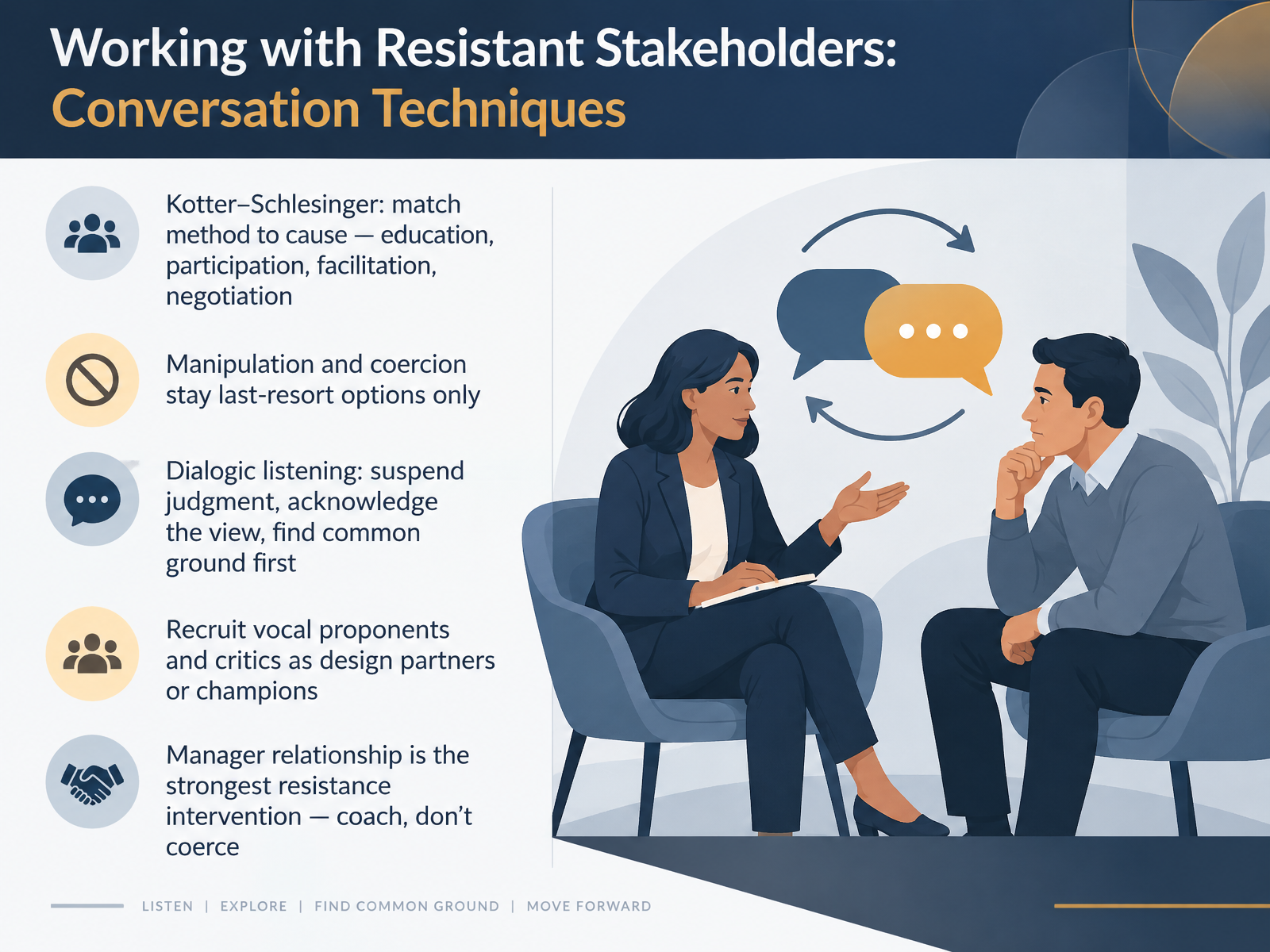
- 11Working with Resistant Stakeholders: Conversation TechniquesNow, let's talk about the conversations themselves. Working with resistant stakeholders starts with diagnosis. Kotter and Schlesinger give us a practical menu. If resistance comes from misinformation, use education. If people feel excluded, invite them into participation. If it's anxiety, offer facilitation and support. And where a stakeholder holds real power, negotiate. Save manipulation and coercion for genuine last resorts. Next, the conversation technique itself. Practice dialogic listening. Suspend judgment, acknowledge the view before you argue, and find common ground first. Then, recruit the vocal people on both sides. Sponsors and critics already show urgency. Bring them in as design partners or champions, because critics whose concerns are heard often become your strongest advocates. Finally, remember that the manager relationship is the single strongest resistance intervention. People managers are the preferred senders of change messages, so coach them. Don't coerce them. Prepare them, equip them, and let them lead the conversation with their teams. Next, we'll put all of this into a practical playbook: Practical Playbook: Leading Change in Your Role.
 prosci.com2 min
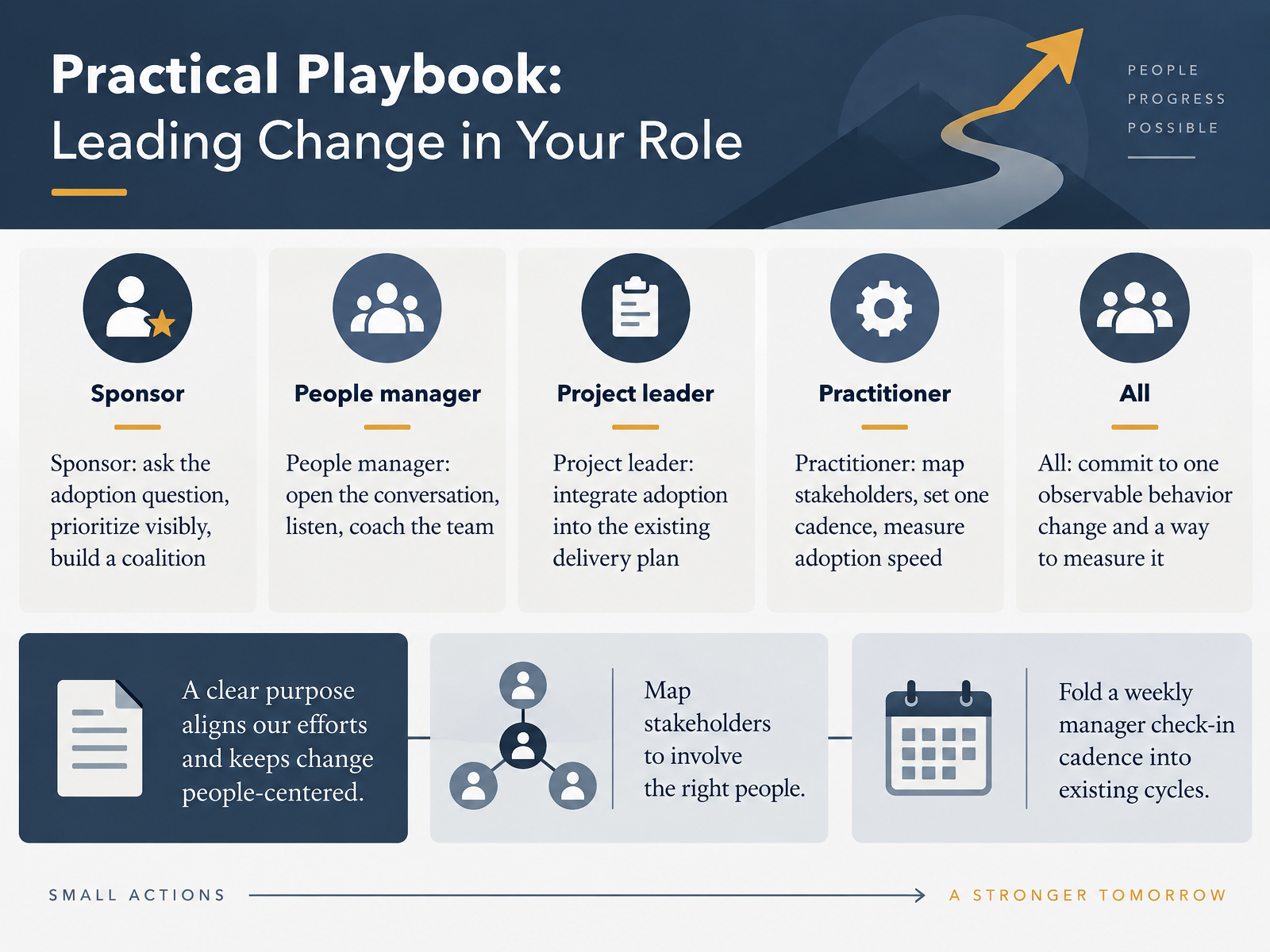
- 12Practical Playbook: Leading Change in Your RoleLet's bring this down to what you actually do on Monday. This slide is a practical playbook, organized by role. If you are a sponsor, ask the adoption question early. What portion of the benefits depends on people using this well? Then prioritize visibly, because what you fund and attend signals what matters. And build a coalition of leaders who reinforce the message. If you are a people manager, your job is closer to the team. Open the conversation, listen, and coach. Your people want to hear the personal impact from you, not from a project email. If you are a project leader, integrate adoption into the delivery plan you already have. Do not run a parallel initiative. If you are a practitioner, map your stakeholders, set one communication cadence everyone can rely on, and measure adoption speed, how quickly people actually use the change. And here is the commitment for all of you. Choose one observable behavior change and one way to measure it. Behavior beats intention. That is your first step. Next, we will pull this together in Key Takeaways and Next Steps.
 prosci.comprosci.comempower.prosci.com+22 min
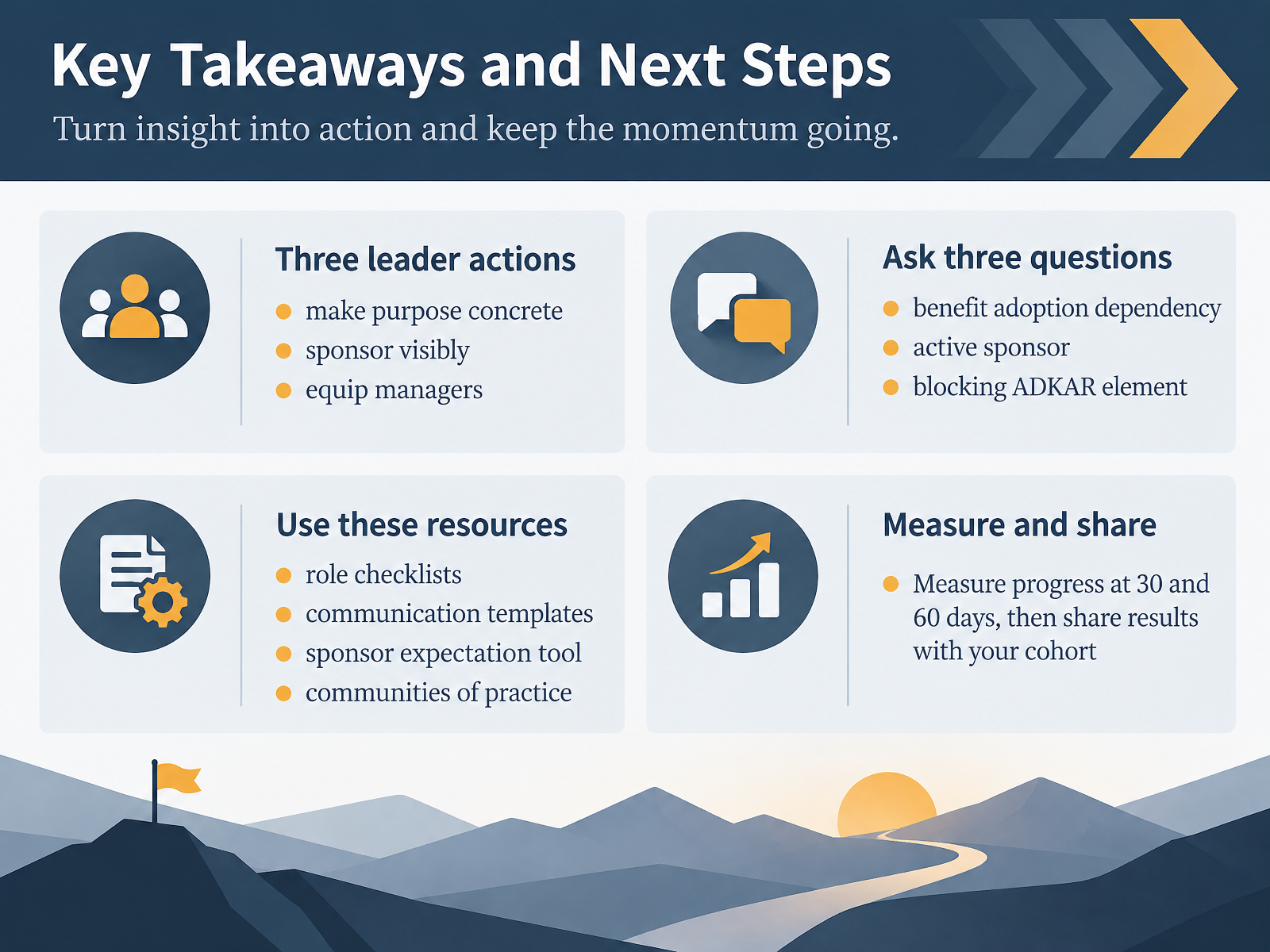
- 13Key Takeaways and Next StepsLet's bring this together with the takeaways you can act on. Three leader actions to hold onto. First, make purpose concrete. Explain what changes for people, not just the project. Second, sponsor visibly. Active sponsorship dramatically improves the odds of meeting objectives. Third, equip managers. They are the preferred senders of messages about personal impact. Next, ask three questions of any change you lead. What share of the benefit depends on adoption? Is the sponsor genuinely active and visible? And which ADKAR element is blocking us right now? Awareness, Desire, Knowledge, Ability, or Reinforcement. Then use your tools. Role checklists, communication templates, the sponsor expectation tool, and communities of practice. Finally, measure progress at thirty and sixty days, and share the results with your cohort. That rhythm turns good intentions into observable adoption. Coming up next, Closing: Building Change Leadership as a Management Capability.
 prosci.comprosci.comprosci.com+22 min
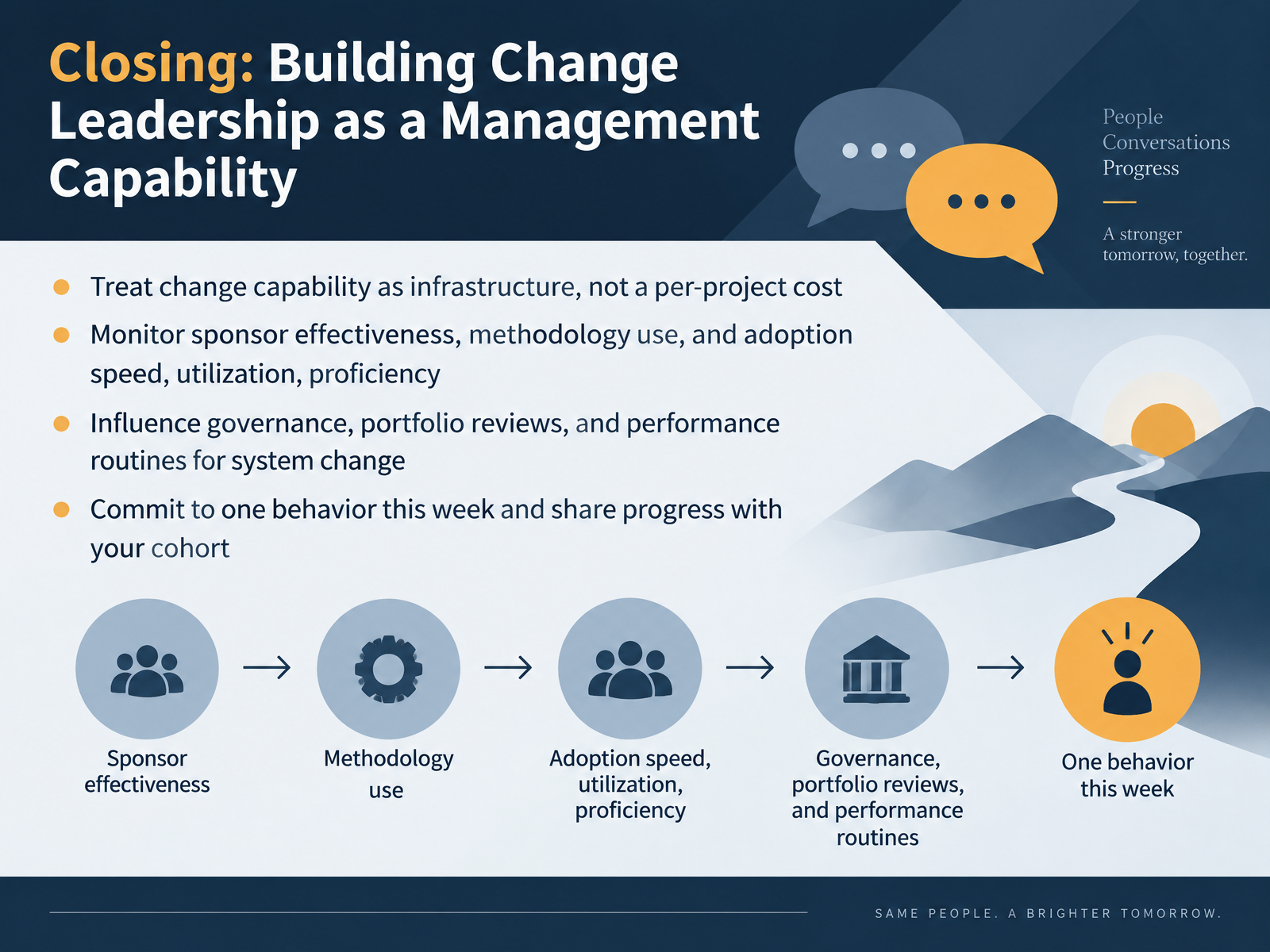
- 14Closing: Building Change Leadership as a Management CapabilitySo let's bring this together. The core message is to treat change capability as infrastructure, not a per-project cost. Fund it, staff it, and govern it the way you would any enduring capability. Then measure what matters: sponsor effectiveness, use of a structured methodology, and adoption speed, utilization, and proficiency. Bring those measures into governance, portfolio reviews, and performance routines. That is how you change the system, not just the project. And one last ask. Commit to one behavior this week, and share your progress with your cohort. Thank you for your engagement throughout this course. You now have a practical foundation. Go apply it in your next real change effort, and lead it with confidence.
 prosci.comprosci.comprosci.com+22 min
Take the deck with you
Download this course as a file — free, no sign-up needed.
- PDF handoutEvery slide page, ready to print or share.15 pages · 3.3 MBDownload
- Narrated PowerPointThe deck that presents itself — every slide carries the digital human's narration video.15 pages · 13.8 MBDownload
- PowerPoint slidesThe full deck as a .pptx — open it in PowerPoint, Keynote, or Google Slides.15 pages · 3.3 MBDownload
Free to use in your own training — please keep the PersonWise credit page at the end.
Have your own deck? Turn it into a course
Sources consulted
Web sources consulted while building this course.
- Calculating the ROI of change management — prosci.com
- Metrics for Measuring Change Management — prosci.com
- ECM Business Case Template | Prosci — empower.prosci.com
- Helping employees embrace change — mckinsey.com
- Making the business case for Change Management — projectone.com
- The Correlation Between Change Management and Project Success — prosci.com
- Can you afford for your change to fail? — prosci.com
- Change Management Success — prosci.com
- https://www.prosci.com/blog/5-strategic-decisions-for-building-organizational-change-capability — prosci.com
- https://www.prosci.com/blog/change-management-vs-change-leadership — prosci.com
- Change Leadership vs Change Management: Key Differences — epw.com
- Managing Change Isn’t the Same as Leading It: Why the Difference Matters — td.org
- Change Leadership: Traits, Tips & Change Management Comparison — smartsheet.com
- Leading Through Change: What Today’s Leaders Are Missing | DDI — ddi.com
- Change Models | Change Management | University of Waterloo — uwaterloo.ca
- Change Management Models Compared: What the Evidence Supports — thebehavioralscientist.com
- Comparison of Change Management Models and Suggestions for Top Management — doi.org
- Choosing Among ADKAR, Kotter, and Bridges | COMPEL Framework — compelframework.org
- The Bridges Transition Model: What It Actually Diagnoses | Workpath Magazine — workpath.com
- Core Roles in Change Management — prosci.com