Begin
14 pages · ~28 min
Reading Poetry: Sound, Image, and Line
This training teaches readers to analyze poetry through sound, imagery, and line structure, building the skills to interpret and appreciate poems with confidence.
A digital instructor presents all 14 pages. Hold “Ask” at any point and ask out loud — the answer comes from this course. No sign-up needed.
What you’ll learn
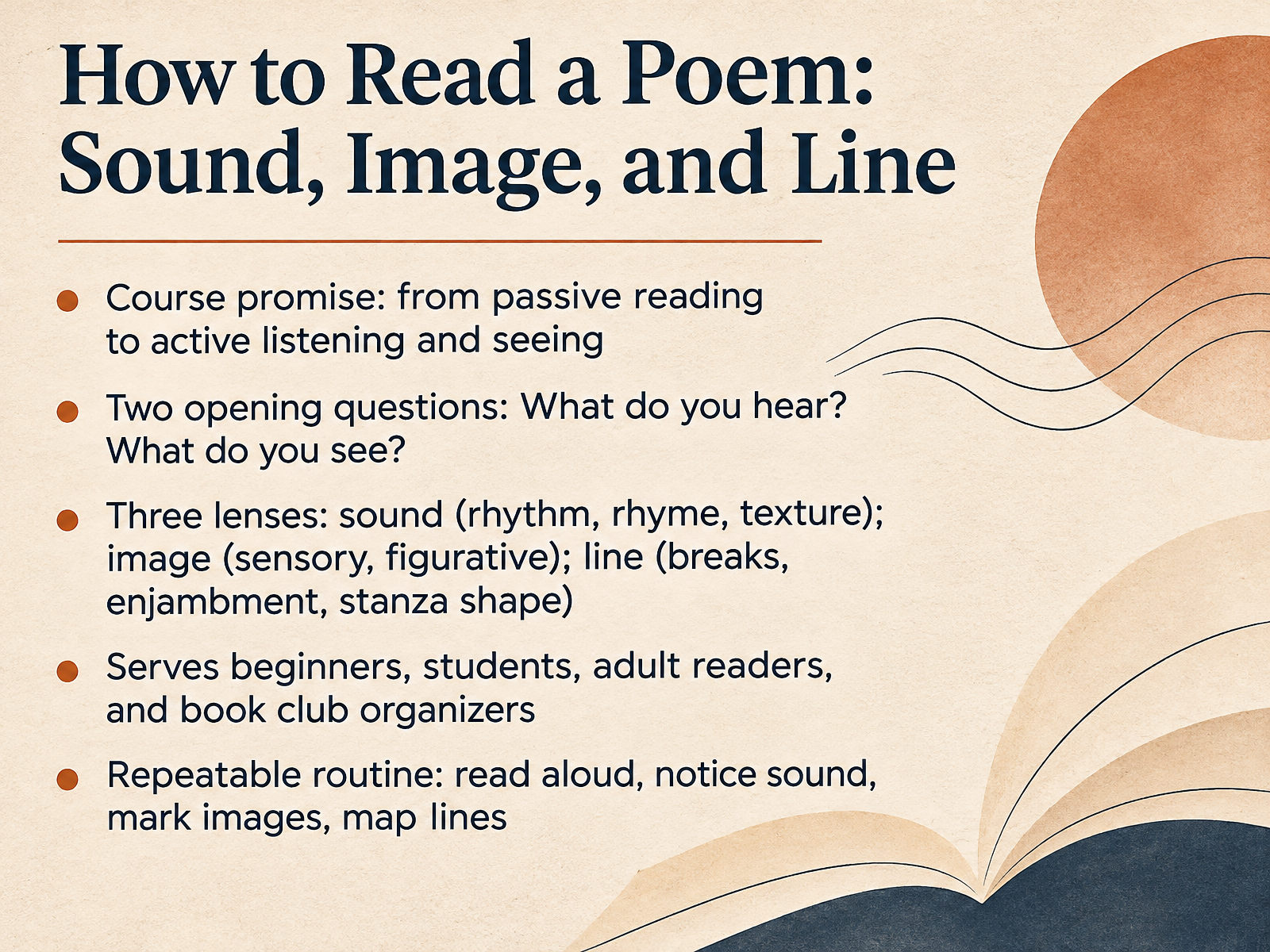
- 01How to Read a Poem: Sound, Image, and LineWelcome. If you've ever felt that poetry is hard, or that you must be missing something, you're in good company. Many readers feel that way at first. So let's start simply. This course takes you from passive reading to active listening and seeing. We'll use two opening questions. What do you hear? And what do you see? To answer them, we'll look through three lenses. Sound, meaning rhythm, rhyme, and texture. Image, meaning the sensory details and figurative language. And line, meaning line breaks, enjambment, and stanza shape. These lenses serve beginners, students, adult readers, and book club organizers alike. Here's the heart of it. Close reading is a repeatable routine, not a test. Read aloud. Notice the sounds. Mark the images. Map the lines. You can return to these steps again and again, and the poem will keep opening up. Try it, and don't worry about getting a perfect answer. Next, we'll begin with the basics. First, Read It Aloud: The Reader's Basic Protocol.pwrites.princeton.edupoets.orgowl.purdue.edu+22 min
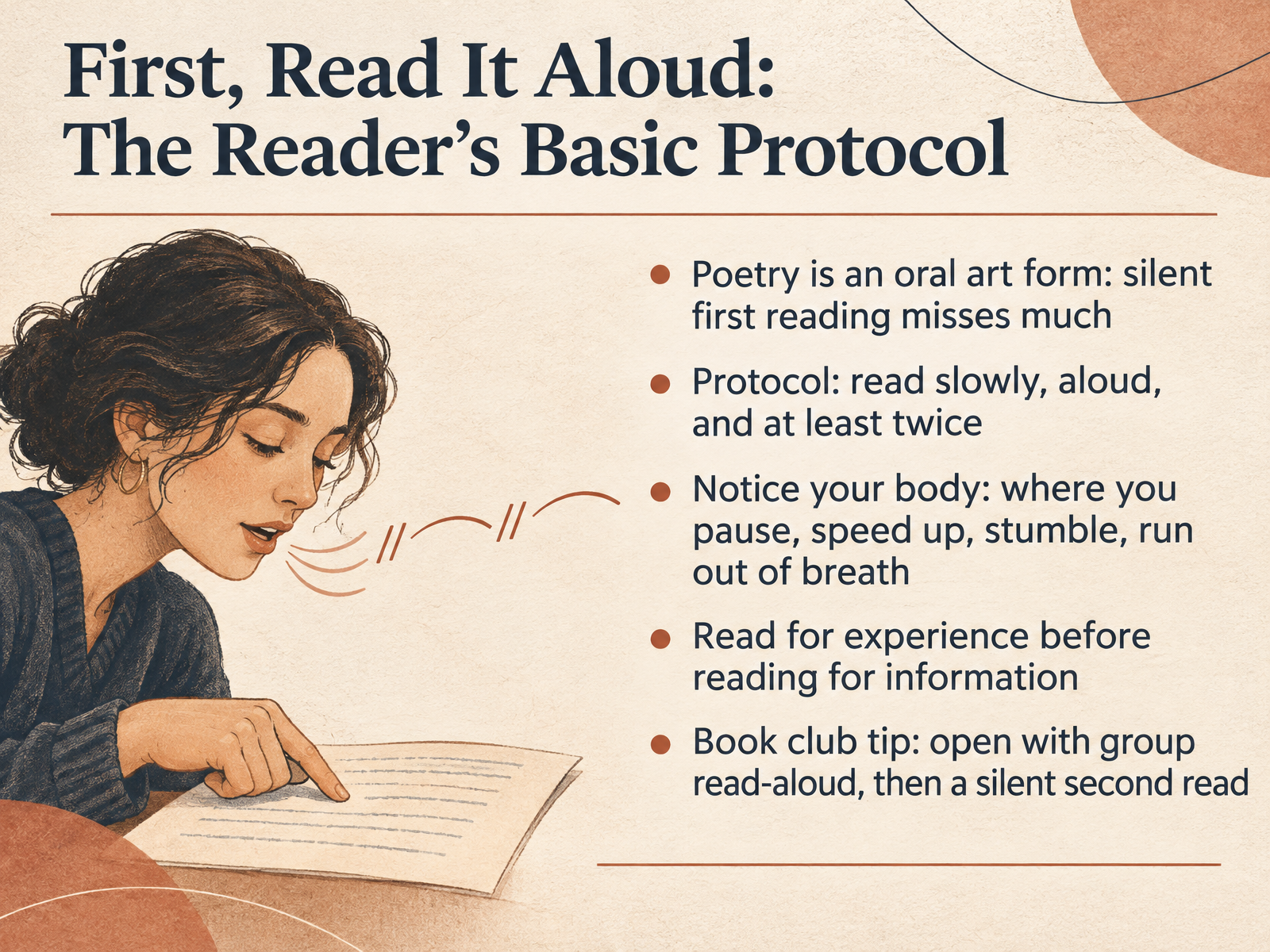
- 02First, Read It Aloud: The Reader's Basic ProtocolLet's start with the first and most important step. Read the poem aloud. Poetry began as an oral art form, so a silent first read misses a lot: the sounds, the rhythm, the way the words move in your mouth. Here is a simple protocol. Read slowly, out loud, and at least twice. Try it now, even quietly under your breath. As you read, notice your body. Where do you pause? Where do you speed up? Where do you stumble, or run out of breath? Those small reactions are clues about how the poem works. Read first for experience, not information. Let the sounds wash over you before you ask what anything means. And if you lead a book club, try opening with a group read-aloud, then a silent second read. Next, we'll look at rhythm and stress.
 pwrites.princeton.edupoets.orgowl.purdue.edu+22 min
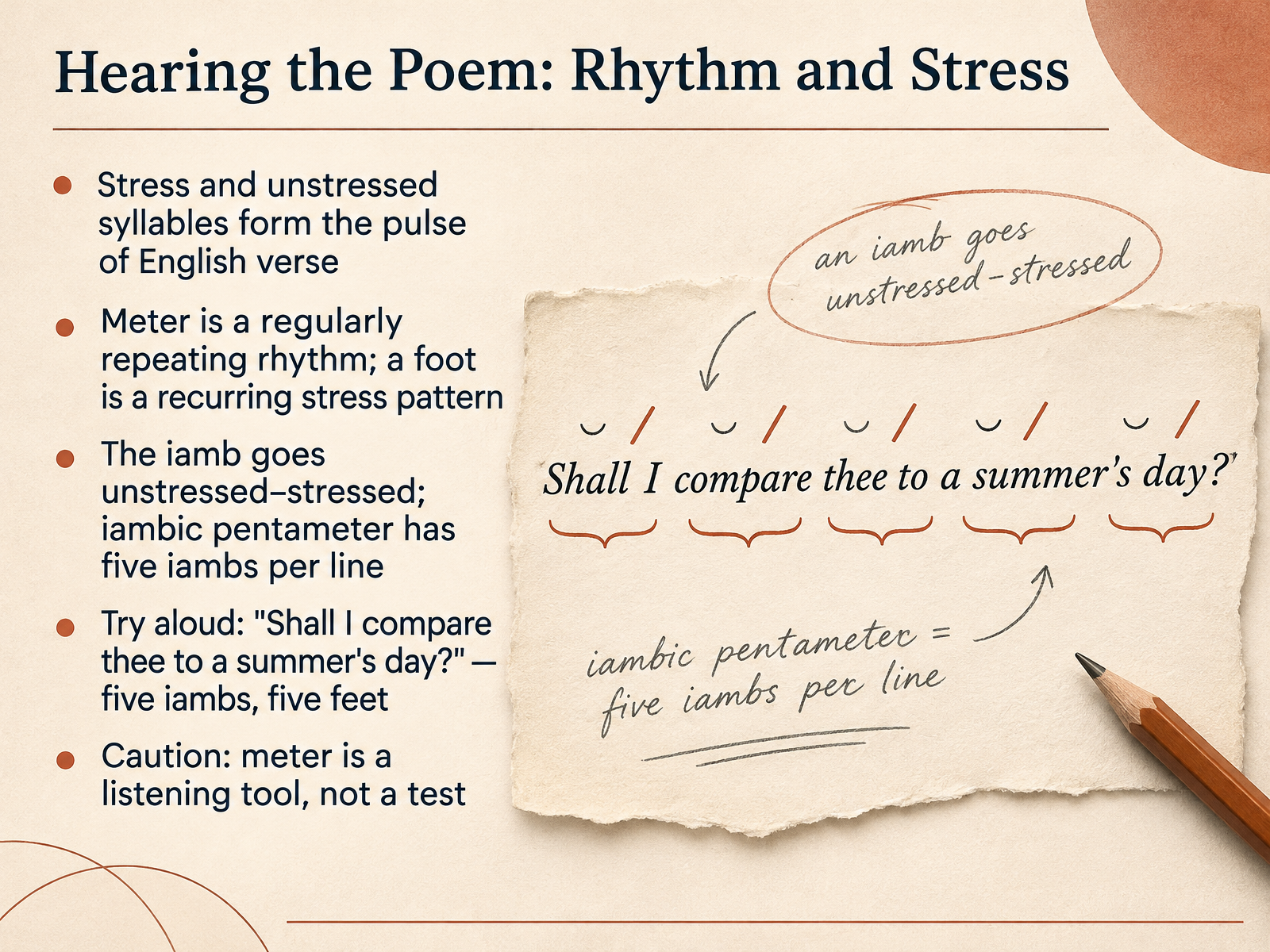
- 03Hearing the Poem: Rhythm and StressNow let's listen to the poem itself. English verse has a pulse. Some syllables get more weight, and others less. Stress and unstressed syllables together create that pulse.
When a rhythm repeats regularly, we call it meter. And a foot is simply a recurring pattern of stress. The most common one is the iamb. It goes unstressed, then stressed. Like the word today. Ta DUM.
Five of those in a line gives you iambic pentameter. Try reading this aloud: Shall I compare thee to a summer's day? You might notice five beats, five feet. Unstressed, stressed, five times.
Here's the caution. Meter is a listening tool, not a test. Your ear may hear a line differently than someone else's, and that's fine. Just read it aloud and notice what you hear.
Next, we'll look at what happens when a poem breaks its own pattern, in From Scansion to Effect: When Poems Break Their Own Pattern.
 poets.orgodp.library.tamu.eduypn.poetrysociety.org.uk+21 min
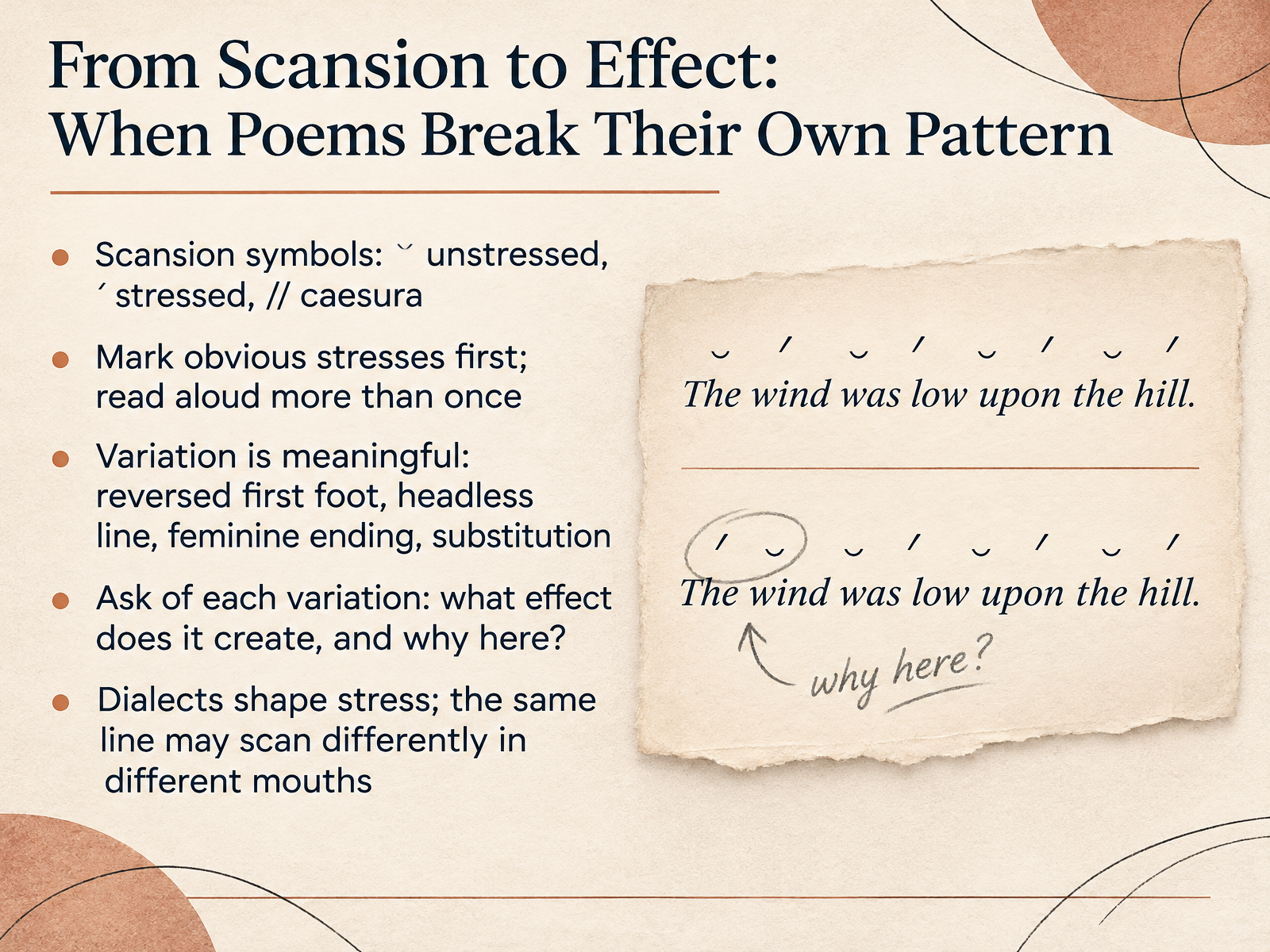
- 04From Scansion to Effect: When Poems Break Their Own PatternNow let's look at what scansion can actually tell you. Scansion just means marking where the stresses fall. Three symbols are enough: a small curve for an unstressed syllable, a short mark for a stressed one, and a double slash for a caesura, a pause in the line. Start by reading the line aloud, more than once, and mark the obvious stresses first. Don't aim for perfect. Then notice the variations, because they mean something. A reversed first foot. A headless line, which begins on a stress with no syllable before it. A feminine ending, an extra soft syllable at the end. Or a substitution, where a different foot replaces the expected one. For each one, ask a simple question. What effect does it create, and why here? And remember, dialects shape stress, so the same line may scan differently in different mouths. Next, we turn to sound effects: rhyme, alliteration, and assonance.
 poets.orgodp.library.tamu.eduypn.poetrysociety.org.uk+22 min
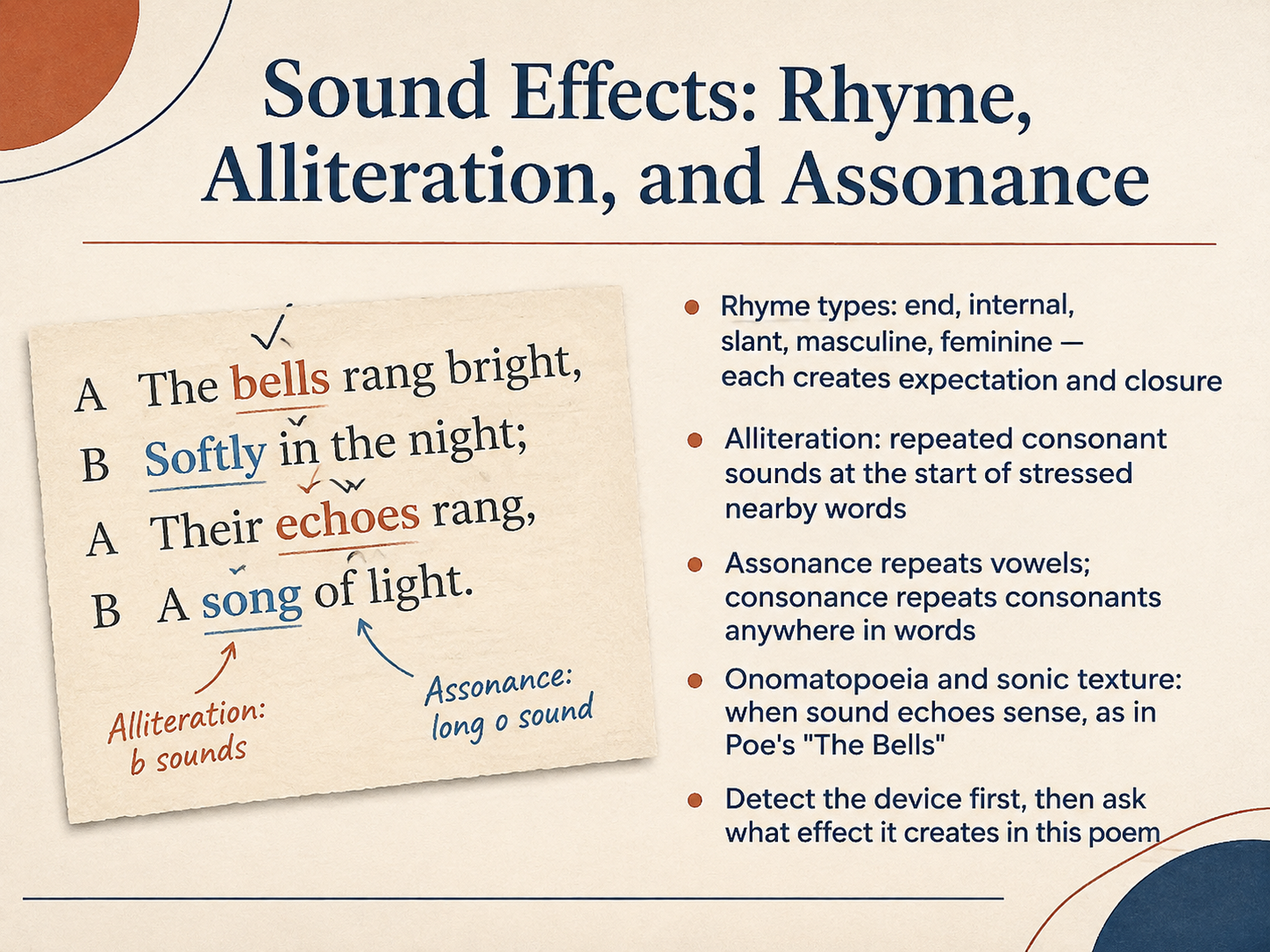
- 05Sound Effects: Rhyme, Alliteration, and AssonanceNow let's listen to how a poem sounds. Rhyme comes in several kinds. End rhyme lands at the ends of lines. Internal rhyme happens inside a line. Slant rhyme is a near rhyme, close but not exact. Masculine rhyme stresses one final syllable, like fight and tight. Feminine rhyme adds an unstressed syllable, like sever and never. Each creates expectation, then closure. Try reading a rhyme aloud and pause after it. Next, alliteration repeats consonant sounds at the start of stressed nearby words, as in glowing golden grains. Assonance repeats vowel sounds. Consonance repeats consonants anywhere in words. And onomatopoeia is a word that sounds like its meaning, as in Poe's The Bells, where the sounds echo the sense. So spot the device first, then ask what effect it creates in this poem. Next, we'll look at seeing the poem: image as sensory language.
 yourdictionary.comwriters.comliberalarts.oregonstate.edu+21 min
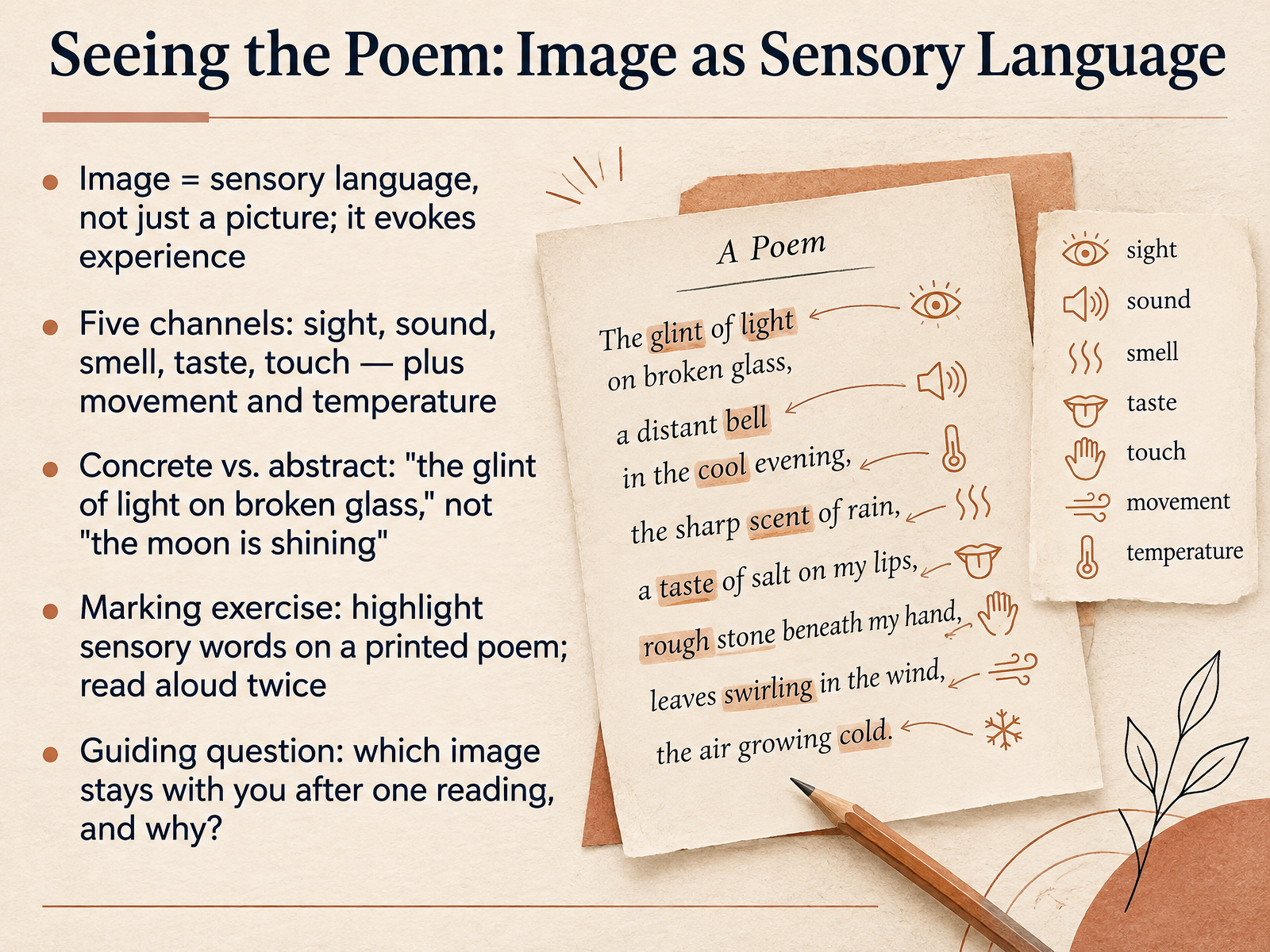
- 06Seeing the Poem: Image as Sensory LanguageNow let's talk about image. In poetry, an image isn't just a picture. It's sensory language that lets you taste, hear, or feel an experience. Poets work through five channels: sight, sound, smell, taste, and touch, often adding movement and temperature. Notice the difference between abstract and concrete. Instead of saying the moon is shining, a poet might write about the glint of light on broken glass. One tells you a fact. The other lets you see it. Try this. Print a short poem and highlight every sensory word. Then read it aloud twice. The first time, just listen. The second time, mark which senses you notice. You might be surprised which channel dominates. Here's a guiding question to carry with you: which image stays with you after one reading, and why? Hold onto that one. It's often your way into the poem. Next, we'll look at how poets build images with simile, metaphor, and symbol.
 writingguide.communityschool.orghcmc.uvic.careadwritethink.org+22 min
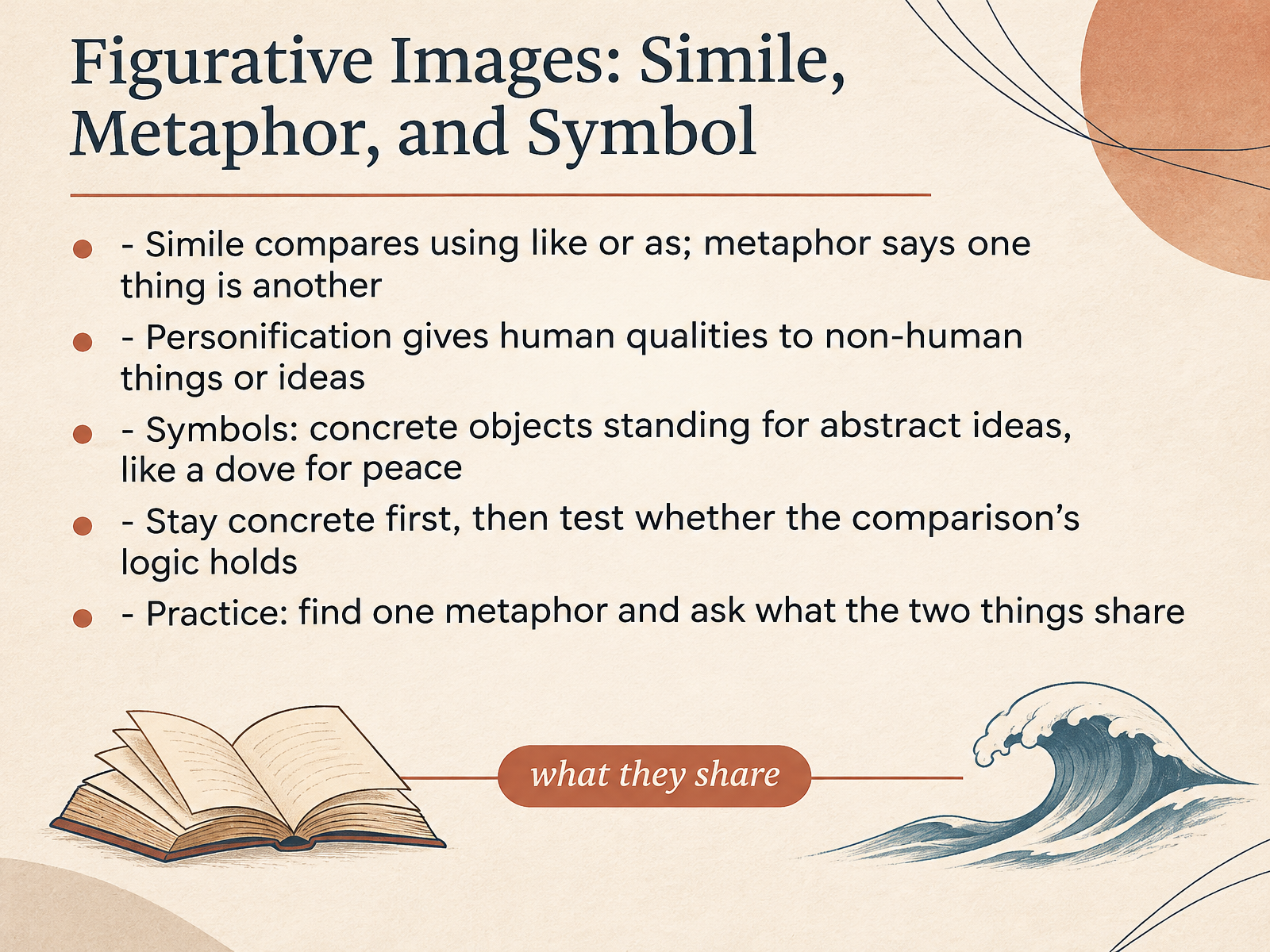
- 07Figurative Images: Simile, Metaphor, and SymbolNow let's look at figurative images. These are the comparisons poems use to help you see something in a new way. A simile compares two things using like or as. So, she is as strong as an ox. A metaphor skips those words and says one thing is another. Freedom is a strong seed. Personification gives human qualities to non-human things or ideas. You might notice leaves dancing in the wind. And a symbol is a concrete object that stands for an abstract idea, like a dove for peace. Here is the key habit. Stay concrete first. Picture the actual thing on the page, then test whether the comparison's logic holds. Ask what the two things really share. Try it with one metaphor you find. What do those two things have in common? Next, we turn to the line itself, in The Line as a Unit of Meaning.
 2 min
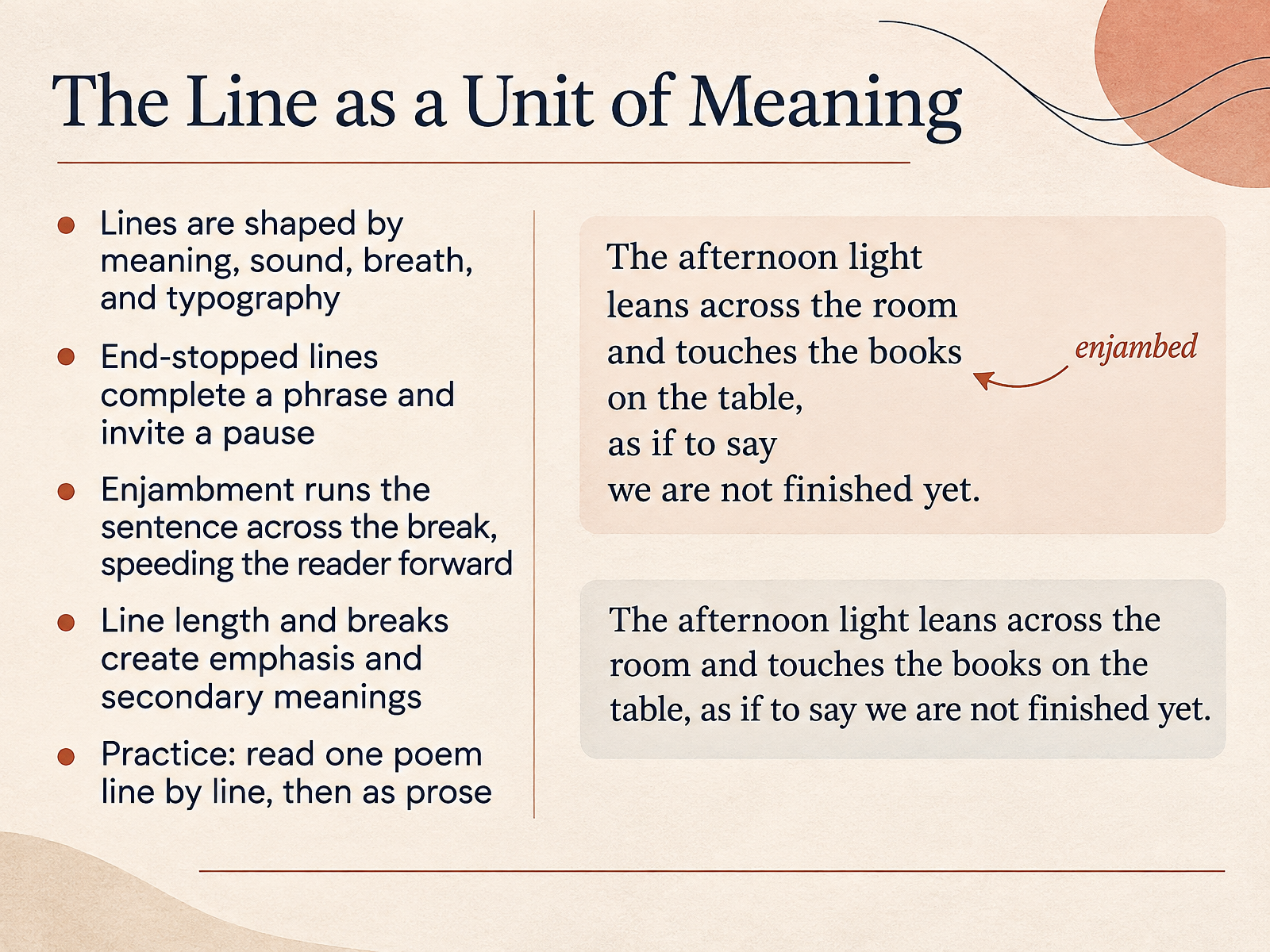
- 08The Line as a Unit of MeaningLet's look closely at the line itself, because in poetry the line is a real unit of meaning. A line gets shaped by several things at once: the meaning, the sound, the breath, and even the typography, meaning where the words sit on the page. Some lines are end-stopped. That means the sentence or phrase finishes at the end of the line, often with punctuation, so it invites a small pause. Other lines use enjambment. That is when the sentence runs across the break into the next line. Enjambment tends to speed you forward, because you want to know how the thought ends. Try this practice. Take one poem and read it line by line, pausing at each break. Then rewrite it as a plain prose paragraph and read that aloud. Notice what changes. The line breaks, and the length of each line, create emphasis and sometimes a second meaning. Keep it simple. Follow the line, and let it guide your ear. Next, we'll look at stanzas, shape, and the poem on the page.
 pwrites.princeton.edupoets.orgowl.purdue.edu+22 min
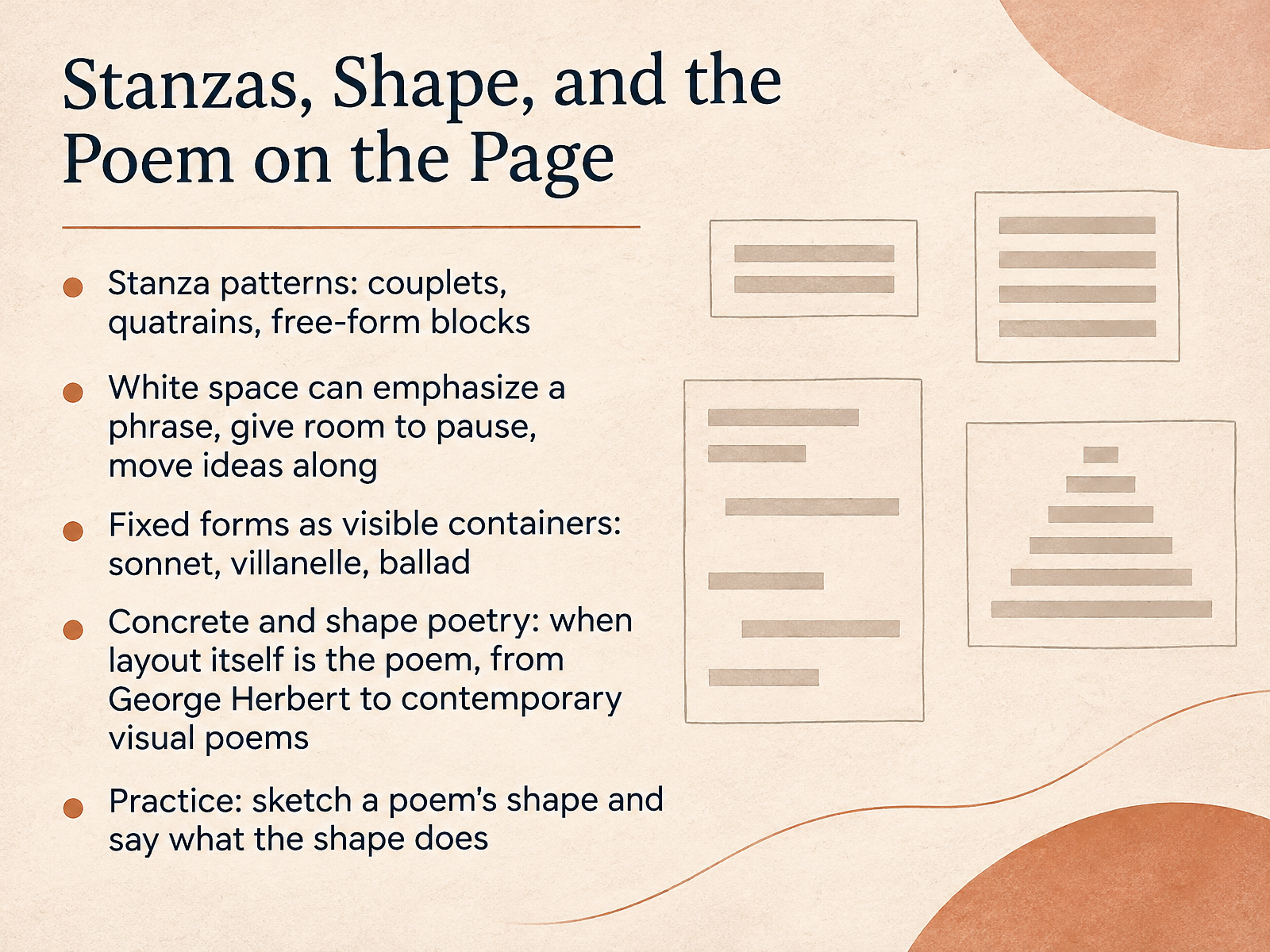
- 09Stanzas, Shape, and the Poem on the PageNow let's look at the poem as an object you can actually see. Before you read a single word, try noticing its shape. Are the lines gathered into small groups? Those groups are called stanzas. Two lines together make a couplet. Four make a quatrain. And some poems are just free-form blocks. Then look at the white space. A gap can emphasize a phrase, give you room to pause, or move an idea along. Some poems wear visible containers, like a sonnet, a villanelle, or a ballad. A sonnet is simply a fourteen-line poem, often with a turn in thought near the end. Shape poetry goes further, where the layout itself becomes the poem. George Herbert's Easter Wings narrows and widens to look like wings. Contemporary visual poems do the same with photography or film. Here is your practice. Sketch a poem's shape on paper, then say out loud what that shape does. Does it slow you down? Does it hold something back? What you notice is enough. Next, we'll bring these lenses together in Putting It Together: A Three-Lens Reading.
 pwrites.princeton.edupoets.orgowl.purdue.edu+22 min
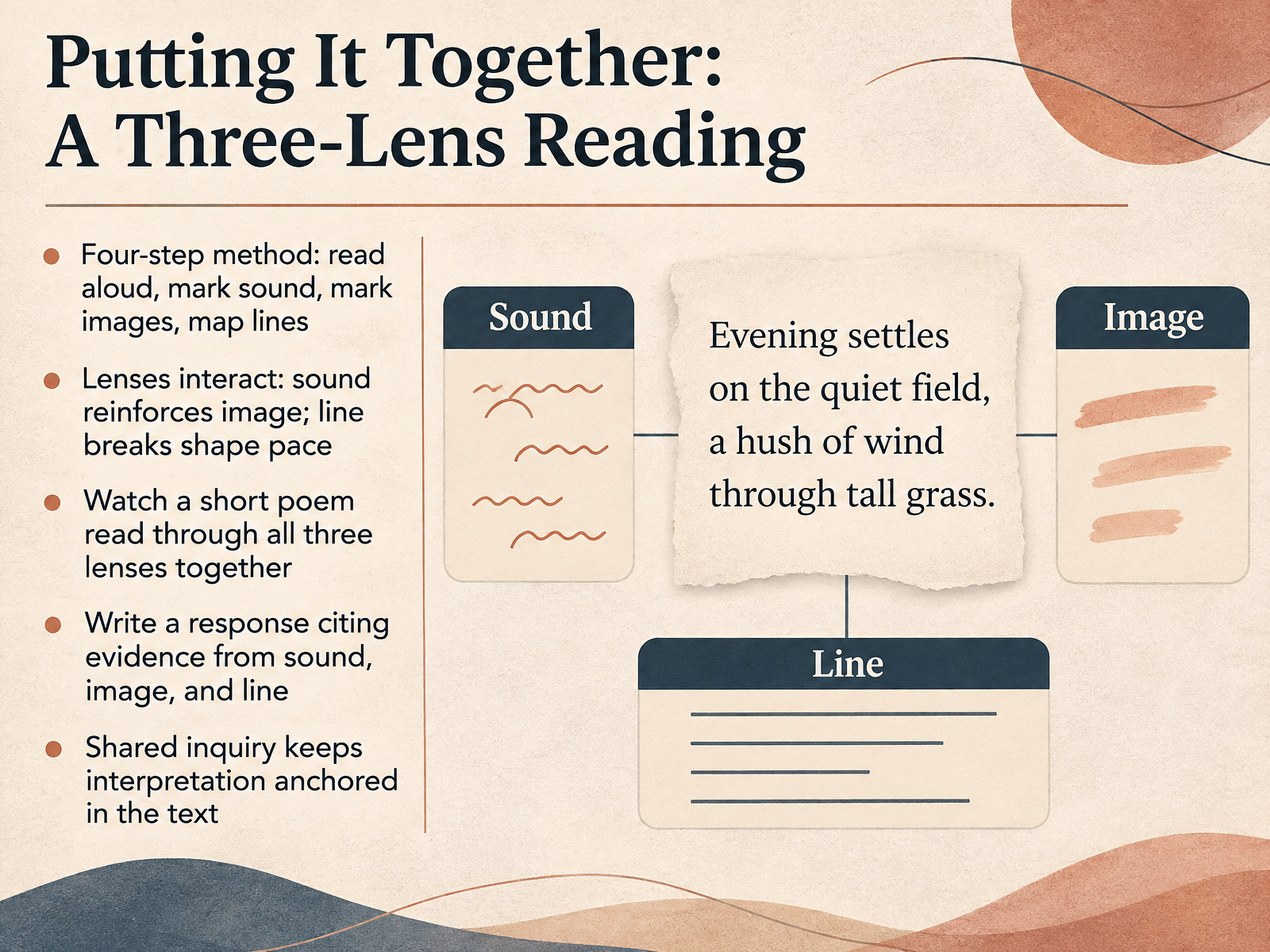
- 10Putting It Together: A Three-Lens ReadingNow let's bring the three lenses together. The method has four steps. Read the poem aloud. Mark the sounds you hear. Mark the images you see. Then map the lines, noticing where each one breaks and where it pauses. These lenses talk to each other. A hard, clanging sound can reinforce a harsh image. A short line can speed you up. An end-stopped line, one that ends with punctuation, can slow you down. So try a short poem and read it through all three lenses together. Then write a short response that cites evidence. Maybe a repeated sound, a striking image, a well-placed break. In a group, shared inquiry keeps you anchored in the text. When talk drifts to personal stories, gently bring it back to the words on the page. Next, we'll look at how to run a book club discussion using this method. Book Club Format: A 20-Minute Guided Poem Discussion.
 pwrites.princeton.edupoets.orgowl.purdue.edu+21 min
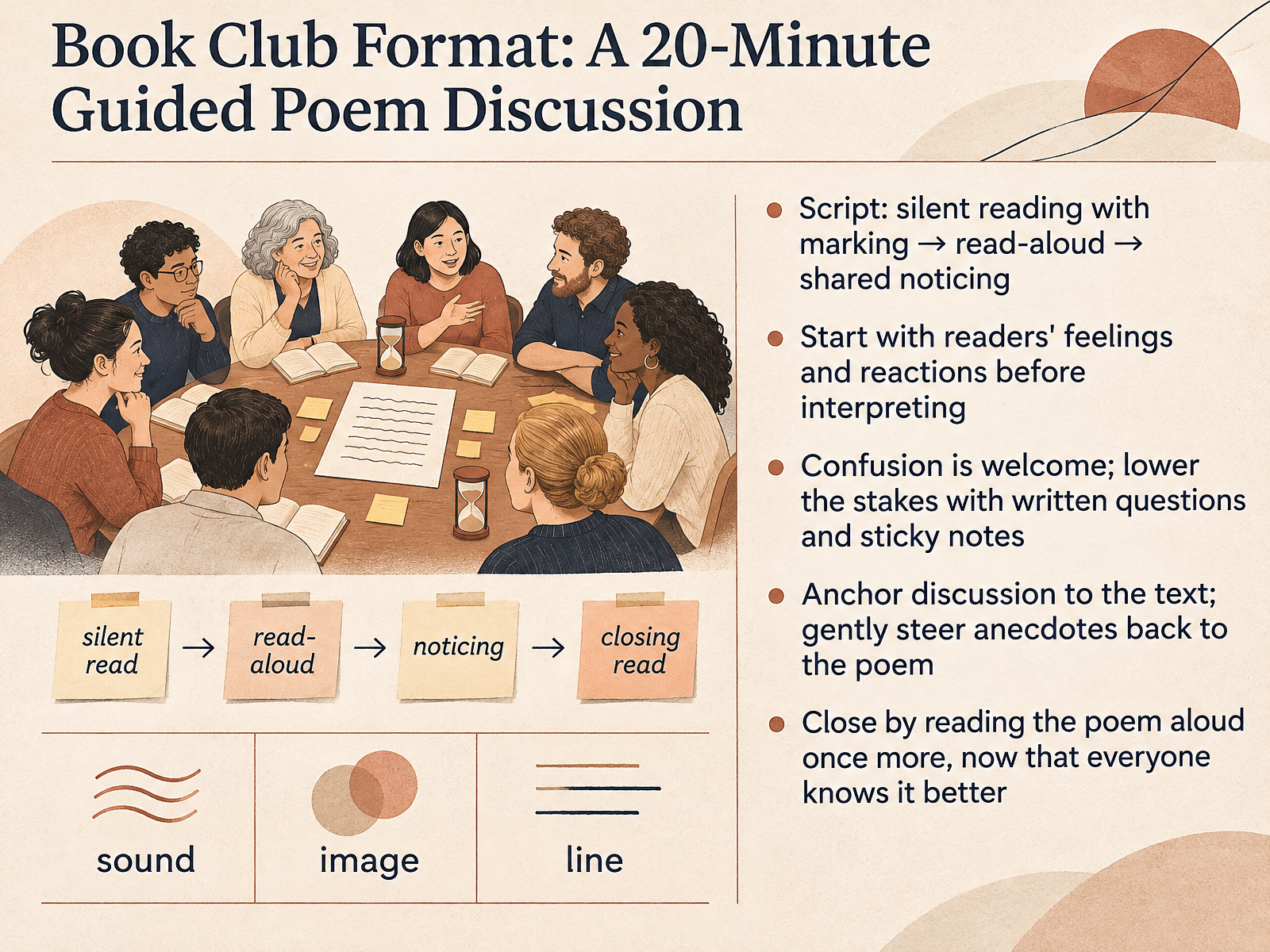
- 11Book Club Format: A 20-Minute Guided Poem DiscussionLet's put all of this into a simple format you can run in about twenty minutes. Your script goes like this. First, silent reading with marking. Ask everyone to underline lines, images, or sounds that stick out, without asking why yet. Then a read-aloud, while listeners mark what they notice by ear. Then shared noticing: what did you see, what did you hear? Start with feelings and reactions before any interpretation. Confusion is welcome here, so lower the stakes. Let people write questions on paper or post reactions on sticky notes instead of speaking. As the leader, anchor the discussion to the text. If someone drifts into a long personal story, gently steer back to the poem. And close by reading the poem aloud once more, now that everyone knows it better. That second hearing often lands differently. Next, we'll look at common pitfalls and self-checks.
 2 min
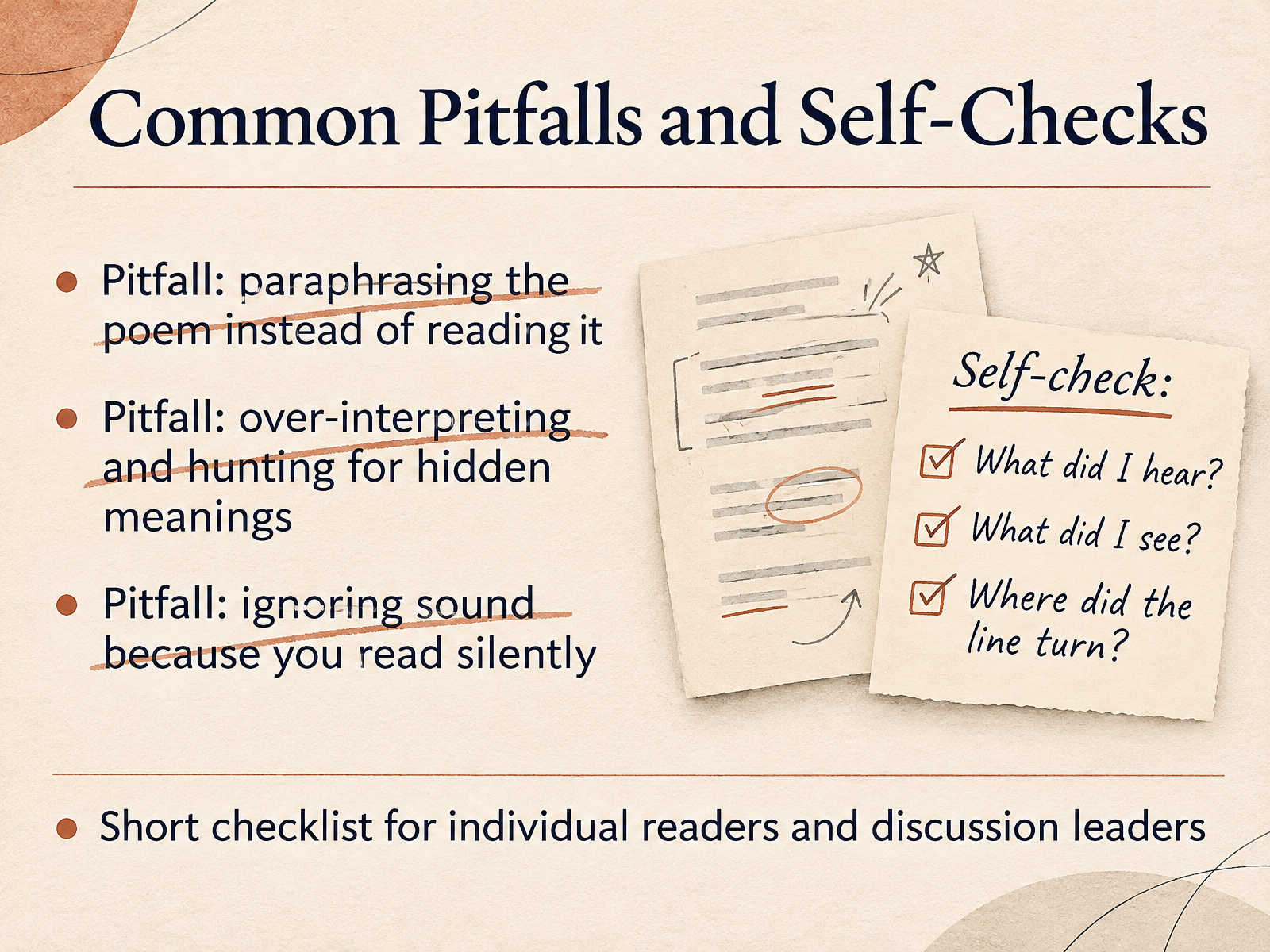
- 12Common Pitfalls and Self-ChecksLet's look at a few common pitfalls, and then some simple self checks. The first pitfall is paraphrasing the poem instead of actually reading it. If you only summarize what it means, you miss the sound, the images, and the line breaks. Try reading it aloud instead. The second pitfall is over interpreting. Not every word is hiding a secret symbol. If you find yourself hunting for hidden meanings, slow down and come back to the text. The third pitfall is ignoring sound because you read silently. Poetry was made to be heard, so read it out loud, even softly. Now, a quick self check you can use every time. Ask yourself three questions. What did I hear? What did I see? And where did the line turn? That last one means noticing where the line breaks fall. Here is a short checklist for individuals and discussion leaders. Read it aloud at least twice. Name one image that stood out. Point to one place where the line breaks before the sentence ends. And share one question you still have. That is enough. No hidden meanings required. Next, we will put these habits into practice with a three poem set.
 pwrites.princeton.edupoets.orgowl.purdue.edu+22 min
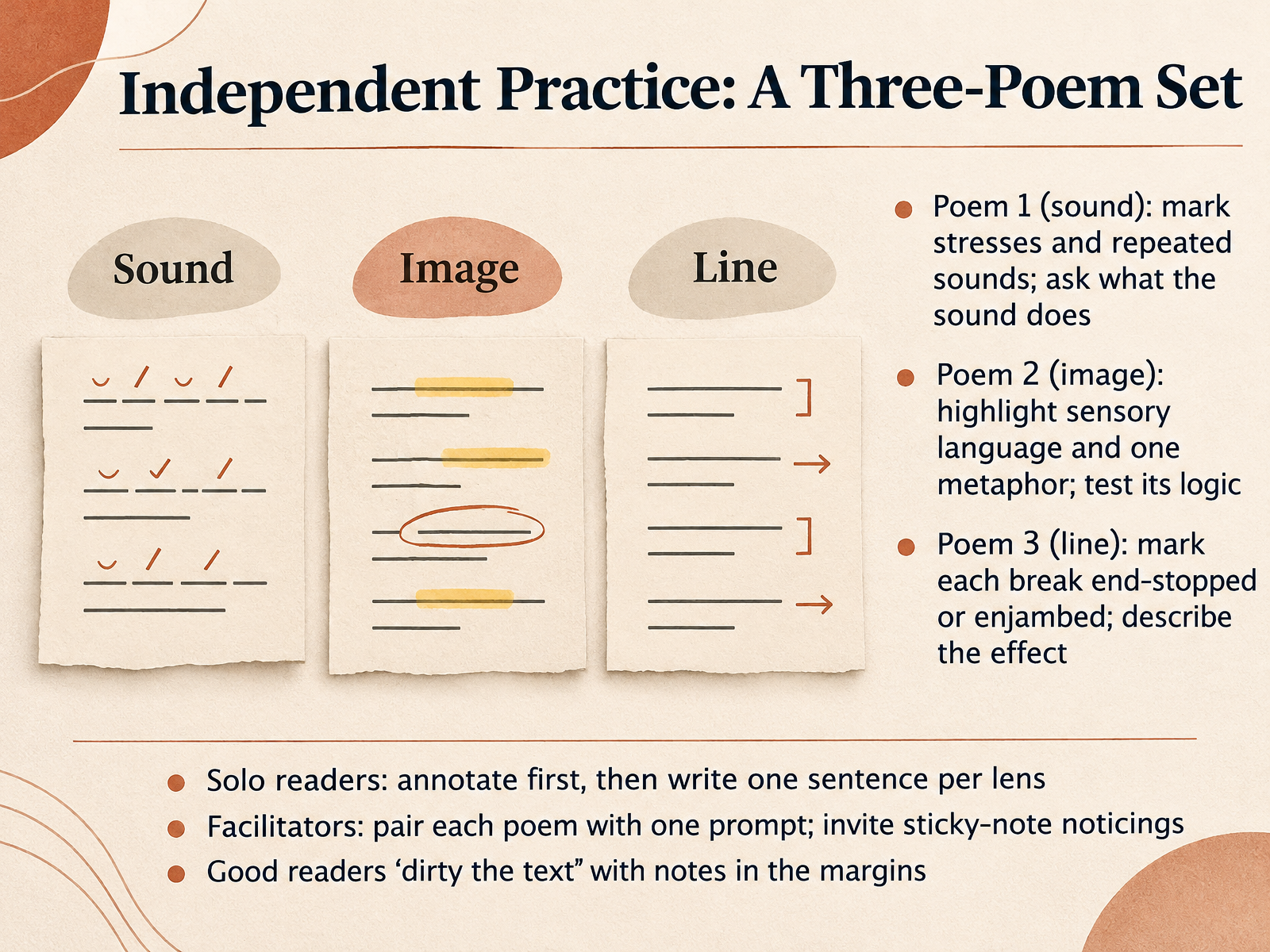
- 13Independent Practice: A Three-Poem SetNow it is your turn to practice, with a set of three short poems. Each one asks you to use a different lens. For poem one, focus on sound. Mark the stressed syllables and circle any repeated sounds. Then ask yourself what that sound is doing. Does it speed things up, or slow them down? For poem two, focus on image. Highlight sensory language, words that appeal to sight, sound, smell, taste, or touch. Then find one metaphor and test its logic. Does the comparison hold together? For poem three, focus on line. Mark each break as end-stopped or enjambed. An end-stopped line completes a thought. An enjambed line runs on into the next. Then describe the effect. If you are reading solo, annotate first, then write one sentence for each lens. If you are facilitating, pair each poem with one prompt, and invite sticky-note noticings on the page. Good readers dirty the text with notes in the margins. That is not mess. That is thinking. Next, let us look at resources and a standing invitation in Next Steps: Resources and a Standing Invitation.
 writingguide.communityschool.orghcmc.uvic.careadwritethink.org+22 min
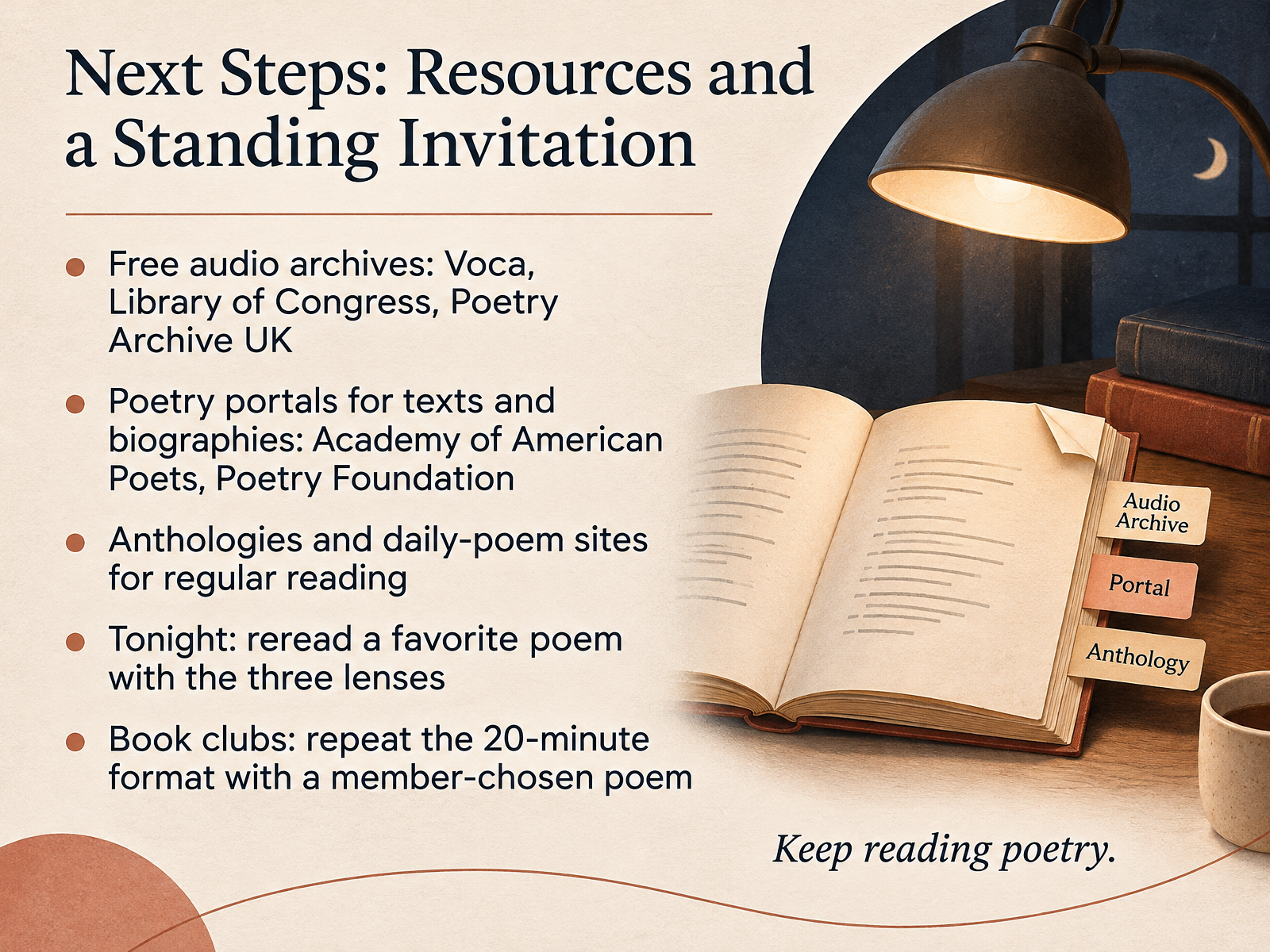
- 14Next Steps: Resources and a Standing InvitationSo before we close, here are a few places to keep going. For listening, try Voca, the University of Arizona's free audio archive, where you can hear thousands of poems in the poets' own voices. The Library of Congress has historic recordings too, and the Poetry Archive UK is a lovely next stop. For texts and biographies, the Academy of American Poets and the Poetry Foundation are both free and easy to browse. Anthologies, and daily poem sites, give you something new to read on any ordinary day. And here is your standing invitation. Tonight, reread a favorite poem with the three lenses. Sound. Image. Line. Then, if you lead a reading group, repeat the twenty-minute format, with a poem chosen by a member. You already have what you need. Thank you for reading with me, and keep listening closely.
 1 min
Take the deck with you
Download this course as a file — free, no sign-up needed.
- PDF handoutEvery slide page, ready to print or share.15 pages · 5.4 MBDownload
- Narrated PowerPointThe deck that presents itself — every slide carries the digital human's narration video.15 pages · 14.9 MBDownload
- PowerPoint slidesThe full deck as a .pptx — open it in PowerPoint, Keynote, or Google Slides.15 pages · 5.4 MBDownload
Free to use in your own training — please keep the PersonWise credit page at the end.
Have your own deck? Turn it into a course
Sources consulted
Web sources consulted while building this course.
- How to Read a Poem by Cate Mahoney – Princeton Writes — pwrites.princeton.edu
- How to Read a Poem | Academy of American Poets — poets.org
- Close-Reading Poetry: An Overview — owl.purdue.edu
- Ways of Reading a Poem - Department of English and Related Literature, University of York — york.ac.uk
- How to Read a Poem (& Maybe Fall in Love with Poetry) – An Introduction to Poetry — pressbooks.pub
- Iambic Pentameter | Academy of American Poets — poets.org
- Guide to Poetic Meter – Victorian Poetry and Poetics — odp.library.tamu.edu
- The Poetry Toolbox: Metre – Young Poets Network — ypn.poetrysociety.org.uk
- Guide to Prosody | Poetry at Harvard — poetry.harvard.edu
- Rhythm, Meter, and Scansion Made Easy — cjpress.org
- What Are Sound Devices in Poetry? Examples and Types | YourDictionary — yourdictionary.com
- Sound Devices in Poetry and Literature | Writers.com — writers.com
- What are Assonance and Consonance? || Oregon State Guide to Literary Terms | Oregon State University — liberalarts.oregonstate.edu
- American Board — americanboard.org
- https://www.mun.ca/writingcentre/media/production/memorial/administrative/writing-centre/media-library/undergraduates/resources/writing-centre/WC_HO-Figurative_Devices_ABW22.pdf — mun.ca
- 44. Close read by imagery — writingguide.communityschool.org
- The Close Reading of Poetry: Figurative Language; Imagery & Allusion — hcmc.uvic.ca
- Color of Silence: Sensory Imagery in Pat Mora's Poem "Echoes" | Read Write Think — readwritethink.org
- Text Dependent Analysis Close Reading Lessons for Uncle Timothy's Ships by Summer Woodford — pa.gov
- imagery: (visual): shattered water ; (auditory): misty din — writingguide.communityschool.org