Begin
14 pages · ~28 min
Sem Digital Marketing
This digital marketing training explains SEO, SEM, and paid search fundamentals for marketers seeking to build effective search advertising campaigns.
A digital instructor presents all 14 pages. Hold “Ask” at any point and ask out loud — the answer comes from this course. No sign-up needed.
What you’ll learn
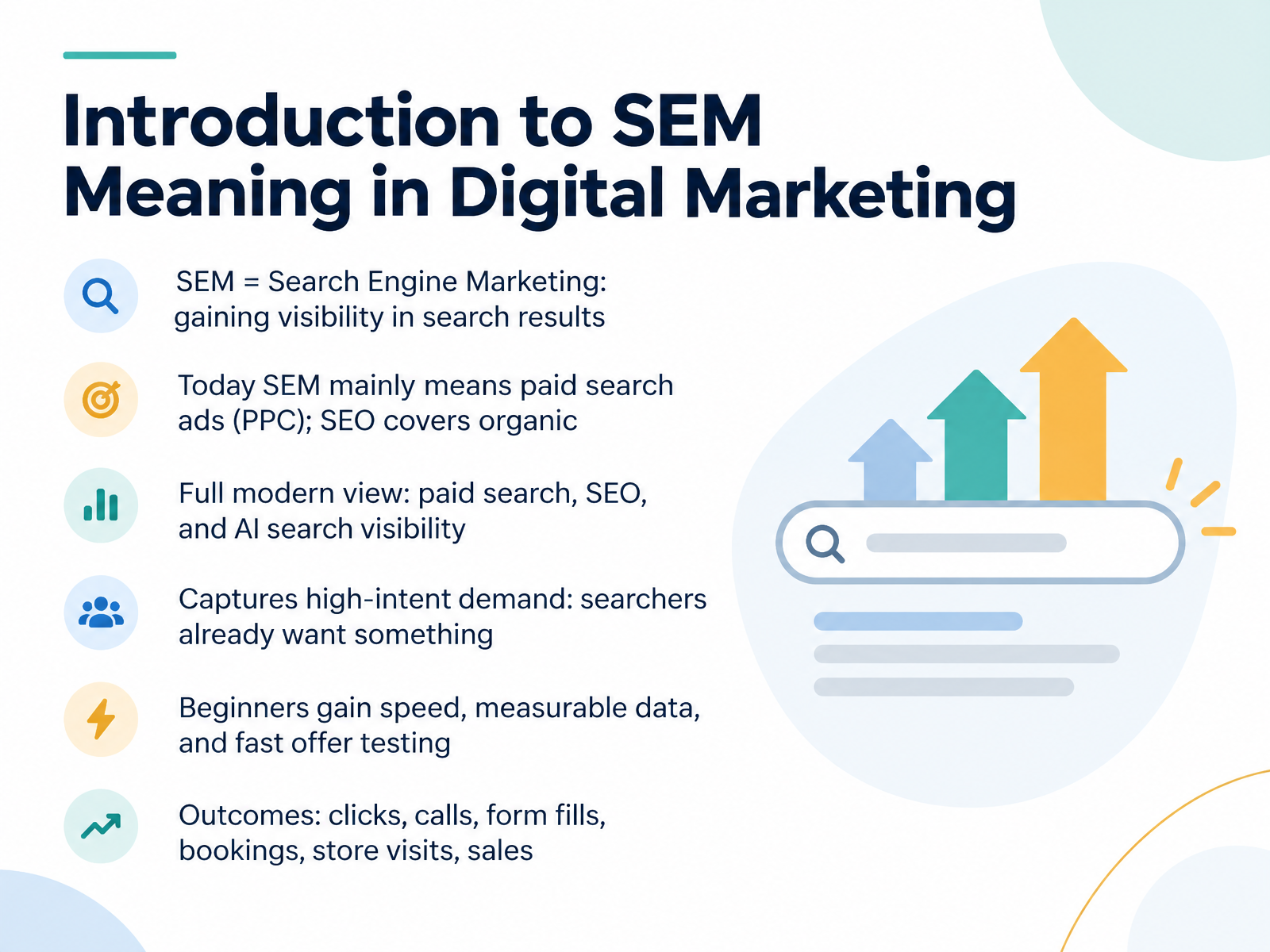
- 01Introduction to SEM Meaning in Digital MarketingWelcome to the course. Let's start with a simple question. What does SEM actually mean? SEM stands for Search Engine Marketing. In plain English, it means gaining visibility in search results so the right people can find you at the moment they're looking. Today, SEM mainly refers to paid search ads, also called pay-per-click, or P P C. You bid on keywords, your ad appears, and you pay when someone clicks. SEO, by contrast, is the organic side, where you earn rankings over time instead of paying for each click. A modern view brings three pieces together: paid search, SEO, and now AI search visibility. Why does this matter for a small business or creator? Because search captures high-intent demand. Searchers already want something, so your message doesn't have to persuade from scratch. For beginners, SEM offers speed, measurable data, and a fast way to test an offer. You can see clicks, calls, form fills, bookings, store visits, and sales. If you're working with a small budget, that feedback tells you what's worth doubling down on. Let's take a quick example. A local bakery bids on the keyword "birthday cake near me." A click leads to a landing page with a simple form. A week of data shows whether that offer converts. That's the beginner's advantage: small experiments, clear numbers, quick decisions. In this course, we'll focus on practical steps you can apply in your own account, from keyword research to ad copy, landing pages, and campaign tracking. Ready to see how paid and organic work together? Next, we'll look at SEM versus SEO.en.wikipedia.orgimd.orgbusiness.adobe.com+22 min
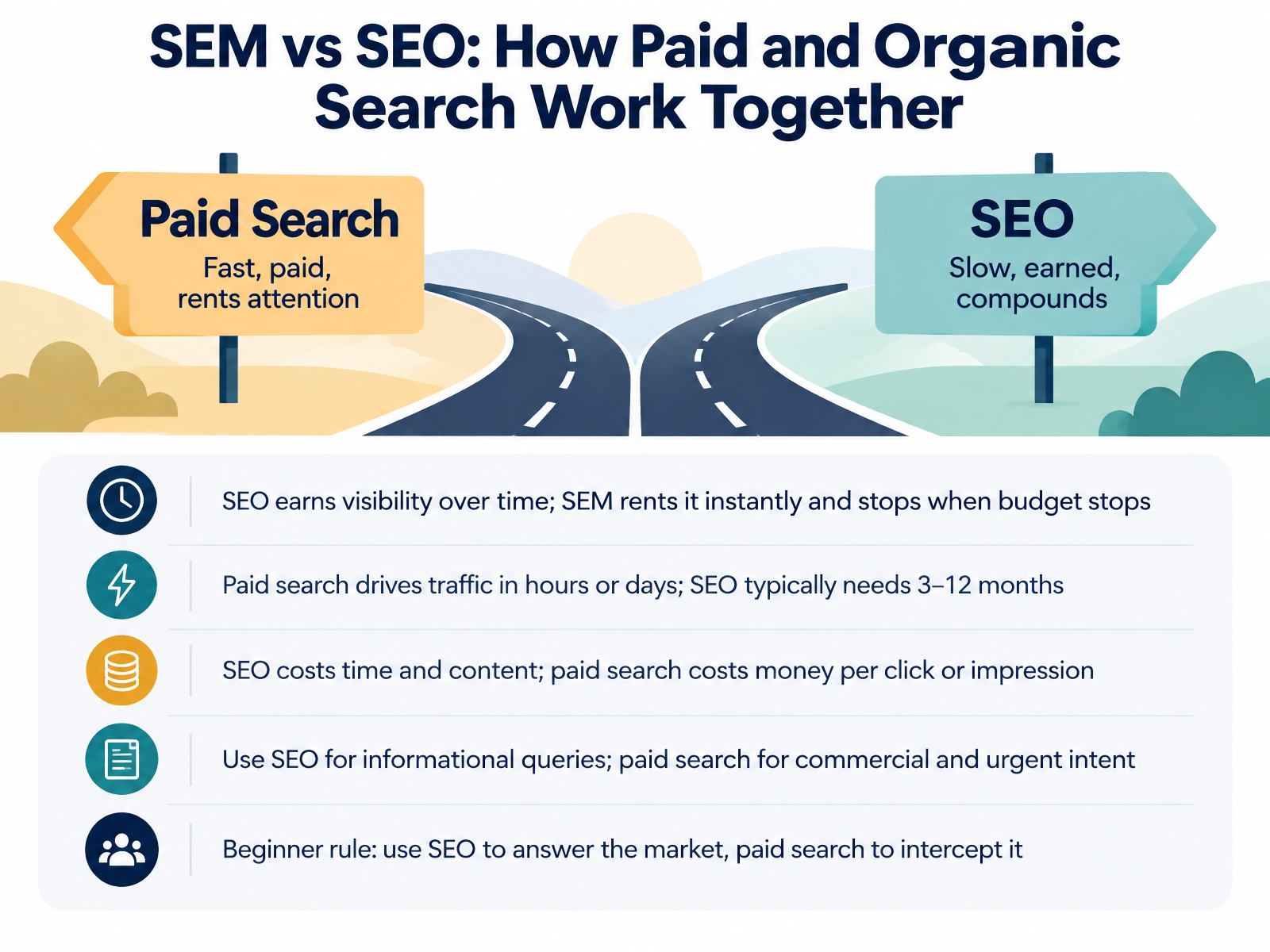
- 02SEM vs SEO: How Paid and Organic Search Work TogetherNow that we know what search marketing is, let's compare its two main paths. SEO, or search engine optimization, earns visibility over time. SEM, or search engine marketing, usually means paid search ads, and it rents that visibility instantly. Paid search can drive traffic in hours or days, while SEO typically takes three to twelve months to mature. And here is the key trade: SEO costs time and content, while paid search costs money per click or impression. Also, paid traffic stops the moment your budget stops, but strong organic rankings can keep working long after you publish. A simple beginner rule: use SEO to answer the market, and use paid search to intercept it. For informational queries, like how to choose a service, SEO usually fits better and costs less per visitor over time. For commercial or urgent intent, like pricing, near me, or book now, paid search lets you show up right away and capture that demand. If your budget is tight, start with a narrow set of high-intent keywords and a small SEO library around the same topic. Next, let's look at how search engines and search ads work.
 ahrefs.comsearchenginejournal.comsemrush.com+22 min
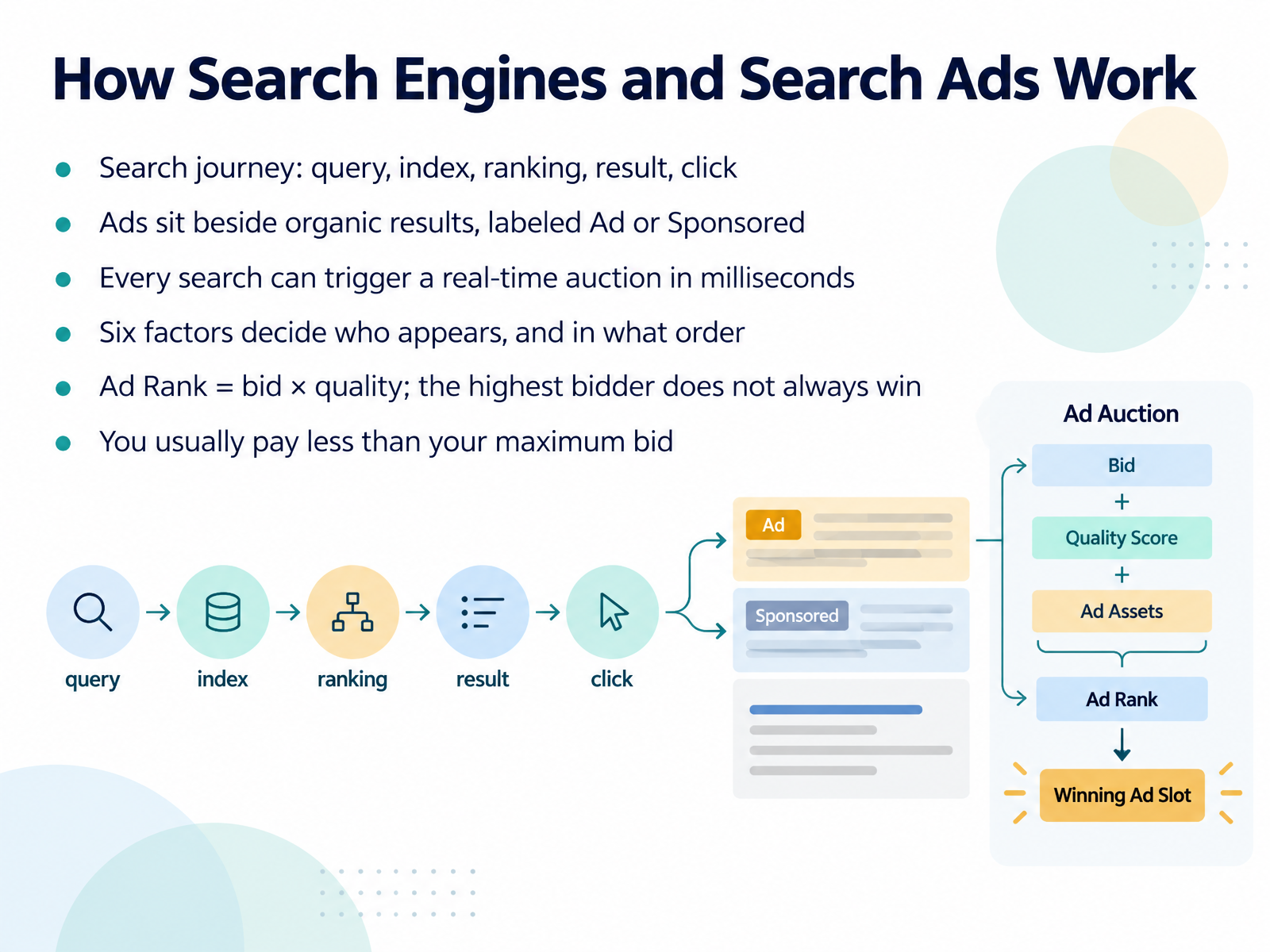
 - 03How Search Engines and Search Ads WorkLet's walk through what actually happens when someone searches on Google. A search journey has five steps: the query they type, the index of pages Google has stored, the ranking that decides which results appear first, the results themselves, and finally the click. Alongside the organic results, you'll see ads, clearly labeled with the word Ad or Sponsored. Here's the important part. Every search can trigger a real-time auction, and it happens in milliseconds. Six factors decide which ads appear and in what order: your bid, your ad quality and landing page, the impact of your ad assets, your Ad Rank threshold, the context of the search, and how competitive that auction is. Put simply, Ad Rank equals your bid times your quality. That means the highest bidder does not always win. A smaller advertiser with a relevant ad and a strong landing page can beat a bigger spender. And you usually pay less than your maximum bid, often just enough to hold your position. Next, let's look at Key SEM Terms and Metrics You Need to Know.
 support.google.comblog.googlewordstream.com+22 min
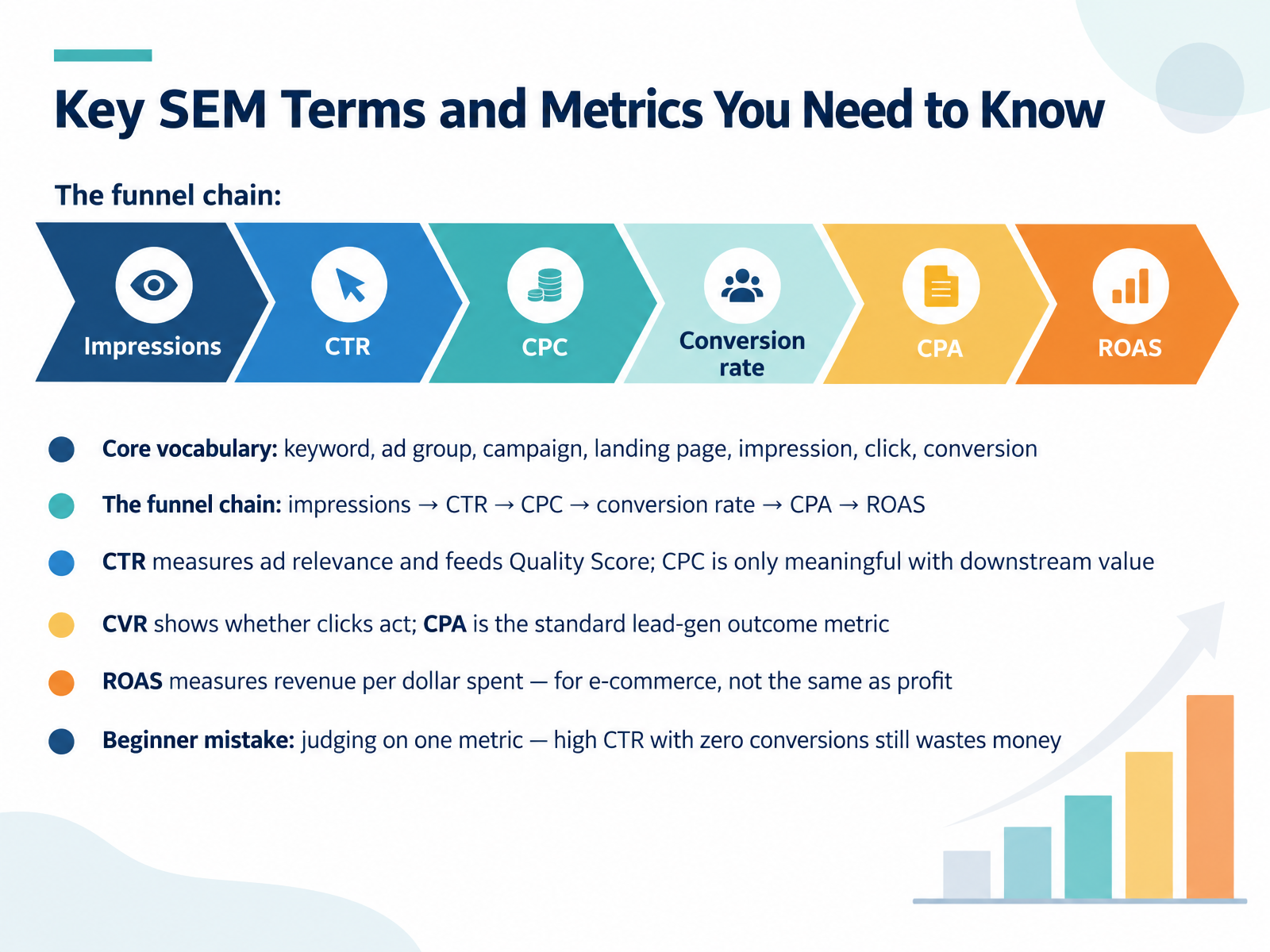
 - 04Key SEM Terms and Metrics You Need to KnowLet's get comfortable with the vocabulary and numbers you'll see every day. A keyword is the search phrase you bid on. An ad group holds related keywords and ads. A campaign is the container that sets budget and targeting. And a landing page is where the click arrives. An impression means your ad was shown. A click means someone tapped it. A conversion is the action you actually want, like a form fill or a sale. These connect in one chain: impressions lead to click-through rate, or C T R. That leads to cost per click, or C P C. Then conversion rate, or C V R. Then cost per acquisition, or C P A. And finally return on ad spend, or R O A S. Here's the key. C T R measures ad relevance and feeds Quality Score. C P C only matters if the click has downstream value. C V R shows whether clicks act. C P A is the standard lead-gen outcome metric. And R O A S measures revenue per dollar spent, mostly for e-commerce, and it is not the same as profit. So the beginner mistake is judging on one metric. High C T R with zero conversions still wastes money. Next, let's look at what counts as a good number.
 dijipazarlama.commarketingscoop.comgrowthdigital.com.au+22 min
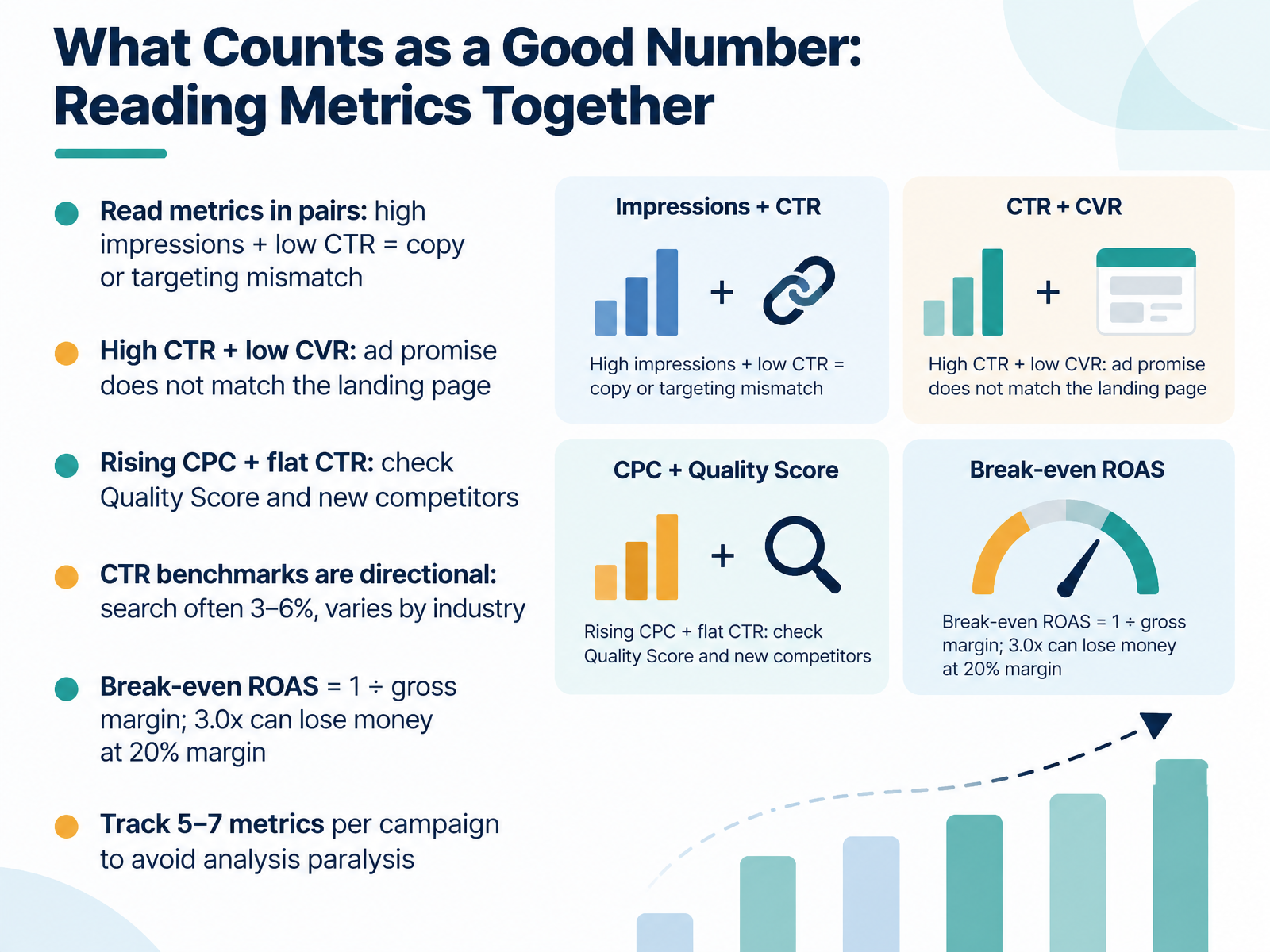
 - 05What Counts as a Good Number: Reading Metrics TogetherNow let's talk about reading metrics together, because a single number rarely tells you the full story. Start by reading metrics in pairs. If impressions are high but click-through rate is low, that mismatch points to your ad copy or your targeting. High click-through rate with a low conversion rate usually means the ad promised something the landing page does not deliver. And if cost per click is rising while click-through rate stays flat, check your Quality Score and watch for new competitors. Benchmarks are directional, not rules. Search click-through rates often land between three and six percent, and that varies a lot by industry. Here is the number that matters most for small budgets. Break-even return on ad spend equals one divided by gross margin. At a twenty percent margin, a three point oh return can actually lose money. Finally, track five to seven metrics per campaign to avoid analysis paralysis. Now let's move on to keyword research and search intent.
 dijipazarlama.commarketingscoop.comgrowthdigital.com.au+22 min
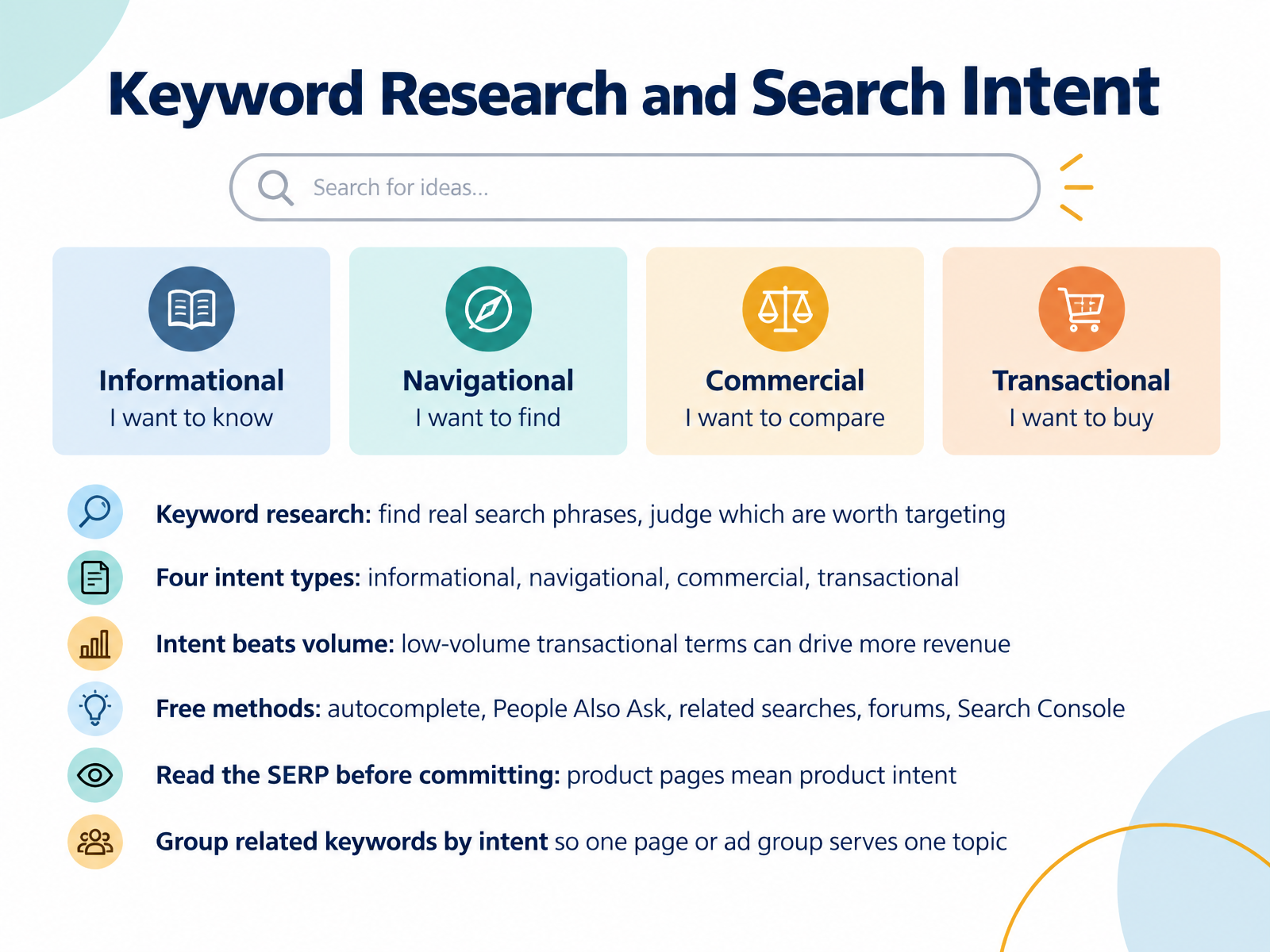
 - 06Keyword Research and Search IntentNow let's talk about keyword research and search intent. Keyword research means finding the real phrases people type into search engines, then judging which ones are worth targeting. Every search has an intent, and intent fits into four types: informational, where someone wants to learn; navigational, where they want a specific site or brand; commercial, where they compare options before buying; and transactional, where they are ready to act. Here is the key takeaway: intent beats volume. A low-volume transactional term like "book a plumber near me" can drive more revenue than a high-volume informational one. You do not need paid tools to start. Use Google autocomplete, the People Also Ask box, related searches, forums, and Search Console for real queries. Before you commit, read the search engine results page. If product pages rank, the intent is product-focused. Finally, group related keywords by intent, so one page or ad group serves one clear topic. Next, let's build a starter keyword list for a small business.
 1 min
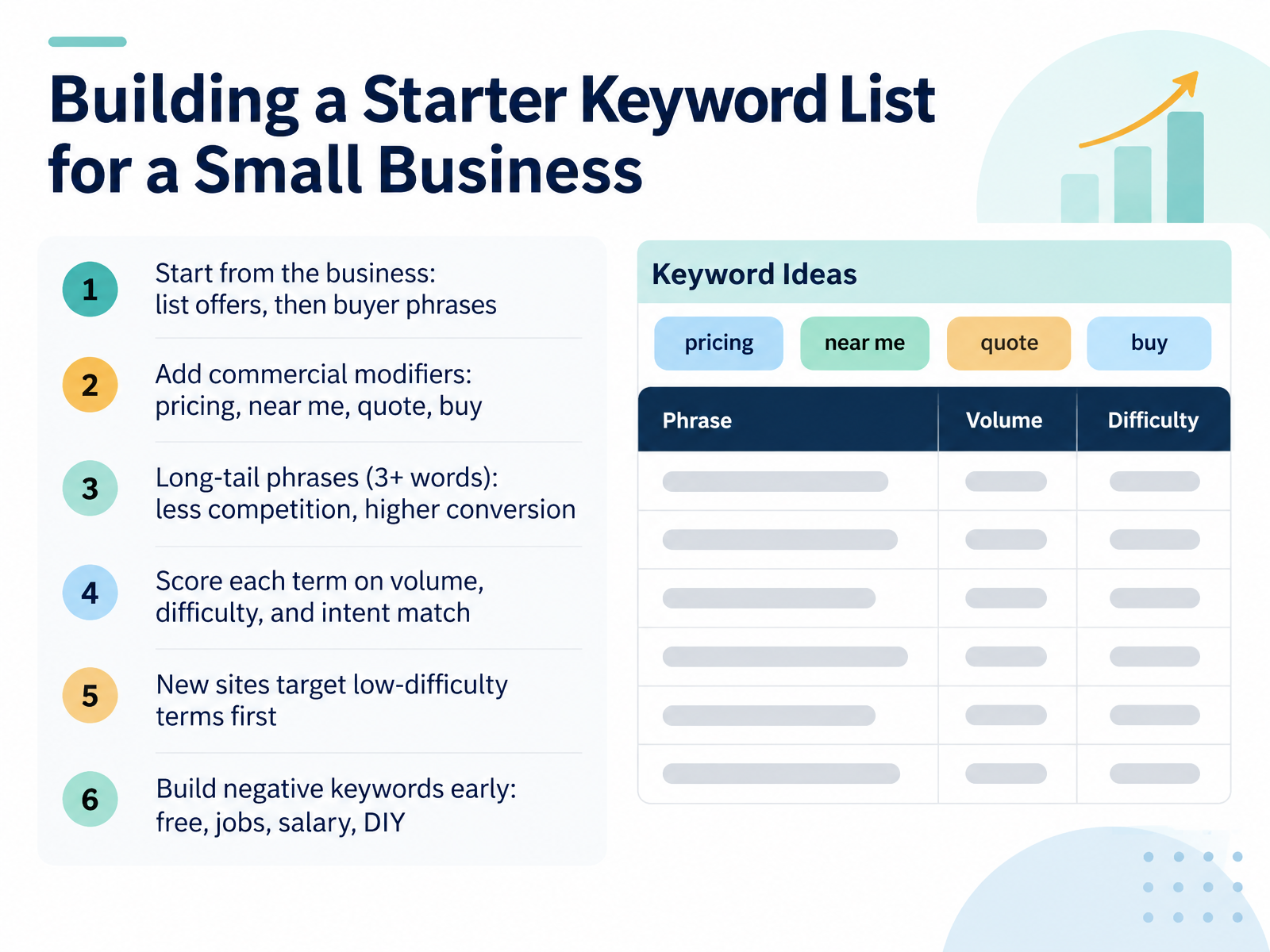
1 min - 07Building a Starter Keyword List for a Small BusinessNow let's build your starter keyword list. Start from your own business. Write down what you actually offer, then the phrases a buyer would use to find it. A dog groomer, for example, sells nail trims, so the phrase might be dog nail trim. Next, add commercial modifiers, because they signal someone close to buying. Words like pricing, near me, quote, or buy. Then look for long-tail phrases. These are searches of three or more words, like same day dog nail trim near me. They get less competition and often convert better. Once you have a list, score each term on three things: search volume, keyword difficulty, and intent match. If you are a new site, target the low-difficulty terms first. That gives you quick wins and real data to learn from. Finally, build your negative keywords early. Add free, jobs, salary, and DIY. These block searches you do not want to pay for, which protects a small budget. Next, we will cover writing search ads that get clicks.
 2 min
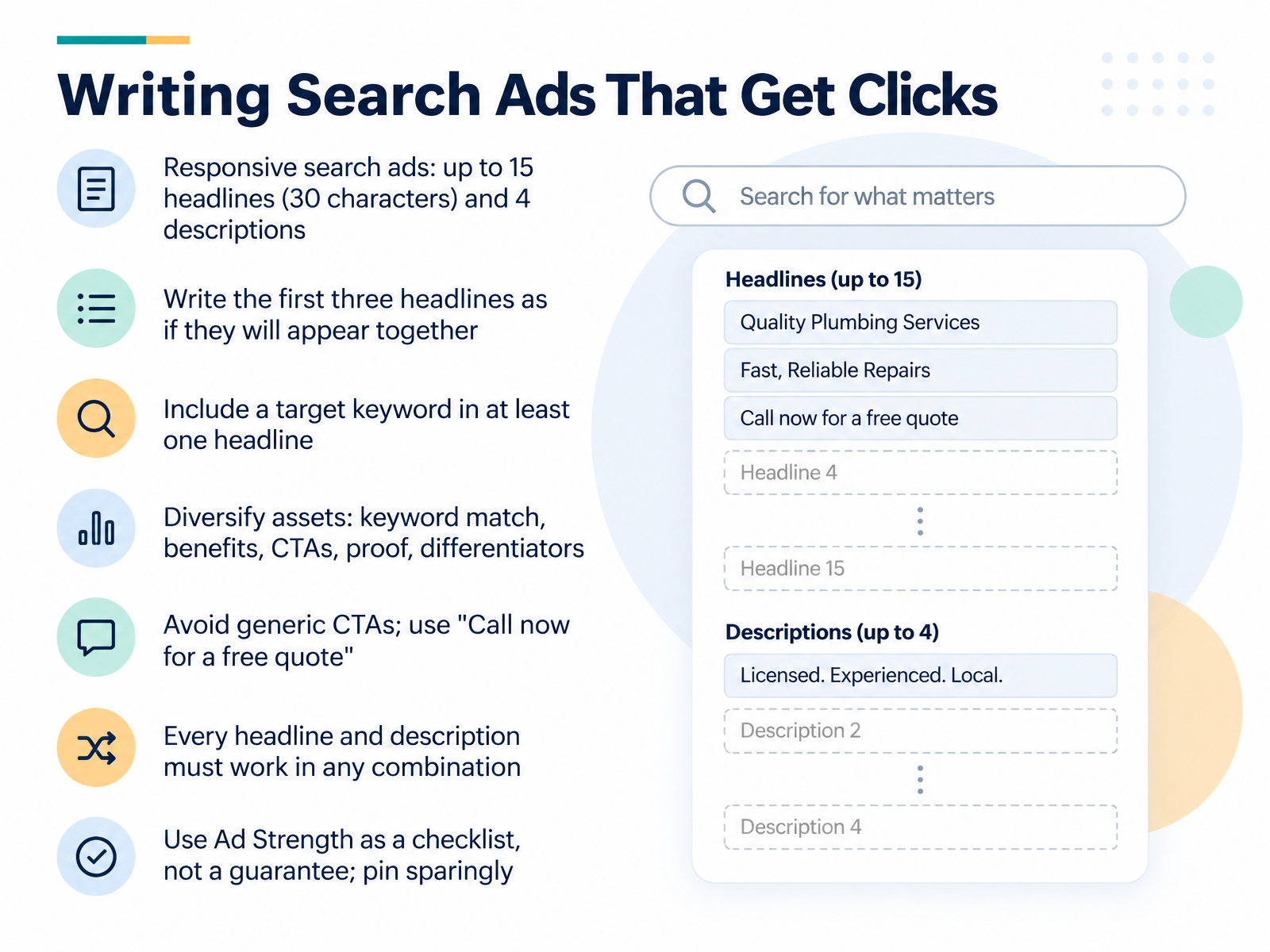
2 min - 08Writing Search Ads That Get ClicksNow let's talk about writing search ads that actually get clicks. Responsive search ads give you up to fifteen headlines, each thirty characters, and four descriptions. Here's the key idea. Google mixes and matches your assets, so write every headline and description to work in any combination. A simple habit is to write your first three headlines as if they will appear together. That way, the most common ad still reads naturally. Next, include a target keyword in at least one headline, because relevance is what earns the click. Then diversify your assets. Cover keyword match, benefits, calls to action, proof, and differentiators. Also skip generic calls to action. Instead of learn more, try call now for a free quote. Finally, treat Ad Strength as a checklist, not a guarantee, and pin sparingly, since pinning limits the combinations Google can test. Your takeaway, diverse, standalone assets give small budgets more chances to win. Next, we'll look at ad assets and testing ad variations.
 2 min
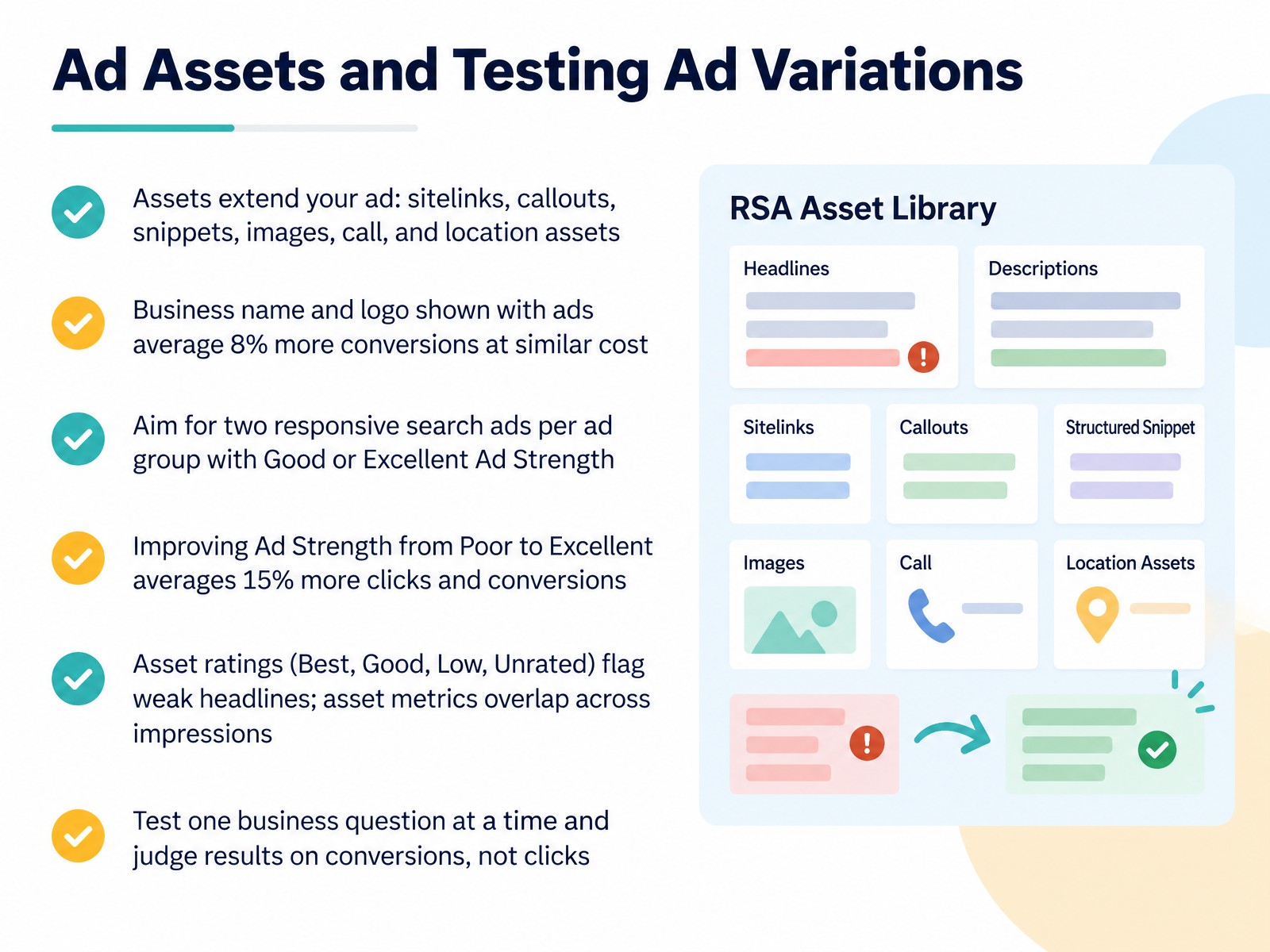
2 min - 09Ad Assets and Testing Ad VariationsNow let's talk about ad assets and testing ad variations. Assets are the extra pieces that extend your ad beyond the headline and description. Sitelinks add more links, callouts highlight short benefits, snippets list things like services, and you can also add images, a call button, and your location. Here is why that matters on a small budget. Showing your business name and logo with your ads averages about eight percent more conversions at a similar cost. Adding assets costs you setup time, not extra spend. Next, aim for two responsive search ads per ad group, each with Good or Excellent Ad Strength. Ad Strength is Google's forward-looking rating of how complete and relevant your assets are. Advertisers who improve Ad Strength from Poor to Excellent see about fifteen percent more clicks and conversions on average. Then watch your asset ratings: Best, Good, Low, and Unrated. Low ratings flag weak headlines. Just remember that asset metrics overlap, because several assets can appear in one impression. So when you test, change one business question at a time, like whether same-day availability improves bookings, and judge results on conversions, not clicks. Let's move on to landing pages and conversion basics.
 2 min
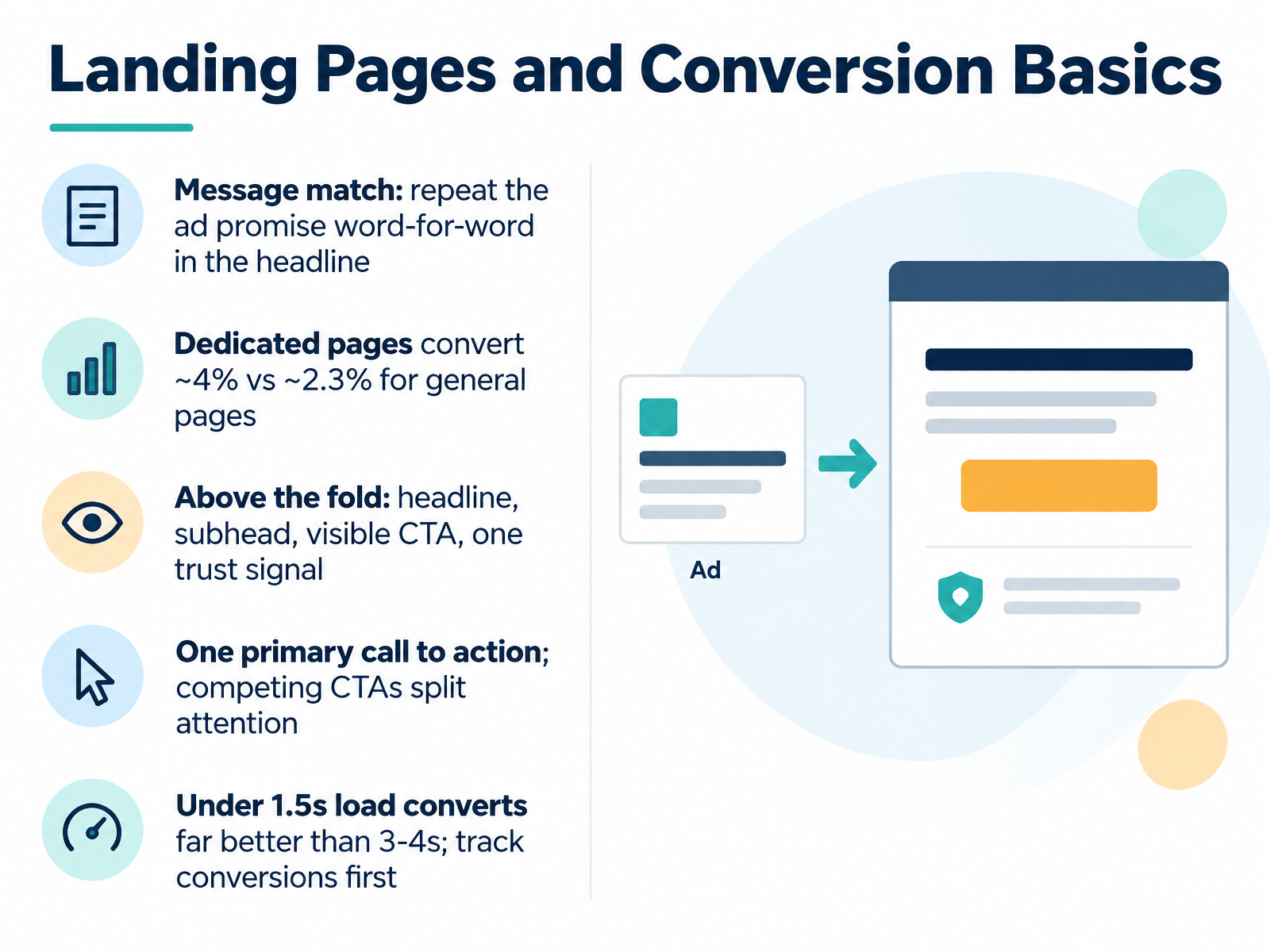
2 min - 10Landing Pages and Conversion BasicsNow let's talk about landing pages and conversion basics. A landing page is simply the page someone sees right after clicking your ad. Its one job is to turn that click into an action, like a purchase, a booking, or a form fill. Start with message match. Repeat the promise from your ad word for word in your headline. If your ad says twenty percent off running shoes, your headline should say the same thing. That keeps the visitor from wondering if they clicked the right link. Dedicated landing pages convert at about four percent, compared to roughly two point three percent for general pages. So focus matters. Above the fold, meaning what's visible without scrolling, include four things: a headline, a subhead, a visible call to action, and one trust signal, like a review or a guarantee. Use one primary call to action. Competing buttons split attention and lower conversions. Speed counts too. Pages that load in under one point five seconds convert far better than pages taking three to four seconds. And before you spend a dollar, set up conversion tracking, so you know what's actually working. Next, we'll look at campaign structure, budgets, and bidding.
 2 min
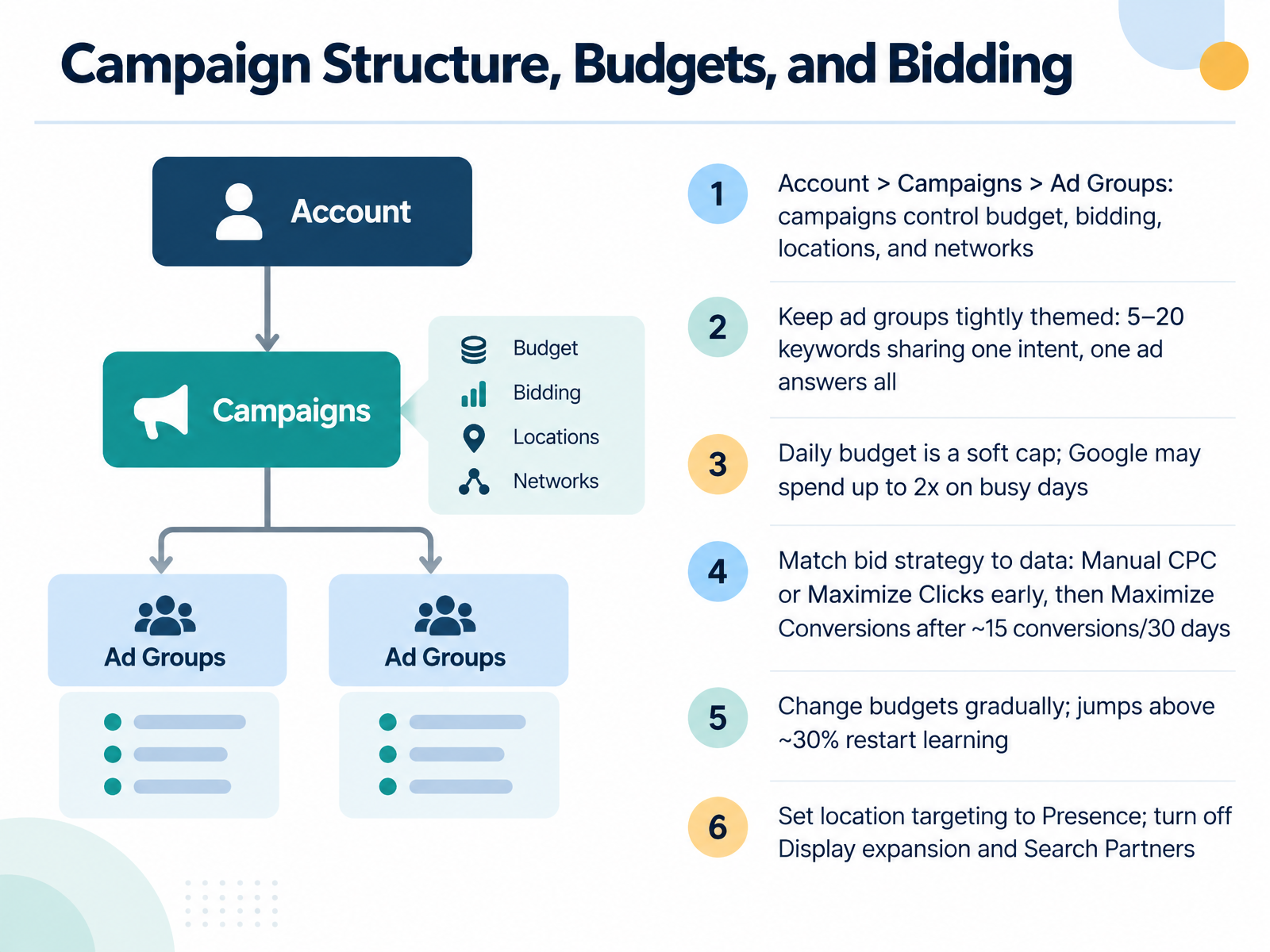
2 min - 11Campaign Structure, Budgets, and BiddingNow let's talk about how your account is actually organized. You have three levels: the account, the campaigns inside it, and the ad groups inside those. The campaign is where you control the daily budget, the bidding strategy, your locations, and your networks. Ad groups are where your keywords and ads live. Keep each ad group tightly themed. Aim for five to twenty keywords that share one intent, so a single ad can answer all of them. This matters because tight themes raise your relevance, which lowers your cost per click. On budget, your daily budget is a soft cap. Google may spend up to two times that on busy days, so plan for it. Match your bid strategy to your data. Start with Manual C P C or Maximize Clicks while you collect information. Once you reach about fifteen conversions in thirty days, move to Maximize Conversions. Change budgets gradually. A jump above roughly thirty percent can restart the learning phase. Finally, set location targeting to Presence, and turn off Display expansion and Search Partners. Next, we'll look at Measuring Results and Cutting Wasted Spend.
 2 min
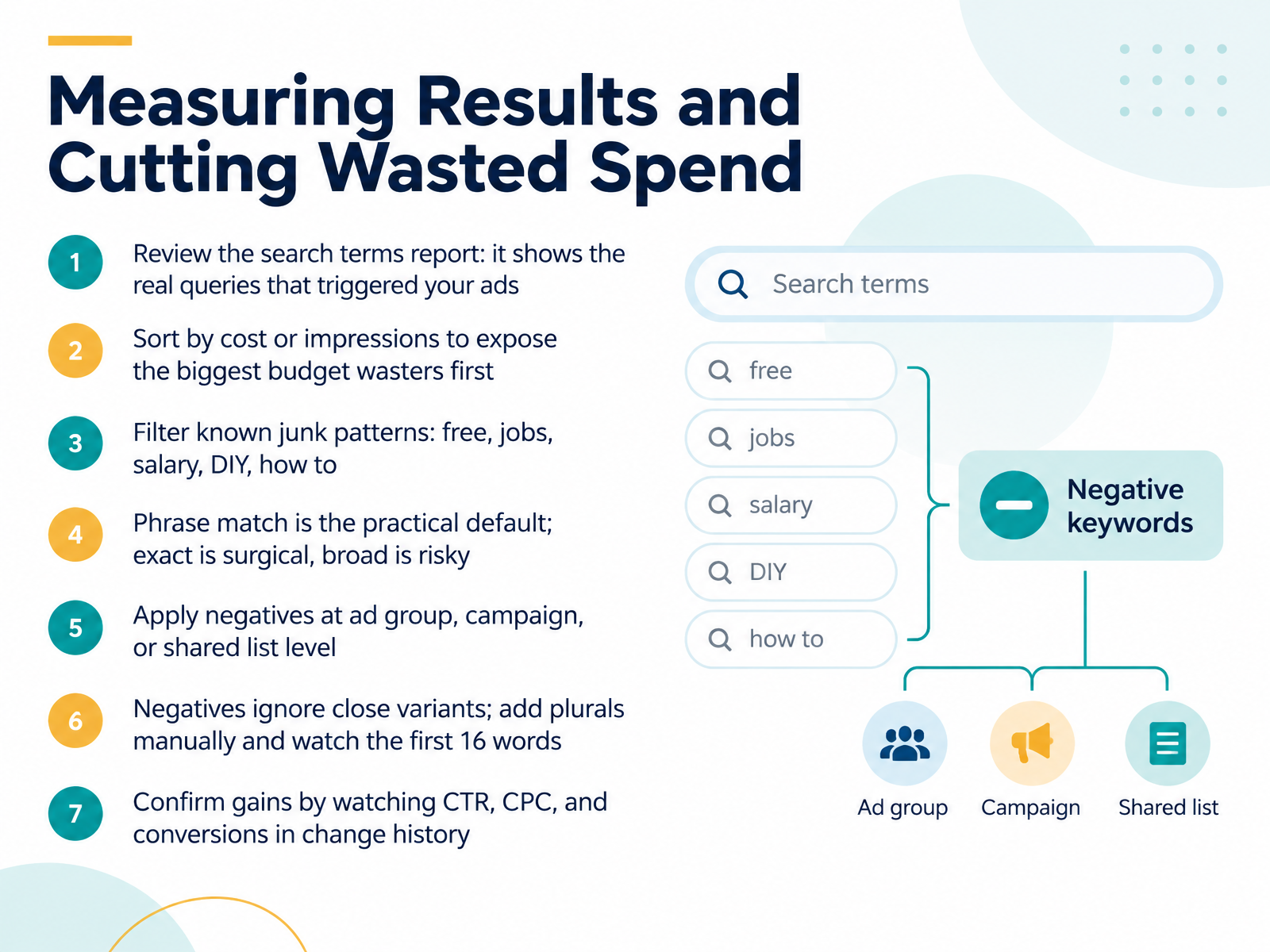
2 min - 12Measuring Results and Cutting Wasted SpendNow let's talk about measuring results and cutting wasted spend. Start with the search terms report. It shows the real queries people typed before your ad appeared, not just the keywords you chose. Sort it by cost or impressions so the biggest budget wasters rise to the top. Then filter known junk patterns like free, jobs, salary, D I Y, and how to. Those searchers are not buyers. When you add exclusions, phrase match is your practical default. Exact match is surgical, and broad match is risky because it can block good traffic. You can apply negatives at the ad group, campaign, or shared list level. One thing to remember, negatives ignore close variants, so add plurals manually, and they only apply to the first sixteen words of a query. Finally, confirm your gains by watching click-through rate, cost per click, and conversions in change history. That is how you turn a small budget into focused, high-intent traffic. Next, let's see SEM in action with local, e-commerce, and creator examples.
 2 min
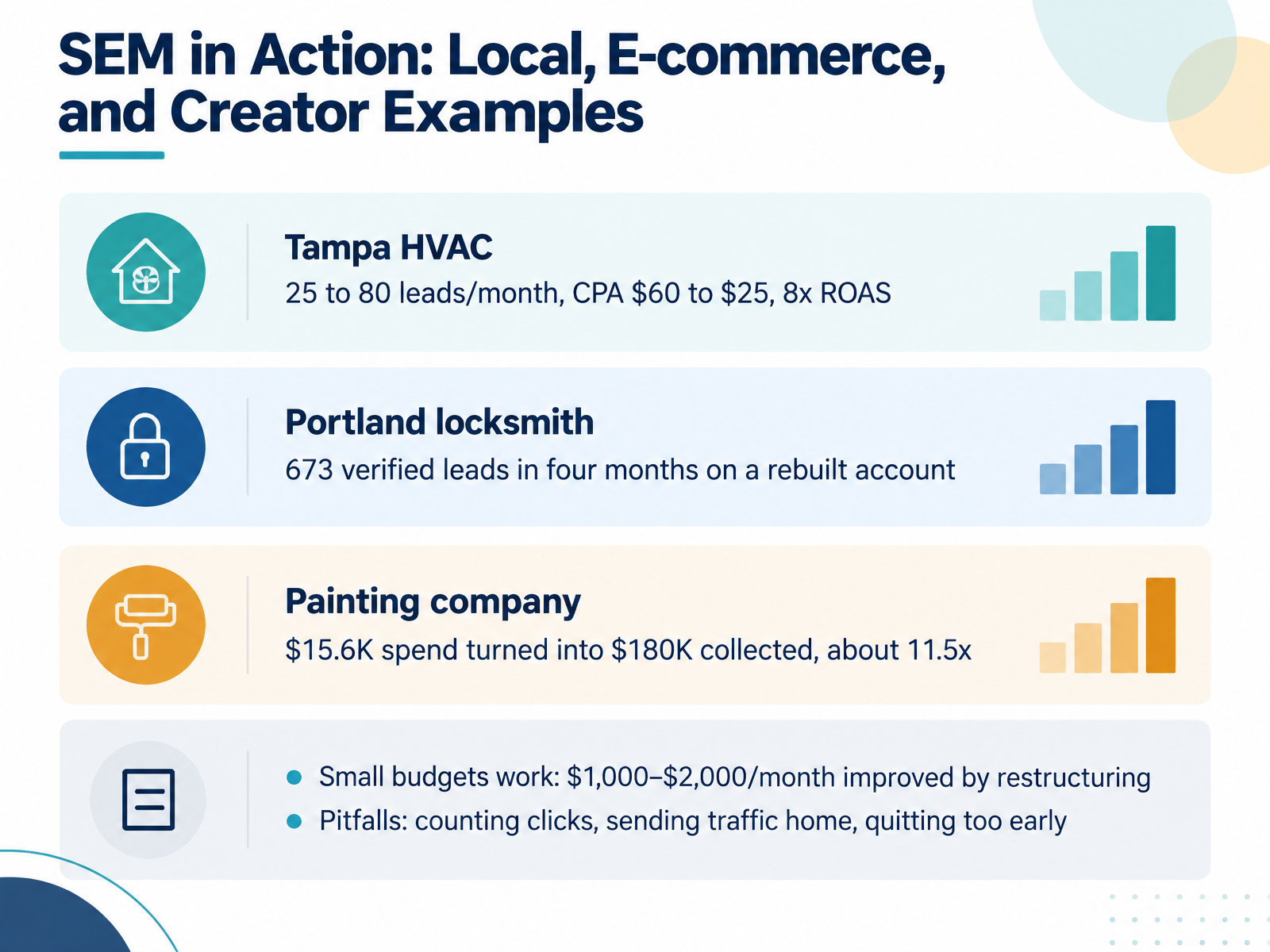
2 min - 13SEM in Action: Local, E-commerce, and Creator ExamplesLet's bring search engine marketing to life with real results from small businesses and creators. First, a Tampa HVAC company grew from twenty five leads a month to eighty, cut its cost per acquisition from sixty dollars to twenty five, and reached an eight times return on ad spend. Second, a Portland locksmith rebuilt its tracking and generated six hundred seventy three verified leads in four months. Third, a painting company turned fifteen thousand six hundred dollars in spend into one hundred eighty thousand dollars collected, about eleven and a half times return. Notice the pattern. Their budgets were modest, often between one thousand and two thousand dollars a month. What changed was structure, tracking, and patience. Now, the pitfalls. Counting clicks instead of real leads, sending traffic to your homepage instead of a focused landing page, and quitting too early all waste money and hide progress. Fix those, and a small budget can still work hard for you. Next, let's build your first SEM action plan and launch checklist.
 2 min
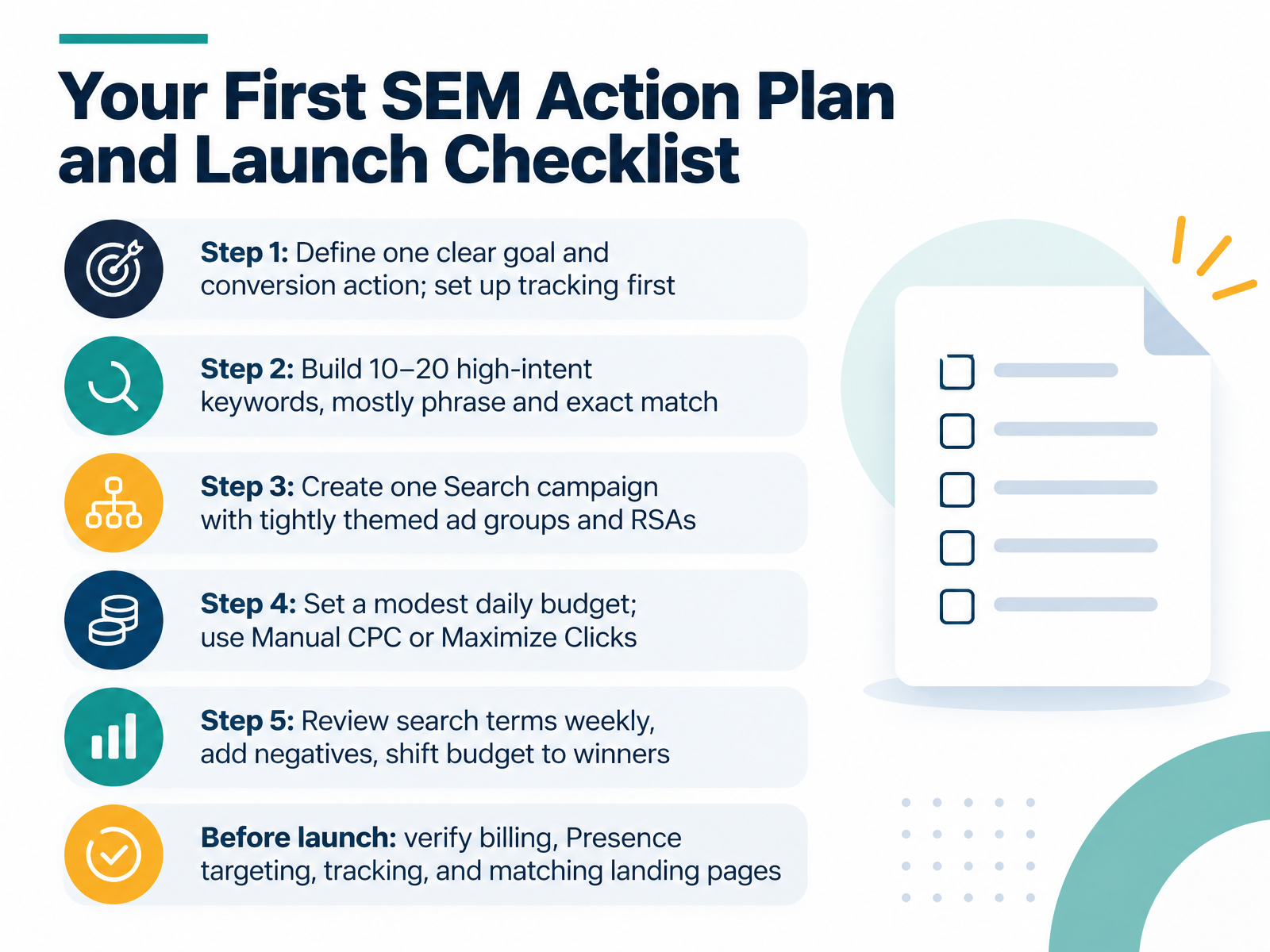
2 min - 14Your First SEM Action Plan and Launch ChecklistLet's pull everything together into your first search engine marketing action plan. Step one, define one clear goal and one conversion action, then set up tracking before you spend a dollar. A conversion is simply the action that makes you money, like a form submission or a phone call. Step two, build ten to twenty high-intent keywords, mostly phrase and exact match. High intent means the searcher is ready to act, like emergency plumber near me. Step three, create one Search campaign with tightly themed ad groups and responsive search ads. Step four, set a modest daily budget, and use Manual CPC or Maximize Clicks while you gather data. Step five, review your search terms weekly, add negative keywords, and shift budget toward what converts. Before you launch, verify four things. Billing is active. Location targeting is set to Presence, so only people in your area see your ads. Tracking is firing correctly. And your landing pages match your ad promises. Here's your takeaway. Start small, measure everything, and improve weekly. You now have a clear roadmap, so open your account and take that first step. Thank you for learning with me, and I wish you a successful launch.
 2 min
2 min
Take the deck with you
Download this course as a file — free, no sign-up needed.
- PDF handoutEvery slide page, ready to print or share.15 pages · 3.1 MBDownload
- Narrated PowerPointThe deck that presents itself — every slide carries the digital human's narration video.15 pages · 13.9 MBDownload
- PowerPoint slidesThe full deck as a .pptx — open it in PowerPoint, Keynote, or Google Slides.15 pages · 3.0 MBDownload
Free to use in your own training — please keep the PersonWise credit page at the end.
Have your own deck? Turn it into a course
Sources consulted
Web sources consulted while building this course.
- Search engine marketing — en.wikipedia.org
- What is search engine marketing (SEM)? — imd.org
- A complete guide to search engine marketing (SEM) strategies — business.adobe.com
- What is SEM – Search Engine Marketing? — searchengineland.com
- What Is SEM? Search Engine Marketing Guide — forbes.com
- SEO vs. SEM: What's the Difference? — ahrefs.com
- SEM vs. SEO: What’s The Difference? — searchenginejournal.com
- SEO vs. SEM: Differences in Tactics, Costs, and Results — semrush.com
- SEO vs. SEM: Differences and When To Use Each - Shopify — shopify.com
- SEO vs. SEM: Practical differences and which to prioritize — activecampaign.com
- How the Google Ads auction works - Google Ads Help — support.google.com
- How Google Search ads work — blog.google
- How Does Google Ads Work in 2026? The Visual Guide — wordstream.com
- How Google Ads Works: A Plain English Guide | Codesky — codesky.co.uk
- Google Ads Auction 101 - Exactly How It Works — ppc.io
- Google Ads Metrics Guide — dijipazarlama.com
- PPC Metrics Explained: A Beginner's Guide to Reading Ad Data in the AI-Search Era — marketingscoop.com
- PPC Formulas Every Marketer Should Know (2026) — growthdigital.com.au
- How Do I Measure SEM Performance? A Complete Guide to CTR, CPC,... — bigmoney.vip
- Google Ads Metrics & KPIs: 2026 Benchmark Guide — mbadv.agency