Begin
14 pages · ~28 min
Employee Onboarding Checklist Review
A step-by-step onboarding checklist course for new employees, guiding them through essential tasks and expectations to ensure a smooth, confident start.
A digital instructor presents all 14 pages. Hold “Ask” at any point and ask out loud — the answer comes from this course. No sign-up needed.
What you’ll learn
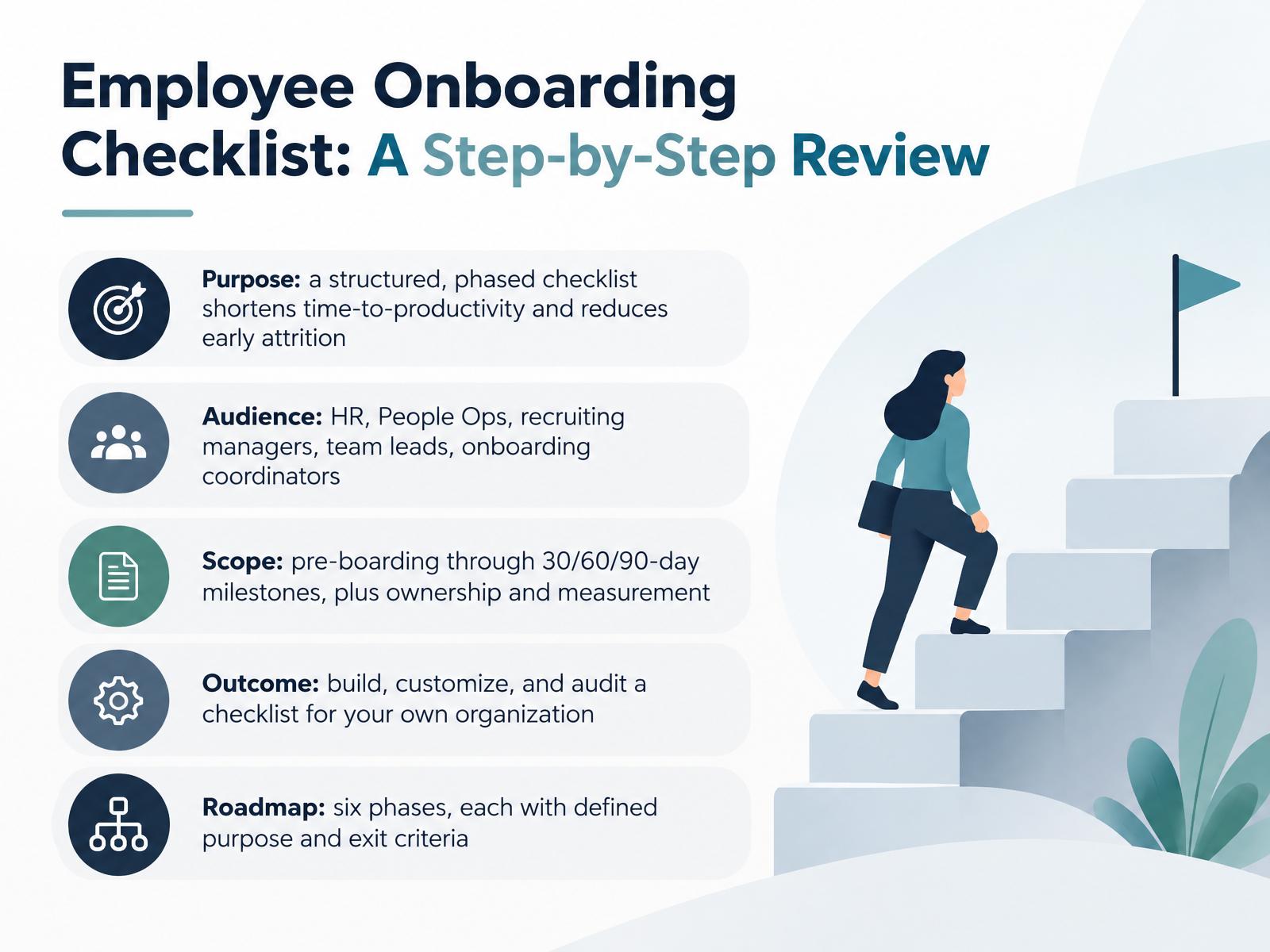
- 01Employee Onboarding Checklist: A Step-by-Step ReviewWelcome, and thank you for joining this review of the employee onboarding checklist. This session is built for HR, People Operations, recruiting managers, team leads, and onboarding coordinators, so we will keep it practical and precise.
Here is our goal. A structured, phased checklist shortens time to productivity and reduces early attrition. Over the next few slides, we will move from pre-boarding through the thirty, sixty, and ninety day milestones, and we will cover ownership and measurement along the way.
By the end, you will be able to build a checklist, customize it for your organization, and audit it for gaps. We will work through six phases. Each phase has a defined purpose and clear exit criteria, so you always know when to move forward. Let's start with why a checklist beats improvisation. That is the business case, and it is our next slide: Why a Checklist Beats Improvisation: The Business Case.randstad.comworkforceinsights.randstad.comdisco.co+21 min
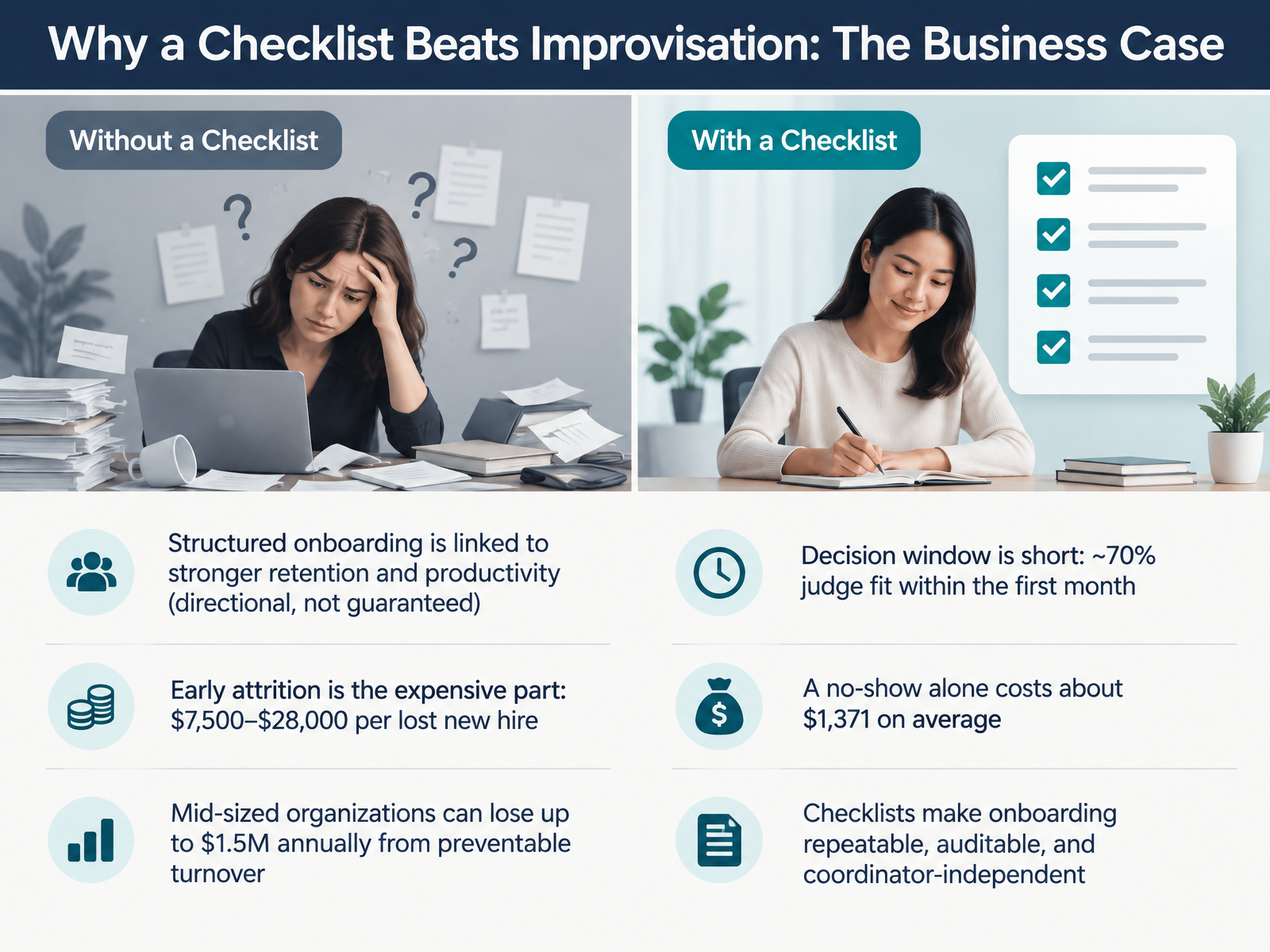
- 02Why a Checklist Beats Improvisation: The Business CaseLet's talk about why a checklist beats improvisation. Structured onboarding is linked to stronger retention and productivity, though treat that as directional, not guaranteed.
The real cost sits in early attrition. Losing a new hire within the first few months runs between seven thousand five hundred and twenty eight thousand dollars in recruitment and replacement expenses. For a mid-sized organization, preventable turnover can reach up to one point five million dollars a year.
And your decision window is short. About seventy percent of new hires decide whether the job is a good fit within their first month. A single no-show costs roughly one thousand three hundred seventy one dollars on average.
That's why a checklist matters. It makes onboarding repeatable, auditable, and independent of whoever happens to be coordinating that week.
Next, let's look at reading the numbers honestly, and what the benchmarks do and don't say.
 randstad.comworkforceinsights.randstad.comdisco.co+22 min
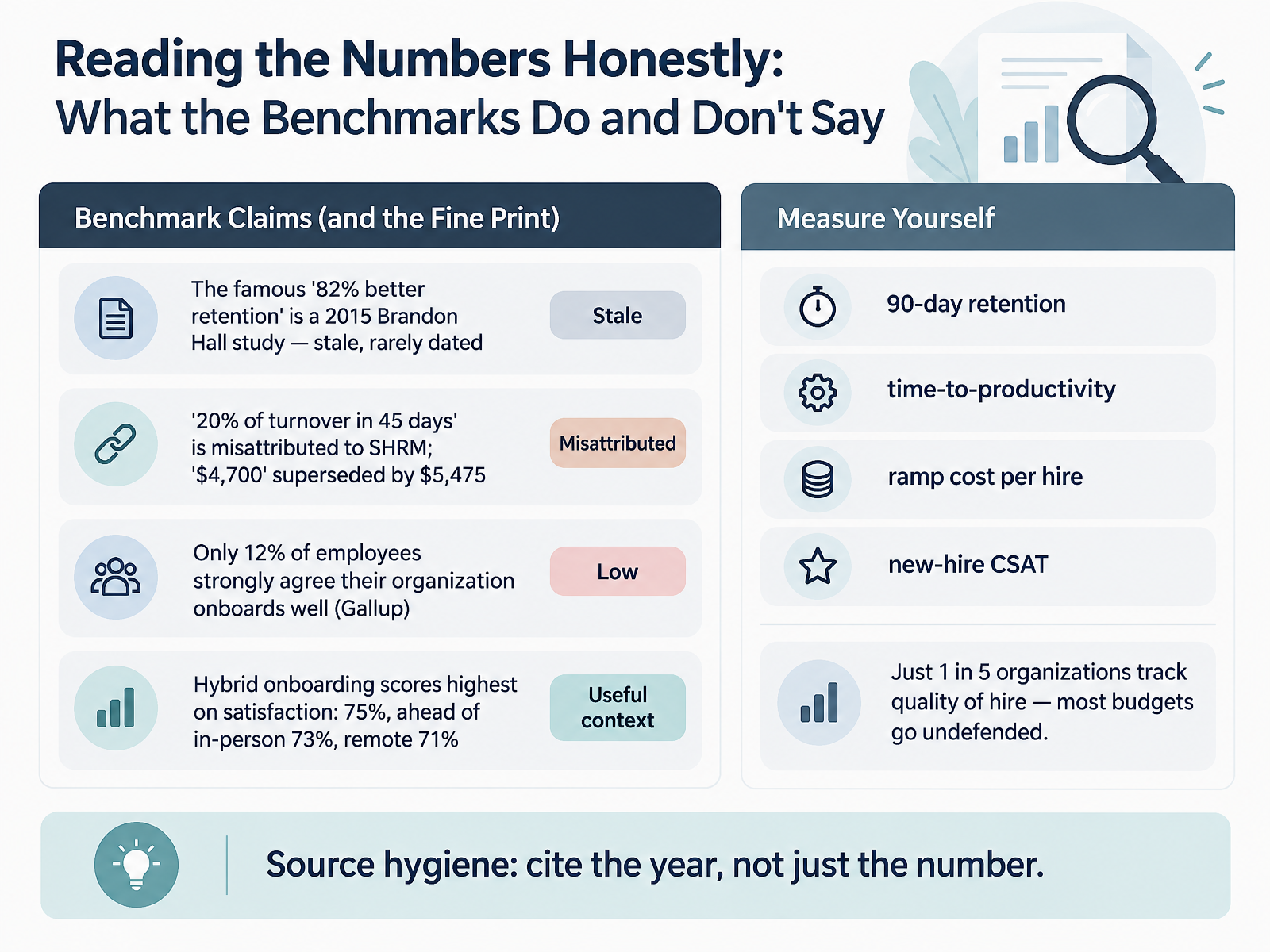
 - 03Reading the Numbers Honestly: What the Benchmarks Do and Don't SayNext, let's read the numbers honestly. Before you cite any onboarding benchmark, check the year. The famous eighty-two percent better retention figure comes from a twenty fifteen Brandon Hall study. It is stale and almost never dated. The twenty percent of turnover in forty-five days line is misattributed to SHRM. And the four thousand seven hundred dollar cost per hire has been superseded by SHRM's twenty twenty-five figure of five thousand four hundred seventy-five dollars. One stat does hold up at source: only twelve percent of employees strongly agree their organization onboards well, from Gallup. On delivery format, hybrid onboarding scores highest on satisfaction at seventy-five percent, ahead of in-person at seventy-three and remote at seventy-one. So what should you measure instead? Track ninety-day retention, time to productivity, ramp cost per hire, and new-hire satisfaction. And here's the gap that matters: only one in five organizations tracks quality of hire, which is exactly why onboarding budgets go undefended. The takeaway is simple. Cite the year, not just the number, and measure your own cohorts. Now let's move on to the structure itself, in The Six Phases of the Checklist: Pre-Boarding Through Day 90.
 onboarding-experience.netclickboarding.comonboardingcost.com+22 min
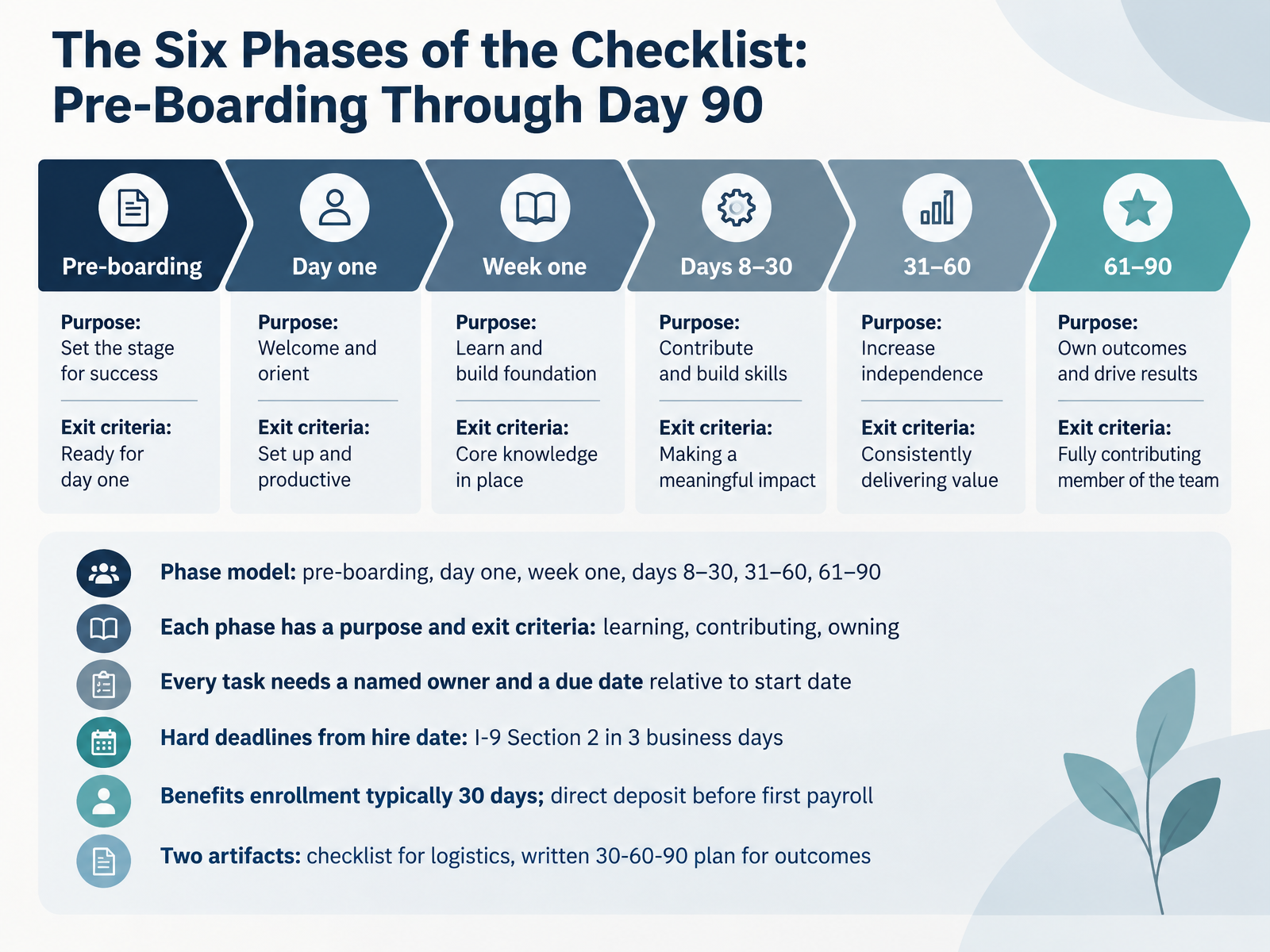
 - 04The Six Phases of the Checklist: Pre-Boarding Through Day 90Let's walk through the six phases of the checklist, from pre-boarding all the way to day ninety. The phases are pre-boarding, day one, week one, days eight to thirty, days thirty-one to sixty, and days sixty-one to ninety. Each phase has a purpose and an exit criteria. Early on, the goal is learning. Then contributing. By the final phase, owning the work. Every task needs a named owner and a due date relative to the start date, not a fixed calendar entry. That keeps the template reusable for every hire. Some deadlines are hard. Form I-9 Section Two must be completed within three business days of hire. Benefits enrollment is typically thirty days. And direct deposit should be set up before the first payroll. Finally, keep two artifacts. A checklist for logistics, and a written thirty-sixty-ninety plan for outcomes. Together, they keep your process consistent and compliant. Next, let's look at pre-boarding, and how to win the window before day one.
 cadenio.comsixfifty.comaccountablehq.com+21 min
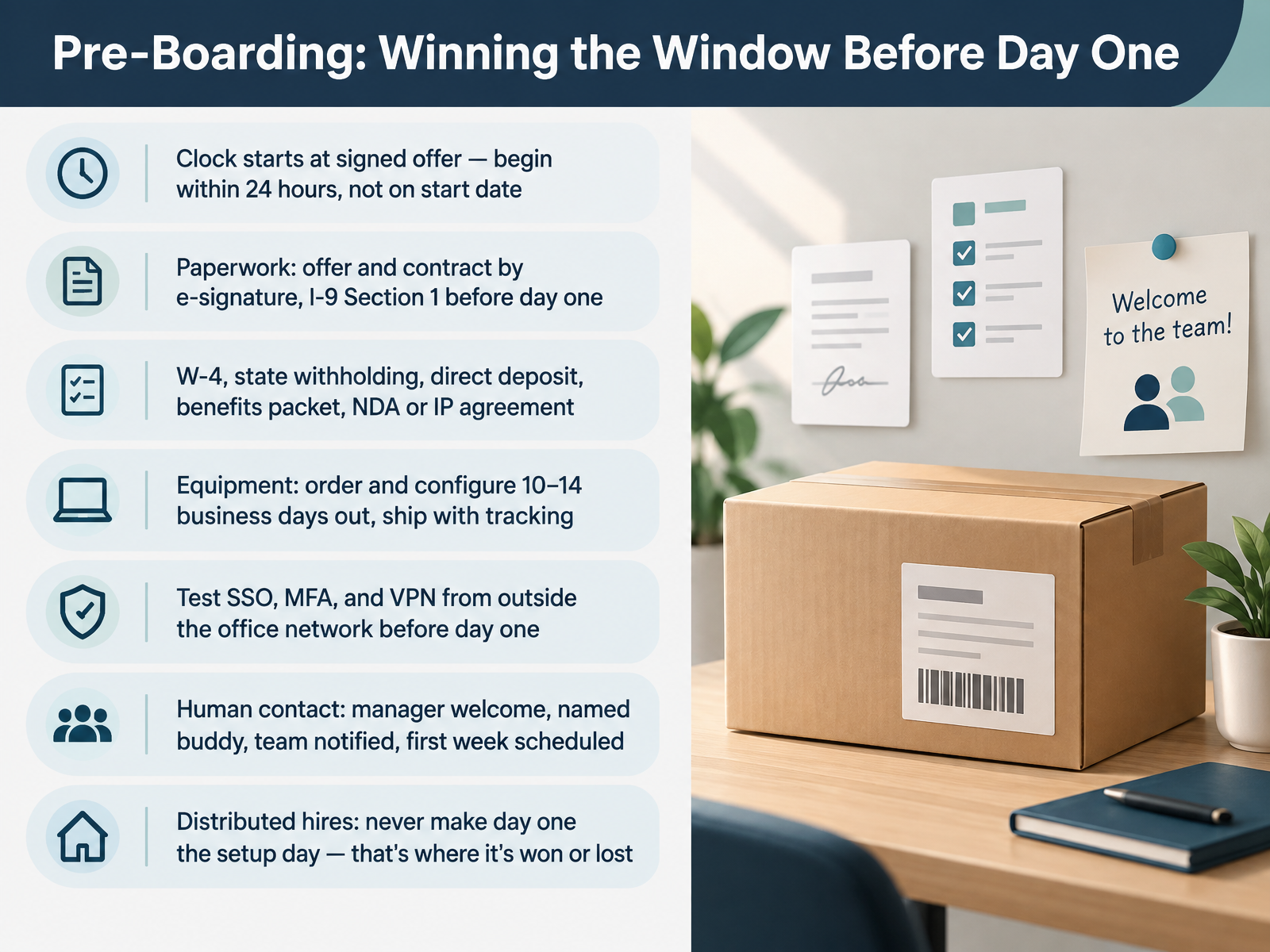
 - 05Pre-Boarding: Winning the Window Before Day OneLet's move on to pre-boarding, and how to win the window before day one. Here's the key shift: the clock starts when the offer is signed, not on the start date. So begin within twenty-four hours. Send the offer and contract by e-signature, and have the new hire complete I-9 Section One before day one. Then collect the W-4, state withholding, direct deposit, benefits packet, and any NDA or IP agreement in the same packet. For equipment, order and configure ten to fourteen business days out, and ship with tracking. Before day one, test SSO, MFA, and VPN from outside the office network, because a login that only works on site is not ready. Add human contact: a manager welcome, a named buddy, a notified team, and the first week scheduled. For distributed hires, never let day one be the setup day. That's where pre-boarding is won or lost. Now let's look at Day One and Week One: Compliance Without the Cold Open.
 cadenio.comsixfifty.comaccountablehq.com+22 min
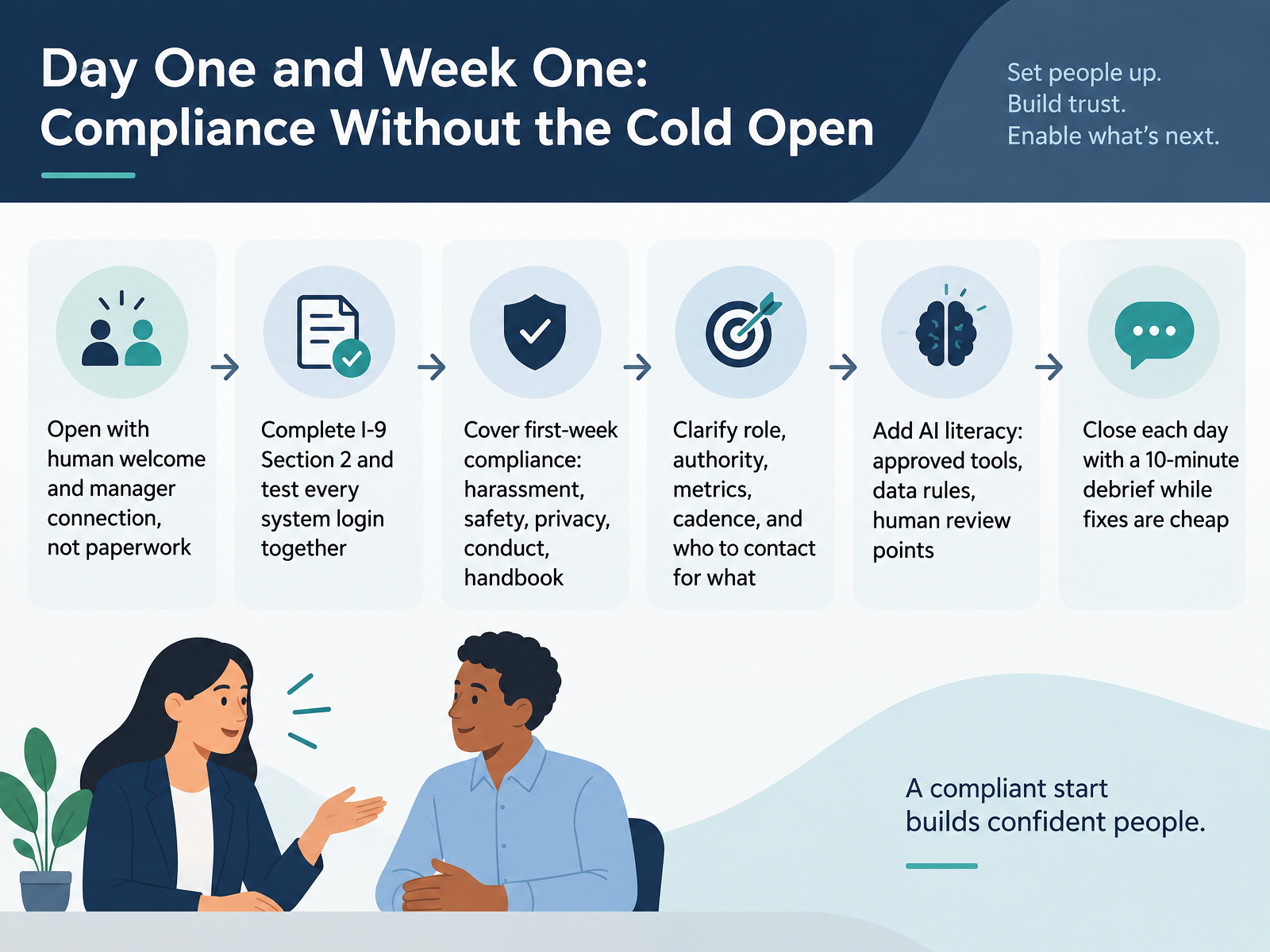
 - 06Day One and Week One: Compliance Without the Cold OpenNow let's look at Day One and Week One, where compliance should not feel like a cold open. Start with the human part. Welcome the new hire in person, and make sure the manager is there to connect first, before any paperwork. Then handle the legal essentials. Complete Form I-9 Section Two within three business days, and test every system login together, so nothing is left to chance.
Across the first week, cover the core compliance topics: harassment prevention, safety, privacy, conduct, and the handbook. Keep each session short and tied to that person's actual role. Next, clarify the role itself. What authority do they have, what metrics matter, and what is the cadence of check-ins? Confirm who to contact for what, whether that is I T, H R, their manager, or a buddy.
Then add AI literacy. Review approved tools, data rules, and where human review is required. And close each day with a ten-minute debrief, while fixes are still cheap. Ask three questions: what made sense, what was confusing, and what do you need tomorrow.
That rhythm sets up the coming month. Days 1 through 30: Building Competence and Connection.
 cadenio.comsixfifty.comaccountablehq.com+22 min
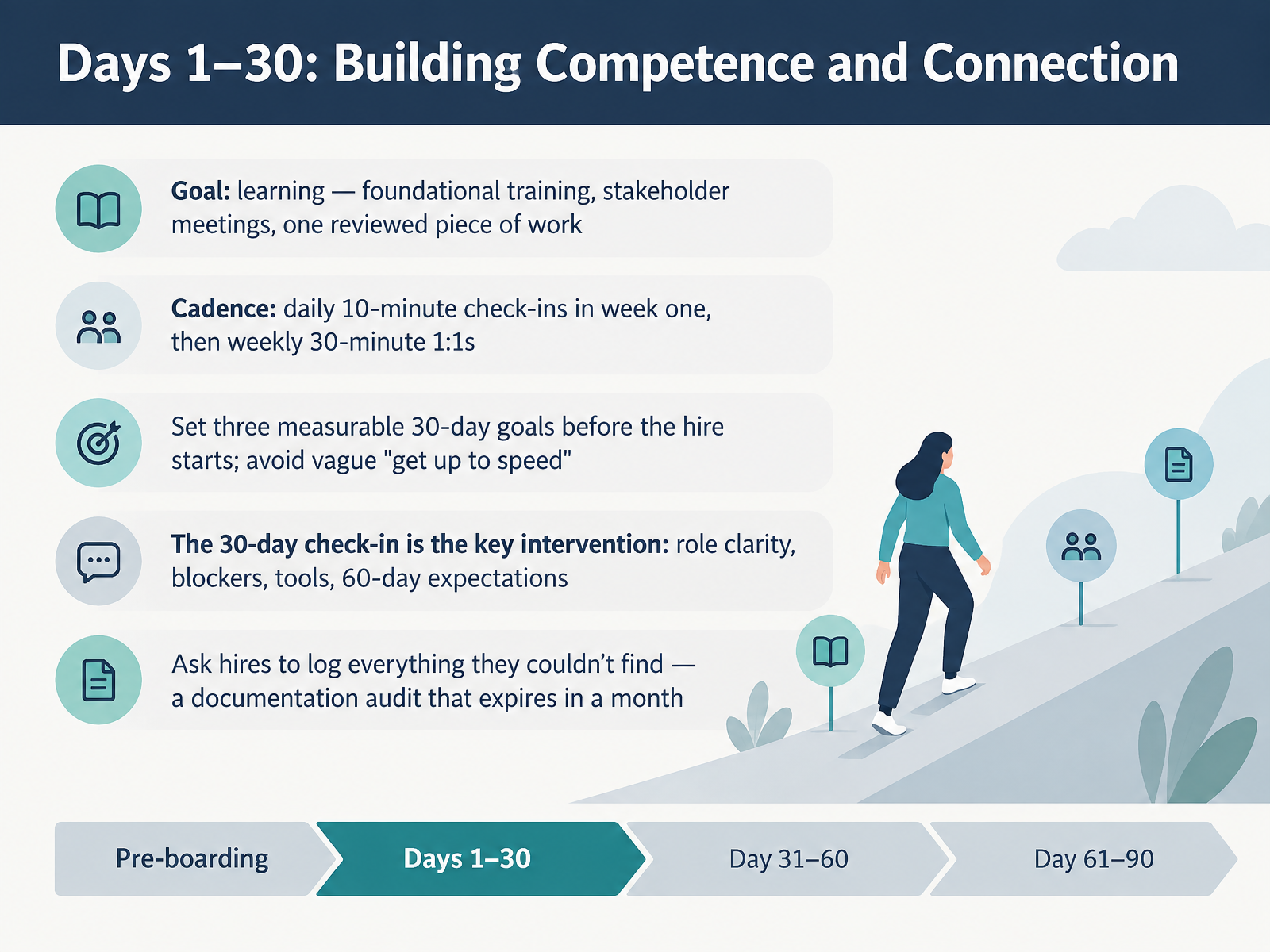
 - 07Days 1–30: Building Competence and ConnectionNow let's look at days one through thirty, where the focus is building competence and connection. The goal here is learning. That means foundational training, meetings with key stakeholders, and one piece of work that gets reviewed. For cadence, run daily ten-minute check-ins during week one, then move to weekly thirty-minute one-on-ones. Before the hire starts, set three measurable thirty-day goals. Avoid vague phrases like get up to speed. Be specific. The thirty-day check-in is your key intervention. Cover role clarity, blockers, tools, and expectations for the next sixty days. One more thing. Ask hires to log everything they couldn't find. That list is a documentation audit, and it expires in about a month. Next, we move into days thirty-one to sixty, from learning to contributing.
 clickboarding.comcheckflow.ioonboarding-experience.net+22 min
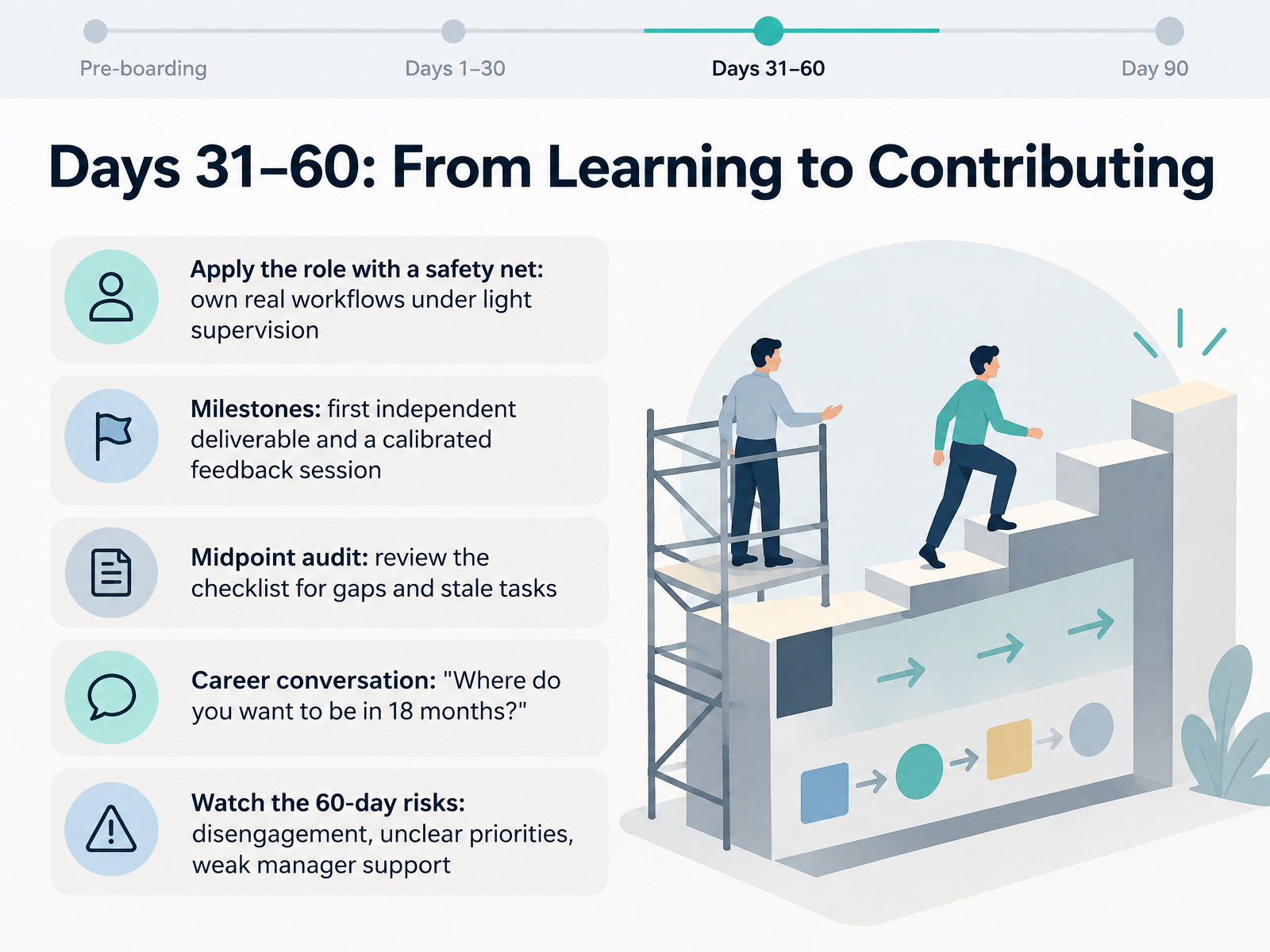
 - 08Days 31–60: From Learning to ContributingLet's move into days thirty one through sixty, where the focus shifts from learning to contributing. This is the apply phase. New hires start owning real workflows, but with a safety net: light supervision, not full independence yet. Set clear milestones. A first independent deliverable, and a calibrated feedback session so expectations stay aligned. At the midpoint, run an audit. Pull out the checklist and look for gaps or stale tasks that no longer fit the role. Then hold a career conversation. Ask directly: where do you want to be in eighteen months? Their answer tells you whether the work connects to their future. And watch the sixty day risks: disengagement, unclear priorities, and weak manager support. Those are the signals that quietly push people out the door. Catch them early. Next, we'll look at days sixty one through ninety: full integration, review, and closure.
 aihr.comevalflow.comcadenio.com1 min
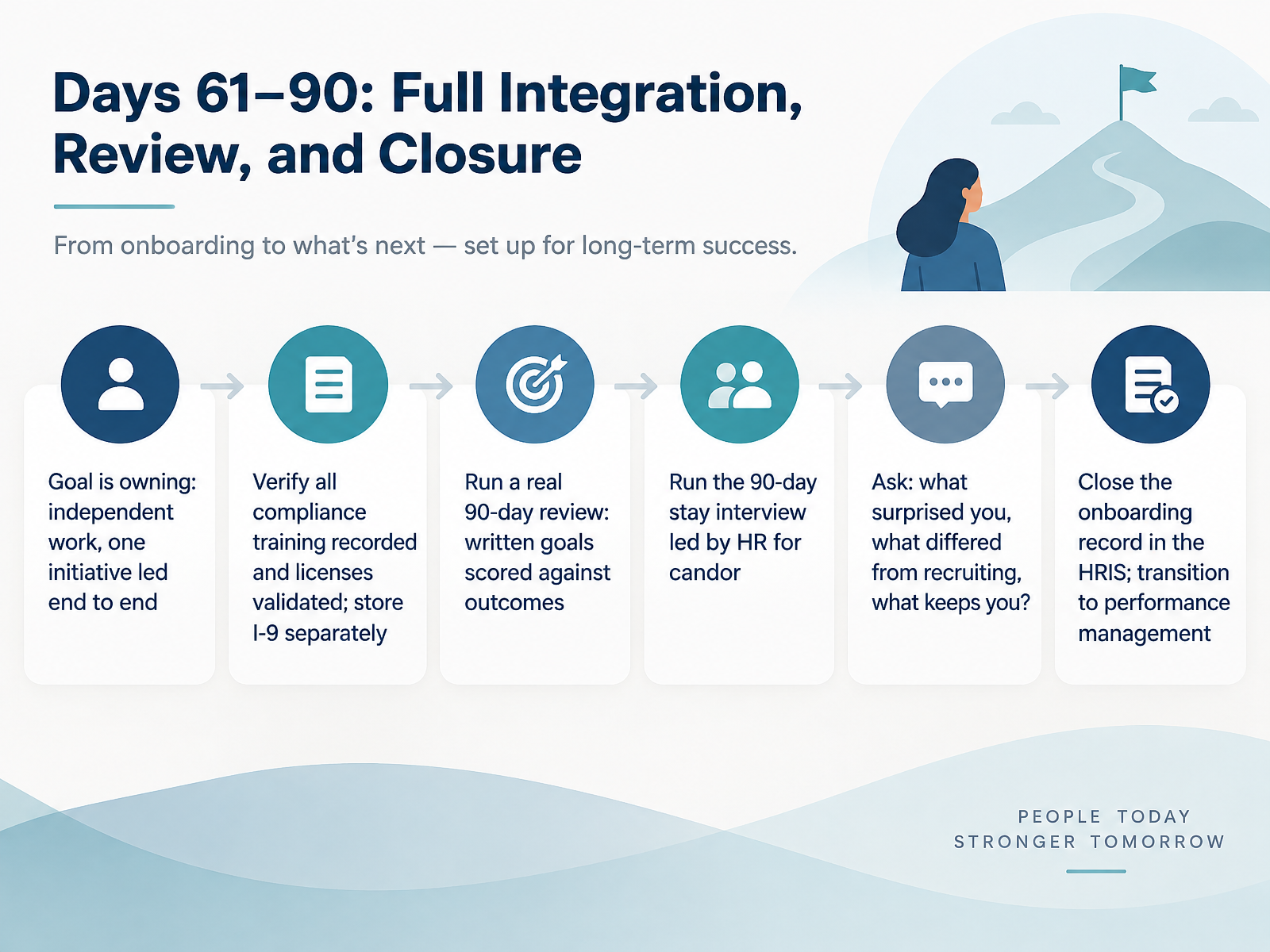
 - 09Days 61–90: Full Integration, Review, and ClosureNow we move into the final stretch of onboarding. Days sixty-one through ninety are about full integration. The goal here is simple to say and harder to do. The new hire should be owning their work independently, and they should have led at least one initiative from start to finish. Before you close this period, verify two things. Confirm that all compliance training is recorded, and that any licenses are validated. Remember, store I-9 forms separately from the personnel file. Next, run a real ninety-day review. Score written goals against actual outcomes. Then run the ninety-day stay interview, and have HR lead it so people can be candid. Ask three direct questions. What surprised you? What differed from what recruiting described? And what keeps you here? Finally, close the onboarding record in your HRIS, and transition that person into performance management. That close marks the shift from onboarding to ongoing growth. Let's look next at who owns each of these steps. Roles, Ownership, and Handoffs: Who Owns What, When.
 cadenio.comsixfifty.comaccountablehq.com+22 min
 - 10Roles, Ownership, and Handoffs: Who Owns What, WhenLet's talk about ownership. Onboarding works when every task has a clear home, so let's walk through who owns what.
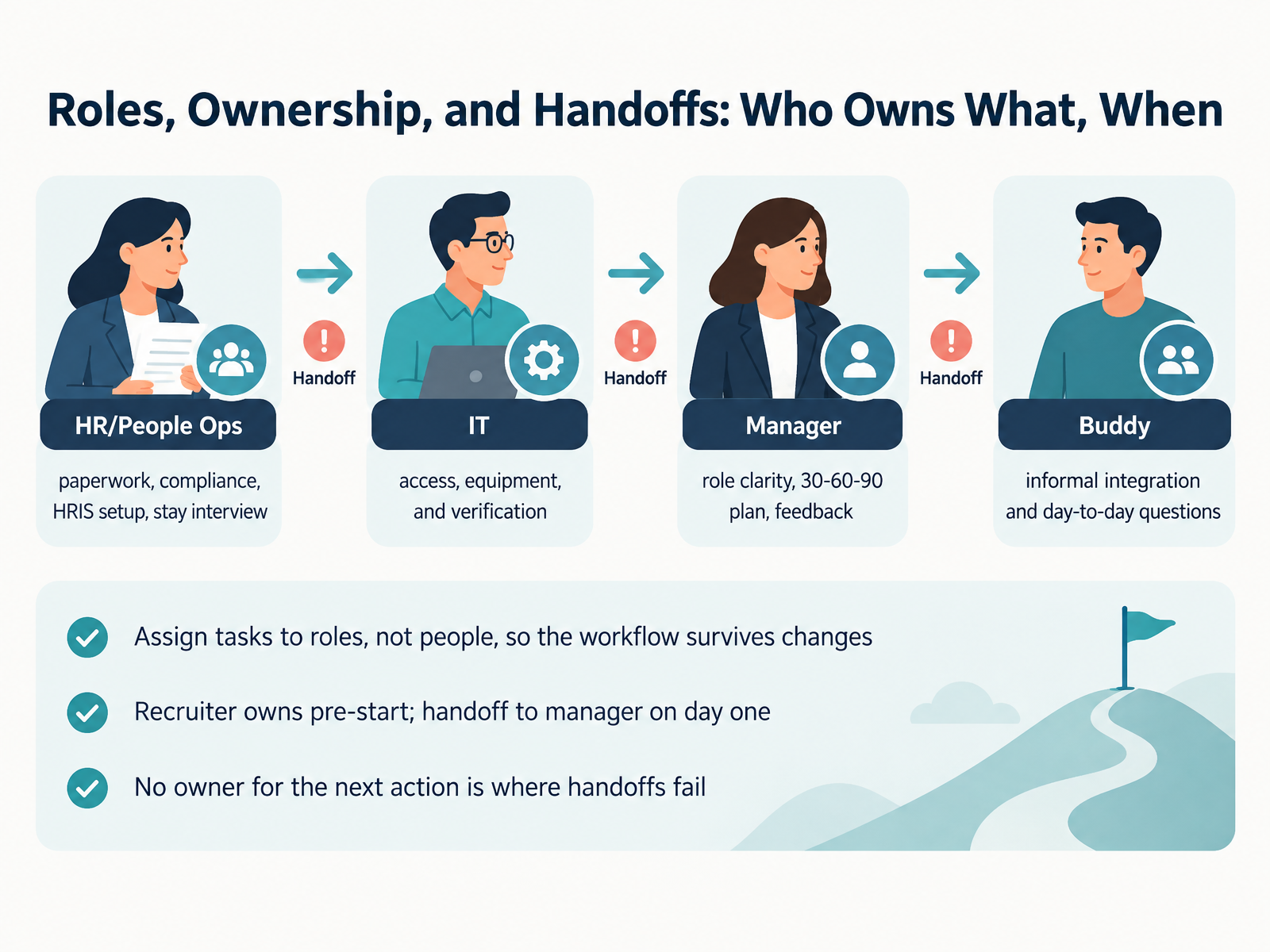
HR and People Ops own paperwork, compliance, HRIS setup, and the stay interview. IT owns access, equipment, and verification. The manager owns role clarity, the 30-60-90 plan, and feedback. And the buddy owns informal integration and day-to-day questions.
Here's the discipline that keeps this stable. Assign tasks to roles, not to people. That way, the workflow survives vacations, turnover, and team changes.
Watch the handoffs. The recruiter owns everything pre-start, then ownership passes to the manager on day one. Make that transfer explicit. As a rule, no owner for the next action is where handoffs fail.
So before your next hire starts, confirm each step has one clear owner and a defined moment of handoff. That single check prevents most dropped tasks.
Next, we'll look at Designing Your Checklist: Structure, Customization, and Systems.
 aihr.comevalflow.comcadenio.com+22 min
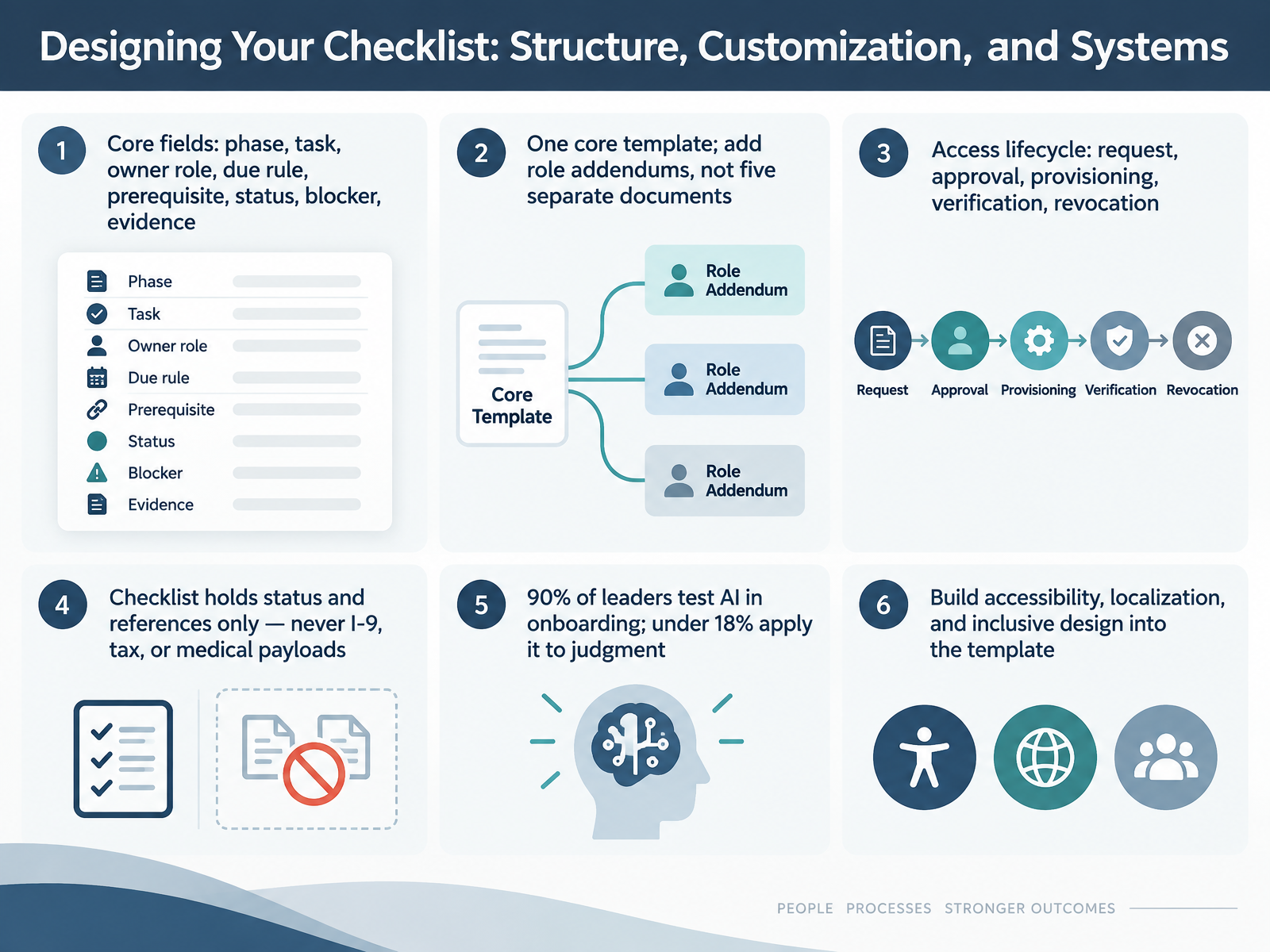
 - 11Designing Your Checklist: Structure, Customization, and SystemsNow let's talk about designing the checklist itself, so the structure stays consistent while the content flexes. Start with one core template built on a small set of fields: phase, task, owner role, due rule, prerequisite, status, blocker, and evidence. Then add role addendums for engineering, sales, or leadership, rather than maintaining five separate documents. For access, keep the lifecycle explicit: request, approval, provisioning, verification, and revocation. Note that this checklist holds status and references only. Never store I-9, tax, or medical payloads inside it; those belong in the approved systems that own them. On customization, most leaders are already testing AI in onboarding, but under eighteen percent apply it to judgment tasks like triage or drop-off prediction. Finally, build accessibility, localization, and inclusive design into the template from the start, not as a later patch. That keeps one source of truth usable across every hire. Next, we'll look at measuring success, covering metrics, feedback loops, and audit cadence.
 clickboarding.comcheckflow.ioonboarding-experience.net+22 min
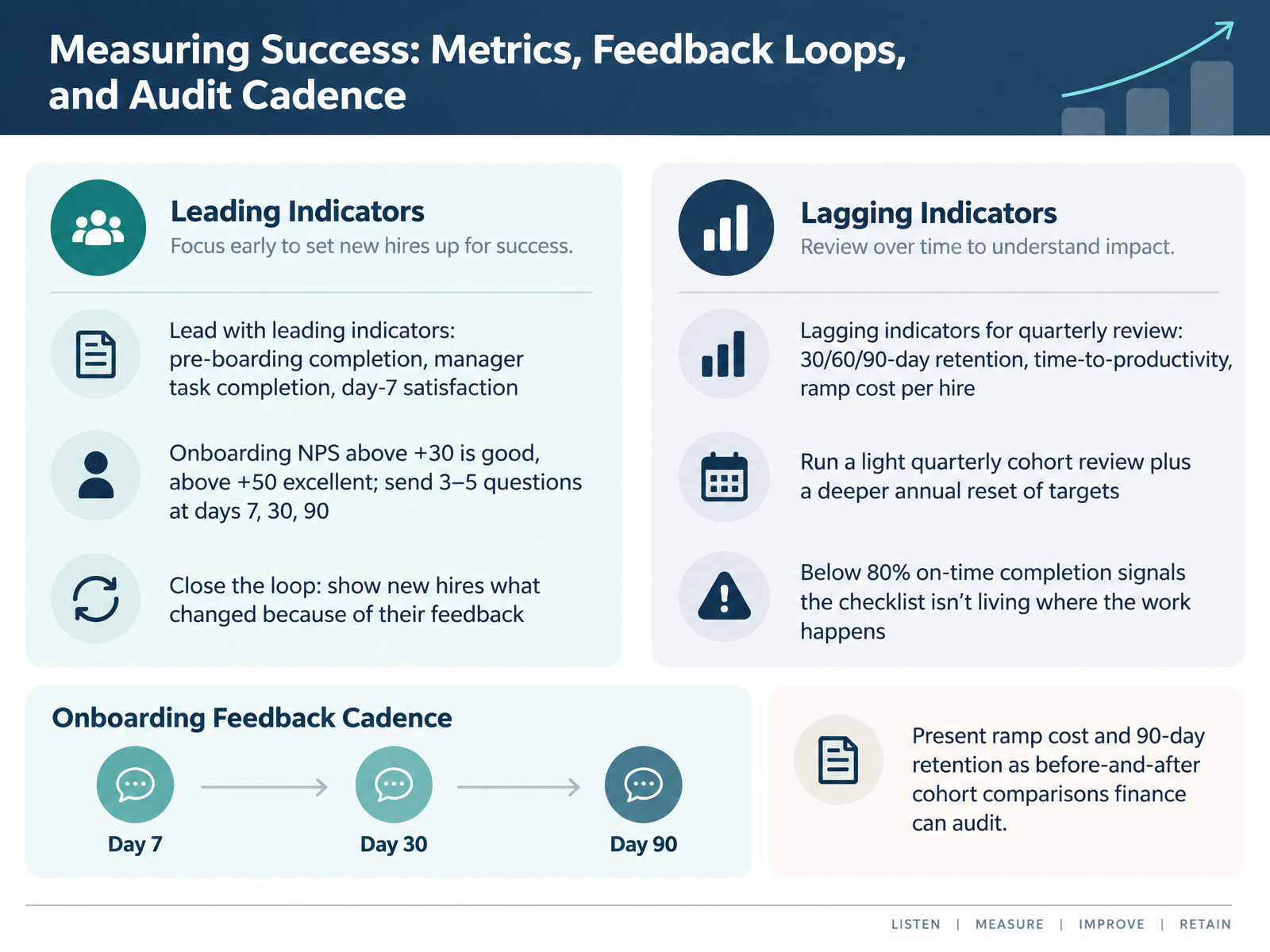
 - 12Measuring Success: Metrics, Feedback Loops, and Audit CadenceNow let's talk about measuring success. Start with leading indicators, because they tell you what to fix now. Track pre-boarding completion, manager task completion, and day seven satisfaction. If on-time completion drops below eighty percent, that's a signal the checklist isn't living where the work happens. For quarterly reviews, turn to lagging indicators: thirty, sixty, and ninety day retention, time to productivity, and ramp cost per hire. On onboarding NPS, above plus thirty is good, and above plus fifty is excellent. Send three to five questions at days seven, thirty, and ninety. Then run a light quarterly cohort review, plus a deeper annual reset of targets. And close the loop. Show new hires what changed because of their feedback. When you present ramp cost and ninety day retention as before-and-after cohort comparisons, finance can audit them. Next, Common Pitfalls and Fixes: A Checklist Health Screen.
 aihr.comevalflow.comcadenio.com+22 min
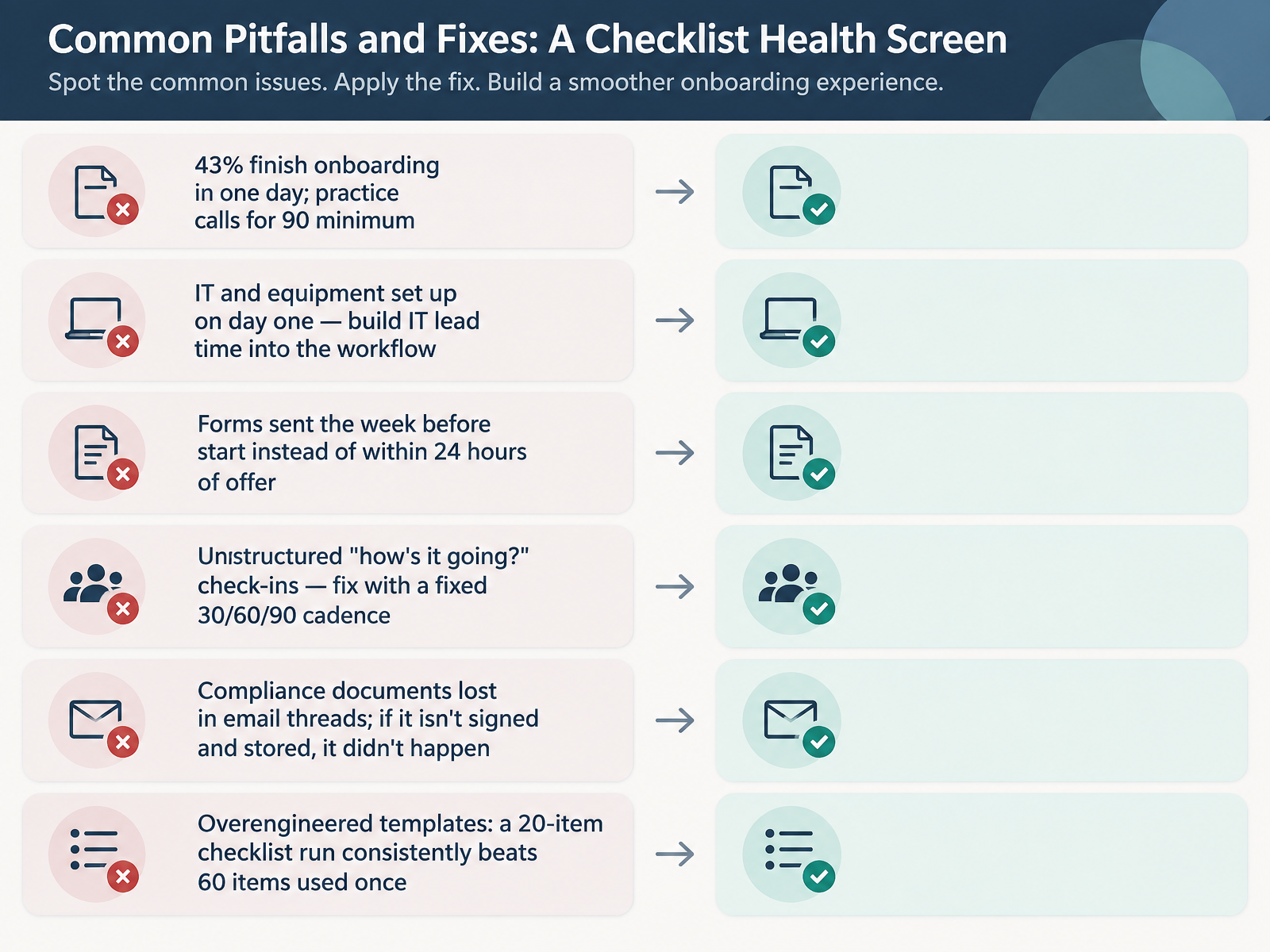
 - 13Common Pitfalls and Fixes: A Checklist Health ScreenLet's run a quick health screen on your checklist, because a few common pitfalls quietly undermine even well-designed onboarding. First, only forty-three percent of companies finish onboarding in a single day. Best practice calls for a minimum of ninety days, so treat orientation as day one, not the finish line. Second, don't set up IT and equipment on day one. Build IT lead time into the workflow so the laptop and all access are ready and tested before the hire arrives. Third, forms sent the week before start are too late. Send them within twenty-four hours of the offer. Fourth, unstructured how-is-it-going check-ins tend to go nowhere. Fix that with a fixed thirty, sixty, ninety day cadence. Fifth, compliance documents lost in email threads are a real risk. The rule is simple: if it isn't signed and stored, it didn't happen. Finally, avoid overengineered templates. A twenty-item checklist run consistently beats sixty items used once. Pick two of these to fix this quarter. Next, let's look at Your Next 30 Days: Building and Auditing Your Own Checklist.
 onboarding-experience.netclickboarding.comonboardingcost.com+22 min
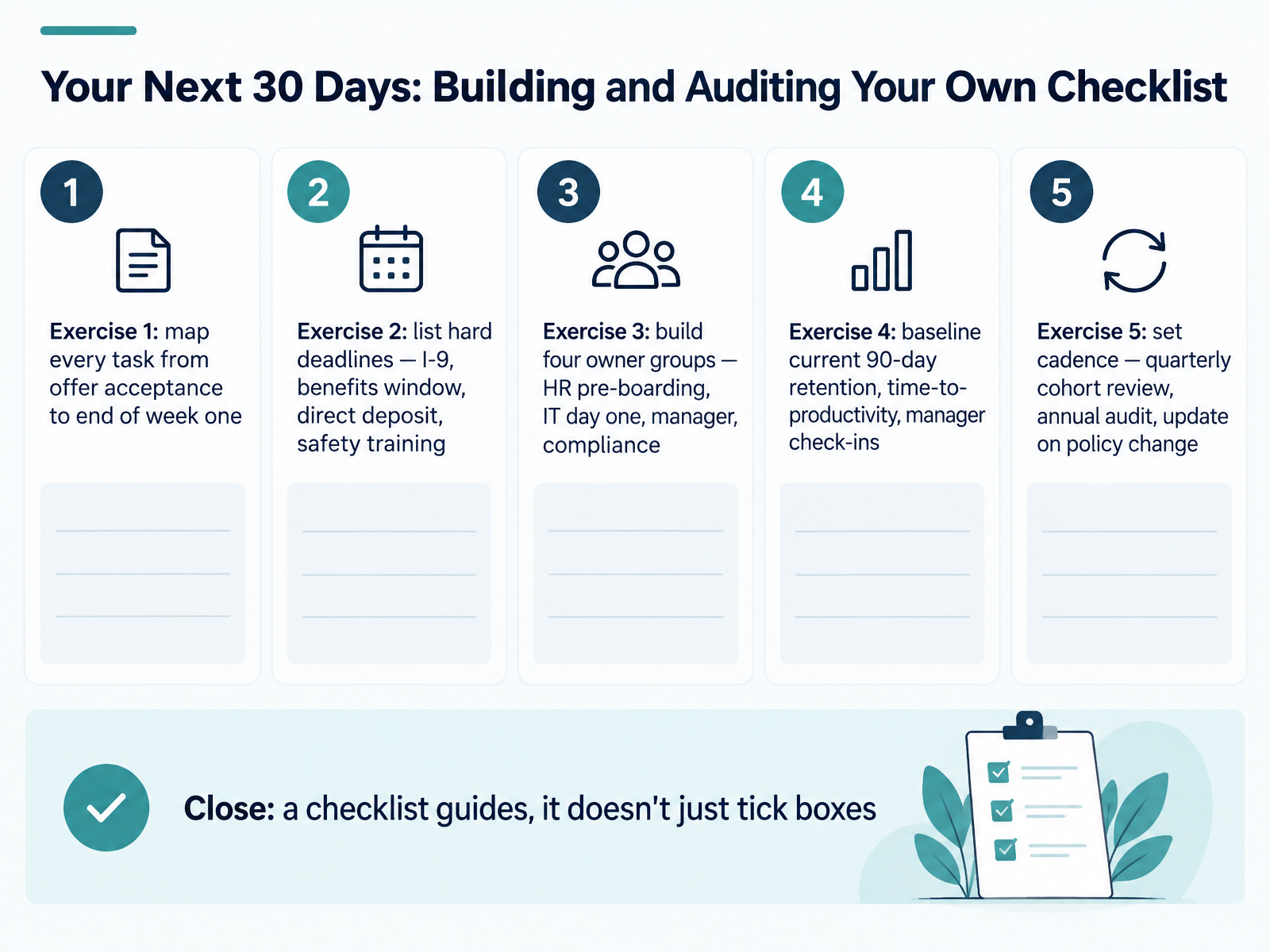
 - 14Your Next 30 Days: Building and Auditing Your Own ChecklistLet's close with action. Five exercises for your next thirty days. First, map every task from offer acceptance through the end of week one, and give each a named owner. Second, list your hard deadlines: I-9 by end of day three, the benefits window, direct deposit before first payroll, and any safety training tied to the role. Third, build four owner groups: HR pre-boarding, IT day one, the manager, and compliance. Fourth, baseline three numbers: ninety-day retention, time-to-productivity, and manager check-in completion. Fifth, set your cadence: a quarterly cohort review, an annual audit, and an update whenever policy changes. Keep one principle in mind. A checklist guides. It doesn't just tick boxes. Thank you for working through this with me, and build the next one with confidence.
 cadenio.comsixfifty.comaccountablehq.com+21 min
Take the deck with you
Download this course as a file — free, no sign-up needed.
- PDF handoutEvery slide page, ready to print or share.15 pages · 3.2 MBDownload
- Narrated PowerPointThe deck that presents itself — every slide carries the digital human's narration video.15 pages · 13.8 MBDownload
- PowerPoint slidesThe full deck as a .pptx — open it in PowerPoint, Keynote, or Google Slides.15 pages · 3.1 MBDownload
Free to use in your own training — please keep the PersonWise credit page at the end.
Have your own deck? Turn it into a course
Sources consulted
Web sources consulted while building this course.
- The true cost of poor onboarding: unveiling the hidden expenses. — randstad.com
- download | calculator: the costs of poor onboarding — workforceinsights.randstad.com
- The $1.5M problem: what poor onboarding actually costs your company — disco.co
- What poor employee onboarding really costs (Australia) | RosterElf Blog — rosterelf.com
- The State of High-Volume Onboarding 2026 | Onboarded — onboarded.com
- The 2026 onboarding benchmarks that actually move a comex, and the ones to stop citing — onboarding-experience.net
- 18 Jaw-Dropping Onboarding Statistics | Click Boarding — clickboarding.com
- 2026 Onboarding Cost Benchmarks: SHRM, Gallup, Brandon Hall, Aberdeen | OnboardingCost.com — onboardingcost.com
- 50+ Employee Onboarding Statistics (2025-2026) | FirstHR — firsthr.app
- Employee onboarding checklist: from day-1 tasks to 90-day compliance checkpoints | Cadenio — cadenio.com
- How to Build a Compliant Employee Onboarding Process — sixfifty.com
- Healthcare Employee Onboarding Best Practices: Compliance, Training, and a 90-Day Checklist — accountablehq.com
- Employee Onboarding Checklist for Small Business | FirstHR — firsthr.app
- Employee Onboarding Checklist: Pre-Boarding Through 90 Days [Free Template 2026] — evalflow.com
- The essential employee preboarding checklist - Click Boarding — clickboarding.com
- Remote Employee Onboarding Checklist: The Complete 2026 Guide | CheckFlow — checkflow.io
- Pre-boarding for distributed teams: building connection, compliance, and culture readiness when your new hire is 3,000 miles from the office — onboarding-experience.net
- How to Build a Remote Onboarding Checklist (2026 Template) | Latestremote — latestremote.com
- Preboarding Checklist: What to Do Before Day One — trainual.com
- New Hire Checklist: A Complete Guide for HR [+ 4 Free Templates] - AIHR — aihr.com