Operations Management Skills
Begin
14 pages · ~28 min
Operations Management Skills
This training equips operations professionals with essential operations management skills and practical techniques to improve processes and drive operational performance.
What you’ll learn
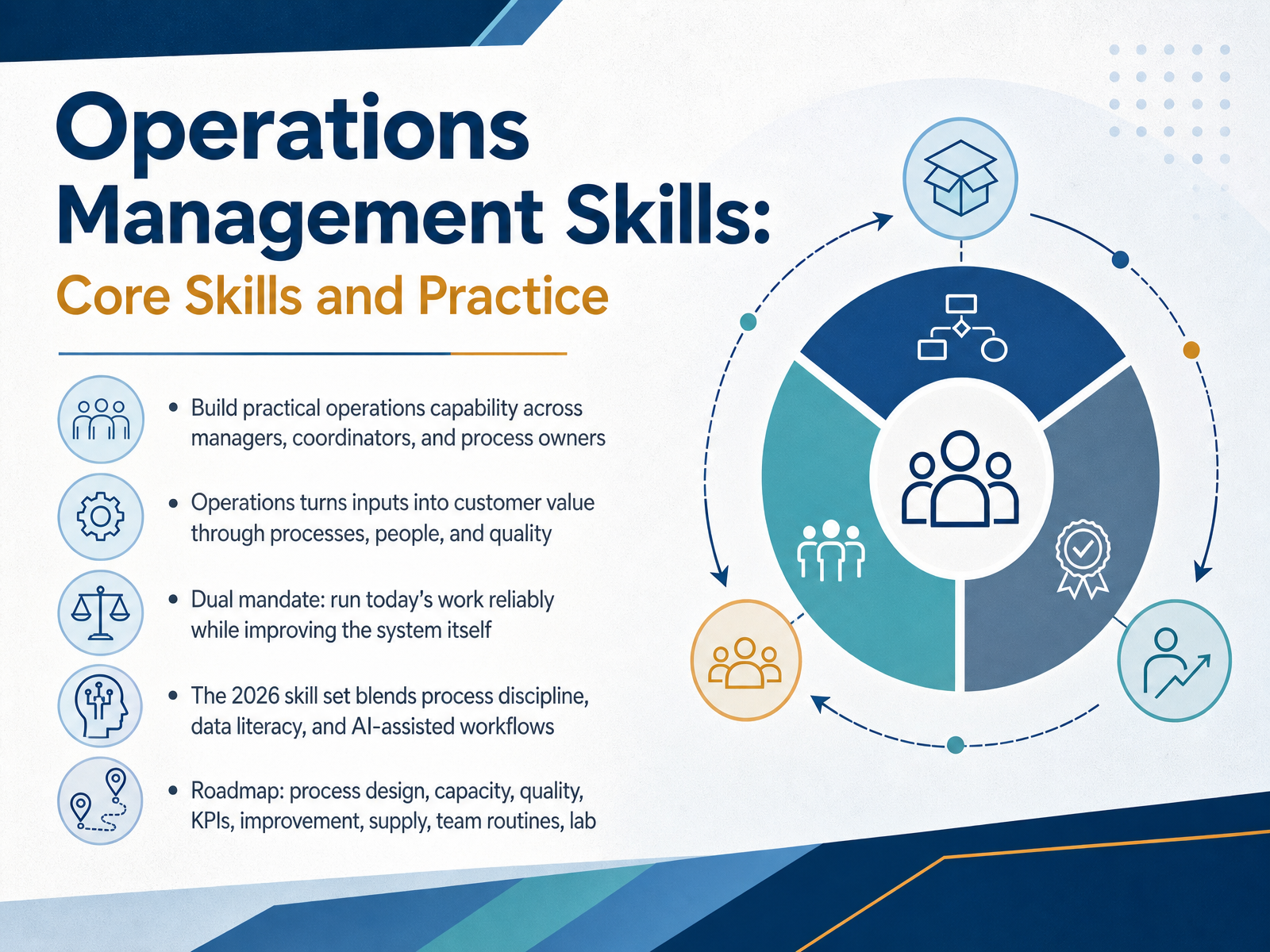
- 01Operations Management Skills: Core Skills and PracticeWelcome. I'm glad you're here. Over the next fourteen short lessons, we're going to build practical operations management skills you can apply in your role right away. This course is designed for operations managers, coordinators, process owners, team leaders, and early-career professionals. So whether you're running a shift, owning a process, or stepping into operations for the first time, you'll find something useful here.
So what is operations management? At its core, operations turns inputs into customer value through processes, people, and quality. Think of a fulfillment center receiving an order, picking the item, packing it, and shipping it on time. That's operations at work.
There's a dual mandate you'll hear us return to. Run today's work reliably, while also improving the system itself. That balance between delivery and improvement is where the real skill lives.
The 2026 skill set blends three things: process discipline, data literacy, and AI-assisted workflows. You don't need to be a data scientist, but you do need to read a dashboard, spot a trend, and ask better questions.
Here's our roadmap. We'll cover process design, capacity, quality, KPIs, improvement, supply, team routines, and a hands-on lab. Let's get started with the operations system itself.jobdescription.orgbusiness.linkedin.comresearchgate.net+22 min
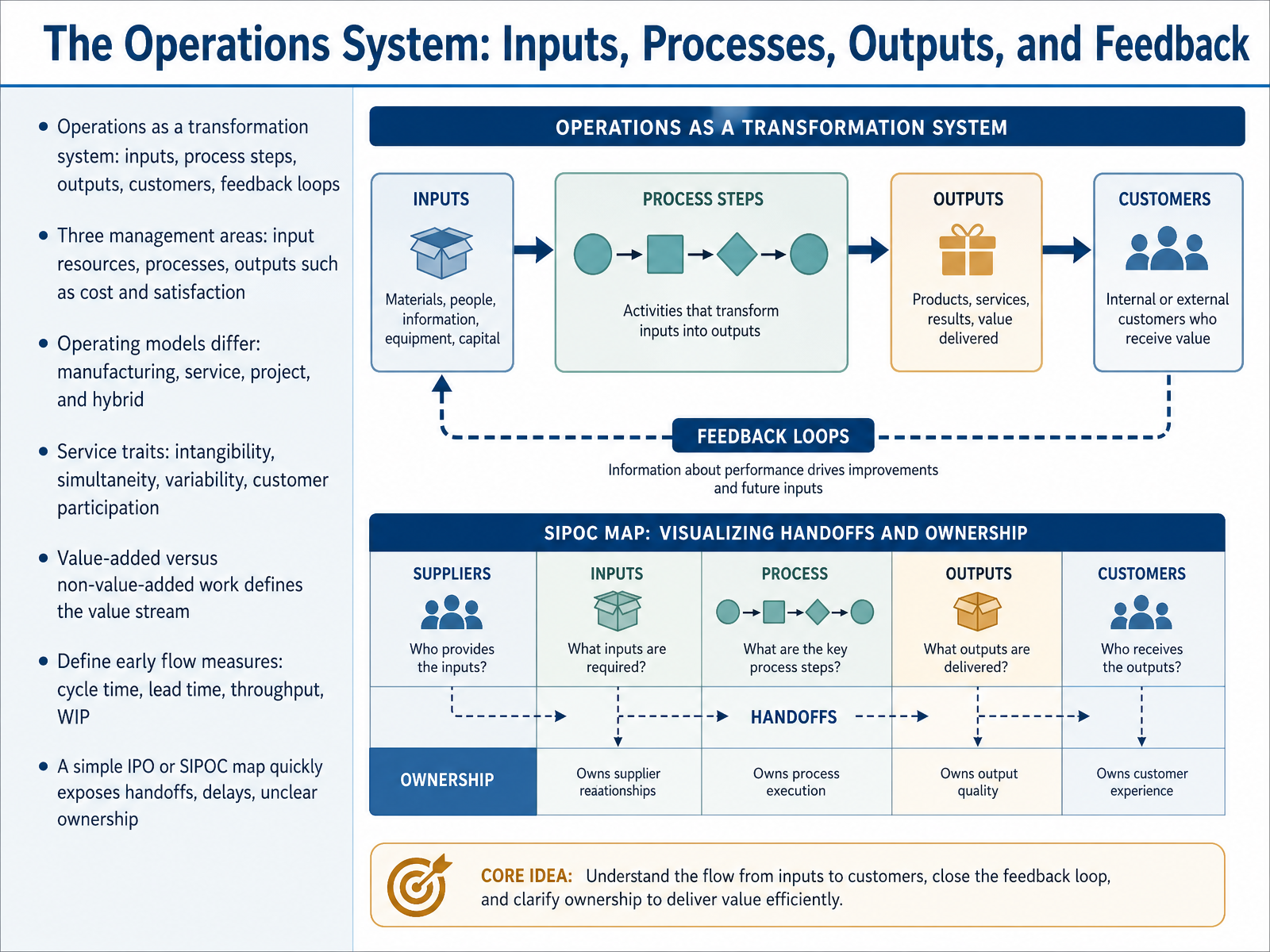
- 02The Operations System: Inputs, Processes, Outputs, and FeedbackLet's look at operations as a system. Every operation transforms inputs into outputs. Inputs are your resources: people, equipment, materials, and information. The process is the series of steps that turn those inputs into something valuable. Outputs include products, services, cost, and customer satisfaction, with feedback loops that tell you how well you're doing.
As an operations manager, you focus on three areas: managing input resources, managing processes, and managing outputs. Operating models differ too. Manufacturing, service, project, and hybrid operations each behave differently. Service work adds four traits: intangibility, simultaneity, variability, and customer participation.
Not all work adds value. Separating value-added from non-value-added steps defines your value stream. Early on, define flow measures: cycle time, lead time, throughput, and work in process. A simple input, process, output map, or a SIPOC map, quickly exposes handoffs, delays, and unclear ownership.
So start by mapping one process you own and measure its flow.
Next, we'll build your first core skill: process design and standard work.
 open.edubusiness.adobe.comisixsigma.com+22 min
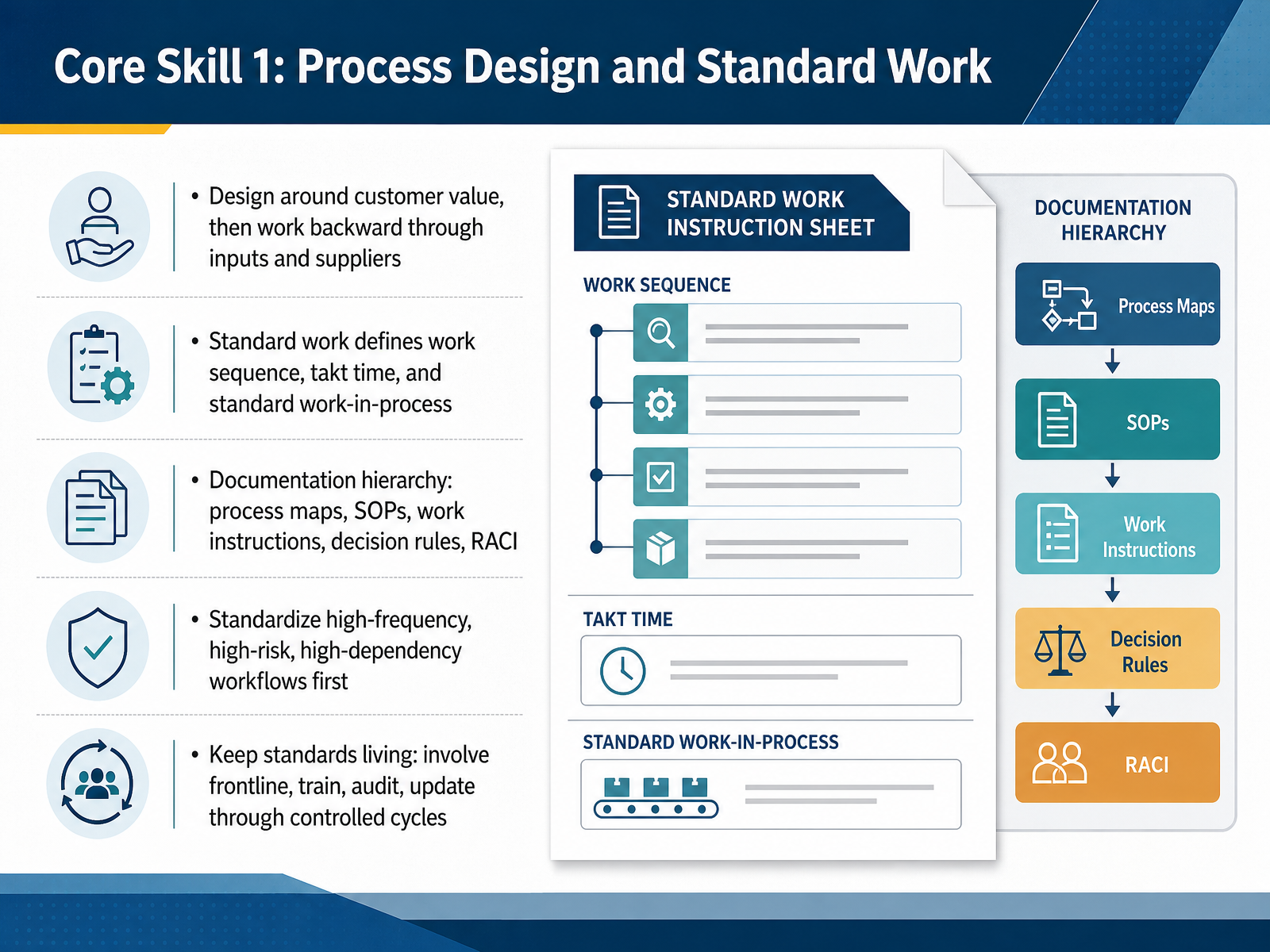
 - 03Core Skill 1: Process Design and Standard WorkLet's move on to our first core skill: process design and standard work. Start with the customer. Ask what value they actually need, then work backward through the outputs, the steps, the inputs, and finally the suppliers who provide them. A simple framework called SIPOC guides that thinking. Next, standard work. This is more than a document. It defines the work sequence, the takt time, which is the pace set by customer demand, and the standard work in process, the minimum amount of work in the system to keep things flowing. Your documentation sits in layers. Process maps at the top, then standard operating procedures, work instructions, decision rules, and a RACI chart that clarifies who is responsible and who is accountable. When you decide what to standardize first, look for workflows that are high frequency, high risk, or high dependency, like project intake, approvals, or handoffs between teams. And keep standards alive. Involve frontline staff, train people properly, audit adherence, and update through controlled review cycles. A standard is your current best method, not a permanent one. Coming up next, Core Skill 2: Capacity, Demand, and Flow Management.
 aisberg.unibg.itresearchgate.netsysgenpro.com+22 min
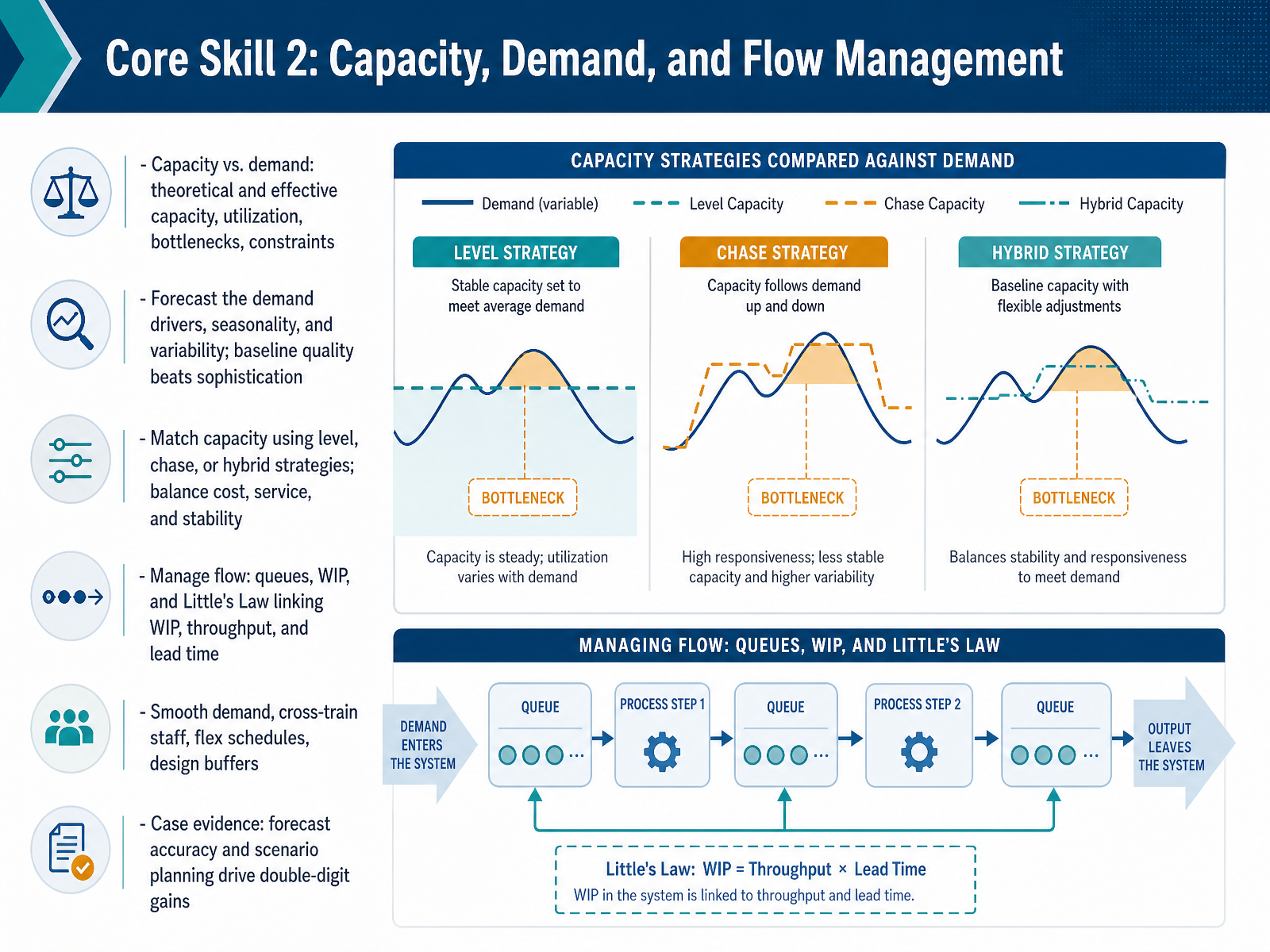
 - 04Core Skill 2: Capacity, Demand, and Flow ManagementLet's move on to our second core skill: capacity, demand, and flow management. In plain terms, this is about making sure you have the right resources, in the right place, at the right time. Start with capacity. Theoretical capacity is what your line or team could do under perfect conditions. Effective capacity is what you can realistically achieve once you factor in changeovers, breaks, and downtime. Utilization tells you how much of that capacity you are using, and the bottleneck is the step that limits your entire throughput. You have probably felt this when one slow handoff holds up everything downstream. On the demand side, forecast the drivers, seasonality, and variability. And remember, a solid baseline beats a sophisticated model every time. To match supply and demand, choose a level, chase, or hybrid strategy, balancing cost, service, and stability. Then manage flow. Queues, work in progress, and Little's Law connect WIP, throughput, and lead time. When WIP goes up, lead time usually follows. To smooth things out, cross-train staff, flex schedules, and design buffers. The evidence backs this up. Better forecast accuracy and scenario planning have driven double-digit gains and lower overtime in real operations. Coming next, Core Skill 3: Quality, Consistency, and Customer Requirements.
 anylogic.commu-sigma.comnvidia.com+22 min
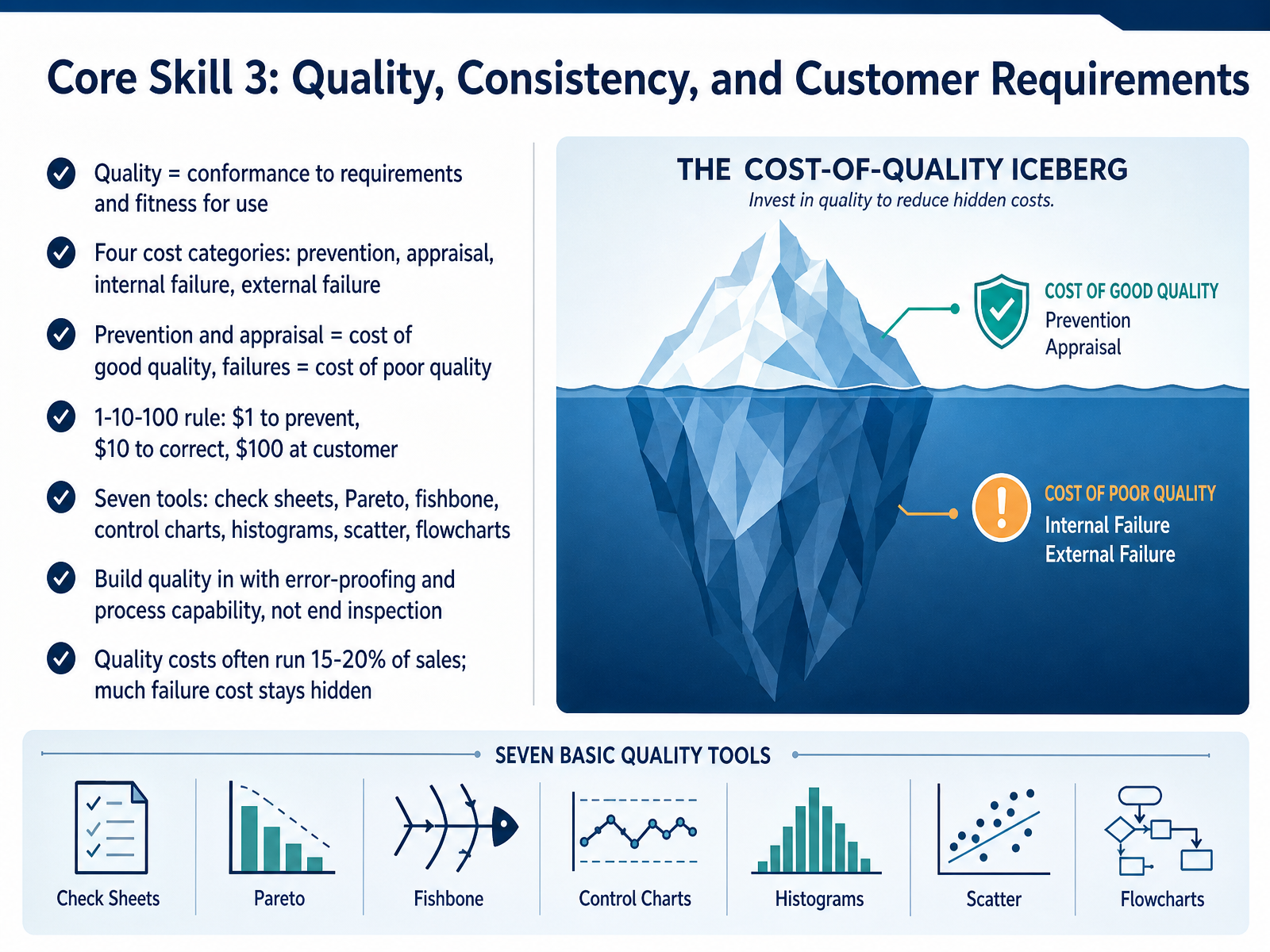
 - 05Core Skill 3: Quality, Consistency, and Customer RequirementsLet's move on to the third core skill, quality, consistency, and customer requirements. In operations, quality simply means conformance to requirements and fitness for use. In other words, you deliver what you promised, and it works the way the customer needs it to work. Quality costs fall into four categories. Prevention and appraisal are the cost of good quality. Internal and external failure are the cost of poor quality. The 1-10-100 rule makes the tradeoff clear. One dollar to prevent a defect, ten dollars to correct it internally, and one hundred dollars once it reaches your customer. A useful toolkit here includes check sheets, Pareto charts, fishbone diagrams, control charts, histograms, scatter plots, and flowcharts. The goal is to build quality in through error-proofing and process capability, not to inspect it in at the end. Across industries, quality costs often run fifteen to twenty percent of sales, and much of the failure cost stays hidden in scrap, rework, and overtime. So before we move into how you measure performance, keep this in mind. Prevention is usually the cheapest quality decision you can make. Next, we turn to Core Skill 4: Performance Measurement and Operational KPIs.
 2 min
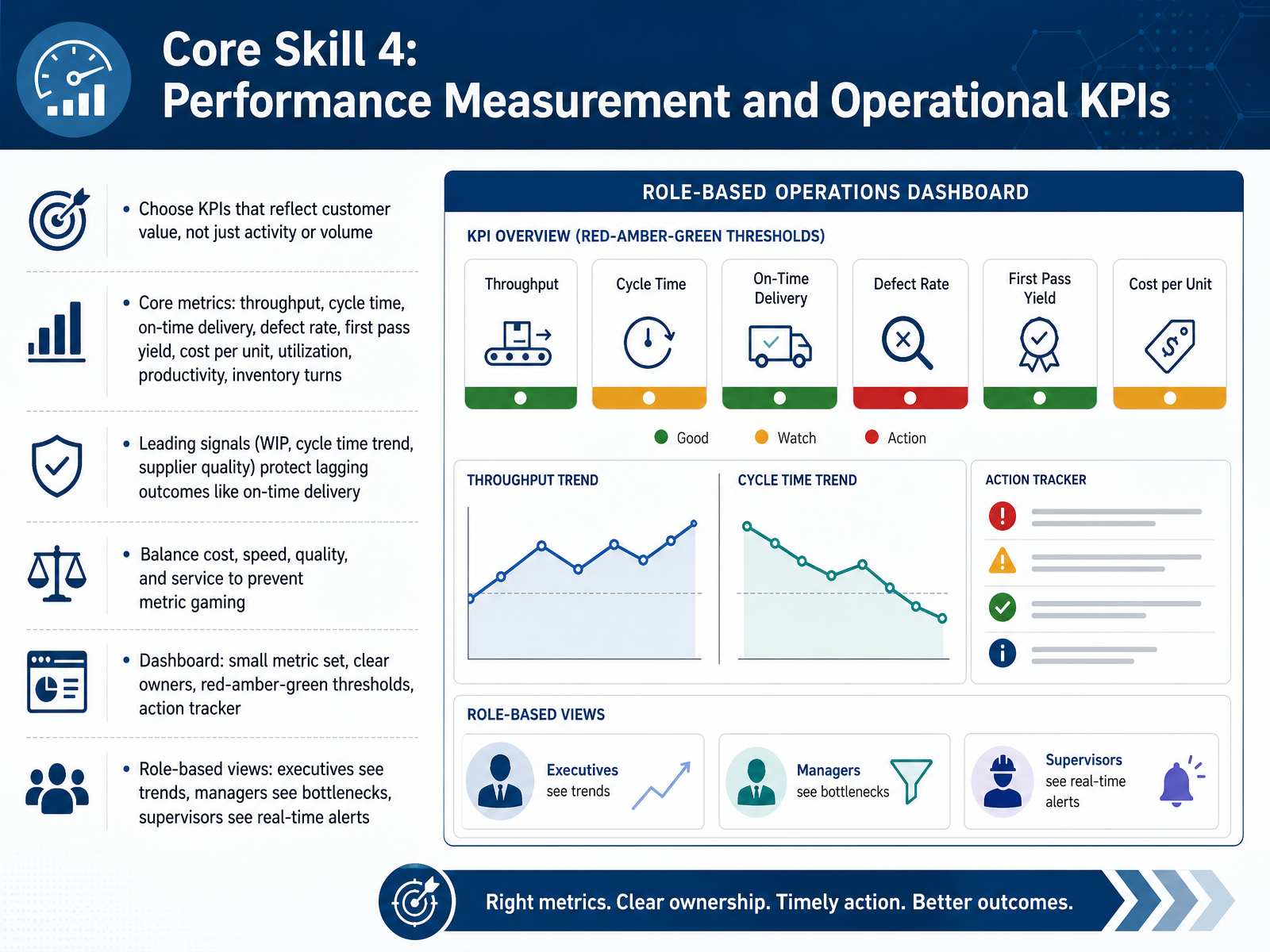
2 min - 06Core Skill 4: Performance Measurement and Operational KPIsLet's turn now to core skill four: performance measurement and operational KPIs. Here's the principle that matters most. Choose KPIs that reflect customer value, not just activity or volume. Shipping a thousand units means little if they arrive late or defective. So which numbers should you watch? Throughput, cycle time, on-time delivery, defect rate, first pass yield, cost per unit, utilization, productivity, and inventory turns. Notice that some of these lead and some lag. Work in progress, cycle time trends, and supplier quality are leading signals. They move first, and they protect lagging outcomes like on-time delivery. So when WIP spikes at one step, treat it as an early warning. It usually means cycle time is about to stretch. Now, a caution. If you push one metric too hard, people will optimize it at the expense of others. Balance cost, speed, quality, and service together to prevent that kind of gaming. Your dashboard should stay small: a focused metric set, a clear owner for each one, red, amber, and green thresholds, and an action tracker so problems turn into tasks. And remember that different roles need different views. Executives want trends. Managers want bottlenecks. Supervisors want real-time alerts. Build one source of truth, then slice it by role. Before we move on, take one action: pick three KPIs that reflect customer value, name an owner for each, and set your thresholds. That is where measurement becomes management. Next, we look at Core Skill 5: Continuous Improvement and Problem Solving.
 2 min
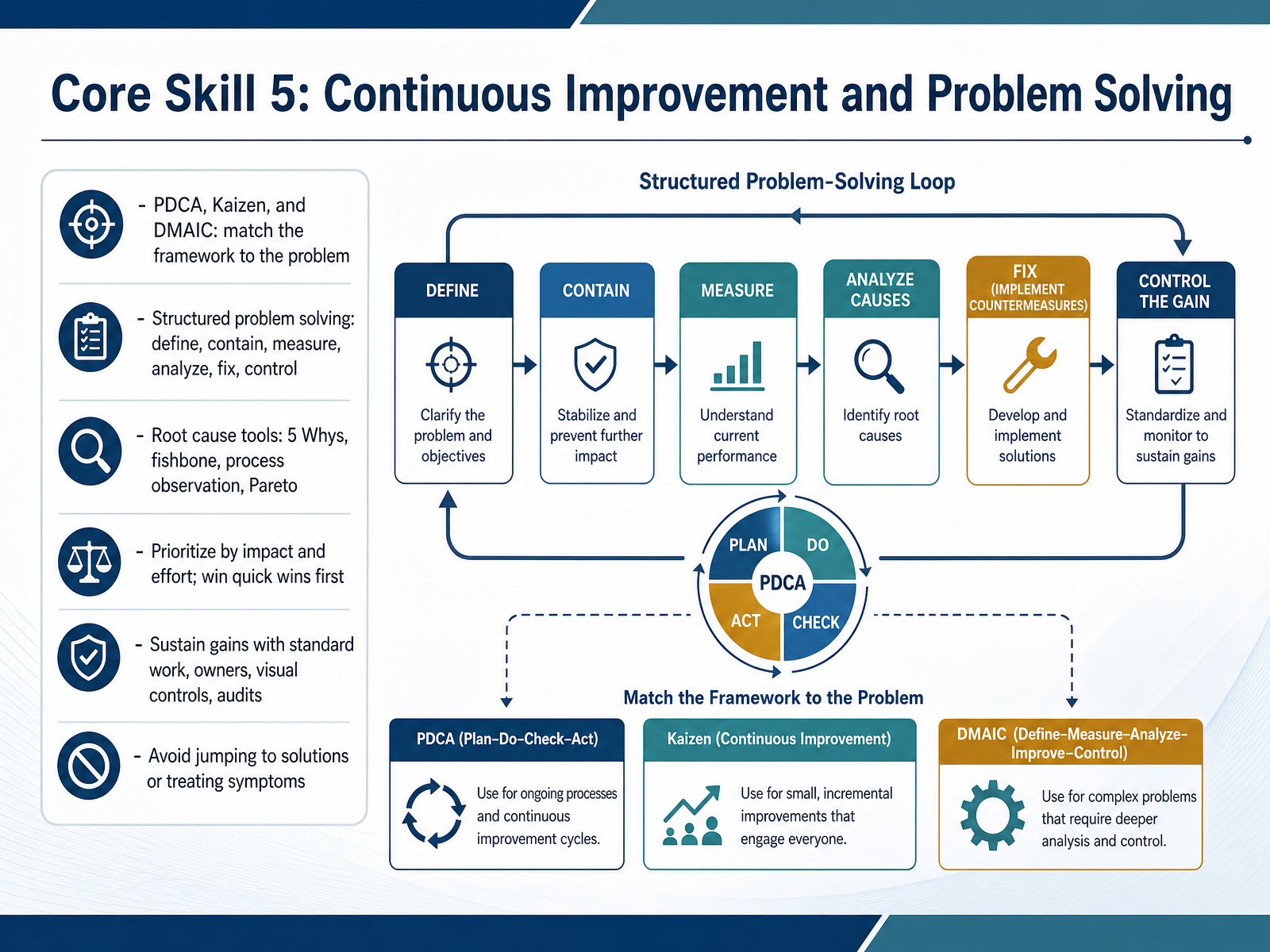
2 min - 07Core Skill 5: Continuous Improvement and Problem SolvingLet's move on to our fifth core skill, continuous improvement and problem solving. This is where operations professionals create lasting change rather than firefighting the same issues week after week. A few frameworks can guide you. PDCA, Plan Do Check Act, works well for iterative improvement with quick tests. Kaizen supports small, team-driven changes. And DMAIC, Define Measure Analyze Improve Control, fits problems that need statistical rigor and verified data. The key is matching the framework to the problem, not picking your favorite. When you face a problem, work through a structured path: define it clearly, contain the impact, measure the current state, analyze causes, implement a fix, and then control it so the gain holds. For root cause work, the five whys, fishbone diagrams, process observation, and Pareto charts help you move past symptoms. Prioritize by impact and effort, and win those quick wins first to build momentum. Then sustain the gains with standard work, clear owners, visual controls, and regular audits. And remember, never jump straight to solutions or treat symptoms. Always ask why until the true cause is clear. Next, we'll look at Core Skill 6: Supply Chain, Vendor, and Cross-Functional Coordination.
 2 min
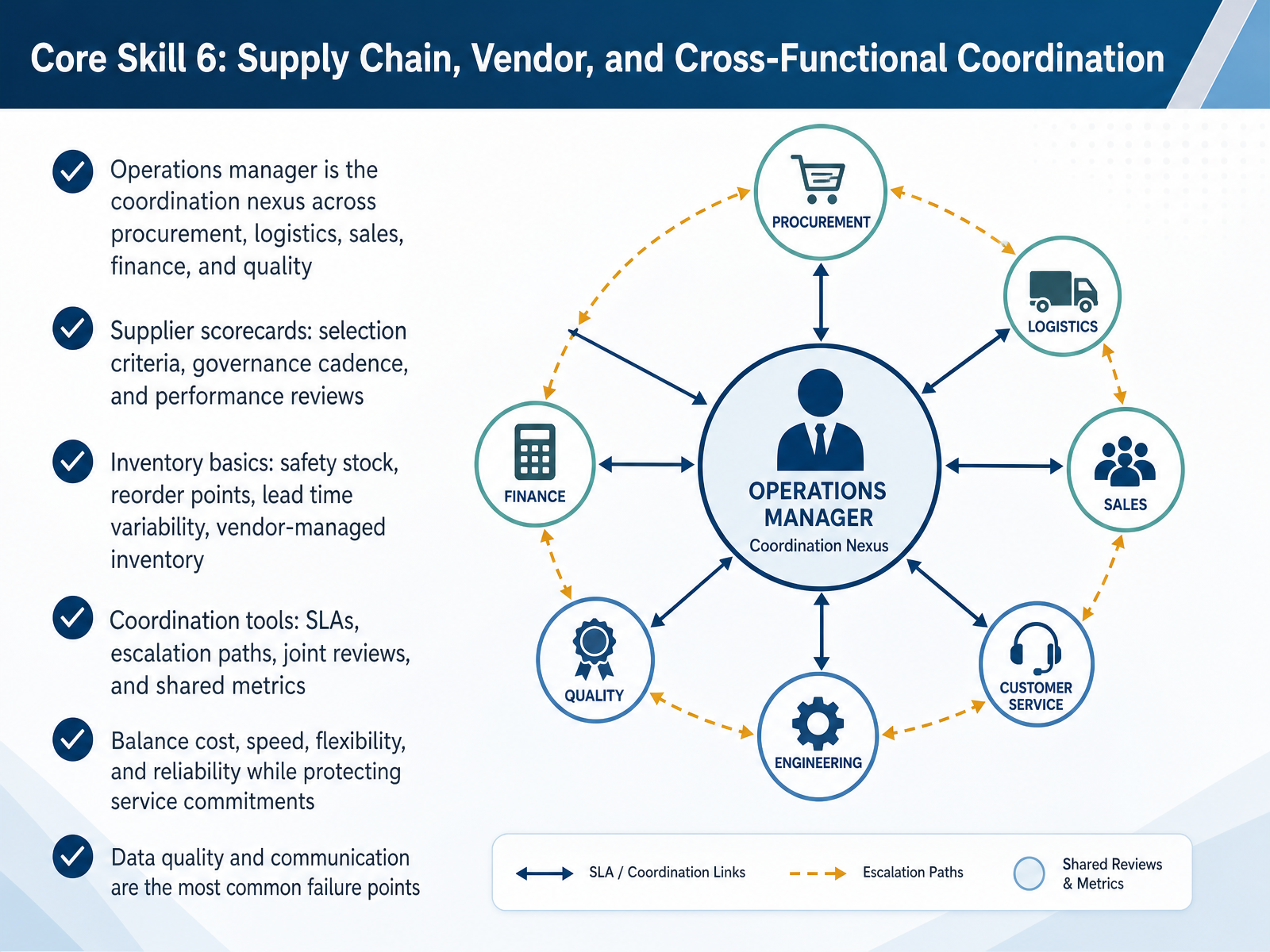
2 min - 08Core Skill 6: Supply Chain, Vendor, and Cross-Functional CoordinationLet's move on to our sixth core skill, supply chain, vendor, and cross-functional coordination. As an operations manager, you sit at the center of it all. Procurement, logistics, sales, finance, and quality all depend on you to keep things moving. Think about a supplier running late while a customer order is already committed. You feel that pressure directly. So how do you stay in control? Start with supplier scorecards. Agree on selection criteria, set a governance cadence, and hold regular performance reviews. Then cover your inventory basics. That means safety stock, reorder points, lead time variability, and where it makes sense, vendor-managed inventory. Use coordination tools deliberately. Service level agreements, clear escalation paths, joint reviews, and shared metrics keep everyone aligned. And always balance cost, speed, flexibility, and reliability while protecting the service commitments you have made. Remember this, data quality and communication are the most common failure points, so verify your numbers and talk early. That foundation will serve you as we turn to Core Skill 7: Team Leadership, Communication, and Daily Operations Routines.
 jobdescription.orgbusiness.linkedin.comresearchgate.net+22 min
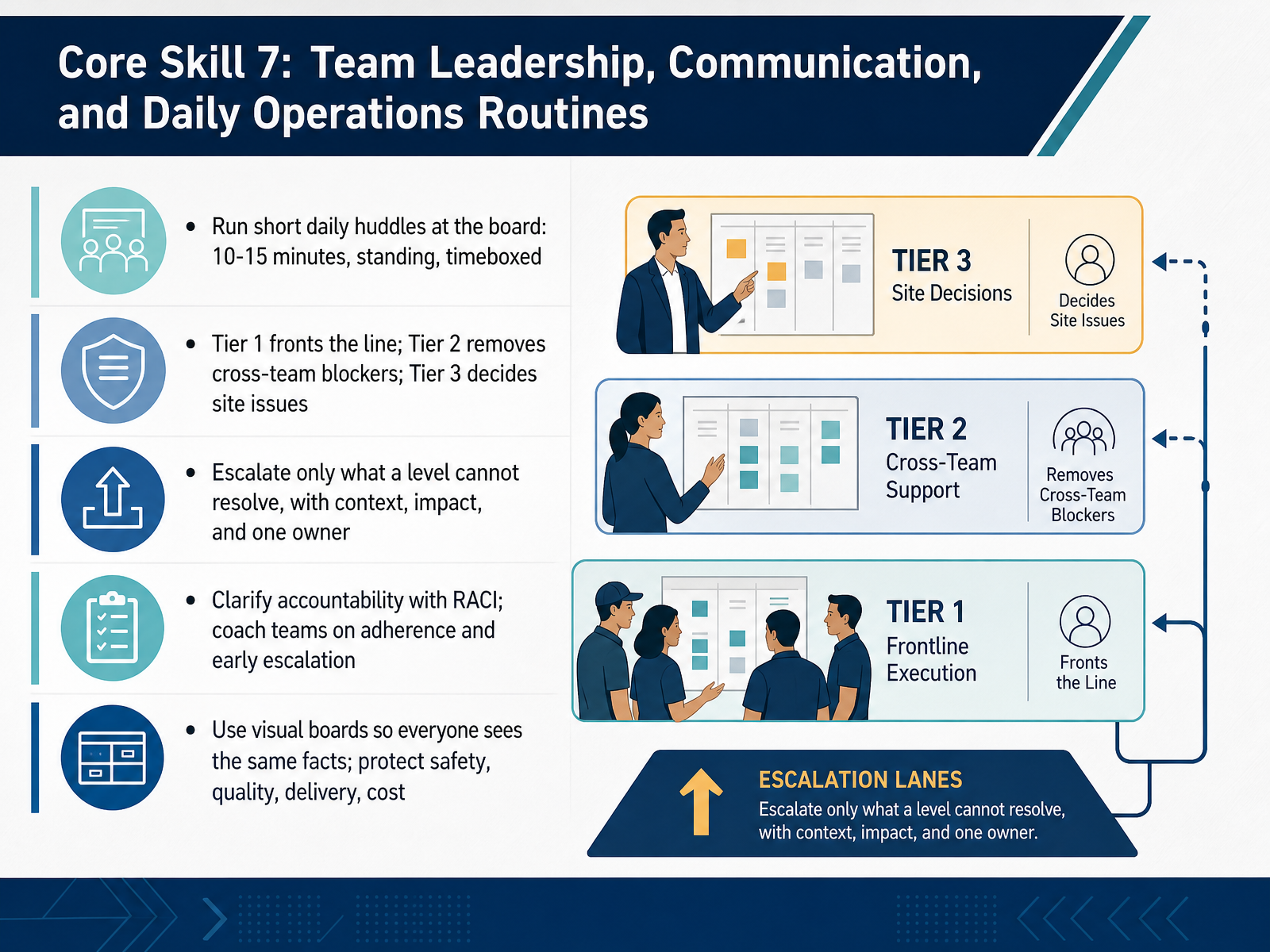
 - 09Core Skill 7: Team Leadership, Communication, and Daily Operations RoutinesNow let's look at Core Skill 7, team leadership, communication, and daily operations routines. The heart of this skill is a short daily huddle, ten to fifteen minutes, standing at the board, strictly timeboxed, so it stays a decision moment rather than a status update.
Tier 1 fronts the line, reviewing the last twenty four hours against safety, quality, delivery, and cost. Tier 2 removes cross team blockers, and Tier 3 decides site level issues like capacity or policy.
Here is the discipline that makes it work. Only escalate what a level cannot resolve, and always bring context, impact, and one named owner. Every accepted escalation gets an owner and a response time, so it never disappears quietly.
Clarify accountability with a RACI, and coach your teams on following it and escalating early. And use visual boards so everyone sees the same facts. When the board is current and honest, the conversation shifts from opinions to countermeasures, and safety, quality, delivery, and cost stay protected.
Next, let's put these skills into action in the Practice Lab: Applying Operations Skills to a Real Process.
 jobdescription.orgbusiness.linkedin.comresearchgate.net+22 min
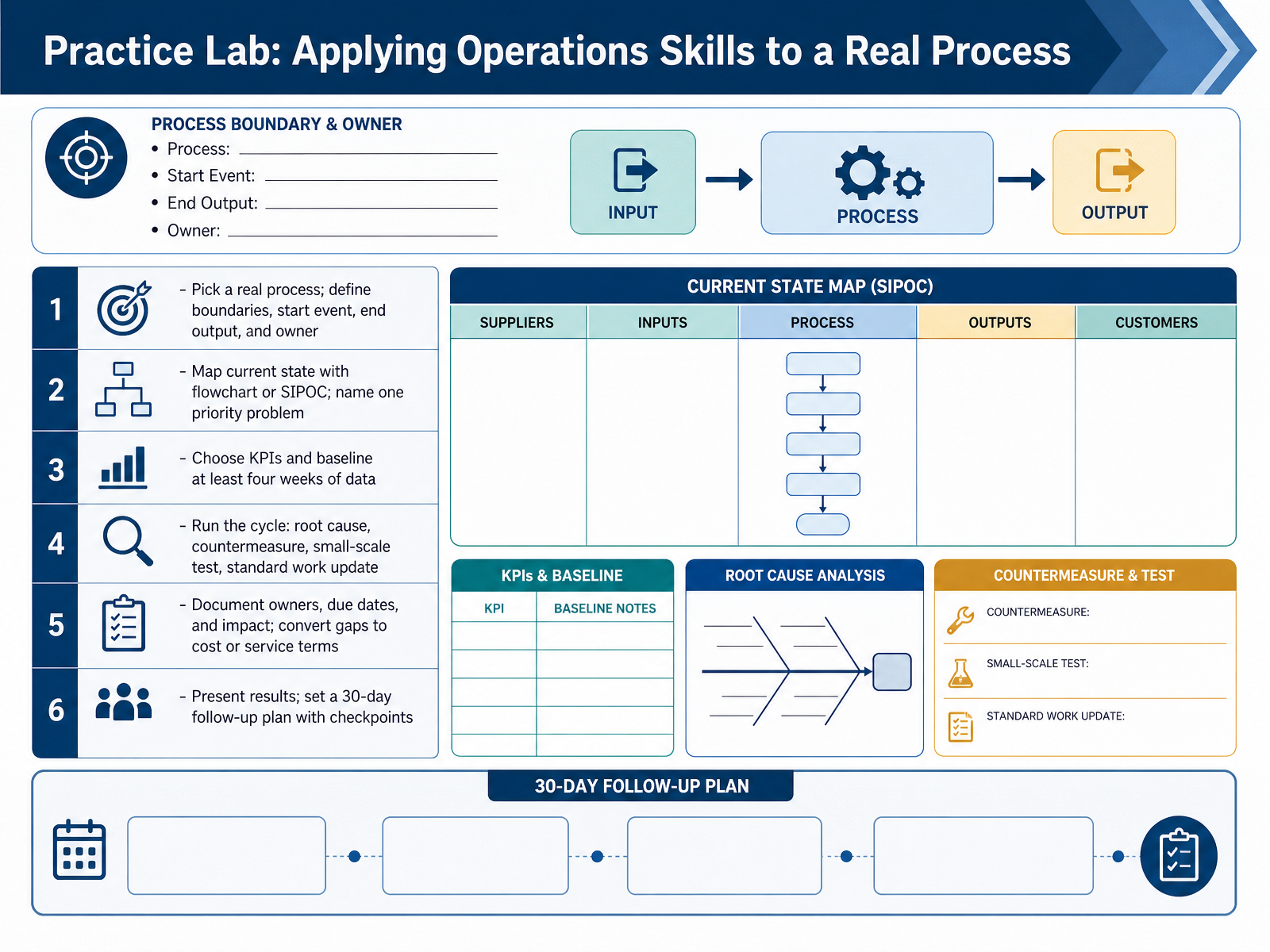
 - 10Practice Lab: Applying Operations Skills to a Real ProcessNow let's put these skills into practice. In this lab, you'll apply what you've learned to a real process of your own. Start by choosing one process and defining its boundaries. Name the start event, the end output, and the process owner. Keep the scope narrow, just a single process, so you can actually finish the work. Next, map the current state using a flowchart or a SIPOC diagram, and name one priority problem to solve. Then choose your KPIs, and baseline at least four weeks of real data. If the data doesn't exist yet, spend a week or two collecting it before you start, because without a baseline, you can't prove the improvement worked. Now run the cycle. Find the root cause, design a countermeasure, test it small, and update your standard work. Document owners, due dates, and the impact. Wherever you can, convert gaps into cost or service terms, because forty thousand dollars in annual rework cost gets attention faster than a twelve percent error rate. Finally, present your results and set a thirty-day follow-up plan with clear checkpoints. One quick checkpoint inside the first two weeks helps you catch early deviations. That's your practice loop. Let's move on to building your operations skill development plan.
 2 min
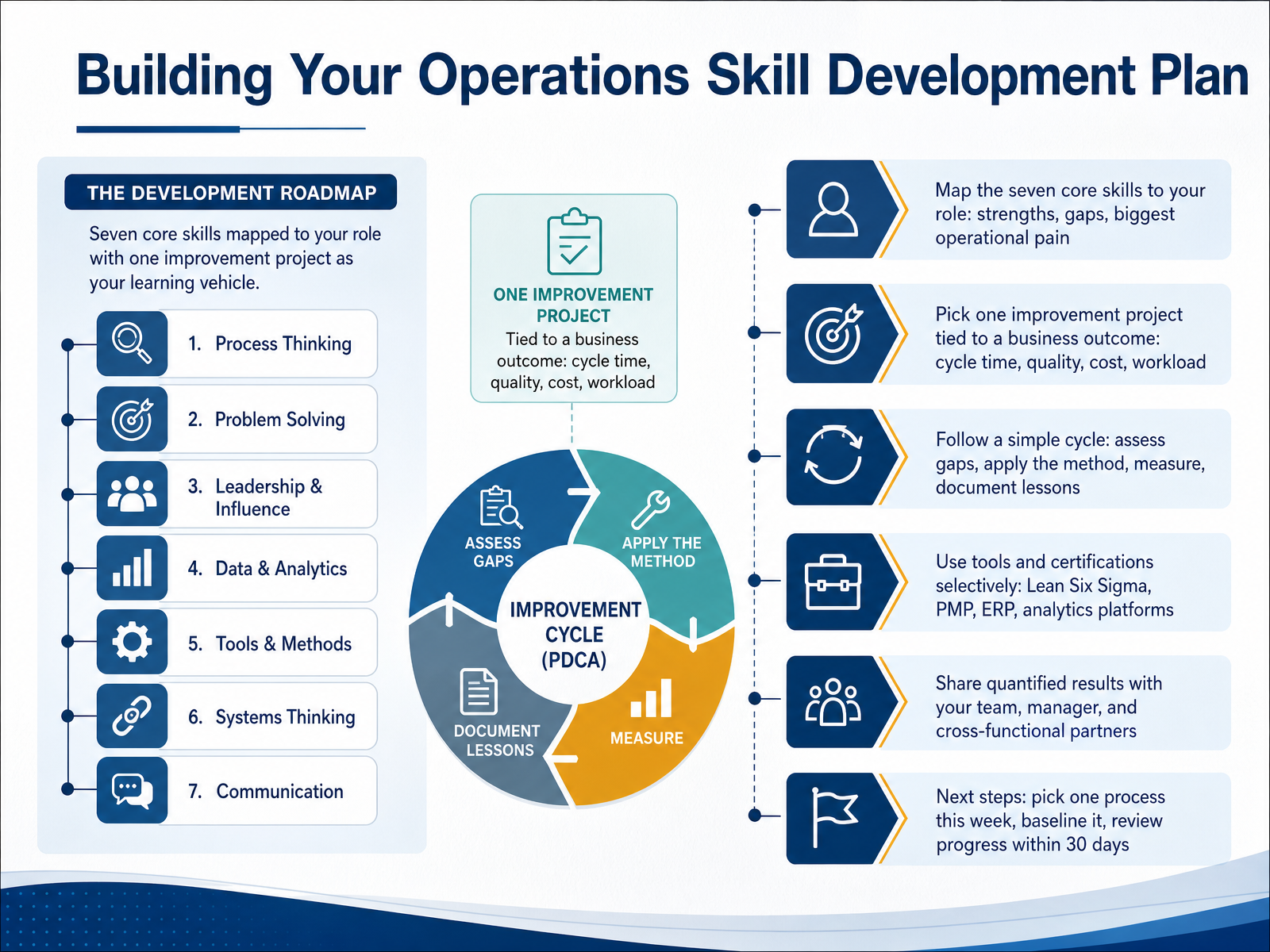
2 min - 11Building Your Operations Skill Development PlanNow let's turn all of this into a development plan you can actually use. Start by mapping the core skills to your own role. Where are you strong, where are the gaps, and which one connects to your biggest operational pain? Then pick a single improvement project tied to a business outcome like cycle time, quality, cost, or workload. Keep it small and measurable. Work through a simple cycle: assess the gap, apply the method, measure the result, and document the lessons. Be selective with tools and certifications. Lean Six Sigma, project management, enterprise systems, and analytics platforms all help, but only when they support the work you're doing. When you get results, share the numbers with your team, your manager, and cross-functional partners. So your next step is concrete. Pick one process this week, baseline it, and review your progress within thirty days. That leads us into common pitfalls and how to avoid them.
 jobdescription.orgbusiness.linkedin.comresearchgate.net+21 min
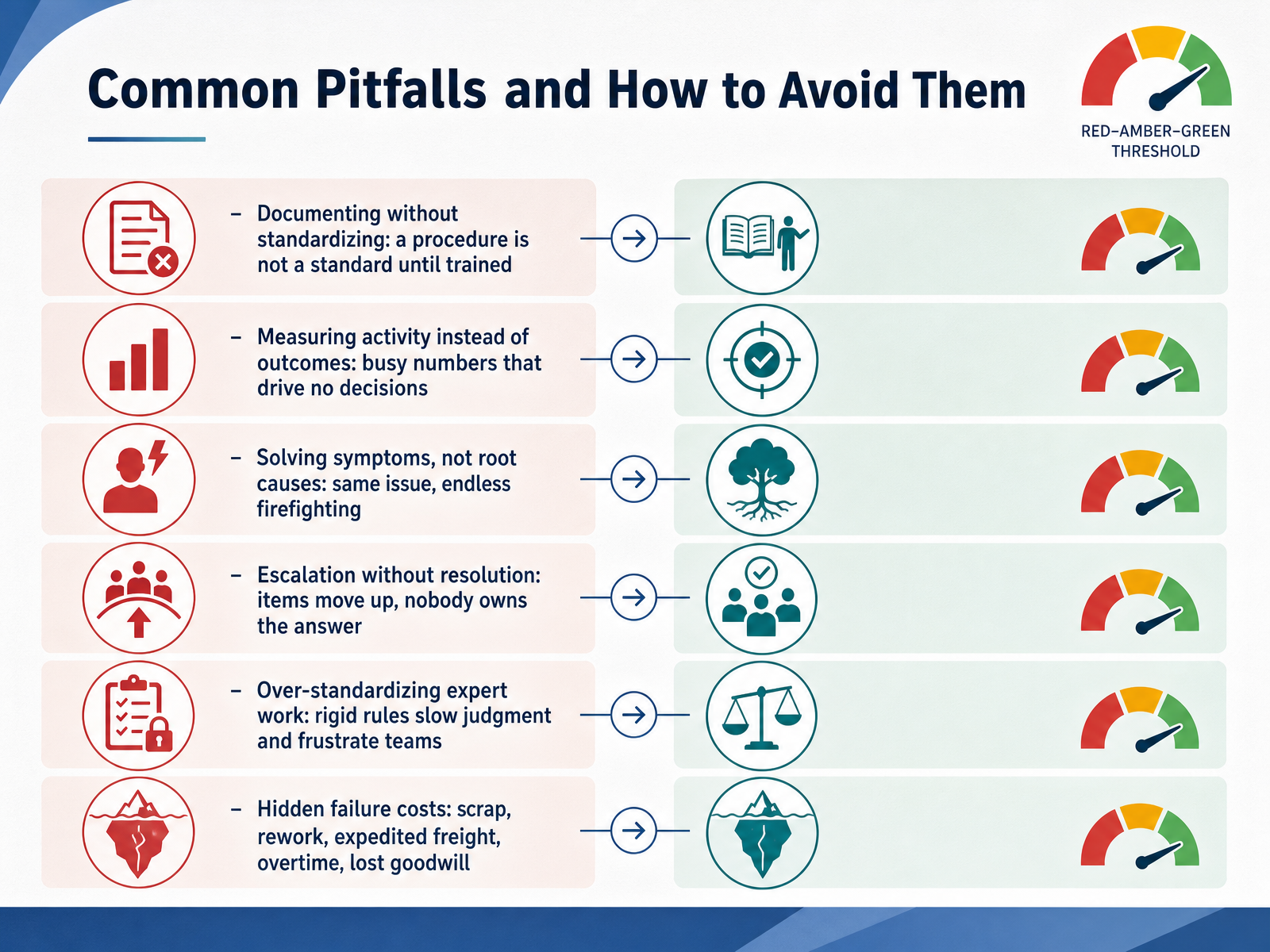
 - 12Common Pitfalls and How to Avoid ThemLet's look at some common pitfalls and how to avoid them. First, documenting without standardizing. A procedure is not a standard until your team is trained on it. Writing it down is just a file. Second, measuring activity instead of outcomes. Busy numbers that drive no decisions help no one. Aim for metrics that trigger action. Third, solving symptoms, not root causes. If you only patch the visible problem, you get the same issue and endless firefighting. Fourth, escalation without resolution. Items move up, but nobody owns the answer. Always assign a named owner and a due date. Fifth, over-standardizing expert work. Rigid rules slow judgment and frustrate teams. Standardize the control points, but preserve flexibility where expert judgment creates value. And finally, hidden failure costs. Scrap, rework, expedited freight, overtime, and lost goodwill often hide in everyday accounts. Surface them, and you make the case for prevention. Remember, standards are living methods, not filed documents. Next, we'll look at applying operations skills in different environments.
 aisberg.unibg.itresearchgate.netsysgenpro.com+22 min
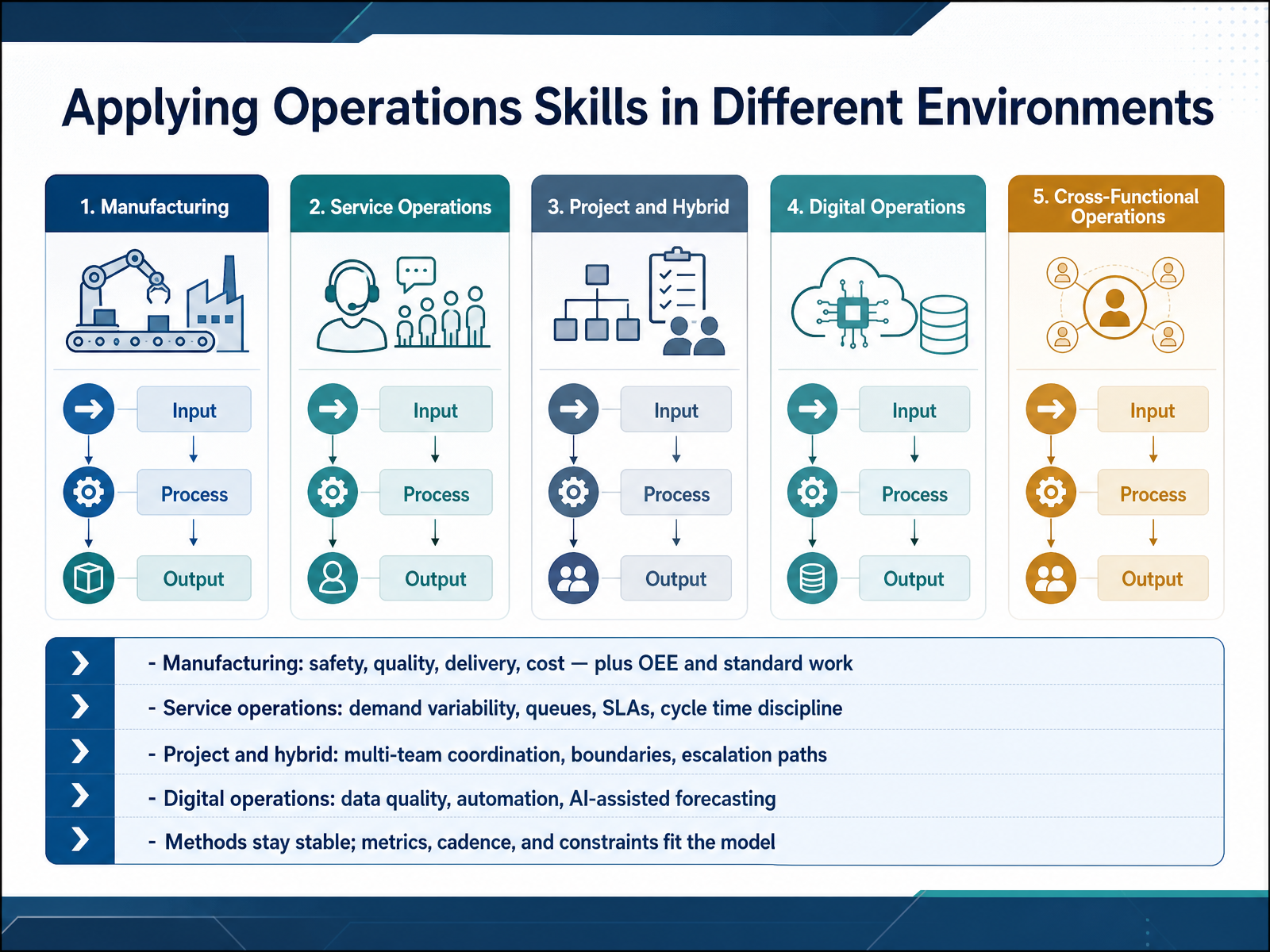
 - 13Applying Operations Skills in Different EnvironmentsLet's bring these skills together and look at how they play out in different operating environments. In manufacturing, you anchor on safety, quality, delivery, and cost, and you lean on measures like Overall Equipment Effectiveness and standard work to keep performance predictable. In service operations, the pressure shifts to demand variability, queues, service level agreements, and cycle time discipline, because your customers experience the wait, not the warehouse. In project and hybrid settings, success depends on coordinating multiple teams, defining clear boundaries, and agreeing on escalation paths before you need them. And in digital operations, data quality, automation, and AI-assisted forecasting become your core tools, since your output depends on clean inputs and fast feedback. Here is the key point. The underlying methods stay stable. What changes is the metrics you emphasize, your operating cadence, and the constraints you manage around. So ask yourself which model you work in, then adapt accordingly. Next, we'll pull everything together in the Course Summary and 30-Day Action Plan.
 jobdescription.orgbusiness.linkedin.comresearchgate.net+22 min
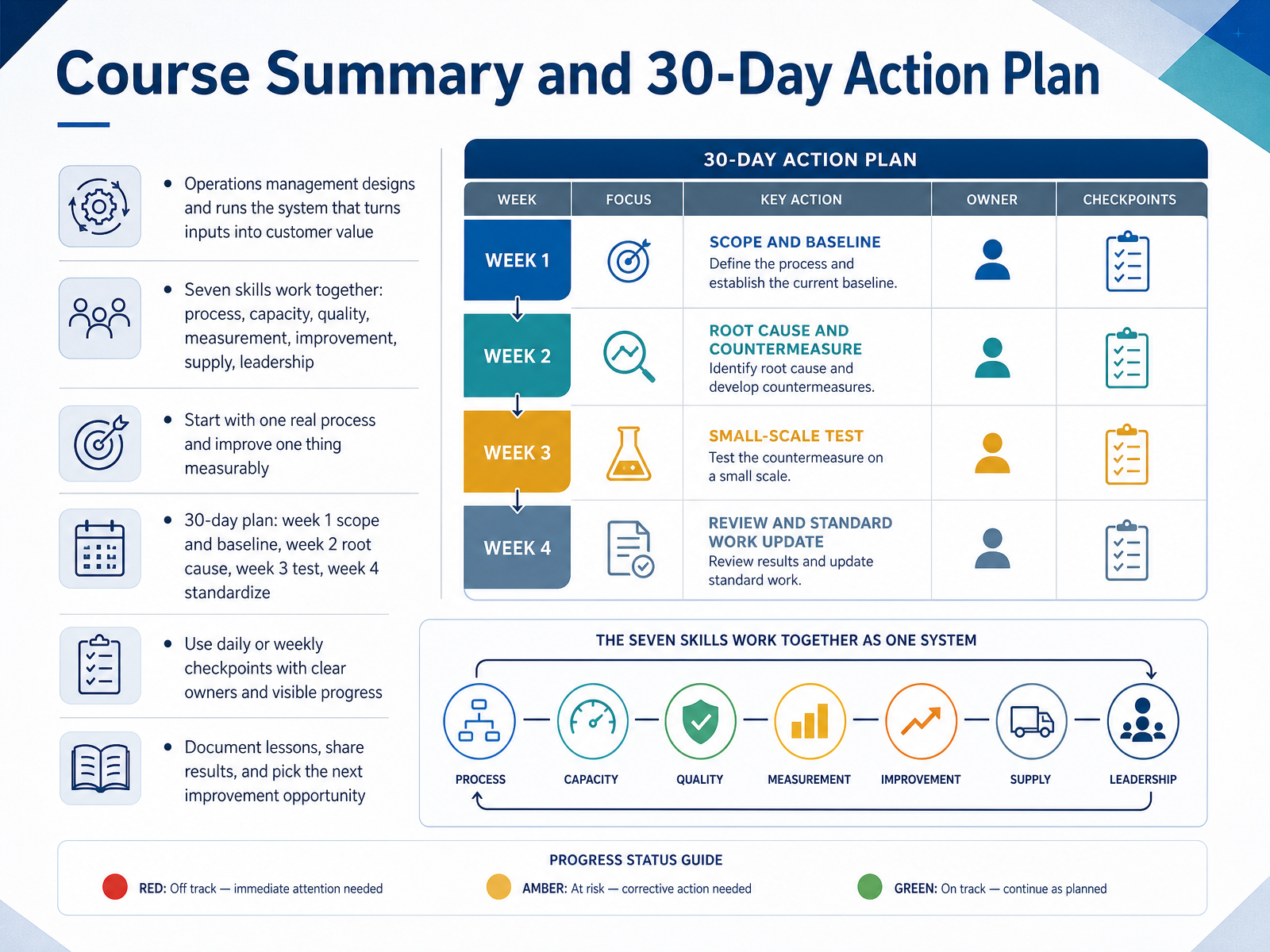
 - 14Course Summary and 30-Day Action PlanLet's bring everything together and turn it into action. Operations management is about designing and running the system that turns inputs into customer value. And the seven skills we covered, process, capacity, quality, measurement, improvement, supply, and leadership, work best together, not in isolation. So here's your thirty-day plan. In week one, pick one real process, define its scope, and collect a baseline. In week two, find the root cause. In week three, test a small change. In week four, standardize what worked. Along the way, hold daily or weekly checkpoints with clear owners and visible progress, so nothing stalls. A tip: compare the same measures before and after, and let the numbers tell the story. Then document your lessons, share the results, and choose your next opportunity. Thank you for your time and attention. You now have a practical, repeatable way to improve operations. Keep it small, keep it measured, and keep going. You've got this.
 2 min
2 min
Take the deck with you
Download this course as a file — free, no sign-up needed.
- PDF handoutEvery slide page, ready to print or share.15 pages · 4.2 MBDownload
- Narrated PowerPointThe deck that presents itself — every slide carries the digital human's narration video.15 pages · 16.6 MBDownload
- PowerPoint slidesThe full deck as a .pptx — open it in PowerPoint, Keynote, or Google Slides.15 pages · 4.0 MBDownload
Free to use in your own training — please keep the PersonWise credit page at the end.
Have your own deck? Turn it into a course
Sources consulted
Web sources consulted while building this course.
- Operations Manager Job Description, Salary & Career Outlook | JobDescription.org — jobdescription.org
- Operations Manager Job Description Template — business.linkedin.com
- Operation manager and its role in the enterprise — researchgate.net
- Operations Manager at Flex — Milpitas, CA — hiringcafe.com
- Operations Manager JD_03022025 — servagroup.com
- 2 The input–process–output model — open.edu
- Learn how to use the input-process-output (IPO) model — business.adobe.com
- A Comprehensive Guide to Input-Process-Output Models — isixsigma.com
- 2.1 Extensions to the input–process–output model — open.edu
- Understanding the Input Process Output Model — sixsigmadsi.com
- Process Standardization to Support Service Process Assessment and Re-engineering — aisberg.unibg.it
- (PDF) Process design principles in service firms: Universal ... — researchgate.net
- Professional Services Operations Workflow Standardization for Delivery Consistency | SysGenPro ERP — sysgenpro.com
- "How to Design a Business Process: The SIPOC Framework" — resources.rework.com
- A Service Designer’s Guide to design SOPs that drive impact | by Juneza Niyazi | Bootcamp | Medium — medium.com
- Demand and Supply Planning with the Use of Production Optimization Software – AnyLogic Simulation Software — anylogic.com
- Optimizing Capacity Planning for Manufacturing Success | Mu Sigma — mu-sigma.com
- NVIDIA Cuts Supply Chain Planning Time by 144x | NVIDIA Case Study — nvidia.com
- Expert Hospitality Capacity Planning for Enhanced Profitability — quantzig.com
- Supply chain planning case study: GUD Holdings moves beyond Excel — horizonsolutions.ai