Begin
14 pages · ~28 min
NIST Privacy Framework Data Minimization
This training helps privacy and data professionals apply NIST Privacy Framework principles to reduce data collection and retention. Learners will gain practical skills to minimize data risk while meeting operational needs.
A digital instructor presents all 14 pages. Hold “Ask” at any point and ask out loud — the answer comes from this course. No sign-up needed.
What you’ll learn
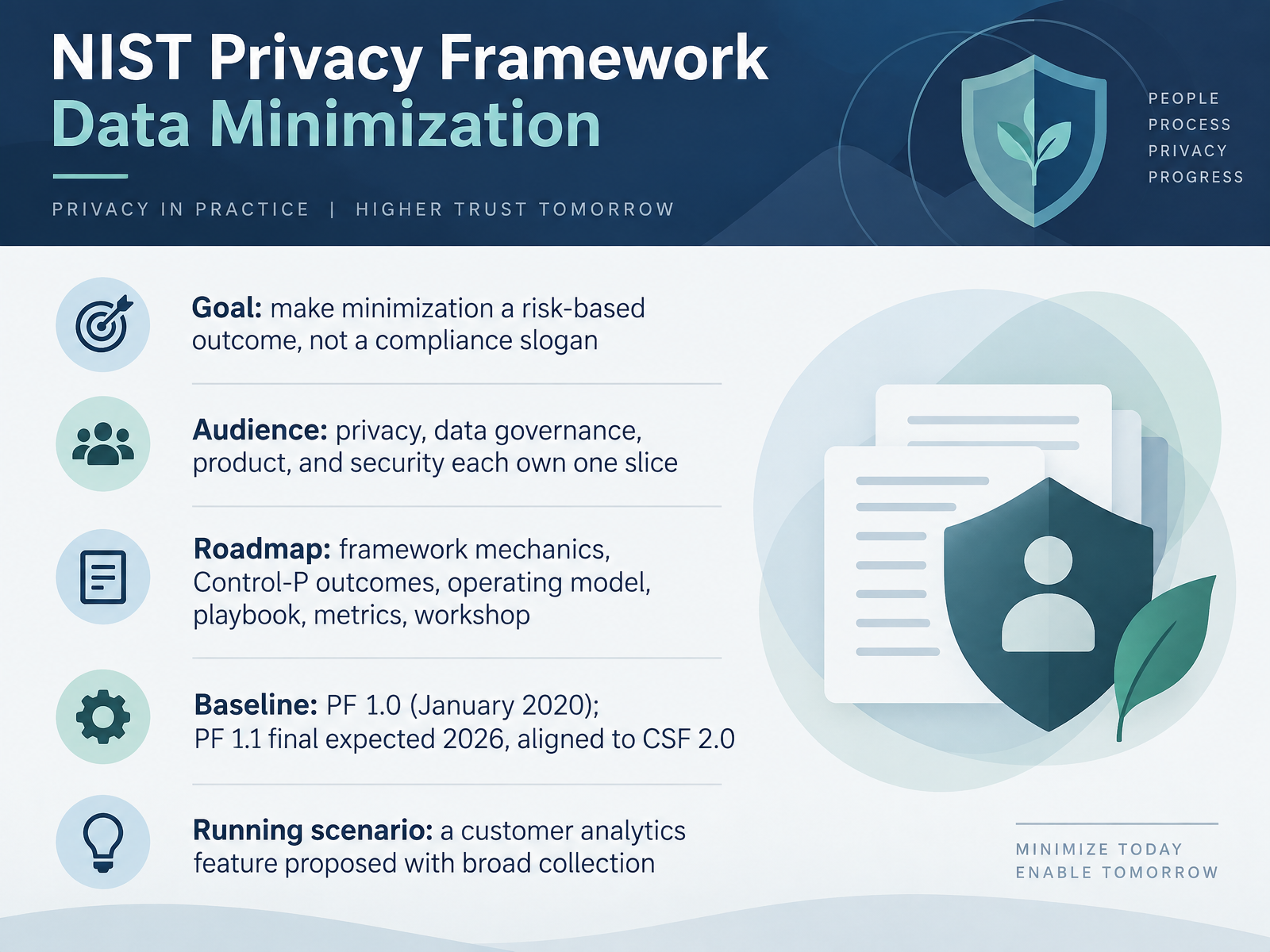
- 01NIST Privacy Framework Data MinimizationWelcome. This session is about data minimization in the NIST Privacy Framework, and our goal is practical. We want minimization to be a risk-based outcome your teams actually reach, not a compliance slogan on a slide. That work is shared. Privacy, data governance, product, and security each own one slice of it, so we will look closely at how those slices connect. Here is our roadmap. We will cover framework mechanics, Control-P outcomes, the operating model, a playbook, metrics, and a short workshop. Our baseline is Privacy Framework version one point zero from January twenty twenty twenty. Version one point one is expected in twenty twenty twenty six, aligned to Cybersecurity Framework two point zero. Throughout, we will use one running scenario. A customer analytics feature is proposed with broad collection. You will see how each team weighs utility against privacy in design reviews, data inventories, and vendor assessments. Let us start by asking why minimization is a strategic imperative.nist.govnist.govdoi.org+22 min
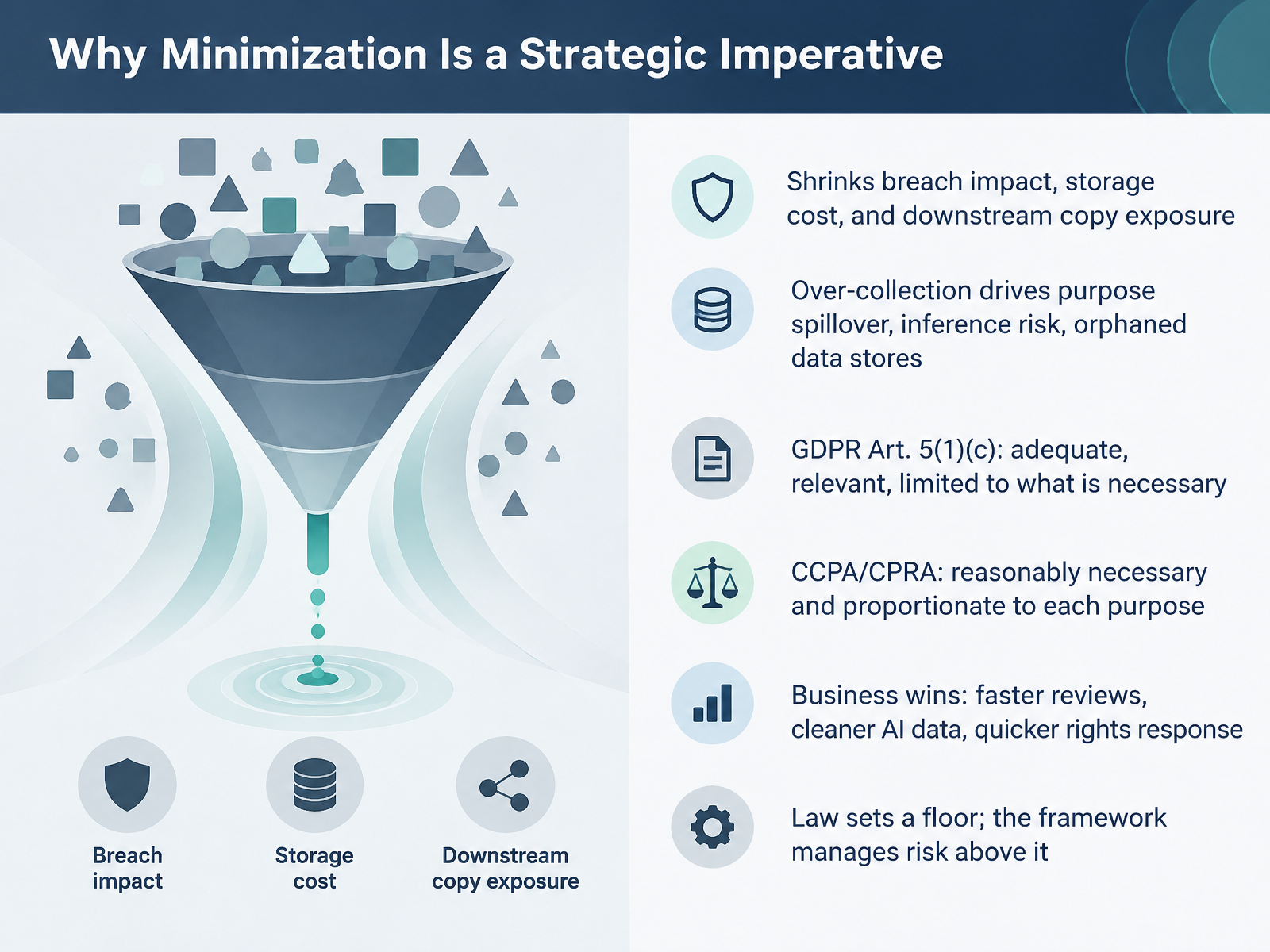
- 02Why Minimization Is a Strategic ImperativeLet's look at why data minimization is a strategic imperative, not just a compliance checkbox. Start with the upside. Collecting less shrinks breach impact, lowers storage cost, and reduces downstream copy exposure. Over-collection is where trouble begins. It drives purpose spillover, inference risk, and orphaned data stores nobody owns. On the legal side, the bar is clear. GDPR Article 5, paragraph 1, point c, requires data that is adequate, relevant, and limited to what is necessary. In California, the CCPA and CPRA require collection that is reasonably necessary and proportionate to each purpose. Treat the law as a floor. The framework helps you manage risk above it. There are business wins too. Faster reviews, cleaner AI training data, and quicker rights response. The trade-off is real: less data can mean less utility in some features. But most teams find the right balance in design reviews, data inventories, and vendor assessments. Next, we'll look at the Regulatory Landscape and Interoperability.
 cppa.ca.govbsa.orgcommission.europa.eu+22 min
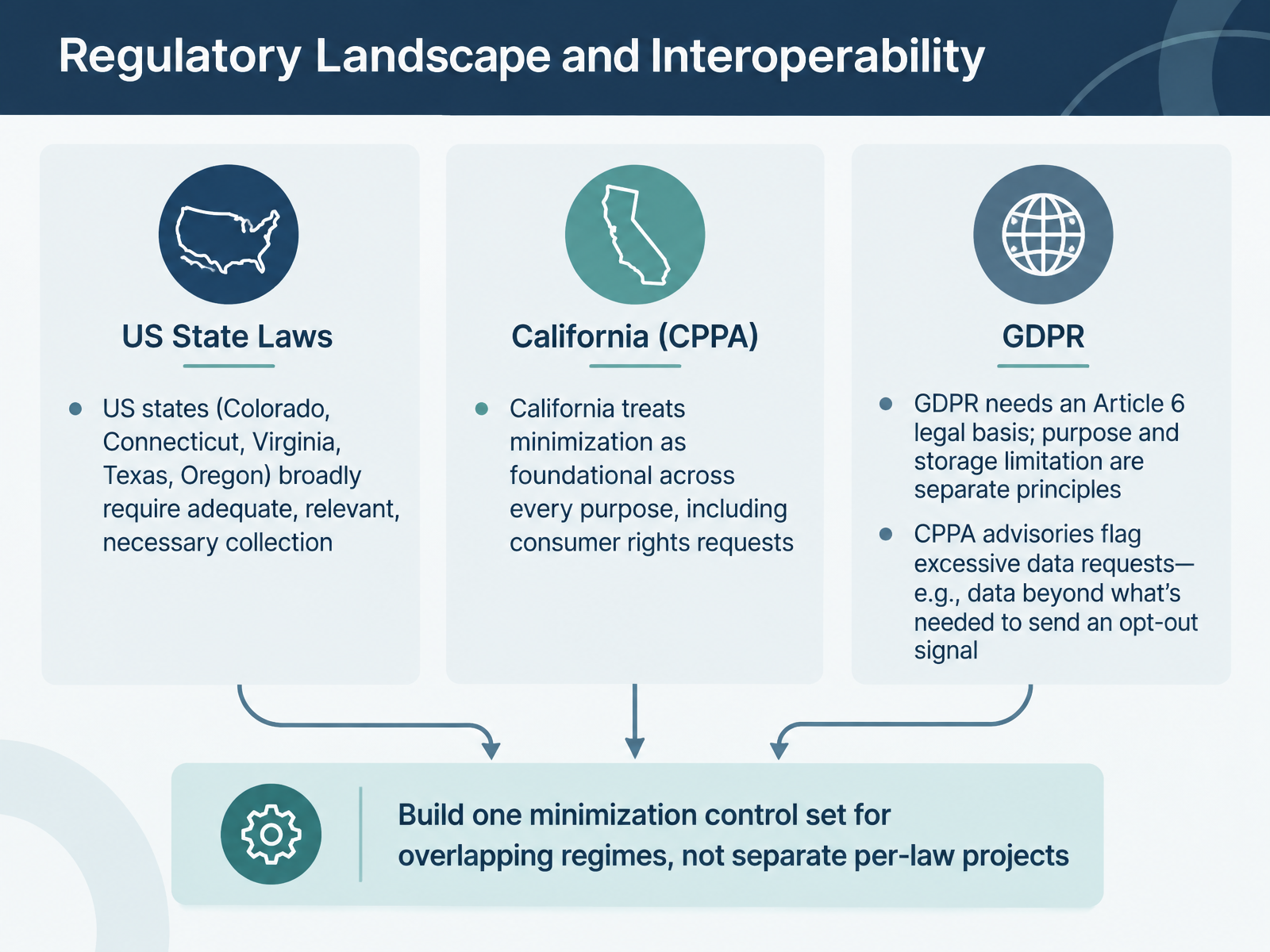
- 03Regulatory Landscape and InteroperabilityLet's look at how the regulatory landscape treats data minimization, and where you can build one control set instead of separate projects per law. Most US states, including Colorado, Connecticut, Virginia, Texas, and Oregon, require collection that is adequate, relevant, and reasonably necessary for the stated purpose. California goes further. The CPPA treats data minimization as foundational across every purpose, including consumer rights requests. Their advisories flag excessive data requests, such as asking for data beyond what is needed to send an opt-out signal. Under GDPR, you first need an Article 6 legal basis. Purpose limitation and storage limitation are separate principles, so minimizing collection and limiting retention are distinct decisions. The practical point is this: these regimes overlap enough that one minimization control set can serve all of them. Write necessity justifications per data field and purpose once, then map them to each regime. Yes, there are trade-offs between utility and privacy, so decide deliberately rather than defaulting to collection. Next, we move to Framework Foundations: Core, Profiles, and Tiers.
 cppa.ca.govbsa.orgcommission.europa.eu+22 min
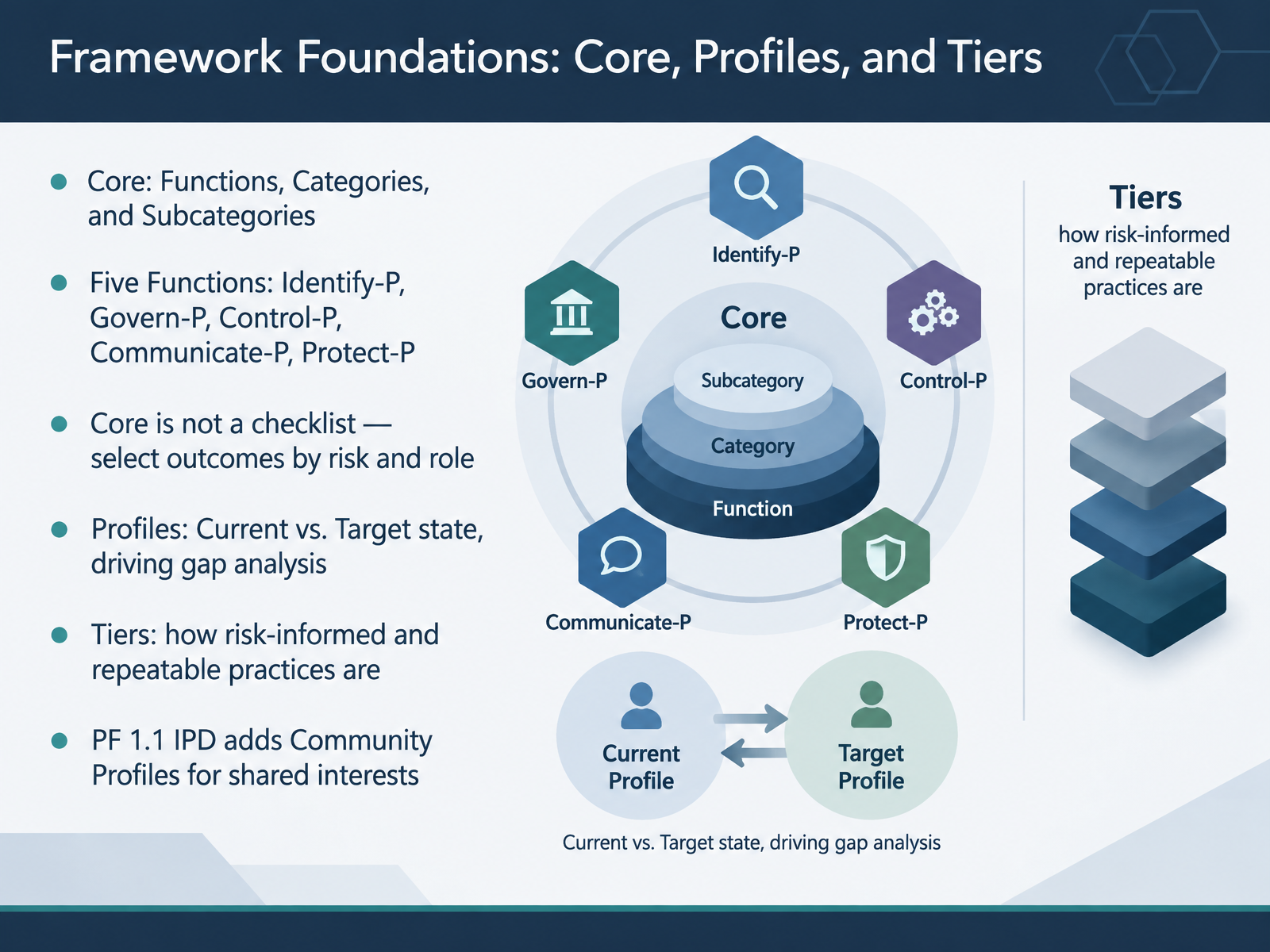
- 04Framework Foundations: Core, Profiles, and TiersNext, let's look at how the framework is built. It has three parts: Core, Profiles, and Tiers. The Core breaks into Functions, Categories, and Subcategories, with five Functions: Identify-P, Govern-P, Control-P, Communicate-P, and Protect-P. Here is the key point. The Core is not a checklist. You select outcomes based on your risk and your role, so you may not address every Subcategory. Profiles capture your current state and your target state, and the gap between them drives your action plan. Tiers describe how risk-informed and repeatable your practices are, from informal and reactive to agile and risk aware. And in the Privacy Framework 1.1 initial public draft, there are Community Profiles for groups with shared interests. Think about how you would use this in a design review: pick the outcomes that matter, then compare where you are with where you need to be. Where Minimization Lives in the Framework is next.
 nist.govnist.govdoi.org+22 min
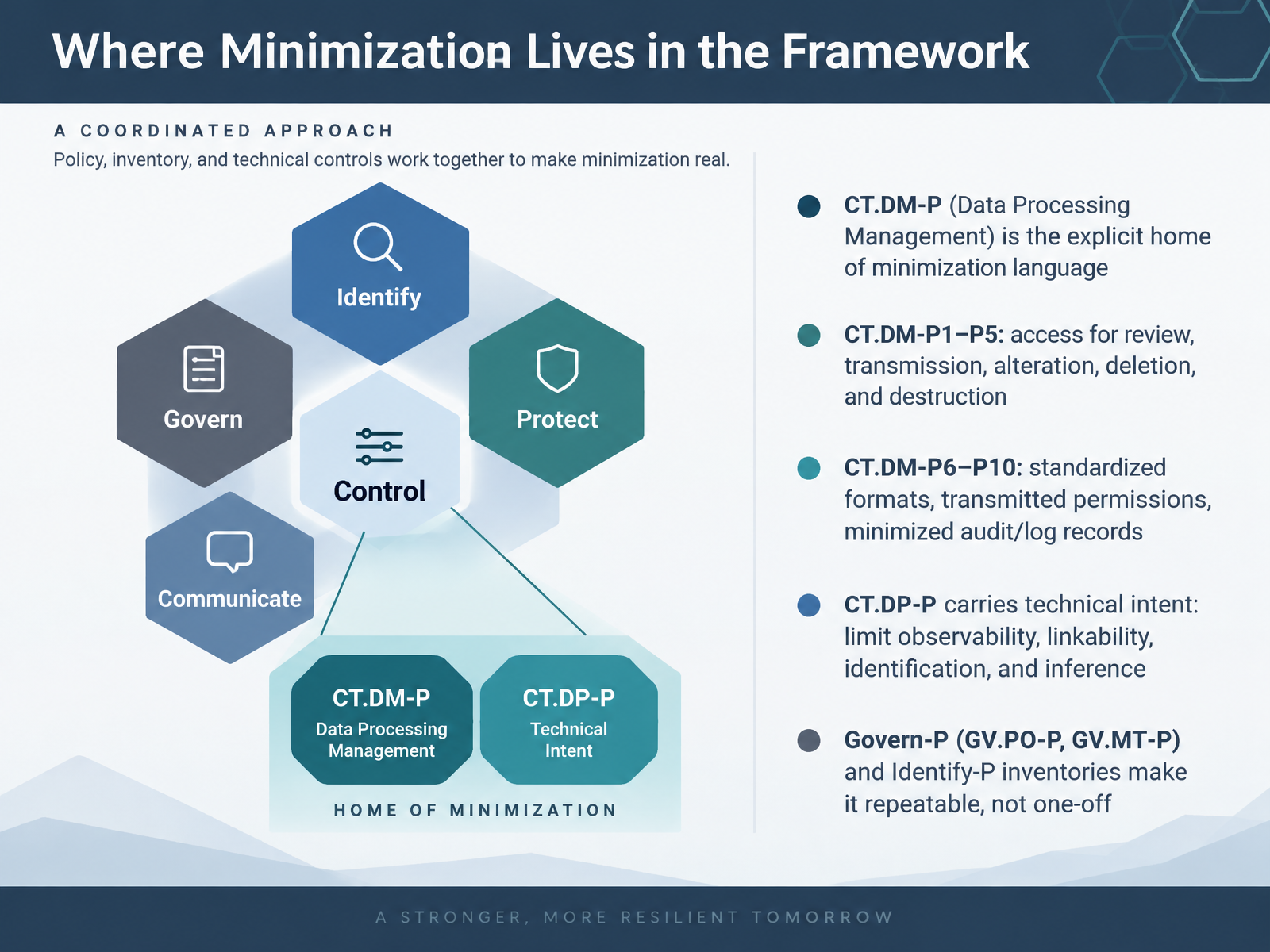
- 05Where Minimization Lives in the FrameworkLet's map where minimization actually lives in the framework. Its explicit home is CT.DM-P, Data Processing Management. The Category description names data minimization directly, and the Subcategories give you concrete outcomes. CT.DM-P1 through P5 cover access for review, transmission, alteration, deletion, and destruction. So retention and deletion decisions land here, not just in policy documents. CT.DM-P6 through P10 cover standardized formats, transmitted processing permissions, and audit and log records that are themselves minimized. That last point often surprises teams. Logs are data too. Next, CT.DP-P carries the technical intent: limit observability, linkability, identification, and inference. Think tokenization, local processing, or decentralized architecture. Finally, Govern and Identify make this repeatable rather than one-off. GV.PO-P sets retention and use conditions in policy. GV.MT-P re-evaluates risk as systems change. And Identify-P inventories tell you what data you actually hold, which is where design reviews and vendor assessments start. There is a real trade-off between utility and privacy here, so choose deliberately and document the reasoning. Next, we'll look at reading the Subcategories for intent and evidence.
 nist.govnist.govdoi.org+22 min
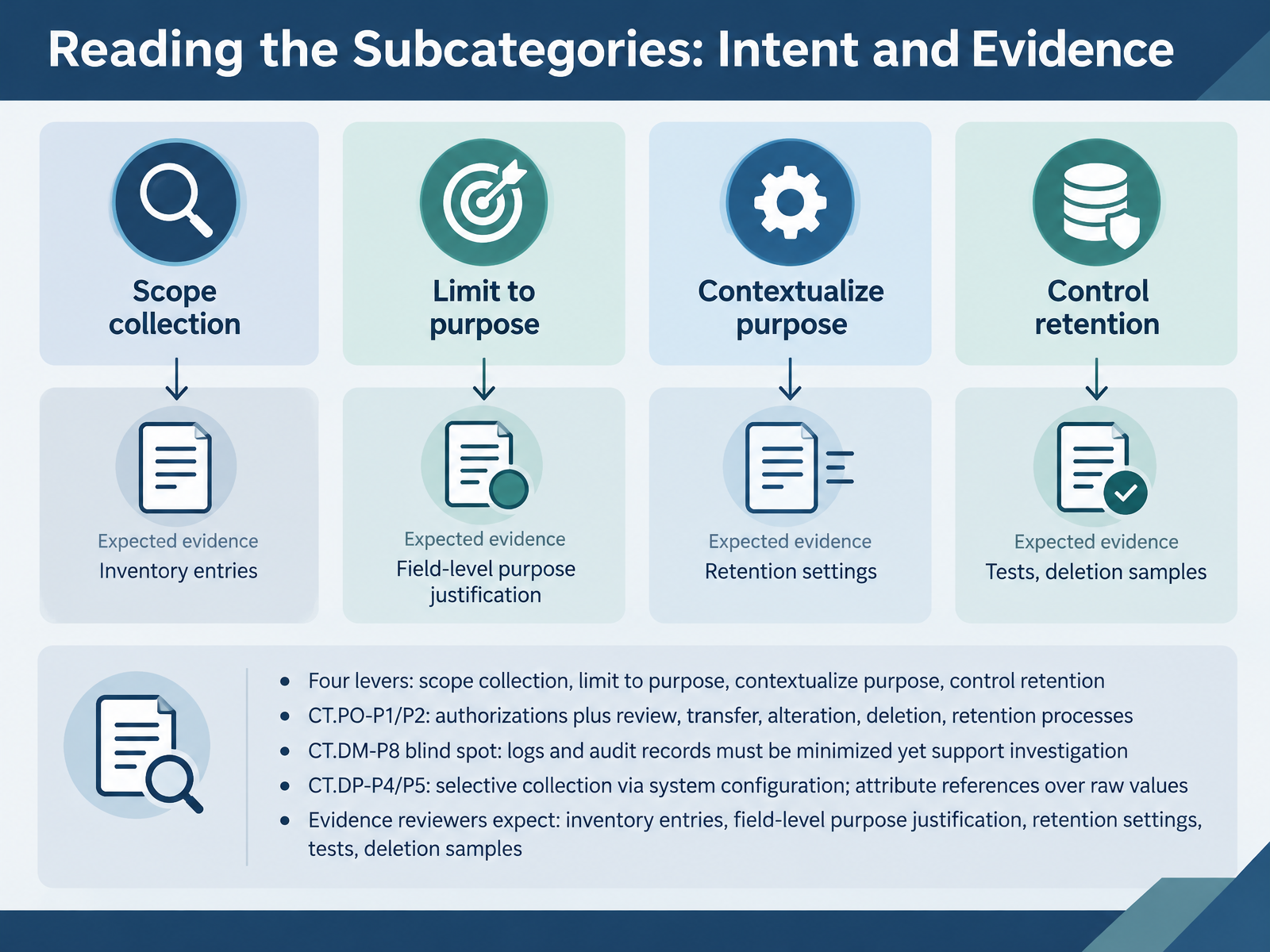
- 06Reading the Subcategories: Intent and EvidenceLet's look at how to read these subcategories in terms of intent and evidence. Four levers do most of the work: scope collection, limit to purpose, contextualize purpose, and control retention. CT.PO P1 and P2 cover authorizations plus the processes for review, transfer, alteration, deletion, and retention. CT.DM P8 is the blind spot: audit and log records must be minimized, yet still support investigation. Resolve that in design reviews by defining which fields you log and for how long. CT.DP P4 and P5 give you selective collection through system configuration, and attribute references instead of raw values. Reviewers tend to expect inventory entries, field-level purpose justification, retention settings, tests, and deletion samples. So build the evidence as you go, not after the fact. Next, an operating model for minimization.
 nist.govnvlpubs.nist.govnist.gov+22 min
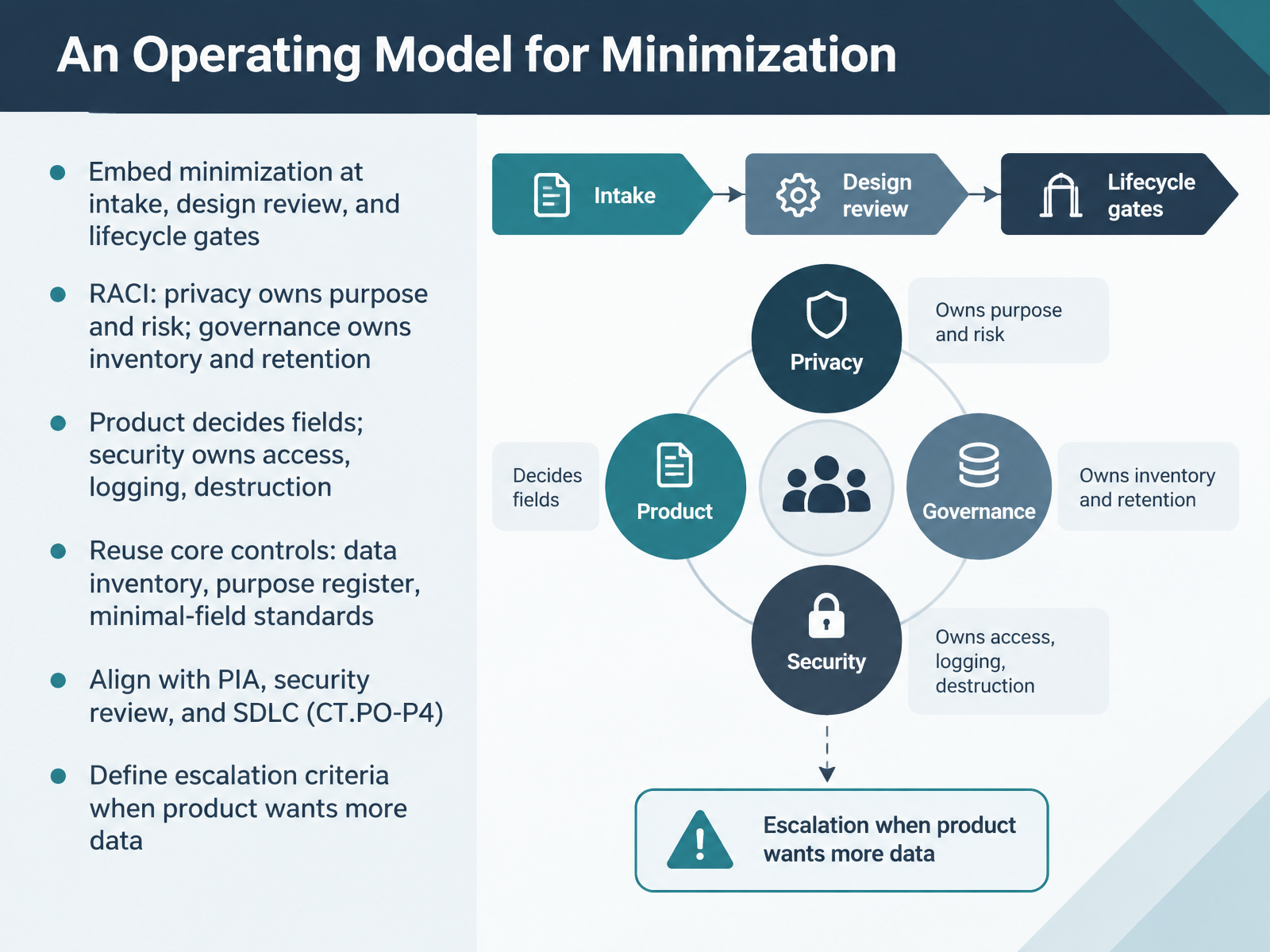
- 07An Operating Model for MinimizationLet's look at the operating model that makes data minimization repeatable. Build it into three points: intake, design review, and lifecycle gates, so the decision on what data to collect happens before code is written, not after launch. Use a clear R A C I. Privacy owns purpose and risk. Governance owns the inventory and retention schedule. Product decides which fields are needed, and security owns access, logging, and destruction. Reuse core controls instead of inventing new ones: your data inventory, a purpose register, and minimal-field standards. Align these with the privacy impact assessment, security review, and the system development life cycle, which maps to CT.PO-P4. There is a real trade-off between utility and privacy, so make it explicit. Define escalation criteria for when product wants more data, for example a new field with no stated purpose or an indefinite retention period. That way the decision moves to the right owner early. Next, we'll walk through the product and engineering playbook.
 nist.govnist.govdoi.org+22 min
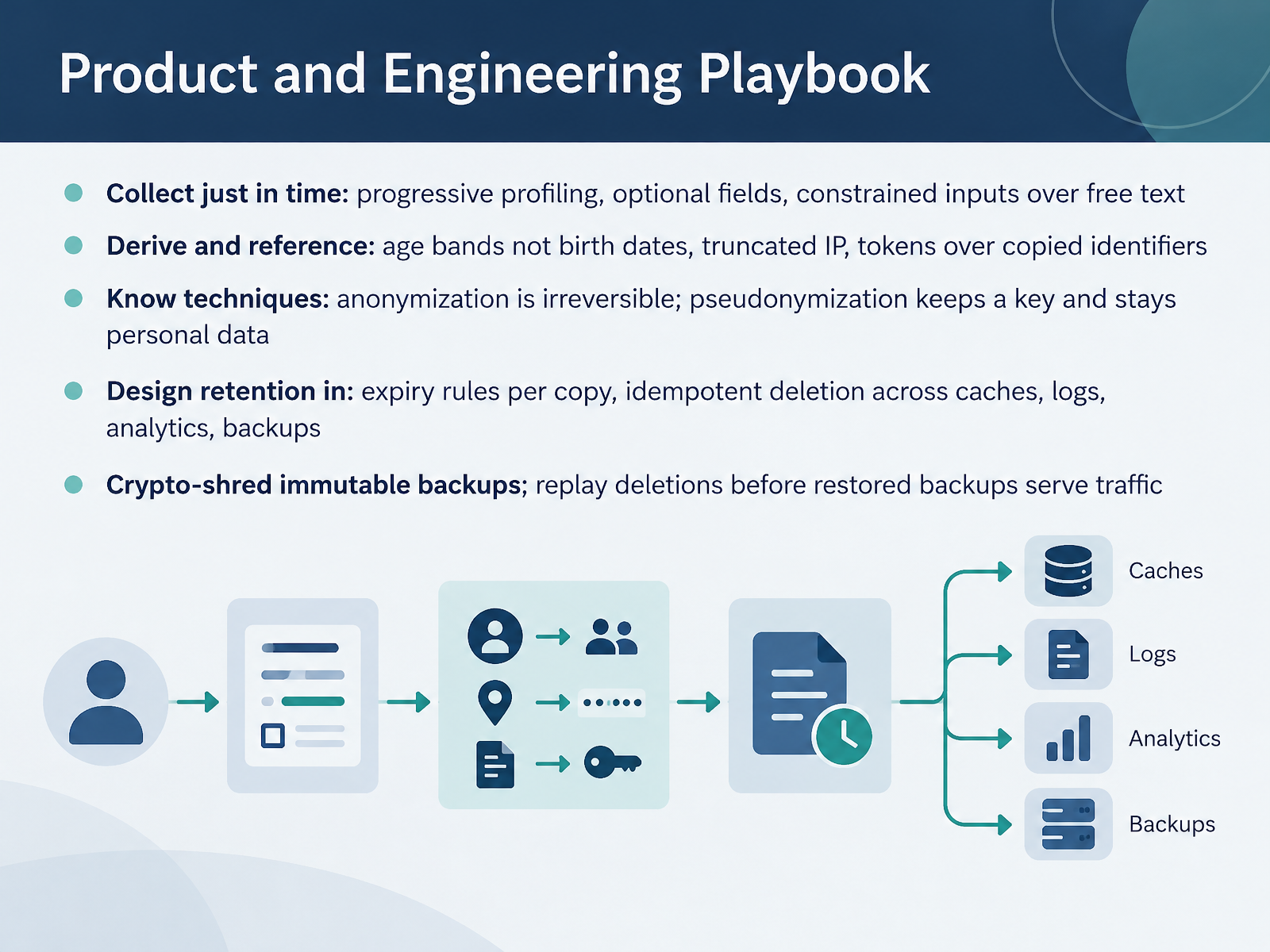
- 08Product and Engineering PlaybookLet's move into the product and engineering playbook. These are the decisions you make in design reviews and data inventories. First, collect just in time. Use progressive profiling and optional fields, and prefer constrained inputs like checkboxes over free text. Second, derive rather than copy. Store an age band, not a birth date. Truncate IP addresses. Reference a token instead of copying the identifier into every service. Third, know your techniques. Anonymization is irreversible. Pseudonymization keeps a key, so it stays personal data. Name the transformation honestly. Fourth, design retention in. Give every copy an expiry rule, and make deletion idempotent across caches, logs, analytics, and backups. There's a real trade-off between utility and privacy here, so decide per purpose rather than applying absolutes. For immutable backups, crypto-shred by deleting the per-subject key. And replay deletions before a restored backup serves traffic. Next, we'll look at minimization in AI and analytics pipelines.
 docs.aws.amazon.compages.awscloud.comsoftwaresecurity.com2 min
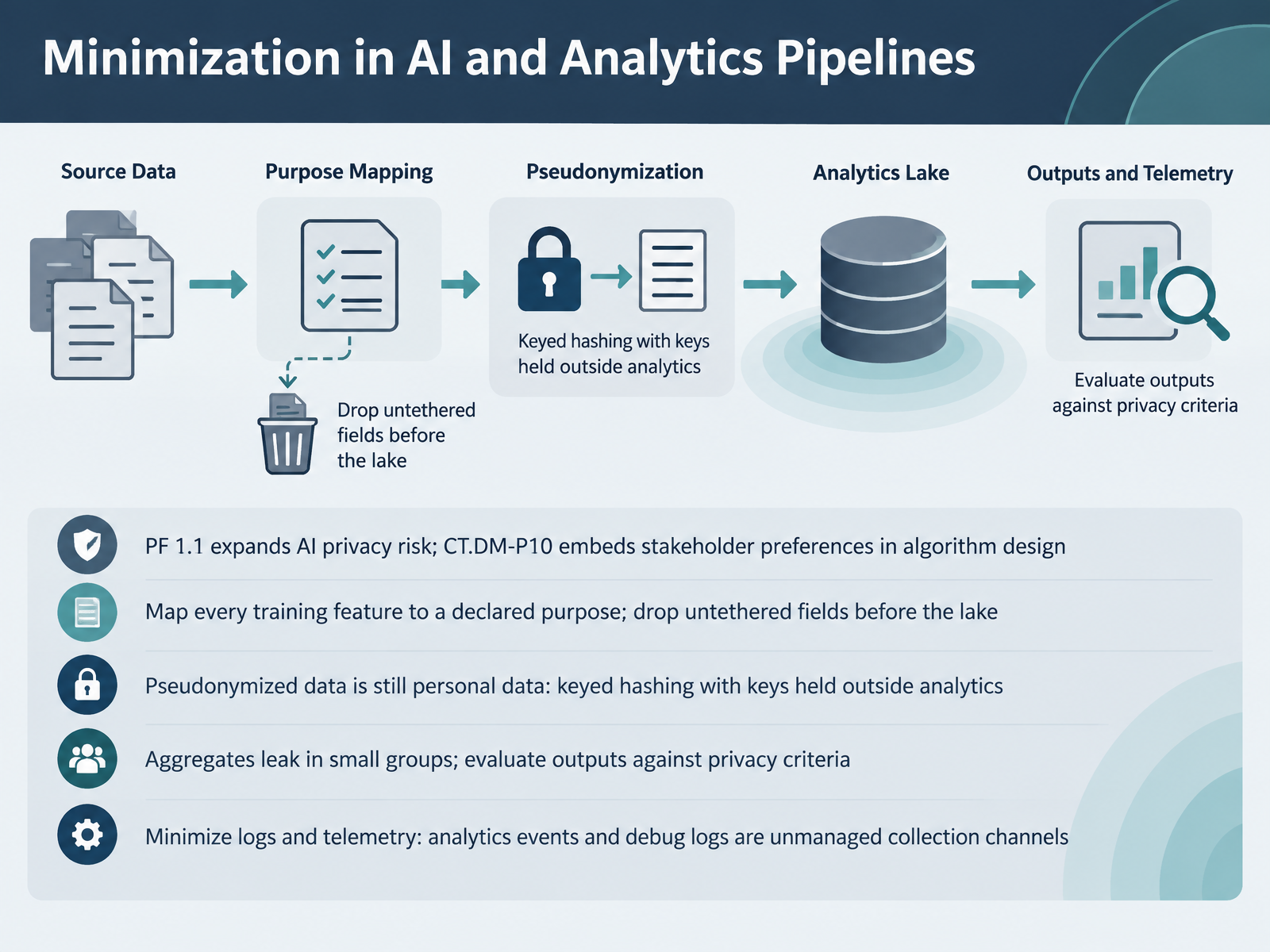
- 09Minimization in AI and Analytics PipelinesNow let's look at where minimization gets harder, in AI and analytics pipelines. Privacy Framework 1.1 expands the consideration of AI privacy risk, and subcategory CT.DM-P10 asks you to build stakeholder privacy preferences into algorithmic design objectives, then evaluate outputs against those preferences. In practice, start with the training features. Map every feature to a declared purpose, and drop untethered fields before the data reaches the lake. During design reviews, treat a feature with no purpose as a finding, not a maybe. Next, remember that pseudonymized data is still personal data. Use keyed hashing, and keep the keys outside the analytics environment. A plain hash of an email can be reversed; an HMAC whose key lives in a separate key management service cannot. Aggregates leak in small groups, so evaluate outputs against privacy criteria before you publish a dashboard. And minimize logs and telemetry. Analytics events and debug logs are unmanaged collection channels, and they quietly become your largest retention problem. We will pick up with metrics and evidence next. Metrics, Evidence, and Assurance.
 nist.govnist.govdoi.org+22 min
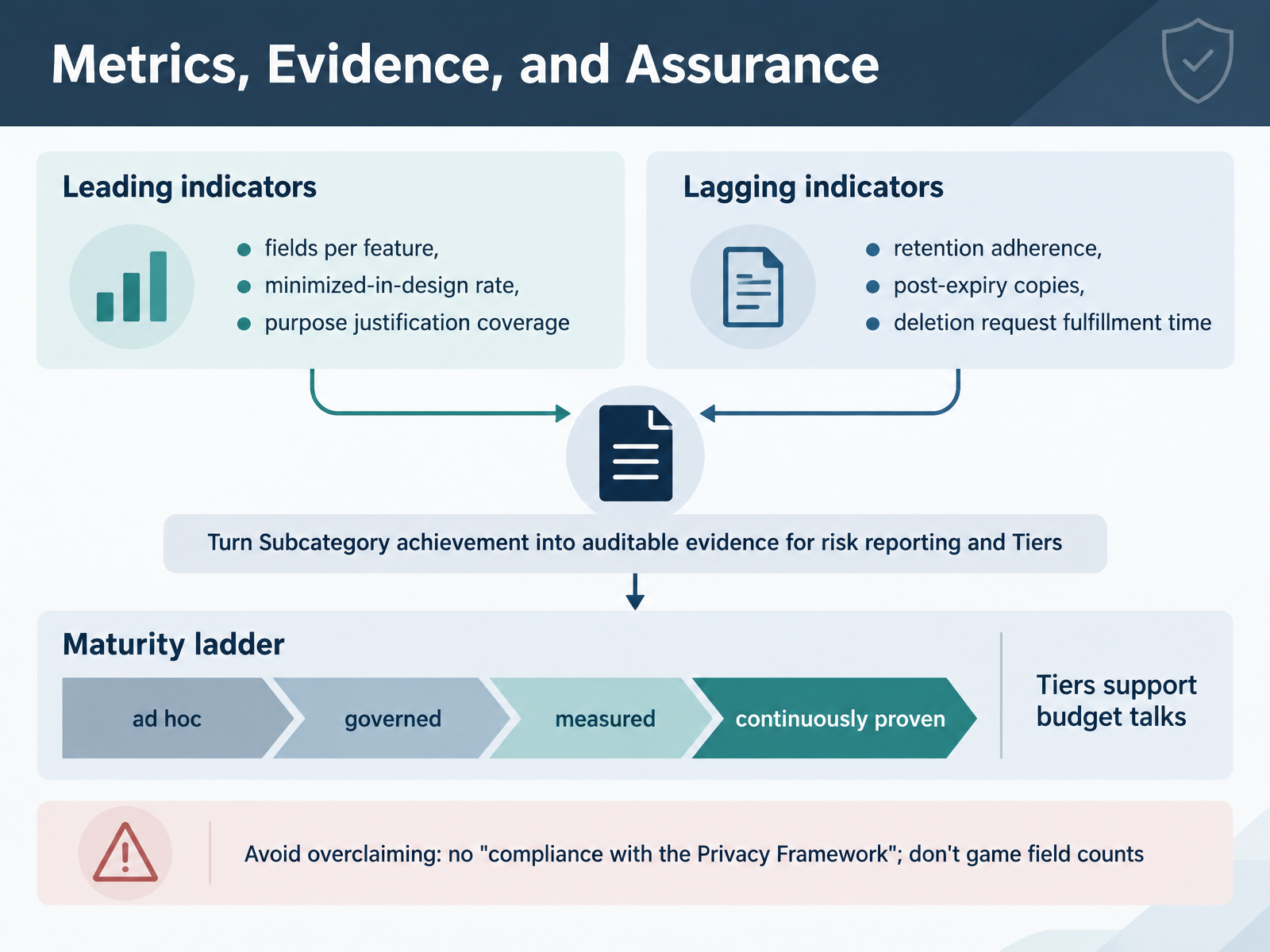
- 10Metrics, Evidence, and AssuranceLet's talk about how you prove this work. Start with leading indicators, the ones you can see before outcomes land. Fields per feature. Your minimized-in-design rate across design reviews. Purpose justification coverage in your data inventory. Then lagging indicators, which tell you what actually happened. Retention adherence. Post-expiry copies found. Deletion request fulfillment time. Pick a few of each and turn Subcategory achievement into auditable evidence, so risk reporting and Tier placement rest on records rather than assertion. Think of maturity as a ladder: ad hoc, governed, measured, continuously proven. Tiers are a useful reference point here, and they can support budget conversations, since gaps make resource needs concrete. One caution. Avoid overclaiming. There is no compliance with the Privacy Framework, and field counts are easy to game, so pair them with purpose and retention checks. That sets up the next slide, Common Pitfalls and Cross-Functional Trade-offs.
 nist.govnist.govdoi.org+22 min
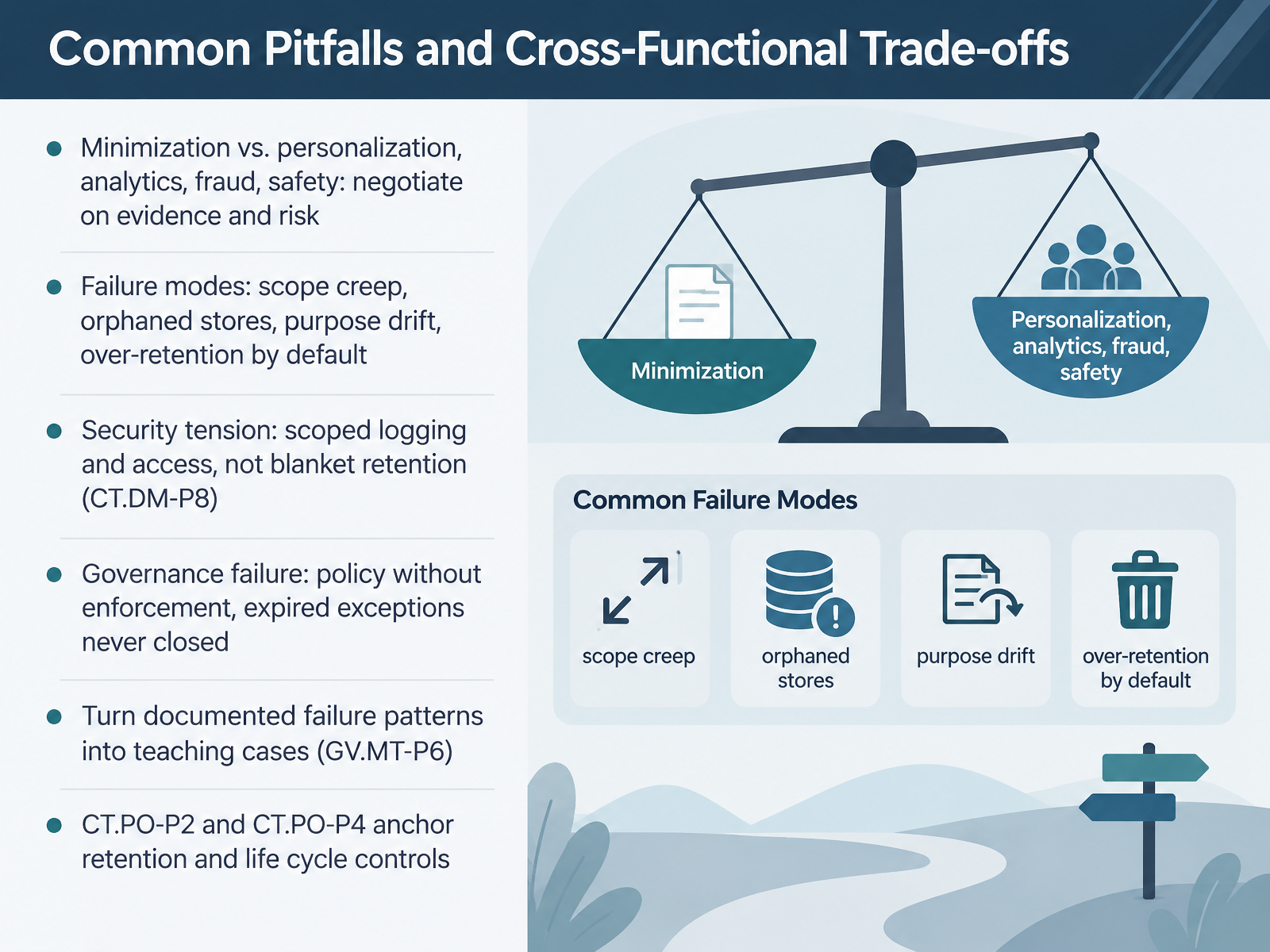
- 11Common Pitfalls and Cross-Functional Trade-offsLet's talk about where data minimization actually gets hard. Personalization, analytics, fraud detection, and safety all compete with minimization. Don't settle that with absolutes. Negotiate on evidence and risk, and document what you decided. Watch for the common failure modes. Scope creep as features expand. Orphaned stores nobody owns. Purpose drift, where data collected for one thing quietly gets reused. And over-retention by default, where keeping data is simply the path of least resistance. Security creates a real tension. The answer is scoped logging and scoped access, not blanket retention. Under CT.DM-P8, audit and log records themselves follow the principle of data minimization. Governance fails in two predictable ways. Policy exists without enforcement, and exceptions expire but nobody closes them. Turn those documented patterns into teaching cases, which is GV.MT-P6, lessons learned from problematic data actions. And let CT.PO-P2 and CT.PO-P4 anchor your retention rules and life cycle controls. Next, we put this into practice with the workshop, Applying the Framework to a Product Scenario.
 nist.govnvlpubs.nist.govnist.gov+22 min
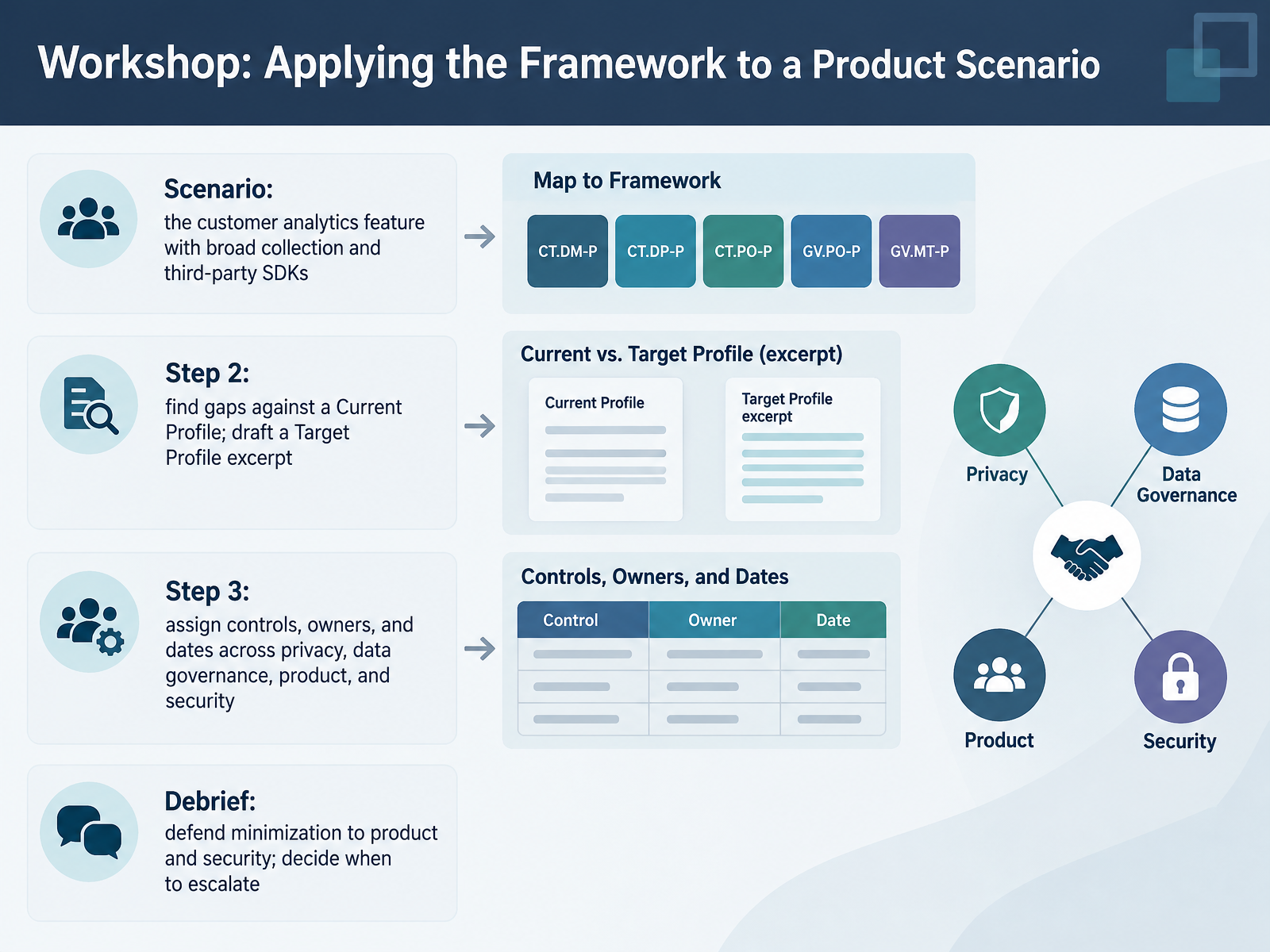
- 12Workshop: Applying the Framework to a Product ScenarioNow let's put the framework to work on a real scenario. Picture the customer analytics feature: broad collection, plus a few third-party software development kits. Step one, map the feature to Control-P subcategories: data processing management, disassociated processing, and data processing policies. Add Govern-P for policy and for monitoring and review. Step two, compare that map to your Current Profile, note the gaps, and draft a short Target Profile excerpt. Step three, assign controls, owners, and dates across privacy, data governance, product, and security. Then debrief. Defend data minimization to product and security by tying it to purpose and retention, and be honest about the utility trade-off. Agree in advance on when to escalate, for example when an SDK collects more than the purpose requires. Next, we look at the adoption roadmap for the first ninety days and the first year.
 nist.govnist.govdoi.org+22 min
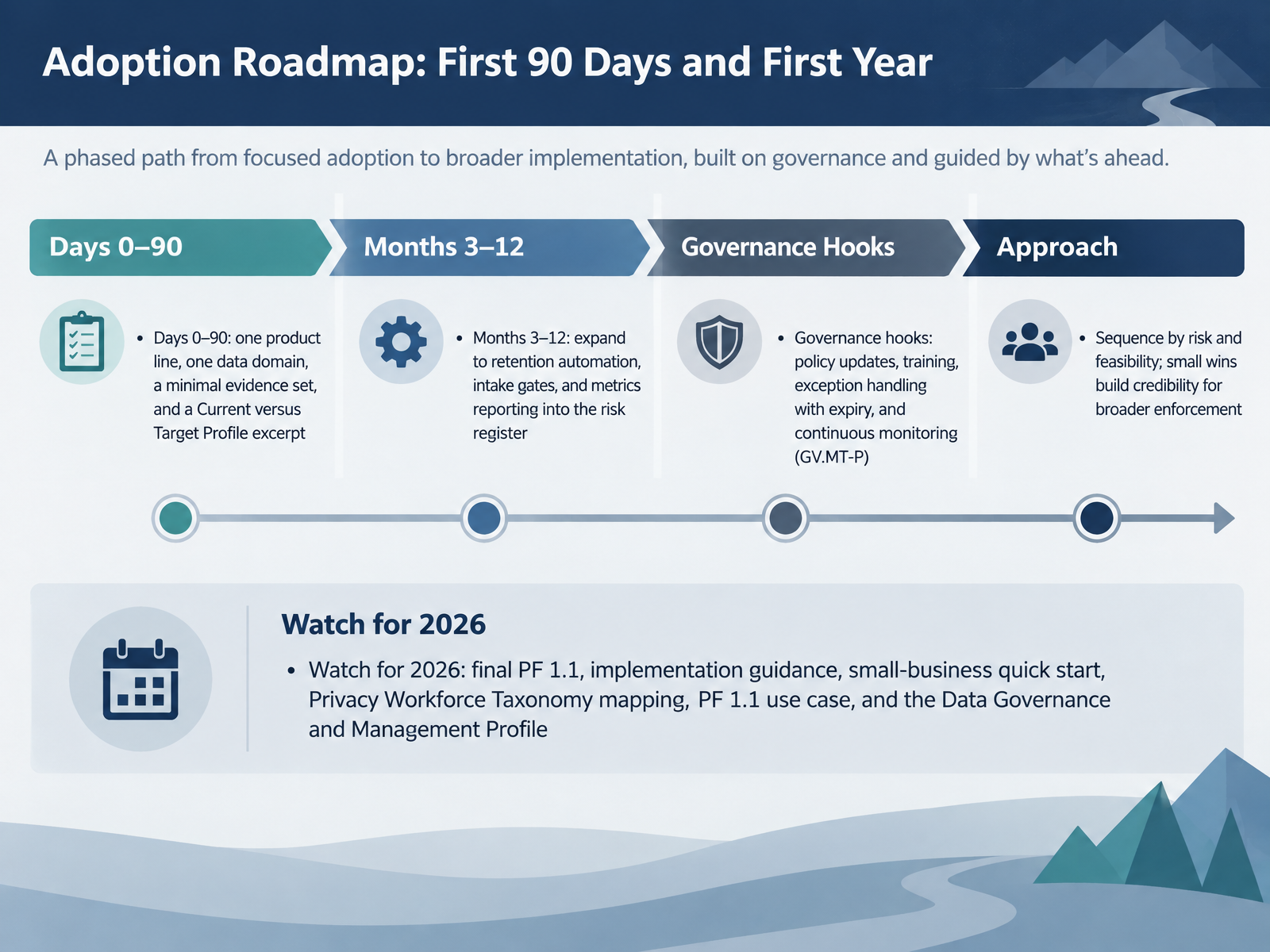
- 13Adoption Roadmap: First 90 Days and First YearLet's turn to the adoption roadmap, and how to sequence this in practice. For the first ninety days, keep the scope deliberately narrow. Pick one product line and one data domain. Assemble a minimal evidence set, and write a short Current versus Target Profile excerpt. That excerpt tells you where you are and where you intend to be, and it gives leadership something concrete to review. From month three through twelve, expand into retention automation, intake gates for new processing, and metrics reporting into the risk register. Tie the governance hooks in as you go: policy updates, training, exception handling with an expiry date, and continuous monitoring under GV dot M T hyphen P. Sequence by risk and feasibility. Small, visible wins build the credibility you need for broader enforcement. And watch for twenty twenty six: the final Privacy Framework version one point one, implementation guidance, a small-business quick start, Privacy Workforce Taxonomy mapping, a version one point one use case, and the Data Governance and Management Profile. Coming up next, Next Steps, Resources, and Q and A.
 nist.govnist.govnist.gov+22 min
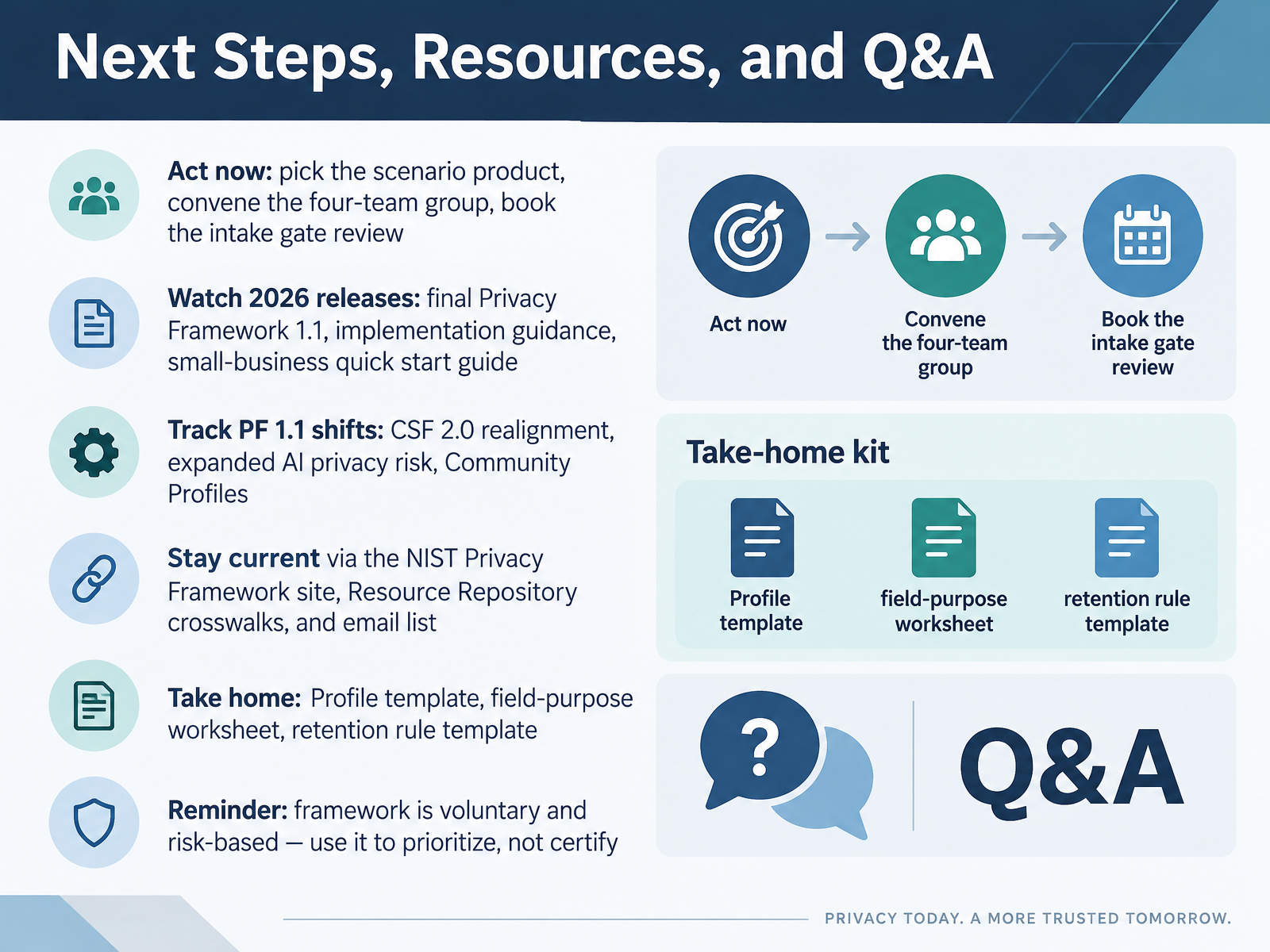
- 14Next Steps, Resources, and Q&ALet's close with what to do in the next two weeks. Pick one scenario product. Convene your four-team group: privacy, governance, product, and security. Then book the intake gate review. That is your first concrete test of data minimization and retention decisions in practice.
Watch for these 2026 releases: the final Privacy Framework 1.1, implementation guidance, and a quick start guide for small and medium businesses. Also track the version 1.1 shifts: realignment with Cybersecurity Framework 2.0, expanded AI privacy risk, and Community Profiles.
Stay current through the NIST Privacy Framework site, the Resource Repository crosswalks, and the email list. Take home three artifacts: the Profile template, the field-purpose worksheet, and the retention rule template.
And remember, the framework is voluntary and risk-based. Use it to prioritize your work, not to certify it. Thank you for your attention today. You have what you need to start, so pick your product and take that first step.
 nist.govnist.govnist.gov+22 min
Take the deck with you
Download this course as a file — free, no sign-up needed.
- PDF handoutEvery slide page, ready to print or share.15 pages · 3.1 MBDownload
- Narrated PowerPointThe deck that presents itself — every slide carries the digital human's narration video.15 pages · 14.6 MBDownload
- PowerPoint slidesThe full deck as a .pptx — open it in PowerPoint, Keynote, or Google Slides.15 pages · 3.0 MBDownload
Free to use in your own training — please keep the PersonWise credit page at the end.
Have your own deck? Turn it into a course
Sources consulted
Web sources consulted while building this course.
- Getting Started | NIST — nist.gov
- NIST Privacy Framework CORE — nist.gov
- NIST PRIVACY FRAMEWORK: — doi.org
- NIST Privacy Framework: A Tool for Improving Privacy Through Enterprise Risk Management, Version 1.0 | NIST — nist.gov
- NIST CSWP 40 Initial Public Draft, NIST Privacy Framework 1.1 — nvlpubs.nist.gov
- Enforcement Advisory No. 2024-01 — cppa.ca.gov
- Data Minimization in State Privacy Laws — bsa.org
- Principles of the GDPR - European Commission — commission.europa.eu
- GDPR v. CCPA & CPRA — dataguidance.com
- CCPA Updates, Cybersecurity Audits, Risk Assessments, Automated Decisionmaking Technology (ADMT), and Insurance Regulations - California Privacy Protection Agency (CPPA) — cppa.ca.gov
- Privacy Framework | NIST — nist.gov
- PR.DS-P1 Guidelines and Tools | NIST — nist.gov
- A Tool for Improving Privacy through Enterprise Risk ... — nvlpubs.nist.gov
- NIST releases Privacy Framework 1.1 update to improve ... — industrialcyber.co
- PF 1.0 Guidelines and Tools | NIST — nist.gov
- Using Privacy Framework 1.1 | NIST — nist.gov
- NIST Informative References for the Privacy Framework: A Tool for Improving Privacy through Enterprise Risk Management — nist.gov
- https://docs.aws.amazon.com/wellarchitected/latest/analytics-lens/best-practice-3.1-privacy-by-design..html — docs.aws.amazon.com
- This template includes: — pages.awscloud.com
- Data retention and deletion: minimize, expire and verify — softwaresecurity.com