Begin
14 pages · ~28 min
Change Management Risk Assessment
Learn to identify, analyze, and mitigate risks in organizational change initiatives, equipping professionals with practical tools to ensure smoother transitions and successful change adoption.
A digital instructor presents all 14 pages. Hold “Ask” at any point and ask out loud — the answer comes from this course. No sign-up needed.
What you’ll learn
- 01Change Management Risk AssessmentWelcome, everyone. If you're responsible for guiding a team through change, you already know the stakes are high. Research tells us that a large percentage of transformations fall short, often because risk isn't managed from the start. This is not about adding more paperwork to your day. It's about learning a practical, repeatable approach to spot trouble early. We're talking about resistance, gaps in capability, and the kind of cultural friction that quietly slows everything down. The goal is simple: act, don't react. By the end of this session, you'll know how to reduce disruption and drive real adoption. This is designed for team managers, change leads, and business teams who want a smoother path forward. Let's get started. First, we'll look at why change initiatives often fail, so we can avoid those traps from day one.prosci.commanageengine.comaevitium.com+22 min
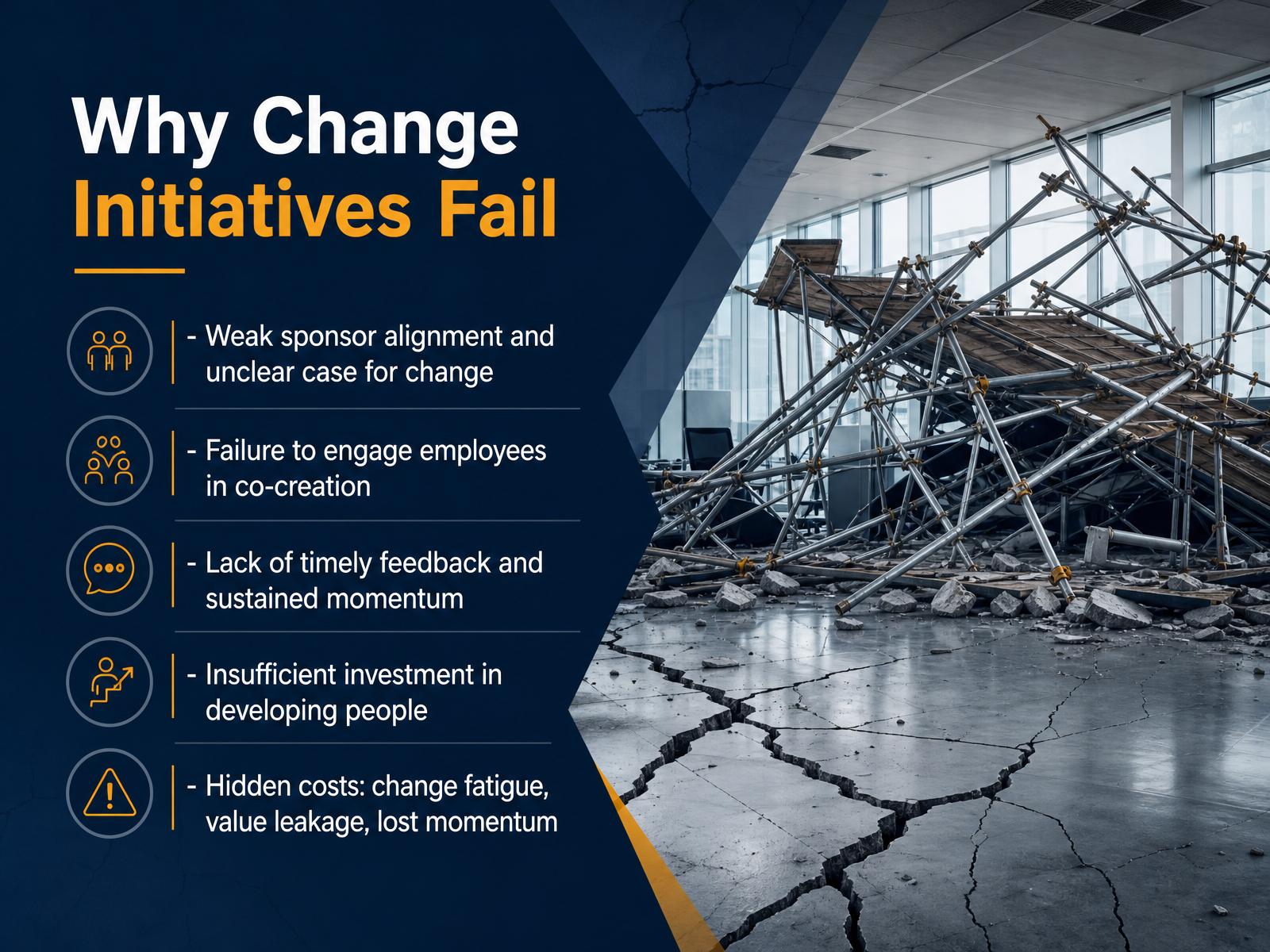
- 02Why Change Initiatives FailLet's begin by looking at why change initiatives fail. In our experience, transformation efforts rarely fail because of poor planning or weak execution alone. The real culprits are usually more human. A weak sponsor alignment, where the leadership team is not fully on the same page about the case for change, is often the starting point. Next is the failure to engage employees in co-creation. When people feel the design is being done to them, not with them, resistance naturally builds. And think about this: how often do you get timely, honest feedback during a project? Without it, momentum dies quietly. We also underestimate the investment needed to develop people for new roles. And finally, there are hidden costs. Change fatigue, value leakage, lost momentum, these are the quiet drains on your budget and morale. So, as we move into the assessment, the question is not just what can go wrong, but how ready is your team for what is coming. The People Side of Risk is where we will start to find those answers.
 imd.orghbr.orgpapers.ssrn.com+22 min
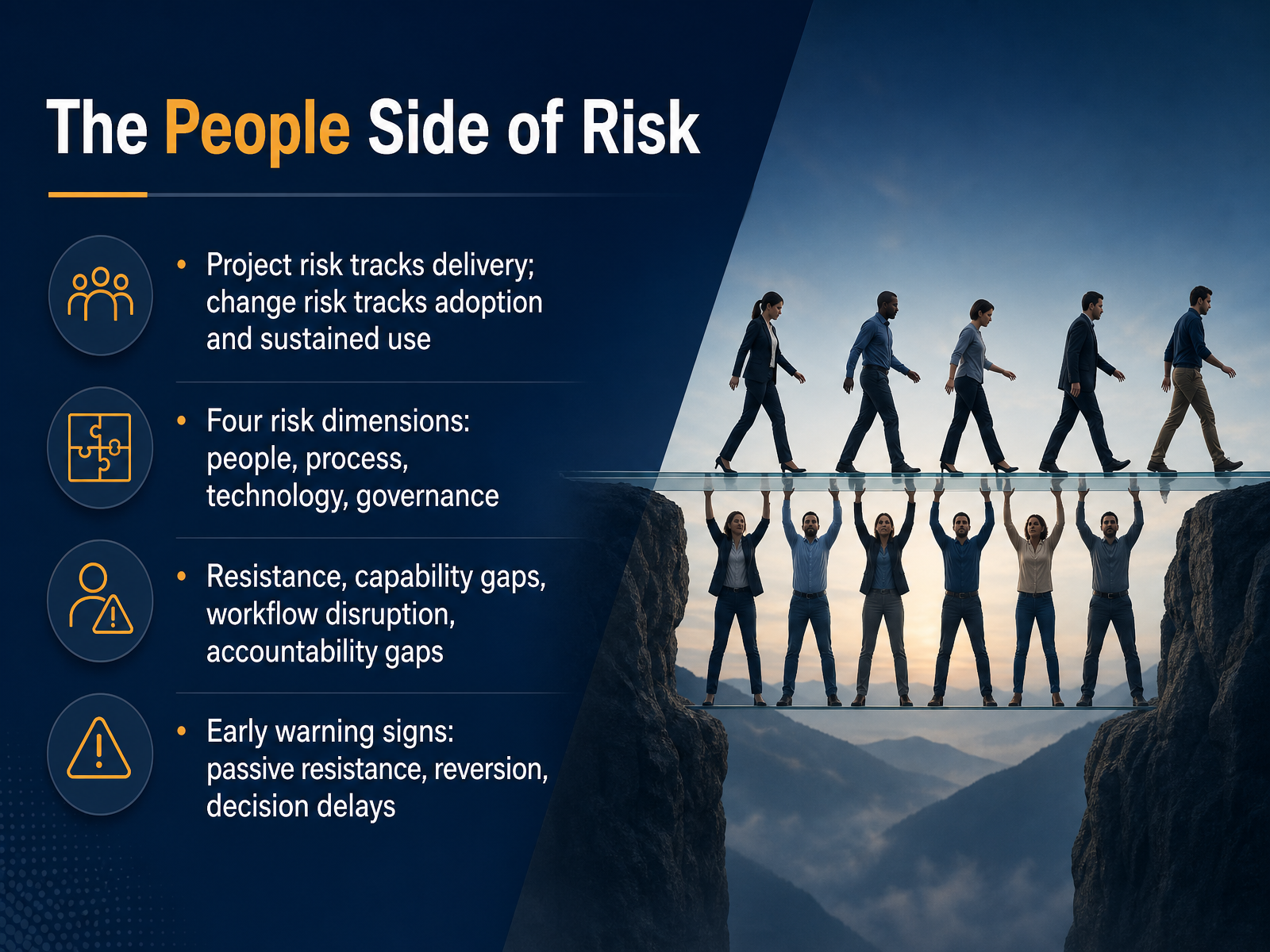
 - 03The People Side of RiskLet's take a closer look at what change risk really means. It's not the same as project risk. Project risk tracks whether you deliver on time and on budget. Change risk tracks whether people actually adopt and sustain the new way of working. Both matter, but they need different attention. We assess change risk across four dimensions. People, process, technology, and governance. People risk covers resistance and capability gaps. Will your team push back, or quietly comply and then revert? Process risk is about workflow disruption. Handover gaps are dangerous because they often stay invisible until something breaks. Technology risk asks whether people can work effectively with the new system, not just whether the system functions. Governance risk looks at accountability and decision making. Who owns the change once it's live, and who has the authority to resolve issues? Watch for early warning signs. Passive resistance, people who nod but quietly slide back to old habits. Reversion under pressure, when workload spikes, they default to what they know. Decision delays, when approvals slow down, that's often a signal. These signs rarely show up in project reports. Think about your own team. Which of these dimensions keeps you up at night? Hold onto that thought, because next we'll walk through the core concepts for assessing change risk. Now, let's move into the core risk assessment concepts.
 projectmanagementformula.comocmsolution.compmi.org+22 min
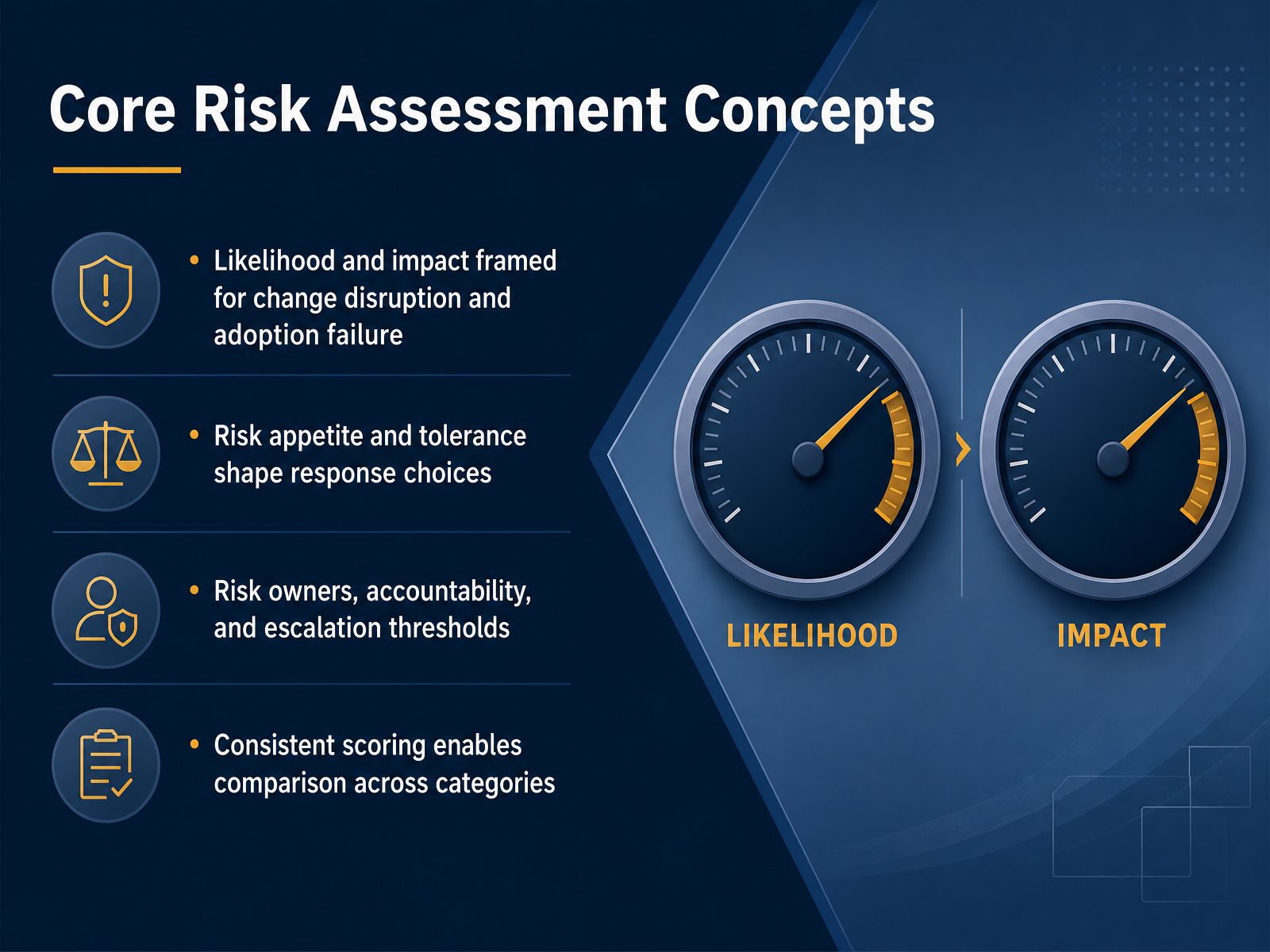
 - 04Core Risk Assessment ConceptsLet's look at the core concepts that will guide your risk assessment. First, likelihood and impact. Every risk has two dimensions: how likely it is to happen, and how much it will disrupt your team's ability to adopt the change. A high-impact risk with low likelihood still deserves attention. Next, consider your organization's risk appetite and tolerance. This shapes your response choices. Are you willing to accept some risk for faster adoption, or do you prefer to slow down and minimize disruption? Knowing your tolerance helps you decide whether to avoid, reduce, transfer, or accept each risk. Then, assign risk owners. Every significant risk needs someone accountable for monitoring it and taking action. Set clear escalation thresholds so that if a risk rises to a certain level, the right people are notified immediately. Finally, use consistent scoring across all categories. If you can compare a people risk to a process risk on the same scale, you can prioritize more effectively. These concepts form the foundation for your entire assessment. Next, we'll map the change landscape.
 prosci.commanageengine.comaevitium.com+22 min
 - 05Mapping the Change LandscapeNow let's map the change landscape. Think of this as creating a terrain map before you start the journey. You want to know where the steep climbs are, where the ground is unstable, and which paths will require the most effort. Start by assessing the scope of the change. How extensive is it? How many teams and individuals will it touch? The broader the reach, the more complex the coordination. Next, evaluate your organization's culture. Is it change-ready or change-resistant? Look at your history. Have past initiatives succeeded? Are there lingering effects from failed efforts? Also, check your leadership capacity. Do your sponsors have the time, credibility, and energy to see this through? Once you have this picture, rate each factor by its characteristics and attributes. Not every risk deserves the same attention. Tier your assessment so you focus your energy on the high-impact risks that could truly derail adoption. This structured focus is what separates proactive management from reactive firefighting. Next, we'll move into readiness and risk identification, where we will look at how to score what we have just mapped.
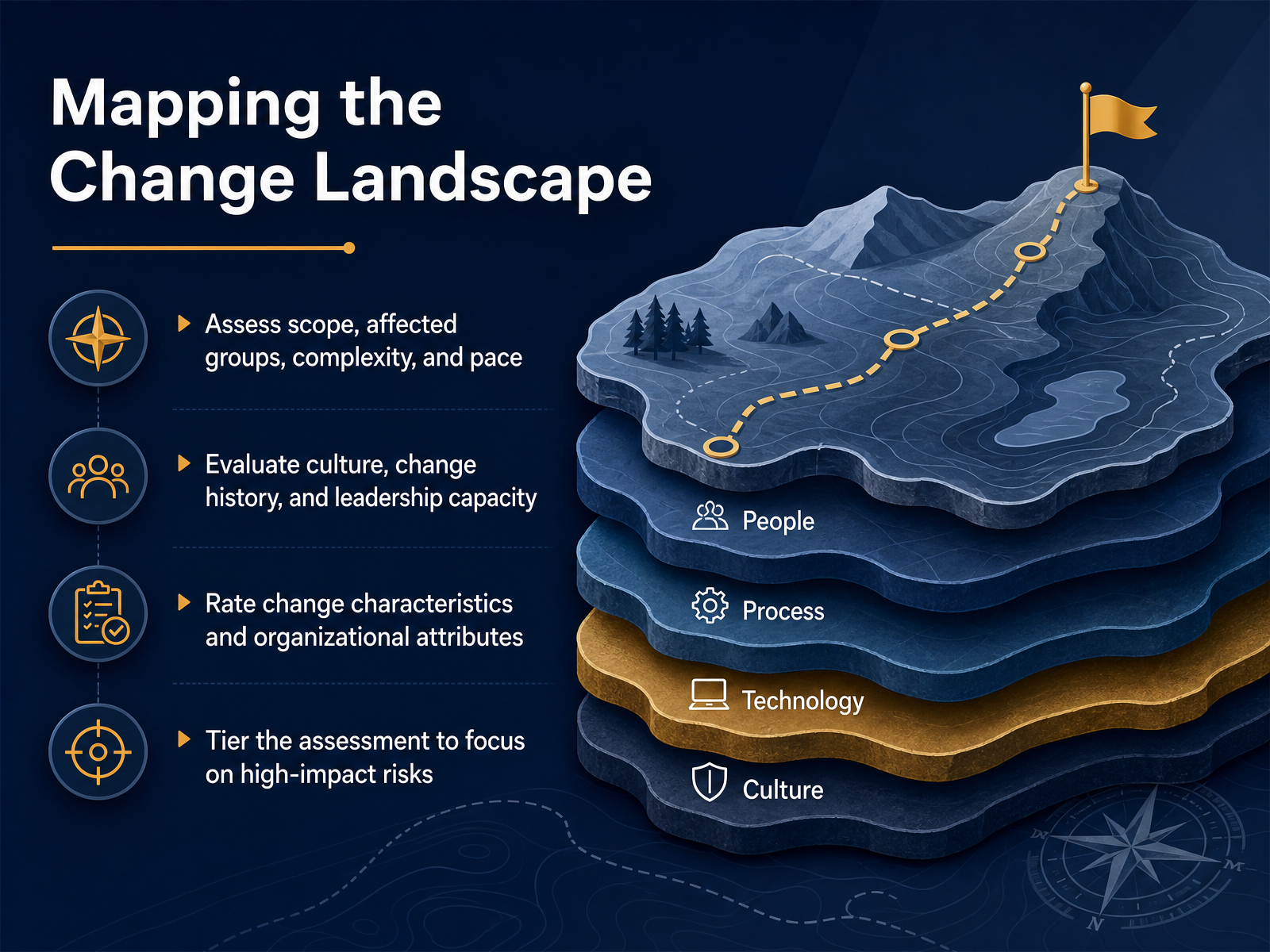 prosci.commanageengine.comaevitium.com+22 min
 - 06Readiness and Risk IdentificationNow let's move into the practical starting point: readiness and risk identification. This is where planning turns into action. A readiness assessment is your diagnostic bridge. It tells you whether your people are prepared, not just whether your plan looks good on paper. Start with structured checklists to spot the common risk areas: stakeholder resistance, capacity gaps, and workflow disruption. Ask yourself, do your teams have the time, tools, and bandwidth to absorb this change? But checklists only show part of the picture. One-on-one interviews are where you uncover the behavioral signals that surveys miss, the quiet hesitations, the hidden workload concerns, and the unspoken doubts. So, consider this: if you were to interview your team today, what would they tell you that they haven't put in writing? Use these conversations to gauge true sentiment, not just surface agreement. That is how you build a realistic picture of readiness before the change ever lands. Now, once you have identified these risks, the next step is figuring out which ones deserve your immediate attention; that is where we turn to scoring likelihood and impact.
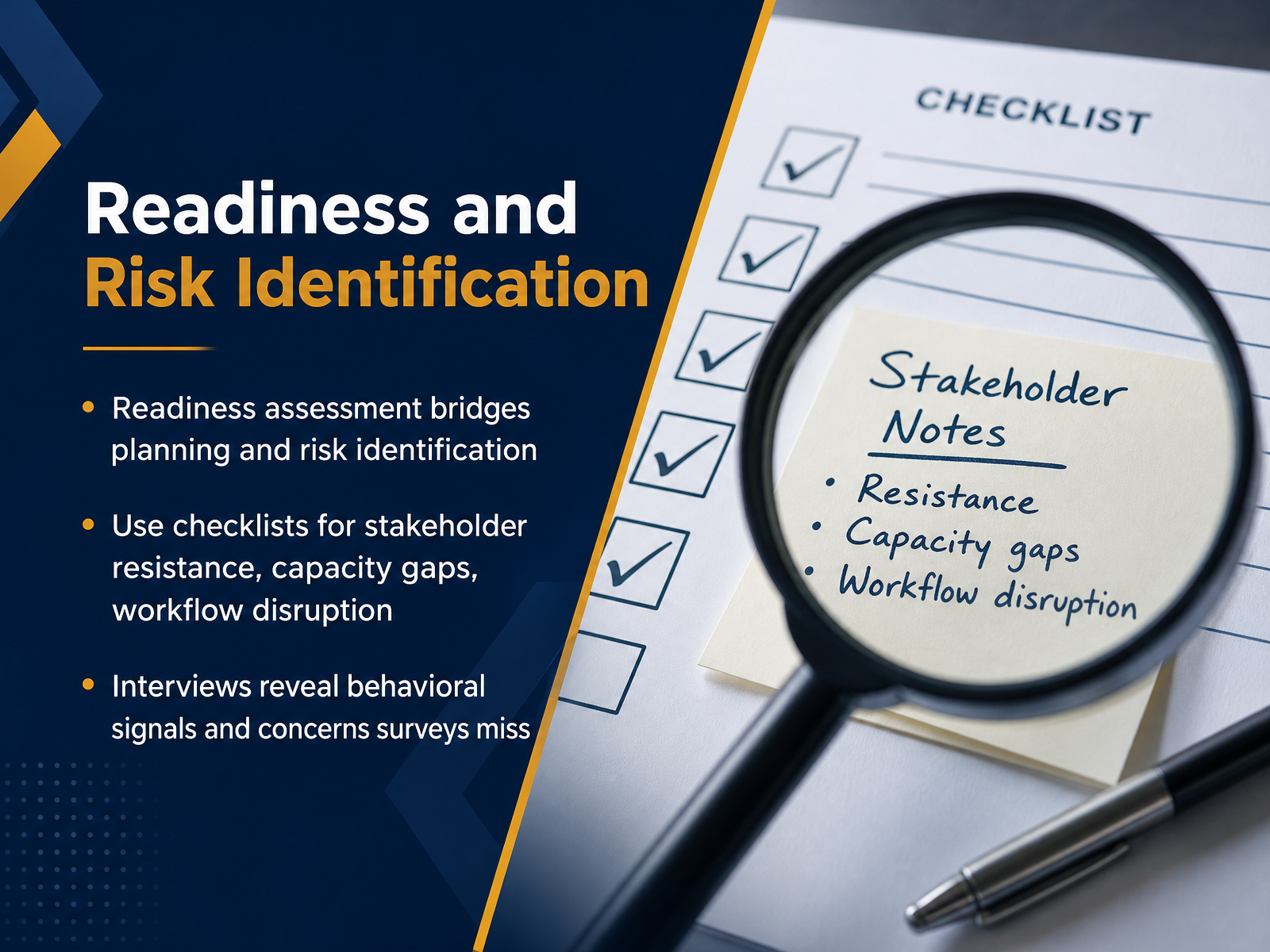 aihr.comcalhr.ca.govworkamajig.com+22 min
 - 07Scoring Likelihood and ImpactNow let's talk about scoring likelihood and impact. This is where the assessment becomes practical. Use the same one-to-five scale for every risk category. That consistency matters because it lets you compare a people risk against a governance risk on equal footing. If you use different scales, you cannot tell which one deserves more attention. As you score, prioritize the risks that would delay adoption or erode the benefits of the change. Those are the ones that hurt the most. Then map your scores onto a heat map. Low, medium, high, or extreme. That color-coded view makes priorities visible at a glance. So, when you rate each risk, ask yourself: how likely is this, and if it happens, how much will it cost us in adoption? That combination drives your next steps. Keep that in mind as we move on to building the risk register and heat map.
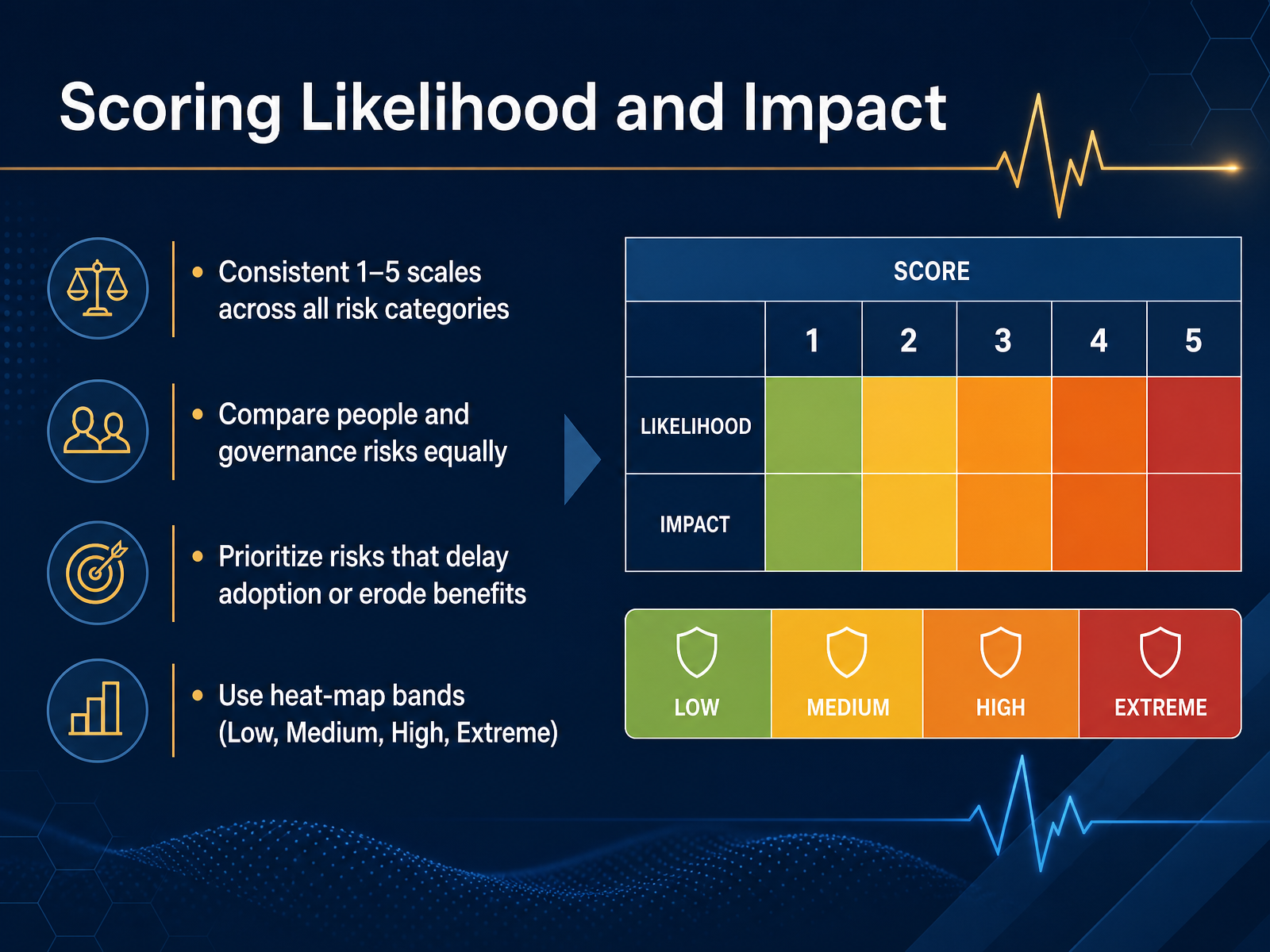 prosci.commanageengine.comaevitium.com+22 min
 - 08Building the Risk Register and Heat MapNow that you have your risks scored, we need to bring them together in one place. This is your risk register. Think of it as the single source of truth for every concern, big or small. For each risk, you will record the owner, the score, the rating, your planned response, and a review date. This discipline ensures nothing slips through the cracks. To make priorities instantly clear, we use a heat map. It is a five by five matrix, color coded from green for low risk, up through amber and red, to dark red for extreme. A quick glance tells everyone where the greatest threats lie. You can use templates that auto calculate these scores and ratings, saving you time and reducing errors. But do not use them as is. Adapt the categories and thresholds to fit the size and maturity of your change. A small team rollout does not need the same thresholds as a company wide transformation. With this foundation, you are ready to think about how you will respond. Let us look at planning your risk responses.
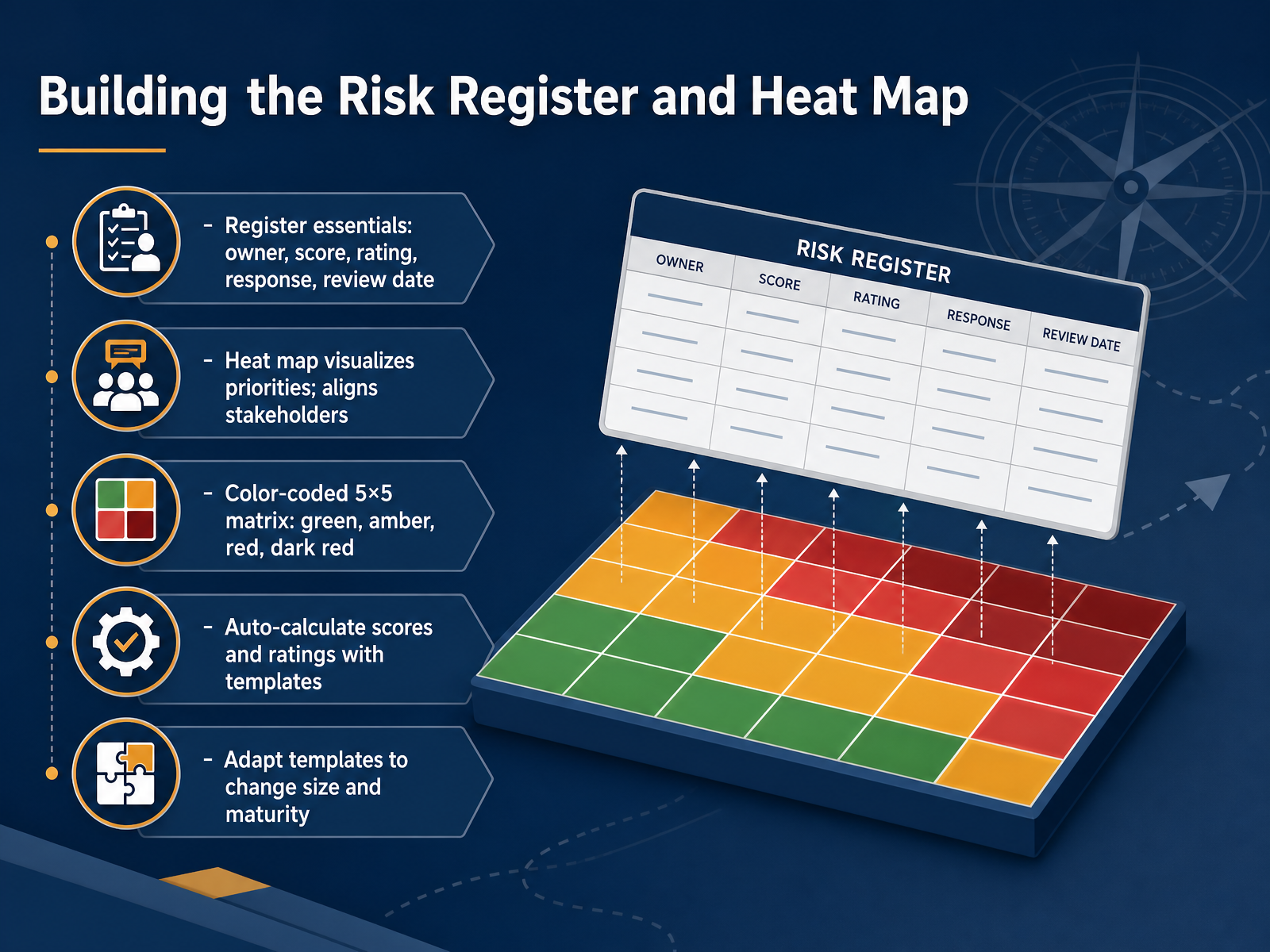 riskpublishing.comprocess.stprosci.com+22 min
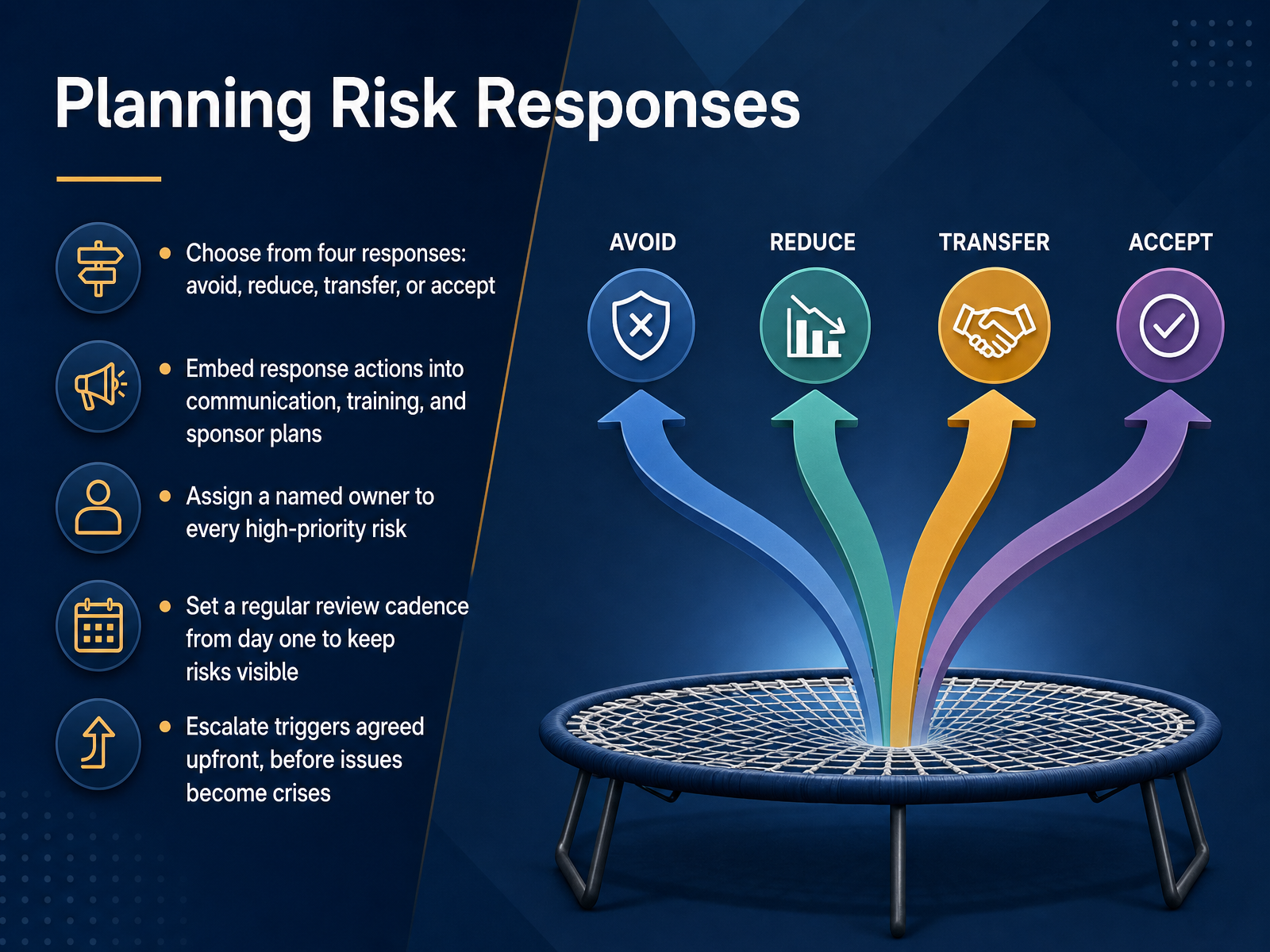
 - 09Planning Risk ResponsesOnce risks are prioritized, the real work begins: planning how to respond. You have four options. Avoid the risk by redesigning the change. Reduce it through training or phased rollout. Transfer it to a partner better equipped to handle it. Or accept it when mitigation costs more than the impact. Whichever you choose, embed those actions directly into your communication, training, and sponsor plans so they are not a separate checklist. Every high-priority risk needs a named owner. If no one owns it, no one will act on it. Agree on escalation triggers upfront, before issues become crises, and set a review cadence from day one to keep risks visible and current. Now, let us look at how to track these risks with monitoring and leading indicators.
 projectmanagementformula.comocmsolution.compmi.org+22 min
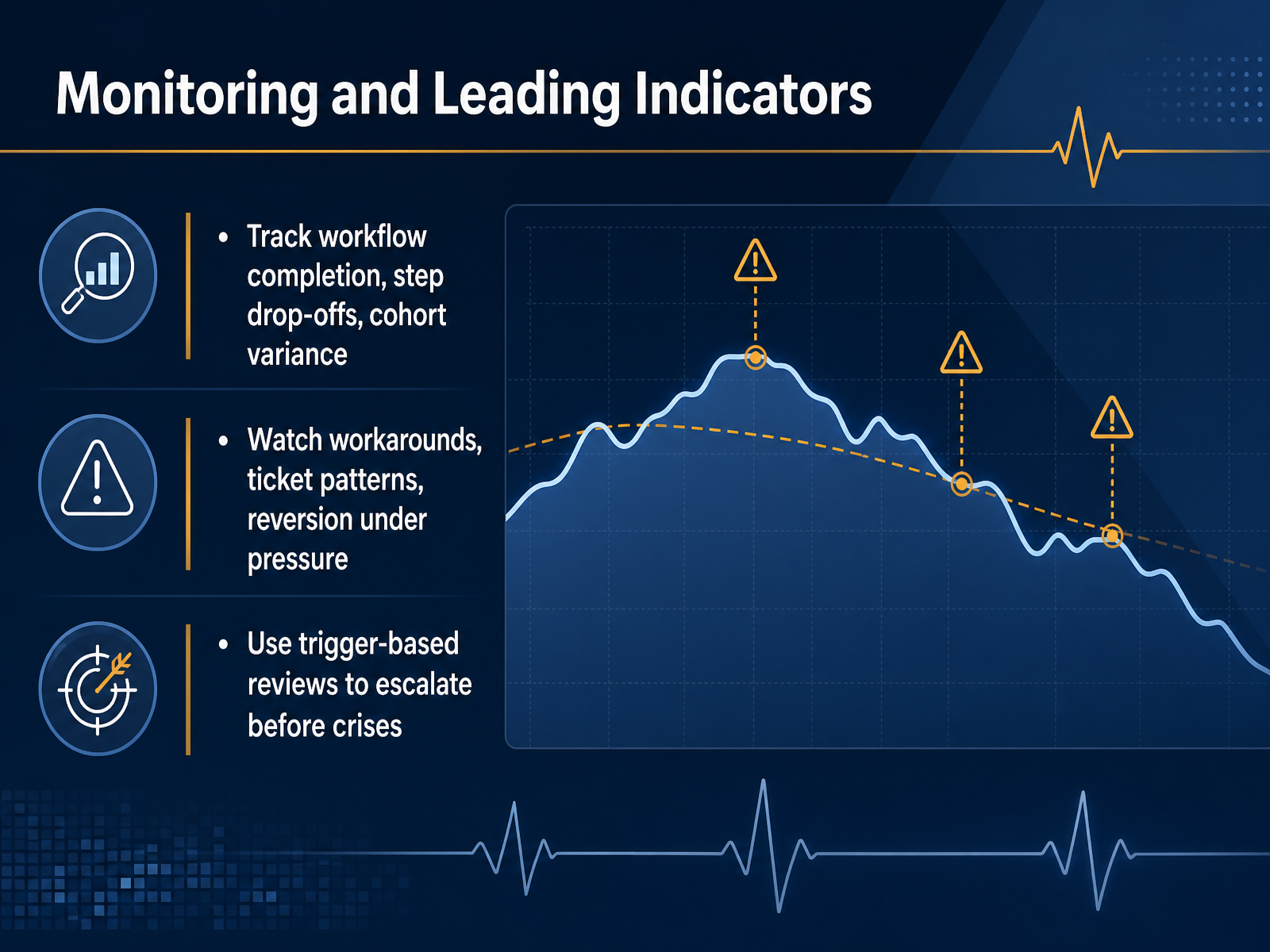
 - 10Monitoring and Leading IndicatorsOnce your change is live, monitoring becomes your early warning system. The goal is to spot problems while they are still small, not after they become team-wide disruptions. Start by tracking workflow completion and where people drop off mid-step. If one team or region is lagging behind others, that variance is your signal. Also watch for workarounds, repeated support tickets, and reversion under pressure. When workload spikes, do people fall back to the old way of doing things? That pattern tells you the change hasn't stuck yet. The key is to set trigger-based reviews. Agree in advance what numbers will prompt a closer look, so you escalate based on data, not emotion. Remember, the fastest leading indicator is often a step-level drop-off spike in week one. Act at that specific point, and measure whether your fix improves the next review cycle. This keeps small frictions from becoming entrenched resistance. Now, let's look at how you adjust your approach as the change progresses.
 2 min
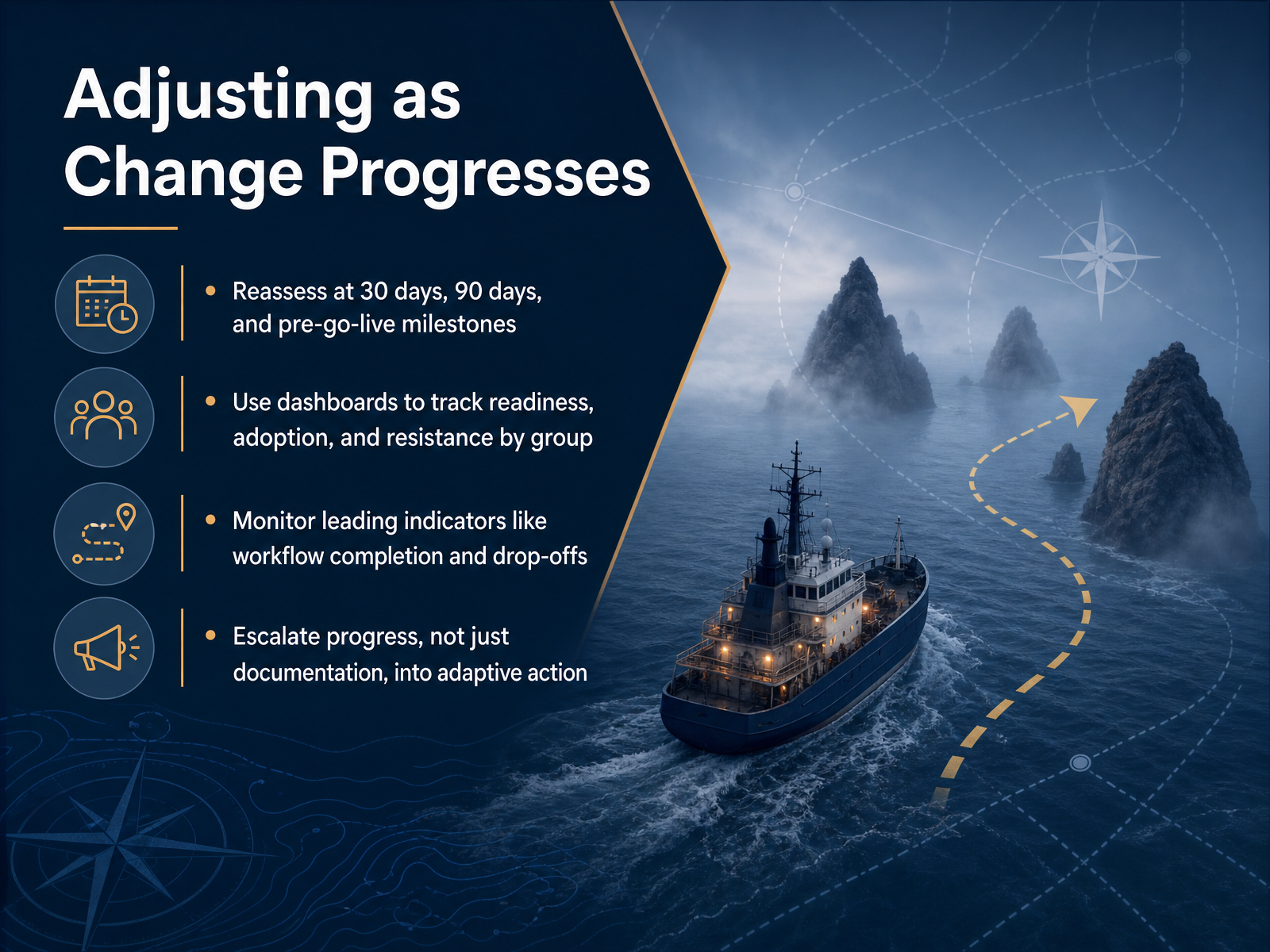
2 min - 11Adjusting as Change ProgressesOnce your change is underway, your risk assessment needs to shift from planning to monitoring. Reassess at the thirty day, ninety day, and pre-go-live milestones. Your dashboard is your compass here. Track readiness, adoption, and resistance by group so you can see which teams are moving forward and which are stalling. Don't rely on documentation alone. Watch the leading indicators. Workflow completion rates and step-level drop-offs tell you where people are getting stuck, often before they submit a help ticket. If one team shows a spike in errors or a drop in completion, that is your signal to act. Escalate progress, not just paperwork, into adaptive action. Ask yourself, what is this data telling me about where my team needs support right now? In the next part, we'll look at the practical tools that make this kind of monitoring simple and effective.
 aihr.comcalhr.ca.govworkamajig.com+22 min
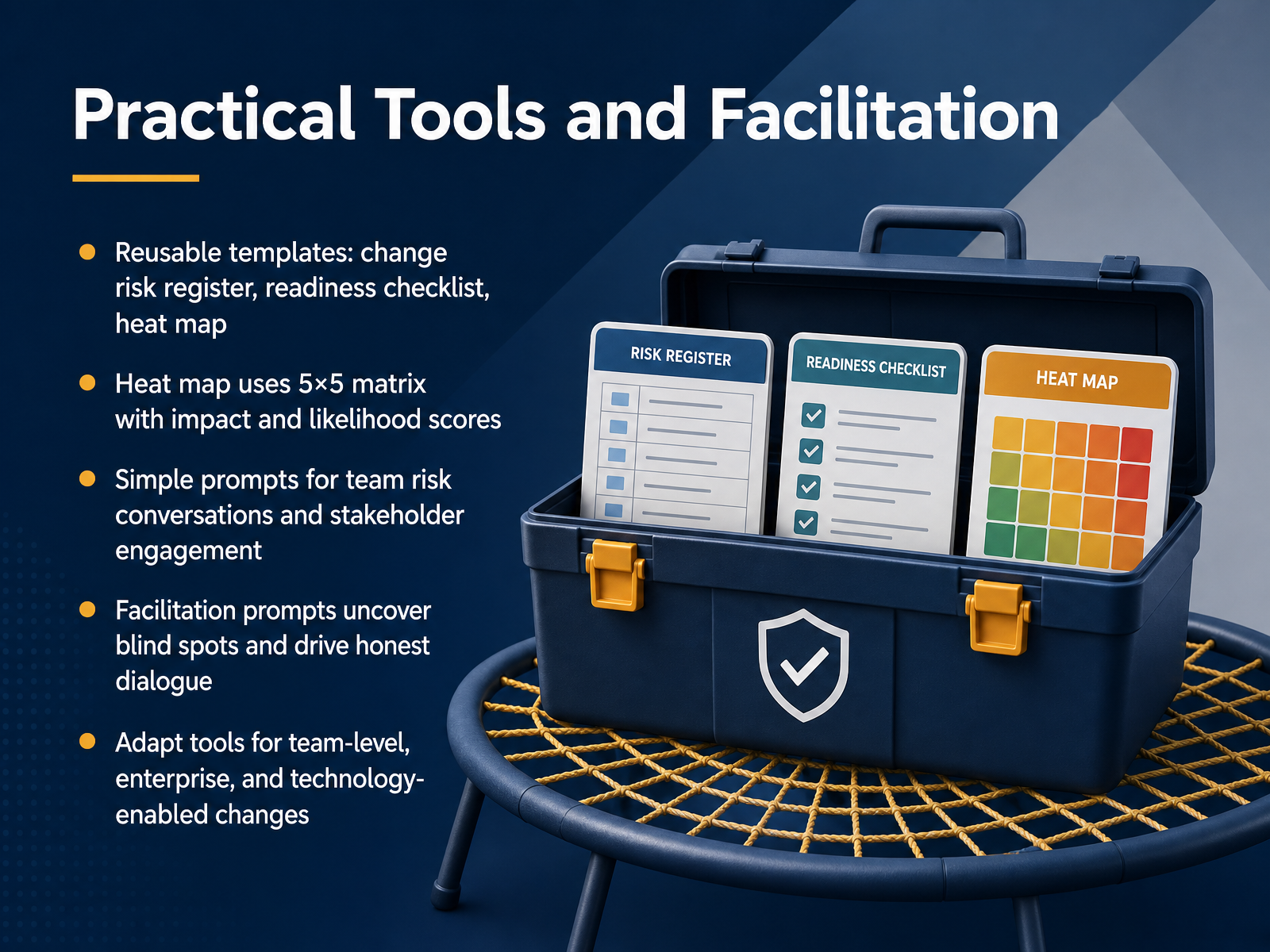
 - 12Practical Tools and FacilitationNow let's talk about the practical tools that make risk assessment a habit, not a hurdle. You don't need complex software—you need templates that fit your team's rhythm. Start with a change risk register. It's simply a living list of risks, with columns for likelihood, impact, owner, and action. Pair it with a readiness checklist to capture the human side: awareness, skill, capacity, and trust. For quick visualization, use a heat map. It's a five by five grid, with impact on one axis and likelihood on the other. Each cell gets a color: green for low, amber for medium, red for high. You can see at a glance where your attention belongs. But here's the key—these tools only work if the conversations are honest. Use simple prompts in team meetings: 'What could make this change harder than we expect?' Or, 'Who might resist, and why?' That's how you uncover blind spots. Remember, the level of detail can flex. A small team change might only need a quick checklist and a chat. An enterprise rollout might need the full register, heat map, and dashboard. Adapt the depth to the stakes. In short, don't let the tool become the task. Use it to bring clarity, drive dialogue, and keep your team grounded. Next, we'll walk through a worked example at team level, so you can see these tools in action.
 riskpublishing.comprocess.staihr.com+21 min
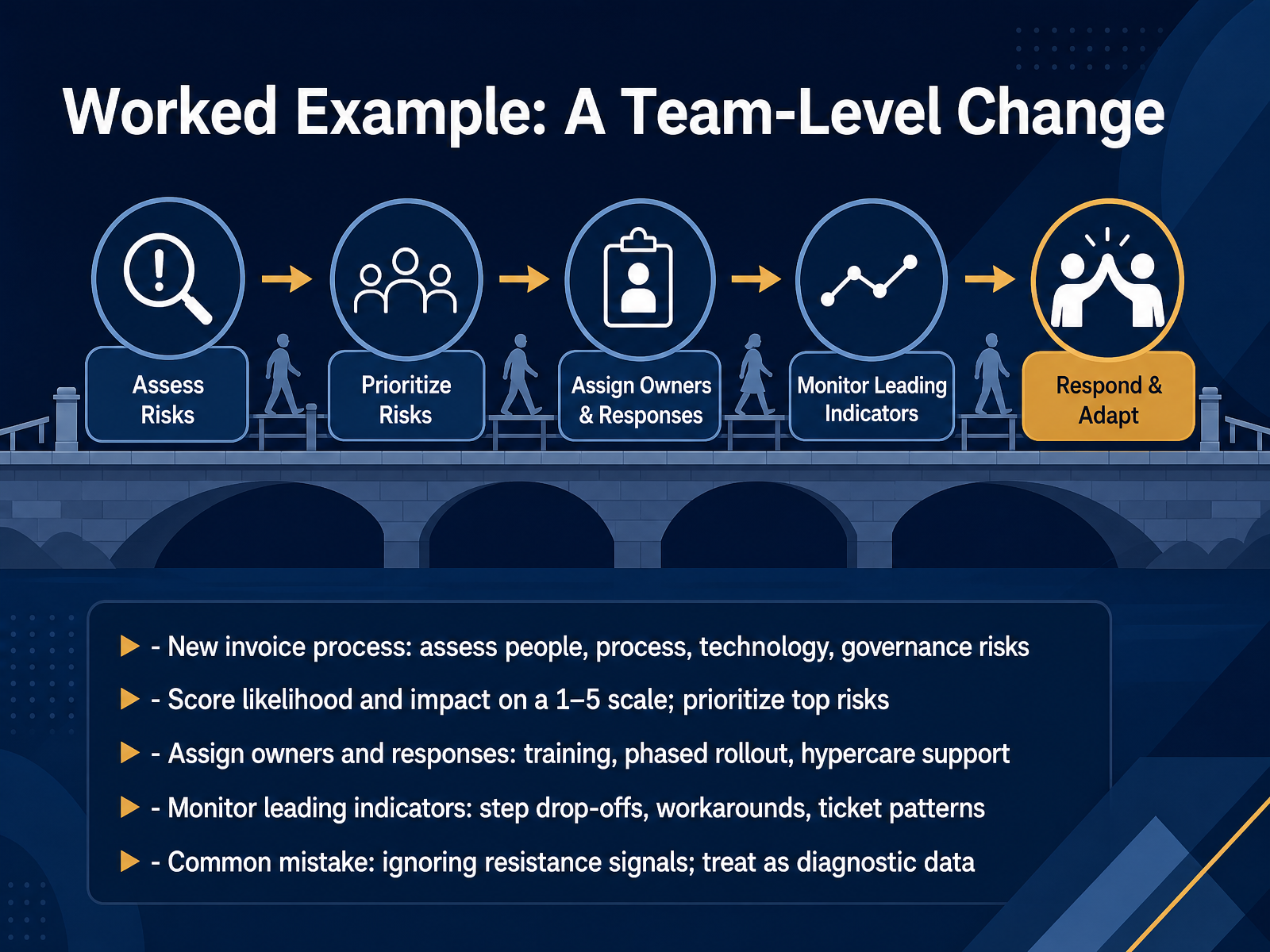
 - 13Worked Example: A Team-Level ChangeLet's make this practical with a team-level example. Imagine you are rolling out a new invoice process. Start by assessing four risk categories: people, process, technology, and governance. For people, ask yourself: who might resist, and who lacks the skills? For process, consider workflow disruptions and handover gaps. For technology, think about usability and training adequacy. And for governance, clarify who owns decisions after go-live. Now, score each risk's likelihood and impact on a scale of one to five. This simple matrix helps you compare a high people risk against a high technology risk. Prioritize the top risks and assign owners with clear responses. For instance, targeted training, a phased rollout, and hypercare support can address many adoption threats. After go-live, monitor leading indicators: step drop-offs, workarounds, and ticket patterns. These signals show where execution is breaking before it becomes widespread. One common mistake: ignoring resistance signals. Treat resistance as diagnostic data, not noise. It reveals design flaws or communication gaps. If you interpret it well, you can course-correct early. Now, let's turn this into your action plan.
 projectmanagementformula.comocmsolution.compmi.org+22 min
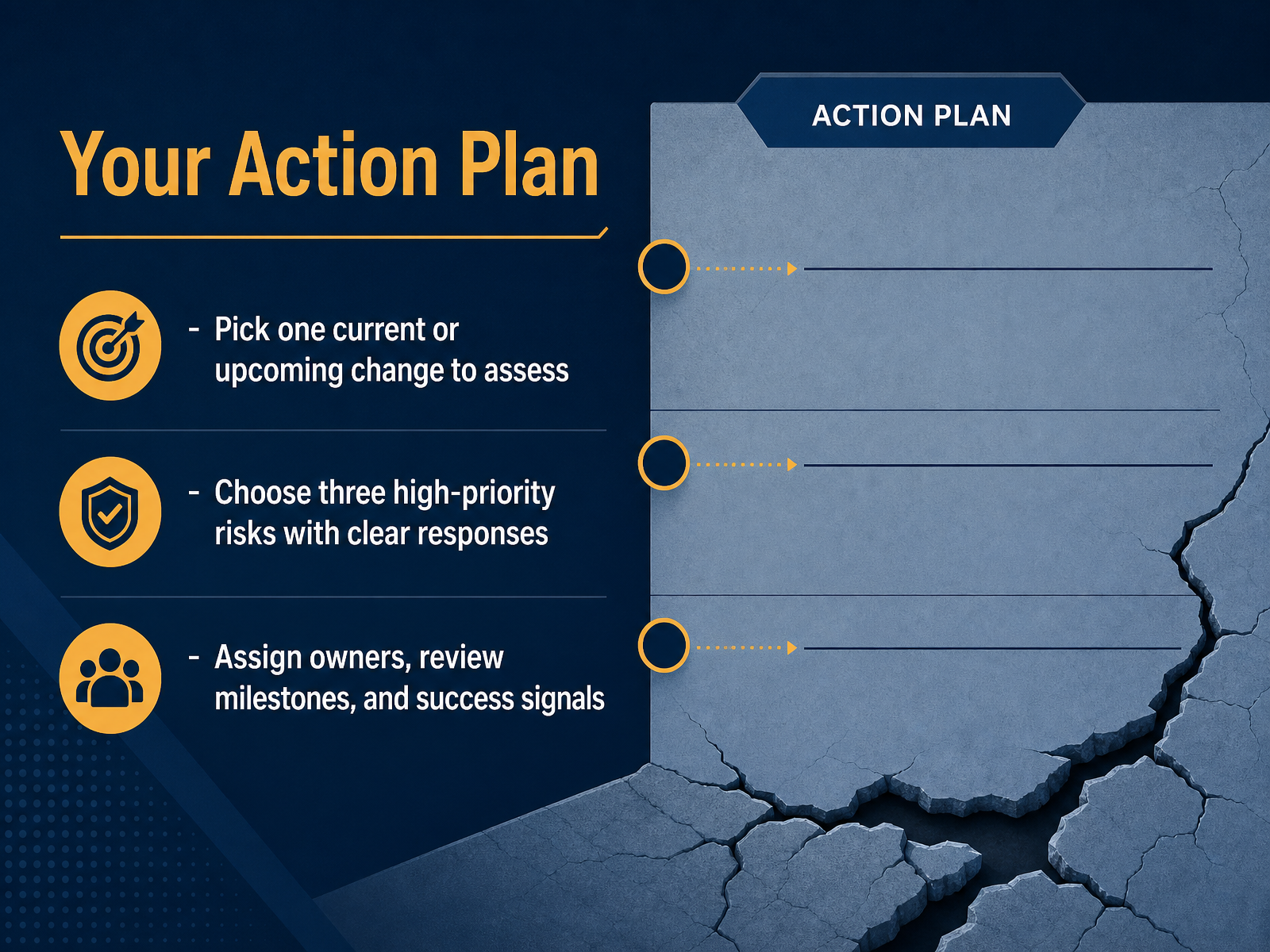
 - 14Your Action PlanSo here's where we turn all of this into action. Don't try to assess every change at once, and don't try to build a perfect plan. Start with just one. Pick a change that's currently underway or coming up soon. It doesn't matter if it's large or small; what matters is that it's real. Then, from your assessment, choose your top three high-priority risks. Not the easy ones, the ones that genuinely threaten readiness and adoption. For each one, define a clear response. What will you do about it? Who needs to know? And what needs to happen first? Next, assign a named owner to each risk. Vague ownership is where plans go to die. Set review milestones so you're checking progress at defined moments, not just when something feels off. And finally, define what success looks like. What signals will tell you that the risk has been managed and the change is taking hold? You now have a framework that's practical, focused, and yours to apply. Thank you for your attention, and I encourage you to take that first step this week. You have exactly what you need to begin.
 prosci.commanageengine.comaevitium.com+22 min
Take the deck with you
Download this course as a file — free, no sign-up needed.
- PDF handoutEvery slide page, ready to print or share.15 pages · 3.6 MBDownload
- Narrated PowerPointThe deck that presents itself — every slide carries the digital human's narration video.15 pages · 25.6 MBDownload
- PowerPoint slidesThe full deck as a .pptx — open it in PowerPoint, Keynote, or Google Slides.15 pages · 3.6 MBDownload
Free to use in your own training — please keep the PersonWise credit page at the end.
Have your own deck? Turn it into a course
Sources consulted
Web sources consulted while building this course.
- Do You Need a Change Management Risk Assessment? - Prosci — prosci.com
- What is change risk assessment? 5 steps to build it with example — manageengine.com
- Change Management Risk Assessment: A Strategic Guide by ... — aevitium.com
- Management of Change Risk Assessment – Project Management Formula — projectmanagementformula.com
- Change Management Risk Assessment: The 3 Risks You Miss — tandemcoach.co
- The Top 10 Reasons why organizational change fails — imd.org
- 3 Reasons Change Initiatives Fail — and How to Ensure Yours Succeeds — hbr.org
- Why Do Organizational Change Programmes Fail? — papers.ssrn.com
- Why Organizational Change Fails | ERE — ere.net
- Leading Change: Why Transformation Efforts Fail — hbr.org
- How to Perform a Change Risk Assessment: Complete Step-by-Step OCM Guide – OCM Solution — ocmsolution.com
- Managing the people side of change — pmi.org
- Managing Change in Organizations — pmi.org
- How To Conduct a Change Readiness Assessment [+ Template] - AIHR — aihr.com
- OCM Element 2: Assessing Readiness for Change - CalHR Website — calhr.ca.gov
- Change Readiness Assessment Template — workamajig.com
- Change Readiness Assessment Tool (CRaT) — changeportal.io
- Organizational Change Readiness Assessment | Canada Health Infoway — infoway-inforoute.ca
- Risk Register Template In Excel: Free Download With Heatmap, Formulas, And Dashboard — riskpublishing.com
- Change Management Risk Assessment Template | Process Street — process.st