Symmetry Patterns & Transformations
Begin
13 pages · ~26 min
Symmetry Patterns & Transformations
A beginner-friendly introduction to symmetry, exploring patterns and transformations like reflections, rotations, and translations.
What you’ll learn
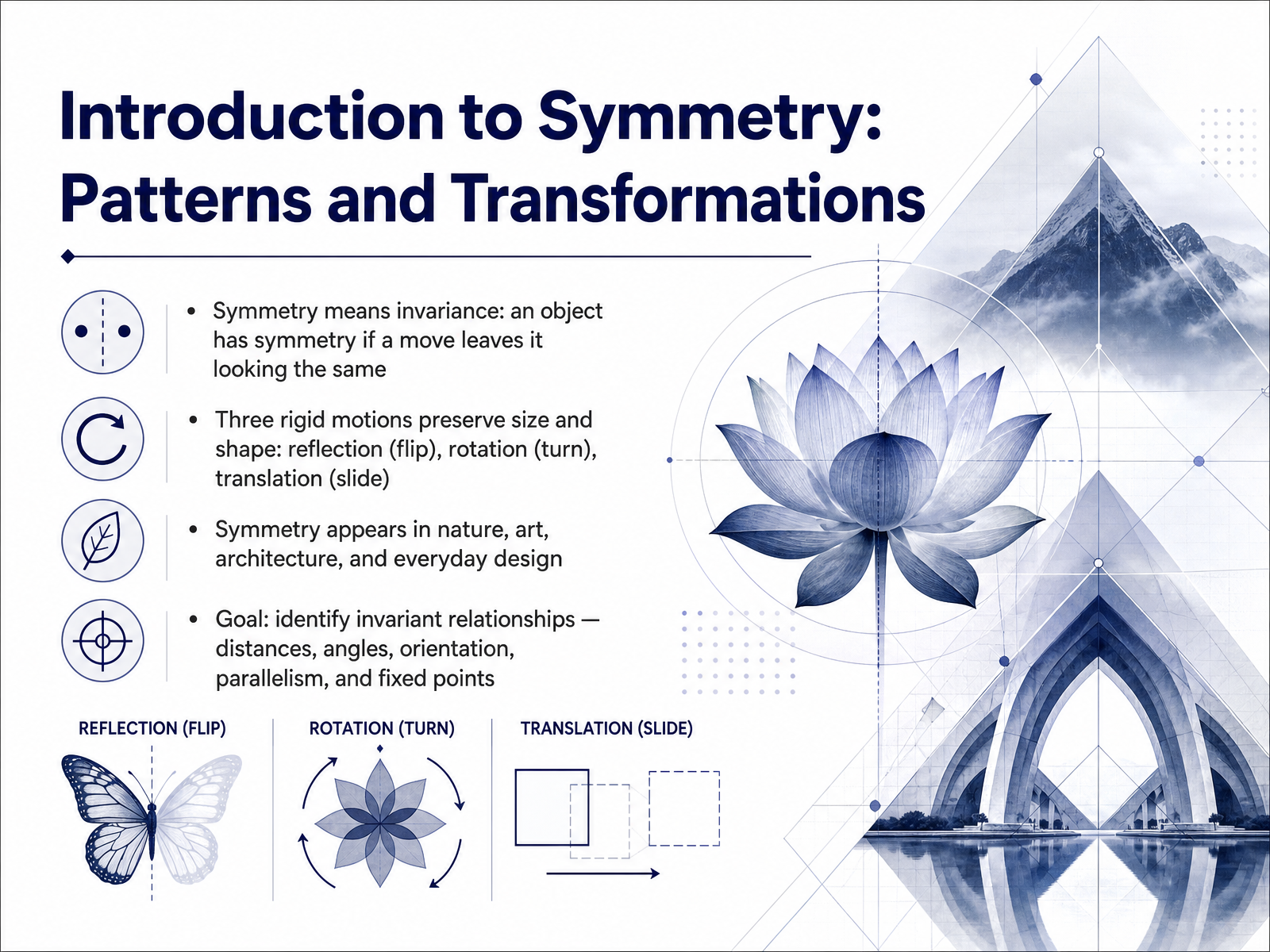
- 01Introduction to Symmetry: Patterns and TransformationsWelcome. In this course, we explore symmetry through patterns and transformations. Let’s start with a simple, powerful idea: symmetry means invariance. An object has symmetry if you can apply a move—a transformation—and afterward the object looks exactly the same. The move might be a reflection, where you flip the object across a line. It could be a rotation, where you turn it around a fixed point. Or it could be a translation, where you slide every point the same distance in the same direction. These three are called rigid motions because they preserve size and shape. Now, symmetry is not just an abstract math concept. You see it woven through nature, art, architecture, and everyday design—from butterfly wings to tile floors. Our goal today is to train your eye to identify what stays the same under these transformations. We will look for invariant relationships, things like distances, angles, orientation, parallelism, and fixed points that do not change. Keep that question in mind: what remains unchanged after the move? Next, we will see that symmetry is much more than just a mirror image.en.m.wikipedia.orgen.wikipedia.orgcut-the-knot.org+22 min
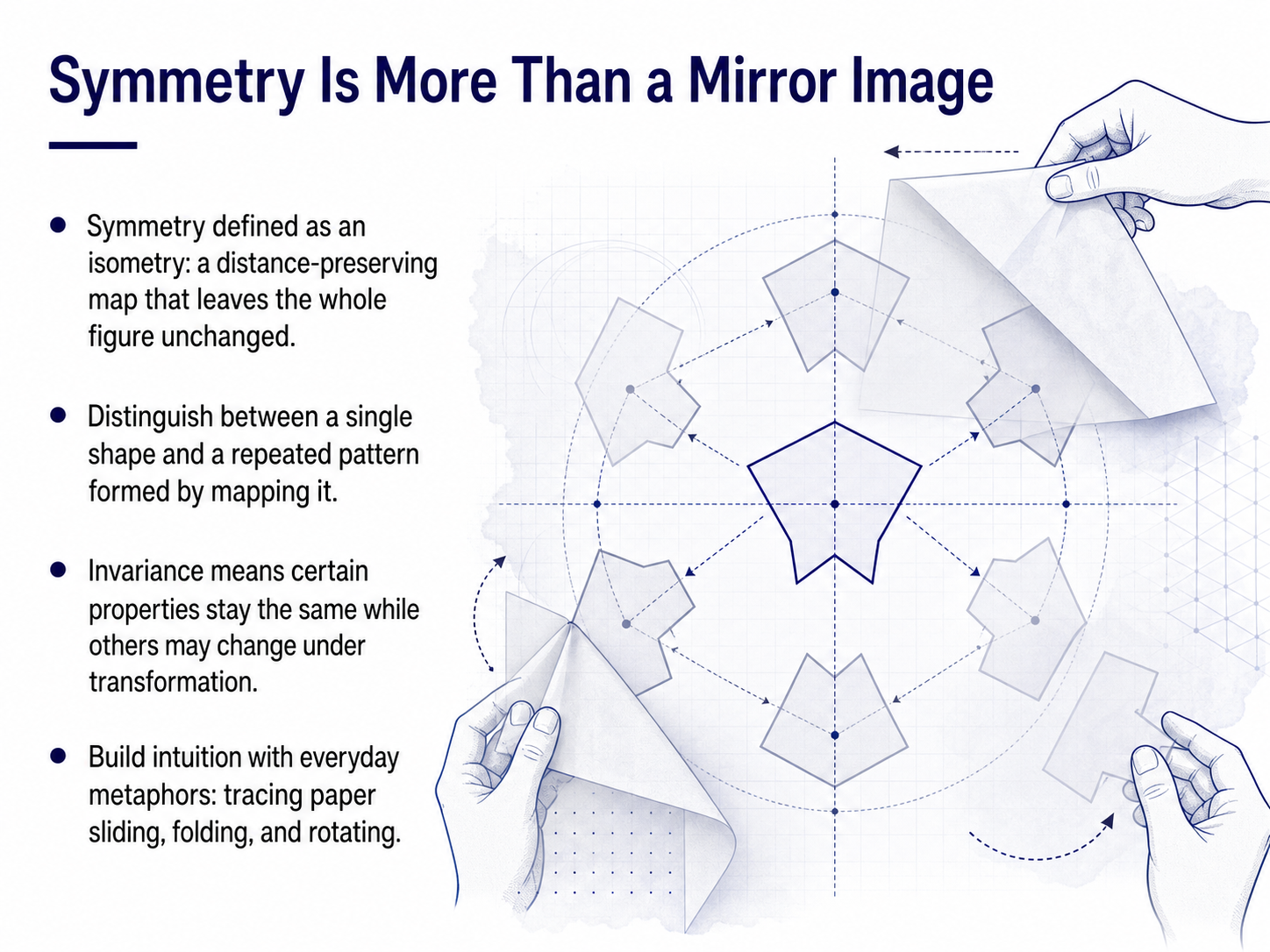
- 02Symmetry Is More Than a Mirror ImageA lot of people first think of symmetry as just a mirror image. But in geometry, symmetry is actually a precise kind of movement. We call it an isometry, which means a distance-preserving map. You take a figure, you move it, you flip it, or you turn it, and after the motion, the overall figure looks exactly the same. No points got squished closer together or pulled farther apart. It’s also important to distinguish between a single shape and the pattern you get by repeating it. A single triangle is one thing. But when you slide that triangle along, the repeating wallpaper pattern it creates is what we study for translational symmetry. At the heart of this is a concept called invariance. Some properties, like distances and angles, stay locked in place, while other things, like location or orientation, can change. The trick is learning to spot what stays the same. To build that intuition, I want you to picture a few simple tools. Imagine a piece of tracing paper sliding over your desktop, that’s translation. Now fold that tracing paper along a line and press down, that’s reflection. Finally, pin one corner and spin the paper around, that’s rotation. These everyday motions are the exact mappings we’ll use to analyze symmetry. Now that we have a clear definition, let’s look closely at our first transformation type: reflection as a flip across a mirror line.
 2 min
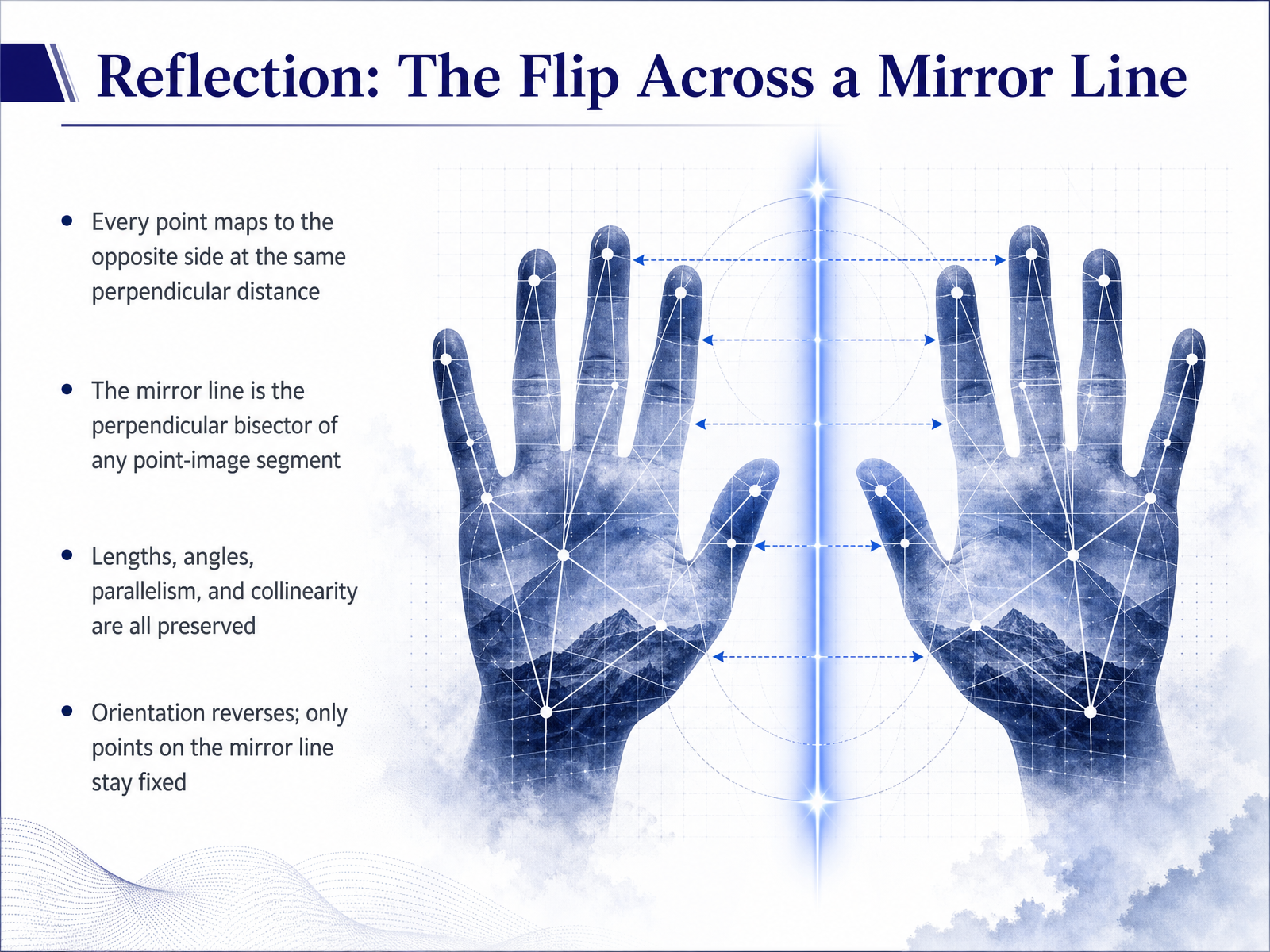
2 min - 03Reflection: The Flip Across a Mirror LineNow let's look closely at reflection, which you can think of as a flip across a mirror line. Imagine a vertical line as the mirror. For any point you pick, its image maps directly to the opposite side, sitting at the exact same perpendicular distance from that line. If your point is three centimeters to the left, its reflection lands three centimeters to the right. The mirror line itself acts as a perpendicular bisector. It cuts the segment connecting any point and its image at a perfect ninety-degree angle, right through the midpoint. What stays the same is important: lengths, angle measures, parallelism, and collinearity are all preserved under reflection. But one key thing changes. Orientation reverses. If you trace the vertices of a triangle before reflecting, you'll move the opposite direction after the flip. The only points that stay completely still are those sitting directly on the mirror line. With a solid feel for reflections, let's move on and twist our thinking into rotation: turning around a fixed center.
 2 min
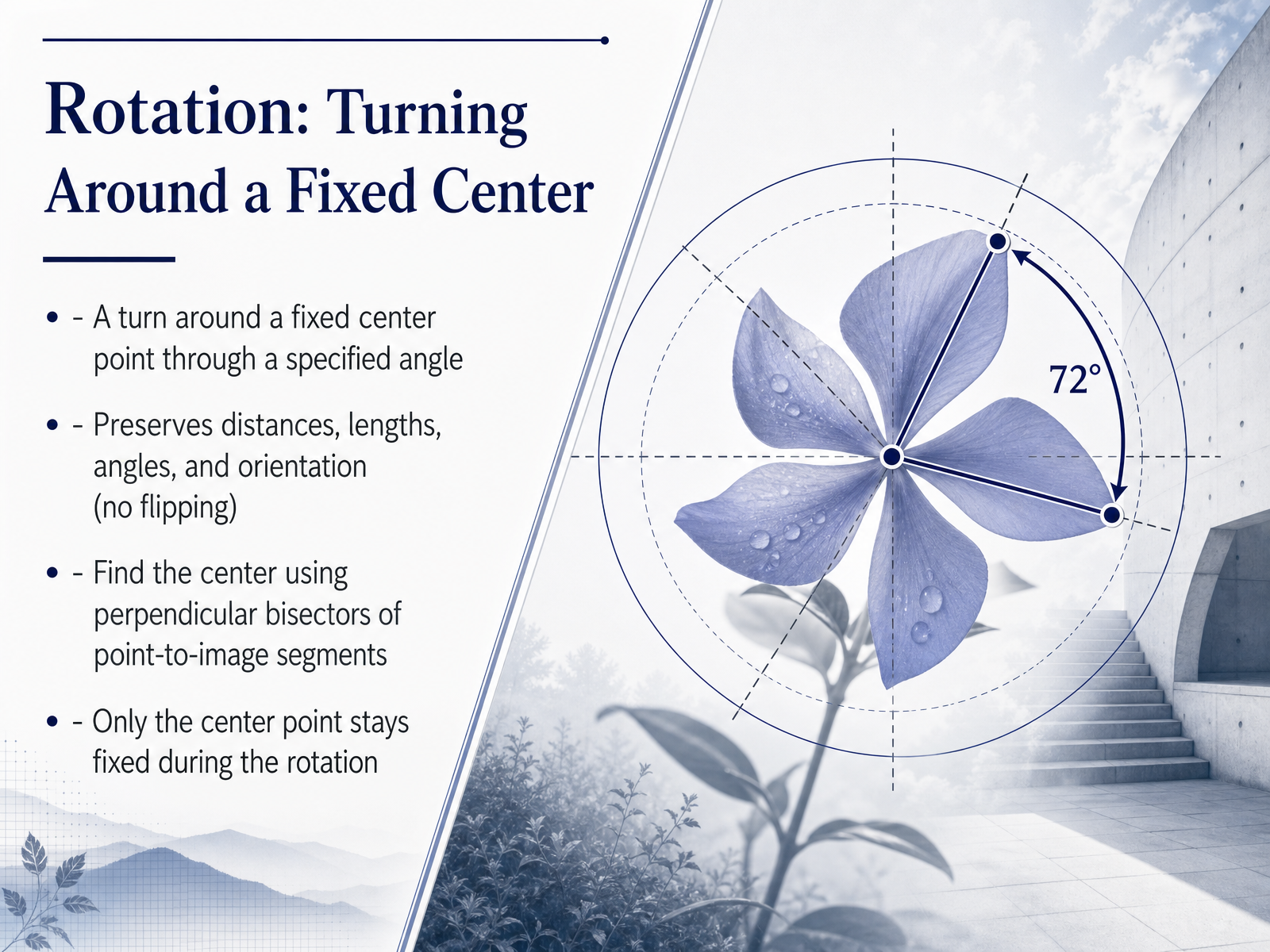
2 min - 04Rotation: Turning Around a Fixed CenterNow let's explore rotation, a transformation that turns a figure around a fixed center point through a specific angle. Think of a pinwheel spinning. The distances from the center to every point on the figure stay exactly the same. Lengths of segments and the measures of angles are preserved. And here is something interesting: unlike reflection, rotation keeps the original orientation intact. No flipping occurs. To find the center of rotation, you can draw the segment connecting a pre-image point to its rotated image, then construct the perpendicular bisector. Repeating that for a second pair of points gives you two bisectors, and their intersection marks the fixed center. Only that single center point remains unchanged during the entire turn. Up next, we will examine translation: a slide without turning.
 2 min
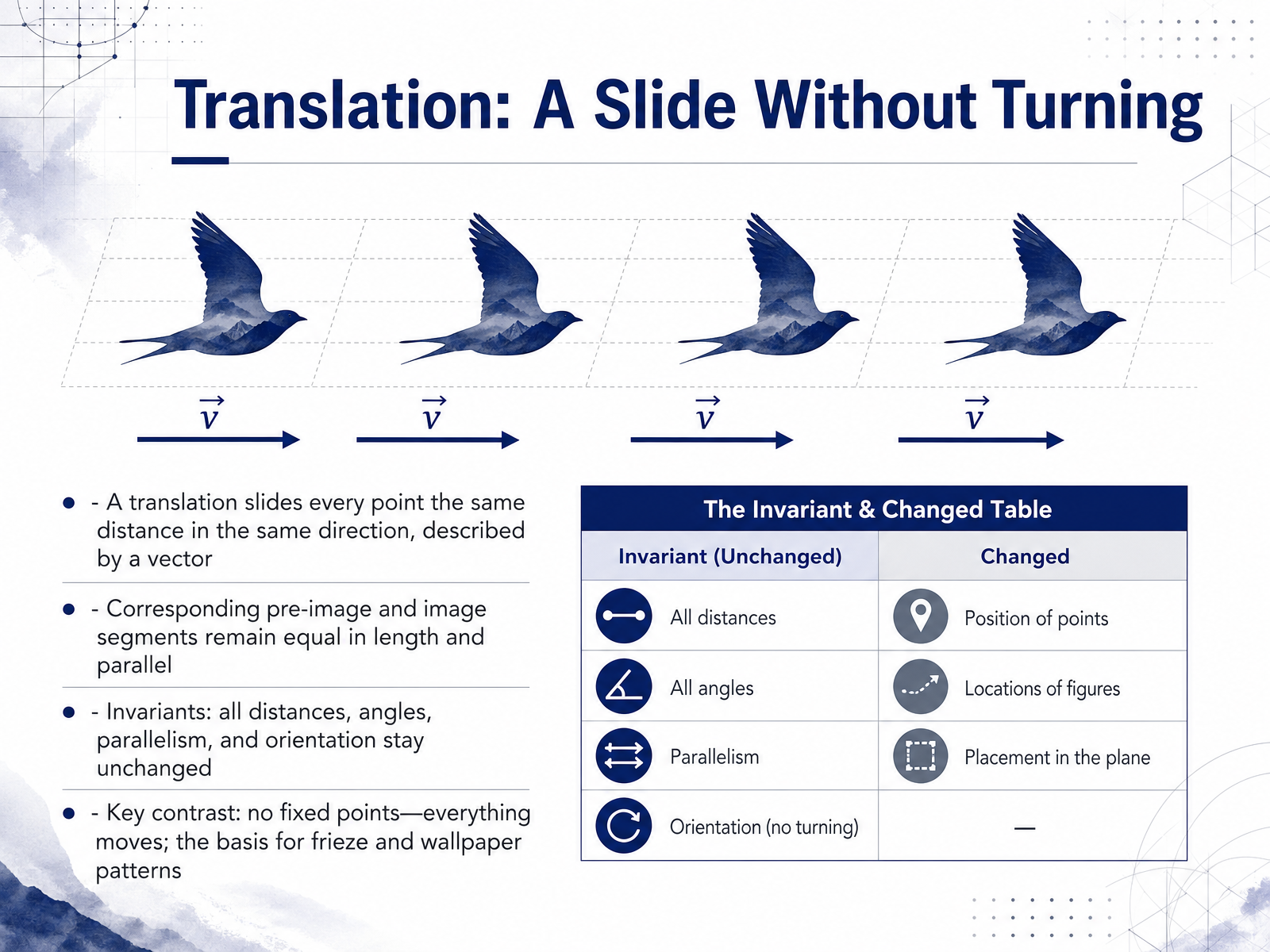
2 min - 05Translation: A Slide Without TurningLet's move to the third type of isometry: translation. You can think of this simply as a slide. Every point of the original figure moves the exact same distance in the exact same direction, which we describe using a vector. Picture shifting your entire shape across the plane without tilting or turning it at all. Because of this rigid slide, corresponding segments between the pre-image and the image stay equal in length and remain parallel. What stays unchanged? All distances, all angles, all parallel relationships, and even the overall orientation are preserved. But here is the key contrast from our other transformations: there are no fixed points. Absolutely everything moves. This complete shift is the essential building block for creating repeating patterns, like the endless ornamental borders known as frieze patterns and the two-dimensional tessellations we call wallpaper patterns. Now that we have explored the individual mechanics of reflection, rotation, and translation, let's put them side by side and compare the three transformations.
 1 min
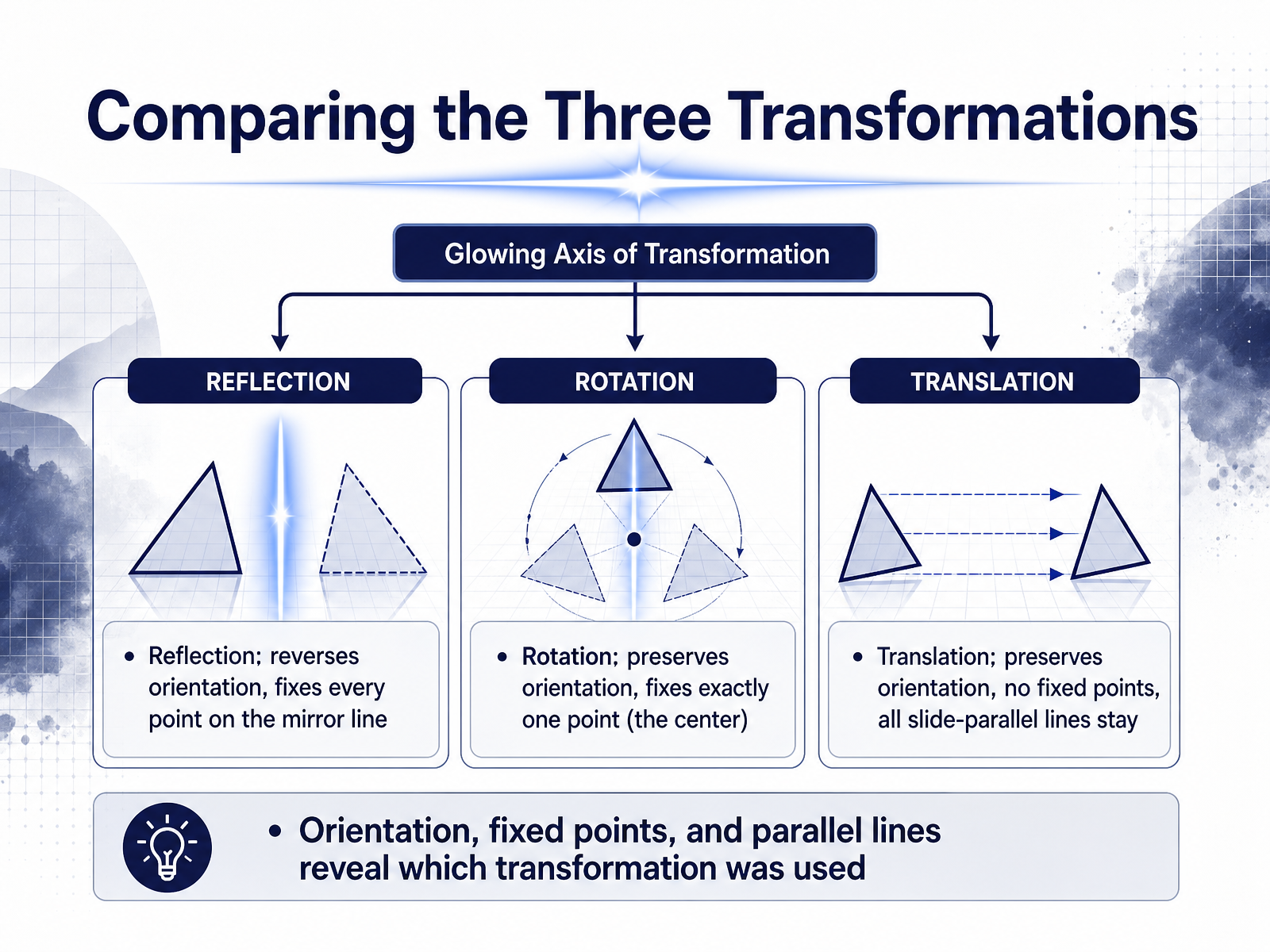
1 min - 06Comparing the Three TransformationsLet's pull these three transformations together and see what makes each one distinct. We'll compare them by looking at what happens to orientation, what stays fixed, and how parallel lines behave. Starting with Reflection. Reflection reverses orientation, flipping the shape into a mirror image. And it fixes every single point that lies on the mirror line itself, holding that line in place while everything else moves across it. Next, Rotation. Rotation preserves orientation. The shape spins but never becomes a mirror image. It fixes exactly one point: the center of rotation. Every other point moves in a circle around it. Then we have Translation. Translation also preserves orientation, so the shape slides without turning or flipping. But here's the key difference: it has no fixed points at all. The whole shape moves. However, any line that runs parallel to the direction of the slide stays pointing in that same direction. So, orientation tells you if a flip happened. Fixed points distinguish the mirror line from the center of rotation. And parallel lines help you spot a translation. Together, these three ideas give you a quick checklist for identifying which transformation you're looking at. Next, we'll use these clues to detect transformations in everyday patterns.
 2 min
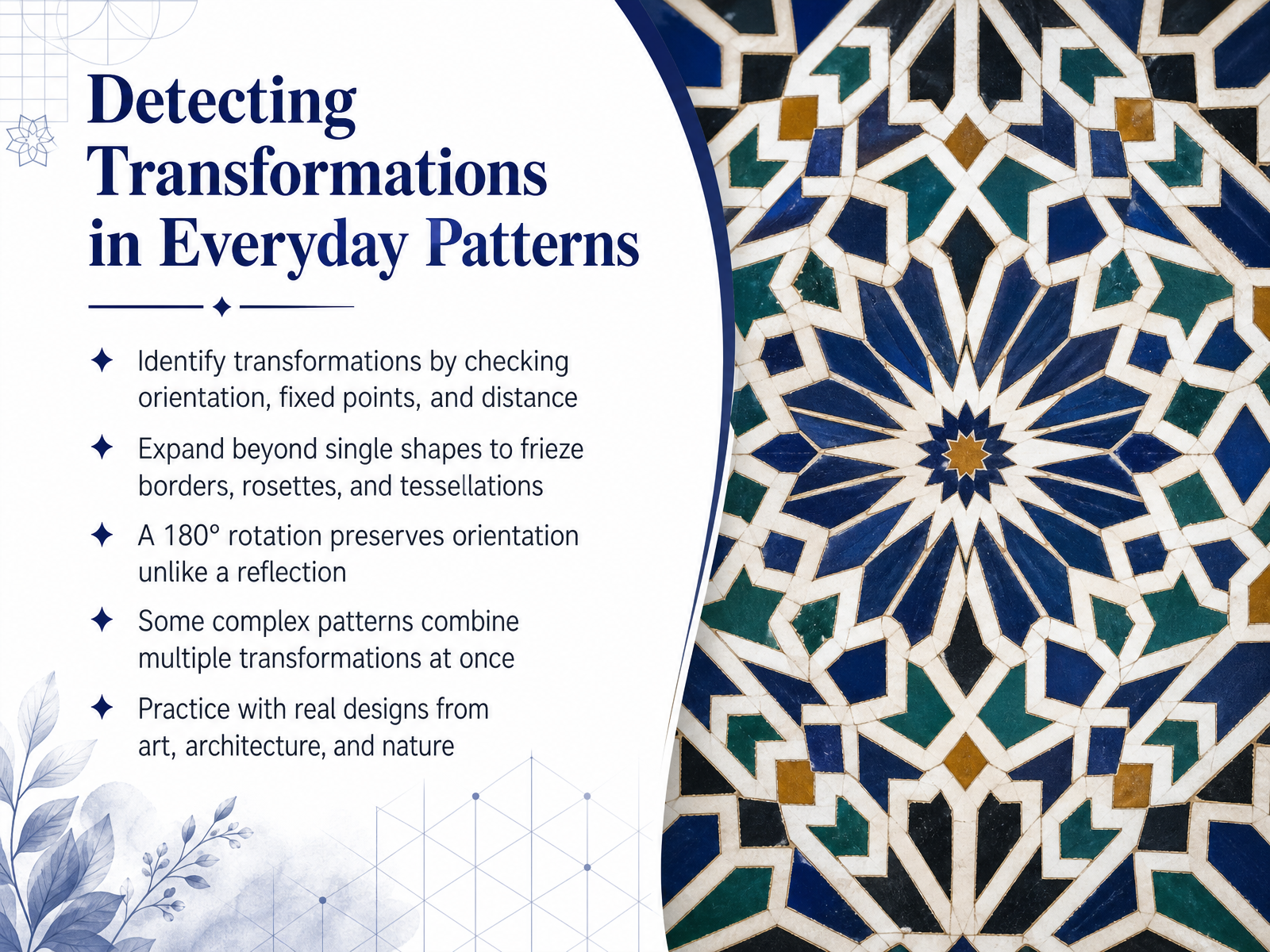
2 min - 07Detecting Transformations in Everyday PatternsNow that we can spot symmetry in single shapes, let’s expand our view to patterns that fill walls, fabrics, and even nature. When you examine a design, start by checking three things: orientation, fixed points, and distance between repeated elements. A reflection flips orientation and leaves a line of points unchanged. A rotation preserves orientation but fixes only a central point, while a translation moves everything with no fixed points at all. A quick test: a 180-degree rotation keeps the shape pointing the same general way, unlike a mirror reflection, which reverses it. As we look beyond single motifs, you will see frieze borders that repeat along a line, rosettes that spin around a center, and tessellations that tile the plane. Some of the most striking patterns combine transformations—think of a row of footprints, where each step slides forward and alternates left and right through a glide reflection. Practice this by analyzing real designs around you: the tiled floor beneath your feet, the carved stonework on a historic building, or the spiral head of a sunflower. All of them are built from these same basic moves. Up next we will use that knowledge to complete and predict patterns, turning detection into creation.
 2 min
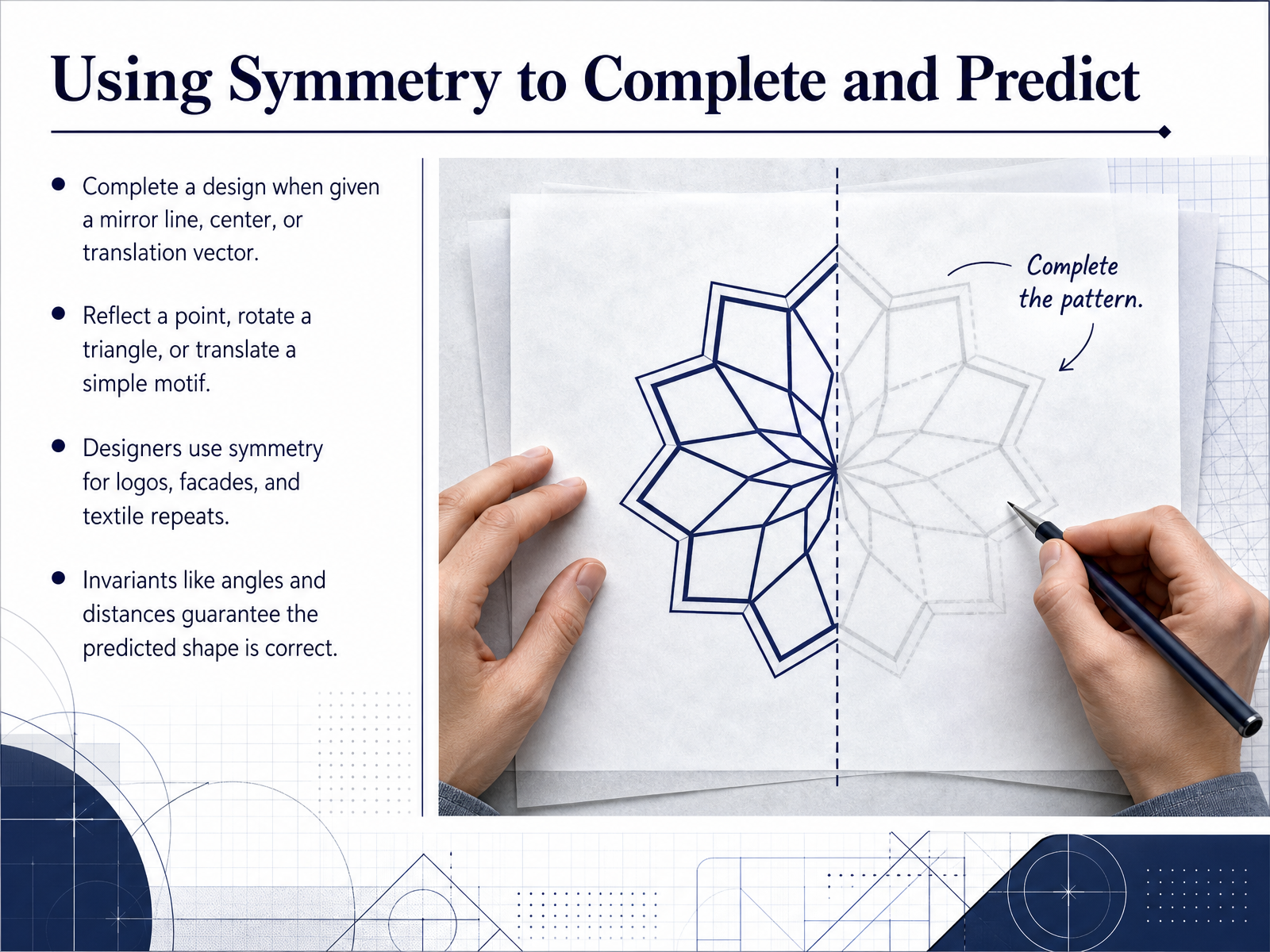
2 min - 08Using Symmetry to Complete and PredictNow let's put those patterns to work. Using symmetry, we can complete a partial design or predict exactly where a shape should go. When you're given a mirror line, a rotation center, or a translation arrow, you have everything you need to finish the picture with confidence. For example, reflect a single point across a mirror line: measure the perpendicular distance and copy it to the other side. Rotate a triangle ninety degrees around a center point: every vertex follows the same circular path. Translate a small motif by sliding each point along the same vector. Designers rely on this logic constantly, whether they're creating balanced logos, rhythmic building facades, or repeating textile patterns. The reason the prediction works every time is that certain features stay invariant. Angles and distances don't change under these transformations, so the predicted shape matches the original in all the ways that matter. That guarantee is what turns symmetry into a practical, reliable tool.
 1 min
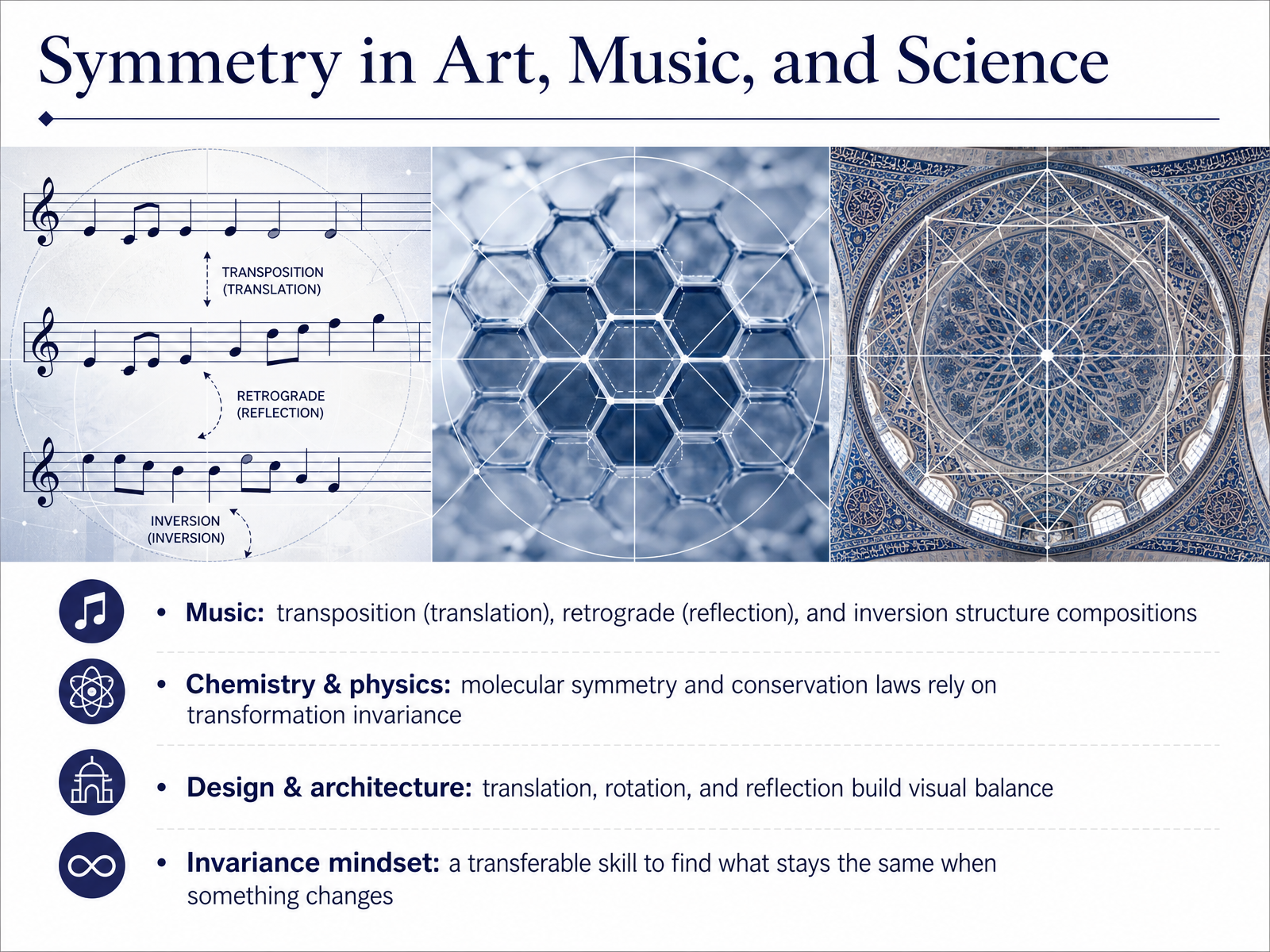
1 min - 09Symmetry in Art, Music, and ScienceNow let's step back and see where these transformations show up in the wider world. In music, a melody can be shifted up or down in pitch. That is a translation, often called transposition. A retrograde plays the melody backwards, which is a reflection. And an inversion flips the intervals upside down, another kind of reflection. In chemistry and physics, the symmetry of a molecule or a crystal connects directly to conservation laws through mathematical invariance. It is the idea that something measurable stays the same even when you rotate or translate the whole system. In design and architecture, repeated elements across a facade use translation. A grand entrance flanked by matching wings uses reflection. A rose window uses rotation. These are not just decoration. They create visual balance by repeating structured relationships. Here is the deeper takeaway. The invariance mindset is a transferable skill. Whenever something changes, ask yourself: what stays the same? That question is at the heart of symmetry, and it is a powerful way to think across many fields. Coming up next, we will clear up some common misconceptions and show you how to correct them.
 2 min
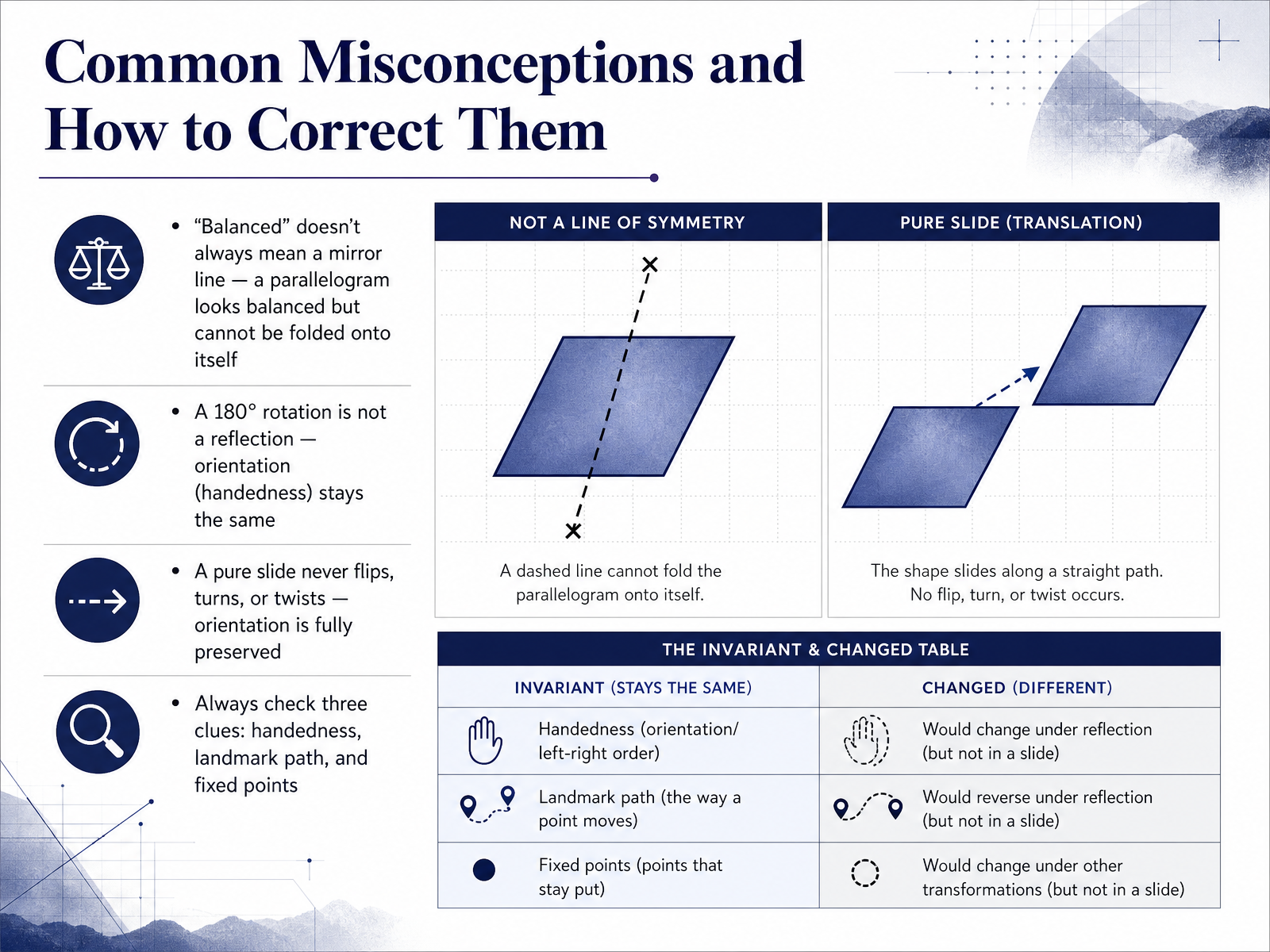
2 min - 10Common Misconceptions and How to Correct ThemNow let's clear up some common mix-ups so you can spot real symmetry with confidence. First, just because a shape looks balanced doesn't mean it has reflection symmetry. Take a parallelogram. It looks even on both sides, but try to fold it diagonally. The edges won't line up. There's no mirror line. The apparent balance tricks your eye, so always test with an actual fold in your mind. Another sticking point is confusing a 180-degree rotation with a reflection. When you rotate a shape halfway around, its orientation, what we call handedness, stays the same. A right hand still looks like a right hand. A reflection flips that orientation like a mirror, so a right hand looks like a left hand. That's a key difference. And then there's pure translation. A simple slide never flips, never turns, and never twists the shape. The orientation is fully preserved. Every point moves the same distance in the same direction without any change in facing. So, how do you avoid these traps? Always check three clues. Number one, look at handedness to see if a flip occurred. Number two, trace the path a landmark point follows. Number three, spot any fixed points that stay in place. Handedness, landmark path, and fixed points. Those three clues will keep you on track. Next, let's put all this into practice with some hands-on identification exercises.
 2 min
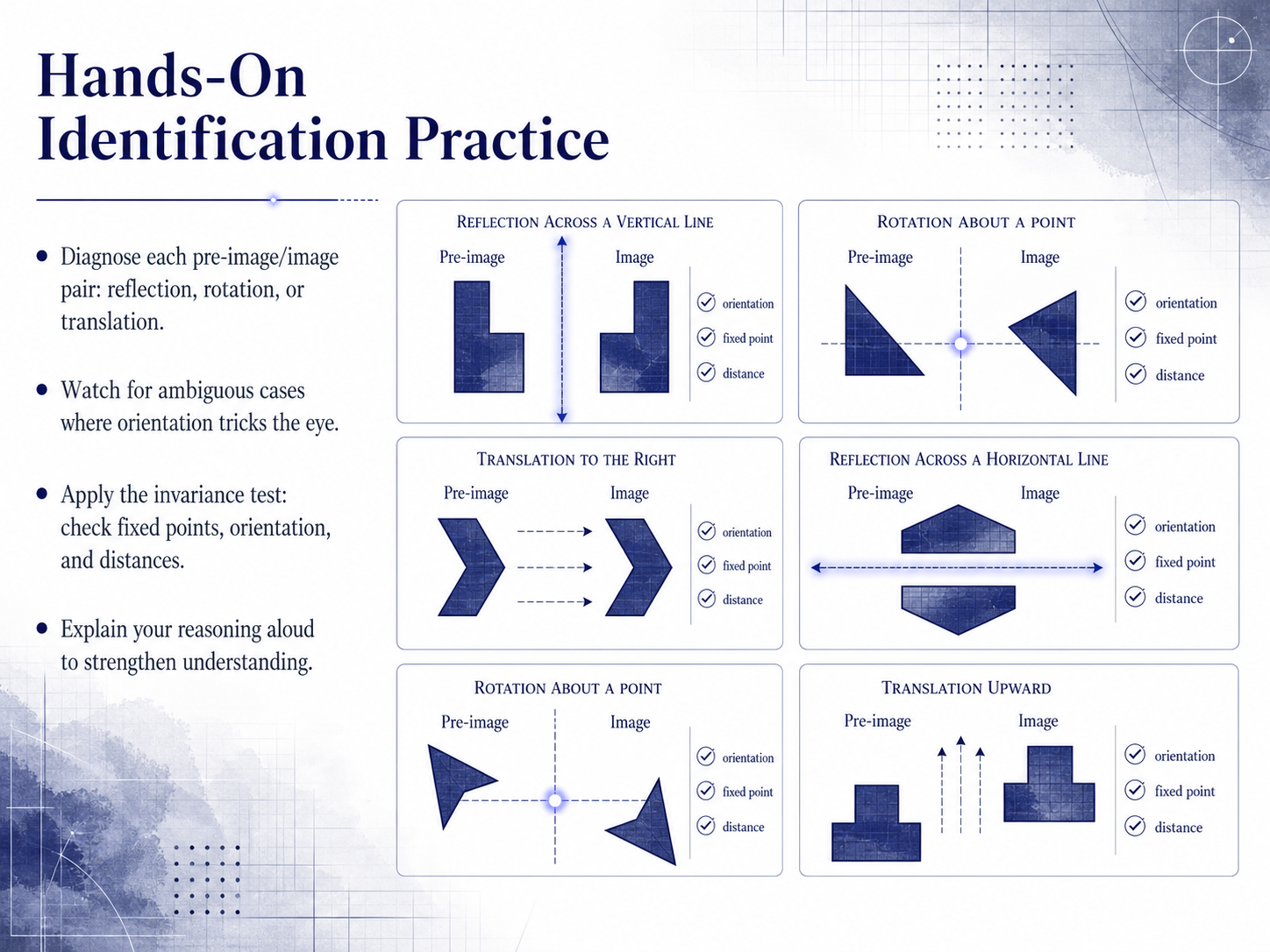
2 min - 11Hands-On Identification PracticeNow it is your turn to put these ideas into practice. For each pre-image and image pair on the screen, I want you to diagnose the transformation. Is it a reflection, a rotation, or a translation? Watch out for tricky cases where the figure's orientation might fool your eye. To be sure, apply the invariance test. Check for fixed points. Is the orientation preserved or reversed? Have all distances remained the same? As you work through each example, say your reasoning out loud. Speaking through it helps strengthen your understanding and can even reveal a hidden assumption. When you are ready, we will take this skill one step further and start building symmetric designs of our own.
 1 min
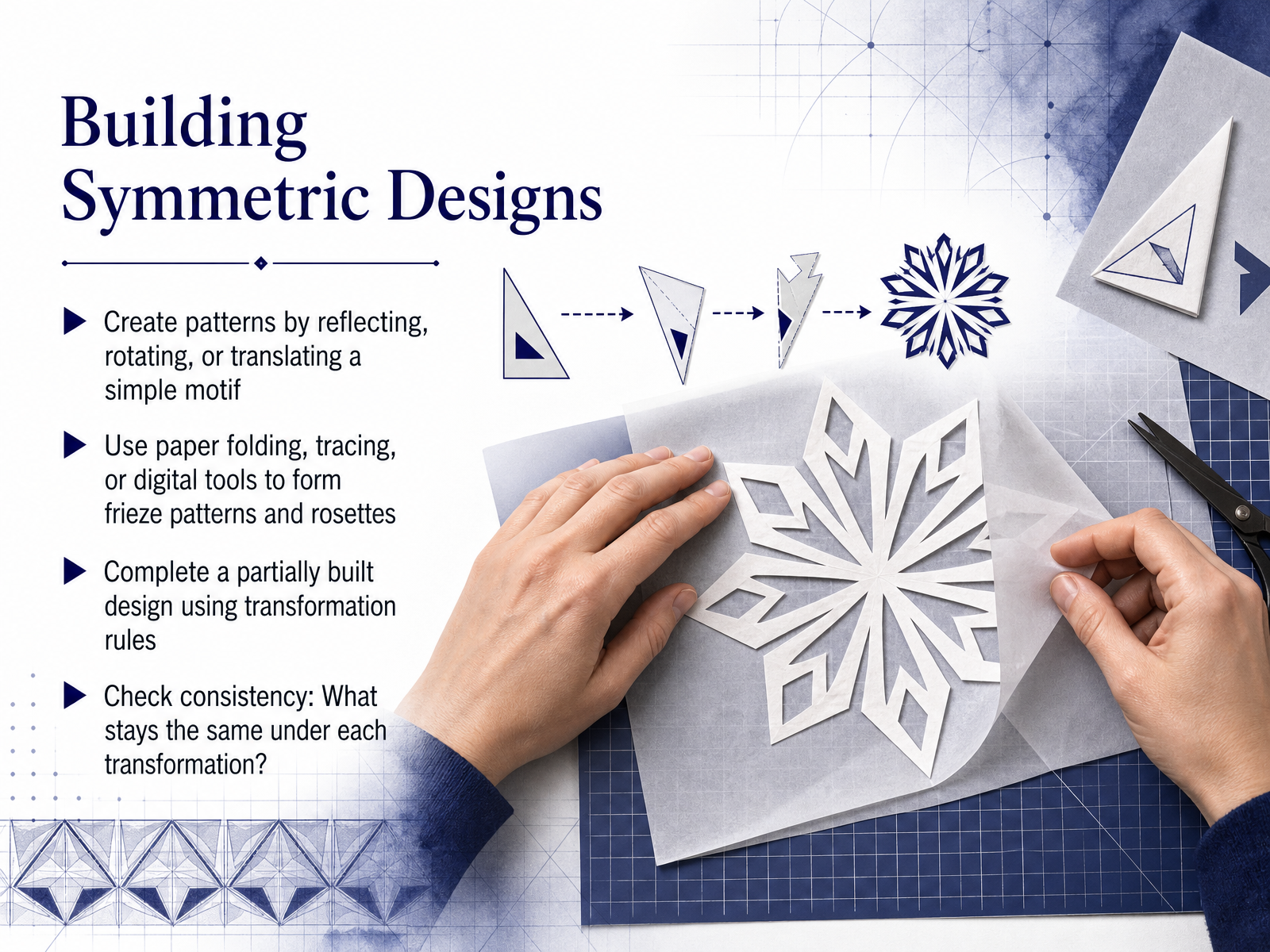
1 min - 12Building Symmetric DesignsNow let's put these ideas into practice by building our own symmetric designs. Take a simple motif, maybe a leaf shape, a letter, or just a small polygon. You can create patterns by reflecting it across a line, rotating it around a point, or sliding it along a path. Try it on paper with folding and tracing, or use a digital drawing tool. When you generate a frieze pattern, you are repeating a translation to make a strip. When you generate a rosette, you are repeating a rotation around a center. Here is a quick challenge. I will give you a partially built design with some gaps, and your job is to fill the missing pieces using the transformation rule you see at work. Ask yourself, what stays the same? Under a reflection, distances are preserved but the handedness flips. Under a rotation, the distance to the center stays fixed. Under a translation, the shape and its orientation remain identical. Checking these invariants keeps your patterns consistent and helps you spot when a rule has been broken. Ready to see the big picture? Our next slide is Summary and the Invariance Mindset.
 1 min
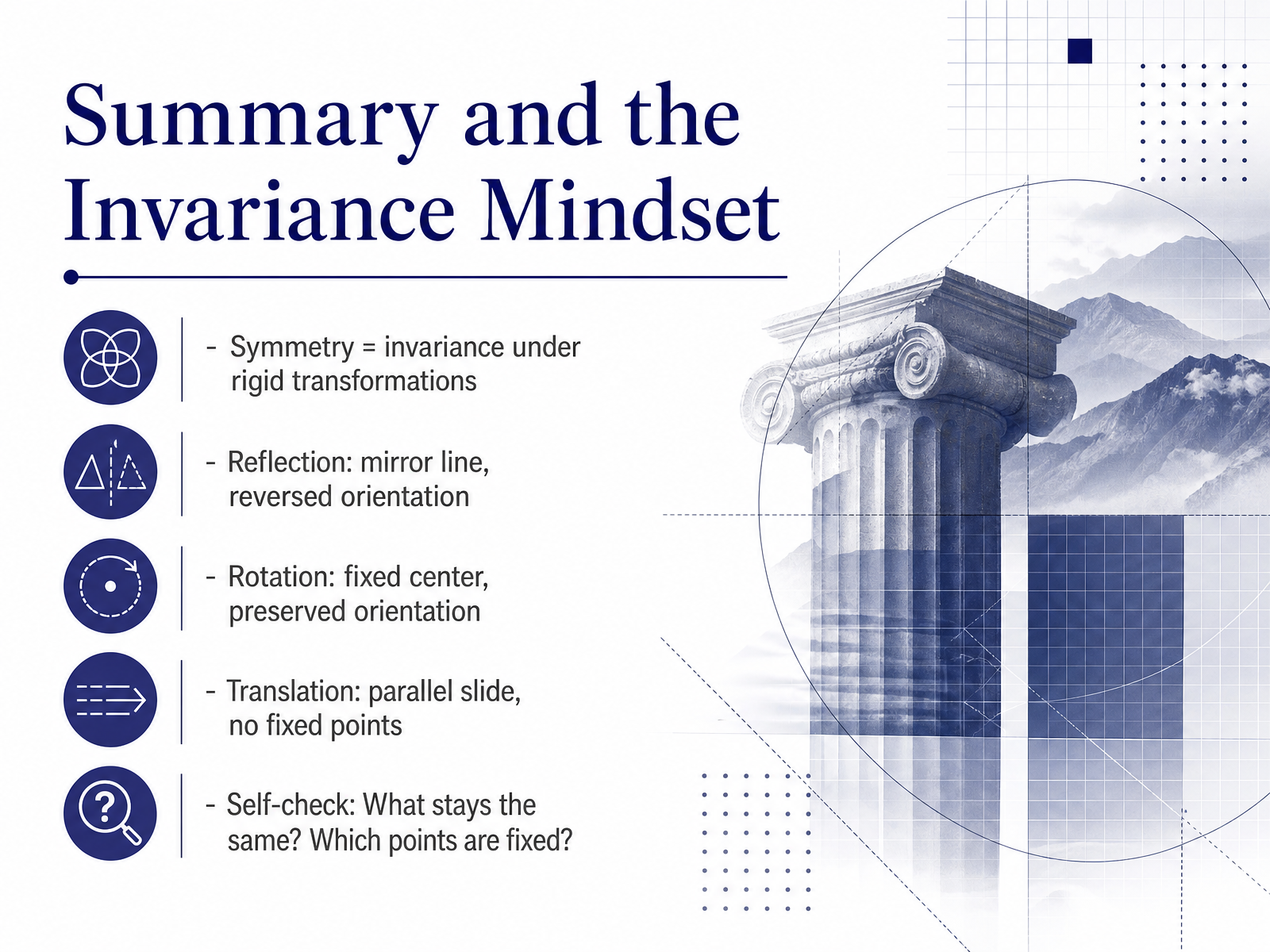
1 min - 13Summary and the Invariance MindsetLet's pull everything we've explored into one clear takeaway. At its core, symmetry is about invariance under rigid transformations. We ask a simple but powerful question: what stays the same when an object moves in a specific way? In a reflection, the points on the mirror line stay fixed, but the orientation flips. During a rotation, the center point remains fixed while the entire figure turns around it, preserving overall orientation. With a translation, there are no fixed points at all, yet shape and size remain perfectly intact through a parallel slide. To build your intuition going forward, use these self-check questions whenever you see a pattern. First, what global properties remain unchanged? Second, which specific points, if any, are fixed in place? Thank you for working through these ideas with me. Keep carrying this invariance mindset, and you will start seeing the hidden structure in patterns all around you.
 1 min
1 min
Take the deck with you
Download this course as a file — free, no sign-up needed.
- PDF handoutEvery slide page, ready to print or share.14 pages · 4.0 MBDownload
- Narrated PowerPointThe deck that presents itself — every slide carries the digital human's narration video.14 pages · 16.6 MBDownload
- PowerPoint slidesThe full deck as a .pptx — open it in PowerPoint, Keynote, or Google Slides.14 pages · 4.0 MBDownload
Free to use in your own training — please keep the PersonWise credit page at the end.
Have your own deck? Turn it into a course
Sources consulted
Web sources consulted while building this course.