Begin
13 pages · ~26 min
Special Relativity: Time Dilation & Light Speed
This training introduces special relativity, focusing on time dilation and the speed of light for learners seeking a concise foundation in these core physics concepts.
A digital instructor presents all 13 pages. Hold “Ask” at any point and ask out loud — the answer comes from this course. No sign-up needed.
What you’ll learn
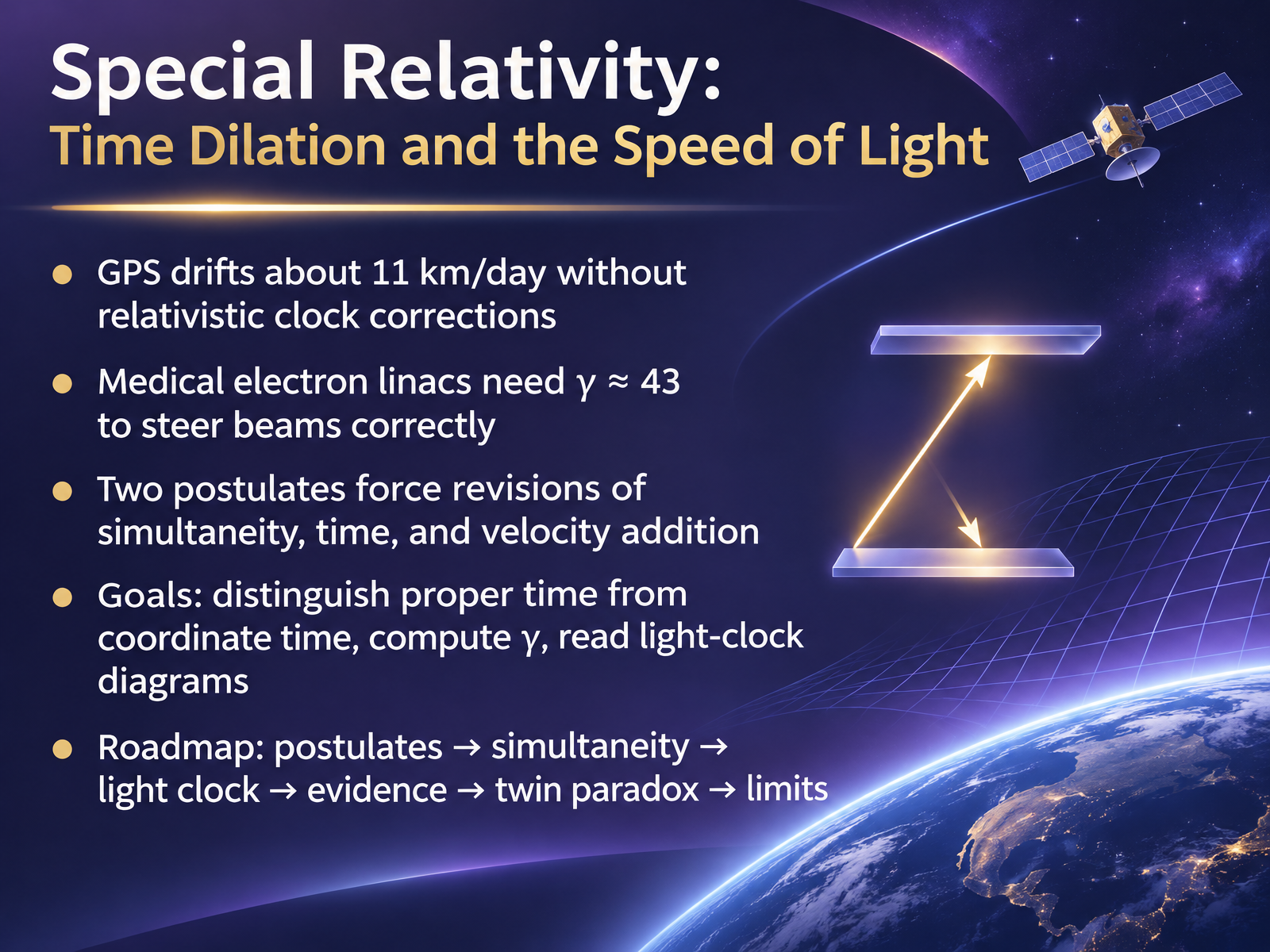
- 01Special Relativity: Time Dilation and the Speed of LightWelcome. Today we're exploring special relativity, and the star of the show is time dilation. Before any equations, let's start with something real. Your phone's GPS would drift about eleven kilometers a day without relativistic clock corrections. And medical electron accelerators steer their beams using a relativistic factor of about forty three. Ignore that, and you treat the wrong part of the patient. Here's the puzzle. Two simple postulates about physics and light force us to rethink simultaneity, time, and how velocities add. By the end, you'll distinguish proper time from coordinate time, compute the relativistic factor, and read light clock diagrams with confidence. Our roadmap runs from postulates to simultaneity, to the light clock, to experimental evidence, then the twin paradox, and finally the limits set by the speed of light. Now let's see why relativity is an everyday engineering fact.openstax.orgdavidfarmer.github.iophys.unsw.edu.au+22 min
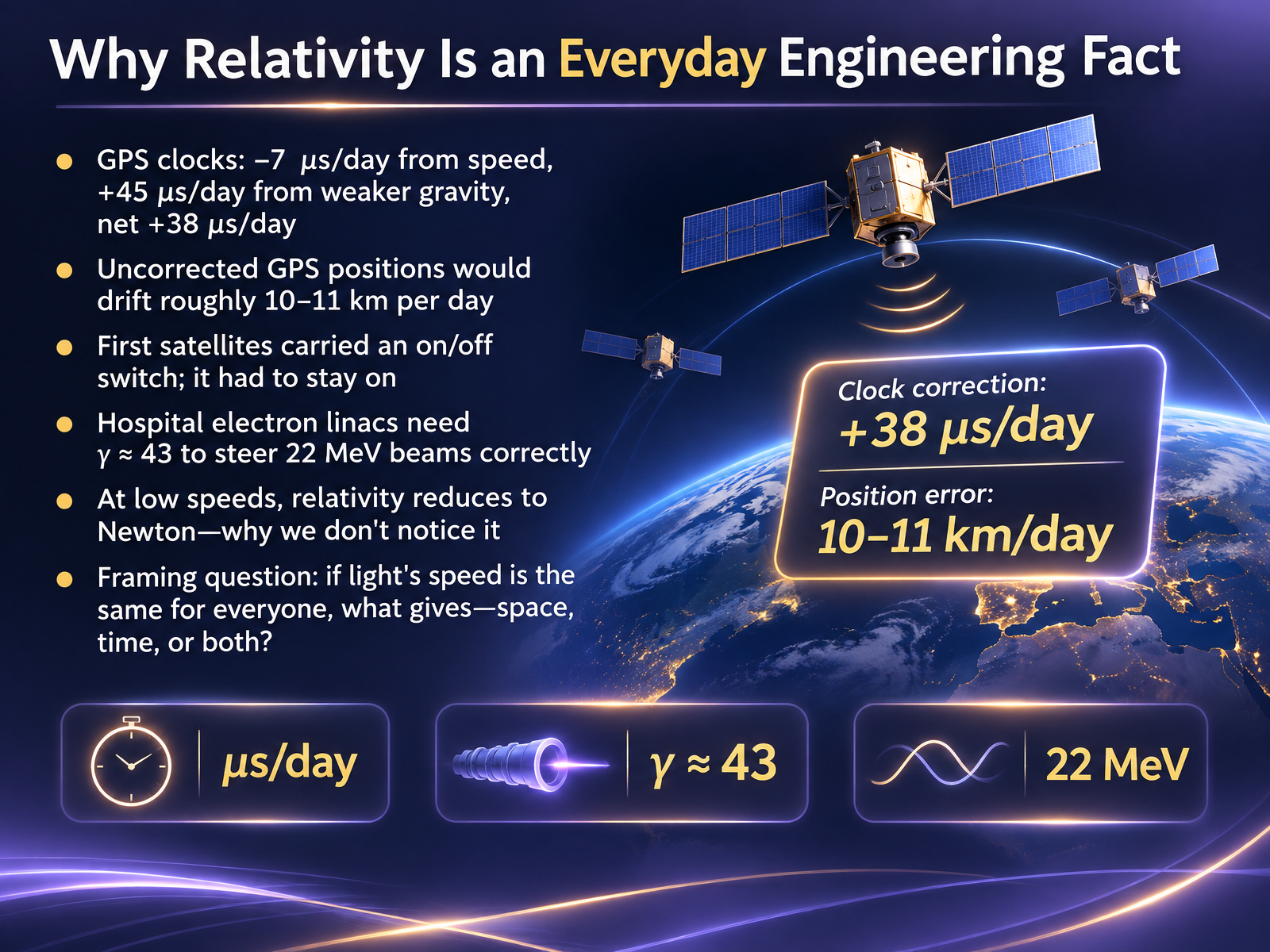
- 02Why Relativity Is an Everyday Engineering FactLet's ground this in engineering. Relativity isn't abstract. Your phone's GPS depends on it. Satellite clocks lose about seven microseconds a day from orbital speed, and gain about forty five from weaker gravity. The net is thirty eight microseconds per day fast. Uncorrected, your position would drift roughly ten to eleven kilometers daily. The first satellites even carried an on and off switch for the correction. Engineers quickly learned it had to stay on. Hospitals rely on it too. Electron linear accelerators need a relativistic factor of about forty three to steer twenty two million electron volt beams correctly. So why don't we notice any of this? At low speeds, relativity reduces to Newton. The effects shrink to almost nothing. Here's the framing question for what follows. If light's speed is the same for everyone, what gives, space, time, or both? Next, we look at the two postulates and the constant speed of light.
 openstax.orgdavidfarmer.github.iophys.unsw.edu.au+22 min
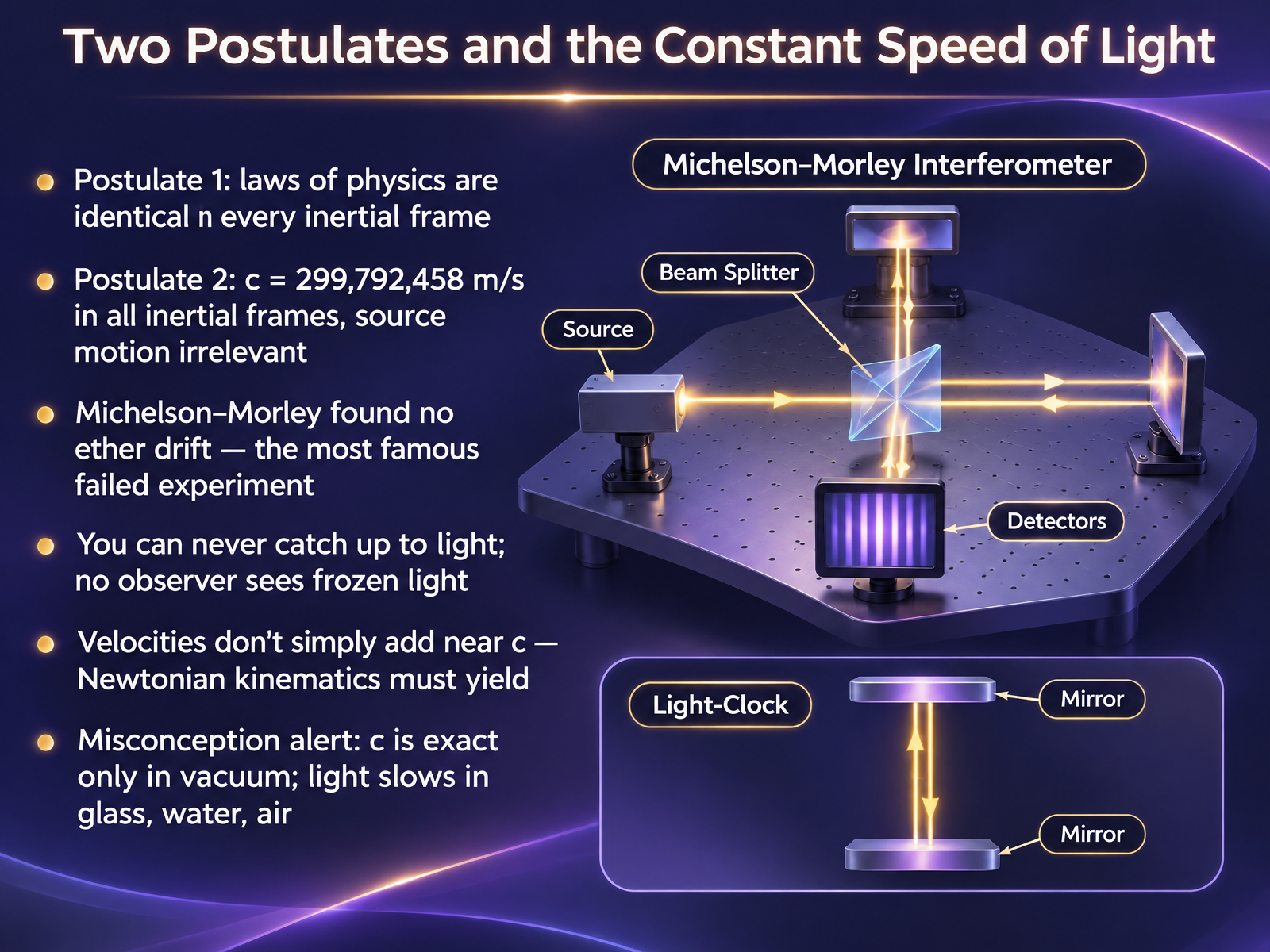
- 03Two Postulates and the Constant Speed of LightLet's look at the two postulates that hold special relativity together. Postulate one says the laws of physics are identical in every inertial frame. In plain terms, a lab drifting through space and a lab resting on Earth should agree on physics. Postulate two is the surprising one. Light travels at exactly two hundred ninety nine million, seven hundred ninety two thousand, four hundred fifty eight meters per second in every inertial frame, and the source's motion does not matter. Why believe that? In eighteen eighty seven, Michelson and Morley looked for an ether drift and found none. It's often called the most famous failed experiment in history. Their null result pushed physics toward this idea. You can never catch up to light. No observer ever sees frozen light. And velocities don't simply add near the speed of light, so Newtonian kinematics must give way. One caution. That exact number applies only in a vacuum. In glass, water, or air, light slows down. Now, if the speed of light never changes, what happens to simultaneity? That brings us to the relativity of simultaneity, and the first surprise.
 openstax.orgopenstax.orgfeynmanlectures.caltech.edu+22 min
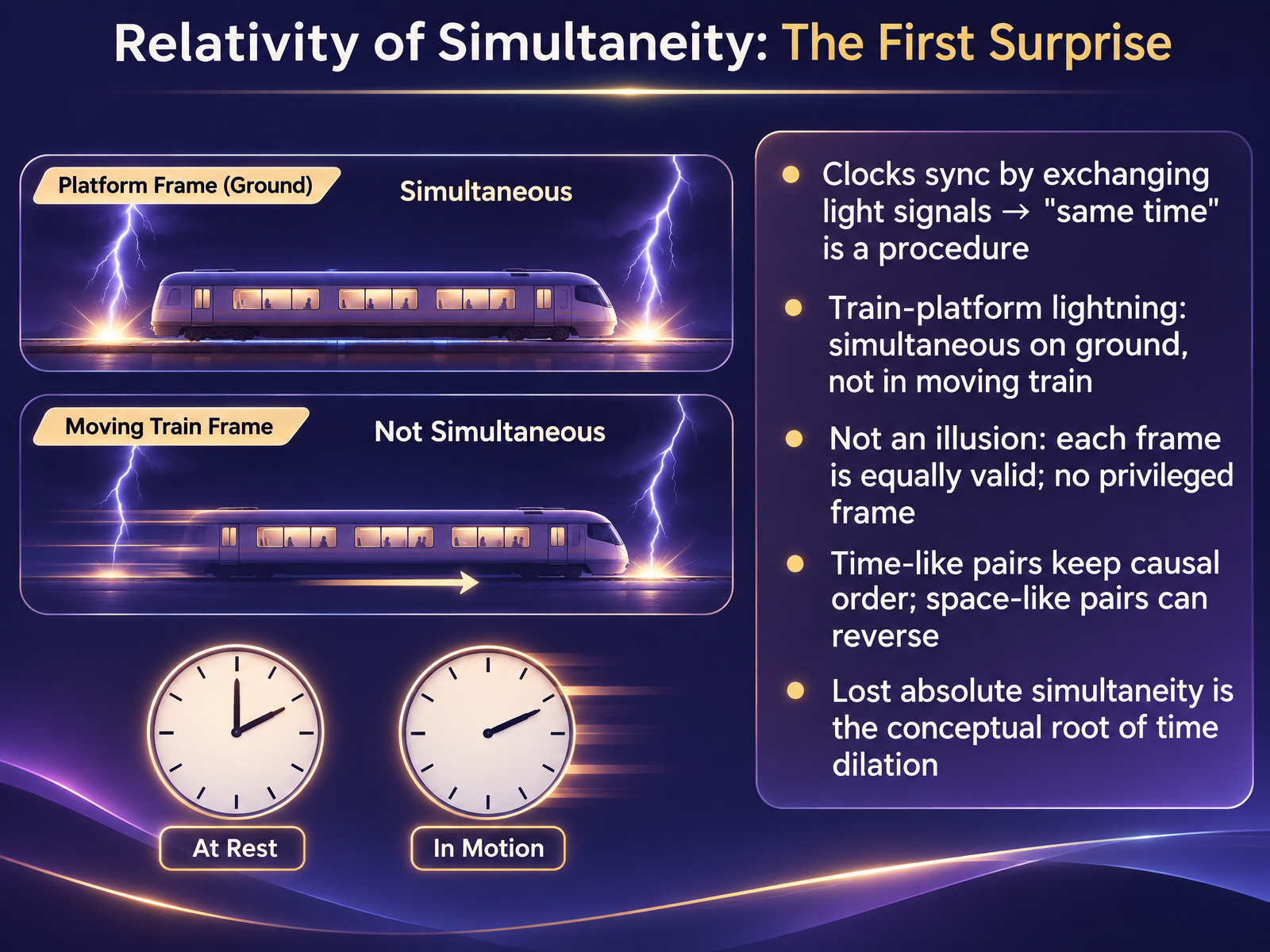
- 04Relativity of Simultaneity: The First SurpriseNow let's tackle the first real surprise: the relativity of simultaneity. When we say two clocks are synchronized, what do we actually mean? In practice, we exchange light signals. Two events count as having the same time only if that procedure says so. Now picture lightning striking both ends of a moving train, seen from the platform. On the ground, the two strikes can look simultaneous. But a passenger on the train, moving toward one flash, sees the front strike first. And here is the key point: this is not an illusion. Both frames are equally valid. There is no privileged frame of reference here. One thing stays safe, though. Events that could causally influence each other keep their order. But events far enough apart can even swap which one comes first. Losing absolute simultaneity may feel uncomfortable, but it is exactly the conceptual root of time dilation. To see how, let's look at the light clock and derive the Lorentz factor.
 openstax.orgopenstax.orgfeynmanlectures.caltech.edu+22 min
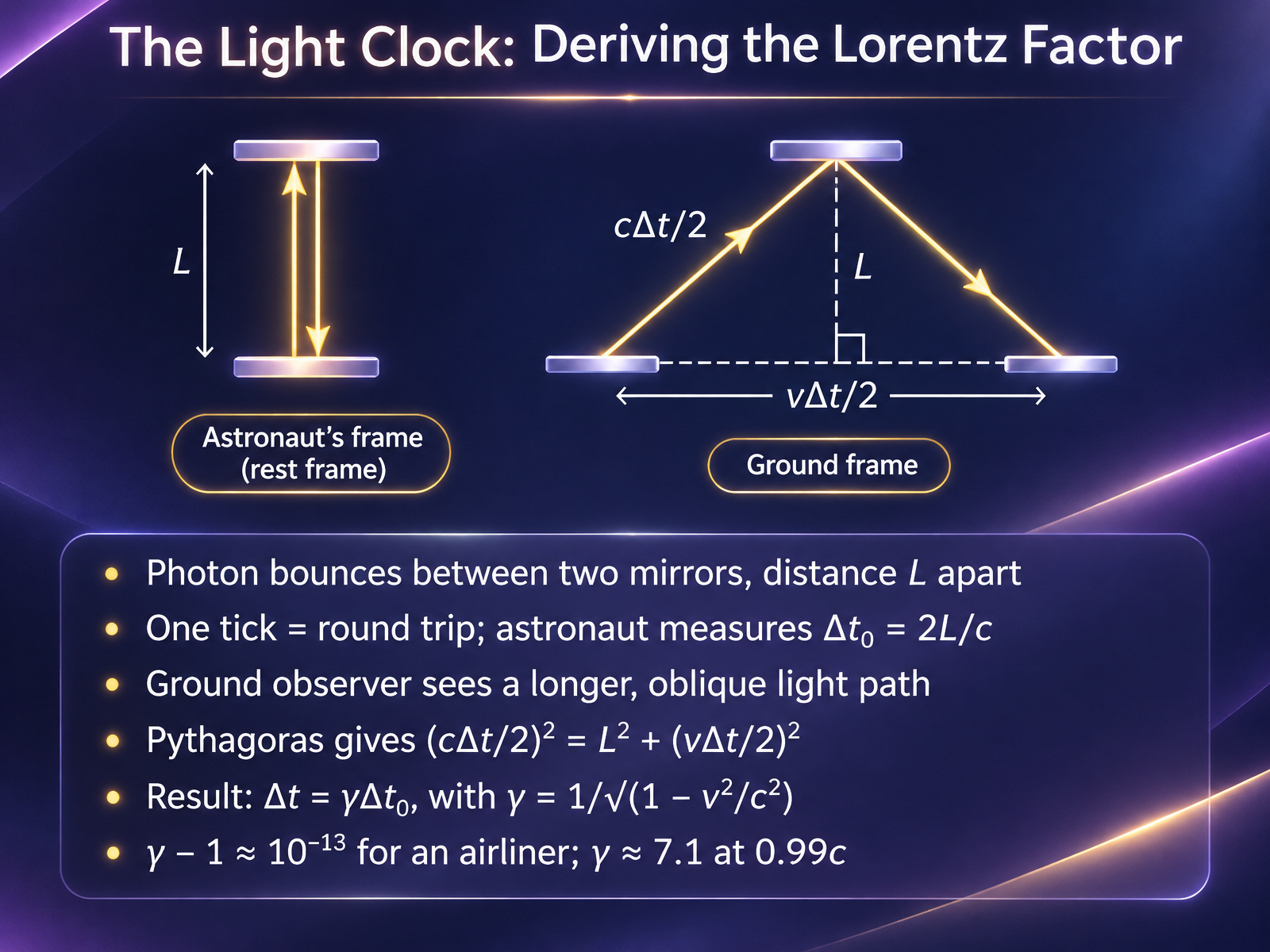
- 05The Light Clock: Deriving the Lorentz FactorNow let's look at the light clock. It's a simple thought experiment, and it gives us time dilation in its clearest form. Imagine two mirrors, a distance L apart, with a photon bouncing between them. One tick is a round trip, and the astronaut measures delta t naught equals two L divided by c. Now watch from the ground. The ship moves, so the light must follow a longer, slanted path. Since light's speed is fixed, a longer path means more time. Pythagoras sorts it out: c delta t divided by two, squared, equals L squared plus v delta t divided by two, squared. The result is delta t equals gamma times delta t naught, where gamma equals one divided by the square root of one minus v squared divided by c squared. For an airliner, gamma minus one is about ten to the minus thirteen. At point nine nine c, gamma is about seven point one. Next, let's put gamma to work in a table of speeds and ages.
 openstax.orgdavidfarmer.github.iophys.unsw.edu.au+22 min
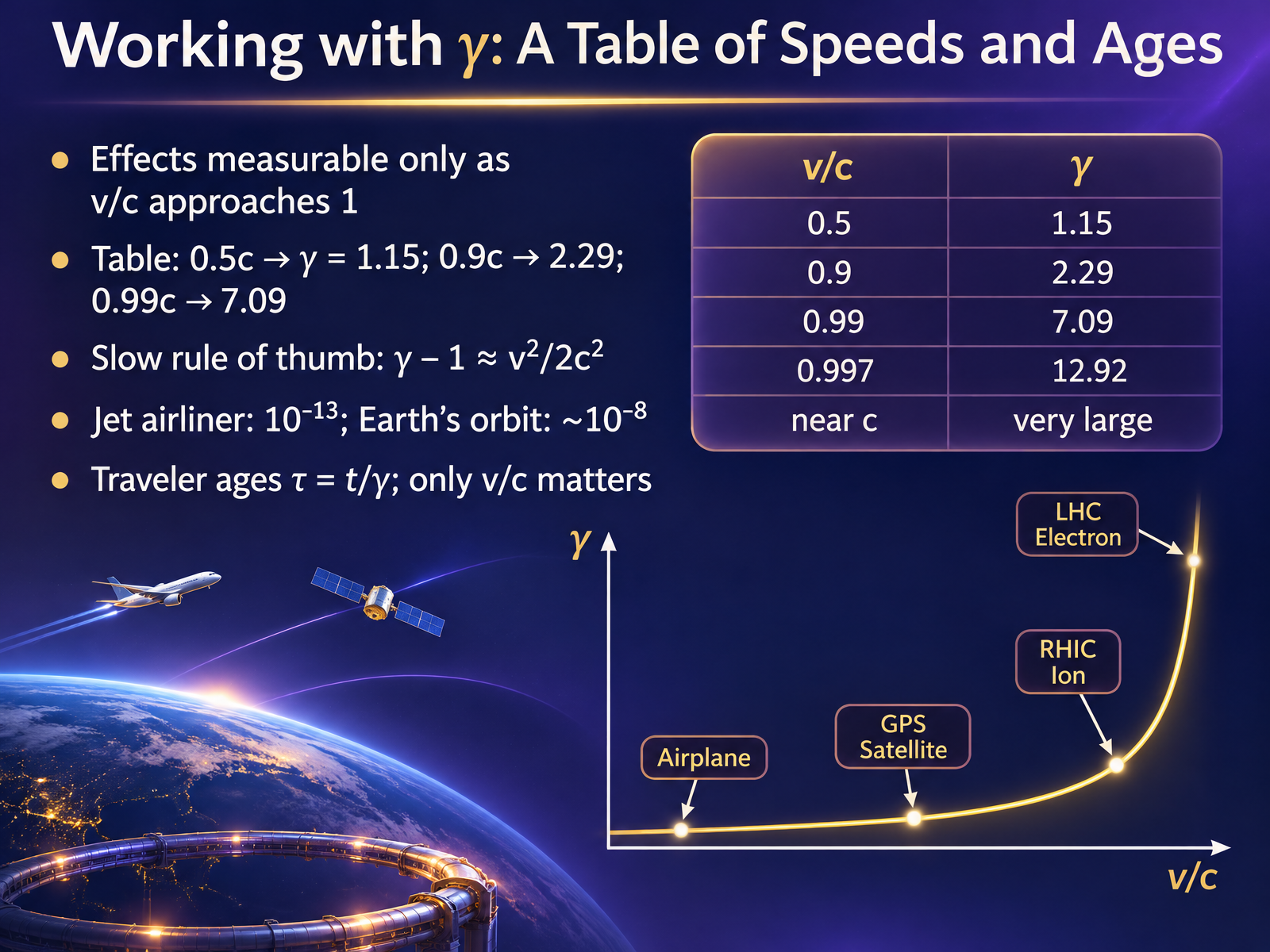
- 06Working with γ: A Table of Speeds and AgesLet's put some numbers to the relativistic factor gamma. Here is the key point. Measurable effects only appear as the ratio of speed to the speed of light approaches one. At half the speed of light, gamma is about one point one five. At ninety percent, it's two point two nine. At ninety-nine percent, it climbs to seven point oh nine. So one second for the traveler means seven seconds for you. For everyday speeds, a slow rule of thumb works well. Gamma minus one is approximately v squared divided by two c squared. That keeps things tiny. For a jet airliner, it's around ten to the minus thirteen. For Earth's orbit, about ten to the minus eight. The traveler's clock reads tau equals t divided by gamma. Only the speed ratio matters, not mass or direction. Next, we'll look at muons: time dilation you can count in a classroom.
 openstax.orgdavidfarmer.github.iophys.unsw.edu.au+21 min
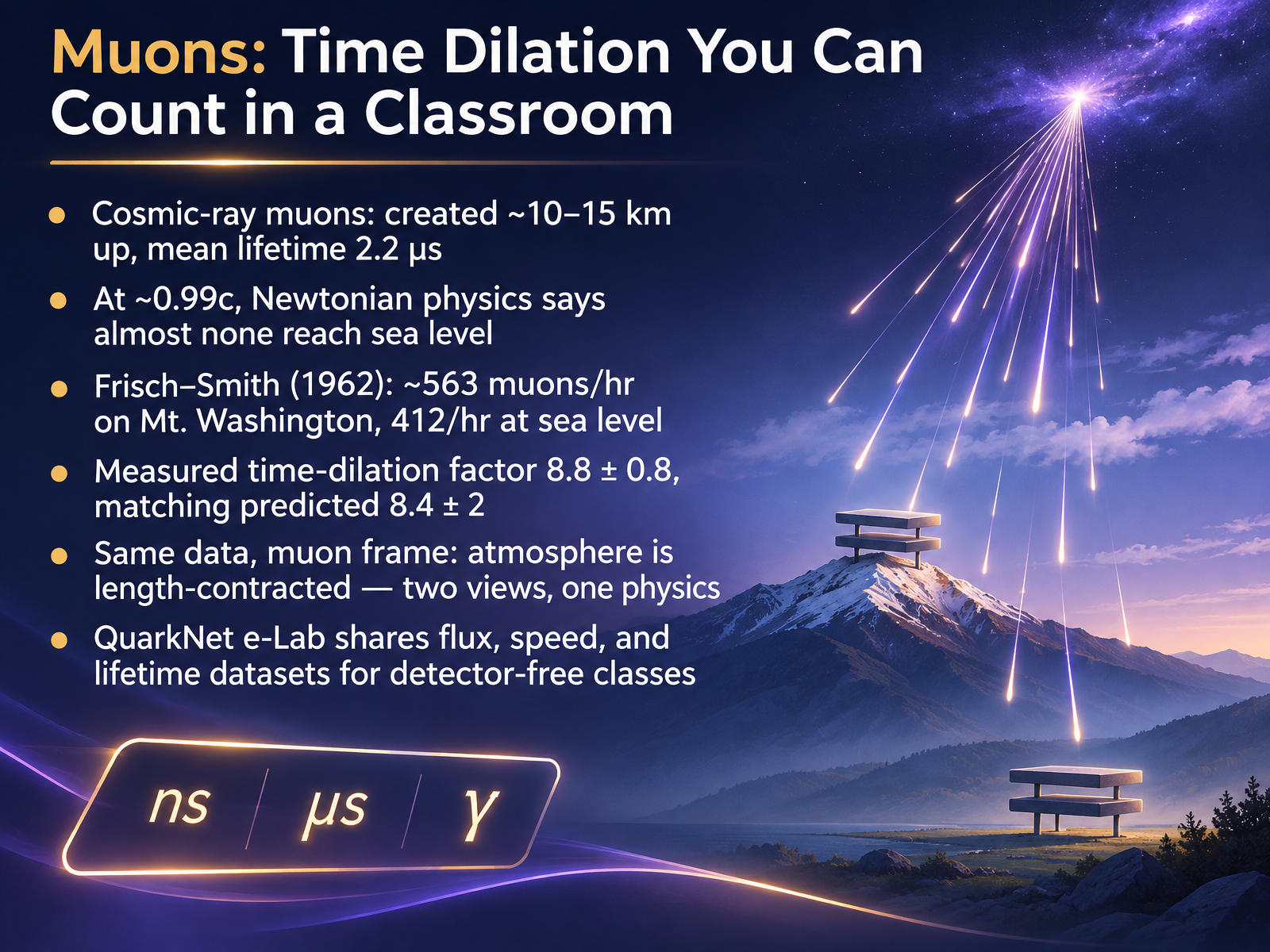
- 07Muons: Time Dilation You Can Count in a ClassroomNow let's look at the classic case of relativistic time dilation, the muon. These particles are created about ten to fifteen kilometers up, and they only live around two point two microseconds on average. At nearly ninety-nine percent of the speed of light, old Newtonian physics says almost none should reach sea level. But in nineteen sixty-two, Frisch and Smith counted about five hundred sixty-three muons per hour on Mount Washington, and four hundred twelve per hour down at sea level. That works out to a time dilation factor of eight point eight, plus or minus zero point eight, matching the predicted eight point four within error. And here's the elegant part. From the muon's own frame, the atmosphere is length-contracted. Same data, two views, one physics. Curious about doing this in class? The QuarkNet e-Lab shares flux, speed, and lifetime datasets, so students can analyze real cosmic-ray data without owning a detector. Next, clocks in flight, from jet aircraft to GPS.
 pubs.aip.orgen.wikipedia.orgpubs.aip.org+22 min
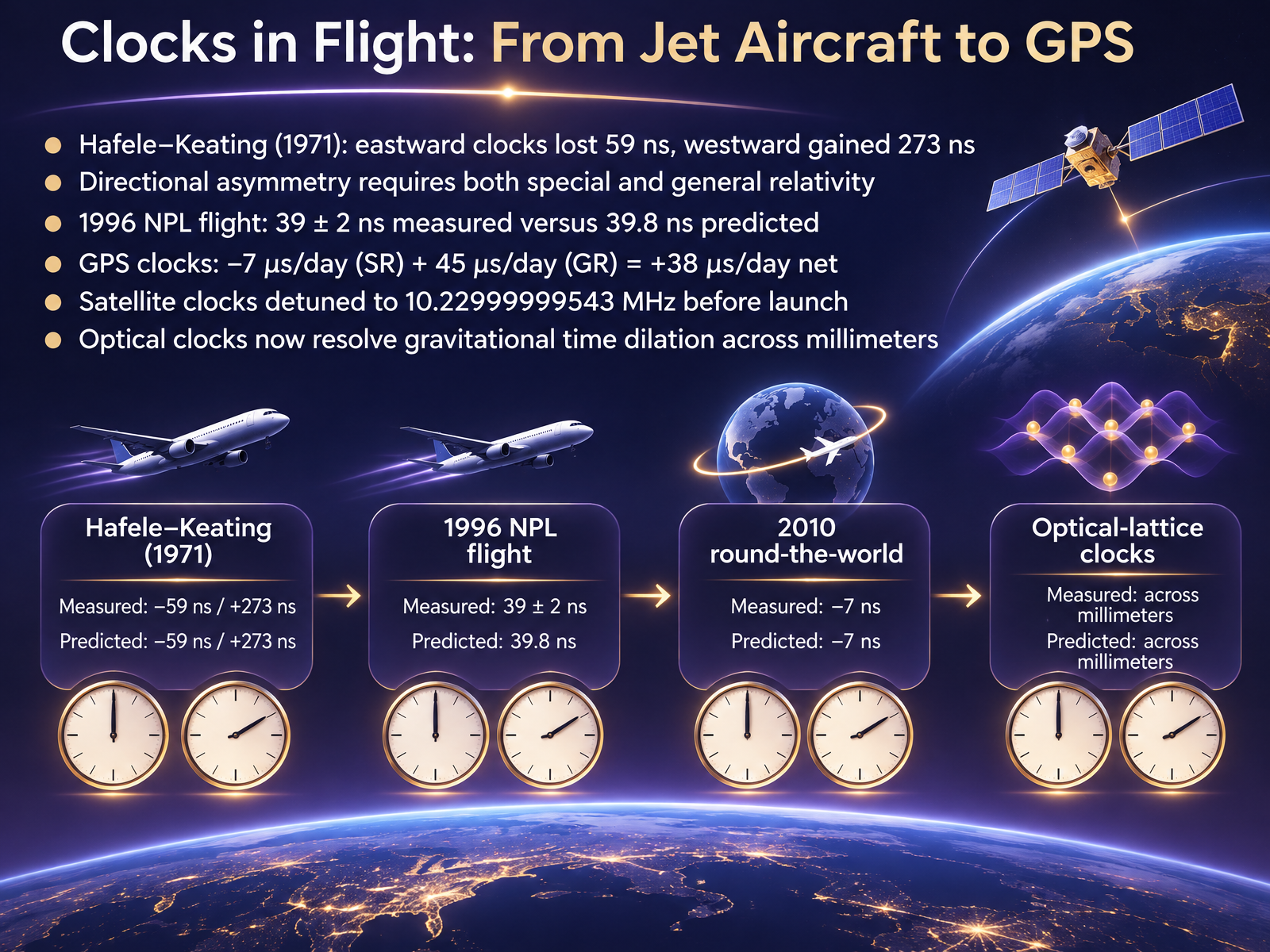
- 08Clocks in Flight: From Jet Aircraft to GPSNow let's take relativity out of thought experiments and into the sky. In 1971, Hafele and Keating flew atomic clocks around the world on commercial jets. Eastward, the clocks lost fifty nine nanoseconds. Westward, they gained two hundred seventy three. Same trip, opposite direction, opposite result. That asymmetry needs both special and general relativity to explain. In 1996, the National Physical Laboratory repeated the flight and measured thirty nine nanoseconds, plus or minus two. Prediction? Thirty nine point eight. Almost a bullseye. GPS is the daily version of this story. Satellite clocks lose seven microseconds per day from speed, but gain forty five from weaker gravity. Net result: thirty eight microseconds faster each day. So engineers detune each clock to ten point two two nine nine nine nine nine nine five four three megahertz before launch. Once in orbit, it ticks in step with the ground. Today, optical clocks even detect gravitational time dilation across a few millimeters. Next, we look at the Twin Paradox, and why acceleration breaks the symmetry.
 nist.govgpsworld.comcds.cern.ch+22 min
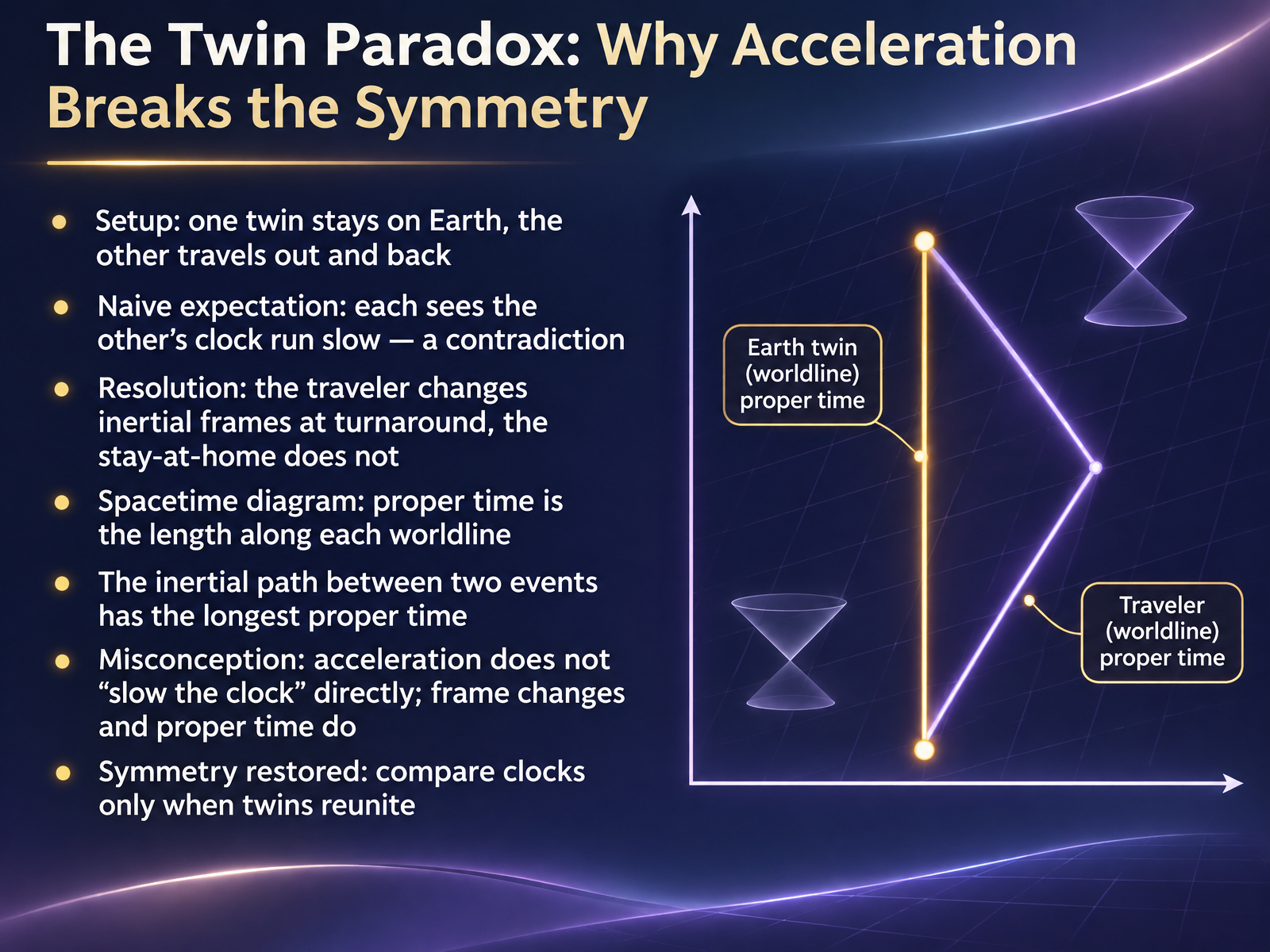
- 09The Twin Paradox: Why Acceleration Breaks the SymmetryNow let's tackle the famous twin paradox. Imagine one twin stays on Earth, while the other flies out and comes back. Each sees the other's clock running slow, so which twin actually ages less? The resolution is symmetry breaking. The traveling twin turns around, changing inertial frames. The stay-at-home twin never does. On a spacetime diagram, proper time is the length along each worldline. And here's the twist: the straight inertial path has the longest proper time. Acceleration itself doesn't directly slow the clock. What matters is the frame change and the path through spacetime. So the paradox disappears once the twins reunite and compare clocks in the same frame. Next, let's clear up some common misconceptions and look at the speed limit.
 openstax.orgdavidfarmer.github.iophys.unsw.edu.au+21 min
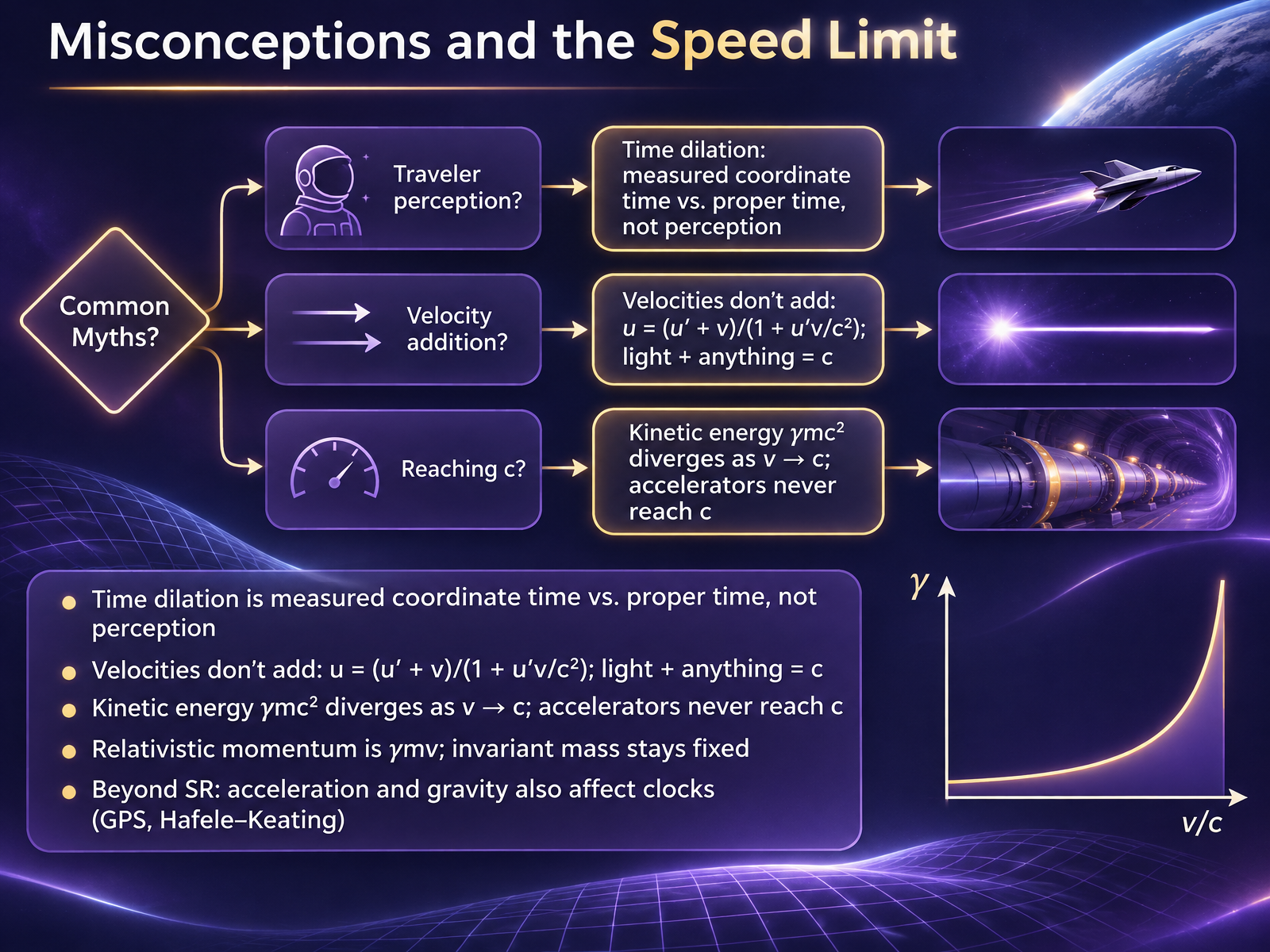
- 10Misconceptions and the Speed LimitLet's clear up a few common misconceptions, starting with time dilation. It's not about perception or illusion. It's a real difference between coordinate time, what one observer's clock network records, and proper time, the time ticked off by a clock traveling with the object. Next, velocities don't simply add. The relativistic velocity addition formula means that adding light's speed to anything still gives you the speed of light. That's the cosmic speed limit. Push a particle harder and its kinetic energy, gamma times m c squared, grows without bound as its speed approaches c. Yet accelerators have never pushed anything to c, no matter how much energy they inject. Momentum, gamma times m v, also grows, while an object's invariant mass stays fixed. And beyond special relativity, acceleration and gravity affect clocks too. GPS clocks run about thirty eight microseconds per day fast overall, a mix of special and general relativistic effects. The Hafele Keating atomic clock flights confirmed this. So keep the core idea: the speed of light is a limit, and relativity is measured, not imagined. That naturally leads us to the open questions and the precision frontier next.
 openstax.orgdavidfarmer.github.iophys.unsw.edu.au+22 min
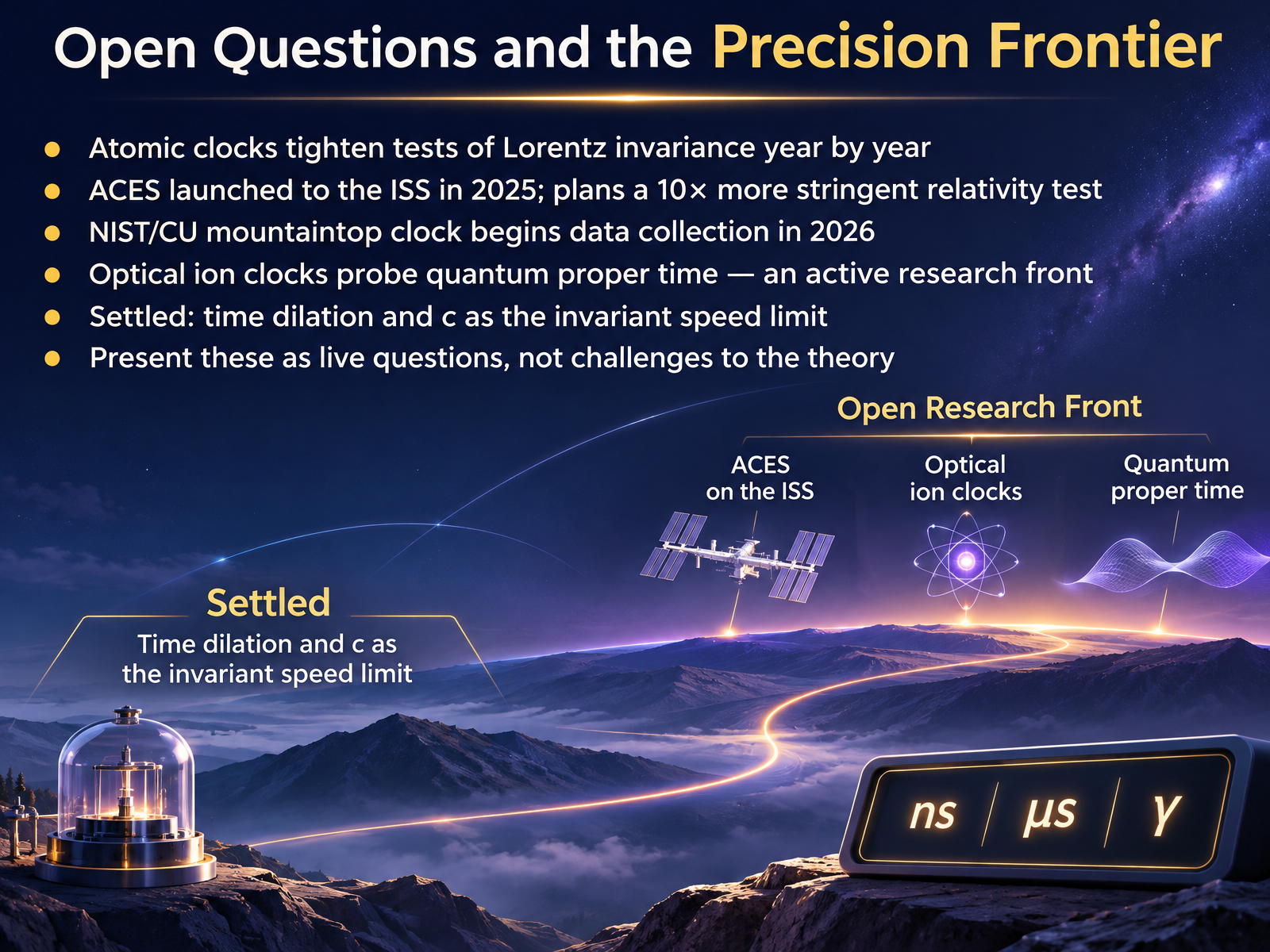
- 11Open Questions and the Precision FrontierLet's be clear about something first. Time dilation and the speed of light as the universal limit are settled science. The open questions are about precision, not about whether relativity is right. Atomic clocks are now so good that they tighten tests of Lorentz invariance year by year. In April 2025, the ACES experiment launched to the International Space Station, and it plans a relativity test ten times more stringent than any before. Meanwhile, a NIST and University of Colorado team carried an optical clock up Mount Blue Sky, and data collection begins in 2026. And on a newer frontier, researchers are using trapped ion clocks to ask whether proper time itself needs a quantum description. So think of these as live questions. Each one is a sharper look at a theory that keeps passing every test. Next, let's move into the Classroom Toolkit: Demonstrations, Simulations, and Data.
 nist.govpubs.aip.orgen.wikipedia.org+22 min
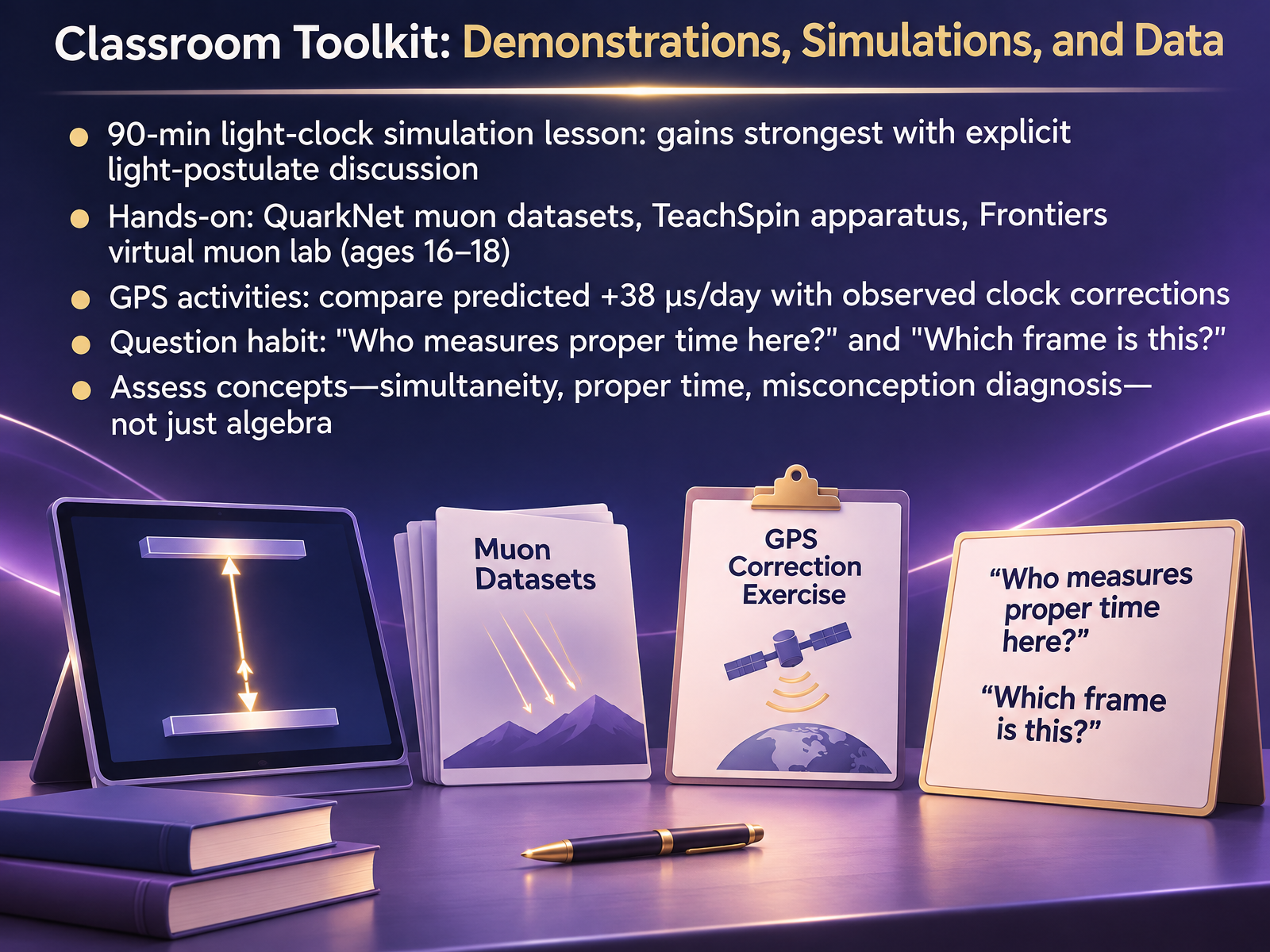
- 12Classroom Toolkit: Demonstrations, Simulations, and DataSo, how do you bring this into a classroom? Here is a practical toolkit. A ninety-minute light-clock simulation lesson works well, but only when you explicitly discuss the light postulate. Without that foundation, students often misread what the simulation shows. For hands-on work, try QuarkNet muon datasets, TeachSpin apparatus, or the Frontiers virtual muon lab, which suits ages sixteen to eighteen. GPS activities are a favorite. Ask students to compare the predicted gain of thirty-eight microseconds per day with observed clock corrections. Build one simple habit: ask, who measures proper time here? And, which frame is this? When you assess, focus on concepts. Check simultaneity, proper time, and misconception diagnosis, not just algebra. Next, we will look at audience takeaways and further reading.
 2 min
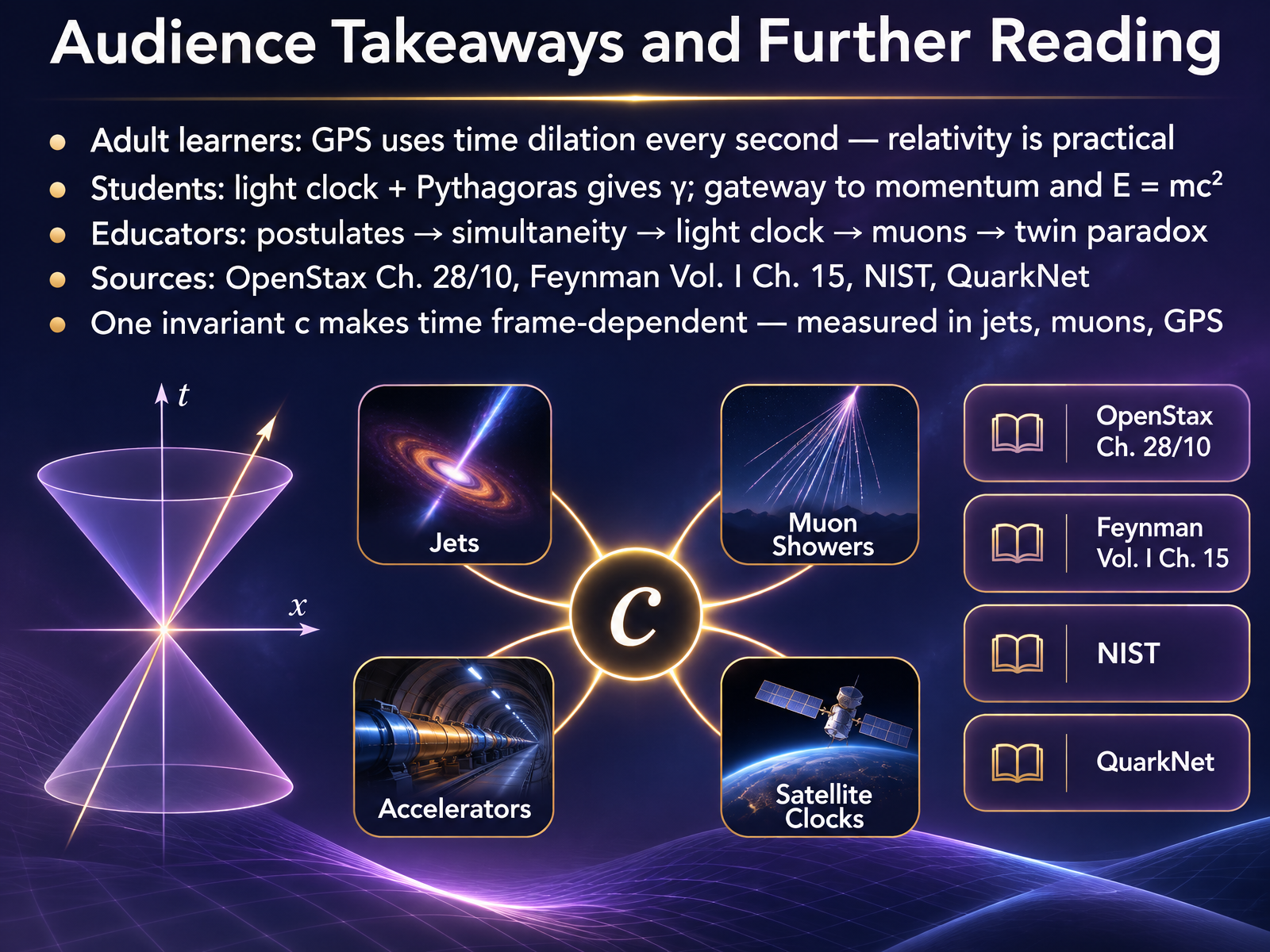
- 13Audience Takeaways and Further ReadingLet's bring this together, with something useful for each of you. Adult learners: every second, GPS satellites carry atomic clocks that run about seven microseconds per day slow from their orbital speed. Engineers correct for it, so relativity is practical. Students: the light clock plus Pythagoras gives you gamma. That same factor then leads you to relativistic momentum and E equals m c squared. Educators: a sequence that works is postulates, then simultaneity, then the light clock, then muons, then the twin paradox. For sources, try OpenStax chapters twenty eight and ten, Feynman Volume One chapter fifteen, NIST, and QuarkNet. So here is the core idea. One invariant speed of light makes time frame dependent, and we measure it in jets, in muons, and in GPS. Thank you for joining me. Keep asking good questions, and enjoy seeing relativity in your everyday world.
 openstax.orgdavidfarmer.github.iophys.unsw.edu.au+21 min
Take the deck with you
Download this course as a file — free, no sign-up needed.
- PDF handoutEvery slide page, ready to print or share.14 pages · 4.0 MBDownload
- Narrated PowerPointThe deck that presents itself — every slide carries the digital human's narration video.14 pages · 13.3 MBDownload
- PowerPoint slidesThe full deck as a .pptx — open it in PowerPoint, Keynote, or Google Slides.14 pages · 4.0 MBDownload
Free to use in your own training — please keep the PersonWise credit page at the end.
Have your own deck? Turn it into a course
Sources consulted
Web sources consulted while building this course.
- Ch. 28 Introduction to Special Relativity - College Physics 2e | OpenStax — openstax.org
- Experimental evidence — davidfarmer.github.io
- Einstein Light: module 5 — phys.unsw.edu.au
- Relativity | Institute of Physics — iop.org
- Unraveling the Mysteries of Relativity: Everyday Applications of Einstein's Theory Of Relativity — blog.learningant.com
- Ch. 28 Section Summary - College Physics 2e | OpenStax — openstax.org
- 10.1 Postulates of Special Relativity - Physics | OpenStax — openstax.org
- The Feynman Lectures on Physics Vol. I Ch. 15: The Special Theory of Relativity — feynmanlectures.caltech.edu
- THE MICHELSON-MORLEY Experiment — physnet.org
- CHAPTER 2: Special Theory of Relativity — sibor.physics.tamu.edu
- Measurement of the Relativistic Time Dilation Using μ-Mesons | American Journal of Physics | AIP Publishing — pubs.aip.org
- Experimental testing of time dilation — en.wikipedia.org
- A compact apparatus for muon lifetime measurement and time dilation demonstration in the undergraduate laboratory — pubs.aip.org
- 1.2: Experimental Tests of the Nature of Time — phys.libretexts.org
- The Speed and Decay of Cosmic-Ray Muons: Experiments in the Relativistic Kinematics of the Universal Speed Limit and Time Dilation — web.mit.edu
- Putting Einstein to the Test | NIST — nist.gov
- Inside the box: GPS and relativity - GPS World — gpsworld.com
- Einstein's Relativity in Action – the GPS Navigation System knows it — cds.cern.ch
- Fundamental Physics - Navipedia — gssc.esa.int
- Clocks on the Moon and in Cislunar space: Lessons from GPS — gps.gov