Begin
14 pages · ~28 min
Square-Cube Law: Size Changes Everything
This training explores the square-cube law, helping learners understand why scaling an object's size changes its strength, weight, and behavior in unexpected ways.
A digital instructor presents all 14 pages. Hold “Ask” at any point and ask out loud — the answer comes from this course. No sign-up needed.
What you’ll learn
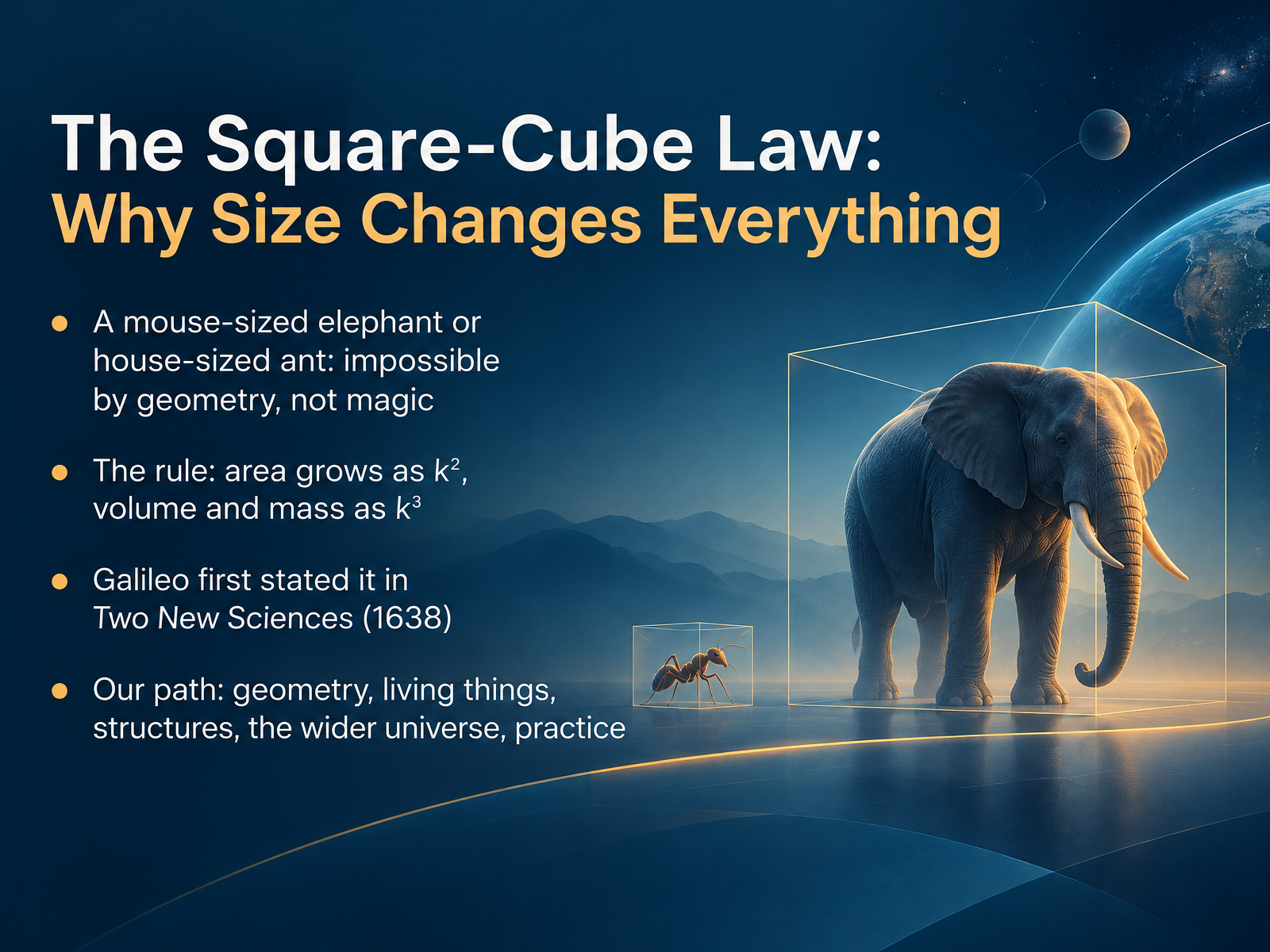
- 01The Square-Cube Law: Why Size Changes EverythingWelcome. Have you ever pictured a mouse the size of an elephant, or an ant as big as a house? It's a fun image, but here's the thing. Those creatures aren't impossible because of magic. They're impossible because of geometry. That's the square-cube law, and once you see it, you'll notice it everywhere. Here's the core idea. If you scale something up by a factor of k, its area grows as k squared, while its volume and mass grow as k cubed. In plain terms, double the size, and area goes up four times, but weight goes up eight times. That mismatch changes everything. It's not a new discovery, either. Galileo first spelled it out in his book Two New Sciences, back in sixteen thirty-eight. So why should you care? Because this one rule explains why living things have the shapes they do, why buildings have limits, and even how planets and stars behave. Our path is straightforward. First, we'll build the geometry. Then we'll look at living things, then structures, then the wider universe, and finally, you'll practice applying it yourself. Ready? Let's start with the geometry behind the rule.2 min
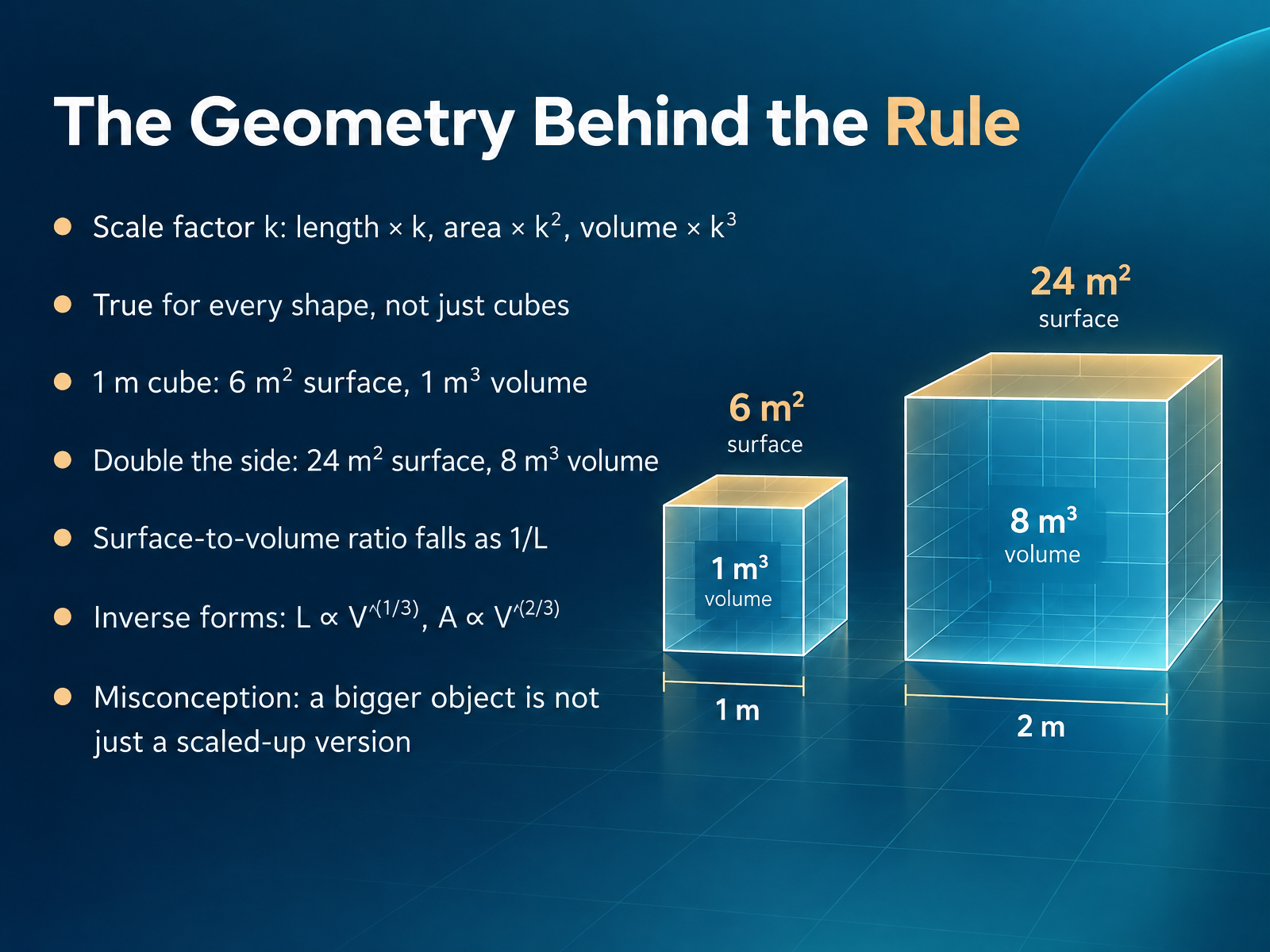
- 02The Geometry Behind the RuleLet's look at the geometry behind the rule. Here's the core idea. If you scale an object by a factor k, then length grows by k, area grows by k squared, and volume grows by k cubed. And this works for every shape, not just cubes. Picture a cube a meter wide. Its surface is six square meters, and its volume is one cubic meter. Now double the side. Surface becomes twenty four square meters, and volume becomes eight cubic meters. Notice the volume grew eightfold while the surface grew only fourfold. That's why the ratio of surface to volume falls as one over length. In inverse forms, length scales as volume to the one third, and area as volume to the two thirds. One common misconception: a bigger object is not simply a scaled up version of the small one. The proportions shift. Next, we'll see that shift in action, from chandeliers to giant bones, with Galileo's insight.
 1 min
- 03From Chandeliers to Giant Bones: Galileo's InsightNow let's talk about a famous insight from Galileo. He was puzzled by a simple question. If you double the size of a chandelier, why can't you just double the rope? Here's the math. Double the length in every direction, and the weight goes up eight times. But the rope's cross-section, the area that carries the load, only goes up four times. So the rope gets relatively weaker. Galileo illustrated this with a giant bone. Stretch a bone to three times its length, and it must become grotesquely thick just to bear its own weight. In nature and in art, you can't simply scale up a structure and expect it to hold together. Galileo imagined a giant who would fall and be crushed under his own weight. But small things tell the opposite story. A small dog can carry two or three dogs on its back. A horse that falls can break a leg, while an ant tumbles and walks away. So size changes everything, and that sets up our next topic: bones, muscles, and why giants fall.
 2 min
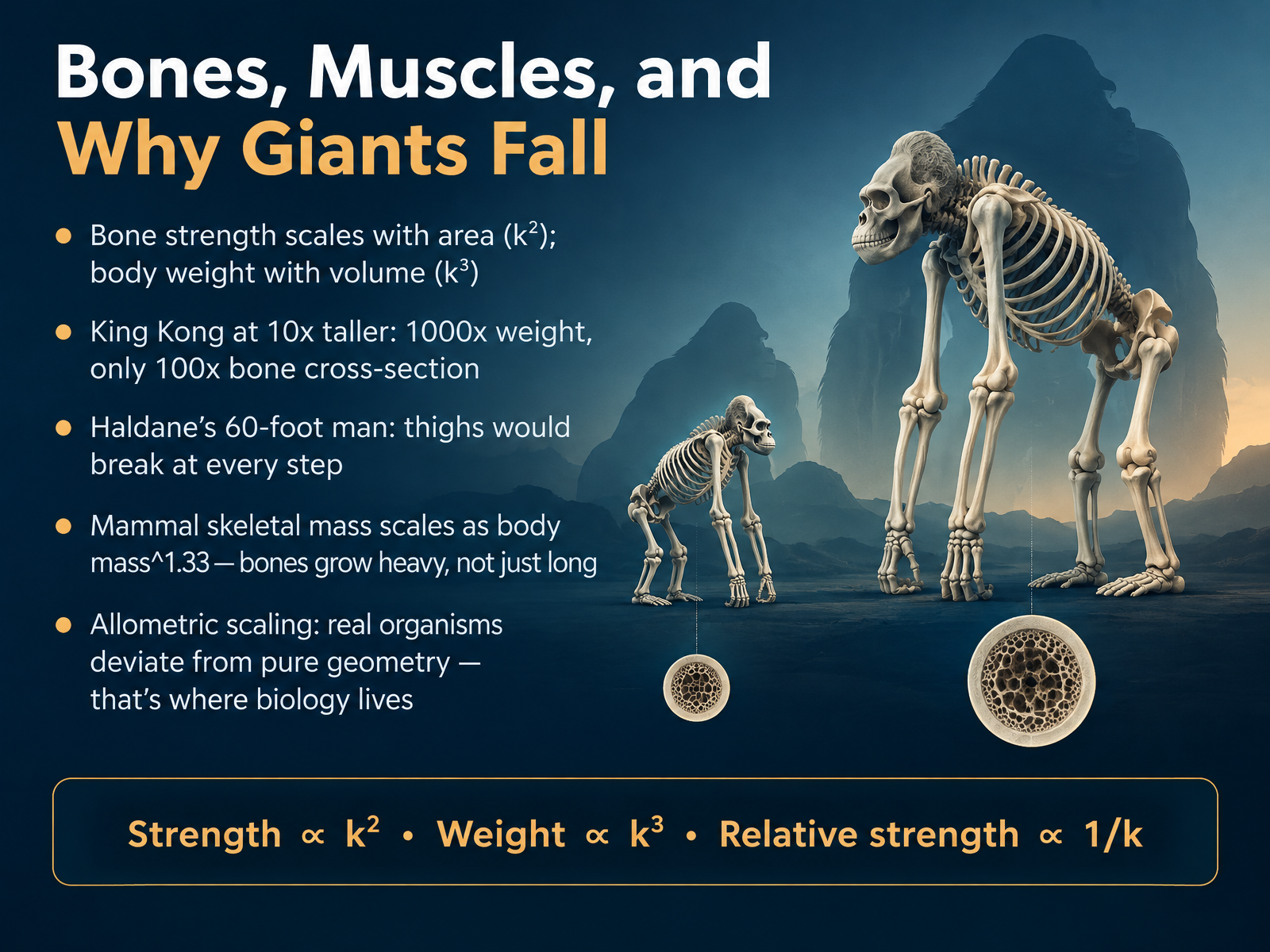
- 04Bones, Muscles, and Why Giants FallNow let's see why big bodies break. Here's the core idea. Bone strength grows with cross-sectional area, which scales as height squared. But body weight grows with volume, which scales as height cubed. So if you make King Kong ten times taller, he weighs one thousand times more, while his bones offer only one hundred times more strength. Relative strength drops as one over the scale factor.
Haldane made this vivid with a sixty-foot man. His thighs would break at every step. That's not poetry. It's geometry. And real mammals show it too. Skeletal mass scales as body mass to the one point three three power. Bones grow heavy, not just long.
Biologists call this allometric scaling. Real organisms deviate from pure geometry, and that is where biology lives. So next time you see a giant creature on screen, ask whether its bones could carry it. Why can ants out-lift us, and why does that not scale? That's next.
 2 min
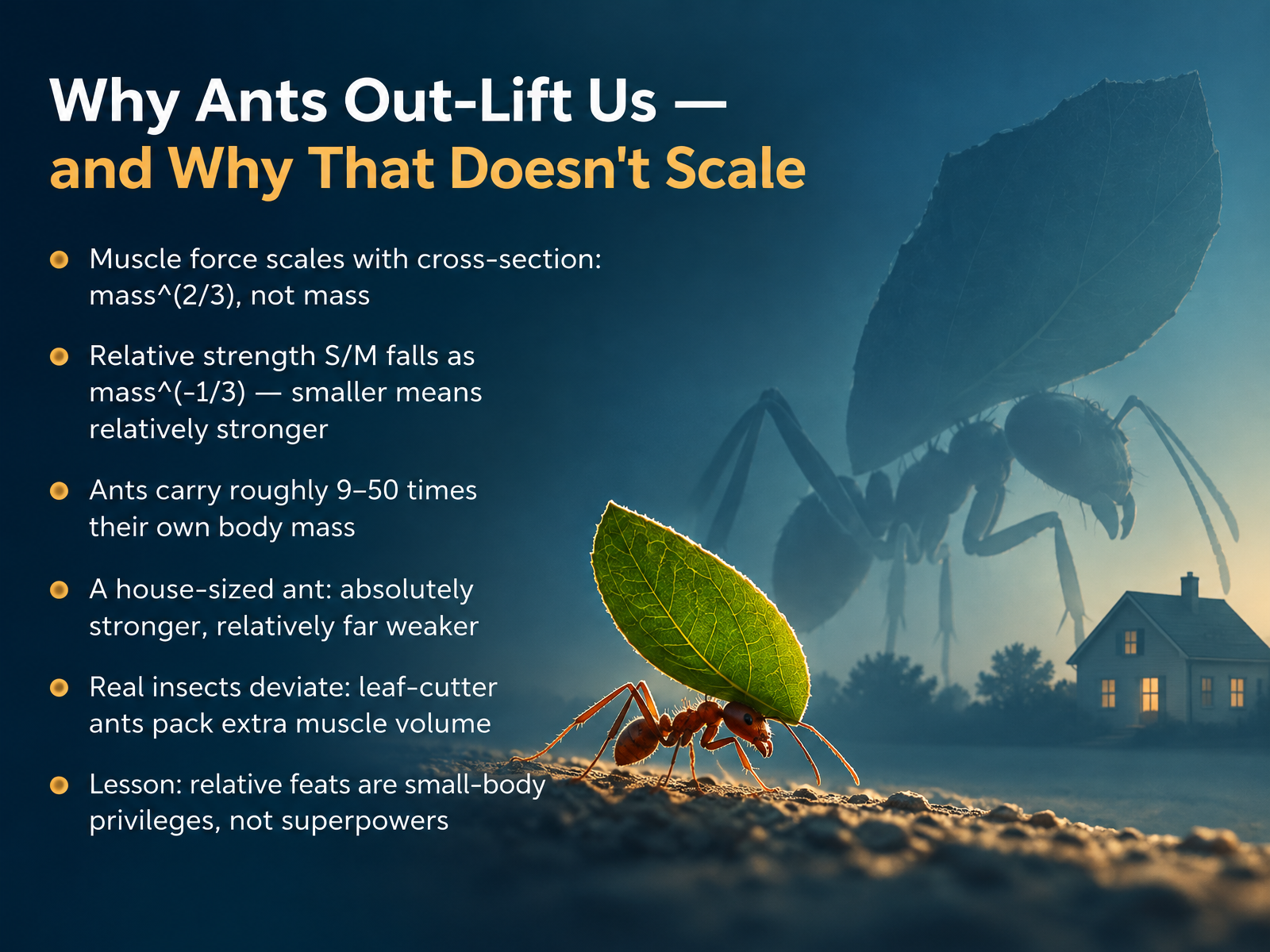
- 05Why Ants Out-Lift Us — and Why That Doesn't ScaleNow here's a puzzle. An ant can carry roughly nine to fifty times its own body mass. Lift a fifty kilogram person to that standard, and they'd haul a small car. So why can't we? The answer is geometry, not grit. Muscle force grows with cross-section, and cross-section grows as mass to the two thirds power, not with mass itself. So as an animal gets bigger, its weight outpaces its strength. Relative strength, strength divided by mass, falls as mass to the negative one third. Smaller really does mean relatively stronger. Scale an ant up to house size, and it would be absolutely stronger, yes, but relatively far weaker, likely crushed by its own weight. Real insects also bend the rule: leaf-cutter ants pack extra muscle into their bodies, so they outperform the simple prediction. The lesson: those astonishing feats are a small-body privilege, not a superpower. But size changes more than mechanics. Next, Heat, Oxygen, and the Limits of Living Cells.
 1 min
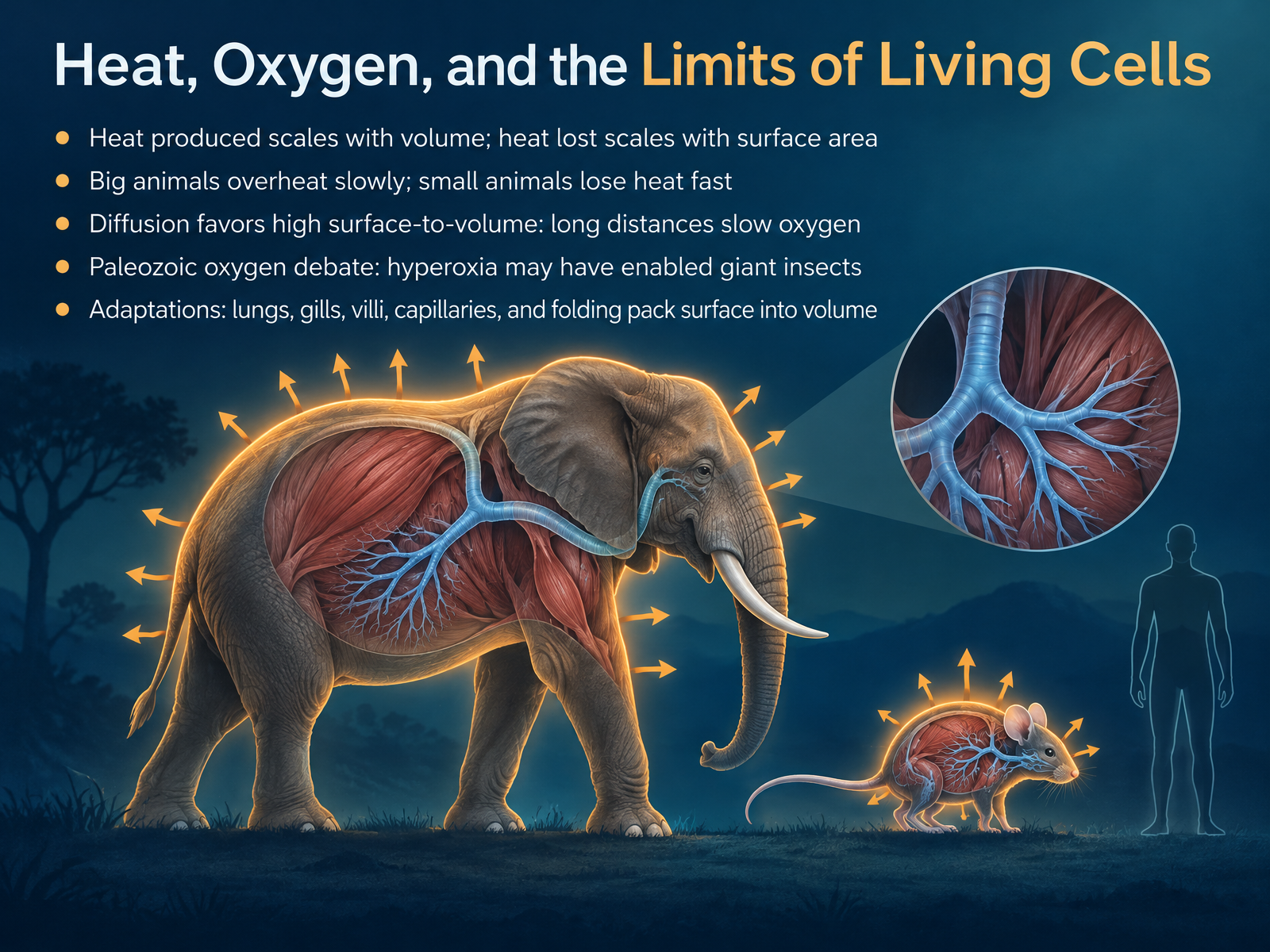
- 06Heat, Oxygen, and the Limits of Living CellsNow let's look at the inner limits of living cells. Heat is produced throughout an animal's body, so it scales with volume. But heat escapes through the skin, which scales with surface area. That mismatch explains a lot. A big animal overheats slowly because it has lots of volume and relatively little surface to lose heat through. A small animal loses heat fast, so it must eat almost constantly just to stay warm. Oxygen faces a similar problem. Diffusion works well over short distances and favors a high surface to volume ratio. But long distances slow oxygen down, so big bodies need help. One famous debate: in the Paleozoic era, higher oxygen may have helped giant insects grow, because oxygen could reach deeper into their bodies through tubes. Today, animals solve the problem with adaptations like lungs, gills, villi, capillaries, and folding. These pack enormous surface area into a small volume. So remember: producing heat is easy with size, but losing it and getting oxygen in is all about surface. That same tension between volume and surface is exactly what hits tall buildings, which brings us to our next section: Structural Scaling: Why Tall Buildings Need Different Rules.
 2 min
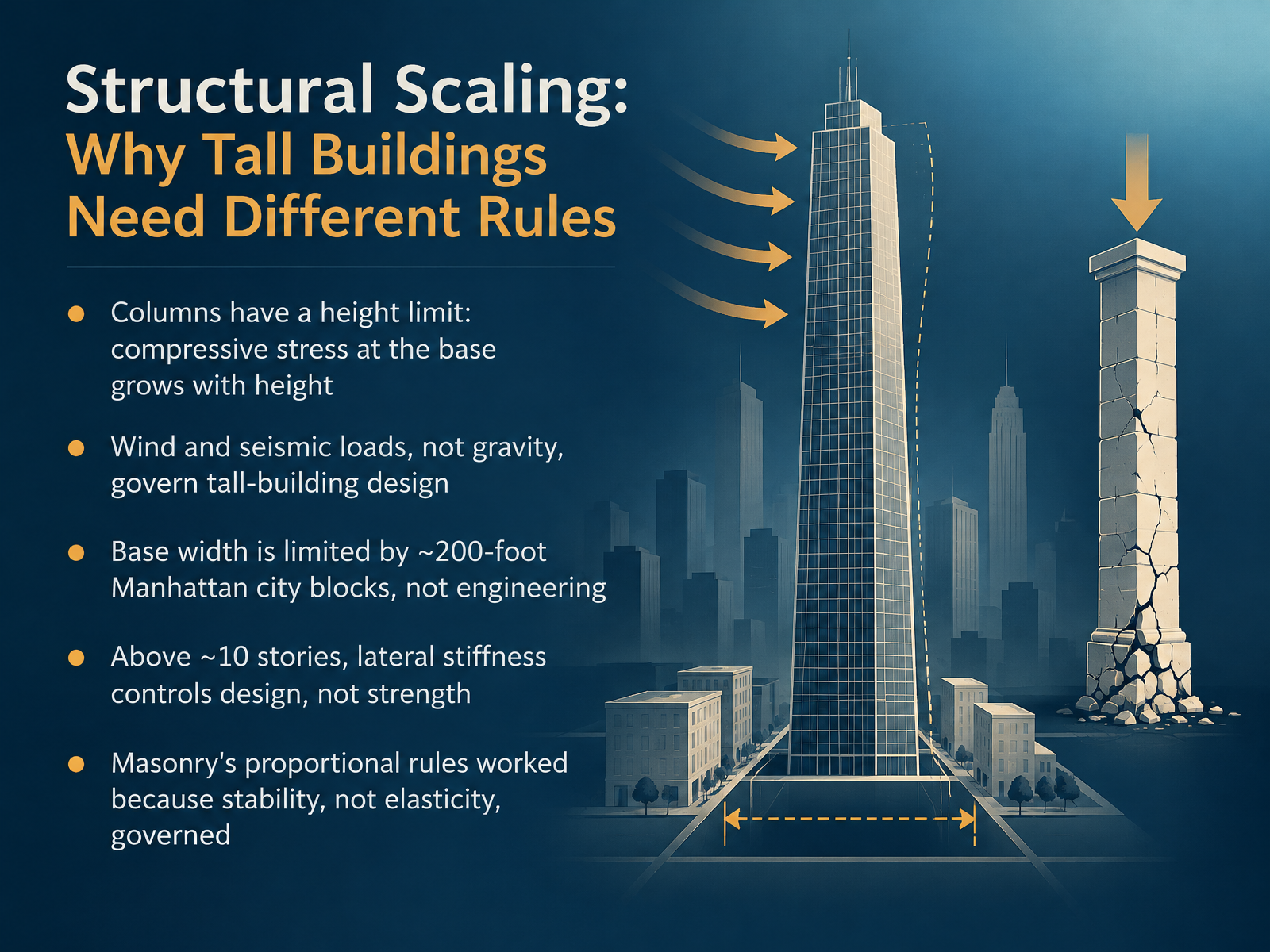
- 07Structural Scaling: Why Tall Buildings Need Different RulesNow let's look at how structures scale, and why tall buildings follow different rules. Start with a simple column. The taller it gets, the more weight piles up on its base. Compressive stress, meaning the squishing force per unit of area, grows with height. Push a column too far and the material at the bottom simply crushes.
But here's the surprise. Past roughly ten stories, gravity stops being the main problem. Wind and earthquakes take over. These sideways forces bend the building, and lateral stiffness, its resistance to swaying, controls the design. Not strength. Nobody wants to work in a tower that sways. And the base width is often capped by the city itself, around two hundred feet in Manhattan. That limit comes from city blocks, not engineering.
So why did old masonry towers work with simple proportional rules? Because stability governed them, not elasticity, the ability of a material to stretch and spring back. Masonry held itself up, while steel has to bend without breaking. Next, we'll see how the same logic plays out in vehicles, ships, and aircraft: Scaling in Design.
 2 min
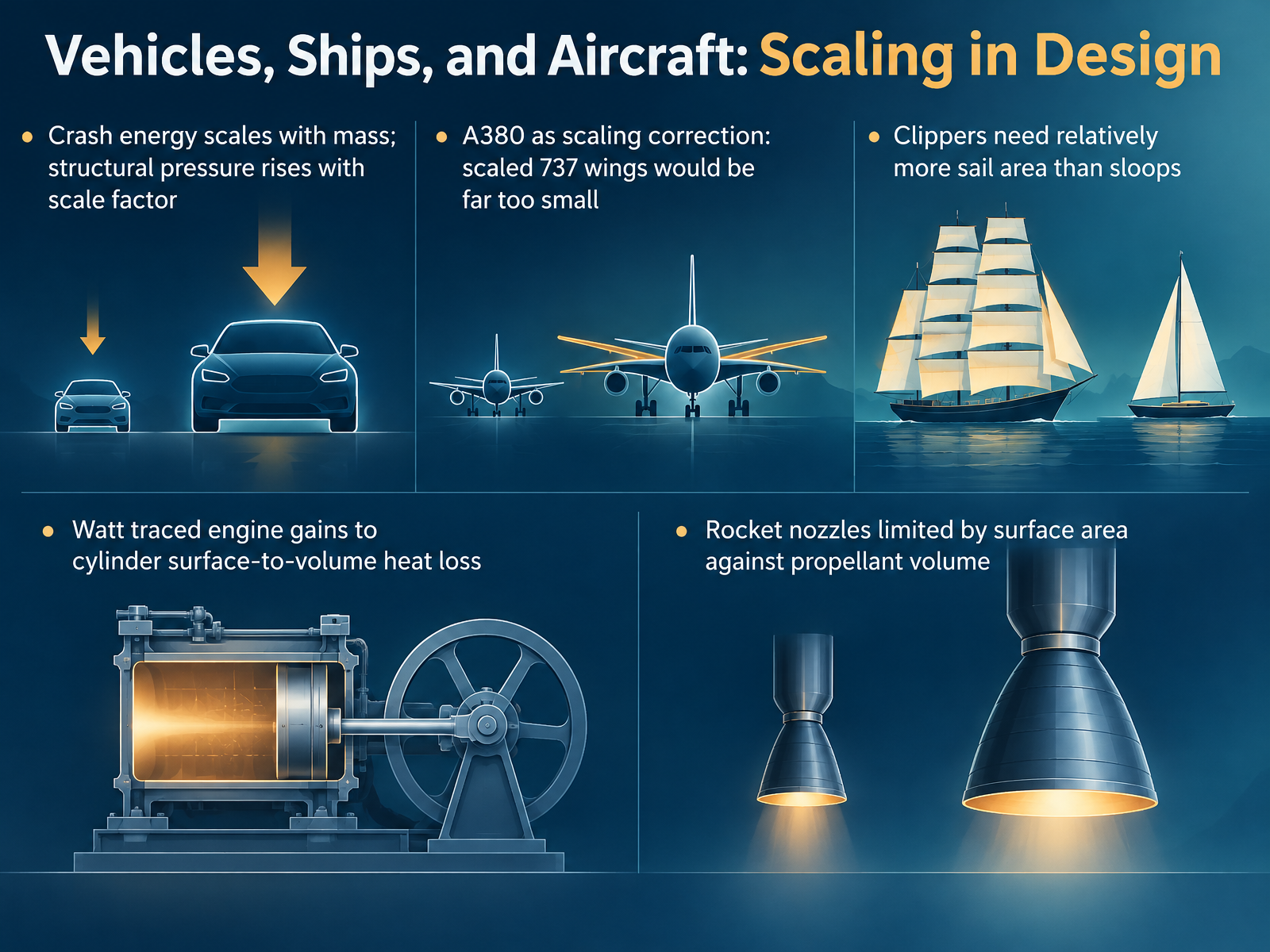
- 08Vehicles, Ships, and Aircraft: Scaling in DesignNow let's take the square-cube law into engineering, where design trade-offs become very real. In a crash, the energy that must be absorbed scales with the vehicle's mass. But the structure that absorbs it grows mainly with surface area. So as you scale a design up, structural pressure rises with the scale factor. That's why simply enlarging a safe small design can produce a dangerous large one. The Airbus A three eighty is a good correction to that intuition. If you took a Boeing seven thirty seven and scaled its wings up proportionally to match the A three eighty's weight, those wings would be far too small to generate enough lift. Real large aircraft need disproportionately larger lifting surfaces. Ships follow the same principle in a different medium. Clippers need relatively more sail area than sloops, because sail area works on surface while displacement grows with volume. James Watt traced part of his engine gains to cylinder heat loss, which depends on surface area compared with volume. And rocket nozzles are limited by their surface area against the propellant volume flowing through them. So next time you look at a vehicle, ask what is growing faster, surface or volume. Next, we'll see this law at work in today's hardware, in Data Centers: How the Law Shows Up in Today's Hardware.
 2 min
- 09Data Centers: How the Law Shows Up in Today's HardwareLet's see the square-cube law at work in the hardware around us, starting with data centers. Cooling a room full of servers is a square-cube problem. The minimum length that heat must travel, in a pipe or inside a chip, scales with the square root of power. So double the power, and the cooling distance grows by only about one point four. Air cooling starts to fade at twenty to forty kilowatts per rack. And here's a scaling twist: fan power rises with the cube of fan speed. Spin a fan twice as fast, and it eats eight times the energy. Water is the stronger tool. Per unit of mass, water moves roughly four times more heat than air. Per unit of volume, about a thousand times more. What really matters is the temperature the IT inlet sees, and ASHRAE guidance keeps that between eighteen and twenty-seven degrees Celsius. Try this: picture a rack creeping past twenty-five kilowatts. The lesson for the twenty twenty-six era is to capture heat at the source, and stop trying to upscale the air system. Next, we put the law to work on monsters, in Fiction Under Scrutiny: Kong, Godzilla, and Movie Physics.
 2 min
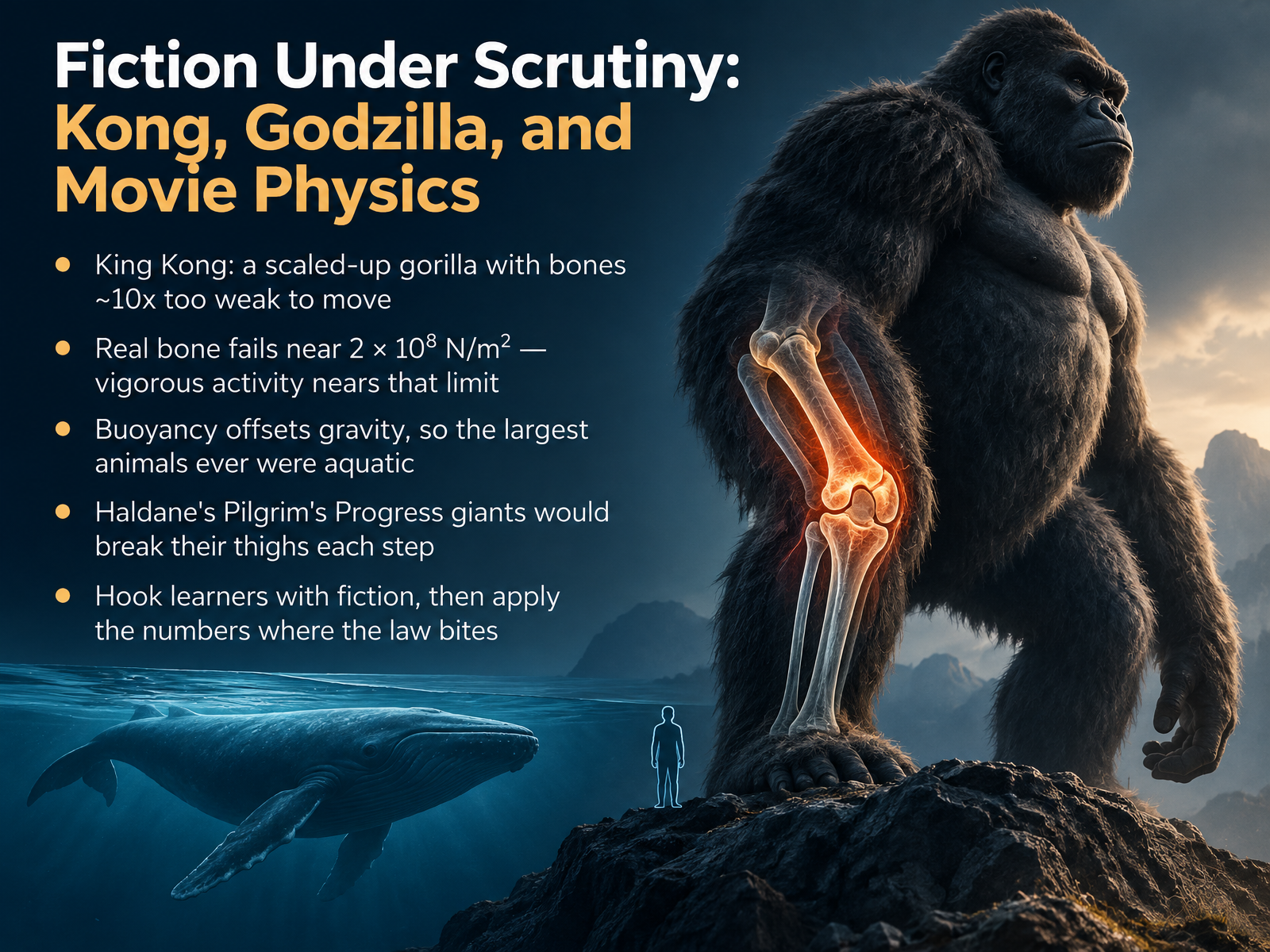
- 10Fiction Under Scrutiny: Kong, Godzilla, and Movie PhysicsNow let's test the law against the movies. Take King Kong: if you simply scaled up a gorilla, its bones would need to be about ten times stronger than they are. Why? Because weight grows with volume, roughly the cube of height, while bone strength grows only with cross-sectional area, the square. Real bone fails near two times ten to the eighth newtons per square meter. For a normal animal, vigorous activity already pushes close to that limit, so the margin is thin. And there's a second check: buoyancy offsets gravity, which is why the largest animals ever were aquatic. Haldane's giants in Pilgrim's Progress would break their thighs with every step. So try this: keep the fiction, then apply the numbers where the law actually bites. Next, we'll see why planets are round and asteroids aren't.
 2 min
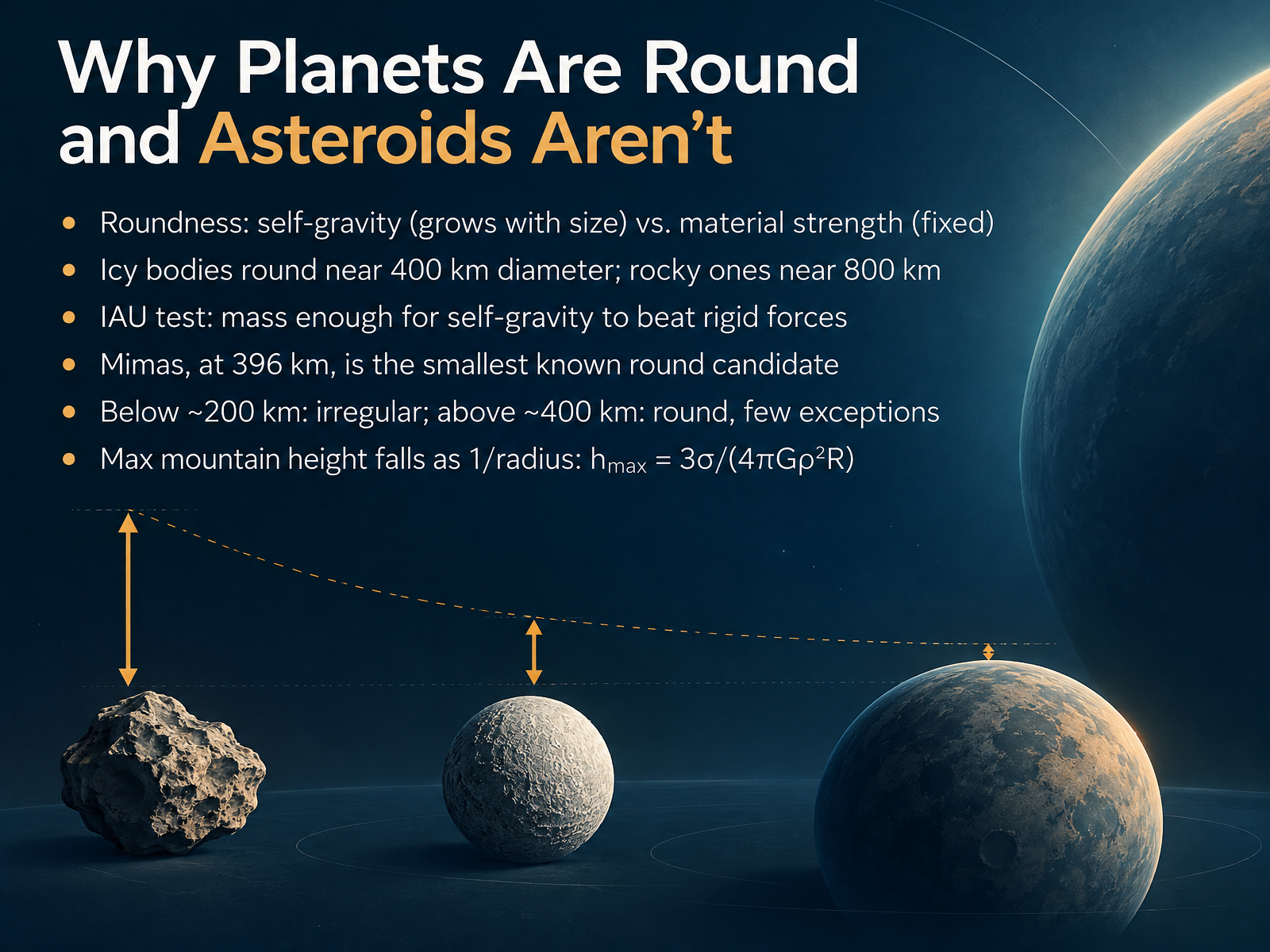
- 11Why Planets Are Round and Asteroids Aren'tSo why are planets round, while most asteroids are not? It comes down to a tug of war between two forces. Self-gravity grows with size. Material strength stays fixed. Small bodies win with strength, so they keep their lumpy shapes. But past a certain size, gravity always wins. For icy bodies, roundness kicks in near four hundred kilometers across. For rocky ones, closer to eight hundred. This is the heart of the International Astronomical Union's definition of a planet: enough mass for self-gravity to overcome rigid forces. Mimas, at three hundred ninety-six kilometers, is the smallest known round candidate. Below about two hundred kilometers, expect irregular shapes. Above four hundred, round ones, with few exceptions. And here's a neat consequence. The tallest mountain a body can support shrinks as one divided by its radius. The formula is h max equals three sigma divided by four pi G rho squared R. In plain words: bigger worlds have flatter mountains. Next, we'll try estimating these scale effects ourselves.
 2 min
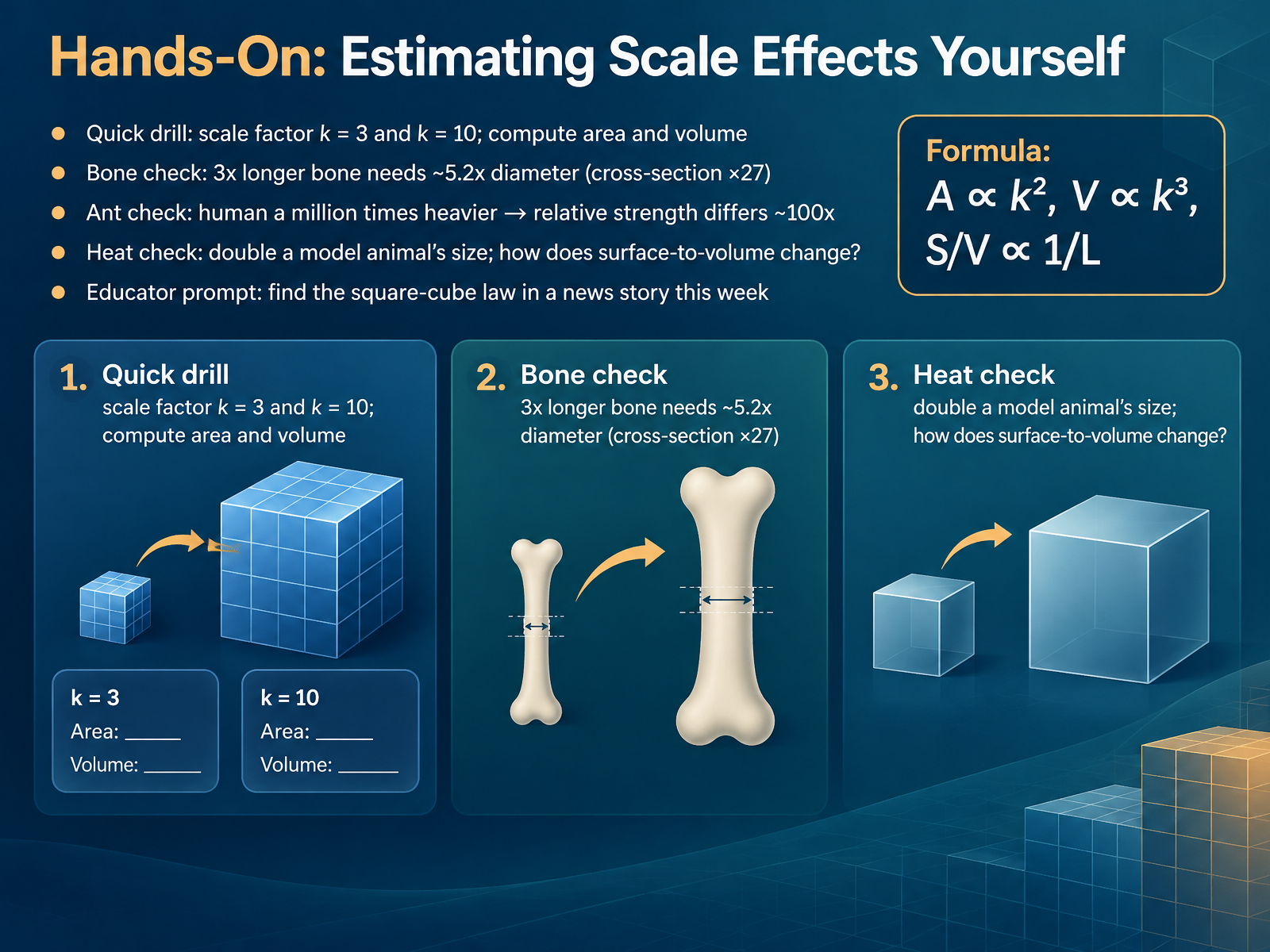
- 12Hands-On: Estimating Scale Effects YourselfNow it's your turn to run the numbers. Grab a pencil. Take a scale factor of three, then one of ten. Area grows with k squared, so it multiplies by nine and then by a hundred. Volume grows with k cubed, so it jumps by twenty-seven, then a thousand. See how fast volume outruns area?
Try a bone that's three times longer. To keep the same stress, its diameter needs to grow about five point two times, and the cross-section by twenty-seven. Now an ant: scaled up to human weight, a million times heavier, its relative strength drops by roughly a hundredfold. And if you double a model animal's size, its surface-to-volume ratio is cut in half.
Educators, here's your prompt: find this law in a news story this week. Next, where the law applies, and where it's a first approximation.
 1 min
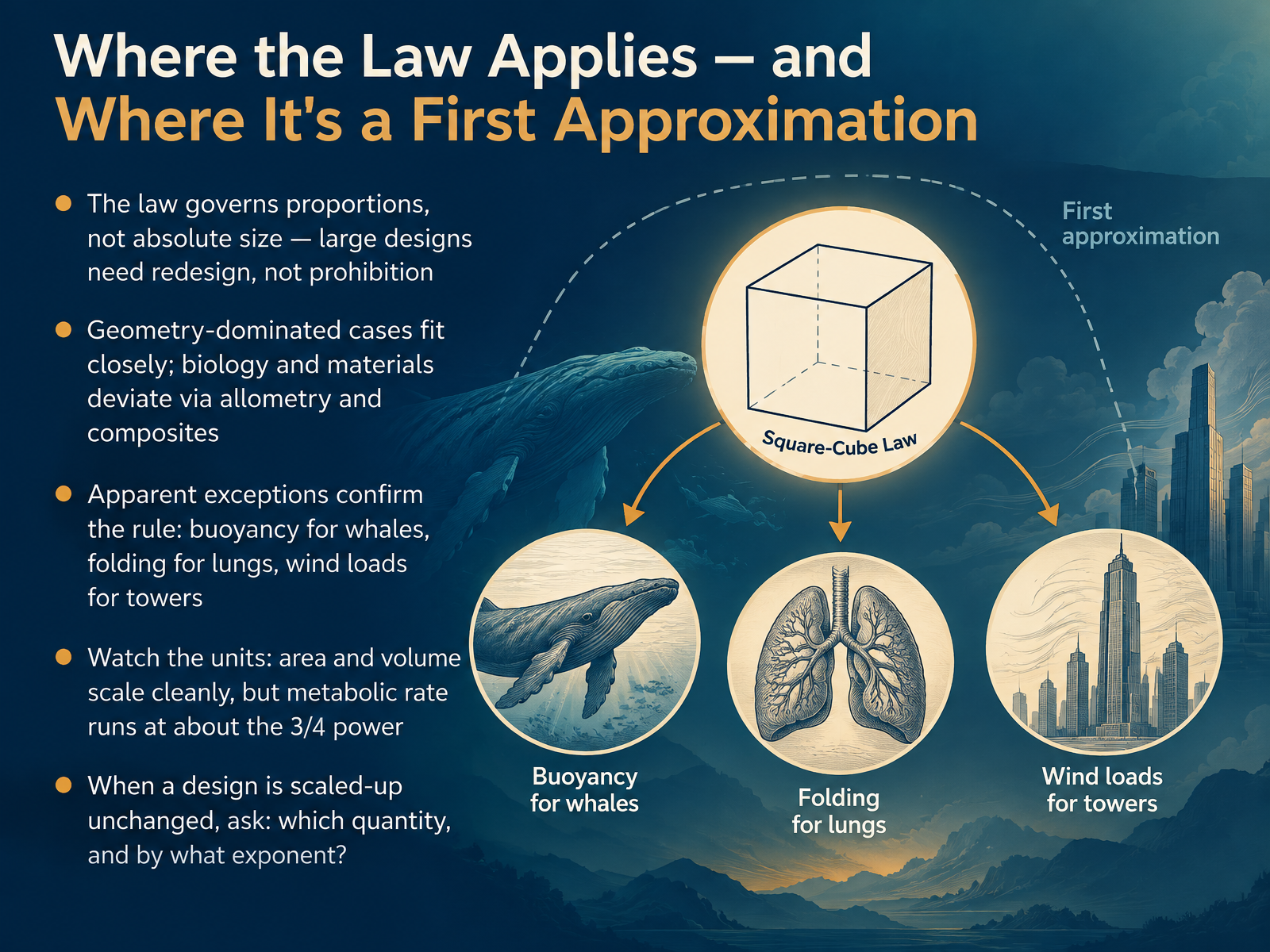
- 13Where the Law Applies — and Where It's a First ApproximationSo where does the square-cube law actually apply? Here is the key idea: the law governs proportions, not absolute size. It tells you that when you double a length, area grows fourfold and volume grows eightfold. But that is a warning to redesign, not a reason to stop building. Now, some cases fit the geometry almost perfectly, like the strength of a simple beam. Biology and materials often drift from the clean numbers, through allometry, meaning the way body parts grow at different rates as an animal gets bigger, and through composites, like bone or bamboo, which are mixtures of stiff fibers and soft matrix. The apparent exceptions confirm the rule. Whales float because buoyancy carries their weight. Lungs fold to pack a huge surface area into a small chest. Tall towers face wind loads that rise faster than simple scaling would suggest. And watch the units. Area and volume scale exactly, but metabolic rate runs at roughly the three-quarter power, not the square or the cube. So when a design is scaled up unchanged, ask: which quantity is scaling, and by what exponent? Keep that question handy, because next we will pull the key takeaways together and explore where to go from here.
 2 min
- 14Key Takeaways and Further ExplorationLet's lock in the big picture. Area scales as k squared, volume as k cubed, and everything else follows from that. It's the same arithmetic behind giant movie bones, skyscraper limits, data-center cooling, and why planets settle into round shapes. Fiction fails the calculation, which is exactly why it works so well in the classroom: ask your students to size up a giant and watch the numbers do the teaching. For further exploration, read Galileo's Two New Sciences, Day Two, and Haldane's essay On Being the Right Size. Then go deeper with D'Arcy Thompson's On Growth and Form, and current data-center cooling literature. That's the takeaway: one ratio explains a surprising amount of the world. Thank you for learning with me today. Keep asking how big, and keep doing the math. You've got this.
 2 min
Take the deck with you
Download this course as a file — free, no sign-up needed.
- PDF handoutEvery slide page, ready to print or share.15 pages · 4.2 MBDownload
- Narrated PowerPointThe deck that presents itself — every slide carries the digital human's narration video.15 pages · 14.8 MBDownload
- PowerPoint slidesThe full deck as a .pptx — open it in PowerPoint, Keynote, or Google Slides.15 pages · 4.1 MBDownload
Free to use in your own training — please keep the PersonWise credit page at the end.
Have your own deck? Turn it into a course