Language, Context, and Meaning
Begin
13 pages · ~26 min
Language, Context, and Meaning
This training explores how language, context, and meaning shape translation, helping learners understand the complexities of effective cross-cultural communication.
What you’ll learn
- 01Understanding Translation: Language, Context, and MeaningWelcome to Understanding Translation: Language, Context, and Meaning. I am glad you are here. Translation quality directly impacts a global brand's credibility and trust. A single word choice can change tone, not just meaning. For example, describing inflation as a monster might sound vivid and acceptable in one culture, while feeling unprofessional in another. This course shows how word choices, cultural context, and audience expectations actively shape a translated message. We will explore how register, culture, and reader expectations influence your decisions. Our roadmap covers four key areas: the core pillars of effective translation, real-world challenges, how to evaluate quality, and finally, practical application. Let us begin by moving beyond the dictionary to see what translation really involves.kayeemecktranslation.comkayeemecktranslation.cominfodrivenbusiness.com+21 min
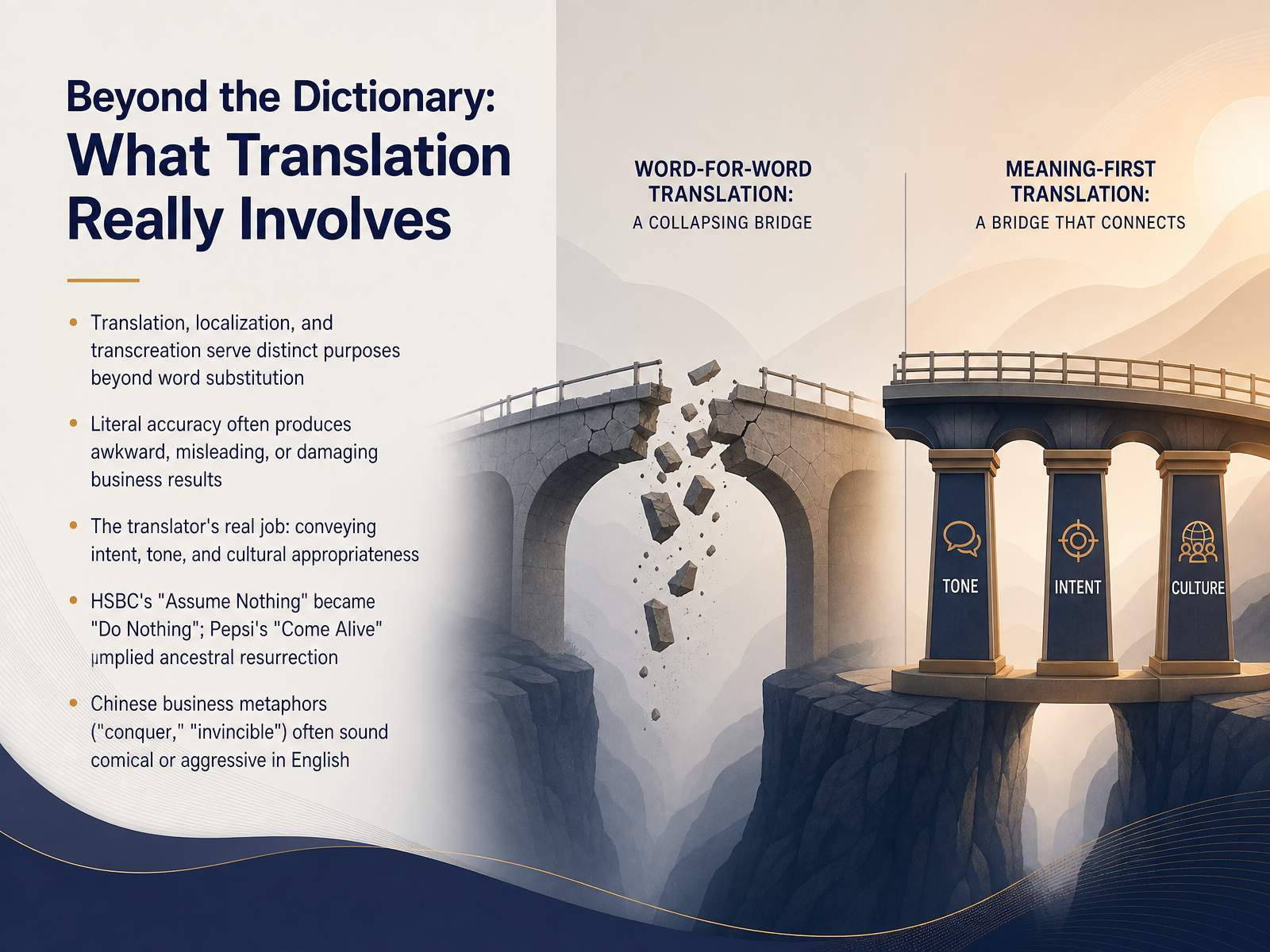
- 02Beyond the Dictionary: What Translation Really InvolvesLet's move beyond the dictionary and look at what translation really involves. It's not just about swapping words. Translation, localization, and transcreation each serve a distinct purpose, and they all go far beyond simple word substitution. Relying on literal accuracy alone often produces results that are awkward, misleading, or even damaging for a business. The translator's real job is to convey intent, tone, and cultural appropriateness. Consider the classic example from H S B C: their global slogan "Assume Nothing" was rendered in several markets as "Do Nothing." That single shift changed a message of diligence into one of complete apathy. Or take Pepsi's slogan "Come Alive with the Pepsi Generation," which in Chinese was interpreted as "Pepsi brings your ancestors back from the grave." These failures show how cultural context completely reshapes meaning. Even in routine business reports, cultural differences in register can cause problems. Chinese business writing often uses powerful metaphors like "conquer" and "invincible" to signal confidence and ambition. However, when translated literally into English, this language often sounds overly aggressive, comical, or simply unprofessional. It shows that the translator must interpret the intended message and adapt it for the new audience's expectations, not just convert the words. Next, let's explore the three pillars that make this possible: word choice, context, and audience.
 kayeemecktranslation.comkayeemecktranslation.cominfodrivenbusiness.com+22 min
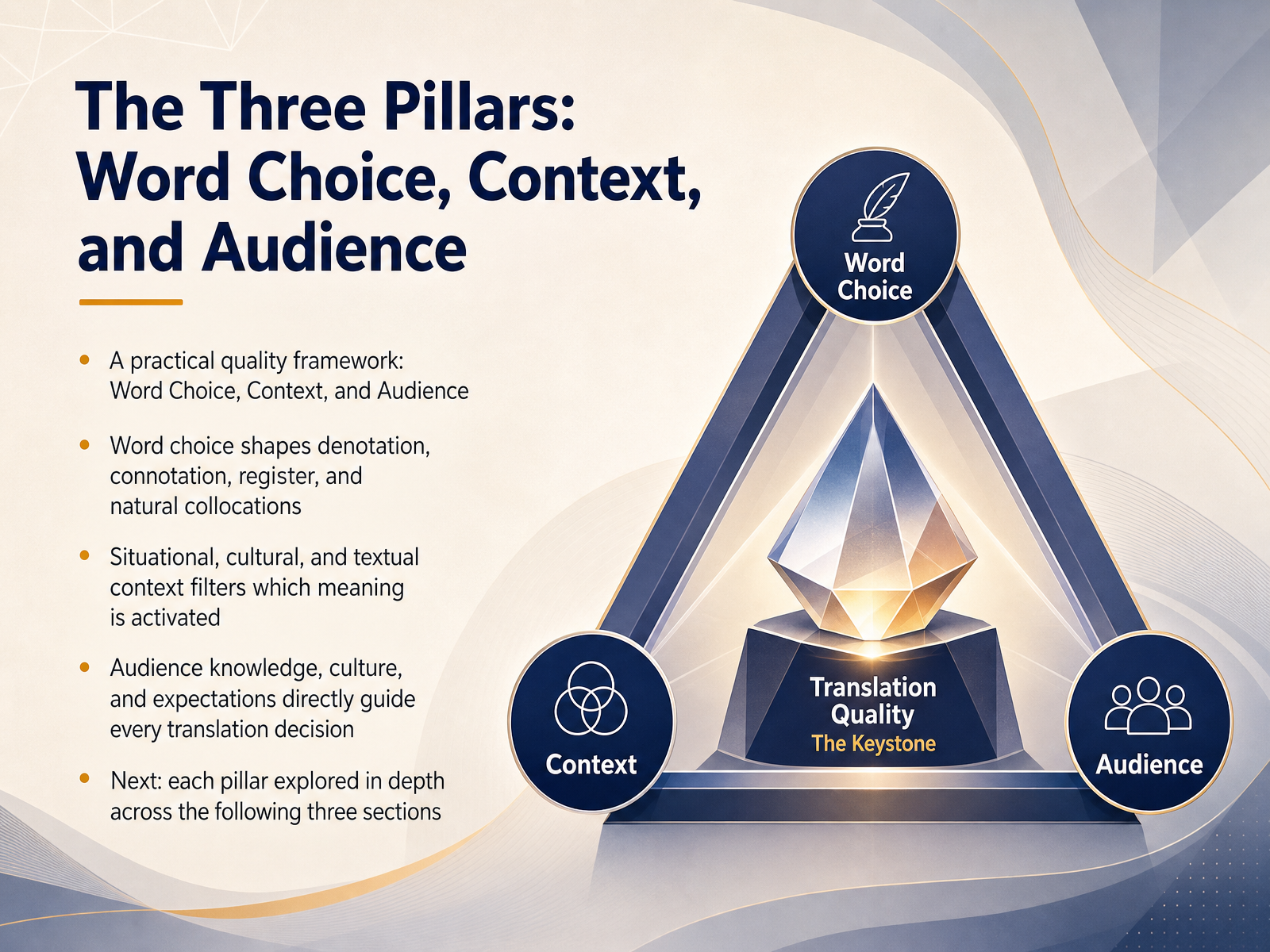
 - 03The Three Pillars: Word Choice, Context, and AudienceNow that we have framed the challenge, let's get practical with a quality framework. We can think of translation as standing on three pillars: word choice, context, and audience. First, word choice shapes far more than dictionary meaning. It controls the denotation, but also the connotation, the register, and whether words form natural collocations. For example, calling inflation a monster might sound vivid in one language but feels comical in an English business report. Second, context is the filter. The situational, cultural, and textual setting activates which meaning is actually understood. A direct translation might be grammatically correct, yet fail completely inside a specific business culture. Third, audience guides every decision. Their knowledge, their culture, and their expectations determine whether the tone should be formal, neutral, or persuasive. A phrase that signals confidence in one market can sound arrogant or unprofessional in another when the audience is ignored. In the next three sections, we will explore each pillar in depth, starting with word choice.
 kayeemecktranslation.comkayeemecktranslation.cominfodrivenbusiness.com+22 min
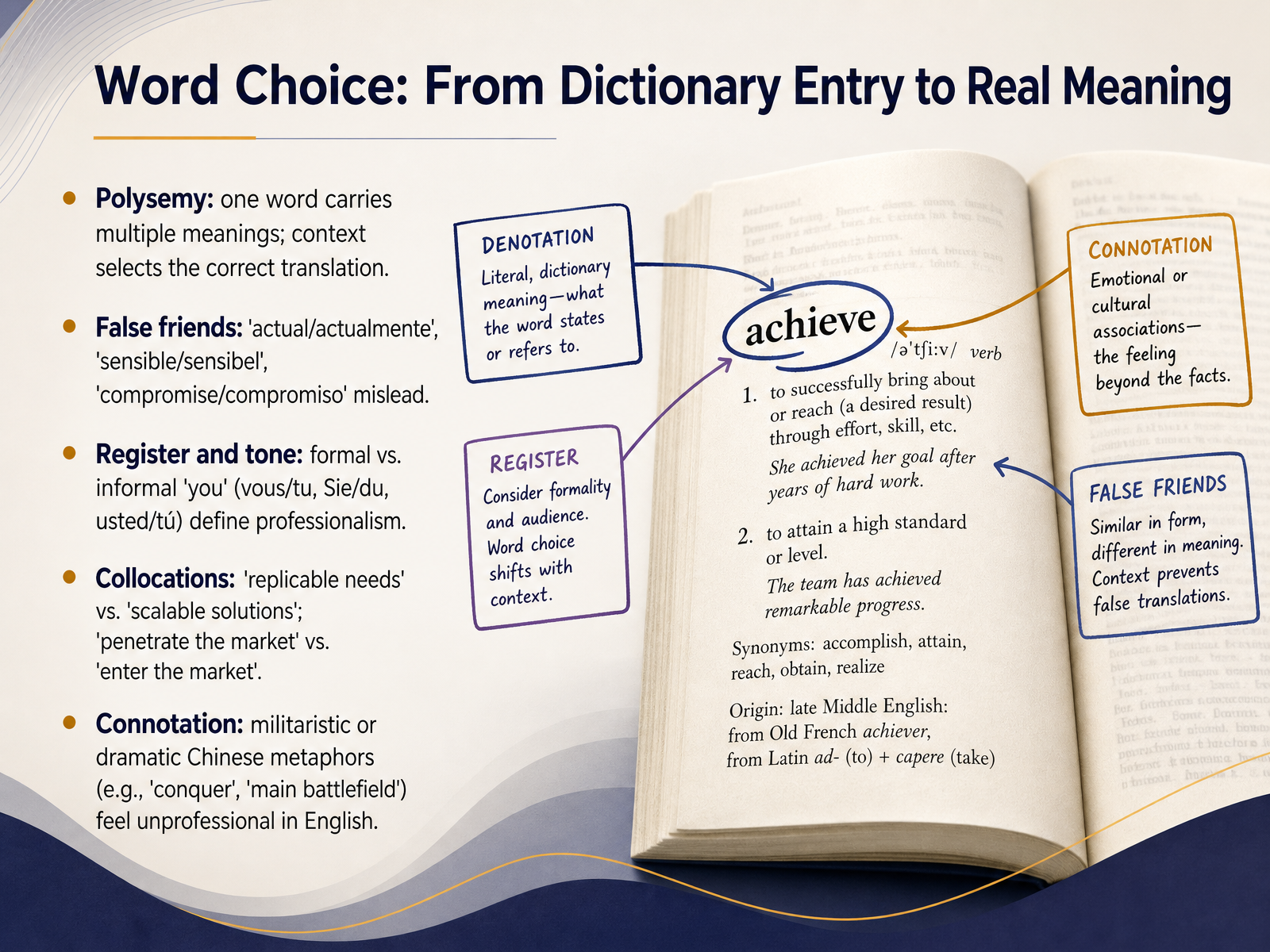
 - 04Word Choice: From Dictionary Entry to Real MeaningNow let's move from general principles to the practical level: how we actually choose our words. A dictionary gives you a list of meanings, but words are rarely neutral. Take polysemy—the fact that one word carries multiple meanings. The word 'run' can mean a physical action, a computer program, or a management function. Only context tells us which one to use in translation. Then we have false friends: words that look familiar but mislead. Spanish 'actualmente' looks like 'actually,' but it means 'currently.' German 'sensibel' seems like 'sensible,' but it means 'sensitive.' And Spanish 'compromiso' doesn't mean 'compromise' as a trade-off; it means a commitment or obligation. Next, register and tone. Many languages distinguish formal and informal address: 'vous' versus 'tu' in French, 'Sie' versus 'du' in German, 'usted' versus 'tú' in Spanish. Choosing the wrong one can immediately damage your professional credibility. Then consider collocations—the natural word pairings in a language. 'Replicable needs' sounds unnatural in English, while 'scalable solutions' fits perfectly. And 'penetrate the market' carries an aggressive tone that 'enter the market' avoids. Finally, connotation. Chinese business writing often uses militaristic metaphors like 'conquer the market' or 'main battlefield' to express ambition. In English, those same terms feel dramatic and unprofessional, so neutral, confident language is preferred. In short, word choice changes tone and professionalism, not just meaning. Next, we'll see how context shapes meaning even further.
 kayeemecktranslation.comkayeemecktranslation.cominfodrivenbusiness.com+22 min
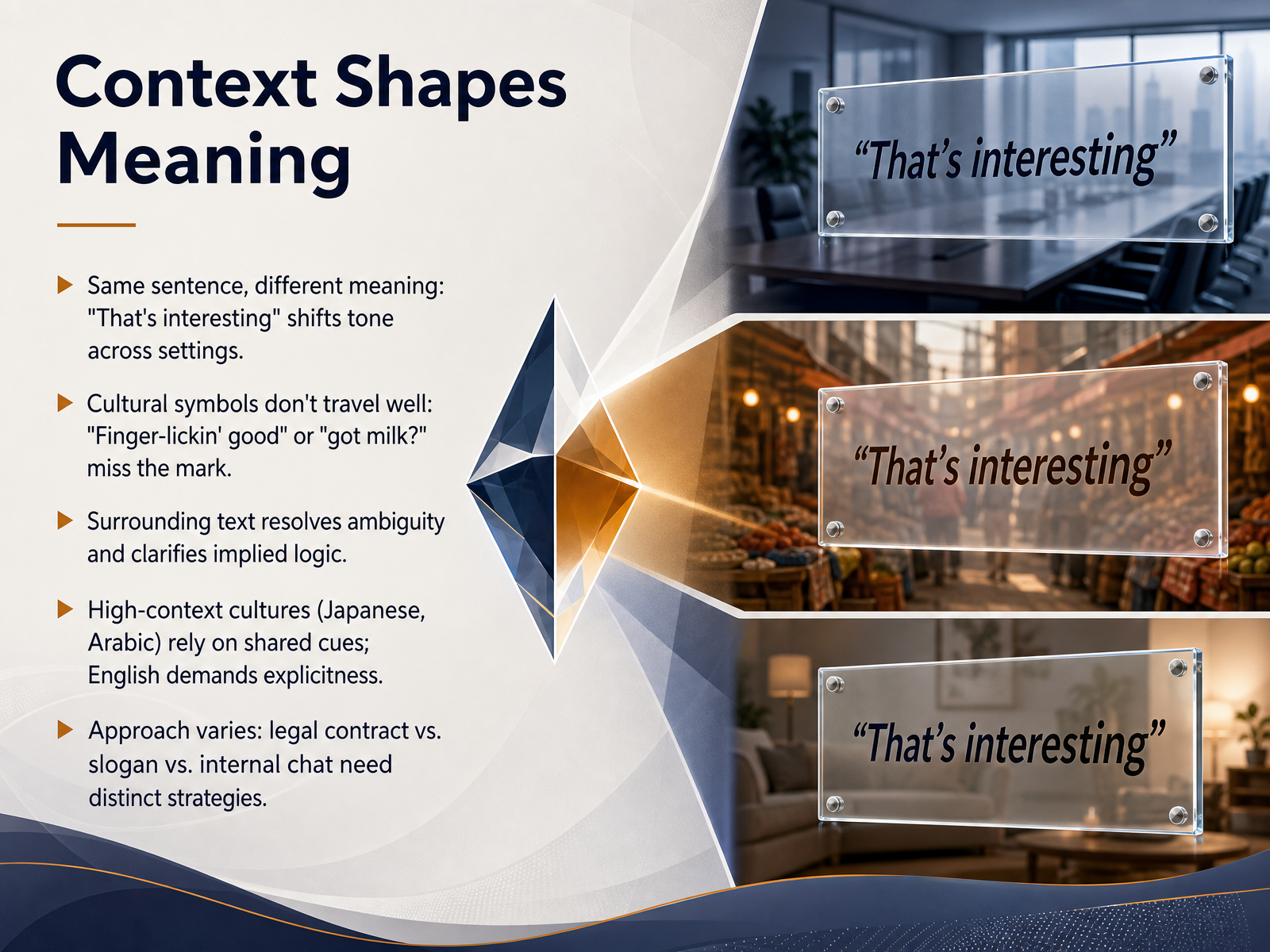
 - 05Context Shapes MeaningNow let's explore how context shapes meaning. The same sentence can communicate completely different things depending on the setting. Take the phrase 'That's interesting.' In a friendly chat, it shows genuine curiosity. But in a tense meeting, it might signal doubt or even polite disagreement. The words didn't change, but the context transformed the message. Cultural symbols create similar challenges across languages. Consider slogans like 'Finger-lickin' good' or 'Got milk?' They rely on local humor and shared experiences that simply don't travel well. Sometimes they become confusing or even unappetizing in other markets. The surrounding text resolves this ambiguity. It clarifies implied logic and helps us understand what the speaker actually intends. This becomes especially important when we consider different cultural communication styles. High-context cultures—like Japanese or Arabic—rely heavily on shared background knowledge and unspoken cues. English, by contrast, demands explicitness. Finally, translation approach must match the text type. A legal contract, a catchy slogan, and an internal chat each need a distinct strategy. What works for a binding agreement would sound absurd in casual messaging, and vice versa. Up next, we'll put these ideas into practice by looking at audience awareness in real scenarios.
 haretranslation.comthelanguagedoctors.orgchinaskinny.com+22 min
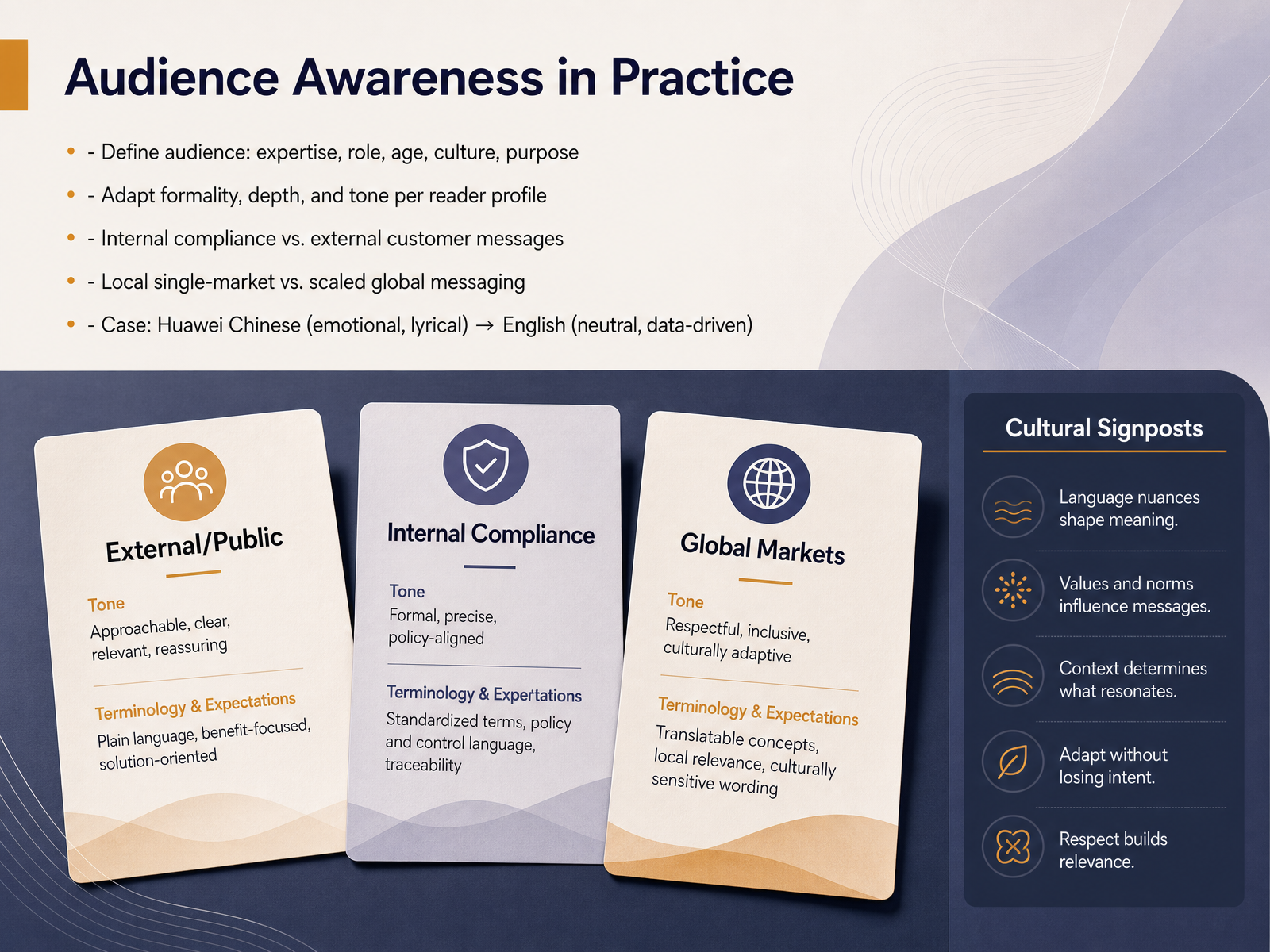
 - 06Audience Awareness in PracticeLet's make this practical. Audience awareness means defining who will actually read or listen to your words. Ask yourself: what is their expertise, their role, their age, their cultural background, and their reason for reading? The answer changes everything. Formality, depth, and tone are not fixed; they shift with each reader profile. An internal compliance alert uses a very different register than an external customer message. A message crafted for one local market often sounds off-key when scaled globally without adaptation. Think of the classic case: Huawei’s Chinese corporate writing often feels emotional and lyrical. But when that text moves into English, the tone shifts dramatically toward neutral, data-driven statements. It's the same core meaning, yet the voice changes to fit what the new audience expects. This is not editing; it is building a bridge. Now, let's look at what happens when this bridge fails. That brings us to our next topic: when translation goes wrong, featuring classic case studies.
 interproinc.comladontranslation.commondaq.com+22 min
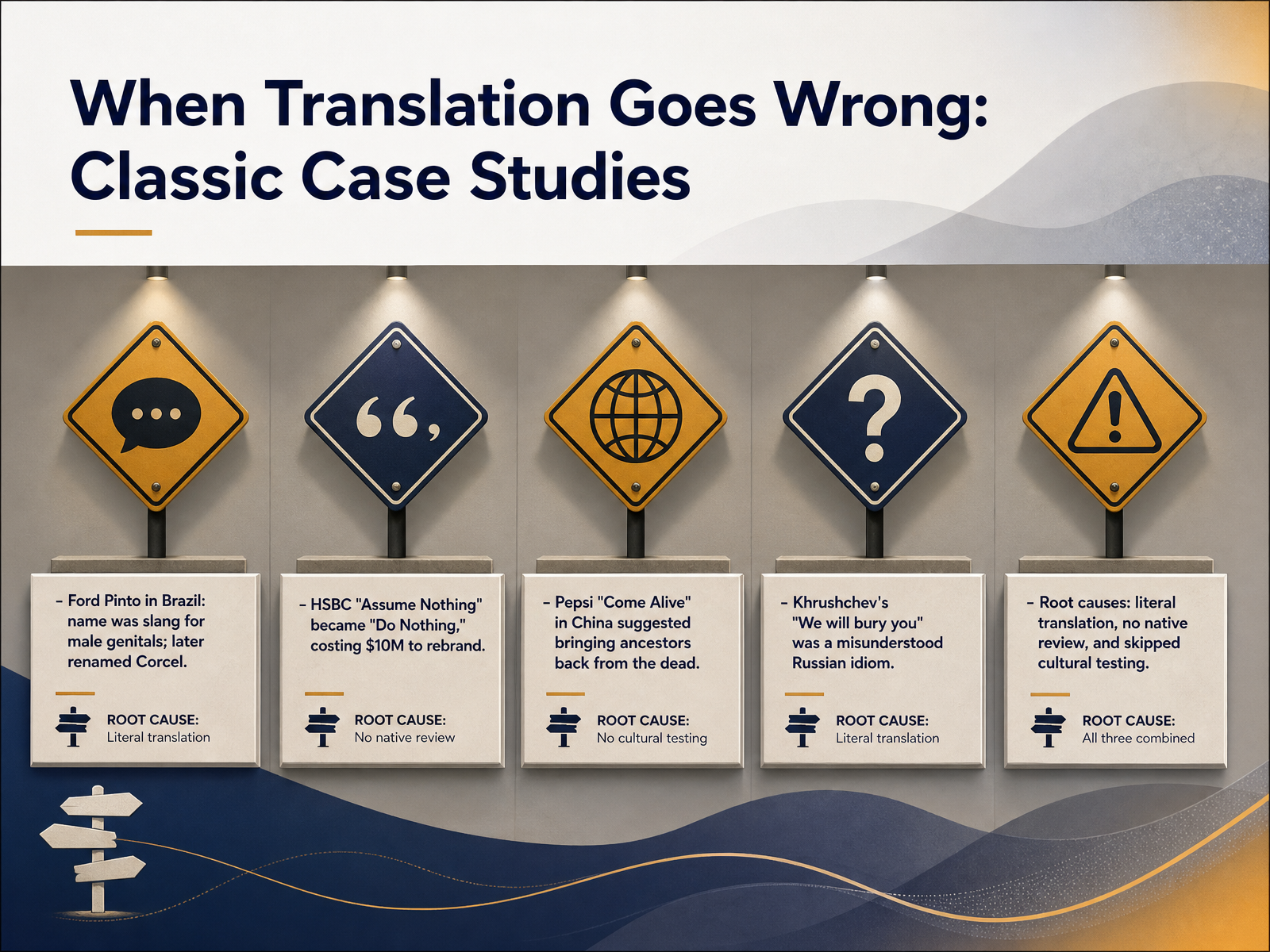
 - 07When Translation Goes Wrong: Classic Case StudiesLet's look at some classic cases where translation went wrong, and why. When Ford launched the Pinto in Brazil, they didn't realize the name was local slang for male genitals. Sales suffered until they renamed it Corcel, meaning horse. HSBC's slogan "Assume Nothing" was translated literally in several markets and became "Do Nothing," a message that cost ten million dollars to rebrand. Pepsi's "Come Alive" campaign in China was interpreted as bringing ancestors back from the dead, clashing deeply with cultural beliefs about death. And during the Cold War, Khrushchev's Russian idiom "We will bury you" was taken literally, escalating international tension when it really meant "We will outlast you." The root causes are clear. Literal translation ignores how words live inside a culture. Skipping review by native speakers lets obvious slang slip through. And rushing to market without cultural testing means you discover the problem only after the damage is done. These mistakes are not just amusing stories. They are expensive proof that language is never neutral. Next, we will explore real-world translation challenges you might face firsthand.
 industryweek.compenji.coimdtranslation.co.uk+22 min
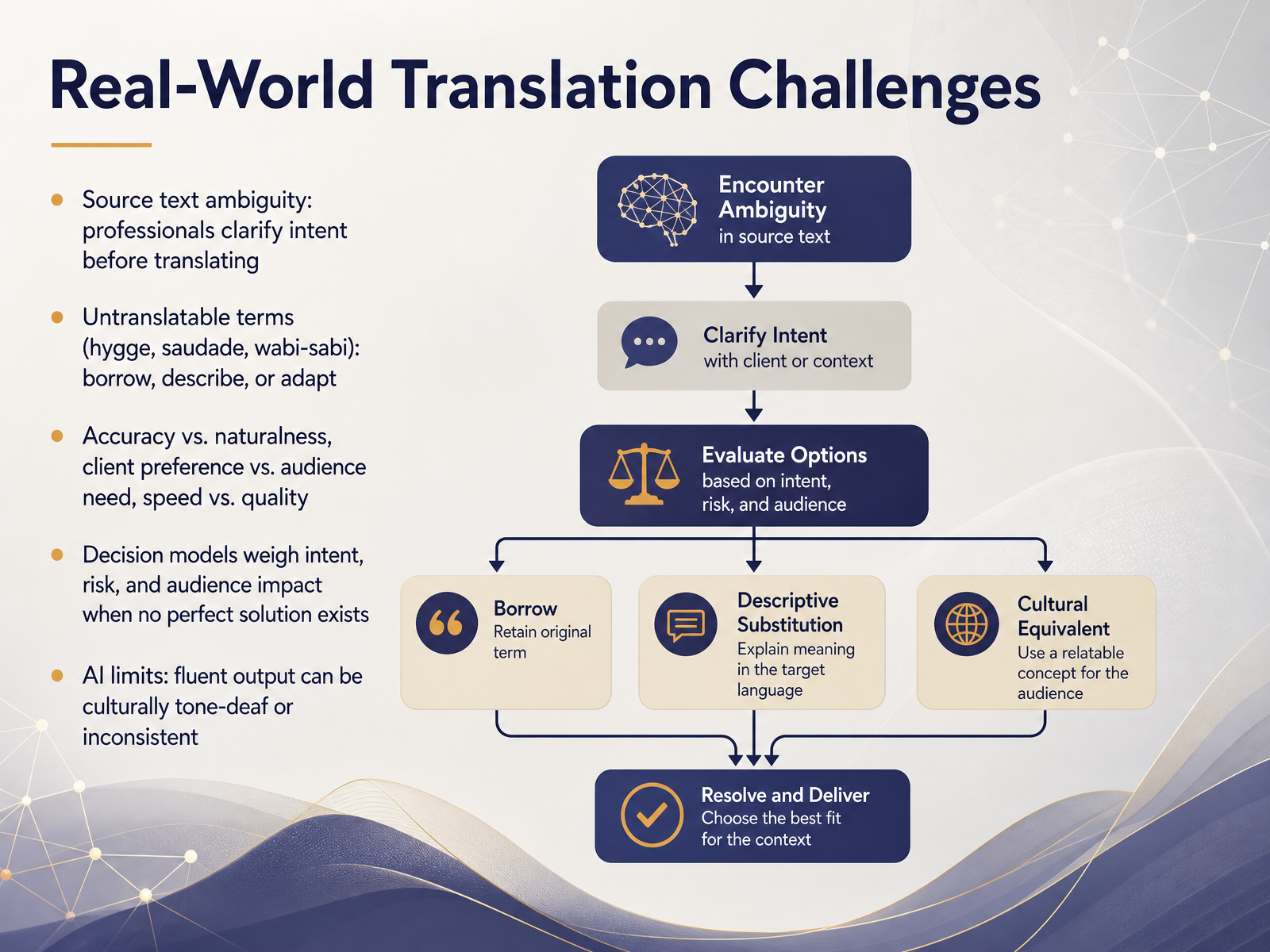
 - 08Real-World Translation ChallengesNow let’s look at where translation gets really complex: navigating ambiguity, untranslatable concepts, and competing priorities. First, source text ambiguity. When a sentence can mean two different things, a professional doesn’t guess. They research the author’s intent, consult reference materials, and clarify the meaning before translating a single word. Next, culturally specific terms like hygge, saudade, or wabi-sabi have no direct equivalent. Translators borrow the original word, craft a short descriptive phrase, or adapt the concept to a recognizable cultural equivalent. The choice depends entirely on the audience and purpose. Translators also constantly manage tensions. They balance strict accuracy against natural fluency, respect a client’s preference while ensuring the target audience actually understands, and weigh speed against the quality a text demands. When no perfect solution exists, good translators use a decision model. They evaluate the author’s intent, the risk of misunderstanding, and the impact on the reader, then choose the strategy that best serves communication. Finally, a note on AI. Machine translation can produce smooth, confident output that is culturally tone-deaf or internally inconsistent. That is why human judgment remains essential, especially for high-stakes content. Up next, we’ll apply a practical lens to evaluating translation quality.
 2 min
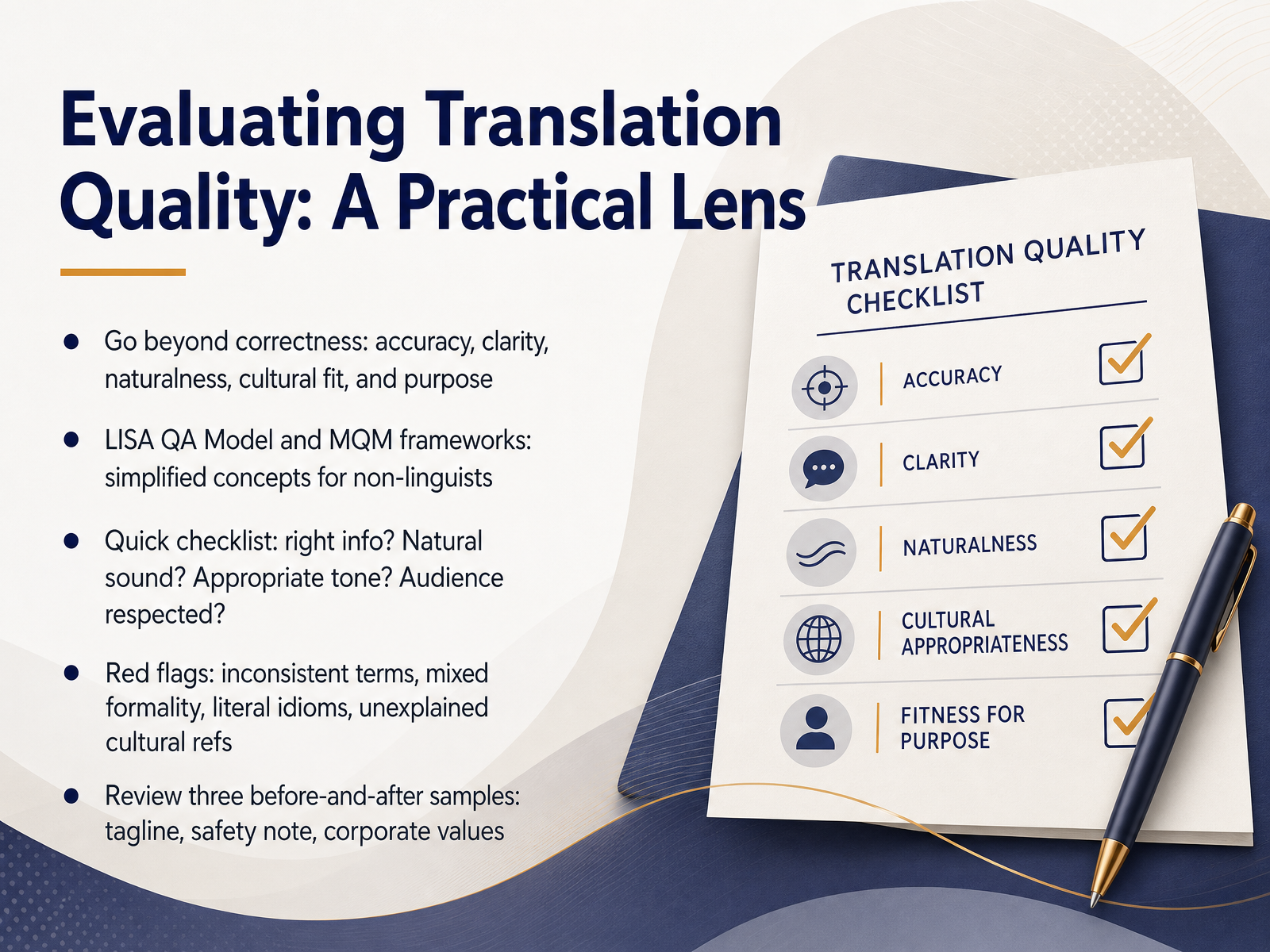
2 min - 09Evaluating Translation Quality: A Practical LensNow let's make evaluation practical. When you assess a translation, look beyond basic correctness. A good translation needs to be accurate, clear, and natural. But it also needs cultural fit and purpose. Two industry frameworks can help, even if you are not a linguist. Think of the LISA QA Model and MQM as structured checklists. A simple version works every time. Ask yourself: Is the information right? Does it sound natural in English? Is the tone appropriate for the situation? And does it respect the audience's culture? Watch for common red flags. Look for inconsistent terms where a key word changes randomly. Notice mixed formality, when a sentence shifts from formal to casual in the same paragraph. Spot literal translations of idioms that sound jarring. And catch unexplained cultural references your reader will not understand. We will practice with three before-and-after samples. One is a tagline, one a safety note, and one a set of corporate values. Let's move to applying the framework with a guided analysis.
 2 min
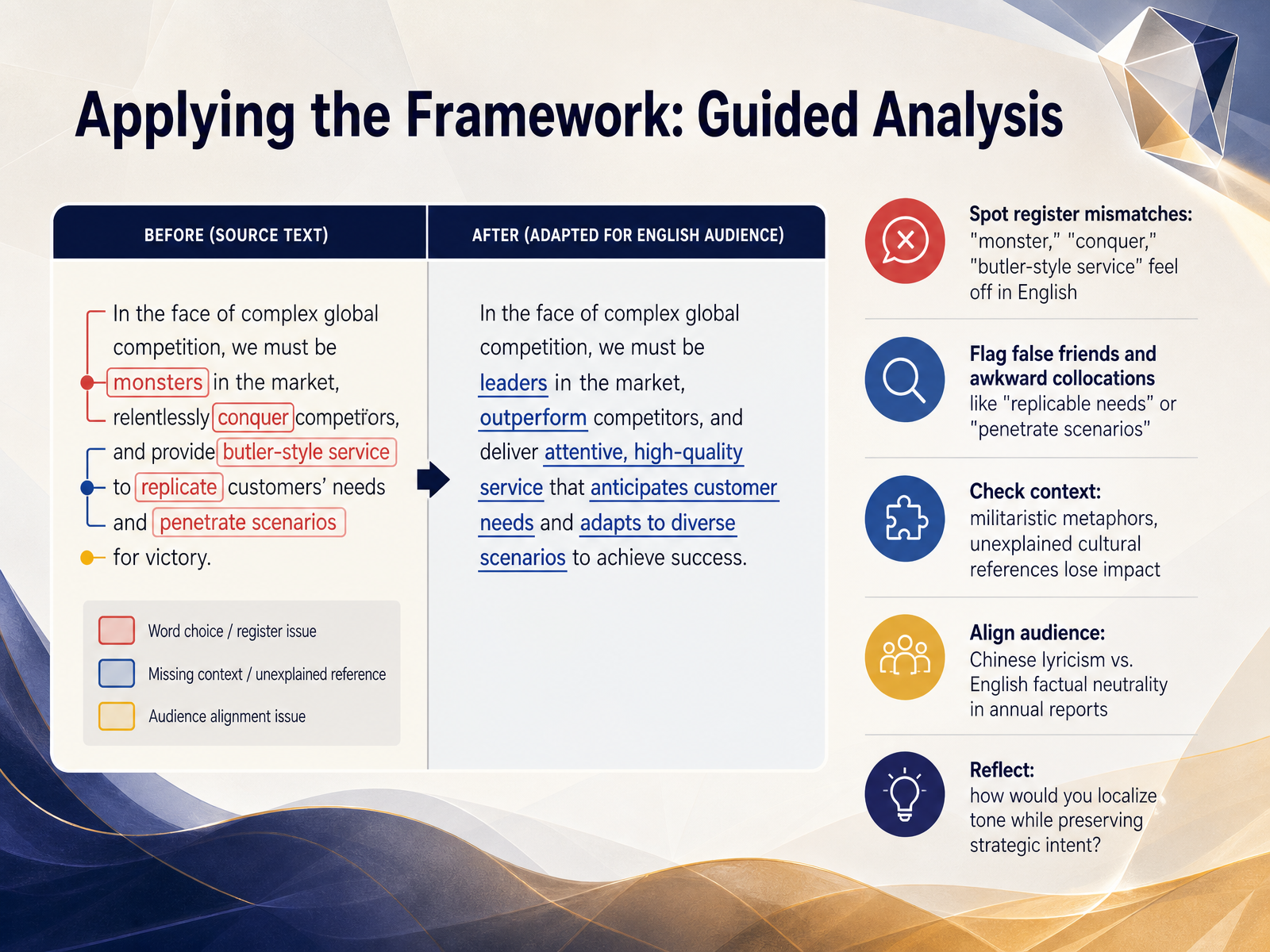
2 min - 10Applying the Framework: Guided AnalysisNow let's put everything we have discussed into practice with a guided analysis. This is where we train our eyes to spot the mismatches that break credibility. First, watch for register problems. Words like "monster," "conquer," or "invincible" are common in Chinese business writing, but in an English report they sound overly dramatic and unprofessional. So we swap them for neutral terms like "severe challenge" or "market leadership." Also, be alert for false friends and awkward collocations. "Replicable needs" is grammatically correct but unnatural in English; we shift the focus to "replicable solutions." Similarly, "penetrate scenarios" is technically accurate but deeply uncomfortable for an English reader; we use "enter new markets" or "expand into use cases" instead. Next, check the broader context. Militaristic metaphors and unexplained cultural references often lose their strategic impact. The goal is not to erase the original meaning but to express it in a way that maintains credibility. Think about audience alignment too. A Chinese annual report might use lyrical, poetic language, but an English version must prioritize factual neutrality and objective data to build trust with global investors. As you review these examples, ask yourself this reflective question: how would you localize the tone to sound natural, while keeping the strategic intent completely intact? This kind of conscious analysis transforms you from a word-for-word translator into a truly strategic communicator. Now, let's take these skills further and build a translation-ready mindset.
 kayeemecktranslation.comkayeemecktranslation.cominfodrivenbusiness.com+22 min
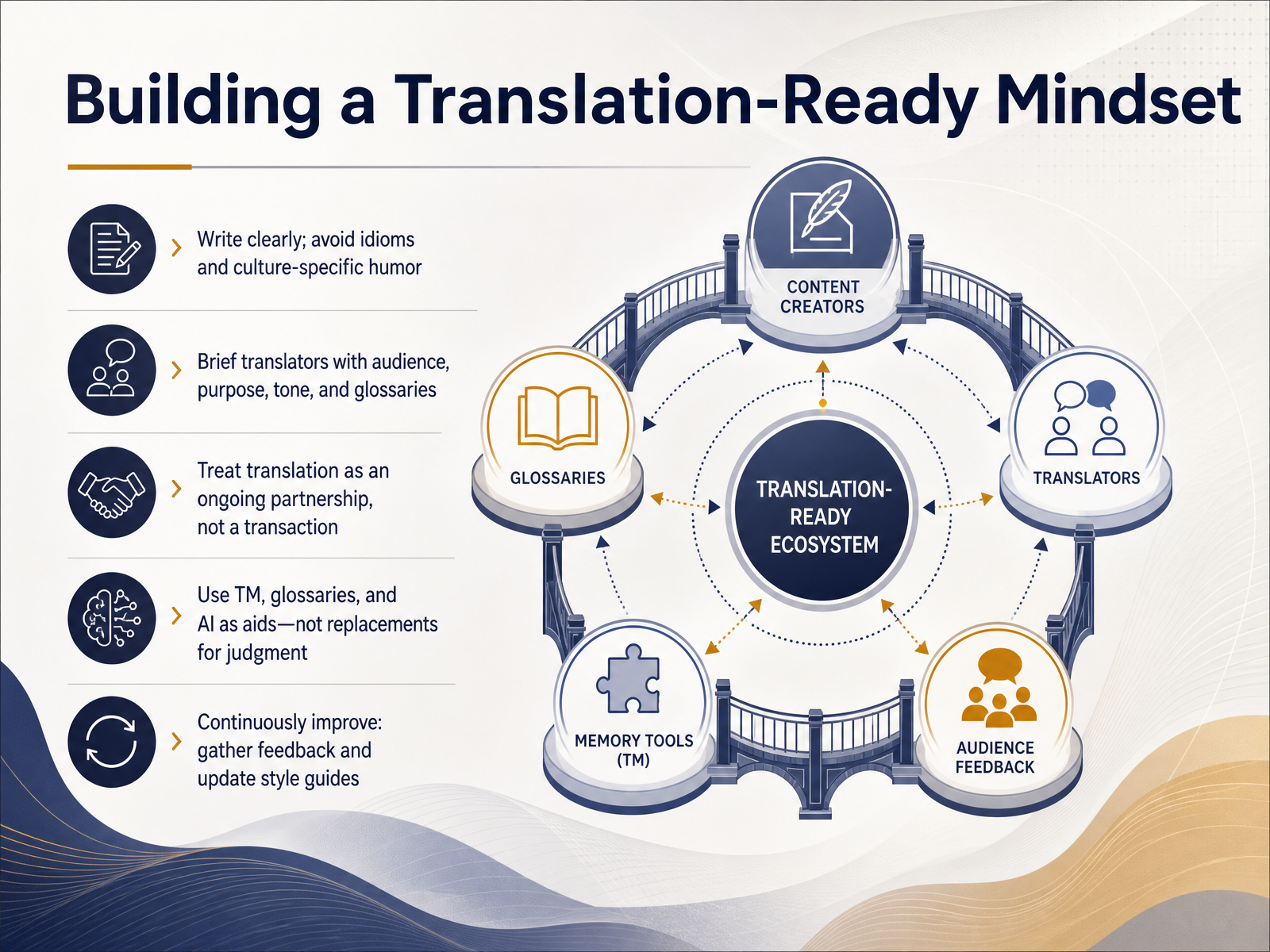
 - 11Building a Translation-Ready MindsetNow, let's talk about building your own translation-ready mindset. It begins long before a single word is translated. First, write source content that is clear and direct. Avoid idioms and culture-specific humor, because what is funny in one country might be confusing or even offensive in another. Second, brief your translators thoroughly. Do not simply hand over a file. Tell them who the audience is, what the training should achieve, and the tone you need. Give them your glossaries so key terms stay consistent. Third, treat translation as an ongoing partnership, not a one-time transaction. The most successful programs work with linguists who learn your brand voice over time. Fourth, use technology wisely. Translation memories, glossaries, and even AI are powerful aids, but they are not replacements for professional human judgment. Machines can miss context or cultural nuance, so expert review is essential. Finally, commit to continuous improvement. Gather feedback from learners in each region, then update your style guides and term bases based on what you learn. These five habits turn translation from a last-minute task into a strategic advantage. Next, let's pull everything together in our final session: Key Takeaways and Your Next Translation Task.
 interproinc.comladontranslation.commondaq.com+22 min
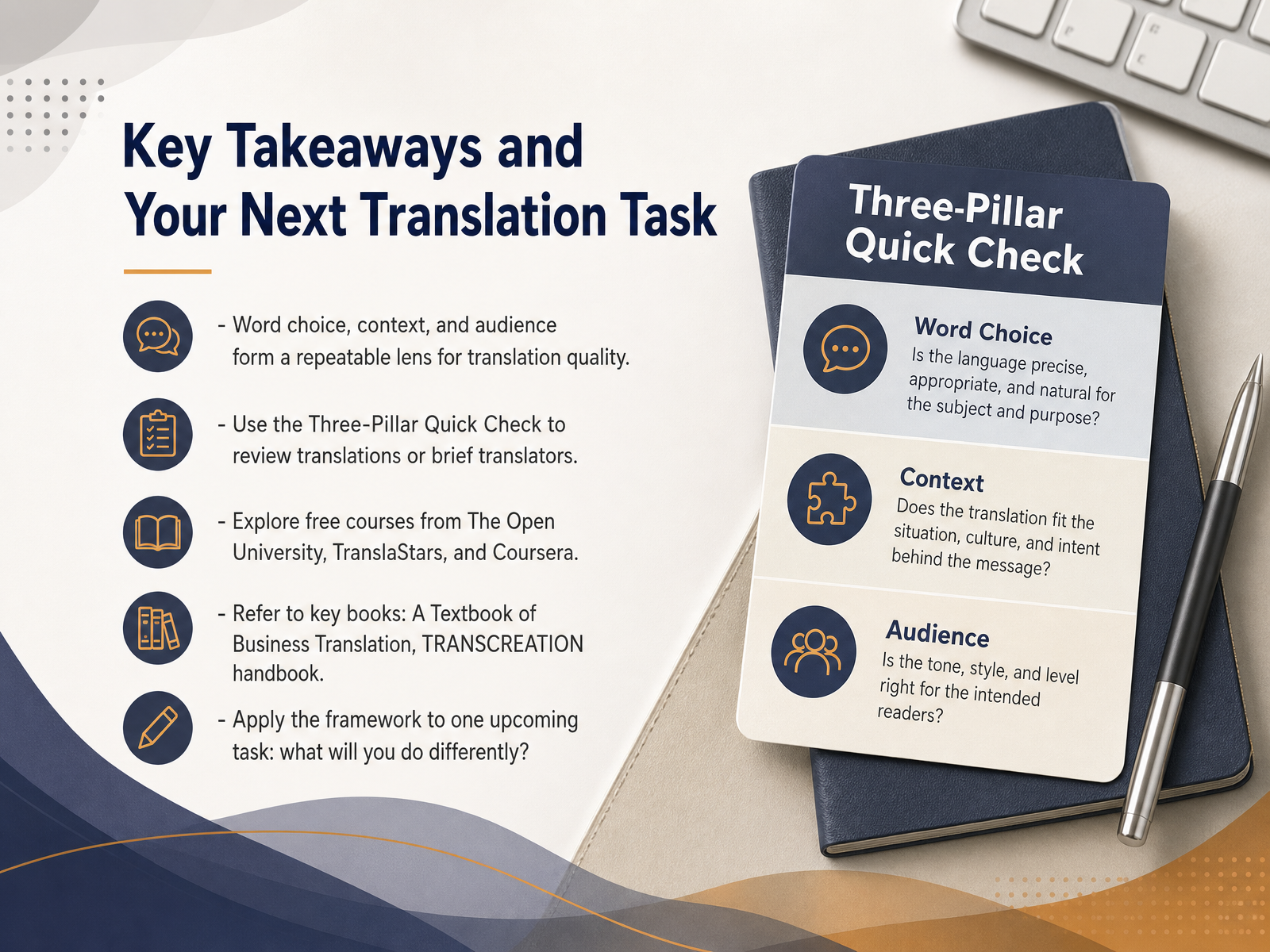
 - 12Key Takeaways and Your Next Translation TaskLet's bring everything together with a few key takeaways and your next practical step. The lens of word choice, context, and audience isn't just theory. It's a repeatable framework you can use to check any translation for quality. You can use the Three-Pillar Quick Check to review your own work, or to give a brief to other translators. If you want to go deeper, there are excellent free resources available. The Open University offers a course on translation as a profession. TranslaStars has courses on everything from AI for linguists to humanitarian interpreting. Coursera also hosts a course from the University of Geneva on international organizations. For your bookshelf, A Textbook of Business Translation and the TRANSCREATION handbook are both essential references. Now, your real task starts. For your next translation project, apply this framework. Consider the words, the context, and your audience. Ask yourself: what will you do differently this time?
 2 min
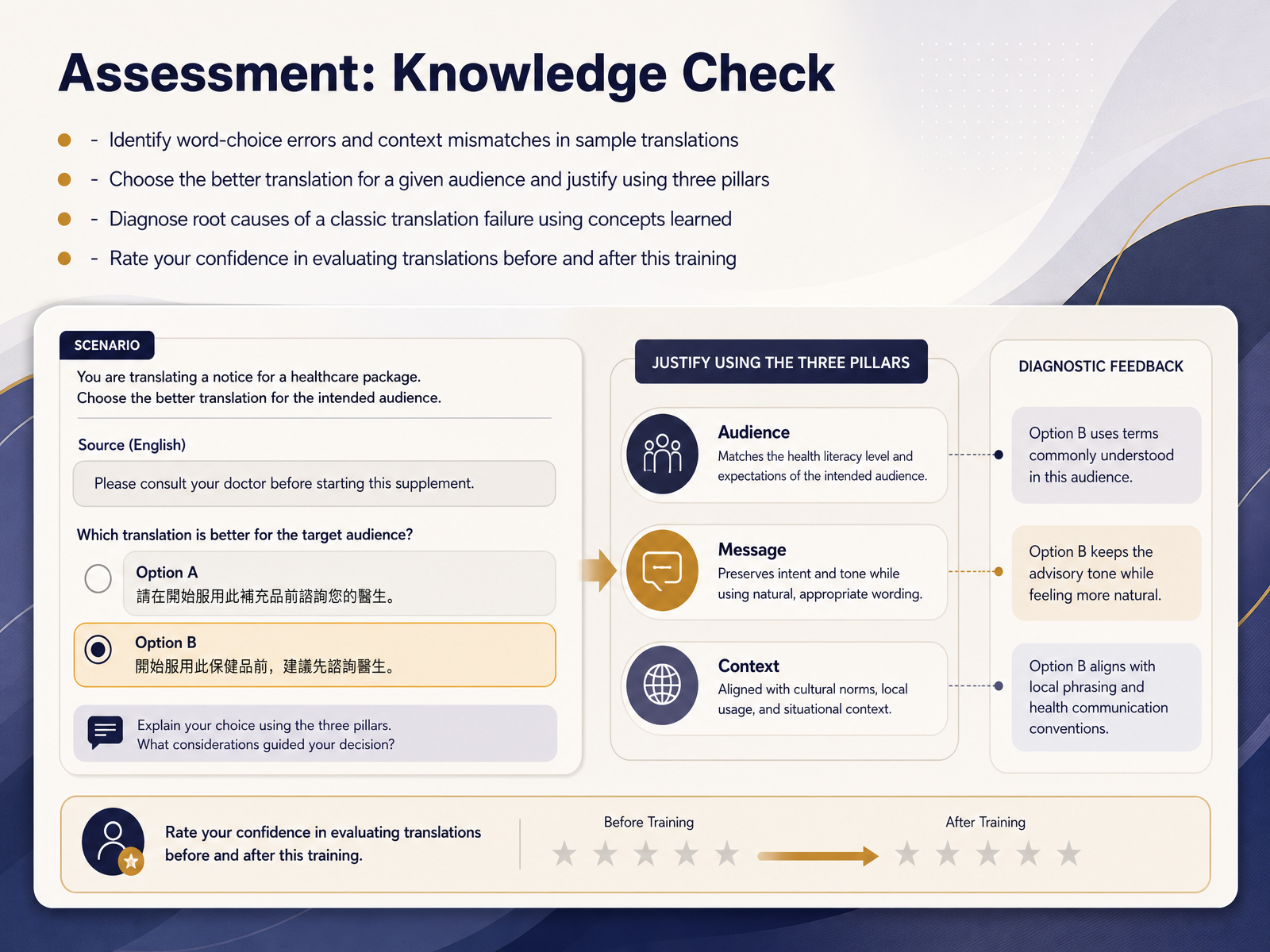
2 min - 13Assessment: Knowledge CheckYou have now reached the final assessment. This is where theory meets practice. First, you will identify word-choice errors and context mismatches in sample translations. Think of phrases like 'conquer the market,' which sounds aggressive in English but confident in Chinese. Next, you will choose the better translation for a given audience and justify your choice using the three pillars: audience, context, and meaning. Then, you will diagnose the root cause of a classic translation failure by applying the concepts learned in this course. Finally, you will rate your confidence in evaluating translations, both before and after this training. This reflection helps cement your growth. Thank you for your dedication throughout this training. Good luck with the assessment, and trust the process you have built here today.
 kayeemecktranslation.comkayeemecktranslation.cominfodrivenbusiness.com+22 min
Take the deck with you
Download this course as a file — free, no sign-up needed.
- PDF handoutEvery slide page, ready to print or share.14 pages · 3.8 MBDownload
- Narrated PowerPointThe deck that presents itself — every slide carries the digital human's narration video.14 pages · 16.4 MBDownload
- PowerPoint slidesThe full deck as a .pptx — open it in PowerPoint, Keynote, or Google Slides.14 pages · 3.7 MBDownload
Free to use in your own training — please keep the PersonWise credit page at the end.
Have your own deck? Turn it into a course
Sources consulted
Web sources consulted while building this course.
- When literal translation goes wrong: (more) real examples from Chinese–English business reports — kayeemecktranslation.com
- Why “accurate translation” isn’t enough: a behind-the-scenes look at how localisation transformed a client’s global report — kayeemecktranslation.com
- When translation falls short – Information-Driven Business — infodrivenbusiness.com
- The Art of Formality in Translation: Why Tone Matters in Every Language — bubblestranslation.com
- The Importance of Tone and Style in Business Translation - Applied Lingo — applied-lingo.com
- On Audience - Hare Translation Journey — haretranslation.com
- HSBC Assume Nothing Translation Mishap Explained — thelanguagedoctors.org
- How Adidas turned a translation blunder into a China marketing win - China Skinny — chinaskinny.com
- The Silences Between: On the Perils and Pitfalls of Translation — thereader.mitpress.mit.edu
- ASTA-USA Case Study — asta-usa.com
- Importance of Audience Analysis for Global Learning — interproinc.com
- How to Translate Corporate Training for Global Teams (Complete 2025 Guide) - Ladon Translation — ladontranslation.com
- How To Build A Global Training Translation Strategy That Scales - Corporate and Company Law - United States — mondaq.com
- E-learning Translation: A Strategic Guide to Educational Excellence - Translated — translated.com
- Corporate Training Translation: Multilingual LMS Translation — quadrate.co.in
- "Bite The Wax Tadpole" | IndustryWeek — industryweek.com
- https://penji.co/the-marketing-blunder-of-the-california-milk-processor-boards-are-you-lactating/ — penji.co
- “Pepsi Brings Your Ancestors Back from the Grave": Lessons from a Legendary Mistranslation - IMD Translation Ltd — imdtranslation.co.uk
- The top 6 worst translation mistakes in history — wxrks.com
- Ford Pinto Translation Mishap Explained — thelanguagedoctors.org