Ethics in Digital Marketing
Begin
13 pages · ~26 min
Ethics in Digital Marketing
This training equips digital marketers to apply ethical principles and responsible practices in their campaigns.
What you’ll learn
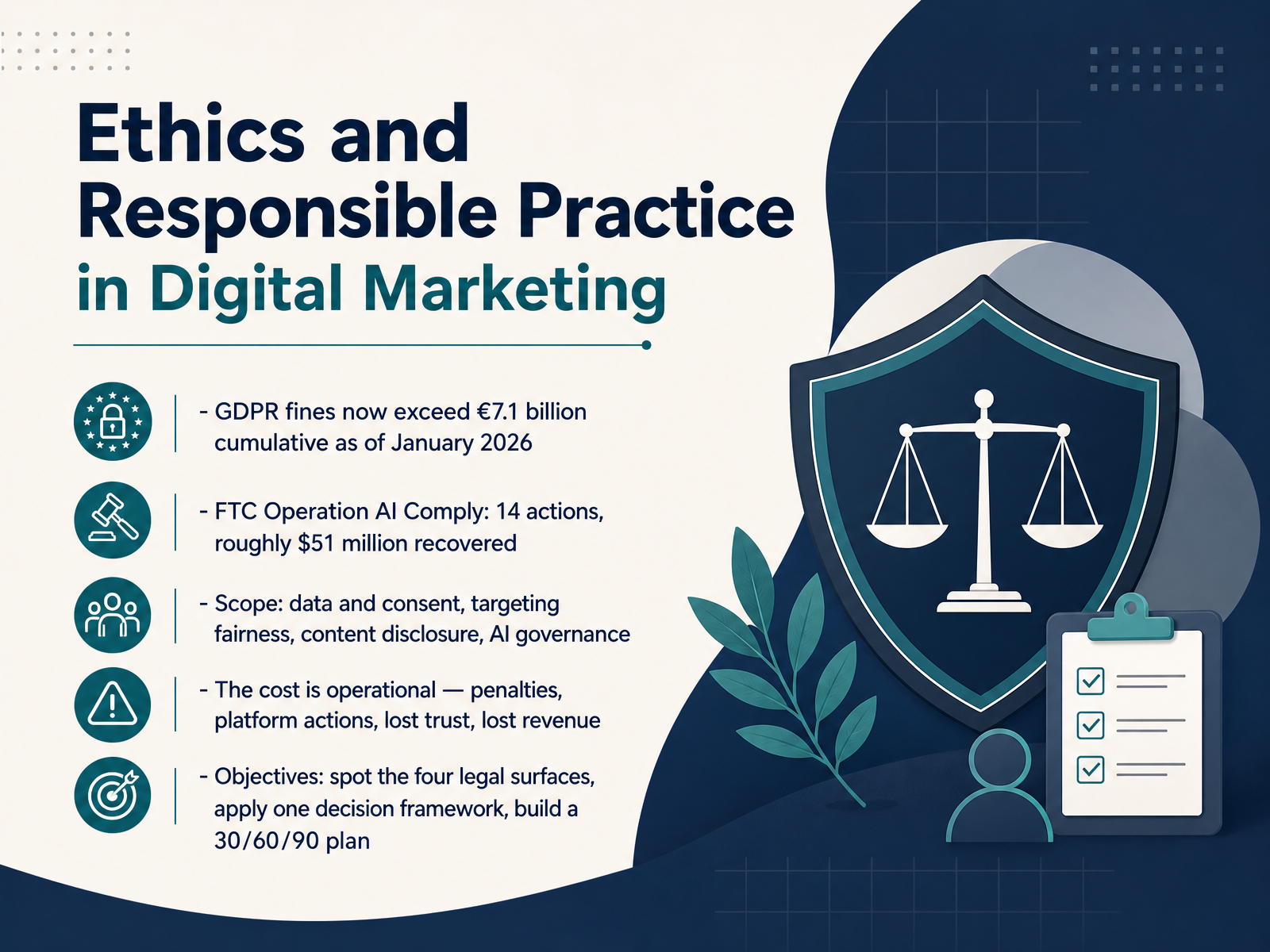
- 01Ethics and Responsible Practice in Digital MarketingWelcome. Over the next few slides, we are going to look at ethics and responsible practice in digital marketing, grounded in what enforcers actually did through early twenty-six. Here is the scale. Cumulative GDPR fines passed seven point one billion euros by January twenty twenty-six. The FTC's Operation AI Comply has brought fourteen actions, recovering close to fifty-one million dollars. And regulators are not slowing down. So what does this mean for you? Four legal surfaces matter most: data and consent, targeting fairness, content disclosure, and AI governance. Notice that the cost is rarely just the penalty. It is operational. Platform actions, remediation sprints, lost trust, and lost revenue. Our objectives are practical. Spot those four surfaces in your own work, apply one decision framework, and leave with a thirty sixty ninety day plan. You will not get a policy manual here. You will get judgment you can defend when a deadline is close and a client wants the number. Let's start with why trust is now a growth metric.indiatoday.intech-insider.orgico.org.uk+22 min
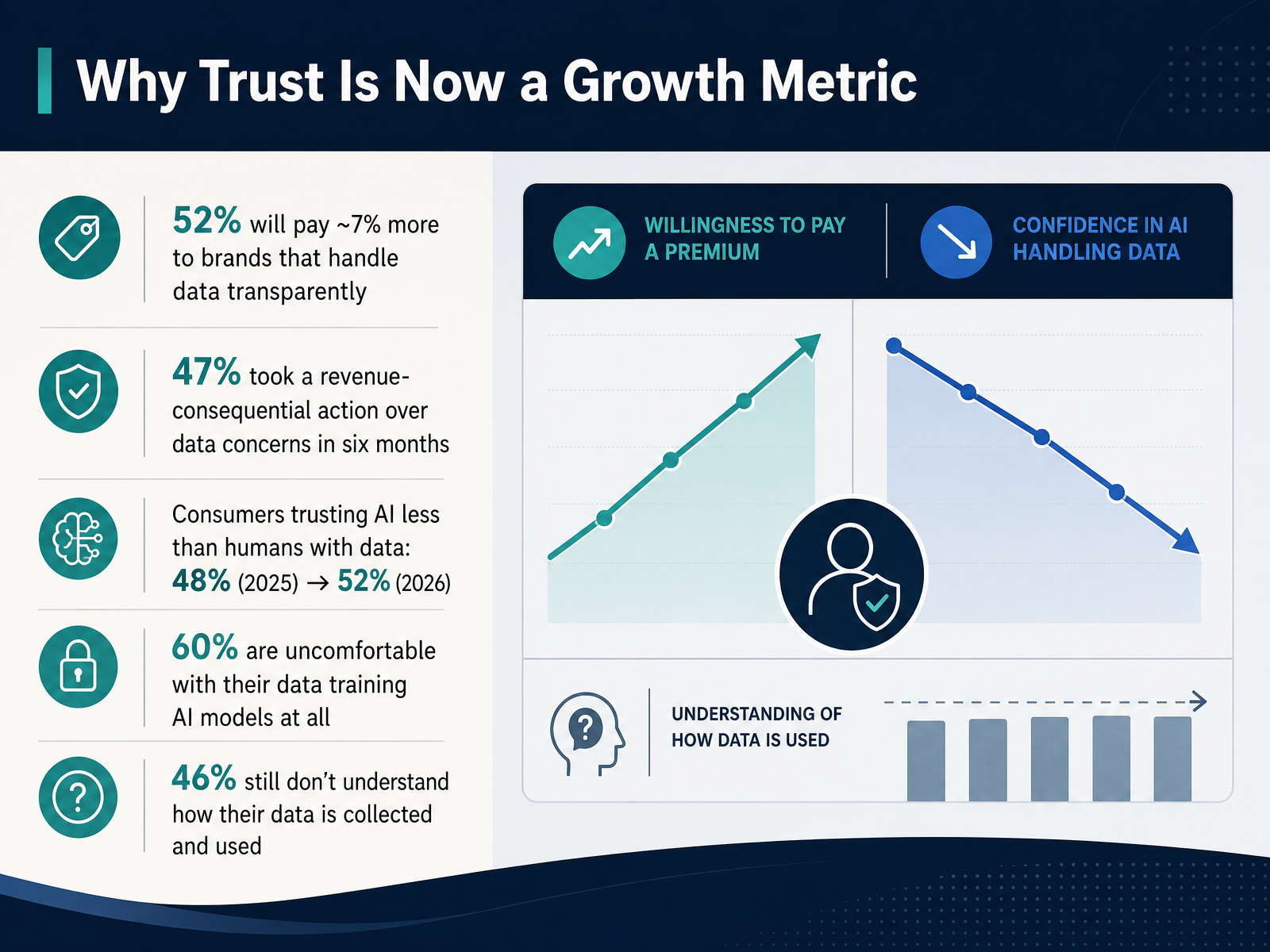
- 02Why Trust Is Now a Growth MetricLet's talk about why trust has moved from a soft value to a hard growth metric. The numbers tell the story. Fifty-two percent of consumers say they will pay about seven percent more to brands that handle their data transparently. And forty-seven percent took an action with direct revenue consequences in just six months. They canceled, switched, or cut spending over data concerns. That is real money moving. Now look at the AI shift. In 2026, fifty-two percent of consumers trusted AI less than humans with their personal data, up from forty-eight percent the year before. And sixty percent are uncomfortable with their data training AI models at all. Here is the gap you can close. Forty-six percent still do not understand how their data is collected and used. That figure has not moved in two years. Banners and policies are not explaining it. So when a client pushes for aggressive tracking to hit a target, remember these numbers. Transparency is not just compliance. It is a measurable growth lever. Next, let's look at the 2026 Regulatory and Platform Landscape.
 usercentrics.comjournal.igiinsight.comusercentrics.com+22 min
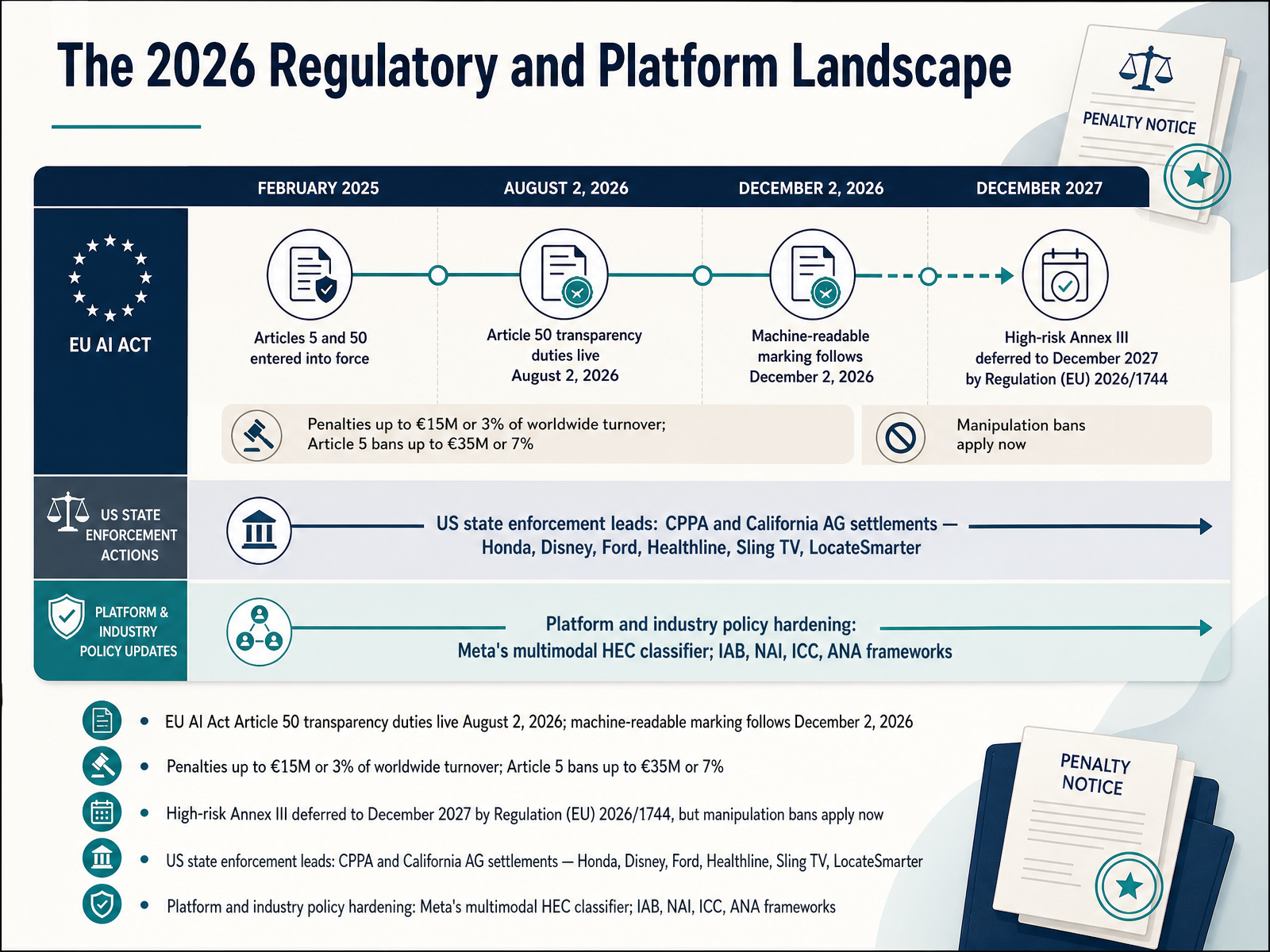
 - 03The 2026 Regulatory and Platform LandscapeLet's look at the regulatory and platform landscape you're actually working in. The EU AI Act's transparency duties, known as Article 50, went live on August second, 2026. That means you must tell people when they're interacting with an AI system, and label deepfakes and synthetic content. Machine-readable marking follows on December second, 2026. Penalties reach fifteen million euros or three percent of worldwide turnover. For banned practices under Article 5, it's thirty-five million euros or seven percent. High-risk Annex Three rules were deferred to December 2027, but the manipulation bans apply now. In the US, state enforcement is leading. California's privacy agency and attorney general have settled with Honda, Disney, Ford, Healthline, Sling TV, and LocateSmarter, mostly over opt-out failures and dark patterns. Meanwhile, platforms are hardening their own policies, like Meta's multimodal classifier for housing, employment, and credit ads. Industry frameworks from the IAB, NAI, ICC, and ANA set a shared baseline, but they don't replace the law. So treat these as parallel checks. Next, we'll move into core ethical principles in practice.
 indiatoday.intech-insider.orgico.org.uk+22 min
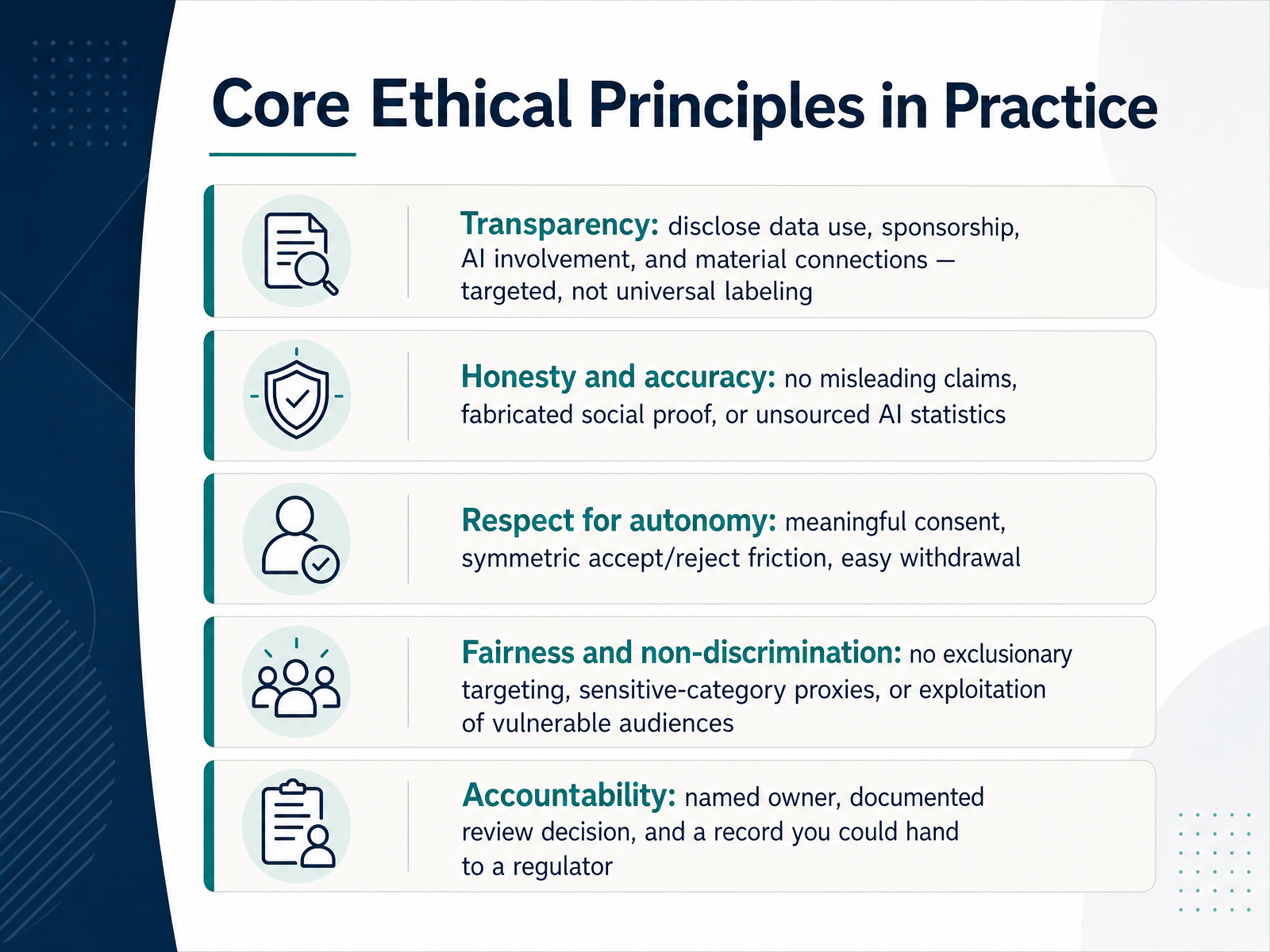
 - 04Core Ethical Principles in PracticeLet's walk through the core ethical principles you'll actually apply day to day. First, transparency. Disclose data use, sponsorship, AI involvement, and material connections, and keep it targeted rather than slapping a label on everything. Second, honesty and accuracy. No misleading claims, no fabricated social proof, no AI-generated statistics without a source. Third, respect for autonomy. Consent has to be meaningful, accept and reject should feel equally easy, and withdrawing should be simple. That symmetry matters, because deadlines and performance targets push teams toward friction on the reject path. Fourth, fairness and non-discrimination. Avoid exclusionary targeting, sensitive-category proxies, and any exploitation of vulnerable audiences. Fifth, accountability. Name an owner, document the review decision, and keep a record you could hand to a regulator without scrambling. Take a moment on that last one, because it's where good intentions usually fall short. Now let's look at dark patterns, deceptive design and consent validity.
 doi.orgdoi.orginria.hal.science+22 min
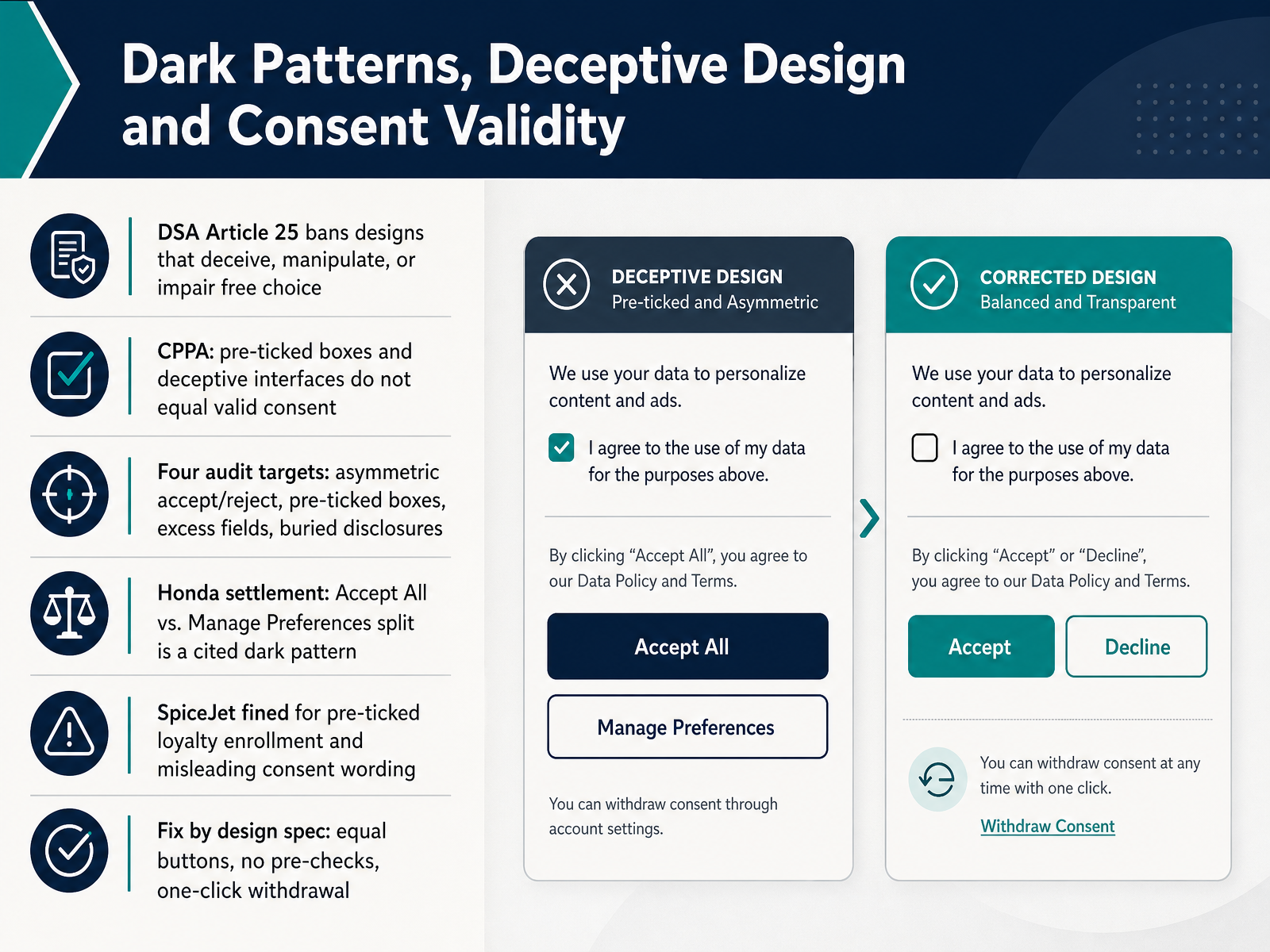
 - 05Dark Patterns, Deceptive Design and Consent ValidityLet's turn to dark patterns, deceptive design, and the question of whether consent is actually valid. Under Article 25 of the Digital Services Act, platforms cannot design interfaces that deceive or manipulate users, or that impair their free choice. The California Privacy Protection Agency says the same thing more bluntly: pre-ticked boxes and deceptive interfaces do not count as valid consent. So when you audit a consent flow, look at four targets. First, an asymmetric choice, where accepting is one click but rejecting takes five. Second, pre-ticked boxes. Third, forms that demand more fields than the law allows. Fourth, disclosures buried so deep users never find them. Real enforcement backs this up. In the Honda settlement, the Accept All button next to Manage Preferences was cited as a dark pattern. SpiceJet was fined for pre-ticking loyalty enrollment and misleading consent wording. I know deadlines and performance targets push teams toward friction on the reject path. But the fix is a design spec: equal buttons, no pre-checks, and one-click withdrawal. That is the standard to build against. Next, we look at data, consent and tracking that holds up.
 indiatoday.intech-insider.orgico.org.uk+22 min
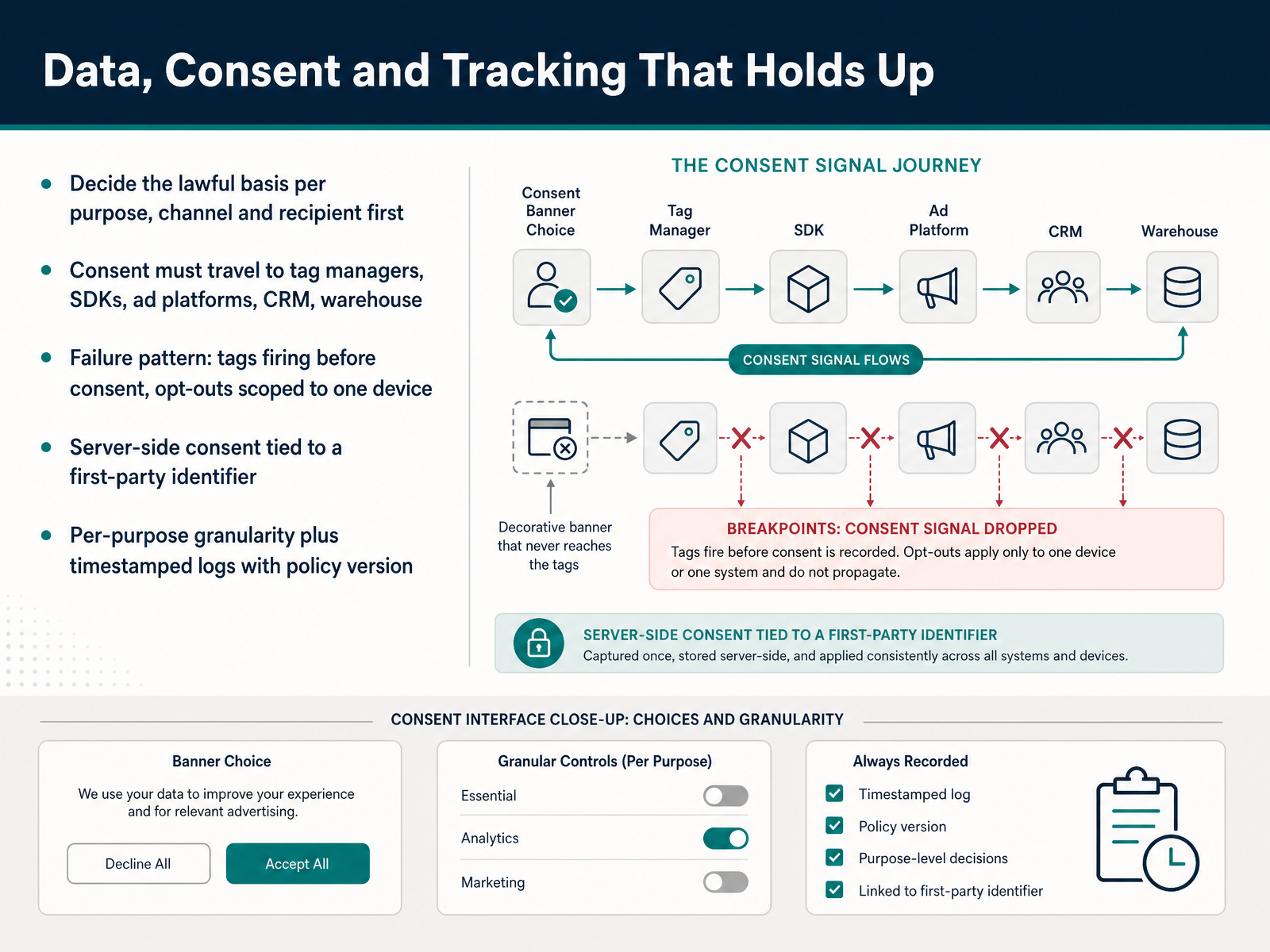
 - 06Data, Consent and Tracking That Holds UpLet's talk about data, consent, and tracking that actually holds up. Deadlines are real, and performance targets push teams to ship tags fast. So start here: decide the lawful basis for each purpose, channel, and recipient before you build anything. That means asking whether consent is the right basis, or whether another applies. Then make consent travel. Your tag manager, mobile SDKs, ad platforms, CRM, and warehouse all need to receive the same signal. The classic failure pattern is tags firing before consent, or an opt-out that only covers one device. Disney's settlement showed that a device-scoped opt-out is not a real opt-out. Regulators now run automated scans and fine per violation, so the banner must sit on top of real enforcement. The stronger model is server-side consent tied to a first-party identifier. Consent lives on your infrastructure, and every request checks it before any data moves. Finally, keep per-purpose granularity and timestamped logs that record the policy version shown. If you cannot retrieve that record, you cannot demonstrate consent. Next, we look at targeting, personalization and fairness.
 datashyre.comhouseofmartech.comdatashyre.com+22 min
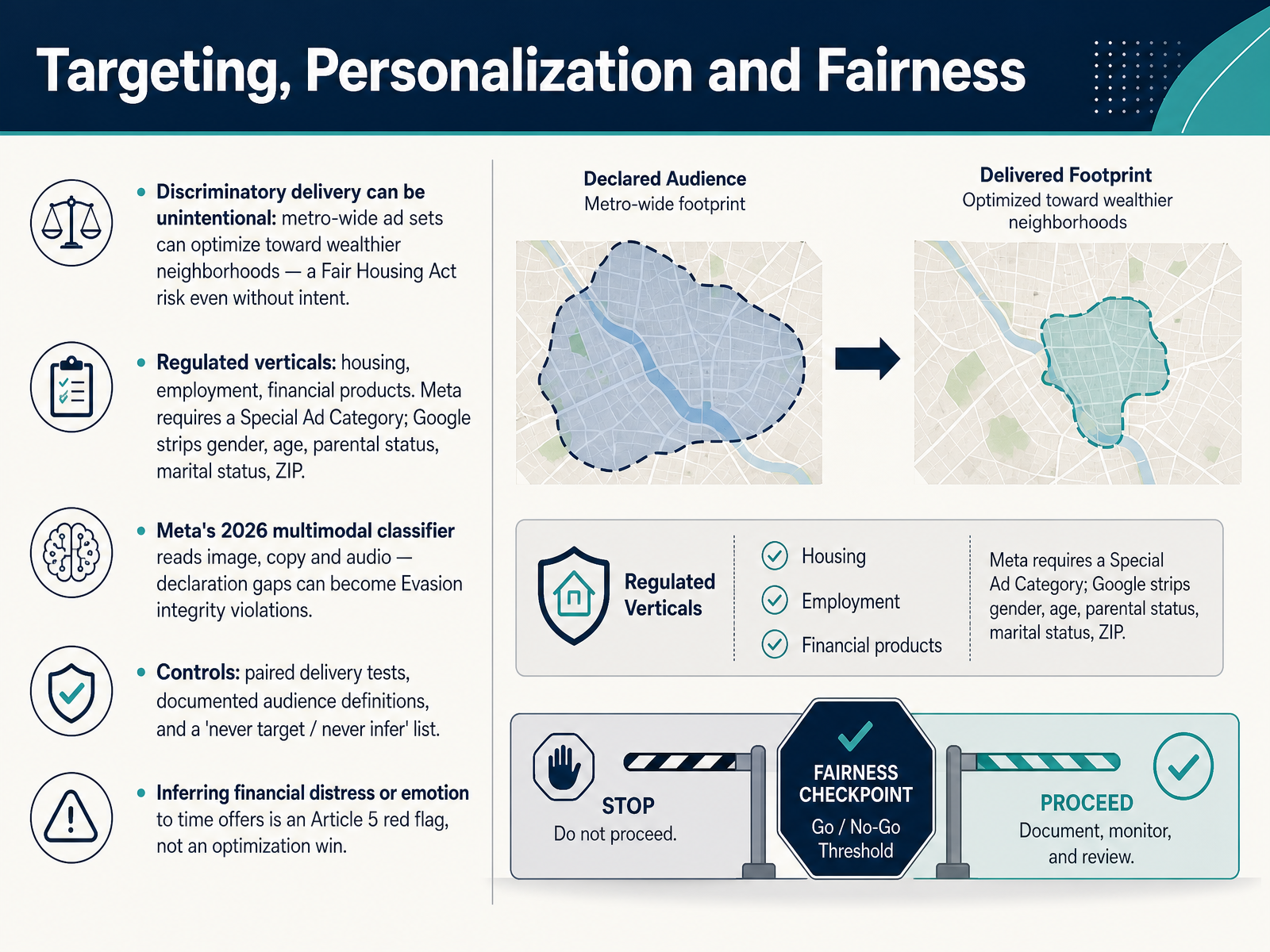
 - 07Targeting, Personalization and FairnessNow let's talk about targeting, personalization, and fairness. Discriminatory delivery can happen without intent. Picture a mortgage ad set to a whole metro area. The delivery system optimizes toward clicks, and the ad lands mostly in wealthier neighborhoods. That is a Fair Housing Act risk, even though no one chose it. Regulated verticals are housing, employment, and financial products. Meta requires a Special Ad Category. Google strips gender, age, parental status, marital status, and ZIP codes. And Meta's 2026 classifier now reads image, copy, and audio together. So a declaration gap can become an Evasion integrity violation, not just a rejection. Once Meta assigns the category, restrictions apply whether you selected it or not. So declare on plausible doubt. Three controls protect you. Run paired delivery tests for equivalent ads. Document your audience definitions. And keep a never target, never infer list. One clear red flag. Inferring financial distress or emotion to time offers is an Article 5 violation, not an optimization win. So what do you do under deadline pressure? Build the determination into the creative brief, not after the campaign. Next, we move to content claims, influencer disclosure, and affiliate integrity.
 2 min
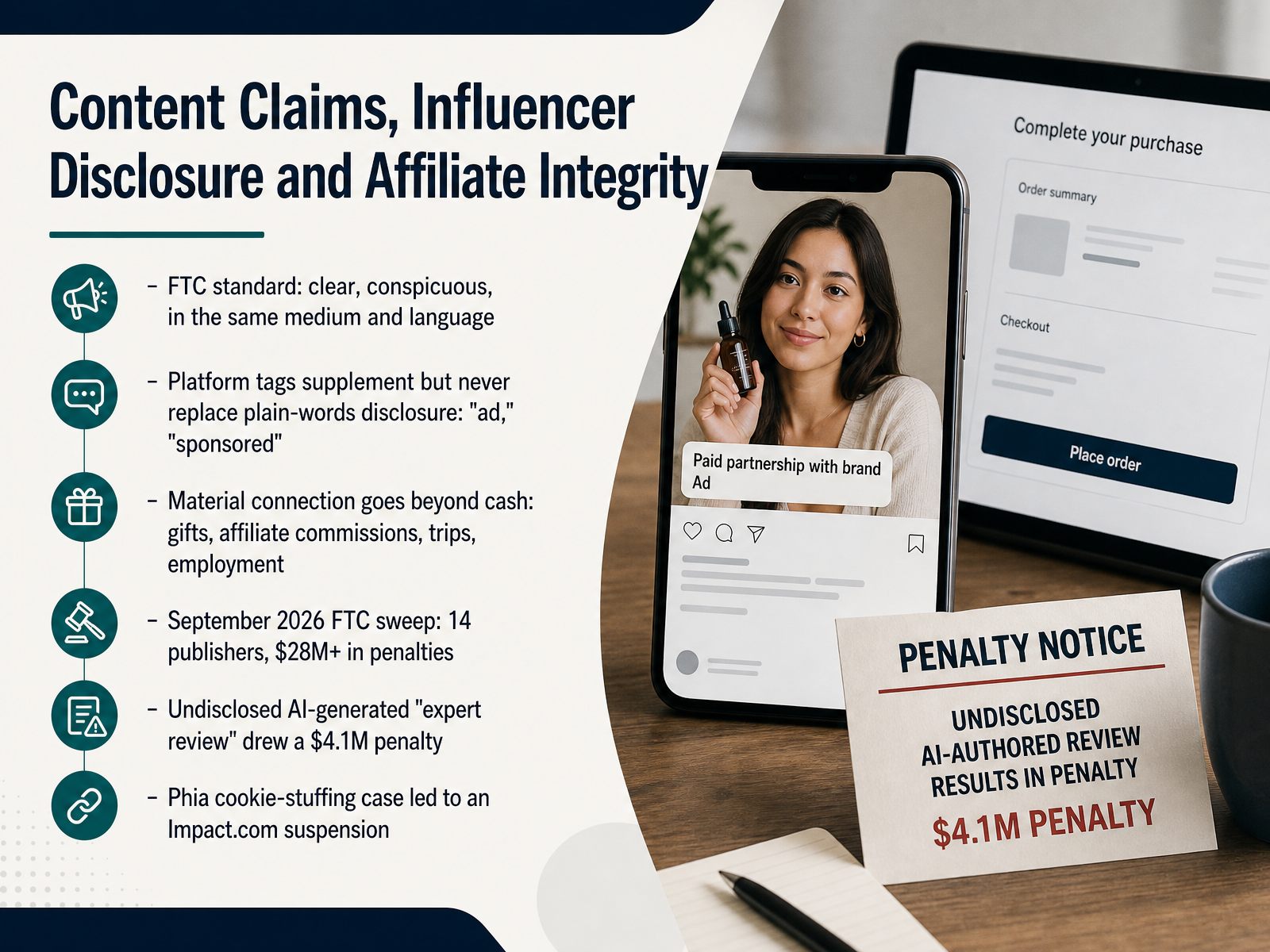
2 min - 08Content Claims, Influencer Disclosure and Affiliate IntegrityNow let's talk about content claims, influencer disclosure, and affiliate integrity. The Federal Trade Commission standard is simple to say and harder to execute. A disclosure must be clear, conspicuous, and in the same medium and language as the endorsement. That means a spoken claim needs a spoken disclosure, and a caption claim needs a visible one where people actually look. Platform tags help, but they supplement and never replace plain words like ad or sponsored. And a material connection goes far beyond cash. Gifts, affiliate commissions, trips, and even employment all count. Why does this matter under deadline pressure? Because in September of 2026, the FTC swept fourteen publishers, with over twenty eight million dollars in penalties. One undisclosed AI generated expert review drew a four point one million dollar penalty. And the Phia cookie stuffing case led to an Impact dot com suspension. Cookie stuffing means claiming affiliate credit for clicks a user never made. So pause here. For every paid, gifted, or commissioned placement, ask two questions. Would a viewer know there is a commercial relationship? And is that disclosure impossible to miss in the format they consume? Next, we will look at AI in marketing, four surfaces that actually apply.
 2 min
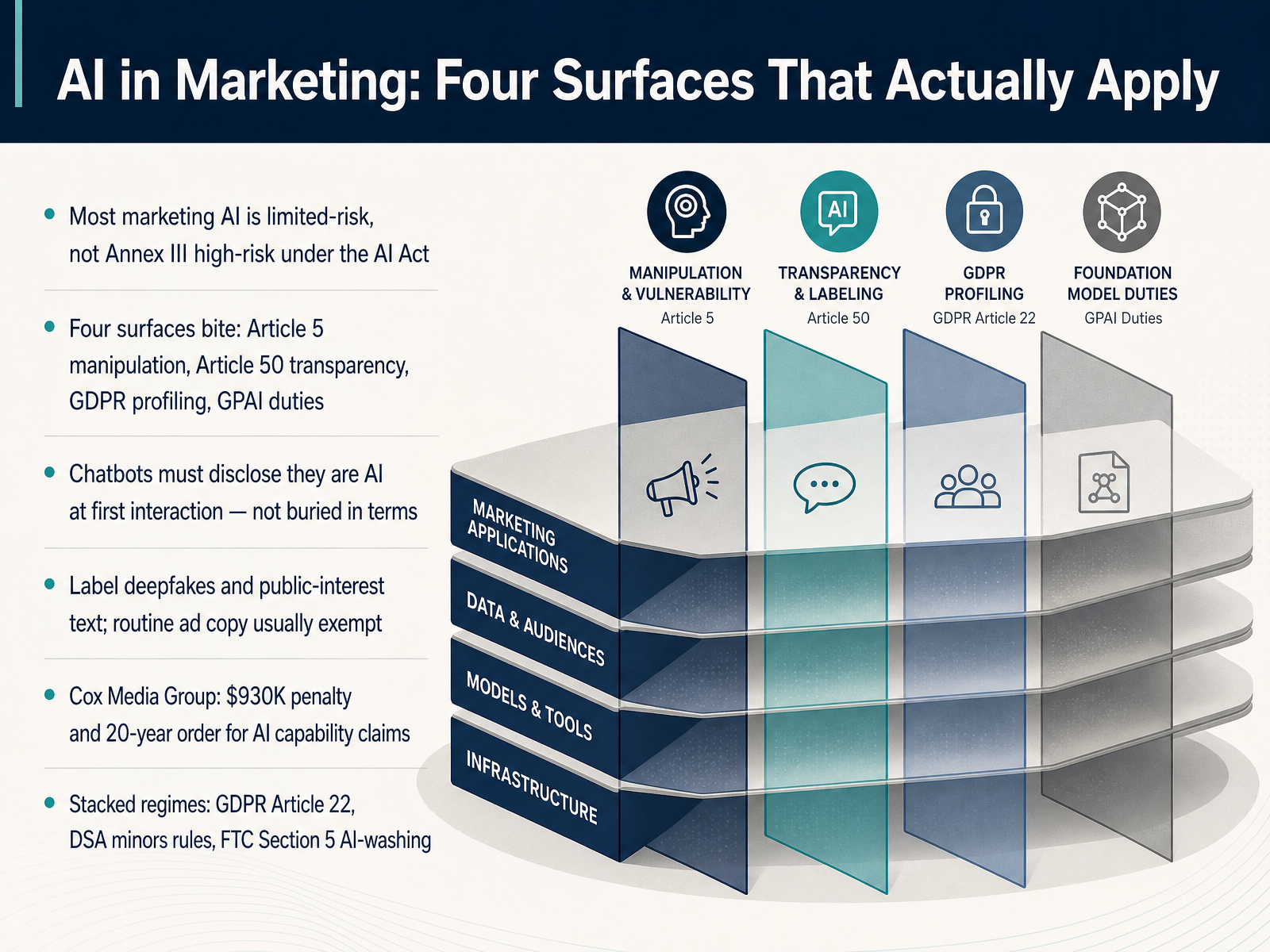
2 min - 09AI in Marketing: Four Surfaces That Actually ApplyNow let's map where the law actually bites. Most marketing AI is limited risk, not Annex Three high risk. Targeting, personalisation, programmatic bidding, chatbots and generative creative all fall outside the high-risk list. So you don't need a conformity assessment. Four surfaces do bite, though. Article Five manipulation, Article Fifty transparency, G D P R profiling, and G P A I duties when you build on a foundation model. For chatbots, disclose the AI at first interaction, in the widget, not buried in the terms. Label deepfakes. Routine ad copy is usually exempt, unless it touches health, safety or sustainability claims. Enforcement is real. Cox Media Group faced a nine hundred thirty thousand dollar penalty and a twenty-year order for false AI capability claims. And these regimes stack. G D P R Article Twenty-Two on automated decisions, D S A rules on minors, and F T C Section Five on AI washing. Next, we look at governance, review workflows and team accountability.
 indiatoday.intech-insider.orgico.org.uk+22 min
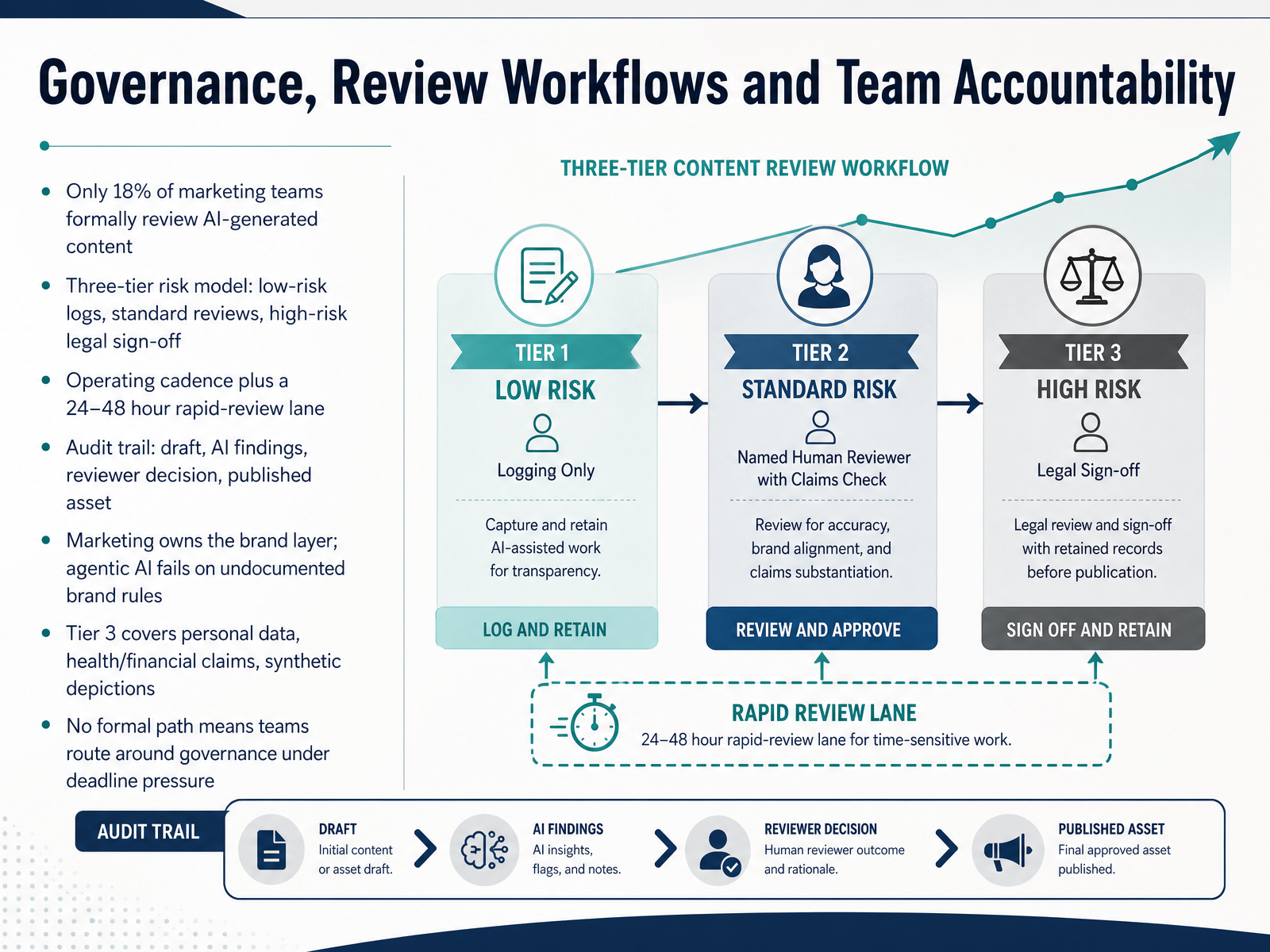
 - 10Governance, Review Workflows and Team AccountabilityNow let's talk about governance, review workflows, and team accountability. Here's the gap you're working with. Only eighteen percent of marketing teams formally review AI-generated content. That means most teams are shipping AI output with no documented checkpoint at all. The fix is a three-tier risk model. Low-risk content gets logged, no pre-publication review needed. Standard customer-facing work gets a defined human reviewer and a claims check. High-risk content, anything with personal data, health or financial claims, or synthetic depictions of real people, requires named legal sign-off. Pair that with an operating cadence: a regular working sync, plus a rapid-review lane with a twenty-four to forty-eight hour turnaround. That fast lane matters, because if the only path to approval is waiting for the next meeting, teams route around governance when a deadline hits. You also need an audit trail connecting the draft, the AI findings, the reviewer decision, and the published asset. And remember, marketing owns the brand layer. Agentic AI fails on undocumented brand rules, so write them down. Next, let's look at case scenarios, where marketing teams actually get it wrong.
 2 min
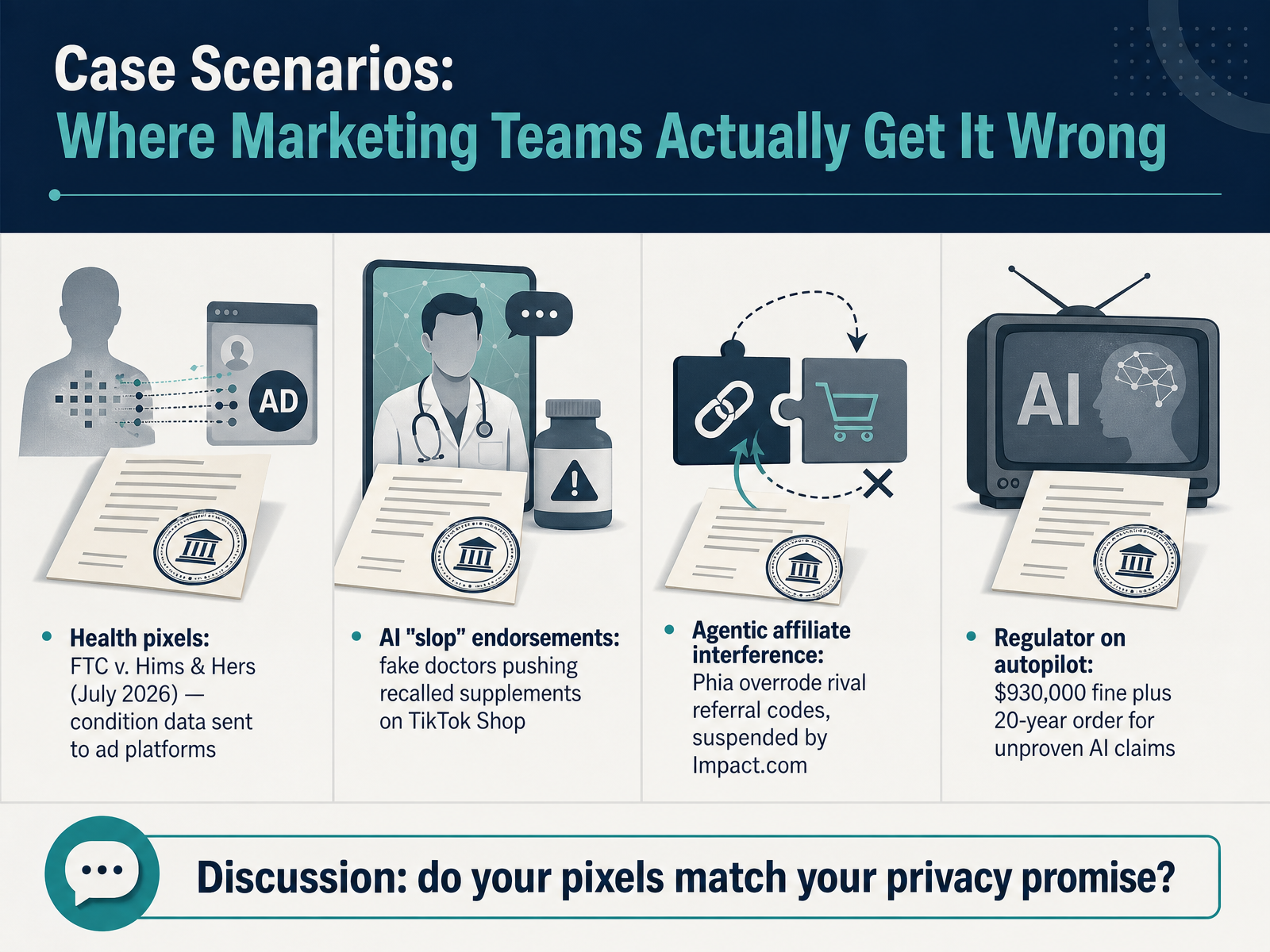
2 min - 11Case Scenarios: Where Marketing Teams Actually Get It WrongLet's look at where marketing teams actually get it wrong, because these are real cases from this year. First, health pixels. The Federal Trade Commission sued Hims and Hers in July, alleging that condition data from intake forms and pages was sent to Meta and Snap through tracking pixels, despite a promise of privacy. The lesson is simple. Your pixels have to match your privacy promise. Second, AI slop endorsements. A supplement brand allegedly paid creators to run TikTok Shop videos with fake AI generated doctors pushing recalled products. Fake credentials plus real commissions equals deception. Third, agentic affiliate interference. The shopping app Phia was suspended by Impact dot com after tests showed its extension overriding rival referral codes at checkout. If your AI agent swaps out another publisher's code, you are taking credit for a sale you did not drive. Fourth, regulators on autopilot. Cox Media Group settled for nine hundred thirty thousand dollars and a twenty year consent order over unproven AI claims. So here is your discussion question. Do your pixels match your privacy promise? Pull one campaign and trace the data. Now let's build a decision framework under performance pressure.
 indiatoday.intech-insider.orgico.org.uk+22 min
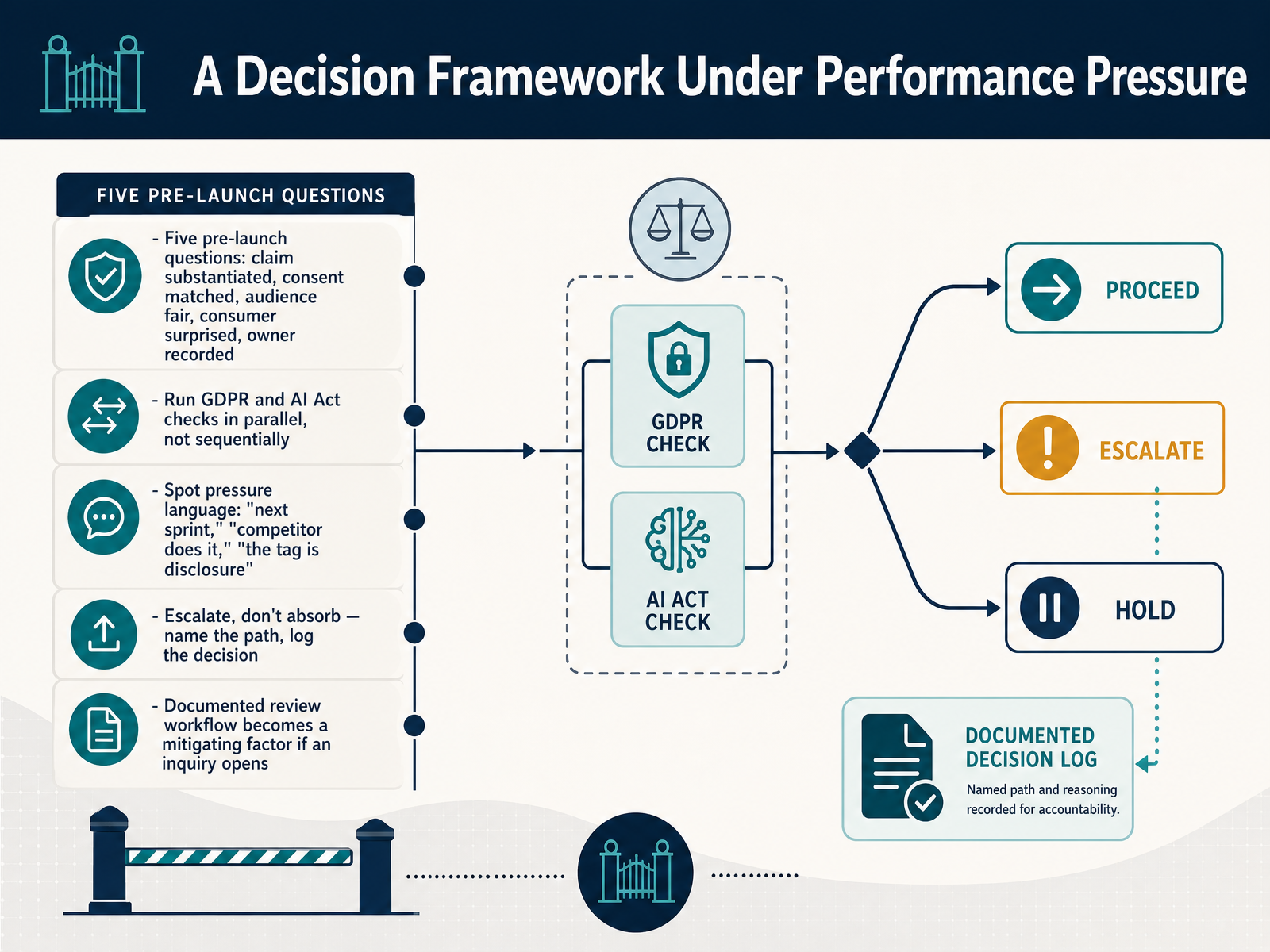
 - 12A Decision Framework Under Performance PressureLet's pull this together into a decision framework you can actually use when the pressure is on. Before launch, ask five questions. Is the claim substantiated? Does the consent match the use? Is the audience treated fairly? Would a reasonable consumer be surprised? And is an owner recorded? Run your GDPR and AI Act checks in parallel, not one after the other, because both apply at the same time. Watch for pressure language. Phrases like "next sprint," "our competitor does it," or "the tag is disclosure" are signals that speed is crowding out judgment. When that happens, escalate instead of absorbing. Name the path, and log the decision. If an inquiry ever opens, a documented review workflow becomes a mitigating factor, not just paperwork. So remember: five questions, parallel checks, escalate and log. Next, let's turn these principles into an action plan you can build into daily work.
 1 min
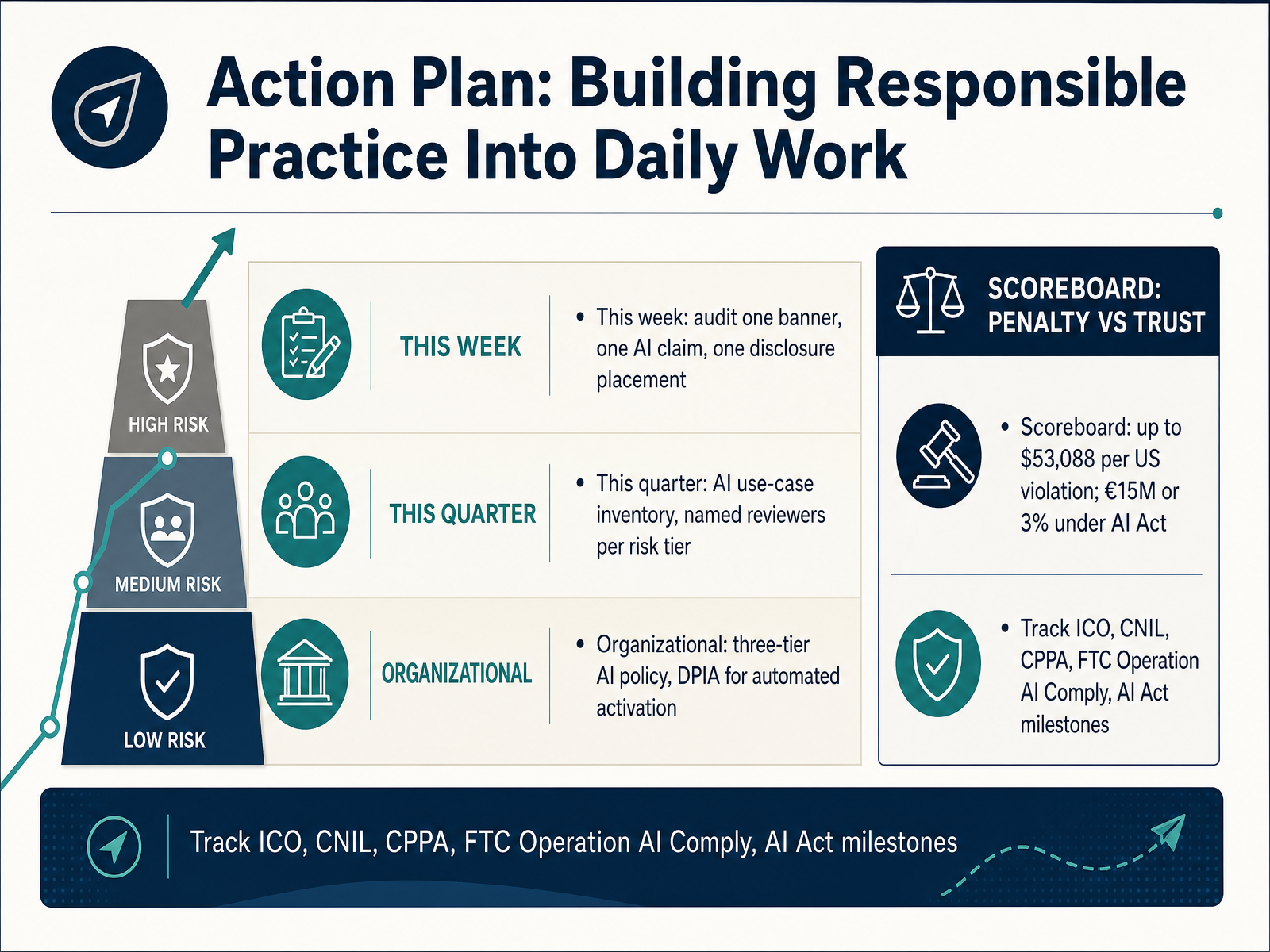
1 min - 13Action Plan: Building Responsible Practice Into Daily WorkLet's bring this home with an action plan you can actually run. Start this week. Audit one banner, one AI-generated claim, and one disclosure placement. Three items, maybe an hour. You're looking for real gaps, not a perfect score. This quarter, build the structure. Create an inventory of every AI use case in your marketing stack, and assign a named reviewer to each risk tier, so accountability has a face, not just a policy. Organizationally, work toward a three-tier AI policy, and require a Data Protection Impact Assessment before any automated activation goes live. Keep the scoreboard visible. Penalties reach up to fifty-three thousand and eighty-eight dollars per violation in the US, and up to fifteen million euros or three percent of global turnover under the AI Act. Why the urgency? Because deadlines and performance targets keep pushing teams to skip steps. So track the regulators: the ICO, the CNIL, the California Privacy Protection Agency, FTC Operation AI Comply, and the AI Act milestone dates. You don't need to fix everything today. Pick the three audits, name your reviewers, and start. That's how responsible practice becomes a habit, not a scramble. Thank you for your attention, and good luck building this into your daily work.
 datashyre.comhouseofmartech.comdatashyre.com+22 min
Take the deck with you
Download this course as a file — free, no sign-up needed.
- PDF handoutEvery slide page, ready to print or share.14 pages · 3.6 MBDownload
- Narrated PowerPointThe deck that presents itself — every slide carries the digital human's narration video.14 pages · 14.6 MBDownload
- PowerPoint slidesThe full deck as a .pptx — open it in PowerPoint, Keynote, or Google Slides.14 pages · 3.5 MBDownload
Free to use in your own training — please keep the PersonWise credit page at the end.
Have your own deck? Turn it into a course
Sources consulted
Web sources consulted while building this course.
- SpiceJet dark patterns fine: CCPA imposes Rs 1 lakh penalty over pre-ticked consent - India Today — indiatoday.in
- FTC Fines Cox Media $930K Over Fake AI Ad Claims — tech-insider.org
- PENALTY NOTICE — ico.org.uk
- GDPR Fines 2026: Recent Enforcement Explained — engagecompliance.co
- CCPA enforcement actions tracker | Ketch Enforcement Analysis — ketch.com
- State of Digital Trust 2026 — usercentrics.com
- Consumer Trust in Digital Marketing: A Systematic Literature ... — journal.igiinsight.com
- Usercentrics Report: The State of Digital Trust in 2026 — usercentrics.com
- 2026 Digital Trust Index - Data Breach Statistics — cpl.thalesgroup.com
- Data Privacy Concerns and their Impact on Consumer Trust in Digital Marketing — doi.org
- Dark Patterns and the EU Digital Services Act: Mapping Autonomy Violations and Design Factors — doi.org
- An Ontology of Dark Patterns Knowledge: Foundations, Definitions, and a Pathway for Shared Knowledge-Building — doi.org
- Understanding the scope of Article 25 of the DSA in regulating dark patterns — inria.hal.science
- A systematic literature review on dark patterns for the legal community: definitional clarity and a legal classification based on the Unfair Commercial Practices Directive — doi.org
- The Dark Patterns Knowledge Stack: Exploring New Ways to Negotiate Context, Law, and Design — colingray.me
- Consent Management Platform Best Practices: A 2026 Implementation Guide - DataShyre | Consent Management Platform & MarTech Services — datashyre.com
- MarTech Data Privacy Compliance Guide 2026: GDPR & CPRA — houseofmartech.com
- GDPR Consent Management in 2026: A Working Checklist for Product and Marketing Teams - Consent Management Platform — datashyre.com
- User Consent Management in 2026: What It Actually Has to Control - Consent Management Platform — datashyre.com
- Marketing Consent in 2026: What Needs Opt-In and What Doesn’t - DataShyre | Consent Management Platform & MarTech Services — datashyre.com