Begin
14 pages · ~28 min
Avoiding Common Customer Education Mistakes
This training helps customer education teams identify common program mistakes and apply practical strategies to avoid them, improving learner outcomes and engagement.
A digital instructor presents all 14 pages. Hold “Ask” at any point and ask out loud — the answer comes from this course. No sign-up needed.
What you’ll learn
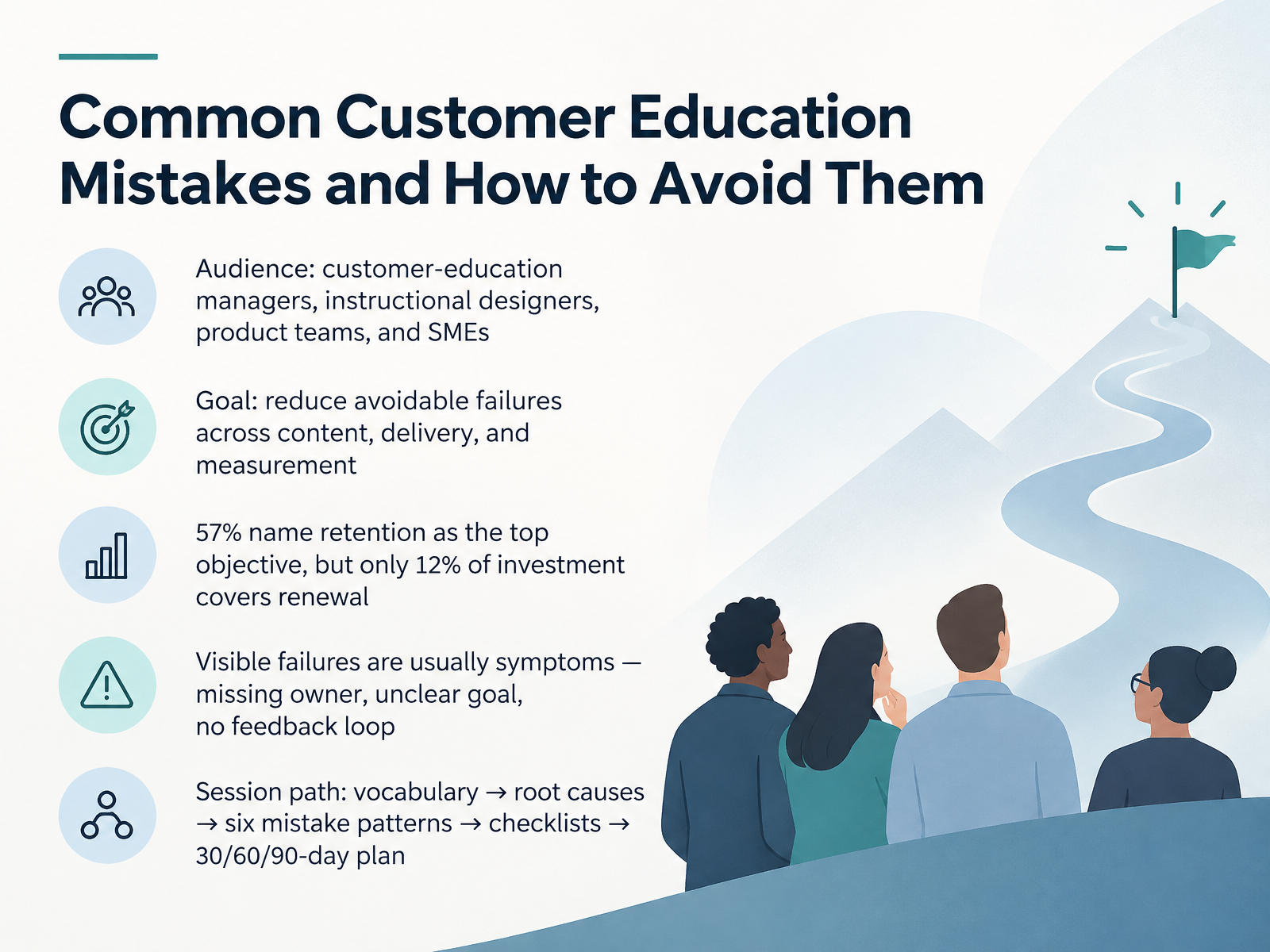
- 01Common Customer Education Mistakes and How to Avoid ThemWelcome. This session is for customer-education managers, instructional designers, product teams, and subject-matter experts. You already know the work. Our goal today is simpler: reduce avoidable failures across content, delivery, and measurement.
Start with one number. Fifty-seven percent of teams name retention as their top objective. Yet only twelve percent of learning investment goes to renewal. That gap is a mistake pattern, not a mystery.
Visible failures are usually symptoms. Behind them you often find a missing owner, an unclear goal, or no feedback loop.
So here is our path. First, shared vocabulary. Then root causes. Then six mistake patterns. Then checklists you can use. And finally, a thirty, sixty, ninety-day plan.
Let's begin with the words we all use differently. Next up: shared vocabulary and scope, covering education, onboarding, and support.thinkific.comabsorbai.comeverestgrp.com+21 min
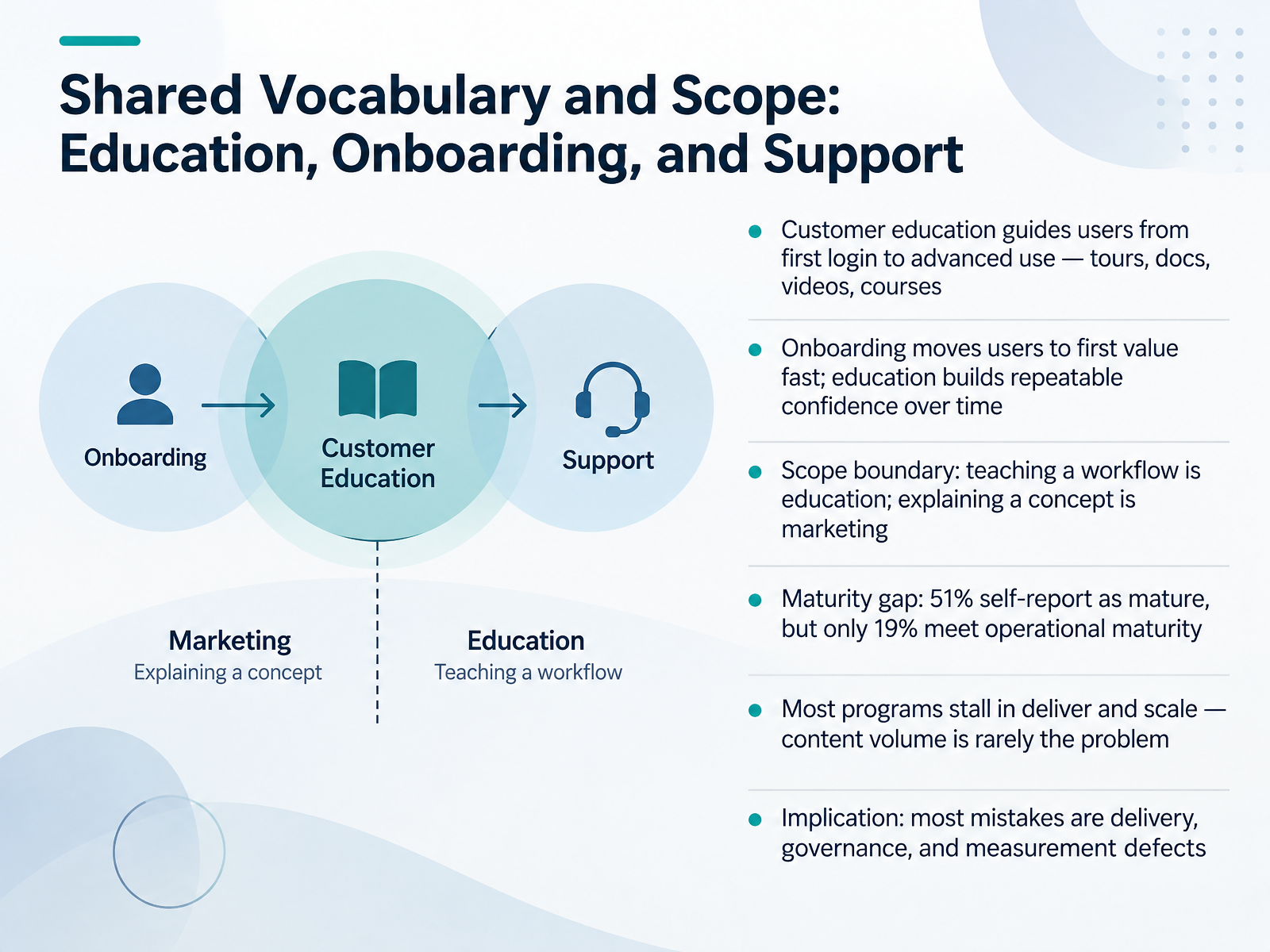
- 02Shared Vocabulary and Scope: Education, Onboarding, and SupportBefore we get into specific mistakes, let's align on language, because scope confusion causes a lot of them. Customer education guides users from first login to advanced use, through tours, docs, videos, and courses. Onboarding is narrower. It moves users to first value fast. Education builds repeatable confidence over time. So keep the boundary clear. Teaching a workflow is education. Explaining a concept sits closer to marketing. Here's where it gets interesting. About fifty-one percent of teams describe their program as mature, but only nineteen percent meet operational maturity. Most programs stall in deliver and scale. Content volume is rarely the problem. So treat most of your mistakes as delivery, governance, and measurement defects, not content gaps. Next, we look at why programs fail, the root causes behind visible mistakes.
 thinkific.comabsorbai.comeverestgrp.com+21 min
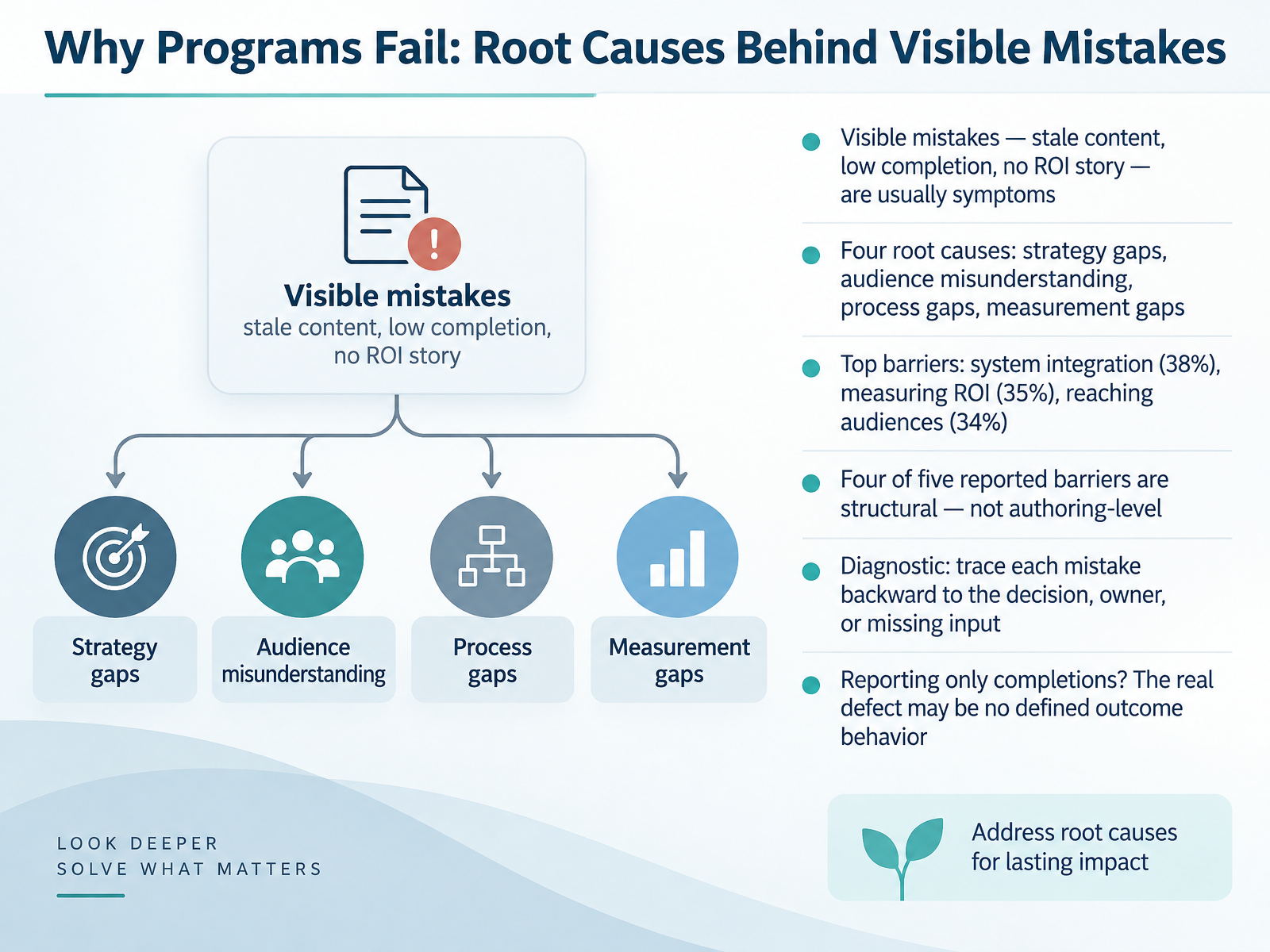
- 03Why Programs Fail: Root Causes Behind Visible MistakesNow let's look at why programs actually fail. The mistakes you can see, like stale content, low completion, or no clear return on investment story, are usually symptoms, not the disease. In practice, four root causes sit underneath: strategy gaps, misunderstanding your audience, process gaps, and measurement gaps. The survey data supports this. The top barriers were system integration at thirty eight percent, measuring return on investment at thirty five percent, and reaching audiences at thirty four percent. Notice that four of the five most reported barriers are structural. They are not authoring level problems. So here is a practical diagnostic. When you spot a mistake, trace it backward to the decision, the owner, or the missing input that allowed it. And if your reporting stops at completions, pause. The real defect may be that no outcome behavior was ever defined. Next, we'll work through the first mistake pattern: designing for everyone, and reaching no one.
 cedma-europe.orggo.cloudshare.comabsorbai.com+22 min
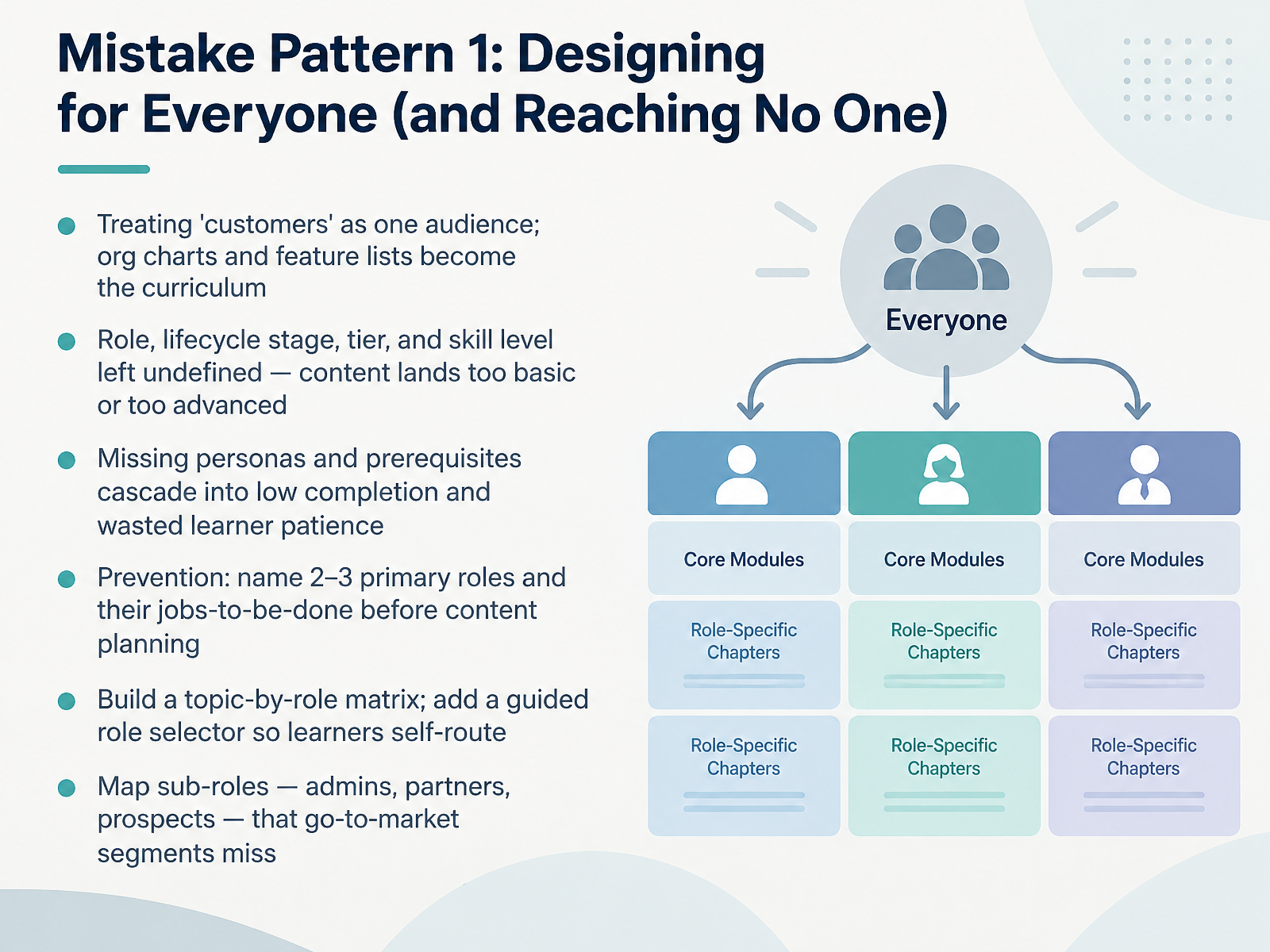
- 04Mistake Pattern 1: Designing for Everyone (and Reaching No One)Let's look at the first mistake pattern: designing for everyone, and reaching no one. It usually starts by treating customers as a single audience. The curriculum becomes an org chart or a feature list instead of something built around real work. Role, lifecycle stage, tier, and skill level go undefined, so content lands too basic for some learners and too advanced for others. Missing personas and prerequisites cascade into low completion and wasted learner patience. The fix is straightforward. Before content planning, name two or three primary roles and their jobs to be done. Build a topic-by-role matrix, and add a guided role selector so learners route themselves. Then map the sub-roles that go-to-market segments miss, like admins, partners, and prospects. Next, we'll look at mistake pattern two: content built on assumptions.
 cloudshare.comtechclass.comsimplitrain.com+21 min
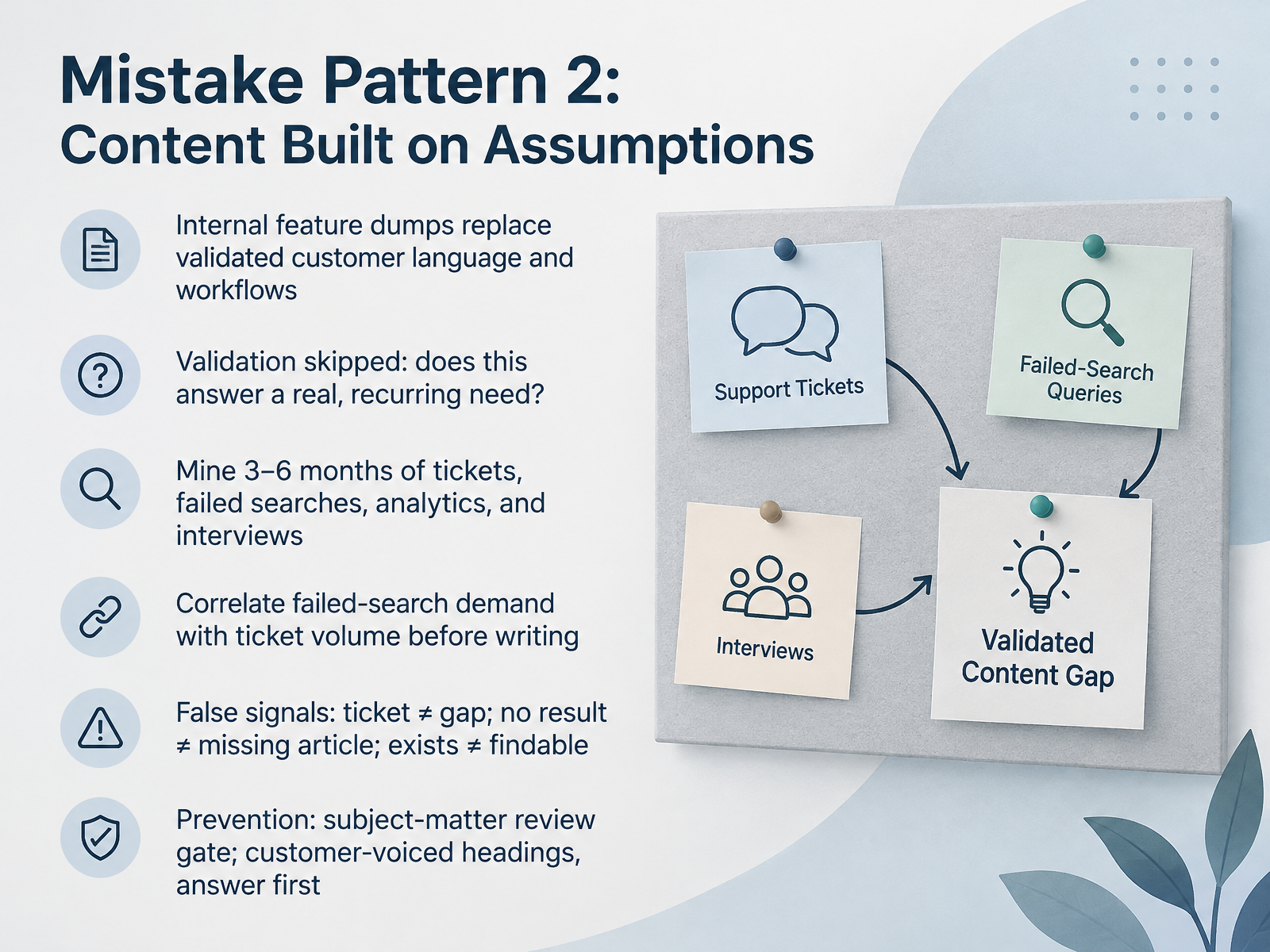
- 05Mistake Pattern 2: Content Built on AssumptionsLet's move to the second mistake pattern: content built on assumptions. It usually looks like an internal feature dump. Someone writes up the release notes, and that becomes the lesson. But it rarely uses validated customer language, or the workflow customers actually follow. The fix starts with one question: does this answer a real, recurring need? To find out, mine three to six months of tickets, failed searches, analytics, and interviews. And correlate failed-search demand with ticket volume before you write a word. Watch the false signals. A ticket does not always mean a content gap. No search result does not always mean a missing article. And an article that exists is not necessarily findable. Two guards help. Add a subject-matter review gate before publishing. Then write customer-voiced headings, answer first. Now, pattern three: ignoring the learner's context and lifecycle.
 cincopa.comus.fitgap.comopenmax.com+21 min
- 06Mistake Pattern 3: Ignoring the Learner's Context and LifecycleHere is the third pattern. Ignoring the learner's context and lifecycle.
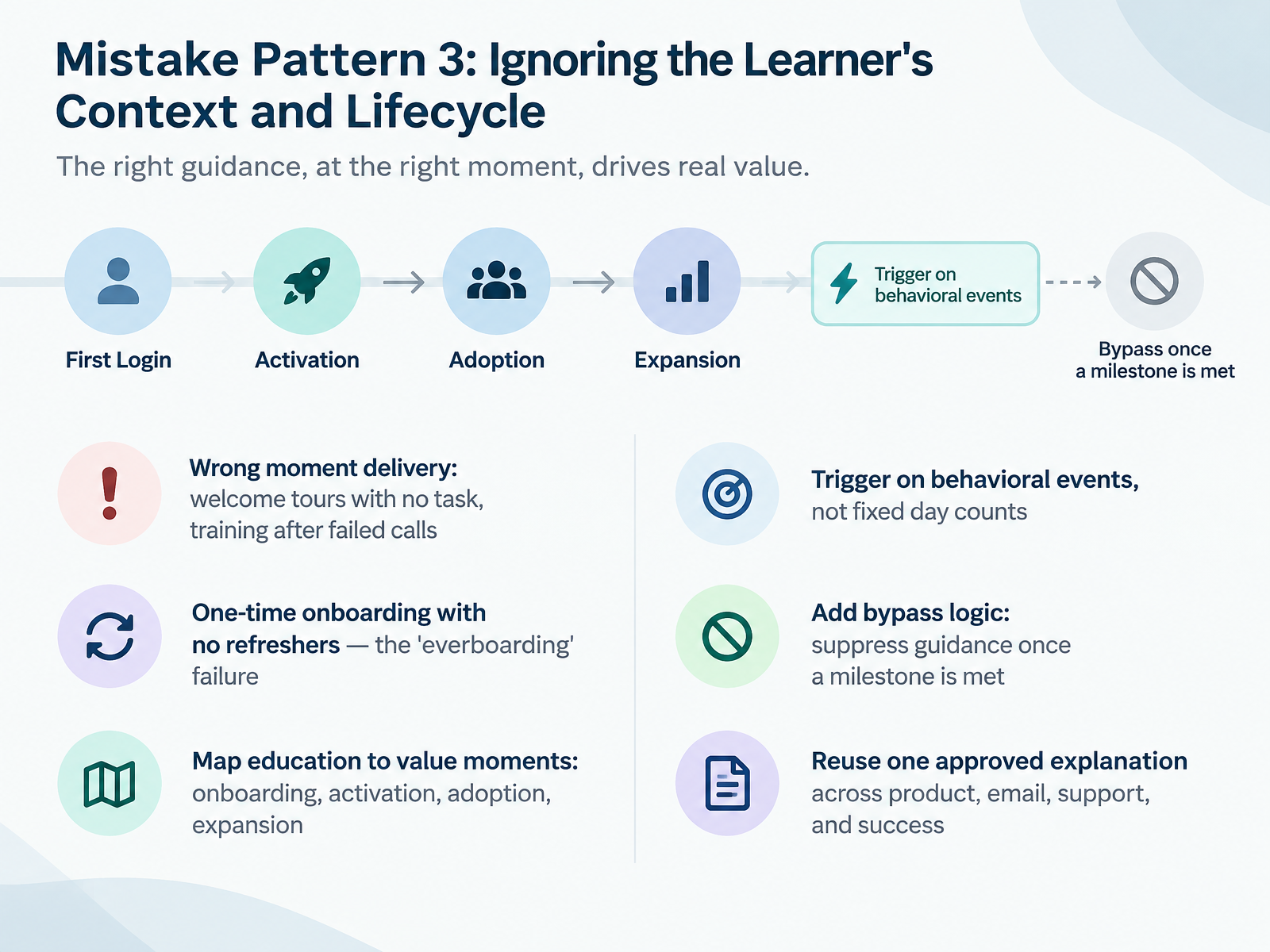
The mistake shows up as timing. A welcome tour fires before the user has a task to finish. A training email lands right after a failed support call. Both feel like noise, and both erode trust in your guidance.
The second version is one-time onboarding with no refreshers. Users change roles and use cases, and the product changes under them. Call it everboarding. If learning stops after thirty days, adoption stalls quietly.
So map education to value moments: onboarding, activation, adoption, and expansion. Trigger on behavioral events, not fixed day counts. A user who configures an integration on day one should not get the day three reminder.
Then add bypass logic. Suppress guidance once a milestone is met, so fast users are not slowed down. (Pause) And reuse one approved explanation across product, email, support, and success. One source of truth, fewer contradictions.
Next, Mistake Pattern 4: Content That Is Hard to Find, Use, and Maintain.
 trainn.co2 min
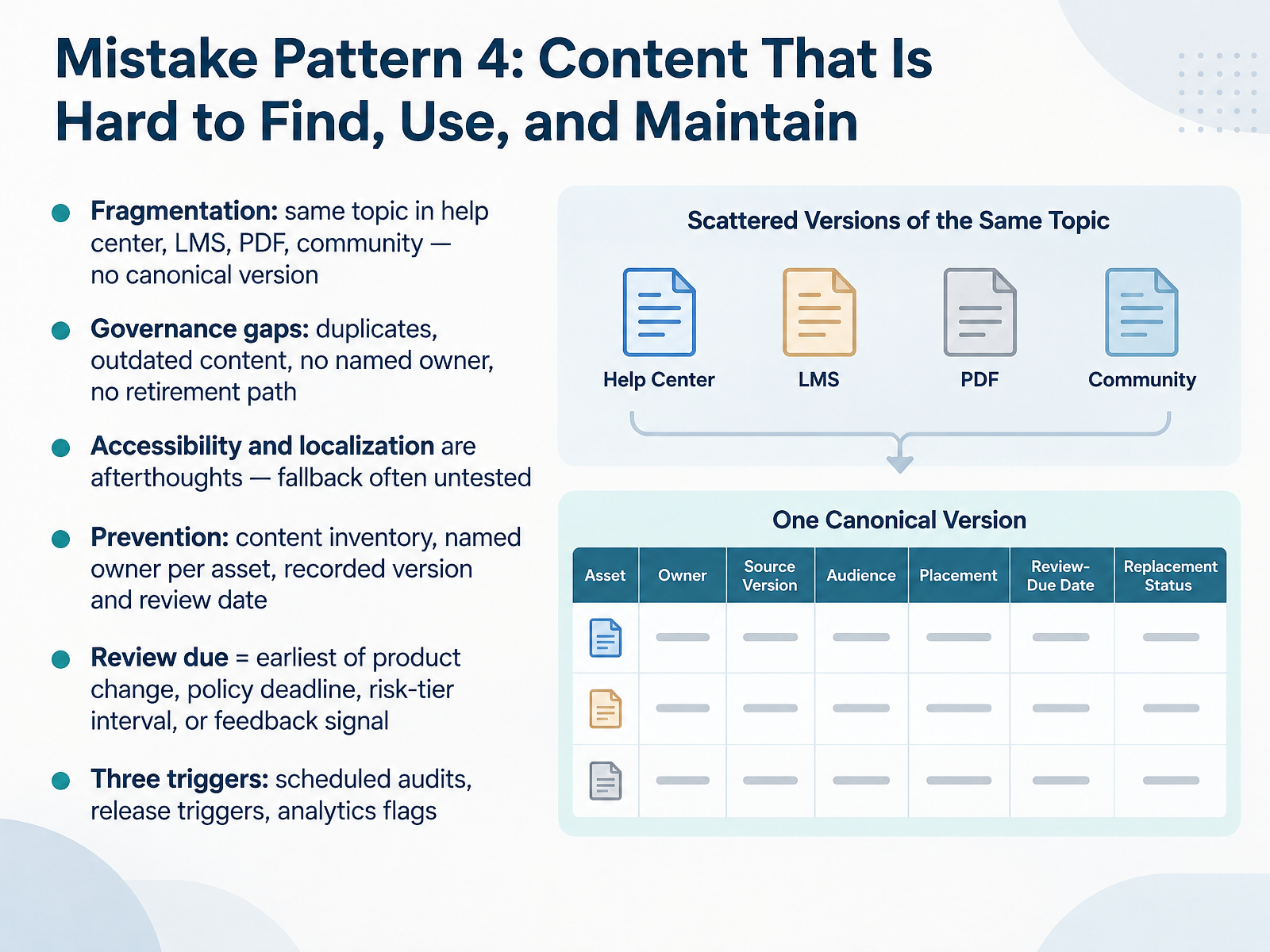
- 07Mistake Pattern 4: Content That Is Hard to Find, Use, and MaintainLet's look at the fourth pattern: content that is hard to find, use, and maintain. It usually starts with fragmentation. The same topic lives in your help center, your LMS, a PDF, and a community thread, and no version is clearly canonical. Without governance, you get duplicates, outdated pages, no named owner, and no retirement path. Accessibility and localization get treated as afterthoughts, and the fallback for a missing translation often goes untested. One corrective action: build a content inventory, name an owner for every asset, and record its version and review date. Set the review due date as the earliest of four triggers. A qualifying product change, a policy deadline, the risk tier's maximum interval, or a verified feedback signal. Then run three triggers in practice: scheduled audits, release triggers, and analytics flags. That keeps content current before customers notice it isn't. Next, Mistake Pattern 5: Measuring Activity Instead of Outcomes.
 umbrex.comcincopa.comus.fitgap.com+22 min
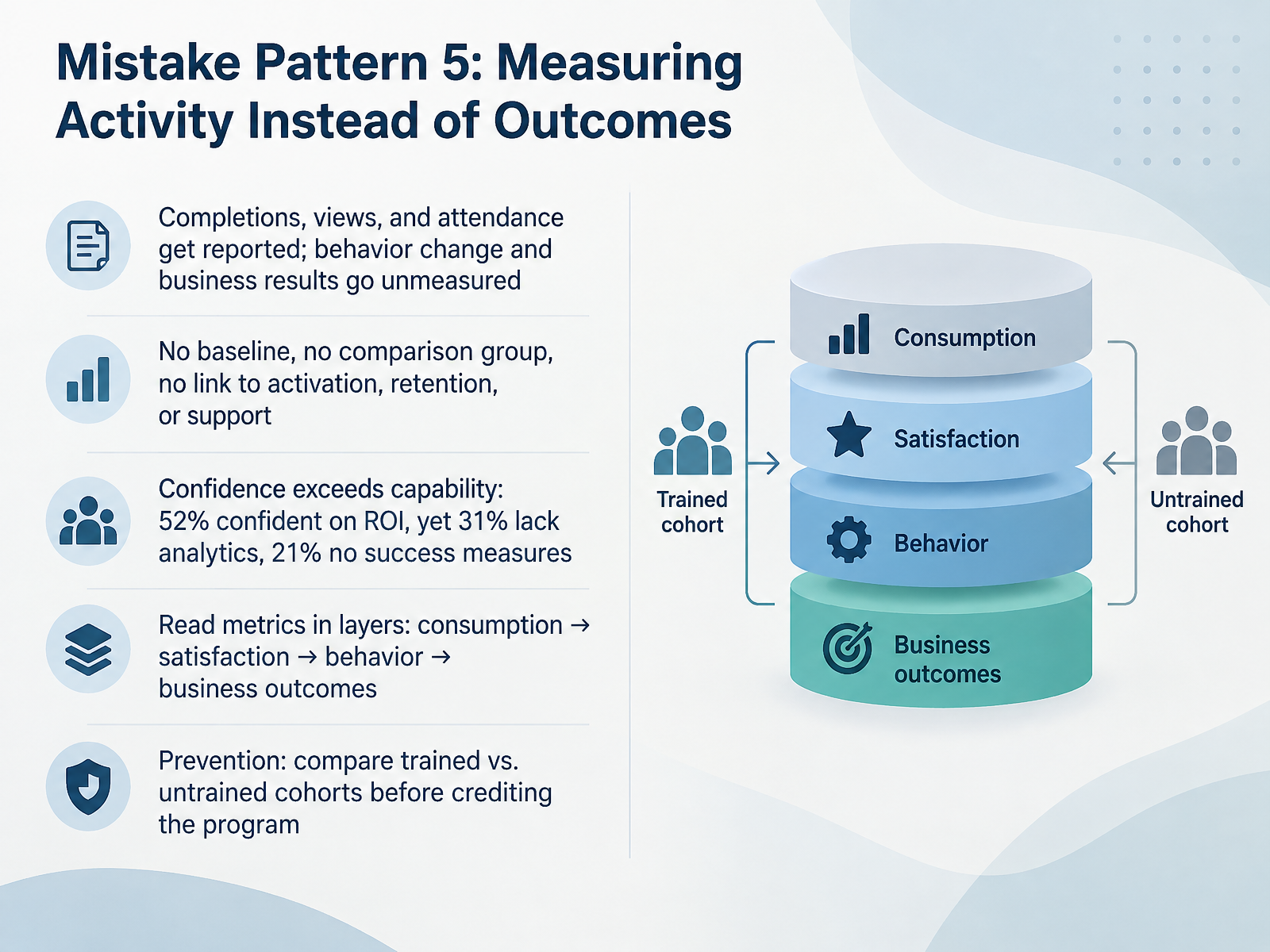
- 08Mistake Pattern 5: Measuring Activity Instead of OutcomesHere's a pattern you've probably seen. Teams report completions, views, and attendance, while behavior change and business results go unmeasured. There's no baseline, no comparison group, and no link to activation, retention, or support. The numbers look busy, but they don't answer the question leadership actually asks. And confidence tends to outrun capability. Fifty-two percent of teams say they're very confident they can show ROI. Yet thirty-one percent lack analytics capability, and twenty-one percent have no defined success measures at all. The fix is to read metrics in layers. Consumption first. Then satisfaction. Then behavior. Then business outcomes. Each layer answers a different question, so don't skip ahead. And before you credit the program, compare trained and untrained cohorts. That single comparison is the cleanest defense against overstating what education did. Next, we look at Mistake Pattern 6: Treating Education as a One-Off Project.
 thinkific.comabsorbai.comeverestgrp.com+22 min
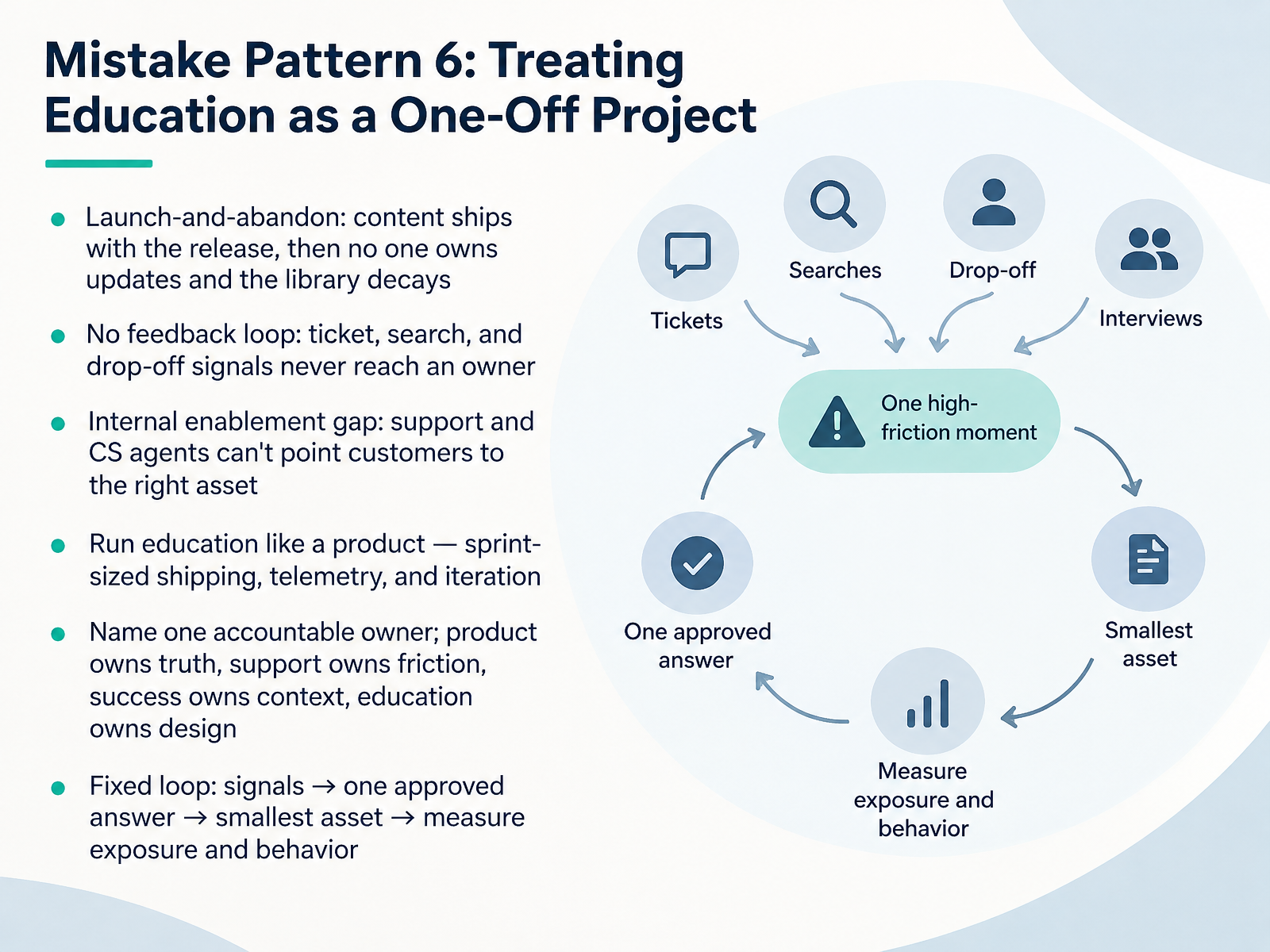
- 09Mistake Pattern 6: Treating Education as a One-Off ProjectNow let's look at a pattern that quietly erodes good programs: treating education as a one-off project. Content ships with the release, then no one owns updates, and the library decays. Ticket, search, and drop-off signals never reach an owner. And support and success agents can't point customers to the right asset.
The fix is to run education like a product: sprint-sized shipping, telemetry, and iteration. Name one accountable owner. Product owns truth, support owns friction, success owns context, and education owns design.
Then close the loop. Signals lead to one approved answer, which becomes the smallest asset. Measure exposure and behavior, and feed what you learn back in.
Next, we'll cover pre-build checks: lock the learner, the job, and the metric.
 1 min
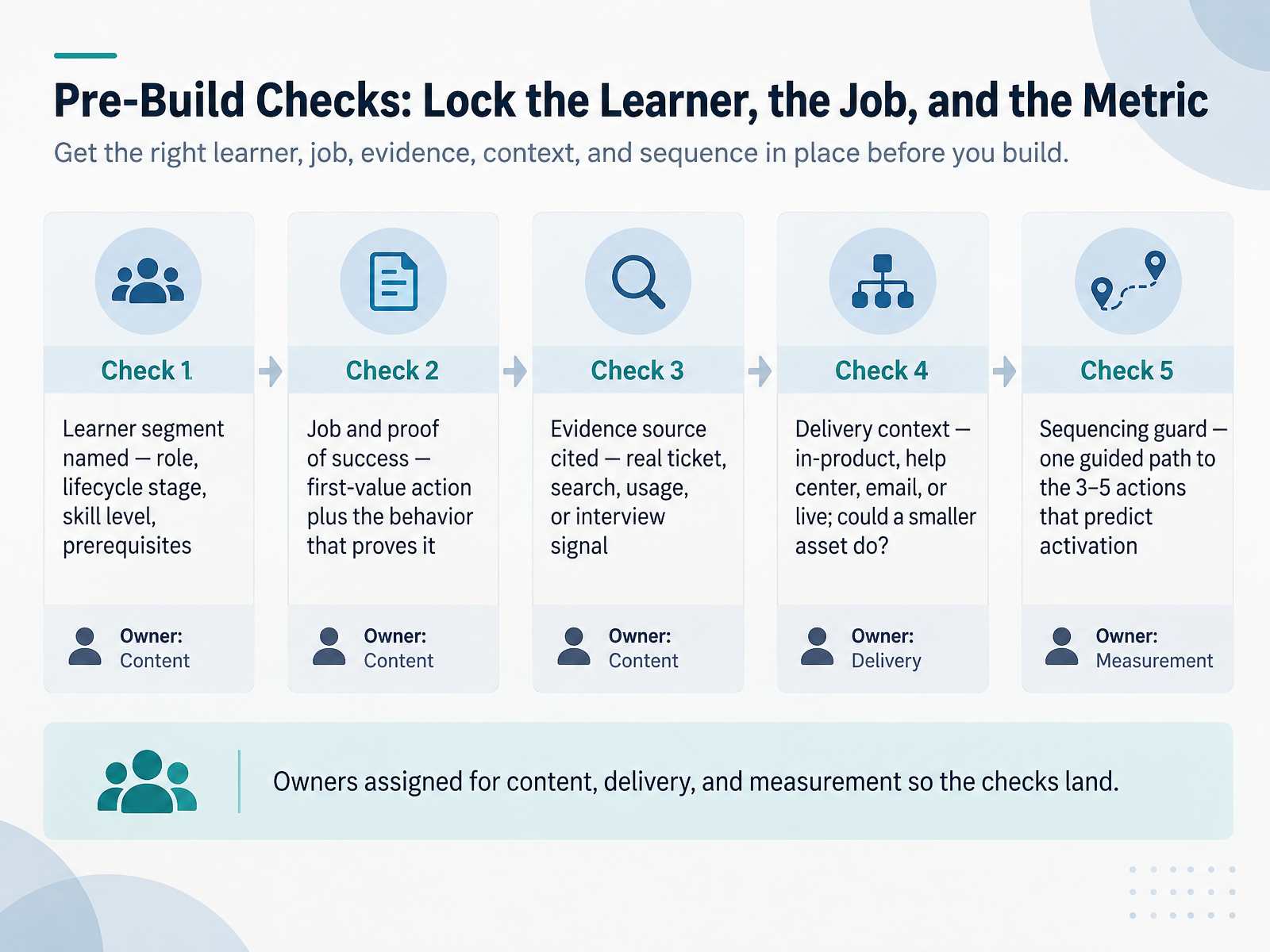
- 10Pre-Build Checks: Lock the Learner, the Job, and the MetricBefore you build anything, run five quick checks. They take an hour and save you a rebuild.
Check one: name the learner segment. Role, lifecycle stage, skill level, prerequisites. If you can't name them, you're writing for everyone, and that usually means no one.
Check two: name the job and the proof of success. One first-value action, plus the behavior that proves it happened. For example, a new admin invites two teammates.
Check three: cite your evidence. A real ticket, a search query, usage data, or an interview. A hunch is not a source.
Check four: choose the delivery context. In-product, help center, email, or live. Then ask whether a smaller asset would do the job. Often it will.
Check five: guard the sequence. One guided path to the three to five actions that predict activation. Not a catalog. A path.
Finally, assign owners for content, delivery, and measurement. These checks only land when someone owns each one.
Next, Pre-Launch and Post-Launch Checks: Quality Gates That Hold.
 trainn.cocloudshare.comtechclass.com+22 min
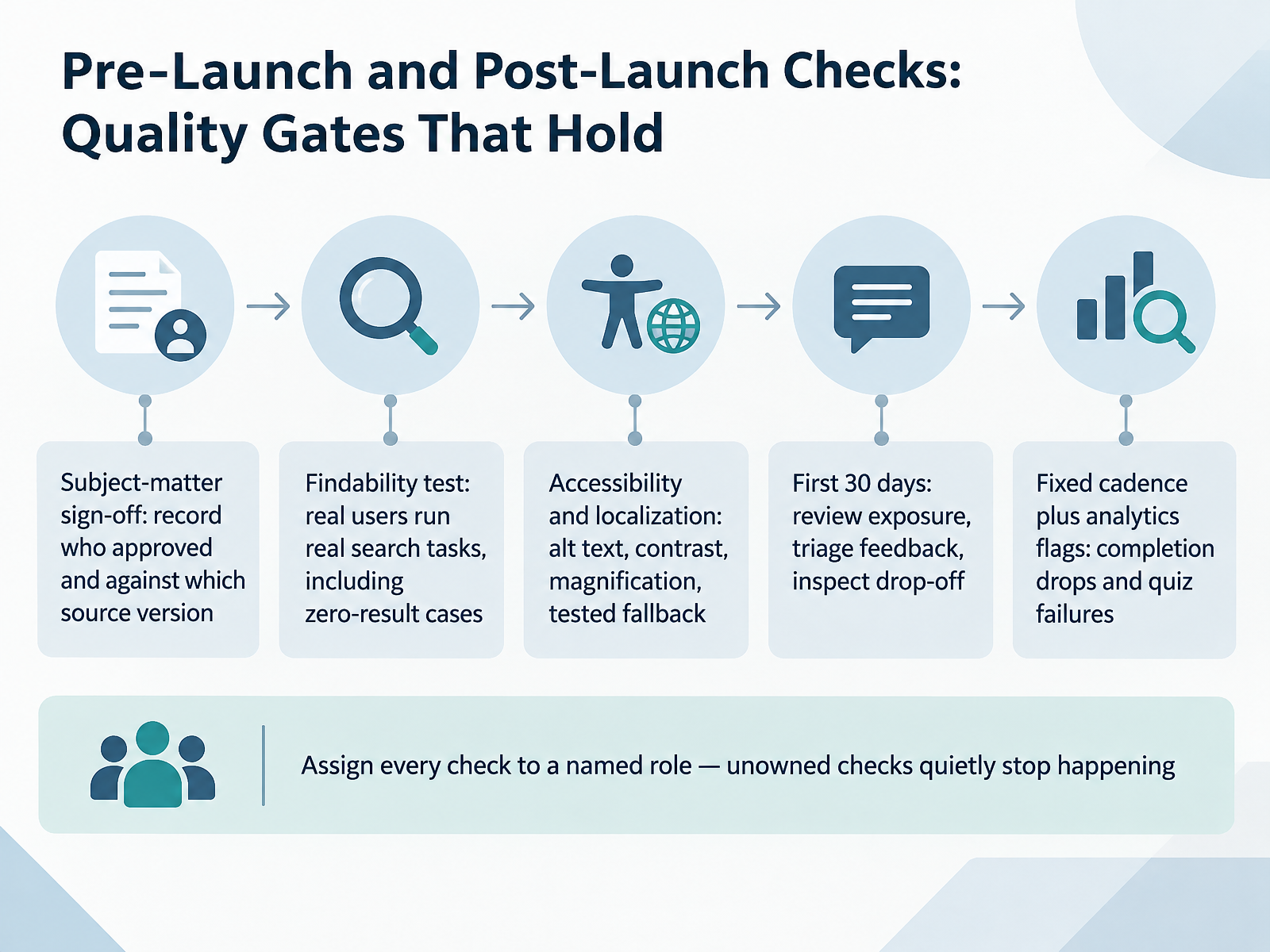
- 11Pre-Launch and Post-Launch Checks: Quality Gates That HoldLet's look at the quality gates that need to hold before and after launch. First, subject-matter sign-off. Record who approved the content, and which source version they reviewed. That one detail prevents a lot of confusion later. Second, run a findability test. Have real users perform real search tasks, and include the zero-result cases. If an article exists but nobody can find it, it will not help. Third, accessibility and localization. Check alt text, contrast, magnification, and that the fallback path has actually been tested. Fourth, the first thirty days. Review exposure, triage incoming feedback, and inspect where learners drop off. Pair a fixed review cadence with analytics flags, so completion drops and quiz failures trigger a review instead of waiting for someone to notice. And finally, assign every check to a named role. Unowned checks quietly stop happening. Before we move on, take a moment to think about which of these gates is missing in your own program. That is exactly what the next section helps you assess, in Self-Assessment: Score Your Program Against the Six Patterns.
 umbrex.comcincopa.comus.fitgap.com+22 min
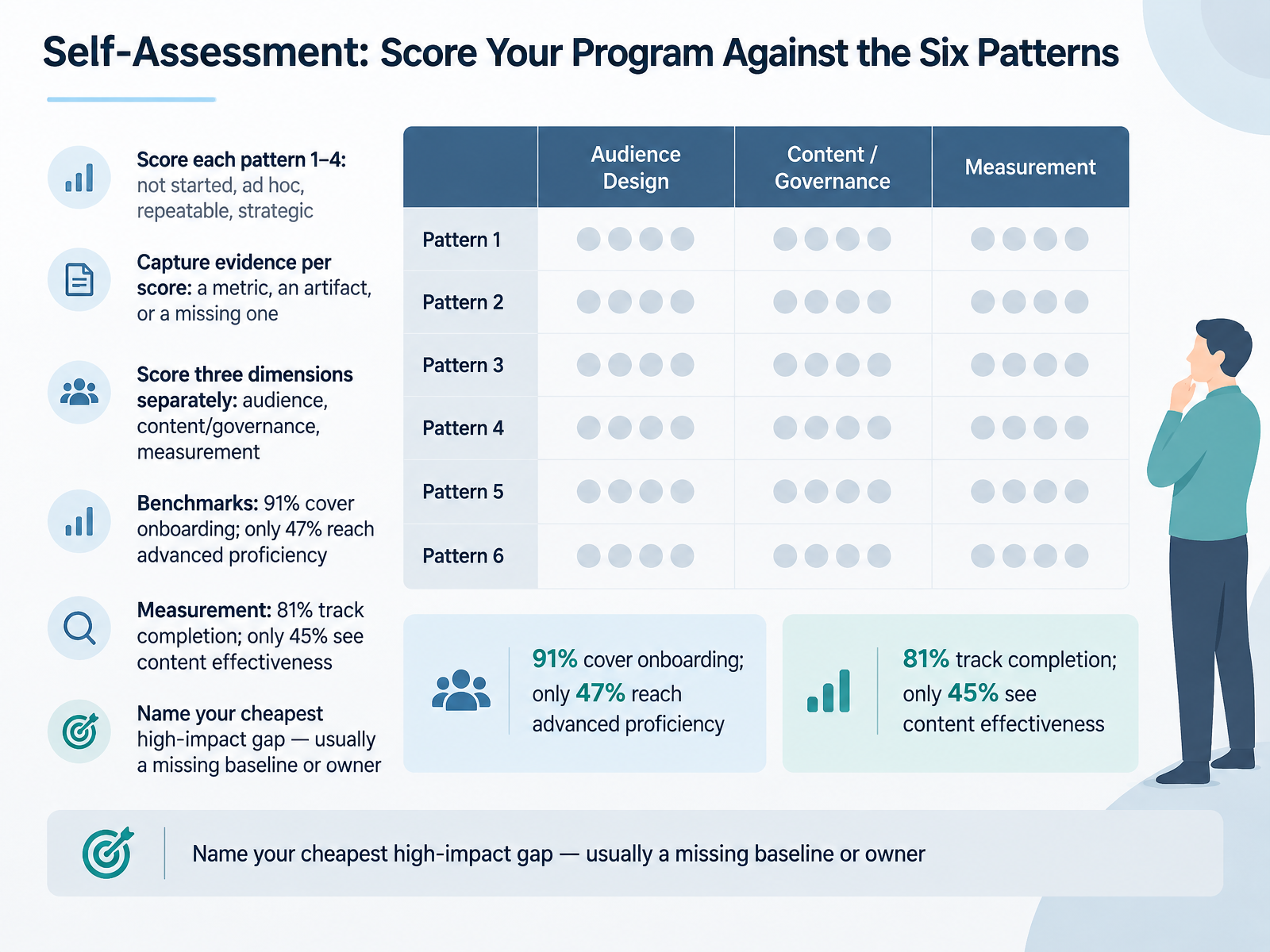
- 12Self-Assessment: Score Your Program Against the Six PatternsNow let's turn the lens on your own program. Score each of the six patterns on a one-to-four scale. One means not started, four means strategic. And don't just assign a number. Capture evidence for every score. That might be a metric, a document, or a missing artifact you can name out loud. Score three dimensions separately. Audience. Content and governance. Measurement. Benchmarks help you calibrate. Ninety-one percent of programs cover onboarding, but only forty-seven percent reach advanced proficiency. And while eighty-one percent track completion, only forty-five percent can see what makes content effective. Then name your cheapest high-impact gap. For most teams, that is a missing baseline or an unclear owner. Start there. Prioritize Two or Three Fixes: Impact, Risk, and Effort.
 everestgrp.comabsorbai.comthinkific.com+21 min
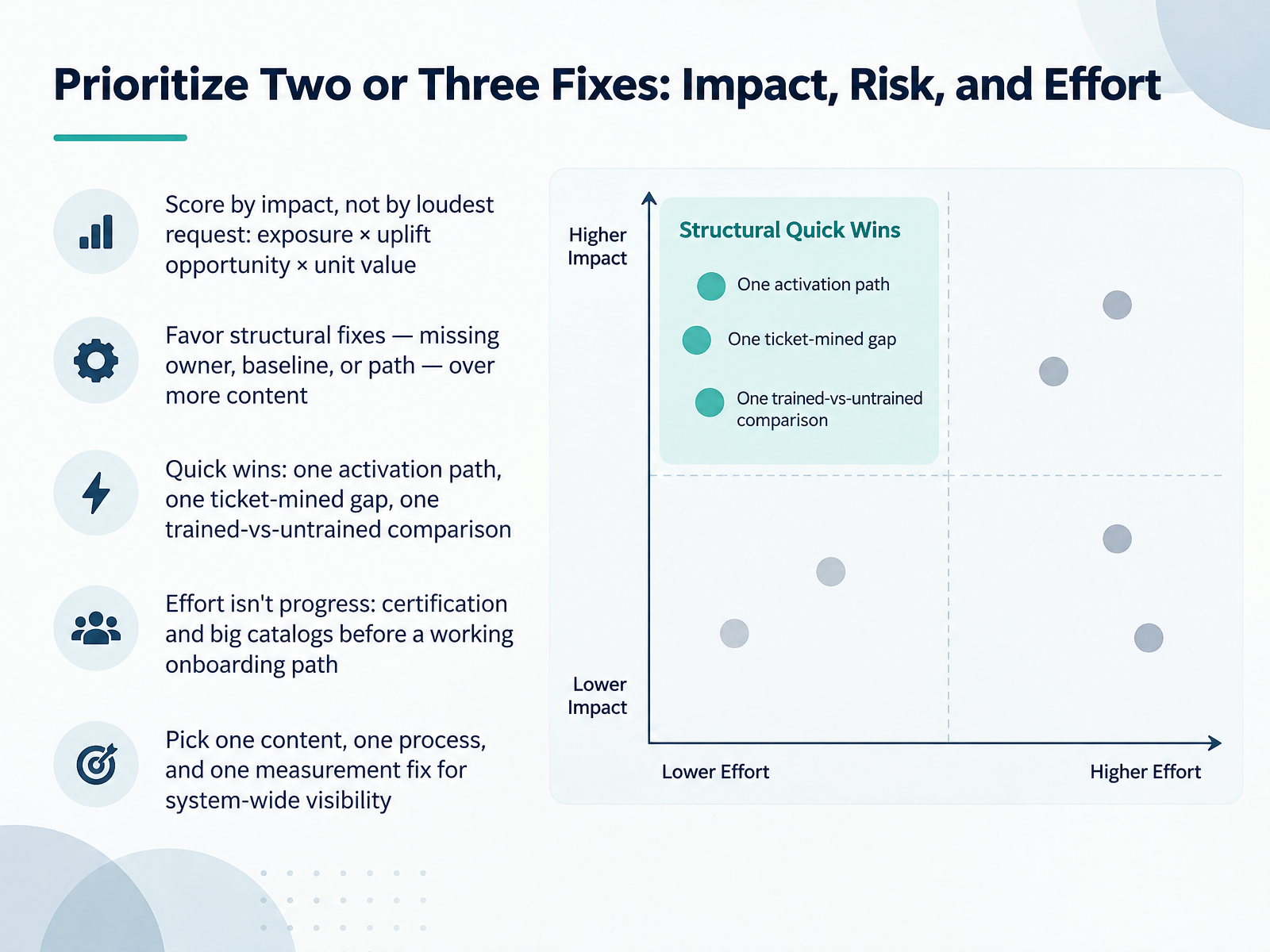
- 13Prioritize Two or Three Fixes: Impact, Risk, and EffortNow let's turn that list into a decision. Pick two or three fixes, not ten. Score each one by impact, not by whoever asked loudest. Multiply exposure by uplift opportunity and unit value, and let the numbers order the list. Favor structural fixes over more content. If there's no owner, no baseline, or no clear path, adding another video won't help. For quick wins, start with one activation path, one gap mined from support tickets, and one trained-versus-untrained comparison. And remember, effort isn't progress. Certifications and a big catalog before a working onboarding path spend energy in the wrong order. So choose one content fix, one process fix, and one measurement fix. That combination gives you visibility across the whole system. Next, we'll move into a practical rollout. Your 30/60/90-Day Plan and Sustaining Momentum.
 trainn.cocincopa.comus.fitgap.com+22 min
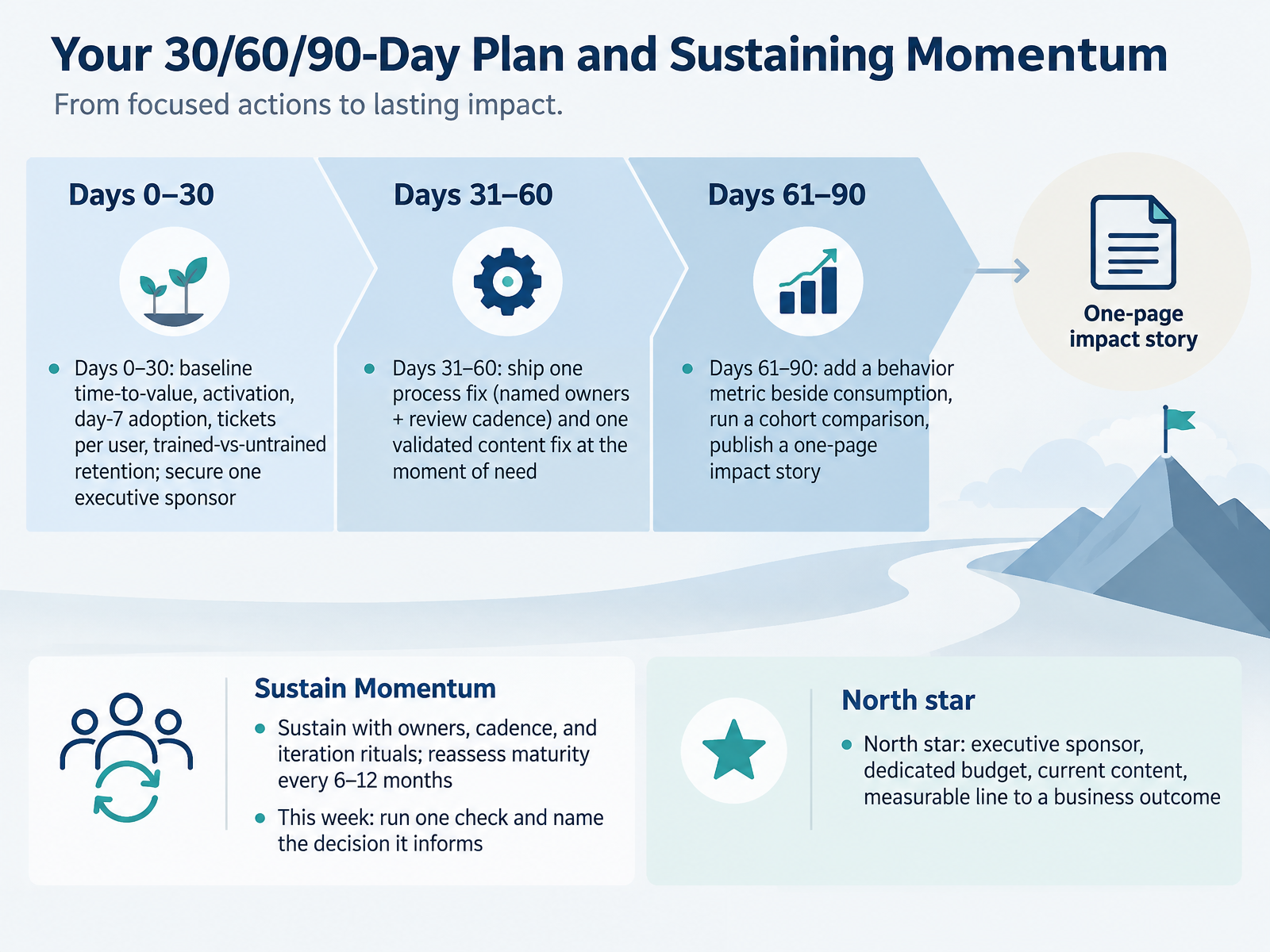
- 14Your 30/60/90-Day Plan and Sustaining MomentumLet's close with a plan you can act on. In the first thirty days, baseline your numbers. Time to value, activation, day-seven adoption, tickets per user, and retention for trained versus untrained customers. Then secure one executive sponsor. In days thirty-one to sixty, ship one process fix with named owners and a review cadence, plus one content fix at the moment of need. Between days sixty-one and ninety, add a behavior metric beside consumption, run a cohort comparison, and publish a one-page impact story. Sustain this with owners, cadence, and iteration rituals. Reassess maturity every six to twelve months. Your north star stays simple: an executive sponsor, dedicated budget, current content, and a measurable line to a business outcome. This week, run one check and name the decision it informs. That is the whole course. Thank you for your attention, and good luck building a plan that lasts.
 everestgrp.comabsorbai.comthinkific.com+22 min
Take the deck with you
Download this course as a file — free, no sign-up needed.
- PDF handoutEvery slide page, ready to print or share.15 pages · 3.3 MBDownload
- Narrated PowerPointThe deck that presents itself — every slide carries the digital human's narration video.15 pages · 13.1 MBDownload
- PowerPoint slidesThe full deck as a .pptx — open it in PowerPoint, Keynote, or Google Slides.15 pages · 3.2 MBDownload
Free to use in your own training — please keep the PersonWise credit page at the end.
Have your own deck? Turn it into a course
Sources consulted
Web sources consulted while building this course.
- From Learning To Revenue — thinkific.com
- The state of customer education in 2026 — absorbai.com
- Customer Education Maturity Assessment (CEMA) - Everest Group Research Portal — everestgrp.com
- Customer Education: Benchmarks and ROI Report — thinkific.com
- Only 19% of customer education programmes meet maturity benchmark - Learning News — learningnews.com
- Customer Education in 2025/ — cedma-europe.org
- Maximizing Revenue & Organizational Value — go.cloudshare.com
- CE 2025 Trends — skilljar.com
- LearnUpon Research Reveals Organizations Are Betting Big on Customer Education — businesswire.com
- How to Build an Effective Customer Education Strategy in 2025 | CloudShare — cloudshare.com
- Personalize Customer Training for Every User Role ( — TechClass — techclass.com
- How to Plan, Build, and Optimize a Customer Education Program — simplitrain.com
- Customer Education Strategies to Empower Growth | Mailchimp — mailchimp.com
- Improve Customer Training Experiences with Learning Paths | Skilljar — skilljar.com
- Product Education Analytics: Questions, Search Failures and Content Roadmaps — cincopa.com
- Stack guide: Flag knowledge gaps before they become repeat tickets | FitGap — us.fitgap.com
- Knowledge Base Gap Analysis from 100 Support Tickets | OpenMax — openmax.com
- Knowledge Article Quality Rating Guide | Service & Support — umbrex.com
- Tackling the Relevance Roadblock in Customer Education — thoughtindustries.com
- Customer Education Best Practices: 12 Proven (2026) | Trainn — trainn.co